Awake!, June 8, 1974
Download: PDF — Awake!, June 8, 1974
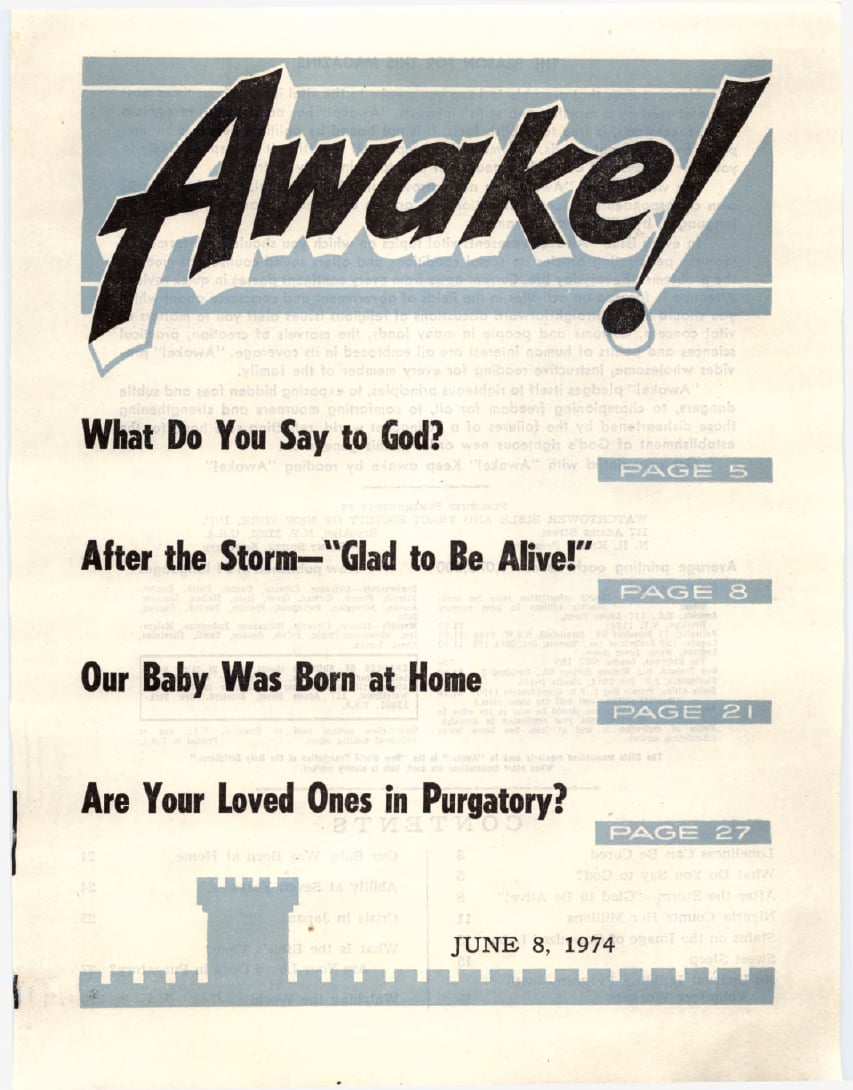
Awake! — June 8, 1974
Source: jw.org
Contents
Loneliness Can Be Cured
What Do You Say to God?
After the Storm—“Glad to Be Alive!”
Nigeria Counts Her Millions
Stains on the Image of Organized Labor
Sweet Sleep
An Unusual Building Program—with Volunteer Workers
Our Baby Was Born at Home
Ability at Seven Years
Crisis in Japan
Are Your Loved Ones in Purgatory?
Watching the World
Are the World’s Religions Giving the Right Lead?
In Six Languages
Loneliness Can Be Cured
Loneliness Can Be Cured
THE telephone rang. “Hello. This is your listener,” answered a seventy-one-year-old retired schoolteacher. The woman at the other end explained: “I’m a widow living in this house alone. I was so lonesome tonight I had to talk to someone.” This woman had called a special telephone service entitled “Dial-a-Listener.”
Loneliness has become such a severe problem today that Swiss psychiatrist Dr. Paul Tournier called it “the most devastating malady of the age.” Young and old alike suffer from loneliness, and the effects of it can truly be devastating. Loneliness can slow down recovery from illness, hasten senile mental deterioration in elderly people and even bring about untimely death in some cases.
Why has loneliness become such a problem in a world experiencing a “population explosion“? What can be done to cure this “devastating malady“?
What Causes Loneliness?
There is a difference between loneliness and being alone. Nearly everyone enjoys occasional periods of solitude. The Bible shows that Jesus Christ sometimes sought out a “lonely place” in order to pray or to “rest up a bit” with his disciples. (Matt. 14:13; Mark 1:35; 6:31) Some individuals spend a good deal of their time alone and yet do not feel lonely.
Then, too, everyone feels lonely on occasion. Psychiatrist Theodore I. Rubin commented about feelings of loneliness: “It is a fact of life that these feelings will come and go. Not accepting this fact, expecting to live in a constant state of euphoria [well-being], will only result in disappointment or bitterness.”
But, in spite of this, chronic loneliness does afflict many people. In some cases parents may be at fault. Why so? Psychologist Allan Fromme explains: “Many parents, unable to relate to each other, create an atmosphere which fosters the same attitudes in their children.”
Life in large cities, where many experience limited, impersonal relationships with others, is another reason for loneliness. Determination to be rich can contribute to this feeling, too, causing a person to become overly concerned with his possessions and to withdraw from others.
Geographical isolation from familiar surroundings due to sickness, old age, a special assignment of activity or any other reason can give rise to feelings of loneliness. Other reasons for loneliness may be loss of sight or hearing or inability to understand the local language.
Loneliness Can Be Cured—How?
What can be done to cure loneliness? One thing is to realize that too much time spent alone can cause a person to withdraw into himself, becoming self-centered. (Prov. 18:1) Make it a habit to enjoy regular association with others. But just being among people will not cure loneliness. Some of the loneliest individuals in the world live in crowded cities.
Is the answer to be found, then, in marriage and raising a family? Not necessarily. Psychiatrist Rubin writes: “Many of the loneliest women in the world are women who are married.” Allan Fromme explained that a person “could be just as lonely if he were surrounded by a family.”
Loneliness can be cured only by developing a relationship with others. How can a person accomplish that?
The Word of God contains a fine principle at Philippians 2:3, 4: “Always consider the other person to be better than yourself, so that nobody thinks of his own interests first but everybody thinks of other people’s interests instead.”—The Jerusalem Bible.
When a person becomes lovingly interested in others, some are sure to reciprocate. Jesus assured: “With the measure that you are measuring out, they will measure out to you in return.” (Luke 6:38) This means that the lonely person must take the initiative to do things for others. Would not a visit to some other lonely person lift his spirits and yours too? What better way to chase loneliness away from yourself than to do so for someone else?
The worship of Jehovah God is the surest way to cure loneliness. No matter how uncomfortable circumstances may become, God’s servants are never alone. They know that “Jehovah is near to those that are broken at heart.” (Ps. 34:18) Because Jehovah is the “Hearer of prayer” the Scriptures extend to lonely ones the invitation to “throw all your anxiety upon him, because he cares for you.”—Ps. 65:2; 1 Pet. 5:7.
The lives of Jehovah’s witnesses include many things that help one to avert loneliness. They regularly communicate with Jehovah God in prayer, with one another at meetings, and spend much time in helping their neighbors to learn about God and his purposes. The united activity of Jehovah’s witnesses causes them to have deep interest in one another too. They agree with the observation of the apostle Paul about Christians: “We . . . are one body . . . , members belonging individually to one another.” (Rom. 12:5) A woman from South Carolina tells of her first visit to a Kingdom Hall:
“I can remember the first meeting I attended and how the love of these Christian witnesses radiated throughout the congregation. After the meeting they would stand around and discuss what we had just heard and other Bible truths. . . . For the first time in my life I have peace of mind and a close relationship with my Creator.”
Yes, loneliness can be cured. But to do so one must take the initiative to develop a relationship with others, especially with Jehovah God. Would you like to do this? Jehovah’s witnesses will be glad to help you. You are cordially invited to attend meetings at their Kingdom Hall. If you wish, a qualified person will conduct a free Bible study with you at your home or at any other convenient location. Loneliness need never afflict you again.
What Do You Say to God?
What Do You Say to God?
THE idea that people can talk to God, and that he may listen, overwhelms many persons. Some feel incapable of addressing God properly, so they use a book of printed prayers, which they read on certain occasions. Others resort to “tongues,” using a babble of words that they do not know. They hope that the holy spirit will put these words into an approved prayer that they themselves do not even understand.
Is this the way that God desires his creatures to pray to him?
True, Jesus Christ encouraged: “Keep on asking, and it will be given you.” (Matt. 7:7) However, he did not mean that we should say the same thing over and over again from a printed prayer book. “When praying,” Jesus said, “do not say the same things over and over again.” (Matt. 6:7) Instead, our prayers should be spontaneous—not a babble of words we do not understand but an expression of what we have to say to a loving and exalted God.
Prayer permits us to express our worship of and love for the Creator. We can pour out our feelings and desires. The psalmist wrote: “Before him pour out your heart. God is a refuge for us.”—Ps. 62:8.
Freeness of Speech
When you have a friend, you talk to him. You speak freely, and are at ease. You can express your feelings to persons who love you. We can talk that way to God.
The Bible says that Abraham had faith in God, and “came to be called ‘Jehovah’s friend.’” (Jas. 2:23) That was an outstanding privilege for Abraham. But Jesus showed that we, too, can be loved by Jehovah. He said: “He that has my commandments and observes them, that one is he who loves me. In turn he that loves me will be loved by my Father.” (John 14:21) So, faith and obedience open the way of access to the Father.
Really, God is very approachable if we but seek him. “In fact,” the Christian apostle Paul said, “he is not far off from each one of us.” (Acts 17:27) However, a basic requirement for freely speaking to God is faith in his Son, Jesus Christ. As the Bible says: “By means of [Jesus] we have this freeness of speech and an approach with confidence through our faith in him.”—Eph. 3:12.
Knowing that God welcomes our prayers, and that we can have “freeness of speech” through faith in Jesus, we should be encouraged to talk regularly with God. There are many things we can say to Him.
Expressions of Appreciation
The Bible provides numerous examples. Just think about the many grand things that Jehovah God has done for our benefit, even as the psalmist David noted: “Many things you yourself have done, O Jehovah my God, even your wonderful works and your thoughts toward us; there is none to be compared to you. Were I inclined to tell and speak of them, they have become more numerous than I can recount.”—Ps. 40:5.
Surely this is true! Consider the food we eat. Is it not something for which to thank Jehovah God? Jesus Christ and the apostle Paul thanked God for these provisions. (Matt. 14:19; Acts 27:35) Even a child at the dinner table is taught to say “Please” and “Thank you.” Should we be less appreciative of the provisions that God makes?
Jesus said that God “makes his sun rise upon wicked people and good and makes it rain upon righteous people and unrighteous.” (Matt. 5:45) Should we not also be thankful for that? Really, are not the provisions of God for which we can be thankful almost endless?
Did you ever thank God for the flavor of a meal? For the ability to appreciate sounds and music? For the fragrance of the air after a late summer rain? For the beauty of wild flowers on a springtime mountainside?
None of these things had to be pleasurable. Eating, for example, could have been a chore—an unpleasant duty, performed daily in order to stay alive. But God made us in such a way that these things would be pleasurable to us, and we could enjoy them. Have you thanked God for that? Remember the apostle Paul’s words: “In connection with everything give thanks.”—1 Thess. 5:18.
Have you ever felt the vastness of God’s creation—by gazing, for example, at the starry vault of the heavens from the nighttime splendor of an Alpine valley? or by driving hour after hour across the magnificent expanses of the great open plains, with neither people nor habitation in view? Such fleeting moments of meditation on the works of God overwhelm us with man’s insignificance in relation to the vast expanse of the created universe, only hinted at by the distant stars above.
Such precious moments of solitude are delightful occasions on which to speak to the great Creator, relating our desire to serve him, and to receive his favor. No “prayer book” or “unintelligible words” are needed. You simply open your heart and mind and address the Creator as you would any respected authority for whom you have deep affection.
Regarding Our Troubles
When is a true friend especially appreciated? Is it not in times of trouble? How fine it is that we can call upon Jehovah then! In fact, God’s Word invites: “Throw your burden upon Jehovah himself, and he himself will sustain you.”—Ps. 55:22.
The Bible gives specific examples of praying to God regarding one’s troubles. For example, the person who is physically ill can pray to God, asking that “Jehovah himself will sustain him upon a divan of illness.” (Ps. 41:3) King Hezekiah of Judah did. (2 Ki. 20:1-6) However, we should not expect Jehovah to heal us miraculously, but, rather, pray that wise steps may be taken to cope with our particular health problem. We can pray for consolation from Jehovah, and for patience until the body’s marvelous healing forces can restore health.
We can also pray for guidance and strength should we be unjustly treated. The apostle Paul and Silas did. They were thrown into prison because of their preaching work, and while there, the Bible says, “Paul and Silas were praying and praising God with song.” And Jehovah God delivered them.—Acts 16:23-35.
Should one even have wickedly opposed God, he may, in repentance, pray when in adversity, and be helped by Jehovah. While Judah’s wicked king Manasseh was suffering in a Babylonish prison, he prayed to God, and the Bible says that God “let himself be entreated by him and He heard his request for favor and restored him to Jerusalem and to his kingship; and Manasseh came to know that Jehovah is the true God.” Despite Manasseh’s evil past, he secured relief and comfort when he truly repented and humbly turned to God.—2 Chron. 33:10-13.
How merciful and forgiving Jehovah God is! Surely we are encouraged to call upon him, freely pouring out to him our troubles and requesting his favor.
Material Needs
We should, however, always remember to consider God’s affairs as more important than our own. Thus the model prayer that Jesus gave puts the requests for God’s name to be sanctified, for his kingdom to come, and for his will to take place ahead of the request for one’s material needs.—Matt. 6:9-13.
We, too, in our prayers should first remember God’s name and kingdom before adding a request for our material needs. Jesus instructed us to say: “Give us our bread for the day according to the day’s requirement.” (Luke 11:3) This is a modest request. It is neither selfish nor materialistic. The expression “give us” includes others. “The day’s requirement” is not an excessive amount. The apostle said, “Having sustenance and covering, we shall be content with these things.” (1 Tim. 6:8) So, we can pray for the necessities of life, but it would be improper to ask for more than that.
Spiritual Needs
There are so many spiritual needs about which we can speak to Jehovah. Consider, for instance, the requests to God made by an ancient Bible psalmist: “Teach me your regulations. Make me understand the way of your own orders, that I may concern myself with your wonderful works. Cause me to tread in the pathway of your commandments . . . Teach me goodness, sensibleness and knowledge themselves . . . Make me understand, that I may learn your commandments.” Can we not speak to God about similar matters, asking his help and guidance always to do what is just and proper?—Ps. 119:26, 27, 35, 66, 73.
Early Christians give us many ideas as to what we can say to God. They prayed for holy spirit. (Acts 8:14, 15) They prayed for the success of their ministry, and, to be able “to keep speaking [God’s] word with all boldness.” (Acts 4:29) They thanked God for his leadership and protection. And they requested him to give them “all freeness of speech to make known the sacred secret of the good news.” Can we not pray regarding similar matters?—2 Cor. 2:14; Eph. 6:18, 19.
Also, there are so many things we can say to God in behalf of others. As an example, the apostle Paul prayed that the Colossians “be filled with the accurate knowledge of [God’s] will in all wisdom and spiritual comprehension.” And he wrote the Philippians: “This is what I continue praying, that your love may abound yet more and more with accurate knowledge and full discernment.” How rich our prayers will be if we, too, are conscious of others and speak to God in their behalf!—Col. 1:9, 10; Phil. 1:9-11.
When we examine God’s Word and think about all his marvelous provisions, both material and spiritual, surely we find a lot to speak to God about. And when we really reflect on all that Jehovah has done for us, are we not encouraged to heed the apostolic instruction, “Persevere in prayer”?—Rom. 12:12.
After the Storm—“Glad to Be Alive!”
After the Storm—“Glad to Be Alive!”
JUST a few seconds of destructive fury left a man in Cincinnati, Ohio, facing the job of sifting through the splinters of what was once his home. He was not alone. Nearly 20,000 other homeowners in the east central United States faced the same bleak prospect. Some had enough left to repair. Many would have to rebuild right from the foundation. They will never forget the power of a tornado.
Those who could concern themselves with their homes were the fortunate ones. About 3,700 would have to wait for the often appalling damage to their own bodies to heal. However, they and all who survived those moments of fury were heard to voice the phrase again and again: “I’m just glad to be alive!”
They had reason to be. The sight of grief-stricken relatives and friends of the some 320 who died tells the story far more vividly than words: a sobbing mother in Ohio whose month-old baby was torn from her arms, only to be found later by his father—in the morgue; a little boy in Georgia, screaming as he ran in circles next to the debris that covered the lifeless bodies of his parents and two sisters.
Nearly a hundred of these killers struck from the Gulf of Mexico to southern Canada, slaying people in eleven states and one province. As if a giant hand, one of them flattened nearly half of Xenia, Ohio—a city of 27,000. In less than five minutes it ripped a half-mile-wide, three-mile-long swath, completely destroying over 1,200 homes, 150 businesses and 6 of the 12 schools, while heavily damaging hundreds of other buildings. At least 34 died and a thousand were injured.
‘Most Violent Storm’
Spring weather in the central United States is said to be ideal for spawning tornadoes. Warm air normally rises above cooler air. When warm, moist air pushing north from the Gulf of Mexico noses under cool, dry air flowing east from the Rocky Mountains, trouble is brewing. Extreme turbulence often develops. The moisture-laden warm air billows up rapidly to create menacing clouds as cool air plummets down to replace it. Hailstones as large as golf balls may form. Many people were out picking them up in amazement moments before the April tornadoes struck.
The rapidly moving air makes a circular motion, much like water quickly funneling down a drain. If it reaches critical speed, whirling “funnel clouds” form, dipping fitfully from the dark clouds draped above. Tornadoes are born when these funnel clouds strike earth. Then they unpredictably dance and skip across the ground or stay down for some distance.
The 1974 Encyclopædia Britannica describes tornadoes as the “most violent of atmospheric storms.” A giant hurricane may develop wind speeds of over 100 miles per hour. But tightly concentrated tornado winds often reach 300 miles per hour and “may occasionally exceed 500 miles (800 kilometers) per hour.” The center of this whirling cylinder develops a powerful vacuum.
Thus tornadoes wreak their havoc in three ways: (1) by direct wind pressure blasting down objects in their path, (2) by causing a sudden air-pressure drop outside buildings as the vacuum center passes over, thereby “exploding” buildings with the force of their own inside pressure, and (3) by their powerful updraft, which can uproot trees and buildings, lift heavy objects and carry lighter ones for miles.
Apparently experiencing some of these forces, one Ohio man felt a “strong force like a magnet pulling” him up the basement stairs as he was trying to dive down for safety. “My ears were popping,” he said, no doubt from the low air pressure.
A Huntsville, Alabama, man tells of driving to work when hail so heavy that he was afraid it would break the windshield forced him to crawl under the dashboard for safety. Then, as he said, “the car was lifted up, flipped over and rolled several times. Finally the car was picked up into the air and came down on its roof, landing 40 yards from where I had originally stopped.” He surely was glad to be alive.
Documents and debris from Xenia showed up as much as 200 miles away! A woman in Cincinnati lost her cat to the tornado until it showed up two days later in a state of complete exhaustion. Apparently it had made a long trip back!
While the average tornado is a few hundred yards wide and moves along at 30 to 40 miles per hour for about 16 miles, they often vary greatly from the average. The most deadly one on record was about a mile wide, and slashed across 219 miles in 3 states at 60 miles per hour, killing 689 persons! That one struck almost 50 years ago, on March 18, 1925. This year’s April 3 tornadoes mark the second most deadly day on record.
Tornadoes strike in a number of other countries. But the United States has the dubious distinction of reporting by far the most and the fiercest, averaging 681 per year during the 1960’s. And there is a disquieting trend toward more twisters: a sixfold increase in the past 30 years! Last year witnessed a record 1,107. The National Weather Service says that “almost no one in the United States should feel ‘it can’t happen here.’”
Value of Tornado Warnings
No doubt the April tornado toll would have been much higher if it were not for extensive radio, television and civil defense warnings. Even so, tornadoes are said to be the most baffling weather phenomenon. Some National Weather Service meteorologists find their inability to make specific tornado predictions frustrating.
Explaining, one says: “For one thing, we don’t know exactly what causes a tornado. We cannot tell where it will hit or exactly when. All we can do is pick a large area and tell people that one might hit between a certain amount of time.” First, the weather service broadcasts a “tornado watch,” advising people to keep tuned for bulletins and to be alert for possible tornadoes. When funnel clouds are actually sighted, an official “tornado warning” urges people to take cover and keeps them posted about the direction of known tornadoes.
But after repeated alerts and no tornadoes “a lot had the idea it’s just another warning,” notes a Cincinnati, Ohio, survivor. Another remembers hearing that the “tornado warning” was definitely over and the newscaster saying, ‘I hate to pooh-pooh the idea, but all these warnings and nothing ever happens.’ Just then a look out the back window at a whirling mass of debris jolted her to the reality: ‘That is what a tornado looks like when it is right in front of your face!’ In less than two minutes her family’s home was gone. Even so, when they came back up out of the basement where they had scurried for safety, they were very glad just to be alive.
The Aftermath
“Most people turn real good during times like this but others are ugly,” observed a Cincinnati police officer. When the family mentioned above was still standing stunned outside the remains of their home, looters began to appear—within minutes! Some even brought trailers to haul their booty away. The National Guard had to be called to protect many areas. One Kentucky guardsman was even seen to handcuff another because he had been looting! Some people patrolled their ruined homes with shotguns.
Sightseers invaded. The Louisville, Kentucky, Courier Journal reports that they “seriously hampered the efforts of police, rescue workers, movers, utility workmen and residents.” Damaged areas often had to be cordoned off to all but residents and authorized people. In Cincinnati, after turning away the twenty cars ahead, an Ohio state patrolman told two ministers who were checking on the welfare of fellow Christians: ‘If you were anyone but Jehovah’s witnesses, I wouldn’t let you by.’ They had to pass four more National Guard roadblocks in the same fashion.
However, the extraordinary human kindness that prevailed far overshadowed the selfishness of a few. Within minutes after the twisters passed, volunteers were everywhere, first looking for survivors, getting injured to hospitals, comforting the bereaved and taking the homeless into their own homes. Hospital personnel worked selflessly. Doctors operated by candlelight when power failed in Xenia. An ambulance firm in Huntsville, Alabama, ran without charge all night long.
The whine of power saws filled the air as volunteers cut up the tragic debris to ease removal. Groups of young people went from house to house, helping complete strangers to clean up. Utility men worked around the clock to reduce the hazard of broken electric lines and gas lines, and to restore needed services quickly. People walked the streets distributing plastic bags of food.
The complexion of today’s world is such that people are often bewildered and touched by such kindness. A frightened little elderly lady in Guin, Alabama, was coaxed out of her cellar after two days. She said: “This is the first time anyone has ever cared about me, and I don’t know how to act.”
No doubt most who witnessed the many displays of unselfishness were moved and encouraged. But another reality must be faced. It was voiced by a Xenia survivor as she sat in a Red Cross center: “When it’s over it will be right back to everybody hating everybody again.” And the thought must have crossed many minds: Why does it take a crisis to make people show consideration for one another?
Still others were forced to reassess what is truly important to them. One Alabama family, whose home “just exploded,” says: “We thought we’d had a real disaster ’til we heard about those people who lost their families. We’re rich compared to them.” Their gladness just to be alive brings home the reality of Jesus’ words: “Is not life more precious than food, and the body than clothing,” or any other material possessions?—Matt. 6:25, Weymouth.
Nigeria Counts Her Millions
Nigeria Counts Her Millions
By “Awake!” correspondent in Nigeria
FOR eight days, from November 25 to December 2, 1973, Nigeria went through the mammoth exercise of counting its population.
Phase one of the census process involved preparing a list of all localities in the country. Then the country was divided into enumeration areas. All the houses within an area were listed and numbered to ensure that none would be omitted or duplicated. Enumerators received careful advance training.
The census that Nigeria held in 1973 was the second one since the nation’s independence, and the thirteenth recorded census in its entire history. Its purpose was to “enable [the] government to plan successfully for the country’s industrial and economic development,” according to Nigeria’s military head, General Yakubu Gowon.
Before the actual head count, the National Census Board undertook a massive program of publicity and of mobilization of workers. The Head of State explained that “all over the country, everyone was involved—the military governors, government officials, local authorities, emirs and chiefs.” The 120,000 enumerators that were appointed for this job were accompanied in their visits from house to house by 130,000 soldiers.
Some Problems to Overcome
There were many problems to overcome in educating and preparing the people to cooperate with the census. A drought in the northern states of the country, which has been ravaging many villages and causing death from starvation, forced many families out of their villages less than three weeks before the start of the head count. “I have found it most difficult in my position as their traditional ruler to convince them to stay in their villages,” lamented Alhaji Ado Bayero, the emir of Kano.
Some feared that counting the number of one’s children would bring about the death of the children. In many areas dogs presented a menace to the enumerators, making it difficult for them to get into the homes of the people to register them. These problems had to be dealt with by information officers and other authorities in each local area.
But, according to Dr. M. I. Iro of the Department of Sociology in the University of Lagos, an even greater problem was that “former population censuses . . . have generated controversy centered on what constitutes an accurate population of Nigeria. Many people within and outside this country have come to believe that the figure of 55,670,052, released in February 1964 as the population of Nigeria after the 1963 census, was inaccurate and probably overestimated.”
That is why so much care was exercised in marking out enumeration areas to ensure that they would not overlap, and in training of enumerators and supervisors. During the house-to-house count, it was required that each individual would have to be seen by the enumerator. When counted, they would have their left thumb marked with indelible ink. This would ensure that no one would be counted twice.
The government also had to cope with the problem of people moving back to their towns of origin to be counted there. This was undesirable, for this was to be a “de facto” census. That is, all persons in Nigeria, whether Nigerian or non-Nigerian, were to be counted wherever they were found during the enumeration period. Therefore, the government requested that people throughout the nation remain where they were now living. The police were instructed to be extra vigilant in checking individuals and motorists, and so during the enumeration period many were not allowed to leave Lagos because they did not have the ink mark on their thumbs.
Determined to Count Everyone
All inmates of prisons, hospitals and other institutions were included in the count. Even the thousands of homeless people throughout the nation who live in parks and sleep under bridges on the roadways were counted the night before the enumeration period began. The total figure includes the more than 94,000 of Jehovah’s witnesses, who find real delight in extending the good news of God’s kingdom to these millions of people.
But what about the thousands of Moslem women in “purdah” who are confined to their homes, according to Moslem tradition? These, too, were to be counted. The Daily Times of Nigeria reported: “Where women police and women enumerators are available, they will do the enumeration in the purdah. Where these are not available the women in purdah will come out into the reception hall or ‘zaure’ heavily veiled and the census indelible ink will be daubed on their thumbs by their husbands in the presence of the enumerator, accompanied by the soldier.”
All primary schools were closed beginning seven days prior to the census. All places of work in state capitals and Warri township were to close early each day during the enumeration period. The Nigerian Railways arranged for an additional daily train service in the Lagos area to enable workers to get home in time to be counted. But even these provisions were inadequate. By the time the head count reached its fifth day, it was found that more time and more workers were needed in order to complete the census.
For this reason, all public and private offices and commercial houses in the nation’s two largest cities were required to close down from November 29 through December 1. The number of enumerators grew to 150,000, and civil servants and teachers at all levels were required to make themselves available for assignment in the enumeration work. As a final measure, the enumeration period was extended to include Sunday, December 2, making eight days in all.
The head count came to a successful conclusion in spite of some enumerators’ trying to charge money for their services. The government condemned this practice severely and immediately took steps to punish these defaulters. The majority of people cooperated well with the exercise and many of them who had been overlooked by the enumerators reported to complaint centers that were set up to ensure that no one was missed.
A visiting UN expert lauded the success of this census, saying that the method adopted by the federal government of Nigeria was “one of the best in the world.” What the total will be after all the figures are added up we must wait to see.
Stains on the Image of Organized Labor
Stains on the Image of Organized Labor
THERE was a time when the sympathies of the public were, by and large, with the efforts and goals of union labor. The workingman was being exploited by long hours, wretched working conditions and miserly wages. To improve their lot, laborers organized. As a result, wages greatly increased, working conditions improved and hours of work decreased to forty, or even to thirty-five, a week.
These gains, however, have not been realized without certain losses. The unions have not been immune to the unethical practices that are rampant in other segments of society. A case in point involves the coal miners.
The United Mine Workers
There was a time when the leadership of the union of the coal miners had a reputation for being concerned with the man working in the mines. But not long ago a researcher reported: “Corruption and murder have stained the image of the once-proud United Mine Workers of America.” What had happened?
Some of the rank-and-file members became dissatisfied with the corruption in high places and began to campaign for a change in leadership. But they were defeated in a flagrantly dishonest election, and their own candidate, together with his wife and daughter, was murdered.
Before those shocking murders the federal government had turned a deaf ear to the complaints of the miners, but now it stepped in and ordered another election. That strictly supervised election defeated the former corrupt management. Investigations and confessions resulted in no less than five persons being convicted and imprisoned, with more officials yet to be tried.
New York’s Uniformed Firefighters Association
A situation involving leaders of New York city’s Uniformed Firefighters Association has added to the stains on the image of organized labor. How?
Union officials ordered a strike on November 6, 1973, in violation of the law and in defiance of a court injunction. They claimed that an overwhelming majority of the firemen had voted for the strike. But what were the facts? A majority of the men had voted against it. Among the many firemen who were embittered by it all was one who had written a best seller about what it means to be a fireman. As reported in the New York Times, his sentiments were:
“We all thought that the majority of the uniformed force wanted a strike, because of the announcement of the ‘overwhelming vote’ for it. With that assumption, the fireman was forced to choose between his commitment to his union and to his profession. I voted against the strike, but when it came, I went out. . . . But what has disillusioned me and most of the men I work with is that, had the actual count of the strike been published [their officials immediately destroyed the ballots], we would never have been out on the street. Guys are really torn.”
The three union officials who conspired to falsify the union vote were arrested. In an indictment handed down by a grand jury, the three men were charged with “reckless endangerment of life and property, attempted coercion of city officials during bargaining negotiations, obstructing governmental administration and conspiring to commit each of these crimes.”
Other Wrongdoing by Officials
During 1972 alone, the U.S. Department of Labor reported seventy-three convictions of embezzlement from union treasuries, welfare and pension funds by union officials, and that in spite of the fact that very meager investigative forces were at work.
It is not surprising, then, that there are lawyers who devote all their time to handling suits brought by members against their union officials. One employee collected $342,000 from the Communications Workers Union. The court sustained his claim that he had been fired at the instance of his union bosses because he had asked to see who paid the fare of the wife of a local union president when she accompanied him on a business trip.
Union officials also stain organized labor’s image when they “milk” their unions by using their influence to hold from two to six jobs in the union, getting high salaries for each job. Thus, while the head of AFL-CIO holds only one job and draws just under $75,000 a year, lesser officials often get more. One collected $124,000 in 1972; another, $172,000; still another, $185,000 plus expenses; another was able to collect (together with his wife) $165,000 in addition to a $50,000-a-year expense account. According to The Wall Street Journal, there are literally hundreds of union executives who manage to hold down two or more jobs within the union and which sometimes total as much as $100,000.
Among other abuses that union members often suffer are their being forced to pay in cash for “work permits,” “working assessments,” “special assessments,” and “voluntary contributions,” in order to get jobs, especially in the construction industry. In some union locals no man can change his job without the permission of the local’s president. Union members often feel helpless when confronted with such practices.
Violence by Construction Workers
It should be realized, however, that union officials are not the only ones that have caused stains on the image of organized labor. At times the rank-and-file workers have been guilty of the same. When there is violence against nonunion projects and workers, the union bosses do not handle it all themselves.
Thus, the New York Times, November 9, 1973, under a heading “Nonunion Site Vandalized by Construction Workers,” said: “About 300 construction workers stoned and vandalized a building being renovated on the northwest corner of 11th Street and Broadway for more than an hour yesterday morning.” A free-lance photographer, a neighbor, stated: “It was about 7:15 when I was awakened by this tremendous roar and windows being smashed. They closed off 11th Street and went at that building like maniacs.” Another neighbor, a university instructor, termed the scene “a gigantic free-for-all. They would pick up bricks and run up and smash windows and run back as if the building would bite back.” Another witness stated: “I can’t tell you the fear I felt. They were like some savage beast with incredible fury.” The damage was estimated to be between $25,000 and $50,000. No arrests were made.
Shocking as this incident was, it was not the only one. In Philadelphia, a crowd of 1,000 union workers caused more than $300,000 of damage to nonunion construction in forty-five minutes. In Memphis, Tennessee, a $1,600,000 building, almost completed, was dynamited, causing a loss of almost half a million dollars. In fact, in 1972 there were 172 such incidents in twenty-six states, accounting for damages running into many millions of dollars. Workers and even police have been severely beaten, some suffering permanent injury, and not a few have been killed in this war upon nonunion construction.
Regarding violence at Kalkaska, Michigan, which cost more than $500,000, the Detroit Free Press said: “Whatever the merits of arguments against non-union construction work, the unionists’ violence is inexcusable. The unions are not only losing public support, but the support of the workers themselves. Getting their public image back up . . . is going to be a difficult task.”
Why all this violence? One reason is that more and more nonunion labor is replacing union labor due to the ever-spiraling cost of union work. As the Engineering News Record of February 24, 1972, reported, a union master mechanic who never used a tool earned $94,000 in one year. It also gave many examples of what is known as “featherbedding,” which is the practice on the part of some labor unions of forcing employers to hire more men than are needed for a particular job.
There are other factors, too, that help to account for all this violence. Powerful and rich labor unions contribute generously to the campaign chests of politicians. In addition, they deliver votes. So politicians, high and low, prefer to turn the other way when unions engage in criminal violence.
The problem obviously is not limited to the unions. The entire worldly system of things is shot through with greed and corruption. What is happening the Bible long ago foretold. (2 Tim. 3:1-5) The Bible also points to the remedy—not the makeshift sort that replaces one set of leaders with others who are likewise imperfect and hungry for power. Instead, it turns our attention to God’s kingdom and explains how it will soon take over the administration of all earth’s affairs. Only then will righteousness prevail.—Dan. 2:44; 2 Pet. 3:13.
Sweet Sleep
Sweet Sleep
In getting a good night’s sleep, the state of one’s mind is much more important than the state of one’s body. One saying puts it this way: “A man’s conscience and not his mattress has most to do with his sleep.” The inspired writer of Ecclesiastes expressed it: “Sweet is the sleep of the labourer whether he eats little or much; but the rich man owns too much and cannot sleep.”—Eccl. 5:12, New English Bible.
An Unusual Building Program—with Volunteer Workers
An Unusual Building Program—with Volunteer Workers
“I NEVER saw people work so hard. No matter what you tell them to do, they do twice as much without cutting corners.” What prompted this exclamation by a Health Department engineer from Orange County, New York? He was viewing the construction of a building about the size of a football field almost entirely by volunteer help.
This project at Monroe, New York, was part of an unusual building program that has been under way for about ten years in the United States, Canada and some other countries. Groups of hundreds of persons of different races and nationalities have volunteered their time, energy and other resources to build spacious assembly halls.
Often large enough to seat over 2,000 people, these building projects have aroused much curiosity. Who are the builders? What purpose do these structures serve? How is it possible to get sufficient funds and volunteer help for such an undertaking?
Why Assembly Halls?
The builders are Jehovah’s Christian witnesses, and there is a special need for these assembly halls. In the United States there are now over 500,000 of Jehovah’s witnesses. Their 6,393 congregations are grouped into 271 “circuits.” In addition to all congregations holding five weekly meetings at their Kingdom Halls, twice a year each “circuit” (about 20 congregations) enjoys a two-day assembly that features a special program of Bible education geared to their local needs.
In the past most of these gatherings would be held in rented facilities such as schools, armories and fairgrounds. But since 1965, when their first assembly hall opened in New York, Jehovah’s witnesses in many areas have sought to obtain their own places for these conventions. There are now fifteen of them in the United States, three in Canada and some in other countries. What prompted Jehovah’s witnesses to want their own assembly halls?
One important reason is the high cost of renting public places. Besides paying for the use of the building, it has often been necessary to hire custodians and union help to operate stage apparatus and public-address equipment. A weekend assembly might cost from $1,000 to $3,000.
A Witness from Winnipeg, Canada, explains another problem that can come up when renting an assembly site:
“It was sometimes impossible to get a rental permit for school auditoriums until about a month before the assembly. And every permit contained a clause to the effect that if the auditorium were needed for a school activity it would take priority over the convention. Sometimes a rental for a certain night would be cancelled at the last moment and we would have to rush to get another place for that night and then move back the following morning.”
And school auditoriums would often lack sufficient seating capacity. Many persons would have to go to other parts of the building and be satisfied with just hearing the program over a loudspeaker or watching it on closed-circuit TV. These and other difficulties made it seem better for Jehovah’s witnesses in many areas to direct their money toward getting their own facilities.
Getting Off to a Good Start
No “elite” group decides to build an assembly hall with others being forced to support it against their will. Jehovah’s witnesses consider in advance whether there are enough congregations in the area to keep such a place busy. If so, they write to all congregations concerned to ascertain if they really want an assembly hall and are willing to support efforts to get one. Then they must decide whether to erect a new building or to renovate an already-existing one. Local circumstances will bear upon this decision.
In Cleveland, for example, a committee appointed to find a site to put up a new building relates: “Suitable locations that had the necessary utilities were difficult to find. When we finally found one we ran into a zoning problem. Then a theater turned up. Besides being well within the approved budget, it was centrally located.” After the purchase, local Witnesses renovated this theater, and it is now a fine facility for Christian assemblies.
Witnesses from Detroit, who also remodeled a theater for their assembly hall, refer to another advantage: “There seemed to be no difficulty in arriving at a reasonable price for these locations. Being highly taxed and often unused, they are just ‘weights around the necks’ of their owners.”
Congregations from the San Fernando Valley area of California acquired an unusual building for their assembly hall, formerly known as the Valley Music Theater. The original builders employed earth-moving equipment to shape a hill into a huge dome. Over this they laid steel and poured reinforced concrete. When it had set, they scooped out the inside of the hill, leaving a modern-looking domed structure sixty-five feet high at the center, with a diameter of 200 feet. A revolving stage in the center is surrounded by 2,654 vinyl-covered theater-type seats. The property also has a “satellite” building with offices and a cafeteria that will accommodate 500 persons. Transforming this modern facility into the California Valley Circuits Assembly Hall cost only a small fraction of the estimated price of erecting a comparable building in that area.
And renovating is usually quicker than building. This California assembly hall was ready two months after its purchase. Witnesses in Chicago write concerning their remodeled theater: “From the time of possession until we were ready for an assembly was only two and a half months.”
In other places, however, existing buildings were too cramped, without cafeteria or parking facilities, or they presented other problems. Thus in the Baltimore-Washington area a theater was sought, but none were centrally located and most of those available were in dangerous neighborhoods. Consequently Witnesses there built a new building of preconstructed steel at Crownsville, Maryland, with an auditorium seating 1,406. The lobby and cafeteria areas are designed so that curtains may be opened to enable an overflow crowd to see and hear what takes place from the platform.
Money, Material Freely Given
But how is it possible to finance such large undertakings? This is an amazing feature of the building of assembly halls of Jehovah’s witnesses. Consider a report concerning the 46,000-square-foot assembly hall in southern Ontario:
“Our building will be financed by contributions and interest-free loans from Jehovah’s witnesses themselves. Eighty percent of the funds are contributions, mostly of modest amounts from those of modest income. There were no fund drives, no games of chance, no powerful appeals. The need was merely explained. We thank God for this generous spirit.”
The Crownsville project provides another example of such generosity. The chairman of the building committee there relates:
“We wrote to the 110 congregations that would be involved in the matter and asked how much they would be willing to contribute. You can imagine how surprised we were when we received over three times the amount that we felt would indicate Jehovah’s approval of the undertaking. We were thus able to complete our building with no financing from any commercial institution.”
Willingness to build necessary equipment instead of buying it sometimes resulted in further substantial savings. A report of efforts to convert a dance hall at St. Luc, south of Montreal, into a place for Christian assemblies affords an example:
“To solve refrigeration problems a Witness who is an expert in this field, along with a group of unskilled helpers, constructed four large walk-in refrigeration and freezer units. The total cost was under $1,000. It is estimated that these units would have cost from fifteen to twenty times as much if built by an outside contractor.”
Materials, too, were often freely given. This is reported concerning putting up the new hall at London, Ohio:
“It happened that a large theater in downtown Columbus was then being dismantled. From this a brother made a donation of 1,000 comfortable seats. Then from a hospital that was being wrecked, we obtained two large boilers in fine condition free. On top of that someone gave us an entire stainless steel kitchen with much usable equipment.”
While the assembly hall at Monroe, New York, was going up, one man was so moved by what he saw that he returned the following week with $5,000 worth of materials as a donation. A large company then contributed over $12,000 in materials and later sent representatives to marvel at the volunteer construction. Paying bills on time resulted in additional savings of $50,000.
Now Monroe has a beautiful assembly hall as large as a football field, nestled in a woodland setting. Three stone bridges connect seven parking areas with the entrance of this building. Beyond the walnut-paneled area, which contains a fountain that doubles as a baptismal pool, there is an auditorium with 2,248 theater seats in alternating bays of blue and green. A dining area with 720 seats is partitioned off from the auditorium by a wall made of glass and enhanced by blue drapes.
Strong Backs, Willing Hearts—All Volunteers
What most amazes observers are the crowds of volunteers that show up to work on these building operations. While the Monroe hall was under construction 192 congregations furnished volunteer help. Whites, Negroes and Puerto Ricans, of all ages and walks of life, worked together harmoniously, referring to each other as “brother” and “sister.” Some weekends as many as 800 volunteers worked together. A non-Witness onlooker observed: “This has to be Jehovah’s organization. Otherwise it would be complete confusion.”
A report of the renovation taking place at St. Luc states:
“No outside help was required for the extensive renovations. Many working at secular jobs in the city would leave for the assembly hall immediately after work and often would remain until early morning. Thus we were able to have our first assembly less than seven weeks after gaining possession of the building.”
Witnesses in Winnipeg, who looked forward to having the first assembly in their renovated theater by January 1972, write:
“As December 1971 came along, the brothers could see that there was a lot of work yet to be done before dedication day. Therefore, many worked full time at the hall, some driving 50 to 130 miles to help. The work became fast and furious. And it was completed on time.”
A similar spirit was manifest while they were building the hall at Yuba City, California. It is estimated that this building would have cost about one million dollars if put up wholly by commercial contractors. But Jehovah’s witnesses were able to complete it for less than a third of that. How was this possible? A member of the building committee explains:
“We had an average of 250 volunteers show up for work each day. On weekends this labor force would swell to 500. Some of them worked around the clock on occasion to meet certain deadlines. And our sisters, besides preparing fine meals for the workers every day, pitched right in with the manual labor, wielding shovels, rakes, hammers and brooms.”
The spirit of freely giving of one’s time and energy can be contagious. When a brother asked a fellow worker one day what congregation he came from, the worker replied: “Oh, I’m not one of Jehovah’s witnesses; I’m a neighbor who lives right over there. I just came to work and enjoy it. You people seem to have such fun. I wanted in on it!”
When a reporter of the Independent Herald of Yuba City showed up for an interview, she exclaimed: “I am simply flabbergasted that you can put up this huge structure with volunteer help. At our church, we can’t even get enough help to finish the painting that we started over a year ago.”
The diligent efforts at Yuba City resulted in a fine assembly hall finished in a Spanish motif with capacity to seat 2,400 people. It includes a Kingdom Hall, conference room and a roomy cafeteria. The front of the building, which faces a tiered fountain, features three large arches accentuated with Spanish lanterns.
Coping with Difficulties
Building assembly halls is no simple matter. Sometimes difficulties arise that seem insurmountable. But determination, patience and hard work help clear them out of the way.
The building committee for the Yuba City hall tell of how they solved an unexpected problem: “On a Saturday the stucco machine broke down. So the brothers gathered some help and the next day stuccoed the whole thing by hand.”
One brother tells of a bit of ingenuity employed while building the hall at Monroe, New York: “When a gasket blew on some important machinery and no replacement was available, a mechanic removed his shoe, cut a gasket out of it and kept the machine running all day.”
When legal problems came up, Jehovah’s witnesses displayed determination to obey the law, paying “Caesar’s things to Caesar,” even if this meant extra work. (Mark 12:17) The one who supervised construction at Natick, Massachusetts, comments: “Problems came up in trying to meet the requirements of a very strict fire code. But instead of whining about high costs when additional fire protection was needed, we kept making design changes until we came up with something acceptable. Officials commended us for this and, as a result, became more liberal and cooperative.”
Assembly Halls Benefit Everyone
The assembly halls that Jehovah’s witnesses build are a great benefit to the communities in which they are located. Not so much for their pleasing décor. Nor because of the excitement and fervor with which the volunteers worked on them. The most important benefits come from what goes on in them when completed.
Would you like to know what God will do about present world conditions? what God’s “new order” is and how you can prepare yourself for life in it? how it is possible for Christians to dwell in unity amidst the pressures of today’s world? The current program at circuit assemblies of Jehovah’s witnesses answers these questions from the Word of God. These programs of Bible education are designed to help old and young alike.
Is there an assembly hall of Jehovah’s witnesses in your area? Why not visit it and benefit from the Bible-based material presented there? You will meet people who truly love Jehovah God and who try to honor him by living according to the principles of his inspired Word, the Holy Bible. They will be glad to help you to do the same, free of charge.
[Picture on page 17]
Jehovah’s Witnesses Assembly Hall in southern Ontario, Canada
[Picture on page 18]
Jehovah’s Witnesses Assembly Hall at Monroe, New York
[Picture on page 19]
Construction of Yuba City, California, assembly hall by volunteer workers
Our Baby Was Born at Home
Our Baby Was Born at Home
“DOES that statement surprise you? Perhaps it does, if you live in a part of the world like North America where almost all babies are born in hospitals. However, did you know that most of the world’s babies—about 98 percent of them—first see life at home?
Why have some of the so-called advanced countries departed from this custom? Is the North American practice of hospital deliveries truly an advantage for mothers and babies? If so, why would anyone choose to have a baby born at home?
Yet that is the decision of an increasing number of parents in lands where home childbirth runs against medical and social trends. Here in Canada, where most babies are delivered by masked medical teams under glaring hospital lights, our daughter was born at home.
Not by accident, but because we planned it that way!
Our Decision
Our previous three children were born in a hospital. My wife and I were together on each occasion until she was wheeled away into the hands of interns and nurses. At the exciting moment of birth, she was alone with strangers while I was out in the hall!
Something was missing. So when we learned that our fourth child was on her way, we decided to share her birth together.
Many hospitals respect, even encourage, such a desire of parents by allowing the father in the delivery room when a baby is born. Still, a hospital is an institution, not a home. We hoped to provide something more loving and personal for our new family member.
Also, in some hospital cases misguided or prejudiced officials have forced unwanted medical treatment on newborn infants. We did not favor taking such a risk.
We decided to have our baby born at home!
A rash decision?
Not according to the better survival records of countries where most births occur at home compared with those where excited fathers-to-be rush their wives to hospitals.
According to a recent issue of Scientific American, “The U.S. continues to rank poorly among industrialized nations when it comes to infant mortality. The latest statistics put this country 15th,” behind several countries in which most babies are born at home.
American author Mrs. Lester D. Hazell reports, in her book Commonsense Childbirth: “At this writing [1969] we lose twice as many mothers in childbirth as England does, four times as many as the Netherlands. . . . Rightfully American women fear having a baby. The way we do it is a fearful thing.”
Of Canadian losses in childbirth, a recent Science Council of Canada report states: “Canada has no grounds at all for being pleased with its performance.”
However, finding a doctor who will deliver a baby at home can be a difficult task in North America. Most of them prefer the convenience of hospitals. On the other hand, there are a few like the California physician who said, “There is a demand for [home deliveries]. It would be medically irresponsible not to respond to that demand.”
Our problem was solved by a friend who is a qualified nurse-midwife. Unlike many countries with better survival rates, Canada does not recognize midwifery as a profession. However, it is legal for babies to be born at home in Canada when reasonable care is provided for the health and safety of mother and child. A friend may act as midwife. Canadian law merely prohibits a midwife from charging for her services as a professional person.
Baby Arrives
On baby’s arrival day, our older children were at their grandparents’ home, awaiting news of their new brother or sister. My wife kept busy about the house, staying on her feet until shortly before baby was born. At 6:35 p.m. our daughter arrived with the usual vocal announcement of a newborn who expects to be made welcome.
After more than twelve hours of labor pains, my wife felt better than she had following any of the previous births. An incision to enlarge the birth outlet is standard procedure with hospital deliveries, but the skilled hands of our trained midwife made this unnecessary.
Our tiny daughter was our shared delight from the moment she was born. Less than an hour after the baby was born, we called home our three older children. They scurried up to the bedroom, paused, then respectfully tiptoed in to find mother sitting in bed with a radiant smile on her face and a bright-eyed bundle in her arms.
The wonder of our children added tender meaning to the psalmist’s words: “Look! Sons [and daughters] are an inheritance from Jehovah . . . a reward.”—Ps. 127:3.
That evening our older daughters, aged nine and four, and our six-year-old son knelt one by one over baby’s small bed and kissed their sleeping sister good night. Then we all settled down for a good night’s rest.
Benefits to Baby
From the beginning, our baby was part of the family. She ate when she was hungry, slept when she was sleepy, and quickly became familiar with the sound of our voices. She never experienced the isolation commonly forced upon hospital babies.
…