Awake!, May 22, 1974
Download: PDF — Awake!, May 22, 1974
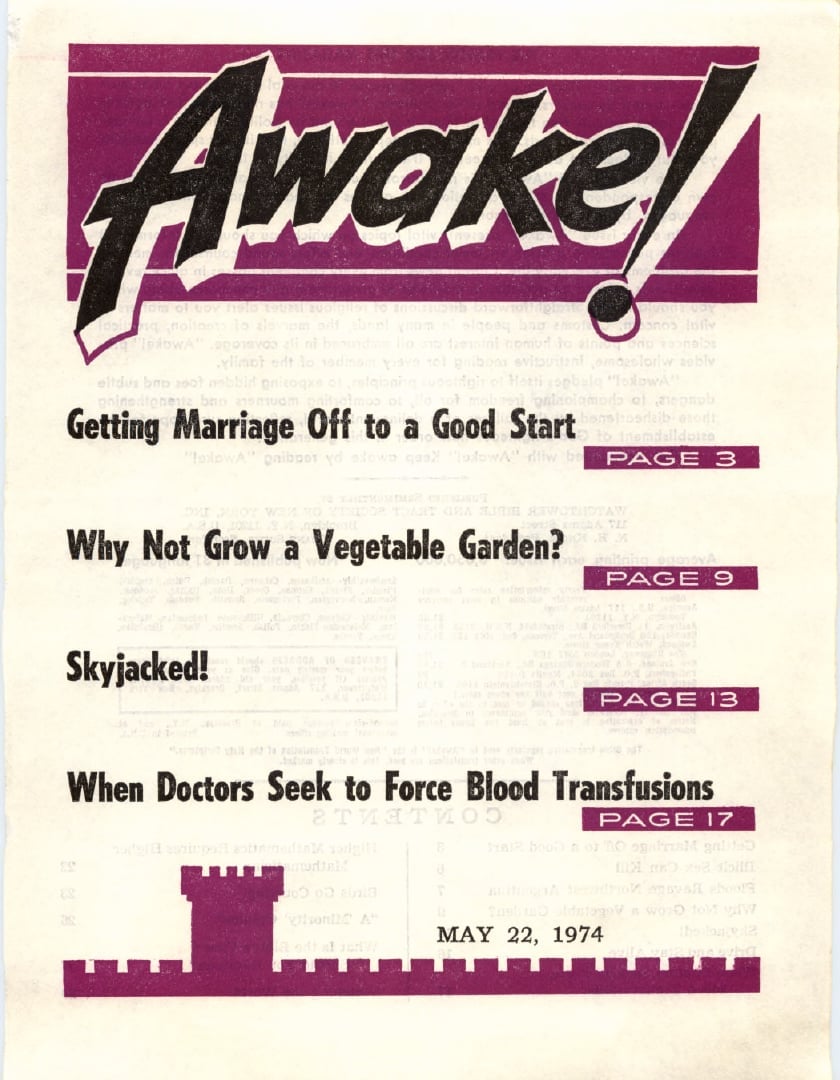
Awake! — May 22, 1974
Source: jw.org
Contents
Getting Marriage Off to a Good Start
Illicit Sex Can Kill
Floods Ravage Northwest Argentina
Why Not Grow a Vegetable Garden?
Skyjacked!
Drive and Stay Alive
When Doctors Seek to Force Blood Transfusions
Higher Mathematics Requires Higher Mathematician
Birds Go Courting
“A ‘Minority’ Opinion”
Should You Retaliate?
Watching the World
Easy-To-Read Bible In Large Print
Electric Energy Sparks A Nation
Getting Marriage Off to a Good Start
Getting Marriage Off to a Good Start
MARRIAGE goes back to the beginning of the human race. In the garden of Eden Jehovah God married the first human pair, Adam and Eve. (Gen. 2:22-25) Marriage is the only way that God approves for men and women to live together and set up families. (1 Cor. 6:18; 7:9) As an institution of Jehovah, “the happy God,” marriage should be an arrangement that brings happiness to a couple.—1 Tim. 1:11.
But today many marriages do not reflect the happiness that God purposed. In the United States alone there are now two divorces for every five new marriages. Many couples prefer to live together out of wedlock rather than to risk the chance of breakup after marriage.
Jehovah’s witnesses present a refreshing contrast to this. Their marriages and family life are remarkably stable in a world of dwindling moral values. Not that the Witnesses are free from all marital problems. But, for the most part, they are able to cope with their problems and to keep them to a minimum. How do they accomplish this? For one thing, Jehovah’s witnesses try to get marriage off to a good start.
The wedding itself affords an opportunity for this. Before the marriage vows are taken, a qualified minister reviews with the bride and groom the Bible’s counsel for successful marriage and family life. Let us look in on what is said at typical weddings of Jehovah’s witnesses. A minister who recently performed a wedding in New York addressed the couple as follows:
“They Must Become One Flesh”
“Marriage was first established by the Creator of the human race, Jehovah God. After reviewing God’s animal creation in the garden of Eden, the first man Adam found that he had no companion like himself. Though perfect physically and mentally, Adam felt incomplete. Therefore God said: ‘It is not good for the man to continue by himself. I am going to make a helper for him, as a complement of him.’ (Gen. 2:18) God then created Eve and ‘proceeded . . . to bring her to the man,’ uniting them in wedlock. (Gen. 2:22) The Bible then says: ‘That is why a man will leave his father and his mother and he must stick to his wife and they must become one flesh.’—Gen. 2:24.
“Did you note that God’s Word states: ‘A man will . . . stick to his wife‘? Jehovah God views marriage as a permanent arrangement. It is not something that you can agree on today but change your mind on at a later date. Only where one partner commits adultery does the Bible allow for divorce.—Matt. 19:9.
“A man’s place after marriage is with his wife, not with his fleshly father or his mother or with friends. Your wife will now become your closest partner in life. From now on you must consider her in everything you do. She is a part of you. You have become ‘one flesh’ in God’s eyes.
“This unity may be illustrated by a healthy human body. The body never fights with itself. The hand does not hurt the foot, nor does the eye harm the ear. Rather, the body members complement one another, each supplying what another lacks. But to achieve this oneness you must submit to the influence of a most important third party in your marriage.
The Third Party to Marriage
“Have you considered that of all the people who observe your wedding today the most important witness is Jehovah God? God must figure prominently in your marriage, for the Bible states: ‘Whatever you are doing, work at it whole-souled as to Jehovah, and not to men.’ (Col. 3:23) You are accepting marriage responsibilities before Jehovah and he expects you to work hard to fulfill them as to him. The principles contained in God’s Word will help you to do that, providing perfect guidelines for you in your relationship with each other. Make Bible study a regular part of your life together.
“In addition to this, it is good for married couples to pray together regularly. The Scriptures admonish: ‘Pray incessantly.’ (1 Thess. 5:17) Does this mean only personal prayer with no one but Jehovah listening? While private prayer to God at any time is very beneficial, there are occasions when prayers of a husband and wife can be united. For example, in addition to mealtimes, every night before retiring affords an opportunity for you to pray together. Your husband is fully able to express the thoughts of both of you at least once a day in the evening. This will have the effect of drawing you closer together, and both of you closer to God. And there is so much for which to thank Jehovah at the end of a day.”
A Wholesome Relationship at Home
A large part of the lives of married couples is spent at home. What type of atmosphere should exist in the home? The speaker at a different wedding made the following observations:
“If you apply Bible principles as a married couple, your love for each other will continue to grow. You will find yourselves attracted to each other, not only physically, but especially because of the godly qualities that you see in your partner. However, as imperfect creatures, you will surely get on each other’s nerves from time to time. How should you react when this happens?
“Ephesians 4:29, 32 provides excellent counsel: ‘Let a rotten saying not proceed out of your mouth, but whatever saying is good for building up as the need may be. . . . become kind to one another, tenderly compassionate, freely forgiving one another just as God also by Christ freely forgave you.’
“While Jehovah God views a married couple as ‘one flesh,’ this does not mean that marriage is a fifty-fifty proposition. Each partner must be willing to give in more than halfway when problems arise. And they will arise, for you both will face pressures daily.
“For example, when a man is out working, people are sometimes unkind or even downright nasty. As a wife does her housework or cares for children, some days it seems that everything goes wrong. This can give rise to tension and create a ‘need’ for sayings that are ‘good for building up,’ as the apostle Paul put it. (Eph. 4:29) Will your homelife provide such a refreshing atmosphere? Each of you must put forth extra effort to make it that way, especially if you feel worn out from a trying day.
Responsibilities of Husband and Wife
“The Bible, at Ephesians 5:23, likens the responsibility of a husband toward his wife to that of Christ toward the Christian congregation. We read: ‘A husband is head of his wife as the Christ also is head of the congregation.’
“What does a husband’s headship involve? Ephesians 5:28, 29 points to an important aspect of it: ‘Husbands ought to be loving their wives as their own bodies. He who loves his wife loves himself, for no man ever hated his own flesh; but he feeds and cherishes it, as the Christ also does the congregation.’ You have been caring for yourself for many years. You keep yourself neat and clean, warm and well fed. Now you must do the same for your wife. This includes providing a home for her. It does not have to be a big house, but a place adequate for the needs of the family.
“How should wives respond to the headship of their husbands? Ephesians 5:22 says: ‘Let wives be in subjection to their husbands as to the Lord.’ Eph 5 Verse 24 adds: ‘In fact, as the congregation is in subjection to the Christ, so let wives also be to their husbands in everything.’
“This is no harsh arrangement in which a husband becomes a dictator. First Corinthians 11:3 reminds husbands that they, too, are subject to higher authority, saying: ‘But I want you to know that the head of every man is the Christ.’ Women, too, are to be subject first of all to Jehovah God and Christ Jesus. A wife’s subjection to her husband is, therefore, not absolute but relative.
“A woman in subjection to her husband recognizes that God expects her husband to make the major decisions in the family. Of course, your husband will talk matters over with you and get your viewpoint. He may even decide to do what you suggest. But he must pay the bills and this can affect his decisions at times.
“A woman who is properly in subjection to her husband is beautiful in the eyes of God. It is as if she were wearing a special type of clothing. How so? Note how the apostle Peter, at 1 Peter 3:3, 4 counsels wives: ‘And do not let your adornment be that of the external braiding of the hair and of the putting on of gold ornaments or the wearing of outer garments, but let it be the secret person of the heart in the incorruptible apparel of the quiet and mild spirit, which is of great value in the eyes of God.’ Unlike material clothing that wears out, these qualities never lose their pleasantness to God. They can make a husband love his wife more after decades of marriage than on their wedding day, although you may find that hard to believe now.
“A Capable Wife”
“Proverbs 31:10-31 describes ‘a capable wife’ whose ‘value is far more than that of corals.’ It would be beneficial for all wives, especially those newly married, to study this material carefully. Let us consider some highlights, beginning at Pr 31 verse 14:
“‘She has proved to be like the ships of a merchant. From far away she brings in her food.’ I can just see your wife traveling a good distance with her shopping cart to search out bargains in the stores. And how necessary that is today with prices continually rising.
“Pr 31 Verses 15 and 17 point out: ‘She also gets up while it is still night, and gives food to her household. . . . She has girded her hips with strength, and she invigorates her arms.’ What could call for more vigor in a woman than keeping a house neat and clean, caring for children and preparing tasty, economical meals on time? Add to this, sewing of buttons on clothes, darning socks and all the other things required of a good homemaker and you realize that a wife has a big job.
“But how rewarding for a wife who puts the counsel of God’s Word to work in her life! Pr 31 Verse 30 states: ‘Charm may be false, and prettiness may be vain; but the woman that fears Jehovah is the one that procures praise for herself.’ What a fine reward! A woman whose conduct shows that she fears Jehovah procures praise from her husband, from those acquainted with her, and, most importantly, from God himself.”
Counsel for Happy Marriage Available to You
A wedding talk is not the only occasion for Jehovah’s witnesses to receive counsel on these matters. Their magazines, books and booklets regularly discuss marriage and the responsibilities of family members toward one another. Some recent articles of this type appearing in The Watchtower and Awake! were entitled “Is God in Your Marriage?”, “Woman’s Regard for Headship—How Demonstrated?”, “Is Divorce the Answer?”.
Jehovah’s witnesses not only read this kind of material on a personal basis, but frequently study it at their congregation meetings. In fact, just recently they studied together the articles “Are Your Children Christ’s Disciples?” and “Finding Joy in Training Children,” which appeared in The Watchtower. Would you enjoy attending such Bible discussions at your local Kingdom Hall? You are cordially invited. In fact, feel free to contact Jehovah’s witnesses at any time.
Getting marriage off to a good start is an important factor in a healthy, enduring relationship. Even if you have been married for many years, applying Bible principles will result in a happier, more meaningful marriage and family life.
Illicit Sex Can Kill
Illicit Sex Can Kill
● Illicit sex relations can be deadly to a person with heart trouble. According to Dr. Lenore R. Zohman, sex relations between a husband and wife are “no more strenuous than climbing two flights of stairs or a rapid walk down the street.” But illicit sex places a heavy strain on the heart because of the emotional stress resulting from a guilty conscience as well as anxiety over the quality of performance. A Japanese study showed that eight out of ten sudden deaths that occurred during sex relations involved illicit sex.
Floods Ravage Northwest Argentina
Floods Ravage Northwest Argentina
BY “AWAKE!” CORRESPONDENT IN ARGENTINA
“HEAVY rains lash Santiago del Estero . . . Four dead and over 1,000 evacuated.” So stated La Gaceta of Tucumán, Argentina, on February 12. By the end of February the storm had affected twelve of Argentina’s twenty-three provinces. It left in its wake a toll of nearly 170 dead, many hundreds missing, and some 100,000 evacuees.
The disaster picture included damage to property and crops, as well as ruptures in communications and transportation systems. Dr. Carlos Arturo Juárez, governor of the province of Santiago del Estero, declared: “Nothing like this has ever occurred in the history of the province!” In Salta, the floods were termed “the worst in 50 years!”
Causes of Devastation
Maps of climate zones in South America indicate that Santiago Province is part of a dry zone with desert-type vegetation. But during the drenching February rains, 463 millimeters (18 inches) of rainfall descended in just ten days. This equals the total precipitation that normally falls during an entire year. And that came on top of an unusually heavy 281-millimeter (11 inches) rainfall in January. As a result, lagoons, dams and reservoirs quickly filled up to or exceeded their capacities.
Torrential rains in Bolivia added to the chaos, aggravating rivers in the northernmost Argentine provinces of Salta and Jujuy. As these rivers flowed southward through Santiago Province, floodgates of retaining dams along the way had to be opened to avoid cracks and ruptures.
The chain reaction continued all the way south to Santa Fe Province where Río Salado empties into the Paraná River. This river, too, rose as other rain-swollen rivers emptied into it. All along the way, especially from Santiago southward, the waters gouged out new courses and channels.
Dr. Juan Rodrigo, chief of the Emergency Committee of the Social Welfare Ministry (Ministerio de Bienestar Social), commented to an Awake! correspondent: “Rivers that have not figured on physical maps for years suddenly appeared; no student of geography had ever heard of them!” He added that rainfall in Santiago was not the only concern. “We are more worried about the weather situation farther north—that is what makes our situation grave.”
As the waters tumbled southward they swept away embankments, bridges, highways, plantations, wooded areas and livestock. In Santiago Province alone, 4,000 kilometers, or approximately 2,500 miles, of roads were destroyed or rendered impassable. Other provinces had similar experiences as mud slides and giant crevices blocked highways and rail lines.
Human error was partly responsible for the damage. People with low income usually live in flimsy structures made of mud bricks. These could not but collapse as a result of the persistent downpour, causing many deaths. Even residents in more durable housing projects were forced to evacuate. Why so? During milder weather overconfident builders erected dwellings in low-lying areas, near rivers and dry washes. City engineers, too, built drainage canals in accord with normal rainfall.
Emergency Relief Measures
A tremendous mobilization took place to aid the flood victims. Municipal, provincial and national government agencies pooled their efforts to organize the work of rescue, salvage and sanitation.
All types of transportation were summoned for the relief measures. Planes, helicopters, trucks, inflatable life rafts and private vehicles carried needed food and clothing to flood victims, or transported them to drier ground. Public schools, hospitals, dispensaries and railroad stations served as emergency housing.
Neighboring provinces, such as Tucumán, furnished a great deal of help. Solicitation of food, clothing, medicines and other necessary items went on from house to house and by radio. Businesses and private institutions lent a hand in the relief efforts. Some people even contributed a day’s wages to aid the flood victims.
Jehovah’s witnesses especially appreciated the quick response from their Christian brothers in other areas. A letter from the Watch Tower Society’s branch office in Argentina asked what kind of help was needed. Money contributions for distribution in the affected areas began to come into the Society’s branch office in Chile. Many phone calls came in from Witnesses in other areas asking what they could do to help their Christian brothers in the stricken zones.
The response of Jehovah’s witnesses to the needs of their brothers was indeed vigorous. So much so that, when Christian associates in nearby Tucumán offered material assistance, Witnesses in Santiago declined, saying that they did not need anything else. How different from the attitude of people who ask for and accept any and all help simply because it is free!
Effect on Religious Attitude
Some people are inclined to view natural disasters as a divine retribution for their sins. It was common in Tucumán, for example, to hear people say: “God is punishing the ‘Santiagueños’ because they are bad.” To this, one missionary responded: “But do you not agree that there are bad people in all provinces and countries of the earth? Do you think that God would punish just the bad people in Santiago? And besides, the bad are not the only ones suffering from the catastrophe!” The missionary went on to explain from the Bible that soon the Creator, Jehovah God, will cleanse the whole earth of wickedness.—Ps. 37:10, 11; Rev. 11:18.
Jehovah’s witnesses have given a worldwide distribution to the special tract entitled “Is Time Running Out for Mankind?” It was distributed in Santiago in early February just before the floods struck. As soon as the water had subsided, the local Witnesses revisited the zone. They found that the flood had caused people to be more receptive to their Bible message.
The Aftermath of the Storms
While some aspects of damage can be estimated, the economic significance in terms of crop loss and soil damage cannot be accurately assessed at this time. Nor can the overall cost in labor and time needed for repairs. Fully 65 percent of the Santiago cotton crop (involving 55,000 hectares, or 135,850 acres) was lost. Comparable losses are expected in corn and sweet potatoes.
Ironically the downpour resulted in a beautiful blanket of green on the usually parched and dusty countryside. As men try to regain their balance from a powerful blow, the herds of goats in this area are enjoying a fiesta.
Why Not Grow a Vegetable Garden?
Why Not Grow a Vegetable Garden?
THE price of food in markets is going only one direction—upward! To cope with this problem, more and more families are growing gardens. One Gallup Poll shows that in the U.S. there were 10,800,000 gardens in 1973, a 30-percent increase over the previous year.
But gardens are on the increase for more than economic reasons. Office workers find that ‘getting next to the soil’ by working in a garden provides a pleasant change of pace from their usual schedule. Another major reason that people have turned to gardening is to provide more nutritious, better-tasting vegetables for their table.
A garden has definite benefits for youngsters too. It can be used to teach them a sense of responsibility, the need to care regularly for what is assigned to them. Learning to identify various plants broadens a child’s knowledge and makes him alert to the wide variety of plant life that beautifies our earthly home.
How does one grow one’s own garden? There are a number of hints and practical suggestions, which, if not already known and followed, can help to make even one’s first garden a productive success.
Size of Your Garden
First, the size of the garden must be considered. A man with a large family may want a fairly large garden to provide fresh vegetables at cheaper cost. However, he may also have a very demanding job and other responsibilities calling for his attention. So he must consider: Will the garden yield enough to be worth the time and energy to take care of it, as well as the money that must be invested? He may decide on a smaller plot than what he originally had in mind. Of course, the size of the garden will also be determined by the amount of land that is available.
Families with spacious backyards can probably find a convenient sun-drenched spot for a productive vegetable garden. The nearer to the house that it is located the greater the likelihood that the garden will get attention during free moments that family members may have during the day.
Even those living in more confined circumstances can often arrange to have a garden. Small strips of ground running along a driveway might be cultivated. Or a trellis with bean or tomato vines can be placed along a wall or up over a patio. Mobile-home dwellers can cultivate crops under the edges of their trailer on the sunny side, and city apartment-house residents can have rooftop and window-box gardens.
Enterprising people have found other ways to get land for a garden. One family placed an advertisement in a local newspaper asking if anyone had land on which they could grow crops. They received a number of responses and finally chose a large plot of very fertile soil located just a few blocks from their home.
Actually, however, a large garden may produce less than a smaller one. Why? Because the well-chosen smaller plot may have better soil.
A Word About Soil
Essentially there are three types of soil. The finest of these for growing vegetables is loam. Why? Because loam is rich in humus, an organic matter from living things that have died, decayed and returned to the soil. Loam is dark, soft and crumbly. While it holds water, it also allows for drainage and is fairly easy to dig.
The other two primary types of soil, clay and sand, are not so richly endowed. But with hard work and the addition of proper nutrients to these soils, some vegetables can usually be made to grow in them. For instance, consider clay. It is usually light colored and consists of very tiny particles. These stick together, making for poor drainage. But if sand, peat moss and bone meal, as well as other soil nutrients, are mixed into clay, it may become suitable for growing crops.
Similarly, sand, the opposite of clay and coarse in structure, may require special working, but some vegetables can definitely be made to grow in it. Asparagus, for instance, actually prefers a somewhat sandy soil. More likely than not your soil is a combination of the three basic kinds. A nurseryman can probably give you exact advice about how best to treat whatever soil you will be using.
Even if you have the best soil in your garden, it will produce well only if it is properly prepared. Views vary as to how this is best accomplished. Ideally, according to many gardeners, soil to be sown in the spring should be partially readied the previous autumn. If it is thoroughly spaded and turned to a depth of about one foot, moisture will sink in during the winter months. Fertilizer can be worked into the ground at the same time; this serves to condition the soil.
A growing organic-gardening movement advocates avoiding chemical fertilizers. Such gardeners use only organic material such as animal manure and compost as fertilizer.a At one time organic materials were available only from farms. But today treated organic fertilizer can often be bought at nurseries as easily as chemical varieties.
Too, some gardeners who live in the city have found that organic fertilizers can be obtained at little or no cost. In most cities there are horse stables and zoos that often allow gardeners to take or buy animal droppings for fertilizing purposes. Then there is treated sludge. When mixed with grass clippings or straw, sludge can serve as excellent fertilizer. It may be obtained from sewage plants. The fertilizer applied to many beautiful golf courses is actually nothing more than sludge that is sold under a trade name and at a high cost.
If you prepare the soil at the time of the growing season, it may be a little harder to work. Weeds should be pulled and the ground turned as soon as it is dry enough. Then a treated fertilizer might be added. It is usually not wise to add fresh manure at this time, as it is likely to burn the plants. The surface of the soil can then be raked level to prevent hollows where water will collect.
Knowing where your garden will be located and something about the soil puts you in position to determine what vegetables can be grown in it.
Choosing and Planting Vegetables
A perusal of seed catalogs will reveal that a wide variety of plants are available for any garden. Obviously you will give preference to vegetables that your family particularly enjoys eating. If the children are allowed to share in selecting garden vegetables, you may find that they feel more involved in the project and thus readily cooperate in taking care of the garden as it grows. But there are other matters to consider.
Why not select those vegetables that ordinarily cost more at the market or those that have a large number of uses? Some families choose to grow tomatoes, not only because they are expensive where they live, but also because tomatoes have a wide variety of uses. They can be served fresh in salads or can be canned, juiced, cooked and made into purees and pastes for sauces.
A wise choice of vegetables for your garden may also later furnish a mutual protection by warding off certain insects. For instance, beans and potatoes make good’ “companions” in the garden. Why? Because beans drive away Colorado potato beetles, and potatoes protect the beans from the Mexican bean beetle. Tomatoes and asparagus are another wise combination.
Once you know where the garden will be situated and its size and which vegetables you will be growing in it, then you might work up a simple plan on paper, showing which plants you will be growing in each part of the garden. Take into consideration the amount of space that is needed between rows of each type of vegetable. Since some vegetables, like radishes, lettuce, scallions and early cabbage, ripen early, you would want them conveniently located in the garden, easy to get at as they mature. Also, you would want any larger plant, like corn, to be situated so that it does not block out needed sunlight from smaller plants.
Plant your garden according to your plan, carefully placing seeds at the correct distance from one another and at the right depth in the soil. (The chart supplied with this article may aid you in this respect.) Once the garden is planted it will need regular attention.
Caring for the Garden
Usually a weekly hoeing will keep the garden free of weeds. This process also creates a thin dust mulch on the surface of the ground, and this aids in the conservation of water. It is wise to avoid cultivating the soil when it is wet, as this causes lumps to form and these harden as they dry. Be careful, too, when hoeing near the roots of plants so as not to damage these.
As to watering, it is ordinarily best to give plants a good watering once or twice each week. A thorough soaking, allowing the water to penetrate four to six inches, is better for the plants than frequent shallow watering. Frequent light watering can have an adverse effect, drawing the feeding roots of the plants up to near the surface. However, plant roots should penetrate deeply so that they will not be scorched by the sun. Thus, proper watering is essential to have healthy crops.
Insect pests are a major problem for many gardeners. There are a number of relatively safe dusting powders on the market for killing insects. If used as directed, the gardener and his pets, as well as the plants, will not be harmed. Here, again, however, more and more gardeners prefer what they call “natural ways” to dispose of bugs.
Some gardeners make their own safe sprays. For instance, they grind up several long pods of hot peppers and then add an equal measure of water and a small amount of plain dishwashing detergent (to make the mixture cling); this serves to discourage chewing insects. Others have used molasses diluted in 50 parts of water as a spray. Some, too, have made concoctions that include various mixtures of ground onions, garlic, mint and geranium leaves, chives, turnips, cayenne pepper and cauliflower seeds.
Enjoy Your Garden
In time your hard work will pay off—vegetables will appear! Carefully watch to be sure that they do not get overly ripe before you harvest them. Peas are delicious if picked at the right time; but they get hard if kept on the vine too long. Staying too long on the vine also makes string beans “stringy.”
Picking the crops that you have planted and patiently cared for and then watching as your family enjoys eating them bring much satisfaction. Most gardeners consider this satisfaction the finest reward for growing a vegetable garden.
[Footnotes]
How to make your own compost is discussed in Awake! of November 22, 1969, pages 20-22.
[Chart on page 12]
COMMON GARDEN VEGETABLES
Distance Distance
Between Between
Depth of Seed Rows Plants
Vegetables (Inches) (Feet) (Inches)
Beans (Lima) 1 2-1/2 to 3 3 to 4
Beans (String) 1 2 to 3 3 to 4
Beets 1/2 to 1 1 to 1-1/2 4 to 6
Brussels Sprouts 1/2 2 to 2-1/2 12 to 18
Cabbage 1/2 1-1/2 to 2 12 to 18
Carrots 1/4 to 1/2 1 to 1-1/2 3 to 4
Cauliflower 1/2 1-1/2 to 2 14 to 18
Corn 1 to 1-1/2 1-1/2 to 2-1/2 18 to 24
Lettuce (Head) 1/2 1 to 1-1/2 8 to 10
Peas (Early) 1 to 2 1-1/2 to 2 4 to 5
Radishes 1/2 1 1-1/2 to 2
Spinach 1/2 1 to 1-1/4 3 to 4
Tomatoes (Staked) 1/4 to 1/2 3 16 to 18
Skyjacked!
Skyjacked!
“THAT man has a gun!” The words sent a chill through us. As I turned to my friend sitting nearby, I noticed the serious expression on his face as he assured his wife he was not joking: “That man has a gun!”
I looked toward the front of the plane and saw a young man in a brown leather jacket, brandishing a rifle. “It can’t be,” I thought. “They searched us before we got on the plane in Pasto, Colombia. How did he get a rifle on without being detected?”
However, it did not matter now, because, real as life, there he was. All of us had seen him by now, disbelieving our own eyes and yet feeling our hearts race and our breathing quicken.
Of the forty-six passengers, twelve were Jehovah’s witnesses, on their way to Bogotá, Colombia, to attend the “Divine Victory” International Assembly of Jehovah’s Witnesses, January 23-27. What was going to happen now? My wife and I prayed together, calling upon Jehovah God to strengthen us for what might lie ahead.
At first it appeared that the gunman was going to rob us, because he was taking something from the passengers in the front rows. His expression was one of great intensity and fear. He ordered our identification papers collected. In one hand he held the rifle. The other hand shook as he searched through the papers. His nervousness excited in all of us a very ominous feeling. For whom was he looking? Was there someone he planned to kill?
As we watched, almost afraid to breathe, the hijacker paused, looked at a set of papers, and called out a name—my name! With a shocked feeling, as in a dream, I waited a few seconds. Finally I got my hand up as though in school and answered, “Here.”
My fear reached a peak. But with his next words I breathed a sigh of relief, as he began calling out other names, apparently for no reason. At least he was not singling out someone.
Women and Children Cleared Off the Plane
We had taken off from Pasto, in southwest Colombia, at ten o’clock in the morning. It was only a few minutes after takeoff that the gunman appeared in the cabin with his rifle, a small semiautomatic type, and ordered the crew to bypass the scheduled stop in Papayan and to divert the flight to Cali.
As we approached Cali the gunman peremptorily ordered that the window curtains be closed and commanded all to sit with their hands behind their heads and not to look out the windows when we landed. Some women and children near the front were crying. Conversation had ceased. Those depending on God were making silent supplication.
The atmosphere was tense as we waited for the hijacker’s next move. It came with an order for the women and children to get off the plane. In our group of twelve there were five married couples. Anxious to get our wives out of danger, we urged them to comply with the gunman’s orders. However, one wife took just a few steps toward the door but then turned and hurried back to her husband in the rear of the plane. She wanted him to kiss their two-month-old baby good-bye. In dismay, he urged her again: “Go! Get off the plane!” Her eyes filled with tears as she left.
But with our wives safe, we felt relieved. Now even the hijacker appeared less nervous. But as for us, we felt sure that we were being taken to Cuba, although the gunman had said nothing about it.
A Tense Time at Barranquilla Airport
Refueled now, the four-engine propjet took off from Cali headed for Barranquilla. We were allowed to put our hands down. Having been frightened and nervous now for over an hour, I asked to use the rest room, located up front. The gunman told me to come forward. As I approached him he motioned with the rifle for me to put my hands on the overhead luggage rack, with my back toward him. Then he searched me and told me to go ahead.
As I entered the rest room I noticed that two packages had been opened on the floor. Evidently the hijacker had brought the rifle on board disassembled and had reassembled it in the rest room during the first few minutes of the flight.
We arrived in Barranquilla, on the northern coast of Colombia, at 2:15 in the afternoon. We had spent the flight time talking quietly, seeking to build each other up. We had prayed privately, not so much for deliverance from the dangerous situation, but for wisdom and strength to take the judicious course. Soon after our landing in Barranquilla, new events caused further reason for anxiety.
Taxiing down the runway for a takeoff, the plane suddenly began to wobble—it had a flat tire. The hijacker began nervously looking out the windows, walking up and down the aisle. He restricted the number of men that could work on the tire and gave them an hour to fix it. By means of the plane’s radio, he ordered them to remove their shirts before approaching the plane, apparently to prevent their carrying hidden weapons.
We could see a large tank truck parked on the other runway near the plane. At one point, we saw smoke ascending from it. It appeared that it was burning. My friend sitting next to me began to balance the danger from the explosion of the fuel truck against the peril of being shot trying to leave the plane. We were “between two fires.” There were some frightening moments until the truck fire was finally brought under control.
The gunman opened the door of the plane and several times took aim at some of the men on the other side of the airfield. He fired at one of them, thus assuring us that he would really use the gun if necessary and that offering no resistance was the wise course. While the tire was being repaired, he released two elderly men.
By the time the tire was repaired, the hot tropical sun was making itself felt inside the plane. The engines started up and we began to roll again. Still the plane wobbled—another flat tire! We conjectured that someone was shooting out or deflating the tires—two flats seemed an unlikely coincidence. Perhaps the police were stalling for darkness. During this second repair session two more elderly men were released. One was a witness of Jehovah, taking his first airflight.
Time seemed to drag by under the watchful eye of the gunman. Everyone feared that his patience would explode into violence. We read our Bibles and magazines we had brought with us. This helped to relieve the tension somewhat. As darkness settled down, the hijacker ordered that no lights be turned on. We waited in the heat and the dark for something to happen.
Off to Cuba
After seven o’clock, the engines started up again. We hoped that no more tires would go flat. After spending about five hours on the runway, almost any kind of action seemed better than that suspense. We were anxious to go ahead and get the trip to Cuba over with.
On the long flight to Cuba we tried sleeping and reading, but mostly we just watched our captor. My aisle seat was situated in just the right position to be in the direct line of fire as the gunman sat on an armrest in the forward part of the plane, facing the passengers. He alertly held the rifle across his forearm, his finger always on the trigger. I tried reading, but every few minutes I would peek over the edge of the magazine, only to look right down the barrel of that rifle. It was indeed a very uncomfortable four-and-a-half-hour trip.
Arrival in Cuba
Shortly after midnight we touched down at Havana. We could see at least twenty soldiers, some with machine guns, gathered around the plane. First out was the hijacker. A photographer in the group of soldiers took a couple of pictures of him as he descended the stairs. He was taken away in a military jeep and we never saw him again.
The police entered the plane and ushered us off to a waiting room in the terminal. We were given refreshments and a smallpox vaccination. They questioned us all, one at a time, in a separate room. As we had left the plane the stewardess had returned our identification papers. This was what the officials were chiefly concerned with. They showed interest also in the fact that four of us were Jehovah’s witnesses.
At 1:40 in the morning we were taken to a large hotel at least thirty minutes from the airport. We were assigned clean, comfortable rooms on the fourteenth floor. While we waited for the keys to our rooms, a policeman approached me and asked how long I had been in Colombia. Perhaps my “beginner’s” Spanish had attracted him. I told him I was the most recent arrival of the four of us. He then sent us up to our rooms and at three o’clock we were in bed. I can assure you that after seventeen grueling hours those beds felt very good.
Speaking About God to a Communist Officer
Next morning after breakfast all twelve passengers were in the lobby of the hotel, waiting for the bus to take us back to the airport. While waiting, I was approached by a tall man dressed in street clothes, who asked if I would answer a few questions. He then took me to a room, where we sat facing each other on opposite sides of a table. The man said that he was an immigration official. His questions ranged from what my impressions of Communism were, to the organization of Jehovah’s witnesses. He inquired about the elections coming up in Colombia.
“Do you know who the candidates are?
“No,” I replied, “I have no interest in the political affairs of the nations. Jehovah’s witnesses in all parts of the earth are neutral as to politics. We are primarily concerned with preaching the good news of God’s kingdom.”
His expression changed to one of skepticism as I continued: “God’s kingdom will bring peace and security to all the earth.”
“We have peace and security here in Cuba and we did not have to talk about God to get it,” he responded.
“I am not talking about the trinitarian god of the so-called Christian churches, but about the God whose name is Jehovah, the true God of the Bible, who has promised to bring perfect conditions to this entire earth, including Cuba. No human government can do that, nor can it give you everlasting life in happiness.”
The man replied that there is no God, that man came from the ocean. I appealed to him to look at the marvel of creation that the human body is, and asked him how he could believe that there is no Creator. I was able to explain further that God himself is soon going to remove from the face of the earth all governments set up by men. Therefore people’s lives are in danger if they do not look into the Bible and listen to the warning God gives.
The interview concluded. I hurried back to join my friends in the lobby, glad to find that the bus had not left me behind. It was a beautiful day in Havana, and on our way to the airport we had opportunity to see something of this large city.
Reunion
About two o’clock that afternoon we took off for home. At six we landed in Barranquilla, this time with one less “passenger” and a great deal happier. The crowd awaiting the plane gave a warm welcome to all. We spent the night in a hotel in Barranquilla, arranged for by the airline.
The next morning, thoughts of a different sort—the prospect of happy family reunions—occupied all the passengers during the trip to Bogotá. On arrival we made our way as best we could through the throng of reporters and police, finally reaching the welcome embrace of our wives.
Over forty-eight hours had passed since the beginning of our trip. Now we were thankful to Jehovah God that we had arrived safely and in time to attend the first day’s session of the assembly. We found that the newspapers had been filled daily with accounts of the hijacking. This publicity served to acquaint many more people in Bogotá with Jehovah’s witnesses’ assembly. It no doubt contributed to the fine attendance of 23,409 persons at the public talk on the assembly’s concluding day. So our unhappy experience was not entirely without good results.—Contributed.
Drive and Stay Alive
Drive and Stay Alive
◆ Heavy summertime driving nears. That will mean vacation pleasure for many; but, undoubtedly, in many lands, death for others. Last year 56,000 people died on United States highways alone, and more than two million were injured. Damages were in excess of 20 billion dollars. Can this be brought down? Howard Pyle, president emeritus of the National Safety Council, recently explained the key to reducing highway deaths: “If reasonable consideration for all concerned guided every driver’s behavior, the death toll could be substantially reduced.” Reduced, in his estimation, by “85 to 90 percent”!
When Doctors Seek to Force Blood Transfusions
When Doctors Seek to Force Blood Transfusions
WHEN you go to a doctor, what qualities do you want him to have? Of course, you want a doctor who has good medical knowledge and skill. The more ability he has, the more he can help you.
However, what if he refused to let you have any say in what happens to your body? What if he strapped you to a table and forced some medicine or surgery on you against your will? You would probably look for another doctor next time, to say the least.
What people want, and need, is a doctor who has, not only knowledge and skill, but also understanding. This kind of doctor never loses sight of the fact that he is a public servant. He serves his patients the best he can, but does not try to rule over them. He considers their wishes. Fortunately there are many such doctors. They realize that there are always new methods—and different opinions even among experts. So, while they may recommend a treatment, they do not force it upon the patient.
However, there is another kind of doctor. He, too, is no doubt sincerely interested in his patient. But this type of doctor feels so strongly about certain treatments that he will resort to a court order to force them on a patient. Often this kind of doctor does not appreciate that newer methods have outdated his way of dealing with certain ills. And it is often this same kind of doctor who lacks true appreciation of his role as a public servant, and of his patient’s right to choose or reject certain types of treatment.
So there is this great contrast in doctors. Of the two types, which would you want if you were sick, or needed an operation?
“Toward ‘Bloodless Surgery’”
Nowhere is the contrast in doctors more evident than in the matter of blood transfusions. In what way?
In the past several years a growing number of doctors have changed their minds about giving blood transfusions. They have learned to perform all kinds of major surgery without giving blood. Yet other doctors ignore these new findings. They still persist in trying to force blood on people who do not want it.
The new developments in this field are typified by such headlines as this one in the Palo Alto, California, Times: “NEW SURGICAL TECHNIQUES ELIMINATE BLOOD TRANSFUSION NEED.” Another headline, in the Long Island, New York, Press, proclaimed: “A GROWING TREND TOWARD ‘BLOODLESS SURGERY.’” This latter publication stated:
“It used to be that the blood transfusion was a standard part of surgery. No longer. In recent years physicians have developed new methods of operating to minimize, if not totally eliminate, blood transfusions. They claim the new methods are better for the patients, too.”
Noted heart surgeon Dr. Denton A. Cooley of the Texas Heart Institute, in Houston says: “The fact is evident now that most major surgery can be done without transfusion. . . . Our goal is to see how little we can use.” And Dr. Jerome H. Kay writes the following to The Journal of the American Medical Association: “We have avoided blood transfusions as much as possible. . . . We have now done approximately 6,000 open-heart operations at the Saint Vincent’s Hospital in Los Angeles. Since we have not been using blood for the majority of patients, it is our impression that the patients do better.”
There are several reasons for this trend toward “bloodless surgery.” One is that the dangers of blood transfusions have become more widely recognized.
Transfusion Dangers
Newsweek of April 30, 1973, noted that blood transfusion is “a process that can produce serious complications if the new blood is contaminated or is incorrectly matched with the patient’s.” How serious? Winfield Miller says in Medical Economics: “No biologic product has a greater potential for fatal mistakes in medical practice than blood. More than one doctor has learned to his sorrow that every bottle of blood in the blood banks is a potential bottle of nitroglycerin.”
How deadly can blood transfusions be? Estimates vary. One says that each year more than 30,000 Americans get hepatitis from blood transfusions, and that of this number 3,000 are killed by the disease. Another estimate says that “180,000 Americans each year develop serum hepatitis from blood transfusions.” Still higher figures have been published in the United States Congressional Record, which says:
“The Center for Disease Control has stated that the actual rate of hepatit[i]s may be well in excess of the official figure due to the failure of many physicians to report serum hepatit[i]s cases. The center estimates that as many as 35,000 deaths and 500,000 illnesses a year may be due to the presence of serum hepatit[i]s in blood for transfusions.”
All those estimates are based on just one complication from blood transfusion—hepatitis. However, there are others, like hemolytic reactions and overload, which are mentioned in the book Complications in Surgery Management. This book then adds: “In terms of disability and loss of life . . . blood transfusions rival some of our major health problems.” The Cecil-Loeb Textbook of Medicine estimates that in the United States “at least 120,000” recognizable adverse reactions to blood transfusions can be expected annually.
In Rhodesia the Bulawayo Sunday News reported late in 1973 on another serious complication. It told of a baby girl and a baby boy who had become infected with syphilis by blood transfusions. Both had been given blood from the same pool. This African publication commented: “The children had been given fresh blood which had been subjected to the normal tests for venereal disease and pronounced clear.” How could such a thing happen? The Davis-Christopher Textbook of Surgery explains: “Early stages of syphilis are difficult to detect and donors may not be aware of their infection.”
How sensitive blood is can be seen from recent findings. In a study of 29,000 blood donors, Wisconsin researchers found an excessively high amount of carbon monoxide in the blood. Carbon monoxide is one of the most deadly poisons known. How did it get into the blood of those donors? Among the factors given were automotive exhaust fumes, the person’s work, and where he lived. The worst offenders were tobacco smokers. They had three to four times as high a level of this poison in their blood.
It is obvious, then, that there are many, many serious problems linked to blood transfusions. With good reason, therefore, the New York State Journal of Medicine declared: “No transfusion should ever be given if other therapy will suffice.” And this conclusion was reached several years ago before many of the new methods of “bloodless surgery” had been developed.
No Foolproof Test
Much effort has gone into trying to devise methods of detecting disease-carrying or incompatible blood. But while some improvements have been made, there is no foolproof method.
This conclusion was reached by the California Legislature and included in its Bill No. 793 of March 15, 1973. And Medical World News acknowledges: “Even if all donor blood is screened by the most sensitive tests now available . . . , many patients will still develop post-transfusion hepatitis.”
Nor is it just a matter of not being able to screen out the hepatitis factor. The famous open-heart surgeon at St. Barnabas Hospital (New York city), Dr. Charles P. Bailey, states: “Damages of incompatibility and kidney damage from transfusions, though much reduced, can never be abolished, no matter how carefully the blood is ‘matched.’”
One of the reasons for these great problems was noted by the magazine Let’s Live. In an article written by two doctors, mention is made of “the uniqueness of the relationship between a body and its own blood.” The article says:
“In his book Who Is Your Doctor and Why?, Dr. Shadman writes, ‘The blood in any person is in reality the person himself. It contains all the peculiarities of the individual from whence it comes. This includes hereditary taints, disease susceptibilities, poisons due to personal living, eating and drinking habits. . . .’
“‘Every individual has his own type of blood, and since no two are exactly alike, you cannot with impunity put another person’s blood into your veins no matter how well it is typed. Your system has to get rid of it and begins to do so immediately, and continues to do so until it has all been eliminated. . . .’
“‘A lot of propaganda is circulated about purifying the blood and only using the clean residue. It cannot be done. The bloodletting of yore has been superseded by blood transfusion. Of all the ridiculous medical practices of the past and present times, this present blood craze is the worst.’”
The article also quoted Dr. Shadman as saying: “In performing upwards of 20,000 surgical operations, I never gave a blood transfusion and never had a patient die from lack of it. I have given many transfusions of normal salt solution. It is better and safer. I have used it in cases of all degrees of exsanguination, and none died. Some were white as chalk and cold as stone, but they lived.”
Such a claim may seem exaggerated to some. Yet, note what the authoritative Davis-Christopher Textbook of Surgery states: “It has been estimated that 35 to 50 per cent of all blood transfusions are unnecessary, and only about 1 per cent are given as lifesaving procedures.”
In addition, it is not likely that the human element can be eliminated from the collection and storage of blood. Mistakes are made, and there is also carelessness, as acknowledged in Hospital Practice of January 1974.
Release from Responsibility
The damages from blood transfusions have created huge legal problems. Doctors and hospitals have been sued for large amounts of money. This became far more serious a problem when not long ago an American state supreme court ruled that hospitals can indeed be held liable for damages resulting from a blood transfusion.
As a result, many patients that are to be given blood transfusions have to sign a release form. By signing this form the patient agrees to release the hospital and its personnel from any responsibility if there is damage from the blood. One such hospital form reads:
“I fully understand that the transfusion or administration of blood or blood derivatives to me may result in VIRAL HEPATITIS or other untoward reactions resulting in possible serious illness and complications, hospitalization, need for further medical care and treatment, temporary or permanent disability, as well as other possible adverse effects upon my health and well-being, (including death).”
In this form, a space is provided for parents or guardians to sign when the patient is a minor.
Is It Consistent?
It is certainly consistent with the patient’s rights to inform him of the dangers of blood transfusions. That is, if the patient wants blood. By signing the form he agrees to take blood at his own risk.
But what if he does NOT want blood? How consistent is it for doctors and hospitals to want forms signed freeing them from liability for giving blood, and yet in other cases want court orders so they can force blood on unwilling patients?
Also, the same inconsistency is shown when dealing with patients who are minors, children. On the one hand, parents or guardians are asked to sign forms freeing doctors and hospitals from responsibility if damage occurs to the child from a blood transfusion. Yet, on the other hand, parents or guardians have been ignored when they sign, or want to sign, forms freeing doctors and hospitals from liability for NOT giving the child a blood transfusion.
There can be only one consistent and reasonable view. That is to take into account the patient’s right to refuse a particular type of medical treatment. Especially is this right precious when that treatment is admittedly dangerous, even death dealing.
On this point, Dr. Arthur Kelly, former secretary of the Canadian Medical Association, said: “No doctor can be positive that a person will die if he doesn’t get a transfusion or live if he does. It is perhaps better that the odd person die rather than the fundamental right of refusing medical treatment become impaired.”
A More Important Reason
As is well known, Jehovah’s witnesses will not take blood transfusions. True, they recognize the dangers. But they principally object on religious grounds, and for them this is a far more important reason.
God’s Word, the Holy Bible, specifically commands true Christians to “abstain from things polluted by idols and from fornication and from what is strangled and from blood.” (Acts 15:20, 29) It says they should “keep themselves . . . from blood.”—Acts 21:25.
This prohibition on blood was recorded in the Christian Greek Scriptures. But it was not new even then. The same law was given by God thousands of years earlier, and is recorded in the Hebrew Scriptures. Nor was such law given just to the ancient nation of Israel. It was given to mankind centuries before that nation came into existence and it applies to all mankind.—See Genesis 9:4; Leviticus 17:11, 12, 14; Deuteronomy 12:23 as examples.
Many people ridiculed such commands when blood transfusions first became popular. But now some of these same people are having second thoughts. They see that what seemed like a “cure-all” at first has now turned into a nightmare. So, after all these years, the latest findings of modern medicine have shown the wisdom in the divine prohibition against taking blood.
Still Trying to Force Blood Transfusions
One would think that surely now, at this late date, and in view of the latest information and new techniques, doctors and hospitals would not force blood transfusions on people. But they do.
For example, late in 1973 a young pregnant woman, Connie Reavis, refused her doctor’s recommendation to take blood. The doctor and hospital in Portland, Oregon, took the matter to court. Circuit Court Judge Berkeley Lent approved the petition to force blood. Mrs. Reavis refused to comply with the order. She contacted doctors in Seattle who agreed not to use blood. At the University of Washington Hospital they performed a successful cesarean section and delivered an eleven-pound eleven-ounce baby girl. No blood was used.
In another instance, Curtis Dunn and his wife Patsy, Jehovah’s witnesses, found how misleading signed forms can be. Expecting her third child, they signed a form releasing the doctors and the hospital from any liability for her not taking blood.
After the child was born it developed anemia. Physicians of a Houston, Texas, hospital took the infant away from the parents by a court order and gave it a blood transfusion. The action was taken suddenly. No allowance was made for a hearing of the matter first. But what had happened to the form they signed?
Closer scrutiny of the release form was revealing. The form stated only that it would release the physicians and the hospital from any responsibility for the parents’ decision. It did not say the parents’ decision would be honored under all circumstances. So such forms may be relatively valueless. They can be deceptive, lulling trusting patients into a false sense of security.
Interestingly, a doctor who analyzed the case later said: “This anemia in all probability was due to the prolonged use of the umbilical venous infusion catheter which had been inserted [for the infusion of fluids or blood] when the child was seven hours old.”
Not “Life or Death”
Many times doctors have told Jehovah’s witnesses faced with major surgery that they must have a blood transfusion or they would die. However, over and over again that has not proved to be the case. Many have been allowed to take alternate treatment and have done very well. And in doing so they were freed from the dangers that arise from blood transfusions.
For example, the parents of a one-day-old baby in Kentucky were told that the baby had to have a blood transfusion. Doctors in a hospital in Fort Thomas said it would otherwise die from Rh incompatibility. When physicians sought a court order to give a blood transfusion, the father, William Bergeron, contacted another doctor. He took his baby out of that hospital and transferred it to one in Houston, Texas. There doctors successfully treated the child with fluorescent phototherapy and dismissed it in three days.
The experience of Aaron Lee Washburn, sixteen years old, was similar. He had been in a vehicle accident and suffered multiple fractures of the head and other areas. At a medical center in Dallas his parents clearly stated their rejection of blood transfusions. At first this was respected. But three days later the surgeon who was to operate sought a court order to force a blood transfusion. He told the judge that surgery could not be done without it. But then other surgeons were given the case. They respected the parents’ stand on blood and proceeded to operate. The entire operative period lasted seven and a half hours. No blood was used. The operation was a success and was widely acknowledged in press reports.
Lessons Learned
The experiences that Jehovah’s witnesses have had regarding blood transfusions reveal several lessons. One of the more positive ones is reported on by the Associated Press:
“The need to develop surgical techniques which did not require blood transfusions was stimulated in part by limitations on usual forms of surgery imposed by the faith of Jehovah’s Witnesses, whose religion opposes transfusion of donor blood.”
Yes, many of the new procedures and trends in “bloodless surgery” have come about because of doctors looking for better ways to operate on Jehovah’s witnesses. Some of these new techniques have been so successful that a growing number of doctors now use them on all their patients.
Another lesson learned is that while there are now more doctors who respect the patient’s right to refuse blood, this is by no means a universal trend. Many doctors do not show such respect, and will resort to court orders trying to force blood on unwilling patients.
…