Awake!, April 22, 1974
Download: PDF — Awake!, April 22, 1974
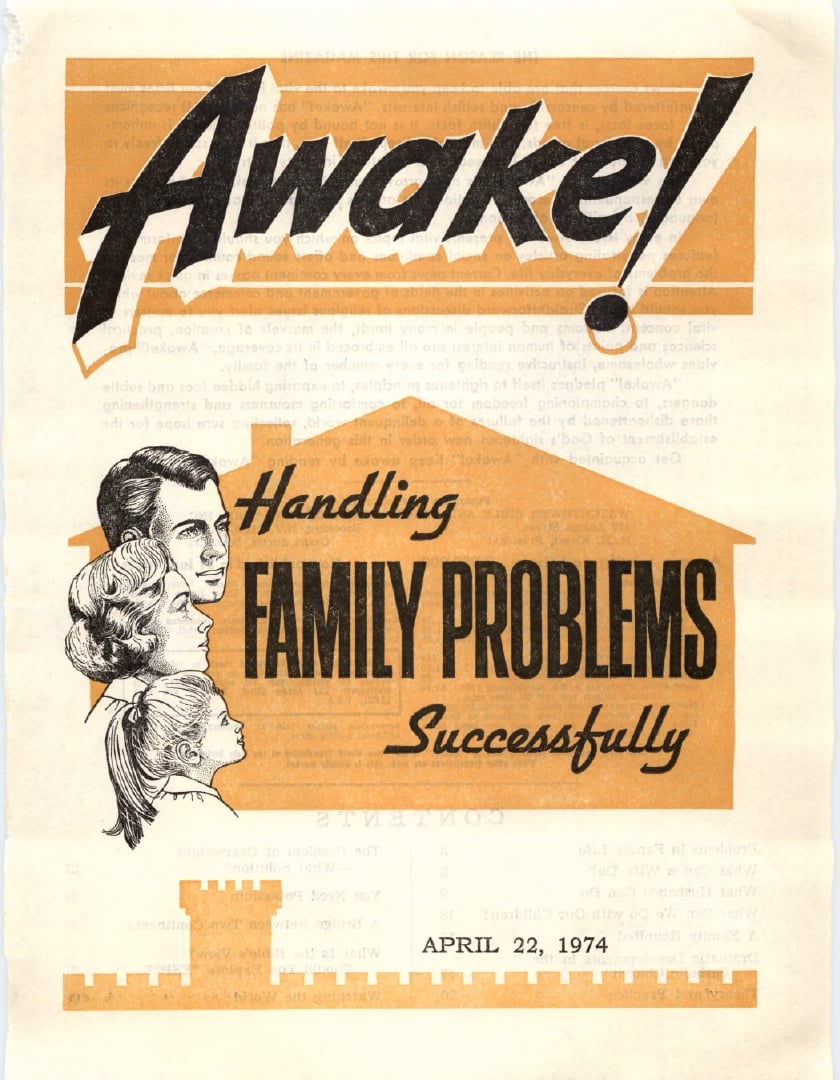
Awake! — April 22, 1974
Source: jw.org
Contents
Problems in Family Life
What Can a Wife Do?
What Husbands Can Do
What Can We Do with Our Children?
A Family Reunited
Dramatic Developments in the Catholic Church
Theory and Practice
The Problem of Overweight—What Solution?
You Need Potassium
A Bridge Between Two Continents
Should You Explore “ESP”?
Watching the World
What Does It All Mean?
How to Keep Delinquency Out of Your Home
Problems in Family Life
Problems in Family Life
IN THE families that you know, how do the members get along together? Do the husband and wife show genuine love and concern for each other? Are the children well behaved and happy? What is the situation in your own family?
Although some families enjoy a happy life together, many do not. What goes on in many families gives reason for deep concern. As the Los Angeles Times reports:
“In virtually every block, in every borough, town and suburb, couples are kicking, elbowing, slapping and punching. The rich and well-bred fight just as much as the poor and uneducated, and the choice of weapons ranges from beer cans, bottles and bread knives to frying pans and pieces of furniture.”—October 18, 1973.
Most aggravated assaults, and many deaths, stem from these family wars. Why, one out of five police officers killed in line of duty in the United States is reportedly slain while responding to a marital dispute!
Most family quarrels are not evident outside the home. Yet they are, nevertheless, extremely damaging. So much so that problems in the family have become a concern to the government. In commenting on reports before a Senate panel, the Akron Beacon Journal reported: “The American family is coming apart at the seams.”
Is it really that serious? Look at the following divorce figures.
Disintegration of Marital Ties
In 1962 there were 413,000 divorces in the United States. Ten years later that number had more than doubled, rising to 839,000! And the breakup of families is gathering momentum.
In the first nine months of 1973, there was a 9-percent increase in divorces over the same period of 1972. At that rate of increase, over 2,000,000 Americans will get divorced during 1974!
Presently there are two divorces for every five marriages. But in many states divorces number more than half the marriages! Here are the figures, taken from the 1974 World Almanac and Book of Facts, for the year 1972:
STATE MARRIAGES DIVORCES
Alaska 3,682 2,096
Arkansas 24,949 13,762
California 173,563 111,162
Florida 81,322 51,688
Oregon 18,824 12,435
Washington 40,814 20,702
What are the consequences of such a staggering divorce rate? For one thing, about one out of every four children lives with only one parent, nearly twice the number who were doing so ten years ago. The effects are far-reaching and tragic. Reports a first-grade teacher in Massachusetts:
“It is very difficult to have a classroom situation in which the kids all sit down and do something together, which you could do if not five, then ten years ago. The children today tend to be very much more upset. The teacher has to be very understanding of the problems that the children have to deal with at home.”
In other countries the situation is similar. Beneath its heading “Family Life in Danger,” the London Daily Mail reported:
“The extent of marriage breakdowns in Britain, with 110,000 divorces in 1971—double the rate for 1968—is now a major social problem, says Dr. [Jacobus] Dominian. It supersedes alcoholism, serious crime, VD and sexual offences.”—June 18, 1973.
In Indonesia nearly one third of all marriages end in divorce. Australia experienced a 20-percent increase in number of divorces in a recent year. In Egypt, where polygamy is practiced, there were 700,000 divorces in 1970 compared to only 325,000 marriages.
Figures Tell Only Part of Story
Many marriage mates simply walk out. They do not even bother with divorce. The New York Times said of this situation in the United States:
“The number of wives running away from home, or walking away from marriage, has risen dramatically over the last 10 years.
“Detective agencies that specialize in tracing missing persons report that the ratio of disappearing wives to husbands, particularly in large Eastern cities, has risen from about 1 in 100 a decade ago to more than 1 out of 3.” Another source says that by 1973 the ratio was about even.
Millions of other couples stay together, yet their relationship is very poor. “Even physical divorce between husband and wife without a court declaration is not uncommon,” explains U.S. Circuit Judge Marvin J. Sternberg. “They live separate and apart, sometimes even in the same house, sometimes even in the same bedroom, but their emotions, actions and conduct towards one another indicate they are separate and distinct.”
In such marriages the partners often get emotional and sexual satisfaction from others. It is estimated that three out of five husbands and perhaps as many as one out of three wives in the United States have had extramarital affairs. Adultery by mutual consent—called “swinging”—has also become popular. Some eight million Americans are believed to be occasional “swingers.”
This lack of respect for marital ties has had tragic effects, particularly on the young.
Youths in Trouble
The mockery that their elders have made of marriage has caused many young ones to cast moral standards aside altogether. “Do your own thing,” or, “Get it while you can,” is their motto. The New York Daily News explains:
“Sexual relationships without marriage are now broadly recognized by parents, colleges and the public generally. There is a sort of quiet tolerance of immorality, as if it would be futile to stem a new irresistible tide.”
Reflecting this rising tide of tolerated immorality are the millions of young women getting abortions. Other evidence of it is the increasing number of illegitimate births. In 1970 California set an illegitimacy record of 46,600. Nation wide in 1969 there were more than 200,000 girls under eighteen who became mothers.
In Sweden, one in every five babies is born out of wedlock. Every eighth New Zealand baby is illegitimate; one in ten births is out of wedlock in Canada, and one birth in twelve is illegitimate in Australia. The London Daily Mail reports: “A third of all teenage brides were pregnant on their wedding day.”
And what is going on in families that are not divorced? For one thing, many parents have little or no control of their children. Often there are constant arguments regarding behavior. Or there may be silent resignation, with parents and children each going their separate ways. Millions of families desperately need help with their problems.
Indicating this, a widely known psychologist last year observed: “During the hour that I’m on radio each morning, New York’s station WMCA is deluged with an average of 5000 calls. Most are from women—about marriage problems.”
Perhaps you are not among those thousands who have phoned, but you, too, may appreciate help with family problems. There are many things that wives, husbands and parents can do to improve the situation in the family, and these are discussed in the succeeding articles in this magazine.
[Chart on page 3]
DIVORCE INCREASE IN U.S.A.
1960 - 393,000
1965 - 479,000
1970 - 715,000
1972 - 839,000
[Chart on page 4]
RATIO OF ILLEGITIMATE CHILDREN TO BABIES BORN
SWEDEN 1 in 5
NEW ZEALAND 1 in 8
CANADA 1 in 10
AUSTRALIA 1 in 12
What Can a Wife Do?
What Can a Wife Do?
WIVES often ask that question in a tone of despair. Their marital problems just seem beyond themselves to solve.
These wives, unfortunately, are not exceptions. Today they seem to be in the majority—a result of what psychologist Israel Charny calls “the nearly disastrous state of most marriages.”
Therefore, it should come as happy news to many to hear that, despite the seriousness of family problems, there is a way to handle them successfully. Considering the origin of marriage sheds much light upon both the problems and the solution.
Where Marriage Originated
Many believe that marriage is of human origin, that in some way it was worked out in the distant past by men. This idea is at the very root of today’s disastrous family breakdown. Why do we say this?
Because it shoves aside as unimportant the very finest counsel on marital problem. Marriage is really of a higher origin. Almighty God himself created the first man and woman, gave them powers of reproduction, and joined them together in marriage. God also provided instructions recorded in the Bible on how to make a success of marriage. When these instructions are followed closely, marital success is enjoyed.
Can the Bible Really Help?
Some persons object, saying that people have long had the Bible and yet their marriages have been failures. The increased divorce rate, they say, is due to fewer couples putting up with unhappy marriages.
There is considerable truth in this argument. Millions of unhappy couples do possess the Bible. But have they read it? More importantly, have they applied its principles in their lives? The simple fact is, the Bible’s advice has already helped many couples to handle their family problems successfully.
If you want a happy marriage, it is wise at least to examine family problems in the light of what this book the Bible says.
When Sex Is a Problem
Sex is commonly cited as a major problem in marriage. This is often due to unrealistic views sponsored by the news media. Popular books, magazines and movies have couples ‘fall in love’ and live ‘happily ever after.’ Literature also highlights sexual pleasures, often raising expectations beyond what realization fulfills.
To illustrate, one young wife explained: “I guess I wanted sex to be some psychedelic jackpot that made the whole world light up like a pinball machine. I mean, it was all right but I kept thinking, ‘Is that all there is? Is that all there really is?’”
The wife’s overriding concern was her own sexual enjoyment. She was not satisfied. This is the complaint of many women—that their husbands do not satisfy them sexually. In such case, what can a wife do? Is it possible for her to realize greater satisfaction? Does the Bible say anything helpful?
Note the straightforward encouragement it provides: “Let the husband render to his wife her due; but let the wife also do likewise to her husband. Do not be depriving each other of it, except by mutual consent.”—1 Cor. 7:3, 5.
According to this Bible counsel, whom should a mate be concerned primarily with pleasing? One’s own self, as was the primary interest of the above-mentioned wife? No, but, rather, one’s mate. The underlying principle here in the Bible is of rendering, giving. The welfare and pleasure of the marriage mate, not oneself, is properly paramount. This is in harmony with the further Bible principles: “Let each one keep seeking, not his own advantage, but that of the other person.” “Love . . . does not look for its own interests.”—1 Cor. 10:24; 13:4, 5.
But how can seeking to please her husband increase the satisfaction of a wife? Well, enjoyment of intercourse is largely dependent upon the mind and heart. Thus, when wives view sexual relations as an opportunity to display their deep love for their husbands, they more frequently, as a side result, find that they themselves are enjoying the relations to a higher degree. When the wife’s mind is not principally on her own sensations, she often relaxes. Any resentment she may have entertained melts away, and the personal pleasure she really desires in the marriage act is realized as a natural consequence.
The greatest teacher to walk the earth, Jesus Christ, indicated that giving of oneself will, in turn, bring a person satisfaction. He said: “There is more happiness in giving than there is in receiving.” This principle has time and again proved true in connection with intimate marriage relations.—Acts 20:35.
Furthermore, applying Bible counsel is likely to work for the wife’s satisfaction because of the effect on her husband. It will do more than anything else to move him to begin to act unselfishly toward her, being more considerate of her needs and desires. It has happened this way in many marriages. The one taking the initiative in giving receives back in kind.—Luke 6:38.
Thus the Bible urges showing unselfishness and love in paying the marriage dues. Try practicing this. See if it does not eventually lead to your realizing greater marital satisfaction.
When Husbands Lack Initiative
Dr. Rebecca Liswood, a marriage counselor with over twenty years of experience, noted another major marriage problem, explaining: “Many of my clients complain of the weakness and irresolution of their husbands.”
Perhaps this is your complaint. Your husband may fail to shoulder his family responsibilities as you believe he should. What can you do about it?
Again the Bible provides help. It shows that man and woman were created with somewhat different qualities and responsibilities, with the purpose that their union contribute to mutual happiness. After creating man, the Creator said: “I am going to make a helper for him, as a complement of him.”—Gen. 2:18.
The two were thus created to go together; their qualities balanced or complemented each other. Each was created with a need that the other filled. Thus woman was made as a helper to her husband, and in keeping with that role the Bible urges: “Let wives be in subjection to their husbands . . . because a husband is head of his wife.” (Eph. 5:22, 23) This is practical, for if there is no head in the family there is usually discord and confusion.
‘But that is the very problem,’ you may say. ‘My husband does not assume headship; he does not take the lead.’ Yet have you considered why he does not? Could your own attitude be part of the problem?
Today female aggressiveness and competition with men have become common. Has some of this spirit rubbed off on you, as it has on other wives? For example, Dr. Liswood said that, even though they may fail to realize it, her clients’ “own aggressive tactics” are often a source of family problems.
Many husbands are repelled when wives push ahead. Their reaction may be, ‘If she wants to run the show, let her go ahead and do it.’ It may not be your intention to operate independently of your husband, but he may think that it is.
Yet you may feel that you are forced to take the lead, since your husband simply will not do so. But could you do more to encourage him to fill his proper role in the family? Do you ask for his suggestions and guidance? Do you indicate that you are looking up to him for leadership? Do you avoid in any way belittling what he does? When in small ways he manifests willingness to make decisions or take the lead in family affairs, do you express appreciation for this? Or do you argue against his decisions?
If you really work on fulfilling your God-assigned role in marriage, it is likely that your husband may start to assume his. And this will contribute to genuine family peace and happiness.
When Communication Breaks Down
Another complaint, perhaps the commonest one voiced by wives, runs something like this: ‘My husband was thoughtful during our courtship, but he isn’t now. He’s hardly ever at home, and when he is, he makes no effort to talk to me.’
Does a communication problem threaten the welfare of your family? It need not, for the Bible helps marriage mates to view matters realistically.
For example, the Bible emphasizes that we are all imperfect. “We all stumble many times,” it says. “If anyone does not stumble in word, this one is a perfect man.” (Jas. 3:2) So, then, is it realistic to expect perfect marital harmony in word and deed? Think back: Before marriage, did you enjoy perfect relations with your brothers and sisters, school friends or possible roommates, with never a sharp word between you? If not, why expect faultless relations with your marriage mate?
Do not be surprised if differences of opinions or expressions give rise to problems. Do not assume, as some wives apparently do, that a dispute or conflict is evidence that ‘he doesn’t love me anymore.’ Try to deal with the problem objectively. True, you may feel deep emotional hurt, but try not to think principally of your own hurt feelings or of how to get even. This will only enlarge the problem. Rather, consider what can be done to settle the difficulty. Do it right away. Remember the Bible’s counsel: “Love . . . does not become provoked, it does not keep account of the injury.”—1 Cor. 13:4, 5.
Analyze your own conduct. Could you bear a measure of fault? Could you, for example, in some way have failed to heed this Scriptural admonition: “The wife should have deep respect for her husband”? (Eph. 5:33) “Deep respect” will cause a wife to avoid anything that would result in her husband’s displeasure. Failure to show such respect is often responsible for a husband’s aloofness.
Many husbands are driven away by the nagging of a contentious wife. (Prov. 25:24; 27:15) In one instance a divorced man said: “Do you know what finally finished me and Estelle? It was her need to be right at all costs. . . . whenever anything went badly, her line was, ‘I told you so!’” Are you careful to avoid such expressions that would show disrespect for your husband?
“Deep respect” may also be shown by a wife’s appearance. Do you try to be attractive to your husband? Would he have continued to call on you before you were married if you gave no more attention to your appearance and personal hygiene than you do now? What about your home? Is it kept neat and clean? Are meals prepared tastefully? When he comes home, do you welcome him with genuine affection? Respect for your husband includes close attention to all these matters.
As for the oft-heard complaint, ‘He doesn’t talk to me anymore,’ one woman said: “The blue-ribbon reason why men don’t talk to their wives is simply that we’re such poor listeners.” Is this true of you? When your husband speaks, do you butt in, leaf through a magazine or have your ear tuned in to some other matter? Lack of interest in his opinions and feelings is certainly not showing him “deep respect.”
By analyzing your conduct in the light of Bible counsel, you may see things that you can do to improve your handling of family problems. Application of God’s instruction has brought contentment and happiness to thousands of troubled homes.
When Husbands Do Not Respond
Yet what if, despite a wife’s efforts, her husband continues to make life difficult? For a Christian wife there is still considerable satisfaction, for, as the Bible notes: “If, when you are doing good and you suffer, you endure it, this is a thing agreeable with God.”—1 Pet. 2:20.
In such suffering Jesus Christ himself set the example, as the Bible account goes on to note: “When he was being reviled, he did not go reviling in return. When he was suffering, he did not go threatening, but kept on committing himself to the one who judges righteously. . . . In like manner, you wives, be in subjection to your own husbands.”—1 Pet. 2:23-3:1.
Admittedly this may not be easy to do, even as it was not easy for Jesus submissively to endure persecution. Yet, having an “unbelieving husband” is no grounds for divorce. (1 Cor. 7:13) But, as in the case of Christ, a wife can be sustained in her righteous course by the contentment and satisfaction that come from knowing that she is doing what is pleasing to Almighty God. And she can be assured that her faithfulness will be remembered and rewarded by God in his righteous new system.—2 Pet. 3:13; Rev. 21:3, 4.
Thus, the wife can only do so much to handle family problems successfully. For a more complete resolving of problems she needs the cooperation of her husband.
What Husbands Can Do
What Husbands Can Do
SUCCESS in marriage depends on the efforts of both mates. Yet the husband bears the greater responsibility for conditions in the family. This is because of his position. God’s Word the Bible says: “A husband is head of his wife.”—Eph. 5:23.
A husband may feel that his wife is primarily the cause of the problems. But even if she is, is it not the mark of a good head that he can successfully handle problems of those under his charge?
Someone may object: ‘Dealing with my wife is different. It’s easier to manage a hundred men in my business than it is to get along peacefully with her.’
There may be some truth in this, for, as a rule, family problems have been the most difficult for men to handle. No doubt that is why the Creator of the family provided husbands with lots of counsel on how to treat their wives properly. Having made them, surely God knows best how wives should be treated by husbands.
The Key to Warm Marital Intimacy
The Creator purposed that a warm intimacy be enjoyed in marriage, and so designed woman “as a complement” of man. Mates, therefore, were not simply to be acquaintances that share the same dwelling place; they were to be “one flesh.” (Gen. 2:18, 24) Their respective qualities were to be balanced, complemented, so well that a truly joyous relationship would be possible. Yet it is rather rare to find such an intimate warmth between mates.
Husbands, for example, frequently complain that their wives are too cold to be adequate sex partners. But why? Where does the trouble lie? As head of the family, the husband should certainly deal intelligently with the problem.
The Holy Bible states: “Husbands ought to be loving their wives as their own bodies. He who loves his wife loves himself, for no man ever hated his own flesh; but he feeds and cherishes it.” (Eph. 5:28, 29) How important is this advice? Do women really need to be loved by their husbands?
Indeed they do. Marriage counselors often emphasize this. For example, Dr. David Reuben observed: “A wife particularly needs that special kind of attention that involves tenderness, understanding and reassurance.”
It is a cardinal truth: For wives to be genuinely happy they need to feel that they are loved. So the key to warm marital intimacy is for husbands to fill this need. The Bible urges husbands: “Let each one of you individually so love his wife as he does himself.”—Eph. 5:33.
Why Love Needs Expression
However, men often consider expressing love for their wives unnecessary, apparently feeling that supporting them materially is evidence enough of their love. But when expressions of affection are withheld, how is a wife affected? The following letter from a wife may give you some idea. She wrote:
“Here is my problem: I am so hungry . . . for a little sweet talk, a compliment, the feel of his arm around my waist while I’m cooking or a chance to sit in his lap, I’d trade all the material things I have for one affectionate squeeze.”
Yes, wives need to be shown love. They blossom out when they receive it, becoming more contented and often even more physically attractive. They were created with this need for love. That is why God urges husbands to love their wives. Failure to heed this counsel has had tragic consequences. It is, in fact, a principal cause of the unhappiness found in so many marriages today. Why so?
Because a wife starved for her husband’s tenderness and affection is likely to feel insecure and lack confidence regarding her femininity. Even resentment of her husband may develop, including perhaps a subconscious desire to get even with him for his neglect of her. How can a wife with such feelings be expected to be a warm and intimate sex partner?
Giving Expression to Love
Often husbands do love their wives, but find it difficult to express it. Here again the Bible can be helpful, for it shows how we should treat others. It says: “Clothe yourselves with the tender affections of compassion, kindness, lowliness of mind, mildness, and long-suffering. Continue putting up with one another and forgiving one another freely.”—Col. 3:12, 13.
Some men, however, feel that it would be unmanly to treat their wives this way. And yet this is actually the way wives should be treated. In fact, sex relations for a wife may be unsatisfying, and even unpleasant, if her husband fails to appreciate that she was designed by God to respond to a kind, considerate man, not a harsh, demanding one.
The Creator realized that husbands, confronted as they are with so many erroneous ideas, would need instruction on how to love their wives. That is why he encourages them to be tender and considerate, saying: “You husbands, continue dwelling in like manner with [your wives] according to knowledge, assigning them honor as to a weaker vessel, the feminine one.”—1 Pet. 3:7.
When it comes to sexual relations, it is especially important that a husband heed this instruction. He should act in accord with knowledge of how God made women. They usually are not as strong physically as men, and emotionally they are generally more delicate and sentimental than men. So God tells husbands to give wives honor as to a weaker vessel, to be respectful of their makeup, limitations and vicissitudes.
Thus, there are likely to be times when wives are very tired and do not feel up to having sexual relations. A husband could be demanding, forcing himself upon his wife. He may consider this a demonstration of his manly headship, feeling it weak to accede to her wish that they wait until another time. However, honoring his wife’s feelings in this matter is not a sign of weakness, but, rather, of strength. It requires manliness to exercise self-control and not to take personal affront at his wife’s wishes.
Also, it is important that the husband act in accord with knowledge while preparing for and engaging in intercourse. He should understand that a wife is not immediately prepared sexually to receive him. She is slower to respond in a sexual way.
Therefore, a husband who follows God’s instructions to honor his wife will take this into consideration. He will tenderly and patiently help her to receive him, so that the marriage act can be equally pleasurable and satisfying to both of them. What often occurs when a wife experiences such unselfish love from her husband? The warm love she, in turn, feels for him smooths over friction that may develop in other areas of married life.
Actually sex is only a small part of marriage in which God’s instructions need to be applied. A husband should not forget to treat his wife according to knowledge and with honor at other times also. For example, he needs to realize that her biological cycle may, at times, affect her adversely in physical, mental and emotional ways. She may then do and say things that she would not ordinarily. A husband needs to take this into consideration, and not to be overly sensitive if she speaks sharply or acts rashly, but continue to treat her with kindness.
Yet much more is involved. Successful marriage requires cooperation and communication. Although the husband is head of the family, before making decisions he should consider the opinions, likes and dislikes of his wife, even giving her preference when there is no issue at stake. In this way he shows her honor.
By thus heeding God’s counsel, there will be peace and happiness in the marriage. But if mates do not cooperate in the various aspects of their marriage, what may then happen when it comes to sex relations? One wife wrote very frankly about this, saying:
“Men complain because their wives are ‘cold.’ May I tell you about my marriage? . . . I have tried to draw [my husband] into conversations about my work . . . And he never says a word about his work, although I ask lots of questions, hoping to generate a little conversation between us. . . .
“Sunday night is his night to ‘relax’ so we don’t go anywhere. I go to bed at 9:30 as I’ve spent my day cooking and cleaning. He hits the hay after the late movie. Then he starts looking for an affectionate bed partner.
“I wonder how many married women are eager to make love to a stranger who hasn’t talked to them all week.”
Really, this is something for husbands to think about. If a warm intimacy does not exist in your marriage, could it be that you bear considerable responsibility for this? It takes humility to acknowledge one’s shortcomings and to take steps to correct them. Doing so, however, will surely help to bring you and your wife greater satisfaction and contentment.
But perhaps the problem in your family is of an entirely different nature. There is more that a husband desires in a wife than a satisfying sex partner.
Handling Other Problems
Caring for the home and cooking tasty and nutritious meals are also integral parts of marriage. One husband expressed his complaint bluntly: “Maybe other husbands will disagree with me, but I would rather have a cleaner house and better fed kids than a wife who lets everything go so she can rest up for sack time.”
Your wife, too, may fall considerably short of measuring up to the “capable wife” described in the Bible. (Prov. 31:10-31) What can you do?
Some husbands may, in a nagging way, draw comparisons with the well-kept homes and fine cooking of other wives. But this probably will only cause their wives to feel resentment. How much better if a husband can appeal to his wife in such a way that she desires to improve in her care of the home and in her cooking ability!
Attention might tactfully be drawn to the poor impression created on others if the home is messy, or the family ill fed. And if there are children, it might be noted that they will be affected adversely later in life by poor parental example now. If these points are made with love and kindness, it will give your wife incentive to improve.
If your wife never learned homemaking skills, encourage and help her to learn. Let her know how much you appreciate her efforts. Even when improvement is small, sincerely compliment her. Then, on your day off, or in the evening, why not give her a hand by washing the dishes and cleaning the rugs and floors? This is practical application of the Bible counsel to ‘love your wife,’ and it is certain to produce rewarding results.
A husband, too, needs to be reasonable, avoiding being overly fussy. One husband, who had often nagged his wife about being neat, was on vacation when his wife required a short hospital stay. After caring for the home and children a few days and thus realizing for the first time all that was involved, he sincerely apologized to his wife for his fussiness.
So be understanding and alert to compliment, rather than demanding or critical. Then if you do make a suggestion for improvement, it will likely be welcomed.
Regardless of what problem arises between you and your wife, if you will only remember that “husbands ought to be loving their wives,” you will be aided to handle the situation successfully.—Eph. 5:28.
However, in many families today major problems are with the children. What can be done to handle these successfully?
What Can We Do with Our Children?
What Can We Do with Our Children?
THAT is what millions of parents are asking. They are anxious about their young ones’ behavior. For example, according to statistics cited by McCall’s magazine, “52 percent of America’s teen-agers are engaging in premarital sexual activity.”
To prevent pregnancies, some parents are giving their daughters contraceptives. Perhaps you disagree with that procedure. But what is the answer?
“By their words and actions, many fathers and mothers make it clear that they are almost paralyzed by uncertainty,” noted a member of the editorial board of the New York Times.
Why the Uncertainty?
Largely responsible is the advice given by many worldly authorities. In recent years these have said: “The child should not do anything until he comes to the opinion—his own opinion—that it should be done.” “In an effective plan of discipline there is no place for corporal punishment.” Thus old methods of discipline have been replaced with new ones.
Attitudes regarding moral behavior have also changed. For example, Parents’ Magazine of December 1973 considers the question of premarital sex for youths. It recommends to parents a letter by Deane William Ferm, chaplain of Mount Holyoke College, to his daughter. The clergyman advised her:
“I suggest you limit intercourse to the marriage promise rather than the marriage ceremony. It is naive to think that the wedding night should mark a radical change in the physical intimacy between two loved ones. . . .
“The value of the so-called ‘new morality’ is that you yourself must decide on the responsible thing to do. . . .
“You may think it quite proper to engage in intercourse under circumstances beyond our suggested limits. If you do so decide . . . we would not want you to feel guilty. . . . Do not feel ashamed that you have acted contrary to what society (often hypocritically) demands, or to what your church and parents have suggested.”
When that kind of advice by a prominent clergyman is thus endorsed, what is the effect? Why, many parents follow the advice, and some even arrange to make fornication convenient for their young.
The bad fruits are all too apparent—venereal disease, fear of pregnancy, illegitimate children, unwed mothers, heartbreak, clandestine abortions and plagued consciences. Suicides of youths have skyrocketed, and emotional disorders are also increasing.
How, then, can parents successfully handle problems with their children?
Source of Successful Advice
It is by applying Bible counsel. The Bible takes a firm stand as to premarital sex. “Abstain from fornication,” it says. “Let fornication . . . not even be mentioned among you.”—1 Thess. 4:3; Eph. 5:3.
Some parents may object, saying, ‘Premarital sex is a way of life with most young people.’ Yet is that a valid reason to excuse it? If most people steal, cheat or murder, should these practices also be condoned? No reasonable person would say so. Parents need to take a firm stand to protect their children against wrong practices.
Reason with Your Children
But it is not enough simply to tell youngsters: ‘I don’t want you to commit fornication, because it is wrong.’ They need to be shown that it is their Creator, Almighty God, who says premarital sex is wrong. But even this often does not satisfy. Children also need to be helped to see why they should heed God’s prohibition of premarital sex, and how obeying his law will benefit them.
For example, you might draw your youngster’s attention to the truly miraculous process of reproduction in which one fertilized cell divides and multiplies according to a prearranged plan to become a human baby, and ask: ‘Don’t you think that the One who designed this marvelous reproductive process knows best how humans should use their God-given powers of reproduction?’ (Ps. 139:13-17) Or you could ask: ‘Do you think that our grand Creator would make a law to rob us of enjoyment in life? Rather, wouldn’t obedience to his laws enhance our happiness?’
Such questions can start your child reasoning on God’s law governing the use of his reproductive organs. Welcome your child’s views. If they are not what you desire them to be, do not get angry. If a child is afraid of being severely criticized whenever he tells his parents something, he may simply keep quiet. Then how will you know what he is thinking, so that you can help him?
So be open and honest. Perhaps you once had similar views or did the same things. It is sometimes helpful to admit this. Try to understand that your child’s generation has deviated a long way from the righteous principles in the Bible, and yet endeavor to show him why his generation’s immoral practices are unwise.
Perhaps you can draw your child’s attention to specific examples (and there are many sad cases around us) of where sexual immorality has led to illegitimate births, venereal diseases or other troubles. Also, you might point out the benefits enjoyed by those who have conformed to God’s law. In this way the child is helped to see the reasonableness and correctness of what the Bible says. And he may be moved to want to obey it.
Guidelines and Discipline
Yet children need more than talk. They need definite guidelines to help them to conform to Bible requirements. Also, they need discipline administered in love when these guidelines are overstepped.
Contrary to popular opinion, children generally appreciate it when their parents set reasonable restrictions on their activities. It gives them a sense of security to know that there are limits within which they are expected to remain. Some of them may complain, but they learn to respect and love parents who show genuine concern for their well-being.
On the other hand, parents who allow their children freedom to do whatever they please are frequently disappointed and shocked. Their young ones may, in time, turn on them, as did one young girl. After finally confessing to being pregnant, she angrily said: “Why didn’t you stop me? You knew what was going on. You let me stay over there at Jimmy’s when his mother and father were away. You just didn’t care what I did.”
Thus parents need to show that they care about their children by disciplining them when they step out of line. It is as the inspired Bible proverb says: “Foolishness is tied up with the heart of a boy; the rod of discipline is what will remove it far from him.”—Prov. 22:15.
Discipline may need to take the form of more than verbal correction. This is because, as the Bible says, often one is not “corrected by mere words, for he understands but he is paying no heed.” (Prov. 29:19) So, then, God’s Word encourages: “Do not hold back discipline from the mere boy. In case you beat him with the rod, he will not die. With the rod you yourself should beat him, that you may deliver his very soul from Sheol [the grave] itself.”—Prov. 23:13, 14.
The very life of the child is at stake! If he is allowed to pursue a wrong course, it will lead to his own unhappiness and eventual death outside God’s favor. Thus the Bible says: “The one holding back his rod is hating his son, but the one loving him is he that does look for him with discipline.”—Prov. 13:24.
Yes, it shows real love on the part of a parent to do whatever he can to correct his child, including administering a good spanking. The rejection by worldly authorities of this counsel of God regarding discipline has led only to trouble in family life.—Prov. 29:15.
However, talking to a child about God’s law, setting guidelines and providing discipline may all be ineffective if parents fail in another important respect.
Proper Example Vital
Parents also need to set a good example. This is because children are more inclined to follow what you do than what you say. And when there is a discrepancy between the two, young ones are quick to detect it. In fact, their open flouting of sexual morality is said to be a rebellion against hypocrisy. For, as psychiatrists point out: “So many adults they know practice adultery but indulge in sanctimonious preaching.”
The same holds true in matters other than sexual behavior. For example, children also are rebelling against parents’ hypocrisy in connection with drugs. Dr. Robert E. Gould, as head of a psychiatric division at New York city’s Bellevue Hospital, explains: “Adolescents are emulating parents. There is not a home I know of where parents don’t either drink or smoke cigarettes, have barbiturates to go to sleep, tranquilizers to get through the day—not aspirin, but mood-changing drugs.”
So, if you want your children to live respectable, decent lives, then you yourself must live that way. If your example is not good, it can nullify all the good things you say.
Show that You Love Them
Perhaps the most important factor in handling problems with children successfully is that you show that you love them. And a principal way to do this is by spending time with them. Not just time when you talk with them about their conduct, or discipline them, but time when you really get to know each other. Time spent eating together, worshiping God together, playing together, getting ready for bed at night—all this time spent with your children is important.
This is where many parents fail. Alan King, a prominent entertainer, who traveled a lot when his children were young, admitted he had failed. He observed:
“The average father doesn’t lead my life, but it’s the same thing. He goes to work, comes home, says he doesn’t want to hear about the little problems because he’s had a tough day at the office, puts on the television and then goes to bed. He’s on the road, too!
“I see successful men running companies with hundreds of men; they know how to deal with every situation, how to discipline and reward in the business world. But the biggest business they are running is their family and they fail it.”
The reason why is that they have neglected God’s counsel. His Word says: “These words that I am commanding . . . you must inculcate them in your son and speak of them when you sit in your house and when you walk on the road and when you lie down and when you get up.” (Deut. 6:6, 7) A parent must spend time with his child to do this. Also, a parent must first learn “these words” of instruction from God himself so that he can teach them to his children.
Really, applying the counsel in God’s Word is the key to successful family living. But how can one learn what the Bible says about building a happy family life?
Worldly authorities, including the religious leaders of Christendom, certainly do not have the answers. These have clearly abandoned God’s counsel and have influenced the majority of mankind to do likewise. Their teachings have contributed to the terrible breakdown in the family today. But there is help available for those who want it.
Jehovah’s witnesses are devoted to helping people to learn the teachings of God’s Word. They provide this instruction free of charge to those who desire it. A qualified minister of Jehovah’s witnesses will be happy to consider with you further details as to what the Bible says on the subject of building a happy family life. To arrange for this, simply write the publishers of this magazine or contact Jehovah’s witnesses locally.
A Family Reunited
A Family Reunited
THE Bible can have a wholesome effect on people’s lives, as was experienced by a woman in Norway. From her Bible discussions with Jehovah’s witnesses she came to recognize that she could not continue living with a man to whom she was not legally married. Because of her refusing to change her newly acquired Bible-based view on moral matters, he left her and went out to sea. A few weeks later her former husband came to see the children. She invited him into the home and told him about what had happened meanwhile and that she was now studying with Jehovah’s witnesses.
There was a meeting at the Kingdom Hall of Jehovah’s Witnesses that evening. Since she did not have a car, she asked if her former husband would be willing to take her and the children there. This he did, and he was so impressed by what he heard that he continued to attend the meetings, bringing the family. He was also pleased with the fine changes his former wife had made in bringing her life into harmony with the Bible. She had stopped smoking and had become more calm and balanced. A good relationship existed between her and the children. Due to what he could observe, he decided to remarry his former wife. Now the entire family is united in striving to live according to Bible principles.
Dramatic Developments in the Catholic Church
Dramatic Developments in the Catholic Church
MANY American Catholics were startled last November when they heard about the latest church-attendance survey. Though surveys vary, this one indicated that the number of those who had virtually stopped attending church had nearly doubled during the past year! Most alarming was the report that for the first time older persons accounted for most of the overall drop. Almost a third of those over fifty years of age stopped attending Mass regularly in 1973! This fact Catholic researchers found “not a little frightening.” Says the National Catholic Reporter:
“The precipitous decline in church attendance that has been going on for several years has reached almost catastrophic proportions. For the first time decline in church attendance is occurring among older members of the population. . . . The changes of the past year may well constitute the most dramatic collapse of religious devotion in the entire history of Christianity.” [Italics ours]—November 16, 1973.
Why is this new phase of the attendance crisis a cause for such concern to the Church? Well, back in 1972 Vatican professor of theology Battista Mondin, when referring to the troubled period since Vatican Council II, said that there is “still a silent majority which has remained faithful.” He referred to the older, more stable members. Furthermore, he predicted that this “silent majority will guarantee the survival and salvation of the Catholic Church in the United States.”
But alas! Two years later what is the “silent majority” doing? Is it saving the Church?
“Silent Majority” Fast Becoming the “Fading Minority”
Recent evidence shows that the majority of U.S. Catholics no longer support religious practices required by Church law. For example, by mid-1973 over half were not attending Mass regularly. The figures showed that 12 percent attended once a month, 26 percent only once a year, and 14 percent almost never attended. Yet Church law demands weekly attendance.
What about other matters where the majority of Catholics are at odds with Church doctrine? Numerous studies show that in 1973 the majority of Catholics (1) practiced birth control; (2) approved of abortion in a number of circumstances; (3) approved of premarital sex, either in some or all circumstances; (4) got divorces at about the same rate as other Americans; (5) did not go regularly to confession.
The Church has repeatedly reaffirmed its laws on these matters. Yet the majority of her members actually believe and act contrary to her laws. Hence, what hope for “salvation” does the Church really have in this so-called “silent majority”? If there is any hope for the Church, it would seem to rest only in the hands of a “fading minority.”
Certainly concerned Catholics want to know what is behind this abruptly accelerated retreat from the Church. Why is it so, especially among older ones? The evidence points to at least two causes: (1) loss of confidence in leadership and (2) loss of the “mystical” aspect in worship.
Crisis in Leadership
The Catholic survey on church attendance reveals that among American Catholics there is a “strong relationship between lack of confidence in leadership and not going to church.” Especially during the past year has church leadership been crippled by dissent. No longer are the strongest attacks from outside the Church, but, rather, from clergymen within. This conflict has now reached the hearts of the laity who always placed their confidence in church authority. How can they continue accepting that authority when those administering it so openly disagree?
Professor of Church history Monsignor John T. Ellis says that the American Catholic community “has never known anything to approximate its present dispiritedness and disarray.” But Pope Paul VI shows that this problem is not limited to the U.S. Speaking to the College of Cardinals last June, he deplored the “doctrinal confusion and indiscipline” in the Church, and conceded that the world’s priesthood was “passing through a period” of “disorientation.”
Did the situation improve as the year 1973 wore on? No. Rather, the strife escalated. There were embarrassing confrontations with renowned Swiss theologian Hans Küng, openly expressed tensions with the 260 American bishops, numerous incidents with dissident priests and greater pressure than ever against priestly celibacy. By October a front-page article in the French paper Le Monde declared: “Religious practice is collapsing, priestly vocations are drying up. Rebellion is everywhere. The [ecclesiastical] authorities are overwhelmed.”
Then, in two speeches on November 10, Pope Paul revealed how deep the wounds had gone. With no prepared script, he emotionally appealed to priests in his audience:
“Accept me; do not despise me; accept me for what I am. I am the Vicar of Christ. . . . understand that this is the hierarchical and established Church . . . The moment has come when I must call on all of you for your full adhesion and attention.”—Catholic Standard, November 15, 1973.
Why was such an outright appeal for recognition of authority necessary? Why has the ‘moment to call for full adhesion’ come? Is it because their religious house is falling apart for lack of adhesive authority to hold it together? Jesus long ago said: “If a kingdom is divided against itself, that kingdom cannot last.”—Mark 3:24, 25, Catholic Jerusalem Bible.
Church statistics show that this principle is at work. In one year, seven thousand nuns left the convents. The priesthood has fallen by about 25,000 since 1969, and the pace is accelerating! Many seminaries are empty. The situation is so critical that, in November, Cardinal Garrone, head of the Vatican’s Catholic education department, called a meeting of eighty bishops from around the world to discuss the crisis. He told them that the loss of priests is critical and that gaining more seminarians “represents for the Church a true question of life or death.”
In an effort to stem the tide of defection, Pope Paul has been forced to take a new, more conciliatory attitude toward dissenting priests than in the past. On November 28, when speaking to a general audience, he discussed the dissent that is spreading “like an epidemic” within the Church. Then the December 23 issue of L’Osservatore Romano, the official Vatican newspaper, published an article pleading with each priest to “do the impossible to remain at his post.” Even “if you commit moral errors—you must not, but it may happen, because you too are weak—you have many remedies.” How desperate the problem must be for that to be said!
This disarray in the ranks of the clerical shepherds is one of the reasons why loyal members of the Catholic flock are becoming disillusioned in increasing numbers. But there is another reason, one that goes to the very heart of Catholicism.
Loss of the “Mystical Tradition”
Most worshipers, particularly older ones, felt that the Catholic Mass of pre-Vatican II days held something special for them. The Latin Mass, with its theatrical splendor, “conspired to speak of the presence, of the mystery of God among men,” says priest William J. Bausch, writing in U.S. Catholic magazine. Admittedly, “the mystery spawned the passive, silent, awe-struck congregation,” but the customers kept coming back for more. Now all that is gone. The slump in attendance at Mass, he believes, is became the Church has ‘forsaken its own mystical tradition.’
Laments Catholic poet Ned O’Gorman, “We must suffer now with mock celebrations.” As he sees it, “in this new Church, everything becomes very quickly, very dull.” When the mystery, the awesomeness, the incomprehensibility are removed, the people feel cheated. The mystery they thought must represent God has been ripped off, exposing a mere empty, man-made ritual.
The same is true of the many other religious appendages that Catholics have used over the years as aids to devotion. Rosaries, saints, images, novenas and other devotional accessories were said to make worshipers feel closer to God. “Emotions are nurtured by hallowed symbols and traditional practices,” says Monsignor Hubert Maino of Detroit’s St. Frances Cabrini Church. “When these symbols are abruptly removed . . . the man or woman in the pew is angered and alienated.” He calls for a return to the former esteem for these devotional crutches.
But is that really the answer?
Jesus Christ did not teach his followers to rely on material aids to devotion. Instead, he said: “True worshippers will worship the Father in spirit and truth: that is the kind of worshipper the Father wants. God is spirit, and those who worship must worship in spirit and truth.”—John 4:23, 24, The Jerusalem Bible.
The Outlook
Serious questions confront those who have stopped attending church. Are they only disillusioned with the Church, or have their hearts grown cold toward God?
If in reality it is a love of righteousness that has moved them to pull away from the confusion facing them in the Church, then they will not simply pursue a cold, materialistic way of life. They will feel impelled to find out how God really wants to be worshiped. This will turn them to the Bible, where God reveals his will for us. They will want to apply it in their lives and seek out and associate with others who do the same.
Those who remain with the Church, hoping that somehow it will survive the present crisis, need to examine their views as well. Why do they remain? Is it because they are convinced that the teachings of the Church are properly founded on God’s Word of truth? Have they personally read it to find out? Or are they largely indifferent and willing to go along with anything the Church may do? Jesus said: “Happy those who hunger and thirst for what is right: they shall be satisfied.”—Matt. 5:6, Jerusalem Bible.
One sincere Catholic person who had questions about her worship began studying the Bible to learn what God requires. She then wrote to her elderly uncle, a priest in Rome, about what she was learning. He replied in part:
“Yes, my child, JEHOVAH is really GOD’S name. It’s not used too much, but how wrong we are. It should [have] been known a long time ago, but we are not perfect and we had to obey our insufficient Superior, which is tragic.
“These people of this Faith are nice people, they are teaching you and others the real Truth. How wonderful it is to go from house to house, and what hard work that is, but didn’t Jesus do it? . . .
“Now my niece, if you can, I would appreciate it if you can send me some more of the books that you are studying. It makes my heart feel so good that you can get knowledge and true knowledge from the right source.”
Yes, many sincere Catholics are taking advantage of the house-to-house ministry of Jehovah’s witnesses. They are accepting the free service they offer—a study of the Bible in the privacy of one’s own home. They are learning for themselves what kind of worship is pleasing to God. For them what has happened to the Catholic Church is proving to be a real blessing. It may have alienated them from an organization of worship contrived by men, but in so doing it has helped them to ‘go nearer to God.’—Jas. 4:8, Jerusalem Bible.
Soon all who profess religious beliefs will be brought into judgment. “When the day comes,” Jesus says, it is not those who shout, “Lord, Lord,” who will be approved, “but the person who does the will of my Father in heaven.” (Matt. 7:21, 22, Jerusalem Bible) Act wisely. Use your opportunity now to learn God’s will and to do it!
[Picture on page 17]
Church Attendance Loss ‘Catastrophic’
THE TABLET Brooklyn, N.Y. November 15, 1973
Only 25 p.c. of Catholics go to mass
THE WEST AUSTRALIAN September 10, 1973
Catholic Churchgoing Still Declining
THE NEW YORK TIMES November 12, 1973
[Picture on page 19]
Pope Expresses Anguish Over Defections of Priests
THE NEW YORK TIMES November 12, 1973
Pope cites ‘epidemic’ of dissent
THE CLEVELAND PRESS November 29, 1973
Vatican paper says 15,000 priests quit
THE ARIZONA REPUBLIC December 26, 1973
Stop Questioning Pope, Catholics Told
THE PITTSBURGH PRESS July 6, 1973
Theory and Practice
Theory and Practice
In the publication entitled “Cross Currents,” Catholic priest Felipe Berryman comments on the vast difference there is between the theory of Catholicism in Latin America and what is actually practiced there by the masses of the people. In his article “Popular Catholicism in Latin America,” he points out:
“In Latin America, however, the masses of the people never accepted official (Tridentine [Council of Trent]) Catholicism. They have never accepted the Church as mediator of salvation in the sense intended by Tridentine theology and pastoral practice. . . . The priests think they are doing one thing; the people think they are doing something else. For centuries there has been concern about the ‘ignorance’ of the people and attempts to ‘convert’ them to marry in the Church, attend Mass, go to communion. By and large, however, there has been little success among the popular masses.”
The Problem of Overweight—What Solution?
The Problem of Overweight—What Solution?
ARE you concerned about being overweight? Do you lose weight only to gain it again?
It may encourage you to know that being overweight—at least up to a certain point—does have its benefits. Jean Mayer, a leading nutritionist, reports that “the death rates from tuberculosis, ulcers and suicide are actually lower than average among obese persons.”
And according to Hippocrates: “Those do best who are a little fat about the belly.” One of America’s leading psychiatrists concerned with this problem, Dr. Albert Stunkard, has expressed a similar opinion. But notice, “a little fat.” Far too many persons have more than “a little.”
How can you tell whether you are too fat? One way is to look in the mirror. Another is to compare your weight with the average for your height, body build and sex. But the best way is to take between your fingers a fold of skin, perhaps at the back of your upper arm. If it is more than an inch thick, you most likely are too fat.
Disadvantages of Being Overweight
Among the disadvantages of being overweight is that it tends to slow you down and so makes you less active. Further, insurance tables show that the greater the overweight, the shorter the life-span. So the matter deserves serious consideration.
There is also the matter of romance, courtship and marriage. It is a fact that the slender figure is considered more attractive in modern societies. That is why dieting has been termed “the most popular indoor sport of the American woman.” She diets to get her man and then to hold him.
Great Interest in Reducing
Literally hundreds of books have been written on the subject of diet and reducing. And how they sell! One book’s sales amounted to a million in less than a year. Another sold five million in several years, and a calorie-counter book has reached a circulation of seventeen million in the United States.a Yearly some thirty articles appear in American magazines. In fact, it is said that “the literature on overweight, diets and related problems is bewildering not only because of its conflicting content but also because of its sheer bulk.”
Yet in spite of all this interest in reducing, 25 to 45 percent of Americans are 20 percent or more overweight and their number is rapidly increasing. This fact has caused a leading nutritionist to complain, “We just don’t know yet how to motivate the individual.” One real aspect of the problem seems to be that more than 90 percent of those who have reduced by means of some crash diet sooner or later return to the ranks of the overweight society.
What Causes Overweight?
As to the causes of overweight, there is truly a ‘bewildering array of conflicting opinions.’ There are many who insist that the problem is simply one of calories, that the more calories you eat the more you weigh. But that is not always so. Some people stay thin in spite of eating a great deal, because they lead very active lives or do hard physical labor. As Dr. W. A. Nolen, a noted surgeon, observes: “There are individual variations in metabolism (metabolism being the term we use to denote the building up and tearing down of our body tissues, both of which processes go on continually). We all know people who never seem to gain any weight, no matter how much they eat.”
Still, when all is said and done, the latest findings do seem to sum up the problem with the words: ‘Fat people don’t know when they are hungry and they don’t know when they are full.’ In some cases the cause may be the appestat, located in the hypothalamus, which governs the hunger and satiety sensations.
Since eunuchs and castrated animals run to fatness, some persons believe that lack of male hormones can cause one to tend to fatness.
…