Awake!, February 22, 1974
Download: PDF — Awake!, February 22, 1974
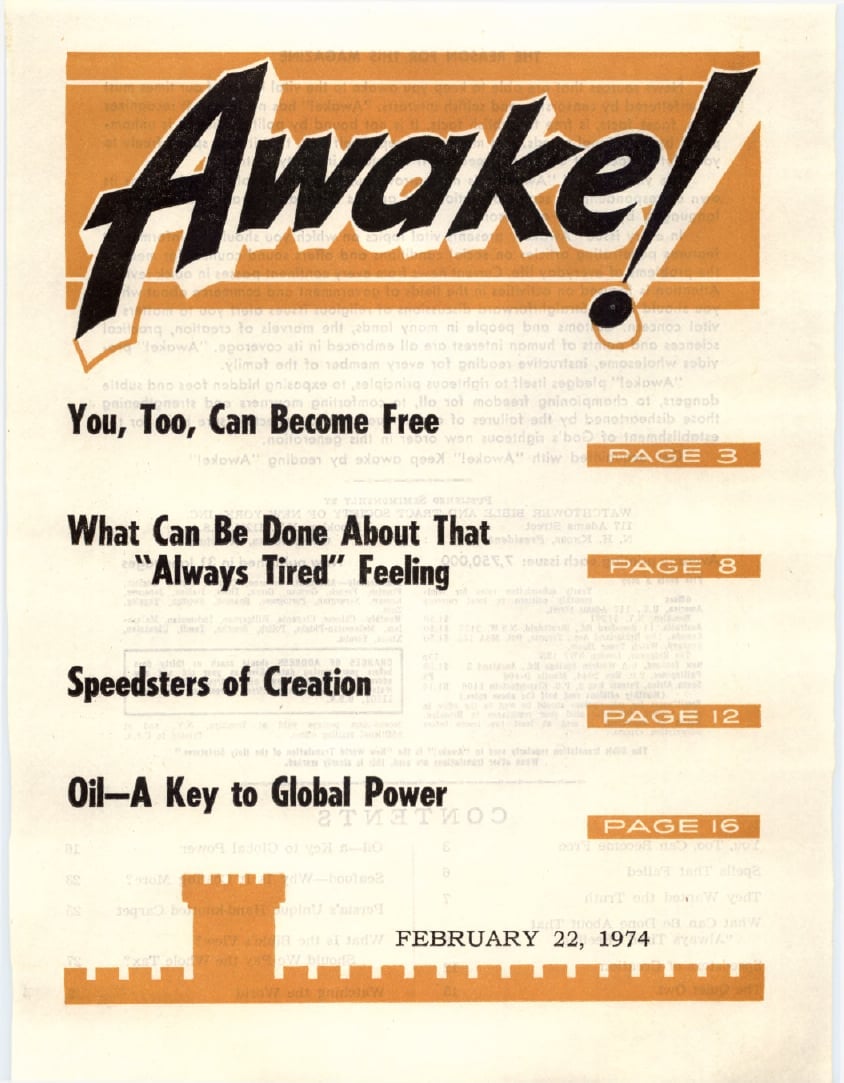
Awake! — February 22, 1974
Source: jw.org
Contents
You, Too, Can Become Free
Spells That Failed
They Wanted the Truth
What Can Be Done About That “Always Tired” Feeling
Speedsters of Creation
The Quiet Owl
Oil—a Key to Global Power
Seafood—Why Is It Costing More?
Persia’s Unique Hand-knotted Carpet
Should We Pay the Whole Tax?
Watching the World
Why are Churches in Trouble?
Around the Globe More Than 18 Times
You, Too, Can Become Free
You, Too, Can Become Free
Have you had unpleasant experiences with supernatural forces? There is a way to get free.
MAN has an inborn desire to be free. He has even fought wars to obtain freedom. But did you know that one of the worst sources of bondage is unseen to man?
There are many people throughout the earth who have had experiences with the supernatural. Some hear “voices” or see “apparitions” of objects or persons. Others may acquire supernatural physical and mental powers. Certain persons become able to cure sicknesses or even to cause them. Some complain of becoming sick with diseases that medical doctors prove unable to diagnose.
“Voices” from the Invisible Realm
Consider, for example, the case of a woman from Brazil. During her childhood her parents allowed an elderly woman who practiced spiritism to stay at their home for a couple of days. But after the woman left, “voices” began to talk to the little girl, teaching her spiritist hymns and remedies to cure sicknesses. The girl became frightened. She went to a spiritist center for help but was told that she had a “gift” and should practice it. As a result, her house became a spiritist center where novenas to Saint Cosme and Saint Damião were held.
In the years that followed, she would be acting quite normal when, suddenly, a black figure would appear and she would go into a trance. In this state she would perform healings, prescribe remedies for illnesses and free other individuals who were under attack from supernatural forces. But when she would come out of her trance and learn what had happened, she would find it hard to believe.
One night while fast asleep, this woman was pulled out of bed and, unconscious, was led outside the house toward a nearby sluice where she could have met her death. However, she tripped over a fence and regained consciousness. She was badly shaken by the experience and desperately wanted to break free from the forces that controlled her.
But what were those forces?
The Bible Explains the Source
The Bible gives a satisfying explanation. It points to wicked intelligent creatures in the spirit realm as being responsible for these things. At Ephesians 6:12 it says: “We have a wrestling, not against blood and flesh, but against . . . the wicked spirit forces in the heavenly places.” The chief of these wicked spirits, or demons, is Satan the Devil.—Matt. 12:24-26; Eph. 2:2.
Some people, though not able to peer into the invisible realm themselves, scoff at the idea that such persons as the Devil and demons exist. Yet Jesus Christ, who had lived in the spirit realm before coming to earth, affirmed their existence. (John 3:13; Matt. 12:25-28) He knew that wicked spirit creatures were responsible for experiences like the one related above. That is why Jesus expelled demons in order to cure certain ailments.—Matt. 9:32, 33; 12:22; 17:14-18; Mark 5:3-5; Luke 9:42.
How You, Too, Can Become Free
Today, too, it is possible to get free from bondage to wicked spirits. The woman mentioned above did. How? First of all, she realized that she would need supernatural help to break free from these forces, whatever they were. So she prayed to God and promised that, if he would deliver her, she would never again do anything disagreeable to him.
The following morning there was a knock at her door. Before she could answer it, “voices” commanded her not to open the door. Why? The “voices” told her that ‘the Devil was waiting for her.’ The knock persisted and so did the “voices.” With great effort she finally answered the door.
But the “voices” had lied. It was not the Devil. Instead, there was a young man at the door who had come to encourage her to read the Bible. He offered her an issue of the Watchtower magazine that contained an article on the influence of wicked spirit forces. She wondered how the young man knew that she was in trouble with these forces. Then she remembered her prayer the night before. Could this be the answer to it? If this was an opportunity to get free from harassment by supernatural forces, she did not want to miss it.
She began to study the Bible, and, as she learned God’s will, she made changes in her life. Gradually she became free of demon control. How happy she was to learn that Bible truth helps people to become free, even from supernatural forces!—John 8:32; Jas. 1:25.
It can help you, too, to become free.
Objects Related to Spiritism a Problem
Many feel that a house full of religious images can benefit and protect the family. But if the images promote false worship or convey ideas contrary to the Word of God, they can invite trouble. Why so? For one thing, such things draw attention away from the true God, Jehovah. (Isa. 42:8) But there is another serious danger too. At Psalm 106:36, 37 the Bible says concerning the nation of Israel: “And they kept serving their idols . . . And they would sacrifice their sons and their daughters to demons.” Do you get the full import of that text? Here the Bible makes a direct connection between the use of “idols” and the influence of “demons.” If one is having unpleasant experiences with supernatural forces, the images may be a factor. The Scriptures counsel: “Flee from idolatry.” (1 Cor. 10:14) The experience of a woman from Rio Grande do Sul State, Brazil, illustrates the value of obeying that counsel.
This woman suffered from a serious inflammation of the hand, which no doctor was able to diagnose. She went with a neighbor to a spiritist session of umbanda and was healed. But at the same time she was threatened that the evil would return if she did not continue attending spiritist sessions. For that reason she spent twenty-two years in spiritism, acting as a medium, a slave to wicked spirit forces. Then something happened to change her entire life. What was that?
One day this woman heard the name Jehovah in a popular song on the radio. Later, when one of Jehovah’s witnesses called on her, she asked who Jehovah was. For the first time in her life the Bible was opened in front of her and she began to study it with the Witness. But the influence of spiritism persisted in her life. Why? This woman did not realize the danger of possessing objects connected with spiritism.
When she became aware of this from her study of the Bible, she decided to get rid of the many idols and spiritistic objects in her house, including serpent bracelets. She planned to throw them all into a nearby river. But a “voice” kept warning her: “Don’t try that or you’ll go down with them.” She did it anyway. When they sank below the surface of the water, the woman felt free for the first time in more than twenty years.
Another woman from Brazil had a similar experience. When one of Jehovah’s witnesses first told her about the good things that God has in store for mankind, she was hesitant to accept the offer of a Bible study. Why? This lady was already very religious and her house was full of images and shrines, including a statue of “Our Lady of the Perpetual Help.” The Witness reasoned with her from the Bible, showing her that real help comes from the “living God,” Jehovah, not from lifeless images. (1 Tim. 3:15; Ps. 115:4-8; Jer. 10:3-5) This moved the woman to accept a Bible study. But each time they would begin the study, strange things would happen in the house. Also, terrible noises would disturb the household during the night. What should they do?
In harmony with Scriptural principles, it was suggested that the images be removed. When this was done, the noises stopped. Now this woman and many of her relatives are helping others to take in accurate knowledge of the Bible in order to become free servants of Jehovah God.
Books on the Occult—Harmless?
Today interest in the occult is increasing as never before. Books about divination, astrology, magic and other occult practices are prominently featured in bookstores and on library shelves. Many people, out of curiosity, have acquired literature on these subjects, feeling that it is really harmless. But is this true in every case?
A man from Australia relates the following experience: “My health began to deteriorate and progressively worsened for about a year. I had no strength at all and would have to go to bed for about an hour just to muster up enough strength to talk to people. After a while I could no longer think straight and was afraid to speak to people for fear that I would say something I didn’t mean. My condition became so bad that I thought I was finished.”
Then this man read in The Watchtower an article entitled “Resisting Wicked Spirit Forces.” He continues: “I noticed that wicked spirit forces can try to gain control over a person ‘by reducing him to a state of exhaustion, nervously, mentally and physically.’ This really stood out in my mind, for that was exactly what I was experiencing.a The article contained the suggestion to get rid of objects that would be connected with spiritism. So I thought about my possessions and remembered a book on ‘occultism’ that I had purchased some time ago.”
Could such a thing really have been instrumental in this man’s difficulty? Here it would be of benefit to consider the course of action taken by certain persons in Ephesus, a city of Asia Minor renowned for magical arts. The Bible, at Acts 19:18, 19, relates: “And many of those who had become believers would come and confess and report their practices openly. Indeed, quite a number of those who practiced magical arts brought their books together and burned them up before everybody.” Would it benefit this man to follow that example?
He reports: “I began looking for the book and located it in my office. I burned it.” What was the result? “The next day I woke up feeling fine. No headache that kept me awake all night, no feeling of deep depression as though my head were in a bag. In fact, I felt so happy and relieved that I couldn’t help whistling.”
Of course, many people possess objects or books connected with spiritism without experiencing any harmful effects. But this does not disprove the fact that they can cause difficulties for others. The case of a family from the eastern United States shows that, sometimes, only certain individuals in a household will be affected.
A seventeen-year-old girl complained that, while she was sleeping one night, she felt something get up on the bed. She became paralyzed with fear and called out to Jehovah. The thing slid off the bed. It was the first experience of this kind for this girl, but her mother had had experiences with the supernatural for twenty-four years. During this time the mother had seen persons in the bedroom and faces coming toward her. She was constantly tired and, at times, a strong, unpleasant odor would seem to follow her. What could be the trouble?
It was learned that her husband had books on demonism, omens and spiritism in their bedroom. He was urged to burn them, according to the example given at Acts 19:19. But, as he had never experienced any ill effects himself, he was skeptical at first. Nevertheless, he agreed to cooperate. The result?
After twenty-four years of demon harassment, this woman had no more trouble. Instead of her suffering from constant fatigue, how delighted she was now to be able to get up and around! Her husband was so impressed with the experience that he began sharing with Jehovah’s witnesses in helping others to learn the grand hope that the Bible contains.
You personally may never have had an encounter with wicked spirit forces. If you wish to remain free of their influence, be sure to avoid every form of spiritism. This includes keeping away from such practices of divination as the use of crystal balls, Ouija boards, palmistry, astrology and looking for omens in dreams. The Bible clearly says that everyone who employs these things becomes “something detestable to Jehovah.”—Deut. 18:10-12.
If you have already had unpleasant experiences with supernatural forces, make a careful study of God’s Word. Draw close to Jehovah God in prayer and get rid of all objects and articles that have any connection with spiritism. Associate yourself with those who love Jehovah God and respect his Word. Doing this has helped many to break free from slavery to the demons. It can do the same for you.
[Footnotes]
Luke 13:10-17 relates about Jesus’ healing of a woman “whom Satan held bound” for eighteen years with “a spirit of weakness.”
Spells That Failed
Spells That Failed
● In Nigeria a witness of Jehovah was threatened by a witch doctor with death if he did not leave town. The Witness stayed. After the witch doctor cast a spell, people waited for the Witness to die. The spell failed, and a more powerful witch doctor was called in. He also failed. Then the most powerful witch doctor in the province was called in. When he too failed, he went to the Witness and, in effect, begged for mercy.
They Wanted the Truth
They Wanted the Truth
MANY people have been disappointed because the religious organizations of Christendom failed to supply the spiritual food they needed. Conscious of their great spiritual need, they prayed that God might help them to find the truth. Today they rejoice that he did indeed answer their prayers.
● It was Wednesday evening. One of Jehovah’s witnesses called on a man with whom he had conducted a Bible study in the past. Though not interested in resuming the study, he told the Witness about another man who was interested. At that time it was already after 9:00 p.m. So the Witness thought that it would be better to wait until the next day to make the call. But the thought occurred to him that the man might be working then. Also, he would be unable to call in the evening of the next day, as he would be attending meetings at the Kingdom Hall. Late as the hour was, the Witness felt impelled to visit the interested man. He had no problem locating the man’s home, as the mailbox with the name and house number was right at the sidewalk.
Before the Witness could say anything, the man spoke up, ‘You came to study the Bible with me.’ Why had he come to this conclusion? Had someone called him? No, he had been lying in bed, praying that God might send someone to help him study the Bible. ‘When I heard the knock,’ he said, ‘I knew my prayers were answered.’ Arrangements were made to study the Bible with him and his wife. About nine months later both became dedicated, baptized witnesses of Jehovah.
● One day in February of 1972 a sincere Catholic woman prayed to God for guidance. Even though attending Mass every morning, she felt empty, without spirituality.
The next morning one of Jehovah’s witnesses called at her door. The woman quickly told her that she was a good, loyal Catholic. As a common ground of interest, the Witness mentioned the Bible and was then invited into the home. This sincere woman disclosed that she had formerly been a Carmelite nun in South Africa and had a deep respect and love for the Bible. Though having left the convent for personal reasons, she remained a devout Catholic.
On calling back, the Witness asked her own mother to go along. This was because her mother had once been Catholic. The woman was very friendly but made it clear that she was a loyal Catholic and would never change. The mention of the Bible, however, again interested her and she agreed to a Bible study.
On the third call the Bible study was under way, conducted by the mother of the Witness who had made the initial call. The woman used only her Catholic translation and the Witness used the New World Translation. In the study itself only the Bibles were used. But the Witness employed the book The Truth That Leads to Eternal Life as a guide in selecting scriptures to be considered.
The woman was torn between a loyalty to the Catholic Church and her recognition of the truth she was learning in the Bible study. Her husband wanted her to stop the study, but she was eager to learn. The study had been in progress about two months when the woman asked for the New World Translation and accepted the publications of Jehovah’s witnesses.
As the study continued, the woman grew in knowledge of what pleases Jehovah God. At one study she said that she had destroyed her images. (1 John 5:21; Deut. 7:25) Another time she requested that the Witness throw away her rosary beads. As they had been very precious to her, she felt she could not do it herself, but she wanted to be obedient to God’s Word.—John 4:23.
Her first visit to the Kingdom Hall was in April of 1972. The occasion was the commemoration of the Lord’s Evening Meal. The woman felt disloyal to the Catholic Church and so would not even touch the utensils containing the emblems as they were passed. But she did not stop. She kept on coming to the Kingdom Hall, rarely missing a meeting.
In the middle of May the woman severed her connections with the Catholic Church. The internal conflict had ended. She knew that she had found the truth and she had no desire to turn back. Soon she was accompanying the Witness in calling on others to share with them the precious truths of God’s Word. About nine months after praying to God for guidance, she symbolized by water baptism her dedication to do Jehovah’s will. She is grateful that he answered her sincere prayer.
What Can Be Done About That “Always Tired” Feeling
What Can Be Done About That “Always Tired” Feeling
DO YOU feel tired most of the time? Dr. Frank S. Caprio, a prominent psychiatrist, writes: “Nervous fatigue is so common today that it has been referred to as the Great American Disease. Most patients who consult a doctor complain of chronic tiredness.”
So great is the problem of always feeling tired that some years ago Science Digest observed: “Every year doctors prescribe at least 3500 tons of amphetamine stimulants just to help their patients get through the day.”
If you are one of those who are ‘tired all the time,’ do you know the reason? What causes fatigue?
A Baffling Question
The difficulty of answering this question may surprise you. The World Book Encyclopedia notes: “Doctors do not know exactly what causes fatigue. They do not know why a person feels tired after muscular exertion or mental effort.”
Yet the answer may seem quite obvious to you. It is commonly thought that when a person works, he uses up energy, and waste products, such as lactic acid, accumulate in his blood. As a result, he becomes tired. Yet the matter is not all that simple, although there is certain truth in the above view.
That waste materials in the blood apparently are a factor in producing fatigue is shown by the fact that injections of blood of a fatigued animal into one that is rested will produce fatigue in the rested animal. Yet The Encyclopedia Americana comments:
“Under normal conditions . . . the muscle is kept supplied with sufficient nutrient material and the waste products are reconverted to supply new energy so long as the blood supply of the muscle is intact. It is therefore unlikely that these chemical changes are of critical significance in normal fatigue, except possibly in very heavy muscular work. For normal kinds of sedentary work, chemical changes in the muscles play a minor part.”
Common experience also runs counter to the view that fatigue is due simply to expenditure of energy and chemical changes in the muscles. Consider, for example, the worker who feels fatigue after hours of work, but then his fatigue suddenly leaves him. You probably have had that experience.
Perhaps you can remember being tired after hours of work. But then you were invited to do something that you really enjoyed, such as play a game or go for a hike in the woods with friends. Even though this required perhaps more energy than the work you were doing, almost at once your tiredness vanished!
You probably have had similar experiences that make the question of fatigue baffling. For example, you may have discovered that you are less tired when doing work you enjoy than when doing even easier work that you do not enjoy. Many persons, in fact, get tired while hardly exerting themselves at all. Even the thought of having to do certain things makes some persons tired! Such true-life experiences caused the journal Today’s Education to conclude: “There is something wrong with the common assumption about what causes fatigue or even about what fatigue is.”
The book Fatigue and Impairment in Man, after presenting extensive research on the subject, explained: “Fatigue . . . bears no consistent relation to expenditure of physical energy.”
If feelings of fatigue are not due simply to the using up of energy, what causes that tired feeling? Various factors are known to be involved.
Physical Factors
Expending physical energy is one of the factors. Fatigue normally results from vigorous work or play. Our bodies were designed to experience a tired feeling as a result of such activity. Ordinarily it is a pleasant sensation, a welcomed one. Because of it, “the worker’s sleep is sweet.”—Eccl. 5:12, The Bible in Living English.
Interestingly, though, studies show that those who do the most strenuous work seldom complain of fatigue. They expect to feel tired. So they eat, they rest, they sleep, and their tiredness leaves. They are refreshed. But what if one continually pushes one’s body day and night, failing to give it proper food and rest?
That “always tired” feeling may result. What is the solution? Will taking vitamins help to combat fatigue?
That depends upon what is responsible for one’s tiredness. Is it due to lack of nutrition? If so, vitamins may help. But perhaps in more cases than not, at least in homes where nutritious food is readily available, a person receives sufficient nutrition from the food he eats. If this is true, vitamins will probably not improve that “always tired” feeling.
What, then, about taking pep pills, amphetamines? True, these may dispel tiredness temporarily, perking one up and giving one a sense of well-being. But they do not replenish the body. Rather, they contribute to its further depletion. According to the American Medical Association, “amphetamines are not a magic source of extra mental or physical energy. They serve only to push the user to a greater expenditure of his own resources, sometimes to a hazardous point of fatigue that often is not recognized.”
So be realistic. If you have that “always tired” feeling because of pushing yourself too long in work, play or late entertainment such as TV viewing, recognize what you need. Get more rest and sleep. The importance of getting sufficient sleep was highlighted by Dr. Philip M. Tiller, Jr., of Louisiana State University’s School of Medicine. His investigations found that women who get seven hours or less of sleep a night report seven times the amount of nagging fatigue that those do who get eight hours of sleep or more.
But what if circumstances do not permit getting sufficient sleep at night? Or what if one simply lacks stamina, and ordinarily develops fatigue during the day?
Many have found the solution to be a short daytime nap. For some people, experts say, a half-hour nap is equivalent to the three hours of sleep just before waking in the morning. In his book Live at Peace with Your Nerves, Dr. Walter C. Alvarez encouraged after-lunch nap taking, saying: “Even ten minutes will suffice.” If lack of sleep is causing you to feel fatigued, you might try a daily nap. By working at it, some persons have learned to drop off to sleep quickly.
A Factor Wisely to Consider
However, sometimes a person may discover that no amount of sleep or rest relieves his “always tired” feeling. A 194-pound, nearly six-foot-tall college athlete found this to be the case. He had been practicing hard and staying up late. So he figured that by getting more sleep he would soon shake his fatigued feeling. But it remained. A checkup with the doctor revealed that he had infectious mononucleosis.
Thus another factor in fatigue may be disease. If this is the case, rest is not necessarily the answer. The fatigue will not disappear or improve until the illness causing the fatigue is improved or cured. Some of the more common diseases of which fatigue is a symptom include diabetes, anemia, hepatitis, tuberculosis, pneumonia and influenza. But fatigue can be the first generalized symptom of almost any organic disease, including some heart disorders and cancer. So if extra sleep does not relieve your “always tired” feeling, it would be wise to have a physical checkup.
But you may be getting plenty of rest and doctors may find no evidence of disease, yet that “always tired” feeling persists. Why? What is the cause?
Emotional or Mental Factors
Your feeling of fatigue is probably due to emotional or mental stress. This is responsible for nearly 80 percent of chronic fatigue, according to Dr. Stewart Bartle of New York City’s Mount Sinai Hospital. Contrary to what some may think, this tired feeling is not imaginary. Dr. Joseph D. Wassersug explained: “Fatigue, whether it is due to disease, physical exertion or emotional stress, produces the same sensation of weariness.”
Some doctors may treat this weariness with amphetamine pills. But these drugs can be harmful, and, besides, they only treat the symptoms. Better it is to find out what is responsible for the emotional stress and correct it.
Surprisingly, boredom is responsible in perhaps the majority of cases of chronic fatigue. Persons tire quickly when they lose interest in their work or other activities. Dr. T. G. Klumpp, an authority on diseases of old age, noted:
“Fatigue in older people . . . is seen more commonly among those who don’t have enough to do. Too often such men and women feel that their life work is done, and their fatigue, therefore, has its origin in boredom, loss of incentive and interest. Over and over again, when a crisis arises or something of deep interest comes along, these individuals miraculously lose their fatigue.”
This is true, too, of persons of practically all ages. When there is a revival of true interest in life through purposeful activity, fatigue astonishingly vanishes. A study made by the efficiency expert Dr. L. Gilbreth illustrated this. The industrial workers studied were all in good health, did much the same kind of work, under much the same physical circumstances, yet they varied greatly in the tiredness they felt at the end of the day. The lively ones were those looking forward to some sort of activity during the evening or the next day.
So if your tiredness is due to boredom, try to develop interest in your work or in other activities. Many of Jehovah’s witnesses report that, although feeling tired after a day’s work, their tiredness leaves when they become absorbed in an evening Bible discussion.
Mind’s Powerful Effect on the Body
It is a mystery how much our mind affects our body. Almost any negative emotion can drain us, causing fatigue. For example, one doctor noted: “Hating somebody all day is more tiring than laboring in the fields from sunrise to sunset.” A true-life example of a businessman illustrates this. Dr. Peter J. Steincrohn, in his book Live Longer—And Enjoy It!, explained: “I suggested he either stop hating the man or stop seeing him. He set out to accomplish the former (because that was less expensive), and succeeded so well that within a few weeks his tiredness had disappeared.”
Feelings of guilt, depression, anxiety or worry are all principal causes of fatigue. A person need not lift a finger all day, yet may be totally exhausted from worrying or brooding over some problem. If harboring such negative feelings becomes a habit, that “always tired” feeling results. What can be done about it?
First, decide what you can do about the matter bothering you. If, for example, you have erred in some way, do what you can to correct the matter. If it is of a serious nature, go to the persons involved and ask their forgiveness. When King David sinned, he said: “When I kept silent my bones wore out through my groaning all day long.” How fatigued he felt! He was bone weary! But when he confessed his error to God, and did what he could to straighten out the matter, he experienced relief.—Ps. 32:3-5.
Follow that example. Do not allow your emotions to keep you worn out. Seek God’s help, as King David encouraged: “Throw your burden upon Jehovah himself, and he himself will sustain you.” (Ps. 55:22) Get your mind off yourself and your problems by taking an interest in others. Do what you can to help them. You will be amazed at how refreshed you will feel.
Working behind a desk all day can be mentally and emotionally exhausting, and can lead to that “always tired” feeling. But surprising as it may seem, physical exercise can refresh one. Science News Letter said: “For a long time, doctors used to treat fatigue by having the patient cut out something, no matter how little he was doing. . . . Now physicians know better. . . . Exercise is the answer, but it should be fun and not drudgery. After an emotionally exhausting day behind a desk, a little exercise can work wonders.”
Yes, fatigue is baffling. Actually, we have much more energy than we probably think we have. It is there, but we need to adjust ourselves mentally to use it. To illustrate, Dr. Stewart G. Wolf of the University of Oklahoma conducted a study in which subjects were told to hold weights in their extended arms as long as they could. Then they were given dummy pills, which the subjects believed contained a powerful antifatigue medication. “This,” said Wolf, “resulted in nearly doubling their endurance.”
It is comforting to realize that we evidently have resources of energy that many of us do not use. By learning to tap that energy, and by not letting it leak away needlessly, we should, if we have normally good health, be able to avoid feeling ‘tired all the time.’
Speedsters of Creation
Speedsters of Creation
SPEED has long interested humans, fast travel among the animal creation often being a topic of conversation. And numerous indeed are the speedsters of the animal world. Speedy travel among the animals, however, is not all pure enjoyment but often serious business; many depend on their speed to stay alive.
For example, consider the rabbit, which depends on its speed to stay out of the clutches of the fox. Among the fastest is the white-tailed jack rabbit. When outrunning a fox, it speeds along at an easy gait of 35 miles an hour or more. Its top speed is 45 miles an hour—faster than a greyhound, and as fast as a race horse with a rider!
For speedy travel over a short distance, however, no other land animal equals the cheetah. When running to grab a meal, this streamlined speedster is said to reach 45 miles an hour in two seconds. “Cheetahs,” says naturalist Ivan Sanderson, “have been clocked at over 60 m.p.h.” Their top speed may be 70 miles an hour.
For speedy travel over longer distances, few large mammals equal the gazelles. So fast is the Mongolian gazelle that it has been observed to travel at 60 miles an hour for half a mile. The remarkable speed of the gazelle is alluded to in the Holy Bible. For example, certain of King David’s mighty men were spoken of as being “like the gazelles upon the mountains for speed.”—1 Chron. 12:8; 2 Sam. 2:18.
Probably the fastest mammal of North America is the pronghorn. This antelope-like runner can dash along at 40 miles an hour for several miles. One pronghorn was timed at 55 miles per hour for half a mile. An unusual feature of this speedster of creation is the long white hairs on its rump. While running, the pronghorn can quickly raise and lower these hairs, flashing a brilliant signal. When flashed in bright sunlight, it can be seen nearly four miles. This signal evidently warns other pronghorns of danger from wolves or coyotes, as well as serving as a guide flag for fawns to follow, as speedily as they can.
Sometimes pronghorns enjoy a race, especially when there is the incentive of a passing auto or a train. In the early days of the American West, these speedy creatures liked to race the wood-burning locomotives of that era. In fact, entire herds would run right alongside the train for a while. Finally, in a tremendous burst of speed, these fleet-looted animals would dash ahead of the train and cross in front of the clanking locomotive, waving their “white flags” in triumph at the engineer!
Speedsters of the Sea
There are more problems to attaining rapidity in water, since it offers more resistance than air. In fact, water has a density about 800 times that of air and its viscosity is about fifty times as great. Despite this, many sea creatures are speedy swimmers because of their design.
The streamlined shape and smooth skin of dolphins minimize friction in the water. Speedy and graceful swimmers, these small whalelike mammals are able to make sharp turns and sudden stops. They swim by moving their tails and rear parts up and down, displacing large quantities of water. They evidently zip through water at around 25 miles an hour, but one dolphin was seen to zigzag in front of a ship traveling at 37 miles an hour.
Sharks may appear to be slow-moving creatures, for example, when they look around for a bite to eat. But if the need arises, they put on a sudden burst of speed, the mako shark reaching a top speed of about 35 miles an hour. Experiments with a blue shark indicated that it could, in a short burst of speed, reach 43 miles an hour.
“One of the most perfect streamlined contours known”—this is how the tuna fish has been described. Designed for swift travel, the tuna’s sleek body slips through water with a minimum of effort. Evidently tuna can travel at around 40 miles an hour. And how they love to travel! A bluefin tuna was tagged by scientists off Cat Cay in the Bahamas. It was caught off Bergen, Norway, 122 days later—some 5,300 direct miles away!
The octopus, crawling on the sea bottom with its tentacles, is not usually viewed as a speedster. But if the octopus sees danger, it makes a jet-propelled get-away. Filling its thick muscular mantle with water, this living jet expels the water through a movable funnel that can be turned in any direction. Away it goes! Said a pearl diver of the South Pacific about the giant octopus: “With a powerful effort he can shoot himself backward like a rocket, 50 to 100 feet, almost faster than the eye can follow. It is a tiger’s spring, the fastest movement I have seen in the water world.”
Like the octopus, the squid is an amazing speedster of the sea. When squids want to go somewhere in a hurry, they simply do as many humans—they go by jet. In fact, speed is the specialty of these ten-armed creatures, which may reach a length of sixty feet. Despite all their arms, squids have a streamlined shape. A rocket par excellence, a squid can change direction instantly, jetting up and down, forward and backward, the latter being their usual mode of travel.
If a squid is attacked by a dolphin, it releases an ink blob resembling a squid to fool the enemy. Then Mr. Squid turns himself into a neutral color and jets out of danger. How fast can a squid do this? Says Dr. Gilbert L. Voss, an authority on squids: “No one really knows how fast squids can swim, because their movements are so erratic. They are certainly among the swiftest animals in the oceans. Some can even shoot thirty or forty feet out of the water, gliding over the waves for more than a hundred feet. Not infrequently, they land on ships’ decks.” No energy crisis for the jet-powered squids!
Many other sea creatures are also spectacular speedsters. For example, the barracuda is said to travel 30 miles an hour; the blue marlin is capable of spurts up to 50 miles an hour. But the fastest fish may be the sailfish, a variety of swordfish. According to C. W. Coates and J. W. Atz, curator and assistant curator of the Aquarium of the New York Zoological Society, “the Atlantic Sailfish . . . looks like nothing so much as a torpedo when it flashes through the water, all its fins held close to its body. . . . The fish seems the very peak of streamlined form. . . . They are said to attain the phenomenal speed of sixty miles per hour under water.” According to Guinness Book of World Records, a speed of 68 miles an hour was cited for one sailfish off Florida. The fastest fish on record!
Birds That Run
Well named is the long-billed, long-legged and long-tailed bird called “roadrunner.” This member of the cuckoo family prefers to run on its legs rather than fly, although it will take to its wings to cross a canyon. On the ground it can move along at 15 to 20 miles an hour with ease, never seeming to get tired. As it runs along it may suddenly jump a foot or two into the air to snatch an insect tidbit. The roadrunner is so speedy that if chased, rather than take to wings, it sprints along out of danger. An obstacle in its path is no problem, because, if one looms up, the bird scoots around it with ease by the aid of a swing of its tail. One auto is reported to have chased a roadrunner that dashed along at a speed of 22 miles an hour.
Another fast-running bird is the emu. One of these large birds, chased by an auto, managed to keep up a speed of 31 miles an hour for 10 miles.
Though the emu is fast, the ostrich generally is viewed as the swiftest bird on land. The wings of these fleet-footed speedsters, though useless for flight, help to give lift to the bird’s heavy body as it runs, enabling it to reach a top speed of 40 miles an hour! The Creator of the ostrich and all the other speedsters of land, sea and air himself commented on that bird’s speed when he told Job that it ‘flaps its wings on high and laughs at the horse and at its rider.’—Job 39:18.
Birds in Flight
The hummingbird is outstanding for speed on a short trip. It is believed to fly as fast as 60 miles an hour. It often looks like an arrow darting through the sky. One moment it hovers over a flower, the next moment it has shot to the top of a tall tree. The hummingbird flies up and down, forward and backward, being the only bird capable of true backward flight. It does this by changing the variable pitch of its wings, helicopter-fashion. This living helicopter is truly a marvel among the feathered speedsters of creation!
Few persons would question the eagle’s credentials as a fast flier. The Bible mentions the swiftness of eagles several times. (2 Sam. 1:23; Jer. 4:13) For example, in a prophecy about the Babylonian armies and their horses coming to punish unfaithful Jerusalem, Habakkuk 1:8 says: “They fly like the eagle speeding to eat something.” When speeding to a meal, the golden eagle travels so fast that, as one authority says, “the sound of the air whining through its pinions can be heard for quite a distance.” It appears to speed to its dinners at 120 or more miles per hour!
But which bird is the fastest of all the flying speedsters? Authorities differ. Some say the peregrine falcon (often called “duck hawk” in the United States because of its fondness for duck dinners). This bird, with a powerful, compact body and long pointed wings, obviously saves its greatest bursts of speed for mealtime. One naturalist, observing hungry falcons, reported: “Many times I have seen one, high above me, turn its nose downward, give a mighty flap for thrust, then close its wings and plummet toward the earth like a hurled stone.” During these dives, the falcon is believed to reach 180 miles an hour or more. One falcon swiftly passed up an airplane nosediving at over 170 miles an hour, the pilot reporting that it was as though his plane “was standing still.”
Other persons mention the frigate bird as possibly being the fastest. Magnificently designed for flying, this speedster with pointed wings has a tremendous wingspread of six feet. It has been called “a flying-machine . . . unparalleled in nature.” Though a flying speed of about a hundred miles an hour has been recorded for this bird, yet it is believed to be capable of much greater speeds. J. E. Capstickdale observed frigate birds over his schooner, heading toward an island. He timed them by chronometer, and reported their speed as 261.4 miles an hour. But this speed is disputed by most authorities. In any event, Capstickdale said:
“I may add that I have always been interested in birds’ flight speeds, and have seen the American duck-hawk put up some enormous speeds, but I may say without the slightest hesitation that always I have been able to distinguish the speck in the sky as a bird, whereas when the frigate dives to his prey, fish or baby turtles, it ceases to be even a speck and becomes nothing more than a very slight blur visible only to keen and trained eyes.”—Nature Parade, Frank W. Lane.
Some naturalists believe that the birds called “swifts” are really the fastest of all. These saber-winged speedsters fly all day without letup, snatching insects out of the air. In the evening, as the last glimmer of sunlight fades from the sky, chimney swifts may circle above an unused chimney and then whirl down it, clinging vertically inside for a night’s rest. Some swifts even spend the whole night in the air!
Here, then, are birds that spend practically their entire lives on the wing. They even ride out storms and gales that would send other birds to cover. In India, spine-tailed swifts were timed over a two-mile course. Speeds varied between 174 and 219 miles an hour! “This bird,” reports Guinness Book of World Records (1973 edition), “is the fastest moving living creature.”
So marvelously designed are these speedsters of sky, sea and land that man has copied some of their ingenious ways to achieve faster travel. The shape of birds has contributed to aircraft design. Even for enjoyment of water sports, man has copied frogs, seals and other efficient animal swimmers by using rubber flippers. But the credit and praise for their marvelous designs should go, not to the animals themselves, but to the One who made these speedsters of creation.—Rev. 4:11.
The Quiet Owl
The Quiet Owl
● In quest of a meal owls reach high speed quietly, without the swishing sound that most birds make when they fly. Lately the quiet owl has been studied by engineers who are looking for a way to lessen jet-engine compressor noise. They have examined the owl’s wing and found it uniquely serrated, making the owl’s flight among the quietest in the world of birds. Engineers want to serrate or “saw-tooth” the edges of engine rotor blades, hoping to prevent the formation of a noise-generating wake. ‘The owl’s wing,’ commented Product Engineering magazine, ‘has provided inspiration for engineers.’
Oil—a Key to Global Power
Oil—a Key to Global Power
Oil—Who Has It?
OIL is vital for all industrial nations. It is the main energy source that fuels automobiles, airplanes and electric generators. It lubricates the machines that are so much a part of the industrial age. It is used in a multitude of products.
As has become obvious, without oil the “advanced” nations of the world would be in deep trouble. Their way of life could not continue more than a few months without drastic changes. Those changes would affect every person living in that type of society.
However, oil is more than just a source of energy. It is also a source of power in another way. Whoever controls the oil in today’s world controls a key to global strategic power. The nations that own the oil can influence, perhaps even dominate, the policies of nations that need oil but do not have enough of it.
News sources have alerted people to the oil crisis in recent times, having much to say about the problems caused by it and what possible remedies there may be. Although strictly neutral in the affairs of the nations, Awake! views with great interest the unfolding developments.
The “Oil-Short” Nations
Among the large industrial nations that need oil, which of them are seriously dependent on other sources? The answer is: Nearly all of them aside from the Communist countries!
For example, Japan is a giant among industrial nations. But she has an almost total oil dependency. That is, she produces hardly any herself.
All of western Europe is oil-dependent, producing very little. While oil fields are being developed in the North Sea, they will supply only a fraction of the needs.
The United States is at present the world’s largest individual producer of oil. However, she is also by far the world’s largest consumer of oil. She does not produce nearly enough to meet the demand. During 1973 the United States used over 17,000,000 barrels of oil every day, but had to import over 6,000,000 barrels a day to meet requirements. What may in time come from the Alaskan oil fields is not expected to care for even the present deficit.
Also, the demand for oil in all these industrial nations is growing swiftly. Population increases, technical advances and the demands of more and more people for a better way of life all stimulate the need for more oil. The result? Time magazine says: “World oil use will more than double during the 1970s. Slaking that intense thirst requires continual swift increases in output.”
Without doubt, then, for western Europe, Japan, and, to a growing extent, the United States, the oil supply has reached a critical stage. In these lands oil is vital to keep the wheels of their industrial societies going, and the demand for it soars. Yet these lands are either totally or increasingly “oil poor.”
That is only part of the problem. An even greater problem is where the available oil supplies are located.
Who Owns the Oil?
The largest proved oil reserves are found in areas that are outside the control of the Western world and its allies. True, there are oil reserves in lands such as Venezuela, Indonesia, Nigeria and others. But there are only two places that, at the present time, are known to contain the vast reserves needed for the industrial nations of the West and Japan.
The first of these areas has the world’s largest known oil pools. It is the Middle East and North Africa, lands controlled by Arab and Moslem nations. Major producers there are Algeria, Abu Dhabi, Iran, Iraq, Kuwait, Libya, Qatar and Saudi Arabia. In 1973 a compilation of oil reserves shows that nearly two thirds of the world supply is located in those lands.
Where is the second-largest proved reserve of oil? In the Soviet Union. She has about 15 percent of the world total.
Thus, about 75 to 80 percent of all the oil reserves on earth are controlled by these nations. And they have political and religious beliefs that are at odds with the nations that need the oil but do not have it—western Europe, North America and Japan.
Largest Reserve
Of all the nations producing oil, the largest known reserve is held by Saudi Arabia. She has an estimated one hundred and fifty billion barrels, much larger than any other known. Some experts say it may actually be much larger than that. So it is to Saudi Arabia that many needy nations look as a main source of present and future oil supplies.
During most of 1973 Saudi Arabian oil production was over 8,000,000 barrels a day. By 1980, users hoped, her production would rise to about 20,000,000 barrels a day. Indeed, they feel it must rise that sharply if the oil requirements of the needy industrial nations are to be met.
At present, no other country appears able to increase oil production at such a rapid rate. Because of her huge reserves, the easy accessibility of the oil, and the fact that production could be greatly increased in a short time, Saudi Arabia is looked to as the one country that must “come through” in the next few years. No alternative source of such huge and available reserves is known at this time. As U.S. News & World Report states:
“Experts going down the list of alternatives to Saudi oil are gloomy. Canada, now America’s top supplier of crude oil, has reversed its long-standing export policy and has adopted a ‘home front first’ approach. Nigeria, another major supplier, is said to be peaking out, at least temporarily. So is Indonesia. Venezuela is finding new reserves expensive to develop.
“As for non-Arab [but Moslem] Iran, . . . authorities insist there is ‘not a chance’ that it can meet U.S. needs.”
So western Europe, Japan and North America find they must increasingly look to the oil of the Arab-Moslem world of the Middle East and North Africa, especially Saudi Arabia. That is the only area known that could supply the enormous quantities of oil that will be needed by all these nations in the years just ahead.
But the question is: Will those nations having the oil reserves supply enough of it? And at what cost?
The Changing Mood of Oil Producers
AT ONE time the industrial nations had few worries about oil. After World War II, the United States produced more than she needed. Oil supplies in the rest of the world were more than enough for western Europe and Japan.
Because of this the industrial nations did not have to worry about the mood of Arab oil producers. If the Arabs did not want to sell their oil for any reason, it could be obtained elsewhere.
However, as the years went by, oil demand increased swiftly. With populations “exploding,” and the larger nations becoming more industrialized, oil needs “exploded” too. In time, the surpluses disappeared. Western Europe and Japan became more and more dependent on oil from the Middle East and North Africa, obtaining most of their supplies from those sources.
It then became apparent that because of the dependence on oil imports from the Arab world, western Europe and Japan could face serious problems if they alienated those countries. Whereas at one time western Europe had largely sided with Israel in its conflicts with the Arabs, by the time of the October 1973 war between the Arabs and Israel, nearly all those nations decided to declare their “neutrality” in the conflict. Thus, Arab oil changed the foreign policy of those oil-needy nations.
Changing Arab Mood
In past years, the Arab nations had been largely pro-Western, pro-American and anti-Communist. Particularly was this true of the governments of Kuwait and Saudi Arabia.
However, four wars have been fought in the Middle East since the formation of the State of Israel. In all that time, the United States has supported Israel. But that support has had its effect on the Arab world. In this regard, U.S. News & World Report noted:
“Arabs everywhere are puzzled and dismayed by the U.S. approach to Middle Eastern problems. Why, they ask, does the United States continue to antagonize a people who outnumber the Israelis by 40 to 1—and who control the oil resources which the U.S. will need over the next decade?”
As a result, Arab regimes in recent years tended to lean more and more away from the United States. Even such formerly staunch pro-American Arab lands as Kuwait and Saudi Arabia experienced a gradual change in attitudes.
In recent years, warnings by Arab nations began to accumulate. They said that if Arab lands held by Israel were not returned there could be repercussions where it would hurt the most—in the oil supply.
Particularly ominous were the warnings issued by Saudi Arabia’s King Faisal, long a friend of the United States. In 1973, over national television in the United States, he warned that before long he might be forced to change his policy of selling all the oil that the United States, western Europe and Japan needed. It might be used as a political weapon to pressure other nations. And of all Arab nations, the use of oil by Saudi Arabia in this way would hurt the most.
England’s Guardian said on September 15, just before the outbreak of war in the Middle East:
“It requires only one Arab regime, King Faisal’s, to make the oil weapon work. He, on his own, commands the economic means. But until recently, as America’s best friend in the Arab world, he lacked the political will. . . .
“Changing Faisal’s mind has been one of [Egyptian] President Sadat’s few indisputable achievements. . . .
“In April this year, the Saudi oil minister told the Americans that unless they changed their pro-Israel posture in the Middle East Saudi Arabia would not ‘significantly’ raise its output.
“Since then Faisal, not a man given to public criticism of his friends, has delivered more warnings.”
What was significant was that the Arab nations, and Saudi Arabia especially, did not have to cut all oil production to make their oil weapon work. Why? Because the oil needs of the oil-short nations keep growing rapidly. So merely keeping Arab oil production at the same level would soon result in hard times for the needy nations.
The Oil Squeeze
The situation that oil users found themselves in after war broke out in late 1973 was very different from that in 1967. In the 1967 Arab-Israeli war several Arab countries suspended oil shipments to the United States and Britain for their backing of Israel. But the embargo did not last long because of the then oil surplus in world supplies.
By 1973 things had changed drastically. The oil surplus in industrial nations had disappeared due to increasingly heavy usage and limited local supplies. Hence, in 1973 the Arabs found themselves in the “driver’s seat” where oil was concerned.
When the latest war came, there was little doubt that some form of Arab retaliation with oil was in the offing. Kuwait’s ambassador to the United States stated: “We will use oil as a means of putting pressure on countries that take a side with Israel. If we have any evidence of any country taking a side there will be an embargo. We’d make sure our oil didn’t get to that country, either as a refined product or crude.”
The blow fell with surprising swiftness. The Arab oil-producing nations agreed to cut production by a minimum of 5 percent immediately, in October. They also agreed to continue cutting production by 5 percent each month afterward. Until when? The Wall Street Journal said: “The Arab oil ministers said production cuts would be made and continued until pre-1967 Arab-Israeli boundaries were reestablished and the rights of Palestinians were assured.”
Even more of a shock to Western nations, and Japan, was the step taken by previously pro-Western Saudi Arabia, the largest of all Arab oil producers. She announced that her cut in production would be, not just 5 percent, but 10 percent! Several other producers did the same.
If the gradual cuts month by month continued, these could, of course, cause severe economic problems for western Europe and Japan in a few months. The vast majority of their oil supplies came from the Middle East and North Africa.
More shocks came in quick succession. The next move was that the Arab oil-producing countries announced a total cutting off, an embargo, of oil supplies to the United States. One third of the oil imports of the United States during 1973 came from the Middle East, with the needs mounting each year.
The total cutoff of oil to the United States was in addition to the 5-percent and 10-percent decreases in overall production. Thus there was originally scheduled a significant drop in oil supplies from the Arab world in October. And at the end of that month the embargo was extended to the Netherlands. The Arab nations claimed that the Dutch had supported Israel and would get no more oil. This further reduced supplies available to the West, and to Japan, as the Netherlands had been a transshipment point for oil.
However, in early November, the Arab lands decided that their oil cuts would be set at an immediate 25 percent, with further 5-percent cuts monthly! And added to the embargo list were Portugal, Rhodesia and South Africa. In the months after this, the oil flow was changed to meet changing circumstances.
In addition to those severe blows, there was another still to come. Whatever oil was sold would be much higher in price.
What the Higher Cost of Oil Means
While oil had been relatively cheap in past years, in October of 1973 Arab oil-producing countries raised their prices again. Time magazine reported that it was by “a stunning 70%.” In later months, other huge increases came. The cost to the using nations became staggering, affecting their balance of payments badly.
That meant several things. For one thing it would keep Arab oil revenues high on whatever oil they did produce and sell. It would also force anyone who uses oil to charge higher prices for their products. Americans, Europeans and Japanese citizens would have to pay more for their gasoline, heating oil and other petroleum products.
Thus, with the huge rise in the price of oil, Arab lands would experience no loss of income even with reduced production. So there was no pressing need for them to worry. The New York Times described the matter as follows:
“Some of the big producing states, notably those with sparsely populated desert territories like Saudi Arabia, Kuwait and Libya, have become more conservation-minded.
“These countries are already earning as much as they can reasonably spend from their current levels of oil production. Accordingly, they prefer to keep any additional oil in the ground where it would surely appreciate in value rather than pile up huge surpluses of unspent dollars subject to the ravages of devaluation and inflation.
“It is here, in the reluctance of the producers to produce as much as the markets want, except at a high political and economic price, that the crunch lies in the prospective world energy crisis.”
Because of the importance of oil to industrial nations, the oil-dependent countries feel that the situation in the Middle East leaves their jugular vein, as it were, exposed, and continuation of life as they now know it endangered by others. Even if they can get the oil, they fear that gigantic expenditures for it will saddle them with more of something they already have too much of—inflation, that is, rising prices. Some authorities fear that too much inflation could actually cause an economic “crash.”
What will the outcome be?
How Will Full Relief Come?
ONE of the solutions proposed to protect oil supplies caused heated comments. United States Senator J. W. Fulbright was among those who warned that, because of the oil crisis, “our present policy-makers and policy-influencers may come to the conclusion that military action is required to secure the oil resources of the Middle East, to secure our exposed jugular.”
Most authorities, however, quickly disassociated themselves from such views.
At one time such a “takeover” of oil lands may have seemed, or even have actually been, relatively simple. Few small countries in the past had the resources or friends to stave off such takeovers. That is why in past centuries the European nations were able to carve up most of Africa, Asia and South America.
But things have changed. It is no longer a matter of any nation being free to take over whatever country it wants. For example, the oil-producing nations are located in a very large area of North Africa and the Middle East. It would require enormous armed forces and resources to conquer and occupy all those lands. Regarding this prospect, The Guardian comments:
“Occupying Kuwait [or any other oil-producing country] would generate such outrage that it would ultimately mean occupying every oil field in the Arab world, protecting every pipeline, storage tank, and tanker terminal from the Persian Gulf to Algiers.
“It would, as Elmer F. Bennett, assistant director of the U.S. Office of Emergency Preparedness, has said, ‘make Vietnam look like a picnic.’”
Another factor, an important one, is the giant that sits to the immediate north—the Soviet Union. Of her, The Wall Street Journal stated: “Since Russia has so much to gain in this situation where stakes are so immense, it has strong reason for supporting its Arab allies. This may be the key to control of the Mideast’s oil, oil which the United States may desperately need in the years ahead.”
…