Awake!, February 8, 1974
Download: PDF — Awake!, February 8, 1974
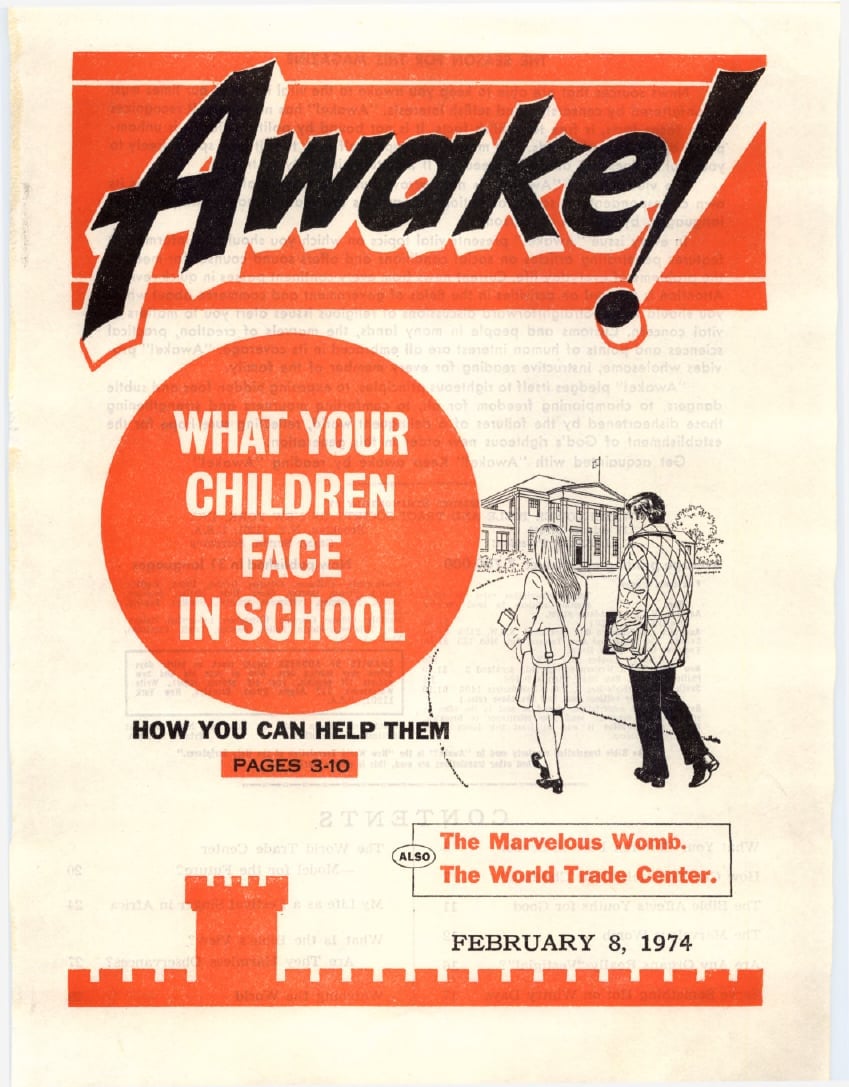
Awake! — February 8, 1974
Source: jw.org
Contents
What Your Children Face in School
How Can You Help Your Children?
The Bible Affects Youths for Good
The Marvelous Womb
Are Any Organs Really “Vestigial”?
Serve Something Hot on Wintry Days
The World Trade Center—Model for the Future?
My Life as a Festival Singer in Africa
Are They Harmless Observances?
Watching the World
Why Do We Grow Old?
A Wealth of Information at Your Fingertips
What Your Children Face in School
What Your Children Face in School
IN TIMES past the school played an important part in the moral development of a child. But school was then much more than a place of instruction where students filled their heads with facts.
The early American philosopher Jonathan Edwards explained that in his day (the eighteenth century) education meant “discipline for life’s duties, discipline to life’s natural moral laws, discipline in the rule of life’s Great Exemplar.” At that time moral training was viewed as more important than gaining knowledge.
Things are much different today. Few people now enter school to acquire moral discipline. There is a totally different atmosphere in today’s schools from that in the schools of years gone by. How does this affect your children? What do they face in school today?
Indifference Toward Study
One of the problems your child is likely to face in school today is indifference toward study. In his book School Discipline in an Age of Rebellion, Knute Larson explains that perhaps the most difficult problem that teachers now face is “the problem of just plain ‘turned off’ kids.” Teacher Bel Kaufman asked: “How do you overcome apathy? . . . These girls are heavy with apathy. I ask them what they would like to do: I offer them choices. They would just as soon sit there till the period is over.” She described the situation in today’s schools as “ominous” and “frightening.”
Why are so many students today indifferent toward their schoolwork? One reason is that some children take a materialistic view of their education. They will apply themselves only to subjects that they feel will benefit them materially. Knute Larson observes: “Outside of directly job related learning experiences, many high school students regard the entire academic curriculum as a complete waste of time.”
Other youngsters refuse to study anything. They have the attitude that ‘the world owes them a living’ and they see no need to acquire skills to care for themselves in later life. These individuals go to school only because they have to or in order to cause mischief.
One of the sad results of apathy toward schoolwork is that many children do not learn to read well. An article appearing in the Dallas Morning News for June 24, 1973, said: “At commencement exercises throughout the city recently, anywhere from 500 to 1,000 of Dallas’ 9,000 graduating seniors, according to official estimates, walked across stages to be handed diplomas they could not read.”
Of course, poor reading may not be wholly the fault of a child. Some methods of instruction in reading have proved woefully inadequate and have come under attack by educators. A San Francisco student recently filed a million-dollar suit against the city and state because he graduated from high school without being able to read adequately.
How well does your child read? How does the atmosphere in his school affect him? Have you visited his school and spoken with his teachers recently? More importantly, have you talked with him personally about his experiences at school? Children benefit when their parents take an interest in what they do.
Attitude Toward Authority
Until recent years the schools did much to engender respect for authority in young people. But now many children do not develop such respect. One educator from the United States observed:
“As we proceeded into the seventies, a formidable youth rebellion started to move down from the colleges into our secondary schools.”
A former assistant principal at Peoria High School, Illinois, made the following comparison of his own school days with what goes on in schools today:
“I know there was some mischievousness when I was in school too, but it wasn’t on an organized basis to disrupt or disparage or cut down the teacher’s authority or respect as it seems to be now. . . . There’s been a decided depreciation in the attitude of many of the students. . . . Discipline and standards seem to have ceased. . . . [It used to be] when I’d go in a classroom if there was quite a bit of noise, it would quiet down within seconds. I was a symbol of authority. But not any more . . . they have no respect for authority.”
This is not because teachers fail to instruct pupils concerning respect for authority. But how is a child to reconcile what his teacher tells him with what he sees adults doing? For example, when he sees perhaps his own teacher, the police, firemen or other civil employees go on strike for more pay in defiance of the law, will the youngster not conclude that rebellion is the only way to get ahead?
Disrespect for authority exists even in grade school today. Because of this, one teacher retired early. She explained: “The language some of [the smaller children] use is one thing. In some cases it’s just unbelievable.” A high school teacher who also retired early said: “They whine a lot, about things like the dress code, and they go around the halls looking like animals, . . . bare feet and all, . . . It’s just depressing.”
Rebellion against authority spreads outside the classroom too. Young people often look down on the authority of the police and of the government. A New York high school boy declared: “Kids view the police as a waste of time. If they want to have a gang fight, the kids feel that the police have no business breaking it up.” As to government: “Many young people feel that they should be their own rulers,” he said.
Violence and Vandalism
Youngsters have been subjected to a worse influence in this generation than in any previous period of time. Each day news reports tell of war and of nations accomplishing their aims by aggression and other underhanded means. Children spend thousands of hours watching television programs that glorify violence, crime and sadism. The effects of this influence are seen in the conduct of children at school.
The Register of Orange County, California, reported: “Today the newspapers that speak of mugging, vandalism, robbery at knife point, assault and rape refer, not to the underworld, but to our schools, our children.”
Newspapers report shootings and knifings in classrooms and schoolyards, rapes, even “vendetta” attacks upon teachers. The Health and Education Committee of the New York City Council reported 5,700 major crimes involving drugs and including rapes and assault on teachers and students during 1971. The special report entitled “Vandalism and Violence” declares: “Teaching in school is twice as dangerous as working in a steel mill . . . [There is a] constant need for disciplining aggressive pupils, which in some schools takes from 50% to 75% of a teacher’s time.”
Many school locker rooms have become deadly arsenals. A New York schoolboy says of his classmates: “Practically everyone in the whole school carries guns or knives.” A high school principal states:
“We’ve gone from finding water guns and bubble gum in lockers to grass [marijuana], ice picks and guns. We’re rapidly developing an environment of fear for the student who wants to come to school to learn . . . The few are terrorizing the many.”
Violent behavior at school is not limited to high schools and colleges. Even the very young face this.
Destructive vandalism regularly confronts schoolchildren today. The report Vandalism and Violence says: “In the past few years, school vandalism and violence, once the marks of a few destructive ‘bad boys’ and ‘psychotics,’ have taken on the magnitude of a national dilemma.”
In some areas students face pressure to join gangs. A high school student stated: “If someone looks strong, a gang will ‘draft’ him. First they will ask him to join. Then they will tell him to do so. Whether he agrees to join them or not, they will beat him up.” Fear, coupled with the desire to be accepted by fellow students, moves many to do what others demand.
Drugs and Sexual Immorality
Another difficulty that your children are likely to face in school is drug abuse. In 1972 a government report from Sydney, Australia, revealed that “up to 50,000 N[ew] S[outh] W[ales] schoolchildren could be experimenting with hard-line drugs.” The report pointed out that 85 percent of New South Wales’ senior students had been offered marijuana or other “soft” drugs in high schools. An undercover narcotics agent who said that she had worked for more than three years in New York city schools stated: “In general, school is like a haven for drugs. It’s a big business there.” She claimed that in some schools 90 percent of the students were using some form of drug. Even some teachers have been arrested for “pushing” drugs to students.
Some schools have taken steps to combat drug abuse by students. But the drug problem among youngsters is so widespread that your children are likely to encounter it in some way. Will they be prepared to resist successfully the temptation to experiment with drugs?
The moral climate among today’s young people may present yet another problem for your children to face in school. Many teachers and students have adopted the so-called “new morality.” It is common for unmarried teen-agers to have sexual relations today. They view it as simply ‘keeping up with the times.’
Overly explicit discussions of sexual matters in class often turn young minds in a wrong direction. School discussions of sex are often based upon the teacher’s personal point of view. Some teachers approve of, even encourage, sexual relations between unmarried persons, homosexuality, masturbation and other sexual perversions. One eight-year-old girl came home from such a discussion at school and asked her mother: “When can I start doing these things?”
Of course, some teachers deplore the excessive immorality practiced so openly today. Not all schools present the same pressures. But what about the school your children attend? Do you know exactly what they face in school in this regard? As a parent, you should. The best way to find out is to talk with them about it.
The School Course
Schoolchildren may face a variety of other difficulties in school. The school course itself can present problems. For example, children whose religion is different from that of the majority of their classmates may encounter customs and practices in school that are incompatible with what they have learned at home. Those who have been raised strictly according to Bible principles may face problems during holiday seasons that they know are of pagan origin. Teachers sometimes expect the entire class to participate in activities related to these holidays. But some children may not be able to do this with a clear conscience. This may even cause other students to ridicule and abuse them.
The widespread teaching of evolution is another problem. Often, courses in biology and history present evolution as a fact. Examinations may be graded as to whether a student agrees with evolution. This can cause difficulties for those who do not accept this unproved theory.
School courses may even include witchcraft and other occult subjects. The Prince George’s Sentinel of Hyattsville, Maryland, reported the following:
“[Citizens for Community Schools] members plan to protest the distribution of a series of handbooks and teachers’ guides which introduce students to the basic principles of astrology, palmistry, fortune-telling by dice and medieval spells and chants. . . . [They] plan to argue, however, that their children in county junior high and senior highs have already taken part in ‘spell-casting’ and ‘witchcraft’ sessions in English classes, in addition to writing papers on their horoscope or zodiac signs. . . . The students are required to prepare creative writing pieces, for example, on exercises contained in one book called ‘Fortune Teller’s Handbook,’ in which chapters on graphology, astrology, and other occult activities are included.”
Indeed, your children can face serious problems in school today. Widespread apathy toward schoolwork and disrespect toward authority can adversely affect their thinking. The crime, violence and general disregard for other people among youths today can have a harmful effect on them too. Even the course of study may contain subjects that are detrimental. Can anything be done to counteract these influences? How can parents help their children through the difficulties they face at school?
How Can You Help Your Children?
How Can You Help Your Children?
HOW can you assist your children to grow up to be responsible, morally upright individuals? What can you do to prepare them to resist the pressures toward rebellion, violence, drug abuse, immorality and other types of wrongdoing that they meet up with both in school and elsewhere? How can you help your children to gain the maximum benefit from their education in spite of difficulties?
Consider an observation of Dr. Lee Salk and Rita Kramer in the book How to Raise a Human Being: “In order to be capable of learning [in later life], [a child] should already have developed both trust and self-control, the sense that it is worthwhile trying to please others and the ability to keep from acting on every impulse.” So, early training at home is of vital importance for children.
Early Training Important
No one knows more about child rearing than Jehovah God. At Proverbs 22:6 his Word counsels: “Train up a boy according to the way for him; even when he grows old he will not turn aside from it.” “The way” concerning which young people need instruction is set out in the Bible.
From its pages they can be helped to “know” God. This can have a wholesome effect on them, because it is by learning of God’s excellent qualities and all that he has done for mankind that humans develop love for him and an earnest desire to have his approval. Whether parents provide such wholesome instruction or not, the thinking and habits of their children will take shape. It is an evidence of discernment and loving concern when parents teach their children even from infancy Jehovah’s ways.
It is well known that much of the indifference of young people stems from failure to see any real purpose in life. And who is it that ought to be answering their questions about this? The parents. Surely, some do try; they endeavor to give them good standards by which to live. But when children learn that the majority of people, often their parents too, indulge in dishonesty and immorality, they frequently reject the ideals that they classify as simply belonging to ‘another generation.’ Something more than personal opinion is needed in order to teach one’s children effectively. The Bible fills that need because it is the Word of mankind’s Creator, the Source of life.—2 Tim. 3:16, 17.
Of course, you will not be able to use it to help your children if you personally do not believe in God or in the Bible. Children are not easily fooled. If you tell them to do one thing but you yourself do the opposite, your children will be quick to detect the hypocrisy. So parents have a weighty responsibility. If they wish to protect their children from the self-seeking, materialistic spirit of so many of today’s youth, they must train them in godly principles both by word and by example.
The Role of Discipline
For children to be equipped to cope with the pressures of life, discipline is vital. The Bible says of God: “Whom Jehovah loves he disciplines.” (Heb. 12:6) The Scriptures also state: “The one holding back his rod is hating his son, but the one loving him is he that does look for him with discipline.”—Prov. 13:24.
Is this an outmoded way of looking at things? Should people view discipline at home and at school as unnecessarily harsh? Dr. Norman Henchey of McGill University writes: “The current wisdom holds that discipline is an invasion of freedom, that only by giving freedom can we teach others to be free. . . . But experience and common sense tell us otherwise. . . . Indulgence is not the spring from which we draw self-control.”
Firm, consistent discipline is really an indication to your children that you love them. Youngsters crave discipline and will often misbehave if they do not receive it. Authors Salk and Kramer write:
“Children feel safer and are more productive in a structured environment; this has been demonstrated by research and confirmed by clinical experience. An atmosphere of complete freedom seems to lead to feelings of insecurity and various kinds of provocative ‘testing’ behavior.”
Discipline, lovingly applied, will help your child in many ways. He will feel more secure emotionally. He will not become frustrated in later life when things do not ‘go his way’ at times. And discipline will help your child to develop an early respect for authority. But discipline does not mean simply punishment.
Help Through “Mental-regulating”
The Scriptures, at Ephesians 6:4, show what must accompany discipline: “And you, fathers, do not be irritating your children, but go on bringing them up in the discipline and mental-regulating of Jehovah.” “Mental-regulating” means more than merely training the intellect by imparting facts about God to your children. The Theological Dictionary of the New Testament comments on the verb form of the Greek word for mental-regulating:
“[It] describes an effect on the will and disposition, and it presupposes an opposition which has to be overcome. It seeks to correct the mind, to put right what is wrong, to improve the spiritual attitude. . . . It does not mean ‘to punish,’ but through the word . . . to cause the appeal to the moral consciousness to gain a hold over men and bring them to repentance and shame, so that punishment is superfluous.”
So parents must do more than provide information for their children. They must exert strenuous effort to assure that right principles reach down into the hearts of their children, that the youths accept what they are learning as the truth. (Prov. 4:23; Matt. 15:19; Luke 6:45) In this way parents train, not only the minds, but also the “will and disposition” of their offspring in righteousness.
How can parents achieve this—educating their children in such a manner that they really want to obey? They should speak to their children frequently about God and the lofty principles for living that are contained in his Word. (Deut. 6:6, 7) The main responsibility for this rests upon the father. When can this be done?
Mealtimes afford an excellent opportunity for relaxed family conversation. In this way parents can get to know what their children face in school and what their viewpoints are toward the unhealthy attitudes prevalent among youths today. Parents will find that some problems can be cleared up with just a brief discussion. But certain topics may require extended discussion in order to mold the thinking of their children in a right direction. How can parents go about this?
Thousands of parents throughout the earth have found it beneficial to hold a weekly Bible study with the whole family. This helps family members to strengthen their relationship with Jehovah God and with one another. Many parents find it wise, on occasion, to adapt the subject matter of their family Bible study to particular needs of family members.
It may be, for example, that your child’s schoolmates are quite indifferent toward their studies, or toward work in general. If so, you might read together scriptures such as 2 Thessalonians 3:10, Ephesians 4:28 and Colossians 3:23, which encourage hard work. For comparison, you could consider Proverbs 10:4; 21:25 and Pr 24:33, 34, where laziness is condemned by God. Emphasize that what you are reading is God’s Word and that it applies both to the child and to you.
If you want your children to be good workers, you must also do your part by giving them useful things to do at home while they are still young. The book How to Raise a Human Being states:
“It’s a vitally important thing for parents to keep in mind at this stage of a child’s development that he has to learn to do things for himself, even though it may mean more trouble for you at the moment. . . . The clinical evidence suggests that many children who later show great dependency and an unwillingness to do things for themselves have been conditioned by a parent’s constant tendency to do things for them.”
Does your child face a corrupt moral climate in school? The Bible contains much information showing God’s viewpoint about sex. For example, the Word of God directs: “Flee from fornication.” Also, “Let fornication and uncleanness of every sort or greediness [including greediness for sensual pleasure] not even be mentioned among you.” (1 Cor. 6:18; Eph. 5:3) “Fornication” means all sexual relations (including homosexuality) outside of marriage. Instead of encouraging fornication, 1 Corinthians 7:9 counsels unmarried persons who may have developed a strong attraction to someone of the opposite sex: “If they do not have self-control, let them marry, for it is better to marry than to be inflamed with passion.” Read this information together with your children and then discuss how it reflects God’s loving interest in the welfare of his servants. Show them that it protects against unwanted pregnancy, venereal diseases and the kind of emotional conflict that has led many young people to suicide.
You may recognize the value of this approach to the matter of helping your children and yet say: ‘I could never do it. I don’t know the Bible well enough.’ Well, how do Jehovah’s witnesses manage? They are ordinary people, some of them only having studied the Bible in recent years.
They use helpful publications that are prepared by the Watch Tower Society for this purpose. Some of these are written especially for small children. Other material is designed for older youths. The subjects covered include misuse of drugs, spiritism, respect for the person and property of others, the importance of truthfulness, and many other topics. All of it is based on the counsel found in God’s Word and is designed for parents to read and discuss with their children. This type of information helps their children to get a wholesome view of life and, at the same time, they learn to read well and acquire good study habits. If you are interested in providing such help for your children, Jehovah’s witnesses will be glad to assist you, free of charge.
There is something else that children need besides proper instruction, however. What is that?
Upbuilding Association
There are hazards that young people face because of the violent and lawless activity of other students. These difficulties cannot be completely avoided. But it is beneficial to realize that most of the activity that could result in any physical harm to a child takes place outside the classroom. Parents can do much toward safeguarding their children by keeping such contact with delinquent children to a minimum. How?
First of all, by making sure that their home is a place to which the children will want to return after school, instead of loitering in the schoolyard or on the streets. What is the situation in your household? When your children return from school, are you there to greet them and are you willing to spend time with them? Do they feel wanted—or in your way? By the manner in which you handle problems that arise, do your children realize that you appreciate the pressures that they face and really want to help them, or might they conclude that it would be better not to mention any difficulties if they do not want to be bawled out? Do you make it a point to do interesting things together as a family, really enjoying one another’s companionship? Wholesome homelife is a major factor in protecting your children.
Of course, young people like to associate with others of their own age too. Where can you find the kind of association that will truly upbuild your children? Jehovah’s witnesses find this among the youths with whom they become acquainted at their Kingdom Halls. These are young people who are cultivating respect for Jehovah God and his Word. They attend these meetings right along with their parents, freely participate on a voluntary basis and even receive free training in giving short talks on Bible topics to the audience. How does instruction and association of this sort influence their lives?
Not long ago one of Jehovah’s witnesses received this note from her girl’s schoolteacher: “This does not happen often that a teacher can write a note such as this, but your little girl is about the best behaved and well-mannered young lady I’ve ever met here or anywhere.” And concerning the teen-agers and parents among Jehovah’s witnesses, the Albuquerque Tribune said: “The police have no problem with Jehovah’s Witnesses’ teen-agers engaging in brawls, vandalism and thievery. Jehovah’s Witness children obey their parents. Jehovah’s Witnesses do not abdicate their position as parents. They are firmly and lovingly in command of their children. They do not expect the teachers and the police to do their work for them.”
Would you like associates of that sort for yourself and your children? Then, why not find out where there is a Kingdom Hall of Jehovah’s Witnesses in your vicinity and go to some of the meetings with them. You will be warmly welcomed.
Never before have youngsters been bombarded by so many unhealthy influences. Parents bear the responsibility to help their children to resist these influences. The best way to do so is to heed the advice of God’s Word: “Go on bringing them up in the discipline and mental-regulating of Jehovah.” To do this, parents must make a careful study of the Bible themselves and show by their own conduct that they really believe it. Will you shoulder the responsibility to give that kind of help to your children?—Eph. 6:4.
The Bible Affects Youths for Good
The Bible Affects Youths for Good
YOUTHS today are often disillusioned by the corruption and hypocrisy they see practiced among adults, including members of Christendom’s churches. This has led to a general disrespect for authority and a breaking down of family relationships. Though perhaps not setting a bad example themselves, many parents have been unsuccessful in helping their children to avoid the trend toward rebellion. Their church has failed to give them needed Biblical direction for training their children.
This was the experience of a schoolteacher in El Salvador. She had been separated from her husband for several years and was trying to raise three boys, ages fifteen, seventeen and twenty respectively. While the youngest was still obedient and respectful, the eldest son had no regard for his mother and was associating with a bad crowd. He would come home late at night, sleep for a while and then leave early in the morning, without ever talking to his mother. In fits of anger he would break some of her appliances. The seventeen-year-old was also pursuing bad associations.
After a period of sickness, this woman asked one of Jehovah’s witnesses to visit her. She then told her: ‘You know, when I was sick, my oldest boys were not concerned at all. They didn’t speak to me; they didn’t inquire about my health. What has my Catholic religion done for me? Not a thing. We’re spiritually bankrupt as a family. Can you help me? You’re the only ones who have ever come to my door, talking about the Bible.’
Her visitor replied: “Well, at least, I could start studying the Bible with you and your youngest son. We would then have to wait to see how we could help the other two boys.”
A Bible study was started immediately and the woman soon began attending the meetings of Jehovah’s witnesses at the Kingdom Hall. The youngest son likewise made fine progress.
One day, while sitting with her Witness companion in the Kingdom Hall, this woman glanced behind her. Grabbing the Witness’ arm, she exclaimed: ‘Look, look who’s here!’
Turning around, her Witness companion noticed a young man in the back of the hall.
Who was the young man? The eldest son of the schoolteacher. He had begun to share in a Bible study being conducted with his girl friend.
The relations between mother and son were still strained, and they were not speaking to each other. Through his study of the Scriptures, however, the son began to change. The frustrations that had prompted him to be disrespectful and violent began to clear up. Appreciating that he was under divine command to honor his mother, he became very considerate of her. Eventually the breach was completely healed, and mother and son became very close.
As for the second-oldest boy, young male members of the congregation of Jehovah’s witnesses showed a real interest in him and this resulted in his agreeing to study the Bible. He, too, is now a fine example in Christian conduct.
What is it about Jehovah’s Christian witnesses that has given young people like these and others an appreciation of the need to apply the Bible in their lives? A young man from the state of Wisconsin relates what impressed him about his first visit to a Kingdom Hall:
“It was so different from my old church services. It wasn’t as if people were just coming to church to ‘put their time in,’ but they really participated in worshiping God. Also, there were different speakers, not just one, and they all seemed qualified to preach. Another big difference from my old church was that there were no collections taken; the emphasis was on worship, not money. And finally, the people were really friendly.”
So the example of Christianity in practice has been a strong incentive for youths to begin living in harmony with the Bible. Why not visit a Kingdom Hall in your locality and see for yourself how the Bible has affected youths for good?
The Marvelous Womb
The Marvelous Womb
WHAT would you regard as the greatest construction job on earth? You will likely agree that, of the millions of structures built, nothing can compare with the building of a human body. And, amazingly, the major part of this work is done in the small female organ called the womb or “uterus.” In fact, we can only begin to grasp the least fraction of the operation of this marvelous “cradle” of life.
This organ, having the shape of an inverted pear, consists of two parts, the main body and the “cervix,” the “neck” of the womb. The womb of the average unmarried woman is about three inches long and is somewhat elliptical at the top or widest part, which is about two and a half inches by two inches in diameter. It is formed of a thick wall of strong muscles, so that the inside volume of the uterus is not much greater than that of a thimble. On the sides, near the top, the two Fallopian tubes branch out, about four and a half inches in length. At a slight angle, under these tubes, ligaments also branch to the two ovaries, each situated near the entrance to the Fallopian tubes. The ovaries are about the size of unshelled almonds, and the inner canal of the Fallopian tubes is about the diameter of a hair bristle.
The first stage toward the construction of a new human begins when the ovaries produce a mature egg or “ovum.” This takes place about every twenty-eight days, the ovaries normally alternating. The tiny pinpoint-size egg, barely visible, finds the trumpetlike entrance to the Fallopian tube and starts a slow journey down its canal toward the uterus. This is the time when conception can take place. At such time sexual intercourse will result in male sperm cells (in the millions) traveling through the cervix, up through the womb and the Fallopian tube, “swimming” toward the ovum. Small as the ovum is, it is 85,000 times as large as a sperm cell! One sperm finally succeeds in penetrating the ovum and reaching its nucleus; there nuclei of sperm and ovum combine to start the life of a new human. The millions of other sperm cells die. Since the life-span of sperm and ovum is only about two days, conception must occur, if at all, within this narrow period.
A New Life Begins
It is to be noted that a new life begins when the cells begin to divide to form the new individual. And the sperm and ovum unite, not in the womb, but in the Fallopian tube, or sometimes during the short journey from the ovary into the Fallopian tube. Conception takes place very rarely, if at all, in the womb. The fertilized ovum reaches the womb about the fourth to the eighth day after conception. Any act that stops the process after conception occurs, or that gets rid of the fertilized ovum, is abortion.
Meanwhile, activity goes on in the womb. A thick, soft, spongy lining, rich in blood vessels, has been made ready. This will form a “bed” for the fertilized ovum. In the case where no fertilization occurs, the blood vessels in the lining begin to be constricted. The lining eventually breaks down and is expelled through the cervix, manifesting itself in a period of bleeding, usually from four to seven days. This is called menstruation.
If conception has taken place, the fertilized ovum multiplies by cellular division, becoming a cluster of cells, but this cluster is extremely small as it travels down the tube. On reaching the womb, this cell cluster, now called a “blastocyst,” imbeds itself in the soft lining. Scar tissue from the wound thus made in the lining closes over the site, protecting the tiny object. Later the growing embryo will protrude farther into the womb cavity, on a “body stalk” that eventually becomes the “umbilical cord.” A bubblelike sac called the “amnion” forms around the embryo and the body stalk. This sac is filled with fluid, which serves as a shock absorber and also provides some nourishment for the forming baby.
The Amazing Placenta
Now marvelous things take place in the womb’s soft lining. The “placenta” begins to form. This is a round, flat organ fastened to the womb wall that, as we shall see, performs amazing functions. As the placenta is forming, blood “islands” appear in the body stalk and the soft lining. Around these islands vascular walls soon appear. The baby’s own circulatory system is formed. By the end of the first month the embryo has simple kidneys, a digestive tract, a liver, a bloodstream and a heart—a small U-shaped tube two millimeters (about one tenth of an inch) long. Thus the circulatory systems of mother and baby are entirely separate and are never directly mixed.
In the few months that it is active the placenta does a stupendous work indeed. From its formation early in the gestation period until birth the baby is wholly dependent on the placenta for oxygen, nourishment and a host of other things. At four months the placenta is a little over three inches in diameter. By the time of birth, it has an eight-inch diameter and weighs about a pound. At birth it becomes detached from the lining of the uterus, to be discarded. For this reason it is sometimes called the “afterbirth.”
How does the placenta get its life-giving supplies to the baby? This is accomplished by the circulation of the baby’s blood through the body stalk, which develops into the umbilical cord. This cord has two arteries leading from the baby to the placenta, and a vein from the placenta to the baby. These blood vessels branch out into the placenta like a group of trees, and leaflike “fingers” made up of cells surround these branches. The mother’s blood flowing by means of other blood vessels from the womb wall into the placenta bathes these “fingers” so that they can dispose of wastes from the embryo and pick up nourishment to carry back through the umbilical cord to the baby.
The placenta serves the baby as lungs, liver, kidneys and intestines until the baby enters the world to be on its own. The placenta also performs some of the functions of a hormone gland. Additionally it produces substances that can combat infections. How does it function as all these organs for the baby’s benefit?
In doing the work of a lung the placenta exchanges carbon dioxide from the baby’s bloodstream for oxygen from the mother’s. As a “kidney” the placenta filters urea out of the baby’s blood and transfers it to the mother’s blood, where it is passed out through her kidneys. As a “liver,” the placenta processes some of the mother’s blood cells, transferring certain necessary components, such as iron, to the baby’s circulatory system. In performing the functions of intestines the placenta digests the food molecules by means of enzymes. These exchanges are made through the pores of the embryo’s branched-out blood vessels. The placenta also does a work similar to the glands by producing certain hormones, both for the baby and for the mother. It serves to protect the baby by manufacturing certain blood ingredients that prevent infection. All of this enables the baby to function fully on its own and prepares it to do all these things for itself after birth.
Since what the placenta supplies comes from the mother’s blood, what the mother takes into her system has an effect on the baby. If she smokes a cigarette, the baby’s blood gets a certain amount of nicotine. If she takes a drug, some of the drug reaches the baby. Many infections the mother develops can affect the baby. The venereal disease syphilis can result in danger to the mother and extreme damage and even death to the baby during gestation or at birth.
There is also a danger in anesthetics given to the mother in childbirth. When a baby is born it needs to be awake and lively, not anesthetized or tranquilized. This is especially so because a baby’s first breath of air requires about five times the effort of an ordinary breath.
The Amniotic Sac—Watery Home During Gestation
During the gestation period the baby lives in the amniotic sac, which is a tough, shiny, transparent membrane. It keeps full of fluid, but this is by no means stagnant. More than a third of its volume is removed and replaced every hour. This amounts to a total daily exchange equivalent to six gallons! In about the third month the baby begins to practice inhaling and exhaling exercises. Breathing in the amniotic fluid may help in formation of its lung sacs. The baby does not drown, because its blood gets oxygen from the mother through the placenta’s action. Also, the baby swallows much of this fluid, from which it apparently gets some nourishment.
The amniotic sac renders another fine service to the baby. It provides the baby with an even temperature in its temporary “home.” Moreover, the baby is almost weightless in its liquid surroundings and is therefore free to kick, to move about and even to turn somersaults, all this strengthening its muscles for when it enters the world of atmosphere and will have to move about without the liquid support.
Marvelous Events at Time of Birth
At the end of nine months the womb has expanded to many times its normal size so that the baby of seven to ten pounds or more can be accommodated. At the time of birth it must contract so as to expel the baby. This is called “labor.” The womb is adequately equipped for this by having a complex system of muscle fibers spiraling around it in both clockwise and counterclockwise directions. Peristaltic waves, initiated in the Fallopian tubal walls, act as lateral pacemakers for uterine contractions that sweep down from the top to the cervix. An interesting fact is that this arrangement might give rise to irregular contraction patterns were it not that the uterus exhibits independently a certain measure of rhythmicity.
After the baby’s birth the umbilical cord is delivered, with the placenta attached to it. If left alone, it would dry up in about a week. But usually the attending doctor cuts the cord after tying it off. Is there danger of profuse bleeding? Not normally. This is because a jellylike substance in the umbilical cord automatically expands to close down the blood vessels like a tourniquet. Also, a valve closes inside the heart so that it can perform its new function of pumping blood to the baby’s now functioning lungs. Were it not for this provision the baby would immediately die.
The baby is usually born head first. The amniotic sac breaks but its fluid still protects the baby from localized injuries by creating a hydrostatic balance so that the pressure of the womb’s contractions are on all parts of its body equally. When the baby is born it is clean and not blood-covered. It will have some amniotic fluid on it. Also, when the placenta breaks free from the womb’s lining, the womb then rapidly contracts to its original or nearly its original size without appreciable blood loss.
Reproductive Organs Deserve Respect
It is indeed a wonder to contemplate the work accomplished in the womb. In this consideration only a mere “fringe” has been explored. Biologists and medical men can explain very little of the operations. Who does understand them fully? The One who designed the entire operation—the Creator, Jehovah God. Note how truthfully the Bible psalmist wrote under inspiration (Psalm 139:13, 15, 16):
“You yourself produced my kidneys.”
Yes, each organ in the body was predesigned by the Creator and directly fashioned in the womb for its specific function.
“You kept me screened off in the belly of my mother.”
Even today many birth processes cannot be observed by men. God arranged matters so that the structural process, some of which is not pleasing to the human eye, would not be seen. The baby is brought forth from the womb a finished product, clean, beautiful, lovable.—Compare 1 Corinthians 12:23, 24.
“My bones were not hidden from you When I was made in secret, When I was woven in the lowest parts of the earth.”
In the sixth week the embryo gains a complete skeleton, not yet of bone, but of flexible cartilage, which later turns to bone. The psalmist speaks of the ‘weaving’ of sinews, muscles, tissues—the thousands of different ‘threads’ that are woven into a most intricate pattern of color, beauty and function. It is done in the complete darkness of the womb, as hidden and mysterious to men as the depths of the earth.
“Your eyes saw even the embryo of me, And in your book all its parts were down in writing, As regards the days when they were formed And there was not yet one among them.”
Scientists now know that the genetic code is primarily contained in the “genes” located in the nucleus of the fertilized ovum. God, who designed the pattern for mankind, can also know beforehand the specific physical and mental traits a child will have by inheritance.—Compare Genesis 16:11, 12; 25:23; Romans 9:10-12.
The psalmist goes on to say:
“So, to me how precious your thoughts are! O God, how much does the grand sum of them amount to!”—Ps. 139:17.
Knowing the wonderful complexity of our bodies and their reproductive qualities, and God’s high regard for them, men and women should indeed avoid their misuse. Deliberate, unnecessary sterilization would certainly reflect disrespect for God’s creation. (Compare Deuteronomy 23:1.) On the other hand, diseases may require operations sacrificing certain organs in order to save one’s life. This situation occurs at times with respect to the female reproductive organs. Christians leave these matters up to the consciences of those involved. The decision would be based on their own knowledge of the problem and the advice of physicians as to the need or urgency of such an operation. At all times, however, it ought to be kept in mind that this “cradle” of life is the handiwork of God, and is to be treated with great respect.
[Diagram on page 12]
(For fully formatted text, see publication)
1. Cervix
2. Uterine cavity
3. Fallopian tube
4. Fertilization
5. Ovary
Are Any Organs Really “Vestigial”?
Are Any Organs Really “Vestigial”?
FOR many years various organs of the human body were called “vestigial” by evolutionists, that is, the last vestiges of organs that supposedly once had a use, but were no longer needed because of the claimed advance up the evolutionary ladder. Of interest in this regard is the small gland that is shaped like a pinecone and hence called the “pineal” gland. Though it is located near the center of the brain, it is not part of the brain. “Until very recently” it was thought that “the pineal in man served no biologic purpose and was merely a vestige,” reported the journal Hospital Practice. Now the pineal has been shown “to possess a unique ability to produce melatonin.” This is a substance that affects the brain, the reproductive system, as well as the pituitary, adrenal and thyroid glands.
Scientists believe that in man the pineal gland “exerts a control over the body, specifically by regulating the body clock.” (Science Digest, September 1972) The pineal does this evidently by secreting various chemicals. Thus it is believed that the pineal gland may chemically supervise many of the involuntary activities of the human body, such as helping to make body temperatures increase during the daytime and decrease at night.
Another gland long thought to be useless is the thymus. In an article entitled “The ‘Useless’ Gland That Guards Our Health,” Reader’s Digest stated:
“For at least 2000 years, doctors have puzzled over the function of a pinkish-grey bit of tissue lying just below the neck and behind the breastbone—the thymus gland. . . . Modern physicians came to regard it, like the appendix, as a useless, vestigial organ which had lost its original purpose, if indeed it ever had one.
“In the last few years, however, the dogged detective work of a small band of Americans, Britons, Australians and Swedes have cracked the thymus enigma. These men have proved that, far from being useless, the thymus is really the master gland that regulates the intricate immunity system which protects us against infectious diseases. . . .
“But is the thymus the only organ regulating our immunity system? Recent experiments have led researchers to believe that the appendix, tonsils and adenoids [once these too were tagged as vestigial] may also figure in the antibody responses.”
Serve Something Hot on Wintry Days
Serve Something Hot on Wintry Days
IT WAS a cold winter day as various members of a certain family came home for supper. What did they find to eat? Cold cuts! What a disappointment that was! All of them were looking forward to something hot to warm them up after coming in from the cold.
True it is, the colder the weather the more the members of your family will appreciate hot meals, morning, noon and evening. And now, when there is such a fuel shortage, and homes, schools and places of employment may not be heated as comfortably as one would like, there is all the more reason for serving hot, heat-producing meals.
Consider Nutrition
An important factor in withstanding cold is nutrition. In particular are proteins helpful in this regard, as can be seen from the diet of Eskimos. But in these days of extremely high meat prices, one must often look to other sources for the necessary proteins. There are eggs, also the vegetable proteins found in soybeans (the most highly rated), as well as those found in other beans, peas and lentils. And cheese can be added to many hot dishes.
For sound health it is important to have a balanced diet that contains the necessary vitamins and minerals, largely obtainable from fruits and vegetables. The vegetables certainly should not be overcooked. But with a little careful planning they can be served hot.
Remember, especially during cold wintry weather, that digestion is a chemical process, and practically all chemical processes are expedited by heat. So it follows that your stomach can digest hot foods, or at least warm foods, more readily than cold ones, which first have to be warmed by it. This is something that persons with weak stomachs should keep in mind. They would do well to avoid eating anything ice cold unless it is eaten like ice cream, which one eats so slowly that it is first warmed up in the mouth before it is swallowed. When eating any foods that are kept in a refrigerator, they would benefit by allowing these to reach at least room temperature. But on a cold wintry day, rather than having cold cuts served at room temperature, far better to serve something hot. And if you truly want to serve a hot meal, first heat your plates, if not also your cups, just before mealtime.
Hot Breakfasts
In wintertime by all means feature something hot for breakfast. For many, a bowl of hot oatmeal (preferably not the “quick” kind) is hard to beat when it comes to a dish that is nourishing, easily digested and economical. If you would make it an especially nourishing treat, cook it with milk and honey. Some Europeans also add diced apple and an egg yolk, and then, just before serving, they fold in the egg white beaten stiff.
There are, of course, other hot cereals from which to choose. Among these are cracked or whole wheat (the latter takes quite a while to cook but is very tasty, chewy and nourishing), hominy grits (made from corn or maize), corn mush and farina. And be sure not to overlook rice (unpolished). Ask almost any Oriental and he will tell you how good it is to start off the day with a big bowl of hot rice. So you can serve a different hot cereal each day of the week, if you wish, adding both nourishment and enjoyment to your family’s breakfast.
If you are in too much of a hurry in the morning, then the night before put one-half cup of whole wheat in a quart thermos. Add boiling water and let it stand for five minutes. Pour off the water and fill the thermos to the top with fresh boiling water. Now, cover it tightly and let it stand overnight. In the morning you will have enough cooked whole wheat for two persons.
For other hot breakfast dishes there are eggs, which can be served in many different ways. And there are many kinds of pancakes, to which can be added such fruits as blueberries, thinly sliced apples or bananas. What about serving waffles or hot muffins, with or without walnuts or pecans? If your menfolk do hard physical labor, hot biscuits served with creamed beef or sausage make a good breakfast.
The extent to which the foregoing suggestions fit your needs, of course, depends quite a bit upon the activity of your family, the extent to which they are exposed to the cold and how weight conscious they are. Growing teen-agers require more food than does the average housewife or other adults who may be engaged in sedentary occupations.
Soups Galore
While there is such a thing as cold soup, we usually think of soup as being something hot. And what a variety you have to choose from! A thin clear or creamed soup can serve for a lunch or the first course of the day’s main meal. One leading cookbook devotes twenty pages to hot soups, and there is another cookbook devoted entirely to soups, giving more than 120 recipes. Among other things, it asks: “What can be more warming on a cold winter’s night than a bowl of richly-flavored and aromatic steaming homemade soup?”
To start, there are the stock soups—made from pieces of chicken or chicken giblets, or from beef or lamb meats and/or with the bones of these animals. Fish stock can be made from the backbones of fish, such as sole and halibut, together with their skins. And while on the subject of fish, what about clam chowder and oyster stew? The recipe books also list a “vegetable stock” soup, made with onions, carrots, the white parts of leeks, celery, turnips and/or potatoes cut small, to which butter or oil is added.
Then there are the consommés, boiled down so they are condensed. They may be of beef or of chicken, and possibly with tomato or long thin pieces of vegetable added. Aside from the vegetable consommés, these are usually at their best with the addition of a few tablespoons of sherry.
Among the vegetable soups are minestrone, green pea, puree of turnip, cauliflower, spinach, watercress, leek or potato, with or without garlic. For something different, why not serve your family French onion soup, Russian borsch or Polish sauerkraut soup?
And then there are the cream soups. Most housewives will buy the base for these soups canned, thereby saving themselves much work, and will cream them simply by adding milk instead of water. Favorites among these are asparagus, celery and tomato soups. For a special treat that will really delight your family as well as your guests when you have company, serve creamed mushroom soup. It is very easy to make. For four people take half a pound of mushrooms, slice and sauté together with onions until brown. Then put these in a blender together with a quart of milk. After blending, heat to a boil, adding salt and pepper to suit your taste. Not only is this soup tasty and nourishing, but recent research has shown that both mushrooms and onions counteract cholesterol in your blood.
For those who want to watch their weight or who do not engage in arduous physical labor, almost any kind of soup can be the basis for a meal, together with a slice or two of toast, and a piece of fruit for dessert.
Where a really hearty soup is desired for a meal in itself, consider such creations as Scotch barley or oxtail soup, lentil, bean or pea soup, cream of chestnut soup and Philadelphia pepper pot (a highly spiced soup made with tripe and vegetables).
Not to be overlooked are the various kinds of garnishes for your soups. Among these are the tiny crackers called oysterettes and croutons. Croutons? Yes, these are tiny squares of bread toasted or fried; they can be flavored with garlic, cheese or bacon. Matzo balls go well with chicken soup, frankfurter slices with lentil, pea or bean soup, pieces of cheese with other kinds of soup. And almost any soup can stand a sprinkling of parsley.
Other Dishes
Do not overlook the various kinds of hot sandwiches, particularly those made with beef and cheese. These really hit the spot on a cold winter day.
And not only will hot dishes, temperaturewise, warm up your family, but so will the judicious use of hot spices, such as red pepper and curry powder.
Of course, there is also such a thing as hot desserts—for those who are not weight watchers!
Something to Drink
What about alcoholic beverages? Will they help to warm up your family? If you serve wine or a mixed drink—that is, to adults—when they come in from the cold, the immediate effect is to warm them up. But do not think that alcoholic drinks can repeatedly warm them up if they happen to be outside in the cold. That is a mistaken idea that has cost some their lives. True, the immediate effect of drinking an alcoholic beverage is to cause the blood to rush to the surface of the body, making one feel warm. But then what happens? If out in the cold the air cools off the blood and so gradually the body’s temperature is lowered.
There are many hot drinks that can fortify one against the cold. If not a cup of hot coffee (many persons prefer the decaffeinated kind), then a cup of Postum, Ovaltine, hot chocolate, Chinese tea or some other kind of tea. Or if something more substantial is desired, how about hot milk flavored with honey or butterscotch or malted milk? Or perhaps an egg nog? For a special treat you might want to make hot spiced cider. Its recipe calls for cider, cinnamon sticks, cloves, allspice and some honey, boiled together, after which the spices are removed.
Truly it is richly rewarding to serve your family hot meals on cold wintry days. And what a wide variety of things can be served! There will be no disappointment either if you prepare and serve things with love for your family, taking pleasure in keeping them healthy and happy.
The World Trade Center—Model for the Future?
The World Trade Center—Model for the Future?
WHATEVER else they may be, the twin towers of the World Trade Center are colossal. Each tower is 110 stories, soaring upward from the sidewalk 1,350 feet—more than a quarter of a mile in the air! They completely dominate the famous New York skyline.
But it is not only their tremendous height that dwarfs the surrounding skyscrapers. It is also their monstrous bulk. Each building is a 209-foot square—about an acre in area. And since the buildings rise in a sheer, uninterrupted line, every one of the more than 200 floors has about an acre of space! That is enough area on each floor for more than nine professional basketball courts!
The World Trade Center, however, includes much more than the twin towers. It is on a sixteen-acre site on the Hudson River side of lower Manhattan island. Already included in the $800 million complex is the eight-story U.S. Customs Building and the nine-story Northeast Plaza Building. Yet to be constructed are the Southeast Plaza Building and a hotel. Eventually all six buildings will be situated around the large five-acre plaza.
At its formal dedication on April 4, 1973, the World Trade Center housed 304 firms employing 7,000 persons. More than twice that number of persons are now working there. Less than half the floor space is presently occupied; many floors are yet unfurnished. Completion is scheduled for sometime in 1975. Eventually 50,000 persons are to work at the Center, and some 80,000 business personnel and sightseers are expected to visit daily.
But why build such a mammoth complex? Is it practical? Are they, as claimed, “the buildings of the oncoming 21st century”?
Purpose and Motives
The complex was built as a central headquarters for firms representing every essential world trade service and activity. Thus, exporters, importers, freight forwarders, customhouse brokers, international banks, and numerous other world-trade-oriented firms can now be located under one roof. As Jack Zwick, head of the World Trade Institute, noted: “It’s all intended to make trading easier and make people better able to plan trading strategies.”
But why such huge buildings? Harry B. Helmsley, a director of the company that manages the Empire State Building, undoubtedly identified the reason when he said: “The image of having the tallest building is important.”
In October 1970 the Trade Center’s north tower eclipsed the Empire State to become the tallest building in the world. But that distinction was short-lived. For just last spring the Sears, Roebuck & Co. building in Chicago topped out at 1,450 feet, a hundred feet higher than the twin towers.
However, the competition is not over. As Helmsley noted: “We are considering plans to add to the Empire State.” Interestingly, last year certain workers at the World Trade Center were speculating regarding the apparent slowness in completing the south tower. Some wondered whether its height might be increased to regain the distinction of being the world’s tallest building.
New Generation of Skyscrapers
The present can-you-top-this skyscraper competition is reminiscent of what occurred a little over forty years ago. In 1931, as the economic depression worsened, the Empire State Building reached 1,250 feet, surpassing the 1,048-foot-high Chrysler Building. Soon afterward really tall skyscraper construction ceased, leaving New York city with seventeen buildings over 600 feet high.
More than twenty-five years later, in 1960, New York still had only seventeen buildings above 600 feet. Then new construction began. In 1970, New York city alone was in the process of erecting nine buildings over 600 feet high! Now the city has at least forty skyscrapers in that category! Chicago has ten; Los Angeles, four, and several other cities have two or three.
Obviously, few of these new skyscrapers were seeking to break a record. Only five of them are over 1,000 feet. Why, then, have so many tall buildings been put up? The president of one land development corporation explained: “The greatest plus of the skyscraper in highly concentrated cities is economic.” Land, for example, in downtown Atlanta, sells for $150 a square foot, and as one developer noted: “70 stories gives better productivity.”
Improvements in building technology also are a major factor in the skyscraper boom. More efficient elevator systems save on interior space. Use of lightweight cement and prefabrication methods have been important. Stiffer steel frames provide greater rigidity and strength. The Trade Center’s twin towers, for instance, have a maximum sway in high winds of eleven inches, compared to fifteen inches for older skyscrapers.
…