Awake!, September 22, 1973
Download: PDF — Awake!, September 22, 1973
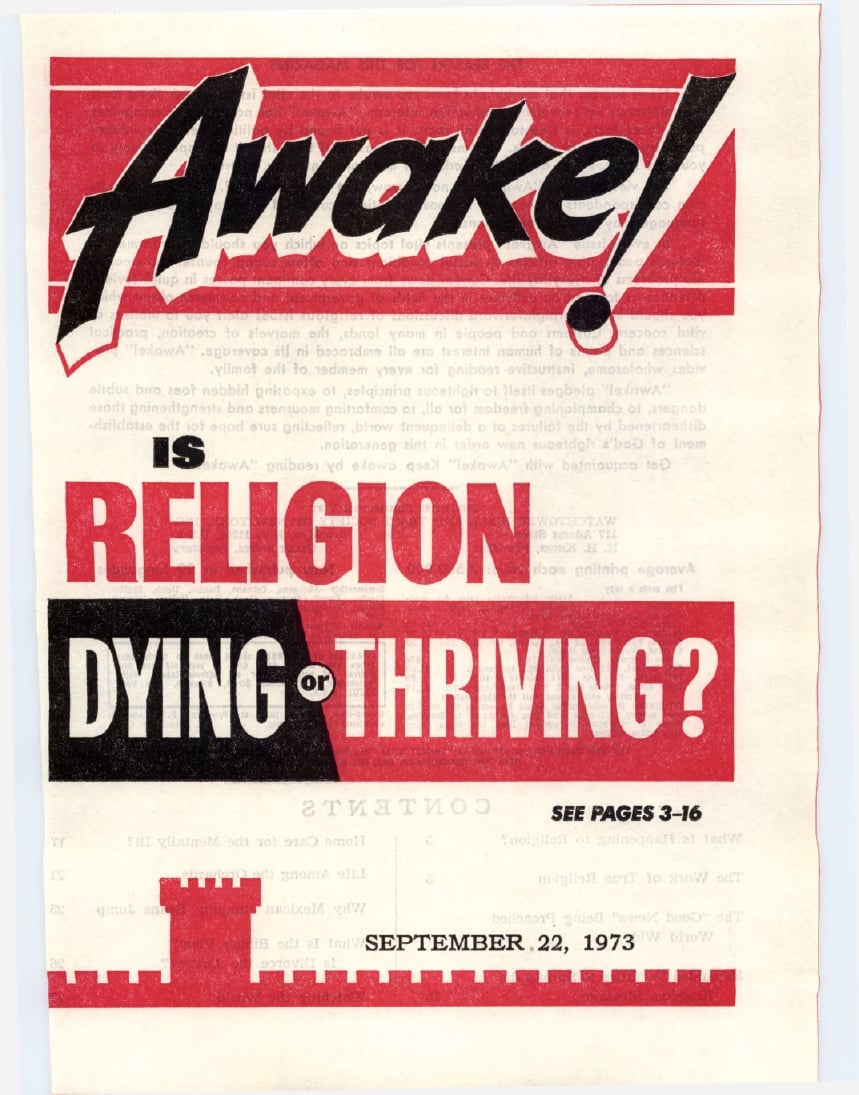
Awake! — September 22, 1973
Source: jw.org
Contents
What Is Happening to Religion?
The Work of True Religion
The “Good News” Being Preached World Wide
Expanded Facilities to Spread the Kingdom Message
Home Care for the Mentally Ill?
Life Among the Orchards
Why Mexican Jumping Beans Jump
Is Divorce the Answer?
Watching the World
Help In Finding Scriptures
Do You Long For True Peace and Security?
What Is Happening to Religion?
What Is Happening to Religion?
HAVE you wondered what is happening to religion? What is the meaning of the turmoil in the churches? Does it mean that religion is on the way out?
‘By no means!’ some may answer. Where they live, many may belong to a church, and on Sunday mornings large numbers may still attend the services. But this situation is clearly the exception now, rather than the rule.
In fact, the rapid decline of religion has become a common topic of discussion today. The national Catholic magazine St. Anthony Messenger of May 1973 notes:
“The decline in converts is just one factor in the malaise of Catholicism in the present day. Priests and sisters leave their posts, seminaries report drops in enrollments, parochial schools shut their doors, young Catholics reject traditional religious and moral values, Sunday Mass attendance sags.”
The decline is observed not only in the Catholic religion. Church attendance is sagging and millions are quitting other churches as well. This May, at the 185th general assembly of the Presbyterian Church in the U.S.A., a church official lamented that Presbyterians had “experienced the same downward trend in membership as have many of our sister churches.”
However, even more serious than the membership loss is the defection of the clergy. Baptist minister Warren Carr, in his new book At the Risk of Idolatry, writes: “Clergymen are finding it just as difficult to stay with the church as are the laymen. Many of my professional colleagues have already made their exits. More are planning to do the same thing. The exodus shows no signs of abating.”
Episcopal priest John W. Downing, director of an agency that helps former priests and ministers to obtain secular employment, predicted that half of all clergymen in the United States will quit by 1975. Could this really happen?
A report in the Yearbook of American Churches 1972 indicates that it could. “In a nationwide survey,” the Yearbook says, “nearly four in ten young Protestant and Roman Catholic clergymen said they have seriously considered leaving the religious life. Among Jewish clergymen, the proportion is six in ten.”
The prospects for replacing the departing clergy are dim indeed. Few people want to become clergymen. Thus many seminaries are closing. In just one area in the middle United States twelve of thirty-three have closed since 1967! The Christian Century observed: “Protestant seminaries are drying on the vine and Catholic seminaries are dying on the vine.”
The situation in other countries is worse. “Eighteen thousand churches, chapels and oratories in France have been or are about to be abandoned,” reports the Paris Le Journal du Dimanche of January 18, 1970. “This means that sooner or later over half of the places of worship in France are doomed.” The Ottawa Citizen of January 6, 1973, notes: “Britain has seen 5,000 [churches] closed in the past few years.”
The decline threatens to cripple world religion. But what is behind it? Why have so many left the churches, or, at least, seldom attend anymore?
Reasons for Decline
For one thing, people have become disgusted with the way the churches keep harping on money matters. “‘I’II tell you what the church’s attitude is,’ said one active Lutheran. ‘It is one of greed. They want your money. . . . They always act as if they can’t get enough.’” Have you felt similarly about the churches? Persons who do have been quitting religion.—The Lutheran, November 6, 1968.
Also, many people are disturbed by religion’s involvement in political matters. Readers Digest of October 1971 carried an article entitled “Must Our Churches Finance Revolution?” It claimed: “The World Council of Churches is using church power and church funds to back insurrection in the United States and Africa.” Are churches with which you are acquainted deeply involved in political issues?
The clergy have not been sticking to the work of teaching God’s Word, and this has distressed many. “Sure, we’re Biblical illiterates,” admitted one woman, as reported in The Arizona Republic. “The ministers aren’t preaching or teaching the gospel anymore.” Is it any wonder, then, that people have been abandoning religion?
The opinion reached by many persons is that the churches simply are not serving God. The front cover of the March 1969 Ladies’ Home Journal carried this arresting heading “1,000 Women Report: ‘You Can’t Find God in Church Anymore!’”
Could it be that Almighty God himself disapproves of the churches?
Religion That God Disapproves
God’s Son Jesus Christ made clear that God does not approve of all religion. These words of Jesus aptly apply to practicers of religion that fails to conform to his Father’s will:
“Not everyone saying to me, ‘Lord, Lord,’ will enter into the kingdom of the heavens, but the one doing the will of my Father who is in the heavens will. Many will say to me in that day, ‘Lord, Lord, did we not prophesy in your name, and expel demons in your name, and perform many powerful works in your name?’ And yet then I will confess to them: I never knew you! Get away from me, you workers of lawlessness.”—Matt. 7:21-23.
Workers of lawlessness! Do you want to be identified with the kind of religion that God views as working lawlessness? ‘But,’ you may object, ‘God would never view a religious system in that way, would he?’
Indeed he would! Consider, for example, the Jewish religious system in the first century that professed to do God’s will, but did not do it, preferring their own ideals instead of God’s Word. (Matt. 15:1-9, 12-14) God’s Son Jesus Christ said to its leaders: “Look! Your house is abandoned to you.” “The kingdom of God will be taken from you.” And that is exactly what occurred! That entire religious system was rejected by God. As a result, it did not simply die out gradually. Instead, in 70 C.E. it was wiped out—its temple and priests and worshipers being destroyed, as God’s Son had foretold.—Matt. 23:38; 21:43; Luke 19:41-44.
What about your own religion? How does it stand with God? There is a way to find out.
The Work of True Religion
The Work of True Religion
RELIGION that God approves conforms to God’s requirements, and does the work he set out for it. Otherwise, it is not true religion.
What, then, is the work of true religion?
Among its outstanding responsibilities is the work that God’s Son Jesus Christ assigned to his followers, saying: “Go therefore and make disciples of people of all the nations . . . teaching them.” And showing the particular message that they should preach, Jesus also said: “This good news of the kingdom will be preached in all the inhabited earth for a witness to all the nations.” (Matt. 28:19, 20; 24:14) While doing this work, the Bible shows, those who practice ‘religion that is clean from the standpoint of our God’ must keep themselves “without spot from the world,” not showing the world’s spirit or meddling in its political affairs.—Jas. 1:27.
Are the churches doing that? A tract sponsored by the Foreign Mission Board of the Brazilian Baptist Convention, which could well apply to all world religion, admits:
“When Jesus left his disciples . . . he gave them only one job. That was to evangelize the world. . . . The truth is that we are doing everything else except the one thing that He ordered us to do . . . We have not taken the Gospel to the whole world. We have not carried out His orders.”
This failure of the churches to preach the “Gospel” in all the world is apparent to many. When social historian Will Herberg was asked recently whether the churches were fulfilling the needs of the people, he said: “I don’t think most churches ever did, in the sense of their one legitimate religious function: preaching the Gospel.”—U.S. News and World Report, June 4, 1973.
Why have the churches failed to do the work that God’s Son assigned to his followers? Is it simply a matter of unintended oversight of responsibility? No, for as two ministers pointed out regarding the largest federation of religions in the United States:
“The National Council of Churches does not have as its primary objective the preaching of the gospel . . . It has become an ecclesiastical power bloc, aiming for a powerful super-church.”
Yes, the churches have deliberately failed to carry out God’s will to preach the “good news” of his Kingdom rule. Instead, they have deeply involved themselves in the political affairs of the nations. And they have directed their peoples to put their hopes in the governments of men for lasting peace.
What, then, about the work that Christ said that servants of God would do? Is anyone doing it?
Religion That God Uses
God’s Word never goes unfulfilled. The “good news of the kingdom will be preached,” just as Jesus prophesied. God is today using a religious people to do this worldwide Kingdom preaching. But they are a people separate and distinct from those religions that have identified themselves as part of the world and supporting its aims. Who are they?
Jesus explained one way they could be identified, saying: “By this all will know that you are my disciples, if you have love among yourselves.” (John 13:35) When you think of all the religious groups you know, which one stands out notably because its members have genuine love among themselves?
There is a religion that is noted outstandingly as bearing that fruitage of love. The Sacramento Union of July 9, 1965, editorially commented regarding them: “Suffice it to say that if all the world lived by the creed of the Jehovah[’s] Witnesses there would be an end of bloodshed and hatred, and love would reign as king.”
But are Jehovah’s witnesses doing the work of true religion? Are they making disciples of peoples of all nations in obedience to Christ’s command? Are they preaching the good news of God’s kingdom?
Church of Scotland minister Arthur G. Gunn, writing in his church paper, noted: “Everyone who joins the Jehovah’s Witnesses becomes a minister, and must go from door to door testifying. In this respect they point out,” Gunn acknowledged, “our most glaring weakness, the failure of our rank-and-file to preach the Gospel.”
Yes, the zeal of Jehovah’s witnesses in preaching the Kingdom gospel often amazes others. Leo Pfeffer wrote in the book Church, State & Freedom: “Their aggressive missionary tactics are reminiscent of those employed by the early Christians.” The very purpose of Jehovah’s witnesses, as the charter of their legal corporation declares, is “to preach the gospel of God’s kingdom under Christ Jesus unto all nations as a witness to the name, word and supremacy of Almighty God JEHOVAH.”
That is their aim. But are Jehovah’s witnesses really accomplishing it? Are they preaching the gospel on a scale that is in fulfillment of Jesus’ prophecy? How extensive really is their preaching?
[Box on page 6]
DID YOU KNOW THAT . . .
● Last year Jehovah’s Christian witnesses were active in preaching the good news of God’s kingdom in 208 countries and islands of the sea?
● They devoted 291,894,945 hours talking to other people about the good news, and this without pay?
● They made 135,898,447 return visits on persons who showed interest in Bible truth?
● Regularly each week they conducted free Bible studies in 1,269,277 homes?
● They distributed in their ministry last year 217,109,764 copies of “The Watchtower” and “Awake!”?
The “Good News” Being Preached World Wide
The “Good News” Being Preached World Wide
MORE is being done to preach the good news of God’s kingdom world wide than many people realize. The truth is, never before in the history of mankind has there been a more sustained and intensive program of preaching and teaching about God and his purposes.
Charles S. Braden, as professor of the History and Literature of Religions at Northwestern University, wrote in his book These Also Believe: “Jehovah’s Witnesses have literally covered the earth with their witnessing.” Braden added: “It may truly be said that no single religious group in the world displayed more zeal and persistence in the attempt to spread the good news of the Kingdom than the Jehovah’s Witnesses.”
That observation was made in 1950—twenty-three years ago. Since then the preaching of God’s kingdom has taken on ever greater scope and intensity. Winthrop S. Hudson says in the 1973 edition of Religion in America: “The Witnesses often seemed omnipresent . . . ringing doorbells endlessly in an effort to gain an opportunity to present their message.”
Magazines That Proclaim the Kingdom
One means that Jehovah’s witnesses use to spread the Kingdom message is the printed page. “Announcing Jehovah’s Kingdom” is the slogan on the cover of their principal magazine, The Watchtower. Its companion magazine, Awake!, points to “the establishment of God’s righteous new order in this generation.” More than a million copies of these magazines, on the average, are printed every day—over 385 million last year. Why, just in the last three years over one billion (1,000,000,000) copies of The Watchtower and Awake! have been produced! Laid end to end, the production would stretch over six and a half times around the globe!
There are very few magazines of any kind in the world that match this circulation. And there is no other magazine anywhere that has such a widespread distribution. The Watchtower is regularly distributed in 208 lands in 74 languages, and Awake! in 29 languages.
By comparison, how have magazines of worldly religions been doing? The Los Angeles Times of September 23, 1972, said: “Denominational magazines have great difficulty keeping afloat.” Many have already died. The Christian Century, a prominent United States Protestant journal, noted: “There is nary a religious editor or publisher of our acquaintance who is not profoundly anxious over the future of his own publication—if, indeed, he still has one.”
Years ago Roman Catholic priest John A. O’Brien toured the printing plant of Jehovah’s witnesses in Brooklyn, New York. He was astounded to learn that Jehovah’s witnesses produced annually tens of millions of magazines as well as other publications. He wrote in the Catholic Digest of December 1962: “This figure exceeds the total output of all the Catholic publishers in the U.S. combined.”
And that was over ten years ago! Since then Catholic publications have declined, while the circulation of The Watchtower and Awake! has more than doubled!
What accounts for this remarkable increase when other religious periodicals are decreasing or even folding up? Is it because Jehovah’s witnesses are preaching the good news of God’s kingdom, and God is blessing their work? Interestingly, a letter regarding Jehovah’s witnesses appearing in the Catholic Commonweal periodical of October 2, 1970, observed:
“Much of the secret of their success can be found by reading their humble publications, Watchtower and Awake! . . .
“The Witness magazines’ anonymous writers write clearly and simply. Their object is to share the good word of the Gospel and to encourage you to go to the source of their wisdom. It inspires, instructs, and comforts.”
The Watchtower and Awake! have had a prominent part in proclaiming the “good news” of God’s kingdom world wide. But other publications produced by Jehovah’s witnesses have also.
Bibles and Bible Study Books
The world’s all-time “best seller” is the Bible. Portions of it have been translated into 1,500 languages. Jehovah’s witnesses are one of the largest producers of Bibles in the world. In 1972 they printed and bound 2,407,411 copies of the complete Bible in six languages.
But Jehovah’s witnesses do far more than print and distribute Bibles. They produce books to help people to understand the Bible. In fact, their printery in Brooklyn, New York, is one of the largest in the world. About 100,000 hardbound books are produced there on an average day—the record for one day being 170,270.
In 1968 Jehovah’s witnesses released the Bible Study aid The Truth That Leads to Eternal Life. Quickly it became an all-time “best seller.” No other book in the Western world, besides the Bible, exceeds its circulation! Guinness Book of World Records under the heading “Best Sellers” reports:
“The total disposal through non-commercial channels by Jehovah’s Witnesses of the 190-page hardbound book, The Truth That Leads to Eternal Life . . . reached 46,000,000 in 67 languages by February, 1972.”
Now, only a year and a half later, this Bible handbook has reached a circulation of 59 million copies in 84 languages! That is over two and a half times the number of the next best-selling book listed in Guinness Book of World Records. And it is five times the total copies of the best-selling fiction title, which reportedly has “a total [sales] of 11,919,660 copies.” Yet a number of books published by Jehovah’s witnesses exceed that total, including the following ones released in recent years:
YEAR
PUBLISHED BOOK QUANTITY
1967 Did Man Get Here by
Evolution or by Creation? 18,000,000
1968 The Truth That Leads to
Eternal Life 59,000,000
1969 Is the Bible Really the
Word of God? 17,000,000
1971 Listening to the Great
Teacher 13,000,000
———————————
Total: 107,000,000
However, the above are not the only books that Jehovah’s witnesses have printed during the past six years. Millions of larger books, including more than 600,000 copies of the 1,700-page Bible dictionary Aid to Bible Understanding, were also produced. And during previous years, the 320-page book “Let God Be True” reached a circulation of 19,246,710 copies in 54 languages. Also, 13,752,775 copies of the 256-page book From Paradise Lost to Paradise Regained have been produced in 60 languages.
The sole purpose of all this literature is to help people to learn the good news of God’s kingdom. Thus the publishing operation is entirely nonprofit. Hardbound Bibles of over 1,400 pages are placed on a contribution of only a dollar, and 192-page hardbound books are left for just a 25-cent contribution. Money received is used to further the preaching of the good news, not to enrich individuals.
These Bibles and Bible study helps are used in home Bible studies that Jehovah’s witnesses conduct free of charge with interested persons. Over one and a quarter million of such studies are held throughout the world every week! How successful is this Bible study program?
Increase in Kingdom Preachers
Its success has been phenomenal. Commenting on this, one person wrote in a prominent Canadian church magazine, The United Church Observer: “It has only been through Jehovah’s witnesses that I have been able to discuss and argue and finally develop a keener understanding of Christianity, of God and his works, because with them, we always look up questions in the Bible.”
Many students are, as a result, moved by their keener understanding of God and his kingdom to share with others the “good news” they are learning. Soon they dedicate themselves to serve Jehovah God. In just the past five years more than 680,000 persons were baptized by Jehovah’s witnesses, and joined in preaching the good news of the Kingdom earth wide. What has this meant?
For one thing, an increase of Kingdom preachers, so that now over 1,700,000 persons are preaching world wide. This has required more meeting places in which to assemble, and, hence, a tremendous construction program. In just the United States three new Kingdom Halls are completed, on the average, every week! These are buildings usually large enough to accommodate 150 to 300 persons. Yet now they are often crowded beyond capacity.
In an African land, for example, some congregations of about 140 Witnesses have 800 persons regularly attending their meetings! This year, at the Memorial celebration of Christ’s death, over 3,883,000 Witnesses and other interested persons assembled world wide on April 17.—Luke 22:19.
Surely religion is thriving! But the religion that is thriving is the one that has God’s spirit on it because it is doing the work that He has ordained for these “last days”—preaching the good news of God’s kingdom.
How well are Jehovah’s witnesses equipped to fulfill such a tremendous assignment—to preach God’s kingdom “in all the inhabited earth”? Do they have the printing facilities to meet the growing demand for Bible literature?
[Picture on page 9]
An average day’s production of hardbound Bible study aids in the Brooklyn printery of Jehovah’s witnesses would make a pile four times as high as the world’s tallest building
Expanded Facilities to Spread the Kingdom Message
Expanded Facilities to Spread the Kingdom Message
MORE and more people are distressed over the worsening world conditions and wonder how these can be improved. There is a growing demand for literature that explains God’s solution—his Kingdom government. This demand has required expanding the printing facilities of Jehovah’s witnesses around the world.
In 1920 Jehovah’s witnesses first obtained a rotary press and began printing operations in a small building in Brooklyn, New York. The whole floor space was only 3,000 square feet. In 1927 a new eight-story factory, with nearly twenty-five times that space, was completed. But demand for Bible literature required further expansion.
By 1968, the printery had grown to more than nine times the size of the 1927 factory. It filled four city blocks, with floor space equaling about 15.2 acres! And the number of rotary printing presses had increased to eighteen. But the fastest expansion was yet to come.
Expansion Speeded Up
In November 1969 Jehovah’s witnesses purchased the huge, ten-building complex of the Squibb pharmaceutical plant, less than half a mile from their Brooklyn factory complex. This nearly doubled available space, providing badly needed storage area, particularly for paper. In five years the number of rotary printing presses, weighing between forty and fifty tons each, has more than doubled. There are now forty!
In 1972 these presses used over 20,000 tons of paper—800 train carloads of 25 tons each. One rotary press will consume a 1,400-pound, five-mile-long paper roll in forty minutes! Almost every day over 200 paper rolls of various sizes are turned into Bible literature. The twenty smaller sheetfed presses, in addition, consume hundreds of tons of paper a year.
Nevertheless, by 1970 it was clear that the Brooklyn printing facilities would be unable to meet the growing demand for Bible publications. So construction was begun on a one-story 300-foot by 200-foot printery on Watchtower Farm, about a hundred miles north of Brooklyn. This was completed in March 1971.
However, even before its completion, it became obvious that this plant would be too small. The demand for the printed message of the Kingdom was that great! So a much larger three-story addition was immediately started. When completed, this factory complex will have more than nine acres of floor space!
Printing began at this plant in February 1973. Millions of magazines a month are now pouring from the presses. Ten forty-ton rotary presses have been set up, and there will be room for more.
A Unique Printing Operation
The tremendous size is not what makes this printing operation unique. Huge newspaper plants produce more printed matter. But it is as Modern Lithography of September 1970 noted:
“With the possible exception of those great metropolitan newspapers that own their Canadian forests and paper mills, the Watchtower’s printing plant may well be the most self-contained in the United States.”
This self-containment is evident in many ways. For example, all the ink for the big presses is made right in the Brooklyn printing plant—over 250 tons a year and in dozens of colors! Also, hundreds of tons of paste and glue are made for wrapping magazines and binding books and Bibles. Diesel engines supply direct current to run many of the printing presses and other printing and binding equipment. A crew of sixty-seven mechanics service and repair the equipment.
Practically every operation to produce a finished piece of literature is handled in the plant. Manuscripts are proofread, translated, set in type; plates are made, and the publications are printed. Magazines are trimmed, wrapped and mailed. Book sections are sewed and glued, covers are pasted on, and the finished books shipped.
But self-containment is especially noted in connection with the work force and its care. Over 800 persons work in the Brooklyn printing plant. These all live a few blocks away as a family, called the Bethel family. Other members of the family care for the Bethel home, prepare the meals, wash the clothes, and so forth. All family members are Jehovah’s witnesses who have volunteered their services because they are sincerely interested in seeing the good news of the Kingdom preached in all the inhabited earth. Each receives board and room and $14 a month for incidental expenses. Their interest is not in personal material gain but in the preaching of the good news of God’s kingdom.
Worldwide Expansion
Due to the worldwide demand for Bible literature, Jehovah’s witnesses have established similar printeries in many countries. Germany, South Africa, Canada, England and Switzerland each have plants with one or more large rotary presses, Printeries in Denmark, Sweden and Finland produce over 15 million magazines a year on smaller sheet-fed presses. Magazine printing is done by Jehovah’s witnesses in France too.
However, just as expansion has speeded up in the United States, so it has world wide. For example, in just the past year or so six new printeries have been established.
JAPAN
A new home and printery was completed a year ago at Numazu, seventy-five miles southwest of Tokyo. It was paid for by loans and donations from Jehovah’s witnesses in Japan; no money was supplied from elsewhere. So generous have been the contributions that, by the end of 1972, most of the loans were paid back.
Even before the building’s completion, a new forty-ton rotary press, made in Japan, was erected. The first magazine that came off it was the October 8, 1972, Awake!—some 300,000 copies! Now over a million copies of Awake! and The Watchtower, in Japanese, are printed on this press each month. It turns out an amazing 21,000 magazines an hour! These are appreciated by many in Japan, for they deal with issues the Japanese are interested in, particularly how the country’s problems of crime and pollution will be solved.
There is plenty of room for expansion in this three-story printery. When Milan Miller, who supervises printing-press erection, first walked into it he exclaimed: “Stupendous!” Measuring it, he said that eight large rotary presses could be installed on the first floor! The adjoining five-story home also is spacious, accommodating comfortably forty-nine Bethel family members, with space for many more.
Construction and Factory Personnel
The construction work was done by the company that built the new Tokyo palace of Emperor Hirohito. However, this company agreed to sublet the electrical installation to Tojiro Takahashi, one of Jehovah’s witnesses. The big moment of the six months of electrical construction came when the brothers assembled by the rotary press. The switch was thrown, and the press started to roll!
The complicated Japanese-character writing system presents many problems in printing. There are as many as 16,000 different characters that may be used. Newspapers commonly use 1,400, though many more need to be available for normal printing. The monotype keyboard contains 3,249 standard characters, and the operator must know each one instantly. Yet Jehovah’s witnesses have learned the operation of these machines quickly, so that one worker can now set most of a magazine in type in a week.
The desire to see the message of God’s kingdom spread throughout Japan prompts the earnest efforts of the workers. All volunteer their services, even as do all the more than 16,000 Witnesses who are zealously preaching the “good news” in Japan. Among those working in the printery is Akinobu Hironaka, whose father was in the group that accepted the surrender of the British general at Singapore during World War II. Also, Hiroyuki Negami, a former “golf pro,” is now supervisor of the factory magazine department. Their interest is the doing of God’s will.
BRAZIL
The new factory and home in São Paulo, Brazil, is even larger than the one in Japan, having nearly two acres of floor space! The complex was actually begun back in 1968, when a new three-story home was completed. But the increase of Brazilian Kingdom preachers by more than 13,000 in just two years called for further expansion.
Efforts, therefore, were made to purchase adjoining property. But it was difficult to locate one of the owners, since he lived in a remote area of Brazil. A friend of his who owned a nearby store was advised of the Witnesses’ desire to see him. Time passed with no word, so a Witness went to the store to make inquiry. The storekeeper had just said, “No, there is no word from him,” when who should walk in but the property owner! Arrangements were made for the purchase.
Thus, late in 1971, construction began on two five-story additions. Also, an adjoining factory was purchased, remodeled, and tied in to this complex. These additional structures increased by more than two and a half times the floor space of the original building.
About half of the 158 workers employed on the construction were Jehovah’s witnesses. Many of these chose to work at reduced salary. Others accepted an invitation to live at the Bethel home, receiving the allowance each month that all Bethel family members do. In addition, on weekends Witnesses from nearby congregations helped with cleaning the building, inside and out. Many thousands of dollars were thus saved on construction costs.
Printing Gets Under Way
The building was completed and dedicated in March 1973. Soon afterward a large rotary press from Germany was delivered. It is now printing about 700,000 Portuguese Watchtower and Awake! magazines a month. These magazines have a circulation larger than practically any other magazine in Brazil. Another large rotary press has recently arrived from Germany, and it is hoped that soon Spanish literature will also be printed here.
In addition to the use of regular mail service, magazines are also trucked to many of Brazil’s 1,260 congregations, which now include more than 75,000 Witnesses. Delivery was often irregular when magazines were shipped from Brooklyn. But now people in Brazil can receive their Biblical magazines on a more regular basis.
AUSTRALIA
Construction began on a new printery in Sydney in January 1972. It was merged with two other buildings of Jehovah’s witnesses, which were renovated. This resulted in one new modern building, with about an acre of floor space. This increased the available working area to some five times what it was!
All the construction work was done by the Witnesses, except for certain specialist jobs. Volunteers gladly came from more than a thousand miles away! Arrangements were made to demolish four buildings. The materials from these, particularly the bricks and timbers, were then used in the new building, effecting a tremendous saving.
Printing and Its Effect
A forty-ton printing press soon arrived from Japan. Thus regular printing of The Watchtower and Awake! started less than a year after the beginning of construction work! Nearly 700,000 magazines a month are now printed in Australia, most of them in English. A few thousand are also printed in Motu, Melanesian-Pidgin and Fijian. Magazines are being supplied from Australia to twenty-five countries or islands.
Most of the English magazines are distributed in Australia, helping the more than 23,000 Witnesses there to preach the good news of God’s kingdom. Many are reading The Watchtower and Awake!, and are responding to the “good news” they contain. For example, the following letter was received by the office of Jehovah’s witnesses in Sydney on March 27, 1973:
“Dear Sir,
“I am a Catholic Mother Superior and for 25 years I have served the Church. While waiting in Dr. Bailey’s office, Macquarie Street, I met a lady from Bondi, who started to speak to me. I looked at what she was reading while waiting for the doctor, and it was an article about Trinitarianism.
“This is a long course discussed in the training of a Catholic Nun and one of our most important Doctrines. The lady explained she had a car accident and was getting some tests done. She was so sincere in her belief of God, that I know not many people today are, . . . She accidentally left the magazine and I picked it up and started to read it.
“I was astounded, surely what I had learnt for 25 years couldn’t be wrong.
“I have now read this article over and over again checking facts for myself. You see, I want to serve the God of Truth.
“As I pray about this matter my whole body is aware that perhaps there are more flaws in the Church. I will find your people and discuss future questions.
“You are unable to write to me as I belong to a closed order called Carmelite nuns but have 3 weeks vacation. I still can’t believe it is possible to be wrong after 25 years but if I am then God will show me the way out.
“Thank the lady for me if you know her.
Yours sincerely,
(Signed) Mother Superior”
GHANA
In May 1972, less than a year after construction began, the expanded facilities of Jehovah’s witnesses in Accra, Ghana, were ready for occupancy. These facilities include a new printery.
The construction work was all done by Jehovah’s witnesses. Skilled masons, plumbers, electricians, carpenters and other artisans all volunteered their services. A Witness building contractor supervised the entire construction, free of charge. Every weekend four of the 45 congregations of Jehovah’s witnesses in Accra and nearby Tema freely volunteered their labor, between 70 and 100 of them showing up every Saturday and Sunday. Where a child was too young to be left at home, the mother tied it to her back and went about her work as baby slept contentedly.
To pour the second floor, all the concrete had to be carried upstairs. The concrete was loaded into steel head pans, each having a capacity of a cubic foot. These pans were balanced on the heads of the women, who carried them up the ramp to the second floor. That whole 3,600-square-foot area of the second floor was poured in this way in three days!
The new printery is self-contained and efficient, providing magazines for use by Ghana’s more than 16,000 Witnesses. The type is set and plates are made here. Printing is done on a brand-new sheet-fed press. A folder then folds the sheets into magazines of 24 pages. The magazines are printed in the African Twi, Ga and Ewe languages—about 20,000 every month. Also, more than 58,000 English magazines, printed in England, are distributed here. The Watchtower and Awake! thus have a far greater circulation than any other magazine in Ghana!
NIGERIA
A new printery was also completed this year in Lagos, Nigeria. It occupies the first floor of a new three-story construction. This new building has a library, offices and thirty-one bedrooms on its second and third floors. It has been merged with the existing Bethel home, about doubling the size of the facilities.
The entire construction was paid for by the Nigerian Witnesses. They also did all the work, with the exception of the laying of the terrazzo floors. Experienced carpenters, masons, bricklayers, steelworkers and electricians freely volunteered their services. From July 1972 through March 1973 a peak number of fifty-two Witnesses kept right on the job, with a reduced crew of about sixteen finishing up the work. The whole job was completed in a little over a year—a very short time for such construction in Nigeria.
The factory started operation in May 1973. Printing is done on two sheet-fed printing presses received from Germany. The Watchtower is printed in three Nigerian languages, Yoruba, Ibo and Efik, and the Awake! is printed in Yoruba. All together, over 111,000 magazines are printed a month. In addition, more than 200,000 English magazines are received from England each month, and distributed for use by Nigeria’s 88,000 Witnesses. The Watchtower and Awake! thus have a combined monthly distribution greater than any other magazine in Nigeria!
THE PHILIPPINES
Since the second world war Jehovah’s witnesses have progressively expanded their facilities in the Philippines, until now they have a five-building complex. A large two-story factory and new home were completed just last year. These additions increase by more than one and a half times the space available.
The property for these buildings was obtained at a particularly low price following the second world war. This is because, during the war, the Japanese had, at this place, tortured Filipinos to get information from them. Thus, as a result of the stigma attached to it, the property was not one desired by buyers.
This February all magazine printing in eight Philippine dialects, previously done in Brooklyn, was taken over by this newly constructed printery. Also, English Watchtower and Awake! magazines for the islands are now printed here. A new forty-ton rotary press was purchased from Japan for this work. Despite the large number of different-language magazines produced, over 250,000 copies a month are turned out. These are used by the 55,000 Philippine Witnesses to spread the Kingdom message.
OTHER EXPANSION
However, the new factories at Watchtower Farm and these six new printeries just mentioned are not the extent of the recent expansion. Other printeries have either been enlarged or moved to new quarters. For example, the following:
In May 1973 presses were moved from the Paris, France, printing plant of Jehovah’s witnesses to a newly built one in Louviers, about sixty-five miles away. In 1972 an extension was made to the printery in South Africa, expanding it substantially. In 1971 an addition was made to the printing plant in Sweden, which now produces well over half a million magazines a month. Also, a large new extension to the printery in Finland is nearing completion. Here over 200,000 books a year are bound, and millions of magazines are printed.
In 1972 an addition was made to the factory of Jehovah’s witnesses in Wiesbaden, Germany, and new bindery machinery was purchased. This makes it possible now to bind as many as 30,000 books here in a single day! The German factory also produces about three million magazines a month. In 1970 the move was made from the smaller printery in Bern, Switzerland, to a five-story home and factory in Thun. Here two large rotary presses each month print over two million magazines.
From 1955 until now Jehovah’s witnesses have increased the number of their large rotary presses earth wide from nine to sixty-four! Yes, printing facilities are available to meet the growing demand for Bible literature! And Jehovah’s witnesses are making good use of them to accomplish the work that Jesus gave his followers to do.
To whom goes the credit for all of this? Just as the apostle Paul acknowledged (after he and Apollos had done their work of preaching) that ‘God makes it grow,’ so, too, Jehovah’s Christian witnesses of modern times give all credit to Jehovah God for prospering the preaching of the good news of his kingdom—1 Cor. 3:5-7.
What About You Personally?
So it is obvious that there are two sides to the current religious situation. As both the members and leaders of many of the religions of Christendom admit, their churches are in a state of serious decline.
At the same time the work that Jesus foretold that his disciples would do is thriving as never before in history. As the facts show, the ones who are doing this work are Jehovah’s Christian witnesses. The things that they believe and the message that they preach are what God has had recorded in the Bible. It is that good news that has given a real purpose in life to hundreds of thousands of sincere persons; it has brought them into association with clean-living people who truly care about their fellowmen; and it has given them a firmly based hope for the future.
Jehovah’s witnesses will be glad to share that information with you too. You are welcome to attend the meetings in their Kingdom Halls. Also, they will gladly study the Bible with you free of charge in your own home. Simply write to the publishers of this magazine or make known your desire to Jehovah’s witnesses locally.
[Picture on page 11]
In 1972 a large new printery, with residence for the volunteer workers, was built by Jehovah’s witnesses in Numazu, Japan
[Picture on page 12]
700,000 copies of “The Watchtower” and “Awake!” in Portuguese are now printed each month here in Brazil
[Picture on page 13]
Magazines printed here in Australia are supplied to twenty-five countries or islands
[Picture on page 14]
A new factory for printing Bible literature has been completed in Ghana; here both men and women, all volunteers, share in pouring the concrete
[Picture on page 15]
In Nigeria, over 300,000 copies of “The Watchtower” and “Awake!” are sent out for distribution to the public each month
Home Care for the Mentally Ill?
Home Care for the Mentally Ill?
FOR ten years they had been a happily married couple. The husband had a fine mind and was active in the Christian ministry. But then he began to have lapses of memory, his mind would go blank while giving a Bible talk, and at his job he would get colors mixed up when painting an auto.
Gradually he talked less and less, and before long all he was saying was “No! No! No!” as many as eight times in a row. Then he lapsed into complete silence. But physically he was hyperactive. He would pace the floor from morning to night, and it was a problem to get him to go to bed. After five years he died.
During those years, time and again specialists were consulted, but they said that nothing could be done to reverse his deterioration. A leading New York psychiatrist, who diagnosed him as suffering from a “degenerative, progressive, organic disease,” concluded his diagnosis with these words to the patient’s wife: “May I say at this point that you are an extraordinarily fine person. The sacrifice that you are making to take care of your husband who is a totally helpless individual is unusual. Many people would have had their irresponsible relative in an institution a long time ago.”
Why did his wife decide to take care of her husband at home? Why had she decided against committing him to an institution? Since doctors agreed that no further medical help could improve him, even in an institution, should she commit him? “It would be like throwing your sweetheart away,” is the way she put it. “You marry for better or for worse, don’t you?” She kept showering affection on him, for, said she, “he is like a baby; you cannot communicate intelligently with a baby but he can feel love, and so can my John.”
Institutional Care Not Always a Blessing
Did that veteran New York psychiatrist tell the wife that she was foolish for taking care of her totally helpless husband at home? No, rather, he commended her as “an extraordinarily fine person.” He may have expressed such a view because of an awareness that institutional care of such mental cases often leaves much to be desired.
This fact was highlighted by an experiment in which eight well-educated persons posed as mentally ill. They asked to be admitted to a total of twelve different institutions in various parts of the United States. What did they find? The university psychologist who organized the experiment and was himself one of the experimenters reported that their discoveries were “damning to the institutional system. For instance, four of these pseudo-patients (who kept a daily record) were ignored or slighted by the staff physicians or attendants three fourths of the time when they tried to talk with them.
Among the conclusions reached by these experimenters was that “the consequences to the patients hospitalized in such an environment—the powerlessness, depersonalization, segregation, mortification, and self-labeling—seem to be undoubtedly counter-therapeutic,” that is, tending to make the patients worse rather than helping them to get better.—Medical World News, February 9, 1973.
In an article appearing in Mental Hygiene, January 1969, entitled “Making Chronic Schizophrenics,” two psychologists gave similar testimony. They showed what harm often results to mental patients because of the way they are treated in an institution. Attendants “recurrently humiliate patients and emphasize the low esteem in which they are held.” Some institution employees take the attitude that patients “are essentially different, and what is bad for us is not necessarily bad for them.” Tragically, the way the attendants treated the patients caused the patients to act in the very ways that the attendants claimed they wanted to suppress. It caused the patients themselves to elicit the various punishments they feared most.
According to a very well-known American psychiatrist, use of the electric shock treatment is greatly overdone in mental institutions and so is the use of drugs. In his private practice he tries to keep severely ill patients out of the hospital if possible. Why? Because, as he said, ‘hospitals are places where patients frequently get worse.’
Why Home May Be a Better Place
No doubt there are many sincere and dedicated doctors and staff members in such institutions, so what is wrong? Ever so much! For one thing, institutions often are unable to pay for quality help or are understaffed. And it is just too much to expect that every mental patient will get the sort of sympathetic personal help that he needs.
It seems that many attendants in such places are prone to overlook the fact that a mentally disturbed person is not always and in every respect abnormal. In other words, his course is erratic. In some respects he may be normal all the time and in other respects abnormal just part of the time. He has lucid moments when he is amenable to reason and able to respond to understanding treatment.
Then, too, experience has shown that mental patients are generally more sensitive to the behavior of others than they were in their normal state; this is because of their helplessness. A mental patient needs the care of someone with a steady hand and controlled sympathy, things that he is more likely to find at home than in an institution.
Supporting this position is a report by the World Health Organization: “With the extension of education on psychiatric topics, more and more relatives have developed sufficient insight to be able to tolerate the patient in home surroundings, provided they are given (professional) help. . . . It is not always advisable to admit the patient to a hospital if his family is prepared to maintain him in the close emotional relationship of the home.”
A book on this very subject, Home Care for the Emotionally Ill, by Dr. H. S. Schwartz, underscores the fact that an intelligent and humane family can create a most favorable climate for the recovery of a mental patient. But there is also another factor to consider. What is that?
The Bible shows that mates have obligations toward each other. Further, parents are obliged to care for their children and may have endowed them with a genetic defect that leads to the problem. On the other hand, the Bible lays upon grown children the obligation to care for aged parents. This obligation may well include caring for parents even though they are no longer fully sound in mind.—1 Tim. 5:3-8.
Of course, not every emotionally ill person can be cared for at home. But where it is clear that the patient is not a danger to himself or to others, the home may well be the best place to care for the patient. At home, recovery may well be the quickest and the easiest.
What It Takes
Caring for an emotionally disturbed or ill person at home is no small task. It would be ideal for the patient to have his own room and for the family to have some trained help such as a part-time or full-time nurse. Also, it would be ideal if an understanding and sympathetic physician had the oversight of the patient and could be consulted from time to time. However, many persons have got over a “nervous breakdown” or severe mental depression or other forms of mental or emotional illness in their homes without such ideal circumstances. Other members of the family, however, had to be equal to the challenge.
The member of the family upon whom the chief burden usually falls is the wife or mother, even as in the case noted in the foregoing. She should be mature—mentally, emotionally, spiritually and physically. She must be self-controlled, affectionate and yet not sentimental; she must be able to be firm when there is need and able to put up with trials. What it really calls for is what the Bible terms the “fruitage of the spirit,” such as love, joy and self-control. Above all, much love is needed.—Gal. 5:22, 23; 1 Cor. 13:4-8.
The love must be genuine, unhypocritical, not superficial. There must be genuine interest in the patient’s welfare. The Bible also says that “love covers a multitude of sins.” Love hopes, so hope for the best and appeal to the best in the patient. Have empathy. Treat the patient as you would like to be treated if you were in his shoes.—1 Pet. 4:8; 1:22.
Understanding is also important. As one doctor put it: “The goal . . . is to understand the patient. Everything the therapist says and does should be directed toward that end.” How can you get to understand such a person? By encouraging him to speak.
Further, recognize that mental aberrations are but extreme forms of weaknesses we all have. For example, we all have feelings of guilt at times. But the mental patient may be so overcome with feelings of guilt that he feels hopeless.
Do all you can to build up the patient’s self-respect. Avoid making fun of him. Always give him the opportunity to save face. Where possible, explain away his mistakes. Do not treat him as an inferior, but as though he were normal, which he may well be part of the time. As one of America’s leading psychiatrists put it: “They can be given what they lack; they can be taught and with this new knowledge helped to will differently and do better.” So appeal to the best part of him. Manifest a sense of humor, endeavoring to get him to laugh by making yourself the object of a joke. Laughter releases tension and so is good for mind and body.
Keep in mind that a common basic characteristic of the mentally ill is rebellion. They are often determined to do the opposite of what they are told to do or what they are told not to do. They may resemble children having tantrums, lacking reason and self-control. Prone to be suspicious, they may require an “indirect approach.”
For example, a rebellious patient once went on a rampage, started throwing books around and threatened to punch out the windows. What was to be done? Telling her to stop would merely make her more determined to continue. So her psychiatrist used the indirect approach. He sat on top of the bookcase and kept counting aloud as she dropped one book after another onto the floor. Then he picked up one book and asked her if she had ever read it. He told her of its interesting contents. What were the results of his exercising self-control, using a sympathetic sense of humor and a diverting tactic? He had her helping him put the books back in the bookcase, apologizing for having thrown them about! By similar tactics he diverted a patient standing on a window ledge ready to commit suicide.
The Physical Aspects
The physical aspects also are important, for well has it been said that “good physical care is a gateway to mental health.” A patient should be made as comfortable as possible. Giving attention to his appearance can have a beneficial effect upon him. With firm and loving help you can start an act and lure him to complete it, such as washing, clothing or feeding himself.
If he is prone to sit in a corner by himself all day long, encourage the patient to take walks. Helpful also are massages, even though one may not have any professional training. A prolonged warm bath can help a disturbed patient. Extremely important is proper diet. According to one leading psychiatrist, a proper diet can be the key to treating mental disorders. Especially important are vitamins and minerals found in unrefined foods.
Help from the Bible
In particular, one should apply Bible principles and truths in dealing with a mental patient. The Bible shows that a cheerful heart does good as a medicine. (Prov. 17:22) It also gives the example of how music helped a king who had an emotional problem. Patients who never speak have been known to sing.—1 Sam. 16:14-22.
It is also helpful to encourage the patient by calling to his mind expressions of God’s watchcare over his earthly children. For example: “As a father shows mercy to his sons, Jehovah has shown mercy to those fearing him. For he himself well knows the formation of us, remembering that we are dust.” (Ps. 103:13, 14) And again: “Do not be anxious over anything, but in everything by prayer and supplication along with thanksgiving let your petitions be made known to God; and the peace of God that excels all thought will guard your hearts and your mental powers.” Of course, the ones caring for the mentally ill person also need to strengthen themselves by such scriptures and also by prayer.—Phil. 4:6, 7.
Truly, care for the mentally ill presents a challenge. A knowledge of what is involved should cause any family to weigh the matter carefully before committing a member who is mentally or emotionally disturbed to a mental institution rather than caring for him at home.
Life Among the Orchards
Life Among the Orchards
By “Awake!” correspondent in Canada
LET me act as your host in the orchard country overlooking Okanagan Lake in southern British Columbia, the westernmost province of Canada. It has been said that this is one of the most delightful areas in Canada, located as it is about 280 highway miles east of the metropolis of Vancouver.
The winters here are usually mild and the summers warm and sunny. Spring offers a panorama of fruit trees in blossom, while fall sees the fruitage of the tree and the vine reaped. All of this within sight of a series of lakes that nestle like placid mile-wide rivers between the mountains. These lakes, of which eighty-mile Okanagan is the longest, are the lifeblood of the area. Without irrigation the average rainfall of twelve inches a year would be sufficient only to grow sagebrush and thin trees. But with irrigation many types of fruit are grown. The frost-free season is too short for citrus growth but long enough for cherries, prunes, peaches, pears, apricots and grapes. And it is ideal for apples.
Growers have explained to me why this is one of the finest apple areas in the world. The dry summers, they say, reduce disease, while the usual high average of hours of sunshine during the growing season enhances the production of starches and sugar. Important, too, is the preharvest period of cooler nights. With temperatures often approaching freezing, the apples gain a delightful crispness and depth of color. In fact, the B.C. apple has become well known in many parts of the world as an outstanding product.
I must caution you not to be frightened if our stroll should suddenly be interrupted by a loud bang. It is simply one of the latest devices used to try to increase the cherry harvest. As the cherry is the first fruit to mature in the spring, many birds are eager to add this dessert to their staple fare of grubs and worms. So, you can see, it is not just humans who are anxious for cherries to ripen. As a result, some orchardists have turned to using automatic noisemakers that go off at timed intervals to discourage birds. It is really harmless. But if a number of growers are using them in one area, at times it can sound like a small-scale revolution.
Striving for Quality and Economy
Over there, through the trees, you can see the orchardist. He is driving his tractor, with that big spraying machine, between the rows of trees. He needs quite a bit of specialized equipment even though his orchard is only about twelve acres in size. That is slightly bigger than average, although there are large company holdings of up to 300 acres and more.
While you might feel this would be the ideal life, I can tell you that the orchardist is beset with many problems. Here in the Okanagan Valley of British Columbia there are more than 3,000 growers farming 35,000 acres, not including those whose land is too small to register with that of commercial growers. Furthermore, almost everyone else has a few trees in his backyard. For most of the growers, it is difficult to make a good living. Costs of land, machinery and labor are rapidly increasing, while prices for fruit received by the grower are about the same as twenty years ago.
In addition to low prices, another problem that the grower has no control over is the weather. To counter that, he must use good management and common sense. His orchards must become productive enough during the good seasons to “ride out” the storms, both financially and physically.
This particular orchardist we are now watching at work has become more efficient by striving for higher quality along with increased production. He cuts costs by using specialized machinery. Now, instead of hiring labor throughout the season, he needs some extra help only briefly during harvesttime. The rest can be handled by him and his family.
In addition, he has found that, by replanting with a variety of smaller trees, as much as three and four thousand bushels to the acre can be grown. These new varieties allow distances between trees to be reduced drastically. Some have even planted full dwarf trees in rows that appear like hedges about eleven feet apart. One of the problems encountered when the trees get too small, however, is that late spring ground frosts may kill the fruit buds, which, by virtue of the smaller tree, are a lot closer to the ground.
You may have thought, as I once did, that a bigger tree would have a lot more apples on it. But the grower says it just is not so. Additionally, the best fruit is on the outside of the tree where the sun can get at it. The smaller tree has less wasted area inside. Besides, it is so much easier to pick the fruit. In some cases no ladders are needed at all.
Along with smaller trees, growers are turning to new strains that produce a richer color. These bring higher prices. The growers know that a housewife likes to provide her family with fruit that is good-looking as well as good-tasting. Thus, varieties have been developed that fairly sparkle with depth of color. More than fifty different varieties of Red Delicious, for example, are available. Yet that is very few compared to the nearly ten thousand different apple varieties grown throughout the world.
New Methods of Pest Control
I can see that you are quizzical about the spraying done by the orchardist. You are likely concerned about the global charges being made that all sprays have a detrimental effect on the environment. The orchardist has been keeping up-to-date on that too, No longer does he attempt to kill every insect and nurture the fruit in an almost sterilized atmosphere. Interestingly, he has learned that even some so-called “harmful” pests can be of assistance to him. For example, some varieties of mites that appear in the early part of the season are food for other insects that do not harm the tree. Now if these mites are killed by using an insecticide, their predators will also likely be killed or driven away and will not be around to devour other more dangerous varieties that show up later. So, later, another spray would have to be applied. Now growers are getting the same results by not using insecticides at all. They just make sure they have plenty of helpful insects. It saves time and money and shows respect for the ecology too.
…