Awake!, August 22, 1973
Download: PDF — Awake!, August 22, 1973
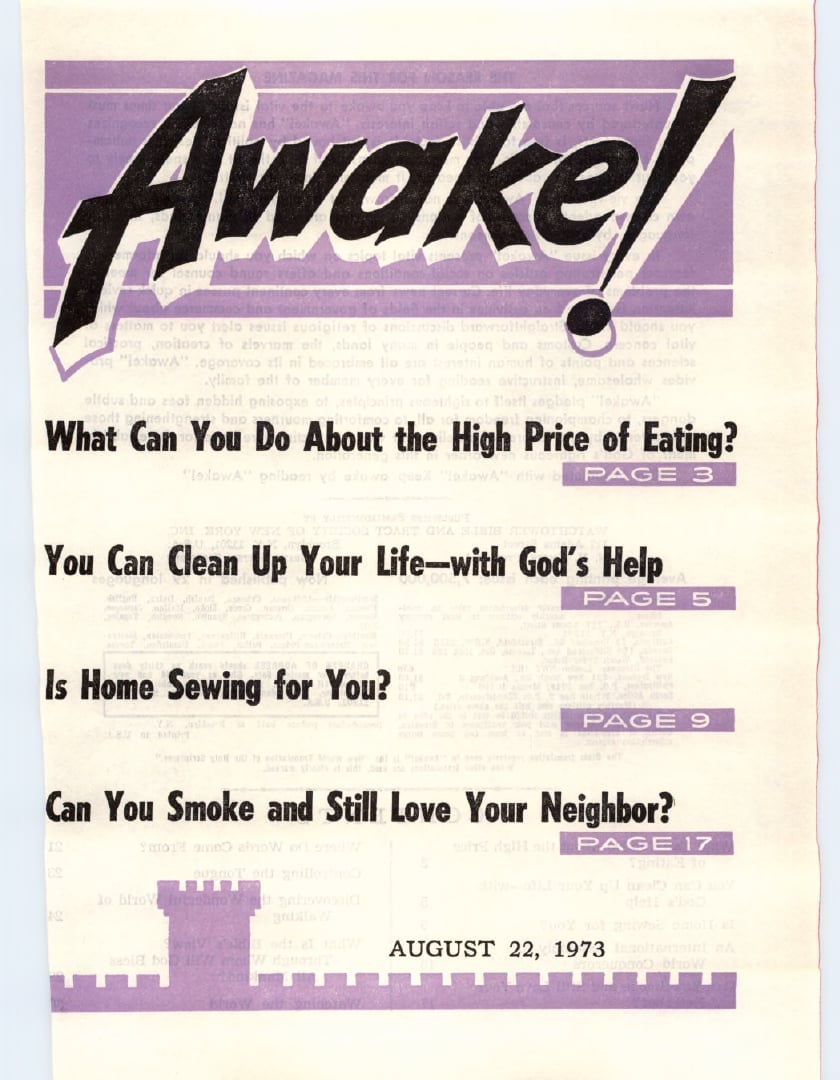
Awake! — August 22, 1973
Source: jw.org
Contents
What Can You Do About the High Price of Eating?
You Can Clean Up Your Life—with God’s Help
Is Home Sewing for You?
An International Assembly of World Conquerors
Can You Smoke and Still Love Your Neighbor?
Where Do Words Come From?
Controlling the Tongue
Discovering the Wonderful World of Walking
Through Whom Will God Bless All Mankind?
Watching the World
What Does The Future Hold?
Only One of These Statements Is True. Can You Prove Which One It Is?
What Can You Do About the High Price of Eating?
What Can You Do About the High Price of Eating?
“HOW can I feed my family at these prices?” That is a question millions of housewives are asking. There are two basic principles that will help in many cases: (1) Be sure your money is paying for food, not advertising or “convenience.” (2) Buy for nutrition, rather than for desire or appearance.
Now, with these principles in mind, consider what happens when you go shopping.
When you look at the enticing frozen-food display, what do you see? Among other things, there are pre-seasoned and premixed fancy vegetables and TV dinners. Over at the cereal shelves you see the presugared, prefruited crunchy cereal for which children often plead. There are also “kits” with sauce for making rice and noodle dishes. You will find whipped butter, precooked rice and handy “individual servings” of soup, cereal or pudding. All these things involve “extras.” When you buy them, it is not only food that you are buying. As an Associated Press analysis says, “Every time the . . . consumer asks someone else to do what he could very well do for himself, it costs.” So, are these foods for you? Not if you need to economize.
If you want to save on your food bills, buy most foods in their simplest form. If you have a tight schedule, certain convenience foods could be valuable. But be sure they are worth the time they save.
In the beverage section are a variety of refreshing drinks. When you purchase them, what do you get? Is it not largely just plain water? It is amazing how much you can pay for a bottle of water when sugar and a little flavor and coloring have been added! If that is what you want, why not buy a powdered mix or syrup and add the water and sweetening yourself?
When shopping, you have to decide which brand to buy. If you make it a habit to reach for the one you hear advertised all the time, some of your money is going to help to pay the advertising cost. Did you know that in the case of dry cereals, for example, an average of one fifth of the price goes to pay for advertising? If you want to economize, why not try unadvertised local or “store” brands, where they are available. You will probably pay less. Did you know that often these brands are prepared by the same manufacturers?
Do you find that, when shopping, you often reach for the small package because the price is less? Really, you are probably paying more per measure than for the larger size. Volume usually means economy; so, generally it is in your interest to buy the largest size you have space for, especially of staple items that will keep. First, though, it is good to check the weight marked on the package to be sure there really is a saving. Packaging can be deceptive. One manufacturer’s container may look bigger, but contain less, than another’s.
Money Value Has Little to Do with Food Value
Have you ever said, “You get what you pay for”? On the other hand, did you know that some low-priced foods are more nutritious than high-priced ones?
Authorities generally agree that foods from four basic groups are needed for good health: (1) Meat, including poultry and fish, as well as eggs, dried peas and beans; (2) fruits and vegetables; (3) milk and milk products; (4) breads and cereals. You can save by using the most economical foods from each group.
Are you inclined to think that a top-grade steak is better for your family than a cheaper cut? Interestingly, cuts and grading of meats, grading of canned goods, eggs, butter, fruits and vegetables have almost nothing to do with food value! So it is wise to use the most economical of these items that will serve your purpose. When you plan to serve meat, why not try the lower grades and inexpensive cuts, like chuck and stew pieces? A good cookbook can tell you how to serve them in an appealing way. Remember, the food value is just the same as in the expensive cuts.
Another point to consider: Do you feel that your menus must always center around meat? The long-living people of Hunza in the Himalayas rarely eat meat and a number have lived well over a hundred years! So, necessary protein in their diet must come from other sources. What do they eat? Dried legumes (peas, beans and lentils), also milk and milk products like cheese. And, do you realize that these foods do not shrink from cooking, as meat does?
You will find that protein from lima beans may cost as little as one tenth of that from meat. Protein from cheese may be one fifth as expensive, and that from milk and eggs is one third of what you would pay if buying meat. But when you prepare a pot of lentils or beans instead of meat, remember that proteins from vegetable sources (except soybeans) are usually “incomplete,” not having all the necessary amino acids. Your body uses the protein best in the presence of all these acids, so include a glass of milk or some cheese when you serve beans.
Many like the convenience of just pouring dry cereal into a bowl, but did you know that you usually pay two to four times as much as if you cooked and served oatmeal? Furthermore, plain cooked cereals usually have more protein and vitamins. It pays to cook your breakfast cereal.
In most stores potato chips, pretzels, onion rings and other “snack foods” sell well. If that is what you purchase, what are you really getting? Is it truly nourishment for your family? The fact is, you are paying a high price for very little food value. You would be kinder to them if you provided cheese or fruits and vegetables in season for them to use as snacks.
Is milk a big item on your budget? If you were to use nonfat dry milk powder, you might cut your milk cost nearly in half, without loosing nutrition. Do you say, “The family does not like the taste”? Have you tried mixing it half-and-half with fresh milk and letting it stand overnight, or mixing it 50 percent stronger than directed? Some find that this solves the problem.
Other Ways You Can Save
When you go to the store, do you have a shopping list with you? It can be a money saver if you stick to it. You will more likely buy what you need instead of being motivated simply by impulse. When you prepare your list, keep in mind the advertised “specials.” If you take full advantage of them, you may save as much as 20 percent on your food bills, on the average, though you may have to go to two or three markets to get the best buys.
There are reduced prices on the day-old bread and pastry rack in many stores. These items are often quite good if you heat them before serving.
Strawberries may look very good, even in wintertime, but they will be much easier on your budget when they are in season, as is true of all fruits and vegetables. Also, why not try buying produce at the end of the week or when its appearance begins to deteriorate? It may be priced for quick sale then.
It could be that you find the price of fresh vegetables is still out of reach. In that case you may want to try growing your own. A small garden about ten feet by fifteen feet could be seeded with a variety of vegetables for $3 or so and may save you annually over $100 in produce. Even in city apartments, a sunny windowsill or roof can afford space for a few plants. If you are a beginner, be sure to get some “how to” information from someone who knows or from your local library or government information offices.
There is another suggestion you may want to consider: Time magazine of December 18, 1972, observed: “The simple fact is that Americans eat too much.” Studies have indicated that keeping children slender, rather than chubby, has health benefits. So, catering to desires for high-calorie, low-nutrition foods is probably no favor to your family.
Consider it a rewarding challenge to provide wholesome and tasty, yet economical meals for your family. You will be happier and healthier if you do.
You Can Clean Up Your Life—with God’s Help
You Can Clean Up Your Life—with God’s Help
WORLD conditions have changed drastically since 1914 C.E. “Critical times hard to deal with” envelop the whole human family. On an unprecedented scale men have become “lovers of themselves, lovers of money, . . . without self-control, fierce, . . . lovers of pleasures rather than lovers of God.”—2 Tim. 3:1-4.
The churches of Christendom have been powerless to stem the tide of crime, sexual immorality, drug abuse and violence that plagues major cities throughout the earth. People feel trapped, forced to ‘go along with the crowd’ in order to get by in today’s world.
But there are some who stand out in refreshing contrast to this. They are changing their way of life to one that is satisfying, resulting in good relations with other people, and a clean conscience before God.
How have they succeeded in doing this? Why have the churches of Christendom failed? Can you, too, remold your life to conform to the principles of God’s Word?
Transforming Power of Bible Truth
“The word of God is alive and exerts power,” says Hebrews 4:12. Why is this true? It is because “all Scripture is inspired of God.” (2 Tim. 3:16) When people of meek disposition read the Bible they realize that it contains the viewpoint of Jehovah God, not that of men. This moves them to make changes in their lives.—1 Thess. 2:13.
In the first century C.E. the transforming power of true Christian teaching was clearly evident. People throughout the Roman Empire had got into a “low sink of debauchery.” (1 Pet. 4:4) But Bible truth produced rewarding changes for those who applied it in their lives. Historian John Lord observed in The Old Roman World: “The true triumphs of Christianity were seen in making good men of those who professed her doctrines . . . We have testimony to their blameless lives.”
But what about today? Is it not true that Christendom with her thousands of sects, Catholic and Protestant, is teeming with degradation? Does this indicate that Christianity has lost its power to change people’s lives for the better? No, it does not. Why not? Because Christendom is not Christian. She does not represent the Christianity of the Bible.
In fact, the clergy of Christendom are largely responsible for the sick state of the world. Pointing his finger at the clergy, Roman Catholic Archbishop Dom Helder Câmara of Brazil commented: “The very grave religious problem is the mystery of knowing why the great religions did not succeed in overcoming selfishness . . . to the point that we see today the beginning of an explosion of hatred and violence all over the world. May my Christian brothers permit me the confidence and courage to admit that among the most responsible in the face of humanity, we find ourselves.” Why is this true?
Because the religions of Christendom have thrust aside God’s Holy Bible. They have disobeyed Bible counsel that Christians should be “no part of the world.” (John 17:16) The churches have involved themselves in politics, supported wars, approved of violence and revolution. Consequently, Christendom is filled with disunity and confusion. She exercises no influence toward bettering the lives of her members.
But how different true Christianity is from Christendom! In the first century those who became Christians changed their lives. They were “washed clean” from such things as drunkenness, violence and sexual immorality. (1 Cor. 6:9-11) Today, too, people who apply Bible principles in their lives are making changes. The following experiences from Brazil demonstrate this.
“Clean” from Drunkenness and Violence
A man known as the “terror of the neighborhood” in the town of Juiz de Fora, Minas Gerais State, used to go on pilgrimages of the Roman Catholic Church. His favorite pastime at these affairs was drinking and rowdiness. Everybody was afraid of him. Then he started studying the Bible with Jehovah’s witnesses and began to change his way of life. His wife opposed him at first, but he kept up his Bible study anyway. Because of the wholesome influence of Bible truth on him the former neighborhood “terror” is now an active Christian minister. Now his wife joins him in studying the Bible and attending meetings at the Kingdom Hall. Neighbors, friends and even the police are all astounded at the great changes in this man’s life.
A young man in São Paulo took up a life of crime in his youth. He tells of being arrested fifteen times for drunkenness, drug trafficking, robbery and rowdiness. Then Jehovah’s witnesses began to study the Bible with him, using the book The Truth That Leads to Eternal Life. From this study he learned the Scriptural principle: “Let the stealer steal no more, but rather let him do hard work, doing with his hands what is good work.” (Eph. 4:28) Consequently, he obtained secular work to care for himself in an honest way. Later he was baptized in symbol of his dedication to God. Now, instead of being a rebel, this man teaches others to respect the laws of God and of the government.—Mark 12:17; Rom. 13:1-5.
A married man from Mato Grosso State lost his drugstore business because of heavy drinking. Although brought up a Catholic, he would get drunk three days each week and have a hangover for an additional three days. When under the influence of alcohol he would break things in his home. Then one day Jehovah’s witnesses talked to him about Bible truth for the first time. He acquired the book “Let God Be True” and read it through three times in one month, learning that Jehovah God forgives past sins on the basis of one’s faith in Christ’s sacrifice. Bible knowledge moved him to clean up his life. He stopped drinking, legalized his marriage and began to train his nine children in the way of Jehovah. He now devotes full time to teaching Bible truth to others, and his family is happy and united.
A young man in Belo Horizonte spent his years between the ages of fourteen and twenty as a member of a gang. He would steal cars, drink beer all night long and start fights. On a visit to his brother-in-law in São Caetano, he found him studying the Bible. Returning to Belo Horizonte, he observed that his mother also was studying. Then his girl friend became interested. That did it. He, too, began to study. And what a change this brought about in him! He gave up going to football matches on Sunday afternoon in order to attend meetings at the Kingdom Hall. Ridicule from his former associates did not deter him. Together with his onetime girl friend, now his wife, he made fine progress. Today this former gang member, thief and drunkard serves as overseer of a school for training ministers in his congregation.
“Clean” from Sexual Immorality
A vast “moral breakdown” is sweeping the earth today. Christendom cannot stop it. But Bible truth motivates people to clean up from such things. Some further experiences from Brazil illustrate this.
A former sexton of the Catholic church in the city of Salvador, Baía State, used to pray to God through Our Lady of Candeias and to observe all days devoted to “the saints.” Yet he lived an immoral life with harlots and said that the only reason he did not do worse things was that he ‘loved to be free and was afraid of prison.’ That church sexton never heard the Bible discussed in his association with the parish priest.
In time he came in touch with Jehovah’s witnesses. After only two months of Bible study with a qualified minister, using the books “Things in Which It Is Impossible for God to Lie” and From Paradise Lost to Paradise Regained, he cleaned up his life and began to teach others the things that he had learned from God’s Word. Today he devotes full time to this activity.
A Catholic man from the city of Belo Horizonte, Minas Gerais State, considered himself to be religious, attending Mass every Sunday. Although he was married, he would visit nightclubs four times a week, engage in drinking bouts and commit adultery. His religion failed to help him to lead a morally clean life. Deep down, however, this man was unsatisfied.
When Jehovah’s witnesses contacted him he accepted the offer of a Bible study and learned what is recorded at 1 Corinthians 6:9, 10: “Do not be misled. Neither fornicators . . . nor adulterers . . . will inherit God’s kingdom.” He viewed this as the truth from God, and it motivated him to clean up his life. He discontinued associating with immoral persons, gave up his heavy drinking and stopped using foul language. Instead, he began applying Bible principles in his daily life. Now he spends his full time teaching Bible truth to others and caring for his family.
You, Too, Can Clean Up Your Life
Some individuals become so deeply involved in sexual immorality and other vices that they think they are ‘too far gone’ to change. But this is not true. If such people want to straighten out their lives they can take comfort in the admonition addressed to unfaithful Israelites: “Let the wicked man leave his way, and the harmful man his thoughts; and let him return to Jehovah, who will have mercy upon him, and to our God, for he will forgive in a large way.” (Isa. 55:7) The following experience is interesting in this connection:
A forty-year-old widow, mother of six children, from the small town of Dores do Indaiá, Minas Gerais State, fell prey to immoral suggestions and eventually became a prostitute. She reasoned that she could use money obtained in this way to support her family. This woman heard the message of God’s Word for the first time at the home of a neighbor who was studying with Jehovah’s witnesses. But she herself declined to study. Why? She felt that she was “unworthy.” Some time later the same Witness met this woman at her home and, to her surprise, she asked for a Bible study. What had happened to change her mind? The little she had heard from the Bible on the first occasion had been sufficient to encourage her to clean up her life. She is now a dedicated, baptized Christian witness of Jehovah, zealously helping others to remold their lives with God’s help.
It is clear that the Word of God is indeed “alive and exerts power.” (Heb. 4:12) Bible study has transformed even the most dissolute of individuals into clean-living, happy servants of Jehovah God. It can do the same for you if you have not yet let its power be exerted in your life. Jehovah’s witnesses will be happy to conduct a free study of the Bible with you each week in the privacy of your own home. Just make your desire known to them at the Kingdom Hall nearest you or write to the publishers of this magazine, and we will have a qualified minister call on you. Do not hold back because of feeling unworthy. No matter what your situation, you can clean up your life—with God’s help.
Is Home Sewing for You?
Is Home Sewing for You?
“HOMEMADE.” We use that term with approval when speaking of pies or baked bread. But applied to home sewing it has not always had the same effect.
Thus a few years ago a girl was inclined to hide the fact that her clothes were homemade lest her friends think her too poor to buy ready-made garments. But times have changed. Today garments made at home are worn with pleasure, and the home sewer takes pride in her workmanship. It was similar before the modern clothing industry had developed.
The sewing machine was introduced around the middle of the last century; prior to that all clothes were hand sewn. Most clothes were made at home by the women of the family. Relatively few persons could afford the hand-sewn clothing produced by professional tailors.
But with the advent of the sewing machine a demand for ready-made garments grew. For some time, though, homemade clothes continued to be considered the best-made clothes. The term “store clothes” carried the connotation of being cheap and lacking in style. Very elderly citizens may still remember that. But as the quality of ready-made clothes improved, practically everyone began wearing them, and home sewing lost appeal.
Revival of Home Sewing
In recent years, however, there has been a return in a big way to home sewing. More than 300 million homemade garments a year are turned out in the United States alone! This has resulted in the phenomenal growth of the home-sewing industry. In 1969 the sale of patterns, fabric and accessories leaped to $3,000,000,000 up from $1,800,000,000 just three years before! And the growth is continuing.
The number of home sewers in the United States has swelled to nearly 50 million. Younger women in particular are learning the art. Surveys show that six out of seven teen-age girls now sew, and that the average age of the home sewer has dropped in the past few years from forty-seven to twenty-three.
Today a woman who sees a garment in a store can often find just the pattern and fabric to duplicate it at home. Patterns are available to make almost any type of garment, and so are fabrics. Fabric stores in the United States increased in number from 2,300 in 1967 to 12,000 last year.
But why this remarkable revival of home sewing?
Attractive Features
One of the most attractive features of home sewing is the savings that can be realized. It is claimed that, due to what she saves, the home sewer may earn $10 an hour! This may seem an exaggeration. But when quality merchandise is priced in stores these days, one can see how such savings are possible.
A Washington, D.C., secretary, for example, priced a mohair suit in a dress shop at $200. She was able to duplicate the suit at an expense in materials of just $50. Savings on making drapes and slip-covers can be even more. It is in sewing major items that the greatest savings are realized.
On the average, home sewers make clothes for 50 to 60 percent below what they would pay for them ready-made. And quality, which is sadly lacking in many of today’s ready-made goods, can be built in to garments and household items sewn at home. The declining quality of retail clothing is itself good reason for knowing how to sew. As a young Cicero, Illinois, woman noted: “You have to be able to sew just to repair what you buy ready-made.”
Also, home sewing can provide a truly satisfying outlet for one’s creative ability and personal taste. Many women find pleasure and a sense of accomplishment in sewing. One woman said: “I think we need to return to a more primitive way of doing things. When you‘re sewing or weaving, those are good, quiet times.”
Another appealing feature of home sewing is the originality that can be achieved. Fabric, design and trim can all be chosen to suit the individual and her personality. At times Christian women, who desire to “adorn themselves in well-arranged dress, with modesty and soundness of mind,” have difficulty in finding ready-made clothes that are modest. (1 Tim. 2:9) Knowing how to sew has been a benefit to them.
The home sewer also can design her clothes to highlight her best features and minimize her figure faults. And by sewing the garment herself she can obtain a perfect fit, which to some is the most attractive feature of home sewing. One young woman, whose father owns several dress shops and who could get all her clothes free, prefers to sew her own because of the better fit she can achieve.
So if the rising cost of clothes and their sinking quality concern you, and you have difficulty in buying clothes that fit well and that reflect you and your personality the way you want, home sewing may be for you. But before proceeding, there are other factors to consider.
Investments and Considerations
Home sewing will require certain investments on your part. Any sewing project will take time, and time is often a scarce commodity in our busy lives. Also, you may find that to produce quality clothing will take more effort than you expected, especially as you are learning. Are you willing to follow through on all the details involved in constructing a garment until it is satisfactorily completed?
Then there is investment in equipment to consider. Most equipment needed, such as needles, thread, pins, shears, pincushion, thimble, tape measure, and so forth, are not expensive. But if you do not own a sewing machine, the purchase of a fine, modern one can be a major expense. However, a simpler machine, perhaps even a treadle-operated one, can serve very well, and one of these can be obtained for much less.
If you are perhaps thinking about making clothes without a sewing machine, it will be much more time consuming. The machine is invaluable to the sewer, as evidenced by what happened in the 1830’s when the French inventor Barthélemy Thimonnier put into operation the first sewing machines. An angry mob of tailors wrecked them all and threatened his life because of fear of losing their livelihood.
The first sewing machines were powered by turning a hand crank, and in some places these early types are still used. The treadle-operated machine was an improvement, since it allows the sewer to use both hands to guide the garment being worked on. Practically all machines now sold in the United States are electric powered. To give some idea of the value of modern sewing equipment: A pair of trousers that took some eighteen hours to sew by hand in 1857 can be turned out in a modern factory in only twenty minutes! A sewing machine is indeed a valuable aid.
Another consideration for a married woman is how her husband feels about her sewing at home. He may well be delighted, being glad for the savings it can mean in the family clothes budget. But some husbands may feel that their wife’s time can be better spent with other matters. Or it may be that he merely objects to having his wife involved with sewing when he is at home in the evening. This is something it is well to discuss together.
Can You Learn?
You may be wondering: How difficult is sewing? How much time and effort are required to learn?
Really, it is not very difficult. It is a skill that can be learned by any willing student. This is particularly true if sewing is approached as a hobby, as something to be enjoyed.
Sewing classes are offered by many sewing equipment manufacturers, but while these may be useful they are not necessary. There are many fine sewing books, filled with illustrations and step-by-step instructions for beginners. These can usually be obtained by a visit to a library. Also, there may be members of your own family or close friends who would be pleased to share their sewing knowledge with you. Surely every mother who knows how to sew will want to teach her daughter this valuable skill.
Patience is a paramount requirement in learning to sew. Be prepared to follow the instructions carefully. Take one step at a time, and do it right. Each success will increase your confidence. Sometimes the person sewing for the first time does even a better job than an experienced sewer simply because she is more apt to follow the instructions given. That even a person without previous experience can sew is illustrated by a New York father who is a carpenter by trade.
One evening he decided to work on a robe that his wife had left unfinished before retiring. Following the pattern instructions, he completed the robe and in the morning presented it to his surprised wife. He noted that sewing is similar to carpentry—a sewer follows a pattern, while a carpenter follows a blueprint. And it is true, sewing is largely a matter of following instructions closely. The operation of the sewing machine itself is quite simple to master.
Suppose that you decide to try your hand at home sewing, where do you begin?
Suggestions for a Beginner
If you have your sewing equipment ready, the first step will probably be to choose a pattern. A good rule here is: Avoid anything that is extreme in design. Choose a style based upon something that you like in your present wardrobe. No pattern should be expected to fit you perfectly, so choose the size that fits you best across the shoulders and upper chest area. Other parts of the pattern can be adjusted more easily.
Only after you have selected your pattern should you select your fabric. The great variety of fabrics available today allows the home sewer to choose material that is both easy to work with and easy to care for once the garment is finished. Since the time that you will spend making a garment will be about the same regardless of the quality of the material, why not make your effort worth more by using good-quality material?
You may hesitate to try to make your own household items, but when you consider the simplicity of such sewing and the savings realized, it will encourage you to try. Draperies and curtains can be constructed with simple straight seams that the home sewer will find she can master with relative ease.
Also, sheeting material can often be purchased for much less than can finished bed sheets. These can be cut to size for your beds, hemmed at both ends and put right to use. But be sure to allow for 10 percent shrinkage if the material is cotton. Pillowcase tubing, too, can be purchased. Cut it to fit your pillows; seam it at one end and hem it at the other.
Remember, an important key to success is to approach with confidence whatever sewing project you undertake.
Mending and Alterations
When clothes are damaged or need alteration, a lot of money can be saved when repairs are made at home. A good suggestion is, while you are ironing or folding garments, set aside those that need repairing. Also, if you see that an item such as a suit jacket or coat needs a repair or alteration, jot this down on a note pad that you keep with your other mending.
Hand mending can be cared for when the family is together, watching TV perhaps. In darning socks, a light bulb can be stuffed into the sock to hold it in shape while you darn. Invite a young daughter to lend a hand. Show her how to sew on buttons and fasten the thread so it will not come out.
Some of the new sewing machines have built-in features for mending that allow you to move your material freely under the needle as you mend, thus stitching together tears and rips. Even without this feature you can mend by machine by slightly lifting the presser-foot lever with one hand while moving the material back and forth under the needle with the other hand.
Some items tend to wear out in one place first. For example, bed sheets generally wear thin in the center. When you notice this, tear the sheet down the center lengthwise. Then seam the strong outside edges together, so the least worn part of the sheet now is in the center. Then hem the outside edges, which once were at the worn center of the sheet.
If the pants of your husband’s favorite suit become thin in the seat, you can take a piece of similar material and put it inside the pants and darn it over the thin area. The suit-coat jacket will likely cover over the repaired area so that it will not be noticed.
Many women long for a quieter, less-hurried life when they will be able to spend more time sewing at home and caring for similar needs of their families. Even the Bible notes, regarding the capable wife: “She has sought wool and linen, and she works at whatever is the delight of her hands. Her hands she has thrust out to the distaff, and her own hands take hold of the spindle.” (Prov. 31:13, 19) So if not now, then sometime in the future you may well decide that home sewing is for you.
An International Assembly of World Conquerors
An International Assembly of World Conquerors
ON June 20, 1973, The “Divine Victory” International Assembly of Jehovah’s Witnesses opened in Detroit, Michigan. It was the first in a series of conventions to be held in major cities around the globe. Some forty such meetings have been planned to run through August in the continental United States, Canada, Europe and Asia. From September through January, the Middle and South Americas, islands of the Pacific, Australia and Africa will host another thirty gatherings.
The internationality of the assembly was well illustrated by the sessions in New York City’s Yankee Stadium, July 6-10. People of all ages and backgrounds from most continents attended. (Hundreds of the foreign delegates stopped only briefly at New York on their way to other American assemblies.) Between June 19 and 29 thirty-three charter flights of 179 passengers each came from all over Europe to John F. Kennedy International Airport. There were also other, smaller groups from as far as India, Ethiopia, Turkey and Brazil. All together, the peak New York attendance of 79,256 included delegates from over sixty countries.
Around the world, lip service is paid to peace and brotherhood. But the traveling delegates to these assemblies showed that it can be and is a reality. Though from many different lands, they are not wedged apart by divisive forces, but are united in Christian brotherhood. With God’s help they are world conquerors, winners over these strong worldly pressures.
Victorious over Nationalistic Pressures
For instance, one of the strongest divisive factors working in the world today is nationalism. As more and more nations assume self-rule, this problem intensifies. Jesus, who said of himself, “I have conquered the world,” also said in prayer that his followers are “no part of the world.” (John 16:33; 17:14) Jehovah’s witnesses, regardless of their native homeland, take these words to heart.
Consider Northern Ireland. Hundreds of persons have been killed in warfare between Catholics and Protestants. But Jehovah’s witnesses take no part in that struggle. “People respect Jehovah’s witnesses in Northern Ireland because we are neutral,” observed one special representative from Belfast. “We are really known to be different.” He also pointed out that the conditions in Northern Ireland have awakened many honest-hearted persons there to the lack of security in the world. Now they listen somewhat more readily to the message of the Bible brought to them by Jehovah’s witnesses.
Nationalism has also been overcome by the Witnesses who visited the New York assembly from various parts of Africa. On that continent some who have been in line to be tribal chiefs have forsaken this opportunity and the privileges and prestige that go along with it.
Some delegates have been resisting nationalism for scores of years. One from near London, England, recalls the struggles that God’s people have had through two world wars. Members of his own family lost employment and were imprisoned because of maintaining a neutral stand. During World War II he and his wife comforted with Bible truths those living in bombed-out regions of their country. The many trials and difficulties over the years have not weakened this couple. Rather, they say: “Opposition really strengthens one.” Obviously their over one hundred years of combined Christian service prove that the world has not overcome them.
But forces other than nationalism have worked to destroy the unity and faith of God’s modern people.
Overcoming Materialism
When the apostle John wrote Christians who had “conquered the wicked one,” he advised: “Do not be loving either the world or the things in the world.” This includes its materialism. Modern Christians have been resisting materialism’s pressure.—1 John 2:14-17.
An Englishman who, with his family, came to the New York assembly was once an executive in a large food company. His work was challenging, but also time-consuming. He often rationalized that he was working hard making money “for the sake of my family.” But, he says, one day it struck him that the best the world could offer his family is only second best. Giving in to materialism would not give his family eternal life and happiness. He asked himself: “How could I preach that the end of the system is near while still strongly relying on the system myself?” So he quit the job and sold his house and furniture. Now he and his family serve in another area where they have a greater share in helping others to learn God’s will.
Materialism also exists in the nations that have not been extensively industrialized. A missionary delegate from Papua says that, since that nation started growing coffee on a large scale ten or fifteen years ago, it has prospered materially. Are the people really better off now? Certainly not those who use the added money to buy alcohol. The facts show that drunkenness, crime and other social problems are increasing.
But what are true Christians doing in such nations? This missionary reports that most are not affected by materialistic thinking. These people do improve themselves without becoming slaves to materialism. How? By learning to use their resources in a way consistent with Christian principles. Now, instead of spending all their money for drink, it goes to assisting their family.
Ultimately, of course, it is up to God to remove the whole materialistic system world wide. Says a couple from South America: “The brothers are doing their best with what material goods they do have and are waiting patiently for Jehovah’s ‘victory’ over this world.”
Not Conquered by Immorality
Christians have also been warned since the first century that they must not be overpowered by uncleanness and sexual immorality. (Rev. 2:20-26) Delegates at the New York assembly included those who have successfully resisted the world’s immoral and unclean ways.
One group of three delegates from Beirut, Lebanon, was once part of a five-man orchestra. They learned the truth about the Bible from Jehovah’s witnesses and saw that their way of life must be changed. But altering their habits was not easy. One of the delegates recalls: “I was aided by Jehovah to overcome habits I thought I could never quit—like using hashish, smoking tobacco and living an immoral life.” Yes, with divine help, he was aided to triumph over the world’s uncleanness.
These delegates and the tens of thousands gathered with them have not buckled under nationalistic, materialistic, and immoral pressures; they have “conquered the world.” The assembly program was of great aid in strengthening them to maintain their faith. How was this?
Program Emphasizes Divine Victory
Delegates were reminded in lectures, demonstrations and Bible dramas of the truthfulness of the apostle John’s words: “The victory that defeats the world is our faith, for who is victor over the world but he who believes that Jesus is the Son of God?” (1 John 5:4, New English Bible) One speaker noted: “The question for a disciple is, Will the world defeat him, or will he defeat it?”
At the New York assembly, foreign-language visitors were given a special program on three mornings of their visit. There were brief talks from older members of the Watchtower Society’s headquarters staff.
Tours, Rooming Arrangements
Thousands of the visitors also went to see the Watchtower Society’s headquarters firsthand. They saw Bibles, books and magazines produced that they themselves might later use. “Bethel,” the home for the 1,300 volunteer ministers who operate the factory and offices and do related work in Brooklyn, was visited too. Over one hundred busloads of tours were specially booked by the Assembly’s Information Department to see Watchtower Farm. There vegetables, fruits, meat and dairy products, used to feed the Bethel headquarters staff are produced. Some printing of the Watchtower magazine is also done there in a newly erected factory.
But how were all these visitors taken care of while they were in New York? Special arrangements were made months in advance by the Assembly’s Rooming and Information Departments. A large section of Pan Am Airlines’ new terminal at Kennedy Airport was reserved to receive the incoming special delegates. Buses met the delegates at the airport to transport them to a central distributing center. There a ‘car pool’ of over 500 volunteer drivers took the visitors to their accommodations. Some 90 percent of the foreigners were housed with Americans who are Jehovah’s witnesses or persons interested in their work. Where possible, visitors who spoke German were housed with German-speaking Americans, French with French-speaking Americans, and so forth. In some cases, however, the delegates and hosts had to communicate with gestures and sign language or with the few words of the other language that each understood. Yet, the ties of genuine brotherhood united them.
The “Divine Victory” International Assembly of Jehovah’s Witnesses is one more evidence that the Witnesses have proved themselves victorious over the divisive influences of the world. God’s people await the time, soon to come, when the Lord Jesus Christ ‘completes his conquest’ over all his enemies. Major hindrances to peace will then be completely gone and a vast crowd of survivors will jubilantly exclaim: “Victory to our God who sits on the throne, and to the Lamb!”—Rev. 6:2; 7:9, 10, New English Bible.
[Picture on page 13]
No national or racial divisions mar the enjoyment of true Christian brotherhood among Jehovah’s witnesses
[Picture on page 14]
Delegates were warmly welcomed at the airport by local Witnesses
[Picture on page 14]
Witnesses from abroad are welcomed as guests in homes of fellow Witnesses at assembly time
[Picture on page 15]
A visit to the Watchtower Society’s printing plant was a highlight of their visit to New York
[Picture on page 16]
Spanish Witnesses here enjoy experiences of those who have maintained Christian neutrality for many years
Can You Smoke and Still Love Your Neighbor?
Can You Smoke and Still Love Your Neighbor?
“SMOKING IS DANGEROUS TO YOUR HEALTH.” By law that warning must now appear on cigarette packages sold in the United States. Last year outgoing U.S. Surgeon General Dr. Jesse Steinfeld said: “Cigarette smoking is deadly.”
In Britain, the Guardian Weekly, after noting the statistical evidence regarding the dangers of smoking, concluded: “The Royal College of Physicians cannot be said to be alarmist in declaring that cigarette smoking is ‘now as important a cause of death as were the great epidemic diseases such as typhoid, cholera, and tuberculosis.’”
That smoking is harmful to the smoker has been clearly established. But what about the welfare of others? When you smoke, how are those nearby affected?
Many nonsmokers do not like to be engulfed by tobacco smoke. It sometimes saturates their body and clothes so much that when they return home, the tobacco smell is offensive to their families. But there is an even bigger objection.
Quite literally, cigarette smoke makes many nonsmokers sick. Today’s Health, April 1972, observed: “A recent study showed that more than 70 percent of a sample of healthy nonsmokers exposed to cigarette smoke suffered from eye irritation, nasal symptoms, headache, cough, sore throat or other ill effects.” Some smokers may object that nonsmokers are prejudiced against smoking and that they imagine discomfort.
But think: How does a person feel when he smokes for the first time? Almost invariably he is made sick by the inhaled smoke, sometimes even vomiting. Is it surprising, then, that many nonsmokers would feel ill on inhaling the smoke from the cigarettes of others?
How dangerous is tobacco smoke?
What Is in the Smoke
Cigarette smoke is extremely toxic, more so than even the deadly exhaust of an automobile. “Impossible!” you may exclaim. Yet observe what an editorial in Science, December 22, 1967, said:
“Concentrations of carbon monoxide as high as 100 ppm [parts per million] often occur in garages, in tunnels, and behind automobiles. Such concentrations are tiny in comparison with those (42,000 ppm) found in cigarette smoke. The smoker survives because most of the time he breathes air not so heavily polluted.”
Yet carbon monoxide is only one of the dangerous substances in cigarette smoke. It also contains hydrogen cyanide. “Long-term exposure to levels [of hydrogen cyanide] above 10 ppm is dangerous,” noted the above Science editorial. “The concentration in cigarette smoke is 1600 ppm.”
Regarding the dangerous air pollutant nitrogen dioxide, Science reports: “Concentrations of NO2 [nitrogen dioxide] as high as 3 ppm have been noted in Los Angeles, and levels of 5 ppm are considered dangerous. Cigarette smoke contains 250 parts of NO2 per million.”
Then there is cadmium, which, in large quantities, is an extremely hazardous industrial pollutant that has already caused deaths in Japan. The cadmium in tobacco smoke is a significant source of pollution, according to Dr. Harold G. Petering at the University of Cincinnati College of Medicine. Smokers and nonsmokers alike absorb it by inhalation. The danger to the nonsmoker is often as great as that to the smoker, Dr. Petering said, since most cadmium is released in the “side stream” that drifts away from the smoker.
Tar and nicotine are probably the most well-known toxic substances in tobacco smoke. And, interestingly, The Journal of the American Medical Association (JAMA) of January 15, 1973, noted regarding them: “Smoke from an idling cigarette contains almost twice the tar and nicotine of smoke inhaled while puffing on a cigarette. . . . Thus, smoke from an idling cigarette may be twice as toxic as smoke inhaled by the smoker.”
Effect on Nonsmokers’ Health
Admittedly, tobacco smoke contains a whole host of hazardous substances which, in sufficient quantities, are deadly. But do these become concentrated enough in a room or other enclosed area to cause serious harm even to nonsmokers?
The evidence indicates that nonsmokers are harmed by the smoke around them. “There is good hard data to suggest that the nonsmoker in any poorly ventilated, smoke-filled room is endangering his health,” Dr. Albert Soffer, American College of Chest Physicians executive director, told a meeting of his colleagues last October.
Recent medical literature says the same. The JAMA noted earlier this year: “Where the air circulation is typically poor, the nonsmoker will be subjected to a significant health hazard from a smoker.” And the Medical Tribune, February 2, 1972, explained: “Cigarette smoking is injurious not only to the smoker’s health—it can be harmful to the innocent bystander as well.”
This is particularly true if the bystander suffers from heart disease or a lung disorder. Why so? For one reason, carbon monoxide in smoke interferes with the oxygen-carrying capacity of the blood, making the heart work harder to get oxygen throughout the body. Some doctors have even forbidden their patients to fly, since the smoke in commercial airplane cabins might kill them.
Nor do small children escape the harm done by tobacco smoke. The JAMA of January 15, 1973, drew attention to a study that “found that smokers’ children are ill more frequently than nonsmokers’ children, usually because of respiratory disease.” Children who have respiratory allergies are especially affected adversely by cigarette smoke.
Pointing to the seriousness of the tobacco-smoke problem, a report by Britain’s Royal College of Physicians said: “Action to protect the public against the damage done to so many of them by cigarette smoking would have more effect upon the public health of this country than anything else that could now be done in the whole field of preventive medicine.”
Tobacco smoke truly is dangerous! Therefore, do you think that a person can continue to smoke, spreading this poison into the air, and still really love his neighbor?
Effect on Driving and Working
Another factor to consider is the efficiency of one’s performance when the air is filled with tobacco smoke. Can a person, for example, drive as well when someone in the car is smoking? The New York Times of January 16, 1972, commented:
“Experiments show that the levels of carbon monoxide in a small room where cigarettes are being smoked can rise to 50 parts per million. At that level, after an hour and a half, the nonsmoker has trouble discriminating time intervals and visual and sound cues. In a closed automobile, 10 cigarettes raise the carbon monoxide level to 100 parts per million. Nonsmokers and smokers will have trouble with eye-hand coordination.”
The problem of driving while smoking is greatest at night, since carbon monoxide destroys the chemical in the eye necessary for night vision. Dr. Lawrence E. Lamb explained: “If you smoke three cigarettes in a row, night vision can decrease 25 percent.”
No wonder that it is recommended not to smoke while driving, or to allow others in the car to do so. In one extensive study, smokers were found to have twice as many auto accidents as nonsmokers. Thus in 1971 the Farmers Insurance Group of Los Angeles began giving up to a 20-percent discount on auto insurance to persons who could prove that they had not smoked for two years.
It should not be surprising, therefore, that smoking would cut down on workers’ productivity. A careful study of the employees of a bank showed, according to a report in Reader’s Digest of March 1972, that “smoking employees were costing the bank $7 a week each in lower productivity, higher absenteeism, burned furniture and rugs.”
When smoking interferes with safe driving and employee productivity, would you say that it is showing love to your neighbor to smoke?
Effect on Offspring
Tobacco smoke has yet another bad effect. The evidence from studies pursued independently in at least nine separate countries all points to the same stark conclusion: Something in the tobacco smoke inhaled by pregnant women adversely affects the fetus, often with tragic consequences.
Outgoing United States Surgeon General Jesse Steinfeld lamented: “Fetal wastage is a terrible tragedy.” He explained: “The mother who smokes subjects the unborn child to the adverse effects of tobacco and as a result we are losing babies.” According to the Public Health Service report released in January 1973, about 4,600 stillbirths a year in the United States can probably be accounted for by the smoking of their mothers.
The Royal College of Physicians in Great Britain said: “There is no doubt that smoking during pregnancy retards the unborn baby’s growth. It has been found that mothers who smoked during pregnancy were more likely to have a miscarriage, to have a still-born baby, or one which died soon after birth.” A massive study of 17,400 births in Britain revealed that even smoking one cigarette a day during pregnancy affects fetal development.
Do you think that a mother who smokes is showing love to her unborn baby when her habit may result in the sickness or even death of her child?
Dr. Donn Mosser, a Minneapolis physician, notes another significant effect that the smoking by parents has upon their offspring. “If a mother smokes,” he said, “it about doubles the probability that the children in the family will smoke.” Is it proper to engage in a dangerous habit that children are likely to adopt? If young ones developed lung cancer as a result, would you not bear some responsibility for this?
The Bible commands: “You must love your neighbor as yourself.” (Matt. 22:39) Yet the smoker does harm to himself, as well as to his neighbor. How clear it is, therefore, that you simply cannot smoke and still love your neighbor!
You Can Quit if You Really Try
Perhaps you say that you realize that smoking is altogether improper. And perhaps you have tried to quit. “Ninety-five per cent of smokers know the dangers of their habit,” says former United States Surgeon General Luther L. Terry, “and 75 per cent want to quit, but can’t.” Yet a person can quit if he has strong enough incentive or motivation.
Terry was United States surgeon general in the early 1960’s when the evidence became overwhelmingly clear that smoking is harmful to health. So in 1963, after twenty-five years of smoking, he decided to stop. He explained: “If smoking was dangerous, and I was convinced it was, then it seemed to me that the Surgeon General should set an example to the public.”
But quitting was not easy. “I had a hard time,” Terry observes. “I was tense, I had difficulty sleeping, and I broke out in sudden, cold sweats. Fortunately, this passed in a couple of weeks. The psychological dependence lasts much longer.” Now Terry tries to help others to quit. “I urge them to set a definite date for quitting,” he says, “and then to stop, cold turkey, on that day.”
This no doubt is the most effective way to quit. But there must be a strong motivation, otherwise one will weaken under the pains of withdrawal and resume smoking. A Queens, New York, housewife observes:
“If I had gone to a doctor and he told me that I would die from cancer unless I gave up smoking I would not have quit. Smoking was the main thing in my life, more important to me than food. I smoked almost constantly. I would even walk around the house with an ashtray in my hand.” Yet in August 1969 this person quit, and has never smoked again.
She explains: “I was baptized by Jehovah’s witnesses in July 1967. I knew that smoking was wrong, and I wanted to stop. But I was so addicted I just did not have the strength to do so. Then my husband accepted the Bible truths he was learning, quit smoking and was baptized. I was so grateful! I did not want to do anything to hinder our serving Jehovah God acceptably and gaining life in his new system of things, so I determined to stop also.
“I finally did in August 1969. For days the agony was almost unbearable, but I prayed to Jehovah incessantly and with his help held to my resolve never to smoke again. As addicted as I was, if I could give up smoking, I feel that anybody can.”
But there must be sufficient motivation. You need to face the fact that smoking is harmful to both yourself and your neighbor, and is a habit that is detestable to Jehovah. Then if you really do love God and your neighbor, you will quit smoking.
Where Do Words Come From?
Where Do Words Come From?
BY “AWAKE!” CORRESPONDENT IN RHODESIA
AS WE master a language, our thinking becomes inseparably linked with words, so that it is impossible to formulate thoughts without using words. But where do words come from? How do they begin?
Those who are acquainted with the Holy Scriptures know that the Great Architect of language is none other than Jehovah God himself. He gave the first man and woman the ability to speak, and later, at the time of the building of the Tower of Babel, he brought into existence a variety of languages, each with its own vocabulary and grammar. This was an effective means of bringing to an inglorious end a project undertaken by opposers of God against his purpose.—Gen. 11:1-9.
The interplay among the various languages since that time and their effect upon one another make a fascinating study.
The Shaping of English
As for the English language, modern-day linguists group it among the Germanic languages, since its early origins are in the language of the Angles and Saxons, who hailed from the western part of Europe that became the Roman province of Gaul. Presently, however, the language is a veritable potpourri of many tongues. Although much of the language is derived from Greek and Latin, as well as the original Anglo-Saxon, the English-speaking person’s speech may contain traces of French, Italian, Hindi, Russian and Turkish, to name but a few.
The first part of a word, often called the “prefix” may give a clue to its origin. The prefix “tele-,” for example, may indicate that the word has been formed from Greek. So we have “telegram,” meaning “something written from a distance,” and “telescope,” which means “looking from a distance.” The word “television” is a hybrid, the first part being from Greek and the final part from Latin. Basically, it means “seeing from a distance,” which is exactly what we are doing when we look at a TV set.
“Pan-” is another Greek prefix. We have it in the word “pantheon,” meaning “all gods.” We also have it in the word “pandemonium.” Do you know what this word means literally? “All demons”; and that is what it seems like when there is pandemonium.
The final part of a word, or “suffix,” as linguists call it, often helps us to identify the word’s origin. You are sure to have noticed that many words end in “-logy,” such as “archaeology,” “anthropology,” “biology” and “geology.” Since the Greeks used the word logia to mean “speaking,” “discussion” or “study,” we can see that “archaeology” means “study of ancient things,” “anthropology” means “study of man,” “biology” means “study of life,” and “geology” means “study of the earth.”
A traveler through England cannot escape noticing that the names of certain towns and cities have the same ending. For example—Chester, Chichester, Manchester and Rochester, and Bicester, Chirencester, Leicester and Worcester. Why the similarity? The names are a relic of the Roman occupation of Britain, when military camps were established to maintain the Pax Romana (Roman peace). The Latin word for “camp” is castra, from which comes the “-chester” or “-cester” of today. One will also notice other English place-names, such as Wigston Parva and Wigston Magna, which again illustrate the impact of Latin on the English language. Since parva is Latin for “small” and magna is Latin for “great,” these names merely mean “Little” Wigston and “Big” Wigston.
In some cases, names of people and places have been accepted into the English language to signify things we use every day. When a builder uses a towering “derrick” to hoist some large component to the top of a building, he may not realize that this helpful machine receives its name from Derick, a seventeenth-century English hangman.
To protect his feet from snow and slush, an English mother may tell her son to put on his “wellingtons.” Why such a strange name for what others might call “rubber boots”? The word comes from the Duke of Wellington, the famous general of the Battle of Waterloo of 1815, and the type of footwear he wore. A German field marshal, who was a contemporary of the Duke of Wellington, Von Blucher, differed in his taste in footwear and so gave his name to another style of boots, “bluchers.”
A student of electricity soon learns that the electrical units of power, pressure, current and resistance come from the names of James Watt, a Scottish engineer, Alessandro Volta, an Italian physicist, the French scientist Ampère and the German Georg Ohm. These are designations that he uses in his calculations every day.
Words sometimes result from the union of parts of two or more English words. Examples of this are “avionics” (from “aviation electronics”) and “parsec” (from parallax and second), an astronomical unit equal to 3.26 light-years. Other words are formed from the mere initials of the words making up the longer name of the thing they designate. Notice this in the case of RADAR (radio detecting and ranging) and MASER (microwave amplification by simulated emission of radiation).
In the city of Newcastle-upon-Tyne, on the northeast coast of England, there is a street called Two Ball Lonnen. How did this strange name come about? The word “Lonnen” is easy, since that is an old north-country English word for “lane.” But why “Two Ball Lonnen”? Local inhabitants say that in former times the road used to lead to a large house that had at each side of its entrance a brick pillar surmounted by a large carved stone ball. Hence, today’s unusual name.
Language Exchange in Africa
Language exchange, which has had such a profound effect upon the English tongue, has also exerted its influence upon the languages of Central and Southern Africa. The Chishona, Cibemba, Cinyanja, Yao, Tumbuka, Zulu and other languages of Malawi, Mozambique, Rhodesia, South Africa and Zambia belong to the group of languages known as Bantu. With trade and travel among these countries, it is understandable that there should be exchange among their languages. A good example of this is the Cinyanja word for “rainbow,” which is uta wa Leza, literally meaning “bow of God.” However, the Cinyanja word for “God” is Mulungu, not Leza. So how did the word Leza come to be included in this word for “rainbow”? The answer is that the Cinyanja-speaking people have borrowed it from the Cibemba speakers of nearby Zambia, who do use this word for “God.”
…