Awake!, April 8, 1973
Download: PDF — Awake!, April 8, 1973
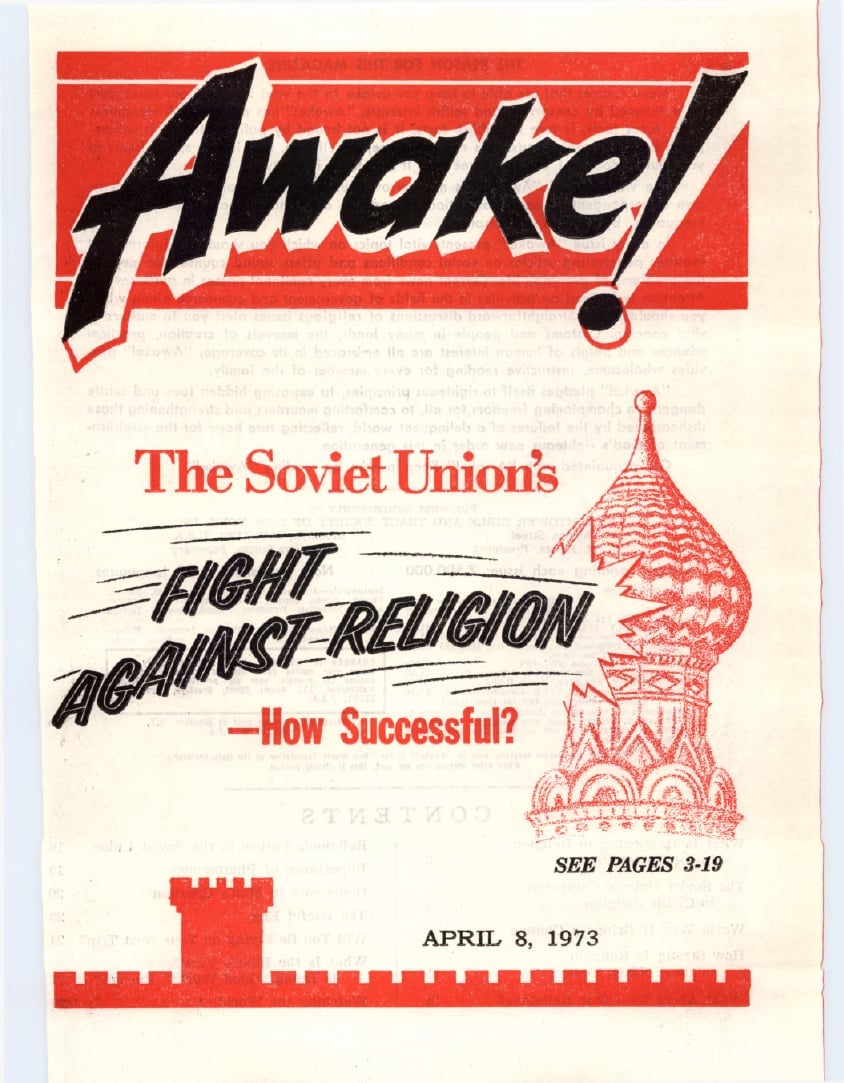
Awake! — April 8, 1973
Source: jw.org
Contents
What Is Happening to Religion in the Soviet Union?
The Soviet Union’s Campaign to Crush Religion
World War II Brings a Change
How Strong Is Religion in the U.S.S.R. Today?
What About the Other Religions?
Religion’s Future in the Soviet Union
Importance of Pheromones
Generosity in Man’s Creation
The Useful Egg
Will You Be Flying on Your Next Trip?
Is Doing “Good Works” Enough?
Watching the World
Could The End Be Near For This System?
The Most Important Event in History
What Is Happening to Religion in the Soviet Union?
What Is Happening to Religion in the Soviet Union?
FOR over fifty-five years now, the Soviet Union has been a land of many mysteries to outsiders. During most of that time, not much information was available on the life of people behind the “iron curtain.”
However, in recent years the Soviets have opened their doors to more and more foreign visitors. These have been allowed to tour much of the country and to talk to all kinds of people. Gradually, an accurate picture of the political, economic, scientific and cultural life of the nation has emerged.
But an accurate picture has been more difficult to come by in regard to one aspect of Soviet life—religion. What is happening to religion there? Is it still alive after five decades of Communist rule? Is it perhaps flourishing? Or is it dying? What does the future hold for it?
Conflicting Reports
In recent years conflicting reports have appeared in the foreign press about religion in the Soviet Union. Some of the reports, taken at face value, suggest a religious “revival” is occurring there.
For instance, the New York Times carried this headline: “RELIGION BELIEVED GAINING IN SOVIET.” The 1972 Britannica Book of the Year reported: “Religious services were going on in virtually every major city of the country and a certain proportion of young people were turning to religion.”
The German magazine Stern commented on a cathedral that authorities in the city of Novgorod had turned into a museum. Visitors there were said to be making the sign of the cross, praying and listening to religious music. This was taken as an evidence of growing religious interest.
Thus, from such reports, one might conclude that there is indeed a religious upsurge in the Soviet Union.
However, when one examines a wider variety of evidence, including other eyewitness accounts, a different picture begins to emerge. These other reports conclude much the same as that of one historian who said bluntly: “Organized religion, apart from pockets of zeal and devotion, appeared to be a dying institution” in the Soviet Union.
Accordingly, there is the need to search underneath the surface appearance. Many things must be taken into account in trying to determine the state of religion in the Soviet Union today. And when all the factors are considered, there are definite conclusions that can be drawn. One of these conclusions may be very surprising to you!
Helpful in this search is an examination of the history of Church-State relations in the Soviet Union. It enables us better to understand why certain things have happened, and what the trend is.
Religion’s Powerful Grip
To trace the story of religion in the Soviet Union, one must follow the footprints of the Russian Orthodox Church. It has been by far the most prominent religion in the land.
That Church had its beginning in 988 C.E. when Vladimir the Great of Kiev was baptized into the Eastern Orthodox branch of Christendom’s religion. It is said that he converted from his pagan religion in order to gain his wife Anna. She was the sister of the emperor of the then dominant Byzantine Empire. That empire had its capital at Constantinople, the chief seat of the Eastern Orthodox Church.
Vladimir told his subjects that they must all submit to baptism as orthodox Christians. Whoever would not do so was considered to be an enemy of the State. Thus, from its beginning, the Russian Church was backed by secular force. When the Byzantine Empire collapsed in 1453, the Russian Orthodox Church was declared independent from control by Constantinople. Later, the chief religious head at Moscow was made a patriarch equal to the one in Constantinople. However, in 1692 Peter the Great abolished the position of patriarch, controlling the Church himself. And in 1721 the Russian Orthodox Church was officially made the national church.
As time passed, the Church became ever more closely linked with the oppressive rule of the czars (kings or emperors, from the Latin word Caesar). The czars required the people to conform to the Russian Orthodox Church and made it unlawful to convert to another religion. The ruthless czars and the self-seeking Church combined to keep the people in ignorance and poverty.
But then, in March of 1917, liberal-minded political groups staged a revolution and ousted the czar. With the czar gone, the Russian Orthodox Church saw a chance to become independent from State control. And the new provisional government encouraged such efforts. In August of that memorable year, the office of the patriarch was restored. With a new patriarch, Tikhon, and new freedom, it was thought that the Church would become even more powerful than before.
Ominous Winds of Change
But before that could take place, political winds of hurricane force blew across Russia! Another revolution took place in November 1917. This one brought to power the Bolsheviks (later called Communists). They swept away the existing order, including the provisional government.
In a few years, under the direction of Lenin, Communism consolidated its hold on Russia and other territories near it. Then, on December 30, 1922, the Union of Soviet Socialist Republics (U.S.S.R.) was declared to be in existence. Ultimately, fifteen republics came to make up the Soviet Union, including Russia, the largest of the republics. Today the Soviet Union embraces a greater land area than any other nation. Its population totals nearly 250,000,000, the third-largest in the world after China and India.
Coming into power over more than one hundred national groups, the Communist rulers were faced with people holding a variety of religious beliefs. Of course, the Russian Orthodox Church was by far the largest religion. But there were many others, especially in the territories that had come under Communist control more recently.
All of these religions wondered about their position in relation to the new government. Very soon they were to find out. They were all to be struck full force by the gigantic winds of change that began blowing in November of 1917.
The Soviet Union’s Campaign to Crush Religion
The Soviet Union’s Campaign to Crush Religion
WHEN the Communists gained control of Russia, they wasted no time before making known their purpose toward religion. It was to smash religion out of existence and to turn the country into an atheistic state.
True, in the early 1900’s, Lenin had written that there should be religious toleration. But once the Bolsheviks seized power it was clear that the government would regard religion as an enemy and would try to bury it. In his treatise Relationship of the Workers’ Party to Religion, Lenin said:
“‘Religion is opium for the people’—this statement by Marx is the cornerstone of all the world concept of Marxism in the matter of religion. Marxism views all of today’s religions and churches, each and every religious organization, always to be organs of the [enemy] bourgeois reactionary forces.”
The Attack Begins
Right after seizing power in November of 1917, the new government issued a decree declaring that all lands, including church property, were now the property of the people (actually the government). This ruling paved the way for the confiscation of church property later.
Another decree stated that all citizens were equal no matter what religion they professed, or even if they did not profess any religion. The practical result of this was to condone and promote atheism.
Then, in early 1918, the government announced the complete separation of the Russian Orthodox Church from the State. At this time all church property was taken over by the Communists. Also, religious instruction was forbidden in schools. And all government payments to the churches stopped.
These steps were only part of the assault. Much more was to come. Vital from the government’s point of view was what needed to be done to the minds of people, especially the young. The first constitution in 1918 had stated that “the right to religious and anti-religious propaganda is recognized for all citizens.” But the constitution was amended in 1929 and the ‘right of religious propaganda’ was withdrawn. While the ‘right to anti-religious propaganda’ was kept, only the “right of profession of religious faiths” was allowed.
The 1929 ruling was very damaging to religion. It forbade all religions to do any social, educational or charitable work. It confined religious groups to the buildings allocated to them by authorities. They could not do anything to spread their religion. And since the children were now being taught only atheism in the schools, the long-range prospects for religion were ominous.
The Effect
All of these legal proceedings and the hostile attitude of government had their effect. From the first weeks of the revolution onward, churches across the country were attacked. They were pillaged, wrecked or converted into factories, warehouses, political meeting halls or museums.
Not only the Orthodox Church was involved. Other religions were attacked too. For instance, Roman Catholic clergymen were imprisoned, the Church’s property confiscated and restrictions placed on Catholic schooling. Standard Communist practice was to form societies of priests loyal only to Moscow, undermining the authority of the pope.
Under severe pressure, some religions disappeared altogether. The Uniate Church was one. This church was a hybrid of Roman Catholicism and the Orthodox Church. It had been strong among Ukrainians. But clergymen opposing Communism were imprisoned or exiled. Others of the clergy renounced their allegiance to the pope, abandoned their religion and enrolled under the banner of the Orthodox patriarch of Moscow.
Hand in hand with the confiscation of church property, the jailing or exiling of opposing clergymen, and the closing of churches, went a furious process of indoctrination through the press, radio, movies and the schools. Especially devastating was the antireligious atmosphere in the schools. Typical of the indoctrination was a ninth-year school textbook published in the Soviet Union, which said:
“The study of the laws of evolution of the organic world assists in the working out of the materialistic conception . . .
“In addition, this teaching arms us for the anti-religious struggle, by giving us the materialistic interpretation of the appearance of purpose in the organic world, and at the same time proving the origin of man from lower animals.”
The children were at the mercy of their atheistic teachers. And their churchgoing parents generally were unable to counteract that influence. Most of these parents knew little or nothing about the reasons for the teachings and practices of their own religion. So they were very ill equipped to stem the tide.
In addition, large organizations were arranged for the young people. There were the “Young Pioneers” for children, and the “Union of Communist Youth” for those between the ages of sixteen and twenty-three. These organizations were filled with the ideas of Marx and Lenin. While membership was not compulsory, the social pressure to conform was tremendous. The natural desire of young people to want to be part of what is popular had its effect.
Thus, once in power, the Communists committed themselves to the uprooting of traditional religion. And for the first quarter of a century after 1917, the campaign against religion was maintained, although the assaults came in waves, more severe at some times than at others.
Why So Antireligious?
Many people in other countries were horrified at these attacks. But that was not the case with all the Russian people. There were masses of them who viewed what was happening as just retribution for the crimes the churches had committed.
To understand the way many Russians felt, one needs to understand that the churches, especially the Orthodox Church, were key elements in the oppression of the people by the czars. For their own selfish advantage, the clergy for centuries had catered to the rulers, ignored the needs of the people and kept them in ignorance. The majority of the people were held in virtual slavery to the rulers and wealthy classes. The clergy worked to keep it that way. Many of the clergy became greedy, immoral and hungry for power.
Historians acknowledge that the Orthodox Church in particular was grossly corrupt. In House Without a Roof Maurice Hindus writes:
“The village batushka [priest] was often himself an ignorant man, addicted to vodka and not averse to seducing an attractive woman parishioner. . . .
“The muzhik [peasant] . . . learned more about good and evil from the tales and ballads of wandering beggars and pilgrims than from the parish priest. . . .
“The fatal liability of the Russian Church was its complete subordination and subservience to the Czarist state, which in the words of Milyukov ‘paralyzed all living buds of religion.’”
This author also noted the words of Russian literary critic Vissarion Byelinsky, who wrote: “In the eyes of all Russians is not the priest the living symbol of gluttony, miserliness, sycophancy [self-seeking], shamelessness?”
Commenting on the Orthodox Church’s use of the armed might of the czars to further its own ends, the late Russian philosopher N. Berdyaev wrote in the book The Origin of Russian Communism:
“Can the hierarchs justify such anti-Christian ‘politics’? Why do they resort to force rather than deeds of love? . . . We observe with amazement the union of Church and State in this hateful work. It is this very subservience of the Church to the State that has resulted in the loss of faith on the part of so many people.”
That the sins of religion were greatly to blame for what happened in Russia is admitted even by religious leaders themselves. A theologian in a Communist land said in a report printed by Harper’s magazine:
“I am not a Communist, I am a Christian. But I know that it is we, we Christians alone, who are responsible for Communism. We had a burden to discharge in the world, and Jesus Christ left us no room to wonder what it was. We failed. We ‘said, and did not.’ . . . Remember that the Communists once were Christians. If they do not believe in a just God, whose fault is it?”
Without doubt, the corruption of the churches in Russia alienated many people from God, from the Bible, and from Christianity. They reasoned: ‘If this is the religion of God, then we prefer to believe that there is no God.’
Thus, there were reasons for the ferocious opposition of the Soviet Union’s leaders against religion. But, unfortunately, they did not distinguish between true faith in God and hypocritical religion. In their bitterness, they resolved to throw out all religion.
The Clergy Compromise
At first, many of the clergy resisted the inroads that the Communists were making against religion. But as time passed, more and more clergy compromised and became tools of the Communist government. But since that government was bent on burying religion, these compromising clergy were, in effect, assisting at their own funerals!
An example of this was the patriarch Tikhon. Unlike Jesus Christ, who was willing to die rather than compromise the truth, Tikhon compromised. In 1923, after being released from prison, he signed a declaration promising not to engage in anything harmful to the interests of the State. Shortly before his death in 1925 he called on all Russians “to sincerely stand for the Soviet power and to work for the common wealth and to condemn any open or secret agitation against the new order of the State.”
After his death, the Church was not permitted to elect another patriarch. But other high church officials generally followed his lead. This was made clear in 1927 when Sergei, a metropolitan (next in rank below a patriarch), issued a proclamation. The book The First Fifty Years notes that in it Sergei “promised the support and political co-operation of the Church and its followers.” He called on the clergy to give written guarantees of their loyalty to the Soviet government or face expulsion from the Church.
Despite all the compromises that the clergy were making, the Communists continued their many-sided campaign against religion. Especially during the political purges of 1936 through 1938 were the churches savagely attacked. While in 1930 Sergei had claimed the loyal support of 163 bishops, there were less than 12 left in 1939. It was said that 40 bishops had been shot. And an estimated 10,000 churches were closed. As The First Fifty Years says: “The church in 1939 was near to collapse.”
But in 1939 something happened that was to bring a change. World War II broke out. It affected the relations between the Soviet government and religion.
World War II Brings a Change
World War II Brings a Change
WORLD War II broke out in September 1939. Within two years Hitler’s armies overran western Poland, France, several other European countries and much of the Balkans. Then, in 1941, the victorious Nazis turned their attention eastward.
In June of that year, German armies plunged into the Soviet Union. By December they had captured nearly all the western part of the country and had reached the outskirts of Moscow. The nation’s survival was hanging in the balance.
However, severe winter weather and determined resistance by Soviet troops and partisans stopped the German tide at the year’s end. But it was obvious that more assaults would be forthcoming the next spring. The Soviet government knew that its people had to be stirred up for what was ahead. A maximum effort was needed.
One thing that made this task easier was the viciousness of the German invaders. The devastation they caused, their slaughter of millions of people, their claims to racial superiority and their clear intent to wipe out many of the Slavs, infuriated the Soviets.
Yet, even more motivation was needed. In order to muster all the resources of the nation and to get the wholehearted cooperation of all the people, the government had to have the support of the religious leaders. Why was this the case?
The government needed the support of religious leaders because there were still tens of millions of religious people in the country. True, Communism had been in control of the nation for twenty-four years. But that was not nearly enough time to raise several younger generations of atheists who, the Communists felt, would gradually replace dying older believers. Many of the people over twenty years of age, especially the women, still professed a religion.
Change Toward Religion
Therefore the Communist rulers, including Stalin, saw the need to change their attitude toward religion. They realized that their campaigns against religion had alienated many religious people. So, from the autumn of 1941 onward, the Communist leadership started making concessions.
Before long, these efforts had their effect. In 1942 Metropolitan Sergei hailed Stalin as Russia’s “divinely anointed leader.” Then, in 1943, Stalin received leading officials of the Orthodox Church in his Kremlin office and authorized them to elect Sergei as the new patriarch. Thus ended a period of eighteen years without an official head of the Russian Orthodox Church.
More concessions were made. The publication of a Church journal was permitted. Several theological seminaries were reopened, as were many churches. The drive to destroy religion was muted. Also, limitations on other religions were eased.
Patriarch Sergei died in 1944. He was succeeded by Alexei. The Encyclopædia Britannica notes that Alexei assured Stalin of the “feelings of profound love and gratitude” with which all “church workers” were inspired. Now, church leaders everywhere pleaded with their followers to give their support to the Communist government. And the government rewarded some of the clergy for their effort by giving them medals.
Church leaders told their followers that the fight against the Nazi invaders was, not only in defense of the Soviet Union, but also in defense of Christianity. The churches took up collections to buy weapons. By January of 1943 the donations were enough to equip a squadron of fighter planes. Another contribution equipped a tank unit, and when this unit was turned over to the Red Army in a solemn ceremony, Metropolitan Nikoloy praised Stalin as “our common Father.”
Finally, by 1945, the German armies were rolled back. Soviet troops advanced into Germany. To commemorate these events, an assembly was convened under the direction of Patriarch Alexei. The assembly adopted a proclamation in which the victories of the Red Army were praised as victories of Christ over the forces of darkness. The proclamation stated: “Everyone can see whose weapons [those of the Soviets] our Lord Jesus Christ has blessed and whose weapons [those of the Germans] did not receive such blessing.” A few days later the Communist leaders expressed their gratitude for the effort put forth by the churches.
A Change of Heart?
Did the change in attitude by the government indicate a true change of heart toward religion? By no means. As the book Europe Since 1939 states:
“Strictly secular objectives impelled the Soviet masters, who were materialistic atheists, to extend concessions to religious sentiments. Religiously inclined citizens in the USSR, it was reasoned, would support the state at war more fully; animosity toward the Communist way of life among Christians in allied countries to the west would be tempered, and devout Orthodox Christians in the Balkan peninsula would sympathize more warmly with Russia.”
Did these tactics succeed? The author of the book just mentioned, Arthur J. May from the University of Rochester, states: “In greater or lesser degree, all of these aims were achieved through the moderation adopted by the Kremlin.” Another result he observed was that “in the sphere of religion, as indeed everywhere else, the cult of Stalin flourished.”
Religion had become useful to the Communists! How useful can be seen even after the war’s end. In the book The Soviet Union: The Fifty Years, edited by Harrison Salisbury, we read: “With the war’s end, church leaders fell in with the Cold War demands of Stalin’s foreign policy.”
At an Easter celebration in 1949, a typical incident occurred. During midnight services at Moscow’s Yelokhovsky cathedral, Patriarch Alexei pronounced God’s blessing on the leader of the Soviet state, Joseph Stalin. And, in 1950, Alexei sent a telegram to the United Nations Security Council protesting “United States aggression in Korea.”
It becomes obvious, then, that the Soviet leadership’s concessions were politically motivated. By this means the churches would be more cooperative. In addition, with the government approving only those clergymen loyal to the State, religion could be completely regulated in harmony with Communist goals.
There could be no doubt that the changes did not represent a real change of heart. The Communists’ objective was still the strangulation of all religion. But their tactics were becoming more subtle. They saw the advantage of using “salami tactics,” whittling away the power and support of religion gradually. This would avoid the undue arousing of opposition, or the creating of martyrs for religion, as had been the case with the head-on tactics used at first.
Of course, not everybody abroad or even in the Soviet Union was convinced that high church officials were all genuine churchmen. The extent of their compromising caused some of them to be accused of being government agents put in office to control the churches. The accusers pointed out that other high clergymen who had opposed Communism had been imprisoned or killed. But the favored clergy were able to move about freely and continue in their offices.
Whether such high clergymen were direct agents of the government or not, the effect was the same. They worked closely with the Communist government to accomplish its aims. And one of those aims was still the determination to kill religion.
Actions Show Objective Unchanged
That the government’s long-range policy of destroying religion had not changed could be seen in its official acts and pronouncements. For instance, despite the concessions made to religion in return for its support, the right to spread one’s religion was still forbidden. The profession of atheism continued to be a condition for membership in the Communist party.
Also, religious instruction continued to be forbidden in school. Atheism was still the official teaching, and it included anti-religious propaganda. Special attention was given to the promotion of atheism among the “Young Pioneers” and “Union of Communist Youth.” The party’s official policy was summed up in this counsel published in Komsomolskaya Pravda, the official journal of the youth league:
“Young Communists must be not only convinced atheists and opposed to all superstitions [religion], but must actively combat the spread of superstitions and prejudices among youth.”
The death of Stalin did not halt the Soviet’s long-range goals against religion. Toward the end of the 1950’s and especially in the early 1960’s under Premier Nikita Khrushchev, much pressure was brought to bear against all religious groups. The scope of it became evident later. New York Times correspondent Peter Grose reported:
“The extent of the damage done to the religious structure across the Soviet Union in the five years before 1964 is now becoming apparent. Dissident churchman in Russia have claimed that 10,000 places of worship were closed down by authorities in those years. . . .
“A vast bureaucratic structure was evolved to insure that church operations across the land were brought under the effective control of the civil power.”
Hence, while Communist leaders have made adjustments in their fight against religion, they have been, and continue to be, single-minded in their objectives. They work unceasingly toward wiping out religion in the Soviet Union.
After all these years of opposition, what is left of religion in that land? Just how strong is religion in the Soviet Union today?
How Strong Is Religion in the U.S.S.R. Today?
How Strong Is Religion in the U.S.S.R. Today?
THE Soviet Union no longer publishes official statistics on religion. However, it did at one time. These statistics, together with eyewitness accounts and other reports over the years, give a fairly complete picture of the situation.
The information shows what has happened to the “believers” and to the clergy of traditional religion. It shows what has happened to the power of these religions, and the condition of their churches, seminaries and convents. It reveals the unmistakable trend.
How Many “Believers”?
Back before World War I, the 1911 edition of The Encyclopædia Britannica stated: “According to returns published [by Russia] in 1905 the adherents of the different religious communities in the whole of the Russian empire numbered approximately . . . 125,640,020.”
Since the population at that time was about 143,000,000, the number of persons who belonged to a religion then was more than 87 percent of the population. Likely the number of “believers” was even higher if those who believed in God but did not associate with a religion are added.
This reflects the basic fact that before Communism took over, Russia was heavily religious. The overwhelming majority of people belonged to some religion or expressed belief in the existence of God. But what has happened since then?
In 1937, the Soviet Union conducted a special census to determine the attitude of its people toward religion. About 50,000,000 citizens declared themselves to be “believers.” In 1939 the Soviet Union’s population was given as 170,000,000. So, in the late 1930’s, less than one third of the people in the entire country professed to be “believers.” After twenty years of Communist control, the number had dropped from about 90 percent down to about 30 percent.
In 1970 the New York Times published a report by the Minority Rights Group, a London-based research organization. The Times said: “The report estimates that the Russian Orthodox Church has the allegiance of 30 million people, in a Soviet population of 237 million.” And, in 1971, the Los Angeles Herald-Examiner stated: “There is no official estimate of active Russian Orthodox believers in the Soviet Union. Unofficial estimates run to more than 20 million.”
Considering that “believers” in other religions total only a few million, the trend is unmistakable. Actually, the situation is worse for the churches, since many “believers” are not churchgoers as they were before the 1917 revolution.
The Daily Post of Kotorua, New Zealand, reports: “A recent survey in Pskov [in the western Soviet Union] showed 13 per cent of the town’s population considered themselves believers.” The newspaper interpreted the figure to mean that there was religious strength in the area. But the opposite is really the case. What it shows is that from about 90 percent who were “believers” before 1917, now only 13 percent are.
Thus, if the available figures show anything, they show that the people of the Soviet Union, after fifty-five years of atheistic indoctrination, are abandoning religion. The younger generations are being saturated with ideas that separate them from religion. And each year these make up a growing percentage of the population as the older “believers” die off.
Orthodox Church Devastated
The Russian Orthodox Church has suffered staggering losses. This is reflected, not only in the dwindling number of “believers,” but also in the number of churches, clergy and religious workers. The 1959 Encyclopædia Britannica said of the Orthodox Church: “In 1914 there were in Russia 55,173 churches and 29,593 chapels.” This is a total of about 85,000 buildings for religious services. But by 1955, only about 20,000 were left!
The same source listed the following:
1914 1955
Clergymen 112,629 32,000
Monasteries & Nunneries 1,025 70
These figures are similar to those given by other sources. For example, the book Europe Since 1939 reports that in 1959 the number of churches was about 20,000 and the clergy numbered about 32,000. It estimated that about 90 monastic establishments were still operating.
Then, during the late 1950’s and early 1960’s, many other churches were closed. The New York Times cited “a study by two Orthodox priests in Moscow that 10,000 churches were closed during the latter part of Mr. Khrushchev’s regime, about half the number that had been open.” The Times added: “An official Soviet publication of 1966 put the number of churches open at 7,500.”
Typical is the situation in major cities. The Los Angeles Herald-Examiner reports: “Moscow in 1917 had more than 600 churches for a population of one million. There are today no more than 40 or 50 active churches for a population of seven million, and some are the size of small chapels.” An editor of The Christian Century, after five visits to the Soviet Union, verified this, stating: “How many Orthodox churches are open in Moscow? Forty.” Thus in Moscow, the heart of religion in pre-Communist days, the churches have practically disappeared. And, as the Herald-Examiner observes, “Rarely is a new one built.”
The situation in Leningrad is similar. The Christian-Century states: “Take Leningrad, a city of 5 million people. Fourteen churches are open there.” However, this report shows that these churches are “packed more than full every Sunday morning.” The reader might thus conclude that this represents a surge of interest in the Orthodox Church.
But such is not the case at all. To illustrate: If three churches had congregations of 1,000 each, but over the years membership had dwindled down to 500 each, and then two were closed, what would happen? Likely you would find about 1,500 people trying to get into the remaining church. A casual observer might conclude that there was a strong upsurge, indeed a “revival,” because that one church was “packed more than full.” But what actually happened? There were fewer persons supporting religion in the area. But because of the constant closing of churches, the one left was crowded.
Who Are the Religious?
Also, who are the people generally attending the Orthodox Church? New York Times correspondent Peter Grose observed:
“Every time I visited a Soviet church . . . There were always shabby old women in their kerchiefs sitting in the dark corners, breathing in the incense, seeming to have lost interest in life around them.
“If this was all that religion meant, then the builders of Communism should have little cause for concern, about the present or the future.”
The Los Angeles Herald-Examiner’s report also said: “Those attending services are few, mostly elderly and mostly female.”
But what of reports that young people are turning to religion? New Zealand’s Daily Post said of this: “In Russia some young people (not many) have turned back to orthodox [religion] for aesthetic as much as spiritual reasons.” What this means is that a small number of young persons attend, not because they learn about the truths of God, but for reasons of art, culture, curiosity or even superstition. As the 1972 Britannica Book of the Year observed: “Young newcomers to the Orthodox faith did not understand the liturgy or care for the sermons, but were baptized into the faith nonetheless.”
In his book House Without a Roof, author Maurice Hindus comments on the fact that some young people are seen in the churches. He says:
“It would be foolhardy to speak of it as a popular movement. Overwhelmingly, Soviet youth is either atheistic or completely apathetic to Orthodoxy.
“Even in the Cossack Kuban, historically one of the most pious sections of the country, churchgoing has practically ceased among young people. While driving through Cossack villages on Sunday morning, I saw crowds of young people promenading the streets, playing in parks, but not going to church. Not in a single church did I see a significant number of young people.”
Hence, the conclusion is inescapable: The once all-powerful Russian Orthodox Church is dying. Peter Grose called it “a pale shadow of what it was before the Bolshevik Revolution.” And a theologian and historian of the Orthodox Church, Anatoly Y. Levitin, said:
“The Russian Church is ill, seriously ill. The most serious ailment is the age-old one of caesaropapism, the subjugation of the church to secular authority.
“In the Church there are bishops who are branches of a dead, sterile and useless fig tree. There are gangrened church members who are . . . infecting it with their putrified exhalations and injecting poison into its most secret depths.”
As Levitin indicates, the “gangrene” exists at the highest levels. This was again seen in 1971 when a new patriarch, Pimen, was installed to replace Alexei, who had died the year before. Of Pimen, the 1972 Britannica Book of the Year said: “He had shown full conformity to the official government policy.”
So much was this apparently the case that Time magazine of April 3, 1972, reported that a prominent Russian writer “accused Patriarch Pimen, the leader of the Russian Orthodox Church, of abject submission to the Kremlin’s antireligious policies.” As Time noted, the writer “reproached the church hierarchy for compliance with such measures as the closing of churches, the repression of dissident priests and the ban on religious education for children.”
For a certainty, the Russian Orthodox clergy continue to assist at the funeral of their own religion! But what about the other religions? Are they faring any better than the Orthodox Church?
What About the Other Religions?
What About the Other Religions?
ACCORDING to one list of church representatives attending a conference in Zagorsk, near Moscow, there are at least twenty-three other denominations registered with the Soviet government. These are allowed to hold services in their meeting places.
Among them are the Moslem, Lutheran, Roman Catholic, Baptist, Georgian and Armenian Orthodox, Jewish, Buddhist and a few smaller religions. Of course, they are minorities compared to the Russian Orthodox Church. Put together, these minority religions represent only a few million people in the entire Soviet Union.
But the fact that these other religions are ‘recognized’ by the government shows something. It shows that they too have compromised with the Communist leaders. An indication of this is that there are other religions not allowed to register or hold meetings. Prominent among these are Jehovah’s Christian witnesses, who have repeatedly tried to register but who have been denied permission.
‘Recognized’ Religions Dying
With hardly any exceptions, though, the ‘recognized’ religions are dying. For example, Europe Since 1939 says: “Some 15 million Moslems in Soviet Asia tended in time to assimilate to the Communist style of life; under official pressures, loyalty to Islam declined along with peculiar Moslem customs.” And an American who recently visited the Soviet’s Uzbek Republic, which had been Moslem, said: “The majority of the citizens of this Moslem country have given up the practice of the Islam religion.”
Buddhism once had a hold on people in the eastern Soviet regions. But reporter Peter Grose comments that the Buddhists now “contend with rapidly depleting numbers in holy orders, the advanced age of the lamas, and, above all, the subservience of Buddhist leaders, who, in echoing Soviet foreign policy, greet fellow Buddhists from abroad with statements about freedom of religion in the Soviet Union.”
The situation of Judaism is the same. Grose states that the Soviet Union’s tactics “have dealt a savage blow to the Jewish community in the U.S.S.R.” He adds: “Soviet Jewry has all but ceased to exist as a unity, . . . the breakup of the Jewish community has been a consistent trend throughout the Soviet era.” He notes that the Jewish community is devoid of leadership. As the father of one Jewish family said: “Our rabbis have given up too easily.” Also, the young people born to Jewish parents have generally abandoned the practice of Judaism.
Yet, what of reports that tell of renewed interest in Yiddish, even among the younger generation? True, in recent years the government has allowed the publishing of a Yiddish literary journal Sovetish Heimland, the circulation of which is growing. But its chief editor is a Communist! When asked if he printed any religious articles, he apparently misunderstood and answered: “No, we print very few articles against religion.” He laughed when it was pointed out that the question referred to articles favorable to religion. “The interests of the synagogue don’t concern us at all,” he stated. Thus, whatever education is being given through Yiddish publications is in harmony with Communist goals, not those of Judaism.
The report by the Minority Rights group in London gave a “reasonably accurate” estimate of the number of synagogues still open in the Soviet Union. It showed a decrease from about 3,000 in 1917 to only 40 or 50 now. And with the recent Soviet policy of allowing some Jews to leave the country to go to Israel, it is likely that religious Jews will be still fewer in the Soviet Union as time passes.
Occasionally the foreign press carries items that seem to indicate some increased interest among Baptists. This is one of the ‘recognized’ religions in the Soviet Union. But note what the book Russia, published by Time Incorporated, had to say:
“A visitor to the Baptist church in Moscow—the only Protestant house of worship in the capital—will find it packed with perhaps 2,000 people crowded into a building designed for a few hundred. Even the temporary balconies are a sea of devout faces.
“A closer look at any congregation in the Soviet Union, however, reveals that most of the worshipers are older people who were born and brought up before the Revolution, and nine out of 10 of them are women. In provincial cities one may find a slightly larger proportion of younger people.
“But to interpret this as a sign of a mass religious revival would be misleading. As the older generation dies off, religion is likely to become even less of a force in Soviet life.”
Also, why is the Baptist religion ‘recognized’ by the Communist government? New York Times correspondent Grose gives a clue. He cites the occasions when 400 adherents of this religion became dissatisfied with it and petitioned the Soviet government for the the right to start a new religious organization. Why were they dissatisfied? Grose says: “At issue was a feeling among [the 400] believers that the Baptist leaders had shown themselves too pliable before state authorities.” But the dissenters were dispersed; some were jailed, others rejoined the national organization.
It is another example of the fact that the Soviets ‘recognize’ only those religions that are totally subservient to them. At least, that is the case up to this time.
Conclusion Inescapable
Thus, the conclusion is inescapable: Slowly but surely the religions of Christendom and heathendom are being strangled to death in the Soviet Union.
These religions are being replaced in the minds of most people by atheism, materialism, science, economic achievements, sports, culture, and a looking to the State for progress. These things are being substituted for the natural inclination that people have to look to something higher, to God.
What has actually happened in the Soviet Union is just as a historian said: “Organized religion, apart from pockets of zeal and devotion, appeared to be a dying institution.” Indeed, it is a dying institution even in much of the rest of the world! It is more so in the Soviet Union where the clergy give no genuine leadership and where there is no proper instruction about God in the churches or in the homes of church people, and where the full might of the government has been against it for over five decades.
Does this mean that in the future the Soviet Union will be inhabited almost totally by atheists? Will it eventually be devoid of all religion? While that is the trend today, that will not be the case in the near future!
Religion’s Future in the Soviet Union
Religion’s Future in the Soviet Union
THERE is no question as to what the future holds for religion in the Soviet Union. That has already been decided. By whom? By the Communists? By the religions of Christendom and heathendom?
No, none of these will be the determining factor. Humans are not going to decide the future of religion there. Why not? Because of what Christendom and heathendom, as well as Communism, have failed to consider—God and his purpose.
God is the One who has determined the future of religion in the Soviet Union. Regarding the carrying out of his purpose, his own Word assures us: “My own counsel will stand, and everything that is my delight I shall do.” (Isa. 46:10) So regardless of what Soviet Communism does, or what the traditional religions do, God’s purpose for the land area now making up the Soviet Union will be accomplished.—Isa. 14:27; 55:8-11.
When? In the immediate future! God’s Word clearly shows that His toleration of man’s wickedness is very near its end. The time that God has allowed is running out. Its end will be featured by striking changes in human society, not only in the Soviet Union, but everywhere.
And just what has God purposed for our time? To remove from all nations, including the Soviet Union, every person and every organization that is violating his laws. That means the destruction of the entire wicked system of things now dominating the earth. It will be replaced by a new order of God’s making, populated by persons who respect God’s laws. It is such kind of persons who will survive the end of this system and continue living on earth. God’s Word declares: “Jehovah is guarding all those loving him, but all the wicked ones he will annihilate.”—Ps. 145:20.
Right now, in the Soviet Union, as well as in the rest of the world, there are persons who do love Jehovah. They obey his laws and practice true Christianity. Are there large numbers of them in the Soviet Union? Should we expect that to be the case? No, for God’s Word shows that such persons would be in the minority: “Broad and spacious is the road leading off into destruction, and many are the ones going in through it; whereas narrow is the gate and cramped the road leading off into life, and few are the ones finding it.”—Matt 7:13, 14.
Regarding our time, Bible prophecy also says: “This good news of the kingdom will be preached in all the inhabited earth for a witness to all the nations; and then the end will come.” (Matt. 24:14) So God sends forth “this good news of the kingdom” to the world, not to convert it, but as a “witness,” a warning affording people opportunity to choose. It would attract only a small minority favorably, those who truly love what is right from God’s viewpoint.
Proclaimers of the “Good News”
Who is proclaiming the “good news” of the near end of this wicked system, and the incoming new order of God’s making? Not the religions of Christendom or heathendom. Who then? In the book These Also Believe, Charles S. Braden points to those who are when he says: “Jehovah’s witnesses have literally covered the earth with their witnessing. . . . It may be truly said that no single religious group in the world displayed more zeal and persistence in the attempt to spread the good news of the Kingdom than the Jehovah’s witnesses.”
Do the Soviets acknowledge that Jehovah’s witnesses are doing this? The Toronto Daily Star reported: “All religion is anathema, to the Soviets. . . . nothing infuriates them quite as much as do Jehovah’s witnesses. . . . Pravda reports that the Witnesses are becoming increasingly active. . . . [Their faith] is spreading, and all the mighty resources of the state seem unable to destroy it.”
The Soviet leaders do not like to hear that God is bringing this system to its end and replacing it with a righteous new order. But while Jehovah’s witnesses obey all the laws of that land that do not conflict with God’s laws, they will not compromise their faith by refusing to ‘bear witness to the good news.’
Thus, in The Kremlin’s Human Dilemma, author Maurice Hindus comments that the refusal of Jehovah’s witnesses to meddle in politics and “their irrepressible zeal for evangelizing, have made them particularly onerous to Moscow and bring them into continual clash with the Soviet police. Though they function underground, they are hunted out and given stiff jail sentences. But there is no stopping them. Suppressed in one place, they bob up in another.” He notes that ‘they appear indestructible.’
How have Jehovah’s witnesses come to be so widespread in the Soviet Union? After all, they are not recognized, and are not allowed to hold meetings, nor can they enter the country as missionaries. How then?
Keep in mind that God accomplishes his purpose no matter what any human does. In the case of the Soviet Union, God has let the Soviet’s own desires work toward accomplishing the preaching of the “good news.” In what way?
Message Spreads
While there were a few Witnesses in Russia as early as 1904, a great impetus was given their work in 1939 and 1940. In those years the Soviet government annexed the former eastern part of Poland, in addition to the Baltic countries, and also Bessarabia and Northern Bukovina. In these areas lived many zealous Witnesses. Overnight they found themselves living in Soviet territory, coming into contact with other citizens of the Soviet Union. They preached to these and spread the message of God’s kingdom.
Another surge came during and after Germany’s invasion of the Soviet Union. During that war, many Witnesses were thrown into Nazi concentration camps. Other inmates who were Soviet citizens came into contact with them. Some of these people became Jehovah’s witnesses. Returning to their homes in the Soviet Union after the war, they took with them their newly acquired faith. This they spread to their families, friends and neighbors.
Typical was what happened in the German concentration camp of Ravensbrueck. When it was emptied after the war, it was found that about 300 young Russian women had become Jehovah’s witnesses through their contact with Witness prisoners who were in the camps because of their faith.
Then, in 1950 and 1951 especially, the Soviet Union engaged in mass deportations of Jehovah’s witnesses to Siberia. But that only helped to spread their message into the farthest corners of that vast land. Thus today there are thousands of Jehovah’s witnesses in various parts of the Soviet Union. They are calling the people’s attention to the fact that this wicked world is nearing its finish, and that God’s kingdom will soon be the only government, and that it will directly rule the entire earth.
End of False Religion and Communism
When God takes action against this system, then, as the Bible shows, the first element to go will be false religion. In the Soviet Union, as elsewhere, what remains of the hypocritical religions of Christendom and heathendom will be crushed out of existence. As Bible prophecy shows, false religion, which has played the harlot with political rulers, will be made “devastated and naked, . . . completely burned with fire, because Jehovah God, who judged her, is strong.”—Rev. 17:16; 18:8.
Why this adverse judgment upon these religions and those who adhere to them? God’s Word answers: “They publicly declare they know God, but they disown him by their works.” (Titus 1:16) They have broken his laws, compromised his truths and have borne rotten fruit for centuries. And the Bible rule is: “Every tree not producing fine fruit gets cut down and thrown into the fire.” (Matt. 7:19) The fact that the traditional religions are disintegrating in the Soviet Union, and elsewhere, is evidence that God is not backing them. He has indeed abandoned them to their destruction.—Compare Matthew 21:43; 23:38.
But what about the ruling political elements? Will they fare any better? No, for they too have broken God’s laws, and have drenched the earth with innocent blood. They also come in for God’s attention. Revelation chapter 19 shows that God will annihilate “the kings of the earth and their armies,” as well as their followers. He has stated in his Word that he “will crush and put an end to all these kingdoms” existing today. All these forms of human rule, including the Soviet, will be replaced. That will mean a new order here on earth, governed from heaven by God. That heavenly government is the kingdom for which Jesus taught his followers to pray.—Rev. 19:11-21; Dan. 2:44; Matt. 6:9, 10.
Too, the destruction of all who have no respect for God and his laws will be no injustice. They want to go their own lawless way rather than conform to God’s standards of righteousness. As the Bible says: “Though the wicked one should be shown favor, he simply will not learn righteousness.” (Isa. 26:10) Therefore they will be removed,
Fighting Against God
Without doubt the Soviet Union’s fight against the religions of Christendom and heathendom has succeeded in great measure. But its fight against God’s purpose has not succeeded. Nor will it. For a certainty it will fail.
In this regard, the Soviets would have profited from the counsel given by a Law teacher who lived in the first century of our Common Era. This teacher, Gamaliel, gave the following advice to his contemporaries who were persecuting Jehovah’s Christian witnesses then: “I say to you, Do not meddle with these men, but let them alone; (because, if this scheme or this work is from men, it will be overthrown; but if it is from God, you will not be able to overthrow them;) otherwise, you may perhaps be found fighters actually against God.”—Acts 5:38, 39.
Soon, God will take action against those who fight against his rule and show it by fighting against his people. Such fighters against God will be cut off from the earth: “The upright are the ones that will reside in the earth, and the blameless are the ones that will be left over in it. As regards the wicked, they will be cut off from the very earth; and as for the treacherous, they will be torn away from it.”—Prov. 2:21, 22.
Yes, as a judgment from God, both hypocritical religion and atheistic Communism, with all their supporters, will be “cut off from the very earth.” Only those who now choose God as ruler and obey his laws will be “left over in it.”
Then, ultimately, in God’s new order, “the earth will certainly be filled with the knowledge of Jehovah as the waters are covering the very sea.” (Isa. 11:9) As the Bible shows, that is the future of the land now called the Union of Soviet Socialist Republics, and the rest of the earth as well.
Importance of Pheromones
Importance of Pheromones
● Scientists are closely studying the effect of the odor of pheromones, an external secretion similar to hormones. These are used among some insects to attract others of the same species. In beehives the queen has been given special nourishment and raised in an oversized cell. But what is to prevent other bees from developing the ability to lay eggs and thus become rival queens? The evidence suggests that the reigning queen secretes a pheromone that affects worker bees who smell or eat minute quantities of it. This prevents the ovaries in the worker bees from maturing and regulates their ability to build royal cells. However, when the queen dies or leaves the hive to start a new colony, the odor of her pheromones disappears. The remaining bees soon begin once again to construct royal cells in order to produce a replacement queen.
Generosity in Man’s Creation
Generosity in Man’s Creation
THE Creator has shown himself to be a generous Giver as regards mankind. (Jas. 1:5) What an abundance this earth contains to supply man with food and drink to sustain him! What an endless variety of fruits, vegetables and grains, as well as fish, land animals and fowl this earth contains! What profusion of beauty there is in flowers and birds, as well as in other living creatures, not to say anything of beautiful rivers, lakes, mountains, clouds and sunsets. Certainly there is nothing skimpy about Jehovah’s provisions for man’s existence and happiness.
And there is also nothing skimpy about the way the Creator made man. He did not proceed on the basis of the greatest of economy, of giving man only a minimum for existence and enjoyment of life. Though, according to the Bible, man has been deteriorating for almost six thousand years, the human body still gives testimony of the generosity of its Maker. Since man became imperfect this abundance has served as a margin of safety, even as noted by outstanding physiologists. Let us consider some examples.
The Paired Organs
To begin, there are the paired organs with which the Creator has endowed the body. For example, man has two lungs. These furnish all the oxygen man needs not only for everyday demands but also for emergencies. Because there are two, surgeons can collapse or remove one of the lungs, when necessity arises, and still the individual is able to carry on, although he is no longer so well equipped for emergencies. This fact, incidentally, shows why man has two lungs, although he is able to get along with just one.
We have also been generously provided with two kidneys. The work of our kidneys is prodigious, and their structure is described by physiologists as being at once wonderful and exquisite. Their ninety miles of tubules serve not only to filter the blood and keep its chemical content correct but also to keep the body’s water balance just right. Their essential work is carried on by tiny nephrons, of which a kidney has more than a million. Even if 90 percent of these were no longer able to function, the rest of them could still keep an individual healthy. From these facts we see that the kidneys have a safety margin of 10 to 1.
And what about the adrenals, one situated on each kidney? If both adrenals are removed, death follows within eight to thirty-six hours, depending upon the general condition of the individual. However, if but tenth of adrenal tissue is left, he can continue to live.
This safety factor also applies to a woman’s ovaries. Not only can one remaining ovary enable her to conceive, but even a fraction of one can. To a certain extent there is a parallel situation with the male, for one testicle is ample for a man to be able to become father of offspring.
The generosity of pairs is also seen in the sense organs. There is nothing skimpy about their endowment. Man can hear quite well without the outer ear and he can also hear with just one ear, although handicapped, in detecting the direction from which sounds emanate. Many persons have only one eye, yet they manage to get along. Still they are handicapped in a number of ways, having a range of vision that covers only about 120 degrees instead of 180 degrees, as well as limited depth perception. We also have two nostrils, which serve not only for taking in vital air but also for smelling. If one nostril is closed, neither the sense of smell nor the lungs’ supply of air is greatly impaired.
Partial Removal
The generosity with which God has created man is also apparent from the fact that quite a few of our organs of which there is only one can be partly removed and we still are able to function rather well. Humans have a goodly sized stomach, which some persons stretch to twice its length by overeating. (Also a margin of safety!) When something goes wrong with the stomach, much of it can be removed and a person can still live to a ripe old age. In fact, existence is possible even with all the stomach removed, because of the compensatory ability of the small intestine.
Then there is the liver. What an amazing number of diverse functions it performs—upward of 500 jobs! Not without good reason has it been termed the busiest and most versatile organ in the body. And yet people are able to lead rather normal lives if but 15 percent of its cells are functioning. Persons have had 80 percent of their liver removed, and the remainder still took care of all its duties.
Another organ bearing testimony to the Creator’s generosity is the pancreas. It supplies the body digestive enzymes, as well as insulin, from its “islands of Langerhans.” Complete removal of the pancreas results in extreme diabetes and other serious consequences. But four fifths of it can be removed, and the remaining fifth is able to supply all the insulin the body needs. Similarly, very serious are the results if all the thyroid gland is removed. But the body can get along well with just one sixth of it.
Note also the intestines. It is possible for well over ten feet of the small intestine to be removed without any serious adverse ill effects. And, in many cases, most of the large intestine has been removed without creating serious problems.
The generosity of the Creator is manifest in the way the body is made to heal itself following trauma. Take, for example, when a section of the small intestine is cut out and the two ends are sutured or sewn together by the surgeon. At once, the intestines exude a “plastic” substance, which, in about four hours, cements tightly the intestine where it has been joined. Not without reason did a noted physiologist speak glowingly of the “wisdom of the body.”
The Heart and the Blood
The heart has a certain normal beat, putting forth an adequate amount of blood into the circulation at a calm and moderate pace. But when emergencies arise, it responds to them, for it too has been generously built. Not only does it step up its beat 100 percent or more, as is necessary, but it also increases the volume of blood to be sent into circulation with each beat. The arterial pressure is increased some 30 to 40 percent and, as a result, the blood flows very rapidly to the capillaries for the feeding of the body’s cells, which are crying out for added nutriment. Thus when a muscle is laboring hard the number of capillaries at work is many times the number that work when the muscle is at rest.
…