Awake!, February 22, 1973
Download: PDF — Awake!, February 22, 1973
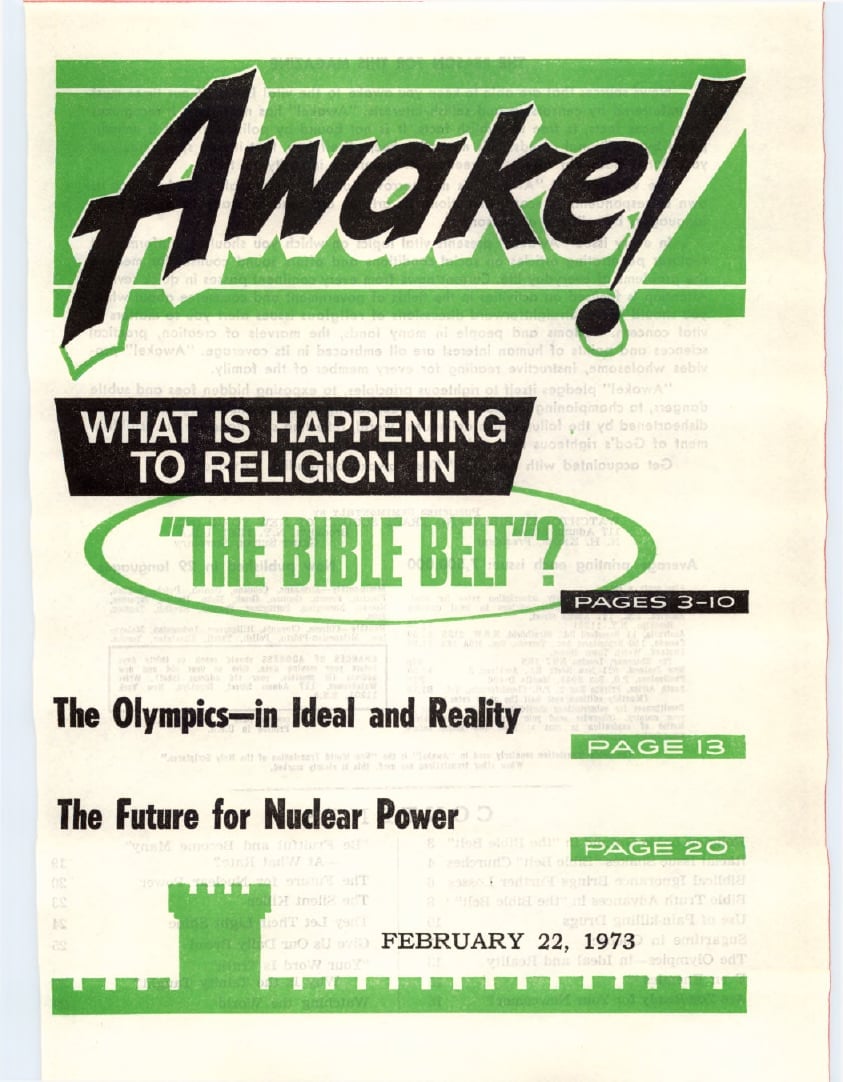
Awake! — February 22, 1973
Source: jw.org
Contents
Religion Loses Ground in “the Bible Belt”
Racial Issue Shakes “Bible Belt” Churches
Biblical Ignorance Brings Further Losses
Bible Truth Advances in “the Bible Belt”
Use of Pain-killing Drugs
Sugartime in Quebec
The Olympics—in Ideal and Reality
Even Enemies
Are You Ready for Your Newcomer?
“Be Fruitful and Become Many”—At What Rate?
The Future for Nuclear Power
The Silent Killer
They Let Their Light Shine
Give Us Our Daily Bread
Why Is the Trinity Taught?
Watching the World
“Adds Life to the Bible”
Now in Six Languages
Religion Loses Ground in “the Bible Belt”
Religion Loses Ground in “the Bible Belt”
FOR over two centuries the southern part of the United States has been a bastion of conservative Protestant religious thinking. Baptists, Methodists and other “fundamentalist” religious groups have so dominated the area that it has come to be referred to as “the Bible Belt.”
But now the former solid front presented by the Southland’s churches is splintering. In 1971 only the Baptist Church, of these major religious bodies in the South, realized any membership gains. This was a nominal 1.2-percent increase, only one tenth of one percent over population growth. The 1972 increase was somewhat more impressive.
However, more than problems with membership rolls afflict southern churches. A former president of the Southern Baptist Convention told an evangelism conference that “a floodtide of paganism, hedonism and atheism threatens . . . the church.” The Austin (Texas) Statesman quotes him as saying: “At a time when the church faces its greatest challenge the church is its most anemic and sickliest. . . . We’re living to see the [Baptist] Church die before our very eyes.”
Observers of other denominations make similar expressions. Some feel that reviving the ‘dying’ church may be impossible. Preachers find themselves frustrated over religion’s dwindling influence in the South. Ken Forshee, pastor of the Highland Hills Christian Church in Oklahoma City, concluded, after interviewing ministers from twenty-five churches in that area:
“For every man I can point to receiving gratification from the ministry, three would leave the ministry if they had any idea of what they could do. This is one of the most critical issues of the church today.”
An associate of Forshee, Rex Vaughan, refers to “a great deal of desperation by clergy as well as laymen—a lack of concrete vision and tools.”
But why this “lack of concrete vision,” loss of “gratification” and feeling of “desperation” in what has come to be considered the very heartland of U.S. fundamentalist religion? Because critical issues peculiar to southern U.S. churches face “the Bible Belt.” For example, there are the changes associated with racial integration. To understand its effect, one must briefly peer back into the history of the U.S. South.
Racial Issue Shakes “Bible Belt” Churches
Racial Issue Shakes “Bible Belt” Churches
IN THE early nineteenth century, churches of the same religious organization were to be found in both the North and the South. Black slavery, too, appeared in both sections of the country. But Negro slavery did not work out well in the North, where there was more concentration on commerce, manufacturing and westward expansion. In the South, however, where the cotton crop was the base of the economy, slavery provided cheap labor.
As the two sections of the country divided politically over the slavery question, they also separated religiously. Churches in the North condemned slavery as ‘unholy,’ while those in the South called it ‘holy.’ Southern religionists sought isolated Scripture texts to try to support the propriety of enforced black slavery. In 1844 the Methodist Church in the North and in the South split over the black slavery issue; the Baptists did the same a year later. Then, in 1862, the year the Civil War broke out, the Presbyterians divided right down the political Mason-Dixon line.
Churches of the South even involved themselves in the slavery business, according to E. M. Poteat, Jr., minister of the Pullen Memorial Baptist Church in Raleigh, North Carolina. He says: “Not only did Christian men hold slaves for the Glory of God, churches themselves frequently advanced the Kingdom of heaven by letting out for hire slaves who had become chattel property of the House of God.”
Negro slavery thus became firmly rooted in the South. It should not be forgotten, however, that, had black slavery been economically successful in the North, where it had earlier existed, churches there, no doubt, would have supported it as passionately as did their southern counterparts.
Post-Civil War Racial Bias
After the South lay in defeat at the conclusion of the Civil War in 1865, her clergymen, nevertheless, clung to what was uniquely their own—“Bible Belt” Protestantism. “If we cannot gain our political, let us establish at least our mental independence,” a Methodist preacher in Mississippi insisted at the end of the Confederacy. The publication Southern White Protestantism in the Twentieth Century by K. K. Bailey says: “Southern leaders were convinced that the white religion of the South was of a purer form than that of the same denomination in the North.”
Slaves may have been legally freed after the Civil War, but the Negro remained socially ostracized. Extremists in the South upheld white supremacy! Even Methodist and Baptist preachers were enlisted into the dreaded Ku Klux Klan to harass emancipated Negroes. Most of the black population in the South was shackled with poverty and illiteracy for decades after the Emancipation Proclamation of 1863.
As a consequence, outcast blacks did not have enough education to read the Bible. Usually not welcome at the white churches, they began their own services, which, at first, consisted of little more than talking and singing. They made up their own songs, the ‘religious spirituals.’ Any sermon that was delivered was often no more than a Bible story that had been handed down from father to son and greatly embellished in the process.
But even if whites would have allowed the Negroes to join their churches, few would have obliged. As the author of the book Deep South says: “Since Christianity as personified by the Anglo-Saxon Baptist and Methodist was the only religion known to them, and that was so definitely associated with the white boss and landlord, there was fear that they would be compelled to spend eternity where the white-race-God would continue to force upon them the same cruelty and injustice they had always known.”
United States history shows that the Negro has wanted little to do with a white racist God. Most, instead, have preferred their own brand of fundamentalist religion.
Effects of Modern Changes on Southern Churches
Then, dramatically, in 1954, the whole complexion of events started changing in the South. The United States Supreme Court struck down school segregation. Since that time blacks have churned up “the Bible Belt.” Walls that enslaved black minds and spirits for a hundred years are crumbling and a college-bred generation of Negroes is emerging, speaking out and demanding equality with whites.
The old southern white-supremist religious arguments have lost their grip before the onrush of Federal legislation and nationally supported protest movements. Many people have forsaken the churches that formerly held racist views. However, in the radical changes of the past few years, black churches in the South have not been left unscathed.
Rather, black churches have become meeting places to organize protests and demonstrations. Black preachers, prominent in the fight for social justice, even seek political office all the way from city councilman to the Senate.
Further, the average Negro has become more materialistic as a result of the demands for equality. U.S. News & World Report says: “Black clergymen are sensing a rise in religious indifference among people for whom the black church was once a mainstay of life.” (September 25, 1972) True, many blacks in the South remain deeply religious and respect the Bible. But the sudden changes in the social and religious picture are causing a new mood to develop. As one white observed, the Negro in the South now “has little feeling of guilt if he should decide to abandon the church and become an agnostic or an atheist.”
The appearance of integration and the rise of black power have been instrumental in fundamentalist religion, “white” and “black,” losing ground in “the Bible Belt.” But what other factors have also served to drive wedges into the Southland’s heretofore solid religious front?
[Map on page 5]
(For fully formatted text, see publication)
THE BIBLE BELT
Biblical Ignorance Brings Further Losses
Biblical Ignorance Brings Further Losses
DURING the 1950’s American churches rapidly grew. Congregations swelled. New sects branched off from the main denominations. Nowhere was the rosy dream of ‘converting the world to the Kingdom of Christ’ rosier than in the “Bible Belt” region. But, beginning with the 1960’s, the heat went out of religion. In the South, as we have seen, many church members and ministers were sidetracked with concern over social and political issues.
But what about those who sincerely sought spiritual food in the churches? Did they find the Bible clearly taught as the Word of God and were they shown how it could be used as a guide for life? A clear answer comes from church leaders. For instance, former Southern Baptist Convention president Carl Bates admits: “We reared a generation of Baptists who are almost totally ignorant of our doctrine.” And Baptist Dr. K. L. Chafin says: “They don’t know how to articulate their beliefs.”
Why Biblical Ignorance Among Church Members?
But why are church members “almost totally ignorant” and unable to “articulate their beliefs,” which should be Bible-based? Could it be that the clergy have nothing substantial to offer their flocks from the Bible? Do the southern clergy really believe the Bible to be “inspired of God,” as did the apostle Paul?—2 Tim. 3:16.
For one church’s answer, consider the twelve-volume Broadman Bible Commentary prepared by Baptist scholars. It casts such doubt on the authenticity of the Bible that its appearance has created a furor in Southern Baptist circles for several years. But, now, fewer and fewer churchmen challenge the commentary. Says the Christian Century regarding the 1972 Southern Baptist Convention business sessions:
“The issue that had threatened to provide the most ear-shattering bang at SBC deliberations—the perennial inquisition involving the 12-volume ‘Broadman Bible Commentary’ and its editors—went out with a whimper . . . [conservatives] introduced a resolution requesting the recall and rewriting of the work because of its inconsistency with Baptist belief in the absolute inerrancy of the Bible.”
Did most of the delegates favor rejecting a commentary that questions the Bible’s “absolute inerrancy“? Did they want it rewritten to show unquestionable support for the Bible? The report continues:
“The [delegates] refused by an overwhelming standing vote to endorse the withdrawal of the commentary . . . No head count was taken, but the resolution appeared to have been defeated by a 4 to 1 ratio.”
How can ordinary church members be expected to “know how to articulate their beliefs” if even the church’s leading members are divided on such fundamentals as “the absolute inerrancy of the Bible”? There are sure to be wide variations in belief as a result of doubt about the Scriptures’ role. But the uncertainty will not be limited to belief.
Christian conduct should be guided by the Bible. So, would there not also be doubt about what is proper as regards Christian action, conduct?
Yes. And the confusion that has resulted can be illustrated with a specific example. Two Southern Baptist ministers were asked by a Georgia public relations firm if political voting, military service, saluting national emblems, interfaith activities, patriotic ceremonies and supporting the UN made one a “part of the world.” One minister said “Yes” to every point in question. The other said “No” to each point. Yet one of the two pastors also noted on the questionnaire sent him that “God is not a god of confusion.”
True, God is not confused, nor is his Word, the Bible. But is there not obvious confusion among the clergy within the same Baptist denomination? The ordinary person will be no less confused. It is not surprising that many “almost totally ignorant” laymen are simply forsaking their churches.
Failure to adhere to the Biblical standard of conduct is also creating a divisive issue among “Bible Belt” Methodists. What issue is that?
Methodists and Homosexuality
The issue is homosexuality. The Bible clearly says: “Make no mistake . . . none who are guilty either of adultery or of homosexual perversion . . . will possess the kingdom of God.” (1 Cor. 6:9, New English Bible) Yet, when four Methodist ministers in the Atlanta area were asked if Bible principles are violated by homosexuality, only one said Yes!
In 1971 a periodical, The Texas Methodist, surveyed members of that church regarding homosexuality. In response to the question, “Do you believe a person can be both a Christian and a homosexual?” 41 percent of the total 533 responding said “Yes!” And 60 percent of the ministers said “Yes!” Some even referred to homosexuality as “natural.”
The divisive effect that the homosexuality issue has had on Methodist churches in the area is clearly observed in this letter from one older church member to The Texas Methodist: “I have been a Methodist for over seventy years and have never seen such filthy things as are going on in the Methodist Church, and which seem to be accepted by the leaders of our church. No wonder that so many members are leaving.”
Hypocrisy Turns Many in “the Bible Belt”
There is another reason why many—especially younger people—have turned from fundamentalist “Bible Belt” religions. What is that? An answer comes from Paul H. Johnson of the Martin Street Baptist Church in Raleigh, North Carolina: “A lot of youngsters see Christians preaching one thing and practicing another.”
Strict requirements have long been imposed on most “Bible Belt” church members, forbidding them to smoke or drink alcoholic beverages. But have church people really believed these teachings? Well, over 90 percent of the United States’ huge tobacco crop still comes from the South. And Kentucky remains a leading American whiskey-producing state. Should today’s intelligent youngsters be expected to ignore such obvious inconsistencies? Hardly!
Nor can they overlook the hypocrisy within many of the “Bible Belt” churches themselves. A woman in Decatur, Georgia, says: “I was raised the daughter of a Baptist minister, which meant no makeup, no jewelry, no cards in the house, no dancing of any kind, no short hair on girls, no music on Sundays, and absolutely no tobacco or alcohol. Nearly everything was ‘no.’ By the time I was twelve or so I realized that everyone was saying one thing and actually living another. Most of all my father. He preached on Sunday against everything that he did all week.” Such hypocrisy is just one more cause for many to turn aside from the South’s churches.
Certainly, failing to believe the Bible by steadfastly adhering to its teachings has resulted in division, uncertainty and hypocrisy within the “Bible Belt” religious organizations. It has contributed to their loss in membership. Yet, many sincere people honestly ask if there is any sound spot at all in the religious picture in America’s “Bible Belt.”
Bible Truth Advances in “the Bible Belt”
Bible Truth Advances in “the Bible Belt”
THE one sign of spiritual health in “the Bible Belt” (and elsewhere in the world) was recently pointed to by Baptist Church historian Dr. H. L. McManus of Mercer University in Macon, Georgia. He singled out Jehovah’s witnesses as due to become a ‘big denomination’ and called attention to their ‘phenomenal growth.’
Figures shown here, based on the work of Jehovah’s witnesses in fifteen states in the traditional “Bible Belt” region, reveal that, indeed, they have had, as Dr. McManus notes, a ‘phenomenal growth.’
Year: 1961 1971 1972
No. of JW’s: 70,926 101,032 120,425
Notice that the increase in one year, from 1971 to 1972, was almost two thirds what it had been in the ten-year period between 1961 and 1971. But why have they grown so vigorously? Consider the explanation offered in a sermon by another Baptist clergyman, C. Earl Cooper of the Riverside Baptist Church in Jacksonville, Florida:
“Witnesses believe the Bible . . . from beginning to the end, ‘not a part of it, but all of it.’ If you [Baptists] believed in your religion as much as they believe in theirs, if you persisted in the intelligent realism of your religion as much as they do in theirs, if the ten million Southern Baptists across this country believed in their religion the way Jehovah’s Witnesses believe in their religion, these Southern Baptists would turn North America upside down or upside up, right side up, but we don’t.”
Thousands of people have found that “Witnesses believe the Bible” and so have turned from fundamentalist churches where God’s Word is often given little more than lip service. Though many persons earnestly desired to understand the Bible and use it as a guide for their lives, it remained like a closed book to them until they contacted Jehovah’s witnesses.
For instance, a man in Columbia, South Carolina, contrasts fifty years in “Bible Belt” churches with what he learned by studying with the Witnesses: “As I studied with Jehovah’s witnesses I began to realize that in Sunday School [of my former church] we had the roll call, two collection plates were passed, the Bible was never opened or used. I just sat and listened and never learned anything from the Bible. When I attended the Kingdom Hall of Jehovah’s witnesses I heard a fine Bible talk, looking up many scriptures and really getting accurate knowledge and understanding.”
Of course, this man found that Jehovah’s witnesses not only learn about the Bible, but really believe it and live it. For instance, they do not pass “collection plates” or financially assess members of the congregation. Rather, they follow the Scriptural principle of voluntary giving as found at 2 Corinthians 9:7: “Let each one do just as he has resolved in his heart, not grudgingly or under compulsion, for God loves a cheerful giver.”
Truth About the Dead Attracts Many
Hundreds of persons who have been in the churches in the South and want to believe the Bible have been perplexed by the teaching of “hellfire.” For instance, a woman in Houma, Louisiana, reveals the frustration she once felt about the “hellfire” doctrine: “I had been taught that God was a God of love as stated at John 3:16, yet the church taught a burning hell. This just did not seem logical for a God of love. I had recently experienced the loss of a loved one in my family and was concerned about the condition of this person. I was thrilled to learn from the Bible the condition of the dead as well as the wonderful hope of a resurrection.” Yes, the simple Bible truth stated at Ecclesiastes 9:5, that ‘the dead are conscious of nothing at all,’ and are asleep in death awaiting a resurrection or return to life, appeals to honest-hearted persons, as it did to this woman. She knows now that a loving God does not torment persons eternally in a “hellfire.”
Another woman, in Daraville, Georgia, had lost her mother in death. She asked her Baptist minister if her mother (not a member of the minister’s church) was in “hellfire.” This woman, in recalling his attempts to answer, concluded: “Well, when I heard the ‘maybes’ and ‘I don’t knows,’ that was it. I finally realized that the man didn’t know anything about God’s Word the Bible. So I decided to forget the whole thing, the preacher, the church, everything.”
Sometime later Jehovah’s witnesses called on her. Now, not only her questions about the condition of the dead were answered, but she learned how the Bible assists the living. She says: “Now I’m learning the Christian way of life. Jehovah’s witnesses really have God as the Supreme Authority on all matters no matter how big or how small the problem. All the answers are in the Bible and now I’m finding them, with the hope of helping others like myself that haven’t been getting their questions answered from God’s Word.”
Biblical Morality Appeals
The genuine, unhypocritical standard of Biblical morality upheld by the organization of Jehovah’s witnesses has appealed to hundreds of persons.
Thus a man who had been a member of the board of trustees of a Baptist church in Louisiana recalls: “At a meeting of the trustees we were instructed by the assistant pastor to teach the teen-age boys how to commit fornication with the girls without getting them pregnant.” He quit the church.
Then what happened? He states: “My wife began studying with the Witnesses. She was impressed with their moral cleanness. I was invited to the meetings. I noticed right away the friendliness of the congregation. Then too I learned that the congregation disfellowships wrongdoers. I knew that here was the organization with very high moral standards.” This man has accepted the Bible’s standards of morality and is now one of Jehovah’s witnesses.
Bible Prophecy Interests Many
Other persons have thrilled to learn of the Bible’s prophecies. The Christian apostle Peter shows that Christians do well to ‘pay attention to the prophetic word.’—2 Pet. 1:19.
But in most “Bible Belt” churches, prophecy is largely ignored. One “Church of Christ” minister in Georgia even refers to prophecy as ‘open to all sorts of subjective speculation.’
However, the current unparalleled conditions in the world are clearly understood only in the light of Bible prophecy. (See Matthew chapter 24; Mark chapter 13 and Luke chapter 21.) Additionally, it is prophecy that reveals to the Christian the marvelous New Order of righteousness where God’s will shall be done on earth as in heaven. (Matt. 6:9; Rev. 21:1-4) Many persons are seeing that this hope is firmly held by the Christian witnesses of Jehovah because they believe the entire Word of God. Learning of that same hope, they, too, have become Witnesses.
As these few examples reveal, the Truth of God’s Word, taught by Jehovah’s witnesses, is spreading rapidly in “the Bible Belt,” as it is throughout the rest of the world. While other churches are watching their membership rolls sag, the Witnesses are growing numerically and, most importantly, spiritually, in an understanding of God’s Holy Word. Why not personally find out the reasons for this growth? Wherever you live, contact Jehovah’s witnesses, learn the Truth from the people who really pattern their beliefs and their lives after the Bible.
Use of Pain-killing Drugs
Use of Pain-killing Drugs
DRUGS to relieve pain are readily obtainable in most countries and are used on a regular basis by many persons. Is it wise? Medical reports show that phenacetin, an effective remedy for fever and pain, can, if used for years, gradually damage the kidneys. Dimethylaminophenazon, also used in some countries for pains of all types, can eventually put a stop to the production of certain white blood corpuscles, with possible fatal effects. Salicylic acid in combination with acetic acid (that is, aspirin), taken to relieve headaches, causes loss of small amounts of blood and, if taken constantly, actually results in frequent headaches.
Commenting on the continual use of such pain-killing drugs, Dr. Heinz Fidelsberger, in Der Einkauf, published in Vienna, Austria, said: “Because one suffers pain on a certain occasion and perhaps feels somewhat ill, one takes a remedy of this sort. Later, it is taken more and more frequently, and then pains set in that are the result of the continual pill-swallowing. Now several tablets are consumed daily to combat these pains, thus increasing the damage to the body.” Does it sound familiar?
In further describing these chronic pill swallowers, the doctor’s report said: “They complain constantly about innumerable afflictions, feeling miserable day and night, and nothing can help them. They have been poisoned, are the victims of preparations which were surely at one time very valuable but are now being swallowed by the millions daily like addictive drugs.”
Would it not be better to identify the ailment and to treat it, rather than always simply to kill the pain, and perhaps yourself?
Sugartime in Quebec
Sugartime in Quebec
By “Awake!” correspondent in Canada
YOU are invited to a “sugaring-off” party. As winter snows give way to the spring thaws, shining tin buckets are seen dangling from the maple trees. In ramshackle sugar huts the vats are set and the fires are stoked, ready for the sap to be boiled into a favorite pancake topping, maple syrup. From Quebec’s cities and farms, crowds flock to the sugar camps. Want to come along?
At many farms in Quebec “sugaring-off” parties are an organized affair, with groups from the neighborhood or the cities going along for a day. The first delight is to your sense of smell. The sweet scent of boiling sap combines with the tangy aroma of burning wood to produce a never-to-be-forgotten fragrance that permeates the atmosphere.
The early European settlers learned from the Indians how to make maple sugar from tree sap. In 1851, the first year for which statistics are available, 13,500,000 pounds of maple sugar and syrup were produced in North America. Today production is about double that. The United States and Canada are the only maple-sugar-producing countries in the world.
Tapping and Gathering
The maple trees themselves catch your eye—straight trunks, free of branches for two thirds or more of their height. One of the largest Canadian maples commonly reaches eighty to ninety feet and a diameter of two to three feet.
As you look through the stand of trees, you notice sap buckets hanging on them. At the start of the season the sugar maker selected a place on the tree’s trunk and bored a hole one to two inches deep in the trunk, sloping it slightly upward so that the sap could drip easily. Next he inserted a metal spout into the bored hole, providing a channel through which the sap could run from the tap hole to the bucket. He also placed a hutlike cover over the bucket.
You will notice that trees with a diameter of less than twelve inches are not tapped. A twelve-inch tree will usually have one bucket, an eighteen-inch tree two buckets, a twenty-four-inch tree three buckets, and a thirty-inch tree four buckets. A tree may give up to forty gallons of sap in one season. The sap runs best on bright sunny days with warm temperatures (about 40 to 45° F.) and frosty nights.
Persons often ask whether the drilling and tapping of the trees harm them in any way. They are deprived of nourishment, but they work harder to make up for the loss. Also, the farmer usually clears the ground beneath them, providing more moisture and nourishment for the trees to draw on. Thus each season trees are drilled and tapped again and again, sometimes for over a century, without apparent harm.
As you wander farther among the maple trees, the ground still covered with snow, you can see the sap being gathered from the buckets. The sap is transported to the sugarhouse on a horse-pulled low-slung sled fitted with a metal gathering tank. The horses seem to have no difficulty winding their way through the snowbanks and trees. The modern metal tank is equipped with a strainer on top and a pipe connection on the bottom, through which the sap can be run into the storage tank at the sugarhouse.
At the Sugarhouse
Here occurs the most crucial and important part of the whole sugaring process, the boiling of the sap into syrup. As it is required, the sap is piped from the storage tanks into the evaporator inside the sugarhouse. This is a giant elongated steel pan. Under the evaporator the wood-fired furnace is in action. The sap flows continuously from the storage tanks into one end of the evaporator, and as it works its way through a long maze of compartments, the heat from beneath drives off the excessive moisture until finally at the draw-off end the concentrated maple syrup emerges. The syrup is filtered and then bottled or canned while hot (180° F.) to prevent mold and loss of color or flavor.
It takes thirty to forty gallons of sap to make just one gallon of maple syrup!
In this whole operation speed and cleanliness are important to the sugar farmer. The entire syrup-making process for one lot of sap is completed in one day.
A Treat for the Visitors
After touring the maple groves and the sugarhouse, the visitors gather around wooden troughs filled with clean, hard-packed snow. Our sugar maker emerges from the house with a bucket of boiling-hot syrup and ladles it onto the snow. It hardens immediately, and the visitors are able to pick it up with wooden sticks and enjoy the delightful “syrup on snow” of sugartime.
Next to be enjoyed by the group is the “sugaring-off” meal, traditionally including baked beans, ham and small pieces of deep-fried salt pork with hot bread; and, for dessert, scrambled eggs cooked in maple syrup. After dinner there are music and dancing.
Use of Maple Products
While maple syrup is the most popular of the maple products, we should not forget maple sugar, maple butter and maple taffy. Maple sugar is obtained by boiling the sap at a higher temperature than for making the syrup. Afterward it is poured into molds. Maple butter is produced by boiling the sap at a slightly lower temperature than for the making of sugar and stirring until fairly thick, and then it is poured into containers. Maple taffy, usually available only during sugartime, is boiled until it becomes of thick syruplike consistency, then it is poured into containers.
You may want to try some Maple Rice Pudding. Ingredients include: 2/3 cup uncooked rice, 2 eggs, slightly beaten, 2/3 cup maple syrup, 1-1/2 cups milk, few grains nutmeg, 1/4 teaspoon salt, 1/2 cup seedless raisins. Procedure: cook rice in boiling salted water until tender. Drain thoroughly. Combine eggs and maple syrup and blend well. Stir in milk, nutmeg and the 1/4 teaspoon salt, then the rice and raisins. Turn into a buttered casserole and cook in a moderate oven (350° F.) until set, 60 to 70 minutes. (Serving for 6 to 8 persons.)
Or perhaps your delight would be in Maple Apple Sauce. One cup of maple syrup and a half cup of water should be brought to a rolling boil in a deep pan. Then fill the pan with unpeeled sections of apples. Stir until all pieces are coated with syrup. Cook only long enough to tenderize apples. The slices remain unbroken and are glazed with maple syrup sweetness.
The short period of the sugar harvest is over in only four to six weeks, but it is a grand experience each year. We have been glad to have had you as a visitor during sugartime in Quebec.
The Olympics—in Ideal and Reality
The Olympics—in Ideal and Reality
LAST fall about one billion persons observed, either firsthand or on television, the Olympic Games in Munich, Germany. Were you among those spectators? Looking back, what do you remember most about the Games?
For many people, the murder of eleven athletes and coaches is most outstanding. This brutal event all but caused the real Olympic spectacle to fade from view. Munich’s $750-million investment was threatened with ruin. But, as events worked out, the Games were only briefly delayed.
Nevertheless, suppose those killings had not taken place? Do the Olympic Games really live up to their own ideals? Let us examine those ideals in the light of what happened in Munich.
Free from Nationalism?
Theoretically, the Olympic Games should reflect “international cooperation and good will,” as stated by Avery Brundage, president of the International Olympic Committee (IOC). National prestige and rivalry should be set aside. But were the Munich Games free from nationalism?
No. Political influence almost torpedoed the Games before they started. Some forty-five nations threatened to quit if Rhodesia competed. The Rhodesians, as a consequence, were ousted from the Games in a move Brundage termed “naked political blackmail.” Politics thereafter saturated the Olympics.
For example, charges of biased nationalistic judging were heard. This was particularly true in events where judges had to analyze a performer’s style. Almost a dozen judges were dismissed from boxing alone, and others were warned for their prejudicial rulings. Time magazine lamented: “Millions [of dollars] are spent on circus-tent publicity, but there is not money to pay for impartial and knowledgeable officials.”
Strong feelings were also evident in national ‘medal counting.’ Individuals win medals for victories in Olympic events. But during the Games observers were reminded of how many medals nations were winning. How well the United States was faring against Russia, or the non-Communist world against the Communist one, was highlighted.
So, regardless of the ideal of “international cooperation and good will,” political differences are really deepened, not resolved, by the Olympics. “No one can doubt now,” the New York Times said, “that the idea of an ‘Olympic peace’ is a mockery.”
But does not competition at the Games make for peace and friendship among athletes? Do they not accept the creed: “the most important thing in the Olympic Games is not to win but to take part”?
Winning Not Important?
In reality, winning is most important, as made clear when one considers the participants’ views.
One American jumper confessed: “What really bothers me, though, is the thought of going back home and, say I don’t win. Someone comes up and says, ‘Hey, how’d you do?’ and I tell them I finished second, and they consider me a failure. The first thing people always ask is, ‘Did you win?’ and if you say no, that’s the end of the conversation.”
Nor does strong competition build friendship among competitors. The opposite is achieved, as admitted by a United States runner: “The spirit of the Olympic Games is gone. . . . Track and field is fun, but here people keep making you want to hate your competitor. Why? It’s just a race.”
Hate, not friendship, leads to such violence as that shown in the water polo competition between Yugoslavia and Cuba. A United Press International report said: “The water in the pool was tinted with blood. Elbows were thrown, players were held under water and there were other forms of minor violence.” But intense Olympic competition has other bad effects.
Some athletes stimulated their bodies with drugs like ephedrine, only to be barred from competition. Others, whose particular sport demanded steady nerves, used tranquilizers. Did athletes drug themselves because they believed “taking part” was all-important? No! In reality, they were determined to win!
Only “Amateurs” in the Olympics?
Ideally, also, all Olympic participants should be “amateurs.” They should participate for love of sport and not for money. But the hypocrisy behind the ‘amateur status’ was pointed up in Esquire magazine:
“Often, amateurism is merely a matter of whether one gets paid openly or secretly. One ‘amateur’ runner recently received a reported $4,000 for a single race. A jumper admits to getting a $6,000 sports car for changing his brand of track shoes just before the Olympic final. In Europe, the payments are also made under the table, but the table is often out in plain sight. One American tells of being handed an envelope on the victory stand in full view of 20,000 Europeans. ‘Everyone knew what was in the envelope,’ he says with a laugh, ‘and most of them knew how much was in it. The guy who gave it to me was a member of the country’s Olympic committee.’”
So financial gain does motivate many “amateur” competitors. Not surprisingly, correspondent Eric Segal referred to the Games as “sick with commercial elephantiasis.”
Nevertheless, today, a clear distinction between “amateur” and “professional” is difficult. For instance, under the Communist systems all Olympic athletes receive food, housing and wages from the government. Yet they are not “professionals,” as there are no ‘professional sports’ in the Communist world. But Communists compete in the Olympics against athletes from nations who struggled to ‘pay their own way’ to the Games. Western nations say this is grossly unfair.
However, are Western teams entirely free from the same charges? Do not American universities grant scholarships worth thousands of dollars to “amateur” student athletes? Do not some American military men spend much of their entire service career, while being housed and fed by the government, competing as “amateurs“? Such practices are equally unfair to poorer athletes.
Because of the friction revolving around the ‘amateur status’ ideal, many Olympic backers prefer to permit all athletes, including “professionals,” to participate. Already, dropping “amateur” and “professional” labels has worked out favorably in golf and tennis tournaments.
Religion’s Role at the Olympics
The Olympics are spoken of as the world’s outstanding sporting event. But, in reality, many religious customs have been preserved in connection with the Games. Does that surprise you?
Well, the ancient Greek games, which started in 776 B.C.E. and continued into the Common Era, were essentially religious in nature. Today the religious tradition has been maintained. How? Consider what happened before the 1972 Olympics.
A woman, dressed as a high priestess, requested Zeus for his grace. She ignited a torch from a fire lit by the sun at the ruins of the Hera temple in Olympia, Greece. For four weeks this “sacred” Olympic flame was carried about 3,500 miles by relay runners to Munich. When it was used to light the Games’ “sacred fire,” there was a fanfare of trumpets, the releasing of thousands of doves and an artillery salute. Then followed a benediction and the Olympic hymn. Really, ancient Greek religious rites, though modernized, live on in the Olympics!
The Future of the Olympics
Olympic ideals seem noble to some. However, the 1972 Games again clearly demonstrated that these ideals are not attained. Some suggest making the Games smaller in the future, holding the swimming championship in one place, track in another, and so forth.
But, in reality, the Olympic Games simply reflect the problem-wrecked world they represent, filled with nationalism, competition and commercialism. The problems before the Olympics, like those facing the world, make some doubt that the 1976 Games will even take place.
Even Enemies
Even Enemies
● The saying, ‘Those who seem to deserve love least, need it most,’ is not unlike Jesus’ admonition to Christians: “Continue to love your enemies and to pray for those persecuting you; that you may prove yourselves sons of your Father who is in the heavens, since he makes his sun rise upon wicked people and good and makes it rain upon righteous people and unrighteous.”—Matt. 5:44, 45.
Are You Ready for Your Newcomer?
Are You Ready for Your Newcomer?
IT HAD been a rough day. Nothing seemed to have gone well. The directors were not pleased with the sales figures. Customers were complaining because of not receiving on time the goods they ordered. An atmosphere of gloom prevailed in the office the whole day. I was depressed as I drove home that evening.
Opening the gate that led to our front door, I was suddenly brought to my senses by the excited chatter of our two-year-old daughter as she ran down the pathway to meet me. What she was saying I do not know. It was not important. But I was immediately transported from the realms of the office gloom to the world of our little girl. What a relief to be home! Yes, children somehow have a way of making one forget one’s problems.
My wife and I are in our mid-thirties, but we both agree that the last two years with our little daughter have been a real education. True, we have had our tiring, and even frustrating, moments. At times we could “eat her up” with affection, and at other times we almost wish we had! But, considering all, we have found it a joy to have her around.
Are you expecting a new addition to the family? Are you ready for the newcomer? You say you already have six of them? Fine! With your experience no doubt you could add much to the following.
Nine Months of Preparation
Conception, gestation and birth are truly a marvel. Men will probably never be able to explain fully just what takes place during these nine months in mother’s womb. Think of it! At conception this creature that is due to affect your lives so much is smaller than the dot on the letter “i.” Three weeks later it has grown to about the size of the letter “t.”
At five months the unborn baby may stretch, head to foot, the width of the page of this journal. Another four months, and all six to ten pounds of him will let out a cry that will thrill you and which virtually says: “Here I am. Are you ready for me?” Actually, these nine months have provided just enough time for the preparation of your mind, emotions and body for the welcoming of your new friend.
Remember, mother, what is taking place within you is a very marvelous and natural process. Do not be overanxious about the changes in your body. But it will be worth while to learn something of the marvelous development from fertilization of a single ovum to the final delivery of the newborn baby. A visit to the library or local bookshop will help you to locate this information. It will give you insight, and enable you to get ready for the newcomer.
What name will you choose? Your child will be known by it for a long time, so it should be given serious thought. Some parents choose names from the Bible. Others select a name having more of a family connection. You may think of a name that has some personal meaning to yourselves. Some parents have even made up an original name. But do not give a name that will result in awkwardness or embarrassment to the young one as he grows older. Maher-shalal-hash-baz may have been all right for the Israelites of Bible times, but it would have its difficulties in most places today!—Isa. 8:1.
You may also want to select a doctor, one in whom you can feel confidence. As a Christian, you will want one who respects your Bible-trained conscience, which may object to certain medical practices. The Rh factor can sometimes cause anxiety and so it is wise early in your pregnancy to find out if this could be a problem in your case. However, rarely does the first child develop this Rh complication.
Then there is the matter of clothes to buy and napkins (diapers), of which you will need plenty. Also, will you have the baby delivered at home or in the hospital? Are you, as father, going to be present with your wife at the time of delivery? These are just a few of the many things you will wish to ask yourselves and ponder over during these nine months. But there are other decisions to be made.
Breast-feeding? Vaccinations?
One early decision is whether the baby will be breast- or bottle-fed. It is true that bottle-feeding is less bothersome. But even though cow’s milk may be adapted to meet adequately the physical needs of the young one, there is a vital emotional need that mother fulfills when she nurses her child.
Also, no substitution can match perfectly the nourishment and protection that mother’s milk was designed to give a baby. It progresses from colostrum in the first two or three days, which is an important food for the little one, to a milk that becomes stronger according to the baby’s needs. Breast milk has a constant temperature; it is germ free; it is easily digested; it contains all the vitamins, and there is evidence that it provides protection from infections.
If you decide to breast-feed your baby, you may find some difficulty at the start, perhaps because of tension or anxiety. Do not worry. Perseverance usually brings satisfying results. You may find that it is several weeks before you feel that the secretion of milk has fully set in.
Then there is the matter of inoculation. It seems that medical science is continually adding to the number of vaccinations and inoculations that it recommends for the protection of the young. It is your decision to make as to which vaccinations your baby will have, if any at all. The pages of this and other journals have contained fine information on this subject, and some research will put you in a better position to decide what you believe to be best.
Early Training
Do not be surprised if you find that your life is not your own when the newcomer first arrives at home. Due to his special needs, you may find that your homelife is governed to a large extent by the desires and dictates of the baby. However, gradually the little one can be trained by firmness and kindness to realize that he has become a member of an already established household, and equilibrium can be restored.
Right from the start help your child to understand the need to obey, even if it means at times using an open hand applied to a sensitive part of his little anatomy. Obedience can be a real protection from all sorts of dangers. To children the whole world is something new and wonderful to explore, but such explorations can be fraught with danger. Obedience will be your newcomer’s protection.
At a very early age, between one and two years, children can be taught to sit quietly for periods of time. If yours is a family that enjoys studying the Bible with others in a group, this will be very important to you. Children like to have books the same as Mom and Dad, and a little cardboard book with appropriate pictures pasted inside will often suffice at the start when pages easily get torn.
If your child becomes restless, it may be helpful to take a brief walk outside for some fresh air. Should he continue to misbehave, the next “walk” would not be so refreshing. The time will soon come when just to mention the idea of going outside will recall the unpleasant experience there, and will get a quick response. Remember also that commendation is very important in all fields of training. When your child does sit well, commend him, and he will glow inside.
Teaching your child to count, learn rhymes, or to read is all part of his training. The mind is a marvelous gift from Jehovah God, and the extent to which it is developed at this early age will often determine the extent of its use later on.
There is also much training to be done in the home. Teaching the child to put away his toys, to put his dirty clothes in the right place, to dress and undress himself can all be done before a child is three. It may take longer to have him do these things himself, but the time you spend teaching him is an investment. You will realize the benefit later.
It is indeed a pleasure to see little ones, without being told, putting away their toys, straightening up their room or doing other chores they have been taught. It is a pleasure, too, to hear them preface their requests with “Please, Daddy,” or to say, “Thank you, Mommy.” But best of all to see is their growth in appreciation for God. You may sit down to a meal one day and before expressing thanks in prayer your little one may remind you, “Close eyes, Daddy.” How happy you will be that he is learning to copy your example of thanking God! It is never too early in life to begin building in his mind and heart a right relationship with his Creator.
Of course, it is always good to remember that there are no ‘little angels’ in the form of children, so be prepared for disappointments. At times there may seem to be no response to your training and you may feel completely frustrated and depressed. You may often find yourself thinking, “Am I training him in the right way?” But never give up.
Children go through all kinds of moods and stages. There are no fixed rules for handling their varying temperaments. What can be said is that they thrive on love, are tamed under discipline, thrill at kindness and appreciate patience. When they are as old as you are, they will thank you for the training you gave them.
Joys and Satisfaction
The first cry of the newcomer will bring you, its mother, an indescribable surge of joy. The baby’s first smile, lifting its head to see what is going on, its gurgling noises, trying to chew on its own feet, following you around the room with jerky head movements are all occasions that will also bring you joy. In fact, you will find that not a day goes by without some surprise and discussion of the little one’s development. One day you will peep into its little crib and get the biggest and brightest smile, and you may feel sure it is a smile of recognition of you, its father.
It brings much satisfaction to parents to see the child developing mentally and physically. You may be eating one day, and perhaps reading a book at your side, when suddenly you become aware that as you raise your fork so does this little mimic sitting at your side. Then you notice that he is also pretending to read, carefully studying your exact hand and arm positions so as to copy them. You will often see yourself in your little one.
When was the last time you jumped around like a frog, or pretended to be a pussycat, or squeezed under a bed to hide? You may find yourself doing all kinds of strange things. Gamboling or standing on your head will be fun. Cows, horses and even the local dog will take on added attraction. You may be anxious to return home at night.
On the other hand, as mother, you may at times find being with the baby all day quite trialsome. But then he will do something that makes you just want to hug him. Perhaps you are brushing his hair and you tell him to hold his head still. Then you notice: There he is, hands pressed tightly against his face, mouth open and cheeks pushed in as he ‘holds his head still.’
Yes, you have a lot to which to look forward. But it is good to realize that rearing children in this modern, crime-ridden world is not easy. We are living in “the last days” foretold in the Bible; these are “critical times hard to deal with.” There is an evil influence all around—in neighborhoods, in schools, on playgrounds—and you will have your hands full to keep your child from becoming as so many other children are, “disobedient to parents.”—2 Tim. 3:1, 2.
It is a sad truth—many young ones today are rebellious and turn to delinquency, and so, instead of bringing joy and satisfaction to their parents, they are a source of great pain and heartache to them. It is vital, therefore, that young ones be taught from infancy the righteous principles contained in God’s Word the Bible. Only in this way can you hope to prevent calamity from befalling your child, and heartache for yourself.—2 Tim. 3:15.
Long ago a Bible writer said: “Sons [and we should also include daughters] are an inheritance from Jehovah; the fruitage of the belly is a reward.”—Ps. 127:3.
My wife and I experience that reward. Our second child is already here, and we do hope that we are better prepared for this one.—Contributed.
“Be Fruitful and Become Many”—At What Rate?
“Be Fruitful and Become Many”—At What Rate?
● The expression “be fruitful and become many” was directed by the Creator to both animals and man. (Gen. 1:22, 28) It is common knowledge that as a rule nine months elapse between the conception and birth of a human. But how about others of earth’s creatures? Various authorities give the following time periods for the following kinds: bacteria, 20 minutes to several days; chickens, 21 days; mice, 20 to 21 days; ducks, 23 to 30 days; rabbits, 30 to 34 days; guinea pigs, 68 to 71 days; hogs, 114 days; sheep, 146 days; cows, 270 days; horses, 330 to 380 days; elephants, 607 to 641 days; whales, 330 to 550 days (depending upon the species).
Generally speaking the larger the kind, the longer its period of gestation.
The Future for Nuclear Power
The Future for Nuclear Power
NOT long ago there was glowing, almost unrestrained optimism for nuclear power. The atom was viewed as a source of limitless, inexpensive energy. But the optimism has cooled somewhat. As noted by a speaker at the fourth international atoms-for-peace conference in September 1971, there are “unforeseen and unpleasant side effects.”
To help protect the American public from adverse “side effects,” the National Environmental Policy Act was signed into law January 1, 1970. It requires that a government agency prepare and distribute “an environmental impact statement” that gives the probable detrimental effects a proposed new project may have. It was charged, however, that the Atomic Energy Commission (A.E.C.) failed to implement environmental safeguards in projects it oversees, thus making a “mockery” of the Environmental Policy Act.
In a milestone decision, a United States federal court on July 23, 1971, upheld the charge. Therefore the A.E.C. was required to review permits and licenses already granted to dozens of nuclear power plants under construction, including some that had recently begun operating. In December 1971, Atomic Energy Commissioner Wilfred E. Johnson noted that it might take up to a year to review pending permits.
Delays and Their Effects
This has resulted in considerable delays in providing electricity from nuclear facilities. As of April 1971, it had been a full year since the A.E.C. had issued a full operating permit to any nuclear power plant in the United States! Some utilities were even notified to cease construction on portions of their nuclear plants until a complete investigation could be made. These delays have served to increase the power crisis, for new generating plants are badly needed.
On March 16, 1972, the chairman of the A.E.C. urged Congress to modify the laws temporarily to permit idle nuclear plants to go into operation. Does this mean that public health and safety could be sacrificed in the haste to keep up with demands for electricity? Can citizens be assured that unsafe nuclear reactors will not be pressed into service? Some persons are apprehensive about the matter. Yet there is something else that is of even greater concern.
Some persons ask: What if a few years from now the radiation emitted from nuclear reactors is indeed found to be damaging to humans, even as some prominent scientists have been saying that it is? By then a large portion of electrical power may be generated by nuclear fission. What would mankind do? Shut down nuclear facilities and bring to a halt the modern way of life based on electrical power? Or would humans accept the resulting radiation-induced cancer plague as a price to pay for electricity? It is indeed an unpleasant prospect to consider, as a writer in the New York Times commented in January 1972:
“The United States, Europe, the Soviet Union and Japan have a habit. They are addicted to heavy energy use, great gulps and injections of fossil fuel. As fossil-fuel reserves go down, they will take dangerous gambles with the future health of the biosphere (through nuclear power) to keep up their habit.”
There is, however, quite a different kind of cloud that hangs over the future of nuclear power.
Fuel Running Out
The present-day nuclear reactor is very inefficient in the use of uranium. It utilizes only about 1 percent of its energy content in producing power. As a result, U-235, the uranium isotope used in nuclear fuel, is rapidly being depleted. Science Digest of last February observed: “Ordinary nuclear plants are consuming available uranium so quickly that by 1980 we’ll probably be scraping bottom.”
The Atomic Energy Commission’s Robert Nininger recently expressed this ominous outlook: “Things could come to a slow grinding halt unless we could get uranium overseas. Mathematically, we could be taken out to about 1982.” Other estimates indicate the supply could last a little longer.
What does this mean? Surely all these nuclear plants are not being planned and built knowing that the whole nuclear fission system of power generation could soon grind to a halt. How is this problem supposed to be solved? Will it result in lessening or increasing possible hazards to man?
A Different Kind of Reactor
The fast-breeder reactor is being looked to as the solution of the uranium shortage. Peter Mummery, head of a reactor development center in northern Scotland, said of breeder reactors: “We are putting all our money on them.” The United States has taken a similar position.
In his June 4, 1971, message to Congress on the energy crisis President Nixon asserted: “Our best hope today for meeting the Nation’s growing demand for economical, clean energy lies with the fast-breeder reactor.” The president asked Congress to pledge $2,000,000,000 in federal funds over the next ten years to develop a commercial model. But how is the breeder reactor intended to solve the fuel problem?
It is by producing more fuel than it uses. The breeder reactor can actually do this, thus the name breeder. This may at first sound impossible, but how it can be accomplished is appreciated when one realizes that new elements are formed during the fissioning process.
In the conventional reactor’s operation, U-235 atoms split and form smaller radioactive elements, as well as releasing neutrons. But U-238 atoms, instead of splitting, capture a neutron and are transformed into fissionable plutonium, an element not ordinarily found on earth. In a conventional reactor a relatively small number of U-238 atoms capture neutrons, thus producing only a little plutonium. But in the breeder reactor more U-238 is transformed into plutonium than the amount of fissionable fuel consumed! How is this made possible?
It is due to the speed with which the neutrons travel. In the breeder reactor, rather than having a material of some sort to slow down the neutrons, they are left to travel rapidly. (That is why it is called a fast-breeder.) Thus when the neutrons hit and split either U-235 or plutonium, they dislodge from the fissioning atoms more neutrons than occurs in a conventional reactor. This makes more neutrons available to be captured by the plentiful U-238, and hence there is a net increase in the production of plutonium, which is the fuel used in breeder reactors.
Because of thus breeding fuel, the chairman of the A.E.C., James R. Schlesinger, said: “The breeder will be able to provide electrical energy for tens of thousands of years.” But the question has been raised: Can commercial breeder reactors be developed before uranium supplies run out?
Possible Production Time Schedule
A number of test versions have already been built. Also, the Soviets and British have made significant progress in building commercial-size breeder reactors. But it was not until January 1972 that the United States announced plans to build their first large fast-breeder reactor. Construction may begin sometime in 1973, and completion can be expected, observed A. Eugene Schubert, vice-president of the General Electric Company, “about 1980.” Therefore he said:
“Utilities obviously will not buy any of these new plants until they see it proven, so it would probably be 1982 before any substantial orders are taken and, thus, 1990 before any real quantities of electricity come from breeders.”
Some believe it may be a close race to get breeder reactors into operation before uranium supplies run out. Unless breeder reactors are available by the late 1980’s, observed one writer, the first generation of nuclear power stations may be the last. So there is urgency to rush ahead with the breeder program. Yet there is also vigorous opposition to this. Why?
Question of Health and Safety
It is because of the potential dangers associated with the breeder reactor. Critics say that there is no assurance it will function safely. For instance, there is danger with the coolant. Because of the higher temperatures at which the breeder reactor operates, liquid sodium rather than water is used to cool the reactor and transfer its heat for producing steam to generate electricity. But since liquid sodium is very corrosive and will explode upon contact with water or air, the concern for safety is understandable.
…