Awake!, August 8, 1972
Download: PDF — Awake!, August 8, 1972
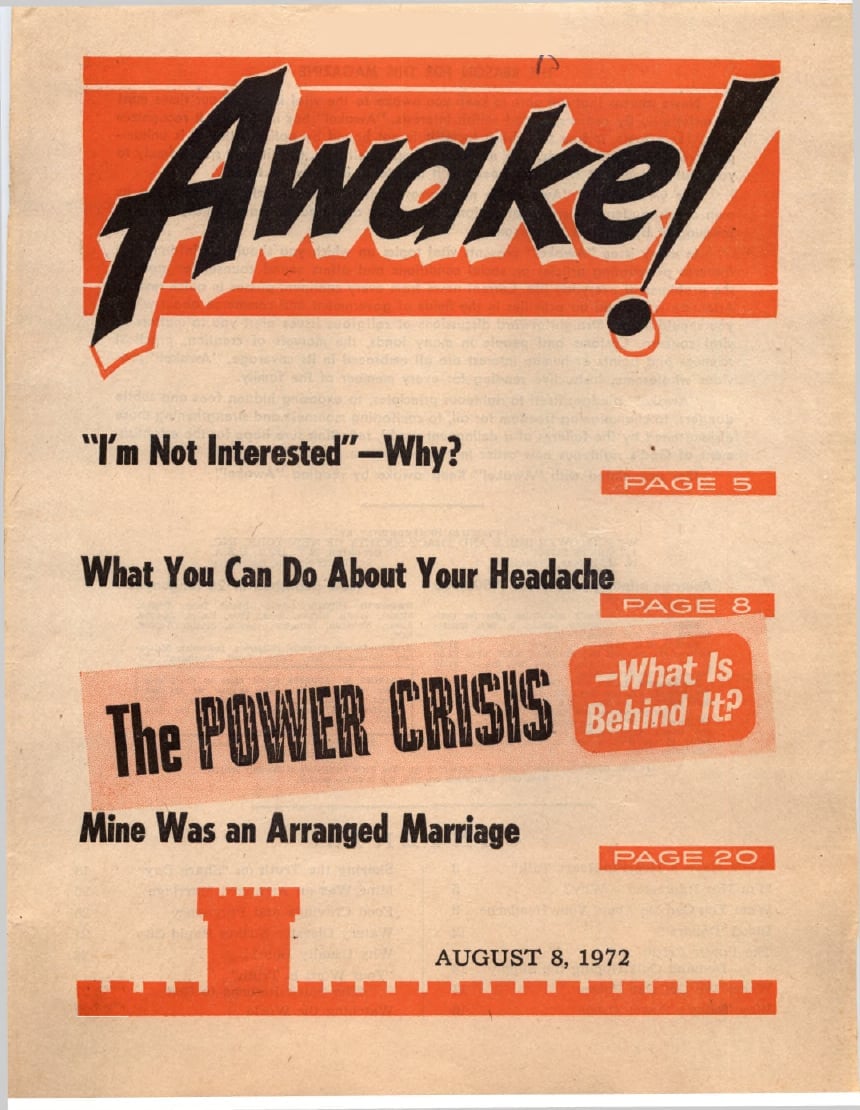
Awake! — August 8, 1972
Source: jw.org
Contents
“Let’s Have a Heart-to-Heart Talk”
“I’m Not Interested”—Why?
What You Can Do About Your Headache
Blood ‘Donors’?
The Power Crisis—Demand Outstripping the Supply
Where We Get Our Power
Why Today’s Power Crisis?
Sharing the Truth on “Share Day”
Mine Was an Arranged Marriage
Food Cravings and Pregnancy
Watery Disaster Strikes Rapid City
Why Usually Blue?
‘The Spirit Returns to God’
Watching the World
The Greatest Upheaval in History
Is Your Security as Reliable as the Weather?
“Let’s Have a Heart-to-Heart Talk”
“Let’s Have a Heart-to-Heart Talk”
“SAY, your wife is really worried about your health,” a man recently told his friend. “Is that so?” the friend replied. “She hasn’t given me any such impression.” And it was a comfort for the friend to know that, for it seemed to him that his wife was not especially concerned.
How typical that true-life incident is! Husbands and wives talk to others about what they should first of all mention to each other (a fact only too well known to marriage counselors!). Parents complain that they do not understand their children. Children, in turn, grumble to others that their parents are “squares.” Employees fail to communicate with their employers, and employers fail to get through to their employees; all of which has bad effects, emotionally as well as economically.
Modern students of human nature make much of the importance of communication, and rightly so, for much of the misery today is because of ever less and less communication. Thus a 1972 book devoted to helping married couples to get more joy and contentment out of their marriages by increased understanding states: “Many couples believe they know a lot more about one another than they in fact do know.”
True, it is so much easier to talk to others, to complain or grumble about a situation, than to talk things over with the one concerned or involved; to that person it is so much easier to give the “silent treatment.” But the easier way is seldom the better way. It takes courage, wisdom and tact, yes, and love to try to communicate with the involved person regarding a misunderstanding or an unpleasant situation or shortcoming.
Such was the situation faced by a husband who had a very intelligent wife but who was also strong willed. It seemed that every time he made an observation she replied with an objection, so he gradually refrained from mentioning such things. But he found that this was not the solution, for their relationship kept deteriorating. So upon the advice of a friend he once said to his wife in as sweet and loving a way as he knew how: “Honey, let’s have a heart-to-heart talk.” Starting off with some expressions of appreciation and endearment, he gradually touched on the things he felt needed to be discussed together. As a result, their relations with each other improved. Actually she had not been aware of how thoughtless her retorts were and how they affected him.
The Bible character Queen Esther sets us an example along this line. She had something very serious on her mind, the welfare of her people. She could have kept quiet and taken a chance that she might escape harm herself, but no. Upon the prompting of her cousin Mordecai, she tactfully prepared the way and then had a heart-to-heart talk with her royal husband. The result? She and her people were spared.—Esther 5:1–7:10.
When there is an apparent lack of harmony between us and another person, we owe it both to ourselves and to the other party to have a heart-to-heart talk. This principle is repeatedly noted in the Bible. On the one hand, it tells us that if we know that another has a grievance against us we should take the initiative to straighten things out, and, on the other hand, it also tells us that if we have a serious grievance against another we should go to that one and discuss the matter frankly.—Matt. 5:23, 24; 18:15-17.
By means of a heart-to-heart talk things can be straightened out, to the benefit of both. A husband may be too attentive to pretty members of the opposite sex. He may not think much of it, just liking to play the role of a gallant, but it might be quite depressing to his less attractive wife. Rather than to suffer in silence, she should have a heart-to-heart talk with him.
What if youths manifest a self-willed attitude? Should their parents let them go their own way? How often parents express shocked amazement when their children get in trouble with the police because of drugs, or a son gets VD or a daughter becomes illegitimately pregnant! Would parents have been amazed if they had been having heart-to-heart talks with their children? No, for then either their children would not have gotten into such trouble or the parents would have known what to expect. How far such lack of communication can go can be seen from the case of a Brooklyn daughter who shocked her family by giving birth to an illegitimate child before they even learned about her pregnancy. Though she was living at home, her parents said that they had noticed nothing wrong about her appearance.
Why do some shrink back from having a heart-to-heart talk? In some cases it could be a tendency to be introverted, and so one takes refuge in self-pity, getting a certain satisfaction from being a martyr.
Or it could be a matter of pride. One may not want to admit to being hurt or to being the cause of the trouble. Or one may not want to humble oneself, for suggesting a heart-to-heart talk often requires humility.
It has been said that 70 percent of communication between persons is nonverbal, that is, by gestures and actions, rather than words. While by these we can communicate our feelings, by these alone we cannot communicate our reasons for acting the way we do, nor can we by them alone dissolve misunderstandings or correct wrong impressions. But by talking things over we can hope to do so. Remember, this will take courage, wisdom, tact and love, but, oh, how rewarding!
Yes, there is a time for every purpose under the sun, and when there is a communication gap—and, better yet, before such a problem develops—that is the time to say: “Let’s have a heart-to-heart talk.”
“I’m Not Interested”—Why?
“I’m Not Interested”—Why?
“I’M NOT interested.” Have you ever said that when one of Jehovah’s Christian witnesses called at your door? As a matter of fact, that was my own first reaction when visited by Jehovah’s witnesses. But what was it that did not interest me? What moved you to say, “I’m not interested”?
What is it that Jehovah’s witnesses want to talk about when they call at one’s home? They want to share good news of how God’s kingdom in the very near future will make this earth a grand Paradise. Gone will be all unrighteous persons, all doers of evil, all fomenters of war and violence. Yes, the Witnesses want to tell people how they can enjoy lasting peace and security, and attain to perfect health and everlasting life in an earth-wide Eden.
Is this too hard to believe to be of interest to you? Well, most people have some interest in even what they view as unbelievable things. Why do they see fanciful films at the movies and on TV and read fiction in books and magazines? They like to escape from reality into an imaginary world. So it cannot be merely because the message presented by the Witnesses seems unbelievable that they say they are not interested.
Is it because they do not need the grand things that God’s Word promises? Well, think about that for a moment. Do we not all need peace, and freedom from evildoers? Do we not need security? Do we not need good health and, above all, a sound basis for hope as to the future? The time comes in the life of everyone when he becomes keenly aware of such needs. Thus, the need is there, and a need is a basic want. So, basically, people want these things too.
But even if everyone wanted God’s crime-free, war-free new order of things with its hope of living forever in vibrant health, could it be that they are not interested in the means to realize it all? But does that seem likely? To illustrate: If our car has run out of gasoline on a solitary road, are we not interested in almost any offer of a ride to the nearest gasoline station—in a truck, a tractor, even an oxcart? Yes, we want the ride, and we do not ask for extravagance, convenience, not even a normal means to get there. The important thing is to use the means at hand, which can really take us where we need to go and want to go.
So, as far as good sense is concerned, there is no real reason for the “I’m not interested” attitude. There must be some hidden motivation behind it.
Prejudice—a Hindrance to Investigation
A reason for saying “I’m not interested”—one that I feel was partly true in my case—has to do with prejudice. We all want to be accurately informed so as to make correct decisions and be considered experienced and competent. But how scrupulous are we in the field of information?
For instance, do we really assure ourselves of the truthfulness of the information we have, when there is an opportunity? Or are we inclined to accept unhesitatingly what esteemed persons or popular books, magazines and newspapers say? Do we easily form our outlook on things according to the conventional, popular attitude, like following the fashions? And when confronted with a different outlook, are we really willing to consider the arguments and reasons behind it before judging it? Are we not apt to hold fast to the mental picture, the “image” of things, we already have created within us?
For example, when a witness of Jehovah calls at their home, many persons follow the same pattern of behavior. As I did, they answer, “I’m not interested,” because they have their “image” ready, they believe they know what it is about, what sort of people those Witnesses are and for what they stand. But, how do they know?
Experience shows that they often think they know, because they have been told by other persons who thought they knew because they had been told by other persons who thought they knew, and so on and on. So, when the Witness suddenly appears at their door, they quickly recollect their “image” of the Witnesses. They think their “image” is the right one, and, as people are apt to remember and pass on to others the disparaging things they hear, this “image” is often unfavorable enough to motivate an immediate rejection. “I’m not interested, that’s all, thank you.”
Prejudices are very hard to eradicate because they are so deep rooted. The bearer is convinced that these prejudices do not even exist. Even if he were asked why he is not interested, a prejudiced person seldom is willing to explain, but often irritatedly terminates the visit by closing the door.
The Easiest Way Out
Other persons may say, “I’m not interested,” because they feel it is the easiest way out.
A discussion with a Witness might demand a mental effort that they are not ready and willing to expend. They might feel pressed too because they have their mind set on other things at the moment and do not want to be tuned in to another wavelength. So they resort to an excuse that is only a more polished way to postpone a decision or to withdraw completely. They do not want to experience the unpleasantness of saying a firm “No.”
Why There Is Fear of Something New
Many persons do not readily accept new ideas, new ways of thinking. They have been conditioned to behave in the old ways. They are bound by tradition. Established habits are “natural,” and the old ways are easy ways to them. Familiar things are normally considered safe things. Even if many are tired of the old, they fear the new and prefer to stick to the old. Their church may well seem lacking and uninspiring, boring to them, but it is still their “old church” and therefore they feel they should stick with it. So, why bother about something new?
Even if the Witness would explain to them that the religion he advocates is older than the oldest church in the community, it still seems new because it is something unfamiliar to them. Thus, their “I’m not interested” actually means: “I have my church. I stick to it, come what may. Please, leave me alone.”
Feeling of Inferiority
Some people feel inferior and hesitate to enter a discussion on a certain subject because they think they lack the knowledge and experience needed.
For example, they may not be well acquainted with religious matters, and they think that a discussion with a Witness would show up their ignorance. Man’s inclination to assert himself and retain a respected standing with those around him often makes him reason that discretion is the better part of valor. So instead of getting involved in something that he has not mastered, he decides to withdraw at once by saying: “I’m not interested.”
A Way That Interested Me
Of course, there are many other explanations behind the “I’m not interested” attitude, such as an excuse of not having time, feeling sick, indisposed or being afraid of what the neighbors would think or say. When I myself raised that same objection years ago, the Witness kindly asked me: “Please, tell me honestly, what is it you are not interested in?”
At first I was a little startled at the question but answered: “In Jehovah’s witnesses.”
“Well,” said the Witness, “let us then talk about something else, something I know you as a young lad must be greatly interested in.”
“And what could that be?” I asked.
“Your future,” was the answer.
“So what do you know about my future?” I replied.
“That it could be very happy. Please, give me a few minutes to show you from the Bible. . . .” And so the discussion began.
The Witness appealed to something I just could not deny was of interest to me. He did not press me to do anything, and he did not raise any objection to my objection. Instead he awoke curiosity, and that caught my interest.
So, are you interested in your future? Then listen to what the Christian witnesses of Jehovah have to tell you from the Bible. They speak promises of “everlasting life” that come from Almighty God and about a grand future you can have. And because these promises come from the God “who cannot lie” you can have confidence in them.—Titus 1:2; Rev. 21:3, 4.
Yes, the sure hope of a Paradise earth with radiant health and life everlasting can be yours. However, you need to know that the Bible calls for action—now, in order for you to enjoy a happy future. This is because little time remains for this system of things before it crashes in total ruin at the “great tribulation,” which Jesus Christ foretold. (Matt. 24:21; Mark 13:19) Why not let Jehovah’s witnesses help you to attain the happy future you seek while there is still time?—Contributed.
What You Can Do About Your Headache
What You Can Do About Your Headache
By medical correspondent for “Awake!” in the British Isles
NEARLY everybody at some time in life knows what it means to have a headache. Think back to that last influenza attack or to that cold in the head when your sinuses and your air passages were full of catarrh. That dull ache or throbbing pain that you felt inside your head was just one of those depressing symptoms that made you aware of your illness. Every cough or sneeze seemed to make the headache worse. How glad you were to rest your head on the pillow, and what a relief when you woke up to find your headache gone! If that is the only kind of headache that you have experienced, then you should be thankful.
Many people today—and some nearly every day—suffer from headaches that are not accompanied by obvious underlying illness. Such headaches may be severe and disabling and are not always easily relieved. Perhaps this is the kind of headache that is more familiar to you and no doubt one that you would be thankful to get rid of.
But why do people suffer from headaches? What really aches when your head aches? Are there different kinds of headaches? What factors precipitate headaches? The answers to these questions may help you to appreciate better what you can do about your headaches.
A Protective Mechanism
People experience pain because of an inbuilt protective mechanism. It may be likened to a warning system that tells us that some pain-sensitive tissue is being stimulated and that action is required to remove the body from contact with the damaging stimuli.
So it is with headache. It informs you that not all is well. For your physical and mental comfort and well-being, action needs to be taken. It is only natural therefore that you should be interested in knowing what to do about your headaches.
But what actually aches when you are suffering from a headache? What pain-sensitive tissues are involved? Surprisingly, the brain itself is not a pain-sensitive tissue. Although the pain perception mechanism is an important function of the brain, surgeons and physiologists have shown that when headache arises within the skull, it is due, not to irritation of the brain, but to pulling or stretching of the blood vessels or coverings of the brain. Likewise, when headache arises outside the skull, the sensation of pain is, in most cases, due to stimulation of the fine nerve fibers in the walls of the arteries or within the powerful muscles of the head and neck.
It is understandable therefore that the site of origin of the painful stimuli may determine the characteristics of the headache. Thus, if the arteries are involved, the headache may be throbbing in nature because of the pulsation of the vessel wall with each heartbeat. In contrast, if the muscles are involved, the headache is more constant and aching in type.
From what has been considered so far, it is evident that not all headaches are alike. Accordingly, what you can do about your headache will depend on the particular kind of headache you suffer from and what causes it.
Different Kinds of Headaches
As a warning symptom, headache may be triggered by a variety of conditions, some serious and endangering life, others much more benign in their nature. The different kinds of headaches fall into two main categories: first, those associated with underlying disease and referred to as “organic” headaches, and, second, “functional” headaches, which are due to some disturbance of function.
Organic headaches include those due to infection or allergic conditions affecting the nose and air sinuses, disorders of the teeth and jaw, disease of the eyes and ears, degenerative changes in the spinal vertebrae in the neck, inflammation of the arteries of the forehead, as well as more serious conditions such as tumor of the brain, and inflammation of the meninges or covering of the brain. In these conditions, headache is often only one of several symptoms and signs that characterize the illness and that may demand urgent medical attention.
You may be relieved to know that the vast majority of headaches, perhaps about 90 percent, are of the functional kind and not due to disease of structures either outside or inside the skull. Generally regarded as benign in nature, they are nonetheless a warning of disturbed function in relation to some of life’s activities. Likely this is the common everyday kind of headache that you may have experienced.
Even so, if you have started to develop a persistent headache with or without other symptoms, or if in the last few weeks or months there has been a change in the type or nature of your headache, then you may find it wise to consult a doctor. If there is some serious underlying disorder, then appropriate treatment can be started without unnecessary delay.
Everyday Headaches
If you have been subject to headaches off and on for many years, it is more than likely that your headache is either the so-called “tension” type or the less common “migraine.” You may be wondering just how you can tell the difference.
If you suffer from tension headache, the pain is constant or steady in type. It is felt in the muscles at the back of the head or on both sides of the head; less often it is felt above the eyes. It may feel as if your head is gripped in a vise or constricted by a tight band; alternatively, you may experience only a sensation of weight or pressure on your head. Tension headaches are due to excessive or sustained contraction of the muscles of the scalp and the powerful muscles of the neck that support the head. For this reason they are also known as muscle-contraction headaches.
Migraine is rather different. The word “migraine” is derived from a French word meaning “half a head” and is appropriate because, in most cases, the ache affects only one side of the head. In contrast to tension headache, the pain soon becomes throbbing or pulsating in kind due to its origin mainly in overdistended arteries outside the skull. There is often a feeling of nausea or other digestive disturbance, and the pain may be so intense as to interfere with work and compel the individual to lie down. There may be more than one in the family who suffer from this kind of headache, because the tendency to develop migraine is inherited. In cases of “classical” migraine as opposed to common migraine an attack may be heralded by a preheadache warning or “aura,” such as spots or flashes of light before the eyes.
These characteristic features may be of some help to you in differentiating “tension” and “migraine” type headaches. The distinction between the two, however, may not always be easy; indeed, you could be subject to both. Whether you suffer from tension headaches or recurrent attacks of migraine, there is much that you can do to lessen the severity of your headache, reduce their frequency, and perhaps even prevent their recurrence.
Treating Your Headache
In the immediate treatment of your headache, the simplest remedy that circumstances may permit is self-medication with an analgesic or pain-relieving drug. Many preparations are widely advertised and readily available in the form of powders and tablets containing mixtures of drugs. Preparations that contain amidopyrine or phenacetin may be harmful and are best avoided. It is safer to use a simple drug, for example aspirin in its soluble form, or if aspirin gives you indigestion, then paracetamol is an effective alternative. The recommended dose can usually be repeated after three or four hours if necessary. With this simple measure, your tension headache may disappear, or your migraine attack may be cut short.
When circumstances permit, however, alternative procedures may bring relief with or even without the use of analgesic drugs. Your tension or muscle-contraction headache may respond to just a brief period of rest and relaxation. If you can interrupt your routine activities and can lie down for half an hour or so in a quiet, semidarkened room, you will undoubtedly feel the benefit. Heat applied locally to the head and neck by means of hot towels or radiant heat, or even a warm bath, is also beneficial. Additionally, if you have a friend who can apply gentle massage or traction to the muscles of the neck for just ten or fifteen minutes, this will greatly assist in relaxing the muscles that are responsible for your tension headache.
Similar general measures may be effective in the immediate treatment of your migraine attack. Instead of locally applied heat, you may get much more relief from cold compresses or even ice packs applied to the head. Such compresses help to reduce the overdistension of the arteries that give rise to this type of headache. Repeated cups of strong tea or coffee may also bring relief by a similar effect on the blood vessels due to the action of caffeine. Your migraine headache, however, may be so severe as to compel you to lie down, and all you may want to do is “sleep it off.” Under such circumstances it is wise to submit to the body’s demands.
If your headache cannot be relieved by the above measures, then it may be advisable to seek the advice of a doctor.
Bearing in mind, however, that your headache is part of an inbuilt protective mechanism, it would be unwise continually to treat only the effect and fail to cope with the cause. So what can you do to reduce the frequency of your headaches or, better still, prevent their recurrence? The answer depends to a large extent on how you can avoid or eliminate some of the predisposing factors.
Predisposing Factors
Well-recognized predisposing factors, even among those not prone to headache, are overindulgence in food or alcohol, or exposure to stuffy, poorly ventilated atmospheres.
Tension headache frequently occurs after fatigue and stress, or may be related to episodes of anxiety or conflict at work or at home. Migraine headaches can also be induced by fatigue, stress, anxiety and overexcitement. In fact, excitement and emotions rank high on the list of predisposing factors. Commenting on this, Dr. Oliver W. Sacks, in his book Migraine: The Evolution of a Common Disorder (1970), writes: “Violent emotions exceed all other acute circumstances to provoke migraine reactions, and in many patients—especially sufferers from classical migraine—are responsible for the vast majority of all attacks experienced . . . we find, in practice, that sudden rage is the commonest precipitant, although fright (panic) may be equally potent in younger patients. Sudden elation (as at a moment of triumph or unexpected good fortune) may have the same effect.” As well as emotional stress, there may be other contributory factors such as exposure to bright lights, excessive noise, hunger, alcohol, eating certain foods such as cheese, chocolate, cucumbers, tomatoes, fatty foods, wheat, onions and even oranges.
If, as is likely, one or more of these predisposing factors are applicable to your case, then there is every possibility that by avoiding or eliminating these factors you can reduce the frequency of your headaches, or even prevent them.
Preventing Your Headache
Since the factors predisposing to headache affect nearly every aspect of living, some readjustment in your life’s activities may be called for. You may need to give attention, not only to your diet and eating habits, but to conditions at work and at home, to your rest, relaxation, recreational activities, and perhaps, even more importantly, to your mental outlook or attitude toward life.
A well-balanced diet taken regularly and in moderation will help prevent the headaches of overindulgence and indigestion, or the migraine that may be induced by hunger. It is easy to exclude any particular food or alcoholic beverage that in your case may seem to be associated with your headache.
If conditions at work or the nature of your work leads to undue stress and fatigue, it may be that a change is called for, or if this is impractical, then an improved work schedule may be necessary. Certainly it would be unwise to work overtime to the detriment of your health. If you are a housewife and work at home, a practical schedule for your daily routine will be a great help in avoiding undue stress and fatigue. Whether at work or at home, it is important to ensure adequate ventilation and proper lighting.
It is advisable to obtain not only sufficient sleep, but also restful sleep. For this purpose you may need a softer or firmer pillow, an extra pillow or one less, or even a new mattress if you are to avoid bad posture and muscle tension that may be contributory to some headaches.
The readjustment of your activities may call for a short period of relaxation each day, perhaps just ten to fifteen minutes after meals. If you can learn to let all your muscles go limp, especially your face muscles, you can do much to relieve muscle tension.
It will be beneficial as well as pleasurable to allow for recreational activity in moderation, preferably one that can be enjoyed with others in the family, one that is not overtaxing in energy and that will make a pleasant change from your daily routine; for example, a visit to the zoo, a trip to the seaside, or just a walk in the country with the opportunity of studying creation in all its variety.
Perhaps the most difficult alteration that may be required and the one most likely to be successful in counteracting tension, stress and fatigue is the mental readjustment of your outlook or attitude toward life and its problems. If you can cultivate the “quiet and mild spirit,” learning to remain unruffled when people or circumstances tend to irritate, if you can come to appreciate the value of contentment in contrast to the demanding and never-ending quest for material possessions and pleasures, and if you can develop an unselfish concern over the welfare of others and not be overly concerned about yourself, you will indeed have gone a long way toward eliminating those emotional stresses and strains that so often result in tension or migraine headaches.—1 Pet. 3:3, 4; 1 Tim. 6:6-8.
Under the present system with all its pressures, it may be very difficult to avoid or eradicate the factors that are conducive to the onset of headaches. While there is much that can be done in the way of treatment and prevention, the final elimination of all bondage to pain, both organic and functional in origin, must await man’s restoration to perfect health in the restored Paradise here on earth under the rule of God’s kingdom. Then and then only can he expect to enjoy life completely free of all headaches.—Rev. 21:4, 5.
Blood ‘Donors’?
Blood ‘Donors’?
● In his book The Gift Relationship (1971), Professor Richard Titmuss of the University of London says regarding blood obtained for transfusions: “There are many myths in all societies and America is no exception. One of the most deeply held myths in that country today . . . is that the voluntary donor is the norm; that most blood donations are contributed by volunteers.”
This author suggests eight different categories of blood “donors.” These are: The Paid Donor “who sells his blood for what the market will bear.” The Professional Donor “who yield[s] blood on a regular, registered, semi-permanent or semi-salaried basis.” The Paid-Induced Voluntary Donor “who receives a cash payment but who claims that he is not primarily motivated by the payment.” The Responsibility Fee Donor who is charged a fee for blood ‘lent’ him during an operation and who can replace the blood and have the fee refunded. The Family Credit Donor “who makes a predeposit donation of one pint of blood each year in return for which he and his family . . . are ‘insured’ for their blood needs for one year.” The Captive Voluntary Donor such as those in military forces or prisons “who are called upon, required or expected to donate. If they do not they may be exposed to disapproval or shame, or they may be led to believe that refusal would adversely affect their future.” The Fringe Benefit Voluntary Donor who is “attracted or induced by the prospect of tangible rewards . . . in non-monetary forms,” for instance, days off work or longer holidays. The Voluntary Community Donor who “is the closest approximation in social reality to the abstract concept of a ‘free human gift.’”
The professor sets forth a chart of the estimates of blood collected in the United States during 1965 through 1967. It shows that only 7 percent of the blood came from the “voluntary community donor.” The author thus observes: “To ‘donate’ is to give implying an altruistic motive; strictly, and perhaps more neutrally speaking, ‘suppliers’ should replace ‘donors’ in the vocabulary of this study.”—Pp. 71-96.
The Power Crisis—Demand Outstripping the Supply
The Power Crisis—Demand Outstripping the Supply
DOES your home have electricity? In millions of homes lights, refrigerator, television and many other appliances operate on electrical power. It is available at the turn of a switch. Yet, there is a shortage.
Already, in places, the demand for power has exceeded the supply, and lights have dimmed or gone out temporarily. The New York Times last summer reported: “Americans by the millions are living under the daily threat of power brownouts, blackouts and possible electricity rationing. But it is more than a seasonal shortage of power. It is part of a national crisis.”
Describing last summer’s situation, December’s Science Digest said: “Brownouts were common. Blackouts in some places became routine. Some of the power networks, teetering on the edge of electrical chaos, barely got by without massive catastrophes.” Were you affected?
These power failures inconvenienced some temporarily. Their elevators stopped operating. Their airconditioners ceased to function. Radios and televisions would not play. Refrigerators no longer kept food cold. And families with electrical cooking appliances could not use them to prepare meals.
Realizing the Crisis
But perhaps you have been unaffected, only hearing that there is a power crisis. And since your power supply seems reliable, you may have given the matter little consideration. Yet the situation is serious, probably more so than you realize. It is not just a matter of inconvenience due to some temporary power shortages and equipment failures. The threat is of total collapse, as energy expert Thorton F. Bradshaw, in an interview with U.S. News and World Report, observed:
“I don’t think most people will recognize this crisis until they go to a light switch, turn it on and nothing happens. Even then they will think, well, something has happened to whatever utility supplies their electricity. . . . we’ve always had such an abundance of cheap energy that people cannot believe that there is an energy crisis.”
Yet the crisis is real. And it is already beginning to be felt. For example, frequently last summer large consumers of electricity in New York city were called up and asked to cut back on their use of power, something the general public probably did not realize. Emphasizing the crisis, Commissioner William K. Jones of the New York Public Service Commission said in a seventy-seven page report:
“Over the long run it is plain that the city of New York and related portions of Westchester County cannot hope to survive under present conditions—these areas are being strangled by the lack of an adequate supply of vitally needed electric power.”
Nor is the problem a sectional one, limited to one part of the United States. Speaking about the country as a whole, John A. Carver, Jr., member of the Federal Power Commission, said: “For the next three decades we will be in a race for our lives to meet our energy demands.”
Other countries, too, are affected, including Europe and Japan. Japan’s premier said that his country’s greatest problem was obtaining sufficient power. “Power is the key,” he said, “for the next 30 years.”
But why is there such a demand for power today? How much power is used? From where does it come?
Where We Get Our Power
Where We Get Our Power
THE electrical power consumed by many families today is simply fantastic. For example, to operate only an electric frying pan and a television requires power equivalent to that exerted by a team of two pulling horses! And that is a lot of power. For an average workhorse will pull on its harness with a force of 180 pounds.
Electrical power is measured in what are called watts and kilowatts. A television draws 300 watts of power, and an electric frying pan 1,200 watts. Other appliances need even more power—a laundry dryer nearly 5,000 watts and an electric range over 12,000.
The amount of electricity used is measured in kilowatt-hours. Thus a kilowatt-hour represents the work done by one kilowatt of electricity during one hour’s time. But how much work will a kilowatt do in an hour?
It will do an amazing amount. In one hour it has been calculated that a workhorse will do the work equivalent to lifting 1,980,000 pounds one foot off the ground. A kilowatt of power in one hour will do about one third more work than even that.
Consumption and Cost
The average family in one section of New York city consumes daily, on the average, 17 kilowatt-hours of electricity, or nearly 23 horsepower-hours. That means an average family uses nearly as much electrical power as a horse would produce working around the clock, day in and day out, without ever stopping or getting tired.
In parts of New York city this power costs a family slightly less than 3 cents a kilowatt-hour, or not quite 50 cents a day for 17 kilowatt-hours. In certain other parts of the country, however, that amount of electricity costs much less—only about a penny per kilowatt-hour. Also, as consumption goes up, cost per kilowatt-hour goes down. Thus large industrial consumers pay only a fraction of what small consumers do.
The demand for this relatively inexpensive, easy to utilize form of power has been phenomenal. In 1970 the United States consumed some 1,550,000,000,000 kilowatt-hours—about five times the amount used in 1950! From 1969 to 1970 consumption leaped 9.2 percent. The United States produces about 35 percent of the world’s electric power, and the Soviet Union 15 percent.
In the United States, industry is the largest consumer. According to the Edison Electric Institute, industry uses about 41 percent of the electricity produced. Another 32 percent goes for residential use, while 23 percent is used by stores, shopping centers, office buildings, hospitals and other commercial concerns. The final 4 percent operates streetlights, subways and the like.
From where does this fantastic amount of electrical power come?
How Electricity Is Produced
Most electricity is produced from what are called “fossil fuels”—oil, coal and natural gas. These fuels are burned at power-generating plants in huge furnaces. The furnace heats a water boiler to produce a superheated steam. The steam then rushes at 1,000 miles an hour into a huge turbine, and spins its bladed wheels. In hydroelectric plants, falling water, instead of steam, is used to turn the turbine. The turbine then drives a generator to produce electricity.
Over 80 percent of the electricity in the United States is produced in steam-turbine plants, while hydroelectric facilities generate most of the rest. The first steam-turbine electric plant went into operation ninety years ago in New York city. Today there are some 3,400 power plants throughout the country.
Actually the steam-turbine process of producing electricity is rather inefficient In the conversion process only about one third of the energy of the coal, oil or gas is turned into electricity. The other two thirds of the energy escapes in the form of waste heat and other pollutants. Also, up to 20 percent of the generated electricity is lost in its transmission from the power plant to the place of use.
The fossil fuel consumption of electric power plants staggers comprehension. A large coal-fired plant may burn over 600 tons of coal an hour! Coal is used to generate nearly half the electricity in the United States, and falling water, natural gas and oil produce most of the rest.
Of course, electricity is only one form of power. There are also increasing demands for power to run automobiles, fly airplanes, provide heat for homes, and so forth. For these purposes oil and natural gas are the principal energy sources.
Harm to the Environment
Of these various fuels, coal is the most damaging to the environment. For example, a Virginia Electric and Power Company plant, which consumes some 10,000 tons of coal a day, generates about 60 tons of fly ash and about 20 tons of irritating sulfur dioxide gas every hour, most of which is spewed into the air! Earlier this year legal action was announced against the Delmarva Power and Light Company in Delaware City for belching out 74,000 tons of sulfur dioxide each year.
Describing the air pollution problem, James R. Schlesinger, Chairman of the Atomic Energy Commission, noted recently: “Fossil-fuel [electric power] plants contribute the bulk of sulphur oxides in the atmosphere and a very substantial proportion of the nitrogen oxides—to say nothing of the particulates [solid matter].”
Also a factor in damaging the environment is the way coal is mined. Last year about 44 percent of the coal was strip-mined, desolating tens of thousands of acres of some of the most beautiful mountain country in the United States. Typical of the recent protests against this practice is that of congressman Ken Hechler, who said this February:
“The coal and power barons and certain Western legislators are trying to subjugate the people of the Appalachian states and rip up our hills and pollute our streams to serve the power-hungry needs of the big cities. We have reached the point where we’re going to stand up and fight against this policy.”
Yet a switch from the use of coal in electric plants, which New York city completed this year at considerable expense, does not solve the problem. For oil and gas also pollute. The sulfur content of oil, too, is poured into the air, and natural gas emits oxides of nitrogen when burned. And there is also the problem of the waste heat from electric plants that is discharged into nearby rivers and lakes, at times dangerously raising their temperatures.
Is the present power crisis due to this threat to the environment? Or, are there other factors that are even more serious?
Why Today’s Power Crisis?
Why Today’s Power Crisis?
ALL power has a source. A horse, for example, derives its power from the chemical energy stored in the vegetation it eats. Vegetation is the source of muscle power, both of animals and humans.
Until the present century man relied heavily upon muscle power to accomplish his work, using either his own muscles or those of animals. Also, men burned vegetation—wood—releasing its energy for use. As recently as 1870 energy from wood provided most of man’s power needs, running early steam engines, riverboats and railroad locomotives.
Use of Fossil Fuels
As industry grew, however, man needed more power to drive newly invented machines. Fossil fuels laid away in the earth ages ago were utilized. Coal was dug up and used in increasing volume. By 1910 it was the energy source for three quarters of man’s power needs.
In about 1859 man began using, on a large scale, another fossil fuel, drilling a successful oil well that year. A principal use of oil today is to provide power for automobiles and other forms of transportation. The United States alone now uses, on the average, about 646 million gallons of oil (petroleum) a day!
More recently, particularly since World War II, the earth’s stores of natural gas have been trapped. A network of about 800,000 miles of underground gas pipelines has been built in the United States, four times the length of the nation’s oil pipelines. Gas that a housewife cooks with may have traveled nonstop from gas fields many hundreds of miles away.
Today more than 95 percent of the energy needs of the United States is supplied by these fossil fuels. In 1970, oil provided about 43 percent, natural gas about 33 percent, and coal some 20 percent of the country’s total energy needs. The rest of the power was supplied principally by hydroelectric facilities. This dependence on fossil fuels is at the root of the power crisis.
The Crisis
The New York Times, March 19, 1972, explained: “The crunch is being felt because our energy resources—coal, oil and natural gas—are beginning to run out and the demand of the rest of the world for these resources is increasing more rapidly than that of the United States.”
What would happen if these energy sources were suddenly gone? Man’s present industrialized way of life would die! Automobiles, buses, trains and airplanes would stop. Most lights, television, refrigerators and other electrical appliances would cease to function. This is the basis of the crisis.
But are fossil fuels really “beginning to run out”? Some have considered them practically limitless—at least good for thousands of years. What has happened?
Rapid Depletion
Demands for power have grown faster than anticipated. Fossil fuels have been consumed at a fantastic rate. Each day, on the average, the world takes from the earth about 2,000 million gallons of oil! In 1970 the world figure increased 9.5 percent over the year before. If that rate continued, oil use would more than double in ten years. Western Europe’s oil consumption actually tripled in the last ten years. Regarding the astounding demand for fossil fuels, last October’s Science Digest said:
“Rapid depletion of the world stock of these vital raw materials becomes grimly dramatic when you realize that as of 1968, half of the oil which man used throughout history he produced during the preceding 12 years. Indeed, most of the world’s consumption of fossil fuels has taken place in the last quarter century.”
Such a rate of consumption has a snowballing effect, picking up incredible speed. For example, electrical power consumption has been more than doubling every ten years in the United States. This means, as Scientific American, September 1971, observes: “During the next 10 years the U.S. will generate as much electricity as it has generated since the beginning of the electrical era.” The consequences of a doubling rate of consumption every ten years is staggering.
Although no one knows how much coal, oil and gas are stored in the earth, for the sake of illustration let us assume that 5 percent of the total supply has thus far been consumed. This means that at a rate of doubling consumption every ten years, all of earth’s fossil fuels would be used up in some forty years!
“Beginning to Run Out”
The rate at which earth’s fossil fuels are being consumed is frightening to many. Some experts say that their depletion is ‘only a little more than a generation away.’ In a 1969 report to the United States president, the National Academy of Sciences predicted: “It will take only another 50 years or so to use up the great bulk of the world’s initial supply of recoverable petroleum liquids and natural gas.”
However, this prediction of three years ago may well be highly optimistic. Already the natural gas supply is running out. In a staff report this February, the Federal Power Commission noted that the shortage beginning last year “has marked a historic turning point—the end of natural gas industry growth uninhibited by supply questions.” The report concluded: “The burden of alleviating the deficiency will fall upon other fuels.”
Yet oil, too, is in short supply in the United States. Already more than a quarter of the country’s oil is imported—about 164 million gallons every day, on the average. But according to a recent Department of the Interior report, these imports will have to be more than doubled by 1980.
Dependence on Foreign Oil
Although oil discoveries have been made in Alaska, the bulk of earth’s known remaining oil resources is in other lands, particularly the Middle East. Thus United States Assistant Secretary of the Interior, Hollis M. Dole, says “this country is going to have to go where the oil is—Africa and the Mideast—to make up its fuel deficit.”
Yet a growing dependence on Middle East oil only accentuates the power crisis, as the New York Times, December 7, 1971, indicated:
“The State Public Service Commission has asserted that ‘current political realities,’ including ‘continued smoldering of Arab-Israeli conflict,’ have made the state’s electric utilities increasingly vulnerable to interruption of their residual oil fuel supply. Nearly all such oil is imported.”
Reports the Miami Herald: “Middle East oil is so important that the United States is willing to run the risk of nuclear confrontation to protect it.” Yes, nations today would risk war to get the oil that is necessary to keep industry going, cars moving, television sets operating and lights burning.
Yet why cannot coal instead of oil be relied upon as the principal energy source? The United States reportedly still has vast quantities of coal.
Plenty of Usable Coal?
The problem is, most coal is too full of sulfur to meet present environmental standards. Laws in an increasing number of cities will not permit coal with a sulfur content of more than 1 percent to be burned. That is why more and more communities are replacing coal in power generating plants with the less polluting fuels, oil and natural gas. Contrary to what some persons seem to think, man simply does not have the know-how to remove sulfur pollutants from coal or oil. President Nixon in his June 4, 1971, energy message explained:
“A major bottleneck in our clean energy program is the fact that we cannot now burn coal or oil without discharging its sulfur content into the air. We need new technology which will make it possible to remove the sulfur before it is emitted to the air.”
True, there is coal available that possesses little sulfur. But it is very likely to be near the earth’s surface, and is thus obtainable only by strip-mining methods. And strip-mining so ruins the land that laws have been proposed to outlaw it.
Coal deep in the earth, on the other hand, is difficult and expensive to get at, and is likely to have a high sulfur content. Thus T. F. Bradshaw, president of Atlantic Richfield Company, observed: “Coal, as a matter of fact—at least in the short run—is likely to be in short supply in spite of these large reserves.”
A Dilemma
Man faces a real dilemma. Today’s industrialized society needs vast quantities of power to operate. Yet fuel supplies are running out, particularly those that cause least pollution. If available fuels are used, people are slowly poisoned by the pollution. But if they are not used, modern industrialized society slowly dies for lack of power.
Apparently humans will make dangerous choices to maintain their present industrialized, power-consuming way of life. Thus, while acknowledging the seriousness of the fossil-fuel shortage, S. David Freeman, former energy adviser to President Nixon, observed:
“The exhaustion of energy resources is not itself apt to be the crux of the problem. . . . The quantities of carbon monoxide, small particulate matter and other potential pollutants projected over the next two decades are so large as to suggest the possibility of fundamental changes in our environment.”
Obviously a change is needed, and it must come soon. The present means of power generation needs replacement. This is generally recognized. In fact, the replacement choice has apparently already been made—it is nuclear power. The United States is practically committed to it.
But is nuclear power safe? Is it a wise choice? How is electricity generated from nuclear energy? Such questions we will leave to a following issue to discuss.
[Picture on page 17]
OUR MAJOR POWER SOURCES ARE GONE!
NOTHING WORKS ANYMORE!
Could the present crisis lead to this?
Sharing the Truth on “Share Day”
Sharing the Truth on “Share Day”
◆ The students in the third grade at one public school in Washington, D.C., were invited to participate in “Share Day.” On this day selected students were to bring to class something from their home and share it with their classmates. When his turn came up, nine-year-old Jimmy, whose mother is one of Jehovah’s witnesses, wondered what to bring, what to “share” with his classmates.
With the permission of his teacher he brought to school a copy of From Paradise Lost to Paradise Regained, a book his mother had used in instructing him about the Bible. His schoolteacher was delighted and ‘shared’ with the entire class the chapter “How Man Lived Through a Flood over All the Earth.” This proved to be so informative and enjoyable for the teacher and the other students that she continued to read into the next chapter, “God Promises His Friend to Bless All Human Families.”
When one knows of good and lifesaving news, is it not the logical thing to share this with others?
Mine Was an Arranged Marriage
Mine Was an Arranged Marriage
I LIVE in India and today is my wedding day, May 19, 1971. In just two hours the wedding ceremony will take place that will unite me in marriage to the man who will be my life’s partner, the one with whom I will share the joys and problems of life, but a man who, as of now, I do not know.
I had not thought seriously about marriage until a few months ago, when mother told me that a fine family had asked if she and father would give their daughter in marriage to their son.
But now here we are arriving at the hall where I will soon see the one who will be my husband. As I step into the hall I realize that he will be sitting at the front, and excitement begins to stir inside me. My mind is racing, my heart beats faster. As I take my seat beside him I cannot sit calmly. Then the Bible sermon begins, and soon I hear the firm voice of my husband making his promise to love and cherish me, and I feel more confidence.
Now it is my turn, and I am ready and willing to promise to love and deeply respect this one whom my parents have carefully, thoughtfully and lovingly selected for me as my husband.
The Custom in India
In arranging my marriage, my parents followed the general custom in India. When parents arrange a marriage in India, both of them carefully consider the personality of the girl and the boy. They try, of course, to find someone in their own community and with a similar background. In my community a teen-age girl is not allowed to talk with boys or to mix or play with them. Likewise, when a boy reaches about fourteen years of age, he is not allowed to talk with any girls. Their parents watch over them as far as possible.
Before a marriage is arranged, the girl’s parents inform themselves of the boy’s ability to support a wife, and then consider his future prospects. They look, too, to his personal appearance. They would not want a tall daughter to marry someone unusually short or in any other way to be unpleasing. And, of course, they consider the health of the one who is to become a mate of their son or daughter. My parents carefully considered these matters.
Most Indian children depend solely on their parents to select a partner for them. In fact, when hearing of the custom in the West for young persons to choose their own mate, young Indians wonder at the presumption on the part of unqualified ones to make such a serious decision. How could a young person be in any way qualified to make such a weighty decision? they wonder. Far better to leave it to those whose age and experience qualify them to know what is the wisest choice, they believe.
A friend of our family recently returned from a few years abroad in the West. He said that when he was in the United States he was puzzled as to how he was going to select his own bride. After getting used to the idea, it seemed to sound good that each person choose his own mate. But then after learning that at least one out of every four marriages ended in divorce, he felt that the Indian way might be better after all.
Even though the prospective husband and wife are not in love before marriage, from childhood they are trained to love and respect their marriage mate. So they automatically start doing it when they get married. Parents try to select for their son or daughter a marriage mate who is compatible. This certainly helps in coping with the problems of married life.
I have heard that in the West young persons do not like to have their parents choose their mate. When I look around for examples of good marriages, I consider my own parents and know that theirs has been a successful marriage. Perhaps you would like to know their story, as related by my mother.
My Mother’s Own Story
“I am the eldest girl of eight children. My father was a Bible lover, and we heard many Bible stories from his mouth. This took the place of attending church, as we lived among Hindus many miles from the church.
“Our neighbors were very friendly with our family and often invited us to their festivals, which we children enjoyed very much. Many of these people were very poor, and often the women would confide in my mother. They would discuss problems, such as husbands who were drunkards and who beat them and their children. They often told stories of not having enough food and how they starved for days. The women were illiterate and so could do little or nothing to alleviate these burdens. But whatever the case might be, these women considered their husbands next to God, and so the difficulties must be endured.
“From my very early youth there was in me a fear that I might marry a man who would be a drunkard and who could not provide for me. This did much to influence my life. Those very few who in desperation ran home to their parents were always sent back to their husbands, where they belonged. When I would hear of this, a fear grew in my mind and a determination that I would not get caught in such a state as this.
“When I was twelve years old my father died. So my mother had to provide for us. Relatives and well-wishers, to lighten my mother’s burden, suggested that I need not continue my education. But mother, being a teacher, was able to care for us and also allowed me to continue my schooling. Shortly after this my relatives exerted their efforts to arrange a marriage for me. They tried to force me to marry a doctor. I desired to study further so that if the need should ever arise I would be able to earn a living. So I pleaded with my mother that I should not marry until I first completed my studies to become a teacher. My relatives did not agree, but my tears and threat to run away and become a nun finally won my mother to my way of thinking, and she did not compel me to marry at that time. No doubt mother realized from her own experience the advantage she had had in her training.
“So, when my studies were finished, my mother and relatives once again began to arrange a marriage for me. I had not met the boy, though families often arrange for the girl and boy to meet or at least to see each other. For example, the boy and his family are invited for tea in the girl’s home, and then the girl will carry in the tea tray and serve the boy and his parents. But my fiancé lived very far from our home. I did not even know his family. However, I gave my consent, as this was expected of a dutiful Indian daughter.
“The boy’s family asked for a certain amount of jewelry to be prepared as a dowry. My mother agreed. Realizing the responsibility that was on my mother to make the jewelry, I requested that I might work and make good the cost. So it was six months later that the marriage took place.
“During those six months I kept on wondering what this boy would be like. I could not even get any information regarding him. But I often prayed to God that my husband-to-be would not be a drunkard. My father had taught us to pray, and I did believe that God would answer my prayers. Two days before the marriage the boy and his family arrived.
My Mother’s Marriage
“The young man’s family bore the expense of decorating the house and the cost of the marriage feast, including the Indian music for the celebration. Our marriage was solemnized in the church, and there was a fine, big reception. The first moments after the ceremony, when we were able to talk together, my husband asked me how I liked the arrangements, and whether I liked the jewelry that I was wearing. I answered him, saying that they were fine, and immediately I asked him what his habits are. He said that he did not drink or smoke and that he loved sports. My heart was filled with joy and I praised God. I had also wished that he might have a good job and so be able to provide a decent living. However, he was not earning much. This news did not upset me though, because the kindness and love shown toward me were worth more than the money he would ever earn.
“After staying five days at my home, I packed up my things to go and live with my husband along with his family. In my husband’s house there were eight children, my husband being the eldest. My mother-in-law was his stepmother. I had to do a lot of housework, such as cleaning, cooking and so forth. I was obedient to my mother-in-law, but she was never happy about the outcome of my work. She was always finding fault. So we finally arranged to go and live elsewhere. She asked that we take with us four of my husband’s own brothers and sisters and care for them. My husband and I discussed the matter and took on the responsibility. It was a great problem, but because I was a trained teacher I could help. I began teaching, and even though we did not earn much between us, we were happy.
…