Awake!, March 22, 1972
Download: PDF — Awake!, March 22, 1972
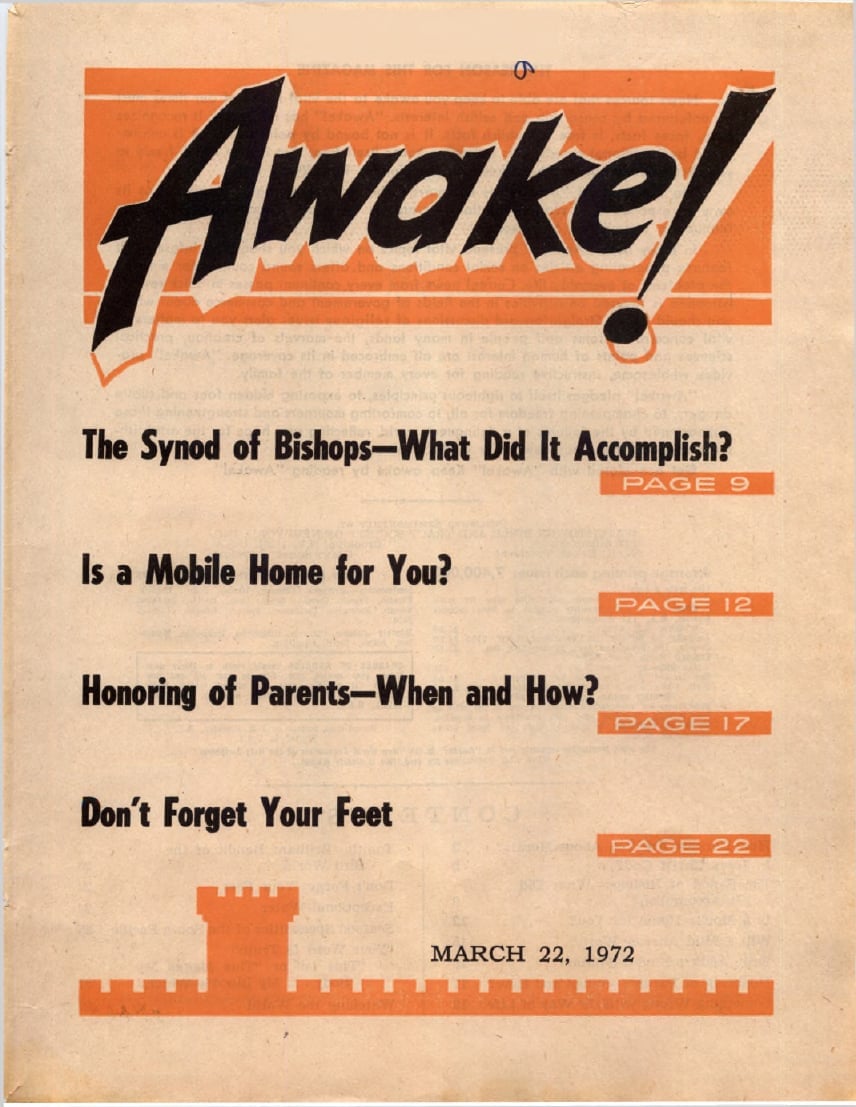
Awake! — March 22, 1972
Source: jw.org
Contents
How Earnest Are You About Morals?
Is Jesus Christ God?
The Synod of Bishops—What Did It Accomplish?
Is a Mobile Home for You?
Will a Mild Answer Work?
Drug Addicts Find a Solution
Honoring of Parents—When and How?
Something Wrong with the Way of Life
Tomtit—Brilliant Bandit of the Bird World
Don’t Forget Your Feet
Exceptional Water
Seafood Specialities of the South Pacific
“This Is” or “This Means My Body . . . My Blood”—Which?
Watching the World
Help Your Children to Gain Bible Understanding
Observe the Memorial of the Death of Jesus Christ
How Earnest Are You About Morals?
How Earnest Are You About Morals?
THAT is a question that every right-minded person could well ask himself, especially in these days. Look where you will in business, in industry, among the professions, in government and you find that the lack of morals is appalling. Unless you are on guard you can easily be influenced by this trend.
Typical is the gross and widespread police corruption revealed by New York city’s Knapp investigating committee during October 1971. At one hearing a former policeman charged that in one precinct of seventy policemen there were only two honest cops, only two that refused bribes. At another one of the hearings the charge was made that the police themselves traffic in narcotics, that $7,000,000 worth of such drugs disappeared after being taken in police raids, the officers themselves selling it. And so the sordid revelations went on day after day. According to some observers, it was no longer a case of just one rotten apple in a barrel that was likely to spoil others but of ever so many apples being bad.
It may be asked, What else is to be expected? As former New York city Councilman Earl Brown wrote in the New York Times, November 2, 1971, “The problem is not police corruption but a lawless society. . . . To demand that the cop on the beat . . . be incorruptible is to demand more than others are willing to live up to. When Americans demand law and order they mean it for somebody else, not themselves. The well-to-do middle-class parent that offers a policeman a bribe not to arrest his son . . . ignores the fact that he is committing a crime. . . . How can anyone expect the cops to be incorruptible” when so many other people are corrupt?
But is there not a sizable portion of the populace of almost every country, and especially among the younger generation, who profess to take morals seriously? Yes, they do profess to be righteously indignant over what might be termed major issues of morality or wrongs—the injustice of war, the injustices caused by racial discrimination, and the exploitation of workers.
Yet, how many of these protesters against injustices are truly consistent when it comes to personal morals? Apparently few indeed. For as headmaster Barr of the Dalton Schools observed, these profess to adhere to a “macro-morality,” one that involves big issues; but they are wholly indifferent when it comes to “micro” or personal morality. Most inconsistently, they manifest no qualms of conscience when it comes to cheating in school tests, stealing, lying, being cruel to their parents or destroying the property of others.
Helping to make matters worse are many of the clergymen of Christendom, especially the modern or “liberal” ones. They have long winked at immoral conduct on the part of their parishioners, and now many of them even approve of conduct that is categorically and unequivocally condemned and forbidden in God’s Word, the Bible, such as premarital sex relations and homosexuality.—1 Cor. 6:9, 10.
True, the Bible is considered out-of-date by many, but has modern man improved his lot by discarding the principles laid down in the Bible? Are not crime and violence rampant as never before? Would this be the case if people heeded the Bible principle to ‘do to others as you would have them do to you’? (Luke 6:31) And would there be a pandemic of venereal diseases, would rapes and illegitimate births be increasing by leaps and bounds if the Bible principles were followed, limiting sexual intercourse to persons duly married to each other?—1 Cor. 7:1, 2.
Not to take morals earnestly is to stamp one as a fool, yes, as even mad, according to the Bible, the Word of God. Thus we read: “To a fool it is like sport to do wrong.” “Like a madman who hurls deadly firebrands and arrows is he who deceives his neighbor and says, ‘Was I not joking?’”—Prov. 10:23; 26:18, 19, An American Translation.
Morals are no sport, they are not to be considered as a mere joking matter. They are to be taken in earnest. That is why God’s Word commands us not only to love and to do what is right but also to hate and abhor what is bad. To safeguard yourself as regards morals you must fortify yourself both positively and negatively, as it were, by loving and clinging to what is good and by hating and avoiding what is bad. “Hate what is bad,” and “abhor what is wicked, cling to what is good,” God’s Word tells us.—Ps. 97:10; Rom. 12:9.
To be in earnest about morals is the course of wisdom. It is the course with the least, if any, regrets. We cannot escape it. If we are careless, as when toying with sexual immorality, we lose our self-respect and will be plagued with a guilty conscience. Persons with a bad conscience ‘flee even though there is no one pursuing them, but the righteous are as confident as a young lion’ the inspired proverb says.—Prov. 28:1.
To help you to be in earnest about morals, make it a habit to read the Holy Bible, God’s Word, daily. It will furnish you with guidance, enlightenment and strength to take the right course and enable you to avoid the wrong. It sums up man’s requirements: “What is Jehovah asking back from you but to exercise justice and to love kindness and to be modest in walking with your God?” To exercise justice means ‘to do to others as you would have them do to you.’ And helping to motivate you to that end is the principle: “The wages sin pays is death, but the gift God gives is everlasting life by Christ Jesus our Lord.”—Mic. 6:8; Luke 6:31; Rom. 6:23.
There is no mistaking it: If we want to be pleasing to our Creator, if we want to do that which is right by our fellowman, if we want to take the course that in the long run is the most rewarding, then we must take morals seriously. “Whatever a man is sowing, this he will also reap.”—Gal. 6:7.
Is Jesus Christ God?
Is Jesus Christ God?
DURING the reign of the Roman emperor Augustus Caesar, a child named Jesus was born in Bethlehem of Judea. He grew to maturity and was finally executed during the rule of Tiberius Caesar, the successor of Augustus.
Today Jesus Christ is better known than even the Roman Caesars who ruled during his lifetime. In fact, churches commonly teach that he is God. But is this true? Is Jesus really Almighty God?
It is vital that we know. For if Jesus is not God, and yet one worships him as if he were, think what that means. One would be worshiping someone other than Almighty God. Surely that would be displeasing to the Creator! So let us examine carefully what personal acquaintances of Jesus said regarding his identity.
Testimony of Acquaintances
Showing that Jesus was clearly no ordinary person, an angel announced in advance his conception and birth, saying: “This one will be great and will be called Son of the Most High.” Notice that the angel said, not “God,” but “Son of the Most High.”—Luke 1:30-32.
At thirty years of age Jesus presented himself to be baptized. On that occasion God’s own voice said: “This is my Son, the beloved, whom I have approved.” And so John the Baptist, who witnessed the event, said of Jesus: “This one is the Son of God.”—Matt. 3:17; John 1:34.
Jesus’ apostles and friends repeatedly identified him in this way. Said Nathanael: “Rabbi, you are the Son of God.” (John 1:49) Peter exclaimed: “You are the Christ, the Son of the living God.” (Matt. 16:16) Martha confessed: “You are the Christ, the Son of God.” (John 11:27) The apostle John wrote so people might believe that “Jesus is the Christ the Son of God.” (John 20:31) And of the apostle Paul’s ministry it is said: “He began to preach Jesus, that this One is the Son of God.”—Acts 9:20.
Did Peter, Paul, John or any other of Jesus’ followers preach that he was God? No, from these scriptures it is clear that they taught he was God’s Son.
Why Many Believe that Jesus Is God
Why, then, do many religious people today believe that Jesus is God? It is due principally to the teaching of church leaders who, in the language of the fourth-century Nicene Creed, identified Jesus as ‘very God of very God, begotten not made, of one substance with the Father.’
Yet some persons may object that this is not so. Their belief, they claim, is based on the testimony of Jesus’ own apostles.
This matter deserves our close attention, for apostles did refer to Jesus as “God.” But did they believe him to be the Almighty God? And did Jesus describe himself as “God”? Let us see.
Jesus Called “God”
First it is of interest to note, as does Canon Theologian of Coventry Cathedral H. W. Montefiore, that “very seldom indeed is Jesus called God in the New Testament.”1
In a lecture at the University of Manchester, visiting Professor of Theology G. H. Boobyer explained: “Some nine or ten passages occur in which Jesus is, or might be, alluded to as ‘God’ (‘theos’). . . . Two or three of these, however, are highly dubious, and, of the remainder, varying degrees of . . . uncertainty attach to all save one, which is Thomas’s adoring acclaim of the risen Jesus in John xx. 28 as ‘My Lord and my God!’ Distinguishing this passage from the others, Vincent Taylor—a moderately conservative scholar on christological problems—speaks of it as ‘the one clear ascription of Deity to Christ’ in the New Testament.”2
But does even this one apparently “clear ascription of Deity to Christ” prove that he is the Almighty God? John Martin Creed, as Professor of Divinity in the University of Cambridge, observed: “The adoring exclamation of St. Thomas ‘my Lord and my God’ (Joh. xx. 28) is still not quite the same as an address to Christ as being without qualification God, and it must be balanced by the words of the risen Christ himself to Mary Magdalene (v. Joh 20:17): ‘Go unto my brethren and say to them, I ascend unto my Father and your Father, and my God and your God.’”3
Thomas may have addressed Jesus as “God” in the qualified sense of his being “a god,” but not Almighty God. The Scriptures speak of spirit persons or angels as gods. For example, 2 Corinthians 4:4 says, “The god of this system of things has blinded the minds of the unbelievers.” Here the wicked angel Satan the Devil is called “god.”
Also at that time powerful humans were commonly called “god.” For example, the Seleucid king Antiochus IV, who ruled from 175-163 B.C.E., styled himself Theos Epiphanes (“God Manifest”) on coins. And the first-century Roman emperor Domitian affected the honor of being “Lord and God.” The Bible, too, acknowledges powerful persons as “gods,” saying, “There are many ‘gods’ and many ‘lords.’”—1 Cor. 8:5; compare Psalm 82:1-7.
What About John 1:1?
Yet some persons contend that Jesus is not a lesser “god,” as are powerful angels or humans, but is actually the Almighty God. They often point to John 1:1 as proof that Jesus is truly God.
A common rendering of John 1:1 is: “In the beginning was the Word, and the Word was with God, and the Word was God.” (Authorized Version) But does this text really say that Jesus is God Almighty? Actually in the original Greek the language is not that explicit. Thus the New World Translation reads: “In the beginning the Word was, and the Word was with God, and the Word was a god.”
However, some persons may claim that it is wrong to translate the text that way. They say that according to the rules of Greek grammar it must be translated “the Word was God.” But is this so?
The Catholic Biblical Quarterly, Vol. XIII, No. 4, October 1951, observed: “Grammar alone cannot prove how the predicate in this verse should be translated, whether ‘God’ or ‘a god.’” And indicating propriety for the rendering “a god,” The New American Bible (1970) in its section “Biblical Terms Explained” says under the word “God”: “In Jn 1:1, the Word is called ‘God’ but the original Greek term used here, theos [God], is not the usual word for God, ho theos [the God].”a
The truth is, just how John 1:1 should be translated cannot be definitely determined solely by rules of Greek grammar. As Divinity Professor John Martin Creed noted: “The Prologue [John 1:1] is less explicit in Greek with the anarthrous [theos without the article ho (the)] than it appears to be in English.”3
Thus this text alone is inconclusive in identifying whether Jesus is truly “God,” or is a subordinate, lesser “god.” Do the few other texts where “Jesus is, or might be, alluded to as ‘God’” prove that he is really Almighty God?
Other Bible Texts
As already noted, there is “uncertainty” that Jesus is the one called “God” in some of these texts; and other texts are “highly dubious.” For example, 1 Timothy 3:16 says, “God was manifest in the flesh.” (AV) But most modern translations read instead, “He who was manifested . . .” This is because, as the footnote of the American Standard Version explains: “The word God, in place of He who, rests on no sufficient ancient evidence.”
Also, it cannot be proved that Jesus is the one called “God” at 2 Thessalonians 1:12. Regarding this text that reads, “According to the grace of our God and the Lord Jesus Christ” (AV), Theologian Vincent Taylor says: “It is manifest that Paul is speaking first of God and secondly of Christ.”4 The Roman Catholic scholar Karl Rahner puts 2 Peter 1:1 in the same category with 2 Thessalonians 1:12, explaining that in the Greek, theos “here is clearly separated from ‘Christ.’”5
Some persons contend that the ascription of 1 John 5:20, “This is the true God, and eternal life” (AV), refers to Jesus and hence proves him to be God. However, Karl Rahner says that “it should be noted that precisely in St. John’s First Epistle [Artwork—Greek characters] [ho theos, “the true God”] so often certainly means the Father that it must be understood of the Father throughout the Epistle, unless we are to suppose that some incomprehensible change has taken place in the subject referred to by [Artwork—Greek characters].”5
Another text that is said to show that Jesus is God is Romans 9:5, which says: “Christ came, who is over all, God blessed for ever. Amen.” (AV) Vincent Taylor notes that there are differences of opinion, but adds: “I think the balance of opinion falls on this side, and that Christ is not addressed as God.”4 Thus modern translations commonly render the text in a way to make a clearer distinction between God and Christ.
In connection with Titus 2:13 the question is whether the Greek should be rendered ‘the glory of our great God and Savior, Jesus Christ,’ or ‘the glory of the great God, and of our Savior Jesus Christ.’ As Vincent Taylor observes: “The grammarians range themselves on both sides.”4 Thus, as with John 1:1, grammar alone is not conclusive in showing how the text should be translated.
Therefore the teaching of the rest of the Scriptures regarding the identity of God must govern the rendering of certain texts—whether they should represent Jesus as truly “God,” or as separate from and subordinate to Almighty God. What does examination of the Scriptural evidence reveal?
Subordinate or Equal?
Consider John 1:18, which reads: “No man has seen God at any time; the only-begotten god who is in the bosom position with the Father is the one that has explained him.” Here Jesus is called “the only-begotten god.” And is it not clear that he is separate from and subordinate to “the Father,” the God with whom he enjoys a choice position?
This conclusion is clearly apparent to the objective investigator of the Scriptures. Martin Werner, as Professor in the University of Bern, observed: “Wherever in the New Testament the relationship of Jesus to God, the Father, is brought into consideration, whether with reference to his appearance as a man or to his Messianic status, it is conceived of and represented categorically as subordination.”6
Examples of Jesus’ subordination to God are cited by Theology Professor Boobyer: Jesus “confesses or denies men before God (Matt. x. 32f.; Luke xii. 8); he intercedes with God on our behalf and as heavenly paraclete [“helper”] pleads our cause with the Father (Rom. viii. 34; Heb. vii. 25; ix. 24; 1 John ii. 1); he is the mediator between men and God (1 Tim. ii. 5) . . .
“St. Paul is quite explicit about it. . . . to quote from the relevant passage in the New English Bible translation ‘. . . when all things are thus subject to him, then the Son himself will also be made subordinate to God . . . and thus God will be all in all’ (1 Cor. xv. 28).”2
But not only in heaven, while here on earth also Jesus showed his subordination and subjection to God. For example, Jesus acknowledged, “The Father is greater than I am,” and declared, “I cannot do a single thing of my own initiative; . . . I seek, not my own will, but the will of him that sent me.” Note that the will of Jesus is one will and that of God another! Obviously Jesus is not God, but is God’s Son, subordinate to him.—John 14:28; 5:30.
What Action Is Vital
Perhaps you believed in all sincerity the church’s teaching that Jesus is God, assuming that it was well-founded on the Bible. But it is not. It is not based on the testimony of the apostles. As Professor of Divinity John Martin Creed wrote: “When the writers of the New Testament speak of God they mean the God and Father of Our Lord Jesus Christ. When they speak of Jesus Christ, they do not speak of him, nor do they think of him as God.”3
It is simply a church tradition that Jesus is God; it is not a Bible teaching. Professor Boobyer notes: “The fact has to be faced that New Testament research over, say, the last thirty or forty years has been leading an increasing number of reputable New Testament scholars to the conclusion that Jesus . . . certainly never believed himself to be God.”2
Yet the churches continue to teach that Jesus is God, causing confusion in the minds of millions. But worse still, they direct the worship of peoples to someone other than Almighty God, leading them in the way of false worship. Will you remain a member of a religious organization that teaches that Jesus is God? You will not, if you really want the favor of the true God, Jehovah.
References
1 Soundings—Essays Concerning Christian Understanding, edited by A. R. Vidler, page 159.
2 Bulletin of the John Rylands Library, Manchester, Vol. 50, Spring 1968, No. 2, pages 253, 259, 251.
3 The Divinity of Jesus Christ, by John Martin Creed, page 123.
4 The Expository Times, January 1962, page 117.
5 Theological Investigations, Vol. 1 by Karl Rahner, Third printing: 1965, pages 136, 137.
6 The Formation of Christian Dogma, by Martin Werner, page 125.
[Footnotes]
Some Bibles, instead of translating the text “the Word was God,” render it, “the Word was divine.”—See An American Translation by E. J. Goodspeed and A New Translation by James Moffatt.
The Synod of Bishops—What Did It Accomplish?
The Synod of Bishops—What Did It Accomplish?
WHAT was the purpose of the some 210 bishops and other Catholic dignitaries that met at the Vatican from September 30 to November 5 last year? It was to come to an agreement as to what to advise Pope Paul regarding the state of his ‘flock’ and what could be done about it. The subjects he chose to be advised on were “The Priesthood” and “World Justice and Peace.”
The underlying principle of the synod, a product of the Vatican II Council, was that of “collegiality.” That is, the bishops of the Roman Catholic Church were no longer to be mere agents of the pope but were to share authority with him.
It seems that the bishops accomplished little in that regard in their consideration of the first subject, “The Priesthood,” for they told Pope Paul nothing new. On the one hand, they reaffirmed his stand on celibacy and, on the other hand, were even more negative than the pope himself on the subject of ordaining married men as priests in special circumstances. As one Catholic weekly put it: “The Synod turned to the incongruous task of teaching the Pope some doctrinal principles he had never expressed the slightest doubt on.”—Commonweal, November 26, 1971.
This result is easily accounted for. Pope Paul chose the subject matter and its wording. He strongly influenced the membership of the synod. His appointees also manipulated the manner of deliberations. Further, at the opening of the synod he sternly warned the bishops against being influenced by outside pressures. As one Catholic reporter put it, “he pictured the bishops as surrounded by a horde of schemers seeking to stampede the bishops into decisions of doubtful conformity with the faith, contemptuous of tradition, tainted with secularism.”
Thus a cartoon in an American magazine showed the pope handing an aide a sheet of paper, saying: “Here are the conclusions the synod is going to reach.” And as one Jesuit observer put it, the attitude that prevailed was, “Don’t rock the boat; above all, don’t rock it publicly.” The pope’s statement at the close of the synod strongly reaffirming celibacy for Roman Catholic priests seems to bear out these conclusions.
“World Justice and Peace”
The bishops’ discussion of this, the second theme for consideration by the synod, dealt with various facets. There were those bishops who argued that the Roman Catholic Church should demonstrate its sincerity in speaking about justice by her own actions. Cardinal Heenan, primate of England, was one of these. He asked that “churches, monasteries and convents should see what treasures they could sell,” the proceeds to be used to help the poor. “With great respect,” he continued, “I suggest that Rome herself should give the lead. . . . There must be thousands of chalices, monstrances and other sacred objects which are rarely used.”
A Filipino bishop said: “He who would speak about justice must first be just.” According to him, when a church acquires great wealth it “causes identification of the church with the rich and powerful and reduces her credibility when she does speak out against injustice and to promote justice.” The Canadian delegation even went as far as to urge “financial openness on the part of the Vatican, national conferences, dioceses, religious orders and related institutions.”
The Vatican itself was criticized on three points. First, because it tended to accumulate wealth rather than administer its property as “the patrimony of the poor.” Secondly, because it underpaid its employees and subjected them to bad working conditions. And thirdly, the Vatican was charged with muzzling the speech of its members and convicting without adequate trial those it suspects of misconduct. “Physician, heal thyself,” is the way one delegate felt about it.
According to a Jesuit observer, a number of speaking prelates suffered a case of nerves when some of their listeners challenged them to quit speaking in generalities about unjust social conditions and actually name the guilty governments. While a number of bishops wanted the Church to get more involved in social issues, there were those who argued against this course, saying that Christ did not intend to “establish a purely human solidarity with the less privileged as though he were a revolutionary on the point of overturning existing social conditions.”
The Ukrainian delegation accused the Vatican of playing politics with the Communists at the cost of their particular rite. African delegates spoke out against both political and ecclesiastical colonialism and contempt for the black race. Delegates from Angola and Mozambique tried hard to present the policies of their Portuguese government in a favorable light, while others wanted to censure them strongly. And a bishop from Chile reportedly “sent older heads into a spin” when he expressed the idea that Christianity might mean socialism.
Still another bishop warned: “Sometimes the people who live close to terror and torture will tell you it is best not to interfere from the outside. Also, we must all remember that looking at a situation from far away it is easy for the Church to make a condemnation but often difficult to find a solution.” After these discussions, and others on justice for women, ecology, population control, and so forth, the synod adjourned without producing a final text on “World Justice and Peace.”
Reporting on this discussion, an American newsweekly stated: “‘Justice in the World’ consisted largely of bland generalities on such topics as economics and ecology, and was sent to the Pope without public release. It protested ‘injustices deprived of a voice,’ but stopped short of citing specific situations such as those in Brazil and South Africa.”—Time, November 15, 1971.
In brief, here again, the synod took great care not to put forth anything that would have embarrassed the pope.
How the Bishops Felt
How did the individual bishops feel about the way things were being done at the synod? On one occasion, when the bishops were handed what was supposed to be a revised statement but which had ignored the hundreds of amendments that had been offered, African bishop Ndayen exclaimed: “I didn’t travel thousands of kilometers from home to dance the tarantella. Where are the amendments?”
According to Jesuit weekly America, “the world at large, and those of us who tried to follow the Synod’s process more closely shared Bishop Ndayen’s sentiments.” Said the same weekly in a later issue: “The Roman Synod ended, first of all for the delegates themselves, as a lesson in procedural chaos and substantive frustration.”
The English-born bishop of Malaysia lamented: “The bishops here completely lack trust in one another. And if you don’t have trust, you may as well as hang it up.” And Cardinal Suenens of Belgium told reporters that the procedures of the synod were “both boring and inefficient. . . . Priests, at least those whom I know in Belgium, expected something else. . . . I really do not know what to tell them. . . . Now Pope Paul can say that, after ample debate, the whole church, as represented in the synod approves his stand in maintaining the discipline of celibacy as it existed for centuries.”
What Was Accomplished?
Regarding what was accomplished by the synod the lay Catholic magazine Commonweal editorialized: “The third synod has ended in utter confusion and bitter frustration. The bishops have left empty-handed. . . . On the last day they were told they were not supposed to address themselves to the priests or to the world . . . but only to the Pope as his private advisers. . . .”
Continuing, it went on to say: “What went wrong with the Synod? Just about everything that could go wrong. An absolute lack of discussion technique, and absurd order of procedure, two topics too vast for the available time, but most of all the bishops themselves, chosen for all sorts of qualities, except for being the natural leaders of their people.”—November 26, 1971.
Concerning this third synod Newsweek’s religious editor, Kenneth L. Woodward, wrote: “The third world synod of bishops stumbled to a halt at the Vatican last week with the delegates as confused at the end as they were in the beginning. . . . [It was] a synod that somehow managed to do almost nothing right. When the 211 bishops, patriarchs and heads of religious orders arrived in Rome late in September, they discovered that the working papers prepared by the Vatican officials were not quite the same documents they had received earlier in the year. . . .
“Most of the synod fathers assiduously tried not to tell Pope Paul VI what he palpably did not want to hear. Since the Pope had already expressed his firm disapproval of optional celibacy for priests, this alternative was soundly rejected without serious consideration. . . . When the synod turned to the Pope’s principal personal concern, justice and peace in the world, the delegates again told him essentially what he wanted to hear. Bishops who had never dared speak out at home . . . suddenly found their voices in Rome. But the test of the bishop’s courage, admitted one delegate, ‘is not what we say to governments, but what we do to achieve justice in the church.’”
In a similar vein wrote Mayo Mohs in Time, November 15, 1971: “Perhaps the real question this autumn is not so much what the bishops have or have not done as whether the Catholics of the world seriously care about what they do at all. Most bishops may still listen to the Pope, but fewer and fewer priests listen to either the Pope or their bishops—and many of the laity are beginning to listen to no one.”
And why is this so? Mohs goes on to say: “It is not so much the beliefs of the church that have come into question . . . as the structure itself. . . . The mystical body of Christ [the Church of Rome] seems to have suffered a nervous breakdown.”
Is a Mobile Home for You?
Is a Mobile Home for You?
ARE you looking for a home? Have you reached the conclusion that the average person simply cannot afford to buy one?
In the last couple of years hundreds of thousands of families have had their need for housing filled by purchase of a mobile home.
Today, there are about three million mobile homes in the United States. Some seven million Americans live in them, and the number is increasing rapidly.
Booming Industry
Mobile homes represent one of the fastest-growing businesses in the United States. In 1969, about 413,000 new ones were produced, compared to 241,000 just two years before, and only 90,200 in 1961! Another 415,000 or so were built in 1970, and a substantial increase is expected this year.
In the last couple of years about half of all single-family homes sold were mobile homes. And in the lower price range they are practically the only homes produced in the United States. Said managing director of the Mobile Homes Manufacturers Association John M. Martin: “Mobile homes made up 96 percent of the new single-family homes sold in the U.S. for under $15,000 last year.”
Commenting on the need filled by the mobiles, Robinson Newcomb, a Washington economic consultant on construction, said: “Mobile homes have saved the day for us. If it weren’t for mobiles, our housing problems would be much worse than they already are.”
Achieving Respectability
In the past, movable homes were crude and cramped; they were commonly used by migrants, or served as emergency quarters. Communities often considered them an eyesore, a liability. Although some communities still do, strides toward removing that image have been made.
The improvements are remarkable. There is little resemblance, for example, between modern mobiles and the thousands of eight-by-twenty-footers produced for emergency use during World War II. Besides improved eye appeal, today’s models commonly have several rooms and over four times as much living space as those earlier ones! Just since the late 1950’s the average mobile home has about doubled in size; in 1957 the most popular length was thirty-five feet, compared with sixty feet today.
Also improving the image of mobile-home living are the modern mobile-home parks; about 1,500 of them are opening in the United States each year. A typical one has from 150 to 300 homesites. Many are well landscaped, have paved streets and sidewalks, off-street parking and recreational facilities. Some have only seven or eight homesites per acre, compared to the fifteen to eighteen common, in older parks.
These improved parks and the larger, better mobiles have caused more and more persons to investigate to see if such a home is for them.
Modern Mobile Homes
Manufacturers emphasize that what they refer to as mobile homes are not merely travel trailers, although there can be some overlapping. Generally speaking, a travel trailer is a temporary dwelling that is limited in width to eight feet and is no longer than about thirty-two feet. It is towed by an automobile and can be operated independently of utility connections.
What is called a mobile home, on the other hand, while constructed to be towed on its own chassis, is not designed to be moved about regularly. It is designed for connecting to utilities, and to be situated in one place for year-round living, yet it can be moved to another location if desired.
However, the most apparent difference is the mobile home’s much larger size. New ones are usually fifty to seventy feet long. And some 90 percent of those built today are twelve feet wide, although fourteen-foot-wide ones are becoming popular as more states permit that wide a load on the roads. Large modern mobiles need to be pulled by a truck and to have special permits to use the highways.
Attractive Economically
Perhaps the main reason why people consider buying a mobile home is that conventional houses are so expensive. The average one in the United States sells for about $30,000; one source says around $36,000. To buy it takes a down payment of $10,000 or so, and monthly payments of almost $200 for twenty-five years. In addition, there is the cost of furniture, appliances, property taxes, upkeep and so forth—all of which is more than most can afford.
The average mobile home, on the other hand, is about one fifth the cost of a conventional house, or about $6,000 to $7,000. The down payment may be $1,200 and monthly payments about $85. On that basis a $6,000 mobile home would be paid for in seven years.
There is still the question of where to put a mobile home. About half of them are kept in mobile-home parks; there are some 22,000 of these in the United States. The average monthly rent is around $45, although it can run considerably higher.
The above, however, is often about the whole expense of a mobile home, aside from the cost of heating and utilities, which is much less than in a conventional house. Also, maintenance costs are much smaller. And taxes are lower, since mobiles are licensed and taxed as vehicles rather than as real estate.
‘But what about the cost of furniture and appliances?’ you may ask. These are included in the original price tag. Mobile homes are customarily sold completely furnished, including refrigerator, stove, furnace, draperies and furniture. About all that is needed to set up housekeeping are linens, towels and tableware.
So you can see why many persons consider mobile-home living economically attractive.
Of course, a mobile home cannot be expected to last as long as a conventional house. Also, a mobile home depreciates in value, much as does an automobile, losing about 20 percent of its resale value after the first year; whereas a house often increases in value as the years go by.
Less Upkeep
A feature that many persons find attractive is the smaller amount of upkeep that a mobile home requires. This is generally true both on the inside of the home and the outside.
Mobiles usually have an aluminum exterior. It can be washed down with a hose like the family car. Occasionally some caulking or tightening of screws maybe needed. And the application of a mastic roof coating every two to five years is a good idea to prevent the roof from leaking. But this is about the only upkeep the outside of a mobile home requires.
In a mobile-home park the yard around each individual home is generally small. This, of course, may be viewed as either an advantage or disadvantage, depending on individual preference.
Since a mobile home is smaller and more compact than a conventional house, one is usually able to finish the housework in less time and without getting as tired. However, since the flow of traffic and other activity is restricted to a smaller area, more frequent cleaning is usually necessary. Carpets must be vacuumed and shampooed more often. And the wood-paneled walls, which most mobile homes have, generally require washing more frequently. But perhaps more than anything else, personal habits affect the amount of upkeep required.
Living in a mobile home is not like living in a large house where a playroom or other areas can be closed off from sight or traffic. Each room is generally used, and used often. So these quickly become messed up and disorganized if each member of the family does not put items away where they belong. You can imagine the embarrassment this can cause when company comes unexpectedly, or the stress that living under these conditions can be. So unless each family member is neat, or will learn to be, a mobile home may not be for you.
What About Space?
People frequently ask mobile-home owners: “Is it difficult to get along with the limited amount of space?”
Couples without children may not find it hard. In fact, those who spend most of the day away from home often consider less space a blessing. They are glad that they do not have a large home to care for.
On the other hand, the limited space can be a real disadvantage. Consider, for example, a mother with a couple of active children when the weather is rainy and they cannot play outside. Within the confines of a mobile home, she may soon be at her wit’s end. Even if there is another room in which they can play, the relatively thin walls may not shut out the noise sufficiently for her to be able to relax.
But more living space can be obtained. Many persons build onto their mobile home a cabana, or extra room. One side of this room is the exterior sidewall of the mobile home. Then there are the so-called “expandables.” These mobile homes are built so that they can be widened by pushing a telescoped section out from the main structure. Often it is just one room, such as the living room, that is expanded to nearly double its original size.
A style of mobile home that has become particularly popular is called the “double-wide.” Two twelve-by-sixty-foot sections, for example, are towed separately to a site and then bolted together. This type of mobile home provides more interior space than is found in some conventional houses. About 45 percent of the mobile homes now sold in California are “double-wides,” which may range in price from $10,000 to $17,000 or higher.
Thus, the problem of living space can be resolved—for a price.
Other Factors
Do you like the idea of easily being able to pick up and move? Persons living in mobile homes have this freedom to some extent. Even the large “double-wides” can be unbolted and towed to another location. And another advantage is that when the family moves to a new community, while everything else may be strange and unfamiliar, their home is the same. Of course, you have the expense of hiring a truck to pull a large mobile home to a new location, something that may be no small item if the distance involved is considerable.
During bad windstorms mobile homes may not be as safe as conventional houses. They are not as heavy and well-grounded, so at times they blow over when regular houses remain standing. This may be a factor to consider if you live in an area where severe windstorms are frequent.
Nevertheless, factory-built homes have proved to provide quality housing. Millions live in mobile homes, and surveys indicate that the majority are quite happy with their quarters.
However, in order to determine whether a mobile home is for you, talk with persons who live in one. Ask them what they like about it, and what they do not like. Visit mobile-home parks and examine the facilities. Whether you decide that a mobile home is for you or not, at least you will learn more about an increasingly popular mode of living.
Will a Mild Answer Work?
Will a Mild Answer Work?
WHAT is the best course when someone is in a rage against you? What about a mild answer? A proverb that has stood the test of time is: “An answer, when mild, turns away rage.”—Prov. 15:1.
One of Jehovah’s witnesses in the state of Washington had an experience some years ago that well illustrates the wisdom of that inspired proverb. She explains:
“One Friday evening, I arrived home from the meeting at the Kingdom Hall to find my husband and eldest daughter in the living room. He was very drunk and had just finished cleaning his guns. He sent our daughter into her bedroom, loaded his pistol and, seizing me around the neck, placed the gun to my head. He threatened to kill me because I continued going to the Kingdom Hall, which I had a legal and Scriptural right to do.”
What could be done in such a situation? What would turn away the rage of a drunken, armed man? She gave a reasonable answer, but also a mild one. As she says: “I prayed to Jehovah for guidance and the right words. I asked my husband which one of our mothers he wanted to raise the children. He knew that his mother wouldn’t want them at all. And he knew that my mother would bring them up to be Christian witnesses of Jehovah. After quietly reasoning with him along this line for a while, I was able to talk him into giving up the gun and I convinced him to get some rest and think about the matter later.”
Now, some years later, this Christian woman is still happily serving God and finding joy in seeing her children progress along this line too. She says: “My husband has gradually grown less opposed to my Christian activities.” Surely she experienced the wisdom of the divine guidance: “An answer, when mild, turns away rage.”
Drug Addicts Find a Solution
Drug Addicts Find a Solution
TODAY many youths have no real goal in life. To them life under the present system seems empty and meaningless. Adult hypocrisy, injustices and the reckless depletion of earth’s resources have caused a considerable number to become bitter. Among such youths are those who have turned to drugs, only to worsen their situation. But, happily, Bible truth as proclaimed by Jehovah’s Christian witnesses has aided numerous young people to break free from enslavement to drugs.
A young drug addict in Denmark spent three months at the state hospital for withdrawal from the drug habit, but without results. Later he lived with his aunt, who was manifesting interest in the work of Jehovah’s witnesses. He accompanied her to some of their meetings. This led to his having a personal Bible study. What he learned gave him the needed aid to transform his life. In the course of just two months he completely gave up drugs, got a job and also had the long hair that hung clear down his back cut off. Now he is joyfully sharing with others the Bible truth that gave him a real purpose in living.
Somewhat similar is the experience of a young man in Norway. After having been on drugs for two and a half years, he was admitted to a hospital. There, although not being aided to break the drug habit, he learned about Jehovah’s witnesses. Subsequent to his release from the hospital he noted that at the same time every day a group of persons with book bags assembled at a certain place. He concluded that they were Jehovah’s witnesses. One day he mustered up enough courage to approach them, requesting some Bible literature and a Bible study. Three or four studies were conducted with him, but he was too enmeshed in the drug habit to give it up. So the study did not continue.
Some months after having no Bible study with Jehovah’s witnesses, this man tried to commit suicide. He was sent to a hospital to have his stomach pumped and then transferred to a mental institution. While at the mental hospital, he felt that he just had to get to the Kingdom Hall of Jehovah’s witnesses. But such a thing was impossible according to the rules, for he had been in the hospital for only five days.
He prayed to Jehovah for help so that he might be able to attend a meeting at the Kingdom Hall. The next day, contrary to all rules, he was permitted to go. Again a Bible study was started with him. After just two studies he had his long hair cut.
How did the doctors react? Were they pleased at the good effect of Bible truth? Apparently not. They sent for a Lutheran minister to talk with him. Despite the obvious changes for the better, the young man was warned against Jehovah’s witnesses.
Some weeks afterward he was released from the hospital. He told his old friends why he had cut his hair and informed them that he had quit using drugs. Though several times offered drugs free, he stuck to his decision. Thus his old acquaintances came to appreciate that he really meant what he had said.
His parents were overjoyed because of the changes he had made. Both his mother and sister later agreed to a study of the Bible. And the young man is very grateful to Jehovah that Bible truth enabled him to break free from the drug habit.
A study of the Bible with Jehovah’s witnesses likewise helped two young men in Alaska to straighten out their lives. They came to Alaska with a panel truck decorated with posters and flowers. Very long hair, old clothing, peace symbols and beads testified to their dissatisfaction with the Establishment. For almost five years they had lived a communal life of immorality, selling and using such drugs as marijuana, heroin, LSD and cocaine. But today, as the result of Bible study, they are abiding by the lofty principles of God’s Word, recommending to others that conformity to God’s righteous laws is the best way of life.
But how did a study of the Bible aid these former drug addicts? Through this study they found satisfying answers to questions that had long perplexed them. They learned that the sorrowful plight in which the world finds itself is really a fulfillment of Bible prophecy. The worsening conditions are a proof that soon God himself will bring an end to all injustices. They also came to appreciate that applying the things learned from the Scriptures leads to contentment and a purposeful life now.
Honoring of Parents—When and How?
Honoring of Parents—When and How?
By “Awake!” correspondent in Hong Kong
PEOPLE’S attitudes toward their parents vary a great deal. But almost everywhere the trend is toward less respect and concern for parents. As an example, in the United States an estimated half million teen-agers a year run away from home.
Among many Chinese, however, parents still hold a unique position; they are honored by their offspring even after they have died. Many families have a small ancestral altar where they pay homage to deceased relatives. It is understandable, therefore, why Ching Ming is an important festival to the Chinese. Regarding it the Hongkong Standard of April 5, 1970, reported:
“Ching Ming festival falls today, but yesterday thousands of people began the traditional grave-sweeping ceremonies. At cemeteries throughout Hongkong, people burnt offerings to the gods, swept graves, placed delicacies on their ancestors’ tombs and bowed in homage. . . . Most cemeteries are expected to be crowded today as tens of thousands of people will sweep the graves of their relatives.”
During the Ching Ming festival people form long queues at Hong Kong railway to go out to their ancestors’ graves in the country. They take the whole family with them, loaded with incense, food, and so forth. The festival provides another opportunity for the Chinese to honor their parents.
What customs or rites are involved in this popular festival? Are one’s deceased parents in any way benefited?
How Ching Ming Is Celebrated
Although customs vary somewhat in different localities, the main feature of the festival is sweeping the graves. They have been exposed to the elements; they may even be overgrown with weeds. So it is understandable that the living might want to tidy up the graves of deceased loved ones. But there is much more meaning to it all.
Sacrifices are also customary. Some persons first sacrifice to the earth god. These offerings are made in appreciation for his supposed services of looking after the graves. After thus thanking this deity, sacrificing to one’s ancestors begins.
There is no strict rule as to the type of sacrifices used; what is offered depends much on the financial position of the individual. Sacrifices may include chickens, ducks, fish, vegetables, fruits and cakes. Afterward, the sacrifices are not left to rot on the ground, but are taken home and eaten by the family.
People who are more conservative generally follow the procedure of first placing the sacrifice before the grave. Then the head of the house reads a eulogy. Next other members the family, one by one, kneel and bow down to the grave, males first and females following. Afterward, paper gold and silver are burned, thus bringing the service to an end.
In ancient times those who could afford it would have musical accompaniment for the proceedings. Nowadays, however, the rites are generally much simpler. The people usually just bow a few times to the graves and leave it at that.
In some places, such as in Taiwan, visitors to the graves must have with them some cakes to give to bands of children who go from grave to grave demanding gifts. If their demands are not met to their satisfaction, they may return after the visitors have left and desecrate the grave. Such pranks remind one of the custom of “trick or treat” at Halloween in Western lands.
Benefit to Parents?
People believe that these rites benefit their deceased forebears. For example, food is offered at the grave in the belief that it will be enjoyed by the dead. The paper gold and silver are burned in hope that they will become gold and silver for use in another world. And bowing is done at the grave with the thought that ancestors will observe that they are being remembered and honored by their offspring. In Taiwan, if someone in the family gets married, has a child, or even enrolls in the university, the family visits the ancestral graves three years in succession to thank the spirits of the ancestors for this blessing.
It is certainly a fine thing to want to show respect to one’s parents. Gratitude is a virtue. But can rites such as these benefit dead parents? Can dead ancestors really eat offered food, or observe respectful bowing before their grave? Can they in any way bless the living?
Truth About the Dead
This raises the question of whether the dead are really alive somewhere. A person may have seen the corpse of a loved parent put into the grave. But is there some spiritual part of that parent that survives and goes to live in “another world”? How can one tell?
No human has been to a so-called “other world” and returned to tell about it. Nor have scientists and surgeons been able to find in man evidence indicating that a conscious, living part survives the death of the body. True, it has been a common teaching for thousands of years that man has an immortal soul. But is this belief, upon which worship of dead ancestors is based, true? Does the evidence support it?
Dating from long before the days of Confucius, Buddha and other such famous teachers are the sacred Hebrew writings that compose a major part of the Holy Bible. And these writings clearly show that man is completely unconscious after death, saying in one place: “The living are conscious that they will die; but as for the dead, they are conscious of nothing at all.” (Eccl. 9:5) And showing that there is no spiritual part, a soul, that survives the death of the body to live on, Almighty God himself said, as recorded in the Bible: “All the souls—to me they belong. . . . The soul that is sinning—it itself will die.”—Ezek. 18:4.
Since the dead are unconscious, not surviving alive anywhere, they cannot partake of food offered them, nor can they in any way help their offspring. The Bible is correct in pointing out: “There is no work, nor device, nor knowledge, nor wisdom, in the grave, whither thou goest.” At least temporarily, dead loved ones are not alive anywhere.—Eccl. 9:10, Authorized Version.
When and How to Honor Parents
Since parents become unconscious at death, is it not much better to show them love when they are alive than to offer them food that they cannot eat and homage that they cannot acknowledge after they have died? Truly, the time to honor parents is when they are alive and can appreciate it! But how?
No one can deny that children owe parents a great deal, since parents do so much in bringing up and caring for their offspring. The Bible shows how children should properly honor their parents. It says: “Children, be obedient to your parents in union with the Lord, for this is righteous.”—Eph. 6:1.
Is it not a blessing for parents to have respectful, obedient children who truly love them? Is this not the right way for offspring to honor parents? Even when children grow up and have a family of their own, it is proper that they show respect and love for their parents, keeping in touch with them and caring for them, if necessary, in their old age.—1 Tim. 5:4.
Honoring Our Heavenly Father
If young people should treat human parents respectfully, what about our heavenly Father? He did not merely transmit life to us, as did our earthly parents, but he is the very source of life! And he continues to sustain our lives by providing things we need, including the sun and rain, air to breathe and food to eat. Should we not show him even greater love and respect?
If a person does not honor his own parents, he is considered an ingrate. But do we recognize that there is a heavenly Life-giver, and do we desire to know and worship him? If a person does not even know the names of his parents, this is considered strange, is it not? Yet how many people today know the name of our heavenly Father, who created man? Do you know his name? God tells us in the Bible that his name is Jehovah.—Ps. 83:18.
Our heavenly Father Jehovah can do much more for us than can any earthly parent, and he has done so. Over 1,900 years ago Jehovah sent his beloved Son Jesus Christ to earth to give his perfect human life as a ransom to release mankind from condemnation to sin and death. In the near future now, Jehovah’s purpose is to usher in a righteous new system of things. Humans will then no longer suffer and die from the effects of inherited sin, and even dead loved ones will be raised from their graves to live again! (2 Pet. 3:13; John 5:28, 29) Does not this provision of Jehovah God cause us to want to honor him? To do so we must first learn what he says about himself and his purposes, in his Word the Bible.
Something Wrong with the Way of Life
Something Wrong with the Way of Life
● In the United States alone nearly a million persons a year—almost two a minute—die of heart and blood vessel disease. This represents about 55 percent of all deaths. The situation is similar in Canada, Australia and most of Europe.
On the other hand, African Negroes and other peoples in less industrialized nations are notably free of heart disease. Also, this disease was practically unknown sixty or seventy years ago in places where it rages today. Obviously there is something wrong with a life-style that accounts for such a terrible epidemic that often strikes young men down in the prime of life.
Tomtit—Brilliant Bandit of the Bird World
Tomtit—Brilliant Bandit of the Bird World
BY “AWAKE!” CORRESPONDENT IN THE BRITISH ISLES
AS HOUSEHOLDERS in Britain stoop to take in the morning milk, they may find they have been raided. Yes, the cream plundered from the milk bottles! Tomtit, that brilliant bandit of the bird world, has been at it again.
Bold and agile, a blue titmouse knows what it wants and will tilt itself precariously into a milk bottle to drink down an inch or two of cream. But how does this feathered bandit get to the milk? Milk caps are no great problem. When thick, waxed cardboard disks were used to seal milk bottles, it seemed to be secure and (one would have thought) beakproof. But tomtit patiently peeled it away layer by layer.
Then came the foil cap. But it too failed to stop the high-powered, chisellike beak of tomtit. Stones placed on top are moved with cheeky impudence. Covering milk bottles with cloths has also failed to protect them.
But if the housewife has occasional problems, the milkman has them too. There are reports that flights of tomtits trail milk carts down the streets, just as gulls follow the plow, and open bottle tops while the milkman is busy with his deliveries.
Now it seems that tomtit is exercising a bad influence on feathered associates. A milkman on his rounds reported that on several occasions robins with their long bills have followed up and drunk milk from bottles conveniently opened for them by the much smaller blue tits. Tomtit leads and others follow. It is a fact that eleven other species of birds are known to have jumped on the milk wagon, so to speak.
And what next? Why, a correspondent to The Times vouched for the following: “A fox discovered by a neighbour when she went to fetch the morning milk was sitting on its haunches in the woodland brambles intently watching the blue tits prizing the lid off one of the bottles, and, no doubt, if it had not been disturbed it would have waited until they had finished the job, and then have had a drink.”
But tomtit has a craving not only for cream. An ingredient of putty is also to tomtit’s taste. Building operations to finish a bungalow were once held up when a nearby wood disgorged its large population of blue tits; the putty-eating spree that followed caused every pane of glass to fall out.
A Look at the “Bandit” and Its Behavior
And what is this feathered bandit like? The blue tit is one of the most beautiful of the small birds found in Britain. Many a person, seeing for the first time a bird poised to make a ‘bottle-killing,’ has mistaken London’s commonest tit for a foreign bird perhaps escaped from some aviary. For in flight, the cobalt-blue cap and wings, white cheeks and yellow underparts do make dazzling streaks of color that cannot fail to captivate the eye.
Perhaps tomtit has become an adroit specialist in the art of bottle opening due to its ability to learn tricks. Says the book Birds of the World: “Titmice are the most adaptable and teachable of the very small birds . . . the tricks tame titmice can be taught are amazing.” For example, the book states that in Japan the varied titmouse is used by fortune-tellers. At a command, the bird hops to its perch, takes a coin from the fingers, drops it into a box, opens the door of a miniature shrine and pulls out a piece of paper, even unwrapping it.
Thus blue tits seem capable of learning by trial-and-error methods. Writes bird biologist J. C. Welty of Beloit College, Wisconsin: “Such pilfering of milk from man-made bottles can scarcely be inborn behavior.” And as bird expert Kenneth Graham writes: “If intelligence is defined as the ability to see connections and to profit from past experience, then it has to be conceded that the tits possess this attribute to a greater extent than has hitherto been thought possible in studies of bird behaviour.”
Since blue tits’ natural habitat is the woodland, their incursion deep into the heart of a great metropolis is all the more remarkable. Their inborn expertise enables them both to exist and to multiply in the dreary and comparatively treeless areas of a throbbing city.
And their choice of nesting sites in the big city also shows ability to try almost anything. For their nesting sites are typically unpredictable: the spare wheel of a car, letter boxes, drainpipes, streetlamps, old pumps, and even in the overcoat pockets of a scarecrow placed beside a row of peas especially to frighten off—did you guess?—blue tits!
A Desired Bird Despite Banditry
And how does the public in general view this bird of so many talents? Despite the pilfering of cream, nothing approaching a public outcry emerges, no great feelings of outrage. To the contrary, something akin to admiration underlies personal accounts of bird banditry.
Thus though these little birds have been making a nuisance of themselves at times, bird lovers still dangle morsels in a garden to get a visit from this small dandy of the feathered world. Tidbits loved by blue tits include cheese, bacon rind, peanuts threaded on a wire, seeds and the half coconut. In fact, tomtit is really one of Britain’s favorite garden birds. It is greatly appreciated for its engaging antics such as hanging upside down to get at a suspended half coconut.
…