Awake!, September 22, 1970
Download: PDF — Awake!, September 22, 1970
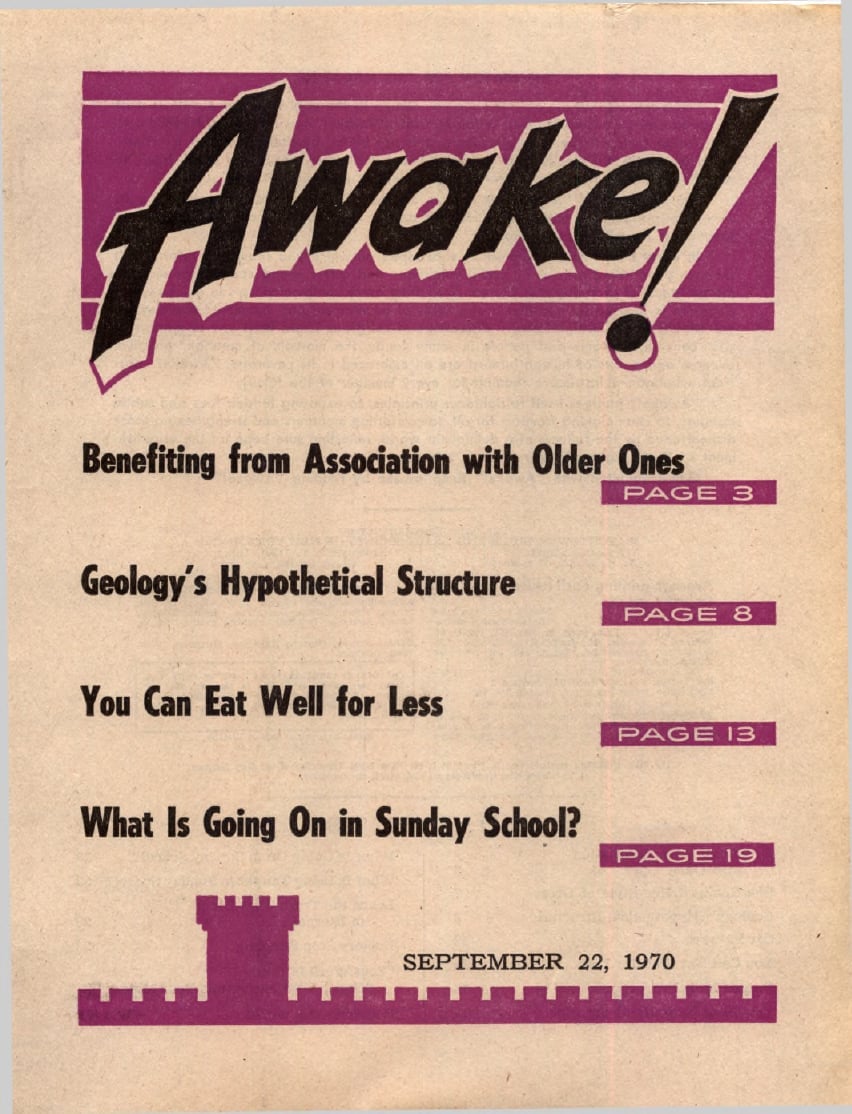
Awake! — September 22, 1970
Source: jw.org
Contents
Benefiting from Association with Older Ones
She Changed Her Style of Dress
Geology’s Hypothetical Structure
Car Failures
You Can Eat Well for Less
Record Milk Production
Let Them Hear the Other Side
What Is Going On in Sunday School?
What Is Being Taught in Sunday School?
Learn the Truth That Leads to Eternal Life
Doctors Stop Smoking
“Honor Your Father and Your Mother”
Watching the World
What Reasons for Believing the Bible?
Round Out Your Library
Benefiting from Association with Older Ones
Benefiting from Association with Older Ones
TODAY a family that does not include at least one relative over sixty-five years of age is indeed an exceptional family. For there are now in America some 19,000,000—nearly 10 percent of the country’s population—that are aged sixty-five or over. In Britain the number of persons over sixty-five has passed the 8,000,000 mark—more than 10 percent of the population. Other nations show similar increases in the number of older persons.
So many millions of mankind can hardly be ignored. Yet this appears to be the trend today in a fast-moving world where greater stress is placed on youth and the advantages of being young. Seldom anymore are the aged invited to youthful gatherings. In fact, it takes considerable encouraging to get children and friends to correspond with the aged or to keep in touch with them by telephone. It was not always this way. Times have changed.
A man of eighty-two recalls the change in these words, as reported in the Newark Evening News: “When I was a youngster, having old folks around us was part of the pattern of life. My neighborhood was full of them . . . When I walked down the street one or two would be sitting on the stoop or the sidewalk in front of nearly every one of the old, red brick houses. Only a few lived alone, most of them with children and grandchildren. They talked, read, or relaxed; some had special hobbies. Each had a smile and a kind word for us as we went by. Alongside our home was Mrs. Burns, a large woman who invited us in every time she made a batch of wonderful yeast bread which she spread with fresh homemade chili sauce. . . . Old man Sherman had retired from drygoods . . . His daughter cared for him . . .
“We respected these old folks and looked up to them; didn’t play jokes or make fun of them behind their backs. They took good care of their children, and after the kids were out of their teens, they expected to take care of their parents in turn.
“Today the oldtimers sit alone in some dingy rented room or on a park bench, neglected, just waiting . . . They know that times have changed but find themselves disinherited from even a little of the harvest of love and regard they had hoped for from their children.”
A true tragedy of old age today is that growing numbers of them are loved less by their children and the youths around them. Few children today count it a privilege to care for their aging parents. However, many children of previous generations thought differently.
More Respect in Ancient Times
As shown in the Bible, the children of ancient Israel were commanded by God to honor their parents, and this proved beneficial to the children. (Ex. 20:12) Communities in which old people abounded were represented as highly favored. The marked respect with which aged persons were treated is seen in the injunction: “Before gray hair you should rise up, and you must show consideration for the person of an old man, and you must be in fear of your God. I am Jehovah.” (Lev. 19:32) Respect for the aged was a command of God, a sacred duty. Even “the aged ones rose up, they stood” as the patriarch Job passed them in the streets. (Job 29:8) Respect for the aged was a beautiful thing then as it is now when shown to the deserving.
Even among some nations not governed by God’s law, respect for the aged was shown. Among the Egyptians, the young men rose before the aged and yielded to them the first place. The youth of Sparta did the same and were silent before older men. In Greece old men were treated with respect.
The aged were viewed as men of understanding and judgment. They were believed to be funded with a wealth of wisdom and recollection. Old men served as counselors to kings, and people generally responded warmly to their knowledge and understanding. When Jeroboam and all Israel pleaded with Rehoboam about lifting their heavy burdens, the Bible says: “King Rehoboam began to take counsel with the older men who had continued attending upon Solomon his father.” However, Rehoboam “left the counsel of the older men with which they had advised him, and he began to take counsel with the young men that had grown up with him.” (1 Ki. 12:4-19) The result was a revolt in Israel and an irreparable split in the twelve-tribe kingdom.
In various regions throughout the earth older persons are still held in high esteem. But in the Western world, generally speaking, their influence has greatly diminished. Notwithstanding, older persons still have much to offer and their association can prove invaluable if one but listens to them and learns.
This does not mean, however, that every elderly person constantly speaks words of wisdom or encouragement. Many of them have had much experience, and some of them have backgrounds that may be very rich indeed. But it must be remembered, too, that many of the problems and troubles in the world can be traced to the workings of gray heads. So selectivity is needed. When older ones have followed God’s way of righteousness, then there are likely to be many benefits from associating with them. The Bible principle holds true: “Gray-headedness is a crown of beauty when it is found in the way of righteousness.” (Prov. 16:31) A gray head that has been molded by God’s Word is a crown of beauty, and with such, one finds pleasure and benefit.
Many Assets of Older Ones
So often youths fear that older persons represent a financial burden, more than they care to bear. Therefore, they shy away from them. The fact is that you are from two to five times more likely to inherit money or property from your aged parents and other elderly relatives than to have to pay their bills!
True, old age has its peculiar aches and pains, but so does youth. Think of the diseases associated with childhood. When age is not plagued by too many ills, regrets and fears, it may, in fact, be a gracious period of tranquillity, with treasured memories locked in a mind that is at peace. In this topsy-turvy world, what youth would not enjoy a fraction of that tranquillity for himself? He can have it if he lingers awhile with the aged who are at peace.
Older people often offer much in being just what they are—older people. They have a warmth and affection that children love. That is why grandparents make excellent baby-sitters, especially when they are not unfairly taken advantage of. They make fine teachers as well. A little girl of five used to spend her time with her grandmother. Granny would tell her about God and the blessings of his kingdom. The child grew up determined to become a missionary for the Watch Tower Society, which goal she eventually realized.
Most of us remember with affection the old people we knew, perhaps our own grandparents. A young man remembered his grandmother for the wonderfully fragrant, crusty, brown loaves of bread she made. ‘Grandma would take a loaf hot from the oven, break it open and place a large slice of butter in the center,’ he reminisced with delight. ‘Then, when the butter was all melted and had run through the loaf, she gave us a large slice. Every crumb was devoured. Freshly made bread was something we were not allowed to eat at home, but grandma always saw to it that we got some.’ The young man long remembered his grandmother and her good-smelling kitchen.
The simple fact that older people usually are not hurried is a benefit not to be ignored. Often in youth all that is desired is a listening ear, perhaps a little sympathy and understanding. Older people often have the time and patience for such things. One elderly grandmother said: “I have been surprised and delighted to discover how many of the neighbors’ children drop in just to talk for a few minutes. They leave their busy play to come in to tell me something interesting or to speak their mind. I have only to listen, for they seem to desire only a sympathetic ear. They cannot know what joy they bring to one whose children and grandchildren are far away, but perhaps they feel something of the love they evoke.”
Not all things that older people do, need be great for them to have an effect. Their occasional batches of cookies are long remembered. What young mother has not appreciated some help in mending socks? Or when sickness or exhaustion strikes, who is there better to turn to for help than grandmother or grandfather?
Often it may be only a word or a phrase from an older person that can make one feel secure and encourage one toward doing good. An elderly woman tells about her childhood days. She had known many older folks, but she especially recalls an old lady who was placid, gentle and kind: “I remember as vividly as if it were yesterday taking her hand, looking into her eyes, seeing her smile at me and hearing her say, ‘Bless you, my child.’ Even her name I remember.” That simple touch with the aged, she says, “made me want to be good.”
Seek Out Association with Older Ones
No doubt, association with older ones has been a much-neglected area in modern life, with a serious loss in love and blessings to old and young alike. Why not do something about it? Why not encourage the aged to stop by for a visit from time to time and enjoy their company? Invite them over for dinner, for which they will be most grateful, and it will be rewarding to you at the same time. Or when preparing a party or a get-together, why not include in your list some older ones? When in large groups of people, older persons have a tendency to withdraw to themselves. Why not seek out their association and make them a part of the festivities? Be with them and make them a part of your life. Such kindness on your part will help to keep older persons from contracting the disease of loneliness and self-pity.
Of course, there are things to remember when visiting with older people. First, allow yourself reasonable time for a constructive visit. Too often younger persons rush in with words of apology: “I’m sorry I can stay but a minute.” Try not to feel rushed. It is well, too, to have in mind interesting and important subjects you want to bring up in your conversation. Have a point that you want to make. And try to leave them with a date when they may expect you back or hear from you in the reasonably near future. This gives them something for which to look forward.
Also it is a fine thing to bring something along that will serve as a conversation piece. When visiting, you might bring a letter from one of the family and read it aloud. Perhaps you have read a book or a magazine that has sparked your interest. You might share some interesting features that you enjoyed. Emphasize the points that impressed you. Thus by helping them you will be helping yourself to remember things of interest to you.
Old people especially like houseplants or flowers. These make wonderful gifts if you are thinking about bringing something along. If you have knitted something for them, such personal things are specially cherished. If you want to give money, put it in an envelope and perhaps suggest how you want them to spend it. Photo albums of family members, foodstuffs, some favorite dish, delight the older ones.
Watch out for fatigue and discouragement. Older ones do not have the strength of youth. Minimize their mistakes. Keep your conversation positive, not critical or carping. Admire their appearance if they give attention to themselves. If they care for their possessions and property, notice it and do not be afraid to compliment them for their interests. When old folks speak, listen to them. You may learn something. Older persons have learned to cope with much pain and suffering. They may be a help to you by showing you how to avoid needless suffering and pitfalls.
As the ancient Jews were under obligation to honor their fathers and mothers, so today Christians are under no less an obligation. The apostle Paul advised Timothy: “Do not severely criticize an older man. To the contrary, entreat him as a father, younger men as brothers, older women as mothers.”—1 Tim. 5:1, 2.
We can show our concern by visiting them and making them a part of our life. We can greet them when opportunity affords and sincerely demonstrate that we are pleased to have them in our midst. If distance prevents us from seeing them in person as often as we would like, there is always the telephone or we can reach them by mail. The sound of your voice or reading a letter from you about your life and the thought that you cared enough to remember are loving rewards to the aged. These things cost us so little, but they mean so very much.
For many, the time of old age may be like the late afternoon of a summer’s day, when the shadows have grown long but the light still lingers, and there are still bird songs in the treetops and the twilight is peace. In association with such older ones we often learn what the vital issues of life are. They, like the earth, may be filled with treasures, unknown treasures still to be discovered and enjoyed. When young folks seek their company it is a kindness, and they themselves are enriched with blessings that only the older ones can give.
[Picture on page 5]
Older persons often have a warmth and affection that children love
She Changed Her Style of Dress
She Changed Her Style of Dress
During her house-to-house ministry a witness of Jehovah in Columbus, Georgia, met a fashionable young woman. She was a Presbyterian and taught Sunday school. Her preacher taught the modern concept of “free thinkers” and that “mod dress” was part of their “expression.” All of her dresses were of micro-mini length.
This woman accepted the free home Bible study offered by the Witness. In time it was tactfully drawn to her attention that the Bible teaches modesty of dress for Christian women. (1 Tim. 2:9, 10) Though she came to the Kingdom Hall wearing her usual-length dresses, the Witnesses warmly welcomed her. And she casually observed the modest dress of the women in the Kingdom Hall.
As she studied the Bible she began to see that her religious leader had misguided her. Now she realized that one is either under the spirit of Jehovah or under the spirit of the world. She cried. But she showed so much appreciation for God’s truth that she began recommending it to others.
Soon she appeared at the Kingdom Hall with a dress on that was of modest length. The Witnesses there all rejoiced with her. Truly, the truth of God helps persons to make over their minds in harmony with the will of God.—Rom. 12:1, 2.
Geology’s Hypothetical Structure
Geology’s Hypothetical Structure
THE science of geology has contributed to man’s knowledge of his home, the earth. By means of the work of skilled geologists much has been learned about the makeup of our planet.
However, dedicated Christians, who have been convinced by ample evidence that the Holy Bible is truly the Word of God, have taken note of apparent discrepancies between geology and the creation account of Genesis. They have noted assertions made by geologists that organic life has been in existence here on earth for hundreds of millions of years. There is a vast difference, indeed, between these claims and the evidence in the Holy Scriptures that life has existed here, not for hundreds of millions but, at most, for tens of thousands of years. (Gen. 1:20-28; 2:1-3; Heb. 4:1-11) What, then, of these claims made by most geologists of our day? Has the Genesis account of creation been disproved? Let us see.
Geologists have classified the rocks that make up our globe into three basic categories: (1) igneous; (2) sedimentary and (3) metamorphic.
Igneous rocks have solidified from a molten state and form the foundation of the earth. They are, therefore, called “primary.” Granite is an example of this rock.
The sedimentary rocks are more recent in origin and have been formed either by accumulation of fragments of older rocks or by the wearing away of older rock due to chemical precipitation. They are found resting upon one another in layers, called strata. Although geologists have discovered vast thicknesses of such strata, they represent only a shallow layer on the igneous and metamorphic foundation of the crust.
Metamorphic rocks have undergone a change from previous igneous or sedimentary rocks by the action of heat, pressure and fluid. Marble is an example of such an occurrence, it being originally limestone.
The “Geologic Column”
The sedimentary rocks especially are packed with fossils. So, the question naturally arises, How and when did all these sedimentary rocks with their abundance of fossils get there?
In an effort to answer this question geologists have created a hypothetical structure known as the “geologic column.” This is a chart found in textbooks of geology. It divides the alleged history of life on earth into four principal eras: (1) Pre-cambrian; (2) Paleozoic (era of old life); (3) Mesozoic (era of middle life); (4) Cenozoic (era of recent life). These eras are subdivided into twelve periods and finally into epochs. A time scale has been attached to this chart giving ages ranging into thousands of millions of years.
Is it true that if a person were to dig down into the earth he would find the rock strata in that sequence? Are the ages assigned to the different life-forms reliable?
Uniformitarianism a Foundation
Upon closer examination it becomes apparent that the above “geologic column” has been built up upon two other theories as foundation pillars—“uniformitarianism” and organic evolution.
What is meant by uniformitarianism? This teaches basically that “the present is the key to the past” or that geological processes have always been uniform. Thus, by measuring what is going on in the seas and on the earth at present, geologists feel that they can deduce what has taken place in the past.
The theory was suggested in the eighteenth century but did not receive general acceptance until the publication of Sir Charles Lyell’s Principles of Geology (1830-1833). In explanation of this idea Lyell pioneered the opinion that all the sedimentary rocks were deposited by extremely slow processes, such as rain washing loose sand down a mountain slope to a river; the river carrying these sediments into the sea. We are told that the sea basin would fill up, the water being pushed over onto the former land area. Then the process starts over again. And thus the continents have seesawed back and forth for countless aeons of time.
In this way uniformitarianism purports to account for the thousands of feet of sedimentary rock that encircles the “primary” rock of our earth. Of course, thousands of millions of years would be required for such a process.
Evolution Theory Involved
It is interesting to note that shortly after Lyell published the above-mentioned book, Charles Darwin’s The Origin of Species appeared. He seized upon the newborn theory of geology as the long-sought answer to explain his idea of organic evolution by natural selection and survival of the fittest.
What Darwin needed was what uniformitarianism offered—unlimited time. Commenting on this, Don L. Eicher in his book Geologic Time stated: “Lyell’s wide influence prepared the ground for succeeding accomplishments of the nineteenth century, including those of Charles Darwin, whose ideas on the gradual development of living things could not have flourished without the intellectual framework of vast time.”
Geologists then became accustomed to explaining their discoveries in terms of evolution. Strata containing fossils of “simple” organisms were considered older than those with more complex ones. Thus, with uniformitarianism and evolution as the two main supporting pillars, the “geologic column” was constructed.
The Truth About the “Geologic Column”
When confronted with the chart, students of geology may assume the rock strata actually follow, one after the other, in that exact order. But is that the case?
Note what American geologist T. C. Chamberlain has to say about this: “It is not possible to proceed directly downward through the whole succession of bedded rocks. . . . The full series of strata is made out only by putting together this data gathered throughout all lands; and even when this is done, an absolutely complete series cannot yet be made out, or at least has not been.”
Further observing that there is no actual “record of the rocks” in their assumed order is the following admission from the work Introduction to Geology (1958; p. 11) by H. E. Brown, V. E. Monnett and J. W. Stovall:
“Whatever his method of approach, the geologist must take cognizance of the following facts. . . . There is no place on the earth where a complete record of the rocks is present. Some areas have been the sites of deposition of sediment for millions of years, whereas other regions have been subjected to the wearing action of natural agencies for equal periods of time. To reconstruct the history of the earth, scattered bits of information from thousands of locations all over the world must be pieced together. The results will be at best only a very incomplete record. If the complete story of the earth is compared to an encyclopedia of thirty volumes, then we can seldom hope to find even one complete volume in a given area. Sometimes only a few chapters, perhaps only a paragraph or two, will be the total geological contribution of a region; indeed, we are often reduced to studying scattered bits of information more nearly comparable to a few words or letters.”
In other words, the entire geologic column, with its high-sounding eras, periods and epochs, is merely a matter of guesswork, a hypothetical structure. There is no place on earth where such a succession of rock strata exists.
Recently Professor of Geology Richard M. Pearl commented on this matter as follows on page 14 of the book, 1001 Questions Answered About Earth Science (1969): “Obviously, then, the geologic record in any area is far from complete. This fact was first perceived by Charles Darwin in his classic book ‘Origin of Species’ (1859), where he expressed his belief that more of geologic time is represented by breaks than by strata.”
Upside-down Conditions of Strata
But not only that. Often geologists have found rock layers resting on one another in the reverse order; that is, a stratum having fossils of simple organisms on top of one having more complex ones.
Byron C. Nelson, in his book The Deluge Story in Stone, refers to an area comprising part of Montana, Alberta and British Columbia, fully 7,000 square miles, where Precambrian rock (said to be formed over a thousand million years ago) lies above “Cretaceous” strata (which are supposed to be less than two hundred and fifty thousand years old).
Is the Present a Key to the Past?
If we examine a pillar of geology’s hypothetical structure, namely, uniformitarianism with its teaching that “the present is the key to the past,” we notice here, too, serious problems.
One might assume that it would be a simple matter to measure the annual rate of the formation of sediment today and then to calculate how long it would take to deposit the various thicknesses of sedimentary rock found on the earth. But this method presents many difficulties.
Illustrating the problem are comments found on page 111 of the current textbook, Principles of Geology by Gilluly, Waters and Woodford. The authors there refer to a 500-foot thickness of chalk in the Paris Basin and go on to say: “The strata of chalk are composed of skeletons of minute animals and plants. Similar deposits are accumulating today at rates so slow as to defy precise measurement—certainly no more than a few millimeters per century and probably much less.”
To complicate matters further, the rates of sedimentation in different places vary greatly, and few have been measured accurately. As to the thought of obtaining an annual average, the same publication points out that it “can only be guessed at.”
There is another problem, too. The type of sediment being deposited today is unlike any that is found in the rock strata. The noted geologist Archibald Geikie commented on this in his Textbook of Geology as follows: “We know what are the leading characters of the accumulations now forming on the deeper parts of the ocean-floor. So far as we know, they have no analogues among the formations of the earth’s crust.”
What of the impressive ages that geologists assign to their time scale based upon the decay of radioactive elements found in certain rocks? The publishers of this magazine have often pointed out that age determination by radioactive decay methods is fraught with uncertainties. One of the difficulties of assigning ages to rock strata by this means is referred to by Henry Faul, in his book, Ages of Rocks, Planets, and Stars: “Rocks that are suitable for age measurement and at the same time reliably correlated with the stratigraphic sequence are very rare.”
Geologists have certainly proved woefully lacking with their time measurements based upon uniformitarianism and evolution. Far from the present geological processes being a key to the past, they “have no analogues” in the stratified formations of the earth. In fact, they cannot even be accurately measured. Besides that, rock layers are frequently found “upside-down” and “more of geologic time is represented by breaks than by strata.”
How, then, did the huge masses of sedimentary rocks with their innumerable fossils get there?
Strata Deposited Rapidly
In pursuing the answer it is interesting to note that the rock strata literally teem with fossils that show clear evidence of having been deposited rapidly.
Scottish geologist Hugh Miller made painstaking investigations of a species of rock called the “old red sandstone” (part of the “Devonian” system in the geologic column). Miller took particular note of its abundance of fossil fish and the peculiar positions in which they are found’ entombed in the rock. What was his conclusion as to how they got there?
On pages 221, 222 of The Old Red Sandstone Mr. Miller answers: “At this period of our history, some terrible catastrophe involved in sudden destruction the fish of an area at least a hundred miles from boundary to boundary. . . . The innumerable existences were annihilated at once.”
Able geologists have drawn similar conclusions with regard to all the stratified rocks. British geologist Sir Henry Howorth in The Glacial Nightmare and the Flood pointed out that “Nature has at times worked with enormous energy and rapidity. . . . the rocky strata teem with evidence of violent and sudden dislocations on a great scale.”
Evidence of catastrophe has been noticed not only in the stratified rocks, but also in the deposits that are on the surface of our globe. Time and again observers have been impressed at finding huge boulders sitting on top of the earth far from their sources. Some of these blocks, called “erratics,” weigh thousands of tons and apparently have traversed hundreds of miles of distance to their present locations.
Modern geologists, proceeding according to the uniformitarian principle, usually say they were carried there on top of huge glaciers during lengthy ice ages of the so-called “Pleistocene” epoch. They allege that when the glaciers melted they left the boulders where we now find them.
But there are many considerations that prove this theory to be unacceptable. One problem is that glaciers move only by force of gravity and, therefore, from higher elevations downward. However, the “erratic” boulders are frequently found at levels thousands of feet higher than their places of origin. To cite just one case, we find on the summit of Mr. Washington boulders of gray gneiss (a form of metamorphic rock) which were evidently carried there from a source “three to four thousand feet lower than their present elevation.”
Harmony of Genesis and Geology
But Bible students have often found that the Holy Scriptures provide satisfying solutions to problems left unsolved by scientific theories. In Genesis chapters six to eight we read of an earth-wide flood that brought an end to an era of wickedness. But would such a flood be equal to the task of uprooting and transporting the immense “erratic” boulders that we find strewn over the surfaces of the earth? Could it also account for the widespread destruction and sudden entombment in rocky matrices of countless thousands of organisms, great and small, that have been found in the fossil-bearing rocks?
The above-quoted Sir Henry Howorth noted that over the entire length of Siberia some cause swept away, simultaneously, all forms of earthly life. What did he consider the cause to be?
In search of the answer he wrote in The Mammoth and the Flood: “We want a cause that should kill the animals, and yet not break to pieces their bodies, or even mutilate them, . . . which would bury the bodies as well as kill the animals, . . . which could sweep together animals of different sizes and species, and mix them with trees and other debris of vegetation. What cause competent to do this is known to us, except rushing water on a great scale? . . . Water . . . is the only cause known to me capable of doing the work on a scale commensurate with the effects we see in Siberia.”
How well this agrees with the inspired Word of Jehovah God! Indeed, how accurate the Bible is when it says: “And the waters became overwhelming and kept increasing greatly upon the earth . . . And the waters overwhelmed the earth so greatly that all the tall mountains that were under the whole heavens came to be covered.”—Gen. 7:18, 19.
Geology based on fact rather than guesswork supports the Bible record. From it we see clear evidence of the pre-Flood earth teeming with luxuriant vegetation and animal life having been suddenly plunged into watery destruction.
But when geological textbooks confront us with a theoretical time apparatus based upon uniformitarianism and evolution we want to remember that the facts do not support this conjecture. No, but there are huge gaps in the “record of the rocks,” “upside-down” conditions of the strata, “evidence of violent and sudden dislocations on a great scale” and distribution of huge “erratic” boulders far from their native source. All these things unite in revealing the “geologic column” with its accompanying time scale to be just what it is—a hypothetical structure that does not represent the truth.
Car Failures
Car Failures
● The American Automobile Association said that about 11,000,000 of its members had about 14,000,000 flat tires in 1967, which represents a 28.6-percent decline from the previous year. However, its members also reported 581,000 brake failures—up 31.4 percent from the previous year.
You Can Eat Well for Less
You Can Eat Well for Less
“WITH prices what they are today, I just don’t know what to feed my family anymore.” Do those words sound familiar? Do they echo your sentiments? Many housewives find they can no longer purchase foods they once did and still stay within their budgets. The reason is that food prices throughout the world have risen so much in the last decade. And in the United States more than one third of the increase between 1964 and 1968 was due to a 15-percent rise in meat, poultry and fish prices.
Many are finding it increasingly difficult to make ends meet. The current plight of the American consumer has received a great deal of attention and many are the proposals to arrest the hike in food prices. Despite various steps taken on federal or local levels to protect the interests of the consumer, it is finally up to the average housewife to achieve savings on her own. She knows just what areas she can cut down without jeopardizing the family’s health. To achieve this goal she must know which foods are essential for their health and which they can do without.
Basic requirements for adequate nutrition may be roughly divided into four groups:
(1) Meats and substitutes for meat, embracing eggs, cheese, nuts, soybeans, and so forth.
(2) Bread, flour and various cereals (grains).
(3) Milk and milk products.
(4) Fruits and vegetables in as great a variety as possible.
For those who do not relish drinking the recommended two to three cups of milk per day for adults and three to four cups for children, it can be used in other forms. It is recommended by nutrition experts that housewives plan their menus around such basic requirements to ensure that their families eat the right foods.
How to Cut Meat Prices
Knowing which foods are essential is important. But if the average housewife is to cut her food expenses to any appreciable degree, she must first start with meat—usually the highest item in her food bill. She can watch for specials in the newspapers and build her menus around the meat bargains of the week. Perhaps it will be advantageous to buy liver and lower-cost cuts of meat such as rump, neck, flank, chuck or bottom round. Rib chops are relatively inexpensive. Blade shoulder steaks are even more economical. Ham shank is just as flavorful as ham butt, yet much less expensive.
The redeeming feature is that these cuts are just as high in food value as the more expensive ones. The only difference is that more care must be taken in cooking them, since they may be less tender. Tongue is another money saver. When braised in an aromatic sauce and properly garnished, it is delicious, and yet is often only half the price of beef!
Low-cost meat, however, is not always economical. Sometimes it contains much inedible waste. So, in comparing the basic cost, it is best to figure out the cost per serving. A pound of ground chuck, for example, may provide four servings. If it costs 69 cents a pound, that means about 17 cents a serving. How does that compare with some other item?
Foods That Satisfy
Once it is appreciated that meat is not the only protein, there can be a start at some real economizing. There are other foods rich in protein, but for best results they need to be prepared and served with special care so that they will be both inviting in appearance and delicious to the taste.
Fish is one of those protein foods, and in some areas it can be obtained at low cost. A great variety of fish foods are now available in ever-increasing supply—mussels, scallops, periwinkles, sea urchins. They can be baked, planked, pan- or deep-fat-fried, poached or steamed, whichever method brings out the best in each one. Are you keeping your eye on the fish market?
The egg is another satisfier that is a complete protein. It, too, can be prepared in a variety of ways—from the hard-boiled egg to the exquisite soufflé. No wonder it is so popular!
Some foods, though not being complete proteins such as eggs, still contain valuable protein. These foods, such as peas, navy and lima beans, are often called “incomplete” proteins because they do not contain as many of the essential amino acids. Lentils are another example. They, combine with many foods to provide satisfying yet inexpensive dishes.
The fact of the matter is that not every meal needs to be a high-protein one. There are other dishes that are quite satisfying. The humble potato is an example. It is astonishing the number of ways it can be prepared and served up in tasty dishes, alone or in combination with other foods. If a cook runs out of ideas in this regard, she may be able to compare notes with her neighbors. Then there is also rice. White rice and brown rice offer plenty of scope, and can be cooked either as a potato substitute or as dessert. It all depends on what seasoning or flavoring is added.
There are many more one-dish meals that can provide satisfying meals: macaroni, spaghetti and tomato sauce, stuffed eggplant, chicken chow mein, stuffed green peppers, to name but a few. True, these present a challenge to the skill of the cook, for they are often expected to rival the meat dish in appeal and taste. But the effort is well worth while, for it will add variety to your menus while also cutting costs.
Shopping Takes Skill
Are you a skillful shopper? Do you know what to buy, where to buy, and, most important, when to buy? It is a skill that can be acquired, and there are many aids. Food specials are usually advertised by radio, TV and in the public press. If you can obtain at a saving items you use frequently, it is worth while to purchase an extra quantity, as long as there is no problem as to storage. But make sure that you do not involve yourself in extra travel cost that can easily wipe out any gain from buying at a bargain price. It is best if you can find a place that is close to home where food bargains can be had.
The first thing the wise shopper will do, before leaving home, is to check the pantry shelves and make a list of items that are running low. In this way the housekeeper will be buying necessary things. It will tend to prevent compulsive buying, or running up a large bill for items that are not really essential.
It is good, too, to get into the habit of reading labels. Said one housewife: “Although I’ve been shopping for years, I’ve only recently become label-conscious. Now I’m not influenced any more by deceptive sales slogans. Now I read the labels to see what I am actually getting before I buy, and it makes a big difference.” The labels should tell the ingredients as well as the quantity or weight. A little mental arithmetic should determine whether it is more economical to buy the small or the large can of some commodity.
Some supermarkets offer their own private-label foods at a lower price than nationally advertised brands of the same products. Why not try these private brands sometime? You may find them to be of just as good quality as those that are so cleverly promoted on billboards or by TV and radio. Indeed, in some cases it will be the identical product retailed under different labels.
And while we are on the subject of labels, another matter for consideration by the judicious shopper is the cost of packaging. Some food products are dressed up in special containers, the cost of which is passed on to the purchasing public. To be practical, it pays to be more concerned about the product itself than about the way it is packed, no matter how attractive it looks.
Also to be kept in mind is the use you are going to make of your purchase. If the item is canned tomatoes, there are top-quality brands as well as those of lesser quality. However, if the tomatoes are to be used in soup or spaghetti sauce, high quality is not a must. The difference in quality may be that one lacks the high color of the other, or one brand has more whole tomatoes than the other.
The time to buy such perishables as fruits and vegetables is important. To buy these just because they appeal to the eye, and regardless of season, can involve unwarranted expense. It should be simple to find out the plentiful season for each item, the season when they can be bought for less. True, one can buy frozen fruits and vegetables, but can it be done at a reasonable cost?
The wise shopper will also take into account the waste factor when purchasing fruits and vegetables. Of the total volume, in any purchase, how much will be thrown away? This is important in determining the real cost. And another point worth giving some thought to: Is it really necessary to throw away so much of the peelings and trimmings of vegetables and potatoes? When cutting raw celery for the table, for example, could the less attractive cuttings be saved in a plastic bag and used later for soup or salad?
The shopper might also ask herself, Am I in a rut when it comes to purchasing vegetables? There is a wide range to choose from, and most of them are excellent for salad-making. Consider, for instance, some of these: finocchio (or sweet fennel), kale, French endive, mustard greens, escarole, chicory and watercress. And in the case of lettuce, it should be kept in mind that those dark green outer leaves, often foolishly discarded, are rich in vitamins and minerals.
Meals to Stimulate the Appetite
A good cook can make the simplest of meals a delightful experience, for she knows that color, form, flavor and arrangement of the food can have a powerful influence on the eater. So, she gives attention to such items as herbs, spices and garnishes. A little extra thought and a few more minutes in preparing an attractive meal can make the difference.
The color factor in the finished meal can have a great deal of influence. A dish of meat that is a drab brown can be livened up with tomatoes, beets, carrots or broccoli. Radishes will add a flash of color to the salad. The attractive appearance of the food stimulates the taste buds and renders the meal more enjoyable.
Spices and flavorings, used moderately, can enhance the enjoyment of the meals and add to the variety of your dishes. And speaking of variety, it is good to try out new recipes from time to time. Take the potato, for instance. It has been said that there are more than 1,500 ways to serve this common commodity. Perhaps many housewives have used no more than half a dozen of these. So there is a big field of adventure here.
Nor is it necessary to cook every vegetable. Besides serving them raw in salads, some of these, such as carrots, onions and celery, can be served fresh. In this form they have more nutritional value than when cooked. Hungry children will gladly nibble on such items between meals.
Skillful use of leftovers is another way to achieve economy without sacrificing taste appeal. With imagination and skill, very popular dishes can be prepared. For example, leftover meat can be chopped quite small and cooked with rice, spiced or seasoned to just the right degree. Leftover mashed potatoes can be panfried the next day.
Love’s Contribution to Good Eating
A loving wife and mother is not merely interested in getting the cooking and serving of meals over in a hurry. She has concern about the health and welfare of the family. When there are school-age children, there is serious effort to stimulate their appetites for plain, nourishing food. Geography lessons could come alive right at the dinner table if dishes popular in faraway lands are worked into the menu from time to time—Russian borsch, Hungarian goulash, Mexican tamales, and so on. Many of these are quite economical too. The housewife will find it to her advantage to experiment and expand the tastes of her regular customers at the table. It will take extra time to watch for food bargains, to make sure that the family are receiving adequate nutrition, to introduce more variety into the menu, to cut down on wastage. But she herself will be relieved of monotony and she will enjoy the satisfaction that she is contributing toward an economy that is so vital in these days of rising costs.
There is one vital factor relative to meals that should never be overlooked or underestimated. It is free and so does not need any shopping. Without it, much of the day-by-day enjoyment of meals would be lost. What is it? The Bible book of Proverbs points it out unmistakably: “Better is a dish of vegetables where there is love than a manger-fed bull and hatred along with it.” (Prov. 15:17) A pleasant, relaxed atmosphere, founded on love, is the sound basis for healthful eating.
Record Milk Production
Record Milk Production
● The average cow in the United States produces over 7,000 pounds of milk a year. Some cows average from 10,000 to 12,000. One cow on record, however, produced more than 42,000 pounds of milk in one year! During the year, this cow produced more than 70 quarts in a single day, on several occasions, compared to an average of from 20 to 32 quarts for other cows.
Let Them Hear the Other Side
Let Them Hear the Other Side
THERE are often two sides to a matter. While you may agree with one side, are you willing to hear the other?
Hearing the other side of a matter is the wise course. For one thing, it increases knowledge of the subject under discussion. It also helps one to understand the other person’s viewpoint. And even more important, it is often a good way to arrive at basic truths.
One of the many areas where there is a need to hear the other side is in the field of science. It would be naive to think that today no scientific theory needs further examination. Why, there were theories accepted just a few years ago that are today discarded.
This willingness to hear the other side is very much needed regarding the theory of evolution. In American schools, for example, evolution is usually taught without any mention of other possible explanations for man’s arrival on earth. As C. P. Martin, an evolutionist from McGill University, said of the many students he observed: “It is not that they are aware of the difficulties [of the evolution theory] . . . and esteem them of little weight or importance; they never heard of them and are amazed at the bare possibility of the accepted theory being criticized.”
Imbalance on Subject
At one time various laws forbade the teaching of evolution in schools. But many educators regarded this as tyrannical. They felt they should be allowed to present the evidence for evolution. Hence, legal actions were taken to repeal such laws. Now evolution can be taught in schools.
However, in large measure the situation is the same—tyrannical. How so? In that the evolution promoters now often try to forbid any other teaching on the subject of man’s origin.
Is such an attitude really scientific? Is it fair? Does it promote true education to saturate students with only one idea as to man’s origin when many scientists admit that the evidence is not conclusive at all, but is primarily conjectural? Why not let students hear scientific evidence for the creation of man as being separate and distinct from animals? Investigation of the facts on both sides is true education on such a subject.
How needed this kind of balance is can be seen from the remarks of one school principal who said: “You know, we have a library of over 10,000 books but not one of them gives the other side of the evolution theory.” Seeing this imbalance, he accepted information that gave the other side.
Others Concerned
Many parents and educators are concerned about this imbalance. They regard it as educational tyranny to teach unproved theories against which no other ideas are tolerated.
Nor is this a matter of advocating a certain religion in the classroom. If presenting scientific evidence for evolution is not considered objectionable, then why should presenting scientific evidence against it be considered so?
Some educators are taking steps to bring this matter into better balance. For example, two members of a California state board appointed to overhaul education protested when they noted that only evolutionary teaching was recommended regarding man’s origin. Drs. John R. Ford and Thomas G. Harward stated that the teaching of evolution should be presented only as one theory, noting that there are others such as creation. They proposed that both sides of the matter should be presented so that students could make up their own minds.
In its decision, the ten-member California board voted unanimously to amend the public school’s scientific framework to show that “all scientific evidence to date concerning the origin of life implies a dualism, or the necessity to use several theories to fully explain relationships between established data points.” The board added: “Science has independently postulated various theories of creation.”
Max Rafferty, state superintendent of schools in California, said that both sides of the matter concerning man’s origin should be presented to the students.
Welcomed to Discuss Other Side
In this regard, a number of educators have welcomed guest lecturers of Jehovah’s witnesses into their classrooms to discuss the other side. Local representatives, or students who are themselves Jehovah’s witnesses, are invited to discuss the matter with students. These discussions have proved very educational and have been enjoyed by both teachers and students.
At a Pueblo, Colorado, school the teacher allowed a student who is one of Jehovah’s witnesses to discuss evolution for an entire class period. Every student participated. At a Catholic school in College Point, New York, a guest lecturer, one of Jehovah’s witnesses, was given several class periods to discuss the other side of evolution. Afterward, groups of students gathered around for further questions. It was obvious from their many sincere inquiries that hearing the other side had stimulated their thinking on the subject.
A teacher at the University of California at Santa Cruz said: “I’m a science teacher. I teach the science concerned with the principles of valid reasoning or logic. We have gone through Darwin’s theory of evolution, one by Ingersoll, and two or three other publications on evolution, and in them we have found absolutely no shred of evidence or logical reasoning.” He asked that Jehovah’s witnesses speak to his class and also accepted for his students’ use the publication Did Man Get Here by Evolution or by Creation?, a 192-page documented discussion of scientific information on evolution that also gives the other side.
In asking for the same publication for his students, an associate professor from the biology department at a college in Fredonia, New York, said: “I like to give my students a chance of evaluating both sides of an issue.” Another teacher from a junior college in Chicago who did the same stated: “I am expected to teach the art of logical argumentation and to make the students aware that many seemingly logical arguments are quite often based upon prejudice. Feeling that truth is unobtainable unless both sides of the argument are heard, I mentioned this book to my classes and recommended it for those who are concerned with truth. To my surprise, the response was overwhelming.”
If you are an educator, Jehovah’s witnesses will be happy to arrange for a guest lecturer or make available to you printed information showing, from the scientific viewpoint, what the other side is concerning the theory of evolution. Truth is often made more evident when both sides of the argument are heard. So why not let students hear the other side?
What Is Going On in Sunday School?
What Is Going On in Sunday School?
IN MANY church organizations around the world millions of people attend what is called Sunday school.
It has been reported that in the United States alone about 20,000,000 boys and girls between the ages of three and twelve attend the Sunday schools of 223 Protestant denominations. There are also Sunday-school classes for all adult age-groups.
The potential of Sunday school for doing good is high, since so many are said to attend. If such a large segment of people, young and old, could be properly taught sound Bible principles, backed up by a wholesome family life, the moral tone of any nation could be lifted. But are Sunday schools bearing such good fruitage?
Problems
Clergymen and parents alike agree that the Sunday school faces many problems. High on the list is disappointment with results.
Disappointment with the results, or end product, is traceable in part to the motives that influence parents to send their children to Sunday school. Many parents feel that Sunday school is an easy and popular shortcut to religious education for the young, relieving themselves of the responsibility.
There are those who say that this motive is even outweighed by parental desire for social status. Redbook magazine stated: “In suburban areas, particularly, parents tend to join churches and send children to Sunday school to fit in with community mores. These parents have little interest in what is being taught—and why and by whom—or taking part themselves.”
With such limited interest in the spiritual condition of the young, the end product is not hard to predict. In an enrollment that numbers millions of youngsters, it is found that their moral atmosphere is not any better than that of an equal number of neighborhood youngsters who have never seen the inside of a Sunday school.
The main reason singled out for such a disappointing result is the unwillingness of the parents to participate with their children in religious training or back them up with a Christian atmosphere at home. So sooner or later the young conclude that, since the parents do not have any real interest in religious training, why should they?
Who Will Teach?
One of the problems that has led to such disappointing results is the qualification of those who teach Sunday schools. The National Sunday School Association’s Donald Reeder said: “The training of leaders and teachers is the greatest single unresolved task of the Sunday schools.”
A survey of five denominations, conducted by the National Council of Churches, concluded that the church school’s “greatest weakness” is its teachers’ lack of knowledge of their own faith and their lack of commitment to learning about it well enough to teach it.
Thus, even though modernization programs have been instituted, with new textbooks outlining programs, and with visual aids being provided, still the Sunday-school structure stands upon a foundation of quicksand. It is no stronger than the knowledge of the teachers. And since most churches are in no position to hire professional Sunday-school teachers, they must depend upon volunteers, often parents who are already busy.
It is hoped that such parents will have the knowledge and determination to impart good religious training because they come from families that are tight religious groups. They presume that such parents regularly pursue religious instruction and set good examples in their homes.
However, the assumption that tight-knit religious families with good knowledge can supply adequate volunteer teachers is not a reality. Indeed, deterioration of family religious life is a basic weakness upon which the entire Sunday-school program falters. As one volunteer Sunday-school teacher lamented: “Many youngsters come from homes, so-called religious homes, where God or love or faith is seldom, if ever, mentioned.” Teachers are drawn from such families where parents often do not have sufficient knowledge even to instruct their own young properly, much less others.
Nor are Protestants alone in this dilemma. A survey noted the reluctance of Catholic and Jewish parents as well to “consider religious training part of their job at home.” Thus, a joint study by the Carnegie Corporation and the Federal Office of Education found that Catholic-school religious education is “virtually wasted” on the large majority of the students.
What to Teach?
Another critical problem of Sunday schools today revolves around what the youngsters should be taught. Some adults ask: “What is being taught? the Bible? denominational dogma? Christian morals? social and political ethics? or what?”
Some parents, and some educators, such as Professor Marcus Barth of the University of Chicago, have defended teaching the Bible as “not just the best tool for Sunday school, but the only one that is reliable.”
However, the architects of many Sunday-school courses have had serious problems with teaching the Bible. They have discovered that the Bible’s teachings often undermine church dogma. Another problem is that many of the teachers, indeed most of them, do not really know how to use the Bible. They are not familiar with its teachings, even with its teachings as explained by their church. Hence, many give the Bible only lip service in teaching Sunday school.
This reflects the fact that religious leaders have lost touch with God’s Word, the Bible. It is like a closed book to them. Their hesitancy in using the Bible, their inability really to teach its truths to others, their failure to apply its laws, principles and prophecies to modern life, have resulted in gross confusion.
This reminded a Bible student of the burning sarcasm of the prophet Isaiah, who declared: “And for you men the vision of everything becomes like the words of the book that has been sealed up, which they give to someone knowing the writing, saying: ‘Read this out loud, please,’ and he has to say: ‘I am unable, for it is sealed up.’”—Isa. 29:11.
As for teaching church dogma, this too has reached a dead end. Many consider that teaching dogma is “narrow” and “separatist,” while the ecumenical movement calls for casting off religious differences. In noting that such teaching would be outmoded, Gerald H. Slusser, professor of theology at Missouri’s Eden Theological Seminary, stated: “In the average family Aunt Millie might have become a Christian Scientist; Brother Bill has been to college and become an agnostic; Father does not say so, but he has adopted the American free-enterprise religion of ‘get rich quick.’”
Hence, fashioners of “modern” Sunday-school teaching programs compromise, trying to please everybody and offend no one. But a father complained: “My son, who is seven, has been taught that God is everywhere. I think my son is getting a tremendously confused idea of things.”
Posing Problems—Offering No Solutions
One popular device in “modern” Sunday schools is to pose “real-life problems” to students, but offer no solutions.
A text used by the Lutheran Church of America entitled “Is It Christian?” raises such problems as this: A sixteen-year-old tries to reconcile his sense of right and wrong with his desire to ‘go along with the gang.’ Instead of getting home from a school dance by midnight as ordered by his parents, he “wonders if a good solution might be to wait till after 1 A.M. and then call home with an excuse for getting in later.”
Each class member is required to work out his answer as to what he would do. The text gives no direction because, according to Dr. W. Kent Gilbert, chairman of the Parish Education Board of the Lutheran Church in America, “a religious person responds to a situation in what he believes is the way nearest to God’s will. But there are no all-right or all-wrong answers.”
How the students learned what God’s will is in the first place is not explained. Yet without direction, they are supposed to answer such questions based on their knowledge of God’s will. What do you think would happen if these youngsters were switched to a mechanics class where the instructor has never explained how to put a motor together, but who then gives them one already taken apart and says: “Now, students, put the motor back together again and tell me why you did it that way”?
Failure
Already many of the operators of Sunday schools consider them spiritually bankrupt. In July 1967 a conference of Catholic and Protestant teachers and pastors met to wrestle with the problem of what to do about religious education. They concluded that the church school in its present form is beyond saving!
According to The Christian Century, the conference “seemed to agree that the denominational approach to Christian education is dead.” Out of the conference came a proposal that the traditional Sunday school be replaced, or at least supplemented by community schools. These community schools would be staffed and operated on a volunteer basis by members of the community and would supplement the public school system.
All of this amounts to an admission that the churches discredit themselves as sources of spiritual knowledge, training and strength. They would resign the task of religious education to the community, to the same people who already confess to being unwilling and unable to teach Sunday school.
Perhaps you may feel that the situation is not all that bad. Yet, if you or your children have attended Sunday school, it would be well to ask yourself what you have learned. So let us take a deeper look at this aspect of the matter.
…