Awake!, July 8, 1970
Download: PDF — Awake!, July 8, 1970
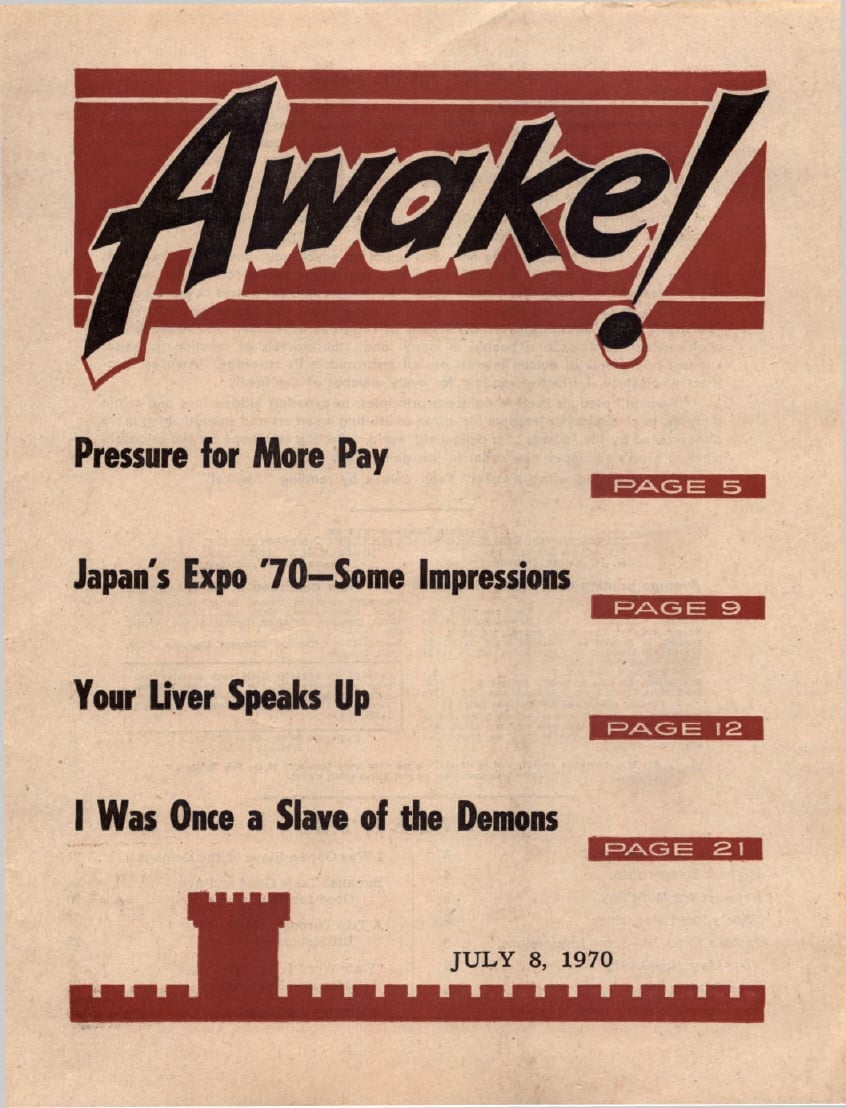
Awake! — July 8, 1970
Source: jw.org
Contents
How Are Your Manners?
Highest Temperature
Pressure for More Pay
Widely Read Magazines
Japan’s Expo ’70—Some Impressions
Your Liver Speaks Up
What Makes It Tick?
Meeting the Demand in Switzerland
I Was Once a Slave of the Demons
Bananas Taste Good and Are Good for You
A Trip Through Morocco’s Rif Mountains
Safeguard Your Heart
Watching the World
Is the Human Race Doomed?
The Greatest Mystery of All Time!
How Are Your Manners?
How Are Your Manners?
IN THE main railroad station of a European capital a line of people waited their turn to exchange foreign funds. Along came a short, stout man. He walked past the waiting line as though it did not exist, reached over a woman at the counter, flourished his money in the face of the teller, and said something about being in a big hurry. He was served immediately, and then strolled off at a leisurely pace, quite pleased at the success of his “me-first” tactics.
Perhaps he was in a hurry. But so were others in that line. The difference is that he was self-centered, inconsiderate, ill-mannered. Many a time you may have experienced similar situations in stores, at public gatherings, on public conveyances. Some persons push and shove their way to the fore.
At public refreshment stands, for example, have you noted that, regardless of the number waiting to be served, someone frequently pushes his way through and shouts out his order? Have you ever done that? We hope not. But did you observe the reaction on the part of those standing by? Some no doubt made quiet comments on his lack of consideration. Perhaps a few harshly voiced their objections. Others, seeing his success, were moved to follow the unmannerly one’s example, well knowing that it was a selfish, rude thing to do. But what did you do?
What you do under such circumstances reveals much about you. It brings to the surface the real you. If you profess to be a Christian, it tells whether your profession is genuine or not. How? Well, the Bible clearly instructs Jesus’ followers that they ‘should do to others what they would like others to do to them,’ and that they ‘need to be gentle toward all, keeping themselves restrained under evil.’ (Matt. 7:12; 2 Tim. 2:24) Why should you demean yourself by stooping to the practices of selfish persons around you? Why permit unmannerly ones to affect you to the extent that you forget the fine manners for which true Christians are widely known?
A well-known medieval poet used the expression, “Murder will out,” that is, it will be exposed eventually. In the same way it may be said that your manners, good or bad, “will out.” Usually they are revealed in small, half-conscious actions, by the presence or absence of such simple words as “Please” and “Thank you.” They can be detected, too, in how you dispose of your trash.
Do you throw trash in just any place, or do you deposit it in the proper receptacle? Discarded cans, bottles, wrappers and paper napkins mar the beauty of public parks. Along a hundred-yard stretch of quiet rural road in New Jersey one reporter found fifteen bushels of trash. On subway stations, at bus stops and around lunch counters litter can often be seen even where trash receptacles are provided. And it is common to find one’s shoe sticking to the sidewalk, merely because some unmannerly person improperly disposed of a wad of chewing gum. Ugh! The thought of having to scrape it off is revolting!
In 1967 an international survey confirmed that this problem of litter exists in many nations. Australia, Canada, Denmark, England, India, Japan, the Netherlands, Sweden, the United States of America, West Germany and Venezuela were named among the lands suffering from this form of delinquency. Nor did they find it true that most of the mess is to be blamed on visitors and tourists. In fact, 70 percent of those sharing in the survey placed the lion’s share of the blame on local residents.
The litterbug is an outlaw. He is against law, order and cleanliness. He has no regard for the comfort and well-being of others. Look at some of the public parks and picnic grounds where he has been! It is no pleasure for you to visit such a messy place. But when you find that a certain area is already a mess, what do you do? Are you tempted to reason that a little more trash thrown around will make no real difference? Do not be misled. You are, by your word and your action, either with those litterbugs or against them.
Not to be overlooked is the cost of this type of bad manners. Yes, it costs money every time litter is discarded. Sanitation workers must be paid to cope with the cleanup demands, and the cost of the growing sanitation staff is reflected in higher taxes—taxes that must come out of the pocket of everyone.
All of us should practice good manners, but parents have an added responsibility. They should also be keenly interested in the manners of their children. It takes patience to train them to display good manners on all occasions, at home and in public. But the parents’ example does most to help their children to learn to be considerate of others, strangers as well as acquaintances, under any and all circumstances. What young people do away from home usually reflects the manners they have been taught in the home.
There is good reason to check on your manners. Certainly you do not want your manners to be offensive to God or man. Indeed, to each one professing to be a follower of Christ the Bible’s counsel is: “Maintain your conduct fine among the nations.”—1 Pet. 2:12.
Highest Temperature
Highest Temperature
●The highest temperature ever recorded in the United States was 134 degrees Fahrenheit, reported on July 10, 1913. The location was Death Valley in California. Summer temperatures of 125 degrees Fahrenheit are common there.
Pressure for More Pay
Pressure for More Pay
“WE WANT MORE PAY!” That is the demand heard with growing force in many nations these days.
Pressure for more pay reached a new high in the United States during March. Government workers walked off their jobs. Why? Because their pay demands were not met. So about 200,000 post-office employees went on strike against their employer—the federal government of the United States.
There were many other strikes and threats of strikes. Private companies and city governments were affected as well as the federal government. And in most cases, the main demand was for more pay.
Why the cry for more pay by so many people today? Where will it all end? What is the remedy?
Rising Prices
One reason why workers in so many countries are pressuring for more pay is rising prices. Prices of goods and services are on the increase.
Last year the United States saw its cost of living rise more than 5 percent on the average. During the first half of 1970 there was no letup, but living costs continued to rise at about the same high rate. However, the price of many items rose far more rapidly. For example, note the following increases in some food prices in the past year:
Item Price Increase
Onions 30 %
Carrots 27%
Bacon 22 %
Eggs 21%
Pork chops 14 %
Hamburger 13 %
Price rises were also far above average for many nonfood items, such as these:
Item Price Increase
Bus fare 16.0 %
Woman’s wool skirt 15.9 %
Air fare, coach 13.6 %
Auto insurance premium 13.0 %
Hospital room, semiprivate 12.3 %
Woman’s casual shoes 10.8 %
The rise in the cost of living has squeezed the pocketbooks of wage earners. A Chicago taxi driver stated to U.S. News & World Report: “You can hardly eat.” He said that his family tries to stretch their food purchases by obtaining cheaper cuts of meat and eating more stews.
An accountant in Michigan declared: “We certainly aren’t living better. When my wife told me that eggs cost 80 cents a dozen, I told her to stop buying eggs. Now I have oatmeal for breakfast. To save money, we buy milk at the market instead of having it delivered at home. We’ve given up our custom of having steak for dinner at least once a month.”
A Houston housewife stated: “I come out of the grocery store in tears. I shop once a week, and every week I find items that have gone up 4 or 5 cents. You can’t cut down on the amount your family eats, but you can cut down on what they eat.”
How strange is the situation that has developed! In some lands people cannot get enough to eat. But in the United States, a ‘land of plenty,’ some people cannot eat what they want because of rising prices.
In addition to rising prices, taxes also have increased. In 1939 taxes of all kinds—federal, state and local—took 19 cents out of every dollar in the United States. But in 1969, taxes took 36 cents out of every dollar—more than one-third of a person’s income. Never in the country’s history had taxes taken so much.
Thus the workingman expects constantly rising prices and taxes. So when negotiating for wage increases workers press for enough to cover the rise in the cost of living for the next few years. And they also feel that when those few years are up, they will have to ask for more increases.
Want What Others Have
In this age of radio and television, people note the material things advertised. They want their share of them. They also hear of the increases in pay others are getting, and they want theirs.
Workers also notice the example of their leaders. They saw, for instance, what the Congress of the United States did in regard to its own pay increase. Early in 1969 Congress quickly voted itself, and other high officials, these salary increases:
Position Old Salary New Salary % Increase
President $100,000 $200,000 100.0
Cabinet
Member 35,000 60,000 71.4
Supreme Court
Justice 39,500 60,000 51.9
Member of
Congress 30,000 42,500 41.7
In addition, these officials get many ‘fringe’ benefits. U.S. News & World Report noted: “Added up, annual ‘fringes’ can total more than $400,000 for a Senator and $150,000 for a Representative. Yet many of these allowances are inadequate, in the view of many members.”
Workers see that government officials, in a matter of days, legislate huge pay increases for themselves. But postal employees waited months for the government to act on their requests for a pay increase. It did not come. Frustrated, the postal workers went on strike. The New York Times declared: “The taxpayers have no right to expect Federal workers to make sacrifices to stem inflation when everyone else is practicing the ‘gimme’ philosophy.”
The Times also said: “Some think we are seeing the results of an atmosphere of selfishness in which every man is encouraged to get his. . . . In any case, in the absence of any nobler agreed social goal, people want and expect more money.”
However, not all practice the ‘gimme’ philosophy. There are hundreds of thousands of persons who are relatively free from the anxieties about money. These work hard for their living, but they have learned and benefited from the truth that Jesus uttered when he said: “Never be anxious and say, ‘What are we to eat?’ or, ‘What are we to drink?’ or, ‘What are we to put on?’ For all these are the things the nations are eagerly pursuing. For your heavenly Father knows you need all these things. Keep on, then, seeking first the kingdom and his righteousness, and all these other things will be added to you.”—Matt. 6:31-33.
Persons who concentrate on making money, but take little or no time to study God’s Word and to associate with those who truly love and serve God, are not finding contentment. But those who put God first in their lives, who are ‘content with food and covering’ and are ‘free from the love of money,’ find great satisfaction in life. (1 Tim. 6:8; Heb. 13:5) As they do their part, God does his and their daily needs are met without undue anxiety.
The majority of people in the world, however, do not apply Bible principles and so do not benefit from them. Hence, they feel they must take any course, even defiance of the law, to get more pay.
Defiance of Law
In the United States there are laws that forbid government and city employees to strike. Violators can be discharged, and in some cases fined up to $1,000 and imprisoned for a year.
But the pressure for more pay is so strong now that these laws are being defied. When mailmen walked off their jobs it marked a defiance of federal law. Court orders to get them back to work were also ignored. So were the pleas of union leaders. The mailmen felt that the only language the government understood was their use of power, the power to cripple the mail service and affect the entire economy of the country.
So serious was the strike that President Nixon told a nationwide audience: “What is at issue is the survival of a Government based on law.” He then declared a national emergency and called up National Guard troops to help with the mail. Incidentally, these troops were civilians who had to leave their jobs and families, resulting in loss to their employers and loved ones.
About a week after the postal workers struck, air traffic controllers, who are employees of the Federal Aviation Administration, began to call in ‘sick’ and not report for work. They were using this tactic to protest working conditions. These controllers perform a vital function at airports, directing air traffic. By staying home they caused a massive slowdown of air traffic.
In many cities, municipal employees have gone out on strike. Teachers, sanitation workers, city workers and other civil servants have defied laws forbidding such strikes. Even policemen have gone out on strike. And New York city’s police force threatened to walk off their jobs if their demands were not met. Of course, the public suffers when city employees strike, because important services are curtailed. So it can be said that the public is held ‘hostage’ as part of the pressure for more pay.
Thus there is a growing trend toward defying the law in the demands for more pay. There is less willingness to come to an agreement ahead of time on the part of both officials and workers. It is just as the Bible foretold of our time: People are “not open to any agreement.”—2 Tim. 3:3.
Who Pays for It?
It is estimated that pay increases in the United States now average about 8 to 10 percent a year. In West Germany wages rose an average of 14 percent last year. In England, the rise is about 12 percent a year. Who pays for all these increases?
An example of who eventually pays was seen in the case of the post-office workers who were promised a raise—the mail rates are to be increased. So everybody who uses the mail pays more. Another example was seen when New York city tugboat crews struck for more pay. They got a huge raise, more than 50 percent. But tugboat operators said they would raise the rates they charge for their tug services by about 40 percent. The New York Times of April 3, 1970, commented:
“It is true that the tug crews and their families do not hire tugs so they can shrug off the increased bill for harbor movement. But that, too, is a delusive measuring rod. Every increase in transportation costs filters into the general economy; every oversized wage agreement causes every other union to raise its sights.
“Unions run faster and faster to keep up with the soaring cost of living, but the money runs out of their pay envelopes as fast as they get it. That has been the record through all of the last four years, and the end is nowhere in sight.”
That is the sad reality of all the pressures for more pay. Eventually the wage earner himself pays for it in higher prices for goods and services, and more taxes. Companies and governments simply charge more to pay for the increases.
So while workers get pay raises, their overall economic situation hardly improves. In many cases it has worsened. In four years the weekly wage of the average factory worker in the United States went up from $107 to $129. On paper, that seems to be an improvement. But he actually ended up poorer! How so? The wage increase did not equal the increase in prices and taxes during that same period. His greater pay was worth about a dollar less in purchasing power!
What Is the Remedy?
The situation in regard to prices and taxes and pressure for more pay is causing great frustration and unhappiness. How obvious it is that man’s economic systems are not working for the benefit of all. And imagine the plight of the old, poor or sick who are on low or fixed incomes, who get little or no pay increases to combat inflation!
Should you expect the economic situation to be corrected? Well, is that likely when so many groups are pulling in different directions? No, because there is too much selfishness and too little concern for the welfare of others.
What is really needed is a system of government that will work for the good of all. But where is there such a government today? If we honestly face facts, we must see that however sincere officials may be, no human government today is able to satisfy the proper desires of all its people.
What is needed is a central government that will be above selfish interests, a government that has the wisdom, power and right to control all economic affairs and to make needed changes that benefit all. No human government fits those requirements. The only government that can and will do all this is the kingdom of God, the heavenly government for which Jesus taught his followers to pray.—Matt. 6:9, 10.
No, the hope for such a government is not ‘pie in the sky,’ a promise for some indefinite future. Bible prophecy shows that the time for God’s world government to take complete control of all earth’s affairs is very near. When it does, no one will ever have to pressure for more pay, for the Bible says to God: “You are opening your hand and satisfying the desire of every living thing.”—Ps. 145:16.
Widely Read Magazines
Widely Read Magazines
The Word, an international Catholic magazine published in Ireland, recently reported: “The Watchtower Society has always stressed the printed word. . . . Its magazine Watchtower reports a circulation of about four times the circulation of the world’s largest Catholic periodical. Its companion publication, Awake! claims a circulation of 4 million.” Yes, these magazines are read by millions of lovers of God’s Word in all parts of the world. In fact, since the writer of the article quoted above obtained his figures, both The Watchtower and Awake! have increased in circulation by some 50 percent.
Japan’s Expo ’70—Some Impressions
Japan’s Expo ’70—Some Impressions
By “Awake!” correspondent in Japan
“PROGRESS AND HARMONY FOR MANKIND”—these words express the theme of Expo ’70. It sets out to show that Occidental progress plus Oriental harmony provide the key to a brighter world for mankind. Does Expo ’70 succeed in this? Let’s go and see.
On this clear spring morning we drive right around Expo ’70’s 815 acres at top speed, and then join hundreds of other cars in a spacious parking lot. It is an hour before opening time, but the line of people is already long. At the main entrance there is a futuristic “Tower of the Sun” rising 198 feet into the sky.
By the time we reach the Soviet pavilion, the line is an estimated three hours long, so we bypass it and enter the United Kingdom pavilion after a five-minute wait. This we find really interesting. A fast-moving variety of movies and still pictures depict vividly the life and industry, the art and history of Britain. And we are brought up-to-date on scientific progress, the latest in jet engines, hovercraft, discoveries in the realm of medicine, and the like.
It is said that some 300,000 people are now on the grounds. Energetic tour groups wearing colorful sashes and “Expo caps” surge here and there. However, there is no waiting as we pass through a unique open-air Brazilian hall and enjoy a complimentary cup of coffee. Next, the Hawaiian pavilion, with its songs and hula dances. There is no waiting, either, at the rest rooms, where we are surprised to find soft music.
Lively Latin music and song, presented by a vigorous group of troubadours, attract us to the Mexican pavilion. A large Aztec sun calendar opens the way to a vivid portrayal of Mexican history through Aztec and Catholic ages into modern times. Close by is the Grecian pavilion, which again takes us far back into pre-Christian times. Outstanding is a large mosaic, excavated from the ruins of Pompeii, which shows Alexander the Great as he comes to grips with Darius III of Persia at Issus, in 333 B.C.E.
The Indian pavilion is splendid in its endeavor to describe the origins and history of India, and the struggle to build a modern nation. The history of Buddhism is very clearly depicted, and we are told that Buddha himself was born as recently as 544 B.C.E. By then the writing of the Hebrew Scriptures was nearing completion. Main tenets of Buddhism are set out on a plaque reading: “Then Buddha spake: Right view, right intention, right speech, right action, right conduct, right livelihood, right effort, right mindfulness, right concentration. All things are impermanent.” We reflect, of what use can “right” things be without permanence?
But it is time to rest weary feet.
The Japanese Garden and Japan
We walk a short distance to the 64-acre Japanese garden. Here, amid lakes and ponds stocked with fish, iris and lotus flowers, among waterfalls and brooks, teahouses and dwarf-tree displays, and with songs of birds and koto (harp) music wafted from loudspeakers, we find a splendidly different feature of Expo ’70. Here we relax over box lunches, amid the harmony of God’s creation. It makes us reflect, too, that lasting progress for mankind is not to be found in steel-and-concrete cities with their air and water pollution, but it must wait until the time, now close at hand, when the all-wise Creator restores paradise to earth in his way.
Refreshed for more walking, we cross over to the Japan pavilion. As the line of people snakes its way toward the entrance, there is forty minutes to contemplate the outside of this $15 million structure, the most costly and controversial in all Expo ’70. Inside there is a vivid portrayal of Japanese mythology, blending into actual history. A fearsome print of the Buddhist “hell” with its victims squirming in excruciating agony reminds one of Dante’s “inferno”—truly, all false religion has common origins!
But soon we pass into modern Japan, and are overwhelmed by the rush of life and statistics. The hustle and bustle is true to reality, even to a forest of TV antennas—but is this progress? A circular theater brings some relief and harmony, as we watch “Our World” on eighteen movie screens, depicting simultaneously the life of Osaka and other great cities around the world. We see a tapestry entitled “The Tower of Joy,” depicting high hope for future uses of nuclear energy.
Next, as a climax, comes one of the finest things in Expo ’70—the Grand Theater, with its 157-foot (48 meter)-wide screen and the color film “Japan and the Japanese.” Superb photography shows Mount Fuji in its four seasons and the everyday life of the people that surround it. We see them, young and old, at school and at work, amid snowfall and typhoon, at blossom time and at Fuji-climbing time—when the mountain summit looks even more crowded than Expo ’70!
After seeing several nearby Japanese technological exhibits, we eat an early supper—at a price—and take the moving footway across the grounds.
Viewing the Contending Giants
Alighting at the American pavilion, we have to wait only thirty-five minutes in line. The evening crowd is smaller. The structure of the American pavilion itself is impressively attractive. A huge self-supporting oval roof, scarcely rising above ground level, shields the entire exhibit space underneath—no girders, no pillars.
The American display gets off to a splendid start, with large black-and-white photo prints by leading artists portraying life in the U.S.A. On we go into the whirl and action of the sports world, tailored to the interests of the sports-loving Japanese public. But the really big display starts with the scorched modules of small Gemini and ever-so-much-bigger Apollo spacecraft, and ends with an enshrined piece of moon rock. It looks no different from earth rock, and we wonder if this end product of space exploration really signifies billion-dollar progress.
If there is any reference to hope in God for progress, we missed it. Or has God been replaced by Babe Ruth’s uniform and the moon rock?
Shall we try the Soviet pavilion again? The monorail whisks us around to the other side of Expo, and soon we are standing under the towering red-and-white structure with its pinnacle of golden hammer and sickle raised to heaven. We are inside within an amazingly brief five minutes. From the outset, the show is very interesting, historically speaking. But soon we tire of seeing pictures of Lenin, Lenin, Lenin—so obviously supreme god of the Soviets.
We are taken to the Soviet’s great timber regions, and are reminded of the birth of many new cities and the spectacular growth of electric power and its use. As the Soviet’s climactic exhibit there come actual spacecraft, including the Soyuz, and we see how these are docked in space. But rather than dummies of astronauts, we would have preferred to have met in person some of the young people of the nation, as had been such a pleasant experience in many of the other pavilions.
Both the American and Soviet displays leave the impression that the hope for mankind’s future progress lies in outer space. But is this so?
Touring Many Nations
Another day dawns, and our first visit is to the Bulgarian hall. What a happy start to the day! We are greeted at the entrance by a wide-screen choir of girls in native costume, singing what seems to be a lively folk song. And though there are reminders that this is one of the socialist family of nations, the people and their lives, their countryside, their vineyards and their fields are portrayed in a way that captivates throughout.
On the other hand, the neighboring Czechoslovakian pavilion, though beautifully constructed with walls of glass, seems to place emphasis on a morbid fear of war. A visitor ahead of us has written in the book at the exit: “This is a very poor show.” However, for our own part, we find much that is interesting and instructive in the Czech finale, a movie depicting the making and uses of Czech glass and crystal.
After another lunch in the delightful surroundings of the Japanese garden, we go on to view the African halls. Some of these present beautiful color “stills” of wildlife and of great forests, mountains, rivers and waterfalls. How attractive is this earth in all its variety when freed from selfish ideologies and greedy exploitation! But we cannot go along with the claim that it was in Tanzania “where man first breathed the spirit of life, 1,750,000 years ago.”
Germany, France, Italy, Switzerland and others have outstanding pavilions covering the European scene, its music, its entertainment, its history and its natural beauty. A walk through a New Zealand rain forest, complete with the cry of tuis and bellbirds, and a series of four theaters depicting “Discovery” in Canada, take us to other parts of the earth. The Canadian pavilion kindly provides benches to sit on as our waiting line proceeds group by group into the pyramid-shaped Palace of Mirrors. Happily, there are seats in each of its theaters, too, and a breathtaking informative show . . . until it launches into ten nerve-racking minutes of raucous, psychedelic rock ‘n’ roll, apparently Canada’s “discovery” for the future. Can this be harmony? Is it progress?
Looking to the Future
We want to see more of the Japanese exhibits, but long waiting lines discourage us. However, we make it past bamboo groves into Matsushita Electric, which sold 1,300,000 color television sets last year. This display features a metal Time Capsule, containing a complete record of our times, which is to be buried fifty feet (15 meters) deep at Osaka Castle, after the close of Expo ’70. The capsule is to contain items of clothing, household utensils, a scroll of history and tapes of noises—even to the neigh of a horse and the grunt of a pig. It is not to be opened for 5,000 years. It is a novel idea, but will the Time Capsule be of interest 5,000 years from now?
The hall of the Fuji Group enterprises looks like a huge orange-covered wagon. Its large-screen movie seems to feature the disharmonies of human life from conception to the grave—its contradictions, its racial and national divisions, its cruelties and frustrations. It makes us ask, Where on earth among mankind is there hope for progress and harmony? Others have strong impressions, too, for we hear a passing Japanese student remark, “Progress and harmony—the exact opposite!”
In two days we see only an interesting, thought-provoking segment of the main Exhibition Area, but we find our delight in the restful surroundings of the Japanese garden.
Expo ’70 is a tremendous spectacle. It is huge. It is informative and educational in showing the peoples of mankind and their environments and activities. It underlines the crying need for progress and harmony. But can it map the road to reach them? This is too colossal a task, even for the colossus of Japan’s Expo ’70.
[Picture on page 9]
Tower of the Sun, Symbol of Expo ’70
Your Liver Speaks Up
Your Liver Speaks Up
YOU probably give me little thought. Oh, you may at times be concerned about your heart or lungs, but seldom about me—your liver. Many persons have little idea of what I do.
Did you know that if I were to stop functioning you would be dead in less than a day? In the number and complexity of my functions I put to shame your better-known organs, the heart and lungs.
I don’t mean to brag, but I perform tasks so complex that it would take a large chemical company with acres of plant to accomplish even some of my simpler jobs. And they just could not carry out some of my more complex assignments.
Actually I do more than 500 jobs—at least that is how many have been catalogued. But men are constantly discovering new ones that I accomplish. I make over 1,000 different enzymes to manage my chemical conversions! Should I fall down on any of my major operations, you would get sick and die. Even my lesser duties are important to your well-being.
I participate in practically everything that you and the other organs in your body do. I’m vital to the digestion of your food, the sharpness of your brain, the strength of your muscles, the makeup of your blood, the beat of your heart. I’m well acquainted with you. Now, don’t you think you should become more familiar with me? Only if you care for me can I do the same for you.
My Abode and Size
First, you may wonder where I am located. I am well-hidden and inconspicuous. I don’t beat, as does your heart. Nor do I noticeably expand and contract, as do your lungs. So even though I am the largest organ in the body, weighing from three to four pounds, many persons don’t know where to find me.
I am situated mainly in the upper right part of your abdomen. But I do spread out! I am almost a foot long, and parts of me vary from one to three inches in thickness. My top reaches, in the male, halfway up the chest. And I extend all the way down to the lower edge of the ribs.
Thus, I lie under the protective cage of your ribs. Your lungs overlay the upper portion of me. And my lower portion, in turn, overlaps your intestines and stomach. You might have had a doctor press the tips of his fingers upward inside the right lower margin of the ribs. He was probably feeling for me.
Ingenuity is apparent in my location. Not only do I fit snugly into a well-protected space, but I am close to your other organs. This is ideal, because they depend heavily on me for their functions.
Key Control Center
Take the heart, for instance. I regulate the blood flow to it. Should there be a temporary surge of blood, I swell, absorbing the excess that might smother its pumping action. Then I emit the blood gradually so the heart can handle it. Being the vascular sponge that I am, I can soak up some three pints of blood, or I may hold as little as a few ounces.
I am also keenly interested in your food. The food you eat passes from your stomach to your intestines, where it is broken down, and usable materials are sent into the bloodstream. I am so situated that these materials first come to me. They are delivered to me by the large portal vein, which connects with the network of intestinal veins.
Portal is an appropriate name for this vein. It serves as a ‘port’ or ‘gateway’ through which food materials must pass before reaching the tissues of the body. And since the portal vein flows into me, I am able to monitor all of these materials, converting them into a form usable by the cells of the body.
My strategic position also allows me to protect you from harmful bacteria absorbed into the portal bloodstream. I have what are called “Kupffer cells.” These act somewhat like scavenger white blood cells. They capture, engulf and destroy bacteria as they pass through me. If it were not for this protection that I afford, a serious infection might develop somewhere in your body.
I also protect you from other toxic substances, such as caffeine and various drugs. If you were to inject such substances into my exit blood vessel that leads to the heart, you might be dead in minutes. But since they must first pass through me, I am able to safeguard you.
An indication of my efficiency was once demonstrated by an experiment that was conducted on dogs. Two dogs were given an equal dose of poison, one of the dogs receiving it in an ordinary vein and the other in the portal vein. The first dog died, but the second, having the poison rendered harmless by the liver, remained unaffected. In fact, the dose of poison had to be multiplied several times before the second dog was affected. That illustrates my importance as a poison-control center!
Your own body itself makes poisons that could kill you. Did you know that? For example, run up a flight of stairs or do some other exercise and your muscles burn glucose—a body fuel—to produce energy. In the process the muscles make lactic acid, which would poison you if it were allowed to accumulate. But I come to the rescue, turning the lactic acid into a form that can be utilized as fuel again.
Also, ammonia is constantly being formed as your body cells burn protein. The ammonia is absorbed into the portal bloodstream and comes to me. If it were allowed to accumulate in your body, you would die. But I take good care of you. I form urea from the ammonia and pass it along to the kidneys for elimination.
I also regulate your supply of hormones, keeping a proper balance. Too many hormones from your thyroid gland could harm you. I destroy the dangerous excess. I also protect you from over-accumulation of adrenal and sex hormones.
This may help you to see why I am the most versatile of your organs, and the body’s key control center. I am the main site of the interchange, synthesis, breakdown and storage of foodstuffs, as well as of other substances necessary for your well-being.
Incomparable Chemical Plant
Think of carrying on hundreds of chemical conversions, some of them unbelievably intricate, and yet getting them all done properly and on time! That’s what I do. I make substances your body needs, when it needs them. But due to the manifold and complex biochemical reactions involved, any description of my processes must be an extreme simplification.
For example, I receive sugar by way of portal blood in the form of glucose. This serves as fuel for your body. But if too much is fed into the bloodstream, you will go into a coma and die. So I see that this does not happen.
If there is sufficient glucose in the bloodstream, I convert the excess glucose I receive to glycogen. This is a convenient, compact form of storage for glucose, which, in its own form, would take up too much room. Then as the body needs fuel throughout the day, I change the glycogen back to glucose and send it out bit by bit. Such transformation, one doctor writes, “involves a highly interrelated and complex sequence of enzymatically controlled events.” Yet for me it is a simple, basic procedure.
In addition, I receive amino acids that intestinal enzymes have broken down from proteins. If I should pass these on in the form I receive them, they would be as deadly to you as cyanide! So I “humanize” them, changing them to a form of protein that your body can use to build tissue.
I also produce the fibrinogen and prothrombin that clot your blood. You would bleed to death from a minor cut without them! Yet, at the same time, I figure in the manufacture of heparin, which keeps the blood from getting fatally thick. One doctor likened this action of mine to making atom bombs and fuses simultaneously, without an accident or fatal explosion. Be grateful that I don’t get mixed up in what I’m doing!
Another substance I make is albumin. It keeps fluid from leaking out of your blood vessels into surrounding tissues. And to provide you resistance against infectious disease I make globulin, which contains immune bodies.
Yet another of my marvelous productions is bile—that bitter, green-yellow liquid. I form it continuously—up to a quart a day—dribbling it into your nearby gallbladder for storage. It’s amazing what goes into it. For instance, each second ten million of your red blood cells die. As they pass through me, I pick them out, salvage parts for making new blood cells, and use some of the debris in bile production!
By means of bile I expel unwanted materials from your body. The bile is discharged into the intestinal tract, and from there it finds its way out of your body.
But bile is also important in the digestion of fats, being passed into your intestinal tract at mealtime. It aids, too, in the absorption of fat particles and vitamins from the intestinal tract into the bloodstream. Thus, I make and deliver bile to the intestinal tract so that important nutrients can be released and sent back to me by way of the bloodstream!
After I finish processing food materials, producing the nutrients your body needs, I may send them immediately into the bloodstream. This food-laden blood goes up to your heart, from where it is pumped to every cell of your body. Or, if they are not needed immediately, I store nutrients for later use—sugars, fats, proteins, vitamins and iron being my principal storage staples. Then when these are needed, I send them out. I can also convert nutrients from one form to another—sugars into fats or fats into sugars—to satisfy your body’s needs.
Giving Proper Credit
I’m sure you must be impressed by the complex tasks I perform. But don’t get the idea that this is a complete survey. It only gives you some idea of what a masterful organ I am. Really, the more a person learns about me, the greater is his awe and astonishment.
But I can’t take the credit. I didn’t make myself. And certainly you didn’t make me! Why, the most informed medical scientists haven’t even learned how I perform many of my marvels of chemistry.
It should be obvious, therefore, that my maker is the Supreme One, the very Creator who designed your entire body so that it functions in such marvelous harmony. As the inspired Bible writer said: “Know that Jehovah is God. It is he that has made us, and not we ourselves.” (Ps. 100:3) He certainly made me!
You Can Cooperate
Do you respect God’s creations? I do hope so! For then you will not abuse me. It distresses me when I look around and see how so many of my neighbors are abused by their owners. Did you know that in 1967 nearly 28,000 persons died of cirrhosis of the liver in the United States alone? This is a disease that destroys liver cells and replaces them with useless scar tissue.
And what causes cirrhosis? Overindulgence in alcohol is a principal factor. I convert alcohol into carbon dioxide and water, preventing a fatal buildup of it in your blood. But when a person daily consumes large amounts of alcohol, his liver cannot take it. It breaks down, becoming shrunken, hard and knobby. If this is not stopped, death will ensue.
This does not mean I am a delicate organ. Far from it! Actually my regenerative powers are amazing. Should part of me be removed—even up to 80 percent or more—I could keep you going until I grow new tissue. In a few months I would be back to normal size!
Still, I need your cooperation to keep healthy, and to keep you healthy. A balanced diet of wholesome foods is my chief requirement. This means eating foods that contain the basic nutrients—carbohydrates, fats and proteins. Particularly do I need protein in which all the essential amino acids are present in the right proportion. Foods of animal origin—eggs, meat, chicken, fish—are an important source of this.
My greatest enemy perhaps is too much of the wrong kinds of food. You simply can’t expect me to keep healthy if you live on a diet of pastries and devitalized processed foods. Nor can I function properly if you put on too much weight, or fail to get adequate physical exercise.
Do you want to be healthy? Then remember that I am one of your best protections against disease. So take care of me, and I’ll take care of you.
What Makes It Tick?
What Makes It Tick?
WHAT makes the rhythmic tick in a watch? That is a question almost every little boy has asked, and perhaps quite a few little girls. Could you answer their question?
The tick is much more frequent than you may have realized. Did you know that a watch ticks an average of 18,000 times an hour? That is five times a second, 300 times a minute, 432,000 times a day—and about 13 million times a month!
Early Timepieces
Compared with other methods of keeping time, the watch is a relatively new device. Humans probably first kept time by observing the sun or by measuring the angle of shadows of trees. Eventually sundials were introduced. These instruments mark off time by measuring the shadows. But on a cloudy day, or at night, they leave man without his clock.
Obviously another type of timepiece was needed. Many early civilizations used a water clock or “clepsydra.” Although these varied, the principle was the same. Water or some other substance was permitted to flow from one vessel to another. The amount that flowed could be measured, and in this way the passing of time was marked off.
The introduction of a mechanical means to measure time was a real improvement. It seems that the first such timepieces appeared in Europe in the fourteenth century. Then, in about 1500, a locksmith in Nuremberg, Germany, invented a portable clock. However, it was so heavy that it had to be hung from a belt around the waist.
Besides being bulky, early watches were not very accurate. In fact, they had only an hour hand. But improvements were made, and eventually precision timepieces were produced. All of these early watches were handmade.
Then, about the middle of the last century, the principles of mass production were applied to watchmaking. Over the years refinements have been made in production techniques, so that watches are now produced that keep almost perfect time.
Watches can now be made that will fit into a dainty ornamental ring for a lady’s finger. The screws used in their manufacture are so tiny that thousands of them could be put in a thimble! Also, some of the holes in which the tiny pivots of the wheels operate are so small that a human hair will not pass through them!
How It Works
But how does a mechanical timepiece work? How does it keep time? What makes it tick?
To help visualize the function of a watch, you might mount a spool of thread on a nail on the wall. Then use a little glue to attach a toothpick to the end of the spool. This toothpick will serve as the minute hand. Now slowly pull the thread of the spool. This will turn the spool and the attached toothpick, the minute hand. If you pull the thread at just the proper rate, the minute hand will make one complete revolution in an hour. Thus, you will have an instrument for measuring time—although a very crude one.
A mechanical timepiece does essentially the same thing. It moves pointers or hands around the face of a watch at precise rates of speed to mark off the day in time units of seconds, minutes and hours. However, the mechanism for maintaining the correct rate of movement of the hands, as well as their synchronization with each other, is indeed complex.
First, a watch must have a power source to move the hands. In the above illustration the power was provided by pulling the thread. This turned the spool, which turned the toothpick, or minute hand. In an ordinary watch the power is supplied by a “mainspring.” This is a thin, narrow ribbonlike piece of highly tempered steel.
The mainspring is inside a barrel that has gear teeth around its outer circumference. To store up power, there is a winding mechanism by means of which the mainspring can be wound. Thus when you wind your watch, you are storing power in the mainspring. The mainspring is attached to the inside of the barrel in such a way that it turns the barrel around as it fights to uncoil itself.
Thus, as the barrel turns, it drives the center wheel. This wheel, in turn, drives a suitable number of other wheels. The series of wheels is called the “train.” Its purpose is to carry the very slow motion of the barrel throughout the watch. The train is thus a series of reduction gears that expends the mainspring’s power a little at a time so that it will last longer.
Attached to certain of the wheels are the watch’s second, minute and hour hands. By means of various ratios between the number of gear teeth, the size of the wheels and their speed of movement, the hands are driven at the proper speed to measure the time.
But how is the flow of power through the wheels regulated so that they turn at the right speed to register correctly the passing of time?
This is the job of the “escapement,” the heart and brain of the watch. The accuracy of the watch is dependent upon its precision, quality and condition. Perhaps you can visualize to some extent the operation of the escapement by considering again the illustration of the spool of thread attached to the wall.
Suppose now that you carefully carve teeth in the outer rim of the spool. Then below the spool of thread, mount to the wall a specially designed fork having a pendulum. Mount it to the wall with a nail at the fork’s pivot point. Position the fork so that its two points enmesh in the teeth of the spool.
Now if you pull the thread, one tooth of the spool will push one point of the fork away from the spool, and this will move the pendulum to one side. This will cause the other point of the fork to enmesh with a tooth of the spool. As you continue pulling the thread, the pendulum will return and the first fork point will enmesh with the following spool tooth. As this action continues, the connecting and disconnecting of these parts will make a rapid tick. In your watch this tick normally occurs five times every second.
A wristwatch generally employs a highly refined escapement, using a fifteen-tooth escape wheel and two ruby jewels at the tips of the fork. In a watch this is called a pallet fork. There is another wheel known as a balance wheel in a watch. This is connected about where the pendulum is located in our illustrated escapement. The speed at which the balance wheel moves back and forth is governed by a hairspring. The balance wheel and hairspring are coordinated to swing back and forth five times a second or 18,000 times an hour.
Self-Winding and Electric Watches
Some modern watches are self-winding. They have a swinging weight geared to the mainspring. As the wearer moves his arm, the weight is swung and the mainspring is wound. The self-winding watch usually costs $15 to $20 more than the ordinary hand-wound watch, and it may cost about 50 percent more to service.
Electric watches employ a very small electric cell of approximately 1.35 volts. This energy is switched into a coil of wire (electromagnet) that is mounted on a balance wheel. The balance wheel then drives the hands in exactly the reverse manner of a mainspring-driven watch. In 1957 the electric watch was introduced in the United States.
One electric watch uses a tuning fork that drives a ratchet wheel, which in turn drives the hands. It does not use a switch, but a transistor to connect the power to its coils. This combination results in a very accurate timepiece. It does not tick, but hums. The second hand does not move in jumps as is true in most watches, but moves smoothly like a second hand of an electric clock. This watch was introduced in 1961.
If Your Watch Runs Erratically
If your watch should start to lose or gain time, or stop altogether, what probably is the trouble?
First it is good to realize that many watches contain nearly 200 tiny parts that are very carefully fitted together and properly adjusted. Although some parts run without oil, the very small pivots rotating in the jewels employ an extremely small amount of very highly refined and expensive oil, usually fish oil.
Now, it is possible to imagine what happens to this oil in a year or two. It may dry up, and the watch will run erratically or stop. Keeping your watch near a source of heat will cause the oil to dry up sooner than normal. Lack of oil is the number one cause of watch failures.
Oil is applied by the watch repairman with a small tool similar to a screwdriver, or with a glass tube that has a minute metal pipe at the end, about the size of a human hair. A tiny dot of oil about one-fourth the size of the period at the end of this sentence is applied to each jewel. If your automobile required one gallon of this type of oil to fill the crankcase, it would cost over $200 for an oil change!
If you see fog or moisture in your watch crystal, take it to a watch repairman right away. It should be serviced or else the oil will be damaged. If it has been submerged in water and you cannot get it to a repairman soon, it can be submerged in alcohol. This will absorb the moisture, although it will damage the dial and hands. The expense of refinishing a dial and hands, however, is minor compared to replacing a ruined watch movement.
Women sometimes forget to remove their watch when washing the dishes. And men who do heavy work perspire freely, thus exposing their watch to the corrosive effects of the acid in the perspiration. Snow, although fun to play in, is a major cause of watch failure in some places.
Also, dirt or lint in the watch’s movement will jam up the very small gears and eventually stop a watch. Sometimes a watch that has stopped is brought in for repairs and a microscopic piece of material is found between the jewel and the balance staff. The obstruction must be removed before the watch will run properly again.
The complexity of a timepiece is reflected in the cost of repairs. Generally, though, a thorough cleaning and lubrication will take one and a half to two hours and the cost can vary greatly, depending on locality.
However, if a watch repairman ever tells you that you have wound your watch too tight, ask for the watch back and go elsewhere. A watch can only be wound so far, and if it is in condition it will run. Also if he tells you that he has to send it to the factory, he is stalling for time, or he is incompetent. Find someone who knows his business.
The Watch-repairing Skill
Perhaps you are intrigued by watches. You may want to know more than just how they tick. You may enjoy working on them. Watch repairing is a skill that can be developed. It is interesting, challenging and sometimes frustrating. But it can also be compensating.
If you want more information, you can locate a watch-material house in the telephone book of any of the larger cities. Have them recommend a good book or watch course. About $100 to $200 worth of tools will get one started. It will take some time and quite a bit of patience before one can begin to do this as an occupation. But some have used this trade to provide a means of support while spending most of their time in pursuing a more important career. They have obtained work from jewelers who are too busy or those who are jewelers and not watch repairmen. The work can be performed at home at one’s convenience.
Even if you are not interested in learning how to repair watches, it is good to know what makes them tick. Knowing something about them will help you to give yours better care.
[Picture on page 18]
An escape wheel and oscillating pallet fork of a watch
Meeting the Demand in Switzerland
Meeting the Demand in Switzerland
By “Awake!” correspondent in Switzerland
HONEST-HEARTED persons in rapidly growing numbers are showing keen interest in what the Bible says as to the meaning of present critical world conditions. This has caused a great upsurge in the demand for the Bible literature of Jehovah’s witnesses, requiring enlargement of their printing facilities. Such has been their experience, not only at their world headquarters in America, but also in other lands.
To illustrate: In 1954 the branch of the Watch Tower Society in Switzerland was producing Watchtower and Awake! magazines in German and French at the rate of 188,500 per month. In 1959 this figure increased to 402,345, and in 1970 thus far the average monthly production has risen to 1,554,190 magazines. These magazines are now being mailed to 85 lands where German and French are used.
In Switzerland itself the growth of the Kingdom-preaching organization has been steady. The number of those actively spreading the good news of Jehovah’s kingdom has increased over the past five years by well over thirteen hundred, reaching a recent peak of 7,525. Without doubt this has had much to do with the increased demand for literature explaining the Bible.
Little wonder, then, that a new branch office and factory became an urgent need. Back in July 1967, efforts were already being made to locate a suitable site. Finally a place was chosen, and work commenced on the new building in February 1969. The property is situated in the town of Thun, close by the Lake of Thun, having a fine view of the majestic mountains there.
Dedication of the new branch quarters was planned for May 16, 1970. Adding to the interest of the occasion for the local Witnesses was the fact that representatives were on hand from Austria, Italy, France, Germany, Belgium, the Netherlands and Luxembourg. They had come for special consultation with N. H. Knorr, president of the Watch Tower Society.
Early in the program Willi Diehl, branch servant for Switzerland, summarized the growth of the Kingdom work from the time when C. T. Russell, the Society’s first president, suggested that a Swiss national living in the United States of America return to his own land and take up work in the ‘Lord’s vineyard’ there. A small office of the Society was opened in Yverdon. In time it was moved to Geneva and later to Berne, where a printing establishment was set up.
In the mid-20’s a large branch building took shape in Berne, where Bible publications were being produced in fourteen languages. In those days the Switzerland branch also served as Central European office of the Society. But now the demand for literature was taxing those facilities that seemed so ample forty years ago.
Visitors at the dedication could see that this new branch is practically double the size of the old one. The five-story building is built on a foundation that is 197 by 118 feet. There are 53 living rooms and plenty of space for office, factory and storage space. Its basement has a fine Kingdom Hall, as well as kitchen and dining room.
President Knorr, who brought with him the love and greetings of the large staff of the Brooklyn, New York, headquarters of the Society, spoke to the assembled audience about ancient structures that were related to the true worship of Jehovah—the tabernacle in ancient Israel and the glorious temple built by Solomon. These, he said, were types or shadows pointing to the real spiritual temple, made up of Christ Jesus and the 144,000 who will be associated with him in heaven. (Eph. 2:20, 21) Though dedicated to the same true worship, the speaker continued, this new branch office was not the truly important thing. Rather, God’s interested in people, particularly those who use such buildings and serve wholeheartedly in the furtherance of Jehovah’s work in the earth.
At the conclusion President Knorr delighted the audience with information about expansion of the Lord’s work in many other lands.
I Was Once a Slave of the Demons
I Was Once a Slave of the Demons
As told to “Awake!” correspondent in Fiji
DEEP shadow surrounding them, the circle of seated men was visible mainly because the dim light of the oil-wick lantern reflected on their coconut-oiled bodies. The location was a thatched Fijian house somewhat removed from the other homes of the village. They passed from one to the other a half coconut shell from which each one drank.
What was this strange ceremony that went on into the night, interspersed with offerings and invocations? And what was that potion that they all shared? There was something sinister about it. The secret nature of the assembly suggested that these men were up to no good.
Well, that older man who appeared to preside was a witch doctor, and the men gathered around were fellow worshipers of the spirits of the dead. That large wooden bowl with its four short legs, all carved out of one piece, contained the kava that was being passed around. The roots and stems of the kava plant, related to the pepper family, are dried and ground to powder and then mixed with water. While the kava was being mixed, offerings were made to the spirits of the dead. Then, as each man drank, the dead were invoked to empower each partaker for the job he had in view.
Yes, they had a job in view. They wanted the help of the spirits of the dead to succeed in making a raid on a certain trading store. They wanted money and whatever else they could get. Finally the witch doctor told them that he was assured they would successfully raid the store. First, though, a spell must be cast on the store owner.
The raid was subsequently carried out at the appointed time. While the raiders took money from the till, canned goods and bales of cloth from the shelves, and even a steel money safe, the store owner stood transfixed, powerless to interfere. Later, however, those raiders were apprehended, when police found them in possession of the stolen goods. So, though they succeeded up to a point, they were unable to escape lawful retribution, and no “spirits of the dead” came to help them then.
Worshiping Spirits
How do I know so much about the case? Well, I was one of those men and that old witch doctor was my grandfather. In fact, before his death he passed on his secrets and powers to me after I had served a necessary apprenticeship period.
For years I too was a witch doctor and led groups of spirit worshipers. We moved from place to place in our islands using my witchcraft powers, stealing and living off our ill-gotten gains, working only when absolutely necessary. The law usually caught up with us, either because we boasted about our success or because stolen goods were found in our possession. As a result I have been in six different jails throughout Fiji, and my reputation was most unsavory.
A rather odd thing about all this is that I was also a member of a prominent sect of Christendom, as was my grandfather, the witch doctor, before me. Though his spiritistic activity was well known, he was no less a respected member of our religion. Never once do I remember our minister saying anything against the Fijian worship of the dead. Besides, in church they taught that the souls of the dead went on living after death, so what was wrong with our seeking the aid of our dead to help us gain a living, we reasoned, even if it was by stealing? Imperfect human nature is usually attracted to the idea of getting something for nothing or with as little effort as possible. Also, being a witch doctor gave me a standing and a respect in the community that conferred a feeling of inner superiority, strengthening my belief in the powers of witchcraft.
…