Awake!, December 22, 1968
Download: PDF — Awake!, December 22, 1968
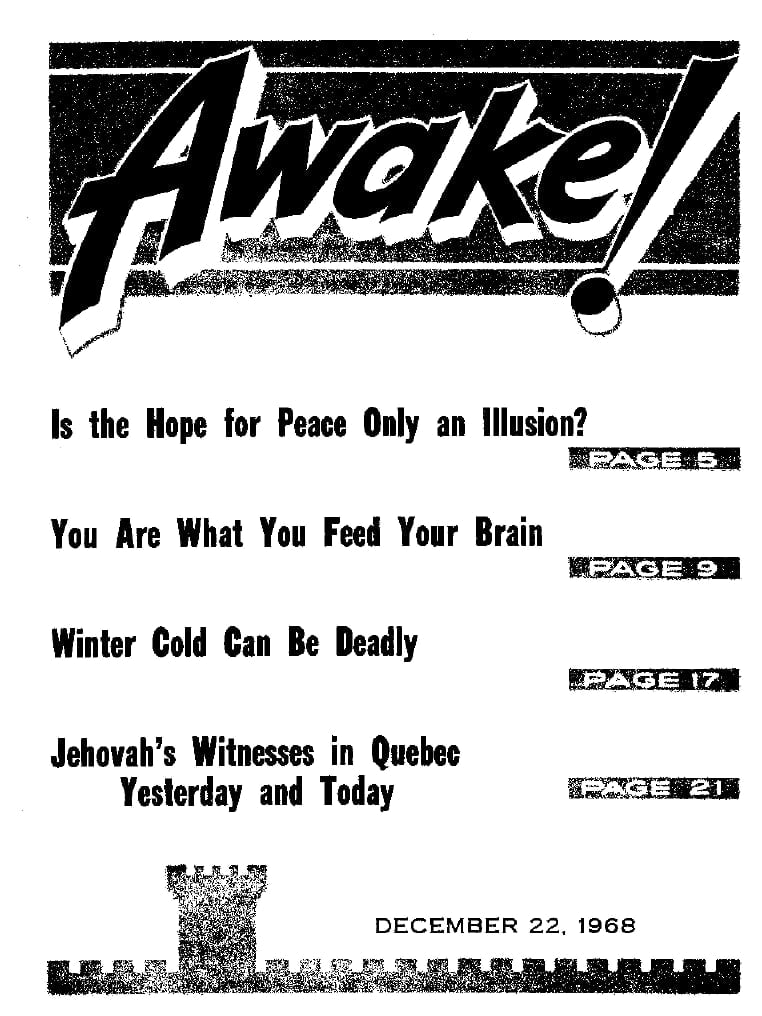
Is the Hope for Peace Only an Illusion? PAGE 5
You Are What You Feed Your Brain
Winter Cold Can Be Deadly
Jehovah's Witnesses in Quebec Yesterday and Today
DECEMBER 22,1968
THE REASON FOR THIS MAGAZINE
News sources that are able to keep you awake to the vital issues of our times must be unfettered by censorship and selfish interests. "Awake!" has no fetters. It recognizes facts, faces facts, is free to publish facts. It is not bound by political ties; it is unhampered by traditional creeds. This magazine keeps itself free, that it may speak freely to you. But it does not abuse its freedom. It maintains integrity to truth.
The viewpoint of "Awake!" is not narrow, but is international. "Awake!" has its own correspondents in scores of nations. Its articles are read in many lands, in many languages, by millions of persons.
In every issue "Awakel" presents vital topics on which you should be informed. It features penetrating articles on social conditions and offers sound counsel for meeting the problems of everyday life. Current news from every continent passes in quick review. Attention is focused on activities in the fields of government and commerce about which you should know. Straightforward discussions of religious issues alert you to matters of vital concern. Customs and people in many lands, the marvels of creation, practical sciences and points of human interest are all embraced in its coverage. "Awakel" provides wholesome, instructive reading for every member of the family.
"Awakel" pledges itself to righteous principles, to exposing hidden foes and subtle dangers, to championing freedom for all, to comforting mourners and strengthening those disheartened by the failures of a delinquent world, reflecting sure hope for the establishment of God's righteous new order in this generation.
Get acquainted with "Awake!" Keep awake by reading "Awake!"
--n 4 copy (Australia, 5c; South Africa, 3vce)
Tally subscription rates
Grass
110,000 (incl. all cultivars)
America, U.S., 11,750 Ada Street, Brooklyn, N.Y. 11201
Australia, 11,900 Bardford Street, St. N.W. 515
Canada, 150,150 Idlewood Ave. Toronto, 19 Oct
England, Watch Tower Street, Toronto, N.W. 7
New Zealand, G21, New North Bd. Auckland 3
South Africa, Private Rd. P. O. Elfordland, Tk. 70c
(Monthly millions add half the above rates.)
Nutritious for subscriptions should be sent to the office in country where you reside and send your reservation to Brooklyn.
In sent at least two days before subscription expires.
PUBLISHED SINCE 1948 IN THE UNITED STATES BY THE
WATCHTOWER BIBLE AND TRACT SOCIETY OF NEW YORK, INC.
117 Adams Street
Brooklyn, N.Y. 11221, U.S.A.
WATCH TOWER BIBLE AND TRACT SOCIETY
Watch Tower House, The Ridgeway
London N.W. 7, England
N. H. KNOR, President
GRANT SUITER, Secretary
Average printing each issue: 5,350,000
Now published in 26 languages
Sælmælchun – Årkjækna, Cebaran, Danish, Dutch, Englih,
Finnish, French, German, Greek, Hokon, Japanese, Japanese,
Korean, Norwegian, Portuguese, Spanish, Swedish, Tagalog,
Zulu
Monthly—Chinese, Cinyan, Hiligaynon, Malaysian, Polish,
Tamil, Ukrainian.
CHANGES OF ADDRESS should teach us thirty days before your moving date. Give us your old and new address. Call us at 1-800-745-1234 or Write a Watch Tower, Watch Tower House, The Ridgeway, London M.W. 7, England.
Entered as second-class matter at Bronlyn, N.Y.
Printed in England
The Bible translation regularly used in "Awakel" Is the New World Translation of the Holy Scriptures, 1961 edition. When other translations are used, this is clearly stated.
CONTENTS
How Will Schoolchildren Be Affected? 3
Is the Hope for Peace Only an Illusion? 5
"A Miracle" 8
You Are What You Feed Your Brain 9
Stop That Hiccup 15
Winter Cold Can Be Deadly 17
Jehovah's Witnesses in Quebec
Yesterday and Today 21
The Largest Star 25
Those Troublesome Barnacles 26
High Temperature 26
"Your Word Is Truth"
When Man's Rage Lauds God 27
Watching the World 29
How Will Schoolchildren Be Affected?
IN THE state of New York there is a law that provides that "each minor from seven to sixteen years of age shall attend upon full time day instruction." It goes on to say that the dominion of the state "is absolute as far as attendance of children upon instruction is concerned during the ages prescribed."
But nearly one million children did not attend school in the city of New York for several weeks of the present school year. Why were they not able to obey the state law? Because the teachers' union had called a strike that closed most of the city schools.
This was a violation of the Taylor Law, which forbids strikes by public employees. It might also be said to violate the education law by preventing children from attending school. With respected adults openly breaking laws, what effect will that have upon the schoolchildren?
In raising this question no attempt is being made to condemn the teachers for their desire to protect themselves from being dismissed from their jobs without satisfactory charges. The point in question is the effect their actions, as well as those of other persons in the dispute, may have on the children's respect for law and order.
There can be no doubt that most of these teachers are dedicated persons who are very much interested in the children in their classes. This is clearly indicated by those teachers who set up makeshift classrooms in community centers, apartments and other places so they could teach some of their pupils without having to cross a picket line. What is more, they did this without pay.
But since the actions of the adults in the school dispute were, in many instances, contrary to law, what impression will that leave on the minds of the children? They saw laws violated, not only by teachers, but also by other adults. Will such disrespect for laws by adults make them feel more inclined to respect the laws of the city, of the state, of the country?
Juvenile lawbreaking is already a serious problem. In its report on crime in 1967, the Federal Bureau of Investigation stated, according to U.S. News & World Report of September 9, 1968, that crimes "committed by youths of both sexes were climbing at a higher rate than crimes committed by older persons." It went on to point out that "arrests of youths under eighteen were up 59.2 percent" from what they were in 1960.
In view of these facts, is it not of vital importance that all adults involved in the field of education set a fine example of obedience to laws and to those persons in positions of authority just as parents need to do? But during the course of the school strike children saw grownups violate laws. They heard adults hurl vile epithets at one another and saw mob actions that required squads of policemen to maintain order. What kind of impression is all this
ing of the schools in New York city may sincerely believe that the action was necessary in order to safeguard the jobs of the teachers, the question as to how the children will be affected deserves serious consideration.
The children saw dissension among the disputing adults become so fierce that police had to be stationed night and day around certain schools for days at a time. With adults acting in such a disorderly
going to leave on the young people?
A teacher that is dedicated to living by Christian principles wants to set a proper example for the children. He believes in obedience to the law and wants to obey it. But what can he do when dissenting factions close down the schools or create a situation in which he becomes subject to physical injury if he tries to obey laws that the authorities are unable to enforce? All he can do is to wait until the worldly people settle their differences. Then he
With adults acting in such a disorderly way, are not the young people likely to show less respect for the authority of their teachers as well as for the authority of city officials and law-enforcing agencies? Was not this dispute a bad adult example for the children?
Has the time come when young people are to be taught, by actions if not by words, that the law is to be obeyed only if it does not result in personal inconvenience or interfere with selfish interests? Is it no longer possible for adults to settle
people settle their differences. Then he can proceed to carry on in harmony with existing laws.
The conflict also creates problems for Christian parents and their children. They also want to be obedient to "Caesar's" laws, because Jesus Christ said: "Pay back Caesar's things to Caesar." (Mark 12:17) These parents want their children to take full advantage of the education provided by the state. They want to obey the education law, but as Christians they
he is no longer possible for adults to secure grievances without resorting to emotional demonstrations, name-calling, vile epithets, violence and disrespect for the law? Some young people have already done such things on school campuses, and are not more of them likely to do such things in the future in view of the adult examples they have seen?
In recent months the public press has repeatedly drawn attention to what appears to be a trend toward anarchy, the complete selection of law and ruling on
cannot become enthroned in disputes between factions of this world, for Jesus said they are to be "no part of the world." (John 15:19) Like the Christian teacher, they can only wait until order is restored. Although those responsible for the clos-
complete rejection of law and ruling authority. With what has been seen in New York city, people have good reason to wonder how children are being affected and to ask if anarchy is indeed what the future holds for human society.
Is the Hope for PEACE Only an
Why do man's efforts to establish peace so consistently fail?
What is the answer?
THE hearts of mankind everywhere yearn for peace. How they wish that the
killing of loved ones, the violence and rioting in cities, and the ruining of the earth would cease! But will they? Will mankind's hope for lasting world peace ever be realized? What do you think?
Some persons view the prospects as bleak. They liken the hope for peace to that illusory lake of water frequently seen as one speeds down a desert road. The car never catches up to it. The water always stays just a short distance down the road. Really it is not water at all, but simply an illusion, caused by the extreme heat near the surface of the ground.
Is the hope for lasting world peace also only a mirage, an illusion? Is it something that mankind was meant ever to seek, feel at times that he almost had in his grasp, but never actually realize? This is what an increasing number of persons apparently are beginning to think.
Why Has Peace Been So Illusive?
What is the problem? Since the desire of all peoples, regardless of race or nationality, is for peace, why can it not be achieved? Is it that the methods by which mankind seeks peace are at fault? Have the hopes for lasting peace been founded on a wrong basis? Has mankind looked to the wrong source for the establishment of peaceful government?
It is obvious that governing the world of mankind is an extremely complicated
process. Yet, since humans are intelligent creatures, it is generally believed that they can successfully rule themselves without God. But is this view correct? Can men really govern themselves properly without the Supreme Sovereign? Or is this a fundamental misconception, an illusion?
Humans may appear capable of self-government; furthermore, efforts by them may seem the only way that world peace can be established. Nevertheless, what may appear to be the solution to establishing permanent world peace may not be at all. Remember, illusions can occur. This certainly happens frequently in connection with physical vision.
How Appearances Can Deceive
Consider the moon, for instance. Undoubtedly you have looked at it many times. Have you observed it when it was low on the horizon, perhaps between some trees and lying just over a farmhouse or some city buildings? Did it not appear unusually large? Have you not also observed the moon later at night when it is higher in the sky? Did it not, appear smaller there? But, of course, it was not. It is an illusion. The terrain of the earth, including the trees, houses, hills and fields, causes the mind to perceive the moon as being larger when it is situated near the horizon than when it is higher in the sky.
Our mind can thus be influenced to believe what is actually untrue. Further evidence must be considered to determine the truth.
Observe how this is the case in the accompanying illustrations. Does not one dish of ice cream in the picture appear larger than the other one? Yet they are
of the same dimensions when measured. The farther dish of ice cream appears larger because it is not drawn in proper perspective. It should be drawn smaller to appear equal in size to the closer dish
Which dish of ice cream is larger?
of ice cream on the counter. Consider another example. Observe the horizontal lines, one with the inverted arrows and the other with the outgoing arrows. Would you say that the lines are the same length? "Of course not," you may respond. But they are. It is another
Is Self-Rule the Answer?
In a similar way, popular views or ideas can also prove to be misconceptions, illusions. Could this be the case with the popular view that humans are capable of ruling themselves successfully? What does examination of the evidence reveal? Are human rulers really a reliable source to which to look for peaceful government?
instance in which what appears to be the case is not so. The mind is influenced to draw a wrong conclusion.
Also note the two sets of parallel vertical lines. Does not one set appear to spread apart in bowlegged fashion? And does not the other set seem to come together in a knock-kneed way? But this, too, is an optical illusion. The vertical lines are perfectly straight. These examples illustrate how easily physical illusions can deceive one.
An investigation of the history of man's attempts at self-government reveals that human rulers almost invariably have plunged their peoples into wars of bloodshed and violence. Their major expenditures have been for building up a strong, well-equipped fighting force. Seldom has there been any real peace. Nor has the twentieth century been any exception. Within the past fifty-five years human rulers have led their peoples into two horrible world wars that were more expensive, more destructive of property, and more costly in terms of human life and suffering than perhaps all other major wars in history combined.
After the second world war, however, many human leaders claimed they finally had the answer to establishing permanent peace. It was a world organization called the United Nations. World leaders praised it as the only hope for a peaceful world. For example, on April 5, 1949, Dr. Herbert
Are the vertical lines really straight?
V. Evatt, then president of the General Assembly, said of the United Nations: "Nothing else is a substitute for it; nothing else can be a substitute for it." Influential clergymen agreed with the political leaders.
But how successful has this human peace effort been? Is the United Nations as a peace-enforcing agent an illusion—a deceptive, misleading hope for mankind? Or has it proved to be a real instrument for preserving peace and security?
An editorial in the New York Times of September 24, 1968, observed in this connection: "The General Assembly of the United Nations, once widely hailed as 'the world's last best hope for peace,' opens its twenty-third annual session today in an atmosphere of diminishing hope for the world organization and for the cause of international peace and justice it was designed to promote. The 'black and gloomy' world outlook was noted last week by Secretary General Thant."
The United Nations has not stopped major wars, such as the recent Vietnam war. Nor has it prevented the more than 300 revolutions, coups, uprisings, rebellions and insurrections world wide since the end of World War II. It was powerless in the wake of Russia's military force moving into Czechoslovakia. It is becoming ever more evident that the United Nations is just another in man's long, unbroken line of failures to govern himself successfully.
Those who have carefully evaluated the evidence can see the shortcomings of human self-government. Observed the prominent magazine editor David Lawrence: "The more we search for an alibi, the more we discover that unhappiness on earth is man-made. Our key weakness is that we have not solved the problem of self-government."* And the well-known
columnist Walter Lippmann said: "For us all the world is disorderly and dangerous, ungoverned and apparently ungovernable. Everywhere there is great anxiety and bewilderment."† This agrees with the words of the inspired Bible writer: "It does not belong to man who is walking even to direct his step."—Jer. 10:23.
But if human self-rule is not the answer, what is? Will permanent peace ever be established? Happily, there is a solution. The hope for lasting peace will be realized!
Rule by God the Answer
Jesus Christ pointed to the only sure solution as being "the kingdom of God." Yes, a government under Almighty God's direction! Although some may believe that such a rule by God is only an illusion, really the illusion is the belief that humans can successfully govern themselves independently of God. Never have they been able to do so. On the other hand, divine laws, called by some persons the laws of nature, control all the universe. Rule by God's kingdom is the only answer to realizing permanent peace.
Government by God was the theme of Jesus' entire earthly ministry, as he once explained: "Also to other cities I must declare the good news of the kingdom of God, because for this I was sent forth." (Luke 4:43; 8:1) Jesus also taught his followers to remember that heavenly government in their prayers, saying: "You must pray, then, this way: 'Our Father in the heavens, let your name be sanctified. Let your kingdom come. Let your will take place, as in heaven, also upon earth.'"—Matt. 6:9, 10.
The realm or domain of this kingdom for which Christians pray includes the entire earth. Here, the Bible teaches, God's will will be done everywhere. The benefits of Christ's ransom sacrifice will be applied in behalf of all obedient humankind, so that all effects of sin and death will be erased.
What a wonderful prospect! The Bible promises: "God himself will be with them. And he will wipe out every tear from their eyes, and death will be no more, neither will mourning nor outey nor pain be any more. The former things have passed away."—Rev. 21:3, 4.
This is what Almighty God promises to accomplish by means of His kingdom. In whose promises, then, will you place your hope?
It may be true, looking at matters from a worldly viewpoint, that the United Nations and other peace efforts of men appear to be a more tangible hope. But, then, outward appearances can be very misleading, as we have seen. One needs to examine deeper and consider the evidence. And both the facts of history and God's Word the Bible reveal that man is completely incapable of providing righteous government. Only God can.
The most reliable evidence, from God's Word, therefore shows that man's rule must soon give way to God's rule. In a prophecy regarding our days the Bible says: "In the days of those kings the God of heaven will set up a kingdom that will never be brought to ruin. And the kingdom itself will not be passed on to any other people. It will crush and put an end
to all these kingdoms, and it itself will stand to times indefinite."—Dan. 2:44.
That this kingdom of God is real, and no illusion, is apparent from the fulfillment in our day of many Bible prophecies regarding it. Jesus Christ and his apostles pointed forward to the present unparalleled fear, violence and distress and identified these conditions as marking the "conclusion of the system of things" or "last days." Jesus also said that at this time God's established kingdom would be preached earth wide as the only hope for peace. (Matt. 24:3-14; Luke 21:7-31; 2 Tim. 3:1-5) This preaching is now being accomplished in 200 lands by hundreds of thousands of envoys of God's heavenly government. Yes, the kingdom of God is a reality! And soon its power will be manifested in its destruction of all political kingdoms of earth.
Do you desire to enjoy the blessings of God's rule? Would you delight to be a subject of God's kingdom and serve under His guidance and direction? You would? Then you must prove this by now submitting yourself to God. This involves learning His requirements by studying his Word the Bible, and doing God's will. (John 17:3; 1 John 2:17) Only in this way will you be able to enjoy the lasting peace that will soon be realized earth wide under God's kingdom.
"A Miracle"
"It is, quite simply, a miracle," confessed Neurosuccio magazine of October 25, 1965. "No other word can describe the beginning of a human life. No technique can pinpoint the momentous time of conception. No scientist can tell what wondrous forces then take over to develop the organs and myriad nerve networks of a human embryo. No doctor knows what causes the contractions of labor in the mother that bring new life into the outside world. Miraculous too is the innate capacity of the human organism for survival."
Truly, the hand of the All-powerful Creator is manifest! How wise we are if we exhibit the appreciation expressed by the Bible psalmist: "I shall laud you because in a fear-inspiring way I am wonderfully made. Your works are wonderful. as my soul is very well aware."-Ps. 139:14.
You Are What You Feed
YOUR BRAIN
</div>
"OF ALL the marvels of nature, none comes close to comparing with your brain," a science magazine observed. "It is more complicated and more wonderful than any machine ever built," noted an encyclopedia.*
The human brain is often likened to an electronic computer. But Science Digest of December 1967 stated: "Even the most complicated computer man has yet built can't compare in intricacy with the brain. Computer switches and components number in the thousands rather than in the billions. What's more, the computer switch is just an on-off device, whereas the brain cell is itself possessed of a tremendously complex inner structure."
It has been said that ever if scientists did design a computer that could roughly do the work of a single human brain, the computer would have to be as large as the Empire State Building in New York city!
So complicated is the human brain that man's understanding of it is very limited. As Science News of December 2, 1967, said: "Despite all the pioneering work done over the past 20 years in brain research, the
The left side of the human brain. About a third of the gray matter is on the surface; the rest is buried in the walls of the fissures
mind is still very much a dark mystery locked in a bony box."
Man's Brain Far Superior
While a thorough understanding of just how the brain works is beyond our grasp at present, there are things about it that can be understood. One is that the human brain is far more complex than that of any animal. That is why man alone of all earthly organisms has the faculty of reason, and why only he can constantly improve upon his knowledge and ability, or upon the knowledge and ability of others. Animals are guided by instinct implanted in them and cannot continue to build on knowledge.
If you did not know how to play a piano, could you expect to sit down at one for the first time and produce beautiful music? No, but with proper training and practice, you could develop this skill. Yet, no amount of training would enable any animal to do this, for they do not have such a capacity. Or if you did not know how to fly an airplane, could you expect to sit at the controls of a jet airliner for the first time and fly it? No, but with training, thousands of persons do. No animal could ever be trained to duplicate this feat.
then, helps to account for the gigantic gulf that exists between the abilities and accomplishments of man and those of beasts.
Development Not Automatic
However, man's great mental capacity does not mean he develops knowledge or skills automatically. Intellectual progress is not implanted in the brain like an instinct. It must be cultivated. That is why, although man's brain has a vast capacity for improvement, if it is not properly used, very little improvement will be made.
If you want to acquire a certain skill, you must feed your brain with the information necessary for that particular skill. Then you must put that information to use by beginning to perform that skill. This establishes patterns in the brain that gradually enable you to master the skill. If knowledge is not taken in and used, then a person will not develop intellectual abilities or skills. He will remain illiterate and unskilled.
There is a similarity between feeding the body with food and feeding the brain with information. Your physical health is largely determined by the food you eat. If your physical food is poor in nourishment, your health will suffer. Malnutrition extended over a period of time can cause death, as resistance to disease is lowered. A total lack of food will kill the body in a few months.
Similarly, your mental condition largely depends upon what you feed your brain. If your mental food is poor, your mental health will suffer.
Early Training Vital
improperly developed in youth, it becomes difficult, as an adult, to reverse the pattern that has been established. Such a person easily falls into lazy mental habits. He does not usually enjoy serious mental activity. His reading ability and reading habits are often poor, even being limited to picture magazines and comic books.
If a person's brain has been poorly fed and poorly exercised in childhood, mental health and ability may be impaired for the rest of his life. When minds are
The first five or six years of life are critical in this regard. Patterns of thinking are fairly well established by this time. If these patterns have been good, the child will find it much easier in later life to develop abilities and skills. If these patterns have been inferior, then he may experience difficulty later on in overcoming this poor start.
But is not one's mental ability fixed at birth? Is not the capacity for intellectual development simply inherited? Inheritance does play a part, but generally the child's environment plays a greater part. In an article entitled "Never Underestimate the Mind of a Child," Science News Letter of February 22, 1964, stated:
"The mind of a young child is quicker than you think it is, and can learn far more than we give it credit for.
"During the early years, a child's intelligence can be greatly influenced by a responsive' environment conducive to learning and exploring.
"This contradicts the traditional idea that human intelligence is fixed in a child at birth, and that its development is predetermined by heredity. . . .
"If a parent, teacher or mentor begins to work with a young child early enough, he can exert considerable influence over the child's intelligence, . . . The mental processes of thinking, reasoning, and reacting become established very early in life, even before school, and become a permanent part of the individual throughout his life."
In tests it was discovered that, in a favorable environment, a child in his first four years of life is able to increase his IQ (intelligence quotient) much faster than in later childhood.
Also, the report said:
"Many preschool children have been unfortunately ignored. . . Latest experiments prove that three-year-old children, who already are performing the rather difficult mental operations of listening and talking, can learn to read and write, tell a story to a tape recorder and type it out as it is played back."
Hence, when parents feel it is not necessary to teach their children such things as reading or writing until they go to school, they make a mistake. Precious opportunity has been lost, for by the time the child enters school his mental habits have been formed to a striking degree. The less the mind is used in early years, the less it is able to overcome the poor start later on. One report in the Scottish Daily Express of March 29, 1962, even said:
"The more that scientists learn about the intricate structure of the human brain the more it seems likely that people in general are endowed at birth with the same basic mental equipment. . . .
"What makes us different in intellectual ability and achievement is the extent to which we use this magnificent apparatus."
The Brain's Structure
The way the brain is constructed helps us to understand why it is difficult for older persons to develop mental abilities if they have not been doing so earlier in life.
Ordinarily, most body cells divide to form new cells. This process replaces cells that have been injured or that have died. For example, a person may get sunburned and a layer of skin peels off. In time, it is replaced by another layer of skin.
However, this process of cell replacement does not hold true in the case of the key brain cell, the neuron, or nerve cell. The neurons take in information from the
various senses, such as those of sight, hearing and feeling. They send out instructions to various parts of the body through the spinal cord. Most neurons are already formed at birth, some being added during the first few years of childhood. But then, no new neurons are formed. As a person ages, some may be damaged or may die, but no new ones replace them. The fact that the brain grows from about one pound at birth to about three pounds in adulthood is not because so many new neurons are added, but because each increases in size, as do other parts of the brain.
The human brain is said to contain over 10,000,000,000 (ten billion) neurons that are located in the outer portion, or "bark" of the brain. This outer portion is called the cortex, or "gray matter." And to allow the brain to have an abundance of these vital neurons, the thin cortex is folded somewhat like an accordion, permitting far more surface area. That is why, if the brain were to be stretched out flat, it would occupy an area of several square feet!
In addition to neurons, the brain contains about 100,000,000,000 (100 billion) smaller cells, called glial cells. These make up a supporting framework for the neurons. The brain also contains a network of very small blood vessels that take nourishment to it.
The neurons, the vital brain cells, are awe inspiring indeed. Each one of them consists of a cell body that is in itself fantastically complex. And each neuron has a maze of hairlike fibers extending from it, perhaps 25,000 to 50,000 of them. These microscopic extensions, called dendrites, come close to the dendrites of other neurons. But they do not quite touch. A tiny gap remains between them. This gap, or space, is called a synapse.
What happens when a neuron, a nerve cell, is activated? Science News of December 2, 1967, states:
"When the nerve fires, tiny amounts of chemical transmitters at the synapse or meeting of nerve cells are released to carry an impulse across the junction. These same chemicals have been deeply implicated in emotional behavior. . . .
"Some of [researchers]' work suggests that the spaces between the neurons have electrical and chemical properties that are highly relevant to memory storage."
It is thought that the thousands of nearconnections each neuron has with other neurons is what enables the brain to interpret signals from the senses, compare them with information already stored, judge their values, and then plan what action to take. The capacity of one brain can be seen in the fact that there are over 10,000,000,000 neurons, each having tens of thousands of near-connections with other neurons!
Establishing Patterns
How does this complex mechanism work to establish the mental patterns that distinguish one person from another in memory, ability and personality?
While it is not certain just how the neurons and their dendrites set themselves in established patterns, some possible explanations have been offered. One such is reported on by the New York Times Magazine of October 9, 1966:
A neuron, when stimulated, is capable of transmitting a tiny electric current along its surface and down its various projections [dendrites]. Ordinarily the current might stop at a synapse [the gap between dendrites], but under certain conditions the chemical environment at the synapse changes in such a fashion as to allow the current to jump the gap and pass to another cell. . . .
Suppose, in addition, that the group of synapses is so arranged that the current flows from one cell to another to another and finally back to the original cell, forming a closed cycle. The current will keep going over and over that cycle for a period of time, like a racer lapping a track. . . .
"Suppose, then, that with every sensation you receive, a particular group of synapses is somehow affected in such a way as to make passage of the nerve current easier.
"As long as the body can somehow sense a particular current cycle and select it from all others, it can remember the sensation that set it up.
"With time, however, the effect on the synapses might wear off, the current cycle fade away, and the memory be gone. It would have been a short-term memory."
This may help explain why some things can be completely forgotten. They have not been impressed on the brain enough. They have not made firmly routed circuits or patterns in the brain cells. But what if certain impressions are more frequently or more strongly impressed on the brain? Then what? The article explains:
"But each time that the current cycle was somehow sensed and the memory recalled, it might be that the change in the synapses was intensified, so that the current became stronger. Eventually, even the physical structure of the cells might be changed; more dendrites might form between the adjoining cells making up the cycle, easing the way for the current. Eventually, the current might be so firmly set that it would continue indefinitely without additional reactivation. The memory then would have become long-term.
"Naturally, the longer a current cycle had been in existence, the more firmly it would have had a chance to set. For many of us, it is considerably easier to remember items learned as youngsters than other items learned last year."
So there is evidence in the very structure of the brain that the longer certain information reaches the brain, the deeper the brain circuits are set. Eventually they become part of that person. What he has fed his brain is what he becomes.
Intake Leads to Action
Some persons think they can take anything into the brain and will not be affected by it.
But everything taken in makes an impression. The more a certain type of information is fed into the brain, the deeper the impression. If it is negative, bad, immoral information, then in time the brain circuits may be so firmly routed in this direction that a person will begin engaging in bad actions.
That this process of taking in wrong information, dwelling upon it, and feeding more and more of it into the brain is the basis of wrong actions is also noted in the Bible. At James, chapter 1, verses 14 and 15, we read: "Each one is tried by being drawn out and enticed by his own desire. Then the desire, when it has become fertile, gives birth to sin."
That a person's attitudes and actions can be changed by what he feeds his brain was also noted in a Columbia Broadcasting System program entitled "Building the Brain." A scientist stated: "The effects of learning and experience don't just pass over without leaving a trace. The brain is actually transformed."
Once the brain is transformed by wrong feeding, and bad habits are established, a person does not just throw off the brain cells in the bad pattern and start fresh with new cells, for the neurons are not replaced. So when bad mental habits are established and maintained, they become more indelibly imprinted. Only by changing one's intake of information can a person undo the damage and in time form new, healthier patterns that lead to good habits. Yes, you can "be transformed by making your mind over."—Rom. 12:2.
But if one persists in feeding his brain mental rubbish, it will in time be transformed into a rubbish heap. His expressions, his way of life, his personality, will reflect this. And when such information is fed into young minds, the effect can be devastating. Of this the book The Psychology of Mental Health says:
"Fredric Wertham, psychiatrist and mental hygienist, as well as consultant in medicolegal cases, published the result of his seven-year investigation of the influence of crime comics on the child under the title, Seduction of the Innocent. Noting that 90,000 comic strips and books are read each month by children, this investigator views their present scope as stimulating unwholesome fantasies, suggesting criminal or abnormal ideas, giving models for criminal or delinquent behavior, and in general as creating an atmosphere of cruelty, sadism, sexual perversion, and deceit."
And Science News Letter of January 18, 1964, said: "Seeing aggressive episodes on TV arouses aggressive feelings in children, who carry out the same action if faced with similar conditions later."
Watch What You Feed Your Brain
We cannot escape the truth of this matter. We will become what we feed our brains. Hence, the need to guard carefully the kind of information we allow our minds to dwell upon.
While we cannot escape negative influences altogether, since the world is so filled with them, still we do not have to seek out harmful information deliberately and regularly absorb it. If a person dwells on wrong information, he allows himself to become susceptible to the full impact of its influence, however warped it may be. For example, a person may know that fornication and adultery are wrong, but if he willingly feeds his mind immoral thoughts, reading immoral literature, attending those types of movies, watching such programs on television, or loitering around immoral people, he will eventually get involved in immoral acts.
Likewise, no matter how good one's parents are, if a child deliberately seeks out the association of others who downgrade their own parents, who encourage disobedience, who question parental motives, then this child will soon become suspicious of his parents and think ill of them.
Because he welcomes the ideas of such persons he will continue to dwell on them, and in that way his own outlook will be changed.
On the other hand, if a youth simply has necessary contact with wayward persons, that is, when attending school, but does not seek out their association, then he will not be deeply influenced by their bad attitudes. He will not become suspicious or rebellious toward his parents because of what other youths have to say.
The same principle operates in connection with a person's contacts at his secular employment. He should be polite, tactful and cooperative with workmates.
Build Good Patterns
On the other hand, when wholesome information is fed to the brain through the senses, then circuits or patterns will be built up that will enable an individual to do what is right. The more he takes in right knowledge and dwells upon it, the more his behavior will reflect this. And the earlier in life this right kind of training begins, the more likely it is that the child will grow up to be a decent, Godfearing adult. The Bible says: "Train up a boy according to the way for him; even
ARTICLES IN THE NEXT ISSUE
Meeting Daily Challenges Successfully.
The Dancing Lights of Northern Nights.
Relaxing the Mind to Go to Sleep.
but he does not have to seek out their negative ideas. He does not have to allow himself to dwell upon them or absorb them.
A Trip into India's Past.
Likewise, a person may be fully convinced that the Bible is God's Word. But if he deliberately chooses to keep company with individuals who belittle the Bible and who falsely impugn the motives of God, then this person too will gradually begin to share that outlook. But this is not necessarily true simply because at secular work one is required to be in the company of faithless persons. If he rejects their ideas instead of showing curiosity and dwelling on them, his mental pattern will not be adversely affected.
Do not delude yourself about this. You should not think yourself above being affected by poisonous thinking. Even the grossest falsehood can be accepted if a person allows his mind to dwell upon it long enough. That is why Nazism became acceptable to millions of persons, why even 'decent' citizens ended up committing the most heinous crimes.
when he grows old he will not turn aside from it."—Prov. 22: 6.
There is evidence that the building of good mental patterns even improves the
brain structure! In dozens of experiments with animals it was discovered that good training involving the use of their brains significantly altered their brain structure and chemistry for the good. The cortex was found to be expanded, deeper and heavier. The neurons increased in size, as did the diameters of the blood vessels supplying the cortex. There was also an increase of glial cells.
However, those animals deliberately denied proper training had brains that were relatively deteriorated, with a thin and light cortex, lowered blood supply and diminished chemical activity. Their neurons were smaller and they had fewer glial cells. Of this the Saturday Review of January 20, 1968, said:
"A lack of adequate educational fare for the young animal—no matter how large the food supply or how good the family—and a lack of adequate psychological enrichment results in palpable, measurable, deteriorative changes in the brain chemistry and anatomy."
While these experiments were not conducted on humans, there is reason to believe that a similar process takes place in the human brain. That is why author E. Hunter said in his book Brainwashing:
"Insofar as a human being allowed the divine traits in him to be overcome and his reasoning power—his judgment and free will—to be atrophied, he could be made into a demon, a puppet, a sick man psychologically, just as sick as an athlete who has allowed his body to be run down by dissipation until he easily contracts some crippling disease."
Yes, the human brain is a marvelous instrument. But you will get out of it only what you put into it. So be careful what you feed it. Remember, you are what you feed your brain.
Stop that HICCUP
WHAT do you do when you get hiccups? Possibly you use one of the many hundreds of different home remedies that people have found helpful. But, whatever remedy you may use, it is not likely that your hiccups will last for very long.
However, there have been cases in which hiccuping has continued for several months and even years. In some instances the spasms were so rapid that eating and sleeping were impossible, and the patients died from exhaustion. Uninterrupted hiccuping took the life of J. McCormick Beeten within the space of only four and a half days. Another man, Edward O'Connor, died after hiccuping for six months. Fortunately, hiccuping does not usually become such a serious problem.
Hiccuping often begins when the stomach is distended suddenly from overeating or overdrinking of liquids, causing the stomach to disturb the action of the diaphragm. This is a broad, flat muscle that stretches like a sheet between your chest and abdomen and is the principal muscle for breathing. Any irritation of this muscle or the nerve that operates it can cause it to contract involuntarily. This results in an abrupt intake of air into the lungs, but there is also an involuntary closing of the opening in the larynx, called the glottis, which cuts off the flow of air. The result is the audible "hlc."
Overeating and overdrinking are only two of many possible causes for hiccupping. It can be started by gulping hot or cold liquids, by fatigue, by postoperative shock as well as by various diseases. Even emotional stress, nervous strain and drugs can cause it. One man became afflicted with chronic hiccups whenever he was given sulfonamide drugs for a bladder infection. When they were discontinued, the hiccups improved immediately and stopped entirely a few days later. Thus, with so many possible causes, it is often difficult to locate the reason for a chronic case of hiccups.
When hiccups begin during an operation or after an operation they can be especially troublesome. Imagine how difficult they could make the work of a surgeon during a delicate operation.
And if they come after the operation they might rip open the incision.
Remedies
There are a great number of simple remedies that people have found effective in stopping hiccups. Taking several deep, regular breaths works for some persons. Others stop them by merely holding their
inserting a catheter through the nose or through the mouth. This is a tubular instrument that is designed to pass along mucous canals in the body. When the technique was used on 150 anesthetized and conscious patients over a space of two years, it stopped hiccups in 148 of them.
In severe cases that refuse to respond to the usual forms of treatment a drug can be used to block the phrenic nerve that is being irritated. This stops the hic
breath for a bit and perhaps drinking some water while doing so.
Breathing into a paper bag often works because it causes a person to rebreathe the carbon dioxide expelled, from his lungs. Cutting down on the amount of oxygen in the bloodstream by breathing carbon dioxide tends to relax
cupping, and when the nerve recovers from the effects of the drug and begins func-
lioning again several hours later, there is a good chance that the hiccups will not return. If they do, a doctor may recommend crushing the nerve.
This drastic step finally brought relief to a woman who
oxide tends to relax the nerves and muscles. There is a danger, however, of fainting from lack of
oxygen. Under the supervision of a physician a mixture of carbon dioxide and oxygen is usually used.
The juice of an orange is claimed by some to be a good remedy, and in bad cases of hiccups teaspoonful doses of onion juice are supposed to be a good remedy. Other home remedies are coughing, sneez-
bet to a woman who had tried numerous home remedies and had visited 100 doctors, all for about
two years. During that time she sometimes hiccupped at the rate of ninety times a minute. As might be expected, she lost weight—forty pounds. When the nerve was crushed, the hiccupping immediately stopped. Crushing the nerve caused her to lose 25 percent of her breathing capacity, but her doctor expected the nerve to
ing, swallowing crushed ice, taking vinegar, pulling the tongue, pressing the upper lip with the finger, and so forth. There are about 300 basic "cures."
A new technique that has proved very successful for doctors to use on patients, whether they are conscious or unconscious, is stimulation of that part of the throat called the pharynx. This is done by
regenerate in eight to twelve months and to begin functioning again.
For some people hiccuping may become very trying, but for the majority it lasts for only five or ten minutes. If your customary remedy should fail, there are many others you can try. One will very likely stop that annoying hiccup.
Winter Cold CAN BE Deadly
OW deadly winter cold can be was demonstrated in 1966 when the worst blizzard in many years lashed a 1,500-mile
by 500-mile area in the central United States. In some places wind velocity reached 98 miles per hour and the temperature dropped to 31\circ F. below zero. Among the 210 deaths from the storm was a six-year-old girl who got lost between the chicken coop on her family's farm and the barn. Being unable to find the shelter so near at hand, she froze to death. What happened to her is a warning to anyone who might be caught in a blizzard.
A hunter, for example, who tries to hike back to his cabin during a blizzard is very likely to lose his life as she did. The same might be said for a stalled motorist who tries to walk through a blizzard to the nearest town or farmhouse. Such persons need to realize that it is practically impossible to walk in a straight line for even fifty feet in a blizzard, much less to endure for long the full force of the heat-sapping wind.
Another hunter caught out in a different storm crawled under the low-hanging limbs of a fir tree and reinforced his shelter by cutting some branches and putting them on the windward side. A small fire that he carefully banked with earth so it would not ignite the tree helped to keep him warm. Realizing that there was almost no chance of making it back to camp through the storm, he waited until it abated the next day. Seeking shelter in this manner during a storm and waiting until it stops is usually the best way to survive.
This was what three mountain climbers who were
A few years ago three hunters were caught in a canyon by an unexpected mountain snowstorm. Unwisely two of them tried to hike out of the mountains despite the blinding snow and freezing wind. They soon lost their way and were found frozen to death by a search party several days later. But the third hunter, who stayed where he was in a sheltered spot, was found the next day in good condition.
caught by a snowstorm in the Alps at an elevation of nearly 10,000 feet did. They built a shelter out of branches with snow packed on top. Although the storm raged for five days with winds reaching sixty miles per hour, they survived.
In the 1966 blizzard several stranded motorists survived satisfactorily by staying with their cars. A family of three was stalled only two miles from their South Dakota ranch, but they wisely stayed in their car for sixty hours until the storm let up enough for them finally to make their way home.
Shelters
In an emergency situation finding shelter from the cold wind is of the utmost importance. It can quickly draw off a person's body heat and exhaust him in a short while. To illustrate the difference that wind can make, suppose you are outdoors when the temperature is 34\circ F , but the wind is blowing at the rate of twenty miles per hour. The effect on your exposed flesh would be the same as if the temperature were 38\circ F below zero with no wind. Having this in mind, you can better understand why it is dangerous to try to walk very far in the fierce wind of a blizzard.
A good shelter, in such a situation, is a snow hole. This can be dug around the trunk of a tree or out in the open. Branches or any other available material can be put over the hole to support an insulating layer of snow. In some instances a cave might be dug into a snowbank or into a mound of snow that covers some bushes.
Because snow has an insulating quality due to the many air spaces in it, a person in a snow hole can keep his body heat from escaping too rapidly. It is possible for the temperature in the hole to become 18\circ F. higher than outside the hole. While there, he is protected from the killing wind of the blizzard. Some leafy branches on the bottom can provide a comfortable place to recline. Here he can survive the storm in comparative comfort, just like a rabbit that burrows into snow-covered bushes.
In certain circumstances it might be best to make an igloo out of blocks of snow. Ice will not do, as it conducts heat. An igloo can be warmer than a snow hole.
A small opening at the top is necessary for ventilation, especially if a small fire is built in the shelter; otherwise there is the danger of carbon-monoxide poisoning. This is an exceptionally fine shelter for warmth and wind protection.
Building a shelter is one of the first things a person will want to do when he realizes that he is in a dangerous situation because of winter cold. If he is stranded in an automobile by a blizzard he may find a snow hole or an igloo warmer to stay in than his automobile because the car's metal body can conduct heat away instead of keeping it in. It is for the same reason that the fuselage of a downed airplane is not as warm as a shelter dug in the snow. Preserving body heat in winter cold is the principal objective whether a person is stranded by a blizzard, is a survivor of a plane accident in a snow-covered wilderness or is just out of doors near his home.
Clothing
In cold winters suitable clothing is essential, and if a person plans an automobile trip at that time of year, he will show good judgment if he takes along extra clothing and boots in case of emergency. They could save his life if he happens to be stranded in a storm.
It is not necessary to have clothing that is heavy in order to be warm. Not weight but the dead air that clothing is able to hold is what makes it warm. Being a poor conductor of heat, dead air acts as an insulator and helps to prevent a person's body heat from being lost. For this reason several layers of lightweight clothing made of material that is good for keeping body heat in are better than a single garment of heavy weight. Warmth comes from trapping dead air between the layers.
A good start for winter is warm underwear. A fine type is that which is designed to capture dead air in the deep depressions of a waffle knit. Manufacturers usually call this "thermal" underwear. Another type is made of Brynje mesh, which traps dead air next to the skin. It has a fishnet design and resembles the mesh fabric used in certain net hosiery. Because dead air is trapped by it between a person's skin and the next layer of clothing, some persons regard it as being
self a little on the cool side whether you are active or inactive. That will avoid the problems created by overheating. This can be done by adjusting your layers of clothing. It may be that just loosening them will be sufficient or some may have to be removed temporarily.
Some type of head covering is also very necessary in cold weather, as the head is the chief source of heat loss in the body. There can be no reduction of the blood supply to the brain when the body is cold
superior in warmth to waffle knits. Additional insulation comes from the dead air trapped between the layers of clothing put on top of the underwear.
An inactive person requires more layers of clothing to keep warm than does a person who is active. If, for example, the thermometer is at zero degrees F., an inactive man could require more than seven layers of clothes, whereas an active man who is walking briskly and carrying a load would be comfortable with two layers. In fact, a person who is walking briskly
as in the case of the skin, feet and hands. At a temperature of minus 4 0\circ F all the heat an inactive person produces can be lost through his head if it is not covered. So keeping your head covered is an important factor in preserving body heat.
It is not easy to remain warm if the dead air between your layers of clothing is being squeezed out through various openings as you walk. Trouser legs as well as the sleeves, waist and neck of a jacket can allow a lot to escape and let cold air in. But tying the trousers let cold air
in fact, a person who is walking briskly can produce four times as much heat by the exercise as a person who is inactive. From this can be seen the importance of exercise in helping a person to keep warm, but care must necessarily be taken to avoid becoming overheated.
When a person begins to engage in vigorous activity he can remove a few layers of clothing so he will not perspire, and when he is finished he can put them on again. The danger from becoming overheated is due to perspiration. Moisture is
in. By tying the trouser legs closed and closing the waist, sleeves and neck of a jacket there will be a marked improvement in warmth. Cuffs can be sewn on the sleeves to close them around the wrist if there are none, and a warm scarf will help to keep your neck warm and close that part of your jacket. If you become too warm you can loosen the waist of the jacket and open the neck so as to allow air to pass under the jacket.
When selecting winter clothing it is better to avoid tight-fitting garments that
heated is due to perspiration. Moisture is a good heat conductor, and it spoils the insulating ability of clothing. Evaporation of the perspiration after a person has ceased to be active and the dampness of the clothing draw away his body heat, chilling him and making him subject to cold injury.
A good policy to follow is to keep your- DECEMBER 22,1968
er to avoid tightening garments that may reduce blood circulation and be lacking in space for a layer of dead air. There is more warmth in loose-fitting garments.
What about your outer coat? It needs to be a good windbreaker. A fabric with a tight weave is better for this than one with a loose weave. It also should be water resistant. When such a fabric is used in a coat that has a lining of acrylic pile or plastic foam, both of which have insulating air spaces, you have a very warm coat.
Keeping Hands and Feet Warm
Due to the great amount of surface area on your fingers and toes in relation to their size, they can readily lose heat. By keeping them warm and the blood circulating well in them, serious damage to the tissues from cold injuries can be avoid-
haps just a prickly feeling, and then numbness sets in, with the affected parts turning white or gray. In very cold weather companions must watch each other for signs of frostbite, because it can creep up on a person without his knowing it.
Unless the affected parts are warmed up soon, serious damage can be done. Frostbitten feet, for example, can swell into painful, shapeless lumps of flesh. In very severe cases the tissues may rot away and gangrene set in because of the blood
ed. Tight-fitting gloves and shoes can make them subject to injury by cutting down the blood supply.
In very cold weather, mittens are better for the hands than gloves. They combine the fingers into a larger space, making the insulating property of the mittens more effective than gloves. They also expose less surface area to the cold than do gloves and therefore lose less heat. Their length should be sufficient so that no part of your arm between the mittens and your
supply being cut off, and that usually requires amputation. Persons with less severe cases may find after their recovery that the affected parts will be, thereafter, very sensitive to cold and to frostbite.
Exercising a frostbitten limb or massaging it is a grave mistake. The same can be said of rubbing it with snow or ice water. Such treatment can damage the frozen tissues. The time to massage or exercise a cold portion of your body to increase circulation is before it is in-
Keeping your feet warm is just as important as maintaining warm hands and just as difficult. More than one layer of socks is helpful, but the number you use will depend upon the roominess of your shoes. If they make the shoes too tight, fewer socks will have to be used so you will have room for moving your toes. Winter shoes and boots should fit loosely for good circulation and warm feet. But you cannot keep your feet warm if they get
jured by the cold, not afterwards.
What needs to be done in case of frostbite is to treat the injured part with gentleness, warming it in lukewarm water at body temperature or with warm, wet towels. If warm water is not available, warm blankets may be used. In an emergency the affected part can be put in a warm armpit, either one's own or that of a companion. At the first opportunity it should be examined by a physician.
wet. If that happens, your shoes and socks must be dried out as soon as possible to prevent cold injury.
Frostbite
The parts of your body that are the most susceptible to frostbite are your feet, hands, ears, nose and cheeks. Usually the first symptoms of it are rather mild, per-
Every year in the United States approximately 200 people lose their lives because of cold weather and thousands of others suffer from various degrees of frostbite. This is usually avoidable. By knowing how to cope with winter cold a person can live with it comfortably under all kinds of situations and at the same time avoid becoming one of its many casualties.
…