Awake!, November 22, 1968
Download: PDF — Awake!, November 22, 1968
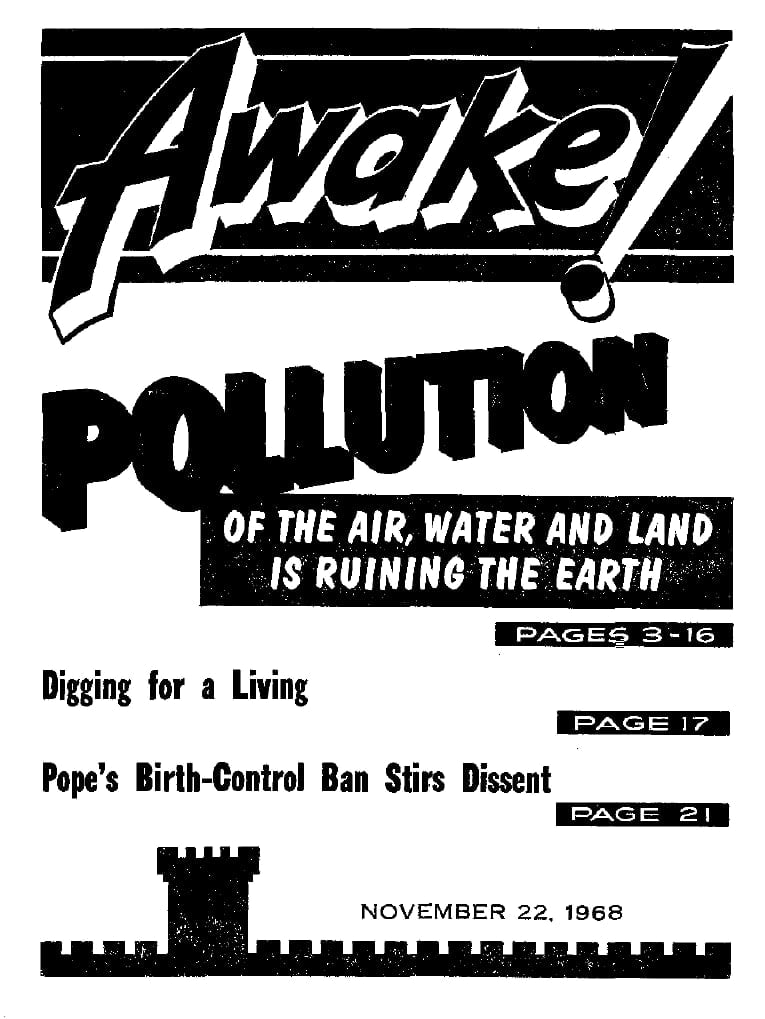
Awake!
POLLUTION
OF THE AIR, WATER AND LAND
IS RUINING THE EARTH
PAGES 3-16
Digging for a Living
PAGE 17
Pope's Birth-Control Ban Stirs Dissent
PAGE 21
NOVEMBER 22,1968
THE REASON FOR THIS MAGAZINE
News sources that are able to keep you awake to the vital issues of our times must be unfettered by censorship and selfish interests. "Awakel" has no fetters. It recognizes facts, faces facts, is free to publish facts. It is not bound by political ties; it is unhampered by traditional creeds. This magazine keeps itself free, that it may speak freely to you. But it does not abuse its freedom. It maintains integrity to truth.
The viewpoint of "Awake!" is not narrow, but is international. "Awake!" has its own correspondents in scores of nations. Its articles are read in many lands, in many languages, by millions of persons.
In every issue "Awake!" presents vital topics on which you should be informed. It features penetrating articles on social conditions and offers sound counsel for meeting the problems of everyday life. Current news from every continent passes in quick review. Attention is focused on activities in the fields of government and commerce about which you should know. Straightforward discussions of religious issues alert you to matters of vital concern. Customs and people in many lands, the marvels of creation, practical sciences and points of human interest are all embraced in its coverage. "Awake!" provides wholesome, instructive reading for every member of the family.
"Awakel" pledges itself to righteous principles, to exposing hidden foes and subtle dangers, to championing freedom for all, to comforting mourners and strengthening those disheartened by the failures of a delinquent world, reflecting sure hope for the establishment of God's righteous new order in this generation.
Get acquainted with "Awakel" Keep awake by reading "Awakel"
PURPOSED SIMULTANEOUSLY IN THE UNITED STATES BY THE
WATCHTOWER SIBLE AND TRACT SOCIETY OF NEW YORK, INC.
117 Adams Street
Brooklyn, N.Y. 11201, U.S.A.
Watch Tower House, The Ridgeway N. H. Knoak, President
London N.W. 7. England
GRANT SUITER, Secretary
Average printing each issue: 5,200,000
Now published in 26 languages
5d a copy (Australia, S.E. South Africa, 3½c)
Reimbursement rates
Offices
for non-educational editions
Australia, 11 Barsford Road, Northfield, N.W. 2135
1 Canada, 150 Bridgman Ave, Toronto, N.W. 100
8/6
New Zealand, 623 New North Ed., Auckland 3
00s
South Africa, Private Bag P. 2, Middlesbrough, Telf. (Monthly editions must half the above rates).
Remittances for subscriptions should be sent to the office in
New Zealand and send your remittance to the
Kelias of enquiries at a post office two weeks before
subscription expires.
Sanitariunny—Africanus, Ebabarue, Danish, Dutch, English,
Nazenish, German, Greek, Irish, Italian, Japanese,
Korean, Norwegian, Portuguese, Spanish, Swedish, Tingalog,
Zulu.
Monthly—Chinese, Chrysanja, Hiligayman, Malagalam, Polish,
Tamil, Ukrainian.
CHANGES OF ADDRESS should remee us thirty days before your inidid date. Give us your age and new address. Call us at 1-800-222-2222 or watch Watch Timer. Watch Tower House, The Ridgeway, London N.W., 7 E.
Entered as second-class matter at Brooklyn, N.I.
Printed in England
The Bible translation regularly used in "Awake" is the New World Translation of the Holy Scriptures, 1961 edition. When other translations are used, this is clearly marked.
CONTENTS
Pollution Threatens Human Life 3
Poisoning the Air We Breathe 4
Relationship of Criminal and Victim 8
What Is Happening to Our Waters? 9
How the Land and Your Food Are Affected 12
An Earth Free from Pollution Near at Hand 15
Digging for a Living 17
Pope's Birth-Control Ban Stirs Dissent 21
Jehovah's Witnesses Everywhere 25
Husband and Wife Under Law 26
Christmas Ignored by Pilgrims 26
"Your Word Is Truth"
Was the Writer Quoting? 27
Watching the World 29
London, England, November 22, 1958
Volume XLIX
Number 22
THE problem of pollution is much greater than most persons think. Practically everywhere pollution of air, water and land endangers both humans and animals alike.
This threat to life is not future; it is immediate. "Deaths are occurring now," says United States Assistant Surgeon General Dr. Richard Prindle. "We already have episodes in which pollution kills people. And as we build up, we're going to have an increasing frequency of episodes."
Many scientists suspect that air pollution presently is linked with thousands of human deaths a year. Also, diseases spread by contaminated water annually cause millions of deaths earth wide. And the land, too, is daily being smothered with tons of debris and poisons from both industrial and private sources, endanger ing food supplies.
It has been the common belief that wastes could always safely be "thrown away"—pumped into the skies or dumped into rivers and lakes. But this is no longer
the case, according to a study of pollution in 1966 by the National Academy of Sciences. "As the earth becomes more crowded there is no longer an 'away,'" it reported. Dr. Athelstan Spilhaus, chairman of the study committee, said that "the situation is unprecedented and becoming desperate. The massiveness and urgency of the
problem justifies large-scale experiments, even in new experimental cities or in urban redevelopment plants."
The severity of the threat was emphasized by naturalist John Perry, who wrote in his recent book on pollution; "There has been a sudden piling up of evidence so frightening it cannot be ignored. Distinguished scientists, government officials, and medical authorities have publicly declared that man has put himself in such danger that his very survival may be at stake."
Norman Cousins, chairman of the New York Mayor's Task Force on Air Pollution, said that, unless efforts to control air pollution are stepped up rapidly, New York city could become "uninhabitable within a decade."
He also said: "The conclusion is inescapable that most of the large cities in the United States could be regarded as uninhabitable within a decade."
The threat to life, however, is not simply from a widespread concentration of deadly contaminants. An even more imminent danger, some scientists believe, is that pollution will upset the marvelously intricate system supporting the millions of interdependent forms of life on earth. Such interference with earth's complex cycles and balances could disastrously affect human life.
Apprehension regarding this was voiced last winter at a meeting of the American Association for the Advancement of Science. Biologist Barry Commoner, professor at Washington University in St. Louis, argued that the environment is being placed under stress "to the point of collapse." He said that earth is approaching "a crisis which may destroy its suitability as a place for human society."
Emphasizing the danger, a task force report last year to John W. Gardner, the then Secretary of Health, Education and Welfare, explained: "It is entirely possible that the biological effects of these environmental hazards, some of which reach man slowly and silently over decades or generations, will first begin to reveal themselves only after their impact has become irreversible."
Without a doubt, pollution is a serious threat. As Science Digest in its February 1967 issue noted: "The plague of pollution is threatening all mankind. But almost all mankind has its head in the sand. The question is: Can humanity be goaded into action before it is literally too late?"
Why has the public not been aroused to an awareness of the seriousness of the situation? What has been done to avert disaster? What can be done?
OVER 3,000 years ago two huge 69-foot-high, 200-ton obelisks were erected in Egypt in honor of its ruler Thutmose III. In 1880 one of them was presented to the United States and was transported to Central Park in New York city. The hieroglyphic writings incised in this stone monument, called Cleopatra's Needle,
were then sharp and clear. But some eighty-eight years in New York's corrosive air has done more damage to the stone than over 3,000 years of weathering in Egypt!
Smog also disintegrates women's nylon stockings in Los Angeles and Chicago. In Tokyo smog warnings are issued on more than a third of the days, and policemen return to the station house at half-hour intervals to breathe oxygen.
In Stockholm a police officer explained: "The gases are breaking us all down. Every day I feel sick for several hours after work."
And so it goes in city after city. In London, Milan, Madrid, Moscow, Kiev, Berlin, Frankfurt, Amsterdam, Singapore, Jakarta, Hong Kong, Bangkok, Tel Aviv, Calcutta, Bombay, Buenos Aires, Caracas, and in many other cities, residents are apprehensive about the poisoned air they breathe.
Pall of Death
People have a right to be concerned, for polluted air can kill. In October 1948, for example, a thick layer of poisonous air hung over Donora, Pennsylvania. Within four days, 5,910 of the town's 14,000 residents became ill, and twenty died.
In December 1952 a thick smog rolled in over London. Within a few days there were 4,000 more deaths than would have occurred under normal circumstances. Again in 1956 extreme air pollution killed about 1,000 Londoners, and another occurrence in 1962 killed more than 300.
New York city, too, has experienced deadly smogs. In 1963 poisoned air trapped over the city killed some 400 persons. And of the choking pollution of November 1966, President Lyndon B. Johnson said:
"An estimated 80 persons died. Thousands of men and women already suffering from respiratory diseases lived out the four days in fear and pain. . . .
"These poisons are not dramatically dangerous most days of the year as they were last Thanksgiving in New York. But steadily, insidiously, they damage virtually everything that exists."
It only stands to reason that air that darkens white house paint, disintegrates stone, corrodes metal and dissolves nylon stockings would be damaging to health. And it is. "There is no doubt," John Gardner, former Secretary of Health, Education and Welfare, said, "that air pollution is a contributing factor to the rising incidence of chronic respiratory diseases—lung cancer, emphysema, bronchitis and asthma."
Economic Cost
In addition, there is the economic loss from air pollution, which is staggering. According to the Department of Health, Education and Welfare, the annual bill for property damage alone is 11,000,000,000—an average of well over50 a year for every man, woman and child in the United States. And to this gigantic bill could be added medical and other expenses, for which air pollution certainly bears some responsibility.
But as a Public Affairs Committee pamphlet expresses it: "Who can assess the cost of air pollution for the woman who scrubs a house never-endingly grimy or for a worker victimized by the psychological depression which has become one of the recognized effects of smog on humans?" And as Dr. John T. Middleton asked: "When people just don't feel well from air pollution, how do you fix a price?" The value of fresh, clean air simply cannot be measured in dollars and cents.
The Pollutants and Their Sources
A breath of fresh air is made up of approximately 78 percent nitrogen, 21 percent oxygen, .9 percent argon and traces of ozone, neon, krypton, helium, and other gases. But now, commonly, the air is contaminated with a large quantity of other particles and gases. From where does all this dangerous and costly pollution come? And of what does it consist?
The most obvious pollutant is visible smoke, the result of the emission of fine particles of carbon, ash, oil, and so forth.
It pours from home chimneys, incinerators, garbage dumps and industrial smokestacks. In New York city about sixty tons of such soot and debris settles on each square mile per month. Each ton of coal burned gives off some 200 pounds of solids, and a ton of refuse burned by usual incinerator methods gives off 25 pounds of solids. But this is only a small fraction of the pollutants.
Invisible gases comprise the greater part, accounting for some 90 percent of the air pollution in the United States. Industry pours out tons upon tons of these contaminants. For example, a coal-fired power plant will emit 300 tons of sulfur dioxide a day; an oil refinery, 450 tons; but just a moderate-size copper smelter will flood the air with 1,500 tons a day!
However, the automobile is the chief polluter. Motor vehicles are responsible for 60 percent of the country's air pollution. It has been calculated that in the Los Angeles area alone about 12,420 tons of pollutants are released each day by the area's some 3,750,000 autos, nearly 10,000 tons of which is the deadly gas carbon monoxide.
Carbon monoxide comprises more than 50 percent of the air pollution in America. The second most plentiful poison is the sulfur oxides, making up nearly 20 percent of the contamination in the air. These are produced principally from the burning of coal and oil in power plants, factories and homes.
The next most common of the air contaminants are the hydrocarbons, which come mainly from the escaped, unburned fuel of automobiles. Large quantities of carbon dioxide, nitrogen oxides and other gases are also produced from combustion.
Poisoned Air Spreads
ing beyond the cities. Frighteningly, it is spreading from one city to another, enshrouding whole sections of the country in a gaseous pall. Pointing to the seriousness of the situation, United States president Lyndon B. Johnson on November 21, 1967, said:
As the volume of contaminants pumped into the air increases, pollution is extend-
"Contaminated air began as a big-city problem. But in just a few years, the gray pall of pollution has spread across the nation. Today its threat hangs almost everywhere—and it is spreading still.
"We are pouring at least 150 million tons of poison into the air each year. That is two-thirds of a ton for every man, woman and child in America.
"And tomorrow looks even blacker. . . That leaves us only one choice. Either we stop poisoning our air-or we become a nation in gas masks, groping our way through dying cities and wilderness ghost towns."
Earth's atmosphere can dilute only so much pollution; then it will build up to poisonous levels. It is noteworthy that about 50 percent of the total air mass is confined to within just three miles of earth, and few impurities ascend above two miles. So the prospect of pollution poisoning to death large masses of the population is not remote, especially if climatic conditions should hold poisonous air close to the ground.
It is true that natural cycles have a marvelous capacity to cleanse the air. There are, for example, plants, and especially a soil bacterium, that can convert carbon monoxide to carbon dioxide. Earth's vegetation, and especially the vast oceans, absorb carbon dioxide from the air and replenish the oxygen supply. But the atmosphere was simply not designed to handle unlimited pollution. Regarding this, the leading meteorologist Morris Neiburger observed:
"We do not know in detail how and at what rate the atmosphere cleanses itself, but we do know that by the time the air moves from one major urban or industrial area to another it is in most cases practically free of pollutants.
. . . In areas of such large and intense sources as Southern California and the northeastern United States the air must travel long and far before it has recovered its purity and clarity...
"It is clear that as the amount of pollution put into the atmosphere increases a stage will be reached at which the cleansing processes in the atmosphere are no longer adequate to purify the air before it reaches or returns to sources where it receives additional pollution. . . . As time goes on, the amount of pollution throughout the world will then increase. Eventually the concentration of toxic substances will reach and exceed lethal concentrations and life on earth will pass away."
Air pollution is indeed a serious problem. To survive and enjoy life on earth man must act to control it. Is it possible to do so? Is poisoning of the air inevitable?
Controlling Air Pollution
President Johnson was very emphatic on this matter in his message to the United States Congress on January 30, 1967. He said: "Air pollution is the inevitable consequence of neglect. It can be controlled when that neglect is no longer tolerated."
Industry has the technological knowhow to eliminate most pollution, both gas and particles. According to Machine Design of July 20, 1967: "The industrial filterhouse is capable of over 99.9% collection on almost any dust." Other methods of removing particles include the use of electrostatic precipitators, wet scrubbers and mechanical dust collectors. Gaseous pollutants can also be cleaned from industrial emissions through the use of a variety of pollution-control methods. Then why is this not done?
It is because it costs money to control pollution. And many corporations will fight with all their power anything that interferes with profits, regardless of who
suffers. Ironically, however, the very pollutants going up many industrial smokestacks can, in some instances, be profitably recovered. For example, one refinery spent $1.25 million to capture its hydrogen sulfide gas. It now converts this to sulfur and sulfuric acid, and the profit from these has paid for the cost of the pollution-control equipment.
No doubt much more can be done to devise ways to recover pollutants profitably. But whether this is feasible or not, authorities emphasize that controls must be enforced if the health and welfare of citizens are to be protected.
Coping with Auto Pollutants
But what about controlling pollutants from the worst contaminator of all—the automobile?
Finally, United States law requires all new cars to be equipped with smog-control devices. But for a long time auto makers fought such controls, even claiming they could not make such devices. In a strong indictment of the industry, S. Smith Griswold, chief of the Los Angeles Air Pollution Control District, a few years ago declared: "Everything that the industry has disclosed it is able to do today to control automobile exhaust was possible ten years ago."
Then why did auto makers not act sooner? Griswold explains: "One is forced to ascribe it to arrogance and apathy on the part of this, the nation's largest industry. . . To people interested in profits, expenditures for the development and production of exhaust controls are liabilities."
Well, then, has the new legislation requiring smog-control equipment solved the problem of controlling auto effluents? Unfortunately it has not, for the legislation only affects new cars; it does not involve the tens of millions of automobiles already on the road.
What is more, the new equipment is far from perfect, stopping only a portion of the dangerous pollutants, and as cars grow older the devices will become less effective.
Therefore, some experts feel that efforts to control exhaust from the gasoline engine is a losing battle. They believe that the continual increase in number of cars will dangerously raise pollution levels even though all cars eventually are equipped with pollution control devices. "It is clearly evident," Frank Stead, a top official in California's public health department, points out, "that between now and 1980 the gasoline-powered engine must be phased out."
Alternatives
Many concerned scientists and officials are urging the investigation of a number of alternatives to the gasoline engine. "We need to look into the electric car, the turbine car, and any other means of propulsion that is pollution-free," urged former Secretary of Health, Education and Welfare, John Gardner. "Perhaps we also need to find other ways of moving people around. None of us would wish to sacrifice the convenience of private passenger
automobiles, but the day may come when we may have to trade convenience for survival."
It is that serious. The signs of danger are clear. There is presently a rapid increase of hazardous pollutants in the atmosphere, which, if unabated, spells almost certain disaster to the human race. However, it will be immensely difficult to stem their increase, because, as the American Association for the Advancement of Science reported: "There is a conflict between man's economic and biologic concerns."
Since economic interests often take precedence over preservation of human life, some persons believe that man is on a suicidal course from which he will not turn. They would predict, as did meteorologist Morris Netburger, that "eventually the concentration of toxic substances will reach and exceed lethal concentrations, and life on earth will pass away."
Others, however, are not so pessimistic. They see a better future for the earth and man. Can we really be assured of this?
What about pollution of our waters and land? Can this also be controlled? Just how serious is it?
Relationship of Criminal and Victim
When a crime is committed our emotions tend to give all sympathy to the victim, overlooking entirely the possibility that he may have been "an accessory before the face." People need to be reminded of this common frailty by noting the following excerpt from the report of the President's Commission on Law Enforcement and Administration of Justice, 1967:
"It is possible to say . . . that many crimes are 'caused' by their victims. Often the victim of an assault is the person who started the fight, or the victim of the automobile theft is a person who left his keys in the car, or the victim of a loan shark is a person who lost his rent money at the race track . . .
The relationship of victims to crimes is a subject that so far has received little attention. Many crimes, no matter what kind of people their perpetrators were, would not have been committed if their victims had understood the risks they were running."
The Bible informs us that "with evil things God cannot be tried nor does he himself try anyone." (Jas. 1:13) Those who seek to please him will not foolishly put temptation to sin before others. Instead they will heed the counsel: "Keep strict watch that how you walk is not as unwise but as wise persons, . . . because the days are wicked." —Eph. 5:15, 16.
What Is Happening to OUR WATERS?
WHAT is the appearance of any river or lake that may be near you? How does it smell? Would you drink from it, or even swim in it?
Such questions can be saddening to many persons, for the smell and sight of their once lovely waters are revolting to the senses. The filth sometimes is almost unbelievable.
Through Akron and Cleveland, Ohio, flows the Cuyahoga River. The bacterial count in it has been measured at a rate four times the level expected in a stream of raw sewage! Also, the chairman of a New Jersey county sewerage authority recalls: "The pollution of the South River and the fumes rising from it were so bad that paint peeled off houses anywhere near its banks, and even wallpaper and paint inside the houses were stained."
Today almost every creek, river, lake and bay in some countries is seriously contaminated and despoiled. President Lyndon Johnson, in his message to the United States Congress in February 1966, lamented over the situation. He pointed to a recent report of a government environmental pollution panel, and said:
"At that time, every river system in America suffered some degree of pollution.
"At that time, discharges into our rivers and streams—both treated and untreated—equalled the raw sewage from almost 50 million people. Animal wastes and waste from our cities and towns were making water unfit for any use.
"At that time, rivers, lakes and estuaries were receiving great quantities of industrial chemicals . . . They posed hazards to both human and animal life. . . .
"I have placed these comments in the past tense not because they are no longer true. They are more tragically true today than they were four months ago."
Sources of Pollution
In America, industries are the main polluters, and their wastes are among the most complex and difficult to clean up. Some 25,000 companies, representing all major industries, are discharging untreated manufacturing wastes into the waterways. One major steel company in Gary, Indiana, for example, sends into Lake Michigan each day via the Calumet River approximately 13,750 pounds of ammonia nitrogen, 1,500 pounds of phenols; 1,700 pounds of cyanide, and 54,000 pounds of oil.
In addition, waterways are polluted by the municipal sewage from thousands of American communities. Incredibly, 2,139 of the 11,420 communities that have sewer systems flush raw sewage directly from the toilet to the nearest lake or stream! Many others give their sewage only "primary" treatment, which usually consists simply of removing the larger solids by settling and screening.
Actually only about one-third of all municipal sewage receives "secondary" treatment, a process that removes up to 90 percent of the contaminants in waste water. Although this treatment is considered the minimal standard, some large cities do not bother with it. Detroit, for instance, gives the sewage from some three million people only "primary" treatment. And New York city dumps untreated sewage into the Hudson River.
The Water We Drink
How does pollution affect the water we use? Does it taint the water drawn from the faucet for a drink?
As distasteful as the thought may seem, the fact is that at least 70 million Americans—more than a third of the population are drinking water that contains remnants of industrial wastes and someone else's sewage. Regarding this, a scientist associated with the Robert A. Taft Sanitary Engineering Center near Cincinnati, Ohio, observed: "It is statistically provable that the main course of many rivers is through people's alimentary canal. In place after place, the bulk of a river's flow measurably consists of the sewage discharged just upstream."
"If the American sewage situation is so bad," a person may ask, "why is contaminated water not killing people by the millions?"
Cleansing the Water
One reason is that a moving river, exposed to air and sunlight, has a remarkable ability to cleanse itself. The flow of water dilutes and disperses pollutants and the action of bacteria breaks them down into harmless materials. Thus, when the population is small and towns are separated sufficiently, the river will cleanse itself before reaching the next community downstream.
But today in many places this is no longer the case. Rivers do not have sufficient time to cleanse themselves before receiving additional loads of contaminants. "The growth and spread of urban and industrial communities is bringing continually closer together the sewage outfall of one community and the water intake of the next one downstream," explained Stewart L. Udall, Secretary of the Interior.
How, then, are communities able to obtain relatively safe drinking water from rivers loaded with dangerous contaminants? It is possible because cities are giving their water supplies more and more complicated and expensive treatment to destroy disease organisms. Thus, although the treated water often tastes bad, it does not cause epidemics of typhoid, dysentery and cholera.
A Real Health Hazard
In underdeveloped lands, however, such waterborne diseases claim millions of lives a year, according to Dr. M. G. Candau, director general of the World Health Organization. But it is not only in those countries that water supplies can be a health hazard.
Three years ago in Riverside, California, a bacterial infection traced to the water supply affected 18,000 persons, and four died. Also, studies have identified outbreaks of hepatitis as waterborne, and waterborne viruses are suspected in the incidence of other diseases.
Gerald Berg, chief virologist at the Taft Sanitary Engineering Center in Cincinnati, and other scientists believe that our water can be a main source of many lowgrade infections that frequently put persons to bed with vague intestinal symp toms or other complaints.
Berg noted: "We know there are viruses in sewage we have isolated many kinds from effluents of sewage plants, even after chlorination . . . There is no doubt that conventional water treatment processes don't remove all the viruses—they aren't designed to."
The development of thousands of new chemicals in recent years has produced another disturbing threat to health. Waste treatment processes fail to remove many of these contaminants from our water supplies, and water purification processes are equally ineffective. Are these chemical pollutants in our water harmful?
James M. Quigley, Assistant Secretary of Health, Education, and Welfare, very frankly answers: "We have a backlog of ignorance when it comes to these things. We don't know how dangerous these waters are. We don't know how to detect them, or remove them." Eminent scientists, however, strongly believe that there is a definite connection between the tremendous increase in the incidence of cancer and the introduction of such pollutants into our waters.
The urgency of controlling water pollution is great. Life and health are at stake, not to speak of the aesthetic beauty and appeal of the community. But can it be accomplished?
Are Clean Waters Possible?
Consider the South River, fumes from which peeled paint off houses near its banks in New Jersey. This river might have been considered hopelessly polluted. But in January 1958 a pollution-control program was initiated that drastically reduced pollutants added to the river. Within six months the chief engineer of the program, Sol Seid, began getting phone calls.
"What are you people doing to the river?" callers demanded angrily. "It's all covered with great black globs of stuff."
This indicates what can be done. Rivers can be restored to usefulness and made aesthetically pleasing, if humans will only cooperate and cease from deluging them with wastes and sewage. Even when pollutants have consumed the oxygen in the water, bacteria capable of functioning without oxygen will take over and begin cleansing the waterway of its organic wastes.
What had happened was that the rush of purer water was breaking loose the deposits of sludge on the river bottom. "We had estimated that it would take about a year for this to happen," Seld explained, "but already the river was beginning to cleanse and purify itself." By September 1958 crabs were reported back in the river.
Obstacles to Achieving Pure Water
However, pollution in the South River has not been adequately controlled. The water is still not pure enough for safe swimming. This is because certain municipalities and industries refused to cooperate with the clean-up program.
"But why aren't all cities and industries required to treat their wastes adequately before discharging them into waterways?" someone may ask. "Isn't this the simple answer to controlling water pollution?"
Many persons think it is, as evidenced by the purity of water where such treatment is given. Take the Ruhr River, for example, which serves six million persons and Europe's greatest industrial complex. It is a comparatively small river, having a streamflow less than the Potomac River at its lowest flow. Yet the water is clean enough to swim in and raise fish in.
This successful program for pollution control is carried out by the Ruhr Association, which has 250 municipal and 220 industrial members. Every city or business using water from the river is required by law to join this group, and they are charged according to how much water they take out of the river and how much they put into it in the way of pollutants.
Generally, however, when there is not such an economic incentive, cities hesitate to spend large sums of money for sewage treatment plants. For these do not return any profits, but rather benefit those who live downstream in the next community.
Industry, too, is extremely hesitant to spend large sums of money for pollution control that benefits others and not themselves. "Big companies haven't hesitated to use political and economic pressure to avoid spending money on pollution control," observed one water-quality expert.
"They threaten to move out of an area, taking their payrolls with them, if regulations are enforced."
Thus, for years the public has been forced to submit to an ever-increasing deluge of industrial wastes. Can this trend be reversed, and profit-conscious businesses be made to control their water pollution?
Although in a few places some progress has been achieved, generally pollution from both municipal and industrial sources continues unabated. Understandably, therefore, many persons are becoming alarmed as their beaches, lakes and rivers become ever filthier.
But there is yet another equally alarming aspect to the pollution problem. And that concerns the effect contaminants have upon the earth—upon the food supplies and upon the marvelously intricate cycles and balances that support the vast array of earthly life. How serious is this threat? Does it endanger human life?
FERTILE soil is not just inert dirt. Rather it contains an incredible abundance and diversity of living things. Why, just a handful may possess tens of millions of microscopic bacteria, fungi and other organisms without which life on earth would pass away.
Now, however, there is a serious threat to this intricate, interdependent web of life.
Pesticide Poisoning
What especially concerns some eminent scientists is the effect that pesticides might have upon organisms in the soil, such as nitrogen-fixing bacteria. Why, if enough of these organisms should be killed, the nitrogen cycle would be interrupted, plants would not receive their necessary food, and life would eventually cease from earth!
But are pesticides really such a threat?
That they can be extremely dangerous has been demonstrated time and time again. Millions of fish, for example, have been killed by pesticides washed from the land into lakes and rivers. Concentrations in water of much less than one part per thousand million have proved fatal, since the poison is absorbed and concentrated in the fish. Also, while fish may not receive lethal doses, they may become infertile, or birds that eat the fish may die.
It is this sinister ability of pesticides to pass along through the links of the food chain that is especially frightening. For example, the soil may contain only one unit of pesticide per gram, but earthworms in the soil may contain 10 to 40 units per gram. Then birds that eat the earthworms receive an even greater concentration, which may kill them or render them infertile. In some areas many kinds of birds, including robins, orioles and warblers, have been drastically reduced by pesticide poisons.
Almost unbelievably, organic pesticides are now found in practically every living thing, even though these poisons reached the public market less than twenty-five years ago. Surveys have shown that United States inhabitants have an average fatty-tissue concentration of four to seven parts per million of the pesticide DDT. Even Antarctic penguins and fish have DDT in their bodies! Regarding this, Science magazine of November 17, 1967, observed:
"We do not know whether the occurrence of DDT, in milligram or microgram amounts per kilogram, in Antarctic aquatic animals and in fishes from all the seas of the world is harmful or harmless. We cannot at this time explain how DDT became so universally distributed. . . . The term biological magnification has been coined to explain the phenomenon that is thought to occur.
Insecticides, such as DDT, may be absorbed directly by living organisms and also, it is believed, may adsorb on, or be absorbed into, lower forms of life or inert foods that are subsequently consumed by larger organisms. . . . It is feared that somewhere along the line unrecognized damage is being done."
There is evidence that some pesticides may be harmful to the vital nitrogenfixing bacteria in the soil. It is such information that causes some scientists to fear that the avalanche of approximately 700 million pounds of organic pesticides a year will eventually bring disaster upon the human race.
It is also feared by scientists that poisons become concentrated in tiny marine plants called diatoms. These plants occur in fantastic numbers near the surface of the oceans and produce most of earth's oxygen. What if enough of these diatoms are poisoned to death? Then what?
Why, the supply of atmospheric oxygen would be drastically reduced, ending man's existence. And the possibility of this occurring is not remote, according to some scientists. "I do not think we are in a position to assert right now," warns LaMont C. Cole, Professor of Ecology at Cornell University, "that we are not poisoning the marine diatoms and thus bringing disaster upon ourselves."
Nitrate and Lead Poisoning
Also, each year in the United States the land is being burdened with 12 thousand million pounds of inorganic nitrogen fertilizers. Nitrates from these fertilizers are now accumulating in foodstuffs. When food is consumed, the nitrates are converted by intestinal bacteria to nitrites, which reduce the blood's ability to carry oxygen from the lungs to the body tissues. Regarding the danger, particularly to infants, biologist Barry Commoner said: "Sufficiently concentrated dietary nitrate can therefore lead to respiratory failure, and even death."
Dr. Commoner pointed out that investigations of certain vegetables revealed that "an infant fed a two-ounce jar of baby food would receive about 40 milligrams of nitrogen as nitrate." Whereas, he said, "public health officials recommend that infants take, in their food and water, no more than 12 milligrams of nitrate nitrogen daily."
Already in England there have been several reports of infant poisoning caused by bacteria turning nitrate in cooked spinach into nitrite. As additional thousands of millions of pounds of inorganic fertilizers are used, the threat will grow. The answer to the problem, according to Dr. Commoner, is "a fundamental revision of the entire economy of agriculture production"—the return to the use of organic fertilizers, such as manure, which are low in nitrates.
Another pollutant that may be approaching toxic levels in humans is lead. Over six thousand million pounds of it have been marketed and burned since 1923 in the form of lead alkyls in antiknock gasoline. And as infinitesimal amounts of pesticides in water are fatally concentrated in fish, so lead from the air, water and soil is concentrated in plants.
Particularly from such food sources the average American ingests about 400 micrograms of lead a day, or a total of some 30 tons a year for the entire nation. Thus the average lead concentration in the blood of the American population has risen to .25 parts per million, or 100 times what it would be in a natural nonindustrialized environment Significantly, lead concentrations in blood no greater than .5 to .8 parts per million are definitely injurious to health.
Technology, warns that "the average resident of the United States is being subjected to severe chronic lead insult."
Therefore, Dr. Clair Patterson, geochemist of the California Institute of
Effect of the Poisons
Thus, from many sources of their own making, humans are being assaulted by dangerous poisons. Even now, before symptoms begin to manifest themselves, these poisons may be doing irreparable damage. Murray Stein, as an official of the U.S. Public Health Service, noted: "We're not certain what the combined effect of some of these toxicants is. Many are stored up within the body. It could be that they will have some sort of long-range disastrous effect, like thalidomide." What a terrifying prospect! As another health expert observed: "Our fate could perhaps be sealed twenty or more years before the development of symptoms"!
Man clearly is ruining the earth. He has failed to anticipate the consequences of his technological innovations. Now they threaten his very existence. Fundamental changes are required if mankind is to survive and earth is to remain a suitable home. Observed Dr. Barry Commoner in his book Science and Survival:
"We have come to a turning point in the human habitation of the earth. The environment is a complex, subtly balanced system, and it is this integrated whole which receives the impact of all the separate insults inflicted by pollutants. Never before in the history of this planet has its thin life-supporting surface been subjected to such diverse, novel, and potent agents. . . . I believe that continued pollution of the earth, if unchecked, will eventually destroy the fitness of this planet as a place for human life."
Is disaster inevitable? Some prominent scientists think that it is. "Man has lost the capacity to foresee and forestall," observed the late Albert Schweitzer. "He will end by destroying the earth." But is this true?
WHAT a delightful thought! To live in a cleansed earth! An earth where each breath of air is fresh and clean,
AN EARTH Free from Pollution NEAR AT HAND
where streams are crystal clear, and lakes and beaches are free of contamination. Just imagine a landscape of lush meadows, multicolored flowers and majestic trees, where there is nowhere a sight of debris or refuse.
Is such an earth free from pollution really near at hand? Will man suddenly reverse his
suicidal course of ruining the earth? Will he cease from pumping filth into the skies and dumping wastes and poisons into the waters and onto the land?
An early change in man's dirty habits is not foreseen by conservation experts. The present trend toward ever greater pollution seems irreversible. Nevertheless, a change will occur. For Almighty God himself has given his word that earth will become a paradise. But how will this occur?
Cleansing the Earth
It is not the planet earth that is at fault; God does not need to change its amazing life-sustaining processes. Why, earth's abundance of natural resources and its self-cleansing functions are truly marvelous. Over 5,000,000,000,000 tons of air surround the earth, and natural cycles rapidly cleanse this air of contaminants in remarkable ways not fully understood by man.
Also, each year some 95,000 cubic miles of water is lifted by the sun from the oceans, seas, lakes, streams
and moist soil, and about 24,000 cubic miles of this is deposited on land areas, fresh and clean. Over just the United States about 4,400,000,000,000 gallons of rain falls per day. What a vast regular supply of clean water for man's use! How wonderfully, too, the earth breaks down and transforms dead matter
and other wastes into useful products! Truly, there is nothing wrong with our earth.
Really the trouble is with humans who have misused its resources. They have needlessly polluted the air, land and water, being simply too greedy for profits to control their wastes. Therefore, radical measures will be employed by God to remedy the situation.
Long ago God's Word the Bible foretold the action that Jehovah God would take. It pointed forward to this very time in which we are now living, and said that God would "bring to ruin those ruining the earth." (Rev. 11:18) No, God will not allow greedy men to continue to ruin this beautiful earth. Rather, he will act against them, and that very soon now, even as the Bible promises: "For evildoers themselves will be cut off, but those hoping in Jehovah are the ones that will possess the earth."—Ps. 37:9.* What a tremendous change this will soon make!
Suddenly earth's population will be drastically reduced from its some 3.5 thousand million inhabitants to a comparatively few persons. The Word of God says: "Look! The day of Jehovah itself is coming . . . that it may annihilate the land's sinners out of it. I shall make mortal man rarer than refined gold, and earthling man rarer than the gold of Ophir."—Isa. 13:9, 12.
building." "Let each one keep seeking, not his own advantage, but that of the other person." (Rom. 15:2; 1 Cor. 10:24) It is this genuine love that will motivate all to maintain the earth in a pure, undefiled state.
That applying the Word of God can really have such beneficent effects is evidenced today at large assemblies of Jehovah's witnesses. Observers are simply amazed! For example, the Allentown Eve-
Just imagine the effect this will have. Those who have been polluting the earth will no longer be here to do so. So, receiving no further burdens of filth, natural cycles will cleanse the air everywhere, making it pure again. Also, polluted rivers and streams will be purified by the natural means that even now operates in them. It may be that, with sufficient rainfall, this will be accomplished after only a season or two. Even the land will be cleansed of its poisons and will flourish abundantly under God's blessing.
ning Chronicle, July 10, 1967, marveled: "Allentown Fair President Ed Leldig said it best: 'When I inspected the grounds this morning I didn't find a single cigarette butt, not a beer can, not a chewing gum wrapper. There was no litter, period.' . . . And whatever evidence others might have dumped in the fairgrounds these tidy people cleaned up!"
Similarly, the Lewiston Daily Sun, July 9, 1968, observed following an assembly of Jehovah's witnesses this summer: "The lawns and grounds of the two public build-
—Ps. 67:6, 7; 72:16.
Maintaining a Pure Earth
Then, never again will humans ruin the earth. Never again will this beautiful planet receive the overwhelming impact of such a vast number of deadly pollutants. Why not? Because only those 'blameless ones will be left over in the earth,' only those who respect God's handwork and obey his laws. (Prov. 2:21, 22) God's righteous kingdom will see that the fresh air never again suffers contami-
ings were as clear of litter as could be, in sharp contrast to their condition after far smaller gatherings and events . . . held there."
The earth, filled with people who truly are concerned about the interests of others and who enjoy the blessing of God, will become a paradise. Yes, all earth—its forests, its fields, its mountains—will be one beautiful park, free of the contaminants that plague mankind today.
Would you like to live on such an earth?
nation. It will protect rivers and streams so that these always sparkle with pure water. There will be no more ruining of the land under the rule of God's kingdom.
Love of God and love of neighbor will guide earth's inhabitants then. All persons who then live will heed these Scriptural injunctions: "Let each of us please his neighbor in what is good for his up-
This marvelous opportunity is yours, but you need to prove yourself "upright," for, as the Bible says, "the upright are the ones that will reside in the earth, and the blameless are the ones that will be left over in it." (Prov. 2:21, 22) To be numbered among them you must learn God's will, and then do it. Truly, this is the only wise course to follow.—John 17:3.
DIGGING is hard work! Anyone who has broken ground with spade or shovel can testify to the labor involved. So, imagine digging for a living, that is, digging because your very life depended on it. More than that, think of an entire lifetime spent in and around a hole in the
ground. Rather a gloomy prospect, you would think. But that is because you are a surface-dweller, without the natural inclination to live a subterranean life.
So what can be said for having a home under the ground? How practical is such a habitation? How long would it take to excavate? What sort of experiences might one expect to have, living below the surface? How about raising a family, eating and sleeping in the bowels of the earth?
There can be no doubt that Mr. Mole was specially designed and built to lead
Built for the Job
the life of an excavator. He is rather odd looking. His long, pointed snout, pinpoint eyes, tiny ears and velvety fur that brushes in
Some experts on the subject have provided the answers to these and many other related questions, through the actual experience of living underground. You may even have a few of these experts running around near your home. Their names? Here are a few of them: First, meet Mr. Mole. He is perhaps the greatest miner alive! Then there are the kangaroo rat, the woodchuck, the badger, the hamster, the pocket gopher, the fox, the prairie dog, and, of course, that expert that bears the official name "Oryctolagus Cuniculus," but whom we all know as Mr. Rabbit. Consider the way of life of a few of these diggers.
any direction, all equip him to be what he is—one of the best diggers alive. Where shoulders would ordinarily be, the mole has broad, bearlike forepaws armed with claws of great strength. These are his diggers.
All of the mole species can dig at the rate of from twelve to fifteen feet per hour, even though these little miners weigh no more than a cup and saucer, or about three ounces. Caught above ground, they do not run. Rather, they just dig down and disappear almost immediately. A moderate-size diesel clam shovel would have to dig itself continuously out of sight at the rate of about one-half mile per night to match this digger extraordinary.
But how does Mr. Mole dig? He uses the same strange method to dig his two types of tunnels—one six inches in diameter and running parallel to the surface just a few inches underground, and the other, his living quarters, down about two feet. He apparently uses his snout to find suitable places to dig, then shovels the dirt aside with powerful forepaws. By
twisting his body sideways and pushing upward with his paws, he makes progress by pushing alternately against the sides and roof, compacting the walls of his passageway.
The mole manages to avoid breaking through to the earth's surface as he digs blindly hour after hour, because he has a built-in spirit level, operated by the fluids that fill his inner ear. Humans have the same "inner ear" system, a system by which physical balance is maintained. Illustrating this, we have but to consider the person who, not having been on a bicycle for many years, finds that he can still ride easily, even without use of his hands, if he learned as a child how to maintain balance by very slight inclinations of the body.
Throughout the North American continent these mole tunnels are common. To people on the surface they appear like a sort of running hump of earth. In fact, one can actually see this furrow moving forward as the mole twists and turns through the subsurface in search of food. Yes, it is for food supply—worms, grubs, and so forth—that he works so hard. He is digging for his very life.
Such strenuous labor, of course, must generate a large appetite. He eats from one-third to two-thirds his own weight each day. A 180-pound man would have to eat from 60 to 120 pounds of food per day to match that! And even the approach of death does not seem to take the edge off his appetite. Mortally wounded moles have been known to eat earthworms placed within their reach, and with as much avidity as a hungry man eating spaghetti. And this comparison is quite apt, for the mole will start at one end of the juicy worm, meantime straightening out the kinks and scraping off the loose earth with his forepaws.
As Mr. Mole digs along below the surface, he pushes the loose earth behind, and then once in a while he will open a hole to the surface and get rid of the
loose earth. Then he seals off the hole and proceeds with the burrowing operation. For his size, perhaps seven or eight inches overall, the mole is a hard worker, and his skill in tunneling, though primarily to satisfy his own appetite, serves man in a very practical manner. The ramification of underground tunnels serves either to drain away excess water in low-lying areas or to convey much needed moisture in dry areas. Also, the mole's enormous appetite kills off a multitude of insects that might otherwise compete with man for growing crops.
Mound Builders
Another lightweight excavator is the kangaroo rat. The name fits, because he does look like a miniature kangaroo. However, do not be fooled; he is neither kangaroo nor rat, and he is not equipped with the handy pouch of the kangaroo. He is more closely related to the "pocket mouse."
And how does the kangaroo rat solve the housing problem? His underground home appears from the surface to be a large mound often fifteen feet in diameter and four inches high. Piercing it will be
from three to a dozen fist-size holes. These are the entrances and exits to an underground home that has possibly taken several successive
generations of kangaroo rats to construct. So this little creature, during his brief life-span of about two years, digs not only for his own life but for that of his posterity.
If you can imagine yourself reduced to the lilliputian size of these little burrowers —two to three inches in height—try to visualize attending an "open house."
Your first step inside and you are swallowed up in absolute blackness. Equipped with a tiny light, you might notice that the hallway is much longer than you are used to. This cool spot may prove to be full of blind
passages. As you proceed along the hallway you would note that here and there it widens out
lets and seed hulls. And Mr. Kangaroo Rat does not sleep atop the mattress as you would do. He worms his way carefully through it and snuggles into a warm nest about four inches in diameter.
Keep in mind, too, that he is a night
ARTICLES IN THE NEXT ISSUE
Christmas Among Non-Christians.
Safeguard Your Possessions.
Explain the difference between a function and a function.
worker. So curfew around this multiple dwelling is observed from sunrise to sunset. At sunset this
to form a room. One room type, like a built-in pantry, is a
Pope's Visit to Latin America—Why?
A Father Talks to His Son.
thimble-size pocket in the wall where food is stored.
Moving farther through the central core, you would doubtless encounter several spherical rooms about ten inches across. But one room you might expect to find in any such well-organized dwelling, you will not find. There are no toilets. These little fellows leave their droppings everywhere throughout their apartments.
gnomelike creature springs to life! And that is no overstate-
ment. You would understand better if you ever could see the kangaroo rat chasing another professional jumping star—the grasshopper. The grasshopper bounds away in a jerking arc and crash-lands about the same time that the little kangaroo rat takes off in pursuit with a jolt that carries his tiny body toward the prey, steered in flight by his long tail. But while
everywhere throughout their apartments, yes, without shame even in their pantries and hallways. Nevertheless, the kangaroo rat keeps his own body spotlessly clean.
It is quite likely that the kangaroo rat's inclination to leave droppings around indiscriminately contributes to one of his major problems—unwanted guests. Every once in a while a toad may wiggle into the house, or even a king snake, a rattlesnake, a centipede, an occasional gopher snake, a scorpion, a black widow spider, crickets, whales, or other attracted to the tell
he is in midair the grasshopper springs away again. Eventually the kangaroo rat catches up with his quarry, decapitates the grasshopper on the spot, and stows the rest of the remains into his cheek pouches for later storage at home. All night long the serious business of collecting food goes on. But his speed and the lateness of the hour soon tire the observer, and so we leave Mr. Kangaroo Rat to his nocturnal life.
cockroaches or ants—attracted by the tentale droppings. Quite a price to pay for poor housekeeping!
In your tour of the complex, you may have met up with one or more of those intruders. But now, at the dead end of the tunnel system, you have reached the bedroom, equipped with wall-to-wall mattress. It is designed 100 percent for slumber. The mattress is made of grass, root-
A Digger Who Enjoys the Aboveground
And now, meet Mr. Woodchuck. Here is a fellow of several aliases: marmot, groundhog, and the Indians of North America named him "Monax," meaning "digger." He digs his burrows for quite a different reason than the mole. The burrow provides a safe place for hibernation, for each night's sleep, for retreat from enemies, and for the production of young.
But otherwise, Mr. Woodchuck loves the outdoors where he can nibble on the green vegetation and loaf in some shady. spot or bask in the sun, whatever his inclination.
Nevertheless, the woodchuck is an expert digger. He provides his burrow with a bedchamber and several other rooms. He prefers to have at least three openings to the burrow; the main entrance, generally marked by a pile of excavated soil; a rear exit that is hard to detect and used as his "spy hole"; and a third hole leading downward several feet to runways below. In face of attack in his own castle, if the worst comes to the
worst, he will disappear down the third hole and lose his pursuers in the maze of passages.
Following the long sleep of the winter, the males awaken first and start off in
splashed with colorful spring blooms?
The youngsters are reluctant to quit the warm milk, even when their sharp teeth annoy mother. Usually she gruffly cuts them off with sharp slaps or pushes. But, like mothers the world over, some have talent to train. One mother was observed solving the weaning problem in the simplest manner. She merely went 20 or 30 feet from the burrow to browse, a distance that was beyond the chucklings, who then had to eat the greenery nearby.
The woodchuck seldom wanders very far from the burrow, however. Usually he limits his activities to a 150-yard square, and often to an area much smaller.
search of a mate for that year, regardless of weather conditions. Mr. Woodchuck approaches each den hesitantly, and it is easy for the observer to tell when a female is present, for Mr. Woodchuck will wag his tail happily and go on in. Often, though, he will come out much faster! Females are discriminating, accepting one suitor and rejecting another. Still, back into a burrow he goes determinedly, until definitely rejected or accepted. Once he is accepted, they live together that year; next year the search starts again.
The chucklings are born early in spring. Papa is neither wanted nor permitted in the nursery. Mrs. Woodchuck manages quite well on her own, nursing the growing infants in the darkness until their debut into the bright world outside. Can you imagine that day when the lively youngsters emerge from subterranean darkness for the first time into a shady apple orchard or a silent meadow of green
The burrow spells safety, and so he keeps close to it. Unlike the kangaroo rat, the woodchuck includes an excrement room in his burrow, and cleans it
out from time to time. His speed of excavation is amazing. He can bury himself from view in a minute; simple burrows may be completed in a day.
To Mrs. Woodchuck the growing babies present a problem—one of living room. They start life in the main nursery, but as they fatten, the space becomes inadequate. By this time, however, mother has done some more excavating within the burrow—a "room" for each chuckling, in fact. And mother will visit each youngster in his separate den several times a day. She digs not only for her own life but also for the lives of her family.
So these denizens of the underground, mole, kangaroo rat and woodchuck, each in his own distinctive manner, dig for the preservation of their own kind. Endowed by their Creator with the physical equipment and marvelous instinctive abilities, they truly prove to be experts at digging for a living.
Pepe's BIRTH-CONTROL BAN
FOR years the decision on birth control had been awaited. Almost unanimously Roman Catholic theologians and laymen favored a change. Even
the majority of the pope's own commission, which was called together to study the subject, recommended a relaxation of the traditional ban on contraception. Therefore one Catholic priest reasoned: "How could the Pope come out with the opposite?"
But he did! In his encyclical "Of Human Life," issued late in July, he reaffirmed that for Catholics "each and every marriage act must remain open to the transmission of life." Leaving no ambiguity, he explained the official Roman Catholic viewpoint: "Excluded is every action which, either in anticipation of the conjugal act or in its accomplishment, or in the development of its natural consequences, proposes, whether as an end or as a means, to render procreation impossible."
…