Awake!, November 8, 1968
Download: PDF — Awake!, November 8, 1968
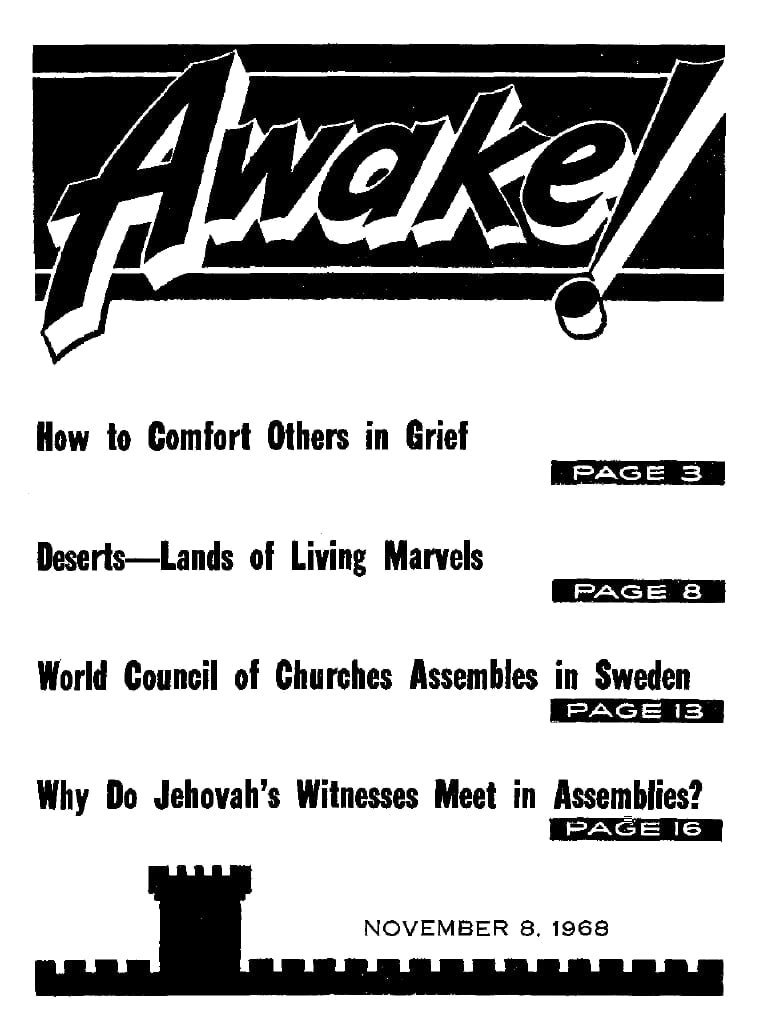
How to Comfort Others in Grief
PAGE 3
Deserts—Lands of Living Marvels
PAGE 8
World Council of Churches Assembles in Sweden PAGE 13
Why Do Jehovah's Witnesses Meet in Assemblies? PAGE 16
NOVEMBER 8.1968
THE REASON FOR THIS MAGAZINE
News sources that are able to keep you awake to the vital issues of our times must be unfettered by censorship and selfish interests. "Awakel" has no fetters. It recognizes facts, faces facts, is free to publish facts. It is not bound by political ties; it is unhampered by traditional creeds. This magazine keeps itself free, that it may speak freely to you. But it does not abuse its freedom. It maintains integrity to truth.
The viewpoint of "Awake!" is not narrow, but is international, "Awake!" has its own correspondents in scores of nations. Its articles are read in many lands, in many languages, by millions of persons.
In every issue "Awake!" presents vital topics on which you should be informed. It features penetrating articles on social conditions and offers sound counsel for meeting the problems of everyday life. Current news from every continent passes in quick review. Attention is focused on activities in the fields of government and commerce about which you should know. Straightforward discussions of religious issues alert you to matters of vital concern. Customs and people in many lands, the marvels of creation, practical sciences and points of human interest are all embraced in its coverage. "Awake!" provides wholesome, instructive reading for every member of the family.
"Awakel" pledges itself to righteous principles, to exposing hidden foes and subtle dangers, to championing freedom for all, to comforting mourners and strengthening those disheartened by the failures of a delinquent world, reflecting sure hope for the establishment of God's righteous new order in this generation.
Get acquainted with "Awake!" Keep awake by reading "Awake!"
PUBLISHED SIMULTANEOUSLY IN THE UNITED STATES BY THE
WATCHTOWER EBIBLE AND TRACT SOCIETY OF NEW YORK, INC.
117 Adams Street
AND IN ENGLAND
Brooklyn, N.Y. 12101, U.S.A.
WATCH TOWER EBIBLE AND TRACT SOCIETY
Watch Tower House, The Ridway
London N.W. 7, England
N. H. Knoxe, President
GRANT SMITH, Secretary
Average printing each issue: 5,200,000
5d n copy (Australia, Se; South Africa, 3½)
Yearly subscription rates
America, B.S., 117 Adams Street, Brooklyn, 812-755-2222
Australia, 118 Bradford Street, Brooklyn, N.E.W., 2135
Canada, 150 Bradford Ave, Toronto, 19. Oct.
England, 150 Bradford Ave, Toronto, 19. Oct.
New Zealand, 623 New North Rd, Anklesd 3
South Africa, Private Bag 3, E. Lloyds Trol., 70
(Monthly subscription cost half the above rates)
Supplement for subscriptions should be sent to the office
and include a verification seed your permission to Brooklyn.
Before a subscription is expired, do not leave two weeks before subscription expires.
Now published in 26 languages
Seminomie- Airliness, Cebuano, Dutch, Dutch, English,
Finnish, French, German, Greek, Kisle, Italian, Jazilones,
Korean, Norwegian, Portuguese, Spanish, Swedish, Tagalog,
Zulu.
Monthly—Chinese, Chrysanja, Hiligayen, Malaysia, Polish,
Tunif, Ukraine.
CHANGES OF ADDRESS should teach us thirty days before your school date. Give us an age and new address. Call us at 1-800-745-1234. Watch Tower, Watch Tower House, The Ridgeway, London N.W. 7, Englewood.
Entered as second-class matter at Brooklyn, N.F. Printed in England
The Bible translation regularly used in "Anakip" is the New World Translation of the Holy Scriptures, 1961 edition. When other translations are good, life is clearly marked.
CONTENTS
How to Comfort Others in Grief 3
Deserts—Lands of Living Marvels 8
The Star of David 12
World Council of Churches
Assembles in Sweden 13
Why Do Jehovah's Witnesses
Meet in Assemblies? 16
Central America's Summit Conference 21
Entertainers Become Witnesses 23
A Flery Volcano and
Its Tranquil Neighbors 24
Dogs and Cats 26
"Your Word Is Truth"
Would a God of Love
Destroy People? 27
Watching the World 29
How to Comfort Others IN GRIEF
PERHAPS the majority of us will sometime during our lifetime meet persons who are greatly distressed and need our help. What can we say or do that will comfort them? When friends suffer injury or bereavement, we often want desperately to console them, but do we know how? When sending a letter or a card of condolence, for example, what can we say that will bring true consolation to the one who is sorrowing?
Many persons fall short of the mark when it comes to offering true comfort to mourners. Embarrassed and uncomfortable in the face of deep sorrow or death, they often do not know just what to say or do. Knowing just what to do when faced with this problem would, in fact, be a comfort to the comforter.
In order to be of greatest service to the grief-stricken one, one must be able to share his sorrow. This is not as hard as many people think. If you are normally compassionate, then just be yourself. Your presence will be felt and appreciated.
However, putting deep feelings into words is not easy for many persons. Often they do not know what to say and so may say very little. But this is not as objectionable as they may think. Some of the truest sympathy is conveyed through a warm handclasp or an embrace.
If the bereaved want to talk of their loss, let them; in fact, encourage them to. As they speak, this will help the timid or inhibited ones to speak up with words of encouragement and comfort. Sometimes it is not what is said that counts as much as one's being present with the bereaved.
Apply Human Understanding
When comforting people in sorrow, it is well to be understanding as well as compassionate. Comforting Bible talk can help some people escape from the silence that largely engulfs them. The warm thoughts of God are uplifting and encouraging at moments such as these. But the principle of moderation should be kept in mind.
Some hospitals advise being cheerful, but here, too, the counsel needs to be qualified.
A person with a heavy heart may be in no position to appreciate efforts at humor. Often a warm handclasp along with a word or two of encouragement are all that are needed. A light quip may be misunderstood. The bereaved may feel that the comforter is not aware of the depth of his distress. So be understanding.
To share the sorrows of others is to give a portion of oneself. When Jesus Christ visited the family of Lazarus, he did not feel called on to betray no emotions. No, he himself gave way to tears. (John 11:35) When tears are shed in sincerity, this lets the bereaved one know that there are others who deeply feel the loss too. Tears show not only feeling but understanding as well.
Christians, of all people, are compassionate. They are, in fact, told to 'clothe themselves with the tender affections of compassion.' (Col. 3:12) So it would be quite normal for them to shed tears. Said an understanding friend to one who felt utterly desolate: "Cry if you need to, but please don't insist on crying alone." So they sat together, sometimes talking and sometimes not. Sometimes there was an occasional sound of tears and a sniffle. This bereaved person said that this understanding person's quiet, compassionate manner gave her the strength she needed. "It was what she did not do that helped almost as much as what she did," the bereaved said. "She did not urge me not to cry; she did not try to distract me with constant chatter . . . She simply gave her presence as support, and I shall never forget it." She was neither frightened nor embarrassed by tears. Neither should we be. Her quiet manner showed that she understood how to bear the sorrows of others and thus was able to offer true comfort.
Offering Firm Encouragement
A woman who keenly felt the loss of her husband was helped by what her doctor said to her. Months later she said: 'My doctor had been justified in reminding me—a little sternly—that my situation was not unique, that millions of other human creatures down the centuries have known the feeling of being forsaken, the physical frustration, the loss of zest for life. 'Above all,' he said, 'don't be ashamed of your feelings. You are flesh and blood. Just thank God for that!'" Many bereaved and depressed people have to be reminded of that fact. Firm reminders are often a source of encouragement.
Evidently Christians in the apostle Peter's day had need of similar advice. Writing to Christians who had endured much suffering and who were about to endure more, Peter said: "The same things in the way of sufferings are being accomplished in the entire association of your brothers in the world. But, after you have suffered a little while, the God of all undeserved kindness . . . will make you firm, he will make you strong." (1 Pet. 5:9, 10) This encouraging advice is timely today, and Christians would do well to remind suffering fellow believers of it. There is a time when firmness can be an act of kindness resulting in encouragement and strength.
Use of the Scriptures
A, timely discussion of the Bible's encouraging promises for the future can be most upbuilding to those who suffer deep sorrow. Christians can guide the thoughts of the mourner away from the immediate tragedy to the happy times that were enjoyed together in life. The hopeful promises of God for the future concerning a paradise earth can also be discussed. (2 Pet. 3:13; Rev. 21:4, 5) Mourners generally are comforted by the thoughts of God.
Deliver them from the heart and they may find their way to the heart.
In the small book "Make Sure of All Things; Hold Fast to What Is Fine," under the heading "Death," on page 142, is a collection of Scripture texts that could prove invaluable on such occasions. Under the subheading "Cause of Death," scriptures are listed to show that man was created to live, not to die, that God warned against the course that would lead to death. Under another subheading, "Condition of the Dead," scriptures are presented to show that a dead person is unconscious and inactive in the grave. And under still another subheading, "Deliverance from Death," we find Bible proof that dead ones under the ransom, both the righteous and the unrighteous, will be resurrected by the power of God. Here are talking points to help mourners.
Helping Brooders
No one should want to ride roughshod over another person's needs for privacy and solitude, especially so during moments of sorrow. There are times when the grief-stricken person wants to be alone and should be left alone, and a good friend can usually distinguish between the genuine need and a kind of withdrawal and brooding brought on by depression. There is a tendency to want to shut the heart to others when a deep injury to the spirit has been sustained, lest hurt be heaped upon hurt. But there are times when friends must invade this area, to the good of the bereaved.
For example, a pioneer minister of Jehovah's witnesses told of her experience following her husband's sudden death. She said: "After my husband's death, I debated in my mind whether I should attend the meetings at the Kingdom Hall as we regularly did and to sit in our customary spot. The Kingdom Hall, of all places, was most intimately connected with my husband. He was a servant in the congregation for many years. My absence at meetings, I reasoned to myself, would be completely understood, perhaps even expected by some. Yet an instinct told me to take head-on the business of facing life. How thankful I was when my Christian brothers came by and insisted that I accompany them to the Kingdom Hall. It gave me strength to do what I knew to be right, but could not in my own strength bring myself to do."
Another woman who received aid said: "The person who helped me most after my uncle died was a friend who dragged me to the supermarket whenever she went shopping. I'm grateful that Anna persisted against my stubborn protests." These experiences teach us that the bereaved must face life anew, and the sooner they do, the better for them. However, at times they will need the assistance of friends to prevent them from becoming overwhelmed by their own depressions and sorrow.
Friends, relatives and loved ones are naturally moved at times of sorrow to manifest concern. This is right and proper. The bereaved should fully accept this love that flows from those concerned. The many friends we have will help sustain us with their manifestation of love and concern during dark, troublesome hours. 'People came with warm handclasps and instinctive sympathy. The love that flowed like a great tidal wave through our Kingdom Hall family blessed us all. I know now that the healing process for any of life's sorrows can begin the moment we stop resisting them,' said one who had suffered much grief. It is a lesson from which we all can benefit.
Comforting Children
Children who suffer loss are particularly sensitive and in need of tender, loving care.
A child's consolation may come mainly in knowing that he is not only loved but needed during the periods of sorrow. A wife said that her grief was diffused by worrying over her ten-year-old son. The son, on the other hand, found his load bearable when told: "Now you're the man of the house. You must be brave and encourage your mother during her time of deep sorrow." The boy sensed his responsibility and tried his best to behave as a man. It helped him carry his load.
Three children, whose parents died suddenly in an automobile accident recently, were encouraged with the Scriptural hope of the resurrection. They trusted so implicitly in God's promise to bring back the dead that they were able to absorb their tragic loss with only minor signs of emotional disturbances. The daughter always hopefully expressed to her school friends that she will see her parents in the resurrection. Her faith never ceased to amaze those who listened to her. Her relatives and friends helped considerably too by showing loving care for them, by giving them things to do and demonstrating concern and love.
Therefore, do not hesitate to discuss with children the encouraging promises of God's Word about the resurrection and the coming paradise earth. Their little minds and hearts will flash with interest. You will be encouraged at the sight of their unwavering faith. Children take great comfort in the words recorded at Revelation 21:4, which says that God "will wipe out every tear from [men's] eyes, and death will be no more, neither will mourning nor outey nor pain be any more." These hopeful promises need to be repeated to children over and over again, because they forget so quickly. And they never tire of them. Each time they are told their delight abounds.
Sending Cards and Letters
Today, with busy schedules facing so many people, more and more persons go to the store and buy sympathy cards. Cards and letters are indeed proper ways to express our sorrow and sympathy. Every manifestation of interest, every visit, every card, every letter, every telephone call helps heavy-hearted mourners. It tells them that someone cared enough to break the stride of his own daily schedule long enough to express concern. Those who wish to comfort the mourners in these ways show that they are willing to share some of the bereaved one's sorrows.
In addition to sending commercial cards with thought-out, printed messages, many persons like to add a few words of their very own. But what should one say? Putting deep feelings into words is hard for some. Even the simplest things are often difficult to express in one's own handwriting. What should one say in a card or letter? Simply put down on paper the loving thoughts that moved you to write. A few words in your own handwriting, expressed in your way, will likely carry more weight and warmth and meaning than all the beautiful commercial phrases in the world. They are your words, your thoughts, your sentiments, and that is what counts. "I can't put things fancy," a letter began, "but I just want to say that your father was my best friend and every child in the school looked up to him." The family cherished that letter above all the cards and other commercial notes that they received. Why? Because it was the person's very own, written from the warmth of his heart.
Continued Thoughtfulness
True consolation cannot be limited to a few days. It often needs to extend over a period of time until the bereaved has fully recovered from his loss. An individual once made this observation: "The bereaved person is usually surrounded by friends and cushioned by every comfort they can provide—at first.
But what happens a few weeks later? The anesthetic of his initial shock has worn off. The sad little tasks that kept him busy are all accomplished. The friends drift off to their own concerns. He is left alone too soon." Where are those friends that flocked to his side during those early days? More than ever now he needs help. He feels empty inside, lonely. Therefore, some well-placed telephone calls, an invitation out to dinner, an occasional visit, a bunch of flowers, can be most helpful weeks and months after the shock of the tragedy has worn off.
How can friends further show their continued thoughtfulness? They can include the bereaved one in their own activities, taking that one with them on trips, inviting that one over when entertaining others, and so forth. Doing a person's household chores or shopping may take a little planning and extra energy, but the rewards are unforgettable. Such expressions never fail to have a healing effect on the bereaved. Their surprising effect is delightful. There may be errands that need to be run. Perhaps you can care for some of these or provide transportation. Anyone who has ever mourned can vouch for the lasting impact of such thoughtful gestures in the lonely weeks and months that follow the initial flurry of attentive callers.
So it is not just one simple call or card that comforts a mourning one, but steady interest and care born of love, until the mourner finds strength to return to the normal functions of life, to live to the glory and praise of Jehovah, "the Father of tender mercies and the God of all comfort."—2 Cor. 1:1-3.
Defending Bible Truth in School
By defending God's truth a young witness of Jehovah helped her teacher to learn who Jehovah is. Here is how she did it:
"One day we were studying a chapter in our school history book on ancient history. The particular chapter we were considering dealt with ancient Bible history of the nation of Israel. The history book made the statement that Jehovah was the name of the God of the Hebrews. At the conclusion of the chapter, our teacher gave us a written test. One of the questions asked was. Who is Jehovah? I remembered what the history book had said, but I knew that Jehovah is our God too and I wanted to make a point of this. So I wrote this down as the answer.
"When I received my test paper back I noted that it was marked ninety-nine. Looking down to see what I had missed, I saw that my answer about Jehovah was marked wrong. After I arrived home, I mentioned it to my parents.
My father suggested that I go to my teacher and ask her why she marked my answer wrong.
"The next morning I approached my teacher and I asked her about it. She replied, 'Jehovah was only the Hebrews' God.' I took her Bible off her desk and showed her God's name Jehovah at Psalm 83:18. She exclaimed in surprise, 'I never knew that Jehovah was the name of our God before.' I also told her that she could find Jehovah's name in three other places in her Bible.
"On hearing this, she took my test paper and changed my grade to one hundred. Thus I was able to make known our God's name Jehovah to my teacher and also receive a grade of one hundred."
No doubt about it, if one is always ready to make a defense in a tactful, mild way, he will see good results. He will attract seekers of God's truth.—1 Pet. 3:15.
DESERTS —Lands of Living Marvels
WE LIVE on a very special planet. Earth is full of life! Myriad forms of life, thrive deep within its soils, throughout its skies and waters. In fact, life appears insistently amid seemingly unlivable circumstances.
Truly, the unconquerableness of life is nowhere better proved than within the nineteen areas listed as principal deserts of the earth. These arid showcases are lands of marvel. Imagine living where daily temperatures range from high above 100\circ F. to below freezing; where sand glare and dust give way to an emerald oasis when drenched by a quick rain; where vast amounts of precious ores and minerals are mined yearly. Furthermore, deserts are a specialized neighborhood tenanted by unique fauna (animals) and flora (vegetation). These animals and plants offer tenacious proof that many, many forms of life are really quite at home in desert lands.
The mighty king of these desert blankets is the some 3,000,000-square-mile Sahara, which is almost as large in area as the United States. Its enormity is better grasped by realizing that its greatest length is some 3,200 miles, or greater than the distance between New York city and San Francisco. The Sahara is followed by the great desert of central Australia, the Gobi Desert in Mongolia and the Kalahari Desert of South Africa.
The most extensively investigated deserts are those of the North American continent. However, deserts also appear in the Soviet Union, Peru and near the southern tip of South America. But whether
small or large, in all the deserts a wonderful story of life persists.
Desert Areas Increase
With the passing of centuries the sizes of deserts have increased, and lands formerly lush with vegetation have become desertlike. Why? Authorities generally agree that man's neglect is a principal reason. In his book Across the Great Deserts, P. T. Etherton said: "Neglect and destruction of this protective vegetation . . . is said to be the reason why Iraq, Syria and Palestine, once 'lands flowing with milk and honey,' have become largely arid and barren."
Once man begins the scalping process, wind action, not lack of water, is thought to be more important in creating deserts. With the absence of trees and other soilholding plants, the wind blows surface soil away and exposes the subsoil. One authority explains: "In bygone days much of the Sahara (great desert) was open grassland . . . even in the Gobi there is evidence of much greater communities having lived there than is the case today."
In the United States, too, neglect has produced alarming man-made barren wastes out of once proud virgin lands of forests. Nineteenth-century settlers rolled across the continent, felling vast forests to make room for farms and homesteads. From the deforested lands, winds swept away as much as twenty feet of topsoil in a century.
Dust storms carried soil from western prairies into houses and streets of New York, 1,500 miles distant, just as soil from the Sahara has settled in Central Europe and on ships at sea off the west coast of Africa. The marching dunes of the Sahara have even buried whole cities!
Yet, despite this neglect that has created and increased desert areas, deserts are lands of living marvels. Their story is of a very intense kind of life, a study of things that may jar and dismay persons conditioned by temperate circumstances where life is less intense. This intensity of life is reflected in desert animals.
"Ships of the Desert"
The camel is just such an intense and vital creature. You may have heard him called the "ship of the desert." It has been said of him, "the camel is a boor." But in the desert he does not have much use for social charms. Since camels are natural pacers, that is, they move their great legs in lateral pairs, they do produce the rocking motion of a small boat wallowing in the troughs of the waves, and that may be why they were dubbed "ships of the desert." At any rate, what magnificent ships they are! Their dusty wake across a sandy skillet manifests an order of endurance that would wilt any other beast.
T. E. Lawrence owned a great camel named Ghazala that, as he reports, "averaged fifty miles a day; eighty was good; in an emergency we might do 110 miles in twenty-four hours; twice the Ghazala, our greatest camel, did 143 miles alone with me." Of course, these camels like Ghazala are the prize camels, always mares, whose ride is so smooth that Arabs call it "swimming." A book can be comfortably read astride them. On the other hand, the lowly untrained camels hardly ever do more than two and a half miles an hour, but
then no one is in a particular hurry in the desert, especially not the Bedouin.
The Bedouin could tell you best about the camel. He calls the camel "God's gift," and, after all, the collapse of his great beast could mean his death. They really love their "gift," and therefore the poor social grace and complaining nature of the camel is understandably seldom seen. For example, the Bedouin will fondle and kiss the big animal, all the while murmuring endearments. And at intervals throughout the night it has been observed that the camel will come over, moaning softly, to sniff at his owner where he lies before going back to graze.
The camel is like a farm to the Bedouin, even like the tractor that goes with a farm, since the camel provides a mount and does often pull a plow. She furnishes milk at the rate of four or five quarts a day, also wool, leather, flesh for meat; even camel dung is used for cooking. Since water is vital to desert persons, they pursue any source of it intently, to the dismay of westerners when they encounter the strangest use of a camel's product. And that is the use to which its urine is put.
tions, Bedouin damsels may use camel urine to wash their hair and as a henna rinse.
Do you admire that alluring red tinge to the young Bedouin's beard? Can you guess where it came from?
Camel urine is used to kill parasites of the head, too, and as a face wash. It is also said to bring color to the cheeks or warm the hands during chilly weather. Nor is all this necessarily an offensive thing. One authority described the precious liquid, saying: "It smells sweetly of herbs and aromatic plants."
If the camel is like a farm, what an enduring farm indeed! Major Leonard once described its peerless endurance as follows: "It is simply wonderful to see him plod along although utterly worn out. He does not give up easily but clings to life, and goes on and on until he drops; and when he does drop, you may take it as a foregone conclusion that he will never get up again. . . . His calm, stoical endurance under intense pain and suffering has excited many a time my compassion as well as my admiration."
Other Intriguing Animals
Desert lands are also known for many animals besides the camel. The lurking lizards, snakes and vultures circling grimly overhead are only some of the supporting actors in the desert story, and by no means the only ones. A zoological list of them would fill many pages. And yet, remember that their array exists despite the fact that, of all land areas, the deserts seem one of the most unsuitable to life.
Each creature, therefore, is intent on being self-sufficient and quick to find and use the vital things. Happily, there are as many forms of this type of life on the desert floors as there are moods in life. There are funny little creatures, magnificent ones, frightful ones and friendly ones, all sharing the desert marvels.
An almost laughable contrast is seen in the kit fox and the clumsy Gila (hee-la) monster. The kit fox is the smallest of the foxes. It has short, stout limbs. It is not really as fast as commonly believed, but it has a most extraordinary ability to make quick turns and take advantage of any scant cover.
On the other hand, the Gila monster likes to spend the hottest days in a kind of stupor called estivation. Even when it moves it is very sluggish. It is thick-tailed and the possessor of fanglike teeth that communicate with poison glands in the lower jaw.
Some of the more magnificent desert creatures are the desert bighorn, or wild sheep. They find their most ideal conditions for existence in the almost waterless, desolate rocky ranges that jut up from the low desert plains. Even deer are desert neighbors. The California mule deer is a year-round resident of the deserts of Pima and Yuma counties along the lower Colorado River in midwestern Arizona.
Desert Birds
The sky over a desert home is beautified by a variety of large and small birds, the smallest being the desert hummingbird. Two unusual varieties of birds are the roadrunner and the verdin.
The verdin is a tiny bird and is of a nervous temperament, and yet, without appearing much disturbed, it will let you sit for hours under the nest while it comes and goes. Their nests are large and easy to see. Often they poke so much into a nest, it appears as if about to burst. They add color to the scene. The male is bright olive green and yellow, whereas the female has only two patches of color.
The roadrunner is a California desert comedy due to its strange punctuality and great activity. An invalid person living on the desert told of a roadrunner that passed her porch regularly at 12:25 p.m.
every day for over a week, never varying by over a few minutes. One observer spotted a roadrunner that would go into a cactus patch after a thirty-minute sunbath, whereupon it would perform a succession of dizzy leaps and jumps and hurried flights and runs, going round and round a cactus clump perhaps as many as twenty times, and then go annoy a family pet cat.
A rare find among birds is the hibernating poorwill. Hibernating is a trait observable in many animals, but was not established as an observed fact in birds prior to 1947. The Hopi Indians call this bird Holchko, "the sleeping one."
Insects of the Desert
The most inexhaustible stock of strange detail lies within the desert galleries of insect life. Most persons are familiar with the centipede, tarantula and scorpion, but what have we here?
It is a moving mass of colored fuzz covered with a deep cushion of black hair on head and thorax and brick-red hair on the abdomen. Look how fast it moves on its slender black legs. It is not an ant, even though those two large black eyes make it look like one. It is what insect specialists call a mutillid, a wasp. See it run out its long black stinger—a stinger almost as long as the abdomen itself. This little creature is called a "singing ant" by many persons because of its ability to force air in and out of the breathing tubes located on the sides of the body, causing a high-pitched singing note to be sounded.
A curious thing about the mutillid is what it lives on. It is said to subsist on the nectar of flowers, where in dry, hot summer days and in autumn does the mutillid get either nectar or water? Said Edmund E. Jageeer in Desert Wildlife: "Never have I seen a mutillid in a flower,
even when flowers are plentiful. They are always seen on the ground. Yet hour after hour, day after day, they run rapidly over hot, barren rocks and sand, using up energy and losing water through the process of breathing."
So from the enduring camel to the multilid the desert reveals a triumphant design of life!
Desert Plants
The power of life rises even from the blistering desert floor. But do you picture merely spiny cacti and tumbling scrub brush? Then meet one of the most overpowering beauties of the plant world that pushes its way up from a sandy floor: the Reina de la Noche, or Queen of the Night. It is also called the night-blooming cereus.
The flower of this plant is among the most fragrant and beautiful of all the cactus blooms. It blooms only on desert nights, losing the blossom before morning. The cereus offers the phenomenon of blooming so fast that one can actually see the petals open, releasing a very strong fragrance. In fact, the cereus has inspired poems and prose to be written in praise of its perfection.
Irresistibly life mounts up into the most amazing of plants, even in the desert! An entire forest of them stretches for miles in Tucson, Arizona, comprising the Saguaro National Monument. The saguaro (sah-war-oh), or giant cactus, is actually classified as a tree. Towering fifty feet, sometimes it will weigh as much as ten tons, but is so thinly rooted that it is often strewn about the desert floor, blown over by the wind.
In his book Desert Plants and People, Sam Hicks refers to numberless little-known plants such as the desert matarique, yerba del indio, pionia, cardon and damania. These provide a sort of desert pharmacy, teahouse and variety store all in one, because they are medicinal and make good teas.
But, in addition, they are useful in many other ways.
Lands of Fascination
So, far from being lifeless, dull places, deserts are full of life and attractions. For different reasons humans have been drawn to them either as individuals, or as a people.
Photographers find the desert full of appeal, and many have been desirous of filming one of the desert's trick effects called "la dune blanche," which means a sand dune covered with hoarfrost. This phenomenon appears at sunrise for only a matter of seconds before the rays of the sun wipe it off.
The "sand rose" is another curiosity that testifies to the abundance of dew on the Sahara. The sand rose is not a living plant. About the size of a cauliflower, it is a beautiful cluster of sand crystals that grows into petals with veins like a flower petal. It is as hard as glass, resulting from the interaction of dew, sand and sun.
Even lightning on the desert produces strange phenomena. Striking the sand, it is like a dagger that fuses the sand around the bolt, often producing a hollow tube of "lightning glass."
Many persons have indeed found deserts to be fascinating places. Especially captivating are the unusual forms of life that make their home there. Truly, the deserts are lands of living marvels.
The Star of David
ONE of the most common symbols associated with modern Jewish religion is the six-pointed star frequently called the "Star of David" or "Mogen David" ("David's shield"). What is its origin? The Jewish Encyclopedia (Volume 8, page 251), in commenting on this "symbol of Judaism," acknowledges that it is not based on the Bible. The encyclopedia goes on to say: "The Jewish view of God, which permitted no images of Him, was and still is opposed to the acceptance of any symbols, and neither the Bible nor the Talmud recognizes their existence. It is not worthy, moreover, that the shield of David is not mentioned in rabbinical literature."
If this symbol does not come from God's Word and the history of his dealing with Israel, what is its origin? It does not appear that we can be certain at this late date. One author noted that "the sign of the Gnostics [an ancient religious group] consisted of a six-sided star, composed of the male and female triangles intertwined, just as the real public [areas] of the man and woman would also form this six-sided star during coition." But, of course, it would be difficult to establish
unequivocally a direct link between that use as oriented around sex worship and modern uses of the same symbol.
In any event, it is evident that the "Star of David" is of uncertain age, origin and meaning. Rabbi Morris N. Kertzer wrote: "The Shield of David, or Mogen David, is a six-pointed star made up of two triangles pointing in opposite directions. The star has no ancient Jewish origin or religious meaning. It became a popular symbol in Jewish life about three hundred years ago in Central Europe.
"A medieval mystic declared that the six-pointed star was identical to the royal shield of the House of David, while the five-pointed star resembled the 'Seal of Solomon'. Although the idea was just a figment of caballistic imagination, it was gradually accepted as true and the Shield of David took on a very special significance for the Jewish community.
"Whatever its origin, the Shield of David has become a distinctly Jewish symbol. . . . But though it often stirs deep emotions of loyalty and pride, the six-pointed star cannot be considered in any sense a sacred symbol." —What Is a Jew?, pages 128, 129.
nating government has gone. This is complete. Christendom is over."
Hence, the main objective of the Assembly, held at the university city of Uppsala, Sweden, was said to be twofold: (1) to decide about the Council's continued work in the future; and (2) to voice their views on the most burning questions of the day.
Hoping that some great sense of removal would
in Sweden
"A CRISIS of faith has overtaken the churches more rigorous, perhaps, than was ever true before. Structures of church life and congregational worship are under serious questioning. The Bible has increasingly ceased to be a book to
of renewal would come forth from the meeting, they chose their theme from Revelation 21:5 (AV), which says: "Behold, I make all things new." As Secretary-General Blake said: "We hope that Uppsala 1968 will not be just an 'interesting Church meeting' but that it will mark a new era for Christianity."
Some New Things
be listened to. It is asked whether even Jesus points beyond man to God."
This comment was made by the president of the Methodist Church of Ceylon. His keynote speech marked the opening of the fourth General Assembly of the World Council of Churches, at Uppsala, Sweden, in July. For the first time since 1961 the Council met to discuss the grave problems that confront the churches and to set the course for the future.
The Council represents 237 churches with about 300 million members, which
One new item immediately became a controversial issue. It was the new artwork that decorated the delegates' dining room. The artists had painted grotesque pictures making direct reference to man's lust for money, the glorification of war, and the hunger that prevailed in the world. Other pictures depicted people crawling in pain, with their intestines pouring out. The archbishop of Uppsala was called upon to inspect this in the hope that he would condemn it so that it could be removed. However, the archbishop said:
includes most major Protestant and Eastern Orthodox churches in the world. It has been in existence for twenty years. During that time it has seen the problems of the churches multiply rapidly. In fact, Eugene Carson Blake, the council's secretary-general, stated: "We are in a secularizing age, and therefore the idea of the church dominating culture or domi-
"After all, they are really not worse than the pictures that were painted on the walls of some of our medieval churches, where devils were tormenting people whose bodies writhed with pain." The pictures remained.
A new item, too, was the way the service in memory of Dr. Martin Luther King was held at Uppsala's Gothic cathedral.
Said the publication Uppsala Nya Tidning of July 19: "It had a form perfectly in keeping with the theme of renewal which has been the guiding line in the Assembly. The program was made up of several components which are often hard to combine: Jazz in a Gothic cathedral, come-as-you-are-style at a church concert."
Another of the new things that occurred at Uppsala was reported on by the New York Times of July 24: "Standing with her eyes closed and her feet close together.
edy for world distress highlighted to build faith?
No. On the contrary, additional conflicting ideas of men were brought forth. One of the more prominent of such ideas was promoted by the representative of the Church of Northern India. Among the main speakers, he told the delegates: "If we believe in progress and development let us not flinch at disorder and instability. . . . I would not condemn those who resort to violent action in order to bring
a young woman allowed her limp body to be passed slowly from hand to hand by four men standing in a small circle. 'The purpose is to see how much we are willing to trust ourselves and each other,' said the leader. Then each of the five participants walked up to the others one at a time, touched them on the hands or shoulders and told them 'what I like most about you.' . . . the occasion was an experiment in 'experiential' worship. 'However, one participant walked out in the
about justice in society."
Some who attended the assembly recognized that such counsel was not at all in line with what the Bible teaches. Said Dr. David Hedegard, a translator of a modern-language "New Testament": "There has been all too little spoken of the Christian faith." Noting that the Council recommended political action, he concluded: "From the Christian biblical and theological viewpoint, the assembly was worse than expected. . . . It dealt with things
middle of it, stating strongly that he was not willing "to call it the worship of Almighty God."
Also new to the Swedish church was the sale of candles just inside the entrance to the cathedral. At the booth a placard exhorted: "Take a candle, light it and put it on the tree." The tree was a metal figure called "The Tree of Reconciliation." Suggested too was this prayer: "Oh, God, I give this candle as a visible prayer: Unite the world's nations, races and
that, according to the Bible, were outside the Church's commission and there was for this reason the risk of worldliness and a watering down [of the faith]."
That Dr. Hedegard was right in his observations is borne out by one part of the report issued by the Assembly, which said that the churches must work toward a change of political conditions so that all get a right to participate in the governing of their country. Yet, nowhere does the Bible authorize Christians to do this.
groups in peace, justice and fraternity." Yet, nowhere in the assembly was it explained, as the Bible so clearly does, how God has purposed to do this.
What Spiritual Uplift?
What about the expectations for renewal, for spiritual uplift, for godly counsel in these troubled times? Was God's rem-
Another critical voice was that of the delegate from Colombia who said: "The assembly is a step backward, because its interest is first of all the problems concerning how the Church is to keep her position, her esteem and respect, her influence in the world."
Similarly, another delegate, a teacher at an Orthodox seminary in India, said: "The World Council of Churches will never be able to accomplish anything.
It is governed by a small faction that is eager to keep exercising power, and as soon as someone steps forward with a good suggestion and a strong will to get something done, he is pushed back, interrupted or placed in some harmless position."
Interfaith Promoted
The ecumenical spirit was strongly promoted. Although the Roman Catholic Church is not a member of the Council, she sent observers to the assembly, as did the World Council to the Second Vatican Council in Rome. And Pope Paul VI sent a message in which he said: "We pray to the Holy Ghost that He may inspire your work and grant it full success. All that you are doing to further unity between all Christians will be blessed by the Lord."
A report approved by the General Assembly regarding the Council's relations with the Roman Catholic Church stated: "The World Council of Churches welcomes a decision by the Roman Catholic Church to form a group in cooperation with this Council that should work out an outline for cooperation between the churches." The Council also stated: "We want to speed up the unification of churches and seek a fuller unity with those churches that have not yet come into fellowship with us."
God's Blessing?
Will such efforts be blessed by God? Will the pope's prayer for success be answered? Well, why have not such efforts been blessed in the past? Why have these churches seen their problems worsening if they are supposed to have God's blessing?
In its final report, the Council recommended: "The churches have to teach men
how they should be politically efficient." It also recommended the use of violence to achieve social change if no other way was open.
Yet, God's Word teaches the opposite. It plainly says: "A friend of the world is constituting himself an enemy of God." (Jas. 4:4) Jesus Christ said: "They [true Christians] are no part of the world." (John 17:16) He also declared: "My kingdom is no part of this world. If my kingdom were part of this world, my attendants would have fought." (John 18:36) And God's Word also states: "Not paying back injury for injury . . . seek peace and pursue it."—1 Pet. 3:9, 11.
Hence, the recommendations of the Council are in glaring opposition to what God's Word teaches. Nor did the Council mention that God's kingdom is the one and only hope for mankind. This kingdom, this government, was the central teaching of Jesus. (Matt. 4:17) He told his true followers to pray for it because the Kingdom is the agency that God will use to bring an end to this wicked system of things. It alone will usher in an era of peace, happiness, health and life for man. And this vital teaching was ignored by the Council—Dan. 2:44; Matt. 6:9, 10; Rev. 21:1-5.
No, there will be no "new era" for Christendom's churches as Secretary-General Blake hoped for. Instand, God's Word shows that such churches can expect His fiery judgments to be executed against them. Why? Because they have abandoned God's truths and have misled millions of others to do the same. It is just exactly as Jesus said of the religious leaders of his day: "You have made the word of God invalid because of your tradition. . . It is in vain that they keep worshiping me, because they teach commands of men as doctrines."—Matt. 15:6-9; 18:6; Rev. 18:4-8.
Why Do Jehovah's Witnesses Meet
"WHY do Jehovah's witnesses hold conventions?" That was one of the many questions a sincere searcher for truth asked one of Jehovah's witnesses who had come from New York city to Lewiston, Maine, for the purpose of attending the "Good News for All Nations"
District Assembly being held there July 4 through 7. The questioner himself had come thirty miles to get his questions answered.
Why do Jehovah's witnesses hold conventions? Why do they enjoy these so much that in the United States an estimated 25 percent attend more than one? Why are the assembly crowds so great that, time and again, closed-circuit television has been used to bring dramatic presentations to overflow crowds in adjoining halls? Why? Because of the blessings of giving and receiving that these provide. These assemblies help them to be better Christian witnesses of Jehovah, as regards both their conduct and their field ministry. Further, these assemblies also serve to advertise God's name and kingdom, even as was amply illustrated by the more than 120 assemblies held in upward of 25 different lands in the northern hemisphere this past summer.
Thus, with regard to their ministry, those attending these assemblies were delighted to receive one of the finest Bible textbooks for teaching beginners yet published by the Watchtower Society, The Truth That Leads to Eternal Life. In clear, simple and direct language it presents the basic Bible truths essential to salvation
and the Bible principles that should govern the lives of Christians. They were also happy to learn of a six-month Bible-study course using this textbook.
Those attending these assemblies also had stressed to them the importance of letting God's work come first in their lives and learned of the great need for more ministers in many lands. Very stimulated were they to receive the reports of the increase in proclaimers of God's Word during the past year and of the great distribution of Bible literature, the greatest ever. They also learned about the planned activity for the coming year and about the large international assemblies in prospect during 1969. No question about it, these assemblies better equipped them in both mind and heart for their ministry.
The Witnesses also gained an increased appreciation of all that God and the "good news" have done for them, and how happy their lot and how light their load are compared to those of the world! Those whose mates were unbelievers learned how to deal with their problem, and parents had their obligations clearly spelled out to them. All were counseled to build one another up both by word and deed, to get along peacefully with one another and, above all else, to guard their heart by paying more than the usual attention to the counsel found in God's Word.
Especially helpful were four beautiful, touching and gripping dramas that underscored the value of the Bible in our day.
The problems of youths were thoroughly dealt with, by means of dramas, lectures and experiences. They saw illustrated the folly of many modern youths and the blessings that come from following Bible principles. These programs, both by and for youths, clearly communicated with them and proved that there was no "generation gap" among these Witnesses.
One of the high points at each assembly was the baptism. An enlightening discourse told of the response that those with honest, wise and loving hearts make when they hear the good news, namely, they dedicate themselves to do God's will and are baptized. During these assemblies 17,613 were baptized. In Washington, D.C., the baptism was held right on the convention grounds, an eighteen-foot swimming pool, rented for the occasion, serving ideally. In Ottawa, Canada, an abandoned quarry was used.
Serving and Cooperation
Finding rooms for conventioners was one of the many ways in which Witnesses were able to cooperate and serve their Christian brothers. It took from two to six hours to find an accommodation, depending upon the housing situation; and this time those living in the host city were glad to devote. One Witness inquiring for rooms in the Kitchener-Waterloo area in Canada could hardly believe his ears when the gentleman at the door, after pausing a moment, said, "I would like to oblige with 700 rooms." It turned out that he was the warden of Waterloo University Village. In the Lewiston, Maine, area three colleges turned over upward of 250 rooms, and a college dormitory housed a thousand Witnesses attending the Pawtucket,
Rhode Island, assembly, a convention bus service bringing the Witnesses back and forth.
One official in Toulouse, France, expressed great admiration for the way the Witnesses were able to get over 800 rooms by going from house to house; but 2,000 more were housed in two large exhibition halls. Noteworthy also was the way the public responded. In Ottawa, Canada, 633 rooms were given free to the Witnesses to use, and seventeen householders turned over their keys. In Ventura, California, some 50 percent of the rooms were given free by the public. Among the homes turned over for the use of the Witnesses on Vancouver Island was one that rented for $250 a month. Sometimes aid came from an unexpected source. Rooming work was going rather slowly in Sheffield, England, when the bishop there made a vitriolic attack on the Witnesses' efforts to get rooms. One lady was so outraged that she phoned the rooming committee and offered accommodations for ten. Also, a personal friend of the bishop phoned to say that previously she had turned down a request for rooms, but in view of the bishop's unwarranted attack, she would be glad to provide accommodations for two. Eventually enough accommodations were found for all.
There was also much cooperation in getting food for the assemblies. In Palm Springs, California, hundreds of Witnesses got up early July 4 to 6 and worked from 4 to 11 a.m., picking fifty tons of grapes for various assemblies, there being a grape pickers' strike on at the time. Tons of these grapes were shipped to assemblies as far as 3,000 miles away. For the Inglewood, California, assembly some Witnesses traveled as much as 350 miles to gather thirty-nine tons of fruit and thirteen tons of vegetables, all of which was gathered from fields already harvested and would have been plowed under.
Witness farmers around Memphis, Tennessee, donated tons of foodstuffs for the assembly there. In Eureka, California, volunteers went out in the woods and picked three hundred gallons of blackberries for assembly meals.
And all this activity in connection with the assemblies was not only a model of cooperation but also a model of efficiency. City and state officials took motion pictures as well as other pictures of the operation of the cafeteria and other departments. At one assembly in Denmark, Witnesses managed to park 580 cars in a place where usually only 370 were parked. The stadium inspector asked for details so as to show his own men that it can be done. At Columbus, Ohio, the assembly's sound department amazed the professionals who had furnished the sound for Billy Graham's program in the Stadium for $10,000. They asked all kinds of questions, because of the clarity and uniformity of the reception.
Advertise God's Name and Kingdom
Nor is there any question about these assemblies serving to advertise God's name and kingdom. For example, The Daily Sun of Lewiston, Maine, would not normally have published information about God's name and kingdom, but it did consider the assembly held there newsworthy; so much, in fact, that it had a large front-page picture about the assembly each day. All together, 1,300 column inches of publicity resulted from this assembly.
This was typical of most assembly cities. The Washington, D.C., assembly received more than 6,000 column inches of publicity; the one in Albuquerque, New Mexico, more than 4,000; the one in Pawtucket, Rhode Island, more than 1,600. A large front-page illustrated story in the
Minot, North Dakota, Daily News told about the assembly in that city, and The Voice Chronicle of Corpus Christi, Texas, in addition to a large front-page story, devoted its entire back page to reprinting the Spanish convention program, voluntarily sponsored by the local hotels and motels. And nearly all lands reported by far the best publicity ever.
As a result of these assemblies there was also much advertising of Jehovah's name and kingdom by means of the radio and TV. In Washington, D.C., thirty-one hours of radio time and seven hours of TV time told about the Witnesses and their assembly. In Pawtucket twenty-one hours of radio and two and a half hours of TV did the same, and it was similar in many of the other assembly cities in the United States and other lands. Radio stations gave news stories, interviews and the thirty-minute recorded program "The Decisive Generation." TV stations presented similar news stories and interviews and the half-hour movie, "Heritage," dealing with family life and youths' problems. One of Washington's leading TV stations gave a half hour of prime time Sunday morning to an interview of several Witnesses regarding their beliefs and activities, and that in color. A Baltimore radio personality interviewed the Witnesses for an hour and was greatly impressed with what they were doing for youth and observed that what made the Witnesses stand out from the rest was love.
In particular do these assemblies serve to make known God's kingdom because of the advertising given the main talk by nearly every conceivable means as well as by the talk itself. The subject, "Man's Rule About to Give Way to God's Rule," was truly good news. Forcefully this lecture showed how man's rule, begun in Eden, has been dominated by Satan the Devil, and how the facts today show that man is unable to govern himself properly.
From the fulfillment of Bible prophecy we know that soon God will take a hand in man's affairs and have His rule replace man's rule. At assemblies held in more than 120 cities in some 25 lands upward of 920,000 heard this talk. In a number of cities it was broadcast either "live" or at a later hour. In Surinam the attendance at this public lecture was 1,509, more than three times as many as there are Witnesses in the entire country!
"Fine Works" Get Recognition
Their assemblies also help the Witnesses to fulfill Jesus' command: "Let your light shine before men, that they may see your fine works and give glory to your Father who is in the heavens."
community that is torn with racial strife. It would be a privilege to me, as the Commander of the National Guard in Washington, D.C., to have 50- to 55,000 people about whose conduct I would not have to be concerned visit this city." Of course, the convention went off peacefully, fully integrated.
A police officer assigned to the Olympia Stadium, Detroit, Michigan, bore like testimony: "Ever since you people have been here we have been having so few calls. It's just like in the winter at midnight. Usually at this time of the year we hardly have time to eat our lunch. But since the
ARTICLES IN THE NEXT ISSUE
Pollution of the Air, Water and Land Is Ruining the Earth.
(Matt, 5:16) Among such fine works that the public press took note of was the racial harmony of the Witnesses. Representative is the article that appeared in the St. Petersburg, Florida, Times, July 14, 1968, entitled "Witnesses Practice Racial Harmony." It said: "Black and white together." The Jehovah's Witnesses don't sing about it, they just practice it. Not only has the convention been a massive example [peak attendance was 16,577] of racial harmony with black and white worshiping together, but it has tucked some 700 Spanish-speaking Witnesses into its programs without a murmur."
Pope's Birth-Control Ban Stirs Dissent.
That is why, when some opposition to the Witnesses using the Washington, D.C., Stadium developed, one of the members of the three-man armory board could state: "I am convinced that we as the Armory Board should work toward having these people in the city of Washington. It will be a stabilizing effect upon our
Witness convention has been here it's so quiet we just can't understand why." Incidentally, the Olympia Stadium, where the Witnesses held their assembly,
is right in the heart of the area that was racked with riots a year ago.
In Trondheim, Norway, a man who had permitted 300 Witnesses to tent on his large plot of land near the assembly afterward stated: "I am very impressed. How is it possible for so many to live so peaceably together? What is even more surprising is the good behavior of the children of Jehovah's witnesses. It has been a pleasure to have Jehovah's witnesses live here, and you are welcome back some other time."
Newspaper Editors Impressed
Carrying their own particular weight in favor of the exemplary conduct of Jehovah's witnesses were the newspaper editorials and feature stories published in addition to the news coverage previously referred to. Here again Jehovah's name and kingdom received fine indirect publicity as the following few examples show: The Rochester, New York, Democrat and Chronicle, July 13, 1968, on the third day of the assembly had this to say, under the editorial heading "Welcome to the Witnesses":
"The community welcomes warmly the thousands of Jehovah's Witnesses who have come to Rochester for their district assembly. Few gatherings of such size could rival this one for efficiency, orderliness and sheer good humor. The Witnesses, each one of whom is a minister, are sufficiently different in some of their beliefs to be controversial. . . But because this is a democratic country, their right to be different must be respected.
"And however much people of other faiths may disagree with some of their interpretations of the Bible, the beliefs of the Witnesses are deeply and sincerely held. The Witnesses give the impression of living their religion daily. Walking among them and watching them at work makes it impossible not to be aware that these are warm, animated, clean-living people. At a time in our society when so many parents and children seem to go their own ways, the prominence at the assembly of family groups is noticeable. It's a pleasure to have them in town."
And the Twin-City Sentinel, Winston-Salem, North Carolina, July 16, had the following to say about the assembly in the "Church Notes" section under the caption: "Jehovah's Witnesses Are Praised":
"It might well be that the cleanest religious convention has come to a close in Winston-Salem . . . As Neil Bolton, Coliseum manager, put it: 'Without reservation, that's the cleanest, most orderly bunch of people that has been in the coliseum in the nearly 10 years I have been there.' He added that in meetings with other coliseum managers, the word is 'get the Jehovah's Witnesses to meet in your facilities if you want your place cleaned because they'll go over it with a toothbrush.' . . . Bolton said he 'didn't know about their theology, but I do know that they are the cleanest and hardest working people I ever saw and the best disciplined people I ever saw.' Others commented on their neatness in dress and speech, the orderliness of their meetings . . . It's an education to me,' Bolton said of the Witnesses, 'and I believe to the community too.'"
…