Awake!, February 22, 1967
Download: PDF — Awake!, February 22, 1967
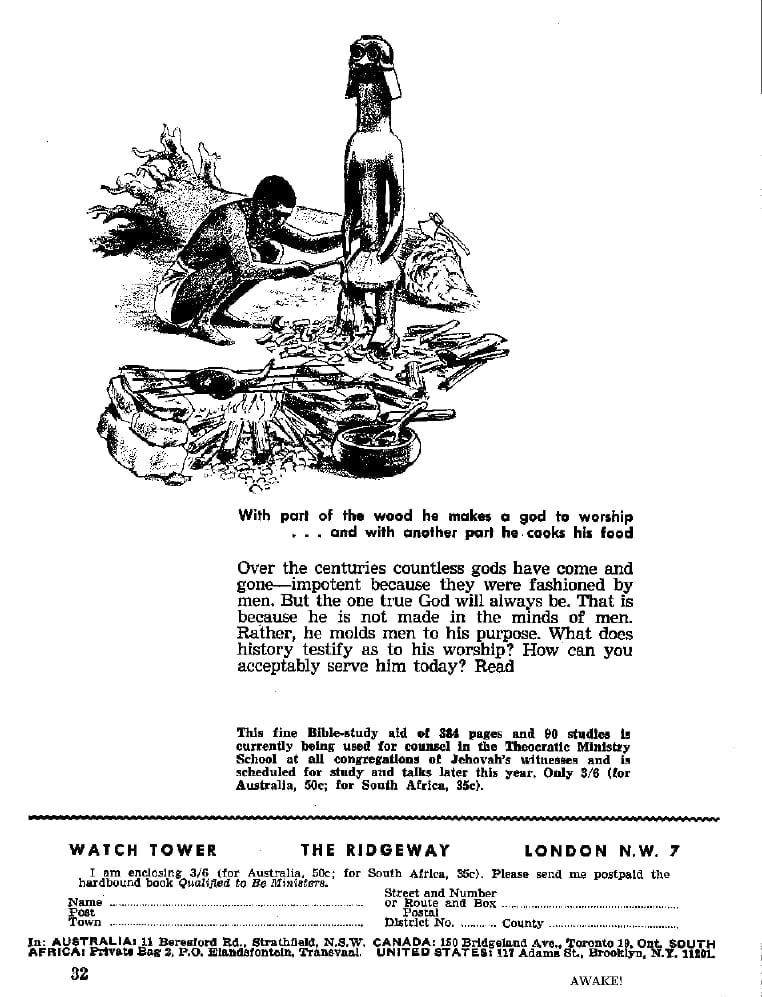
With part of the wood he makes a god to worship . . . and with another part he cooks his food
Over the centuries countless gods have come and gone—impotent because they were fashioned by men. But the one true God will always be. That is because he is not made in the minds of men. Rather, he molds men to his purpose. What does history testify as to his worship? How can you acceptably serve him today? Read
This fine Bible-study aid of 384 pages and 90 studies is currently being used for counsel in the Theocratic Ministry School at all congregations of Jehovah's witnesses and is scheduled for study and talks later this year. Only 3/6 (for Australia, 50c; for South Africa, 35c).
WATCH TOWER
THE RIDGEWAY
LONDON N.W. 7
I am enclosing 3/6 (for Australia, 50c; for South Africa, 35c). Please send me postpaid the hardboard book qualified To Be Ministers.
Name ...
Post ...
Town ...
Street and Number
or Route and Box
Postal
District No. ... County
IN: AU8TRALIAI 11 Beresford Rd., Strathfield, N.S.W. CANADA: 118 Bridgesland Ave., Toronto 19. Ont. $OUTH
AFRICAN IFAFICI Bag 2, P.O. E.I.兰顿湾, Transvaal. VANNAI: 118 STATES: 117 Adams St., Brooklyn, N.Y. N.118L
Parents, What Are Your Children Being Taught? PAGE 5
Crimes of Youth—Who Is to Blame?
PAGE 10
Why Keep On Smoking?
PAGE 17
The Farmer's Fertilizer Problem
PAGE 21
FEBRUARY 22.1967
THE REASON FOR THIS MAGAZINE
News sources that are able to keep you awake to the vital issues of our times be unfettered by censorship and selfish interests. "Awake!" has no fetters. It recognizes facts, faces facts, is free to publish facts. It is not bound by political ties; it is unhampered by traditional creeds. This magazine keeps itself free, that it may speak freely to you. But it does not abuse its freedom. It maintains integrity to truth.
The viewpoint of "Awake!" is not narrow, but is international. "Awake!" has its own correspondents in scares of nations. Its articles are read in many lands, in many languages, by millions of persons.
In every issue "Awakel" presents vital topics on which you should be informed. It features penetrating articles on social conditions and offers sound counsel for meeting the problems of everyday life. Current news from every continent passes in quick review. Attention is focused on activities in the fields of government and commerce about which you should know. Straightforward discussions of religious issues alert you to matters of vital concern. Customs and people in many lands, the marvels of creation, practical sciences and points of human interest are all embraced in its coverage. "Awakel" provides wholesome, instructive reading for every member of the family.
"Awakel!" pledges itself to righteous principles, to exposing hidden faes and subtle dangers, to championing freedom for all, to comforting mourners and strengthening those disheartened by the failures of a delinquent world, reflecting sure hope for the establishment of God's righteous new order in this generation.
Get acquainted with "Awake!" Keep awake by reading "Awake!"
PUBLISHED SIMULTANEOUSLY IN THE UNITED STATES BY THE WATCHTOWER BIBLE AND TRACT SOCIETY OF NEW YORK, INC. 117 Adams Street Brooklyn, N.Y. 11201, U.S.A.
WATCH TOWER BIBLE AND TRACT SOCIETY
Watch Tower House, The Ridgeway N. H. KNOHR, President
London N.W. 7, England
GRANT SUMMER, Secretary
Average printing each issue: 4,475,000
4 a copy (Australia, Se: South Africa, 3½c)
Average printing rate for monthly editions
Officer
1 Australia, 11 Breckenridge EG, Stratford, N.W.1
$1 England, Wake Forest, Toronto, 19. Oct.
$1 England, Wake Forest, U.S.
The Bidway, London N.W. 7
$76 The Bidway, London N.W.
Bamimovich — Arkizkan, Celebu, Danah, Dutch, English,
Flintik, French, Germen, Greek, Itope, Japan, Japanese,
Korren, Newarkan, Portuguese, Spatak, Swalik, Tagalog,
Zala
Monthly—Chinese, Ciyanja, Killgaynco, Malayalam, Polish,
Tamil, Ukrainian.
CHANGES OF ADDRESS should reach us thirty days before your moving date. Give us your old and new address. Call us at 718-255-1234 or visit Watch Tower, Watch Tower House, The Midway, London M.W. 7, England.
Entered as second-class matter at Brooklyn, N.Y.
Printed in England
The Bible translation regularly used in "Awake" is The New World Translation of the Holy Scriptures, 1961 edition.
When other translations are used, this is clearly marked.
CONTENTS
Guard Against the Practice of Sin 3
Parents, What Are Your Children
Being Taught? 5
Crimes of Youth—Who Is to Blame? 10
The Caspian Sea—Russia's
Billion-Ruble Problem 14
"According to Their Kinds" 16
Why Keep On Smoking? 17
The Farmer's Fertilizer Problem 21
A Tragedy in the Greek Archipelago 25
"Your Word Is Truth"
Jesus' Condemnation
—on What Charge? 27
Watching the World
GUARD AGAINST
THE PRACTICE OF SIN
</div>
A POET long ago said: "To err is human; to forgive, divine." As much as that saying is quoted, it is not altogether true. To forgive may be Godlike, but to be human does not necessarily mean to err. Our first parents, though human, did not have to err. They were created perfect. (Gen. 1:31; Deut. 32:4) When the Son of God came to earth he proved this to be true, for, though human, he did not err—not in thought, nor in word, nor in deed. (1 Pet. 2:22) It is only due to the transgression of our first parents that erring became human, that "the inclination of the heart of man is bad from his youth up."—Gen. 8:21; Rom. 5:12.
But let no one jump to the conclusion that, since a tendency to err, to sin, to make mistakes, is inherent in man, we have no obligation to strive against these. We do have such an obligation! We are obligated by the light of conscience, and our very ability to reason, to treat others as we ourselves would be treated and to take care of ourselves properly so as not to become a burden upon others. And to the extent that we become familiar with Bible principles we are further obligated, for knowledge brings responsibility.
In this regard some have pointed to the mistakes made by certain men of God and asked how it was possible for them to do such things. But the important thing is not that they did this or that but that they did not take their erring lightly, they did not make a practice of such things. Noah is such an example. On one occasion, some years after the Flood, he drank wine to the point of intoxication. No doubt there were extenuating circumstances; but, be that as it may, the fact remains that we do not read of his getting intoxicated again. So also with the apostle Peter. Though on one occasion he denied his Lord three times because of fear of man, he sincerely repented and thereafter became a fearless witness to his God and his Lord, continuing faithful in spite of beatings and imprisonment. Acts 5:40, 41; 12:3-5.
In this respect Peter stood in striking contrast to his fellow apostle Judas. Judas had made a practice of being dishonest; for, as the inspired record tells us, "he was a thief and had the money box and used to carry off the monies put in it." He made a practice of stealing, and that from such an unselfishly dedicated group as Jesus and his apostles while posing as one of them!
Pride and greed combined in him to commit the act of betraying his Lord. No wonder that afterward he found no repentance, though remorseful, and so hanged himself!—John 12:1-6.
The apostle John makes this fine distinction between committing a certain sin and making a practice of sinning, saying: "My little children, I am writing you these things that you may not commit a sin. And yet, if anyone does commit a sin, we have a helper with the Father, Jesus Christ, a righteous one."—1 John 2:1.
But as regards those who keep on repeating their sins he says: "Everyone who practices sin is also practicing lawlessness, and so sin is lawlessness. He who carries on sin originates with the Devil, because the Devil has been sinning from the beginning"; that is, from his beginning as Satan the Devil.—1 John 3:4, 8.
Today, more than ever before, we see people making a practice of sin, of loose conduct, of sexual immorality, of crime. Regarding the problem this poses for those having to do with law enforcement, the New York Daily News, July 8, 1966, had a 'guest editorial' by New York's Chief Police Inspector S. D. Garelick, which read: "Recidivism (the repeating of crimes by the same persons) is increasing in intensity and is becoming much more serious. The fear of punishment is waning and it is apparent that there is a lack of respect of other people—both for their person and property."
This "falling back," which is what recidivism literally means, is something that every self-respecting person, every lover of righteousness and, in particular, every Christian should want to guard against, for often it is the practice, rather than the sin itself, that determines its seriousness. Thus in the summer of 1966 in a certain Brooklyn congregation of Jehovah's witnesses two likable young people were excommunicated, disfellowshiped, to the shock of many of their friends. Why? They had been put on probation because of having violated the Christian moral code, but, instead of taking this censure to heart and exercising care in the future, they became repeaters, making a practice of their wrongdoing. So the Christian congregation had no alternative but to excommunicate them.
Not that committing a single act of sin is to be taken lightly. Not at all! One will never become a practicer of certain sins if he never commits them the first time. Besides, it is so much easier to transgress the second time; one may even find he has acquired a craving for it. More than that, many a single act has resulted in untold misery, as unwed mothers, victims of venereal disease, and even King David of old can well testify.—2 Sam. 12:7-12.
Yet, because of circumstances, because of being caught off guard, because of inherited tendencies, a person may yield to temptation and commit a serious wrong. Then what? Will he sincerely repent and change his course of action? If he is wise he will cultivate a hatred for what is bad because of the evil it entails, even though it may seem pleasant. As the psalmist counsels: "O you lovers of Jehovah, hate what is bad."—Ps. 97:10.
He who wants forgiveness and a right standing before God and his fellows must be on guard against making a practice of erring, of sinning. He must walk in the fear of God, keeping close to Him by a study of his Word and by prayer. A great aid is association with those who recognize the Bible's lofty principles. Doing so, he can have stumbling stones become stepping-stones, and the undeserved kindness that God has extended to him will not have failed in its purpose.—2 Cor. 6:1.
"DON'T be surprised if Johnny comes home from Sunday School some day soon and tells you that the whale didn't swallow Jonah, that Moses didn't cross the Red Sea, and that what the Bible says about the creation of the world is way off base."
Thus the Toronto Daily Star commented on the nature of the modern Sunday-school course of the United Church of Canada shortly before it was published. The course, a million-dollar publishing enterprise, features special literature for children of various ages, primary, junior, and so forth. In addition to the Teacher's Guide for the various age-groups there are such books as God Speaks Through People, The Word and the Way and The Mystery of the Rock.
Christian parents know that it is important for their children to take in the right kind of religious knowledge. Why? Because as Jesus Christ said: "This means everlasting life, their taking in knowledge of you, the only true God, and of the one whom you sent forth, Jesus Christ." At the same time, knowledge of God's Word will enable the children to go straight and avoid the many pitfalls causing juvenile delinquency, even as we read: "All Scripture is inspired of God and beneficial for teaching, for reproving, for setting things straight, for disciplining in righteousness."—John 17: 3; 2 Tim. 3:16.
If you are parents who love God, you want your children to take in explanations of the Bible that will strengthen their faith in God and in his Word, not destroy it; knowledge that will help them to do what is right by instilling in them the fear of God, not make them indifferent to what is right and wrong. Will they be getting this kind of teaching from the Sundayschool course of the United Church of Canada?
First Eleven Chapters of Genesis—"Not History"?
Repeatedly these United Church publications make the statement that the first eleven chapters of Genesis are not history: "The basic ideas on which the rest of the literature is built are set out in the first eleven chapters of Genesis. These chapters are not history. . . The first historical person to emerge in the Biblical narrative is Abraham."1
But is that what Jesus Christ and his apostles taught? By no means! Jesus accepted the account of creation as history, for he used it to refute the position of hls opponents on the matter of divorce: "Did you not read that he who created them from the beginning made them male and female?"
(Matt. 19:3-6) He made reference to the shedding of Abel's blood as history, and he also considered the account of Noah and the Flood as historical. Matt. 23:35; 24:37.
Jesus' apostles and early disciples were wholly of the same mind. Why would Luke, an educated physician, trace the genealogy of Jesus, not only back to Abraham, as did Matthew, but farther back, to Adam, and that according to the Genesis account, if these first eleven chapters were not historical? (Luke 3:34-38) Why would the apostle Paul tell of sin entering into the world by one man and death ruling as king "even over those who had not sinned after the likeness of the transgression by Adam," if Adam were not a historical person?—Rom. 5:12-14.
More than that, why did the writer of the book of Hebrews draw on these first eleven chapters for examples of faith if they are not historical? He tells that "by faith Abel offered God a sacrifice of greater worth than Cain," and that "by faith Noah . . . showed godly fear and constructed an ark." (Heb. 11:4-7) Other Bible writers, such as the apostles Peter and John and the disciple Jude likewise make reference to events and persons recorded in the first eleven chapters of Genesis. —2 Pet. 2:5; 3:6; 1 John 3:12; Jude 14.
Parents, with whom do you agree? With Jesus Christ and his apostles and early disciples who regarded the first eleven chapters of Genesis as historical or with the Sunday-school course of the United Church of Canada, which claims that those chapters are based on myths?
The Bible Charged with Inconsistencies
therefore cannot be taken literally as the infallible Word of God. "There are inconsistencies in the Bible. . . If you compare the two creation stories you will see that in the first one, man and woman are created together at the same time. In the second story man is created first."
The Sunday-school course also charges that the Bible contains-inconsistencies and
It may well be asked, How can such a statement be made in all sincerity? The account of creation in the first chapter of Genesis merely states that "God proceeded to create the man in his image . . . male and female he created them." (Gen. 1:27) Nothing is said here about time. It is simply a condensed statement of what occurred. Proof of this is seen in chapter two, from which we learn how God created man, "out of dust from the ground" and blew "into his nostrils the breath of life." And in giving the details, the second chapter also tells us how the woman was created, when, as well as why—because it was not good for the man to be alone.—Gen. 2:7, 18-25.
How logical that the writer of Genesis in telling of the creation of all material things would first give a condensed statement of the creation of the first human pair and then devote another portion to the details as to just how the first man and woman were individually created! Surely there is nothing inconsistent about the way these two chapters of Genesis are written.
The United Church of Canada spokesman lists another alleged inconsistency as follows:
"Israel used, to be ruled by judges. A judge was a sort of combined general and prime minister. He assumed leadership during a national emergency. Once the emergency was settled, he became a private citizen again. This was not a very stable form of leadership, so Saul was finally chosen as the first king. One story says the choice was made by God. The other says, in choosing a king, the people were really putting a man in the place of their King."
But what are the facts according to the Bible record? In the first place, these emergencies arose only because the Israelites fell away from the worship of Jehovah. Secondly, it was Jehovah God who time and again chose these judges, and, further, the reason the people "finally" wanted a king was that the Israelites got the idea from the nations roundabout them. There is nothing inconsistent about the Bible record, for it shows that while the people wanted a king, it was Jehovah God who chose the particular man who was to be their first king.—1 Sam. 8:4-20; 10:1, 24; Hos. 13:11.
Other alleged inconsistencies in the Bible can be as readily explained. The Bible contains inconsistencies only for those who want to find them in the Bible as an excuse for not accepting it as the inspired Word of God. Parents, do you want your children to view the Bible as filled with inconsistencies or do you agree with Jesus Christ when he said to his Father, "Your word is truth"?—John 17:17.
Moses' Miracles Explained Away
How this modern Sunday-school course destroys faith rather than building it is further seen from its efforts to explain away the miracles of Moses. Thus the death of the firstborn of Egypt is termed a "children's disease of such epidemic proportions that nearly every Egyptian home lost at least one child." But what does the Bible say? It tells that only the firstborn died, whether small children or older ones, and even the firstborn of the lower animals; also that the only protection against the plague was having the lintels and doorposts of one's house sprinkled with the passover blood and remaining inside. More than that, we read that Jehovah God claimed all the firstborn of Israel as his because of having spared them from this plague.—Ex. 12:1-38; Num. 3:40-51.
Children who attend these courses are also asked to believe that from previous experience, accidentally come by, Moses knew that the "Red Sea" was a very shallow body of water and that men, women and children could walk through it but that chariots and horses or even a man in armor would get bogged down in it. It strains credulity to claim that a mother with babe in arms, of which there must have been many among the fleeing Israelites, could have waded through the muddy seabed but a man in armor would have perished in the attempt. At the same time such an explanation ignores the Bible account that there was literally a wall of water on each side of the Israelites as they marched across dry of foot, not having waded through shallow, muddy waters! Ex. 14:5-15:21.
This Sunday-school course further teaches children that Moses was familiar with manna and knew that it would spoil if kept for more than one day. But the inspired Bible record tells us that it spoiled if kept over until the next morning, except if that morning was a sabbath. Then, the day before, the Israelites were to gather twice as much, as it would not spoil if kept twenty-four hours longer. And what is more, when the Israelites wanted to gather manna on the sabbath, which they had been expressly forbidden to do, they did not find any manna. How can it be explained why the manna did not spoil when kept over to the sabbath but spoiled when kept overnight on other days? And how can it be explained that they found no manna on the sabbath? Ex. 16:11-31.
Clearly, Moses made much of these unusual characteristics. Was it all fiction? By no means! Rather, it was Jehovah God by means of Moses who was teaching his people the Israelites the lessons of obedience and dependence upon their God.
What can endeavoring to explain away all these miracles do but destroy the faith of children in the Bible as the dependable, authoritative Word of God? Is that what you would want?
Jesus' Birth Without the Miraculous?
Regarding the virgin birth of Jesus Christ, children are told by the Sundayschool course of the United Church of Canada that "this may rest on a mistaken translation of Isaiah 7:14." But, regardless of how Isaiah 7:14 reads, the inspired Gospel writers Matthew and Luke leave no doubt about the fact that the virgin Mary conceived by the power of God's holy spirit. Reported Matthew: "She was found to be pregnant by holy spirit before they were united." Also Joseph was urged to accept Mary as his wife because "that which has been begotten in her is by holy spirit." (Matt. 1:18-20) And Luke gives us more details. (Luke 1:28-38) It cannot honestly be stated that the belief in the virgin birth of Jesus depends upon a mistranslation! Why, Jesus Christ himself time and again testified to his own prehuman existence and so did his apostles. Since he did have a prehuman existence, he could not have had a human father; and so Mary must have been a virgin who conceived by the power of God—John 1: 1-3; 3:13; 6:41; 8:58; Phil. 2:5-8.
Not content with casting doubt on the virgin birth of Jesus, this Sunday-school course also questions the rest of the record about Jesus' birth: "Such narratives as the annunciation to Mary (Luke 1:26-38) and the shepherds and the angels (Luke 2:8-15) and the visit of the wise men (Matthew 2:1-12) are expressions of the reverence, love and devotion that Matthew and Luke shared. . . . Crude literalistic
analysis will literally get us nowhere."
But Luke begins his Gospel with no allowance for his merely giving expression to his love and devotion for the Messiah, nor is there any bid to us to use our imagination in understanding what he has to say: "Whereas many have undertaken to compile a statement of the facts that are given full credence among us, just as those who from the beginning became eyewitnesses and attendants of the message delivered these to us, I resolved also, because I have traced all things from the start with accuracy, to write them in logical order to you, most excellent Theophilus, that you may know fully the certainty of the things that you have been taught orally." Parents, surely you can see that the Bible is setting out fully checked facts of history and not engaging in poetic flights of imagination as the authors of the Sunday-school course of the United Church of Canada would have children believe.—Luke 1:1-4.
Is It Honest?
So determined are the writers of this Sunday-school course to do away with Biblical miracles that they will even distort the record to keep from mentioning them. How damaging to the faith of children this can be may be seen from the way they retell Jerusalem's deliverance from the siege of Sennacherib in the days of King Hezekiah: "The Assyrians did return to their own land, but Hezekiah had to pay them a big price to do so."<sup>46</sup> Is this right? No, it is not, for according to the Bible account, even after King Hezekiah tried to pay off Sennacherib with a large sum, that pagan emperor proceeded against Jerusalem. (2 Ki. 18:13-27) True, relief came, but how? "It came about on that night that the angel of Jehovah proceeded to go out and strike down a hundred and eighty-five thousand in the camp of the Assyrians.
When people rose up early in the morning, why, there all of them were dead carcasses."—2 Ki. 19:35.
There just were no two ways about it. The issue was unequivocally stated and joined: Was Jehovah, the God of Judah, the one true God, or was he like the gods of the nations roundabout? Sennacherib's spokesman had taunted: "Do not listen to Hezekiah, for he allures you, saying, 'Jehovah himself will deliver us.' Have the gods of the nations at all delivered each one his own land out of the hand of the king of Assyria?"—2 Ki. 18:32-35.
Meeting the issue head on, King Hezekiah prayed to Jehovah: "Open your eyes, O Jehovah, and see, and hear the words of Sennacherib that he has sent to taunt the living God. It is a fact, O Jehovah, the kings of Assyria have devastated the nations and their land. And they have consigned their gods to the fire, because they were no gods, but the workmanship of man's hands . . . And now, O Jehovah our God, save us, please, out of his hand, that all the kingdoms of the earth may know that you, O Jehovah, are God alone." In view of such a plea, what else would Jehovah God do but act in a supernatural way so as to prove that he was indeed the one true God?—2 Ki. 19:16-19.
And so, as we have already noted, it came about. But the paying of a big price to have Sennacherib return would not have been a vindication of Jehovah as the one true and living God. To present the account in this fashion is palpably dishonest and robs youth of a powerful example showing Jehovah's superiority over all other gods, weakening faith. Parents, would you want this to happen to your children?—2 Ki. 19:21-35.
Unchristian and Faith-destroying
God. But distorted and dishonest retellings of it are faith-destroying as well as unchristian. Jesus Christ, and his apostles and early disciples were all of the same mind. They accepted the Hebrew Scriptures as the inspired Word of God and repeatedly quoted from them, appealing to them as the authority. Today we are living in the times Jesus foretold in his great prophecy about the conclusion of the system of things. We have seen, not only wars, famines, earthquakes and pestilences, but also the "increasing of lawlessness," as a result of which the 'love of God on the part of the greater number of people has cooled off.' Many people have little faith, if any at all.—Matt. 24:12.
The Bible's account strengthens the faith of youth in Jehovah as the one true
With the Bible being charged with inconsistencies, with its miracles either ignored or explained away, is it any wonder that modern youth has so little faith in God? The situation is not limited to Canada. The stand taken by the United Church of Canada's Sunday-school course is the same as that taken by ever so many other professedly Christian organizations and groups, and the faith-destroying effect is the same. So parents, it is up to you to choose. Do you believe the Bible to be the inspired Word of God? Do you believe that Jesus Christ, the Son of God, knew what he was saying when he testified to the truth of the Scriptures? If you do, then you will want to look somewhere other than to such churches of Christendom for help in teaching your children about God and the Bible. Standing ready to help you are the Christian witnesses of Jehovah in your community, and this applies to parents not only in Canada but throughout the world.
REFERENCES .
1 The Junior Teacher's Guide, Year I, p. 4.
2 God Speaks Through People, Frank Morgan (1984), p. 18.
3 Ibid. pp. 58-68.
3 Ibid., pp. 58-68.
4 The Junior Teacher's Guide, Year I, p. 18.
5 The Junior Teacher's Guide, Year II, p. 8.
8 God Speaks Through People, p. 141.
OF YOUTH
IT WAS early Saturday morning, November 12, 1966, at Mesa, Arizona. A local beauty shop had just opened and in it were five women and two children. Then in came an eighteen-year-old high-school youth. He ordered the women to lie on their stomachs on the floor in a circle like spokes of a wheel, with their heads in the center, and then calmly began to pump bullets into the backs of their heads as he walked around the circle, refilling his revolver as it ran out of bullets, and laughing all the while. By the time the police arrived and apprehended the youth he had murdered four of the women, stabbed a three-year-old girl to death "because she kept jumping around," and wounded the remaining woman and infant.
Why had he done it? According to his own statement: "I wanted to get known . . . just wanted to get myself a name." He further boasted that he had planned the murders for about three months, getting the idea from the massacre of eight nurses in Chicago and the mass murder of more than a dozen persons in Austin, Texas. At the time of his arrest he was cocky and showed no sign of remorse.
Yes, in this age of violence and crime, youth looms up prominently. In the United States 48 percent of all arrests for serious crimes involve
who is to blame?
</div>
Parents blame youths.
Youths blame parents.
What are the facts?
youths under eighteen years of age. This figure is not at all surprising when we note that New York police, in mid-March 1966, arrested a group of twelve boys, ages fourteen to eighteen
years, all from comfortable homes, with money and autos, who had burglarized seventy-eight different homes and stolen thousands of dollars' worth of goods. Why? They wanted something to brag about, they said. Then there was the teen-ager who in three months robbed thirty-five taxi drivers, many of whom he wounded with a knife or pair of scissors.
Last September the New York City police picked up five youths ranging from twelve to fifteen years of age. Why? One of them had poured gasoline on two sleeping Bowery tramps and another threw burning matches on them while the other three stood by to watch the "fun." Both men had to be rushed to the hospital, where one died four days later from his wounds. What kind of mentality did these five "good boys"—according to their parents—have, for them to plan and execute such a cruel deed?
In November in the same city three welldressed youths asked an elderly slightly built unemployed man for the time and then suddenly knocked him to the sidewalk and, in spite of his pleadings, poured a can of scaring lye on his head. Why? Not for money, but, according to the police, simply "for the thrill of it."
Modern youths' proclivity for crime is also seen in vandalism. In New York city alone youthful vandals each year destroy $5 million worth of school property.
They not only break windowpanes by the hundreds of thousands, rip out pay phones and mark up walls with paint or lipstick but also steal much valuable school property.
There are also the sorry and harmful aspects of "glue sniffing" and other forms of drug and narcotic addiction such as LSD. Police records are filled with the violence and crimes committed by youthful glue addicts, including armed robbery, rape and murder. Three Chicago youths of "respectable" homes, while under the influence of "pills," shot a sixty-three-year-old man and then stomped him to death.
Not that the crimes of youth are limited to the United States. It is only that they are more widespread and vicious there. Other lands also have their problems. An item from New Zealand tells of three boys, two of them thirteen, and one fourteen years of age, having been involved in thirteen, nine and six robberies respectively. They stole hundreds of dollars' worth of transistor radios, wrist watches and like valuable articles. The press also reports increasing juvenile delinquency in Russia and blames it on boredom. And the latest phenomena are China's Red Guards, who have embarked on a campaign of terror, violence and torture.
Who Is to Blame
Shocking? Yes, this behavior on the part of youth is indeed shocking. But let it never be forgotten that youth takes its attitudes, its values, from adults. There is no question about the increase of lawlessness among adults. According to the FBI of the United States, there were 2,780,000 serious crimes in the United States in 1965, a 6-percent increase over 1964. It is the adults who set the example. Thus a prominent New York City clergyman has used every conceivable disreputable trick to evade the law and even became a refugee from justice What kind of an ideal is he for youth to copy?
Not only do adults set wretched examples for youth, but some of them make it their business to exploit youth for the sake of selfish gain. They encourage youth to gamble, to become drug addicts, and they harden them to violence by its portrayal in motion pictures and on television screens, and in particular do they abet youths' trend toward sexual immorality by pornographic material, books, magazines and moving pictures, all of which has become a multimillion-dollar business in the United States. Who is operating it? Adults. Who are its prime targets? Youth.
But in particular are the immediate parents of delinquent and criminal youths to blame; a fact on which, incidentally, both the Bible and psychiatrists are agreed. Thus the Bible says: "Train up a boy according to the way for him; even when he grows old he will not turn aside from it." (Prov. 22:6) And reports Science Digest (December 1966): "Psychiatrists . . . place the blame for criminality almost completely on the early parent-child relationship." It also reports that "delinquents begin antisocial acts at the average age of eight."
In what respects do the parents fall short? Primarily in two respects. One of these is the failure to be firm for what is right, or to be "strict," in dealing with their offspring. The other is an indifference as to what is best for the child and an unwillingness to sacrifice one's pleasures for one's children. They both betray a lack of parental love and affection, which the Bible shows was to be one of the characteristics of the "last days." 2 Tim. 3:1, 3.
Rightly the Bible says: "Do not hold back discipline from the mere boy." (Prov. 23:13) The wisdom of this is apparent from the report of a seven-year survey sponsored by the National Institute of Mental Health and under the direction of Dr. Coppersmith, chairman of the University of California Psychology Department.
According to his findings: "Almost without exception the most successful children—in school and in play—came from homes where parents laid down the law. Children of strict parents reported that punishment usually was deserved . . . Children from strict parents felt closer and more affectionate to their parents than children from permissive homes. The father usually was successful, confident and the family disciplinarian." He also stated that these strict parents put the acquiring of high standards ahead of a child's enjoying himself, and achievement ahead of sociability. "They knew practically all their childrens friends." Yes, as the Bible shows, the parent that truly loves his child will discipline him. (Heb. 12:6-11) This is in striking contrast to such parents as the prominent Oklahoma City, Oklahoma, attorney who tried to excuse the raping of a fifteen-year-old girl by seven teen-age youths, one of which was his own son, as a "boyish prank."
The importance of parents' having a genuine interest in their children is being demonstrated by the New Castle, Pennsylvania, Youth Guidance Council. According to its spokesman, "most children who get in trouble are in one way or another neglected at home. . . . Some parents are just indifferent." Through this Council a youth who has gotten into trouble with the law has a counselor assigned to him whose chief role is 'to be a substitute parent for the youth to confide in and look up to.' (Just what parents should be!) This has proved so helpful that very few of these youths show up at police headquarters a second time, resulting in a decrease in juvenile crime in this city as compared with increases elsewhere.—Parents' Magazine
and Better Homemaking, February 1966.
In one New York community there is a somewhat similar arrangement in which mature, volunteer women are assigned as "school moms," one to each problem child, with whom they spend several mornings each week. Being a "school mom" requires much patience and affection, but the results are worth it, not only for the child but also for the "school mom," one of whom stated: "I've never done anything so exhausting and rewarding in my life. No one can measure what it means to me to know that I am, in a very real sense, helping to save [the child's] life." What these are willing to do for other people's children, parents should be willing to do for their own. If they did, there would be no need for such "school moms."—The PTA Magazine, June 1966.
Note also the record being made by the Kinderdorf orphans. Instead of being housed in large institutions, these live in tiny villages consisting of individual homes where a mature woman with a sense of humor and, above all, a large motherly heart presides over eight children. The village itself has a male supervisor serving as father. The purpose of Kinderdorf is "the generating of strong currents of love. . . The mother's job is love." Some 200 of these children have already grown to adulthood, not one of whom has turned out bad. Originated in Austria, the Kinderdorf idea is spreading to many other lands.
But it is not only mother love that is needed. The role of that male supervisor is just as important if not more so. The Scriptural principle of the father being the head of the home is a sound one. (Eph. 5:22, 23; 6:1-4) Says one government official: "The ancient culture in which the father is the undisputed head of the family . . . appears to produce fewer lawbreakers." No question about the father's responsibility for the way youth turns out!
Youth's Own Responsibility
Do the foregoing facts absolve youths from all blame? By no means! They are not robots. On the principle of particeps criminis, accomplices to the crime, they share the blame. Youths blame parents and then deliberately do worse themselves!
Youths pride themselves on their thinking ability, so let them think. Do they want someone to steal their auto and then wreck it? Do they want to be tortured or have their home vandalized? So youths should think about the lack of logic in treating others differently from the way they themselves want to be treated. Matt. 7:12.
Further, youths should ask themselves, Does my pursuit of "kicks" or thrills make sense? Doctors tell that glue sniffing results in much physical harm and even death as well as leading to the use of stronger drugs. As one youth put it: "You start on the glue kick and you get to like it. Then you want a bigger kick. You begin to take pills and you like them even better." But the result is a ruined life.
Further, youth should be realistic. Does the pursuit of such lawlessness pay? Is it worthwhile? Is it rewarding? Who sits out a lifetime sentence for rape, as in the case of a white Mississippi youth who lured a fifteen-year-old colored girl into his car on the pretext of needing a babysitter and then took her to a lonely spot and at knife point raped her? That teenager's parents or himself? Thus also, Science Digest, August 1966, tells that suicides are increasing as the cause of deaths by youths, only auto accidents, cancer and drowning being more frequent causes of death, whereas among college students it is the second most frequent cause of death. Besides, are these the ways to reward one's parents for having practiced all the self-denial and sacrificing necessary to
bring into the world and rear these youths? Youths may think they are smart, but no more than adults can they thwart the divine principle that what a man sows he will also reap.—Gal. 6:7.
There are also other things to consider, such as peace of mind and self-respect. Certainly no one who gives expression to his feelings without regard to the interests of others can have either self-respect or peace of mind.
Above all, there is the question of God, the Creator, whose name is Jehovah. All visible creation testifies to his existence, even as his Word shows. (Rom. 1:20) Only the "senseless one has said in his heart: 'There is no Jehovah.'" (Ps. 14:1) Since He is our Creator, we are accountable to him. To recognize that fact means to fear to displease him, which the Bible shows is the beginning of wisdom, as it means to turn away from what is bad. Prov. 8:13; 9:10.
The fact that there is so little respect for the Bible, and that Bible knowledge has declined and Bible principles are ignored is a basic underlying cause for youths' crimes, and for this the clergy of Christendom are chiefly responsible. But the Bible points out the true course of wisdom: It shows that, rather than selfishness, unselfishness is truly rewarding: "There is more happiness in giving than there is in receiving," and who does not want to be happy? More than that, the Bible holds out the hope of everlasting life, and who would not want to live in happiness forever?—Acts 20:35; John 17:3.
That Bible principles can be applied by parents and youths to modern living is not merely a theory but is practical and practicable. It has been proved to be so by some one million Christian witnesses of Jehovah living in nearly two hundred lands and islands of the sea.
The Caspian Sea
Russia's Billion-Ruble Problem
THE Caspian Sea is not quite a Russian lake. The Soviet Union and Iran share its coastline and waters between them, Russia claiming the lion's share. To the peoples of America and western Europe this largest inland body of water in the world seems to be rather remote, but to Russia the Caspian is a valuable link in her waterways system, a source of food and raw materials for industry, and a very costly and chronic problem. Let us see why this is so.
This huge inland sea— its area is greater than all the Great Lakes of North America put together—
stretches some 750 miles from north to south and is almost 270 miles across its widest section. Its 169,000 square miles of surface make it, in magnitude, truly a "sea," though we usually call a landlocked body of water a "lake." It is formed of two major basins divided by an underwater ridge, in reality the eastward continuation of the Caucasus Mountains. The maximum depth of the north basin is 1,500 feet, that of the south basin some 3,240 feet.
Fed by the waters of several rivers, including the Ural, the Terek and the Volga, one of the world's sixteen largest, we might expect the Caspian to be a freshwater sea. But, in fact, it is salty, though not too salty to support an abundance of
fresh- and saltwater fish: pike, sturgeon, mullet, carp, whitefish and herring, to name a few. There are even seals in the Casplan, suggesting some ancient connection with the Arctic area.
The really profitable feature of the Russian fisheries in the Caspian is the trade in caviar, obtained from sturgeon and other large fish. And it so happens that 90 percent of all sturgeon caught in the Caspian are caught in the shallower north basin. In fact, Astrakhan, near the mouth of the Volga River, is one of the chief centers of export of this delicacy. From this region almost the whole European demand for caviar is met.
A Disappearing Sea
But what bothers the Russians is the fact that, despite the regular influx of river waters into this land-girt sea, there are undeniable signs that its level is dropping steadily year by year. Imagine what this means to port facilities and to fishing villages that are left high and dry by the receding shoreline! And what about the costly installations at oil harbors such as Baku, center of the Caucasian oil region? Already the breakwaters constructed in some locations are, in their stranded state, useless and unsightly. The threatened loss to fisheries and to economical shipping by seaway by reason of the continuing drop in the water level certainly poses a serious problem.
The Caspian's water level has a history of inconstancy. For example, prior to the year 1665 its level was constantly rising. Then for sixty-five years it dropped steadily. During the following eighty-five years, ending in 1815, it had gained and lost as much as ten feet. Thereafter and until 1930, it seemed to stabilize at eighty-five feet below sea level. Then, once again, it began falling, until now it is about ninety-two feet below sea level.
Explaining the Loss of Water
Researchers have explained that the fluctuations are tied in with the amount of rainfall in the whole Volga River basin, and that this, in turn, is vitally affected by weather in the Arctic. They point to the steadily moderating conditions in the Arctic and fear that this presages a diminishing rainfall and therefore a continuing fall in the Caspian's level. They are not at all optimistic.
Another factor that adversely affects the northern basin of this vast inland sea is the tremendous volume of sediment washed down by the Volga and her tributaries—believed to be about fifty-five million cubic feet annually. And this is cause for chagrin to the Russians on two counts. Most of the sediment is valuable topsoil that is lost to the land, and its entry into the Caspian is making their most productive fishing areas shallower and shallower. The constant dredging of the Volga's delta is one of the operations that is costing Russia one billion rubles each year.
Then there are the great dams that have been reared here and there in the Volga basin for purposes of irrigation and production of hydroelectric power. Huge artificial lakes have thereby been formed, one of them near Kutbyshev being almost as
large as Lake Winnipegosis in Canada. Thus the inflow of water to the Caspian has been seriously reduced.
The question of evaporation was considered to be but a minor cause for water loss until it was realized that the Gulf of Kara-Bogaz-Gol was the Casplan's own special evaporation pan. This large, almost circular gulf or bay on the eastern coast, north of Krasnovodsk, is believed to have been at one time merely a shallow depression in the desert, separated from the Caspian by a narrow ridge running north and south. At one time when the sea's level was unusually high it is said that the waters must have breached the ridge with a 400-foot-wide channel and poured into the desert depression, flooding an area of about 7,000 square miles to a maximum depth of about forty feet. Since even now the level of the gulf is some fifteen feet below the level of the Caspian the waters rush through this channel to the gulf at the rate of 22,000 cubic feet per second—truly a vast drain!
The torrid winds speed the evaporation of the waters in this large, shallow "pan," building up salty deposits on its bed and around its shores. The result is that the salinity of the water climbs steeply as it enters the gulf, becoming lethal to fish that are caught in the swift waters of the channel and swept into the gulf. Salts in the Caspian's water amount to 13 parts in 1000 of water, whereas in the gulf there are 300 parts of salt to the same quantity of water. Compare this with America's Great Salt Lake, which has 200 parts of salt, or with the Dead Sea, which has 250 parts of salt.
So here, where the waters of the Caspian pour into the gulf, there are desert eagles, sea gulls, corsac foxes and even wolves eagerly waiting to pounce upon the weakening or dead fish before they become too highly impregnated with salt.
Fish that get too saturated with the salt are eventually cast up on the shores of the gulf, where they become completely dried out and preserved, useful to any wandering shepherd who may chance to pass and pick them up for his larder.
Today, due to the lowering of the Caspian's level, the maximum depth of the gulf is only about ten feet and its area has shrunk to some 4,000 square miles, still well over twice the area of the Great Salt Lake. But this shrinkage only intensifies the evaporation process, and is proving to be a costly inconvenience to the Russian interests that are exploiting the sodium sulfate deposits in the gulf.
Grappling with the Problem
Russian scientists and technical men have come up with various ideas for solving the problem of the disappearing sea. Eyeing the northward-flowing rivers that seem to drain uselessly into the Arctic Ocean, they speak of diverting some of those waters into the Volga River basin and thence into the Caspian. For example, they believe that the Ob and Yenisel Rivers could be dammed so as to form a huge artificial lake the waters of which could be backed into the Volga water system. This also, they claim, could be done even more easily with the Dvina, Mezen and Petchora Rivers, since their valleys lie west of the Ural Mountain barrier. However, it is generally admitted that such vast schemes would involve staggering expenditures and many years of labor before anything tangible could be achieved.
Another more immediate scheme, for the maintenance of the water level in the northern portion of the sea, calls for construction of a dam across the Caspian from a point south of the Terek River on the west coast to the Island of Kulali off the eastern coast. Then another short dam would connect the island with the mainland. The total length of the proposed dams would be 280 miles. Though opponents criticize this as an almost impossible undertaking, its proponents point out that the maximum water depth that would be encountered at the proposed site would be only about twenty feet.
It remains to be seen whether Russia can solve this problem and how many more billions of rubles it may cost. It may even be that the inconstant Caspian will move into another period of buildup. The fact remains, however, that this vast inland sea presents a unique geographical feature. Ordinarily rain and snow on the land masses eventually seep and drain by rivers and streams into the ocean. But here is an instance where the rivers pour into the Caspian, and it, in turn, pours its waters into the eastern desert. The Caspian has no other known outlet.
"According to Their Kinds"
The biological rule that living things were created to reproduce "according to their kinds" occurs ten times in Genesis chapter one. This immutable law was made by the Creator, Jehovah God. While allowing for immense variety within each family kind, it does not allow for the evolutionary idea that one family kind can make or evolve another, entirely new, kind. So obvious is this that even current proevolution scientific journals such as Scientific American have admitted it. In its December 1966 issue on page 32 it said: "Living things are enormously diverse in form, but form is remarkably constant within any given line of descent: pigs remain pigs and oak trees remain oak trees generation after generation."
AFTER a separation of about two years a couple of old friends got together, keen on exchanging news and talking over old times. As we listen in on their conversation, John is saying: "Make yourself comfortable, George. Will you have a smoke?"
"No thanks," is the rejoinder. And then, after a brief pause: "I thought you quit smoking the same time I did after that report by the Surgeon General in 1964?"
"You're quite right, I did cut out cigarettes for a few months. But then I got started again. Everyone else is doing it, so I could see no reason why I should deny myself the pleasure."
"That may be okay," said George, "but if everyone took to loose living, I'm sure you would not follow the crowd."
"Oh, that is different. After all, there has been no solid proof that smoking is the hazard they try to make of it, and I have been told that the Surgeon General's report was only a scare."
"I would like to know where you get your information, John, because every time I pick up a magazine or a newspaper, it seems, I find articles about the dangers of cigarette smoking, often by medical men with long experience. The mere fact of cigarettes being linked with lung cancer prompted me to give some serious thought to the subject. Why run the risk of cancer?"
"Do you really think the matter so serious, George? You know, there are many cancer deaths among nonsmokers."
"Quite true, John, but that is because there are other causes. At least the link between cigarettes and lung cancer is established, and statistical records of male smokers who were patients in hospitals for other reasons indicate that the incidence of cancer is directly related to heavy smoking."
"Well, I am not a heavy smoker—only about twenty a day."
'It's rather odd you should mention that figure, for I just read a clipping from a Toronto paper telling how one doctor claimed the man who smoked one pack per day can expect to die eight years earlier than he should; and the two-packs-a-day man can move up his date with the undertaker another eight years."
"What should I care whether I'm going to die at sixty-five or seventy-three. It's still a way off."
"You must be joking," said George. "I know right well you would not want to leave your family without its mainstay even at sixty-five, if you live that long. It reminds me of the experience told by a scientist who contracted cancer.
Speaking of his ability to stop smoking, he said, after the operation: 'I was strongly motivated; if I did not stop, I was a goner. Even so, I had to submit to surgery, an ordeal I might have avoided had I quit a few years earlier.' And his operation involved an incision nineteen inches long."
"I hope I never run into anything like that. But did you know, George, that only a small percentage of cigarette smokers ever contract cancer? Also, I read recently that a prominent officer of the Tobacco Institute charged that many 'unjustifiable emotional campaigns based on the "health scare" technique' were being conducted."
"But has it occurred to you that smokers who die of other ailments may already have developed cancer, even though not to the extent that it would appear on the death certificate as the major cause of death? Anyway, physicians claim that the smoker doubles his chances of coronary disease and lays himself open to chronic bronchitis. The statistics are quite positive on this."
"Yes, George, but don't you know that almost anything can be proved by statistics? They are not so accurate as they are supposed to be."
"That depends altogether on the honesty and the integrity of the one employing them. All these doctors who are themselves breaking away from the cigarette habit and warning others to do the same are not going to make more money if cancer and heart cases are reduced drastically in number. Besides, you yourself are in the insurance business, and you have to depend to a large extent on statistics to protect you from crippling losses. In fact, several life insurance companies are now offering lower premium rates to nonsmokers. Most of those who challenge the statistics produced by independent research projects have some connection with
the tobacco industry or are justifying their own captivity to the habit."
"Well, don't you think if the danger were so real the Government would step in and completely ban the sale of cigarettes?"
"The Government, John, has to respect democratic rights and processes. But even at that, various governments have gone quite far. In Italy cigarette advertising is unlawful. The Polish Government has purposely upped the price of tobacco because of the conviction that smoking exerts 'a negative influence on the health of the population.' In Britain television advertising of cigarettes was discontinued on August 1, 1965. In fact, the chief medical adviser to the British Health Ministry only recently urged a complete boycott of cigarette smoking in his country. He claims that lung cancer and respiratory ailments cause more than five times as many deaths as do road accidents in a year. And here in the United States the Federal Government requires tobacco companies to print a danger warning on all their cigarette packages. Our Public Health Service, too, has no delusions about cigarettes. It awarded grants and contracts totaling nearly $2 million during the year that ended June 20, 1966, for research and education on the dangers of cigarette smoking."
"I admit they are spending plenty of the taxpayers' money on a lot of projects that I can't see. What the Government spends money on does not always make sense."
"But look at it this way, John. The Government stands to lose a lot of badly needed revenue through curfaitment of cigarette smoking. Yet in spite of this, state and federal programs are moving right ahead. This can only mean that a growing number of responsible citizens are convinced of the danger. On this very point I recall that the sponsors of the Italian legislation banning tobacco advertising felt that it was immoral to permit the advertising of products clearly injurious to the nation's health."
"You make a strong case, George. But you must admit that there are many people, prominent and otherwise, who still smoke their favorite brands, and have no intention of giving them up."
"I can't deny that. I am inclined to think that they are so completely enslaved to the habit that they cannot even see how they could ever get free. It is not that they believe all the phony advertising claims about 'cooler' smokes, 'more puffs to the cigarette,' billboard posters depicting smokers in delightful and healthful surroundings—not far from outright misrepresentation."
"Yet the law does not step in and curb it."
"Well, in the past it did have to step in and curb many false claims made by cigarette advertisers, claims that the product would sweeten the breath, prevent colds, soothe the nerves and all sorts of other benefits. And even recently the industry agreed under pressure to impose its own code of advertising ethics. By this code they pledge that 'cigarette advertising shall not represent that cigarette smoking is essential to social prominence, distinction, success, or sexual attraction.' They also agree to refrain from using the names of popular athletes in testimonials of their products. Yet all these gimmicks they have been using for decades to entice the gullible public into becoming their captive customers."
"Well, I agree that there has been plenty of promotional advertising of cigarettes, and I feel that too much of it has been directed at children."
"You're so right, John. You know, one writer aptly described cigarette advertising as 'a narcotic dream with an inexcusable dosage of dishonesty.' And the worst feature of all was touched on by the American Public Health Association back in 1959, when it declared that 'lung cancer will claim the lives of more than one million schoolchildren in this country before they reach the age of 70 years.' I am convinced, however, that there are those who will be just as much to blame as tobacco advertisers."
"Who do you mean?"
"I mean adult cigarette smokers in general."
"You mean, George, that we smokers are the main cause of young people taking up the habit?"
"That's exactly it. You know, youngsters are great mimics, and they like to try everything they see done by their parents, their heroes, their sport champions. What they see in real life, on television, at the movies, becomes something all right for them. And they are innocent enough to believe there can be no real harm in something that is done by so many people."
"Well, I can't help what other people's children do. I forbid my youngsters to smoke until they are seventeen."
"So you do realize that smoking is a menace. But your verbal warnings, without the backing of example, will have no effect. Your children are going to get hooked. In fact, most children manage to get in quite a lot of secret smoking before they start smoking openly. After all, John, you are their hero."
"But I really don't do much smoking in the home or when they are around; mostly it's when I'm commuting to and from work."
"So that makes you a big-time advertiser for cigarettes."
"How do you mean?"
"Have you ever stopped to think of the many young people who may be riding in the same coach with you?
They probably look forward to the day when they can do just what you are doing. Of course, there are also the nonsmokers who are forced to breathe in your exhaled smoke. It surely must appeal to them as a deprivation of their right not to smoke, when so many smokers on public vehicles insist on blowing their used cigarette smoke all around, even when 'No Smoking' signs prohibit it. For myself, I never realized how utterly oblivious to the comfort of others we smokers are, until I quit the habit."
"You know, I never thought of that angle, George. Of course, I usually ask whoever is next to me if they mind my smoking. But I know many smokers just go right ahead without even bothering."
…