Awake!, January 22, 1967
Download: PDF — Awake!, January 22, 1967
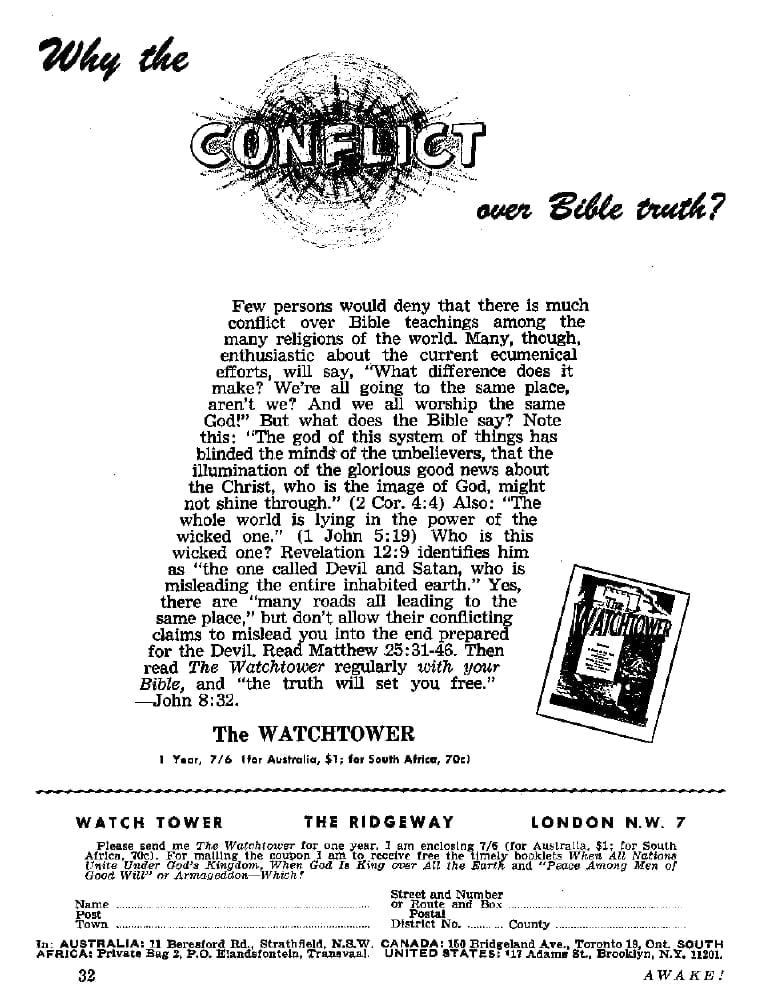
over Bible truth?
Few persons would deny that there is much conflict over Bible teachings among the many religions of the world. Many, though, enthusiastic about the current ecumenical efforts, will say, "What difference does it make? We're all going to the same place, aren't we? And we all worship the same God!" But what does the Bible say? Note this: "The god of this system of things has blinded the minds of the unbelievers, that the illumination of the glorious good news about the Christ, who is the image of God, might not shine through." (2 Cor. 4:4) Also: "The whole world is lying in the power of the wicked one." (1 John 5:19) Who is this wicked one? Revelation 12:9 identifies him as "the one called Devil and Satan, who is misleading the entire inhabited earth." Yes, there are "many roads all leading to the same place," but don't allow their conflicting claims to mislead you into the end prepared for the Devil. Read Matthew 25:31-46. Then read The Watchtower regularly with your Bible, and "the truth will set you free." —John 8:32.
The WATCHTOWER
1 Year, 7/6 (for Australia, $1; for South Africa, 70c)
WATCH TOWER
THE RIDGEWAY
LONDON N.W. 7
Please send me The Watchtower for one year. I am enclosing 1/7 (For Australia, $1; For South Africa, 70c). For mailing the coupon I am to receive free the timely booklets When All Nations Unite Under God's Kingdom, When God Is King over All the Earth and "Peace Among Men of Good Will" or Armageddon-Which.
Name
Post
Town
IN. AUSTRALIA: 11 Beresford St, Strathfield, N.S.W. CANADA: 164 Bridgeland Ave., Toronto 19, Ont. SOUTH
AFRICA: Private Bag 2, P.O. Eldonfieldton, Transvaal. UNITED STATES: 114 Adams St, Brooklyn, N.Y. N1201.
Religion and the Bible in Communist Russia PAGE 5
What Makes a Good Secretary?
PAGE 9
Manila and Its Quest for Peace
PAGE 12
The Chiropractor—Cultist or Curer?
PAGE 16
JANUARY 22, 1967
THE REASON FOR THIS MAGAZINE
News sources that are able to keep you awake to the vital issues at times must be unfettered by censorship and selfish interests. "Awake!" has no fetters. It recognizes facts, faces facts, is free to publish facts. It is not bound by political ties; it is unhampered by traditional creeds. This magazine keeps itself free, that it may speak freely to you. But it does not abuse its freedom. It maintains integrity to truth.
The viewpoint of "Awake! is not narrow, but is international. "Awake! has its own correspondents in scores of nations. Its articles are read in many lands, in many languages, by millions of persons.
In every issue "Awake!" presents vital topics on which you should be informed. It features penetrating articles on social conditions and offers sound counsel for meeting the problems of everyday life. Current news from every continent passes in quick review. Attention is focused on activities in the fields of government and commerce about which you should know. Straightforward discussions of religious issues alert you to matters of vital concern. Customs and people in many lands, the marvels of creation, practical sciences and points of human interest are all embraced in its coverage. "Awake!" provides wholesome, instructive reading for every member of the family.
"Awake!" pledges itself to righteous principles, to exposing hidden foes and subtle dangers, to championing freedom for all, to comforting mourners and strengthening those disheartened by the failures of a delinquent world, reflecting sure hope for the establishment of God's righteous new order in this generation.
Get acquainted with "Awake!" Keep awake by reading "Awake!"
PUBLISHED SIMULTANEOUSLY IN THE UNITED STATES BY THE WATCHTOWER BIBLE AND TRACT SOCIETY OF NEW YORK, INC. 117 Adams Street Brooklyn, N.Y. 11201, U.S.A.
WATCH TOWER BIBLE AND TRACT SOCIETY
Watch Tower House. The Ridgeway N. H. KNORK, President
Average printing each issue: 4,475,000
London N.W. 7, England GRANT SUITER, Secretary
4d a copy (Australia, 5c; South Africa, 3½c)
New Zealand, 821 New North Rd., Auckland S.W. 1 7/-
South Africa, Private Bag 2, P.O. Elandsfonteln, TvL 70c
Remittances for subscriptions should be sent to the office in your country. Otherwise send your remittance to Brooklyn. Notice of expiration is sent at least two issues before subscription expires.
Now published in 26 languages
Semimonthly - Afrikaans, Cebuano, Danish, Dutch, English,
Finnish, French, German, Greek, Hokie, Italian, Japanese,
Korean, Norwegian, Portuguese, Spanish, Swedish, Tagalog.
Zulu.
Monthly—Chinese, Chuyanja, Hiligaynon, Malayalam, Polish, Tamil, Ukrainian.
CHANGES OF ADDRESS should reach us thirty days before your moving date. Give us your old and new address (If possible, your old address label). Write Watch Tower, Watch Tower House, The Ridgeway, London N.W. 7, England.
Entered as second-class matter at Brooklyn, N.Y. Printed in England
The Bible translation regularly used in "Awake!" is the New World Translation of the Holy Scriptures, 1961 edition. When other translations are used, this is clearly marked.
CONTENTS
Friendliness Is Contagious 3
Religion and the Bible in Communist Russia 5
What Makes a Good Secretary? 9
Why So Precious? 11
Manila and Its Quest for Peace 12
The Syrian Bathhouse 15
The Chiropractor—Cultist or Curer? 16
Friday No Longer "Fish Day"
for Many Catholics 21
Wheat—That Versatile Cereal 23
Life Everlasting Book Appreciated 26
"Your Word Is Truth"
What Happened at Jesus' Trial? 27
Watching the World
Volume XLVIII
Number 2
Friendliness is contagious
WHEN someone leaving or entering a room holds the door open for you, how do you feel? When a person smiles and extends
his hand to shake yours, what is your response? What is your reaction when somebody says a nice thing about you?
Would any of the above gestures by another person make you angry? On the contrary, they are far more likely to make you glad. The usual reaction to friendly acts or words is a smile, a thank you, a kindly feeling toward the friendly
Such positive reactions are normal. They are the way most people respond to the quality of friendliness. By far the majority of humans appreciate a friendly person, like being around him and are made happier by his association. Truly, it is difficult to dislike a sincerely friendly person, unless it is out of jealousy. On the other hand, most people avoid an unfriendly person if they have a choice.
Friendliness brings out the better nature of other people. It tends to make them more friendly. Yes, friendliness is contagious!
An example showing that friendliness is
contagious was noted in the relatively unfriendly large-city atmosphere of New York. By being friendly, a token-booth employee of
the subway system was able to draw smiles and kind words out of even the usually sullen subway riders. A report in the New York Times of July 29 stated: "He says customers have always responded favorably to his courtesy and cheer. 'Some are taken aback at first,' he said, 'but after their initial surprise they take it for granted and are friendly back.'" The report concluded that friendliness, as practiced by this employee, "does seem to be contagious."
So much does such friendliness stand out in today's cold world that even the mayor of New York city was impressed when, by chance, he bought a subway token from the friendly employee. In fact, the mayor returned to thank him and later wrote a letter of commendation to the head of the Transit Authority!
Yes, even a normally gloomy attitude can often be improved when a friendly approach is used. It is just as the Bible said long ago: "Pleasant sayings are a honeycomb, sweet to the soul and a healing to the bones."—Prov.
16:24.
Where the situation is downright hostile, often the friendly attitude calms anger and soothes ruffled feelings. Notice, too, how the Bible comments on this fact: "An answer, when mild, turns away rage, but a word causing pain makes anger to come up." (Prov. 15:1) The friendly person does not add fuel to the fire, so it goes out. "Where there is no wood the fire goes out, and where there is no slanderer contention grows still."—Prov. 26:20.
No, it is not easy to be friendly in a generally unfriendly world. The truth of the matter is that the unfriendliness of mankind is becoming more pronounced. As time passes, violence, hatred, strife and prejudice increase. But this does not mean that individually we must imitate the worst in mankind. We can still be friendly and enjoy the many benefits it brings within the family circle, among our close friends and among those with whom we work. It makes sense not to return in kind the coldness and nastiness of others, because, if we do, then we will surely reap more of the same and increase the aggravation we bring upon ourselves.
There are those who think friendliness works for others, but not for them. Generally, these persons have not really tried it. To get a friendly reaction from others one must be friendly. If you sow friendliness, you will usually reap it. But if you do not, you will generally not receive it back from others.
Friendliness is so universal in its effects that it works on all sense-possessing creatures, even brute beasts. Yes, even animals respond much better to friendly persons than to those who are unfriendly. For instance, if a dog is spoken to harshly, will it wag its tail and come running happily toward its master? No, the opposite will
almost always occur. The dog will place its tail between its legs and edge away, perhaps growling and baring its teeth, on guard against the display of hostility. But let the master speak in a friendly voice, and it matters little what he says. The dog will respond with wagging tail and come running expectantly to its master. The gentle, friendly voice and manner, combined with a few friendly pats, provoke unbounded joy in the animal.
Yes, everyone can have friendliness work for him if he works at it, if he cultivates it. But we want to make certain we cultivate it with the proper motive in mind, and that is out of a love for our fellowman, not hypocritically, to work out some selfish scheme. Also, one should exercise care not to go to the other extreme and become overly friendly with members of the opposite sex who are not one's marriage mate or close relatives. This might be misunderstood, particularly by the wife or husband of the other person. Not only can it cause jealousy to spring up, but it can lead, and has led, to an improper relationship that results in the committing of immorality.
The right kind of friendliness, the kind that is genuine, from the heart, is a thing of beauty. It considers others, takes into account their moods and imperfections, and is willing to extend mercy. As it is written: "The insight of a man certainly slows down his anger, and it is beauty on his part to pass over transgression." (Prov. 19:11) The truly friendly person has an inward beauty. That is why those who practice friendliness are the most desirable associates. They are easy to get along with, do not promote strife, but contribute to the happiness of those with whom they come in contact. In addition, they encourage others to be friendly too, because friendliness is contagious.
in Communist Russia
FOR almost five decades now the Russian Communists have carried on a campaign against all religion. The last great push in their war against religion was inaugurated some three years ago. At that time a special dispatch to the New York Times (March 3, 1964) told that "the Communist party had announced a renewed campaign designed to eradicate religion from Soviet life . . . Soviet publications have conceded that despite years of active antireligious propaganda religious convictions remain widespread in all sections of the population, including those people who are supposed to be in the forefront of the drive against religion." And an Associated Press dispatch was headlined, "Soviets Anxious for Religion to Die—Open New Drive."—Tulsa Daily World, February 2, 1964.
But more recently it appears that the policy of the Russian government in regard to religion has undergone a change. Or perhaps it might be better stated that her tactics have changed. Thus the July 1966 issue of Soviet Life, an official Soviet English-language monthly, quotes Lenin, the "father" of the Russian revolution, as saying:
"There must be complete freedom not only to adhere to any faith but also to preach any faith or to change any faith. No official should have the right even to ask anyone about his religious belief; that is a matter of conscience, which no one has the right to inquire into. There must be no 'ruling' 'aith or church. All faiths and all churches must be equal before the law."
Soviet Life comments thereon: "Relations between the Soviet government and religious groups are based on
this principle of complete separation of church and state."
Why the Apparent Change of Policy?
What accounts for this apparent change in the position of the governing powers of Communist Russia in regard to religion? It could well be that, in spite of all the opposition by political factors, in spite of all the irreligious teachings of Marx, Darwin and Freud, and in spite of all the idolizing of science, the common people of Russia still find a basic need of religion, and that, if need be, even apart from their churches. If man were but a few steps removed from the apes, the Russian atheists would have been successful; but because, as the Bible shows, man was created in the image of God as regards his intellectual and moral qualities, men find it impossible to stamp out religion entirely.—Gen. 1:26-28.
In fact, Soviet authorities have become frustrated because their opposition to religion simply caused it to go underground, making it still more difficult to cope with. As one Soviet spokesman admitted: "It is true that there are no churches and no ministers in a large part of the Soviet Union.
But there are believers. If they are not Orthodox, they are members of one or another of the multitude of finely differentiated sects. . . . Closing a parish does not make atheists of believers. On the contrary, it strengthens the attraction of religion for people and it embitters their hearts besides."—New York Times, March 7, 1966.
That is why Soviet propagandists now advocate a more refined approach: "Long years of experience and practice in anti-religious work shows convincingly that naked, purely defamatory stereotyped lectures cannot overcome religion." In fact, Russian journalists were told: "We must all learn this truth well: the great majority of believers in our country are honest Soviet citizens, the same kind of toilers as we atheists are, and we should therefore treat them with respect."* However, it might well be asked, To what extent will this approach be adopted?
That previous methods of attacking religion have failed is apparent from the statistics coming out of Russia. In a poll taken in the model modern city of Shuya of some 40,000, not far from Moscow, 10 percent, openly declared themselves to be believers. This has the authorities concerned. Why? Because of its implications after almost fifty years of antireligious propaganda. What are those implications? If that many openly declare themselves as believers when the government is so opposed to religion, how many more must there be who are believers at heart but who lack the courage to identify themselves? And if that is the situation in a model modern city that is exposed to atheistic propaganda all the time, what must it be in the rural areas, which are not so exposed and which have ever been more religious?
It is not surprising, then, that for long the Soviet government refused to take any census as to the state of religion in her land. However, it seems that now she has done this and the situation is no cause for rejoicing on her part. Thus we read that, of Russia's 230 million inhabitants, 93 million are 'believers.' Of these, 50 million are Russian Orthodox, 24 million Moslems, 10 million Roman Catholics, 5 million Protestants, 3.5 million Jews and .5 million Buddhists. To which figures must be added, also some of Jehovah's witnesses.
More than One Inconsistency
In all of this, however, there appears to be more than one flaw, more than one inconsistency. Why quote the words of Lenin with approval and yet act so differently from the principles they enunciate? Lenin says that no one religion is to be supported by the State, but does not the Soviet government support a substitute for religion, namely, atheism, making it, in fact, a religion? It does serve in the place of a religion for many.
Proof of this can be seen in the efforts of atheistic propagandists to fit out atheism with the trappings of religion so as to make it serve as a substitute for religion. Thus we are told that 'an important part of the campaign against religion was to be a gradual introduction of nonreligious ceremonies for birth, coming of age, marriage and death.' But does atheism of itself need or require these ceremonies? Is not this an admission that atheism must be made a religion if it is to supplant other religions? And does this, then, not contradict Lenin's principle that the state is not to show any preference for one religion above another? Why establish an Institute for Scientific Atheism, as was done in recent years, if all religions are to be treated equally?
More than that, it appears that official sanction has been given only to certain leading religious organizations, such as the Russian Orthodox, Roman Catholic and Baptist. Why? According to all the evidence at hand, it is because these are willing to compromise, are willing to intersperse Communist propaganda in their religious services and publications. Does not having religious organizations serve as mouthpieces for Communistic ideology violate either the principle of separation of church and state or that of freedom of religion?
Certain smaller groups, such as Jehovah's witnesses, have been refused official sanction because of steadfastly refusing to compromise. They readily obey the Scriptural injunction, "Let every soul be in subjection to the superior authorities, for there is no authority except by God." But they realize that this subjection to the worldly "superior authorities" is relative, so when the "authorities" command something that is in violation of God's laws, Jehovah's witnesses invoke the Scriptural dictum: "We must obey God as ruler rather than men."—Rom. 13:1; Acts 5:29.
Fearful of the Bible and Bible-based Literature?
Another inconsistency is seen in the attitude of Soviet authorities toward the Bible and Bible-based literature. According to Soviet Life, "We cannot ban the conflict of ideologies. . . We respect people's rights to their religious beliefs, but we have even more respect for the power of scientific thought." But how powerful is this "scientific thought"? Is it powerful enough to defend itself against that powerful book, the Bible, the Word of Jehovah God? Apparently not!
True, Russia recently allowed to be published an edition of 100,000 of Biblical Stories, which, we are told, was sold out
in a few hours. But this edition of Bible stories was not without an epilogue in which the reader was warned against taking the Bible seriously as a historical document, although admitting that some of the account may well have been historical. Time, September 9, 1966.
Russia's real attitude toward the Bible can be gathered from the two incidents reported in Der Spiegel (The Mirror), German weekly news magazine, of August 8, 1966. One of these took place at the border town of Ljancheny, in the southwestern Russian province of Moldavia (Moldau). There two Bible lovers were detained forty-eight hours by the border officials. Why? Because the two had in their German automobile 215 Bibles in the Russian language. The Soviet border guards not only confiscated the Bibles but sent the two men back after releasing them. They were not welcome in Russia. Why did the border officials seize the Bibles? The report did not give their reasons.
But this report did give the reason why Soviet border guards refused to let Bibles in the Russian language enter in another instance. A married couple that wanted to bring Bibles into Russia at the border town of Brest, adjoining Poland, were stopped, the Bibles were seized and the couple were turned back. And what was the reason the border guards gave for this action? That Bibles are "literature dangerous to the security of the state." The Bible-based literature of the witnesses of Jehovah is also denied entry into Russia.
True, the Soviet government has gone far in liberalizing her opposition to religion, even as noted in the report on Russia appearing in the 1967 Yearbook of Jehovah's Witnesses: "The past service year has been one of great joy to the brothers. All those who years ago had been deported to Siberia on account of the truth and who were restricted from moving to some other region have been freed and were permitted to go to any place they liked within the country.
. . . The trend to a more tolerant attitude on the part of the authorities, which has been noticeable for the past few years, has continued to become more manifest. There have again been no new arrests or searchings of homes during the past year." Yet opposition to the Bible and Bible-based literature continues.
The Bible—Book of Truth and Power
In this matter it might be said that Soviet opposition to the Bible furnishes an answer to the professedly Christian theologians who speak of the "myths" of the Bible. What accounts for the strange power that these "myths" have so that one of the world's most powerful nations feels that it must protect itself against them?
The only explanation is that the Bible has power because it is the truth, even as Jesus Christ, the greatest Teacher of all time, testified when on earth: "Your word is truth." (John 17:17) It supplies Christians with weapons that "are not fleshly, but powerful by God for overturning strongly entrenched things . . . reasonings and every lofty thing raised up against the knowledge of God." (2 Cor. 10:4, 5) As Jehovah God's prophet long ago stated regarding the execution of God's Word: "Is not my word correspondingly like a fire, . . . and like a forge hammer that smashes the crag?"—Jer. 23:29.
Yes, it may seem strange that the Soviet government would ban the Bible's entry, but, then, perhaps it is not so strange. The Bible is truly a book that imparts power into people. It has a way of instilling into people strong convictions, a love for freedom to serve God, and it imbues people with a missionary zeal for a government that is far superior to anything that any of the ideologies of this
world can offer, namely, the kingdom of God. The Bible inspires men to give exclusive devotion to a personal God whose name is Jehovah, rather than to any manmade organization. Proof of this the witnesses of Jehovah provided in Russia during the great persecution under Stalin. Thus Walter Kolarz, an authority on modern Russia, in his book Religion in the Soviet Union had, among other things, the following to say about the Witnesses in Russia:
'No other group in Soviet Russia, whether of religious or political inspiration, has ever thought of embarking on such an extensive and illegal propaganda and publishing work. . . [They] take advantage . . . of every opportunity to advertise the kingdom of Jehovah. . . It is these beliefs which give the 'Witnesses' their moral and ideological strength."
Further testifying to the fact that the power of the Bible is greater than the vaunted "power of scientific thought" are two experiences reported on in the abovenamed Yearbook. One concerns a professor who, when lecturing to technical students, referred to Jehovah's witnesses and, among other things, stated that it was useless to try to convert them. Yes, atheistic ideology is powerless against a faith based on accurate knowledge of the Bible. (Eph. 6:16) But the truth of the Bible is not powerless against atheism, as can be seen from the other Yearbook report telling of an instance in which a Communist not only failed in his efforts to convert a certain Witness but in the end became a witness of Jehovah himself.
It will indeed be of interest to watch whether Communist Russia will continue to give ever more freedom to religion and so act fully and consistently in line with the principles enunciated by Lenin by also letting Bibles and Bible-based literature freely enter her territory.
AVE you met my secretary?" "Why, she's like my right arm." "I don't
know what I'd do without her." Is that how your employer describes you to others? If not, think back. When last did you review your duties, question your attitude and look over your shoulder at some of your work habits? If not recently, why not take a look now in a figurative mirror to see how you compare with those skilled in the field and where there might be room for improvement.
Specific Duties and Skills
Since a secretary's duties are varied and numerous, one might ask, Just what is it that makes
one good and another mediocre? She must, first of all, be a capable stenographer, taking dictation between 100-120 words per minute; a fast and accurate typist, typing between 60-80 words per minute; a good speller; have a good working knowledge of language, including business terminology; be able to take orders and work under pressure. But that is just the beginning.
Specifically, a secretary is required to open and refer mail, compose correspondence, operate various office machines, make appointments, arrange travel schedules and accommodations, perform bookkeeping tasks, handle telephone and personal inquiries and numerous other chores. If she is an executive secretary, she is called upon to supervise and handle people, delegate authority, make decisions, think creatively and organize her time and that of others. Hard work is entailed and, sometimes, long hours, but it has its rewards besides her salary. It is satisfying to the secretary to know that, because of her competence, her employer is relieved
of routine work to devote his time to the more complicated aspects of his business.
To stand head and shoulders above the rest, however, a secretary must have more than ability. She must have something extra. It may be in certain qualities, such as being personable but not flashy, intelligent without being overbearing, poised yet not conceited. Or it may be her endless supply of good humor, her talent for details and the good judgment she uses. She needs to be patient, friendly, have a pleasant and cheerful manner and always be well groomed. But let us look further.
The Right Attitude—All-Important
A secretary can be skilled and perform her duties well enough, but her attitude toward her job and especially her employer can really be the key to success. How about you? Do you really like your job?
Are you as enthusiastic now as when first employed? That is usually one of the qualities employers look for in hiring a secretary—her enthusiasm. How you feel about your job will reveal itself in how careful or careless you are about details, whether you accept jobs eagerly or seek to pass them off on others, whether you do extra work uncomplainingly or always play the martyr when an emergency arises.
Dependability is another desirable asset. Are you as punctual in the morning as you were during the first weeks on the job? Can you be depended upon to finish what you start or are you a clock watcher? When the hands of the clock indicate the end of working hours, do you close up shop regardless of what is undone? When raises or promotions are given, the ones passed over are usually the latecomers, those who go home early and the long-lunch-hour offenders.
The better secretaries remain so because they keep learning. They are not afraid to admit they do not know everything. They keep their mind, eyes and ears open, ask questions and learn from the answers. Do you do similarly? Do you stay abreast with the new trends? Do you seek ways to improve your stenography and typing? You will if you have the right attitude.
Having the right attitude is also important if one is to remain humble despite one's position. A really humble secretary does not think more of herself than is necessary. She usually gets along well with her co-workers and is not above helping out even when it is not her job. She is always courteous, appreciative, and she never talks "down" to others.
She is also organized, doing one thing at a time for best results. She takes notes and follows through on them, letting them work for her. She checks her own work,
not relying on others to catch her mistakes. Realizing that her job depends upon how neat and accurate she is, she keeps erasures at a minimum. She is productionminded, since she knows that the more she produces, the more valuable she is to her firm. This prevents her from wasting the firm's time in making too many personal telephone calls, desk hopping with the latest gossip and other such habits indulged in by some.
Working with One's Employer
If having the right attitude about one's job can be likened to a key, the proper attitude toward one's employer might be likened to a lock-a combination to get the work done.
For a secretary to work well with her employer, she must understand him. She observes his moods and reacts to them. She learns when to question and probe and when to wait for the answers. She finds out how he likes things done, by watching and listening to him. It might be noted here that there are really two kinds of listeners: the passive, who appears to be listening but is not; and the active, who appears to be and really is. Employers truly appreciate "listening" secretaries, for valuable time is not wasted in repeating instructions.
Webster's dictionary defines a secretary as "one entrusted with the secrets or confidences of a superior," for she must keep information in strict confidence. Another thing she must learn to keep, in relation to her employer, is her place. He is the captain of their ship, and she does well to remember it. She must be willing to work behind the scenes unobtrusively, seeking to complement, not compete with him. She does not expose his errors or mistakes just to clear herself. She welcomes constructive criticism and may even have to absorb blame at times to better their relationship.
When she does make a mistake, she openly admits it, since nothing undermines an employer's opinion of her more than to find out something she should have told him herself. Besides, it is the honest thing to do.
As they work together, she will be able in time to anticipate his needs. This is where a really good secretary stands out. Let us look in on one now and observe how she functions.
A letter comes in the mail requesting information on a certain report. She goes to the file, pulls out the report, reads it and is then able to discuss it with him. If she knows that he prefers to read it himself, she places the report under the inquiring letter and puts a pad along with it so that when he reads the letter, he is able immediately to consult the report and make notes on the pad, thus drafting his answer then and there. How timesaving and practical that procedure is! Using this principle throughout, she works not only for him but with him. No wonder her boss considers her like a right arm.
Another quality admired in a secretary is thoughtfulness. A thoughtful secretary does so many little things to brighten her employer's day: Her cheerful "good morning" sets the pace; his pencils are sharpened before he asks; she reminds him of appointments and things to be done, without nagging; files are brought out when needed and put away when finished with. His desk is kept neat, if he likes it that way. If he prefers his desk left alone, her motto is "Hands off." He will appreciate it. She discourages interruptions when he needs quiet to concentrate, and she seems
to know just when he needs a humorous story to relieve the tension. In fact, she feels that he should not have to do anything she can do for him. And, while this is commendable, she must be careful that she does not become bossy or domineering. Some secretaries take their roles so seriously that they fail to control any urge to take charge or try to change their employer, only to find they lose their jobs as a result.
Flexibility aids in getting the work done in the most efficient way. If a secretary finds her energy dwindling as the day proceeds, she wisely arranges to do the most demanding and taxing jobs early in the day when her energy is at its peak, leaving the routine tasks, such as filing, tidying up, and so forth, for the end of the day. If her peak of energy is in the late afternoon, the procedure is reversed.
A secretary who is flexible is considered a real gem. In emergencies she works like a beaver and then shifts back to her normal pace when the crisis is over. She is also able to work without supervision, and when problems arise, she uses initiative in solving them. What employer does not appreciate a secretary who can keep calm during emergencies and at the same time get things done?
After peering into that figurative mirror, we have seen many things that contribute to making a secretary effective and valuable. How have you rated yourself? Are there any bad habits or wrong attitudes that you would like to correct or skills you would like to improve? Then why not start now?
Why So Precious?
Gold is a precious metal not only because of its desirable properties but also because of its comparative scarcity. Did you know that all the gold mined in the United States since 1492 would not even make a fifty-foot cube?
AND ITS QUEST FOR PEACE
By "Awake!" correspondent in the Philippines
THE eyes of the world were recently focused on Manila as the site of a seven-nation summit conference to discuss the problems of finding peace in Vietnam. It is interesting to note what the reaction is here after the Manila Summit conference. What is said here about the conference and its official communiqué may well be quite different from the way it is presented in other lands.
Summit took a step in this direction only to fall back before the overwhelming fact of the US participation whose views were reflected in the stand of most of the delegates."
For instance, an editorial in The Daily Mirror of Manila said right after the conference: 'The concept of 'Asians solving Asian problems' has yet to be implemented. The Manila
That same newspaper, on another day, published an editorial under the heading "Marcos' Hard Fight at the Manila Summit," and said concerning Philippine President Ferdinand Marcos: "Mr. Marcos did his level best to keep the Summit from turning into a war council. If he was unable to do more he at least kept it from looking like one in the communique. . . In the face of overwhelming odds, Mr. Marcos' meager success in imposing his own conception of the conference is a considerable achievement indeed. He was virtually alone, with the other Asian participants taking the hard line, Australia and New Zealand taking a harder line than before after Mr. Johnson visited them on his way to the Summit, and the US pounding the table for more and more troops."
Also in its column entitled "In the News," under the heading "Summit Net Gains," The Daily Mirror said: "Results of the summit how close to stated expectations of unbiased observers—more of a show of solidarity on the part of one side in the Vietnam war rather than a gesture that would make Hanoi seriously consider giving a response to invitations to come to the conference table. This conclusion is inescapable in the reading of the joint communique issued by the seven nations which participated in the Manila Conference, a meeting that was dominated through and through by US influence."
There is strong feeling here in Manila that the war in Vietnam should not be enlarged, an editorial in the Manila Times saying: "Our people have always been with their president from the start of the holding of the Manila Conference. But only because of faith in his assurance that he would dissociate us from any proposal to enlarge the war."
Why are the people of Manila and the Philippines so keenly desirous of being dissociated from "any proposal to enlarge the war"? A look at Manila's history and its quest for peace helps us to understand.
Some 400 years ago the site recently used for the Summit conference was only a native village. Rajah Suliman was the chieftain over a large village of nipa huts sprawled at the mouth of the lazy Pasig River. A bamboo palisade faced the thick mangroves and the sea as protection from pirate raids and, while torches flared in the night, the mournful tu-ko! of the big lizards kept his sentries company. The raids were sporadic. There was much time to trade with the Chinese for their silks, with the East Indians for their cargoes of spice, with Malays and Indonesians for their pottery and metalware.
Foreign aggression? Not much. Pirates from Mindanao did not stay long. The Rajah's little army, armed with bows and arrows, bamboo spears and lantakas or small cannon, was equal to the task of defense. But it was a totally different raider that struck at his people in 1571.
Spanish and American Rule
They came in large wooden ships—men armed with muskets and large cannon from halfway across the globe under the leadership of Miguel López de Legaspi (Legazpe), Spain's commander on this Asian expedition. Five years before, he had set up his headquarters in Cebu to the south, but he was dissatisfied with the site. He struck Maynilad, effectively crushed all resistance and moved on to expand the conquest to the entire island of Luzon.
Legaspi decreed that Manila would henceforth be the capital of the territories. Thus Manila was born as a city and for four centuries was the official capital of the country now known as the Republic of the Philippines.
Rajah Suliman, had he lived to this day, would have quite a story to tell his great-great-grandchildren in 1967. His seamed, coffee-brown face would grow sad as he
tells how the Spaniards destroyed every trace of Tagalog literature, art and craftsmanship; how infants were baptized at swords' points, with the blessing of the Spanish clergy. There was freedom of religion, but only for Catholics. Illiteracy was encouraged, much learning discouraged. Forced labor was the rule. Stifling of freedom came to a head in the late nineteenth century in a rebellion that almost toppled Spanish power in the Philippines.
Manila came under British rule for about six months, from October 1762 to February 1763. Perhaps had they known how valuable Manila would come to be much later on, they would not have given up the site to Spain so easily at the Treaty of Paris in 1763. From this date to 1898, Manila and, of course, the Philippines were completely under Spanish rule. For some 330 years the people had little time to enjoy the sunsets at Manila Bay.
In 1898 the Americans came, under Commodore George Dewey, crushing Admiral Montojo and his Spanish fleet at Manila Bay, though not one American sailor was killed in action. Aided by 20,000 troops under General Westley Merrit, Dewey took Manila easily. The Filipinos expected that the Americans would go home after the brief war with Spain, but they were disappointed. Afraid that the islands would fall to either Japan or Germany if they left, the Americans decided to stay.
The Japanese Occupation
The sun nearly set for good on Manila during the second world war. On December 8, 1941 (Manila Time), simultaneous with the bombing of Pearl Harbor, the Japanese bombed Clark Field, Cavite City and other military establishments, and the war over southeast Asia was on. Manila was declared an open city and the fighting raged elsewhere on Corregidor Island at the entrance to Manila Bay and on the Bataan peninsula.
For four years the city lived in fear. When the war ended, about a million men and women had perished throughout the country, in Japanese garrisons and in guerrilla fighting. Towns were razed, people were massacred as General Yamashita's troops retreated. But it was Manila that bore the brunt of
the bloodiest fighting of the war as the American troops, with the help of the guerrillas, took the houses one by one, street by street, with rifle, bayonet and
retaken, there was the smell of death in every street. It was not unusual to stumble upon a severed foot, arm or head as one walked through the ruins. Manila was battered, bruised and bleeding, only one-fifth alive. It received one of the worst poundings of any city during the second world war. Independence finally came in 1946.
COMING IN THE NEXT ISSUE
Since Manila knew the scourge of war
For Whom Do You Pray?
The Church in Commercial Business.
grenade, from the outnumbered but tenacious enemy.
Ten Thousand Miles on a Raft.
Today there are still reminders of the war. In a hydrofoil boat we speed across the bay to Corregidor Island. We climb its rocky sides and walk through its tunnels. The long guns are silent now, but, at the start of hostilities, they prevented the Japanese fleet for four and a half months from entering the bay. Military men claim that the action here upset the Japanese timetable for the conquest of southeast Asia by half a year. It gave MacArthur and his forces time to regroup and fight back.
How Dangerous Are Tumors?
Over there is Fort Santiago, where José Rizal, the national hero and author of a novel exposing the Spanish priests in his native islands, spent his last few hours. He was executed by a firing squad on December 30, 1896, at Bagumbayan, now the magnificent Luneta Park. During the Japanese occupation hundreds died in Fort Santiago. One almost hears the screams of dying men echoing through the dark corridors while tortured by the secret police called Kempei-tai.
In the early months after Manila was
as few other cities perhaps one can better understand the Philippine attitude toward the Manila Conference and the way many in Manila interpret the communiqué. For instance, an item in The Daily Mirror of Manila said:
"The communique also shows that efforts of President Marcos to infuse a somewhat soft tone in the conference got steamrollered to nowhere by the hawks who prevailed throughout. In plain language, the communique could read this way: 'Now hear this, you guys in Hanoi, we folks are still in the mood to talk peace but if it's still fight you want, that's what you'll get and plenty more!' Whatever 'peace' atmosphere there was at the start of the conference immediately vanished when General Westmoreland, commander-in-chief of the almost half a million American troops in Vietnam, briefed the conferees on military gains, with the recommendation that more troops are needed to preserve these gains and achieve some more."
Does this sound like the way the matter was reported in the land where you live? If not, then perhaps it helps you to realize that the news does not read the same everywhere. It is frequently slanted quite strongly toward the viewpoint of the ones in power.
The Syrian Bathhouse
By "Awakel" correspondent in Syria
FOR persons who are accustomed to private bathrooms in their homes a visit to a Syrian bathhouse is an unforgettable experience. When people in Aleppo, Syria, go to one of the nine or ten bathhouses in their city for a weekly bath, they go with the intention of staying for several hours or perhaps an entire day. So they pack a lunch. Along with the lunch they take soap, towels, a silver bowl, slippers, a sleeveless smock, a piece of rough wool shaped into what looks like a pocket and a bucket of soft brown clay. Ten or twelve kilos of clay can be bought for twenty-five plasters, or seven cents in American money.
A bathhouse is open twenty-four hours a day, with separate days for men and women. As you pass through the entrance of one, you will note that it is an old one-story building with a dome top. In the entrance room you see a woman collecting the fee from those who are coming out. On both sides of the big, stone, hall-like room are wooden benches, where women and children are sitting wrapped in towels, eating their lunches. In the center of the room is a tap with fresh drinking water running from it continuously. Troughlike grooves in the floor carry the waste water into the main drains of the bathhouse.
A woman entering this bathhouse will pick a spot in this room to change into her smock and put on her slippers. Leaving everything else there but her money, bucket of clay, silver bowl, soap, wool and comb; she goes into an inside waiting room. It is semihot, and its domed ceiling has air holes that allow fresh air to enter the room. Here she can sit on a warm stone before entering and after leaving the room where the bath is.
in the center that has taps pouring hot and cold water into it. Talking by the many people in the room makes it a rather noisy place. Around the basin, bathers sit on the floor and dip water out of the basin with their silver bowls and pour it over themselves. A fire in the cellar of the building heats the water as well as the building.
From this waiting room she goes through a narrow door into the hot bathroom. It is a large, salonlike room with a round stone basin
In one of the somewhat private rooms off this main one, there may be only seven or eight women sitting around two basins of water. Here a person can take the clay she brought along and rub it on her hair. Before leaving home she dampened it, and now she works it a little with her fingers so as to get rid of the lumps. Taking a few handfuls, she rubs it into her hair and then combs the clay through it. This cleans the hair, leaving it soft and manageable. She then dips water out of the basin and pours it repeatedly over her hair.
If she finds that the room is becoming too warm for her, she can go out to the waiting room to cool off and to get some fresh air. Then she can return for the next bathing procedure.
Taking the piece of rough wool, she rubs it over her entire body, washing each section after rubbing it so that the loosened, dead skin does not cling to her. This makes her feel as if she has had a massage. Her skin glows. Now she uses the soap she brought along and then rinses herself off.
If she wants to treat her hair with henna, a woman in the outer room of the bathhouse will accommodate her for a small fee of fifty plasters, or twelve American cents. Henna comes from an oriental shrub and is used to dye hair a reddish color. The powder is made into a paste and the woman rubs it into her customer's hair, where it is left for one to three hours.
By the time a woman finishes with her bathing procedure and socializing, several hours have passed. She feels tired but relaxed. Before going home she eats her lunch, which is likely to consist of a piece of round, flat bread and melted cheese. The price of the bath is only forty piasters, or about ten American cents. Unusual as a community bathhouse may be to persons from other countries, it holds an important place in the community life of Aleppo.
The Chiropractor
CULTIST OR CURER ?
</div>
HAVE you ever called at the office of a chiropractor because of some bodily ill? If so, then you know that, after having diagnosed your case, he will neither write out a prescription to be filled at the corner drugstore nor will he recommend that he perform some major or minor surgery to bring you relief. Rather, he will, if he feels your case comes within his domain, recommend giving you a chiropractic adjustment, that is, a manipulation of your spine by means of his hands.
The very name "chiropractic" means "effected by hand," and this name goes back some seventy years to its founder D. D. Palmer. However, there is reason to believe that manipulation of the spine in the interest of health goes back thousands of years. Ancient Egyptians, Chinese, Hindus and Greeks appear to have been familiar with it, even as K. Ligeros, Ph.D., M.D., shows in his interesting book How Ancient Therapeutics Governs Modern Healing. According to him, "Hippocrates was the natural scientific founder of rachiotherapy [spinal therapy] and spinal mechanics even as he is universally acknowledged to be the father of general medicine and the healing arts." He quotes Hippocrates as saying, among other things: "Nature tries to bring these irregularities to a normal state, and the physician must know thoroughly their primary
cause. . . All the physician can do for the patient is to give Nature a chance, to remove by proper regimen all that may hinder Nature in her beneficent work."
Opposition to Chiropractors
Chiropractors have met up with much opposition on the part of the medical profession. After many years of opposition in the United States, where they had their beginning and where the vast majority of them practice, they are being legally recognized in all but the two states of Louisiana and Mississippi. Chiropractors are recognized in many other countries, such as Canada, Mexico, Bolivia, Australia, New Zealand and Switzerland; and in many other lands, such as Great Britain, France and Germany, they are not interfered with so long as they practice solely chiropractic, even though not officially licensed. In fact, chiropractic has become the largest drugless healing specialty. In the United States chiropractors are being given ever more recognition by insurance and other business corporations and by governmental agencies.
Generally, it is the leaders in organized medicine rather than the rank and file of medical practitioners that oppose chiropractic. Representative is the attitude taken by Dr. Marc Trudel, president of Quebec College of Physicians and Surgeons.
According to him, 'No scientific basis has ever been found for chiropractic,' and it is "impossible to compromise with error."
In the same vein a vice-president of the American Medical Association once stated: "Chiropractic is not based on sound scientific principles. The medical profession regards chiropractic as a cult." What is a cult? "A system for the cure of disease based on the dogma, tenets or principles set forth by its promulgator to the exclusion of scientific experience or demonstration."—Webster.
Why the Opposition?
Why is chiropractic termed unscientific, an error and a cult? Could it be that some have failed to examine it dispassionately, and so speak from prejudice or ignorance? That this could well be can be seen from the statement of one professor of neurology: "I am not well acquainted with the views of the chiropractor, but it does not seem reasonable to me as a theory and I believe that there are no facts to support the idea that disease may be caused by irritation or pressure on spinal nerve roots."
That professional prejudice might be a factor is indicated by orthopedist John M. Mennell. He counsels doctors that under certain circumstances "I think you are justified in asking a well-trained manipulator, whoever he may be, to treat your patient for that specific complaint, just as you would ask . . . a pharmacist to make up a prescription. . . Do not deprive your patients of relief from pain because of your prejudice."1
Not that the blame rests wholly on one side; both sides appear to have erred in times past, even as noted by a team of German doctors, led by Dr. L. Zuschwerdt, full professor of surgery at the University of Hamburg: "A kind of battle between medicine and chiropractic had arisen which, on both sides, was waged
with sectarian intolerance and with beliefs more than with factual truth." This, he tells, was caused by "misunderstandings that had their origin in earlier exchanges between medicine and chiropractic, but also sometimes by the very aggressive language of the chiropractors."2
Oversimplified, the issue might be put this way: The chiropractors said: "Look what we've found! We can cure everything!" And the medical profession replied: "What do you know about medicine? How can you cure anything?"
The Chiropractic Philosophy or Viewpoint
Not that chiropractic views health and disease in the same way that regular medicine does. There is what might be said to be a philosophical difference that can be illustrated by a true-life incident: The wife of the dean of a chiropractic school had a sudden attack of appendicitis one night and wisely her husband called in a medical doctor who, in turn, called in a colleague to verify his diagnosis, and all agreed on an operation the following morning. But in the meantime the dean treated his wife with chiropractic adjustments and cold compresses, with the result that the next morning the operation was no longer necessary. Not only had the pain and tenderness disappeared from the right side but the number of white corpuscles in the blood was back to normal.*
In discussing this incident, which happened years ago, the dean, now a dean emeritus, noted that it served to underscore the basic difference in approach to health and disease. Chiropractic relies heavily on the innate wisdom of the human organism and its inherent powers.
Chiropractic endeavors to aid the body so that it is able to do the most that it can possibly do for itself, thus agreeing with Hippocrates. It feels that the orthodox medical approach often serves merely to remove or conceal symptoms rather than getting at basic causes.
Not that more drastic measures may not at times be necessary; but when time permits, as in this instance, it is well to try to aid the body to mend itself before resorting to drugs or the knife. Modestly a modern chiropractor has a sign in his office reading: "Chiropractic Cannot Do Everything; But What It Can Do It Does Well."
In this respect chiropractic might be said to be more or less in line with the old French proverb: "There are no diseases, only sick people." It also finds itself in harmony with the late noted physician, Sir William Osler, when, writing on Louis Pasteur's role in the progress of medicine in the nineteenth century, he said: "We learned to trust Nature more and drugs less. Much treatment was and still is irrational."
Body Mechanics and the Spine
Basic to appreciating the nature of chiropractic and why it can cure is a recognition of the fact that "the human body may be looked upon as a machine, with all its various parts so closely interrelated that any one part may do its share in compensating for the failure of some other part." (Because of the body's being unified by the circulatory and nervous systems chiropractic holds that the converse is also true, namely, that failure of one part can adversely affect another part.) That physicians have tended to slight this basic truth is testified to by orthopedists Magnuson and Coulter: "Unless the medical profession wakes up to the fact that our bodies are built upon mechanical principles and that many things we have groped in the dark about are due to a mechanical fault . . . we are doing our patients a grave injustice, neglecting our duties as physicians."6
Why are body mechanics so important? Primarily because the spinal column houses the marvelous spinal cord, second only to the brain in complexity and importance.* From between the vertebrae of the spine extend thirty-one pairs of nerves for sending and receiving messages to and from all parts of the body.
Because of the importance of the spine and good body mechanics to health, the chiropractor emphasizes the value of good posture. He is inclined to agree with Drs. Meyerding and Pollack, Mayo Clinic orthopedists, when they said:
"Poor posture, whether it is the result of bad habits or the result of organic defect, if maintained for a long time, will result in structural changes, lessen muscular tone and pulmonary [lung] efficiency. Impaired oxygenation of the tissues and still further lowering of muscular tone will establish a vicious circle, the results of which are lowered resistance to disease, predisposition to the occurrence of," among many other ills, "anemia, ill health, and chronic backache. The importance of correcting minor faults in body mechanics in their early stages cannot be overemphasized. We are convinced from the examination of a great number of patients, that much of the backache with which one is confronted in general practice is the result of poor postural habits in youth."
Deviations or 'Subluxations' and the Ruptured Disc
Basic also to the position of the chiropractor is that the joints of the spine are liable to slight subluxations or deviations. These may result for any number of reasons, such as when the body receives a jolt in an accident or when a woman twists her back when taking off a dress over her head. As orthopedist J. A. Pinegree noted in arguing for correcting certain curvatures of the spine by manipulation: "In a normal spine it is possible even by a very slight pressure to push one or several vertebrae out of normal relation with another."
Thus Dr. James P. Warbasse, in his great work Surgical Treatment, Vol. 1, p. 577 (1937), says: "Subluxations of vertebrae occur in all parts of the spine and in all degrees. When the dislocation is so slight as not to affect the spinal cord, it will still produce disturbances in the spinal nerves, passing off through the spinal foramina" or channels. "The value of manipulative procedures has not been fully appreciated."
Such subluxations at times result in the 'ruptured disc' because of a shearing stress upon the disc, a frequent cause of back pain. These discs, which act as cushions between the bony vertebrae, at times lose their supportive power and sag backward into the canal containing the spinal cord, a portion of the inner softer material of the disc escapes, causing the two vertebrae on each side of it to come closer together. It is easy to see what follows in such cases: irritation of the spinal nerves if not also interruption of the nerve force.
according to one Swiss surgeon, 'the number of one's candidates for operations decreases in proportion to the inclusion of manipulation among other conservative measures.'
In times past there has been an eagerness on the part of orthopedists to attribute back pain to ruptured discs and to operate. Today, however, more and more leading orthopedists recommend conservative treatment, at least to begin with. And,
Cause of Many Ills Removed by Manipulation
That spinal manipulation can bring relief from backaches is readily seen from the foregoing, but that is by no means all the good they can do, even as testified to by Neville T. Ussher, M.D. He reports curing ever so many cases involving a great variety of internal ills by means of manipulation, most of which failed to respond to regular medical treatment. Writing in Annals of Internal Medicine, May 1940 (p. 2087), he says, among other things: "The typical reaction is expressed by the common question: 'Doctor, why do you pay so much attention to my back when it is my stomach that is hurting me?' "
In a similar vein orthopedists Kerr and Lagen report: "About one-third of all the patients referred to us for supposed [heart] pain have their symptoms on the basis of a spinal condition in the [chest] region. Many patients are treated for pain of suspected cardiac origin and are subjected to the anxiety which such an interpretation [heart trouble] connotes. . . The 'spinal adjuster' sees many of these patients, and frequently after relief is not forthcoming from general practitioners and specialists."10
Thus also one of England's leading orthopedists, James Mennell, M.D., M.A., once wrote: "It is indisputable that the testimony is overwhelming that countless patients have derived relief from aches and pains of a great variety as a result of manipulation of the joints of the back. This is only what we should expect, once we realize that the joints in question are just as much joints in every detail as are those of the extremities.
The only difference is that, from the very nature of their shape and movement and the stresses that are laid upon them, they are more liable to 'lock' with the creation of a 'lesion.' Local pain would thus be caused, and relief would reasonably be expected to follow manipulative treatment if properly applied in suitable cases. . . . It is thus that many patients claim, and quite rightly, the cure of widespread symptoms as the result of spinal manipulation."11
…