Awake!, February 22, 1966
Download: PDF — Awake!, February 22, 1966
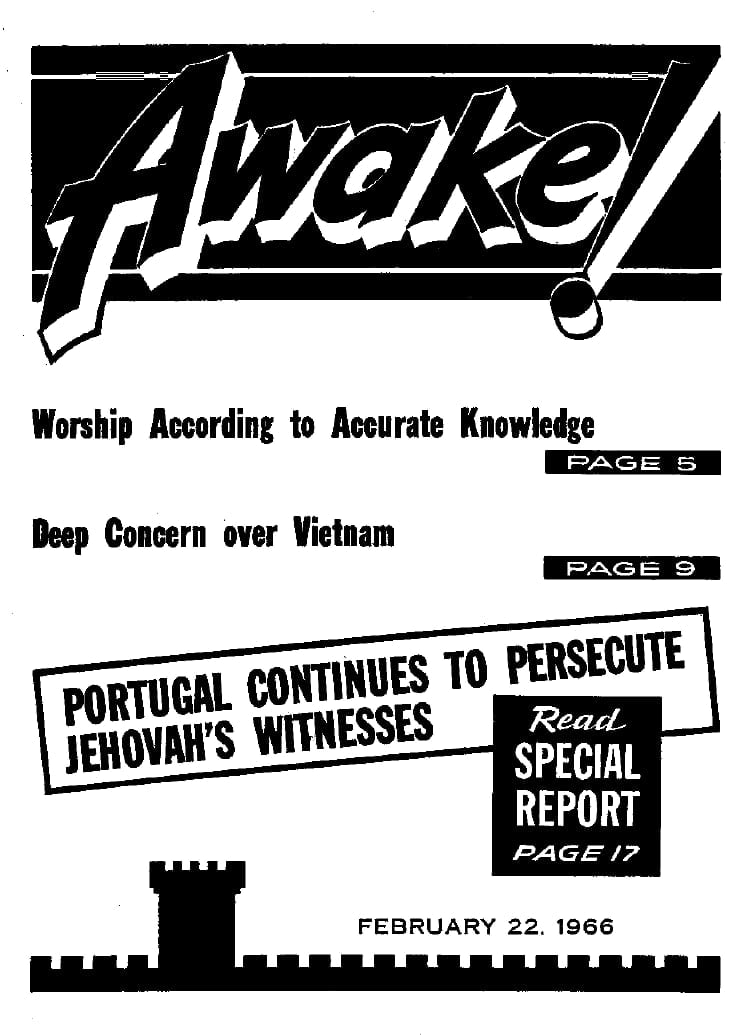
Worship According to Accurate Knowledge PAGE 5
Deep Concern over Vietnam
PAGE 9
PORTUGAL CONTINUES TO PERSECUTE JEHOVAH'S WITNESSES Read SPECIAL
Read
SPECIAL
REPORT
PAGE 17
FEBRUARY 22.1966
THE REASON FOR THIS MAGAZINE
News sources that are able to keep you awake to the vital issues of our times must be unfettered by censorship and selfish interests. "Awakel!" has no fetters. It recognizes facts, faces facts, is free to publish facts. It is not bound by political ties; it is unhampered by traditional creeds. This magazine keeps itself free, that it may speak freely to you. But it does not abuse its freedom. It maintains integrity to truth.
The viewpoint of "Awake!" is not narrow, but is international. "Awake!" has its own correspondents in scores of nations. Its articles are read in many lands, in many languages, by millions of persons.
In every issue "Awakel" presents vital topics on which you should be informed. It features penetrating articles on social conditions and offers sound counsel for meeting the problems of everyday life. Current news from every continent passes in quick review. Attention is focused on activities in the fields of government and commerce about which you should know. Straightforward discussions of religious issues alert you to matters of vital concern. Customs and people in many lands, the marvels of creation, practical sciences and points of human interest are all embraced in its coverage. "Awakel" provides wholesome, instructive reading for every member of the family.
"Awakel" pledges itself to righteous principles, to exposing hidden foes and subtle dangers, to championing freedom for all, to comforting mourners and strengthening those disheartened by the failures of a delinquent world, reflecting sure hope for the establishment of God's righteous new order in this generation.
Get acquainted with "Awake!" Keep awake by reading "Awake!"
PUBLISHED SIMULTANEOUSLY IN THE UNITED STATES BY THE
WATCHTOWER BIBLE AND TRACT SOCIETY OF NEW YORK, INC.
117 Adams Street
BROOKLYN, N.Y. 11201. U.S.A.
AND IN ENGLAND
WATCH TOWER BIBLE AND TRACT SOCIETY
Watch Tower House, The Ridgeway
N. H. KNOWE, President
GRAND TOWER, Secretary
Printing this issue: 4,450,000
4d a copy (Australia, 5d; South Africa, 3½c)
48 a.m. copy. (Austinville, S. South Africa). Weekly subscription rates
America, U.S., 117 Adelaide Street, Brisbane, 13011
America, U.S., 114 Broadway Bc, Brisbane, N.S.W.
Canada, 180 Bridgeway Bc, Tweedie Bc, Onl
New Zealand, 213 New Bristol Bc, Auckland B. 2
South Africa, Private suite, Belfast Bc, 70
Britannia (for subscriptions should be sent to the office in your country) send your subscriptions to Bristol.
In sent at least two images before subscription expires.
Now published in 26 languages
Sintenesthly-Afrikaans, German, Danish, Dutch, English,
French, German, Greek, Dutch, Italian, Japanese,
Korean, Navanian, Portuguese, English, Spanish, Tagalog,
Middle-Chinese, Cilugah, Hillewood, Malaysian, Polish,
Jawal, Urbanian.
CHANGES OF ADDRESS should reach us thirty days before your mailing date. CMU us your old and new address. Call us at 212-555-1234. Welcome to Walters Town, Walters Town Mesa, The Ridgeway, London N.W. 7. England.
Entered as second-class matter at Brooklyn, N. R. Printed in England
The Bible translation regularly used in "Awaken" is the New World translation of the Holy Scriptures, 1962 edition. When other translations are used, this is clearly marked.
CONTENTS
Do You Really Want Truthful Answers? 3
Worship According to Accurate Knowledge 5
Deep Concern over Vietnam 9
Ancient Mayan Religion 13
Portugal Continues to Persecute
Jehovah's Witnesses 17
Witnesses Imprisoned 18
Interview with Minister of
Foreign Affairs 19
Physical Abuse 20
Government Members Advised 21
Police Raids 23
Overseas Province 24
Fair-minded People 25
State Produces Accusation 26
Why the Persecution? 27
Bible Accuracy in Incidental Detalls 28
Watching the World 29
Volume XLVII
Number 4
WHEN you ask your marriage mate or a friend for an opinion, do you really want an honest reply? Will you give the opinion careful consideration, even though it differs from your own ideas? You are wise if you do.
DO YOU Really Want TRUTHFUL ANSWERS?
Of course, we have all met persons devoid of principle who will, without hesitation, state untruths in order to please an inquirer. Some salesmen, when questioned by a prospective customer, will respond in any way they think necessary in order to sell their product. The victims of such dishonesty are understandably disgusted when they find out what has happened. They want to know the truth about products they are about to buy. But do they always want truthful answers?
Frankly, many questions are motivated by the desire to receive support for a decision already made. A matter has been considered and the course of action decided; then the person asks, 'Do you think I should do this?' For instance, the Bible says that, when King Ahab of ancient Israel determined to embark on a military offensive against Ramoth-gilead, he consulted four hundred false prophets as to the advisability of the campaign. Those servile impostors replied that he would have success. However, at the suggestion
that Ahab inquire of Micaiah, a true prophet of Jehovah God, the king complained: "He does not prophesy good things concerning me but bad." —1 Ki. 22:8.
After Ahab finally asked Micaiah and received a prophecy of calamity, he whined: "Did I not say to you, 'He will prophesy concerning me, not good things, but bad?'" Obviously, that wicked king did not want a truthful answer! He had made up his mind as to what he was going to do and was just seeking support for his decision, though it later resulted in his death in battle.—1 Ki. 22:18, 34:37.
While some persons may feel that they would never demonstrate Ahab's attitude in such a life-and-death matter, they form the habit of doing just that with everyday affairs. For example, after they have made up their mind to engage in some activity that, while it is a matter for personal decision, reflects spiritual immaturity, they may seek justification for what they have already decided to do. Answers that disagree with their personal decision are brushed aside. Of course, the habit thus formed can be detrimental when they are faced with more crucial decisions.
The Jews in Judah once demonstrated another aspect of this failing. After the governor that the conquering Babylonians had placed over them had been assassinated, the people asked Jeremiah to approach Jehovah and find out what he wanted them to do.
God's answer was: "Keep dwelling in this land." Did the people accept that honest reply? "It is falsehood that you are speaking," they snarled at Jeremiah, Taking the prophet prisoner, the people fled to Egypt, only to meet disaster there for falling to heed the authoritative advice they had requested.—Jer. 42:1-43:7; 44:12; Ezek. 29:19.
Authoritative answers are often sought today, such as from the Bible or a dictionary. Will you accept the answers received from such sources instead of finding an excuse to reject them if they do not meet with your favor? Yes, do you really want truthful answers?
Other factors also motivate questions. When a man purchases a new car, or a woman a new dress, what frequently happens? What do you think of it?' acquaintances are asked. They may simply be delighted with their new possession and desire to share that delight with others. But, on the other hand, some may really be soliciting flattering compliments.
However, if you ask such a question of the proper persons, and have the correct motive, much good can result. A wife may want to know whether her husband thinks her new dress sufficiently modest, or whether he likes a new recipe enough for her to serve it again. If his reply is affirmative, not only does she know how to proceed, but also she receives the satisfaction of having pleased one whom she loves. If the honest answer is tactfully negative, though she may not be as delighted for the moment, future disappointment and dissatisfaction can be avoided.
There is good reason for the husband in such a situation to give a truthful answer. It may influence his wife's style of dress
or selection of the menu for years to come. But if he falsely gave his approval to something he did not like, how much grief would result when his wife learned he actually disapproved of the results of her sincere efforts to please him! The sound guilding principle in the Bible is: "Speak truthfully with one another."—Zech. 8:16.
Especially when we ask about our conduct should we appreciate receiving straightforward answers. "Better is a revealed reproof than a concealed love." (Prov. 27:5) Such honesty inspires trust and respect. It is a refreshing contrast to those who compliment outwardly and condemn inwardly. Indicating the mutual affection that can be built up between one who gives honest answers and one who appreciates receiving them, we are informed: "Lips will he kiss who is replying in a straightforward way."—Prov. 24:26.
This does not mean, though, that the answerer has no responsibility other than to be truthful. Tact and empathy are not ruled out. If one truthfully knows of something encouraging that can be said, it is much better to say it than to make some caustic, discouraging reply. Even if a negative or adverse opinion is necessary in order to be honest, or to aid the inquirer, loving discernment should be used so as not to cause unnecessary hurt feelings. Jehovah wisely had recorded the counsel: "A word causing pain makes anger to come up." "There exists the one speaking thoughtlessly as with the stabs of a sword, but the tongue of the wise ones is a healing."—Prov. 15:1; 12:18.
So, the next time you start to ask for an opinion, stop and ponder: Am I only looking for flattery or for backing for a decision that has already been made, or do I really want a truthful reply? If you are honest with yourself, you will appreciate a truthful answer.
ORship according to CCURATE OWLEDGE
There are many forms of religious practice. How can we know which God accepts?
THROUGHOUT the ages men have originated multitudes of religious practices, some that would be quite shocking to those living in this twentieth century. For example, at one time there were people who thought that the sacrificing of their children in fire, and even prostitution, would please God. These practices were actually included as part of several ancient national religions.
Today there are still scores, yes, hundreds of differing religious rituals, sacrifices and practices carried on in the world. This prompts many to ask: Are all these varying expressions of religion acceptable to God? How can we know for certain?
Such questions are not new. Almost 2,700 years ago the Bible writer Micah similarly inquired: "With what shall I confront Jehovah? With what shall I bow myself to God on high? Shall I confront him with whole burnt offerings, with
calves a year old? Will Jehovah be pleased with thousands of rams, with tens of thousands of torrents of oil? Shall I give my first-born son for my revolt, the fruitage of my belly for the sin of my soul?"—Mic. 6: 6, 7.
Practices Differ Widely
The fact that the difference in practices between religions can be so wide gives even more force to the asking of such questions. It is interesting to note just a few of such practices in our day.
For instance, it would seem strange to some that man would use a dog to express his worship. Yet that is what some do in the land of Tibet. Small dogs are trained to turn prayer wheels. On the outside of the prayer wheels and on strips of paper inside, Tibetan Buddhists write prayers for the purpose of ensuring rebirth after death in a heaven ruled by 'the Buddha of eternal light.' Each time the dog turns the wheel these prayers are considered said. The more revolutions of the wheel, the more prayers. Other Buddhists have prayer wheels as large as eight feet, often turned night and day by men hired for the job.
In India, Hindus consider pilgrimages to certain bathing places as holy, a necessary part of worship. To follow the course of a river considered sacred, from its mouth to its source and back again, always keeping the stream on one's right hand, is also held to be highly meritorious. During one special occasion millions of Hindus gathered at the confluence of the rivers Jumna and Ganges to bathe in the waters, thus supposedly ensuring eternal happiness. But, in a wild stampede that ensued, at least 350 were killed and more than a thousand injured.
Adherents to the Moslem religion have as a pillar of their belief the obligation to make a pilgrimage to Mecca. Of this The Encyclopedia Americana states: "Throughout the pilgrimage a seamless garment must be worn, although a new one is put on before entering Mecca.
No person is allowed to shave, or cut his hair or nails, or shed blood, or uproot any plants. Arriving at Mecca, he must pass seven times around the sacred Kaaba [the building housing the black stone the angel Gabriel is sald to have given Abraham] and seven times between two adjacent mounds. On the way to Mina, which is outside Mecca, in the name of Allah he throws seven stones at the devil at each of three pillars."
Some Oriental religions consider it holy to punish the body. Their devotees renounce earthly concerns, smear their bodies with ashes and wear a tiger skin and a necklace or rosary of berries considered sacred to their god. They allow their hair to grow long, and they subsist by begging.
Among those who profess Christianity, there are practices of a similar nature. For example, the rosary is not limited to the Hindus, Mohammedans and Buddhists, but it is also used by many in Christendom. Reciting the rosary involves fifty-three Hail Marys, six Paternosters, five Mysteries, five meditations on the Mysteries, five Glory Be's and one repeating of the "Apostles' Creed." The forty words in Hail Mary, repeated fifty-three times, means a total of 2,120 words, aside from the other repetitions involved.
In most of Christendom's churches their adherents consider their obligation to God fulfilled by attending a church service once a week, often even less. By their attending, listening to a short service, watching or performing a short ceremony, God is thought to be satisfied.
in an acceptable manner the carrying out of these practices?
How to Judge Religious Practices
In ancient Israel certain practices were authorized by God, and acceptable. Certain ones were not. But just as important, and not to be overlooked even when one was performing a practice approved by God, was the need to do something else, something so vital and fundamental that without it the performance of even approved rituals became meaningless, unacceptable to God.
Of all such ceremonies, rituals and practices the question must be asked, Is this what God wants? Is the worship of God
The Bible writer Micah wrote of this. After raising questions concerning sacrifices, he stated: "He [God] has told you, O earthling man, what is good. And what is Jehovah asking back from you but to exercise justice and to love kindness and to be modest in walking with your God?" —Mic. 6:8.
These requirements involve an intelligent molding of a right heart attitude toward God and one's fellowman. There is the need (1) to exercise justice, to love what is right, fair, honest; (2) to love kindness, not to be hard, harsh, arrogant, but to treat others in a gentle and loving way; and (3) to be modest in walking with God, humbling oneself in God's sight.
To do these things requires accurate knowledge of God's standards of justice, kindness and modesty. A person can walk with God, go in God's direction, at his side as it were, only if he knows in which direction God wants him to go. To know such things the individual must constantly search so as to determine God's will. But where does one find this information? In the book that true worshipers have had to consult ever since God began its preparation by the prophet Moses. That book is the Holy Bible, the only Scriptures "inspired of God and beneficial." This accurate knowledge of God's Word is vital and fundamental to true worship.—2 Tim. 3: 16, 17.
When an individual, or a religion, departs from this Word of God and initiates rituals and practices and doctrines unauthorized by God, then God does not bless such worship. As 2 Chronicles 15:2 states: "Jehovah is with you as long as you prove to be with him; and if you search for him, he will let himself be found by you, but if you leave him he will leave you."
An example of this was in ancient Judah. In the time before King Josiah's reign, which began in 659 B.C.E., the kings and people had departed from God's laws as recorded in his Word handed down through Moses. As a result, their worship degenerated. It became mechanical, debased. They built graven images, high places and sacred poles as part of their worship. They pushed God's written Word aside, not consulting it. They departed from what was required by God. Thus their worship became unacceptable. God no longer walked with them, for they no longer walked with God.
Accurate Knowledge from
God's Word Needed
How do we know their rituals and sacrifices were no longer acceptable to God? Because of what happened in connection with the Scriptures during the reign of King Josiah. Under his direction, the temple at Jerusalem was being repaired. During this work, "Hilkiah the priest found the book of Jehovah's law by the hand of Moses." Yes, God's Word that Moses had recorded under inspiration, which included the laws God's people were to keep, had been so long neglected that it was lost for a time! Now it had been found and was brought to the king. Josiah had it read to him. "And it came about that as soon as the king heard the words of the law, he immediately ripped his garments apart."
Why this expression of grief by Josiah? Because, when he compared the religious practices carried out in the land with the
requirements of God's Word, he realized "the fact that our forefathers did not keep the word of Jehovah by doing according to all that is written in this book." Josiah knew that God's wrath against Judah and Jerusalem would be expressed. With humility and repentance he approached God, who told him: "For the reason that your heart was soft so that you humbled yourself . . . and ripped your garments apart and wept before me, I, even I, have heard, is the utterance of Jehovah. Here I am gathering you to your forefathers, and you will certainly be gathered to your graveyard in peace, and your eyes will not look upon all the calamity that I am bringing upon this place and its inhabitants."
Josiah next spoke to "all the people, the great as well as the small; and he began to read in their ears all the words of the book of the covenant, which had been found at the house of Jehovah." He then "proceeded to conclude the covenant before Jehovah to go following Jehovah and to keep his commandments and his testimonies and his regulations with all his heart and with all his soul, to perform the words of the covenant that were written in this book."—2 Chron. 34:14-33.
No question about it! Without God's Word as a guide, their religion had become corrupted. Only by consulting that written Word to learn what they must do, and then by doing it, did that generation once again walk modestly with God and receive his favor.
Same Principle for Christians
When we consult the Christian Greek Scriptures to determine what Jesus taught about walking with God, we find the same principle true: Worship not based on accurate knowledge of God by means of his written Word is not acceptable to him.
The religious leaders of Jesus' day performed many rituals and sacrifices required by God's law to Israel, Yet Jesus said to them: "Woe to you, scribes and Pharisees, hypocrites!
because you give the tenth of the mint and the dill and the cumin, but you have disregarded the weightier matters of the Law, namely, justice and mercy and faithfulness. . . . Blind guides, who strain out the gnat but gulp down the camel!" They had forgotten the very heart of God's commands. They ignored the most important parts of God's Word. Hence, Jesus condemned their worship as unacceptable to God.—Matt. 23:23, 24.
These examples show that God is not served by ceremony alone. And surely he is not served by any practice he does not authorize. When we search in God's Word, as Josiah did, we too note the vast difference between what is practiced in the world's religions today and what God requires. For instance, in his Word we search in vain for a command to degrade one's body, as is the practice in some religions. To the contrary, the apostle Paul stated that "a self-imposed form of worship and mock humility, a severe treatment of the body," is of no merit in God's eyes.—Col. 2:23.
Nor can we find Scriptural authorization for the use of a prayer wheel by humans, much less that turned by an unreasoning dog. Nor do we find sanction for repetitious prayers of any kind. Jesus said: "When praying, do not say the same things over and over again, just as the people of the nations do, for they imagine they will get a hearing for their use of many words. So, do not make yourselves like them." —Matt. 6:7, 8.
is not according to God's will; therefore it cannot be said that those practicing them are walking with God. They do not worship according to accurate knowledge.
Neither are pilgrimages to certain cities or rivers required now, according to God's Word. The performing of these ceremonies
Church attendance that is not followed by daily Christian conduct is not the way of true worship either. As a matter of fact, the Bible writer James stated: "Faith without works is dead."—Jas. 2:26.
What must he cultivated is right worship, worship the way God wants it, not the way humans want it. Right worship means the right heart attitude and the right Christian practices, all based on accurate knowledge from the Scriptures, the Holy Bible. As in Josiah's day, we today cannot worship the right way without that knowledge. That is why Jesus said: "This means everlasting life, their taking in knowledge of you, the only true God, and of the one whom you sent forth, Jesus Christ." (John 17:3) Such accurate knowledge enables sincere persons to fulfill their obligations to God. It enables them to measure up to the two great commandments of which Jesus spoke: "You must love Jehovah your God with your whole heart and with your whole soul and with your whole mind," and, "You must love your neighbor as yourself."—Matt. 22:37, 39:
True worship is a way of life, not just a rite, ceremony or sacrifice. This worship must involve the mind as well as the heart. It must be based on the right knowledge of God, which knowledge comes only if one searches for it in God's written Word. "For all hearts Jehovah is searching, and every inclination of the thoughts he is discerning. If you search for him, he will let himself be found by you; but if you leave him, he will cast you off forever."—1 Chron. 28:9.
DEEP CONCERN
over Vietnam
FTER dousing himself with gasoline from the two-gallon can be carried, 22-year-old Roger LaPorte set himself afire in front of the United Nations building in New York City. A member of the Catholic Worker movement, he performed his act as a protest against the war in Vietnam.
His was not the only self-immolation in the United States during 1965. In March an 82-year-old Detroit woman fatally burned herself in similar protest, explaining before she died: "I wanted to burn myself like the monks in Vietnam." On November 2 a 31-year-old Quaker burned himself to death outside the Pentagon in Washington in objection to the Vietnam war. His widow said he gave his life "to express his concern over the great loss of life and human suffering caused by the war in Vietnam." Then on November 11 a 24-year-old mother who had stated that "all the world's problems are my problems" was found with her clothing aflame in front of her Indiana home. Her husband said she had been concerned about Vietnam.
While these human torches represent extreme examples of concern, they are by no means the only evidence of anguish over Vietnam that exists in the United States. Debates between critics of the United States government policy in Vietnam and
its supporters have been carried on throughout the country month after month, in the press, over radio and television. Discussions on many college campuses have provoked heated arguments. Demonstrations, marches, draft-card burnings and other manifestations of distress over the war in Vietnam have taken place.
The depth of concern over government policy by some can be seen in the statement of a professor and writer. In an article printed in the New York Times of December 5, 1965, he stated: "From my own observation over the past few decades I would say that no other issue since the Second World War has created so much dismay, anguish and outrage among writers as the large-scale commitment of American troops to the undeclared war which brings about the indiscriminate killing of women and children in South Vietnam."
President Johnson, of course, is also gravely concerned. Of him one senator stated: "I know that foreign affairs bear down on him heavily. It's Vietnam that weighs most heavily. The President knows that the country is not in this war with enthusiasm." Taking note of those opposing his views, President Johnson issued a statement declaring, as Time of December 3 observed, "that dissent was a sign of political vigor and would help establish that the basic U.S.
policy in Viet Nam had been framed and tested in a climate of 'free discussion and openness.' "
The Issues
The issues all revolve about United States participation in the Vietnam war. Those who are opposed to involvement see in the rapidly growing United States commitment of men and arms an unnecessary intrusion in the affairs of a distant country. They say the conflict does not really concern the United States to the extent that thousands of American lives must be sacrificed, with the real possibility of the struggle escalating into a direct clash between the United States and Communist China, possibly even Russia. Many opposers are also concerned about the moral aspect, that of being partner to a situation where innocent civilians, Vietnamese men, women and children, are being killed. At times American and South Vietnamese aircraft have made errors and have even bombed certain South Vietnamese villages by mistake, resulting in large losses of life to the civilian population.
Those in favor of United States government policies are in the majority, however, and include most of those in positions of authority in government. They are just as emphatic as the critics, and they firmly contend that United States involvement in Vietnam is necessary to prevent the spread of communism and to back the American promise to support the government of South Vietnam.
and that it is being sustained principally by the support of Communist countries such as North Vietnam and China.
But critics point out that South Vietnam has had a succession of unstable governments, none of which has found any real popular support with the mass of Vietnamese people. However, government supporters claim that, regardless of this lack of popularity, the United States must defend South Vietnam because the war was begun and backed by Communist elements,
Critics reply that the opposition and rebellion against the South Vietnamese government was made inevitable by the regime of Ngo Dinh Diem, which regime oppressed the people and refused to hold the elections called for by the Geneva conference of 1954. That conference of major powers ended the previous conflict fought in French Indochina between Communist-supported forces under Ho Chi Minh and the French army and its local supporters. At the Geneva conference it was agreed that Vietnam would be temporarily divided between north and south at the 17th parallel. Provision was made to hold a national election in 1956 to unify the country under one government. The American-backed Diem refused to hold these elections. This and the repressive nature of his regime, state the critics, are the main reasons for the violent opposition that broke out after 1956 and that has grown to the frightening proportions we see today.
Typical of the two different attitudes over Vietnam are two different full-page advertisements published in the New York Times. The headline of one, appearing on November 23, 1965, declared: "For Peace in Vietnam." The statement pointed out that the Johnson administration rejected peace talks with North Vietnam in the autumn of 1964, that the United States seems less interested in negotiations now that it has scored several victories over Communist forces. It notes that the election provision of the Geneva agreement of 1954 has been violated. The full-page advertisement charges that the fighting is a result of oppression by the Diem regime, and because North Vietnam realized that "a permanent, client state of the United States was being established [in South Vietnam] in violation of the Geneva accords and in contradiction to the war of independence against the French."
The advertisement accuses the United States of condoning "the routine 'interrogation' of prisoners by means of torture," and notes other points of opposition to current policy. The advertisement concluded with a call for a "March on Washington for Peace in Vietnam." This march was organized by the National Committee for a Sane Nuclear Policy (SANE). Some 22,000 persons, representing about 140 different groups, went to Washington, D.C., and participated in the march on November 27 to publicize their views on Vietnam.
However, another advertisement in the same newspaper, on December 5, was headlined: "For Peace . . . With Freedom." It was a call for public action on the part of those supporting Administration policy. Its views were generally opposed to those of the previous advertisement. This statement declared: "Americans must make plain to the entire world their support of the United States commitment in Vietnam. This is no longer merely a question for domestic debate over national policy. Across the world, friend and foe alike are watching intently to gauge the strength of our national purpose. The consensus, which is clear to all experienced observers, must not be obscured by the behavior of a small segment of our population. They have the right to be heard, but they impose on the rest of us the obligation to make unmistakably clear the nation's firm commitment to these just purposes: —to help the people of South Vietnam resist subversion, hit-and-run terror, and foreign military intervention plotted, directed, and supplied from the North. —to demonstrate that the aggressors and subverters cannot win, that Communist doctrines of guerrilla warfare and 'wars of national liberation' will not succeed against a determined people with firm allies. —to seek the end of the war
by negotiations or other honorable means not in conflict with our obligations.—to get on as rapidly as possible with more constructive tasks in Southeast Asia—healing the scars of war, laying foundations for a better future for all the people of the region, and building peace with freedom."
This declaration was sponsored by Freedom House in New York, and was endorsed by 118 leaders in various fields of activity.
Who the Critics Are
Those protesting current government policies are not just one voice, but represent a spectrum of opinions. They include people from all walks of life, of various professions, political allegiances, student groups and religious affiliations. They include many of the intellectually 'elite,' as well as hard-core leftist groups.
What has disturbed many government supporters is not the more demonstrative critics, but those who are not generally looked upon as irrational in thinking and acting, the usually respected professors, scholars, educators, doctors and others in the arts and sciences. These are not wildey youths out for "kicks." These are sober, responsible persons genuinely distressed at what they see happening. One such, Hans J. Morgenthau, Professor of Political Science and Modern History at the University of Chicago, serves as a consultant to the State and Defense departments. His view is that the United States has let itself become engaged in a war it cannot win, and that it should withdraw. He stated: "President Eisenhower declared on February 10, 1954, that he could conceive of no greater tragedy than for the United States to become involved in an all-out war in Indochina." General MacArthur, in the Congressional hearings concerning his dismissal and in personal conversation with President Kennedy, emphatically warned against sending American foot soldiers to the Asian mainland to fight China."
Clergymen of different faiths are also included among the critics, although many others support government policy. In early December more than one hundred Roman Catholic priests and laymen published an advertisement in three Catholic periodicals deploring United States participation in the Vietnam conflict. The statement called
whelming military strength to kill more and more Asians."
Opposition by Americans is not confined to the shores of the United States. In New Delhi, India, on December 4, American students who oppose the war in Vietnam and visiting American congressmen who support it clashed in a debate outside the United States Embassy.
The Future
the Vietnam conflict. The statement called the war "morally unjustifiable, an objective violation of the law of God and a betrayal of our national tradition of respect for democratic process." The signers condemned the "tactics both of the American forces and of the Vietcong," and de-
So the dispute over United States involvement in the Vietnamese war contin-
clared their agreement and solidarity with men who "refuse to serve in wars which they judge unjust."
ues to rage. So does the war. Not only that, but the commitment increases daily. The United States continues to send additional tens of thousands of troops and
there is talk of even hundreds of thousands more. This escalation is being met by the infiltration of thousands of soldiers from
The National Council of Churches also has become involved. This group is a federation of most of the larger Protestant and Eastern Orthodox churches in the United States, with a combined membership of about 40,000,000 people. The council issued a statement to serve as a guide to its thirty member denominations in considering the moral aspects of the conflict in Vietnam. It proposed a halt in the bombing of North Vietnam long enough to create a favorable atmosphere for peace
the regular North Vietnamese army.
Day by day, the world draws closer to what nobody seems to want, but what nobody as yet seems to be able to do anything about: a much wider war that could encompass all of southeast Asia, include the major powers, and possibly ignite another world conflagration, the terror of which can only be imagined.
How grateful Christians are at this critical time in world history to know that, while "men become faint out of fear and exclamation of the things coming upon the
negotiations. In one of its concluding points, the council said: "We believe that if the United States follows a unilateral policy in Vietnam, no conceivable victory there can compensate for the distrust and hatred of the United States that is being generated each day throughout much of the world because we are seen as a predominantly white nation using our over-
expectation of the things coming upon the inhabited earth," those who do God's will can 'raise themselves erect and lift their heads up, because their deliverance is getting near' (Luke 21:26, 28) Yes, God himself has promised in his Word the Bible that he will put an end to war, and to the greed for power and the distrust that give rise to it, and he will do so by means of his kingdom, for which all Christians pray.
AWAKE!
ANCIENT MAYAN RELIGION WHAT WAS THE ORIGIN?
SCATTERED throughout the southern part of Mexico and Central America lie the ruins of one hundred and fifteen ancient cities, some exposed by the archaeologist's spade, the majority overgrown by green jungle growth. These cities once formed the tribal and religious centers of the colorful Mayan civilization, a civili-
ization whose beginnings extend back more than a thousand years before our Common Era. Archaeologists, ethnologists and linguists, all show intense interest in this unusual Indian civilization, yet today the average person knows little indeed about the Mayas and their remarkable achievements. Fewer still realize the light their history sheds on the origin of many modern religious practices and beliefs.
You may know that our present-day calendar was produced in the sixteenth century C.E. by Pope Gregory L. But did you know that well over a thousand years before him the Mayas devised a calendar that measured the solar year even more accurately and that would not lose a day in 374,400 years?
At least five centuries before either the Hindus or the Arabs began to make use of the zero in mathematical computations, the Mayas had invented a symbol for it and developed a system of dots and bars to represent mathematical qualities, as well as a system of numerical positions that increased their values by twenties, instead of by tens, as in our decimal system. By it they rivaled the Babylonians in measuring the movements of the sun, moon and Venus and even predicted solar eclipses with precision.
Mayan cities in some cases covered an area of twenty square miles and their temple-complexes included
buildings towering up to 229 feet, the height of a modern twenty-story building. One of their highways was sixty feet wide and contained an estimated 700 million pounds of stone.
They also produced their own hieroglyphic system of writing and, with the exception of certain mathematical and calendrical texts, it has resisted full deciphering to this day.
The Intriguing Question
Because they represent a race so isolated geographically from the mainstream of human civilization in Asia, Africa and Europe, interest in the Central American Mayan people is especially great. The "cradle of civilization" is recognized to be in ancient Mesopotamia. What connection or influence does this Central American Mayan civilization, clear on the other side of the globe, show with that focal point of civilization, and what vital facts can we learn that will be of lasting benefit to us today?
Here, the Bible provides the key to untraveling the mystery, a key that the archaeologists and ethnologists often overlook.
That key is found in the Bible's reference to "Babylon the Great," the world empire of false religion originating in ancient Babylon and foretold to outlast most of the major world empires and endure down to our day. (See Revelation chapters 17 and 18.) Did the Mayan people of Central America come under that religious world empire and did their religion have its roots in Babylon?
The Bible describes the start of "Babylon the Great," and secular history supplies further valuable information concerning its teachings. Compare, then, the following information and see the surprising evidence linking the Mayas with ancient Babylon.
Babylonian Background
The book of Genesis tells us that, following the flood of Noah's day, the human family multiplied and worked its way down from the Ararat mountains to the valley plain of Shinar in Mesopotamia. There an effort was made to consolidate the people around a projected city with a great tower and thus avoid their being "scattered over all the surface of the earth." (Gen. 8:4; 9:18, 19; 11:1-4) Who led in this? Chapter 10 of Genesis identifies the founder of the resulting city, called Babel, as Nimrod, "a mighty hunter in opposition to Jehovah." It shows that he aggressively fought to build up a kingdom and evidently desired to keep the people in that area in order to dominate them. This was in direct opposition to God's command given to Noah and his sons that they should "be fruitful and become many and fill the earth." (Gen. 9:1) It resulted in God's taking swift action by confusing the language of the people and causing a diversity of tongues to be spoken. Their tower project
came to a sudden halt and Jehovah "scattered them from there over all the surface of the earth."—Gen. 10:8-12; 11:5-9.
This marked the start of a world empire, not a political one but a religious one, for the false religion of Babylon was now carried throughout the earth as the different language groups spread in all directions. What were the principal doctrines and practices of this religious empire?
The Bible and history combine to show that its false worship centered around Nimrod, who was deified after his death and worshiped in Babylon under the name Tammuz; that his worship was associated with sun worship and had as its symbol the cross, originally in the form of a simple "T," and that this symbol stood for fertility and life to the Babylonian worshipers. (Ezek. 8:13, 14, 16) Other symbols prominently employed were the leopard, due to Nimrod's hunting exploits, and the serpent, since he was evidently held to be the "Seed" of the Edenic prophecy that was to crush the head of the Great Serpent (Satan).—Gen. 3:15.
Nimrod's mother also received defication and was worshiped as the goddess of fertility under various names, including Semiramis, Ishtar and Venus. The emphasis given to fertility led to "nature worship" and to phallicism, the worship of the sex organs, symbolized by such objects as "sacred poles." Sacrifices were offered to Tammuz, Ishtar and an ever-increasing number of other gods to ensure productivity in agriculture. Temples were built on the tops of "ziggurats," or multistaged towers similar to pyramids. A priesthood developed and came to dominate the entire life of the people. Astrology and the worship of sun, moon and stars were especially prominent in Babylon. Immortality of the human soul was a basic doctrine; also that of a "hell" of torment and gloom.
Babylon the Great Reaches
Bible chronology shows that the events at Babylon took place from about 2239 B.C.E. If, as many archaeologists hold, the Mayan civilization began to take roots in Central America as early as 1500 B.C.E., this would allow some 700 years for the ancestors of the Mayas to make their way from Mesopotamia to the Western Hemisphere, possibly by way of the steppingstone Diomedes Islands crossing the sixty-mile Bering Strait from Asia to North America. What, then, do we find to link these Mayas with ancient Babylon?
If such a thing as a Babylonian tourist had existed in the early centuries of our Common Era when the Mayan civilization was reaching its peak, he certainly would have found much to make him feel at home on entering a Mayan city, perhaps Chichen Itzá, the most sacred city of Mayadom. His gaze would have taken in a broad plaza covering many acres and flanked by numerous and lofty towers, built in the same familiar zigzigrat style of Babylon and topped by temples serving as places of sacrifice and as observatories for astronomy. Here priests kept eternal fires burning and caused incense made from copal, a chunk of pale resin, to smoke. Other large buildings, including both monasteries and nunneries, were for officials and for the priesthood. All had elaborate carvings of the gods of the Mayas decorating them. In the plaza he would see phallic symbols of the male sex organ 'standing about like toadstools,' as one writer phrased it.
He would also find that the entire life of the agricultural Mayas was controlled by their religion and the priesthood. Every activity was regulated by the movement of the astral bodies, and the priests, who alone understood the sacred calendar, read their "horoscopes." Every day was, in effect, a "holy day" dedicated to a particular god. The people's greatest fear was the breaking of the natural or religious cycles that were supposed to bring them into perfect harmony with their destiny.
Were our "tourist" to visit the city of Palenque and enter its temple he would see a sight that was later to amaze the sixteenth-century Spanish conquistadores. What? A large stone cutting with a cross as its central theme. At Copán, in present-day Honduras, he would find the statue of the sun-god, holding a torch on which is engraved a large "T," and, extending out from the sides of his mouth, a serpent. The hieroglyphic symbol for the name of this sun-god also had a cross in it, as did the symbol for the planet Venus and many of the symbols that represented the sacred days and months of the Mayan calendar, a calendar based on the cycles of fertility. In another temple he could find a throne in the form of a life-sized statue of a jaguar (a leopardlike animal). There was also a goddess of fertility named Ixchel, and pilgrimages were made by Maya women to the island of Cozumel, off the coast of Mexico to sacrifice to her.
Babylonian Influence on Mayan Mythology
The imprint of "Babylon the Great." with its worship of Nimrod and Ishtar, is also stamped unmistakably on the beliefs and mythology of the Mayas. These are partially preserved today in the writings of persons from the time of the Spanish Conquest forward.
Consider the sacred account of the Quiché Maya Indians of Guatemala called the Popol Vuh. After first describing the creation of earth, animals and man, the account then tells of the destruction of men by a flood. Of this the Spanish bishop Las Casas says in his history: "[The Mayas] believed that certain persons who escaped the flood populated their lands, and that they were called the great father and the great mother."
A portion of the Popol Vuh text says: "There they were then, in great numbers, the black men and the white men, men of many classes, men of many tongues, that it was wonderful to hear them."
The account now relates the adventures of the god Hunahpu, who is identified by a translator of the Popol Vuh as the principal divinity of the Quiché Maya. Of him a footnote adds: "The name Hunahpu . . . is a word of the Maya tongue, ahpu in Maya meaning 'hunter' . . . Hunahpu would be, consequently, the universal hunter who provided man with food; hun in Maya also has the meaning of 'general' or 'universal.'" In the account he is accompanied by his brother called Xbalanque, a name meaning "small jaguar."
Just as the "mighty hunter" Nimrod died and then was deified by the Babylonians as an immortal god, so too the account tells of Hunahpu descending into Xibabla, the gloomy location of the nine hells presided over by the gods of the underworld, but from which place he escapes by defeating these gods.
This death and rebirth of their god was symbolized by the Mayas in later periods in a gruesome way. A young man was selected to represent their god and for a year was honored and feted. Then the time came for the sacrifice to be made. He was led up the steps to the top of the religious tower and was there stretched out on his back over a stone so that his chest or rib cage was pushed upward. While priests held his arms and legs, the high priests quickly slit the flesh below his ribs and tore out the still palpitating heart, which was then offered to the idol of their god as a symbol of the renewal of life. The offering of this "sacred heart" was to ensure the restoration of fertility to the land for another year.
Remarkable Similarities
Millions of Mayas still live today, but their civilization was already in a state of decay by the time of the Spanish Conquest. Their splendid cities and imposing towers were abandoned and, in many cases, became the sites for the construction of Catholic cathedrals and edifices by the Spanish conquerors.
Let it be noted, however, that the religious empire of "Babylon the Great" continued strong and suffered no setback from the Spanish Conquest and the forced conversion of the Mayas that went with it. True, one kind of temple was replaced by another kind, one priesthood replaced another; crosses of different styles, a different calendar with its own "saints' days," new images and ceremonies were brought in, and the "sacred heart" was worshiped only in picture form, but all these things bore the same unmistakable imprint of ancient Babylon.
That is why tourists, visiting these lands today, may yet see the Mayas burning their sacred copal incense on the steps and even inside Catholic churches, as in Chichicastenango, Guatemala; as well as see these Mayas do the same thing before remains of ancient altars where they make prayers and sacrifices to Chac, the raingod. Thus, while the ancestors of the Mayas evidently traveled eastward from Mesopotamia and the ancestors of the Spaniards traveled westward, they both carried with them the religion of Babylon and they met in Central America.
Carefully compare these Babylonish practices and teachings with what you see in modern religious organizations today. Remember, too, the urgent call God gives at Revelation 18:4: "Get out of her [Babylon the Great], my people, if you do not want to share with her in her sins." Along with the surviving Mayas, the lives of all of us depend on heeding that call.
SPECIAL REPORT PORTUGAL Continues to Persecute JEHOVAH'S
WITNESSES
AWKE! magazine in its May 22, 1964, issue released shocking information regarding Portugal's suppression of religious freedom. This article described the deplorable action of police officers in hounding, threatening, brutally mistreating and jailing members of the religious group known as Jehovah's witnesses. Readers of this magazine were invited to write
indeed be happy to see the principles of such a fine Constitution honored and upheld. We would be glad to tell the world that Portugal is now a good example of defending religious freedom, which its subjects so dearly cherish. Unfortunately, though, the present situation does not reflect such a flattering picture. The facts show that constitutional rights do not really exist for Jehovah's witnesses. At the present time the Portuguese government is
to responsible government authorities in Portugal asking for relief from such unnecessary police-state methods used against these Christians. Fair-minded people around the world had hoped there would be at least an investigation to suspend such strong-arm tactics.
Our August 22, 1964, issue reproduced a letter received from the Portuguese Embassy in the United States, which attempted to explain the situation of Jehovah's witnesses in their country. This same issue printed our open letter of reply to the
present time the Portuguese government is permitting disgraceful treatment of these Christians in an attempt to slander and intimidate their honorable ministry. We feel obliged to present the facts and let them tell the story.
Consider the following governmental action: During October 1964 an extremely prejudiced bulletin was submitted to the Minister of Interior summarizing the purposes and activity of Jehovah's witnesses in Portugal. On October 17, 1964, this government minister signed the following statements:
printed our open letter to the Portuguese Embassy, since their letter completely failed to clarify matters. The Portuguese government has seen fit to deny any mistreatment whatsoever against Jehovah's witnesses. Everyone is asked to believe wholeheartedly that Portugal upholds its Constitution, which so nobly guarantees religious freedom.
statement: "I agree with this information, copies of which under the heading 'Confidential' should be sent to the Civil Governors, General Commanders of the Republican National Guard, of the Public Security Police and to the Director of the International Police and Defense of State." Signed —"Santos Junior, Minister of Interior." This confidential dispatch, which was hereby approved for distribution to all lawenforcing agencies in the land, levels some of the most absurd accusations against Jehovah's witnesses.
The concluding part of this dispatch states:
"... In addition to all this, it must be rigorously understood that the sect of 'Jehovah's witnesses' is not a religious sect, because their purposes, at least in the first aspect, are purely material: extinction of the governments, of authorities and of the churches and existing cults as preparing the way for the Installation of Universal Theocracy. The use of the Bible is nothing more than mere technique of propaganda and of defense before the authorities, of a movement of ambitious political ends (italics theirs) that in many respects is similar to other totalitarian movements.
"From the above, the activity of Jehovah's witnesses must be considered as violating the law since they preach collective disobedience to the laws of public order and to the legitimate orders of the authorities.
"Such activity is outlined in Article 174 of the Penal Code and a simple religious cloak cannot transform a crime into an act of worship."
From this we must conclude that the Portuguese government does not view Jehovah's witnesses as a religious group, but as a movement with "ambitious political ends." Here the activity of Jehovah's witnesses is classified as being subject to the sanctions of Article 174 of the Penal Code, which Article declares:
"The instigation or provocation of collective disobedience to the laws of public order or the fulfilling of inherent duties toward public functions, or an attempt to perturb, by any means, the order or public peace, is punishable if not by a more serious penalty, by imprisonment up to six months with corresponding fine."
Armed with the backing of this "Confidential" dispatch, the police began to organize daily raids on the homes of Jehovah's witnesses in Lisbon and other large cities throughout the country. Especially during the ensuing month of November 1964, many private homes were searched by agents of the P.I.D.E. (International Police and Defense of State). These visits seemed to have as their main objective confiscating all religious literature belonging
to members of Jehovah's witnesses, including personal copies of the Bible. The customary conclusion of these raids has been to make a carefully calculated threat of imprisonment if such literature is found on any future occasion. Very interestingly, it has been observed that this invading of the homes of Jehovah's witnesses never goes farther than an adroitly planned effort to intimidate Jehovah's witnesses and seize their personal Bible literature. No charges are laid and no prosecution is brought before the courts of the land. But Jehovah's witnesses continue to be subject to this constant harassment by P.J.D.E. agents who unlawfully invade the privacy of their homes and seize their Bibles.
Witnesses Imprisoned
On Sunday morning, December 6, 1964, Maria Helena da Silva, age thirteen, and Maria de Lourdes Oliveira, age twenty-three, were preaching the message of God's kingdom from house to house in Lisbon. A policeman stopped them for questioning and then took them to the local police station. The police then returned to the same area, suspecting that other Witnesses would also be engaged in preaching activity. This time, Fernanda Maria, age sixteen, and José Manuel Carneiro das Neves, age twenty, were arrested and taken to the police station. When the mother of Maria Helena da Silva appeared at the police station to inquire about her daughter, she also was put under arrest and detained, although the daughter was then released. These four Christians were taken to P.I.D.E. headquarters and finally transferred to the well-known Lisbon prison, Fort Caxias.
A lawyer intervened to plead the case of these Christians and determine what charges were being laid. No satisfaction of any kind was obtained. No charge was brought forth, no accusation was officially presented, and yet day after day these peaceful Christians, three women and one young man, were held prisoners.
Finally on January 9, 1965, after more than a month in prison, the three women were released. José Carneiro das Neves was then transferred to a military prison in Trafaria. A writ of habeas corpus was eventually presented on January 23, 1965, on behalf of this imprisoned Christian. Then, suddenly, on February 7 he was released from prison.
In what way had these Christian witnesses violated the law? Can it be said that by preaching the Bible message of God's kingdom these people were guilty of infringing Article 174 of the Penal Code, thus "instigating or provoking collective disobedience to the laws of public order"? By what stretch of the imagination can their ministerial activity be classified as "having ambitious political ends"? Why did the authorities hold back from legal prosecution in the courts? Why were these Witnesses all held for over a month in prison and then suddenly released with no explanation? Is this to be considered an example of Portuguese justice? Yes, it would indeed be interesting to know how Portugal justifies such actions, especially when one of the imprisoned girls was a minor, only sixteen years of age. We find it impossible to harmonize these acts with Portugal's denial that no reprisals have been taken against Jehovah's witnesses.
Interview with Minister of Foreign Affairs
The State Department of the United States in Washington has been informed of these injustices regarding Jehovah's witnesses. In an effort to clarify the position of this religious group in Portugal, an interview was arranged for a foreign delegation of three Witnesses to speak with
Dr. Franco Nogueira, Minister of Foreign Affairs. The foreign delegation traveled to Lisbon and on February 25, 1965, they clearly explained to him the position of strict neutrality taken by Jehovah's witnesses toward political matters. The purposes of Jehovah's witnesses were outlined as being entirely religious and in no way obstructing or hindering Portugal's political program or policy in connection with its overseas provinces. It was most emphatically stressed that the authorities could be absolutely sure that no Witness would conspire or join forces to aid terrorists, for such conduct would be in complete repudiation of the Christian principles we teach.
Our protest was heard regarding denial of the Constitutional right of freedom of worship. The Minister was informed of the facts concerning recent cases of P.I.D.E. interference involving Jehovah's witnesses, and he manifested some surprise that such things were taking place. The delegation felt that a fair hearing had been granted and the promise was made to look into the situation, as it was stated there was no apparent reason for denying Jehovah's witnesses religious freedom.
On March 14, 1965, a group of fourteen Witnesses left the city of Castelo Branco to visit some fellow members of their faith in the town of Covilhã. They also intended to participate in preaching the good news of God's kingdom in this town. As they shared their Bible knowledge with friendly householders, the police systematically began to round up the entire group. Finally they were all taken to police headquarters for questioning by P.S.P. (Public Security Police). Interrogation lasted until 3 a.m. of the following day. During all this time the Witnesses, several being young teenage girls, were most disgracefully treated, being subjected to language in no way becoming to officers of the law. The men were then locked in one cell and the women put in a room.
This detention was organized by the chief of P.S.P. of that district, Lieutenant Henrique de Almeida, with the collaboration of Sub-Chief António Nunes de Oliveira and António Barbosa Leão. At 2 p.m. on March 15 the group was taken to court. They remained there until 7 p.m.
In the meantime relatives of the Witnesses succeeded in arranging for a local attorney to represent the group. In the courthouse it was learned that the accusation filed by the police had entirely misrepresented the Witnesses, declaring their activities to be of a political nature. The evidence of the Witnesses was then considered. Finally the judges decided to drop the whole matter, and the group was dismissed. This incident received wide publicity in Portugal's overseas provinces such as Mocambique and Angola, as well as in Spain.
…