Awake!, September 22, 1965
Download: PDF — Awake!, September 22, 1965
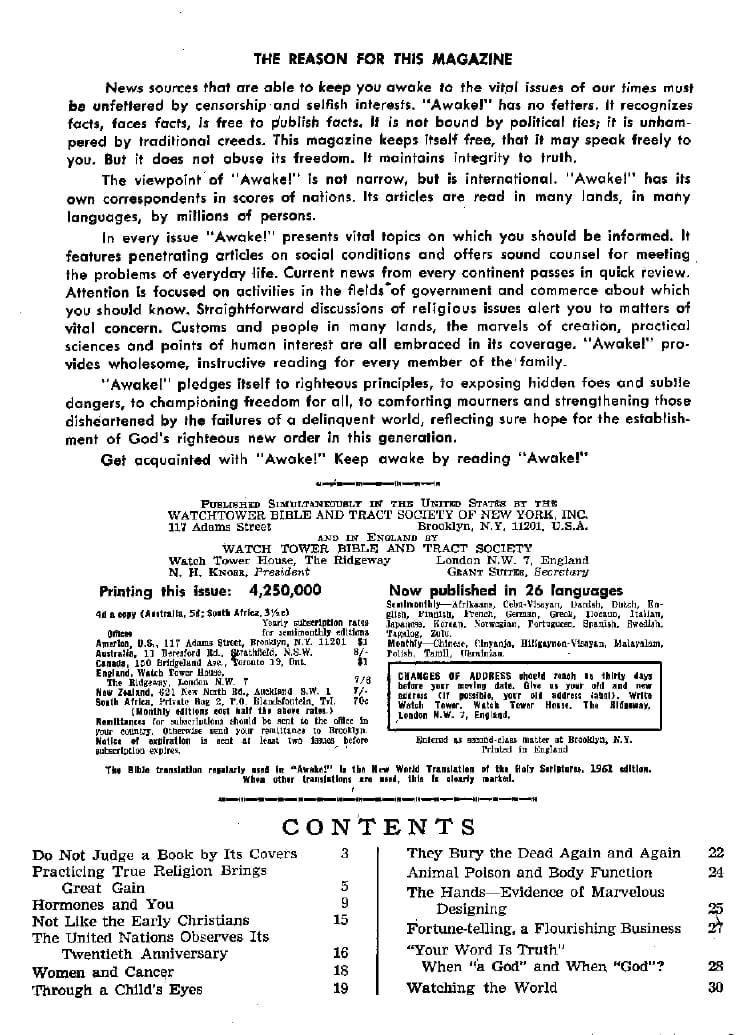
THE REASON FOR THIS MAGAZINE
News sources that are able to keep you awake to the vital issues of our times must be unfettered by censorship and selfish interest. "Awakel" has no fetters. It recognizes facts, faces facts, is free to publish facts. It is not bound by political ties; it is unhampered by traditional creeds. This magazine keeps itself free, that it may speak freely to you. But it does not abuse its freedom. It maintains integrity to truth.
The viewpoint of "Awake!" is not narrow, but is international. "Awake!" has its own correspondents in scores of nations. Its articles are read in many lands, in many languages, by millions of persons.
In every issue "Awake!" presents vital topics on which you should be informed. It features penetrating articles on social conditions and offers sound counsel for meeting
features pertaining to the problems of everyday life. Current news from every continent passes in quick review. Attention is focused on activities in the fields of government and commerce about which you should know. Straightforward discussions of religious issues alert you to matters of vital concern. Customs and people in many lands, the marvels of creation, practical sciences and points of human interest are all embraced in its coverage. "Awakel" provides wholesome, instructive reading for every member of the family.
"Awakell" pledges itself to righteous principles, to exposing hidden foes and subtle dangers, to championing freedom for all, to comforting mourners and strengthening those disheartened by the failures of a delinquent world, reflecting sure hope for the establishment of God's righteous new order in this generation.
Get acquainted with "Awake!" Keep awake by reading "Awake!"
PUBLISHED SIMULTANEOUSLY IN THE UNITED STATES BY THE WATCHTOWER BIBLE AND TRACT SOCIETY OF NEW YORK, INC.
117 Adams Street Brooklyn, N.Y. 11201, U.S.A.
AND IN ENGLAND BY WATCH TOWER BIBLE AND TRACT SOCIETY
Watch Tower House, The Ridgeway N. H. KNOBR, President
London N.W. 7, England
GRANT SUITES, Secretary
Printing this issue: 4,250,000
4d & copy (Australia, Sd: South Africa, %c)
subscription rate
for subscription editions
American, D.U., 117 Adams Street, Broadway, N.Y. 11201 $1
Canada, 10, Bridge Street, W. 15, New
New Zealand, 12, North New Bedford, W. 14, S.W.
South Africa, Private Bag 2, T.O. Blackwood, Toul., 70
Rhodesi
Now published in 26 languages
Seoullyth (=Arkansas, C邑-Viagen, Tandish, Dutch, English, Fannita, French, German, Greek, Iceland, Italian, Japan, Korea, Norway, Portuguese, Sweden, Swedish, Manshiy-Chiche, Chengda, Hilsgaven-Viagen, Malayalam, Polish, Tamil, Ukrainian)
CHANGES OF ADDRESS should reach to thirty days before your mailing date. Give as your old and new addresses the old address of your Welch Tower, Watch Tower Hotel, Leiden, Belgium, N.W. J. England,
Entered as second-class matter at Brooklyn, N.Y.
Printed in England
The Bible translation regularly used in "Awake!" is the New World Translation of the Holy Scriptures, 1962 edition.
CONTENTS
Do Not Judge a Book by Its Covers 3
Practicing True Religion Brings
Great Gain 5
Hormones and You 9
Not Like the Early Christians 15
Twentieth Anniversary 16
Women and Cancer 18
Through a Child's Eyes 19
They Bury the Dead Again and Again 22
Animal Poison and Body Function 24
The Hands—Evidence of Marvelous Designing 25
Fortune-telling, a Flourishing Business 27
"Your Word Is Truth"
When "a God" and When "God"? 28
Watching the World 30
London, England, September 22, 1965
Volume XLVI
Number 18
IN THESE days when paperback books in the United States alone are printed and sold by the hundreds of millions annually, it might seem that the saying 'Do not judge a book by its covers' is a little out of date. If taken literally, that may well be, for the day is long past when men bound their books in ivory, silver or gold covers and studded them with jewels. Still, even in a
DO NOT JUDGE A BOOK BY ITS
literal sense, the saying is not altogether out of date, for do not paperback book manufacturers endeavor to make the paper covers of their books as attractive or striking as possible so as to lure buyers?
Nevertheless, the fact remains, both literally and figuratively, that what counts is not the covers but the contents of a book. Perhaps no book has had more costly bindings than the Bible, yet what has made it the world's best seller all these years has been not its covers but its contents. An apt illustration of the relative value of a book as compared with its covers was made by Benjamin Franklin, one of the founding fathers of the United States. In his proposed epitaph for his own tombstone he likened his dead body to a book from which all the inside pages had been torn, leaving but the covers. And truly, the covers of a book, apart from its contents, might well be likened to a corpse.
Yet because of human frailty, how prone we all are to judge a book by its covers, or to judge by appearances! This may be due to vanity, prejudice and acquisitiveness, or because of an innate hunger for beauty. But recognizing it as a weakness, we want to guard against it. Helping us to do so is the Word of God, the Bible, both by illustrations and commands. Thus when Jehovah God sent his prophet Samuel to the home of Jesse, a Judean who had eight sons, to pick one of them to succeed unfaithful Saul as king of Israel, and Samuel was impressed by the appearance of the firstborn, God told Samuel: "Do not look at his appearance and at the height of his stature, for I have rejected him. For not the way man sees is the way God sees, because mere man sees what appears to the eyes; but as for Jehovah, he sees what the heart is." In the end the youngest and seemingly most unlikely son of Jesse proved to be God's choice. Was it a wise choice? It most certainly was, for it was David, not any of his brothers in the army of Israel, that accepted the challenge of the giant Goliath and killed him, and this was but one of David's many exploits of faith. —1 Sam. 16:1-13; 17:1-54.
Jesus Christ, the Son of God, drove home the same point repeatedly in his ministry.
On one occasion he scored his opposers for their religious prejudice, saying: "Stop judging from the outward appearance, but judge with righteous judgment." Far from being deceived by their seemingly righteous appearance, he exposed them for what they were, saying: "Woe to you, scribes and Pharisees, hypocrites! because you resemble whitewashed graves, which outwardly indeed appear beautiful but inside are full of dead men's bones and of every sort of uncleanness. In that way you also, outwardly indeed, appear righteous to men, but inside you are full of hypocrisy and lawlessness."—John 7:24; Matt. 23:27, 28.
If we would not judge books by their covers we must be guided by wisdom, reason and principle rather than by emotion, sentimentality or greed. This will keep us from forming a poor opinion of another merely because of his clothes, his skin color or some physical defect he may have. On the other hand, wisdom indicates that we be not unduly impressed because of the professional attire a man may wear, be his profession religious, medical or legal. A principle that is especially helpful in this matter is the one Jesus enunciated in his sermon on the mount: "Just as you want men to do to you, do the same way to them."—Luke 6:31.
However, when it comes to making purchases, it would seem wiser to err on the side of caution, as indicated by the time-honored rule, "Let the buyer beware!" A man likes to be seen in good-looking clothes or in a fine auto. But when buying clothes he should also be concerned with the quality of the goods and the workmanship. And so with buying an auto. A new paint job does not make an auto run smoother or more economically.
vulnerable; not so much when it comes to making purchases but in her quest for approval and popularity. She is prone to give undue attention to her appearance, her clothes, her hair style, her facial makeup and attractiveness, being apparently more concerned with the cover of her 'book' than with its contents; for which weakness, however, it must be admitted, men contribute their share of the blame.
In this concern over outward appearances it might be said that womankind is more
Not that she should neglect her appearance; she should give thought to it, but not to the neglect of furnishing her heart and mind. True, a man is pleased to be able to introduce a pretty wife to his friends, but the wise man will be more concerned with what she has on the inside. That is why the apostle Peter counseled women: "Do not let your adornment be that of the external" things, "but let it be the secret person of the heart in the incorruptible apparel of the quiet and mild spirit, which is of great value in the eyes of God." An ancient Hebrew proverb made a like observation: "Charm may be false, and prettiness may be vain; but the woman that fears Jehovah is the one that procures praise for herself."—1 Pet. 3:3-5; Prov. 31:30.
The counsel not to judge a book by its covers is particularly pertinent for the dedicated Christian minister. Certainly in his relations with fellow Christians in the local congregation he needs to exercise care not to show partiality because of appearances, favoring the well-to-do, the comely, the educated or those of one's own race. And likewise in his field ministry, in his preaching to strangers, he will remember that God's will is that "all sorts of men," both rich and poor, "come to an accurate knowledge of truth." His doing so will result in a happy and fruitful ministry.—1 Tim. 2:3, 4.
THOUGHTS OF LOSS PREVENT SOME FROM PRACTICING TRUE RELIGION, BUT THE GAINS ARE GREATER.
BRINGS GREAT GAIN
AFTER studying the Bible with Jehovah's witnesses for a short time one finds that it is no longer a closed book, but that its truths are understandable and soul-satisfying. He begins to grasp the reason for the present critical conditions and sees how to cope with them in a godly way. More than that, he comes to realize that the kingdom of God is the means by which God will clean out all wickedness and make this earth a paradise home in which obedient mankind will enjoy everlasting life in happiness.
But certain fears may begin to press in upon him. Observing that many of his friends do not share his enthusiasm for the Bible, he may be inclined to draw back, explaining rather apologetically: "I'll lose all my friends if I become one of Jehovah's witnesses." An elderly person, in a land where cemeteries are owned and operated by the dominant religion, may fearfully inquire: "Who will bury me if I change my religion?" And a single person, believing that just about everyone who gets married has a church wedding, may ask: "Who will perform my marriage?"
It is true that becoming a dedicated Christian witness of Jehovah requires adjustments in one's life. But it is not true that one loses all his friends, that he will not have a proper burial or that there will not be anyone to perform his marriage. Rather, practicing true religion brings great gain.
Identifying True Friends
For instance, in the matter of friends. It is true that when a person embraces the religion set out in the Bible he may lose the association of some he was previously acquainted with. But why is this? Has the truth seeker all of a sudden become an unlikable personality? Quite the contrary is the case. The one taking up true religion now comes to be molded by the Christian qualities of love, joy, peace, long-suffering, kindness, goodness, faith, mildness, self-control, mercy and justice. These outstanding qualities make a person more desirable as an associate, not less so.
Hence, there is really another reason for losing a former friend. It is because of the truth itself. The truth separates those who really love God from those who do not. Those who love God want to talk about him to their friends, neighbors and relatives. But if these acquaintances do not have a deep love for God, they may find it embarrassing to talk about their Creator, because they may not want to face up to the truths God reveals in his Word. Or prejudice, built up by wrong religious instruction or what others mistakenly say, may be the source of the friction. In any case, it is not the Christian who is responsible for the loss of friendship, for his friendliness improves as his faith increases.
This should help one who has come to an understanding of Bible truths to discern who his true friends really are. A true friend will not turn away from you just because you have increased your love for God and because you are trying to apply Christian principles in your life.
To the contrary, a true friend will respect you, trust you and search out your companionhip even more, for he will appreciate the value of having a principled, moral companion in today's wicked system of things.
Friends Gained Rather than Lost
That Bible truth would divide was foreold by God. Not that God makes it happen. He merely told in advance what would occur in some cases. As his Son Jesus christ stated relative to some who would ecome Christians: "A man's enemies will e persons of his own household." (Matt. 0:36) But you, as a true Christian, should ever be the one who causes such division. If there is animosity, let it be because your relatives or friends cause it; for the Christian seeks peace and actively pursues it, usiring to heal divisions, not cause them.
Jesus Christ gave the proper perspective on the matter. He knew it would be difficult for some to have their former friends and relatives turn away from them just because they followed his example and took up the service of God. So he gave them this marvelous promise: "No one has left house or brothers or sisters or mother or father or children or fields for my sake and for the sake of the good news who will not get a hundredfold now in this period of time, houses and brothers and sisters and mothers and children and fields, . . . and in the coming system of things everlasting life."—Mark 10:28-30.
Yes, even though you may lose a former friend or have a relative turn against you for the truth's sake, you really do not lose a true friend at all. Rather, by associating with the Christian congregation, you actually gain many friends who appreciate God as you do, friends who will not turn away in times of distress but who will remain
by your side even through persecution. These friends will be hospitable, loyal, kind and loving. They will assist you along the way to that much desired everlasting life that Jesus promised.
But are such fellow Christians the only friends that you gain by becoming a lover of truth? No, for Jehovah God and his Son Jesus Christ, the grandest, truest, kindest, most loyal and loving friends of all, are now yours. When you learn to love, appreciate and serve God and his Son you are taken in by them as their friends.
Note how Jesus showed this when he stated: "For whoever does the will of my Father who is in heaven, the same is my brother, and sister, and mother." Jesus also said: "If anyone loves me, . . . my Father will love him, and we shall come to him and make our abode with him." How comforting to know that God and Christ can be your friends! And what wonderful friends to have in these critical last days! —Matt. 12:50; John 14:23.
True Friendship a Reality
For some of you who are isolated from a sizable congregation of God's servants, it may be hard to appreciate the warm Christian friendship that exists among them. But it is there. A common love for God and one another has drawn people of all races, nationalities and social positions together into an organization of real friends, yes, of brothers and sisters! That it is not mere formalism when Jehovah's witnesses call each other "brother" and "sister," visitors at their assemblies quickly realize. One reporter wrote in Die Welt (The World) of Hamburg, Germany, July 22, 1961: "This form of address, 'Brother' and 'Sister,' which the 'Witnesses' use in such a matter-of-fact way, really has meaning."
Many of you have probably attended large assemblies of Jehovah's witnesses and have experienced the warm Christian love demonstrated there.
Perhaps others of you have seen assemblies of these happy Christians in motion pictures, such as the recent one "Proclaiming 'Everlasting Good News' Around the World." Just think! These tens of thousands of true Christians are your friends, and they will stand by you at all times, "fighting side by side for
the faith of the good news." (Phil. 1:27) O what great gain!
ducted free of charge by Jehovah's witnesses. Instead of parroting the religious misconception, that at death the soul separates from the body and enters heavenly bliss, on such occasions scriptures are read that fill the survivors with well-founded hope. They are shown the true state of the dead—that they are unconscious and have
no feeling whatsoever. (Ezek. 18:4;
Ps. 146:3, 4; Eccl. 9:
By practicing true religion you will have thousands of friends of the kind Proverbs 18:24 describes:
"There exists a friend sticking closer than a brother."
Burial of the Dead
It is true that, in a few countries where religious prejudice is strong, a problem regarding burial can arise. Some years ago in a small island in the Caribbean one of
5, 10) It is also shown that for billions of persons now dead in their graves this sleep in death is only
temporary. In time these will hear the voice of the Judge Jesus Christ and come to life again, just as did Lazarus, whom Jesus resurrected many centuries ago. It is a real comfort for those bereaved of loved ones to have this hope so clearly explained from God's Word.—John 11:11-44; 5:28, 29.
Jehovah's witnesses died and a burial place was refused. Finally the body was taken to the police headquarters, and a place for burial was granted. However, this is a comparatively uncommon incident.
In most countries cemeteries are operated by nonreligious corporations and there is no discrimination. In some lands, where cemeteries are largely operated by the dominant religion, there may be local prejudice and the Christian witness of Jehovah might be denied burial. But while these cemeteries may be regarded by some
So it is not a place of burial that one need be particularly concerned about, but, rather, in doing that which will merit the favor of Jehovah God. Trusting in Him, the Christian will not be as concerned about the place of burial as he is about the prospect of a resurrection.
Performing Marriages
Neither does one have to be concerned about having his marriage performed, for marriage services are also conducted free of charge by qualified ministers of Jeho-
as "holy ground," true Christians know otherwise. They appreciate that the entire earth belongs to God, and that no matter where one of His servants is buried, even if it is in a private plot not associated with a cemetery, God will remember that one with a resurrection in paradise.
This comforting hope found in God's Word is clearly explained at funerals consePTEMBER 22,1965
vah's witnesses. In this way no financial obligation is placed upon a couple who may already have expenses in connection with their wedding and the setting up of a household. Where local laws do not allow ministers of Jehovah's witnesses to act as legal marrying agents, a civil wedding is performed by a local authority, such as a justice of the peace or other authorized agent of the State.
If it is desired, a Scriptural talk can be arranged in addition to this civil ceremony, although it does not add to the legality of the marriage.
Marriages performed by Jehovah's witnesses, do not consist of a lot of ritual, but, rather, feature practical instruction to the bride and groom from God's Word the Bible. Attention is thus turned to Jehovah God, and the parties are reminded that he is the One they must obey in order to realize the greatest happiness in marriage. The wedding is a joyous occasion. It need not be a financial burden on anyone, for the couple know they are not under obligation to go beyond their means, and into debt, in order to stage a pretentious wedding and reception. In fact, for personal pride to cause them to do so would be a violation of Scriptural principles.
On the other hand, couples who desire a more elaborate wedding and are financially able are perfectly free to have one. The same is true relative to wedding receptions. It is entirely proper for a couple to have a large reception or a small one or, if preferred, none at all. Practicers of true religion have a wide realm of liberty in such matters, for they are not bound by popular customs or motivated by pride. They do not try to be something they are not, and their fellow Christians respect them for it.
The Benefits Gained
So rather than being a hindrance, practicing true religion actually results in freedom of mind and action. Saul of Tarsus is a fine example of the great gain realized when one leaves false religion to practice the true religion. Saul, who later became the apostle Paul, was a religious zealot who had attained a place high in the religious councils and society of the Jewish community. But then the miraculous occurred! Christ Jesus appeared to him in heavenly
glory to inform him that he was practicing the wrong religion! How he must have been shocked to hear this! What did he do? What would you have done?—Acts 9:3-9; 22:3; 26:10.
At the coming of the Christian Ananias to him, Saul "rose and was baptized." (Acts 9:18) What a change this caused in his life! Gone quickly were his past aspirations and his former associates, the religious Pharisees. Yet Paul was not sorry, for he found true joy in his new life as a Christian. He wrote: "It is a means of great gain, this godly devotion along with self-sufficiency."—1 Tim. 6:6.
But what about the worldly position and friends that he gave up? Do you think that he was unwise to sacrifice all that? Listen to what Paul said: "I have taken the loss of all things and I consider them as a lot of refuse, that I may gain Christ and be found in union with him."—Phil. 3:7-11.
Yes, in comparison with what he gained on becoming a Christian, what he lost was so much refuse. And understandably so! For Paul gained God and Christ as friends, had the hope of eternal life, and the friends who left him were replaced with a "hundredfold" all over the Mediterranean area, true friends who truly loved and cared for him. (Acts 20:37, 38; Gal. 4:14, 15) His gain was indeed great!
As Paul gained, so you can too. By accepting the true religion and practicing it you will gain what is truly worth while. Think of it! Anywhere you may travel in the world you will have friends, yes, spiritual brothers and sisters who will be delighted to see you. But most important of all, you will be close to your heavenly Father, Jehovah God, and Christ Jesus, with the grand prospect of remaining alive to enjoy their friendship forever. Such gain far outweighs any loss that may come due to practicing the true religion.
HORMONES and You
MAN'S knowledge
M of hormones is comparatively recent. In fact, the very name "hormone" was coined first at the beginning of this century. It is not surprising, then, that man has still much to learn about them. But he is rapidly increasing his knowledge of them; especially has he done so in just the past few years. One indication of this increased knowledge is the ever-widening use of hormones in the practice of medicine in treating arthritis, cancer, skin defects and malnutrition, to mention but a few.
What are hormones? What can be said about their ever-increasing use in medicine? Is there something to be said against this trend?
Hormones have been defined as chemical messengers produced by one part of the body that have specific effects upon
a certain other part of the bo to which they are brought by the blood. However, today that definition is recognized as quite incomplete. Why so? Because, for one thing, certain hormones affect, not just certain cells, but all the body's cells. And as a group they play a vital role in practically all life processes, such as growth, metabolism, regeneration and adaptation to environment.
While man has no way of knowing just how many
hormones the body produces nor all the organs that produce hormones, it may be categorically stated that there are eight established glands that produce hormones: the pituitary and pineal glands in the skull, the thyroid and parathyroid in the throat, the thymus in the chest, the adrenals on the kidneys, the islets of Langerhans in the pancreas and the male and female sex glands. Certain hormones are also produced by the brain, the intestines and small bodies scattered throughout the body.
These glands are termed "endocrine" glands, because they secrete or give out their products internally, directly into the blood as it passes through them, rather than by means of a duct, as is the case with the pancreas, the salivary and the
sweat glands. Their products, the hormones, are therefore also called products of internal secretions.
Doubless the best known hormone is insulin, due to the prevalence of diabetes. Insulin is produced by hundreds of thousands, if not millions, of tiny cell bodies in the pancreas known as the "islets of Langerhans." Insulin is essential for the body's metabolism of sugar and starches, and its supply appears to be kept in balance by a growth hormone. If these islets produce too little insulin, or too much starch and sugar are consumed, or there is too much of the growth hormone, the result is an excess of sugar in the blood—diabetes.
Diabetes in children seems to have a glandular basis, for which reason insulin in addition to diet and exercise is indicated. But for middle-aged diabetics it seems more and more that the answer may be diet and exercise, rather than sole dependence upon insulin and other drugs. Why? Because, according to recent findings, such diabetics have an excess both of sugar and of insulin in their blood, paradoxical as this may seem. What is now recommended for these, if unable to control their appetites, is a drug that decreases their appetite and speeds up the metabolism of sugar but does not stimulate the production of insulin. Time magazine, June 25, 1965.
The Adrenals
Perhaps the next best known hormone is adrenaline, produced by the adrenal glands situated on the kidneys, whence their name, ad, "near," and ren, "kidney," from the Latin. (In archaic English the word is "reins," as at Psalm 26:2, King James Version, Psalm 25:2, Douay Version, where the term is used to refer to the deepest emotions.) Each adrenal consists of two glands fused as one: the adrenal medulla, the center, and the cortex, the outer rim or layer of cells.
The medulla releases two hormones, adrenaline, the medical term for which is epinephrine, and noradrenaline or norepinephrine. Adrenaline is poured into the blood in the case of fear, anxiety or depression and it elicits aid to practically every system of the body for flight. It steps up the senses, such as hearing and seeing; it takes the blood from the skin and internal organs and pours it into the muscles,
including the heart muscle; it speeds up as well as increases the taking in of oxygen by the lungs and also raises the blood pressure and the heartbeat rate.
On the other hand, when the emotion of rage is felt, noradrenaline is poured into the blood, which raises the blood pressure but does not affect the rest of the systems of the organism. Beasts of prey who live by killing have high concentrations of noradrenaline in their blood, whereas domestic animals and such wild animals as rabbits whose life depends upon their being able to flee fast have high concentrations of adrenaline.
An organism can exist after a fashion if the medulla of the adrenals is destroyed, but not without the more vital and complicated cortex of the adrenals. Its hormones are steroids, being related to fatty, wax-like cholesterol, even as are the sex hormones, whereas most of the other hormones, such as insulin and those of the thyroid and the pituitary glands, are proteins. Although some forty different hormones of the cortex have been discovered, three, we are told, corticosterone, hydrocortisone and aldosterone, seem to play the major roles. Among the vital body functions that these hormones induce or regulate are keeping the right amount of water and salt in the body's tissues, eliciting the body's resources in time of stress, cooperating with other hormones in enabling the body to utilize carbohydrates and proteins and helping to account for sex distinctions.
Some fifteen years ago cortisone, taken from the adrenal cortex, was hailed as a wonder drug in treating arthritis. But with the years enthusiasm for it has cooled down, many holding that aspirin can also be of help and is free from the untoward side effects so often associated with cortisone therapy.
The Thyroid and Parathyroid Glands
The thyroid gland consists of two lobes joined by a 'bridge.' It straddles the windpipe just below the Adam's apple, each lobe resembling a flattened peach stone. It is the largest ductless gland in the adult and produces two hormones that regulate the body's rate of metabolism and for which hormone the thyroid depends upon the iodine in the blood. Too little may cause the thyroid to enlarge, becoming a goiter. Too little of the thyroid's hormone results in sluggishness and undue sensitiveness to cold; too much makes a person overactive and unduly sensitive to heat. Iodine and hormone treatment help to compensate for a lack of the hormone, whereas drugs, such as radioactive iodine (I31) or surgery are used to treat the overactive thyroid. Alcoholics have been found to be deficient in the thyroid hormone and, according to one report, their symptoms as well as their craving for alcohol have been greatly decreased by injections of the thyroid hormone.
The parathyroid glands have little in common with the thyroid except their location, being as their name suggests, near that gland. They are tiny beads of glands, usually two on each side of the windpipe. Smallest of the endocrine glands, they are indispensable to the life of the organism and, if removed, death results from tetany or muscle spasms unless substitute medication is given.
calcium from the bones of the body. Among the causes of kidney stones is too much of this hormone.
These glands keep the right amount of calcium in the blood by means of their hormone, the importance of which in the blood can hardly be exaggerated. Should there be a lack of calcium in the blood, these glands pour extra hormone into it, which hormone has the power to dissolve
When the thyroid and parathyroid glands have been removed because of cancer, patients have been kept well by being given oral calcium, injections of vitamin D and drugs. Recently, in two such cases, surgeons have taken these glands from stillborn infants and transplanted them into a twenty-eight-year-old man and a fifty-three-year-old woman, with the result that both no longer needed any drugs or vitamins and only a mere fraction of the calcium they formerly took orally.
The Sex Hormones
Hormones and their glands have been termed "creators of personality," and to no small extent this is true, as can be seen from the effect of the sex hormones. These are produced primarily by the gonads, the testes of the male and the ovaries of the female. The male hormones are testosterone and androsterone; the female, estrogen and progesterone.
The androgens or male hormones account for man's being broad-shouldered, having an angular frame, hair on his chest, deep voice, tendency to baldness, sexual desire and wanting to dominate woman. On the other hand, the female hormone gives women their bone structure, curves, full bosom, long hair and feminine voice. In view of woman's role in reproduction it is easy to understand why hormone control in womankind is far more complex than in men. Woman's libido or sexual desire is due to male hormones the same as in man.
Women have male hormones? Yes, une adrenal cortex produces androgens or malelike hormones in women, even as the testes in men produce female hormones as well as male.
In fact, in its early stages the human embryo contains rudimentary sex organs of both sexes, but in time organs of one sex become dominant and those of the other recede. Experiments with animals have shown that either sex can develop the characteristics of the opposite sex by being given its hormones. This has proved to be one of the disadvantages of hormone therapy. It is known that women have far fewer heart attacks than men, and this has been attributed to the female hormone estrogen. Men who have had heart attacks have been treated with estrogen with good effects as to their heart condition. However, not always without feminizing effects, such as loss of sexual desire and enlargement of the breasts.
It is not surprising, therefore, that there is considerable disagreement in medical circles as to the relative merits of certain hormone therapies. Least objectionable seems to be the giving of hormones to make up for the body's lack because of old age or surgery. Thus while some physicians question the advisability of giving hormones for relief of menstrual discomfort, there is general agreement on their use in treating such symptoms of menopause as hot flashes, sinking spells, periods of mental fogginess and creeping skin sensations.
The Thymus and Pineal Glands
For a long time the thymus gland kept its secret well guarded. Many have been the guesses as to its purpose, some holding it was a gland, others merely a part of the lymphatic system, and others that it was a vestigial organ. But there is no need to guess now. In just the past three or four years men have discovered that the thymus is the master gland as to the body's immunity and that babies born without it are doomed to early death.
The thymus lies in the center of the upper chest and is so called because it resembles a bunch of thyme. It consists of two lobes, quite small at birth, which reach their largest size in adolescence, after which they recede. Early in life it is the chief producer of the lymphocytes, white corpuscles, which it seeds throughout the body. But more important, it produces a hormone, or several, according to some authorities, without which these lymphocytes could not produce antibodies to fight off the antigens that invade the body. Once having seeded the body with these lymphocytes and activated them by its hormone so that they can produce antibodies to fight off minute enemies that invade the body, the thymus shrinks in size and becomes more or less a fatty body. It has served its purpose. To use a crude illustration, the thymus is both the chief producer of soldiers to fight off invasion and the manufacturer of the weapons, without which those soldiers could not wage effective warfare.-Scientific American, November 1962; July 1964.
"Until a year or two ago the pineal and thymus remained the last highly specialized organs in the body for which no function was known," said Annals of Internal Medicine, December 1964. That no longer is true of the thymus, even as noted in the foregoing, and the pineal is gradually yielding its secrets also, as noted in these Annals: "As of March 11, 1964, we . . . think that light works to effect the synthesis [the forming] of certain compounds in the pineal which are hormones: these enter the blood stream and alter the endocrine economy of the body. They may play a role in all kinds of non-feedback processes, like puberty . . . and [menstrual] cycles."
The hormone has been named melatonin. Certain tumors of the pineal produce too much of it, retarding sexual development; other tumors cause it to produce less, greatly hastening such development.
The Endocrine Orchestra Leader
If the various endocrine glands we have considered might be likened to various instrumental players in an orchestra, then the pituitary gland may well be likened to the conductor, but like the old-time conductor who played the violin while conducting, for the pituitary not only "directs" the secretions and activities of other glands but furnishes its own complement of hormones.
The pituitary gland, situated at the base of the brain, near the hypothalamus, is no larger than a pea or small cherry and consists of two main lobes, the anterior or frontal lobe and the posterior or rear lobe. The rear lobe produces two hormones, one of which serves to contract the various internal smooth muscles, as of the intestines and the bladder, furnishing also the powerful impetus for expelling the fetus at childbirth. The other hormone of the posterior lobe of the pituitary shares in regulating the amount of water the kidneys discharge and has power to constrict blood vessels.
The role of the conductor, however, is played by the frontal lobe, in particular by its producing three kinds of trophic hormones. One of these, the thyrotrophic hormone, exerts its influence on the thyroid, without which the thyroid becomes inactive and shrinks. Another, termed ACTH, stimulates the cortex of the adrenal gland, even as indicated by its name, adrenocorticotrophic. Without this hormone the adrenal cortex can function under normal conditions but cannot meet the challenge of "stress," in the form of bacteria, poisons, and suchlike. Then there are certain gonadotrophic hormones that, among other things, stimulate the production of sex cells and hormones by the sex glands. The
gonadotrophic hormones are so vital that the removal of the pituitary in childhood has the same effect as castration.
Chief among the pituitary's other endocrine products is the growth hormone. The hormones of certain other glands do affect growth, as can be seen from the effect on the body when they are deficient, but only the growth hormone of the pituitary also shows a growth effect when there is too much of it. Too little of it in childhood results in dwarfism, and too much in giantism, as when a boy grows to be eight feet tall. Too much of this hormone in adults results in the grotesque condition known as acromegaly, in which the feet, hands, chest, brow and lower jaw become abnormally large, the linear bones being no longer capable of growth.
The pituitary also secretes the lactogenic hormone, which stimulates milk production under certain set conditions in which several other hormones are involved. Thus by the time a woman gives birth to a child her mammary glands are prepared to supply the needed milk.
How does the brain act upon the endocrine glands? There is clear evidence that at least noradrenaline is triggered directly by the sympathetic nervous system. But for most of the rest of the hormonalf activity it appears that the key is the hypothalamus. It appears likely that this tiny organ or part of the brain belongs to both the endocrine and the central nervous systems, producing both hormonal products and nerve impulses. Situated right next to the pituitary, the master gland of the endocrine chain gland system, the hypothalamus, as it is affected by the thinking and feeling going on in the brain, apparently triggers the hormonal activity of the pituitary as well as the sympathetic nervous system.
possible only to touch briefly on the wonders of the body's endocrine system. Today endocrinology is a medical specialty just as is gynecology, and it has its own monthly periodicals, some devoted exclusively to the reporting of experiments, and some dealing solely with the clinical aspects, the use of hormones in treating humans and endocrine disorders. Among the latest advances made is the knowledge that many of the hormones operate on the genetic level; that is, they activate the genes, which not only are the carriers of heredity but also direct the activities of life in the cells. Understanding of the role of the thymus now explains why it is practically impossible to graft tissue from one person onto another except in the case of identical twins.—Scientific American, July 1965.
Among the negative aspects of hormones must be mentioned that overactivity of the male hormone androgen accounts largely for baldness in men, even as overactivity of the female hormone estrogen has a bearing on breast cancer in women. Also the United States government has banned the use of a growth hormone in chickens because it produced cancer in laboratory animals.
On the positive side, it must further be mentioned that estrogen, the female hormone, has been found valuable in treating skin afflictions, which is readily understandable since it accounts for woman's skin being thicker than that of man as well as for hers having an extra layer of fat underneath it. Another hormone has been found of great aid in the treatment of shock, being far more effective in this dangerous situation than blood transfusions. Among the things that have contributed to the use of hormones is the fact that men have been able to form them synthetically as well as to obtain them from plants.
But much as has been learned, there is still very much tq be learned about the endocrine glands and their hormones. As one authority expressed it: "We have only a vague understanding of the fundamental mechanism of endocrine activity . . . We have nothing like a full list of hormones themselves, or of the organs that produce them. . . We have no present means of determining with certainty whether or not such organs [as the lungs] secrete hormones, although they may well do." —Scientific American, March 1957.
But enough has been discovered, to underscore what one of the pioneers in endocrinology, Ernest Starling, said at the turn of the century "It was not until [our] discovery . . . in 1902 that we recognized that these so-called internal secretions were merely isolated examples of a great system of correlation of activities, chemical and otherwise, of different organs, not by the central nervous system but by the intermediation of the blood, by the discharge into the bloodstream of drug-like substances in minute proportions which evoked appropriate reaction in distant parts of the body." How minute these proportions of hormones can be is to be seen from the fact that it has been stated that 1/2000th of an ounce of thyroid hormone is all that is needed to separate a potential genius from an idiot, a cretin, and that one part of pituitrin to 18 billion parts of water is enough to cause contractions in the uterus of small animals.
Some would have us believe that this marvelous correlation of the endocrine chain gland system is the product of blind evolution, but surely reason indicates that here in this amazing working together of the ductless glands we have further eloquent testimony to the wisdom of our Maker, Jehovah God.
NOT LIKE THE EARLY CHRISTIANS
PAPAL PRONOUNCEMENT
A report from Vatican City tells what Pope Paul VI recently told two hundred Belgian officers and soldiers: "Pope Paul said today a good Christian could be a good soldier and urged the faithful not to shirk military duty on the grounds of conscientious objection. . . He told them that 'there is no incompatibility between rigid military discipline and the discipline of faith, between the ideal of the soldier and that of the believer.'"—Vancouver Sun, April 22, 1965.
PROTESTANT LAMENT
Despite lamentations from a few Protestant clergymen from time to time, Protestant religions have also generally adhered to the same view. Recently cleric James H. Laird commented on the widespread opinion that "one's highest loyalty is to his nation": "In other words this is to say that the nation is our God. This is probably true, not only for Americans but for all the citizens of all the nations. That is why Arnold Toynbee has spoken of nationalism as the 20th century substitute for religion. ... Men no longer sacrifice their children to Moloch—that outmoded, primitive deity now in discard; today we sacrifice our sons to that Leviathan from whom all blessings flow, the nation. ... Adolf Hitler said in one of his speeches, 'Germany is our God on this earth.'" (Detroit Free Press, March 7, 1965) Yes, Catholic and Protestant religions urged their adherents to serve in the Nazi armies. But in doing so, they were not like the early Christians.
REPORTS BY HISTORIANS
"The Christians refused to show their loyalty by burning incense to the emperor. Being men of pence, they would not serve in the Roman armies."—The March of Civilization, Ancient and Medieval World (New York; 1331) Jesse E. Wrench, Professor of History, University of Missouri, p. 205.
"They preferred the Kingdom of God to any kingdom that they might serve on earth. . . The early Christians were ready to die for their faith. . . Since they believed in peace, they would not serve in Rome's imperial armies." From the Old World to the New (New York; 1932), Eugene A. Colligan, Associate Superintendent of Schools, City of New York, and Maxwell F. Littwin, Principal, New York City Public Schools, pp. 88, 89.
"There were two grounds on which service in the Imperial armies was irreconcilable with the Christian profession; the one that it required the military oath, and the countenancing, if not the actual performance, of idolatrous acts; the other that it contravened the express commands of Christ and the whole spirit of the Gospel."—Early Church History to the Death of Constantine (London; 1892), E. Backhouse and C. Tylor, p. 128.
Tertullian, a convert to Christianity about 180 C.E., wrote: "To begin with the real ground of the military crown, I think we must first inquire whether warfare is proper at all for Christians. . . . Shall it be held lawful to make an occupation of the sword, when the Lord proclaims that he who uses the sword shall perish by the sword? . . . Shall [the Christian] carry a flag, too, hostile to Christ? . . . Of course, if faith comes later, and finds any preoccupied with military service, their case is different. . . . when a man has become a believer, and faith has been sealed, there must be either an immediate abandonment of it, which has been the course with many; or all sorts of quibbling will have to be resorted to in order to avoid offending God, and that is not allowed even outside of military service. . . . Nowhere does the Christian change his character."—"The Chaplet" or "De Corona," in The Ante-Nicene Fathers, edited by Alexander Roberts and James Donaldson, Vol. III (Grand Rapids, Michigan; 1957), pp. 99, 100.
Justin Martyr of the second century C.E. wrote: "We who were filled with war, and mutual slaughter, and every wickedness, have each through the whole earth changed our warlike weapons, our swords into ploughshares, and our spears into implements of tillage." "Dialogue with Trypho, a Jew," in The Ante-Nicene Fathers, Vol. I, p. 254.
The text from the Hebrew Scriptures that the early Christians applied to themselves is Isaiah 2:4: "They will have to beat their swords into plowshares and their spears into pruning shears. Nation will not lift up sword against nation, neither will they learn war any more." However, in this respect, as in others, modern-day Christendom is not like the early Christians.
IN June of this year representatives of 113 nations belonging to the United Nations gathered in North America at San Francisco to commemorate its anniversary. But they did not appear to be particularly happy about the occasion. They lacked the enthusiasm that was manifested by the delegates from the 51 member nations who founded the organization in the same city precisely twenty years ago.
The signers of the United Nations' Charter had high hopes for the organization, and when the then-president of the United States, Harry Truman, expressed some of those hopes, they applauded him enthusiastically. He told them: "You have won a victory against war itself. If we fail to use it, we shall betray all those who have died in order that we might meet here in freedom and safety to create it. If we seek to use it selfishly, for the advantage of any one nation or any small group of nations, we shall be equally guilty of that betrayal. . . . By their own example the strong nations of the world should lead the way to international justice." He concluded by saying: "Oh, what a great day this can be in history!" As he sat down, the members gave him a thunderous ovation, but in June of this year the mood was sharply different. The future of the U.N. did not look as bright. This fact dampened the
spirits of the delegates.
At the time of its twentieth anniversary the United Nations was in a state of paralysis because of a dispute among the big powers over peace-keeping assessments that compelled the General Assembly to adjourn on February 18 without completing any of its scheduled business. So serious was this dispute that the magazine
U.S. News & World Report of February 22, 1965, observed: "The United Nations is close to complete collapse as a peacekeeping body." Since its crisis in February its financial woes have been somewhat relieved but by no means solved. Lack of enthusiasm at its anniversary observance was, therefore, understandable.
Effectiveness
In some fields, of course, the United Nations has been effective. It has been helping poor nations to raise nutritional levels. It has made loans to underdeveloped countries for important development projects. It has been helping illiterate people learn to read and write. Since 1945 it has helped 700 million people to get their own governments. It has helped free 280 million people from the danger of malaria. It has aided millions of mothers and children with food, medical supplies and other things that they needed. It has aided more than one and a half million refugees with medical care, schooling and getting resettled. These accomplishments were not forgotten by delegates present at its anniversary celebration, but what has caused them keen disappointment has been its ineffectiveness in the field of peacemaking, the chief reason for its existence.
Although the U.N. contributed to the shortening of the 1949 war in Palestine, the 1956 war in Egypt, as well as the Cyprus conflict, it seems to have had little success in preventing wars or establishing a really secure peace after stopping those that have broken out.
An editorial in the Saturday Evening Post of February 13, 1965, observed: "But is the U.N. really achieving any goal at all? Is it, in fact, keeping the peace? In the most important war now going on, in Vietnam, the U.N. plays no serious role at all. In perhaps the second most tormented area, the Congo, the U.N. has virtually admitted defeat by pulling out after a vain four-year effort to achieve stability. And when a major conflict does occur—the Berlin Wall or the Cuban missile crisis—the great antagonists are likely not to rely on the U.N. but to ignore it."
For the settling of their many disputes, the big powers have not been turning to the U.N. and using it as a court of first resort. Instead they have tried to settle their differences outside of it. Their continuing to do this after the U.N. has existed for twenty years is most disappointing to persons who have looked to it as mankind's hope for peace. Equally disappointing has been the way the big powers apparently have tried to use the U.N. for their own nationalistic interests. Regarding the United States' actions in this respect, the New York Times of June 27, 1965, commented: "The United States, especially, used the United Nations cleverly and effectively in the decade from 1950 to 1960—from Korea to Congo—as a cover or substitute for unilateral action. It used it also as an arena for multinational diplomacy and consultation."
It seems evident that the power politics that is played by the U.N. members, even within the U.N. itself, is undermining that international organization. This fact prompted U Thant, the United Nations
Secretary-General, to state in his anniversary speech at San Francisco: "The greatest obstacle to the realization of the Charter is the inescapable fact that power politics still operates, both overtly, and covertly, in international relations. The concept of power politics, whether as the instrument of nationalism or of ideological extremism, is the natural enemy of international order as envisaged in the Charter. It is also an expensive and potentially disastrous anachronism. . . . Is it really only the scourge of war or the lash of terror that can move us toward the goal of peace and justice in the world? Can we not make the effort to advance out of our own sense of responsibility and knowledge, rather than be driven like refugees before a storm which may be unleashed by our own inability to take hold of the future?"
Also stressing the need to work for peace, President Johnson told the delegates at the anniversary observance: "The first work of all members now then just must be peacemaking. For this organization exists to resolve quarrels outside the confines of its headquarters, and not to prolong quarrels within. Where there are disputes let us try to find the means to resolve them through whatever machinery is available or is possible." Although he spoke of peace, some of the delegates manifested open hostility toward him. The Cuban delegation walked out before President Johnson began his speech and East European delegates characterized his speech as a Sunday-school lesson full of vague promises. Outside the building, pickets wore signs that demanded his impeachment and that the U.N. take action in Vietnam.
Religious Support
Despite growing disappointment over the U.N., seven international religions sent representatives to San Francisco for a separate gathering in celebration of the United Nations' anniversary.
They represented more than two billion members and were from religions that professed to be Christian as well as those that are non-Christian. Representatives were present from the Roman Catholic Church, Eastern Orthodox Church, Protestants, Jews, Hindus, Buddhists and Moslems. During the convocation at San Francisco's Cow Palace, a blessing from Pope Paul VI was conveyed to the religious delegates. Commenting on the gathering, he said: "How truly right and proper it is that a religious convocation for peace has been included among the ceremonies commemorative of the signing of the United Nations Charter twenty years ago."
Religious admiration for the United Nations is nothing new. From the time of its birth religious leaders have been hailing it as man's only hope for peace. They made the same expressions toward the League of Nations that preceded it, going so far as to claim, in the case of the Executive Committee of the Federal Council of Churches, that the League was "the political expression of the Kingdom of God on earth." They regard the United Nations with the same reverence. At the twentieth anniversary celebration for the U.N. by religious leaders, Rabbi Louis Jacobs expressed their feelings when he said, as reported by the New York Times of June 28, 1965, that the U.N. is the "sole hope for lasting peace in a world whose survival depends on it." He went on to state that the world's Jews looked upon the 1945 signing of the U.N. charter as "the writing of God."
It seems very strange that religious leaders who are supposed to place their trust
in the supreme Ruler of the universe are looking so worshipfully toward a political creation of men's hands. It is a grave mistake to identify God with the political creations of men, especially when the architects and builders of such creations include men who hate God and who refuse to obey his righteous laws. That they are mistaken in thinking that God's hands are in such man-made peace agencies is evident from the fact that the League of Nations, which they hailed as being of God, failed and the U.N. has not brought world peace as they had hoped.
When religious leaders claim that the U.N. is man's "sole hope for lasting peace," they ignore the provisions man's Creator has made for lasting peace on earth. He has promised to make "wars to cease to the extremity of the earth." (Ps. 46:9) This he has purposed to do by means of a world government, a kingdom of his making that will rule in justice and righteousness. (Isa. 9:6, 7) The instrument he uses to bring peace is not, therefore, a political production of the nations of the world. This the religious leaders ought to know.
Twenty years may not be long in the life of an organization, yet it is long enough to show that the United Nations, despite the good it has done, is woefully inadequate as an instrument for bringing an end to war and for ushering in permanent world peace. Something better is needed, and the growing realization of this fact has deflated much of the initial enthusiasm that marked its birth. The United Nations as it is today is a disappointment to people the world over who had placed their hope in it.
WOMEN AND CANCER
"Women who smoke are ten times more likely to die of lung cancer than nonsmoking women, a study by the U.S. Public Health Service indicates."—Science News Letter, May 2, 1964.
That day, not so long ago, I was helped to realize this. I had planned to give Tina's parents a "break" by taking care of her for a while, but it wasn't long before I realized that I too was to get a "break" and to benefit greatly from our time together.
A S Tina came racing down the slide, flinging herself into my arms with a gleeful cry, her eyes dancing with laughter, she brought a glow to my heart. How happy and contented she is, I thought as she skipped away, and how contagious her laughter. In a few minutes she ran to my
Enjoying Little
Things
After we left the play area and started to walk through the park Tina reacquaint-
ed me with some of the small and wonderful things that make up a child's world. We examined bugs, stopped to listen to a symphony of birds and observed the busy activity of an army of ants. We admired the various shapes and colors of flowers and
side, took my hand in hers and pulled me toward a swing. "Come on, Aupt Sue, let me push you in the swing. It's fun. You'll see." Yes, I did see. The years seemed to roll away and once more I, too, was a little girl, swinging through the air, savoring the joy of play and glimpsing the wonderful world that is a child's.
What a happy time children in general have, and how much happier we adults would be if at times we would but pause and capture the excitement and delight that children have in living! They are ab-
leaves. How long had it been since I had last done those things? I couldn't remember. Although I had passed here often myself, this time it was fun, for I again saw things through a child's eyes.
I had forgotten how fascinating it could be to watch a squirrel, with his quick and jerky movements. But soon I found that, like Tina, I wanted to grab hold of his furry tail and follow his chase through the trees, and we rocked with laughter watching his antics once he became aware of his audience. I couldn't help but think
that children have in living sorbed in living each moment to the full and are usually untouched by the problems that tend to make us forget the joy of living. They bask in the sunlight of their special little world, with their games, imagination and secrets, and, if we let them, they will often gladly share their world with us.
how little it takes to entertain children. Often we miss so much by showering them with expensive presents and toys, when the simple things usually give them the most delight. But no amount of material things can compare with spending time with them. Try it. Take a walk through the woods, hand in hand with a child. He
will laugh when a leaf blows away, run after a bird, be fascinated with a stone.
His joys will be your joys as you see life through his eyes.
As I thought about these things, I realized that Tina was no longer at my side. With the speed of youth she had skipped off to something else that caught her fancy. Concerned only with her discovery, she was entirely engrossed with exploring the size and color of a flower at her feet. As I hurried to her side, she looked up with fascination in her eyes and eagerly urged: "Look, Aunt Sue, isn't it pretty?" I knelt to inspect the flower with her, only to marvel myself at its exquisite colors and shape. After she had examined it carefully, she wanted to pluck it and carry it off with her. "Wouldn't it be better to leave the flower in its natural home, the earth, than to pick it and have it wither and die in a few hours?" I asked. After wrinkling her brow and thinking for a moment, she concluded: "O I wouldn't want it to die. Let's leave it here. All right?"
…