Awake!, August 22, 1965
Download: PDF — Awake!, August 22, 1965
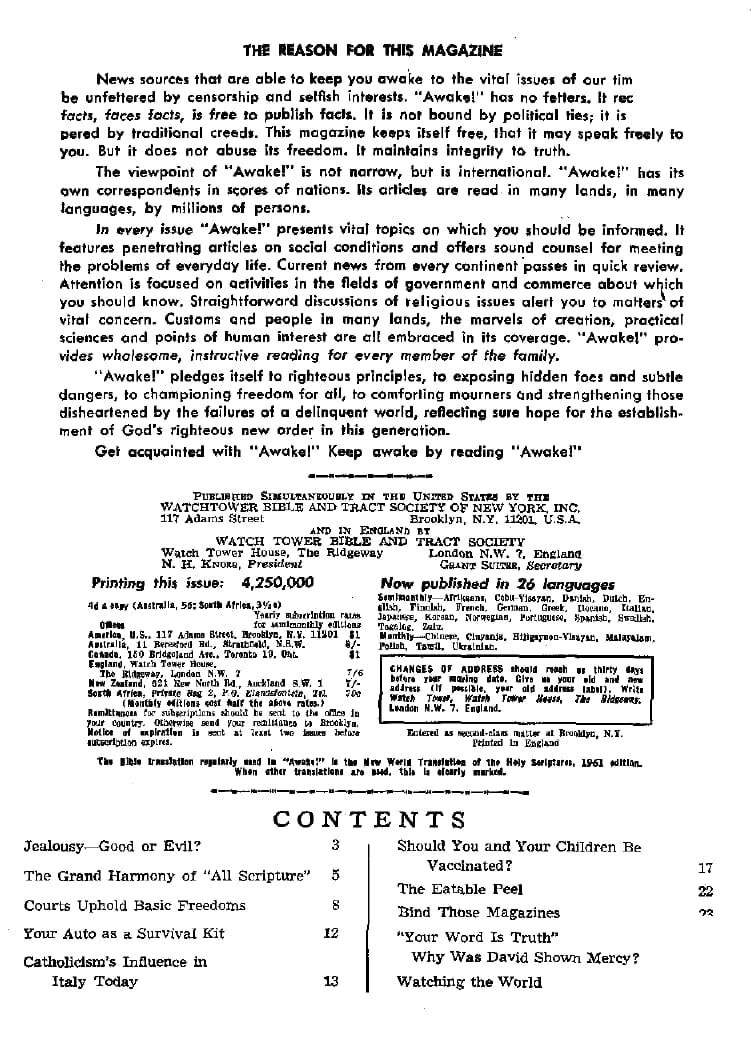
THE REASON FOR THIS MAGAZINE
News sources that are able to keep you awake to the vital issues of our tim be unfettered by censorship and selfish interests. "Awake!" has no fetters. It rec facts, faces facts, is free to publish facts. It is not bound by political ties; it is pered by traditional creeds. This magazine keeps itself free, that it may speak freely to you. But it does not abuse its freedom. It maintains integrity to truth.
The viewpoint of "Awake!" is not narrow, but is international. "Awake!" has its own correspondents in scores of nations. Its articles are read in many lands, in many languages, by millions of persons.
In every issue "Awake!" presents vital topics on which you should be informed. It features penetrating articles on social conditions and offers sound counsel for meeting
the problems of everyday life. Current news from every continent passes in quick review. Attention is focused on activities in the fields of government and commerce about which you should know. Straightforward discussions of religious issues alert you to matters of vital concern. Customs and people in many lands, the marvels of creation, practical sciences and points of human interest are all embraced in its coverage. "Awakel" provides wholesome, instructive reading for every member of the family.
"Awakel" pledges itself to righteous principles, to exposing hidden foes and subite dangers, to championing freedom for all, to comforting mourners and strengthening those disheartened by the failures of a delinquent world, reflecting sure hope for the establishment of God's righteous new order in this generation.
Get acquainted with "Awake!" Keep awake by reading "Awake!"
PUBLISHED SIMULTANEOUSLY IN THE UNITED STATES BY THE
WATCHTOWER BIBLE AND TRACT SOCIETY OF NEW YORK, INC.
117 Adams Street
Brooklyn, N.Y. 11201 U.S.A.
AND IN ENGLAND BT
WATCH TOWER BIBLE AND TRACT SOCIETY
Watch Tower House, The Ridgeway
N. H. KNURS, President
London N.W. ?. England
GRANT SUITER, Secretary
Printing this issue: 4,250,000
4d a sgay (Australia, 55: South Africa, 3½s)
Officers for semi-monthly editions
Amation, U.S., 117 Adma Street, Brooklyn, N.Y. 11201 $1
Australia, 11 Beresford Rd., Sigathafield, N.B.W. $/-
$
Canada, 159 Bridgeland Ave., Toronto 10, ONL
England, Watch Tower House.
The Bridgeway, London N.W. 2 7/6
New Zealand, 621 New North Rd., Auckland S.W. 1 7/-.
South Africa, Private Bag 2, P.O. Enlargement, Zel. 700
(Monthly millions cost half the above rates.)
Rumblings for subscriptions should be sent to the office in your country. Observe and keep your contacts to Brooklyn. Notice of expiration is sent at least two issues before subscription expires.
Now published in 26 languages
Semianthem -African, Cebu, Visayan, Danish, Dutch, English, Finnish, French, German, Greek, Danee, Italian, Japanese, Korean, Norwegian, Portuguese, Spanish, Swahili, Tamilog, Zalz.
Monthly—Chinese, Cipyanis, Biligayon-Vlasay, Malayalam,
Polish, Tauril, Ukrainian.
CHANGES OF ADDRESS should result in thirty days before your mailing date. Give us the old and new address for your town, town tower, town junction, Zinc Blossom, London N.W. 7, England.
Entered as second-class matter at Brooklyn, N.Y.
Printed in England
The Bible translation regularly used in "Awake!" in the New World Translation of the Holy Scriptures, 1961 edition.
When other translations are used, this is clearly marked.
CONTENTS
Jealousy—Good or Evil? 3
The Grand Harmony of "All Scripture" 5
Courts Uphold Basic Freedoms 8
Your Auto as a Survival Kit 12
Catholicism's Influence in
Italy Today 13
Vaccinated? 17
The Eatable Peel 22
Bind Those Magazines 23
"Your Word Is Truth"
Why Was David Shown Mercy?
Watching the World
Volume XLVI
London, England, August 22, 1963
Number 16
JEALOUSY Good or Evil?
EVIL, of course,' some might answer. Why, jealousy is widely recognized as one of the most vile of emotions.' While that can be true, it must be recognized that there is a form of jealousy that is right and proper. A comparison of the two forms will be profitable in determining how correct our emotions are.
We have but to turn to the inspired writings of Moses to find an example of righteous jealousy. The perfect Creator declared: "You must not prostrate yourself to another god, because Jehovah, whose name is Jealous, he is a jealous God." Also, he describes himself as "a God exacting exclusive devotion" from his worshipers. (Ex. 34:14; 20:5) For Jehovah to be jealous about worship, or to exact exclusive devotion, is altogether fitting. He is the only true God; he has a proper claim on all our worship. Nor can any selfish motive be ascribed to God on this account, for it is in the interest of the peace and happiness of all his creatures that they worship their Creator. As the Creator, he
knows what is in the highest interest of his creatures.
In line with this, devoted servants of God, such as the prophet Elijah and the apostle Paul, could properly express jealousy over the worship of professed servants of God. (1 Ki. 19:10) To the congregation that he had established in Corinth, which included persons Jehovah had accepted as part of the 'bride of Christ,' the apostle Paul wrote: "I am jealous over you with a godly jealousy." (2 Cor. 11:2) He was not craving their devotion for himself. Rather, because Jesus Christ the Bridegroom has the right to devotion from his Bride, the apostle could express proper concern over the congregation, which he had promised in marriage to the one Husband, Jesus Christ.
In contrast to perfect, godly jealousy, imperfect humans often express an emotion called jealousy that is in reality fear of losing something that they have or resentment toward a person who might take away the possession. But, you might ask, is it not human nature to be jealous about the object of one's love? True, but let us remember that we are dealing with fallen, sinful human nature. Jealousy can act like a corrosive acid that eats away one's vital organs. It can drive persons to depression, violence and even suicide. Properly this form of jealousy is soundly condemned in the Bible as "earthly, animal, demonic," a 'work belonging to darkness,' which Christians should abandon.
(Jas. 3:14-16; Rom. 13:12, 13) In fact, Proverbs 14:30 warns us that "jealousy is rottenness to the bones."
Human jealousy is often based, not on fact, but on fanciful imagination. For example, a wife might notice that her husband appears to be giving extra attention to another woman who is quite pretty or who is a sparkling conversationalist. While there may be no basis for distrusting her husband, soon seeds of suspicion are found in the wife's heart, seeds that can grow into the malicious weed of jealousy, destroying her happiness and even her home. Or some husband might notice that his wife seems to enjoy talking with a particular man who has a striking personality or who has many interesting experiences to relate. Unless he controls his emotions, the husband could allow baseless jealousy to increase until he is reduced to a bitter dictator of his wife's actions. And yet his wife may have been completely faithful to him, having no romantic interest in the other man at all.
Jealousy is even used at times as an unchristian, underhanded tool. As an illustration, a young girl might be interested in a boy who does not openly return her attention. In order to increase his interest in her, she might dishonestly feign romantic interest in another boy. She hopes to use this third person as a fulcrum on which she will use jealousy as a bar or lever to raise the interest of the first boy toward her. Obviously this subterfuge is wrong, doing emotional harm to innocent persons; but jealousy often destroys right principles.
Of course, within the marriage union exclusive devotion is proper in certain respects. A married individual has the exclusive right to the marital due and the intimate expressions of affection from a
marriage mate. This is a God-given right. Gen. 2:24; 1 Cor. 7:3-5; Heb. 13:4) But this does not mean that married people can have no friends aside from their mates. Balance in appreciating what is proper association will greatly relieve persons who have a tendency to be jealous of their mates.
It is normal and proper to have love for your family and friends, but it has been said that in jealousy there is more self-love than love. When you see a loved one enjoying the company of another person, you should honestly admit to yourself that possibly that person has a personality trait or ability that you do not. Instead of resenting that, more happiness would be produced for all if you would join your mate or loved one in enjoying the knowledge, ability or personality of that other person. If married, you should realize that your mate loves, accepts and needs you, but that does not mean that you are perfect, with all knowledge and abilities. When you learn of things or persons that your mate enjoys, instead of competing and struggling to be possessive, why not join your mate in that one's enjoyment? In this way mutual love is built up, and it will also eliminate jealousy. Speaking of true love, the apostle Paul said: "Love is not jealous, it . . . does not look for its own interests . . . Love never fails."—1 Cor. 13: 4, 5, 8.
The apostle Paul listed human jealousy as one of the "works of the flesh." (Gal. 5:19, 20) Appreciating our imperfection, we should resist the human form of this emotion that runs contrary to true love. By being fully concerned about 'godly jealousy' or jealousy exercised in a way that God does and not getting carried away with base human jealousy, we can enjoy increased peace with God, family and friends.
THE evenings are cool here in the mountains, and the Jones family appreciates the warm fire-side as they relax after the day's activities. John Jones and his wife, Mary, have done well in rearing their family according to Bible principles. From Mark,
the oldest son, to daughter Ruth—yes, right down to Thomas, the youngest, they can all hold their own when it comes to answering questions on the Bible.
It is Ruth who brings the conversation around to their previous topic of discussion. "You know," she says, "I saw something in the field this morning that reminded me of the Bible. You would never guess what it was—a spider's web!"
"A spider's web remind you of the Bible?" asks Mark.
"Yes," continues Ruth, "it looked so beautiful and symmetrical, with dewdrops glistening on all its threads. And then I got to reflecting that Jehovah, the Author of the Bible, is also the Master Designer of that beautiful web. . . . You know, I once watched a spider weave its web."
"Ugh," says Thomas, "I don't like spiders. But go on, Ruth."
"Well, first he spun a framework between the bushes—something that looked like the spokes of a wheel."
"And then—" prompts Thomas.
"Why, then he spun his way round and round and round, from spoke to spoke, making a beautiful spiral of shiny, sticky thread. But both spokes and spiral made up one
shimmering, harmonious whole. It is this beauty and oneness that remind me of the Bible. You see, Jehovah first inspired the writing of the Hebrew
Scriptures, over some eleven hundred years. And then on this framework of thirty-nine books he later spun the
twenty-seven books of the Greek Scriptures, a perfect complement to the Hebrew Scriptures that preceded them."
"That illustrates things very well," remarks Mary Jones. "First the Hebrew Scriptures, and then the Greek. But how interdependent the two are—in fact, so inseparable that we must always regard them as being one composite whole, the complete, inspired Word of Jehovah God."
"Very true," continues her husband, "for it was Jesus who opened up the minds of his disciples 'fully to grasp the meaning' of the Hebrew Scriptures; you remember, it's at Luke 24:45. Then those disciples drew heavily on the Hebrew Scriptures for proof texts and arguments in their writings. That is why we find many parts of the Greek Scriptures hard to understand without a background knowledge of the Hebrew Scriptures."
"Oh, yes," says Ruth, "that reminds me of the time I came across 'Melchizedek' in Paul's letter to the Hebrews and had to trace him back to Genesis, chapter 14, and Psalm 110 to find out what it was all about."
Mark breaks in: "And talking of the book of Hebrews, how is it that we have come to understand Paul's applications here of the Law of Moses, its covenant, the tabernacle, the priesthood, the blood and the mediator?
Mother replies: "Why, only by studying out the greater part of Exodus, Leviticus, Numbers and Deuteronomy."
"That's very true," says father, "And so we appreciate how well the Greek Scriptures support the Hebrew Scriptures in showing us the fulfillments of the many details. This also helps us to understand Christ Jesus' office, not only as King, but also as God's great High Priest in heaven."
The warm fire has made young Thomas a little drowsy, so father rouses him to read a scripture from his Bible, Hebrews 8:1: "Now as to the things being discussed this is the main point: We have such a high priest as this, and he has sat down at the right hand of the throne of the majesty in the heavens."
"How do we understand this?" asks John Jones.
Mark is quick to reply: "This is another reference to the Hebrew Scriptures, this time to Psalm 110. I recall reading in the book 'All Scripture Is Inspired of God and Beneficial' that there are at least five quotations of verse one of this psalm alone in the book of Hebrews. Thomas, you may recall what Psalm 110:1 says."
To make sure, Thomas locates the text in his Bible and reads it: "The utterance of Jehovah to my Lord is: 'Sit at my right hand until I place your enemies as a stool for your feet.'" "Yes," he adds, "David is here speaking in a prophecy about his Lord, Jesus Christ, in heaven after his resurrection."
served in Jesus, they should have been able to answer."
"Well spoken, Thomas," says Mary, and continues: "It was to these same words that Jesus referred—and here it is, at Luke 20:41-44—when he asked his opposers, 'How is it they say that the Christ is David's son?' If those Jews had compared the Hebrew Scriptures with what they ob-
"And note Peter's famous speech at Pentecost," adds Mark. "Here, as recorded in Acts, chapter 2, he makes a number of quotations from the Hebrew Scriptures, and then relies on Psalm 110 for the clinching argument of his talk. He shows that Jesus, now at God's right hand, has poured out the promised holy spirit. After quoting this psalm, he concludes, at Acts 2:36: 'Therefore let all the house of Israel know for a certainty that God made him both Lord and Christ, this Jesus whom you impaled.'"
John Jones summarizes the matter: "So if we did not have the prophecies of the Hebrew Scriptures, it would be very, very difficult to understand all these passages in the Greek Scriptures. Why, the 110th Psalm alone is quoted by Bible writers Matthew, Mark, Luke, Peter, Paul and John. What an abundant support this is for the Hebrew Scriptures!"
Mother now comments: "I've just been looking here at Romans 10:11-21, about the importance of obeying and proclaiming the good news. Look!—three different quotations from Isaiah, and others from Psalms, Joel and Deuteronomy."
To which Mark adds: "And here at Galatians, chapter 4, about the symbolic drama involving Sarah and Hagar—how could we ever understand the import of Paul's remarks without reading the background information about these two women at Genesis, chapters 16 to 21?"
"And what about James' references?" asks Ruth. "In his letter he speaks of the exemplary qualities of Abraham, Rahab, Job and Elijah. To get the full benefit, we really have to study out these Bible characters. And that takes in the Bible books of Genesis, Joshua, Job and First and Second Kings."
"It's the same," continues Mark, "with Jude's references to Cain, Enoch, Sodom and Gomorrah, Korah and Balaam. Here, also, it's essential to be familiar with the background information in the Hebrew Scriptures—at Genesis and Numbers."
"Then there are the references," says Ruth, "in Peter's two letters, to Noah's day, the angels that sinned, Sarah's adornment and God's promise of 'new heavens and a new earth.' We truly need Genesis and Isaiah's prophecy to elucidate these."
"You children have it 'down pat,'" remarks John Jones. "And since the Greek Scriptures do indeed give all this support to the Hebrew Scriptures, does it not indicate that we too should give careful study to the Hebrew Scriptures, as well as to the Greek? . . . And now let's review! First, Thomas, what do we call the first five books of the Bible?"
"That is the Pentateuch," Thomas replies, "and it was written by Moses."
"Very true," John Jones remarks, "and what other people of ancient times had anything to compare with the writings of Moses? A dynamic record, indeed—practical, thorough and complete for the needs of the nation of Israel. And it sets out principles that Jesus observed when on earth, and which continue to be an invaluable guide for all Christians till this day."
"Next," says Mark, "we have the historical books from Joshua through to Esther. Here we can note how each book builds on the preceding ones in developing the Kingdom theme of the Bible. Truly this is a record that is both inspired and inspiring!"
—the book of Job. What a clear focus it gives us on the issue of integrity and on God's sovereignty!"
"And here we must include my favorite, the book of Ruth," mother adds, "beautiful and meaningful, and essential too in identifying the line of descent to Messiah."
It is Ruth's turn: "Then there is that superb example of ancient Hebrew poetry
"And we must not forget all the other 'writings,'" says Mark, "Psalms through to The Song of Solomon. These are inspiring in their amonition and encouragement, and what heights of grandeur they reach in portraying Jehovah's royal Son, and in giving foveglimpses of his kingdom! No wonder that the book of Psalms, with its emphasis on praise to Jehovah, is most frequently quoted in the Greek Scriptures!"
Young Thomas joins in: "And what about the prophets? Daddy, you have often told us about their courageous acts."
"That's right," says his father. "Just visualize Jeremiah, Isaiah, Micah and the others standing up among wicked rulers and wicked people and fearlessly proclaiming the word of Jehovah. And how enjoyable it is to study the modern-day application of these prophecies!"
"What wonderful forevisions Jehovah provided through them," adds Mary, "of a new covenant, God's law written on the hearts of his people, new heavens and a new earth, the Prince of Peace to rule in David's line, beating swords into plowshares . . ."
Her husband takes up the theme: "And as we continue into the study of the Christian Greek Scriptures, we note the overwhelming support that they give to all that has gone before. They quote and requote, and draw illustration upon illustration from the Hebrew Scriptures. Thus, from beginning to end, both Hebrew and Greek Scriptures make to stand out clearly the glorious, harmonious theme of 'all Scripture.' And Thomas, do you remember what that theme is?"
"Yes, Daddy, it is about making God's name holy through Christ's kingdom."
"Very good, my son—the sanctification of Jehovah's name through the Kingdom of the Seed.
And now I think you all understand why I require you to attend the Theocratic Ministry School and other congregational meetings each week. There we all learn the things about 'all Scripture,' God's Word, that we need to know.
Surely we all rejoice in the spiritual understanding and strong faith that we gain as a result of this."
"But look at the time!" mother exclaims. Again it is bedtime. However, all agree that it has been time well spent—around the happifying Word of God.
FOREMOST among the precious freedoms man has today are the freedom of religion and the freedom of speech.
Such freedoms are virtually nonexistent in some lands, and hard won in others. In the United States of America the founding fathers of the nation thought so highly of these freedoms that they incorporated them in the very foundation document of the country, the Constitution, particularly in the first ten amendments.
On March 8, 1965, the Supreme Court announced its decision in a case involving
Freedom of Religion
Part of the First Amendment to the Constitution states this: "Congress shall make no law respecting an establishment of religion, or prohibiting the free exercise thereof; or abridging the freedom of speech." It was in regard to these two fundamental freedoms, of religion and speech, that cases decided early in 1965 by the United States Supreme Court and by a Superior Court of California stirred great interest.
three young men, each of whom claimed exemption from serving in the armed forces of the United States on religious grounds.
Their cases had come up separately in lower courts previously. One of the individuals, Daniel A. Seeger, had been convicted in a federal District Court in the state of New York for having refused to submit to induction into the armed forces. He took his case to a United States Court of Appeals, and won. The court reversed the judgment against him. However, the prosecution then took the case to the United States Supreme Court in an attempt to get the original conviction upheld.
The second case was that of Arno S. Jakobson. He was also convicted in the same District Court in New York for having refused induction into the armed forces. But the Court of Appeals reversed this decision; whereupon, as in Seeger's case, the prosecution took the case to the United States Supreme Court.
The third case involved Forest B. Peter, convicted in a federal District Court in California on the same charge, that of refusing induction into the armed services.
In this case, however, a Circuit Court of Appeals affirmed the lower court's judgment, so Peter took the matter to the United States Supreme Court.
Since these three cases were similar, each involving a claim of conscientious objection to the Universal Military Training and Service Act, they were consolidated by the Supreme Court.
Belief in a "Supreme Being"
The crux of the matter involved interpretation of the draft act's exemption from combat training and service in the armed forces of persons who, by reason of their religious training and belief, are conscientiously opposed to participation in war in any form.
The three men raised the basic question of the constitutionality of the section of the Act that defines the term "religious training and belief" to mean "an individual's belief in a relation to a Supreme Being involving duties superior to those arising from any human relation, but [not including] essentially political, sociological, or philosophical views or a merely personal moral code." Each claimed that this interpretation was unconstitutional because it discriminated between different forms of religious expression. Each stated he had an individual religious belief, although not connected with any organized religion nor conforming to the orthodox view of a "Supreme Being."
Seeger declared he was conscientiously opposed to participation in war in any form due to this individual religious belief. He left open the question as to his belief in a Supreme Being, choosing not to answer whether he believed in such a Supreme Being or not. He held that his skepticism in the existence of God did not necessarily mean lack of faith in anything
whatsoever. Rather, he stated that his was a "belief in and devotion to goodness and virtue for their own sakes, and a religious faith in a purely ethical creed."
Jakobson also held to unorthodox views. He defined religion as the "sum and essence of one's basic attitudes to the fundamental problems of human existence." He said that he believed in "Godness," which was "the Ultimate Cause for the fact of the Being of the Universe."
Peter, too, was not a member of a religious sect or organization. On the question as to his belief in a Supreme Being he said that it depended on the definition. He also stated that he felt it a violation of his moral code to take human life and that he considered this belief superior to his obligation to the State. When asked whether this conviction was religious, he quoted with approval a clergyman's definition of religion as "the consciousness of some power manifest in nature which helps man in the ordering of his life in harmony with its demands . . . [it] is the supreme expression of human nature; it is man thinking his highest, feeling his deepest, and living his best."
The Circuit Court of Appeals that previously exonerated Seeger had stated: "We cannot conclude that specific religious concepts, even if shared by the overwhelming majority of the country's organized religions, may be selected so as to discriminate against the holders of equally sincere religious beliefs. . . We are convinced that the believer in a Supreme Being is not for that reason alone more entitled to have his conscience respected by a draft board than is Daniel Seeger. In the words of Madison's historic Remonstrance, . . . 'religion is too personal, too sacred, too holy, to permit its "unhallowed perversion" by a civil magistrate.'"
The same Circuit Court of Appeals reversed Jakobson's conviction, and it commented: "Under present day thinking as to the First Amendment, a statute could scarcely be defended .
. . if it protected 'the free exercise' of only a few favored religions or preferred some religions over others without reasonable basis for doing so. . . The freedom which the Constitution protects is the freedom to exercise the religion of one's choice; a statute limited to certain religions would restrict the free exercise of the disfavored ones."
The Circuit Court was very concerned about protecting the freedom of religion guaranteed by the First Amendment to the Constitution of the United States. The judges felt that, even though Seeger and Jakobson did not have orthodox religious views and were not connected with an established religion, it did not mean they were not religious, nor could this be used as grounds to deny them exemption from bearing arms. However, the prosecution disagreed and, in both instances, took the case to the Supreme Court.
Decision of Supreme Court
The cases of Seeger and Jakobson, as well as that of Peter, were together brought before the Supreme Court. On March 8, 1965, the highest court of the land announced its decision, stating: "We have concluded that Congress, in using the expression 'Supreme Being' rather than the designation of 'God,' was merely clarifying the meaning of religious training and belief so as to embrace all religions and to exclude essentially political, sociological, or philosophical views. We believe that under this construction, the test of belief 'in a relation to a Supreme Being' is whether a given belief that is sincere and meaningful occupies a place in the life of its possessor parallel to that filled by the orthodox belief in God of one who clearly qualifies for the exemption. Where such beliefs have parallel positions in the lives
of their respective holders we cannot say that one is 'in a relation to a Supreme Being' and the other is not. We have concluded that the beliefs of the objectors in these cases [Seeger, Jakobson, Peter] meet these criteria."
The Supreme Court then upheld the Appeals Court in the cases of Seeger and Jakobson and reversed the judgment that had been entered against Peter by another Appeals Court. All three were exonerated and were permitted deferment as conscientious objectors on religious grounds.
Commenting on the Court's decision, Mr. Justice Douglas said: "I agree with the Court that any person opposed to war on the basis of a sincere belief, which in his life fills the same place as a belief in God fills in the life of an orthodox religionist, is entitled to exemption under the statute."
The Supreme Court was not attempting to say that a liberal view of God is better than a fundamentalist view, or that any particular definition is the only valid one. The Court was saying that if a man's conscience makes a difference in such matters, then he must be taken seriously regardless of the theological source of his convictions. What the Court had to decide here was whether a belief professed by an objector was sincerely held and whether it was, in his own thinking, religious. In the cases of the three individuals in question, the Supreme Court decided they were sincere and religious. The decision took into account the individual conscience and upheld the freedom of the individual to believe according to that conscience.
Freedom of Speech
About the same time a different case involving another basic freedom, this time freedom of speech, arose in the state of California. Here, a youth, Charles Ames, was threatened with expulsion from the Santa Barbara High School because he refused to recite the words of the Pledge of Allegiance.
He based his refusal on the ground that to compel him to recite the Pledge of Allegiance violated the First and Fourteenth Amendments to the United States Constitution.
The First Amendment had incorporated in it the freedom of speech, as well as the freedom of religion. But Ames did not, as the court stated, "take the easy way out by declaring his stand based upon the Freedom of Religion." Had he done so, there probably would have been no case, as this right is already well established. Ames definitely declared that he did not have any religion, as that word is commonly understood, and therefore renounced the protection of the First Amendment's freedom of religion clause. He described his position as that of an agnostic who does not accept dogma or theology. His stand, then, was based on freedom of speech, as well as conscience. He claimed that under the First Amendment he had the freedom to take the position that he wished to take when the Pledge was recited. In this case he stated that he had the freedom to recite it or not to recite it, and he chose not to recite it.
The case came before the Superior Court in the county of Santa Barbara. On April 30, 1965, the judgment of the court was announced. The presiding judge said: "I must by compulsion of the United States Constitution command the Respondent Board of Education to permit this Petitioner to remain silent and not to compel him to recite the words of the Pledge of Allegiance. I have no other choice."
The court cited as an example a precedent in the case of United States vs. Barnette, which also involved a pledge of allegiance. The court quoted a portion from the U. S. Supreme Court's decision in that case. It said, in part: "If there is any fixed star in our constitutional constellation, it is
that no official, high or petty, can prescribe what shall be orthodox in politics, nationalism, religion, or other matters of opinion or force citizens to confess by word or act their faith therein. If there are any circumstances which permit an exception, they do not now occur to us. We think the action of the local authorities in compelling the flag salute and pledge transcends constitutional limitations of their power and invades the sphere of intellect and spirit which it is the purpose of the First Amendment to our Constitution to reserve from all official control."
The Superior Court then decided that Ames' right to freedom of speech had to be upheld, declaring: "Because some may think him odd, or even sacrilegious is of no moment to this Court. We must and we shall stand for his right, his own right to think as he will so long as his way of life resulting from his thoughts do[es] not harm and do[es] not interfere with the beliefs of others. We hold Petitioner has the right to refuse to verbally recite the Pledge, and I base this upon the Constitutional ground, too, of Freedom of Speech,—his right to express himself or speak in a sense is his right to remain silent."
These two cases, the one decided by the Supreme Court and the one decided by the California Superior Court, were welcomed additions to the great legal bulwark protecting basic freedoms of the individual in the United States. These courts are to be commended for their integrity, for their decisions benefit not only the individuals directly involved but many others who may take a like stand in the future.
Freedom of religion and freedom of speech are precious. They are God given, and no individual, whether in high or low station, should deny them to others. It is heartening to see that the high courts of the United States continue to uphold these basic freedoms.
YOUR AUTO AS A SURVIVAL KIT
WITH the great number of auto accidents that take many thousands of lives yearly, one may not readily think of the auto as a means of saving lives. Yet in some situations your auto can mean survival.
There are times when an auto breaks down in very isolated areas, sometimes at night. In these instances and in many others, such as being marooned in a blizzard, flood or desert, people have kept alive by staying with their car, waiting for help. Usually it is easier for search parties to find a car than an individual wandering about. Yet the first inclination of a marooned person is almost always to set out for help.
"Too often," says a California highway patrolman of the motorist who thinks only of leaving his car, "he's beyond help when we find him a couple miles down the road, dead from exhaustion, heat or cold." According to this patrolman, "not one motorist in a hundred sees his car as a survival kit."
The auto can indeed be a survival kit, for it has almost everything to keep one alive except food. What is required is some imagination. As the leader of a rescue team in the United States put it, one must turn his auto to purpose and "wring from its ton or more of metal, wires and gadgets the essentials of survival."
How can one survive by staying with his car till help arrives? If there is no snow or water nearby, there is a water reservoir under the hood of many kinds of autos. Depending on the car's size, the radiator may contain up to twenty-one quarts of water. Here is a thirst-quenching canteen for one marooned in desertlike places. By using the radiator's spigot on the car's underside, one could get water, providing it has not been contaminated with antifreeze, to last for days. If the water is rusty, it could be filtered with a handkerchief. For a cup, one could unscrew the small bowl or sediment bulb attached to the fuel line. Or one could use one of the car's hubcaps. If digging or shovelling materials are needed, one could use the jack handle, hubcaps, sun visors or the glove-compartment door.
unscrew the rearview mirror and use this as a reflective signal. One motorist, car broken down at night, removed a sealed-beam headlight. Leaving it wired to the battery, he directed its beam upward in wide, sweeping ares. He and his family were rescued. Still another way to signal for help is to make use of the oil under the car's hood. By burning a quart of oil in a hubcap, one can send up a smoke signal high into the sky, visible for miles around. A little gasoline poured on top of the oil will help ignite it, but be careful!
If you wanted to signal for help, how could you use your auto? First, there is the auto's horn. The car may have a flashlight in the glove compartment or trunk. Or one could
Rubber tubing or hoses could be used in several ways, such as a tourniquet to stop bleeding. In some cars a hose may be long enough to be used to siphon out gasoline from the car's fuel tank.
A little gasoline will help to get a fire going. If there is no wood to burn and warming is needed, one could do as some stranded persons have done—set an auto tire on fire. The gasoline helps the tire to get burning and one tire may thus furnish warmth for three to four hours. To get gasoline for starting fires, one could open the drain plug on the bottom of the gasoline tank. Or one could use a rag or handkerchief tied to a wire and thrust it into the filler pipe of the gasoline tank. The gasoline-soaked rag could be used as a torch to start a fire, but be ready to move back quickly when you light it. Suppose a stranded motorist had no matches. Some motorists overlook the obvious: That their car may have a builtin fire starter, a cigarette lighter. If the car has no such device, the dome light's glass could be used to focus the sun to start a fire. Or, if the motor runs, a gas-soaked rag could be ignited by making sparks from a spark-plug wire.
One of the most obvious uses of the car for survival, of course, is as a place to sleep or as shelter. In an electrical storm, few places are as safe as a car with its rubber-tire insulation. When the car is used as shelter from cold air, there may be slipcovers, floor mats and rugs that can serve as blankets or a means to shut out wind.
By using imagination while waiting for help a stranded motorist can use his auto to withstand the rigors of cold, heat, wind, sleet or snow. For in the auto are raw materials for family survival.
ITALY is one of the many countries that have felt the religious influence of the Roman Catholic Church for centuries. Every well-
ITALY TODAY
informed person knows that in the past, particularly during the Middle Ages, the Catholic clergy exercised great influence over the lives of Italians, both individually and collectively as a nation
lectively as a nation.
But what is the situation today? How much religious influence does the Roman Catholic Church exercise in Italy today? Does she still succeed in dominating the lives of the Italian people as in the past? What is the attitude of Italians in this regard? Do they accept control by the church, or do they reject it?
Church in Crisis
The fact of the matter is that in Italy, called by some "the cradle of Christianity," the Roman Catholic religion is in deep trouble, losing ground year by year. The situation has approached crisis proportions.
Most Italians generally believe in God and are Catholic because they were baptized, christened and received communion when they were children. But when they see the Catholic church participating in activities of which they disapprove, then many make and follow a personal religion of their own, in which part of the Catholic teaching is accepted and part is discarded.
By "Awake!" correspondent in Italy
Therefore, it is common to hear people say: "I believe in God but not in the priests," or, "I go to church to pray when the
priest isn't there."
This is admitted by Catholic newspapers. La Voice (The Voice), published at Terni, on January 19, 1958, said: "It is useless, in fact, to keep on repeating that 99% of us in Italy
are Catholics; sorry to say, useless and substantially false. If we examine these statistics
in the light of the catechism, which is what really counts, we find them false. A Catholic is a person who: (1) is baptized, (2) believes ALL the truths taught by the Church, (3) practices a sacramental life, (4) obeys the Church like God. Here are some facts: about a third of the Italian electorate vote for parties openly and repeatedly condemned by the Church on the religious and moral level. From sufficiently accurate polls we are assured that 31\% of Italians never go to mass, 34\% are not completely in favor of religious marriages, 45\% believe one can be a good Catholic and also a good socialist (follower of Nenni), only 62\% are against divorce, only 38\% are contrary to abortion. Yes, 99\% of the Italian population are baptized but if we check the other three requirements of true Catholics, a fearful lowering of the percentage is plainly evident."
A poll conducted by the newspaper L'Espresso (The Express) on October 20, 1957, verified these conclusions. To the question, "Are you a practicing Catholic?" only 13 percent answered Yes, whereas 87 percent answered No! Emphasizing the seriousness of the problem, Il Tempo (The Time) of June 19, 1960, affirmed: "Catholicism risks, for the future, being completely excluded from the life and customs of the local population. The undeniable technical-industrial progress of the South . . . has created the dangerous question of survival for the Catholic Church. Nor is this a condition that takes place only in the southern part of the peninsula."
The situation in the North is even worse. The newspaper Roma (Rome) of February 11, 1962, published the results of investigations made by the Catholic dioceses themselves in various regions of Italy. All the clergy deplored the frightening crisis in the religious condition of the people. The newspaper stated: "People are not what they were once upon a time. They rarely attend the sacraments, participate in religious rites only on holidays, and even the number of these is plainly decreasing. In short, one is brought to ask: 'Do Italians really believe in God?'"
In the northern city of Bologna less than a quarter of its 425,000 inhabitants of the age of reason observed the "religious holiday of obligation" on any one winter Sunday. But even of those that attend Sunday services, Roma observed, "only an appalling 10% . . . can be considered actually 'faithful.'" This paper finally concluded: "We have therefore ascertained, with unchallengeable figures as evidence, that religiousness in Italy is in a continual crisis. . . It is as if millions of Italians had discovered in themselves the vocation of paganism, of syncretism, or, at any rate, of public disbelief."
Changing Attitudes
This change is not only one of a careless drifting away from the church, but also involves basic attitudes.
For instance, on certain occasions of the year the priest visits every house in a community in order to "bless" it by means of the sprinkling of "holy water." In exchange he receives eggs, cheese, money and other gifts. During the period of Fascist rule, when the church reigned supreme, this tradition met practically no opposition.
Now, however, unpleasant controversies take place more often than the priests like if they do not avoid the houses where they are not desired, which are many. Much of the time these controversies are due to political motives, but, in some cases, opposition now arises because of differing religious beliefs. Often the church's handling of matters results in bad publicity. In one case a farmer in a little town near Rome prevented a priest from blessing his stable and consequently was cited for outrage to the Public Prosecutor! But the publicity resulting from the affair brought great dishonor to the Catholic church. Furthermore, when the clergy appeal to local authorities to vent their intolerance, they lose the sympathy of the majority of the people, who side with the ones being persecuted.
A similar case, the echo of which has not yet died down, is the one regarding the Bellandi couple. These two young persons got married in a civil ceremony, which is the one required by the Italian government. The Catholic bishop of Prato, however, accused them of concubinage. A trial followed, which interested public opinion throughout the entire country. As foreseen, the civil marriage was judged honorable and valid by the State. But what effect did this have on the minds of observers, including many Catholics? L'Espresso of April 12, 1959, complained: "This manner of interfering with the private lives of two citizens is uncivilized and deplorable."
Communism a Formidable Foe
The rise of a huge Communist party in Italy is one direct result of years of dissatisfaction with the Catholic church. It is today one of the essential reasons for the crisis in the Catholic religion in Italy, for the Communists form one of the most organized and dedicated groups in opposition to the church. In Italy the Communist party has caused millions of believers to be led away from active participation in their traditional religion.
Pope Pius XII tried to stop the growing opposition of the Communists by excommunicating the followers of this party and denying them religious services. The results, however, were not satisfactory. In fact, after the excommunication the number of Communists increased and their aggressiveness became greater!
The following pope, John XXIII, made efforts to draw them close again and exerted a less hostile influence. But not even this attitude made the situation any better. The present pope, Paul VI, outlined in a recent encyclical his desire to define the situation and hold it within its present limits. L'Osservatore Romano (The Roman Observer) of December 6, 1964, said in this regard: "This is the reason that obliges the Holy Father, as it obliged his predecessors, to condemn the ideological systems which deny God and oppress the Church, systems that are often identified with economical, social and political regimes, and among these especially atheistic Communism."
That the Roman Catholic Church fears "especially atheistic Communism" is understandable when one considers that a future political election in Italy could possibly mean the victory of the parties to the Left. Including Communists, which would likely mean the losing of privileges now given to the church. For example, at the present time the clergy receive a salary from the State, the patrimony of the church is recognized and her ecclesiastical jurisdiction is guaranteed in the entire territory of the nation. But what would happen if there was a political change of a radical nature, with Leftist forces controlling the government?
Other Manifestations of Animosity
Another manifestation of animosity that underlines the serious crisis plaguing the Catholic church in Italy is the continual repetition of particular news happenings. Criminal acts occurring in places of Catholic worship are becoming more frequent. Sometimes they are even the object of ridicule. Paese Sera (Evening Country) of December 2, 1964, in the article "At Centocelle Thief Repents (but not too much)," announced a theft committed in a parish of Rome. Having noted that the thief had stolen objects from statues of Catholic saints and from an image of the Madonna in the amount of three million litre ($4,840), the article added: "It is noteworthy that the thief had lit a candle in front of the statue of St. Anthony, the only candle that gave light in the church immersed in darkness. Only the one who had committed the theft could have lit it. Did he do it perhaps in order to obtain forgiveness?"
Furthermore, when the pope recently made two trips to other countries, thereby breaking a tradition that had lasted for a long time, it appeared that many of the people of Italy were pleased. It seemed to mark a new conciliatory attitude. But this does not mean that the words of the pope were received without reservation. In fact, upon his return from his trip to Palestine, the newspaper L'Espresso of January 19, 1964, said: "If the words of Paul VI are supposed to be promises of a new course, we shall be the first ones to greet them as a real sign of new times; but they may only be propaganda and in that case it is safer to wait for confirmation by the facts."
And the article concluded: "Honesty requires that one reserve enthusiasm for the accomplished facts more than for the words that simply (and not always clearly) announce them."
Another event that caused animosity toward the church on the part of believers as well as nonbelievers had to do with "Saint" Filomena. On August 10, 1805, a little box containing the mortal remains of the one who was supposed to be this saint was carried to Mugnano del Cardinale, near Avellino. A sanctuary was built and pilgrims began to flock there. Besides Italy, the cult of this "saint" spread to France, Portugal, China, the Indies, the United States of America, Canada and Brazil. A number of articles, and also books, have been written about her, and many miracles have been attributed to her. The existence of this presumed saint had never been questioned.
A few years ago, however, the Catholic church had "an accurate investigation" made. What was the result? It was determined that this "saint" never existed at all! Il Mattino (The Morning) of April 21, 1961, reported: "The Roman Curia arranged for an accurate investigation. The research was carried out by the Congregation of Rites and brought about the disconcerting conclusion that a saint by the name of Filomena had never existed."
a century they could have venerated a person who had never existed! It was too much of a shock for some. For others, such as some of the people in Mugnano, the indignation took the form of stating that they would continue the veneration of Filomena regardless of what the church said!
For opposers of the church, this was the kind of event that could only add to their animosity. But for believers it was stunning, shocking, to realize that for over
Support Waning
Adding to the difficulties of the church in Italy these past few years has been the economic condition of the people, which has generally improved. The desire for more of the conveniences of life is very strong among Italians. This state of mind increasingly induces people to pursue materialism and thereby takes them away from their religion. The Catholic church continually seeks new expedients in order to try to stem the tide of the falling away. For the young, recreation rooms are opened near the churches. Carnivals and folklore programs are arranged. But all these nonspiritual manifestations and institutions do not have the desired effect. Many people take part in them and enjoy themselves as they would in any other club, but they receive no spiritual benefit whatever.
So despite centuries of domination by the Roman Catholic Church over the people of Italy, despite all the traditions, arrangements and organizations designed to perpetuate her empire, the population becomes increasingly indifferent to her. Her influence wanes.
There is no doubt about it. The Roman Catholic Church in Italy is deeply in trouble, losing her influence over large segments of the population, and the church has not been able to devise a remedy. This portends the likely loss of even more influence in the immediate future.
Should You and Your Children Be
IF YOU have children, you most likely have been confronted with the decision as to whether to have them vaccinated. Parents are faced with this decision from when the child is about two months old, at which time doctors customarily recommend vaccination for diphtheria, whooping cough and tetanus. Later, when the child goes to school, vaccination for several other diseases may be insisted on by school authorities. Should you as a parent consent to these vaccinations? Are they really a protection to the child against diseases? Are they without danger? For some parents the decision is not difficult to make, but for others it is, because they have misgivings about the wisdom of vaccinations. The decision must also be faced by persons who want to travel to other lands.
Some persons are convinced that vaccinations are unnecessary and even dangerous, and they firmly refuse vaccinations of any kind. In Great Britain a number of them have banded together into an anti-vaccination league. Many other persons with a special interest in health diets also oppose vaccinations, maintaining that a healthy body does not need vaccinations for fighting diseases. Such opposers of vaccinations have arguments against being vaccinated and those with an opposite view have arguments on why a person should
be vaccinated. The arguments of both sides merit consideration.
The Vaccination Theory
Throughout the ages past, contagious diseases have swept repeatedly through large populations, taking a heavy toll in lives and leaving great numbers of people with damaged bodies. Smallpox, for example, would often kill from 20 to 80 percent of those it struck down. It has been estimated that approximately 60 million Europeans were killed by smallpox during the eighteenth century. How to safeguard the lives of people from the ravages of this and other diseases has been a grave medical problem. The answer in the eighteenth century seemed to lie in the findings of Dr. Edward Jenner, who, in 1796, took material from blister-like eruptions on a milkmaid's hands and inoculated it into an eight-year-old boy. He did this because milkmaids who had contracted cowpox from the cows they milked were untouched by smallpox. A few weeks later he inoculated the boy with pure smallpox material, and the boy did not get smallpox. Why? What appears to be the answer is the reason why doctors want your children to be vaccinated.
Although doctors do not clearly understand what the body does when assaulted by disease-causing organisms, they believe that it produces antibodies that neutralize the harmful organisms called antigens. When it is unable to produce antibodies fast enough, the organisms cause the body to become sick and to produce outward evidence of disease. It is thought that immunity to the foreign organisms comes when the body is able to recognize them and to generate enough of the right type of antibodies to neutralize them. The theory behind vaccinations is based upon these conclusions.
Temporary immunity is generated by injecting into a person a weakened or inactivated microscopic organism, which might be either a very tiny virus that attacks cells or parasitic plants known as bacteria. The resulting antibodies last for a considerable length of time, making the person immune to the disease when he comes in contact with it or at least preventing him from getting a severe case of it.
In some instances, doctors say, a person's life depends upon his having antibodies in his blood immediately. By the time his body identifies the foreign organism and then manufactures the right antibodies, it is too late. This is the case, for example, with botulism food poisoning. The organism causing this disease gives off the most poisonous substance known to man. A quick injection of a serum, called an antitoxin, immediately gives a person antibodies against this poison. This is said to give him protection for a few weeks or a few months. Vaccines act differently. They do not provide ready-made antibodies but stimulate the body to produce its own. Consequently the protection they give lasts much longer.
How Prepared
In the preparation of antibodies for a serum the blood of horses usually is used. A horse is given successive doses of a disease-causing organism, called a toxin. In the case of tetanus, for example, a horse is given small, but increasingly larger, doses of toxin until it is hyperimmunized. This process takes from six to nine months. The antibodies, which are chemical compounds, are removed from the horse's blood and bottled as a serum. This is what is injected into you when you are given a serum.
Gamma globulin is an antitoxin, that is, a serum, and it is obtained from pooled human blood taken from persons who have built up antibodies against certain diseases. The substance consists of one of several chemical compounds found in the blood plasma of such persons. When injected into a person, it provides passive immunity for only a short time, possibly up to five weeks.
The fact that serums are prepared from blood makes them undesirable to Christians because of the Biblical law against the use of blood. However, since they do not involve the using of blood as a food to nourish the body, which the Bible directly forbids, their use is a matter that must be decided by each person according to his conscience. Vaccines, on the other hand, do not involve blood in their preparation.
The organisms used in a vaccine are not identical with those that cause the disease for which the vaccine is made. In some instances they have been inactivated with chemicals or ultraviolet light. The Salk poliomyelitis vaccine is of this type as well as the vaccines for typhoid fever, rabies, cholera and measles, to mention a few. The inactivated organisms cannot, usually, cause the disease, but they can stimulate the body to produce antibodies against it. The inability of this type of vaccine to give protection for a great length of time without repeated booster shots is its chief disadvantage.
A live vaccine, such as the Sabin poliomyelitis vaccine, contains nonvirulent organisms that a person's body can, in most cases, overcome, and in so doing it builds up an immunity to the disease, which immunity lasts for a very long time. There is great difficulty in producing a satisfactory live vaccine, because a strain of the disease-
Vaccination League in Great Britain points out that more people die from smallpox vaccinations in Great Britain than from smallpox itself. In Germany 115 deaths have resulted from 32 million vaccinations.
Another reason for opposition to vaccinations is the dislike of having one's body contaminated with foreign organisms, which, in some instances, actually cause a person to get the disease against which
causing organism must be found that is sufficiently altered from the original that it will not cause the disease and yet will stimulate the body to produce antibodies.
Yellow-fever vaccine, which you are required to take if you travel to certain Asian countries, contains an attenuated or weakened virus that was obtained by passing the yellow-fever organism through several hosts: the monkey, the mouse and, finally, fertilized chicken eggs. The changed organism that resulted from this procedure is now grown commercially in
the vaccine is supposed to protect him. The polio vaccines, for instance, were found to be responsible for some cases of polio. Vaccinations are, therefore, not necessarily harmless but involve a definite risk that some people prefer not to take.
Confirming the danger vaccinations present, especially for infants, Professor George Dick, head of the microbiology department at the Queens University in Belfast, warned that at least twenty babies a year would die if the British government insisted that all babies be vacc
procedure is now grown commercially in eggs for making the vaccine. The small-pox vaccine, which so often is administered to travelers, is made from a virus of cowpox that is grown in chicken eggs. Cholera vaccine, also required for travel to certain areas of the world, is a bacterial vaccine cultured in an artificial laboratory medium. Most of the bacterial vaccines are prepared on artificial material, which means they are free from blood.
Risks
criminals insisted that all unvaccinated for smallpox. He pointed out: "In order to obtain a highly immune population, repeated vaccination of nearly everyone at least six times during life would be required. If this is what we want, then we must be prepared to sacrifice at least 30 individuals a year and, in addition, produce about 30 neurological or psychiatric cripples who have survived their post-vaccinal encephalitis," which is inflammation of the brain.
The risk of bad reactions is much great-
Notwithstanding the great effort made by researchers to render vaccines safe, their use involves a certain amount of risk. Reactions can be caused that, in some instances, are very serious, such as extreme brain damage and even death. Opponents of vaccination single out these facts as some of the reasons why they object to vaccinations. The National Anti-
er with serums than with vaccines. This is due to the fact that serums usually are made from horse blood and thus contain protein matter that is foreign to humans. Because of this, serum sickness is often experienced after an injection. Hives, fever, swollen joints, asthma, vascular collapse or other reactions may become evident. Death occurs sometimes when persons who have received an injection of horse serum, and have become sensitive to it, are given another injection of it at some later time.
Use of a serum can often be avoided by being inoculated with a vaccine well in advance of trouble. An injection with a tetanus vaccine, for example, gives a person protection from the danger of the lethal poison of tetanus organisms, should he receive a wound from something that has tetanus spores on it. A vaccination for tetanus could mean that tetanus serum would be unnecessary. This is a factor a person might want to consider since tetanus serum presents a greater risk of bad side effects than the vaccine and also is produced from blood.
…