Awake!, July 22, 1965
Download: PDF — Awake!, July 22, 1965
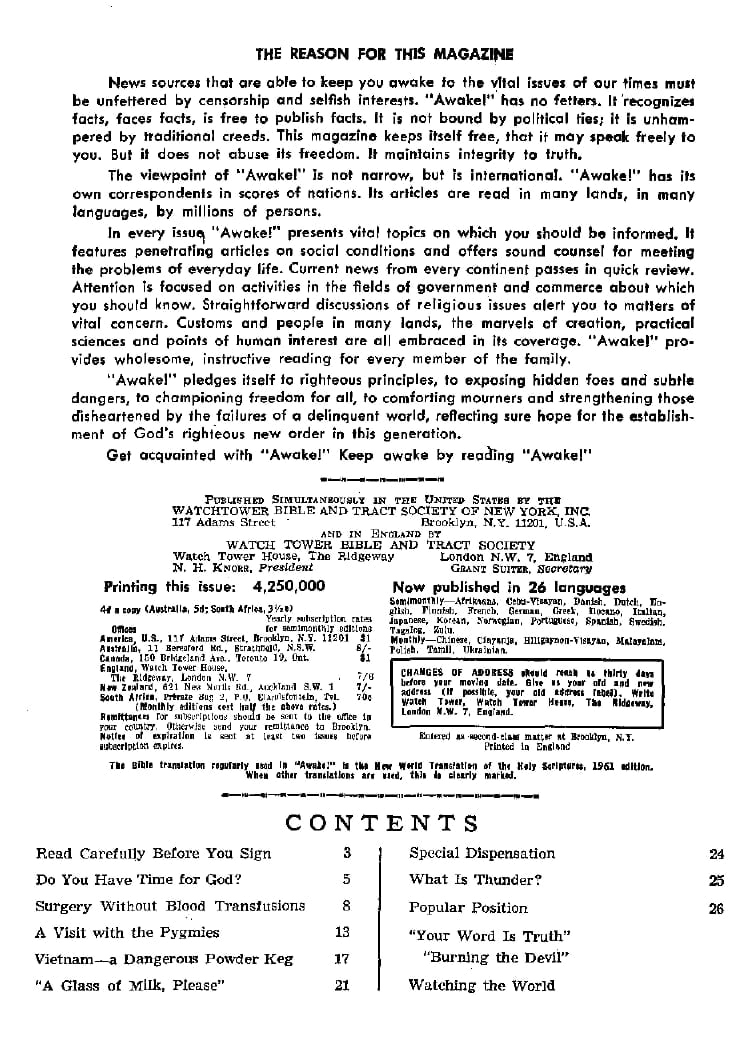
THE REASON FOR THIS MAGAZINE
News sources that are able to keep you awake to the vital issues of our times must be unfettered by censorship and selfish interests. "Awake!" has no fetters. It recognizes facts, faces facts, is free to publish facts. It is not bound by political ties; it is unhampered by traditional creeds. This magazine keeps itself free, that it may speak freely to you. But it does not abuse its freedom. It maintains integrity to truth.
The viewpoint of "Awake!" is not narrow, but is international. "Awake!" has its own correspondents in scores of nations. Its articles are read in many lands, in many languages, by millions of persons.
In every issue "Awake!" presents vital topics on which you should be informed. It features penetrating articles on social conditions and offers sound counsel for meeting the problems of everyday life. Current news from every continent passes in quick review. Attention is focused on activities in the fields of government and commerce about which you should know. Straightforward discussions of religious issues alert you to matters of vital concern. Customs and people in many lands, the marvels of creation, practical sciences and points of human interest are all embraced in its coverage. "Awake!" provides wholesome, instructive reading for every member of the family.
"Awaket" pledges itself to righteous principles, to exposing hidden foes and subtle dangers, to championing freedom for all, to comforting mourners and strengthening those disheartened by the failures of a delinquent world, reflecting sure hope for the establishment of God's righteous new order in this generation.
Get acquainted with "Awake!" Keep awake by reading "Awake!"
PUBLISHED SIMULTANEOUSLY IN THE UNITED STATES BY THE
WATCHTOWER BIBLE AND TRACT SOCIETY OF NEW YORK, INC.
117 Adams Street
AND IN ENGLAND BY BOOKLON, N.Y. 11201, U.S.A.
WATCH TOWER BIBLE AND TRACT SOCIETY
Watch Tower House, The Ridgeway
M. H. KNORE, President
London N.W. 7, England
GRANT SUITER, Secretary
Printing this issue: 4,250,000
4d a copy (Australia, 32d South Africa, 32c)
subscription rates, copies
for nonimmunity additions
Americas, U.S. 114 Adams Street, Brooklyn, N.Y. 11201
Canada, 118 Bowery, Montreal, QC
Canada, 105 Bridgford Avenue, Toronto, T6. 101
England, Watch Tower Eaton, Hampshire
New Zealand, 621 New Westminster, Anchorage S.W. 1, 7/6
South African宠物 dog suit (with ammunition), 706
Rentals for subscription should be sent to the office in your country. Objserve your rentals to brokery in
which you are sent at least ten days before subscription expires.
Now published in 26 languages
Summertime—Arkansas, Civic-Vianau, Danish, Dutch, Dutch,
English, Finland, French, German, Greece, Hungary, Italian,
Anglo-Spanish, Norwegian, Portuguese, Spanish, Swedish,
Monthly—Chinese, Cayatay, Hillaryan-Vianau, Malayalam,
Polish, Tamil, Ukrainian
CHANGES OF ADDRESS should result in thirty days before your morning date. Give as your old and new address your current address. Watch Timer, Watch Towar House, The Oldenway, London W. 7, England.
Entered as second-class matter at Brooklyn, N.T.
Printed in England
The bible translation regularly used in "Awake" in the New World Translation of the Holy Scriptures, 1961 edition.
When other translations are used, this do clearly marked.
CONTENTS
Read Carefully Before You Sign 3
Do You Have Time for God? 5
Surgery Without Blood Transfusions 8
A Visit with the Pygmies 13
Vietnam—a Dangerous Powder Keg 17
“A Glass of Milk, Please” 21
Special Dispensation 24
What Is Thunder? 25
Popular Position 26
"Your Word Is Truth"
"Burning the Devil"
Watching the World
London, England, July 22, 1965
Number 14
Read Carefully Before You
persons, and it could happen to you too. A salesman may call at your door and offer to demonstrate a vacuum cleaner or some other appliance, assuring you that there will be no obligation to buy. When finishing and about to leave, he may say something to this effect: "By the way, would you please sign here. It is just for the record, so that I can let the boss know how many demonstrations I have conducted." Many persons have quickly scribbled their name—sometimes just to get rid of the man. Would you do so?
Some of those doing so have later discovered their signature to be very costly. The dishonest salesman simply has to fill in the terms of a contract in which the signer agrees to buy the appliance for a given amount—which, of course, is an exorbitant price that the salesman inserts. It is next to impossible to prove that the contract was filled out after the signature was affixed to it. So the signer may be required to pay. If he refuses, his salary can be garnisheed, so that the amount due is taken from his wages.
When a person appreciates the importance of his signature—to what it can legally obligate him—he becomes very cautious about signing anything. He reads carefully before he signs; and more than that, he keeps a copy of all signed documents in his own personal file. Exercising this precaution can save one many hundreds of dollars.
A brochure from a Better Business Bureau tells about one of its employees who has a desk full of cheap watches, none of which work. They come from persons who have had their wages garnisheed for refusing to pay for them. The trouble that each of these persons experienced resulted from failing to take notice of what they were signing.
The salesmen from whom these people obtained their watches usually did business in a parking lot, at a bus stop or in a bar. "Wear it home," they would invite. "No charge. Just give me a buck or so, and bring the watch back tomorrow if you don't like it." Then came the "receipt," as the salesman called it: "Just sign here." It even happened that one man who signed for a friend who was busy starting the car ended up having his own wages attached! According to a Better Business Bureau, one of the most common complaints is from customers who thought they had signed a "receipt" or something of the sort, but in reality had been tricked into signing a blank contract.
Many other persons experience a financial tragedy because of failing to read carefully the fine print. Only afterward do they discover that they have signed up to pay exorbitant interest rates, or that what the
often required to sign certain forms. Here, too, one needs to be careful as to what is signed. One patient in a New York hospital was asked to sign some papers for the hospital records. She refused because the papers contained no provision for her objection, on religious grounds, to taking blood transfusions. (Lev. 17:14; Acts 15:29)
salesman promised is really not provided for in the contract.
ARTICLES IN THE NEXT ISSUE
Approaching Cadis Inspired Word
However, the woman was persuaded to sign when she was
For example, one family was induced to sign an inflated 1600 contract for house repairs, with the promise that they would receive a100 check for every person in that area who, after seeing their home, placed an order for similar improvements. Later, however, the company salesman denied any knowledge of such a promise, and the family was stuck with paying the entire price.
Appreciating Goals Inspired Word.
New Faces for an Old Bean.
* Religious Freedom Upheld in Medical Treatment.
Indoctrination and You.
Good Reasons for Keeping Clean.
One should remember that it is what is
assured that other papers covering this matter would be brought around later. But the promised papers were never brought, and, because she had signed, the hospital had written permission to administer whatever treatment they deemed necessary.
In another instance, a form was brought around for an elderly patient to sign. It granted the hospital permission to perform any operation required, but since it
on the paper that one signs that counts; not what a salesman promises, or what he says is there. Beware of anyone who explains, "That's only there for special conditions," or "Pay no attention to that because we never enforce it," or "This clause doesn't apply to you." Do not accept such explanations. Have the contract changed before you sign it, and keep a copy of it.
Another thing to watch for are blank spaces in a contract, or illegible writing or figures that can be doctored up later. It is a common practice of some after you sign.
did not contain a 'no-blood-transfusion' clause, she refused to sign. At that she was shown another form, and told this was the one she wanted. After signing, it was discovered that she had signed a form identical to the previous one. By this deception the hospital obtained legal authority to administer a blood transfusion!
This emphasizes how careful one must be. Never forget that your signature holds you legally responsible to fulfill or submit to all the provisions of the contract you sign. So in order to avoid being cheated
to fill in these blank spaces with terms
that alter the contract altogether. The
numbers can easily be changed. One woman
customer complained that her contract
was for 360, but it came through as560.
Here is an example of where having a carbon
copy in legible form can save you from
being cheated out of hundreds of dollars.
sign. Or in order to avoid being created, or forced to submit to what is in violation of your principles, do not sign anything unless you clearly understand what it obligates you to do. Do not let anyone hurry you into signing. Take your time and read carefully—even the fine print. And always remember to get and keep a copy. This may save you much trouble and a great deal of heartache.
Do You Have
MANY men, even when not at their secular work, are so busy taking care of a garden, polishing the car, playing golf or reading the newspaper, that they fail to
people to the great treasures of wisdom in God's Word, causing them to become indifferent toward God.
Commenting on the boredom that is so evi-
take time for God. Women, too, are frequently so busy taking care of their family, engaging in community activities or attending social affairs that they feel they have no time to spare for personal reading of God's Word and for discussing its teachings with ministers who may call at their home from time to
dent among many church attenders, Canadian clergyman J. M. Schroeder said: "Boredom comes when a man must try to hear with relish, what for want of relish, he hardly hears at all. By this definition there is certainly much
boredom in religion these days. The businessman on a Sunday morning whose
time.
On the other hand, there are those who do attend church. But frequently the interest of even these persons extends no farther than the time they spend in church on Sunday morning. They find time for television, movies, plays, boating and other forms of recreation, including the reading of some of the best-selling books, but when it comes to personal reading of God's Word and considering how to put its principles to work in their life, they have no time. If they have a Bible, it usually is not read
mind is on golf can scarcely disguise his lack of interest in the sermon he is compelled to hear." Not having become well acquainted with the Bible, the disinterested churchgoer mistakenly associates what it contains with the bone-dry sermons he hears in church.
For their members, Christendom's churches have much to keep them busy, but imparting an accurate understanding, an appreciation and a trust in God's Word is not part of their program. Note what
because there are always other things that seem to be more important. They are "too busy."
Responsibility for a certain amount of this apathy rests upon Christendom's churches, for they have substituted illogical traditions and dogmas, empty ceremonies, money-raising socials and interest-deadening sermons for the vibrant truths of God's Word. They thus help to blind JULY 22, 1965
was reported in the Scottish Daily Express of May 14, 1963: "Church members were told in Edinburgh yesterday that their congregations are 'cluttered up' with social circles, drama clubs, men's clubs and women's guilds. 'We're all very busy—but are we very busy with the right things?' demanded Glasgow accountant Mr. George R. Green in his inaugural address as president of the Congregational Union of Scot-
land.
. . Mr. Green's comment on church organisations was: 'Their relation to the main purpose for which the church exists is rarely examined. . . In many cases the effort of keeping our organisations going is absorbing our whole time and producing very little result.'"
These people who are so busy with church social affairs that they have no time for God are the losers. They are losing out on the wise instructions God has set down in his Word for solving as well as avoiding many personal problems that cause no end of mental anguish. They miss out on the hope-inspiring promises in his Word of a new era of peace and justice. Faith in such promises quiet the heart in this nervous age of nuclear weapons. They fall to learn what God requires of a person in order to escape the disaster He has purposeed to bring upon the present wicked system of things. All this is also missed by the indifferent persons who are too busy with weekend pleasures to have time for God.—Zeph. 3:8.
In this seemingly mad world, reasonable persons would like to have something that would have a stabilizing influence in their life, something that they could rely on to show them the right course to follow, something that would give them good counsel on domestic problems. God's written Word can do just that. Its instructions, counsel, laws and wise observations can help you to make decisions that are for your best interests. Its warnings can save you from many personal tragedies, especially the one that is coming with the great war in which God has purposed to bring to an end this wicked system of things. But to benefit from what God has put in his written Word for you, you need to give it your attention. You need to take time to listen to what he has to tell you.
Seeking God When in Need
When in great need of his help, it is proper to turn to God in prayer, but does God answer the prayers of those who turn to him only when they are in trouble and who are too busy for him all the rest of the time?
In the Bible, at Proverbs 15:29, we are told: "The prayer of the righteous ones he hears." This does not mean persons who are simply righteous in their own eyes, but persons who are righteous because they seek God and strive to do his will. Such persons are willing to spend time to learn what Jehovah God's will is by studying the Bible. They are anxious to be taught by him through his Word.
The ancient inhabitants of Jerusalem were at one time too busy in materialistic pursuits and religious activities not sanctioned by God to have time for him. They too neglected the studying of his written Word, giving it no place in their lives. God forewarned them that when trouble would come upon them and they turned to him in prayer he would not hear them:
"Because I have called out but you keep refusing, I have stretched out my hand but there is no one paying attention, and you keep neglecting all my counsel, and my reproof you have not accepted, I also, for my part, shall laugh at your own disaster, I shall mock when what you dread comes, when what you dread comes just like a storm, and your own disaster gets here just like a stormwind, when distress and hard times come upon you. At that time they will keep calling me, but I shall not answer; they will keep looking for me, but they will not find me, for the reason that they hated knowledge, and the fear of Jehovah they did not choose." (Prov. 1:24-29) In view of this statement to the nation of Israel, the person who has no time for God is in danger of not getting a hearing ear from him when in time of trouble.
He is in danger of being a victim of the disaster that is coming upon the world of mankind at God's coming war of Armageddon.—Rev. 16:14, 16.
Listen to Your Creator
Do not make the mistake of being so busy that you have no time to listen to your Creator. His written Word is a treasure-house of knowledge that you can draw upon for wise guidance. It gives you guiding principles so you can have peaceful relationships with other persons. Its moral laws can protect you physically and mentally. Its marriage counsel shows you how to have a happy marriage. It illuminates the way to gain good relations with your Creator and to be a recipient of his gifts. The wisdom of God's written Word can be a source of real happiness for you.
"My son, my law do not forget, and my commandments may your heart observe, because length of days and years of life and peace will be added to you. Happy is the man that has found wisdom, and the man that gets discernment, for having it as gain is better than having silver as gain and having it as produce than gold itself. It is more precious than corals, and all other delights of yours cannot be made equal to it. It is a tree of life to those taking hold of it, and those keeping fast hold of it are to be called happy." (Prov. 3: 1, 2, 13-15, 18) This wisdom is lost to those who are too busy to let God instruct them.
Having no time for God was very dangerous for the people who lived in the days of Noah. They were so preoccupied with materialistic matters that they had no time to listen to the good counsel God could give them through his representative Noah. They did not want to hear that preacher of righteousness when he pointed out to them what is good and what is bad in the eyes of Jehovah God. Although an
effort was made by Noah to warn them of God's purpose to bring an end to their whole system of things, they would not listen. They had things that they considered as being more important for their attention. When the great Flood swept over them, any frantic prayers they might have offered then were useless. It was too late to turn to God. "They were eating, they were drinking, men were marrying, women were being given in marriage, until that day when Noah entered into the ark, and the flood arrived and destroyed them all." —Luke 17:27.
The present generation is in the same dangerous situation as that ancient generation, for it too faces a great catastrophe at God's hands. "Just as it occurred in the days of Noah, so it will be also in the days of the Son of man." (Luke 17:26) With the present system of things facing destruction in God's day of vengeance, this is a dangerous time for persons who have no time for God. Instead of ignoring him and his Book of instructions as so many people are doing, give heed to what he has to tell you. Do not lose out on the wisdom that he has put in his written Word for your benefit.
When Jehovah's witnesses call at your home, do not be too busy to discuss God's purposes with them. Do not be like the people of Noah's day who were too busy to listen to Noah. Remember that God has time for those who have time for him. Such ones he instructs through his Word and organization and is more willing to hear their prayers. "Jehovah is near to all those calling upon him, to all those who call upon him in trueness, Jehovah is guarding all those loving him, but all the wicked ones he will annihilate." (Ps. 145: 18, 20) Allow him to instruct you, and you will know the way to life in his righteous new order.
SURGERY
IT WAS September 18, 1964. The place was St. Barnabas Hospital in New York City. A forty-year-old patient with a damaged aortic valve was wheeled into the operating room. Awaiting him was a twelve-man operating team consisting of four surgeons, two medical doctors, a blood specialist, two anesthetists and three technicians. It was a case for open-heart surgery but, instead of blood, the heart-lung machine contained a saline solution to which had been added glucose, dextran and other plasma substitutes.
A report on the operation relates what happened: "The surgery began. The patient's chest wall was opened. Then the sac surrounding the heart was incised. At each step, the medical team rapidly sutured, clamped or cauterized each bleeding point immediately to keep blood loss to a minimum. Tubes were inserted into the upper right chamber of the heart and into the aorta. The tubes were connected to the heart-lung machine. [The pump was started and the circulating blood was diverted from the heart into the machine.] The aorta was opened. Tiny tubes were placed in the two coronary arteries so that the machine could pump blood to the heart muscle itself. Then the damaged aortic valve was cut out, and the man-made one sutured into place. The tubes were removed, the aorta was closed, the chest was closed and finally the skin.
BLOOD TRANSFUSIONS
</div>
"The operation was over. It had been done exactly as all such operations are, except for these differences; The medical team worked with split-second precision to stop all bleeding at each step; the operation was performed with no wasted motions because each second counted. . . . And not a single drop of transfused blood was given,"* either before, during or after the operation, thereby making medical history. Before the operation it appeared that the patient did not have much more time to live, because of a toxic condition. Today he is back at work, strong and healthy.
Hemostasis
Here was a practical example of hemo-stasis. The term comes from two Greek roots, haima, "blood," and stasis, "halt," and refers to stopping of blood loss. It requires great care with many little things.
To begin with, there is the matter of first ascertaining the coagulating ability of the patient's blood. From 20 to 33 percent of persons in the United States have blood below par in this respect, and this lack results in more blood loss.
An aid in these cases has been found to be injections of the female hormone estrogen. The fact that women never get hemophilia (although they alone act as carriers, transmitting it from their fathers to their sons), led to the discovery of this use of estrogen.
Its use cuts down on the need for ties and sutures during surgery. It seems that estrogen affects the platelets, increasing their number and activity, and these platelets are one of the keys to coagulation of the blood.—Hemostasis and the Effect of Estrogens, Excerpta Medica Foundation (1962).
Another aid, a simple one, is for the patient to eat plenty of peanuts ahead of time. Purely by accident it was discovered that peanuts are very beneficial to persons suffering from hemophilia, a disease in which the blood does not clot.—Nature, Vol. 185, p. 469 (1960).
To conserve the blood supply during an operation a skilled surgeon exercises great care, but at the same time works as expeditiously as possible. Wherever possible, he avoids a previous incision. Why? Because operations generally result in internal adhesions, and if these are cut through when operating again, there is added blood loss.
He also avoids extending the incision any farther than absolutely necessary. The shorter the incision the less loss of blood, of course. True, it is easier to operate if there is the convenience of a large exposure, but a surgeon concerned with conserving blood will deny himself this convenience.
Among the devices that make for hemostasis or halting blood loss is cautery, or the use of a high electric current instead of a knife, as cutting this way tends to seal the smaller severed blood vessels automatically. And to save blood the careful surgeon makes the greatest possible use of sutures or stitches, ligatures to tie blood vessels, hemostats or clamps, as well as cotton, cloth or a foam product wherever necessary to stop the flow of blood. He even places clamps on each side of the larger blood vessels before making
the incision, thereby precluding needless loss of blood.
While all such devices are well known to the profession, they are not used as conscientiously as they might be. It is much easier to transfuse a little extra blood than to take all this, added care. But surgeons who have been willing to operate on patients who had religious scruples against using blood tell that they have learned much by their trying for 100-percent hemostasis. A leading New York thoracic (chest) and cardiac (heart) surgeon and one of the original pioneers in closed- and open-heart surgery—the surgeon in charge of the operation described at the beginning of this article—Dr. Charles P. Bailey, tells that he has operated on upward of thirty of Jehovah's witnesses, many of them serious cases. He has never refused to operate because of the patient's objection to blood nor has he lost a single one because of it. In fact, of all the Witness cases, only one, an infant, died. And his was a case of transposition of the greater arteries; an operation of such hazards that in all the world there have not been a dozen successful ones thus far.
Hypothermia
The foregoing are not the only ways that a surgeon can use to achieve hemostasis. Among other very effective methods is that known as hypothermia. The term comes from two Greek words or roots, hypo, meaning "under, beneath, less than normal," and therme, meaning "heat." Hypothermia is based on the principle that the "rate at which chemical reactions proceed is dependent on temperature. . . Since the reaction rate is diminished by falling temperature, the metabolic rate of cells of the living organism is reduced as the temperature falls. In particular is the flow of oxygen essential to keep up the body's metabolic process, and for oxygen the body depends largely upon the red cells in the blood.** In other words, slow up the metabolic process by reducing the temperature and you need less oxygen, and so, in turn, less blood.
At the same time the lower temperature slows the flow of the blood. Hibernation of the lower animals might be said to be a natural example of hypothermia.
Hypothermia has been used for some thirty years now. At first only on rare occasions, and then more and more until in the late fifties its use became quite widespread.
There are several types of hypothermia employed today, such as profound or deep hypothermia, local hypothermia, and moderate and general hypothermia. While both profound and local hypothermia have their uses, it is the moderate and general hypothermia that has the widest application. It is "general" in that the temperature of the entire body is reduced and "moderate" in that it is reduced only about 12 degrees Fahrenheit, from 98.6 to 86.
There are various ways in which this reduction of the body's temperature can be induced, some preferring to immerse the patient in a tub of cold water. But among the most simple, practical and popular is use of the hypothermic or "ice" blanket. It resembles the electric blanket except that, instead of wires of electricity running back and forth in it to warm the body, it has coils through which water is pumped to cool the body gradually. The patient is placed between two of these, and by means of controls, the temperature is lowered so gradually that there is little if any shivering, let alone the danger of fibrillation or fluttering of the heartbeat, as is sometimes the case in profound hypothermia. This procedure is handled by nurses, usually beginning at six o'clock in the morning, and by eight the patient is
ready for the operation. Of course, there is the usual need of sedation, either by means of barbiturates or opiates.
When the patient is rolled into the operating room he remains on one of these blankets. An electrical graph recorder connected with a rectal thermometer shows at all times the exact body temperature of the patient. In hypothermia there is no limit to the length of time that an operation may take. Furthermore, because of the reduced metabolic rate there is so much less need for any transfusion; and any substitutes such as saline-sucrose, dextran or PVP are wholly adequate.
Consider a typical case history. In 1958 an accountant was urinating blood for some time before he consulted his physician. X rays revealed that he had cancer of the bladder, a malignant tumor the size of an orange. Because of his putting off going to a doctor his blood count was down to 3.2 grams of hemoglobin (normal is 14.5). As he had religious scruples against blood transfusions, he had difficulty in finding a surgeon and a hospital willing to handle his case. He finally found Dr. Philip R. Roen, a member of the American College of Surgeons and today a fellow of the New York Academy of Medicine. Because of Dr. Roen's empathy and his confidence in hypothermia he readily agreed to take the case. The operation lasted two hours, and in about two months the patient was back at work. In spite of the seriousness of the operation, he survived it upward of five years, dying about a year ago at the age of sixty.
According to the surgeon that performed that operation, hypothermia has many merits and apparently is neglected simply because of the extra work it entails in preparing the patient and while operating. The principles governing hypothermia in surgery are taught in all medical schools, but seem to be forgotten or ignored by most surgeons upon entering their practice.
It is especially indicated for all poor-risk patients as well as for those having high fevers.
Giving somewhat similar testimony as to the value of hypothermia is the aforementioned Dr. Bailey. He tells that there are not a few cardiologists who are of the opinion that hypothermia should be used far more than it is. Among those that do appreciate its value are those at the Neurological Service at the Toronto, Canada, General Hospital.—Annals of the New York Academy of Sciences, Vol. 80 (1959).
A favorable report on hypothermia is also found in an article appearing in the Surgical Clinics of North America, February 1964. Among other things, it had the following to say: "Moderate hypothermia . . . permits reduced perfusion rate and still supplies physiologic needs. . . . There is an increasing quantity of evidence that hypothermia is of value in stress states. . . . The pulmonary complications that sometimes accompany open-heart surgery are not present when it is used. Hypothermia not only reduces oxygen needs of the tissues, . . . but it also directly depresses the activity of the entire adrenal gland."
No question about it, hypothermia may often spell the difference between life and death for a patient needing extensive surgery and it is of special value when operating without blood transfusions.
Plasma Substitutes
Among the things that have made possible all this surgery without the use of blood transfusions have been plasma substitutes. The medical profession prefers the term "plasma substitutes" to "blood substitutes" because none of the substitutes are able to supply the body with oxygen as can blood. Among the oldest and most time-honored plasma substitutes is simple saline solution, salt and water. At times sucrose or "sugar" is added to the saline solution. A complex mixture more closely resembling or simulating the body fluids that has come to be in much favor, and deservedly so, is Ringer's lactate solution.
A modern synthetic solution that is highly regarded in certain eastern United States hospitals is PVP, standing for polyvinyl pyrrolidine. It is a product of the plastics industry.
Then there is gelatin in certain forms, which, dissolved in water, is preferred by some surgeons. It can serve as a plasma substitute because its molecules are of such size as not to seep through the walls of the blood vessels into the surrounding tissue. There is also sucrose or the "sugar" and water solution, long used for intravenous feeding. Some surgeons prefer it for priming their heart-lung machines.
What rapid progress has been made in this regard can be seen from an item appearing in the United States Joint Blood Council's statement regarding the indications for blood transfusion, published in 1962. It stressed the importance of blood and, among other things, stated that "open-heart surgery and other major surgical procedures would not be possible without large supplies of blood." But only two years later, in 1964, there appeared in The American Journal of Cardiology, a report by a team of surgeons at the Baylor University Medical School, Houston, Texas, telling of the performing of more than 450 open-heart operations using as a primer in the heart-lung machine only a 5-percent sucrose solution. As a result more and more leading medical institutions in the United States and Canada are now priming their heart-lung machines with sucrose or similar solutions. And not without good cause.
They get better results from these plasma substitutes than from whole blood, as Dr. Mustard, of the Sick Children's Hoscapital in Toronto, Canada, stated when arranging for an open-heart operation on a child without the use of blood.
These plasma substitutes have a number of advantages: They cost far less, can be used immediately, requiring no delay for typing, and do not induce hemorrhaging, which often occurs when large amounts of whole blood are used. Also, patients recover more quickly from their operations, and their kidneys and other internal organs function much better, if such solutions are used instead of blood. It should be added that among the things that have made possible the use of the heart-lung machine without blood has been the changing of them so that they need only one and a half pints to prime instead of eight or more.
Perhaps the most useful of all the plasma substitutes is dextran,* which is being used world wide, in particular the more recent low-molecular-weight dextran. Surgeons report using it scores of times with "gratifying results" in various types of operations in which they had formerly used whole blood. Particularly do some recommend it in lieu of the one-pint whole blood transfusion. Arguing also in favor of dextran are its ever-increasing medicinal uses, as in clearing up clots in the veins of the legs, as well as gangrene in the extremities.
The Blood-Transfusion Risk
And what is that? Their appreciation of the risks involved in blood transfusions.
As indicated in the foregoing, among the reasons that some surgeons have shown such readiness to accept patients who have scruples against blood transfusions has been their empathy and confidence in their own medical procedures. However, there is yet another powerful reason why these have been so willing to cooperate.
On this matter several university professors of surgery said: "One must certainly consider when he prescribes whole blood that an illness may be inflicted which is far worse than the retarded recovery which is assumed but not proved to attend failure to replace all preoperative red cell deficits and all operative blood loss. Since certain complications are unavoidable after transfusion, one's only means of prevention of transfusion morbidity is to avoid transfusions . . . The only way by which death from serum hepatitis can be eliminated is to avoid transfusions." —Complications of Surgery and Their Management (1960), Drs. Artz, Hardy and Wilson.
Because these grave risks accompany blood transfusion we find surgeons, such as Dr. Philip Thorek, clinical professor of surgery at the University of Illinois College of Medicine, stating: "I'm scared to death of blood." And on another occasion, "In doing major surgery I use blood in many cases but also feel happier when the operation can be performed without a transfusion."
Yes, the medical profession is becoming ever more keenly aware of the risks involved in blood transfusions. At the same time it is making great strides in operating without blood.* Part of this progress is no doubt due to the refusal of the witnesses of Jehovah to take blood. Thus, according to the American Journal of Cardiology for June 1964, the fact that the heart-lung machine can now be primed without blood resulted from the willingness of a group of surgeons to follow "a medically unsound course of treatment . . .
because of the sincerity of their patient in not wanting blood."
A Challenge
That team of surgeons faced a challenge and met it triumphantly. A similar challenge faces each surgeon when confronted with a patient who has religious scruples against using blood. Use of methods other than those he is accustomed to may require greater patience, more skill and involve a certain added risk. He may therefore probe with questions to find out how strong the patient's convictions on the matter are. Some, finding that the patient is firm in his request, say they cannot operate without blood. That may be; they may not have used other procedures enough to have confidence in their ability to handle them. In such cases it would be wise for the patient to look elsewhere rather than insist that the surgeon do something that he feels is unwise or that he lacks the desire to do.
But there are surgeons who are willing to help, who are willing to respect the religious convictions of their patients, and their number is ever increasing. Many have operated on Jehovah's witnesses and they are acquainted with their religious objections to blood transfusions. They know that, generally speaking, these patients do not expect them to do the impossible. Furthermore, they have found that they are quite willing to sign a statement absolving the surgeon and the hospital, not of all responsibility for their work, but of responsibility for complications that may arise from not using blood. So these surgeons, having checked and satisfied themselves that they are dealing with such a person who is sincere in his religious convictions and who is reasonable in what he expects of his surgeon, are willing to do all they can to help. The good results of their efforts have made clear that surgery is possible without blood transfusions.
A VISIT WITH THE Pygmies
By "Awakel" correspondent in Cameroun
IT WAS hot and sunny, a typical morning during dry season in equatorial Africa. We set out with our companion along the road, cutting through the forest on our way to the next village, where we were looking forward to telling the inhabitants about the good news of God's kingdom. It was quiet except for the buzzing of insects and the occasional cry of a bird heard from the branches of the trees towering high over our heads on both sides of the road. As we continued along, enjoying the natural beauty that surrounded us, we became aware of a sound coming from
somewhere deep in the forest. It sounded like someone singing. "What is that?" I asked our companion. "Why, those are Pygmies," he answered. Pygmies! I was delighted.
Like many people I had often heard about Pygmies but had never had the privilege of meeting them. A multitude of questions sprang to my mind. There were so many things I wanted to know. Our friend smiled. "The best ones to answer your questions," he said, "are the Pygmies themselves. See there in the clearing at the side of the road—that is their encampment. Those small dome-shaped huts are their sleeping quarters.
The singing we hear must be from those who have gone down to the stream to draw water."
When we entered the encampment we were greeted warmly. Our companion was no stranger to these folks. He had lived most of his life in this region and was well known to the Pygmies as the man who preaches about Jehovah. The very word Pygmy brings to mind something small, and this was true of our amiable hosts. They were certainly small in comparison to ourselves. It made me think of a line of poetry I learned in my childhood where an elf, when asked by a curious little girl why he was so small, answered, "I'm just as big for me . . . as you are big for you." Their average height was about four feet five inches to four feet eight inches tall. We were told, however, that there are some Pygmies that are somewhat taller than this but that the tall ones were more the exception than the rule. I could see immediately that their small stature was not all that distinguishes the Pygmies from their Negro neighbors; their skin is more brown than black and their tightly curled hair has a brownish color.
Way of Life
As we spoke to the doyen or eldest male of the encampment we learned many things. "We are men of the forest," he said. And with these few words he described in a nutshell the way of life of the Pygmies who live in nomadic bands, or in communities along the roadways in the rain forests of the Congo, Gabon, Central African Republic and here in Cameroun.
Yes, the forest is truly their home. It provides building materials for their huts,
their food, toys for their children and, in many cases, their clothing. It is for this reason that the BaMbuti Pygmies who live in the Ituri rain forest of the Congo call themselves "children of the forest" and consider the forest as their parent. They often sing songs whose theme is "the forest is good, the forest is kind." The Pygmies feel quite as much at home in the forest as you do in your own hometown and, although they engage in trade and social intercourse with neighboring Negroes, they rarely integrate
and so have been able to keep their identity as forest dwellers.
Pygmy Women
The woman in the Pygmy community plays an important role. She builds the small dome-shaped huts that serve as sleeping quarters for herself and her family, she gathers and prepares the roots, fruit and edible leaves that form an important part of the Pygmy's diet, and she also cares for the children. During all the time she is busy caring for her various duties her lèle or baby is right with her. He sits comfortable and safe on his mother's hip in a broad leather sling.
When a camp site is chosen, it is the women who immediately set to work building the necessary sleeping huts, as the men are busy preparing for the hunt. The size of the huts depends largely on the building materials at hand. They are usually about four or five feet high. The basic structure is formed from bent saplings and this is thatched with broad forest leaves arranged in several overlapping layers so that the hut is quite water resistant. The door is a low opening left on the side, and sometimes a small passage leads from the door to the inside of the dome.
Even the Pygmies must stoop to enter. To furnish her home the Pygmy woman gathers more leaves, which she arranges to make a soft bed. In just a few hours all the huts are built and the women have reason to be proud of their handiwork.
One elderly woman invited us to come inside her hut and see for ourselves. We had to crouch to get in, but, once inside, we could see it was well constructed and quite suitable for its intended use.
Reputed Hunters
These "men of the forest" have a well-established reputation as hunters. Their extraordinary agility permits them to move swiftly through the forest in pursuit of game. Even those Pygmies who have given up the nomadic life in favor of life in established communities still live largely from the hunt. They often leave their villages for months at a time to go into the forest in search of game. At such times the whole family is likely to come along and each has his special work to do.
The men spend many hours preparing and keeping their weapons ready for the hunt. Such weapons vary greatly from one band of Pygmies to another. Some have learned to use guns, but many seem to prefer the traditional weapons of their ancestors. Some Pygmies carry small bows with arrows that are poisoned with Strophanthus, which can kill a small animal with a mere scratch. Others use nets made from vines. These nets are usually about four feet high and often more than a hundred feet long. Still other bands of Pygmies use spears and various forms of traps. With these weapons they hunt antelopes, monkeys, birds, buffaloes, and even elephants.
When hunting small game no special ritual is followed, but this is not the case
when the hunt is for larger game such as buffaloes, gorillas or elephants. Before going after such big game many bands of Pygmies observe special rites and ceremonies. For almost a week a ritual dance called "djengui" is organized. During these ceremonies the witch doctor invokes dead ancestors to find out if the hunt will be successful or if it will be dangerous.
If the hunt for one of these bigger animals, and especially for an elephant, has been successful, it is a time for rejoicing and hard work. Meat is cut up and dried, and there is much dancing and singing in the encampment. Demonstrating their usual generosity, the Pygmies invite Negroes from neighboring tribes to come. There is meat for everyone.
When game has been frightened away and the nearby vegetables begin to get scarce, it is time for the Pygmies to move on. The huts are abandoned and the whole band migrates through the forest to a new camp site.
In Search of Honey
Not to be overlooked is the important place that honey occupies in the Pygmy's life. In the legends about their ancestors it is said that when the first Pygmies migrated to the rain forests of Africa, weary and hungry, it was wild honey that saved them from starvation. Today when strangers visit an encampment they are offered honey as a sign of welcome. When a Pygmy has to spend many days in the forest, he likes nothing better than to have a good supply of honey with him.
But where do they get the honey? We saw for ourselves. Three men were going into the forest that very afternoon to get honey and they invited us to come along. There was no path where we entered the forest. Our three Pygmy friends went ahead of us, cutting aside vines and leaves as they went along to leave us an easier passage, but, even so, it was all we could do to keep up with them.
Happily the tree in question was only about half a mile from where we entered the forest and we soon arrived. At first glance the tree looked just like any of the other tall gray trees that stood around. It was only when one of the men pointed out a dark hole in one of the branches that I became aware of the bees.
After a brief discussion the Pygmies decided the tree with its smooth gray bark was too high and too dangerous to climb, so they would chop it down. The decision made, each one began to busy himself in preparation for the work at hand.
The first man gathered some sticks and leaves to light a studge fire to keep the mosquitoes and, small flies away. The second lit his small pipe, which had a short stem broadening out until the part held in the mouth was as big around as the bowl of the pipe. Satisfied with his pipe, he began to sharpen his ax, holding the blade over the fire until it was hot, then filing it to a sharp edge. The head or blade of the ax was made from a piece of flat car spring sharpened at one end and tied with a vine to a handle made from a thin sapling cut close to a strong branch. The blade was inserted in the trunk and the branch served as the handle, forming an ax that looked like a short-handled hoe with the blade turned sideways. The third man cut a vine long enough to encircle the tree and his own body. With the help of this vine he climbed up about eight feet to where the tree was not so thick and began to chop. Each man took his turn chopping, until finally the enormous tree fell.
There were bees everywhere! A few strokes with the ax opened the hollow branch, and there was the honey. The Pygmles escaped without being stung, but
our friend came away with a very swollen top lip. The honev was superb!
Religion
Their living so close to the handwork of God, it is not surprising that Pygmies are religious people who believe in a Supreme Being who created the earth and sky. Some Pygmies have adopted the religious brought to Africa by missionaries; others have kept to the traditions and superstitions of their ancestors.
Among the latter group especially reigns a terrible fear of death and dead persons. If there has been a death in the encampment, it is not uncommon for the entire band to abandon the encampment, leaving only two persons behind to cover the body with the materials of his hut. This done, the two make haste to rejoin the rest of the band in their new camp site. No child is permitted to look upon a dead person. Why this fear? Not knowing what the Bible teaches, they believe that death is a person and that if he sees you he will surely take you away. To avoid being recognized by "death," the two who are left behind to care for the dead are protected by a special "charm."
We enjoyed our visit with the Pygmies. It was interesting to learn of their way of life and a joy to share with them our hope of living forever in Jehovah's new order of things where death will be no more. There have been some from among these kindly people who have been delighted to learn of this hope from the Bible. To them, too, is opened up the unspeakable privilege of being among those mentioned at Revelation 7:9, 10, persons "out of all nations and tribes and peoples and tongues [who are] saying: 'Salvation we owe to our God, who is seated on the throne, and to the Lamb.'"
VIETNAM
--A Dangerous Powder Keg
TINY South Vietnam, with a population of a little more than fifteen
million, has become a dangerous threat to the peace of earth's three billion people. Like a small flame that can grow into a devastating forest fire, the war going on there has the potential of engulfing the entire world in a frightful nuclear holocaust. Understandably, world leaders are striving to limit the war to southeast Asia and to find some formula for stopping it.
The roots of the Vietnam conflict go back quite a few years. When Japanese troops were in the process of wrestling it from the hands of the French in the early 1940's, native guerrilla groups began operations against them. The two Communists who are now leaders of North Vietnam, Ho Chi Minh and Vo Nguyen Giap, headed some of these groups. They called themselves Viet Minh.
Following World War II and while other national groups were squabbling among themselves, the Communist Viet Minh began taking over the country. On September 2, 1945, they proclaimed a republic and began an effort to push out the French who had returned to Vietnam. This effort continued until July 20, 1954, when a conference of eight nations discussed, in the Swiss city of Geneva, the Indochina question. It was finally agreed to partition Vietnam near the seventeenth parallel, with the Viet Minh receiving North Vietnam.
It also was agreed that all-Vietnamese elections would be held before July 20, 1956.
In accord with the Geneva Conference, North Vietnam requested talks with South Vietnam on arrangements for holding national elections. The Geneva Conference called for such talks to be held after July 20, 1955. South Vietnam's Premier Ngo Dinh Diem rejected the request, and then insurgents, known as The National Liberation Front of South Vietnam, began guerrilla actions against the Diem government, which actions have developed over the passing years into the war that is now threatening the peace of the world.
Role of the United States
The United States became interested in the problems of Vietnam after World War II when the French were trying to combat the Communist Viet Minh. Through the French it gave military and economic aid to the South Vietnamese. Then when the French pulled out, the United States continued its aid and steadily increased its influence in the country. Now the American commitment involves a steadily growing part in the war against the rebels whom the South Vietnamese deprecatingly refer to as Viet Cong. More than three billion dollars in economic and military aid has been sent to this small country during these years of United States' involvement.
Although the United States participated in the Geneva Conference, it has not encouraged the successive South Vietnamese governments to carry out the Geneva agreement regarding national elections.
It has backed governments such as the hated Diem regime that do not have the popular support of the people. Regarding this, Bernard Fall states in his book Street Without Joy: "It takes all the technical proficiency our system can provide to make up for the woeful lack of popular support and political savvy of most of the regimes that the West has thus far sought to prop up. . . What makes the difference between defeat and victory in Revolutionary War [is that] the people and the army must emerge on the same side of the fight. . . In South Viet Nam that essential condition did not yet exist as of early 1963." Regarding this matter of popularity, Drew Pearson in the Honolulu Star-Bulletin of February 24, 1965, reported: "When Sergeant Eddie Anderson of Kansas City, wounded in Vietnam, was asked what was the basic trouble over there, he replied, 'I guess the Viet Cong is more popular with the people of the country than our side is.' This is about the frankest diagnosis that has come out of Southeast Asia in a long time. Other fragmentary information indicates that it is the truth."
Fear that communism will spread throughout Asia is the principal reason why the United States has committed itself so deeply in the Vietnam conflict. The New York Times of May 9, 1965, pointed this out when it reported what President Johnson said in one of his speeches on Vietnam: 'Mr. Johnson said the aim of the guerrilla war was not only the conquest of South Vietnam, but a desire 'to show that American commitment is worthless.'' He added: "Once that is done, the gates are down and the road is open to expansion and endless conquest." This view is called the theory of the falling dominoes. When several dominoes stand on end and near one another, the fall of one causes all of them to
fall. Similarly, the fall of South Vietnam to the Communists would, it is feared, pave the way for the fall of all Asia, from India through Japan and the Philippines.
However, not everyone agrees that the theory holds true with regard to Vietnam, as was pointed out by Professor McT. Kahn. According to the New York Times of May 16, 1965, he stated in a public debate: "So long as Southeast Asian governments are in harmony with their countries' nationalism, and so long as they are wise enough to meet the most pressing economic and social demands of their peoples, they are not likely to succumb to communism." Where the spread of communism is a real threat is in countries that have unpopular, corrupt governments and dire poverty. This has been a problem in Vietnam. The magazine U.S. News & World Report of January 11, 1965, observed that one of the problems in Asia is "poverty—poverty the like of which does not exist anywhere else in the world, poverty so grinding that statistics on family income are meaningless. . . . Unless we can find some way to really help Asians, we're in trouble of the worst sort. We're getting richer and they're getting poorer."
The United States is determined to prevent a Communist takeover in South Vietnam and is willing to send as many of its own troops there as may be necessary to do this. Because of the apparent impossibility of crushing the insurgents militarily, due to their having the support of the people and having help and sanctuaries in neighboring countries, President Johnson said that "in the long run, there can be no military solution to the problems of Vietnam. We must find the path to peaceful settlement. Time and time again we have worked to open that path. We are still ready to talk, without conditions, to any government. We will go anywhere, discuss any subject, listen to any point of view in the interests of a peaceful solution.
I also deeply regret the necessity of bombing North Vietnam. But we began those bombings only when patience had been transformed from a virtue into a blunder—the mistaken judgment of the attackers." By intensive bombing raids, the United States has hoped to persuade the Viet Minh to negotiate a settlement of the dispute.
Opposition to United States' Policy
The Communist nations are, of course, vehemently opposed to the American policy in South Vietnam. The North Vietnamese paper Hoc Tac of September, 1963, observed: "South Vietnam can be liberated only by force. To that end we must smash the reactionary administrative machinery and the imperialists' mercenary army. This revolution can and should be decided only by revolutionary action, using the force of the masses to defeat the enemy forces; it cannot be settled by treaties and agreements." Expressing the view that the United States government also holds with regard to the significance of the conflict in Vietnam, General Glap of North Vietnam said: "South Vietnam is the model for the national liberation movements in our time. . . If the special warfare that the U.S. imperialists are testing in South Vietnam is overcome, this means that it can be defeated everywhere in the world."
Within the United States there have been many protests against American policy in Vietnam. Twenty-five hundred clergymen requested President Johnson to stop the bombing raids. One hundred and thirty-four professors urged an end to the escalation of the conflict. Hundreds of university students have protested American participation in the war and a number of United States senators are urging the U.S.
administration to pull American forces out of Vietnam. There are, of course, many other Americans strongly in favor of the Vietnam policy.
The United States would like to get out of Vietnam but without losing face and without losing South Vietnam to the Communists. But it finds itself in a very costly and dangerous dilemma. If it pulls out, that would confirm the Communist ideas about revolutionary wars and might open the way for the spread of them. If it stays in, the war is likely to drag on for years, being a costly drain of men, money and materials. The war is now costing almost two million dollars a day. So a negotiated peace is very much desired. As an encouragement toward that end, President Johnson has promised to institute a one-billion-dollar program for developing southeast Asia, which program would include North Vietnam, if the Viet Minh will negotiate a settlement of the conflict.
Religious Factors
What is not generally known is the role played by certain religious factions in much of the trouble. In 1954 when the country was split into North and South Vietnam, hundreds of thousands of Catholic Vietnamese found themselves in the section dominated by the Communist Viet Minh. Since bishops in two major Catholic provinces had built up armies to fight the Viet Minh along with the French, Catholics had good reason for feeling that they were not particularly welcome in North Vietnam. So they moved into South Vietnam, where they received special privileges under the rule of the Catholic Ngo Diem.
During the closing years of World War II when Vietnam was under Japanese control, Diem was in exile, living at the Maryknoll Catholic Seminary in Ossining, New York, in the United States.
How he gained power after returning to Vietnam is described by the progressive Catholic magazine Ramparts of January-February 1965: "Diem would have been merely another emigré politician had he not won the favor of an intensely loyal and influential group of Americans. When Diem assumed power in 1954, he was perhaps better known in the U.S. than in Vietnam. Not the least among his American followers was Cardinal Spellman."
Describing how he built up a Catholic dictatorship in South Vietnam, David Halberstam, a New York Times correspondent in Vietnam, wrote in the September 14, 1964, edition of that paper: "In forming a government in a country eroded by division and jealousy, he created an apparatus in which jobs in the secret police network and the command of key divisions went to Catholics. . . More than two-thirds of the province chiefs were Catholics."
Although the Catholics wielded overwhelming governmental control in South Vietnam, they represented only 9 percent of the population. The major portion of the population, 65 percent, is Buddhist, and the remainder are of various other religions. As might be expected, a great amount of animosity was generated between the Catholics and the Buddhists because of the injustices and oppressions of the Diem regime. Buddhist demonstrations spearheaded the crisis that finally toppled that corrupt government.
…