Awake!, December 22, 1964
Download: PDF — Awake!, December 22, 1964
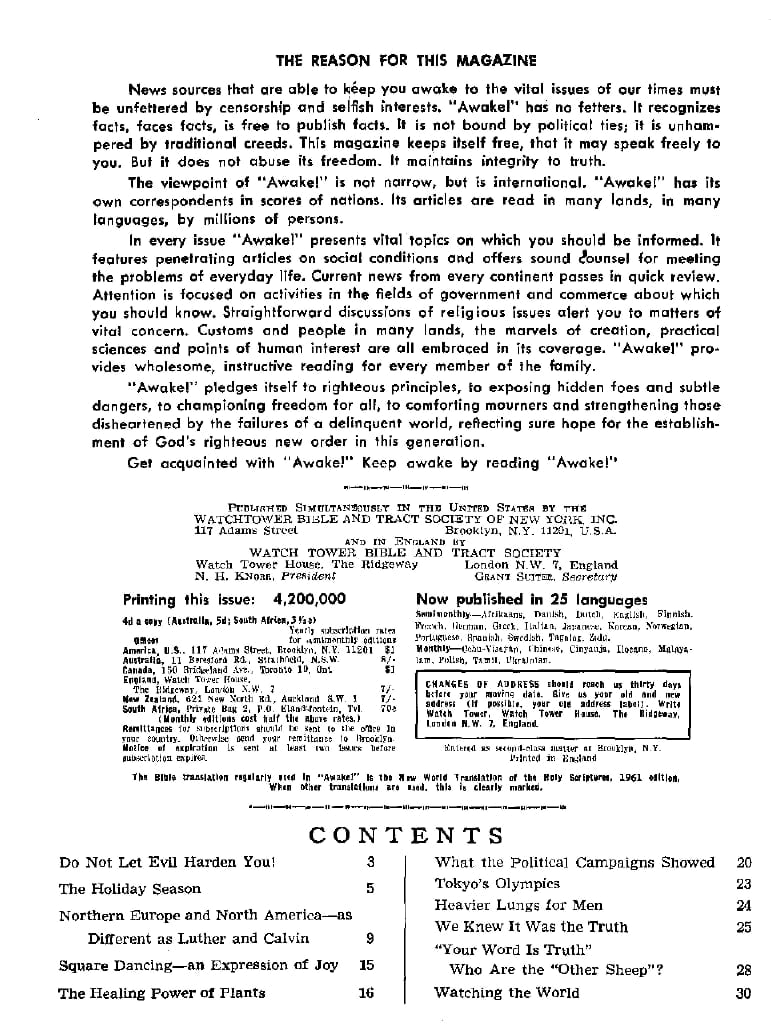
THE REASON FOR THIS MAGAZINE
News sources that are able to keep you awake to the vital issues of our times must be unfettered by censorship and selfish interests. "Awakel" has no fetters. It recognizes facts, faces facts, is free to publish facts. It is not bound by political ties; it is unhampered by traditional creeds. This magazine keeps itself free, that it may speak freely to you. But it does not abuse its freedom. It maintains integrity to truth.
The viewpoint of "Awake!" is not narrow, but is international. "Awake!" has its own correspondents in scores of nations. Its articles are read in many lands, in many languages, by millions of persons.
In every issue "Awakel" presents vital topics on which you should be informed. It features penetrating articles on social conditions and offers sound counsel for meeting the problems of everyday life. Current news from every continent passes in quick review. Attention is focused on activities in the fields of government and commerce about which you should know. Straightforward discussions of religious issues alert you to matters of vital concern. Customs and people in many lands, the marvels of creation, practical sciences and points of human interest are all embraced in its coverage. "Awakel" provides wholesome, instructive reading for every member of the family.
"Awakel" pledges itself to righteous principles, to exposing hidden foes and subtle dangers, to championing freedom for all, to comforting mourners and strengthening those disheartened by the failures of a delinquent world, reflecting sure hope for the establishment of God's righteous new order in this generation.
Get acquainted with "Awake!" Keep awake by reading "Awake!"
PUBLISHED SIMULTANEOUSLY IN THE UNITED STATES BY THE
WATCHTOWER BIBLE AND TRACT SOCIETY OF NEW YORK, INC.
117 Adams Street
Brooklyn, N.Y. 11201, U.S.A.
Watch Tower House. The Ridgeway London N.W. 7. England N. H. Knoan. President GRANT SUITER. Secretary
Printing this issue: 4,200,000
40 a day (Australasia, South Africa, 3/4) $1500 per semester rate for amateur admissions Amelia, U.S. 117 Adams Street, Brooklyn, N.Y. 11201 40 a day for amateur admissions Amelia, U.S. 117 Adams Street, Brooklyn, N.Y. 11201 Canada, 195 Bridgway Street, Toronto, 19.00 U.S. 40 a day England, Watch Tower House, London, 7 40 a day New Zealand, 621 New Westminster, Auckland, S.W. 1 7/8 South African Private Bag House, Johannesburg, 700 40 a day South African Private Bag House, Johannesburg, 700 Remittance for surcharges should be sent to the office in your country, and your remittance
Now published in 25 languages
Swimming — Arikana, Danish, Dutch, English, Finnish.
French, German, Greek, Dutch, Japanese, Norwegian, Norwegian.
Swedish, Danish, Swedish, Tatar, Dollar.
Bathing — Arikana, Chinese, Chinese, Chinese, Malaysia.
Polish, Tatar, Ukrainian.
CHANGES OF ADDRESS should reach us thirty days before your moving date. Also we age our old and new residents. Please contact us at Watch Tower, Watch Tower Hauser, The Bistway, Lovin W. R. 7, England.
Entered as second-class matter at Brooklyn, N.Y.
Printed in England
The Bible translation regularly used in "Awaken" is the New World Translation of the Holy Scriptures, 1961 edition. When other translations are used, this is clearly marked.
CONTENTS
Do Not Let Evil Harden You! 3
The Holiday Season 5
Northern Europe and North America—ns
Different as Luther and Calvin 9
Square Dancing—an Expression of Joy 15
The Healing Power of Plants 16
What the Political Campaigns Showed 20
Tokyo's Olympics 23
Heavier Lungs for Men 24
We Knew It Was the Truth 25
"Your Word Is Truth"
Who Are the "Other Sheep"? 28
Watching the World 30
London, England, December, 22, 1964
DO NOT LET EVIL HARDEN YOU!
DO YOU want to be happy? Do you want to be content? Do you want to have peace of mind? Then guard yourself against
the common mistake of letting evil harden you.
There is no question about it, evil abounds in this world of ours. There are evils of catastrophes, such as earthquakes and floods; there are the evils of accidents, which often leave persons disabled and disfigured for life; and there are the many incapacitating and life-shortening diseases, such as arthritis, cancer and diabetes. Perhaps most prominently today loom up the evils of social injustices in homes, in communities and in whole nations because of personalities, because of religion, nationality, color or race.
Many are the victims of social evils who let themselves become hardened by them. As a result, they take extreme action that is both unwise and unjust. Thus, writing in the New York Times Magazine, August 16, 1964, Hubert Wilkins, the executive secretary of the National Association for the Advancement of Colored People in the United States, discussed the folly of the
current trend of Negroes' resorting to violence in an effort to gain their ends more rapidly. Among other reasons why such violence is unwise, he cites the blunt inescapable fact that the Negro in the United States represents but 10 percent of the population and that to gain his ends he really needs to win friends and influence people rather than to antagonize them by violent methods. He therefore urges Negroes to support a
moratorium on actions that may bring violence: "Whether violence grows out of an honestly spontaneous eruption of emotions or whether it is drummed into life by incantation or other incitement it does little good, either as a catharsis [that is, as a purification of emotions by arousing pity] or as a corrective of social ills. It brings on looting and grand thievery."
Yes, letting evil harden one so that one returns evil for evil is foolish. It merely compounds the misery and makes the remedy more difficult to achieve. Wisely God's Word counsels against it by precept and example: "Do not show yourself heated up because of the evildoers. . . . Let anger alone and leave rage; do not show yourself heated up only to do evil." Two injustices do not make matters right—Ps. 37:1, 8.
Among the examples found in the Bible highlighting how NOT to respond to evil is that of King Saul of Israel. King Saul was faced with what he viewed as an evil when he heard the women of Israel singing: "Saul has struck down his thousands, and David his tens of thousands."
He saw in this comparison a threat to his security as king of Israel. (1 Sam. 18:7-9) As a result, he became so hard, so envious, so hateful that he made the killing of David the consuming passion of his life. But all in vain. On two occasions he had to drink the bitter cup of humiliation as he learned that the one whom he was hunting down as a wild beast had magnanimously spared his life. And in the end David did become king of Israel, while Saul came to his end, a hateful, bitter, frustrated suicide.
On the other hand, there was David. It would have been easy for him to have let himself become hard, hateful, bitter and vengeful because of Saul's so unjustly trying to kill him. On one occasion Saul threw a spear at David, trying to pin him against the wall with it. Because of Saul's pursuit of him, David had to take refuge in mountain fastnesses. But did David let this evil treatment harden him? No, he remained loyal to God and God's principles, to his people and even to Saul the king. As a result, he was protected by Jebovah God, prospered and in God's due time became king of Israel. More than that, David was privileged to write almost half the psalms recorded in the Bible, succeeded in extending the boundaries of his land to their divinely appointed limits, and had his dynasty established as the one through which eventually Jesus Christ, the promised Messiah, would come. What a rich reward he received because he did not let evil harden him, make him bitter, hateful and vengeful, but waited on Jebovah!
This is God's message to all who today are suffering gross social injustices. Do not engage in uprisings, in rebellions, in
riotous violence, but wait on Jehovah God to set things straight. " 'Therefore keep yourselves in expectation of me,' is the utterance of Jehovah, 'till the day of my rising up to the booty, for my judicial decision is to gather nations, for me to collect together kingdoms, in order to pour out upon them my denunciation, all my burning anger; for by the fire of my zeal all the earth will be devoured.'" And while keeping yourself in expectation of Jehovah, heed the threefold command to 'seek Jehovah, seek righteousness, seek meekness.' Obeying that command will keep you from hardening yourself.—Zeph. 3:8; 2:3.
The same principle applies to our everyday relations. How much happier many homes would be, how much happier many places of employment would be, if those suffering from the selfishness and tyranny of others would heed the advice of the Christian apostle Paul: "Return evil for evil to no one. Provide fine things in the sight of all men. If possible, as far as it depends upon you, be peaceable with all men. Do not avenge yourselves, beloved, but yield place to the wrath; for it is written: 'Vengeance is mine; I will repay, says Jehovah.' Do not let yourself be conquered by the evil, but keep conquering the evil with the good."—Rom. 12:17-19, 21.
We cannot improve on divine wisdom. What God commands in his Word is not only the right thing but also the wisest thing to do. Not letting evil harden you results in your own happiness, peace of mind and contentment. More than that, such a course is the most likely to succeed in improving matters; certainly it will not make matters worse. And above all, by leaving one's cause in Jehovah's hands one can rest assured that eventually the outcome will be for the best.
The Holiday Season
MILLIONS of persons look forward to the Christmas holidays. Not only are they glad for
being popularized to an unprecedented degree, few persons apparently give any thought whatsoever
only are they glad for the vacation, but many are happy because of the cheery spirit of friendliness and generosity that often prevails. For some persons it is a time for love and laughter, and happy fellowship with dear ones. Minds are turned toward promises
of "peace among men of good will" and thoughts of doing things for others.
Often the holiday season is spent in a
thought whatsoever to the birth of Jesus Christ, the event the occasion is supposed to commemorate.
Nowhere is this more evident than in Japan, where Christmas has become a major tele-
bration since World War II. Last December Newsweek magazine observed: "In Japan, where Christians make up less than
Often the holiday season is spent in a joyous family reunion, with relatives far and near getting together and sharing pleasant memories and experiences. A feature of the occasion is a tantalizing feast of seasonal delicacies, the mere sight of which makes the mouth water. The children especially enjoy the celebration, particularly when everyone opens the colorfully wrapped gifts. The excitement, laughter and squeals of delight associated with this holiday season make it a most pleasant time for many families.
1 percent of the population, Christmas is now the biggest holiday of the year. . . The season starts in mid-November and continues on until January. The last days of December swim by in a series of parties in homes, offices, factories, and nightclubs that leave the nation with a colossal hangover on which to start the new year." The central figure of the Christmas celebration is not Christ, but Santa Claus.
This popularizing of Santa Claus, however, did not begin in Japan, but in nominal Christian countries such as the United
Present-Day Trend
Yet many of these same persons are disappointed by the marked trend away from the traditional family Christmas. Practically everywhere they observe that big business now dominates the celebration, and the sole purpose of many celebrants seems to be to have a riotous time. Although this has resulted in Christmas DECEMBER 22, 1964
States of North America. Businessmen, who profit from the celebration, are the ones largely responsible, for they have used Santa to bolster business. In connection with the use of such sales gimmicks, the book The American Christmas: A Study in National Culture noted: "The studied exploitation of the festival did not develop fully until the third decade of the
present century.
. . Both merchants and advertising agencies recognized the commercial potentialities of folk festivals, and began to exploit these occasions shortly after 1920. This was immediately successful and has continued unabated to the present."
But what many people find even more disturbing than the commercializing of Christmas is the senseless revelry, heavy drinking, immorality and increased crime that invariably mar the holiday season. The December 21, 1962, issue of Time magazine commented on troubles around Christmastime, saying: "Beginning about Thanksgiving, family quarrels become fiercer, relations with relatives become more strained, tradesmen assume a forced friendliness, and the dispenser of holiday cheer begins to feel there is not an honestly cheery face to be found anywhere. . . Part of the strain, of course, is financial . . .
"Alcoholics and their families have an especially rough time of it because the Christmas spirit so often comes in bottles. One family counselor estimates that this problem alone poses potential trouble for some 3,500,000 families annually, and the lipstick worn home from the office party disturbs millions more."
Some Revealing Information
Does it disturb you that a holiday season intended by some to glorify mankind's Savior should dishonor him to such an extent? The notorious behavior at Christmastime has caused many persons to be deeply concerned, and some have taken the time to investigate. This has turned up a great deal of surprising information regarding Christmas, much of which has been published in newspapers and magazines for all to read.
For instance, did you know that early Americans who were endeavoring to live in accord with God's Word did not celebrate Christmas, and that in 1659 they actually passed a law forbidding its celebration? Look magazine of last December 31 brought this to light, noting: "Christmas itself did not have the same hold on the youthful United States that it did later. In early New England, celebrations were forbidden by law because the Puritans were offended by the pagan origin of many Christmas customs."
Early Americans, however, were not the first to forbid the celebration of Christmas. "In Cromwell's time," MacLean's magazine of January 6, 1962, observes, "the Puritan church of England not only ignored the so-called birthday of Jesus, but prosecuted any unregenerated souls who dared to keep it in secret."
Pagan Roots
The reason for this legal action against Christmas was that it originally was a licentious pagan festival. It had been adopted by apostate Christians centuries after the death of Christ, and the Puritans knew that it had no place in true Christian worship. An editorial in a Puerto Rican newspaper, the San Juan Star of December 24, 1962, made the following interesting observations:
"The anniversary of the birth of Christ was not celebrated until the fourth century A.D. . . . December 24th or 25th, however, was finally chosen as the official birthday of Christ. The ancient Greeks and Romans as well as the Huns, Goths, Teutons, and Celts celebrated the birth of the unconquered sun on those days. . . . The Greeks celebrated the re-birth of Dionysus in mid-winter . . . The bringing of gifts to the child-god Eros was part of the Dionysian festival. Christmas is indeed an ancient festival with pagan roots . . . Yes, Christmas is a pagan holiday."
This is not simply the conclusion of a few persons. It is well known. For example, note what the authoritative work The New Schaff-Herzog Encyclopedia of Religious Knowledge, Volume III, page 48, says about this: "The pagan festival [in commemoration of the return of the sun] with its riot and merrymaking was so popular that Christians were glad of an excuse to continue its celebration with little change in spirit or in manner.
. . . The festival rapidly gained acceptance and became at last so firmly established that even the Protestant revolution of the sixteenth century was not able to dislodge it."
If you want to check this information for yourself, go to the public library and consult the reference works there. If you look in The Encyclopedia Americana under "Christmas" you will find this: "The celebration was not observed in the first centuries of the Christian church, since the Christian usage in general was to celebrate the death of remarkable persons rather than their birth. . . In the 5th century the Western church ordered the feast to be celebrated on the day of the Mithraic rites of the birth of the sun and at the close of the Saturnalia, as no certain knowledge of the day of Christ's birth existed. Among the German and Celtic tribes the winter solstice was considered an important point of the year and to commemorate the return of the sun they held their chief festival of yule, which, like other pagan celebrations, became adapted to Christmas.
"Most of the customs now associated with Christmas were not originally Christmas customs but rather were pre-Christian and were non-Christian customs taken up by the Christian church. Saturnalia, a Roman feast celebrated in mid-December, provided the model for many of the merry-making customs of Christmas. From this celebration, for example, were derived the elaborate feasting, the giving of gifts, and the burning of candles. Lights also played
an important part in most winter solstice festivals."
Examining the Bible Record
These facts, which have been widely publicized in recent years, are not unknown to people in general. Yet many feel that what they are celebrating is not a pagan feast but something that is clearly set out in the Bible. After all, does not the Bible tell about the birth of Christ, the giving of gifts by the "wise men" to the babe Jesus and other things that are called to mind at Christmastime?
Why not open your Bible and see what it actually does say. Read carefully what is related in Luke chapter 2, verses 1 through 20, and in Matthew chapter 2, verses 1 through 16.
Now, what indications do you find there in the Bible as to the time of year Jesus was born? Does not the account say that shepherds were in the fields tending their flocks? Since December in Palestine is the rainy season, it is unlikely that shepherds would be out-of-doors with their flocks at that time of year. Notice, too, that this was the time of the registration, when the people were required to travel to their native city to register. Is it not unlikely that the Roman authorities would require a people already inclined to revolt against them to make such a trip in mountainous country to register in the dead of winter?
The evidence is quite conclusive that the date for the Christmas celebration is not supported in the Scriptures. Even The Catholic Encyclopedia, Volume III, page 727, admits that, not Jesus' birth, but "the well-known solar feast, . . . celebrated on 25 December, has a strong claim on the responsibility for our December date." So can Christmas really be said to be a celebration of the birth of Jesus when, as it is plain to be seen, it is not even the time of year he was born?
But what about the popular Christmas customs of giving gifts and decorating a tree? The Bible account does not mention anything about setting up and decorating a tree. And did you notice that the shepherds did not bring any material gifts?
The Bible record makes clear that the gift bringsers were, instead, "wise men from the east," who were guided, not by angelic instructions, but by a "star in the east." An examination of various Bible translations will reveal that these "wise men" were not kings, but magi or astrologers. And although astrology is popular among many people, God condemns it. It is also observed that by the time the astrologers arrived in Bethlehem Jesus was no longer a babe in a manger, but had grown and was a young child living in a house.—Isa. 47:12-15.
Another important thing to note is that those astrologers were not at first directed by the star to Jesus in Bethlehem, but to murderous King Herod in Jerusalem. Now, if God had used the star to guide them, would he have directed them first to Jerusalem so that they would come in contact with that dangerous king? Obviously not, for when the star finally led the astrologers to Jesus and they were about to report his whereabouts to Herod, God stepped in and warned them in a dream so that they departed for their own country by another route.
It was this intervention by God that saved his Son, for when Herod learned that the astrologers had fled without reporting to him, he sought to kill Jesus by destroying every young boy two years of age and under in the district of Bethlehem. From a careful reading of this Bible record, is it not apparent that the menacing star that led the astrologers was of demon origin? Yes, it actually was a scheme of Satan the Devil to expose Jesus to murderous King Herod! So then, when gift giving is done
at Christmastime in imitation of what those astrologers did, is it really in honor of Christ?
Pursuing a God-honoring Course
When a person becomes acquainted with the Bible account, it becomes apparent that the Scriptures do not support the Christmas celebration. To the contrary, that celebration distorts the truth regarding events in connection with Jesus' birth, and actually idolizes astrologers who are condemned in God's Word the Bible. This may surprise some, but, if they are truly sincere in their desire to do the will of God and if they really appreciate God's provision of his Son, they will not continue to be a part of something that so obviously dishonors him.
Now, this does not mean that it is wrong for families to get together at any time and to enjoy themselves by eating and drinking in moderation and having happy fellowship. Not at all! It is a grand thing when friends and relatives can be together, and it is good to give things to persons you love. Spontaneous, uncompelled giving brings real happiness, not only to the receiver, but especially to the one who gives. Acts 20:35.
Is it not true that the Christmas celebration often robs persons of this joy by making them feel compelled to give? Actually a gift means so much more when one gives it, not under compulsion, not because it is expected, but out of love. This Christian giving, along with pleasant fellowship with dear ones, can be enjoyed anytime during the year. It does not have to be done in celebration of a Goddishonoring holiday. So, you see, when one conforms his conduct to what is pleasing to God, that which brought genuine joy and happiness is not lost, yet, at the same time, what was a source of anxiety when one celebrated Christmas is gone.
Northern Europe AND North America
-as different as
</div>
By "Awake!" correspondent in Denmark
IT IS generally known that in many fields the attitude of the people and the arrangements of society in North America are different from those of Europe. But only a few know that many of the differences are connected with the different
ways in which two leaders of the Reformation viewed the Bible.
If, for instance, a Dane, after having lived in the United States for several years, takes a trip to the old country, the first thing he will notice is, as a rule, the big difference in living standards and economic activity. But he may not be aware of the fact that one of the reasons why the United States became the richest and most productive nation of the world is said to be the Bible faith of a man in sixteenth-century France, John Calvin.
The next thing our visitor to Denmark may notice is the church attendance, which is deplorably low and comes far short of the attendance in America. People over in North America believe more in the Bible.
They show more interest in religion. Not only are they less constrained in discussing the subject, but they even spend a lot of money on religious activity. The American is not left in any doubt about the fact that money is needed for
ECEMBER 22,1964
this purpose and that he has the "blessed privilege" of donating the money. Nevertheless, the minister and the missionary in America have long been held in high esteem. It is respectable to be religious. Of course, you have churches that are
more "respectable" and some that are less "respectable" than others, but you do not have a privileged State Church as in Lutheran Northern Europe.
The law is different. The law of the United States has given the citizens great religious freedom. Separation of Church and State is carried through, farther there, probably, than in any other place. Not that the legislators were atheists or that religion was of no importance to them, but, on the contrary, they had a strong religious conviction that State and Church ought to be separated. Religion was very important to the makers of the American Constitution, and their Calvinistic view of the Bible has marked their work and the later legislation.
Also, morals are different, at least officially. You can see it in the public attitude toward conduct of those contemplating marriage in the United States, which differs from the more liberal ways of the Scandinavians. Further, you can
see it in the American film censorship, which the Europeans stamp as old-fashioned and often describe as puritanical, with a direct but generally unconscious allusion to the historical cause of the phenomenon.
We could mention other examples of differences, but those mentioned are clearly connected with the spreading of the two main streams of Protestantism after the Reformation.
Special Cause of the Differences
Truly, there are many reasons why "the New World" on the American continent assumed characteristics of its own. The vast and almost virgin land stimulated the colonists, and its riches opened up great prospects to them. But it was the sense of duty, the industry and thrift that the New Englanders brought along from Western Europe that enabled them to take up the challenge and develop the resources of the country, and all these characteristics were encouraged by the Calvinistic Bible climate from which they came.
The influences carried to the new nation with the immigrating Catholics and Lutherans from all parts of Europe, and the liberal Bible view that has since then advanced on both sides of the Atlantic, have not been able to change the United States from being a country marked by Calvin's view of the Bible; and the leveling out that has taken place between the two continents because of the two-way flow of influences has not been able to change Northern Europe from being a region marked by Luther's view of the Bible.
How, then, did these two men with their different views of the Bible come to influence the two main camps of Protestantism? The answer may help us better to understand our fellowman on the other side of the Atlantic Ocean, especially why he generally has another attitude toward
the Bible. The answer may also help us to reconsider our own point of view as regards the Bible. At least we will get to see that it is of no little consequence how we think about this Book. It has been a powerful factor in the lives of men and nations in the past and the present, and will be so in the future too.
Calvin's Reformation
In 1528 the Frenchman John Calvin had left his theological studies and thrown himself into the study of law and arts when he got the chance to read some of Luther's writings and thereby was carried away by the Reformation. Five or six years later he broke away from the Roman Church and stood up as a reformer himself. Although he closely followed Luther on the two essential points: that justification is obtained by faith and that the Bible and not the pope or the church councils is the determining factor as to what is the true faith, Calvin's effort to represent a "Bible Christianity" nevertheless led to a protestantism distinct from that of Luther.
From 1541 to his death in 1564 he worked with untiring energy as a leader and reformer from his headquarters in Geneva, the Rome of Calvinism. His special reformation spread from Switzerland to France, the western parts of Germany, the Netherlands, England and Scotland, and later it came to America with Puritans, Presbyterians, and Baptists; also immigrating Methodists and Anglicans carried elements of Calvinism along with them.
Calvin was more intellectual and systematic than Luther. "To both Luther and Calvin the Bible was decisive . . . , but in a different way," says the church historian Hjalmar Holmquist. To Calvin the whole Bible was inspired by God word for word. He saw the Bible as God's law from which you can directly draw rules for the life of the individual and society in both spiritual and practical, everyday matters.
Because of this view the Bible was read.
Discussing the extent of Bible reading in Lutheran Denmark in the sixteenth and seventeenth centuries, P. G. Lindhardt, D.D. and professor of theology at Aarhus University, Denmark, has this to say: "In the reformed [Calvinistic] countries, especially in England, Bible reading is far more common, in the church as well as in the home; there the Bible . . . really became the people's book which until the present time has influenced English manner of thinking and speaking to an amazing degree . . . But there, it must be admitted, the Bible view was different—at least in puritan circles. People were able to read the Bible without qualifications; it was the Word of God to such a degree that it worked by itself, and all situations in life were to be governed by it. All that is not allowed by it, is forbidden, was the principle, contrary to the Lutheran principle: What is not forbidden by it, is allowed."12 This attitude of the Calvinists or reformed Christians toward the Bible made them Bible distributors before the Lutherans.
This view of the Bible also caused strictness in the demands for holiness and obedience. Calvin did not teach that Christians could earn God's favor (justification) by good works, but he taught that they were predestinated to salvation and that the fruits of the spirit, their good works, were signs of their election. While Luther saw God as the merciful Father, God was to Calvin the sovereign Majesty whose will must be done and whom man must serve and honor above all. Virtues such as diligence, thrift, chastity, honesty and conscientiousness were stressed, and Calvinists became generally known for their industry and hard work, their strong will to endure in the belief that they were
God's chosen ones and were doing God's will.
This attitude manifested itself in the zealous and extensive missionary work carried out by the reformed or Calvinistic churches, and also in the Calvinists' industry in the secular field. Calvin encouraged the citizens of Geneva to toil for a more healthy economy. He understood "that most important for an economic recovery was industry and hard work, orderliness, honesty, thrift, moderation in life and unity for the sake of mutual benefit. This he taught the citizens of Geneva, and little by little he taught it to the whole Calvinistic world. Therefore it became the carrier of the growing commerce and industrial activity."a
Calvinistic services were simple, without ornamentation or images, without altars and organs. The sermon, baptism and the Lord's supper remained. As a rule the sermon is sober. There is nothing mystical about baptism or the Lord's supper. The baptism is a symbol or a sign. The Lord's supper is viewed as a memorial. Bread and wine are nothing but symbols of the body and blood of Jesus. They are not transformed, as taught by the Catholics, and they are not the literal body and blood of Jesus in a mystical way, as taught by Luther. And according to Calvin only the worthy may partake of the Lord's supper. Against the unworthy, strict disciplinary measures were taken. Accordingly, a pure congregation is aimed at, and therefore meddling in its administration by the secular authorities is ruled out. The reformed churches are generally separated from the State.
The English State Church is Calvinistic in doctrine only, while it is Catholic in worship and ceremony, and Lutheran in its organization as a State Church. Because of the bad experiences of the Puritans with the State Church in England, those who fled to America saw to it that in the new land Church and State were separated.
Consequently, no single denomination was favored by the State, and the way was prepared for many denominations to arise. Furthermore, the Calvinistic organization of the church had an educational effect on the people toward democracy and tolerance, and in this way too it contributed to the American Constitution and the great personal freedoms that this guarantees. Although the church discipline internally often expressed itself as intolerance of the worst sort, externally Calvinism has shown great tolerance and, with its Bible view, made room for greater individualism than Lutheranism. That is why the many denominations and sects have come mainly from the reformed churches.
No doubt you can point out reformed churches that have little resemblance to the picture we have just sketched. That is because many different circumstances made themselves felt in time and modified the characteristics of the churches more or less. Only the group that adhered to the original view of the Bible as God's Word and in which each member through diligent study of the Bible let himself be filled with the power of this Word would be the one that remained untouched by the world and its materialistic and faith-destroying philosophy. Calvin's reformation and Bible view were able to prepare the way for such a true Christian church. Now let us see what Luther's reformation and Bible view led to.
Luther's Reformation
Hundreds of years before Luther, lay movements such as the Catharis and Waldenses came to see the distance between the original Christianity and that of the Church of Rome. What characterized these humble people was a strong moral sense supported by diligent Bible study. The Bible was their standard for doctrine and life. The same stand was taken by John Wycliffe in England and John Huss in Bohemia. Of these preparations to the Reformation, one historian says: "Since the time of the Waldenses, Wycliffe and Huss there were men who by reading the Ancient Scriptures got to see the Truth and the Way in a simple and literal observance of the words of Jesus. These 'dangerous' writings had now been distributed through printed translations into thousands of hands that in believing sincerity grabbed hold of the lifegiving food."
It was not necessary for Luther to produce new evidences or new doctrines in order to start the Reformation. And, in fact, he did not do it either. "During all the reformation commotion there was hardly expressed one thought which was not already thought by Wycliffe one and a half centuries previously." Luther spoke only the word for which everybody had been waiting, and this he did with his protest against the selling of indulgences in 1517.
The people eagerly accepted his words about the Christian's freedom and independence of the pope, church council or any other authority; the Bible alone was to be his guide. The teaching that a man will not be justified by works but by faith alone also fell on fertile ground. In order to prevent what was now in process—that people unrestrainedly began to split up into more or less fanatic and political and revolutionary movements or, in reliance on God's forgiveness, began to ignore morals and good conduct completely—Luther thought that he had to stress the virtue of obedience toward the worldly authorities, and this he did to such a degree that the political prince or king became the head of the church.
In addition, Luther set bounds for the freedom to interpret the Bible. He taught that only those words in the Bible that were clear and would direct the Christian to Christ and justification by faith were truly evangelical.
He even judged each book of the Bible according to the degree in which it expressed these central teachings, and he thought that some books in the Bible were more inspired and more canonical than other Bible books. The letter of James, which speaks about faith as being dead without works, he could not appreciate as being on a par with Paul's writings, and the Revelation he also disliked. The way he looked upon law and works required that he take a liberal stand toward the "Old Testament." The Ten Commandments he divided otherwise than Calvin, placing no emphasis on the commandment against images. Because of this liberal attitude toward the Bible it was not difficult at all for him to include the quite uninspired apocryphal books in his Bible edition. (These books Calvin would not havel!) In fact, Luther exercised a dogmatic Bible criticism, a kind of higher criticism.
A good number of his followers, therefore, did not feel any desire to occupy themselves with the Hebrew Scriptures to any great degree. His somewhat simplified conception of the gospel or good news about a forgiving God caused them to feel no great need for reading the Christian Greek Scriptures either. In fact, Lutheranism did not urge people to read the Bible, and its followers did not do much about Bible distribution. Because of the idea of some of Luther's followers, that the gospel had in fact been preached in all the world since the days of Adam and Eve, the Lutherans were slow in getting the missionary work started. Lutheranism spread to the Scandinavian countries, not through missionary work, but because the kings accepted the new teaching and ordered their subjects to accept it. In many places even the same Catholic priest and bishop
were allowed to continue in office, but now on the king's order as Lutheran priest or bishop.
As an example of the effect of Luther's reformation we can take Denmark, which was reached by the Reformation in 1536. The first real steps toward the educational system promised by the Reformation were not taken until two hundred years later, and then because of influences from Calvinistic England and pietism, a spiritual movement started by Ph. J. Spener, who, though being a German Lutheran, had received many impulses from English Calvinism. Until that time the Bible was not a popular book in Denmark. People could not read.
Then followed a period in which it became the fashion to view the Bible just as another piece of literature, yes, even to despise it. The Bible interest fell to near zero. In 1814 it was found that for several years hardly a score of Bibles had been sold in Denmark.
A new impulse from the Calvinistic part of Christendom was necessary in order to awake "the phlegmatic Danes," as the Scottish Congregationalist Henderson described them in 1814. That year The Danish Bible Society was established on the initiative of Henderson, who was sent out by The British and Foreign Bible Society. The next year he observed that the work went all too slow and said it was due to the clergymen, whose sermons were not Biblical enough. The Bible Society later on apologized by explaining that the slow pace was due to "the difference between the reformed [Calvinistic] and the Lutheran view of the Bible."
In Lutheran Denmark the priest and poet N. F. S. Grundtvig, about one hundred and fifty years ago, could say: "The Lord's book was put on the shelf, fairy-tales were heard in the Church." Strangely enough, he himself caused most of his countrymen to keep the Bible on the shelf.
In 1825 he made what he himself termed "a unique discovery," to the effect that the Bible is not the Word of God, but the Word of God is in the Bible, and the Word of God is mainly the words contained in the Apostles' Creed said at baptism and the Lord's supper. "Only at the bath and the table we hear God's Word to us," he said. His followers took the consequences of this view of the Bible and declared that Christians should not let themselves be "hectored," or bullied, by the Bible either religiously or morally. Bible reading was never their strong point, and this is the most widespread view of the Bible now in Lutheran Denmark. The circles that have endeavored to stick to the Bible have in almost every case received influence from Calvinism.
Shortage of clergymen and bad church attendance are taken as signs of the ailing condition of the church in Denmark. Various remedies are suggested, and some cast sidelong glances at America, where at least church attendance is better. When a clergyman recommended that the church rate in Denmark be doubled in order to get rid of some of the lukewarm members and teach those "who now content themselves with coming to Church on Christmas Eve and at their own funeral" to show more appreciation for the church, a newspaper asked: "Is he going to do away with the State Church and bring about American church conditions with free and financially strong religious communities?"
The clergyman said No. In Lutheran Denmark many people have much to criticize about religion in the U.S.A. It is unhealthy and of bad taste, some say, and they think of Norman Vincent Peale or Billy Graham. "Can anything [religiously] good come from America?" others are asking. They do not like religious influence from America. At the same time they have to admit that the Lutheran State Churches themselves are in a weak position.
A Source of Reformation and Renewal
A Source of Reformation and Renewal This short study shows us that it was the Bible that delivered the power for Luther's and Calvin's reformation. To the degree that the new churches made the Bible their guide and source of renewal, they were able to reform and exert a good influence on the people, but when they drifted away from the Bible they lost their original strength. The differences between North America and Northern Europe that we have discussed can to some degree be explained by the fact that Calvin was more bound to the Bible than Luther, and his reformation and the territory it covered were therefore influenced by the Bible much more than Lutheran Northern Europe.
We have not looked into this subject in order to choose between Luther and Calvin. True Christianity is neither Lutheran nor Calvinistic, neither American nor European. In our search for the true Christian standard we have to go farther back, back to Jesus Christ and the early Christians of whom we can read in the Bible. But we have treated the subject in order to show that it is of no little consequence how we view the Bible. The Bible has worked as a powerful factor and source of renewal in the life of nations and men in proportion to how much they read it and appreciated it. This has given you an opportunity to reconsider your own stand toward this unique Book.
REFERENCES
1 Kirkehistorie (Church History) by Hjalmar Holmquilst (1931), Vol. II, p. 153.
x Bibelen og det danske folk (The Bible and the Danish People) by P. G. Lindhardt (1942), p. 27.
a Kirkehistorie by Hjalmar Holmquist, Vol. II, p. 172.
4 Europas Kulturhistorie (Cultural History of Europe) by Hartvig Frisch (1928), Vol. II, p. 134.
& Thid. Vol. II, p. 135.
a Johs. W. Jacobsen, vicar. in the book Bibelisyn
(Bible View), p. 287 (1951).
7 BT (a Copenhagen daily). January 10, 1981.
SQUARE DANCING-an Expression of Joy
DANCING as an expression of joy is far different from those forms of dancing in which dim lights, passion-arousing music and suggestive movements and embraces are featured. It is a clean and open expression, a joyous physical response to the sheer pleasure of living. Square dancing is like that. You cannot
square dance without smiles and laughter and hearty cooperation with others. It is wholesome exercise, and it usually does not present the same danger to good morals that is involved in dances in which unmarried persons are paired off with those of the opposite sex to dance with their arms around each other.
The square dance literally involves a square of four couples who go through a prearranged pattern of swinging and bawing and stepping, gracefully yet vigorously. It also includes such folk dances as the "Virginia reel," in which two rows of dancers face each other. It calls for a brisk tempo and unhesitating leadership from the one who is calling out the progressive movements. It is not so much a question of learning intricate steps as it is of coordinating one's movements with those of other dancers and responding to the directions of the "caller."
Square dancing in North America is derived from older British, Irish and French folk dances. Of late there has been a vigorous revival, so much so that it is estimated that square dancing has at least a million regular, ardent devotees in the United States, with other millions enjoying it occasionally. In any one night square dancing is going on in at least a thousand towns and cities across the country. In New York City alone about a quarter of a million share this stimulating pastime regularly. In Europe, too, square dancing has "caught on." According to the U.S. State Department, American folk dancers abroad are among the best ambassadors of goodwill the nation has.
One good reason for the popularity of this wholesome type of dance is that it can be enjoyed by young and old alike. It is open to people of all classes, since it requires no special talent or training. Only a few basic steps are involved, though almost endless variations are
possible. Indeed, if one enjoys simply tapping his foot to lively music he can learn to square dance and enjoy it. More than that, if you can walk, you can square dance. Why, even the blind and the deaf enjoy it and frequently excel at it!
Think, too, of the fine physical exercise, the relief from nervous tension,
the improvement in poise that result from this wholesome form of relaxation! As one worker expressed it: "The square dance nights are worth a million to us. The little irritations don't bite so hard anymore at home or on the job. I just laugh them off!" Its effects on mind and heart have been highly praised. During World War II, for example, it was used with excellent results to aid soldiers to relax and to get amputees accustomed to using their artificial limbs. It is even now being used in some mental hospitals to dispel mental depression and restore patients to reality and a measure of joy. For hospital patients the tempo is slowed down considerably. Nevertheless, results have been most encouraging. When we think about the joy-expressing and joy-inspiring elements of the square dance, we are reminded of the Bible's assurance that "a heart that is joyful does good as a curer."—Prov. 17:22.
Square dancing also helps to improve relationships. Its tendency to bring young and old together to share precious moments of relaxation and do things together is most commendable. Unlike modern dance fads that have been observed to lead to crude and unmannerly conduct, square dancing, by reason of its inherent joy and graceful cooperative movements, improves manners.
However, even square dancing can have its pitfalls. Surely it would not prove to be beneficial if it became a means of bringing you into regular association with persons who have no love for God and his righteous principles. And it would not be beneficial if it became a time-consuming obsession. But in the right company and in moderation, square dancing can be lots of fun, an expression of joy for young and old, "all together."
The Healing Power OF PLANTS
WHEN the German chemist Richard Willstätter was a boy, one of his closest friends, ten-year-old Sepp Schwab, cut his knee while chopping wood. Since his parents had strictly forbidden him to use the ax, young Sepp concealed his injury. However, after a few days infection set in, and by the time the condition finally came to the attention of Sepp's parents the infection had become serious. A doctor was called and he decided that the only way to save the boy was to amputate the leg at once. It was only after strong persuasion by the parents that the doctor agreed to postpone the operation until the following morning.
That evening when they were discussing what they could do for their son, the father suddenly remembered the marvelous cures performed by a certain shepherd. Immediately the man was found. After examining Sepp, he went out into the fields and came back with a handful of plants. The Schwabs recognized some of them as the ordinary nettle, plantain and watercress. The shepherd cut all of these into very fine pieces, until they were a mass that resembled cooked spinach. This was applied to the wound.
The next morning when the doctor arrived, he was surprised to find
PLANTAIN
NASTURTIUM
FOXGLOVE
that the infection was considerably improved and the fever had receded. He, therefore, was agreeable to postponing the amputation again. By this time the shepherd had brought more herbs, and this second mixture was even more successful than the first. In time the swelling disappeared entirely and the wound healed.
CABBAGE
It is reported that this healing effected by plants made an indefible impression upon young Richard Willstätter, who was watching closely the progress of his little friend. Later, Willstätter studied chemistry at Munich University and became an outstanding student of the biochemistry of plants. For his investigations into chlorophyll and the revolutionary discoveries he made, Willstätter was awarded the Nobel Prize in 1915.
But despite such investigations that revealed the marvelous processes of plants, during the years that followed, the attention of medical men was directed almost exclusively toward the producing of synthetic drugs. Scientists and doctors, for the most part, had no interest in investigating the healing properties of plants. However, in view of the many remarkable cures realized by employing plants, there is certainly no good reason to hold a contemptuous attitude toward them. They have been used successfully in medicine for centuries.
Successful Plant Remedies
For hundreds of years Polynesians used the leaves of the papaya tree to treat their wounds. When a person was injured, his wound was bound in these leaves. Modern medicine now recognizes the value of applying papaya leaves to an injury.
Researchers have recently investigated the papaya leaf and found it to be rich in enzymes that are beneficial in the treatment of bruises and in cleaning wounds.
Early in the sixteenth century white men first learned about the curative powers of quinine from the Peruvian Indians. It is believed that these South American Indians had long used the bark of a certain type of tree in the treatment of fevers. One account says that they learned about the curative powers of this tree from an ailing lion that they observed chewing its bark. Regardless of whether this report is true or not, the quinine obtained from Cinchona trees is to this day by far the most effective medicine for treating malaria. It has alleviated suffering and extended the lives of countless millions of persons.
But perhaps one of the most important plant remedies is the one that was employed during the eighteenth century by a woman in Shropshire, England. She brewed a tea from leaves that included those of the beautiful foxglove plant, and served this concoction to patients suffering from edema—a condition commonly known as dropsy. She obtained remarkable results, and became noted for her cures.
When hearing of the herbwoman's successful treatment, the medical doctor William Withering did not dismiss her home remedy as useless. Instead, he investigated and found that the heart-stimulating properties contained in foxglove leaves were actually successful in treating dropsy. These leaves came to be an accepted medicine in treating heart conditions. In time it was found that the leaves contained the powerful heart stimulant digitalis, which, to this day, is a most important heart medicine.
Other plants long used successfully in medicine include the poppy, from which
such important painkillers as morphine and codeine are derived. Curare, a poison prepared from plant juices by certain tribes of South American Indians, is now used as a muscle relaxant in a host of paralyses and spastic disorders including pollo, tetanus and multiple sclerosis. And ephedrine, which is obtained from medicinal plants used successfully by the Chinese for centuries, is an important medicine in treating asthma.
A Change in Attitude
Despite the many successful plant medicines in use, up until about ten or twelve years ago there was little interest in searching any farther for plants that heal. This all changed, however, with the discovery in the early 1950's of reserpine, the tranquilizing component of the Indian snakeroot Rauwolfia serpentina. This discovery marked the introduction of modern tranquilizers, and it touched off a multimillion-dollar-a-year, worldwide search for other plants that might prove useful in treating man's lils.
When commenting on Rauwcolfia, Dr. Robert de Ropp made an interesting observation as to why many medical researchers were so reluctant to investigate natural sources. "It is curious," he said, "that a remedy so ancient [as Rauwcolfia] . . . should have been ignored by Western researchers until the year 1947. This situation results in part, at least, from the rather contemptuous attitude which certain chemists and pharmacologists in the West have developed toward both folk remedies and drugs of plant origin. . . . They further fell into the error of supposing that because they had learned the trick of synthesizing certain substances, they were better chemists than Mother Nature. . . . Needless to say, the more enlightened members of these professions have avoided so crude an error, realizing that the humblest bacterium can synthesize, in the course of its brief existence, more organic compounds than can all the world's chemists combined."
With an estimated 350,000 known botanical species, and about 2,000 new plants identified and added each year, the field for research in the plant kingdom is almost limitless. "We have scarcely begun to explore its potential," noted one leading researcher. Doctor Evan C. Horning, as laboratory head at the National Heart Institute in the United States, observed: "Undoubtedly the things we are looking for are in the world of plant life." But he added: "Our search is like looking for a small needle in a large haystack."
Cancer Research
Thus far the results have caused investigators to press on in their search. For example, Dr. Alfred Taylor, cancer expert at the University of Texas, noted that "in our twenty years of cancer research we have never had as much success with chemicals invented by man as we are now having with plant extracts." Explaining an advantage of using plants, he said: "As a rule, the naturally occurring compounds are less likely to be poisonous than the synthetic, because they are developed in association with life."
Dr. Bruce W. Halstead, director of the World Life Research Institute, related an incident of the kind that spurs on researchers. An Indian with a huge growth on his cheek visited a mission hospital in Nicaragua. A specimen taken by a mission doctor was diagnosed as skin cancer. When the native was told he would have to submit to surgery at once, he vanished into the jungle. Three months later he was back. He had been treated by a witch doctor with a leafy poultice, and "his face was clear as a baby's bottom."
Not long ago there would be little inclination to investigate such a reported cure. But this is no longer true; now special attention is being focused on plant medicines of so-called primitive peoples and, on occasions, with good results. The examination of a Penobscot Indian cancer remedy resulted in obtaining an extract from the American mandrake or mayapple, Podophyllum peltatum, which is now a preferred treatment for certain warts, and is used by some cancer specialists in treating other skin growths.
It is interesting that some common plants have been found to possess promising anticancer properties. An extract from the Viscum album species of mistletoe, for instance, was discovered to cause more than a 50-percent tumor inhibition in mice. And an extract from the leaves of a species of periwinkle plant is reported to be successful in treating cancer patients. Surprisingly, substances from the common muskmelon and cucumber also possess good anticancer properties, according to latest research.
Confirmation of Natural Remedies
Certain natural remedies have been used by people for many years. Long experience with them has proved their effectiveness. That they work is what matters—why they cure is not of primary importance. Interestingly, however, modern medicine has confirmed the value of many remedies that have long been popular.
In commenting on this Dr. R. T. Whiteman of Cambridge, Idaho, observed: "Many a granny has used a mold scraped from cheese as an application to open sores. [Some also used moldy bread as a poulice on wounds to prevent infection.] She got results, but she didn't know why. Today we derive penicillin from a certain type of mold. Some grannies applied wet tea leaves to a fresh burn, but modern medicine has substituted tannic acid solution, which is the active principle of tea leaves."
The recent investigation of thousands of common plants has revealed some amazing facts concerning their healing properties, as Margaret B. Kreig in her new book, Green Medicine-The Search for Plants That Heal, explains: "Current research is turning up medicinal properties in everything from lettuce, used by the ancients as a sedative, to apples and onions. . . Research at the United States Department of Agriculture, in England, and elsewhere has proved that antibiotic properties exist in so many plants that it would take many pages just to list their names. New drugs may come not only from rare jungle vegetation but also from the commonest field and garden flowers and everyday foods."
In Germany, Professor A. G. Winter and a research team collected specimens from 1,248 different families of plants, and an examination revealed that 378, or about 30 percent, yielded an antibiotic. Winter found that within twelve hours after eating plants such as nasturtiums there was sufficient antibiotically active material in his urine to be effective against many species of bacteria. A horseradish poulice produced a similar result. To the surprise of doctors, mustard, oil was found to be absorbed through the skin into the body, where it exerted its antibiotic action before being excreted in the urine.
Professor Winter decided to experiment with his own children, who every winter had been subject to tonsillitis and other infections. He coaxed them to eat nasturtium salad, and their resulting resistance to infections was remarkable. Dr. A. Vogel of Switzerland also reports that his experience has been that horseradish, watercress, garden cress and nasturtiums build up immunity to colds and infections. He has also found that poultices of pulped cabbage
leaves are effective in treating swellings, bruises and wounds.
During the Middle Ages lichens held a high place in the pharmacopoeias of medical doctors, and now their usefulness has been confirmed. Dr. Mason E. Hale, Jr., Smithsonian Institution botanist, pointed out that extracts of some lichens act as potent antibiotics. "Approximately half of the species in temperate areas," he said, "will inhibit bacterial growth, and in most cases the active principle has been traced to a specific lichen acid."
It is interesting that the Finns now extract an acid from reindeer mosses in Lapland and produce an effective commercial salve. According to Hale: "It is much more effective than penicillin salves in the treatment of external wounds and burns," and, he said, we can expect "that lichen antibiotics will become increasingly more common in medical practice in the future."
…