Awake!, September 8, 1964
Download: PDF — Awake!, September 8, 1964
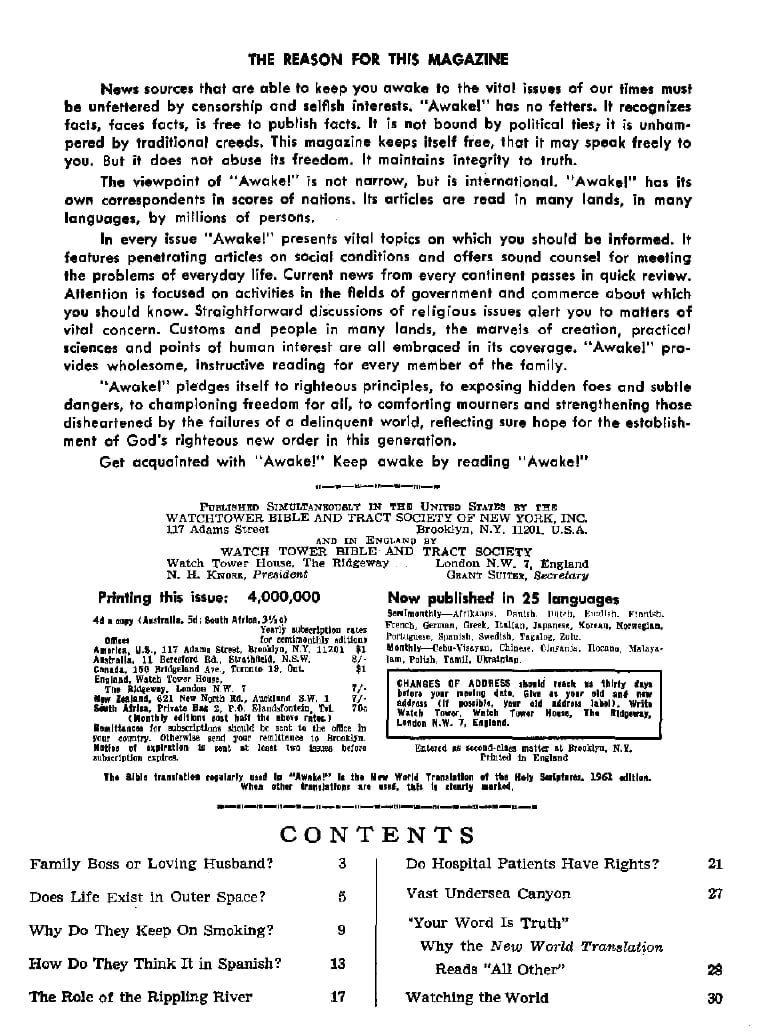
THE REASON FOR THIS MAGAZINE
News sources that are able to keep you awake to the vital issues of our times must be unfettered by censorship and selfish interests. "Awake!" has no fetters. It recognizes facts, faces facts, is free to publish facts. It is not bound by political ties; it is unhampered by traditional creeds. This magazine keeps itself free, that it may speak freely to you. But it does not abuse its freedom. It maintains integrity to truth.
The viewpoint of "Awake!" is not narrow, but is international. "Awake!" has its own correspondents in scores of nations. Its articles are read in many lands, in many languages, by millions of persons.
In every issue "Awakel" presents vital topics on which you should be informed. It features penetrating articles on social conditions and offers sound counsel for meeting the problems of everyday life. Current news from every continent passes in quick review. Attention is focused on activities in the fields of government and commerce about which you should know. Straightforward discussions of religious issues alert you to matters of vital concern. Customs and people in many lands, the marvels of creation, practical sciences and points of human interest are all embraced in its coverage. "Awakel" provides wholesome, instructive reading for every member of the family.
"Awakel" pledges itself to righteous principles, to exposing hidden foes and subtile dangers, to championing freedom for all, to comforting mourners and strengthening those disheartened by the failures of a delinquent world, reflecting sure hope for the establishment of God's righteous new order in this generation.
Get acquainted with "Awake!" Keep awake by reading "Awake!"
PUBLISHED SIMULATIONBOTH IN THE UNITED STATES BY THE
WATCHTOWER BIBLE AND TRACT SOCIETY OF NEW YORK, INC.
117 Adams Street
Brooklyn, N.Y. 11201, U.S.A.
AND IN ENGLAND BY
WATCH TOWER BIBLE AND TRACT SOCIETY
Watch Tower House, The Ridgeway N. H. KNORK, President
London N.W. 7, England
GRANT SUITER, Secretary
Printing this issue: 4,000,000
4d a copy (Australia, South Africa, 35c) registration fees
Office, South Africa, for commensurably aditions
America, U.S., 117 Adams Street, Brooklyn, N. W. 11701
Canada, 169 Princetown Ave, Toronto, U. T. 169
7/ New Zealand, 621 New York Ave, Australia S.W. I
South Africa, 705
(Registrant officers must hold the above rates)
Haiti (registrant officers should send your visitation to Haiti)
Notes of application must be kept two weeks before
subscription expires.
Now published in 25 languages
Seventhmost — Alkjama, Dombai, Fouli, Fouli, Fouli, French, German, Greek, Italian, Japanese, Japanese, Norwegian, Norwegian, Dutch, Dutch, Zulu, Zulu, Zulu
Monthly — Cebu-Vietnam, Chinese, Chinese, Hoccon, Malaysia, Palah, Palah, Uruguay,
CHANGES OF ADDRESS should reach us thirty days before your rental date. Give us your old and new address and the address of the old house that you want. Watch Tower, Watch Tower Tower, The Midway, London N.W. 7, England.
Entered as second-class matter at Brooklyn, N.Y.
Printed in England
The Bible translation popularly used in "Ankhe" in the New World Translation of the Holy Scriptures, 1961 edition.
When other translations are used, this is clearly marked.
CONTENTS
Family Boss or Loving Husband? 3
Does Life Exist in Outer Space? 5
Why Do They Keep On Smoking? 9
How Do They Think It in Spanish? 13
The Role of the Rippling River 17
Do Hospital Patients Have Rights? 21
Vast Undersea Canyon 27
"Your Word Is Truth"
Reads "All Other" 28
Watching the World 30
FAMILY BOSS OR LOVING HUSBAND?
DO YOU walk several feet ahead of your wife to show your position as head of the house? Or do you speak disparagingly of your wife to others out of fear that kind words would
imply that you are "henpecked"? Believe it or not, this is the practice in some communities. You may agree that the man should be head of the house, but still you probably say, "That's taking headship a little too far."
Nevertheless, in a society where the family is the basic unit it is proper that a man should take his responsibility as family head seriously. Some family heads, though, have difficulty in adjusting themselves to the home environment because of the highly competitive atmosphere in which they must work all day, where the big-man-kick-little-man attitude often alienates the overseer from his fellow workers. The boss wants to get as much out of his men as he can, while the men want to get as much out of the boss as they can. His presence will stimulate activity, but will not always be welcome. Perhaps you would like to improve conditions under which you work but are not in position to
do so. However, you can do something about conditions in the home where you are the head. Your homecoming can be something that the whole family looks forward to, or it can be a time when
your wife says, "Look out, kids, your father's coming!"
Something that makes any of us feel good is when the boss comes along, notices the good work we are doing and commends us. Nothing is more discouraging than always to have one's mistakes noticed and bad work returned, while good work seemingly goes unnoticed, taken for granted. When we stop to think about it, we know that we are getting paid for doing the job right, but we still appreciate a little pat on the back. Now, if a husband feels that way, would it not be reasonable to conclude that a wife does too?
She will soon sense it if her housekeeping and cooking are being taken for granted. She works hard to have the house clean and the meal ready on time. Perhaps she has spent a lot of time looking through magazines to find a new recipe. She has changed her dress and tidied her hair, and now here comes her husband. Coat thrown there, shoes kicked off here, he gobbles down the meal without noticing anything different, then sinks back in the armchair buried in a newspaper.
What a disappointment! If only he had said something that showed a little appreciation. It would have required very little effort, and it would have meant so much. Empathy, putting oneself in the place of the other person, makes all the difference. It can turn a bosslike head into a loving husband.
An inspired writer of the past made clear that this is a basic factor to keep in mind in exercising husbandly headship. He wrote: "A husband is head of his
weekly meeting at the workshop where the boss delivers a short speech that no one would dare to miss but in which no one is interested. The family can always be commended for getting together on time and for the good comments that they make. The discussion must be kept lively and practical. The children, for instance, go to school and mix with a wide variety of other children. What problems do they face? How can the information studied be of help
Youthful Indifference Leads to
Adult Failure.
What Has Nationalism Done to Mankind?
Protect Yourself Against
Fraudulent Business Practices.
To Wed or Not to Wed?
wife," and he added, "Husbands ought to be loving their wives as their own bodies. He who loves his wife loves himself [because they are one flesh since marriage], for no man ever hated his own flesh; but he feeds and cherishes it." (Eph. 5:23, 28, 29) Or, as Jesus Christ put it, we 'should do to others as we would like them to do to us.' (Matt. 7:12) Such a simple rule, but so difficult for some to apply. It is as the West German magazine Kristall commented: "In place of the understanding fatherly type, we now have the rushed robot that arrives home from work worn out and unapproachable." All right, so you have been pushed around all day, but why make your home as unpleasant as the place where you work? Why not make it a place where there is an atmosphere of love and mutual refreshment?
In a commendable effort in this direction, many fathers have come to appreciate the need for some religious activity in the home, and set aside time each week for a family Bible discussion. Care must be exercised, though, to see that this does not become simply a duty performed, like a
to them? What is needed is not just an academic approach but one that takes in each member of the family and his individual needs. Such a Bible discussion can
be very upbuilding, and one to which all will look forward.
This points up an important fact about a happy home environment. It comes about, not regardless of what the family head does, but because of what he does. How much effort do you expend in this behalf? Have you become just a mechanical breadwinner, or do you have a genuine love for your wife and children? You may be very generous, showering your wife with gifts and yet notice that there is not the same response as there used to be. Perhaps she feels that your gift-giving has become perfunctory. If this is the case, use a little more initiative, giving a gift when it is not expected. It is not that the gift is an expensive one, but it comes as a surprise and says, "Thank you, Darling, for all the effort and cooperation in making our home such a happy place." By taking your responsibility seriously, always having empathy, commending wherever possible, and being alert to ways of showing appreciation, you can avoid the reputation of being a family boss, and show that you really are a loving husband.
DOES intelligent life exist in outer space? Science fiction writers have long been writing fantastic stories about "people" on other planets. However, much more reliable scientists have now begun to talk seriously about the possibility that life will be found elsewhere in the universe.
Fordham University chemist Bartholomew Nagy recently led a team that thought it had found microscopic fossil life forms in a meteorite that fell in France a hundred years ago. Spectacular newspaper reports termed this positive proof of extraterrestrial life. However, they did not give equal space to the fact that other scientists pointedly disagreed.
Scientists have conferred with a U.S. Congressional committee on the possibility that life could be found on other planets. The principal conclusion at the time was that even if material life does exist elsewhere, no one was willing to spend the fantastic sums of money that would be necessary to get in touch with it.
Other Kinds of Life
V. Axel Firsoff, writing in the British scientific publication Discovery, said astronomers have considered "the problem of life beyond the Earth . . . strictly from the narrow viewpoint of terrestrial organisms . . . it is beginning to be widely felt that this one-sided approach has become outdated." Scientists no longer
think all life must be our kind of oxygen-breathing, water-drinking life. Firsolf proposes "only one selected alternative scheme of 'pseudo-organic chemistry' in which liquid ammonia replaces water." He says many other possibilities exist, but suggests that ammonia in the atmosphere of the giant planets and perhaps on some of their satellites could support this kind of life. "Jovian animals," he says, "could breathe nitrogen and drink liquid ammonia. Whether they do remains to be seen."
Dr. Ralph E. Lapp, special editor of the Bulletin of the Atomic Scientists, thinks the places where life may exist are too far away for man ever to reach. The still theoretical ion rocket may someday be used to attain the fantastic velocity of a hundred miles a second. But even at that speed our closest stellar neighbor in space, Alpha Centauri, is eight thousand years away! Since it is not imaginable that man could travel such distances, Lapp proposes we listen for them. He thinks he knows what radio frequencies an intelligent society would use to communicate from remote space—frequencies close to the 21-centimeter hydrogen note. In 1960 the U.S. National Radio Astronomy Observatory near Greenbank, West Virginia, tried listening to two of the nearest stars, but without initial success. Lapp thinks an intelligent society could send an understandable message to Earth.
"The basic reason for my optimism," he wrote in Harper's magazine, "is that if we do establish contact with an exosociety [a society outside the solar system] it is probable that their technology is more advanced than ours. We may find that we are dealing with vastly brighter beings."
Interstellar Warnings
Sebastian von Hoerner, of the Astronomisches Rechen-Institut in Heidelberg, Germany, thinks that more "advanced" planets may have been through cycles of self-destruction and would have something to say to Earth's young civilization now approaching a great crisis. Writing in Science, a technical magazine published by the American Association for the Advancement of Science, he said: "The civilizations we find will very probably be much older than we are, and they will be more advanced. Our chance of learning from them might be considered the most important incentive for our search." Time magazine, commenting on Von Hoerner's views, suggested that perhaps there is "an old, wise civilization that has survived many crises and is trying to warn the callow earth against the mistakes of its own youth."
Professor Shapley says: "The high probability of the existence of senses, and of sense organs, now unknown to man is proposed. Their existence is indeed so reasonable as to seem axiomatic. . . Many realities may lie beyond the comprehension of human terrestrials, simply because our outfitting of sense organs is limited."
Dr. Lapp adds: "Think of the knowledge we could gain if planet X is far advanced and is already familiar with the discoveries, inventions, and evolutionary steps which are still in our future. Think of the impact which such knowledge could have upon our lives, upon our philosophy and our religion. These matters are now
being discussed quite seriously by reputable scientists."
Life DOES Exist in Space!
The amazing fact is that life does exist in space—life that has senses and capacities man has never imagined! Further, contact with it has been made! The simple fact is that the scientists are looking too low. They are looking for an "evolved" kind of life, based on the type of chemical processes still-young man has thus far discovered.
However, they have made a great step forward. They have begun to realize that not all life has to be the kind we know, and not all phenomena need to be the kind we understand. This is of interest to the Bible believer who has long recognized the existence of a kind of life many scientists refused to admit. The evidence is clear that this life exists, though many men, like children at the edge of the sea, do not imagine the marvels that exist beyond the reach of their limited knowledge.
The life that unquestionably does exist in space does not require powerful radio signals to communicate with men. Nor does it depend on man's ability to build radio telescopes to receive its messages. No 21.6-year time lag is necessary for a roundtrip message, as would be the case for radio communication traveling at the speed of light between earth and relatively nearby Tau Ceti. No 2,000-year wait is necessary for the answer to a question from a more distant source.
Ask one of Jehovah's witnesses if life exists elsewhere in the universe. He will answer: "Certainly it does!" He knows that it exists on a scale far higher than life forms requiring the same chemical elements found on earth, or having only our limited number of senses.
Further, he knows that this intelligent life, much older and wiser than man, has something very important to teach us; that it has a vital warning for Earth's young civilization in the face of its present great crisis, and that it has warned of the destruction of the world of unbelieving mankind, and has shown the way of escape.
The impact this warning should have "upon our lives, upon our philosophy and our religion" is overwhelming.
Persons who consider this revelation beneath their intelligence are themselves the ones who are looking too low. In confining their investigations to the visible universe, they look far beneath the magnificence of what actually does exist, and dangerously ignore its warning.
More Information than They Expect
Splendid creatures from what men call "outer space" were used by God to explain his requirements to faithful men three and a half millenniums ago—long before the epoch of modern radio or twentieth-century science! Paul, an apostle of Jesus Christ, truthfully wrote under inspiration that the Law given to Moses was "transmitted through angels." The Law they transmitted from God included severe warnings of what would happen if the people who accepted it failed to remain faithful to their God—these were warnings from space that proved to be amazingly true!—Gal. 3:19.
The word "angels" means "messengers." These invisible messengers in space, far wiser and more powerful than any material life man knows, have transmitted outstanding predictions and warnings of the future. The fulfillment of the things they were used to foretell is the greatest proof of their existence, and of the fact that the men who wrote their predictions and warnings really were in touch with them. Let us consider two different examples, one that has already been accomplished in detail, and another that presents a serious warning for our day.
Two thousand five hundred years ago, in a message much easier to understand than the coded communications radio astronomers hope to hear from space, an angel told Daniel the Hebrew that Persia, then ruling as a world power, would be overthrown and replaced by Greece. This actually did occur! The messenger from space said: "I have come to cause you to discern what will befall your people in the final part of the days." He gave "a vision yet for the days to come," which foretold the major events of world history from Daniel's time down to our day!
He described, in advance, kings who would rule Persia. He foretold the Greek Empire's taking Persia's place as a world power. He announced the division of Alexander the Great's Greek Empire into four parts at his death. He predicted the replacing of Greece by Rome. The angel further described the modern world struggle between democratic and totalitarian governments. He told of the world's impending "time of distress such as has not been made to occur since there came to be a nation." He announced that the archangel Michael would stand up to protect God's people at the "time of the end" of this troubled and wicked world, where we now find ourselves.*
Certainly the angel who gave this message gave far more information than scientists hope to gain from creatures on another planet. Daniel was not writing on his own authority. How would he have known, two hundred years in advance, what Greece would do? How could he have predicted its split into four parts after Alexander's death? How could he have foretold what would happen hundreds of years later in Rome, or some 2,500 years later in our century? No man could have predicted this. Rather, this was a vastly superior "wisdom from above."—Jas. 3:17.
A Far Greater Wisdom
This 'wisdom from space' warns of the destruction of our present "civilization" in a far more specific way than any "old, wise civilization" in space could do. This destruction is discussed in detail in the Bible book of Revelation, which opens with these words: "A revelation by Jesus Christ, which God gave him, to show his slaves the things that must shortly take place. And he sent forth his angel and presented it in signs through him to his slave John." That revelation contains angelic warnings of the destruction that now faces an unbelieving human society. Heavenly messages warn of man's failure to establish righteous conditions, and foretell divine intervention. The political vine of disobedient mankind is gathered and hurled "into the great wine press of the anger of God." However, the angel let John know that a righteous government is to come "down out of heaven from God," and that by means of it God "will wipe out every tear from their eyes, and death will be no more, neither will mourning nor outcry nor pain be any more."—Rev. 1:1; 14:19; 21:1-4.
This is not fiction! Rather, it is a divine message, transmitted through a mighty spirit creature from outer space. It represents a wisdom far greater than man's. That wisdom warns humankind against continuing its present course, and foretells the blessings that will come to those who heed the divine warning, flee from the world's course, and receive life under the righteous new conditions the Creator soon will establish on earth.
The divine message from space said: "These words are faithful and true; yes, Jehovah the God of the inspired expressions of the prophets sent his angel forth to show his slaves the things that must shortly take place. And, look! I am coming
quickly. Happy is anyone observing the words of the prophecy of this scroll."
—Rev. 22:6, 7.
Far Superior Creatures
Thus, the scientists are looking too low. A much higher form of life than many of them are willing to imagine does exist. It has contacted man, not through man's radio, but through powers of communication far superior to the accomplishments of modern science. It is not limited to "potentially life-supporting planets," and is not an evolutionary civilization that has progressed beyond earth's. Rather, it was created vastly superior to human life by the Creator, who made the awesomely magnificent material universe. The proof it exists is the prophecy-filled Bible. This "wisdom from above" has not come about by trial and error, but it has warned men of what is about to happen, and it would be foolish not to listen.
What kind of life the Creator has produced elsewhere is not known to man. But one fact is sure: He has produced creatures far superior to man. He created them before he created man, and he has used them to communicate with men. Through them he announced, long in advance, marvels he will perform. And he has used them to give a small glimpse of the magnificent conditions that are in the immediate future for those of mankind who will heed his warnings.
Will you listen to this mature advice from space? Will you study the Book that the Creator of all things inspired? Will you learn from the Bible what is about to happen on earth, and what you can do to survive the impending destruction? The intelligent course is not to turn a deaf ear to this message, but to listen, and to accept the spiritual warning, which is rejected by many people who are looking for inferior, physical life in space.
why they keep on
"CIGARETTES PERIL HEALTH, U.S. REPORT CONCLUDES."
Such was the headline in the January 12, 1964, issue of the New York Times, which went on to tell about the 150,000-word report by a panel of ten impartial authorities in several health fields, based on an evaluation of almost 12,000 studies of smoking's effect on health. Cigarette sales declined about 25 percent.
A few weeks later, on March 15, the same newspaper reported: "CIGARETTE SALES ARE REBOUNDING. Decline Following Surgeon General's Health Report Is Now Less Severe." Then in June the surgeon general said that cigarette sales in April 1964 had soared to 44 billion cigarettes shipped from factories. This was an increase of two billion cigarettes above the same month a year ago! Any decline in the nation's smoking, he explained, was probably due to some young persons' not taking up the habit after the government report. Thus the majority of smokers in the United States, estimated at about 70,000,000, never really quit.
Why? Yes, why, especially in view of what the government report revealed? It disclosed that "cigarette smoking contributes substantially to mortality from certain specific diseases and to the over-all death rate." The greatest risk in smoking, it forcefully stated, was lung cancer; but other diseases were linked to smoking, such as various forms of heart disease, gastric ulcers, bronchitis and cirrhosis of the liver. Studies indicate, the report said, that those who smoke one to two packs a day have an overall death rate 90 percent higher than for nonsmokers. As for lung
cancer, cigarette smokers have a death rate that is almost 1,000 percent higher than for nonsmokers.
A similar report was released in Britain in 1962, when the Royal College of Physicians indicated cigarette smoking as a cause of lung cancer. Cigarette sales slumped for about a year. Then, despite an official campaign urging people to cut down or cut out cigarette smoking, Britons began smoking more than ever. Cigarette sales were estimated to be at least 5 percent higher than they were when the government report said that eight out of every ten deaths from lung cancer were caused by cigarette smoking.
Though measures have been taken in a number of countries, such as in Denmark, West Germany and the Soviet Union, to discourage cigarette smoking, it has generally increased. Why is this? Is it that the facts about the danger of smoking are not known? No, in most cases the smokers have heard about the peril. In many instances it is an unwillingness to face the facts, combined with encouragement people get from cigarette advertising to keep on smoking.
Effect of Advertising
In many countries television and radio advertise cigarettes daily. In the United States a great number of popular shows, including highly popular medical shows, are sponsored, at least in part, by cigarette companies.
One could hardly expect a TV physician to tell his patient to stop smoking! Some smoking ads on TV seem to be aimed at young people; even if they are not, there seems to be little on TV in the United States to send a 15-year-old away with the feeling that smoking is not for him. While the television viewers are spurred by advertising to smoke a certain brand of cigarettes, there is little on TV and radio to warn the public of the health hazards. Such efforts have been described as "practically nil." This is understandable, since cigarette advertising on TV in this one country alone cost more than $110,000,000 in a recent year.
Newspapers and magazines, moreover, have not done a great deal, especially in the United States, to emphasize the peril of cigarette smoking. Again this is understandable, since almost every issue of a magazine or newspaper has large cigarette advertisements. Though reports on smoking studies have appeared in newspapers, the general story has been fragmented. "Few newspapers," stated the Consumer Reports, "undertook to present the full evidence on tobacco."
This tendency to play down the perils of smoking is because many publications depend on cigarette advertising. Using various advertising mediums, the tobacco companies in the United States spend about $200,000,000 a year telling people to SMOKE! SMOKE! SMOKE! Who is going to spend such money telling people not to smoke? Many governments are in a difficult position because taxes on cigarettes and tobacco bring in a large amount of the budget resources.
Some governments, such as that of the Netherlands, have earmarked money to warm against smoking and some have
placed limits on advertising. In Italy, where all cigarette advertising has been banned, cigarette smoking has been significantly inhibited.
But in many countries the advertising continues and the effect is evident. In a discussion held by the National Conference on Smoking and Youth, teen-agers noted that the antismoking propaganda is not as vast in magnitude nor as powerful in impact as the pro-smoking ads. They claimed that antismoking propaganda is usually unattractive and is no match for the alluring advertisements paid for by the cigarette companies. The teen-agers were also critical of the schools for "apathy" on the smoking question. Indeed, in another panel of youths the expression was made that teen-agers were "brahwashed" into smoking by "parents, television, people at school . . . everybody."
Bad Examples Everywhere
This points up the fact that many people keep on smoking because others do. Those "others" are, all too often, parents themselves. No matter how much parents warn children about the perils of smoking, young persons who have taken up the habit are not likely to quit as long as their parents keep on smoking.
Moreover, there is the pressure to conform to the bad examples of other young persons. If others their age smoke, young persons feel they must do so. Instead of conforming to what is right, they conform to the crowd.
Then there is the bad example of doctors themselves. Some doctors, of course, have now quit smoking, but many still reach for a cigarette with great frequency. In fact, some years ago an advertisement in the United States declared: "More doctors smoke Camels than any other cigarette." So bad is the example of doctors that the president of the Canadian Medical Association called on doctors to stop smoking or to refrain from it in front of patients in order to help stem the "epidemic" of lung cancer.
How can a doctor with cigarette in hand or a pack in his shirt pocket convince his patient that he should stop smoking?
Powerful in effect also is the bad example of many of Christendom's clergy, for it is an obvious fact that many clergymen are heavy smokers. What does this say to adults and especially young people? And those clergymen who do not smoke usually hesitate to speak out against smoking. At church affairs and clerical conventions the air is often heavy with cigarette smoke.
It is small wonder that people do not stop smoking and that they are apparently starting to smoke at an earlier age than ever, despite health reports. At least in Birmingham, England, a survey made last year revealed that the average age when a boy has his first cigarette is nine years, seven months. Nearly 85 percent of all boys were said to have smoked by their fourteenth birthday. And officials on the Toronto, Canada, Board of Health were recently shocked and disheartened when a survey among 8,000 school-age children disclosed that children smoke their first cigarette at the age of six or eight years. "If the parents smoke," an official asked, "how are we to stop the children from smoking?"
"Weak Moral Fabric"
But the bad examples of so many persons do not explain it all. Many persons know that the hazards of smoking are great, yet they keep on smoking. In fact, one survey for the American Cancer Society found that 86 percent of the smokers queried wished that they could give up the habit. Is it that giving up the habit is impossible? No, the medical consensus is that if a person really wants to quit smoking, he can. Even the inveterate heavy
smoker can break the habit. What, then, is the trouble? A professor of medicine, when asked why so many doctors did not quit smoking, answered: "Weak moral fabric."
This points to the trouble with many smokers who prefer not to smoke. They lack sufficient willpower and moral determination to stop smoking. A person who wants to discontinue may try some of the antismoking pills or products, but, without a firm moral decision, he will likely keep on smoking. Those who have stopped usually are those who have made this firm decision. They do not try to taper off, but they make a complete break from the habit. One heavy smoker who had the moral fabric to make that decision said it was a fight for the first three days: "I had terrible headaches and felt ill enough to go to bed. I was addicted and I battled against an invisible enemy that I was determined wouldn't win. Then the fourth morning I woke up hungry, my headache was gone and food had never tasted so good."
But many persons never make such a firm decision to win the battle; they never get around to making the big decision—to stop completely. A lung cancer specialist at the Toronto General Hospital, who has seen too many smokers die in agony to be able to joke about the habit, forthrightly says smokers are "intellectually destitute and morally derelict." Asked what might wake up a person to give up the habit, he answered: "The information that smoking can kill him."
Indifference to Consequences
Even though the evidence is overwhelming that smoking can kill a person and that it is linked to many diseases, still there are multitudinous smokers who will not stop. Why?
Young persons who keep on smoking seem indifferent to the danger because it seems too far off.
One teen-ager just beginning to smoke said: "Nobody young worries much about some disease they might get 40 or 50 years from now." Death from lung cancer seems remote to those who have not seen a person die from it. A twenty-year-old girl told a reporter: "Look, I don't know anybody that's ever died from smoking." Many are undoubtedly indifferent to the consequences until they come face to face with grim reality, much as the story goes about the simple man who was sentenced by a judge in April to be hanged in July. He took the news carelessly and was turning to go back to his cell when a thought suddenly occurred to him. Turning back to the judge, he asked, "You don't mean this coming July, do you, Judge?"
Many are so indifferent to the consequences that even when the danger is immediate, they still puff away heedlessly. In his book Smoking and Health, Dr. Alton Ochsner tells about a patient with Buerger's disease who was warned of the danger of amputation if he did not stop smoking. But the doctor had to amputate. "Nor is mine a rare experience," he writes. "A well-known physician has remarked: 'I marvel how intelligent individuals calmly go about killing themselves.' He, too, had . . . patients who, despite repeated warnings to stop smoking, preferred to lose their legs rather than give up the cigarette habit. . . Why, indeed, are smokers so intent on suicide? . . . How anyone could read these statistics and yet continue to smoke will also always be utterly bewildering to me."
tinued to smoke, as reported in The Saturday Review of January 25, 1964:
One explanation why they keep on smoking must lie in the general attitude of great numbers of persons toward moral values and life itself. This is illustrated by the words of a doctor explaining why he con-
"I didn't need the government's report to convince me that smoking can cause cancer or bronchitis or various forms of heart disease. I see the evidence almost every day in the hospital wards or among my own patients. . . . I suppose I'm like many of my own patients. I've advised them to give up smoking but they'd rather not. It doesn't make that much difference to them if some years are lopped off their life. I'm very realistic when I tell them about the probabilities, especially when I point out that their chances of dying from cancer are about ten times greater than if they didn't smoke. But they really don't care. That's about the size of it. They really don't care."
Asked if he felt the same way, the doctor replied: "Just about."
But what kind of person are you? Are you enticed to smoke or to keep on smoking by the alluring and seductive advertisements? Are you letting yourself be brainwashed into smoking by the poor examples of schoolmates, friends, fellow employees, doctors or clergymen? Do you have enough moral fiber to make a firm decision to stop and then abide by it?
Do you care enough for your family to take care of your health? More than the smoker's life is involved; what about the grief and anguish of the wife whose husband dies in agony at age fifty of lung cancer? What if there are children? Will they be smoking, too, as a result of a bad parental example and headed for the same tragic end? How much better for fathers and mothers to set a good example for their children and eliminate the whole frightful chain that leads to one tragedy after another!
If any smoker really cares, not only for his life, but for his loved ones, he can indeed stop.
THE days of discovery are not gone.
Times when hardy men set out for the unknown and unexplored in search of the new and exciting may
seem to have faded except for the few who probe the remaining frontiers of space, jungle, ice and ocean. Yet the thrill of discovery offers itself to anyone who wishes to explore one of the Creator's most fascinating productions—man himself in all his variety.
From babyhood curiosity about one another stirs in us until, later in life, induced prejudices blind people to the
charms, ingenuity and abilities of others of our species but of a different race. Yet discovery awaits us if we keep alive
the curiosity and keen observation of children, as when a European child and an African child, meeting for the first time, touch each other's skin and look at their fingers to see if the respective black and white rub off.
Little reveals more of the thinking of one's neighbor than his language. Certainly this is true of the Latin peoples of the Americas. From Spain came an intelligent, emotional and warm heritage to mix with the practical, hardy and stoic Indian to produce a people who, as in Central America, have a unique distinctiveness and charm. Look past mere grammar and vocabulary into the idioms and sayings of the Latin-American people. Ask yourself, "How do they think it in Spanish?" and an adventure in language is at the threshold.
Spanish reveals a heritage of courtesy and empathy. Perhaps no word in the English language matches in courtesy the Spanish title "Don." A young man who
has become very fond of an older man and wishes to show both his respect and affection at the same time finds that calling him only by his first name would be too familiar, and using "Senor" or "Mr." with the last name would be too formal. So he uses the title "Don" with the older man's first name, as "Don Pedro," and the older man responds warmly, pleased with both the respect and the affection shown him by the younger man.
The language itself provides for sparing from insult an acquaintance who may be of an unpopular group. Merely adding a diminutive or affectionate ending to the word makes an otherwise slighting term become quite acceptable. During World War II when being a German was frowned upon in much of the world, one could identify a German friend without implying an insult by calling him a "little German" or alemancito. Nowadays when North Americans are not altogether popular in many parts of Latin America children may not know any other way to describe them than by the snide term "gringo." Yet a "gringuito" is quite all right; so approaching the home of Honduran friends, the 6-foot, 200-pound American may be amused to hear one of the children call out, "Daddy, here comes the 'little gringo.'"
If you wish to keep your business to yourself, it is not necessary to tell your Honduran inquirer to mind his own business. Just tell him you are going to "make an errand." You have not offended him, and he politely refrains from questioning you further as to your mission.
On the other hand, Spanish can be very emphatic in a negative way. What English-speaking schoolchild has not been corrected for using double negatives? However, in Spanish the double negative is not only correct but essential, and what could be more satisfying than an emphatic triple negative: "I do not want no sugar in my tea never!"
Different Viewpoint
Besides expressiveness, Spanish often reveals a different way of looking at everyday activities, sometimes with irrefutable logic behind it. In English, when someone calls you, you reply, "I'm coming." But the Spanish-speaking person asks, "How can I be coming when I am not yet there? You can come to me, but in order to get where you are I must go to you, not come." So he logically responds to your summons, "There I am going" ("Alla voy"). Similar reasoning gives him a generous outlook. We often say we must "take steps" to accomplish some project. But steps do not come to you nor do they just wait to be picked up and carried away. You must expend energy, reasons our Spanish friend, and so he "gives steps." In many such expressions, Spanish "gives" where English "takes."
The Spanish language does allow one to "take" some things, however. Decisions, for instance. The Latin feels that when decisions are presented, they are already created and you merely choose among possibilities already in existence. So instead of "making a decision" he "takes the decision." When presenting such choices English-speaking persons often present the alternative after saying, "on the other hand." Literal translation of this into Spanish is quite amusing, as one looks first at one hand and then at the other. So he says, quite reasonably, "in change." In examining the possible choices, one naturally chooses, in English, the one that is "worth while." Of course, time, or a "while," is worth something. Our Central-American neighbor, though, colorfully chooses that which is "worth the pain."
Similar Viewpoints
That the human race is one family with a common ancestry and common experience is reflected in common expressions that are almost the same in different languages, some almost unchanged, others with slight but revealing differences. In English, for example, you can reject an obviously unreasonable offer by saying, "I wasn't born yesterday," whereas in Spanish the intended victim retorts, "I'm not in diapers" ("No estoy en pañales"). If the deceptive rascal happens to be a thief as well, he will have "sticky fingers" in English and be "long of nails" in Spanish. You can also warn your friends of such a villain without a word by simply making a gesture like a cat extending its claws, and they will immediately look well to their purses.
When the North American is "just a step from" home, his Honduran neighbor will be "at two steps from" home. And what the former "takes to heart" the latter "takes to breast." However, the slight differences in some ideas show a different way of life, a different setting for a similar experience. For instance, one who sleeps soundly in English may be so inert and motionless as to "sleep like a log." But have you ever seen a child asleep, completely relaxed, with his legs sprawled at incredibly awkward angles? If so, you will appreciate the Spanish equivalent, "to sleep at loose leg."
When a little one grows up into a young lady and attends dances, she will be a "wallflower" at an English-speaking party if no one asks her to dance, for she may as well be one of the decorations on the wall. However, at a Spanish flesta chances are she will remain seated all evening if no one invites her to dance, and this is referred to as "to iron the seat." Some well-meaning young man may undertake to teach the lonesome young lady to dance without stepping on her partner's toes, but he may have taken on a job that is too big for him. So an English-speaking companion may suggest that he has "bitten off more than he can chew." Can you imagine the struggles of one trying to wear a shirt made of eleven yards of cloth? If so, you can easily picture why his Spanish-speaking friend may suggest that he has "gotten himself into an eleven-yard shirt."
To "burn the midnight oil," of course, means one is working unusually long hours into the night to accomplish some task. However, if you use a candle instead of an oil lamp you may well "burn the eyelashes," as the Latin American might say. If you suddenly find that the task will require more effort than you are willing to expend, you may say, "That is a horse of a different color." Horse trading may not be so common in certain parts of the Spanish-speaking world, but flour of varying quality is a common part of life, so it means the same thing in Spanish to say, That is "flour from another sack."
When your partner becomes angry and explosively loses his temper at you for having changed your mind, your description of him will be determined by your background. The English-speaking world has its Irish and the Spanish its Indian. So if he is English he "got his Irish up," or if Spanish, "the Indian climbed up in him."
Extension of Viewpoint
Gems of wisdom have been condensed into proverbial sayings in nearly every language, and Spanish is especially rich in them. Entire conversations can be carried on in Spanish with proverbial sayings. These brief expressions often settle a conversation or sound out viewpoints on delicate subjects. Sweethearts may demonstrate remarkable ingenuity at this game. Where there are similar proverbs in the two languages, Spanish frequently extends the thought.
If, for example, your neighbor wants to trade you some corn that he has only just planted for some beans you have already harvested, your English reply may well be, "A bird in the hand is worth two in the bush," or, in Spanish, "Of more value is a bird in hand than a hundred flying." If you were not wise and you lost heavily in the foolish bargain, in English you may be said to have been "fleeced." The Latin mind, with its keen insight into human nature, recognizes that the victim may not have had the most blameless of motives himself, perhaps even being a bit greedy. So it is said, "He went in after wool and came out fleeced." Such kind of persons are not uncommonly found in one another's company, for "birds of a feather flock together." But where great flocks of birds are not so common, Spanish observers may be heard to say, "They are foxes from the same pineapple patch."
Persons who have become noted for certain characteristics may find it difficult to change; in fact, others may view this change as impossible. From the Middle East, where there were leopards, came the expression, 'Can a . . . leopard change its spots?' (Jer. 13:23) In Spanish-speaking tropical countries the people may be more familiar with monkeys and use this comparison: "Although she dresses herself in silk, monkey she remains." Familiarity with monkeys coming out in troops in the evening has also given means of expression to the advice that if you want to stay out of trouble, do not go where you know trouble is likely to occur.
So the Honduran parent wisely advises his youngsters, "He who does not want to see monkeys, let him not walk at night."
Daily Life
The daily life of the people is often re-
tion is borne out by the increasing number of juvenile delinquents who, resenting the failure of their parents to administer proper parental discipline, turn on them with hatred and even violence. Similarly, another effective Spanish comparison, substantiated by Proverbs 22:6, is: "Tree that grows twisted, never its trunk straightens up."
The English "look before you leap" is given a very practical application in the
flected in their sayings. In English the idea that everyone eventually suffers a defeat is expressed in various ways. However, in Latin America it is the pig that rarely dies a natural death, and it has been a custom in many places in Honduras to slaughter pigs on Saturday. So the Honduran farmer says, "To every pig there comes his Saturday." The same farmer may not have had much education in mathematics, and he would be quite puzzled to be told that he was "going off on a tangent." Yet, if in conversation you get off the subject
Spanish proverb, "Autes que te cases, mira to que haces," or, "Before you marry, look what you are doing." And delving into human nature, the Spanish sage observed, "The young one arranges himself in order to please; the old one in order not to displease."
Finally, two very down-to-carth gems point up the Scriptural thought that bad associations spoil useful habits. (1 Cor. 15: 33) If you associate with bad people, some of their badness will "rub off" on you. So in a masterful understatement the Spanish
and dwell too long on an unimportant angle, he will express the same thought in terms with which he has had experience: You are "dismounting by the tail" or "climbing down through the branches." If you have ever tried to get off a donkey over the tail or climb down a tree without touching the trunk you will understand.
Practical Wisdom
Many Spanish sayings show practical, down-to-earth observations, and many are
says: "He who walks in honey, something sticks to him." Similarly showing the impossibility of staying completely free of the customs of those you choose for your company, for good or for bad, is the following blunt comment: "Animals of the same flock share the same fleas."
This is but a glimpse into the colorful personality of our Spanish-speaking neighbors, merely a taste of the enjoyment that can be yours through knowing your neighbors better. Make the effort. Look at your
in harmony with Bible principles. The importance of rearing children correctly is graphically illustrated in this expression: "Raise crows and afterward they will pluck out your eyes." The truth of this observa-
rellowman through eyes unclouded by prejudice. Examine his way of thinking. You will discover traits that make you admire him and qualities that can enrich your own life.
It is reported in the book Language for Everybody that there are 2,796 languages in the world. Which language is used by the largest number of persons? Why, it is Mandarin, spoken by 505,000,000, mostly in China. English, which comes next, is spoken by 294,000,000 persons. And Spanish, a little farther down the list, is the language of 159,000,000 persons.
WORSHIPED as gods, extolled in song, feared and loved, the mighty rivers of the world have, through the centuries, played a singularly important role in the life of man. It is not surprising to learn that man's very first home
By "Awakel" correspondent in Venezuela
was located on the banks of a river and that his descendants later settled farther down in the rich Mesopotamian valley between the Tigris and Euphrates Rivers.
With the passage of time, the river's importance to man has not lessened. There is almost no limit to the services and benefits they provide. Without doubt, the first of these is an abundant supply of that essential commodity—water.
The average citizen in many industrialized countries gives little more than a passing thought to the significance of that cool, sparkling stream of water that flows from a turned-on tap. Where does it come from? What would we do if it suddenly stopped? Surely, nothing affects our lives as completely as water: drinking, bathing, cooking, sanitation—all depend on it. Actually, life on earth would be impossible without it, for men, animals and plants must have it to survive!
River water comes from melting snows and rainfall, which, in turn, largely come from moisture lifted from the oceans and other bodies of water by evaporation and carried inland to be deposited over the land masses. Thousands of streams then
channel the water down to the rivers.
Water from rivers is often piped hundreds of miles to bring it to cities and towns that have no natural supply close at hand or whose supply is inadequate. Semi-dry southern California, in spite
of a mushrooming population, enjoys water made possible in part by a 233-mile-long pipeline from the Colorado River. This
system pierces six mountain ranges with 142 tunnels and is one of the longest of its kind in the world. In Venezuela we have another good example. The people in the state of Nueva Esparta, better known as the Island of Margarita, now have an ample water supply for the first time in centuries, thanks to a recently completed pipeline that runs fifteen miles under the Caribbean Sea and thirty-six miles overland to bring them fresh water from the Carinicuao River.
If little thought is given to where our water supply comes from and how it gets to us, much less is given to where it goes after it disappears down the drain. All this used water must be disposed of somehow. Again rivers come to man's aid. They offer a simple and economical means of disposal and, if properly regulated, the results are entirely satisfactory. Rivers have a built-in system of self-purification that makes this possible. Bacteria in the stream consume waste products, using great quantities of oxygen in the process. Algae replace the oxygen.
These two elements must be kept in proper balance. This control is provided in the form of protozoa, which feed voraciously on bacteria. They, in turn, are kept in balance by serving as food for aquatic insects, snails and other lower invertebrates. Small fish eat the insects and snails, and bigger fish eat the small fish. Man can upset the whole cycle by dumping more waste into the river than can be disposed of by the bacteria or by dumping waste that is toxic to life in the river. Sad to say, this is becoming a big problem in many parts of the world.
Agriculture and Industry
An outstanding example of the varied services performed by rivers in man's behalf is found in the Nile. As a provider of Egypt's water supply and sewage system, and source of its food supply, the Nile is the faithful servant of over 27 million people. Little wonder that tourist guidebooks tell us that "the Nile is Egypt, and Egypt is the Nile." Egypt's chief industry, agriculture, depends entirely on irrigation from the Nile River. At the present time only about six million acres are under cultivation, but the Aswan High Dam, now under construction and expected to be completed by 1970, will provide water for the irrigation of two million more acres.
In Afghanistan, the Arghandab and Helmand Rivers are playing similar roles. The dammed-up waters of these rivers are being used in a huge irrigation project near Kandahar that is converting large sections of the Registan desert into farmland and changing the lives of former nomad families who now own lands and homes for the first time.
yearly to paper mills. Their conversion into high-quality paper requires more water daily than is used by the capital city of Edmonton with a population of about 280,000 persons!
The role that rivers play in industry is indeed great. The papermaking industry furnishes a fine example. In Alberta, Canada, the Athabasca River carries thousands of cords of pine and spruce downstream
An abundance of cheap electricity is a vital factor in the growth and development of industry. Again rivers step in to serve man's needs. Harnessed by dams, their waters are used to turn huge turbines that generate billions of kilowatts of electricity daily, and their potential has hardly been tapped. There are tens of thousands of rivers around the globe that can be utilized for the production of electricity.
Just as industries are greatly indebted to rivers for their supply of cheap electricity, so too are they aided by the inexpensive transportation they provide. Most of the large industrial centers of the world are located where there is easy access to river highways. These help keep factories supplied with the needed raw materials and carry away the finished products. One of the busiest rivers in the world, the Rhine, links the famous Ruhr industrial area with Belgian and Dutch ports and is a principal outlet of Europe's system of inland waterways. The "beautiful blue Danube," thought of by many only in terms of music and romance, plays a more important role as one of the main commercial arteries of Europe. Rising in the Black Forest of Germany, its some 1,750 miles of rolling waters serve as a means of water transportation for eight nations before finally emptying into the Black Sea.
We must not think, though, that river transportation is of benefit only to agriculture and industry. In many parts of the world, rivers serve as the sole means of travel and communication to otherwise inaccessible regions. Much of the Amazon basin would be virtually impenetrable were it not for the Amazon River and its more than 200 tributaries. Ocean steamers can go as far as Iquitos, Peru, 2,300 miles upstream.
In New Guinea, rivers keep isolated native villagers in touch with the outside world. Countries like Burma and Thailand with few good roads depend heavily on rivers. Water routes in Thailand handle about 80 percent of all internal traffic.
Floods and Flood Control
Although rivers have proved to be man's good friend and valuable servant, they can turn into powerful and feared enemies at floodtime, causing much destruction of property and lives. One of the most devastating floods man has ever experienced occurred in 1927 when the Mississippi and all its chief tributaries went on a rampage at the same time, flooding an area of thousands of square miles and leaving about 700,000 people homeless. In some places the Mississippi broadened to eighty miles, carrying away houses and burying farms under eighteen feet of muddy water. People and animals were trapped and drowned.
Undaunted by what may be considered an overwhelming task, man has pitted his brains against the tremendous forces unleashed at floodtime and has succeeded in taming many rivers. Trees have been planted on bare mountain slopes to retard the flow of water. Tidal rivers have been dredged to increase their depth and facilitate the passage of floodwater. Natural, and in some cases artificial, obstructions are removed, enabling the floodwaters to pass more rapidly and lowering their height. Flood-prediction services on many rivers are able to foretell the arrival and height of floods with remarkable accuracy and telegraph timely warnings ahead.
One of the most effective measures has been the building of dams across upper valleys of rivers. These not only help reduce the height of floods but at the same time provide for the storage of water. An excellent example is the Tennessee River. Once treacherous and destructive, it can now be turned off "Just like a faucet" due to thirty-one major dams operated by the Tennessee Valley Authority. In April of 1963 it was "turned off," saving an estimated $100,000,000 in flood damages in Chattanooga alone.
To protect vulnerable lands along the river, embankments or levees have also been built. Rather than being situated on the riverbank as one might imagine, they may be as far back as five miles or more from the water, giving "Mr. River" ample room to thrust out his elbows. The resulting flood plain serves as a relief valve and the water loses much of its force before reaching the embankments. Today there are more than 3,500 miles of levees along the lower Mississippi and its tributaries. Spillways and floodways have been built at special places in the levees that permit the water to escape, flooding lands where they will do the least damage.
Provides Pleasure
Although rivers do at times present problems, these are overshadowed by far by the services they provide us. However, the role of the river is not limited to providing us with practical benefits. Think of the immense enjoyment and pleasure it affords us, its sparkling waters becoming a playground where we can swim, fish, go boating, water-skiing, or just laze around in the sun on its shores. In its wanderings, it brings this playground within the reach of numberless people.
Could anything be more tempting on a hot summer's day than a dip in a cool, tree-shaded river? Or if you prefer to fish, what lovelier spot could you find than a beautiful, unspoiled mountain stream? As for boating, rivers attract pleasure craft of all types, including sailboats where the currents are not swift. For a pleasant Sunday excursion, if you happen to be in New York, there's nothing like a boat ride down the Hudson.
Is it sightseeing you enjoy? Again "Mr. River" has just what you want, offering you some of the most magnificent scenery to be found anywhere. One of the most beautiful rivers in the world is the Rhine. Framed by castles, storybook villages and sun-kissed vineyards, the Rhine affords a delightful view. Canada's St. Lawrence is also a source of pleasure to countless visitors. Its amazingly clear waters are normally free from sediment, since it runs over rock formations for much of its length. Lined by towering cliffs and dotted with over 1,500 islands, its loveliness moved Charles Dickens to say: "The beauty of this noble stream at any point can hardly be imagined."
When a river's wanderings lead it to the edge of a cliff, the results can be truly breathtaking. Victoria Falls, in Africa, where the Zambezi River cascades down 354 feet, is one of the most spectacular sights in the world, as are the famed Niagara Falls of North America. Venezuela can boast of the highest falls yet discovered, lovely Angel Falls, an underground river that flings itself from the face of a cliff and falls 3,300 feet into the jungle below. A thrilling sight indeed!
…