Awake!, August 22, 1964
Download: PDF — Awake!, August 22, 1964
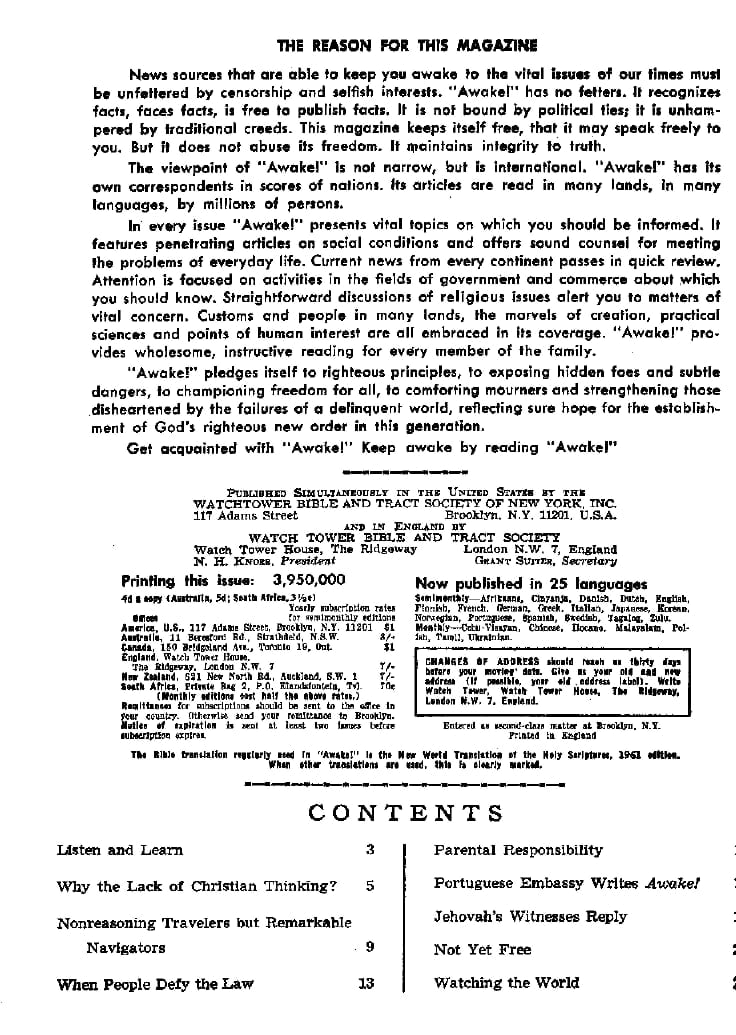
THE REASON FOR THIS MAGAZINE
News sources that are able to keep you awake to the vital issues of our times must be unfettered by censorship and selfish interests. "Awake!" no fetters. It recognizes facts, faces facts, is free to publish facts. It is not bound by political ties; it is unhampered by traditional creeds. This magazine keeps itself free, that it may speak freely to you. But it does not abuse its freedom. It maintains integrity to truth.
The viewpoint of "Awake!" is not narrow, but is international, "Awake!" has its own correspondents in scores of nations. Its articles are read in many lands, in many languages, by millions of persons.
In every issue "Awakel" presents vital topics on which you should be informed. It features penetrating articles on social conditions and offers sound counsel for meeting the problems of everyday life. Current news from every continent passes in quick review. Attention is focused on activities in the fields of government and commerce about which you should know. Straightforward discussions of religious issues alert you to matters of vital concern. Customs and people in many lands, the marvels of creation, practical sciences and points of human interest are all embraced in its coverage. "Awakel" provides wholesome, instructive reading for every member of the family.
"Awakel!" pledges itself to righteous principles, to exposing hidden faes and subtle dangers, to championing freedom for all, to comforting mourners and strengthening those disheartened by the failures of a delinquent world, reflecting sure hope for the establishment of God's righteous new order in this generation.
Get acquainted with "Awake!" Keep awake by reading "Awake!"
FULLBARK SIMULIJANEBUSELY IN THE UNITED STATES BY THE
WATCHTOWER BIBLE AND TRACT SOCIETY OF NEW YORK, INC.
117 Adams Street Brooklyn, N.Y. 11201, U.S.A.
AND IN ENGLAND BY
WATCH TOWER SIBLE AND TRACT SOCIETY
Watch Tower House, The Ridgeway
London N.W. 7, England
N. H. KNORE, President
GRANT SUTTER, Secretary
Printing this issue: 3,950,000
4d copy (Australia, 5d; South Africa, 3½¢)
New Zealand, 521 New North Ed., Auckland, S.W. 1/-
South Africa, Private Bag 2, P.O. Elkhampton, Tv. 1/-
(Monthly写信费 cost half the above rates.)
Requirements for subscriptions should be sent to the office in your country. Otherwise send your remittance to Brooklyn. Mails of expatriation is sent at least two times before subscription expires.
Scolmity —African, Cizary, Cizary, Dutch, Dutch, English, French, French, German, Greek, Italian, Japanese, Korean, Norwegian, French, Spanish, Spanis
CHANGES OF ADDRESS should reach us thirty days before your mortgage date. Give us your old and new address, and we will send you a new address. Watch Tower, Watch Tower House, The Ridgeway, London W. 7, England. J. W.
Entered as second-class matter at Brooklyn, N.Y.
Printed in England
The Bible translation regularly used in "Awakzi" is the New World Translation of the Holy Scriptures, 1961 edition.
When other translations are used, this is clearly marked.
CONTENTS
Listen and Learn 3
Why the Lack of Christian Thinking? 5
Nonreasoning Travelers but Remarkable Navigators 9
When People Defy the Law 13
Parental Responsibility
Portuguese Embassy Writes Awake!
Jehovah's Witnesses Reply 1
Not Yet Free 2
Watching the World 2
HEN you were in school did you ever sit in class and daydream until the teacher jolted you to reality by speaking your name and asking: "Are you listening?" It was important for
you to listen so that you would learn what was being taught. Throughout your life listening plays an important role in your learning process. How well you learn things or follow directions depends to a great extent upon how well you listen.
Possibly you are one of the many people who only half listen, with the result that when you are introduced to a person you forget his name in a matter of minutes. Do you blame your memory? Usually the reason you forget his name so quickly is that you fail to listen when it is told you. Pay close attention when his name is mentioned and repeat it to make certain you heard it correctly, and during the course of the conversation use it several times. It will then stay with you for a longer period.
You are listening when you hear with thoughtful attention, but if your attention is not focused on what is being said, the words that are spoken fall on deaf ears. Whether you are speaking with someone or strolling through the woods, you will get greater enjoyment from life and learn more by paying attention to what you hear. Listen to the sounds around you.
When in the woods give attention to the distinctive sounds of the various birds. See if you can distinguish one variety from another. Listen to the woodpecker chipping his way into a tree, to the sounds of the squirrels as they scamper about, to the gurgle of a stream and to the sound of the wind passing through needles of pine trees or through the leaves of other trees. The various sounds of a woodland contribute to its beauty and its fascination for man. But you miss much of the pleasure if you do not listen to its distinctive sounds.
A real test of your ability to listen comes when you sit in an audience that is being addressed by a public speaker. Whether his talk is for ten minutes or for one hour, it usually is not easy to keep your mind centered on what is said unless he is an exceptionally good speaker. To keep your mind on a talk being delivered by a less capable speaker requires effort. Like a restless child who sits quietly for a few minutes but then squirms and strives to run off to do something else, the mind strives to wander when a speaker lacks the ability to hold its attention. For you to learn from what he has to say, you must make a conscious effort to prevent this wandering and to focus your mind on the talk.
You have to pull down a mental curtain on the extraneous thoughts that seek to intrude on your conscious mind and to distract you. If you permit your mind to wander you can miss whole sections of the talk and not have the slightest idea of the good points the speaker may have brought out in those sections.
The mind has the peculiar ability to shut out sounds. A ticking clock, for example, is not noticed by the person who becomes used to it. He ceases to become conscious of the clock's sound. So too with a speaker, especially one that does not have a captivating manner of speaking. Unless you concentrate on what he is saying, your mind can wander to other things and shut out his voice so that it becomes a distant, sleep-inducing drone. When this happens, you are not learning anything. Inasmuch as you made the effort to come to the talk, you might as well benefit from the time you spend there by listening to what is being said. Even when it is the speaker's fault that your mind tends to wander, try to pick enough out of the talk so that you could briefly summarize its content.
To keep your mind focused on a talk, you must keep it active by thinking about what is being said. Analyze the information the speaker is giving and strive to tie it in to his theme. What are the main points that he is developing? Is his reasoning sound? Does he present satisfactory proof for what he says? Compare the information he gives with what you already know on the subject. Be alert for information that you might be able to use. A real gem can be missed entirely if you permit your mind to wander. By taking a few notes throughout the talk, you can help your mind to keep centered on it. With
good reason the Bible tells us: "A wise person will listen and take in more instruction." (Prov. 1:5) He realizes that he can learn by being attentive to what other persons say.
Listening is just as important in the process of communication as is talking. There is no purpose in talking to a person if he is not listening to what you say. You can no more get your ideas across to his wandering mind than if you were speaking to a mindless statue. As you expect other persons to listen to what you say, so you should listen to them. Show a speaker on a platform the same courtesy you expect from others by being attentive. The speaker, of course, has the responsibility to prepare a talk that is worth the attention of the audience.
A good listener realizes that he does not know everything. Because other persons may have information that will add to his fund of knowledge, he will listen attentively to what they have to say, being alert for new bits of information, useful arguments and thoughts that might help create new ideas and viewpoints. He also realizes that it is easy to get into the habit of daydreaming when someone is speaking to an audience whether large or small. It is especially easy to get into this habit if he listens to a number of talks every week. So he must make a definite effort to resist the habit by concentrating on what the speaker is saying, not permitting his mind to wander to other things.
If you make the effort to congregate with others for the purpose of hearing instructive talks, do not misuse your time and the time of the speakers by not listening. Maintain a rein on your mind so that it does not wander aimlessly but keeps focused on what the speakers say. By listening attentively you can grow in knowledge and understanding.
ALL told, there are upward of 910 million professed Christians in the world today. Of these, more than five ninths are said to be Roman Catholics, as also are from 90 to 99 percent of the people in some twenty lands in Europe, Central and South America.
Why THE LACK OF HRISTIAN THINKING?
In certain Protestant countries, such as Great Britain and Denmark, the head of the State is also the head of the Church. Even the
United States with its principle of separation of Church and State is, according to its Supreme Court, "a Christian nation."
On the basis of such facts you might expect that there is widespread Christian thinking
in Christendom, but is there? No, there is not. Actually, there is so little Christian thinking manifested that some even despair of there being any Christian mind today. Among such is the English writer Harry Blamires. In his book The Christian Mind he laments that "there is no longer a Christian mind." As he sees it, "the modern mind has been secularized [and] deprived of any orientation toward the supernatural. The Christian mind has succumbed to the secular drift with a degree of weakness and nerveless unmatched in Christian history."
While professed Christians are numerous, genuine Christian thinking is scarce. What accounts for this?
He spares neither the "laity" nor the clergy. Of the former he says: "Though he does not face it, the loyalty of the average Churchman to the Conservative Party or to the Labor Party is, in practical matters, prior to his loyalty to the Church." And regarding the bishops and the clergy he states: "Neither our bishops nor our
clergy give us leadership in thinking Christianly about the contemporary world. What we lack is not scholarly bishops but thinking bishops and preeminently Christianly thinking bishops. It is a peculiarly English, probably even peculiarly Anglican confusion of thought to assume
that the pursuit of learning is somehow of necessity a less secular activity than the pursuit of wealth. The scholar is not, by the mere fact of his scholarship a more religious, a more spiritual, a less secular [person]. The idea
that because a man is learned, especially in subjects pertaining to religion, he is therefore secure from the seductions of worldliness is a fallacy."
What Is Christian Thinking?
Throwing light on this question by way of contrast is the following confession made some years ago by the popular American clergyman, John Haynes Holmes, recently deceased:
"I have found incalculable help and guidance in recent years in taking Gandhi as my example. If I have been tempted to write an angry letter, I have asked myself, 'Would Gandhi write such a letter?' If I have been irritated by some selfish boor who has stolen my time to serve his own designs and purposes, I have said to myself, 'How would Gandhi treat this person?' If I have found myself perplexed as to what to do in this instance or that, I have again and again inquired within my heart, 'What would Gandhi tell me to do if I should ask him?'
From this quotation it is quite apparent that the late pastor of New York City's Community Church confessed to Gandhian thinking. Even as Gandhi was Holmes' example, should not Christians set up Jesus Christ as their example? For one to do Christian thinking would mean for one to ask oneself: "Would Christ write such a letter?" "How would Christ treat this person?" "What would Christ tell me to do if I should ask him?"
The answers to such questions are not hard to find. They are recorded for us in the Christian Greek Scriptures and particularly in the four Gospels. Therein we find what principles governed Jesus Christ, how he dealt with various problems that came up in his life and the truths and rules of action he laid down for his followers.
From those Scriptures we see that Jesus Christ himself had a guide to direct him, his Father's Word, the Hebrew Scriptures, of which he said, "Your word is truth." (John 17:17) He accepted the Mosaic writership of the Pentateuch, the first five books of the Bible and, more than that, he considered them authentic and inspired. His ministry shows that he accepted as historical the account of creation, the Deluge, the destruction of Sodom and Gomorrah, the record of Abraham, and so forth.
To have Christian thinking on these matters would therefore mean for us to believe as Jesus did about them rather than adopting the theories and speculations of the higher critics and evolutionists. The writer of the Illustrated London News (Nov. 2, 1963) who not long ago observed that "there are remarkably few instances in which Darwin's theory has been tested, as all scientific theory should be tested, by practical work" was understating the matter. As evolutionist the late Sir Arthur Keith admitted, "Evolution is unproved and unprovable. We believe it only
because the only alternative is special creation, and that is unthinkable." But special creation is not unthinkable to those who do Christian thinking.
The entire tenor of the ostensibly Christian higher criticism is to disparage the Hebrew Scriptures, but Jesus appealed to them as his authority all through his earthly ministry. Thus each time the Tempter approached him Jesus countered with, "It is written," even as he appealed to the same Authority to show which is the first and greatest commandment and that the dead will have a resurrection. Christian thinking is Christ's manner of thinking, and that is in line with the inspired Word of his Father, Jehovah God. —Matt. 4:4, 7, 10; 22:29-40.
Christian Thinking on God's Name and Kingdom
The lack of Christian thinking today is also seen by the way many religious leaders speak disparagingly of God's name, terming it a "solecism," and by their leaving it out of their Bible translations altogether.
In striking contrast to such men, Jesus Christ throughout his ministry made prominent his Father's name. Did he not make the sanctifying of his Father's name the very first petition of his model prayer for his followers? "Let your name be sanctified," or, "Hallowed be thy name." His own prayers manifest the same concern for his Father's name: "Father, glorify your name." "I have glorified you on the earth . . . I have made your name manifest to the men you gave me out of the world. . . . Holy Father, watch over them on account of your own name which you have given me . . . I have made your name known to them and will make it known." Yes, from the inspired Record we see that Christian thinking exalts God's name, which name is Jehovah.—Matt. 6:9; John 12:28; 17:4, 6, 11, 26; Isa. 42:8.
The way professed Christians put first their loyalty to worldly governments is further evidence of the lack of Christian thinking. They are first Americans, Frenchmen, Italians, and only after that "Christians," as is so clear in time of war when Catholic kills Catholic and Protestant kills Protestant. This lack is also seen in the support professed Christians give to such human schemes as the United Nations and Godless Communism—for which 25 percent of "Christian" Italians voted in the latest elections—instead of putting their hope in God's kingdom.
Christian thinking, as exemplified by Jesus Christ, is oriented to the kingdom of God. That kingdom was the theme of his sermons, his parables and his prophecies. Throughout his ministry he stressed its importance. He had nothing in common with the kingdoms of the world, even as he said to Pontius Pilate: "My kingdom is no part of this world." When men wanted to make him king forcibly, he withdrew. He was not interested in politics.—John 18:36; 6:14, 15.
The lack of Christian thinking betrayed by the youths in Roman Catholic parochial schools whose highest aspirations were found to be money and pleasure is but indicative of the thinking of professed Christians in general.* Jesus' words go unheeded by them: "Stop storing up for yourselves treasures upon the earth, where moth and rust consume, and where thieves break in and steal. Rather, store up for yourselves treasures in heaven, where neither moth nor rust consumes, and where thieves do not break in and steal. For where your treasure is, there your heart will be also. No one can slave for two masters . . . You cannot slave for God and for Riches. Keep on, then, seeking first [God's] kingdom and his righteousness."—Matt. 6:19-21, 24, 33.
Christian Thinking as to Witnessing
The Christian's obligation to witness is another aspect in which there is a woeful lack of Christian thinking in Christendom. For most professed Christians the sum of Christian duty is to go to church on Sunday and keep the Ten Commandments. Far from witnessing, they do not even think it important to take in knowledge about Jehovah God and Jesus Christ, as is apparent from the widespread Bible illiteracy in the United States, Canada and other lands. Thus, according to George W. Goth, president of the United Church's London conference, the churches are filled with people who do not know or understand the Bible.
How different all this is from the pattern of Christian thinking set by Jesus Christ! He was continually bearing witness to the truth; no wonder he was known as the "Teacher."* More than that, he trained and commissioned his disciples to be teachers. That he intended this obligation to rest upon all his followers is apparent from his parting instructions: "Go therefore and make disciples of people of all the nations, baptizing them in the name of the Father and of the Son and of the holy spirit, teaching them to observe all the things I have commanded you." It is therefore not surprising to read that those who had been scattered from Jerusalem because of persecution "went through the land declaring the good news of the word." —John 13:13; Matt. 28:19, 20; Acts 8:4
Christian Thinking as to Conduct
Even as there is a woeful lack of Christian thinking in regard to the obligation to bear witness, so there is a woeful lack in the world today as to Christian conduct. Far from heeding Jesus' words, "Just as you want men to do to you, do the same way to them," professed Christians by and large follow their selfish inclinations.
Their pride, ambition and ruthless competition stand in stark contrast to the mildness and lowliness of mind that Jesus displayed and of which he spoke: "Come to me, all you who are toiling and loaded down, and I will refresh you. Take my yoke upon you and become my disciples, for I am mild-tempered and lowly in heart."—Luke 6: 31; Matt. 11:28, 29.
Jesus also set a high standard of sexual morality. He taught
tween religious life and community responsibility, . . . or perhaps both."* In concluding this way he is not far wrong, for the materialistic and faithless appeals by commercialism to human weaknesses and selfishness, together with the failure of the religious leaders, because of their selfishness or lack of faith and enlightenment, to preach the truth of God's Word, without doubt account for much of the lack of Christian thinking in Christendom.
Put dogs this moon
morality. He taught that "everyone that keeps on looking at a woman so as to have a passion for her has already committed adultery with her in his heart." But today
ARTICLES IN THE NEXT ISSUE
Does Life Exist in Outer Space?
Why Do They Keep On Smoking?
How Do They Think It in Spanish?
Family Boss or Loving Husband?
popular entertainment in Christendom is to a great extent given over to this very thing and some of its grossest forms come from a land that is supposed to be 99 percent Christian, Roman Catholic, namely,
But does this mean, as Blamires states, that there is no Christian mind to be found today? Not at all. There is; a simple proof of this is to be seen in this very While dealing with its in various issues, formation to the Christaterial is viewed in the and devoted exclusively
magazine, Awake! While dealing with many different topics in its various issues, it relates all its information to the Christian mind; all its material is viewed in the light of the Bible. And devoted exclusively
Italy. Jesus also taught that the only grounds for divorce with remarriage is adultery, but today divorces are being granted for all manner of specious reasons: incompatibility, "mental cruelty," and what not. What a lack of Christian thinking all such conduct betrays!-Matt. 5:28; 19:3-9.
and Where Can It Be Found?
to advancing Christian thinking on Biblical subjects is its companion, the Watchtower magazine. Each of these magazines is distributed to the extent of millions of copies twice each month both by mail and by dedicated Christian ministers who give evidence of having the Christian mind, of thinking Christianly on all subjects.
They give evidence of this by accepting the Bible as the inspired Word of God, by making known God's name and kingdom and by making the Christian ministry the most important thing in their lives. By do-
among professed Christians? According to a Chicago professor of Christian Ethics, the reasons for the present state of professedly religious denominations are: "(1) other forces have minimized, diluted or rendered meaningless the Bible insights as they pertain to Society, or (2) ministerial leadership has been unwilling or unable to make clear the relationship being this they lay up treasures in heaven and show where their mind, their heart, is. If you would acquire Christian thinking on life's questions and problems, ask for assistance from one of these Christian witnesses of Jehovah or write the publishers of this magazine requesting someone to call on you.
NONREASONING TRAVELERS
BUT
WITH the coming of fall millions of birds in the Northern Hemisphere take to the wing and head south in a mass migration that carries some of them many thousands of miles. High-flying ducks and
geese pass in formation over city after city without the benefit of radio beacons and other electronic guidance systems that keep human air travelers from becoming lost. At lower altitudes clouds of smaller birds pass by with equal disregard for knowledge about the science of
navigation. How is it possible for these nonreasoning creatures to navigate accurately over great distances while intelligent humans are unable to do it without the aid of precision-made instruments?
The songbirds known as warblers live in north European countries during the spring and summer, but in September they begin heading south. Their destination is Africa, including its southern part. Although this is a trip of several thousand miles, they navigate it with surprising accuracy. Unlike ducks, the warblers do not make the trip in groups that follow leaders. Each is an individual traveler.
Possibly the longest route that is flown by migrating birds is that followed by Arctic terns. Every year they make a round trip between the Arctic and the Antarctic, with some flying a distance of about 25,000 miles. With equally good navigational ability, the bristle-thighed curlew files 6,000 miles from Alaska to Tahiti in a migratory flight. For more than 2,000 miles of this trip, between Alaska and the
Hawaiian Islands, the birds must fly nonstop over open ocean with no landmarks to help them to find their way.
Not even a previous knowledge of a route is necessary for migratory birds to fly accurately to their destination, although that destination may be nothing more than a speck of land surrounded by hundreds of miles of water. Young birds making the trip for the first time manifest the same ability as the older birds for navigating accurately.
In a test of a bird's ability to find its way over unknown territory, some investigators sent a Manx shearwater from England to the United States by plane. There it was released. Within twelve days it was back in its nest on the west coast of England, having flown more than 3,000 miles over an unfamiliar route. Certain types of pigeons manifest a somewhat similar homing ability. When released in unfamiliar territory, they will circle briefly and then head off in the right direction for their lofts.
Other Navigators
Like birds, green turtles can also find a speck of land in the middle of an ocean. Turtles from Brazil swim about 1,400 miles to Ascension Island, a tiny piece of land only seven miles wide in the Atlantic Ocean between South America and Africa. For these turtles to navigate accurately to that tiny island is a remarkable feat. It is believed that they use the same method of navigation as used by migratory birds. But their location-finding ability is possessed by many other inhabitants of the oceans.
Eels migrate through the Atlantic Ocean from rivers in Europe and America to their spawning grounds near the Bahama Islands. For many of them this is a trip of thousands of miles. Every year Alaskan fur seals swim 3,000 miles to the Pribilof Islands to give birth to their young, and they too find their destination without difficulty. Salmon swim hundreds of miles through the Pacific Ocean at spawning time to ascend rivers that they left years before as mere fingerlings. With astounding homing ability they return to the very streams where they were hatched. Even insects have an amazing sense of direction.
Monarch butterflies migrate more than 1,800 miles from eastern Canada to San Luis Potosí in Mexico without getting lost. Bees know the direction in which they found food and are able to communicate that direction to other bees by a peculiar dance in the hive. Foraging ants do not lose their way when they are hundreds of feet from their nests but are able to find their way back. Solitary wasps have no trouble locating their individual nests in the ground although they may have to fly hundreds of yards away to locate a spider or caterpillar to stuff into it. Whether they approach it from the air or from the ground, they are able to find it despite its tiny size and inconspicuous appearance.
These and many other creatures seem to have a surprisingly good sense of direction. What many of them succeed in doing instinctively man can do only with special instruments. Not until recent years did man begin to realize how some birds, animals, insects and sea creatures are able to travel without getting lost.
Celestial Navigation
Experiments by researchers have revealed the remarkable fact that the sun, moon and stars are important factors in the direction-finding ability of certain creatures. Early in the 1950's investigators such as G. V. T. Matthews of England and Gustav Kramer of Germany turned up convincing evidence that pigeons and wild birds orient themselves by means of the sun, using it as a compass.
While working with starlings, Kramer discovered that their direction of flight in a building could be altered by deflecting sunlight through different windows by means of mirrors. He also found that they used the sum to locate a feeding station they had been trained to look for in a particular direction. With their surroundings screened off from them, all they could see was the sky. On sunny days they found the feeding station with no difficulty, but on overcast days they hunted for it at random.
An experiment performed with warblers by another researcher, E. G. F. Sauer of Switzerland, proved that they can orient themselves not only by the sun but also by the stars. When migration time came, caged warblers would invariably take up the right direction of flight. The only clue they had as to direction was the night sky They watched it so closely that meteors would cause a momentary change in their direction of flight. Whenever the sky was hidden by clouds they became disoriented.
This was also observed with free warblers while migrating.
Regarding the astounding navigational ability of warblers, Sauer states in the magazine Scientific American of August 1958 with regard to a warbler named Johnny: "Johnny's behavior, confirmed by experiments with other birds, leaves no doubt that the warblers have a remarkable hereditary mechanism for orienting themselves by the stars—a detailed image of the starry configuration of the sky coupled with a precise time sense which relates the heavenly canopy to the geography of the earth at every time and season. At their very first glimpse of the sky the birds automatically know the right direction. Without benefit of previous experience, with no cue except the stars, the birds are able to locate themselves in time and space and to find their way to their destined homes."
Accurate navigation requires a means for precise measurement of time. An instrument used by men for this purpose is called a chronometer. It gives a navigator his longitude location on a navigational chart. A sextant gives him his latitude position by measuring the angle of the sun above the horizon at noontime. These instruments make it possible for accurate guidance of a plane or a ship to a distant place. Birds accomplish the same thing without the instruments.
A bird knows from the position of the sun at any time of day which direction to fly. It automatically allows for the movement of the sun across the sky so that its angle of flight does not change. In order to do this it must have an accurate time sense or inner clock.
The inner clock of celestially guided creatures appears to be regulated by their bodily processes. The time sense of bees, for example, can be speeded up by increasing their metabolism with drugs, and it
can be slowed down by retarding their metabolism. Whatever the inner clock actually is, it is essential for those creatures that travel by the position of heavenly bodies.
Experiments with sockeye salmon have revealed that they too navigate by heavenly bodies. It was found that they have consistent directional tendencies as long as they can see the sky. But when the skies are overcast or artificially covered, the fish point in random directions. Similar results were had in experiments with the little shrimplike crustacean, Talitrus saltator, that inhabits the shores of Europe. It always moved in the right direction for reaching the sea when removed a distance from it. Loss of direction occurred only when the sky was heavily overcast. Like the starlings, it responded to mirrored reflections of the sun and altered its course accordingly. A similar response was achieved by mirrored reflections of the moon. It had a time sense that allowed for the movements of the sun and moon so that its path of travel was always correct.
Insects
By means of the sun or polarized light from a patch of blue sky bees are able to navigate their flights from flowers to hive without losing their way. What is even more remarkable is that a returning bee informs other bees in the hive where it has found food. This is done by a peculiar dance that reveals the location of the food by indicating its direction according to its angle with the sun. The time of day is taken into account by the bee so that the angle will be correct for other bees that head for the spot. It adjusts its position with the movement of the sun.
An experiment with an aviary placed in a darkened shed revealed the effect of polarized light upon bees. A wide tube that opened on the sky was placed over the entrance of their hive.
When a polarized light filter was held over the open end of the tube and turned, the dancing bees at the entrance of the hive turned through the same angle that the filter was turned. It appears that the compound eyes of insects enable them to see polarized light and to use it as a reference for navigation. Polarized light helps ants to find their way about although they depend chiefly upon scent trails that they lay down. Ants that have their view of the sky blocked by a Polaroid light filter can be made to go in different directions by merely rotating the filter. They alter their course according to the polarized light they see coming through the filter. Other insects, such as the wasp, depend upon landmarks such as trees, stones, and so forth.
Source of Orientation Ability
That unreasoning creatures are able to orient themselves by polarized light and heavenly bodies is a cause for wonderment. How did they come to have this ability? Where did night-flying birds such as the warbler learn to navigate great distances by the stars? How did other birds learn how to use the sun? Why is it that young migratory birds automatically know which direction to migrate and how to navigate the trip although it is a new experience for them? Who taught the salmon how to use the stars for finding its way back to the place where it was hatched? How did these creatures get a time sense so they can allow for the movement of the heavenly bodies that they use as a compass? How did bees come to have the ability to use the sun and polarized light for finding their way about? Why are these creatures able
to do by instinct what man has had to learn to do with the aid of special instruments?
The obvious answer to these questions is that celestial navigation is beyond the power of nonreasoning creatures to develop by themselves. The ability for it had to be imprinted upon their genetic structure by the One who designed their bodies. Thereby the thinking that he did for them became an inherited instinct. Due to this fact, man, with his power of reason, is able to learn from these dumb creatures.
In wonderment man studies the amazing accomplishments of nonreasoning birds, animals, fish and insects and then devises scientific instruments that enable him to duplicate their feats. His navigational instruments permit him to sail and to fly to distant parts of the earth with the same accuracy exhibited by fish, turtles and birds. By applying the aerodynamic principles evident in the bodies of birds man is able to make aircraft that enable him to fly like them. His duplicating the shape of large sea creatures has resulted in speedy undersea craft with exceptionally good maneuverability. His use of sonar and radar copies the dolphin and the bat that use echo ranging for locating food and avoiding obstacles. And so it is with many other scientific achievements.
Wise designing is clearly manifested in all these nonreasoning creatures. Their Creator who gave them instinctive knowledge about celestial navigation and other scientific things is worthy of man's worship and praise. "How many your works are, O Jehovah! All of them in wisdom you have made. The earth is full of your productions."—Ps. 104:24.
IN MOST parts of the world respect for law and order has swiftly eroded in recent years. This lawless drift was well described by H. R. McKinnon, prominent lawyer and member of the police commission of San Francisco, who said: "It requires no great effort to establish that disrespect for law is widespread, is alarming, and is steadily growing worse."
Regularly, reports of public defiance of governmental authority are heard from Asia, Africa, Europe and the Americas. Defiance of the law is not limited to criminals, but is indulged in by ordinary citizens who would not consider themselves lawless. One aspect of this was noted by lawyer McKinnon when he stated: "Lately a new development has begun to appear, namely citizen participation in resistance to arrest. Time and time again a police officer making an arrest finds himself surrounded by a group of bystanders who assist the suspect resisting arrest. In some cases they have taken the suspect away from the officer, sometimes before his identification has been established, thus nullifying the whole process. Sometimes they attack the officer, with intent to inflict grievous harm."
such as rioting, racial conflicts, revolutions and civil disobedience, where people take the law into their own hands, often resorting to acts of violence to gain what they desire. Frequently crowds at sporting events disagree with decisions of officials and hurl missiles at them or even assault them with fists and other weapons. Also, young students all too often show disrespect for authority by irresponsible acts, some even assaulting the very teachers trying to instruct them to respect the law!
Swelling this defiance of the law, sharp increases have occurred in lawless acts
Another shocking manifestation of disrespect for authority on the part of many "average" citizens has come to the attention of police in the United States recently. A man climbed high up on a Brooklyn Bridge cable and threatened to jump in an apparent suicide attempt. As police were struggling to bring him down safely, the crowd that gathered broke into an organized chant, crying, "Jump! Jump!" In a similar situation a short time before, another young man poised on a hotel ledge was urged by a large crowd to jump, adults mocking him, calling him "chicken" and "yellow."
These are not isolated incidents, but reflect the mounting disregard for established law, order and decency on the part of many who are not considered criminals in the ordinary sense.
But the question that needs answering at this point is this: Why have so many become defiant of the law, and what has made ordinary people so callous and disrespectful?
Reflection of National Lawlessness
Those in authority cannot shift their responsibility for conditioning the minds of people for such defiance of the law. It must be said that individual lawlessness is very often a reflection of national and international lawlessness. Just as delinquent fathers and mothers are likely to produce delinquent children, so, too, governments that show disrespect for established law and order share in large measure the responsibility for the lawlessness of their citizens.
What inspiration for lawful behavior is it when nations fabricate reasons for invading and plundering the territory of their neighbor, killing and maiming thousands of innocents? In World War I about 65,000,000 people were mobilized in the armed forces of the nations involved, and during World War II more than 90,000,000, according to The Encyclopedia Americana. When so many persons are trained to destroy property and lives on a wholesale scale, they are being mentally conditioned to do the same, even though on a lesser scale, when they return from war. Since brute force has been applied to solve problems on the international scale, it is not so difficult for some to reason that the same thing can be applied on an individual scale.
How can governments expect respect for law when they themselves mock it? For instance, in 1899 and 1907 two peace conferences were held in The Hague, Netherlands; the first attended by twenty-six nations and the second by forty-four. Almost all these nations were at war in 1914! In
1928 the Kellogg-Briand Pact outlawed war "as an instrument of national policy," and it was signed by sixty-two nations. Most of them participated in World War II a few years later! Yet these examples represent just a small fraction of the treaties that have been violated in our generation alone!
It is against international law for the aircraft of one nation to fly over another nation without its permission. Yet the United States, supposedly a champion of law, flew U-2 aircraft over the Soviet Union repeatedly until one was shot down. They have done this over Cuba also. Thus, international law is violated when it suits a nation's purpose.
Defiance of international law by nations was noted after the 1963 nuclear test-ban treaty was signed by Russia, Britain and the United States. Commented U. S. News & World Report of August 19, 1963: "Optimism stirred by the pact is tempered somewhat by memories that agreements in the past often were repudiated when they outlasted nations' interests."
When laws outlast a nation's interests, the nation does not hesitate to violate them. It is not difficult, therefore, for individual citizens within nations to feel that they will do the same, that they will obey the law until it outlasts their personal interests. Then they resort to whatever means they feel they can get away with, including violence, when their interests are at stake.
Other Poor Examples
Below the national level, local leaders also have contributed to the breakdown of law and order. When the United States Supreme Court ordered schools desegregated, the governor of Alabama defied the court and troops had to be called out to enforce the integration order. In Prince Edward County, Virginia, local officials closed down the schools for five years rather than submit to the law!
When governors and other high officials defy the highest law of the land, then lesser persons consciously or unconsciously feel they can do the same.
Adding another voice to the justification of defying the law, though supposedly in support of human rights, was none other than Adlai E. Stevenson, United States representative at the United Nations. He stated that with American students participating "in the great struggle to advance civil and human rights, even a jail sentence is no longer a dishonor but a proud achievement." Thus, defying the law is made a thing of honor. But who is to say when individuals will do the same over other issues that they may consider right, but that others, perhaps the greater majority, including the law, may consider wrong?
The Supreme Court of the United States also ruled against permitting Bible reading and prayers for worship in public schools. But many insist that their schools must have these, and work against the law. Such ones fail to see the great harm they do by their resistance and rebellion against law. Their poor example and disrespect for law waters it down in the eyes of others, especially young ones. What such persons fail to appreciate is that the court does not say Bible reading and prayer are wrong! The court merely states that they should not be forced on children, for some are of different faiths and may object. Actually, religious instruction should be given in the home primarily, and that by the father and mother. Without this, compulsory Bible reading and prayer in school have little effect, as has already proved to be the case.
Religion must also take its share of the blame for lawlessness. In South America, as well as elsewhere, the number of children born out of wedlock is staggering. In some lands more than 70 percent of all
births are illegitimate! But the Catholic Church, as well as other denominations, continues to accept at their services couples living immorally, without insisting on proper marriage. How can these people be expected to have respect for civil law concerning marriage when the churches do not? Yes, the responsibility of false religion for setting a bad example toward the law is a heavy one indeed.
Heroes
Another reason for the lawless nature of many people today was typified by this "wise saying" in a newspaper recently: "Fools make rules; great men break them." This implies that it is an honorable thing to break the law. And is it not true that many of the past and present leaders of nations, who are singled out as "great men," "heroes," fall into the category of rulebreakers, yes, lawbreakers? Some of the most prominent national "heroes" were and are revolutionaries, those who showed utter disregard for the established law and who organized violent revolutions that took the lives of many, including the innocent.
In the United States, George Washington is hailed as the "father of his country." He was a revolutionary. In Russia, Lenin is revered. He masterminded the Bolshevik revolution. Between 1933 and about 1943 or 1944, who was considered the greatest man in Germany? Hitler! He, too, had revolted against the established order.
What effect does this have on law and order? The masses of ordinary people are led to believe that, since their hero was a revolutionary, or a great conqueror, then strife, violence and disregard for the lives of others is proper under given conditions. But what conditions? What one person considers the proper condition for his rioting, revolution and killing, another may not.
In Hitler's case, his conquests conditioned many of his people to commit heinous crimes. Were all those who carried out such crimes viewed as criminals? By no means! Of such ones, Charles Wighton states in his book Heydrich, Hitler's Most Evil Henchman: "They include lawyers, university professors and intellectuals and, as was stated at Nuremberg, 'they consisted of a group of well-educated, well-bred men, most of them from devout families.' The other ranks were drawn partly from the SS but still more from the regular police forces throughout the Third Reich."
Thus, the world trend toward delinquency and anarchy is sparked by the idolizing of men who have made disregard for the law a way of life. It is a preparing of the minds of the young to rise up against their elders in delinquent acts. What their fathers did on a national level they can do on a local or home level when they do not like the established law or procedure. It's sad but true that men of peace are rarely the greatest "heroes" that the rising generation seeks to copy.
God's Laws
The basic reason for such defiance of law today is that man has forsaken God's
laws governing human affairs. The result is just as was predicted in the Bible: "There is no truth nor loving-kindness nor knowledge of God in the land. There are the pronouncing of curses and practicing of deception and murdering and stealing and committing of adultery that have broken forth, and acts of bloodshed have touched other acts of bloodshed." (Hos. 4:1, 2) The apostle Paul foretold that in these last days "wicked men and impostors will advance from bad to worse." (2 Tim. 3:13) Jesus Christ also foretold "the increasing of lawlessness" in our time. —Matt. 24:12.
Should all of this make you throw up your hands and forget about trying to be lawful? By no means! The one who wants to do what is right in God's sight will respect law and order and will not permit himself to get sucked into the delinquent ways of lawless ones. He will not allow himself to be duped into thinking that by taking the law into his own hands, by rioting or committing murder, he will help to correct what is bad. Instead, he will seek to obtain justice through the due process of law in whatever country he lives. If this is lacking, then the law-abiding one leaves the matter in God's hands, confident that He will execute justice in His due time.
PARENTAL RESPONSIBILITY
"Youthful criminality is one of our fastest growing and most serious problems," according to John Edgar Hoover, director of the FBI. Hoover warned:
"There is one common denominator in the background of almost all youthful criminals — parental neglect."
He blamed soft law enforcement as next most reprehensible.
Reporting the situation in Family magazine, the FBI director urged parents to take to heart these suggestions:
"Maintain a strong family relationship with proper respect for parental authority a requirement of your children.
"Provide your children with responsibilities by giving them specific tasks to perform. Encourage them to take on outside activities to earn money or perform voluntary services.
"Keep your children busy with wholesome activities and control the type of television programs and movies they see.
"Keep informed on the whereabouts and activities of your children. Know their associates and insure that social functions they attend are properly chaperoned."
He urged, "Be a law-abiding citizen yourself . . . Realize that you are responsible for your children and their deeds. Do not shirk this responsibility."
Portuguese Embassy Writes Awake!
READERS of Awake! will be interested to hear about response to the article "Portugal Suppresses Freedom of Worship," which appeared in the May 22 issue of Awake! Soon after this magazine was released, people from all over the world began writing to Portuguese officials regarding the religious persecution in Portugal.
The Portuguese Embassy in the United States wrote to the Awake! magazine after receiving an avalanche of this mail, and attempted to explain the situation of Jehovah's witnesses in their country. In keeping with the Embassy's request, and so that Awake! readers will be informed on the situation, the Embassy's letter is here reproduced in its entirety.
PORTUGUESE EMBASSY
PROC. 4,26
WASHINGTON
No.395
16 JUNE 1964
THE EDITOR
"AWAKE"
117 ADAMS STREET
BROOKLYN, NEW YORK 11201
DEAR SIR:
In connection with the article "Portugal Suppresses Freedom of Worship", which appeared in the May 22, 1964 issue of your publication—and also in reference to a letter from Mr. Grant Suiter, Secretary and Treasurer of the "WATCH TOWER"—the Embassy is in a position to advise you of the following:
There is indeed religious freedom in Portugal, fully guaranteed by the Constitution, as well as by the Christian traditions of the Portuguese people.
The Portuguese authorities have not exerted any reprisals against members of the sect "Jehovah's Witnesses" although certain measures had to be adopted by the
same authorities to curb those activities of the "Jehovah's Witnesses", in Portugal, which are in flagrant conflict with the laws of the Country and with the private rights of the citizens, to wit:
a) The "Jehovah's Witnesses" in Portugal have been distributing propaganda material, and also preaching such propaganda, advocating disrespect for the National Flag and inciting the people against military duty in the defense of their Country. These two aspects of the propaganda of the "Jehovah's Witnesses" are not pertinent to Religion or Christianity. They are considered subversive attempts against the security and public laws of the Country.
b) In the course of their propaganda activities through the various residential areas of Lisbon, as well as in other towns, the "Jehovah's Witnesses" have violated the privacy of the citizens, by imposing their presence in their homes on false pretences, and forcing propaganda material on them, often with threats and insults. In several instances, these "Jehovah's Witnesses" have literally forced doors open when the alarmed residents tried to close
sand years, and who have toiled and died throughout the centuries trying to carry the message of Christ to all corners of the world. We fail to understand this extraordinary paradox in the behavior of the "Jehovah's Witnesses."
In the meantime, allow me, dear Sir, to regret the organized hate campaign which the "Jehovah's Witnesses" in the United States are carrying on against Portugal, by means of letters addressed to the Em-
their doors to protect their privacy. This is a flagrant violation of the rights of privacy of the citizenry in Portugal.
The civic and religious groups in Portugal, both Catholic and Protestant, as well as the population itself, became very alarmed in the face of the unethical and seemingly non-religious propaganda and activities of these "Jehovah's Witnesses", and the local authorities were flooded with complaints which led to an investigation of such activities and eventually to certain measures to curb them.
bassy. It is a shocking organized campaign by the members of your sect, for we have received many hundreds of letters—the text is often the same in dozens of them, and some even arrive in the wrong envelope! Hastiness, we presume, must have caused the mix-up. But the contents of such unanswerable letters (which are open to your personal inspection) is mainly insulting, coarse, and often bordering on the unprintable. We find it impossible to associate the feelings of the authors of such
measures the size of the
It is deplorable, indeed, dear Sir, that the members of the "Jehovah's Witnesses" should have placed themselves in a position so hostile to Portugal that the genuine alarm of the population and Churches compelled the local authorities to adopt restrictive measures to prevent more disagreeable consequences. Portugal is a deeply Christian country but the Portuguese people also believe in the concept of nationality and in the defense of their Nation's security, and of the dignity of the
deplorable letters with the principles of Morality and Christianity, as you, Sir, and I know them.
The Embassy would be very obliged to you, if you would kindly have this letter printed in your publication, for this is our clarification in connection with your article about the situation of the "Jehovah's Witnesses" in Portugal.
Sincerely.
people.
It would appear to us that the missionary activities of all Christian groups should be re-routed towards the anti-Christian countries of the World—of which, unfortunately, there are many—rather than being wasted and creating ill will among peoples, such as the Portuguese, who have followed the precepts of Christ for a thou-
J. de Menezes Rosa [Sig.]
J. DE MENEZES ROSA
MINISTER-COUNSELOR
cc: MR. GRANT SUITER
"WATCH TOWER"
124 COLUMBIA HEIGHTS
BROOKLYN 1, NEW YORK
MR. ANTON KOERBER
WASHINGTON REPRESENTATIVE
"WATCH TOWER"
JEHOVAH'S WITNESSES Reply
Upon receipt of the foregoing letter from the Portuguese Embassy, Grant Suiter, Secretary-Treasurer of the Watchtower Bible and Tract Society of New York, Inc., publisher of the Awakel magazine, sent the following open letter of reply. After reading it, you may want to write again to the Portuguese Embassy in Washington, or to other Portuguese government officials. It would be a fine thing to let them know how you feel about this matter.
MAIN 5-1240
CABLE WATCHTOWER
OFFICE OF THE BECRETARY AND TREASURER
124 COLUMBIA HEIGHTS, BROOKLYN 1, NEW YORK, U.S.A.
OPEN LETTER OF REPLY TO THE PORTUGUESE EMBASSY
JULY 6, 1964
THE HONORABLE J. DE MENEZES ROSA
MINISTER-COUNSELOR
PORTUGUESE EMBASSY
WASHINGTON, D. C.
DEAR MR. MINISTER:
We are happy to oblige by printing your letter for the consideration of Awake! readers around the world. However, rather than serving to clarify matters, this letter still leaves unanswered the important questions: What is to be done in behalf of those Portuguese citizens who are suffering for their religious beliefs in Portugal? Will Portuguese police continue to hound private citizens, invade their homes, ransack personal belongings and arrest persons simply because they meet together to study the Bible or speak about it to others? Millions of freedom-loving people around the world have their attention focused on the situation in Portugal and they want to know.
It is obvious to Awake! readers that for you to say that "there is indeed religious freedom in Portugal" and that "Portuguese authorities have not exerted any reprisals against . . . 'Jehovah's Witnesses'" is merely to ignore the facts concerning what is happening in your country. Awake! carefully reported facts, names, places, dates and details. For example, the order from the police in Caldas da Rainha forbidding Alexandre Cardosa Veiga, his wife and José Fernandes Lourenço to read the Bible is now public knowledge around the world. It has been reproduced in millions of copies of Awake! magazines in many languages. By what standards, or form of reasoning, can a country that refuses its
AUGUST 22, 1964 people the right to possess and study the Bible be said to have "religious freedom"?
Do responsible Portuguese officials honestly believe that such action is in keeping with the guarantees of your Constitution? Will similar orders continue to be given?
That reprisals have not been exerted against Jehovah's witnesses is simply not true. Bibles, Bible literature and even the furniture have been taken from their homes and, on occasions, never returned. Bible studies have been forcibly broken up, as on August 21, 1963, in Aveiro, and on March 12, 1964, in Lisbon, and those in attendance herded off to jail. In Setúbal, Artur Canaveira was arrested, mercilessly beaten by the police, and months later released without any charge being made against him. Down in Angola, Manuel da Silva and Manuel Gonçalves Vieira were separated from their families, who depend upon them for support, and were held for months in prison without any charge being made against them. Recently the authorities escorted them to a ship and forced them to travel to Lisbon. How can you say that these are not unjust reprisals against Jehovah's witnesses? Apparently these are examples of the "certain measures" you said were adopted by the authorities. It is obvious to millions of people who are acquainted with these incidents that they are unjust reprisals, and they will want to know whether Portugal is going to quit this campaign of religious persecution and really grant freedom of worship to Portuguese citizens who are Jehovah's witnesses.
It is common knowledge that Jehovah's witnesses are not endeavoring to undermine the security of any nation. Their activities are not subversive. They remain separate from politics, as Christ Jesus explained at John 17:14, and confine their activities to preaching the good news of God's kingdom for which all Christians
were taught by Jesus to pray. Therefore, in the vast majority of countries in the world that grant freedom of religion, Jehovah's witnesses carry on their preaching without interference. Why is Portugal a major exception? Why is it that you claim that the ministerial activities of Jehovah's witnesses "are in flagrant conflict with the laws of the Country"? Is it because Portuguese authorities consider it against their laws to teach people about God's kingdom? Do they believe that Jesus' teaching to "love one another just as I have loved you," and to "love your enemies," must be suppressed?—John 15:12 and Matthew 5:44 in the Holy Bible.
Contrary to what your letter asserts, Jehovah's witnesses have never taught disrespect of any nation's flag, or incited people against military duty. Their internationally distributed Bible textbook "Let God Be True" clearly says, on page 245: "Jehovah's witnesses are not against people who salute or desire to salute the flag of any nation. Nor do they oppose the desire of any person to serve in the armed forces of any nation. Nor do they oppose the efforts of any nation to raise an army by conscripting its manpower. If a citizen wants to salute a flag or to enter the armed forces of any nation, it is his right to do so, and Jehovah's witnesses regard it as wrong for them to oppose the efforts of such person or to condemn him. They do not attempt to convert the world to a refusal to salute flags or to decline to bear arms. They merely keep their neutrality and their obligations as ambassadors for God's kingdom, and they declare their reasons for refusing to break their allegiance to their God and Savior."
The sole purpose of Jehovah's witnesses is to make known the teachings of God's Word the Bible for the salvation of all kinds of people. When individuals learn that God commands men to love one another, regardless of nationality, and as a result they conscientiously refuse to go to war against their fellowman, then what?
Did not Justin Martyr and Origen as well as other reputable historians say that many early Christians responded in a similar way to Christ's message? To contend that they did not is to ignore the facts of history. The prominent religious leader Martin Niemöller even said recently: "I cannot imagine Jesus marching with any army." Was that subversive?
…