Awake!, June 22, 1964
Download: PDF — Awake!, June 22, 1964
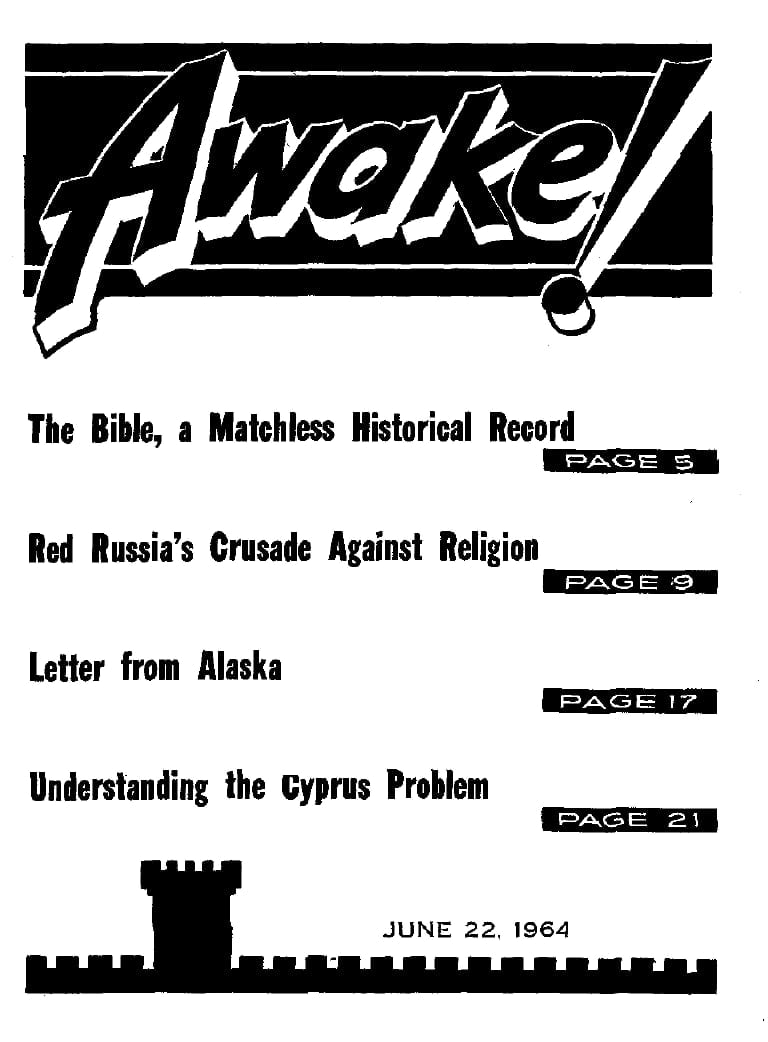
The Bible, a Matchless Historical Record PAGE 5
Red Russia's Crusade Against Religion
PAGE 9
Letter from Alaska
PAGE 17
Understanding the Cyprus Problem
PAGE 21
JUNE 22,1964
THE REASON FOR THIS MAGAZINE
News sources that are able to keep you awake to the vital issues of our times must be unfettered by censorship and selfish interests. "Awake!" has no fetters. It recognizes facts, faces facts, is free to publish facts. It is not bound by political ties; it is unhampered by traditional creeds. This magazine keeps itself free, that it may speak freely to you. But it does not abuse its freedom. It maintains integrity to truth.
The viewpoint of "Awake!" is not narrow, but is international. "Awake!" has its own correspondents in scores of nations. Its articles are read in many lands, in many languages, by millions of persons.
In every issue "Awake!" presents vital topics on which you should be informed. It features penetrating articles on social conditions and offers sound counsel for meeting the problems of everyday life. Current news from every continent passes in quick review. Attention is focused on activities in the fields of government and commerce about which you should know. Straightforward discussions of religious issues alert you to matters of vital concern. Customs and people in many lands, the marvels of creation, practical sciences and points of human interest are all embraced in its coverage. "Awake!" provides wholesome, instructive reading for every member of the family.
"Awakel" pledges itself to righteous principles, to exposing hidden foes and subtle dangers, to championing freedom for all, to comforting mourners and strengthening those disheartened by the failures of a delinquent world, reflecting sure hope for the establishment of God's righteous new order in this generation.
Get acquainted with "Awake!" Keep awake by reading "Awake!"
PUBLISHED SIMULATIONUALLY IN THE UNITED STATES BY THE
WATCHTOWER BIBLE AND TRACT SOCIETY OF NEW YORK, INC.
117 Adams Street
Brooklyn, N.Y. 11301, U.S.A.
WATCH TOWER BIBLE AND TRACT SOCIETY
Watch Tower House, The Ridgeway
N. H. KNOR, President
London N.W. 7, England
GRANE SUTTER, Secretary
Printing this issue: 3,950,000
4d a copy (Australia, South Africa, Niger)
Office: 50 South Africa, Street, Greenwich, N.Y. 11201, 501
for semiquantitative entries
America, U.S. 117 Admiral Street, Greenwich, N.Y. 11201, 501
Canada, 150 Broadway, Greenwich, U.S. 106
$1
England, Windsor Town House
$1
New Zealand, Cairns New Rd. 7, Auckland, S.W. 1, 7/
South Africa, Private Rugged 10, Auckland, S.W. 1, 7/
Rumitamina for silberfarbige should be sent in the office in
your country;
Now published in 25 languages
Saminthom — Arkansas, Chesapeake, Danish, Dane, English, Finnish, French, German, Greek, Italian, Japanese, English, French, Spanish, Swedish, French, English
Monty — New York, Virginia, Chesapeake, Minnesota, French, Tamil, Uttarakhand
CHANGES OP ADDRESS should reach us thirty days before your moving date. Give us your airline and new address. Call 800-722-2222, Watch Tower House, The Ridgeway, London N.W.-T, England.
Entered as second-class matter at Brooklyn, N.Y.
Printed in England
The Bible translation regularly used in "Anakha" is the New World Translation of the Holy Scriptures, 1961 edition. When other translations are used, this is always marked.
CONTENTS
Why Worry? 3
The Bible, a Matchless Historical Record 5
Red Russia's Crusade Against Religion 9
Who Are the Doukhobors? 13
Nylon's Uses 16
Letter from Alaska 17
Understanding the Cyprus Problem 21
Hemoglobin in Natural Iron Products 24
Trees Made for the Rocky Hillside 25
They Found True Faith 26
"Your Word Is Truth"
Monstrous Evils? 27
Watching the World 29
Volume XLV
MOST likely you have at this moment one or a number of things in the back of your mind about which you have been worrying. They may be things that happened today or perhaps months and even years ago. On the other hand, they may be things that have not happened but that you fear will happen. In either case you probably play these worries through your mind over and over again like a broken phonograph record. When you do this, do you realize what you are doing to yourself? You are ruining your health.
In his book How to Live 365 Days a Year, Dr. John A. Schindler states: "If you become ill tomorrow, or if you are ill today, the chances are a little better than 50-50 that you are ill with E. I. I. [emotionally induced illness]." Worry is one of the principal causes of such illness. When you worry about something you build up tensions in your body and upset its functions. An example of how worry can do this is given by Dr. Schindler. He tells of a man who developed a severe dizziness whenever he sat upright. Although he stayed in bed under the care of a physician for a number of days, there was no improvement. Then one day it disappeared.
It seems that this man had backed a friend on a loan of a large sum of money. Later he learned that this friend was seriously hurt in an accident that had kept him in the hospital for several
months. It appeared that his business venture was certain to fail, and that would affect this man who had backed his loan. It was the intense worry about this situation that brought on the man's dizziness. After his remarkable recovery he told his doctor: "When I was in bed, feeling my sickest, this friend of mine for whom I had signed the note came to visit me, and told me that he had just been over to the bank and had paid off the note in full. From that moment, I started to recover."
Worry can affect your body in a way that is just as dramatic as the way it affected this man, or it can break it down gradually. It can slowly tear down any part of your physical organism. Considering the upsetting effect worry can have on you, is it worth it?
Absolutely nothing good can be accomplished by worry! What has happened in the past you cannot change. Worry will not correct mistakes. Instead of worrying about a mistake, determine what you did wrong and then strive not to repeat it. The unpleasant past is gone.
Do not try to keep it alive in your mind by going over again and again what happened. Shut it out of your mind! Concentrate on the present!
As you cannot live yesterday over again so you cannot live tomorrow until it becomes today. You can live only one day at a time. Why make yourself sick worrying about what might happen tomorrow, next week, next month or next year? You cannot be certain of what actually will happen. Plan for the future, but do not foolishly worry about things that have not happened and perhaps never will. Do not try to live the future as well as the present. There is only one moment you can live and that is right now.
Instead of worrying about what might be, face what is. Because your employer did not give you his customary hello, do not worry that you may have lost his favor. Because you have a sudden ache or pain, do not worry that you may have cancer or some other dreaded disease. Rather than worry about what be, search for facts. When you have them and it seems evident that a certain thing is going to be, lay plans for the course of action you will take. With this done, there is no sense in worrying about it.
Perhaps you worry when you see your work load stacking up until it seems mountain high. Worrying will not get it done. No matter how big the mountain of work is, you can get over it by taking one thing at a time, just as you can get over a literal mountain by taking one step at a time. Instead of worrying about the amount of work you have, regard it as a problem to be solved. Think of ways you can increase your efficiency and output. This will accomplish much more than worry. If you permit yourself to worry about it, your
ability to concentrate will be ruined and your efficiency lowered.
If something has happened that causes you to worry about the ultimate outcome, force yourself to face and accept the worst that is likely to come from it. Then make plans to adjust to it. This will help to remove vague imaginings of what might be. If the worst does not take place, as so often is the case, you are that much better off. A definite plan of action is much better than useless worry. If the result of something that has happened appears inevitable, then accept the inevitable, planning ways to adjust to it.
Do not weakly contend that you are just naturally a worrier and there is nothing you can do about it. If you want relief from worry, you can discipline yourself to think and act constructively. You can do it if you really want to.—Phil. 4:8, 9.
Good advice is given in the Bible. By following it you will not endanger your health by worry. It tells us: "Never be anxious about the next day, for the next day will have its own anxieties." "Throw all your anxiety upon [God], because he cares for you." (Matt. 6:34; 1 Pet. 5:7) Thus the Bible itself wisely advises you against trying to live the future as well as the present at the same time. Make plans for the future, but do not worry about things that have not happened, and do not worry about the past, about things that have happened and cannot be changed.
No matter what happens or threatens to happen, refuse to worry. Face your problem, plan ways to solve it and then try to keep your mind occupied with other things. Remain calm and cheerful. This you certainly can do if you throw all your anxieties upon God and dismiss them from your mind. You will find this practice to be much more productive and healthful than useless worry.
HISTORY is written to enlighten and instruct. If it also entertains, so much the better. Of course, for history to enlighten and instruct it must be accurate; it must tell the truth. But arriving at the
truth is not an easy task, for not only are the facts often hard to come by but there is the factor of human frailty. Because of this, one authoritative history states: "It would be too much to suppose that any historian, even of the most modern school, has written without
getting at the causes of events, and this quest influences their presentation of facts.
Among the latest trends has been the writing of history from a technical stand-
prejudice of race, of station or of religion."*
The problem of writing history, therefore, fittingly has been likened to fishing. Even as the results you get from fishing depend upon your skill, where you fish, the kind of bait you use and the kind of fish you want to catch, so the results of the historian depend upon his skill and equipment, where he looks for information and his motive in writing.
Thus there was a time when men wrote history for the purpose of extolling or glorifying some ruler. Histories written about and at the instance of such rulers as Rameses, Sennacherib and Darius tell only of their achievements and victories. Historians such as Herodotus and Thucydides made their theme a nation or a people rather than some individual. In more modern times some historians have written with the idea of expounding a certain philosophy. Toynbee appears to be one of these. Others make their chief concern the
point. In the interest of what is called "science," historians endeavor to present the facts just as they have found them without passing any moral judgment and without getting emotionally involved in them. But such historians overlook the fact that the most important part of man is his moral nature and his concern with what is right and wrong. Ignoring these, they write history that is incomplete. No wonder it has been stated that, because of this, today the writing of history is in a state of turmoil.
Facts in Human History Distorted
From the foregoing it is apparent that the facts in human history as authored by humans are often shaded. They are ever qualified by the personality, the times and the environment of the historian. An interesting discussion on this aspect of writing history appeared recently in the New York Times. Among those quoted was the modern French poet Paul Valery, deceased some twenty years. According to him, "History is the most dangerous product the chemistry of the intellect has ever invented. It endangers dreams, it intoxicates people, it begets false memories, it exaggerates their reactions, keeps their old wounds open, disturbs their sleep, leads them to delusions of grandeur, and makes nations bitter, arrogant, insufferable and vain."
While historians of all nations have been and are more or less guilty of writing biased history, either consciously or unconsciously, those in the employ of totalitarian governments have been especially notorious in prostituting their art by deliberately tampering with the facts of history; Red Russia providing one of the most glaring present-day examples. Says a recent survey of the problem of rewriting German history, as published in The Saturday Review: "In East Germany school books are written in accordance with the Soviet propaganda line to serve the interests of the Communist state. All historical references in this context become political weapons and cannot be taken at face value."
That the facts in human history are at times distorted can nowhere be better seen than in the record of German history during the past half century. In the days when the Hohenzollerns ruled Germany it had one kind of history. With the fall of the German Empire and the establishment of the Weimar Republic after World War I came the need of rewriting that history. When Hitler and his Nazis came into power, German history as they found it did not suit them and so they rewrote it. The collapse of the Third Reich again required changes to be made in German history. It appears that there was some laxness on the part of the educational authorities in this matter, but the resurgence of anti-Semitism and the trial of Eichmann, among other things, have spurred the authorities to yield to the clamor of schoolteachers and others for a new approach to German history.
the study of modern history is compulsory in all types of schools. The crimes of the Nazi regime are explicitly stated and condemned. Typical is the statement appearing in one of them: "The terror and crimes of the National Socialist regime are without parallel in modern history . . . No German can escape responsibility for the crimes committed in the name of the nation."
As a result, a tremendous revision of history is going on today in West Germany involving hundreds of history books, and
Yet even in this statement there is betrayed a trace of human frailty. What about all the Germans that preferred to go to the concentration camps, if not also to certain death, rather than support the Nazi regime? Certainly such Germans did escape responsibility for the terror and crimes of the National Socialist regime; most conspicuous of whom, incidentally, were the Christian witnesses of Jehovah.
Yes, because of human frailty the facts in human history are at times distorted and, therefore, must be taken with the proverbial "grain of salt." All that is stated may be true and yet may present a distorted picture because of what is stressed and what is omitted. The same must be said about the historical records appearing in such authoritative works as encyclopedias. True as this is of secular histories and encyclopedias, it is even more true of religious historical works.
In particular are works dealing with Bible history to be viewed critically. The contents of such works invariably depend upon whether the author is a "higher critic" or one that believes in the inspiration of the Bible. Thus a greater contrast could hardly be imagined than between that which appears in The New Bible Dictionary by J. D. Douglas and that which appears in Harper's Bible Dictionary on such subjects as who wrote the book of Deuteronomy; the latter work presenting the speculations of "higher critics" as sound sense and truth. Even such an extensive and scholarly work as M'Clintock & Strong's Cyclopedia errs when it comes to presenting the historical facts regarding the Trinity because its compilers believed in that teaching.
The Bible's Matchless History
In modern times archaeologists have uncovered a wealth of facts that stamp the Bible as accurate history. As the author of The Bible as History so forcefully observes, the Bible "is a book about things that actually happened." The events recorded "themselves are historical facts and have been recorded with an accuracy that is nothing less than startling." "In view of the overwhelming mass of authentic and well-attested evidence now available," this author became fully convinced that "the Bible was right after all."
While accuracy regarding times, places, events, things and peoples, such as can be verified by archaeology, is indeed a sterling quality for Bible history to have, it is not in this respect alone that the Bible shows itself to be such a matchless historical record. It also shines, in fact, shines chiefly by reason of the impartial, objective writing of its penmen. The Bible writers nowhere betray a bias because of religion, position in life or race or nation. The facts of their record are not distorted but absolute, truly representative, presenting an impartial picture of persons and events. This was not because they were perfect or were supermen but because they were honest men who wrote under the guidance of God's holy spirit.
The very record of how sin entered into the world, the slaying of Abel by Cain, the wickedness of the antediluvians is flattering to no one, and even appears to reflect unfavorably upon the Creator unless one has an understanding of his will and purpose. Noah lived 350 years after the Flood, but, apart from what took place
immediately after he left the Ark, the only incident of his life recorded during that time is in relation to his getting drunk on one occasion, not to downgrade him, but because it was pertinent in connection with the prophecy he uttered regarding his descendants.—Gen. 9:20-29.
In particular, note the history of the nation of Israel during the lifetime of Moses and as recorded by him under the direction of God's spirit. Obviously he could not have begun to record all of it and so could have used that fact as a pretext for presenting only a part of it, only a favorable record. But did he do so? Far from it! It almost seems as though the opposite were true; that he leaned over backwards to present the failings of his people!
Moses tells of the ingratitude of his people, how they complained time and again; how they made a golden calf and worshiped it; how they rebelled against his leadership; how they were overtaken in gluttony and gross immorality, resulting in the execution of many thousands of them. More than that, he spares neither his own tribe nor the members of his own family, not even himself. How different all this from the way in which men customarily write the histories of nations and individuals!—Ex. 15:24; 15:3; 32:1-6, 28; Num. 11:31-34; 12:1-16; 25:1-9.
In his official history book Moses even recorded his unflattering prophecy about what his people would do after his death: "I well know that after my death you will without fail act ruinously, and you will certainly turn aside from the way about which I have commanded you; and calamity will be bound to befall you at the close of the days, because you will do what is bad in the eyes of Jehovah so as to offend him by the works of your hands."—Deut. 31:29.
The rest of the Bible history of the Jews is equally as impartial and unflattering. To note just one of the many examples that might be cited, there is one that was written some 850 years after Moses died: "Jehovah the God of their forefathers kept sending against them by means of his messengers, sending again and again, because he felt compassion for his people and for his dwelling.
But they were continually making jest at the messengers of the true God and despising his words and mocking at his prophets, until the rage of Jehovah came up against his people, until there was no healing," and Jehovah permitted the nation to be taken into Babylonian captivity.—2 Chron. 36:15, 16.
Do the charges by Paul Valery, that history endangers dreams, intoxicates people, leads them to have illusions of grandeur and makes them arrogant and vain, apply to the inspired history of the nation of Israel as contained in the Bible? Absolutely not! Rather, the Bible record gives ample reasons for humility. If the Jews do manifest any such vain characteristics, it is not because of what their inspired history contains but in spite of it. The Jewish Apocrypha and such historians as Josephus may give them grounds for boasting, but not their inspired Bible history. In fact, the inspired history of the nation of Israel presents such a sorry picture that it should not be difficult for any Jew today to comprehend how it could have been possible for his nation to have missed its greatest opportunity, which came with the appearance of Jesus of Nazareth as their Messiah, the Son of their God Jehovah.
The same frankness was manifested by the writers that recorded the inspired history of the founding of Christianity. They tell how the apostles quarreled among themselves as to who would get the chief seats in Christ's kingdom, how the apostles all fled when their Master was taken, how Peter, the spokesman among the twelve at Pentecost, had denied his Master
three times, and how one of their number, Judas, betrayed his Master for thirty pieces of silver. Further, after Pentecost, does their record not tell that there were dissension and discord among the early Christians, materialism and immorality and the beginnings of apostasy? Certainly here again we see impartial, objective, yes, matchless history written; history not written to suit certain ideas, but impartial history free from human frailty, because its writers were aided by God's holy spirit.
Matt. 20:20-27; 26:14-16; Luke 22:24-27; 39-62; Mark 14:50-52; 1 Cor. 1:11; 5:1-6.
Today history is in a turmoil; history is contradictory, depending upon the philosophy, or the nationality, or the religion, or the race of the historian. It is being used as a propaganda medium. Human history keeps changing, as noted in the record of Germany's history—four distinct and often radically different and conflicting histories of a nation and people in the course of fifty years. History is supposed to enlighten and instruct, but to what extent can it do so when it is so contradictory and unstable?
Bible history stands in striking contrast to other history written by men. It bears the stamp of truth, of accurate, honest history. It is verified by various lines of external evidence, chief of which is archaeology, and by the internal evidence of the candor, honesty and objectivity of its penmen. But the Bible is not only divinely guided or inspired history. It is also, in fact, primarily, the revelation of the Creator's will for man, guiding man in right conduct and informing him of the purpose of his existence and his destiny. To help sincere seekers of truth find this in God's Word is one of the chief purposes of the publication you are now reading.
NO PEOPLE has ever been discovered which, in the strictest sense of the term, is 'atheistic.' Individuals may be atheists; but a people, never," said philosopher C. N. Bittle
Why that observation should be true is not hard to understand. As has been noted by not a few psychiatrists, psychologists and psychoanalysts, such as Jung, Frankl and Slesinger, man has an imperative need for religion. They testify that religion is vital to mental and emotional health and that man is driven "by an overriding need for God."
Red or Communist Russia denies this need. She insists that "religion is the opium of the people."* Lenin, the father of Red Russia, was an outspoken foe of religion, even as was Stalin and as is Khrushchev. Lenin preached that religion was an invention of the rulers to keep the masses in subjection, and that the fight against religion was one of the chief goals of communism. He claimed that communism needed neither a belief in God nor a morality based on such a belief.
But it may well be questioned whether Red Russia is so strongly opposed to religion only because of its
having been used to oppress the masses. Could it be that faith in and devotion to the Communist ideology is itself a religion, even though few of its devotees may be aware of that fact? Does it
not have its 'inspired utterances,' its 'saints,' its shrines, its missionaries and its calendar of 'holy days?' In fact, Communists from time to time tacitly admit this, as can be seen from what appeared in
Youth of Esthonia, an official journal, in its issue of June 1958: "As masters of the earth and creators of history, we must not betray our convictions, for our faith is faith in Communism, which in its sincerity is the only true faith."
Red Russia's crusade against religion has not been uniform nor consistent, but keeps fluctuating according to what seems to be the best policy under the circumstances. It has been carried on in waves or offensives, as it were. The first was from 1917 to 1923, the second from 1929 to 1932, the third from 1937 to 1939 and the last or present one began about 1959. However, during the years in between these offensives Russia has kept up her atheistic propaganda war, she being officially committed to atheism.
Red Offensives Against Religion
In keeping with their atheistic policy, Lenin and his associates at once initiated an offensive against religion. On December 4, 1917, they confiscated all church property; on December 11, closed all theological schools; on December 18, made civil marriages obligatory, and on January 19, 1918, ordered the separation of church and state.
Many of the clergy were imprisoned, others were exiled or deported, and many others were even executed, as at Kiev, and in 1922 the head of the Russian Orthodox Church, Tikhon, was imprisoned.
Tikhon had at first taken a strong stand against the Red Russian government, excommunicating all those who persecuted his church. But after a year in prison he did an about-face. He found it expedient to admit having been mistaken in his previous position and pledged his allegiance and that of his church to the Russian government. With his release in 1923 and the reversal of his position came a letup in the persecution of the Orthodox Church. During this time the government aided and abetted a schism in Orthodoxy known as "The Living Church," which was pro-Red in its politics and liberal in its theology. However, the common people refused to support it and so it came to nothing.
The second offensive began in 1929, several years after Stalin took over the reins of the government. Up until this time religious propaganda was legal, but now a law was passed permitting only atheistic propaganda and allowing religion only limited freedom. From now on to preach against atheism or to try to convert anyone was a criminal offense. The activity of the League of the Godless was stepped up, it being now called the League of the Militant Godless. At one time it boasted 5.7 million members and had as its goal the turning of every last man, woman and child away from religion. But then economic problems became so pressing that in 1932 this offensive slowed down, an indication of this being the restoring of the rights of citizenship to the clergy.
The third offensive came in 1937. It appears to have been the bitterest of the three. In fact, it was so intense that in it many heads of the Communists themselves fell because of the poor showing they
made in turning Russians away from religion and to atheism. It resulted in large-scale closing of churches and deportation of even local priests to Siberia. It was the most devastating blow Red Russia had yet given to religion and all but demoralized the Orthodox Church in Russia. But it was not to last long, for with World War II and particularly with the German invasion of Russia, the government saw fit to do an about-face. It was fighting with its back to the wall and was highly grateful for the stand the Orthodox Church took in calling on all Russians to fight for their fatherland.
Red Russia's fourth and present offensive against religion has been going on for several years now. She has greatly stepped up atheistic propaganda, publicizes all misdeeds of the clergy and indulges in official harassment of the Orthodox Church, as when she decreed April 29, 1962, Easter Sunday, a workday and the following day a day of rest. Mob tactics, such as used in the early days of Russia's crusade against religion, are being smiled upon, as when in 1961 a group of howling atheistic snake dancers invaded a large Easter service and for an hour and a half disrupted the program.
While Red Russia's crusade against the Russian Orthodox Church has fluctuated through the years, her offensive against the smaller religious groups, and in particular against Jehovah's witnesses, has been an unrelenting and bitter one. Concerning her offensive against the Witnesses Everyman's Concise Encyclopedia of Russia states: "Jehovah's Witnesses . . . are extremely active in proselyting, and . . . are the most harshly persecuted community in the Soviet union."
Weaknesses of the Crusade
The weaknesses of Red Russia's crusade against religion are seen in the changes she has had to make.
Lenin had boasted, "We deduce our morality from the facts and the needs of the class struggle of the proletariat." Thus from 1917 to 1936 their morality discounted the family institution and made divorce easy to obtain. But then Red Russia found that this morality of expediency worked against the interests of the State, and so in 1936 she did an about-face and made divorce difficult to obtain and tried to save marriages. In 1944 she put still more obstacles in the way of divorce, so determined was she to save the family institution. In brief, Red Russia found that the morality that worked the best was the one that most closely resembled that found in the Bible.
Another reversal that Red Russia had to make in her crusade against religion was in connection with her substituting the "permanent work week" for the seven-day week with its one day of rest. In her "permanent work week" work never stopped. Five-sixths of the population worked every day, and every day one-sixth rested. The Reds thought they were certain to succeed, for were they not giving the worker sixty-one rest days in the year instead of fifty-two? Although stubbornly hanging onto their "permanent work week" for twelve years, from 1929 to 1940, they at last had to admit defeat and to return to the seventy week with a general rest day. Needless to say, there were many reasons, both religious and practical, why Red Russia found it expedient to reverse her policy in this matter.
Perhaps nowhere has the weakness of Red Russia's crusade against religion been more manifest than when she took her census of believers and nonbelievers in 1937. After twenty years of antireligious legislation and government action, after twenty years of atheistic propaganda by Godless Leagues and all the avenues of communication, press, radio, theater, the
arts, not to say anything about tolerating widespread mob action against religion, what were the results? In the 1937 census 57 percent of the population claimed to be believers. Since it took not a little moral courage to admit to a godless census taker that you were a believer, without a doubt there were many more that at heart were believers but just did not have the courage to admit it. No wonder that not a few heads fell among those responsible for the campaign against religion, that Russia stepped up her crusade against religion to an all-time high and that since then Red Russia has not dared to take a religious census! Now she gives merely round figures: 50 million Russian Orthodox, 26 million Moslems, 2.3 million Jews, 500,000 Baptists and an unspecified number of Roman Catholics, Lutherans and others.
Admitting Weaknesses
Not only does Red Russia, by reversing herself, tacitly admit weaknesses in her crusade against religion, but time and again her spokesmen come right out and complain about its weakness. Thus her high officials lash out against the poor quality, the inaccuracies and the ineffectiveness of much atheistic propaganda. Complains Science and Religion: "Atheistic propaganda is continually the weakest sector in all our ideological educational work." And no wonder, for atheists are prone to underrate the intelligence of the religious man. This frequently causes their propaganda to boomerang, as when a workman, upon leaving the Moscow planetarium where he had heard a lecture on astronomy, was heard to exclaim: "Well, well, who would have believed that God organized all things so well!"
The fact is that the party officials in Russia can never be certain who is a believer and who is not. Thus an outstanding professor of physiology working at the Academy of Medical Sciences who had been a party member for twelve years was discovered to be a believer only upon his being given an assignment to speak on the incompatibility of religion and science.
He did not consider the two incompatible! Others, with more moral courage, resign from party organizations, giving as their reason: "I am a Christian." Currently their publications complain of hundreds of thousands of young people in the cities and many more in the country attending church services.
Why So Ineffective?
Clearly, Red Russia's crusade against religion has been most ineffective. Why? One reason is that she has not been able to produce a just and equitable order of things. Another is that her propagandists, not being bound by morality per se, take such liberties with the truth as to appear ludicrous. Says W. Kolarz in his book, Religion in the Soviet Union: "Truth and fiction are closely intermingled in the Soviet accusations, but one is outstandingly ludicrous, namely, that the 'Jehovah's' were racialists who accepted the nazi philosophy of a master-race. . . In fact, far from being racialists, the 'Witnesses' are more internationally-minded than the communists, for they do not recognize any national and racial barriers among themselves."
Ludicrous also must be termed such statements as the following that appeared in the Soviet publication The Jehovist Sect and Its Reactionary Character: "Jehovah's Witnesses were always faithful servants of the oil king millionaire Rockefeller. Rockefeller several times gave these 'servants of God' tens and even hundreds of millions of dollars in order to carry on their reactionary propaganda against the USSR." When propaganda goes to such ludicrous extremes it defeats its own ends, for people
see through it and so are not swayed by it.
However, perhaps more telling than any other reason for the ineffectiveness of Red Russia's crusade against religion is the fact that man has a basle need for religion. As one of America's leading newspapermen, who spent many years in Russia, put it: "The plain truth was that the Party had never devised a means for replacing the Church in those great hours of a man's life—birth, marriage and death." It is not surprising, then, that after forty-five years of war against religion more and more marriages are being performed in the Russian churches and that today the majority of infants are baptized.
Red Russia's crusade against religion is doomed to failure. Why? Because in taking on all religion, she has attacked also the worship of the one true God Jehovah. As already noted in the foregoing, the Christian witnesses of Jehovah are the most severely persecuted of all religious groups in Red Russia. Although they are among the smallest religious bodies, Red Russia has gone all out in attacking them over the radio and in the newspapers, has produced a moving picture "exposing" the Witnesses and keeps publishing books and booklets to arm her propagandists in their fight against the Witnesses.
Her campaign against the Witnesses is bound to fail, for Jehovah God promises his people: "Any weapon whatever that will be formed against you will have no success, and any tongue at all that will rise up against you in the judgment you will condemn. This is the hereditary possession of the servants of Jehovah." Red Russia would be wise to heed the advice given by Gamaliel in apostolic days to persecutors, namely, to leave the work of Christ's true followers alone, for if it is of God it will succeed and those opposing it will be found fighting against God.—Isa. 54:17; Acts 5:35-40.
By "Awakel" correspondent in Canada
THIS has been an oft-repeated question about a people of whom so much is heard and so little is known. They periodically break into front-line news with burnings, pilgrimages and nude parades. Those who know them say they are friendly, industrious and generally kindhearted and honest. But who are they? Where do they come from? What is their purpose?
Complications beset the inquirer, and no single account will suffice. No one can uncover all the facts involved, because the Doukhobors kept no written record of their own movements and all information about them must be gleaned from outside writers, many of whom were biased. However, in one way or another answers to the first two questions are traceable but the third one packs a headache.
They came from Russia. Some historians trace their ancestry back as far as Wycliffe, from whom their basic doctrines seem to stem. The movement developed as a revolt against Russian church and state, whose moral corruption evidenced rejection of the teachings of primitive Christianity.
Their name Doukhobor means "spirit-wrestler." They believed that Christ is reborn in each individual and gives direct revelation through "the voice within" without need of church, clergy or the Bible. Therefore, they acknowledged no human leadership. Schools, governments and man-made laws were rejected as part of this world along with every form of exploitation and war. They held that God had
made men free and that all races and sexes were equal and no one should exercise authority over another.
Their objection to killing anything included killing of animals for food, so they became vegetarians as well as pacifists. They refused to record statistics, take oaths or own private property. They maintained that all things should be held in common and they wanted to remain separate so as to live as a nation within a nation.
These ideas did not suit the Czars, who set about to reform the Mujiks ("common peasants"), first by persuasion and later by the ruthless heel of force. Detachments of Cossacks charged and cut the nonresisting peasants to pieces with whips. Confiscations, separation of families, prison, dispersion and banishment followed. But if the Czars hoped for success they were disappointed, for the stolid peasants faced the persecution without surrender. Thousands perished.
A New Deal
In 1899 a new deal brightened their horizon. Canada, with vast areas of virgin land, needed settlers, and an invitation was extended to the Doukhobors as immigrants.
Military exemption was granted and each man was to receive 160 acres of land free, if, within three years, certain nominal homestead duties were performed. It looked like the promised land. Thus about 7,500 crossed the Atlantic and established themselves on the prairies as the Christian Community of Universal Brotherhood. "Slava Bohul" or, "Praise the Lord!" was their cry.
With light heart and unequaled zeal they faced and overcame obstacles. Community buildings were soon erected and homes established. In summer the men hired themselves out and pooled their earnings. In lieu of horses the women hitched themselves to plows and broke the tough prairie sod for the coming crop. The industriousness of these new Canadians was amazing.
But it was not to last. All went well for three years, and then trouble struck when it was learned that the government required each person to sign for his own land and take an oath of allegiance. This they refused to do. They wanted land en bloc. Time passed. Counsel, investigations and discussions deadlocked as neither side gave in. Finally the government delivered an ultimatum: "Sign or be dispossessed."
Thus the first break in Doukhobor solidarity came about when segments of the communities signed the Homestead Act. The rest refused to budge. Nude parades broke out and pilgrimages to a new promised land began. No one knew where this was to be, but they picked up and marched until rounded up by the police. A battle of wills ensued and prison terms followed. The Doukhobors wanted community land, the government stood firm, and the public abhorred nude parades.
Freedom organization, and thelrs has been the voice from which so much is heard.
Those who had not signed berated their brothers for compromising. They disassociated themselves and formed the Sons of
Strange Reasonings
In explanation it should be said that Doukhobors saw nothing wrong in nude parades and burnings. It was their form of protest, to show their complete disregard for all things worldly. However, once they discovered that it embarrassed the government and occasionally brought concessions, they used these as weapons to impress their demands.
They had always decried human leadership, claiming to follow only Christ, but they were ever dependent upon strong personalities whom they sometimes exalted as Christ incarnate and whom they followed with blind tenacity. In their present emergency they sent to Russia for Peter Vasilivich Verigin, known as Peter the Lordly (who had just been released from a Siberian prison), to stave off encroaching obscurity.
Verigin, an able man, arranged to purchase a huge block of land in the mountains of southern British Columbia to which all the dissidents flowed, and again the struggle for a fresh start began. Again Doukhobor industriousness came to the fore. Timber was turned into homes, land was cleared and irrigated, crops were planted, industries established. Under sound cooperative leadership the project flourished. It appeared as though the Doukhobor problem was dissolving.
But the Sons of Freedom balked. There was too much prosperity; the brothers, they felt, were being endangered by encroaching worldliness. Children were taking to school, integration was making inroads and such gradual infiltration could only mean eventual capitulation. Verbal objections having failed, more drastic action followed; so once again the nude parades. Only this time there were punctuations of more serious nature when scores of schools were suddenly set ablaze, bridges blown up and buildings dynamited.
In October 1924 Peter Verigin himself was killed in a railway explosion.
Three years later Verigin's son Peter Petrovich arrived from Russia to take over his father's reins, but Peter the Second was a poor substitute. While flailing the Sons of Freedom, his own fallings mounted as he squandered the communities' hard-earned funds and lacked the ability to pull their bursting seams together. He died in 1939. But despite his idiosyncrasies the Doukhobors stuck with him and lamented that he had suffered so much on their behalf. "Poor Petushka," they exclaimed.
Militant Action
What to do now? Other leaders rose, but by this time various independent factions had split the communities and the Doukhobor movement was cracking. Nude parades returned. Damage pyramided and creditors, fearful of their investments, foreclosed. Thus, while the independents were safe, the communal Doukhobors, for the second time, were dispossessed of their holdings. That was a bitter pill. In retaliation every mill, bridge, powerline or public building not under constant guard became a target. But when a $300,000 jam factory went up in smoke the situation took on the proportions of a war.
As tension mounted such experiences boded ill for the future. In 1950 and again in the sixties such epidemics of violence erupted that public and official patience was exhausted. But what to do? Jails, fines and banishment had failed. In 1963, after burning their own homes to the ground, 1,300 Sons of Freedom staged a march on Vancouver. Those who were imprisoned went on a hunger strike. As winter approached, hastily constructed squatters'
huts provided filmsy shelter. They considered it all "suffering for Christ."
Thus the Doukhobors are again on the move. Some say an ancient prophecy urges them to move every forty years until they reach the promised land, and it is suspected that their purpose is to create so much trouble that the Canadian government will finally move them elsewhere. But where is the promised land? Representations to other countries, including Russia, failed, for no one will permit them entry.
For the present all plans are stalemated. Social assistance and costly investigations prove unavailing and discussions with the Sons of Freedom result only in endless word marathons to no purpose. No one knows what to do. But these people are Canadians and cannot be deported, so the government will need to use much wisdom and patience and the Doukhobors will likewise need to show increased understanding and balance.
Not All Guilty
In fairness to Doukhobors in general it must be said that they have many admirable qualities. They are industrious, scrupulously clean and mind their own business. They raise their children under the firm hand of parental discipline where obedience is demanded, and they feel that integration would break up their close-knit communal life and open the way to delinquency.
However, by now there is little left of the original movement, for the majority have become thoroughly Canadianized. Many own fine homes, send their children to school and live in harmony with their neighbors. Numbers of the younger generation attend university. Some have become ministers in declaring God's kingdom under a new order of things. It is only the radical Sons of Freedom minority group that continues to spearhead the opposition.
As for the Sons of Freedom, their desire to live in Christian unity is commendable. However, the way of its attainment is not by rebellion and destruction. Neither Christ nor his disciples became insurrectionists. Fire and sword was the pagan way. Likewise, fire and nude parades bring no credit to Christians.
It appears that the root cause of all
authority except by God; the existing authorities stand placed in their relative positions by God." (Rom. 13:1) So it would be well to recognize that human governments do have relative authority permitted by God to them, to be exercised in harmony with his righteous principles pending the time of their removal by God's kingdom.—Dan. 2:44.
By the same Word we are informed that in due time all wrongful authorities, ex-
Doukhobor troubles lies in their refusal to accept the Holy Scriptures as an inspired guide (2 Tim. 3:16, 17) and in their teaching that Christ is reborn in each individual so that the "voice within" becomes the supreme authority, nullifying all government and regulation. In this way each person's private conclusions, or those of their leader, become the infallible guide re-
ARTICLES IN THE NEXT ISSUE
Should the Christian Church Be a Tool of the State?
Comfort for the Lonely.
The Effects of Employee Dishonesty (Held over to make room for report from Cyprus).
plotation and wars will disappear and the illusive blessings so often promised but seldom enjoyed at the present will become the inheritance of all integrity-keepers
worldwide.—1 Cor. 15:25; Isa. 2:4.
If all Doukhobors can bring themselves to accept this inescapable situation, their unswerving determination will stand them in good stead and the Doukhobor question
gardless of all evidence to the contrary. Could this be the difficulty? Let us see.
Delegated Authority
Of some Jews, Paul wrote: "I bear them witness, that they have a zeal for God; but not according to accurate knowledge." (Rom. 10:2) That strikes right at the core of the Sons of Freedom's problem. Their sincerity stands beyond question, but their misplaced zeal brings them endless suffering to no purpose. A further Bible record reads: "Let every soul be in subjection to
will disappear. So why not face the inevitable, even though it may seem disagreeable, and ride it out in patience in view of the good things to come when God will cause men to "sit, each one under his vine and under his fig tree, and there will be no one making them tremble"? (Mic. 4:4) God's Word sets the time for this within this amazing generation. It will come true, and it stands out as the only hope for fearsticken humankind, including all Doukhobors and any others who feel moved to revolt against the secular authorities under
the superior authorities, for there is no which they live.
Nylon's Uses
Twenty-five years ago nylon stepped before the American public. In 1933 women's hose gobbled up all the nylon. But today dress fabrics eat up 75 million pounds of nylon, carpets take another 100 million pounds, automobile tires use 210 million pounds, while hosiery uses only 45 million pounds.
YOU have probably heard many reports of the earthquake disaster by now, but I think you will be interested in what we and others have seen and experienced. Here is how the earthquake hit us.
We were just finishing dinner, and I was sitting in our living room. Our house here in Anchorage is built back into a southeast-facing hill. After the first few seconds of the quake, I realized the movement was picking up momentum like a rolling stone. I yelled to Ann to get the children outside quick. I threw the main electrical breaker switch on my way through the kitchen as I went out. By the time I got to the door, I had to duck to get through it; it was moving so far, one way and the other. Our dog practically went out of his head—just like a hysterical person.
When I got out, which took only about fifteen seconds, the children were falling to the ground. I told them to sit down in the snow, but they could not even sit up. All the time the quake kept picking up momentum. I yelled over the noise for everybody to hang on; then I looked around.
The trees were bending over as if there were a fifty-mile wind, but there was not even a breeze. After being grotesquely churned in one direction, the trees would be whipped back in the opposite direction. Still no wind. The ground was rippling from ten to twelve inches high and jerking back and forth rapidly. We could really
appreciate the comment of a young child we heard about later: "I remember that a mud puddle was bouncing up and down in our yard. I thought it was funny." It was not so funny, though, the way my car would go clear down on one spring and then clear down on the other spring. This kept up for about six minutes. When it stopped, I told Ann that Anchorage would probably be wiped out. The main part of town was.
Although we all kept calm, the dog shook for an hour afterward. The first thing I did was to start the car so as to get the children, all of them without coats and some without shoes, into a warm place. It was about 28\circ F. and snowing lightly at the time. After getting everybody safe from the elements, I ventured back into the house to see if I could get our transistor radio and to see if the house was damaged. There was nothing on the radio. What a mess in the house! But there was no apparent damage to the structure. There was a broken water pipe on the hotwater tank and water was running down the pipes, but this soon stopped.
After I got everything organized as best I could, I went to the neighbor about 200 yards away to see how he and his family were. He also is one of Jehovah's witnesses. His house was not destroyed, but about three hundred yards away a neighbor lost his garage.
Damage in Anchorage
Later we learned the extent of the damage and heard many experiences. Civil Defense authorities have listed 215 homes destroyed and 157 commercial buildings either destroyed or left unusable. One of those ruined buildings was the new five-story J.C. Penney store. Scores of people still in the store when it groaned under the twisting heaving of the earth groped their way out to an unbelievable view of ruin about them. In one of Anchorage's nicer residential districts, Turnagain-by-the-Sea, homes were heaved up. Others stayed upright and just moved out toward the water. Fissures appeared, separating homes and streets—fissures that resembled furrows from the plowshares of some giant plowman. Here $30,000 homes were destroyed by the scores.
In our downtown area block after block crumbled. Buildings and pavement in some places dropped as much as twenty feet. Fourteen-story buildings such as the L Street apartments and the McKinley buildings were still standing, but they had angry X's marked all over them where the concrete had broken away. Steel girders buckled like drinking straws. One brand-new, still-uninhabited five-story apartment building crumbled, like a miniature dry mud model that had been stamped on. The only sizable piece left that we could notice was the elevator shaft. We can understand why a city councilman here said: "I'd hate to think how many hundreds of people in Anchorage are bankrupt right now."
wide apart, hands held out for balance and I knew we were on a moving, pitching earth."
Many persons riding in autos could hardly grasp what was happening. This is understandable. One motorist said: "It started with a moderate rocking motion: I was sitting in my car and at first I thought the engine started to miss. Then I looked at my employer standing beside my car; he was standing with feet planted
A young woman said: "I came out of the Ben Franklin store and was about to get into my car when it started to bounce up and down. I thought some pranksters were rocking the car. About the same time I saw an old lady running out of the store, her hands outstretched, her face was white, she threw her arms around me and I held on to her. In this way we both rode out the quake. After the earth stopped rolling the little old lady went her way and disappeared around the corner. I had never seen her before and haven't any idea who she is. But for a brief moment we had a common interest—survival."
In a downtown area people tried to get their cars started when the quake began, but the autos bounced around slamming into one another. Other people were clinging to parking meters and lampposts. Some were running and falling down; getting up and falling down again. We heard that a man darted out of the Athletic Club steam room stark naked. People were forming a human chain to protect themselves in case a fissure opened up in the street; and this man, fresh from the steam room, grabbed onto the last man, nobody concerned over the fact that he was unclothed. At a Fourth Avenue jewelry store the window was broken and a passerby started to pick up a diamond ring. The store owner, amid the wreckage, spoke up: "Do you want to buy that ring?" The man put the ring back and walked away.
Airports for miles around reported buckled runways. At the Anchorage International Airport a policeman said the first shock did not faze him. "We get them frequently," he explained. "But when I felt it twist, I went under my desk and stayed there. I could see the walls twisting away from the floor and I thought the whole building was coming down."
As it was, the control tower collapsed, killing one man. More than a million gallons of jet fuel swirled across the ground.
Tidal Waves Bring Ruin
Outside of Anchorage, as you know, much of the damage came from tidal or seismic waves that followed the quake. The town of Kodiak on the northeast corner of Kodiak Island was swamped by a seventeen-foot wave, washing buildings out to sea. One person said that where the sky and the ocean had previously formed the horizon, there were now buildings. It was an ever-changing picture as the buildings drifted here and there, with some coming back as debris on the shoreline. An old fisherman was found wandering along the waterfront. "Looking for your wife?" asked a friend. "No, my boat!" It had been washed out to sea.
Another town hit by tremendous waves is Seward, named after Abraham Lincoln's secretary of state who arranged for Alaska's purchase from the Russians. When the quake began, a seaman from a tanker started to run for his ship: "I couldn't get back. All of a sudden a corner of the dock just lifted up ten feet. The ship went up—or maybe I went down. All the hoses parted and there was a spray of gasoline in every direction. The dock just fell in and I saw this big comber wave full of timber roll in 'way above me.' In some strange way the seaman was washed aboard his ship; he woke up with a broken leg.
autos, but "we hadn't got far when the wave picked us up. The car went like a boat. We just went sailing. It left us in the trees up on higher ground."
We had a scenic seacoast town known as Valdez, which called itself "The Switzerland of Alaska." The quake and the waves left it a pile of rubble, everyone having to be evacuated. A man in Valdez related this experience:
Three men who were about a mile and a half south of Seward saw the huge wave. One said: "It must have been a hundred feet high. It sloshed around inside the bay like water in a basin. We saw it hit Seward—the other side of the bay—and then start back our way." They sped away in
"I had just gotten home from work and was sitting in the kitchen drinking coffee with my wife when the quake started. We ran to the doorframe and watched. The house pulled completely apart. We don't think we can rebuild it. It is completely demolished. The first wave hit about ten or fifteen minutes after the quake. It was a good five to six feet higher than our usual fourteen- to fifteen-foot-high tide. My wife and children and I came through it all right. I think staying in the doorframe saved us."
At the dock in Valdez the freighter "S.S. Chena" was being unloaded. A longshoreman, who was in the hold, later said: "The ship seemed to whip up and down like it was in an elevator shaft. All of a sudden we were higher than the two-story warehouses next to us. Then the next minute we were far below them. Twice we hit the bottom of the harbor with a heavy thud. I heard three blasts of the whistle. Somehow the captain had gotten up some steam and was trying to put to sea. We crashed through logs, wrecked boats and huge chunks of ice from the beach as we made our way out of the harbor."
Thirty-one persons perished at Valdez. Here in Anchorage there were seven dead and two missing and presumed dead. Loss of life turned out to be relatively small. There were only eighty-two dead and thirty-three missing and presumed dead in all of Alaska.
Powerful and For-reaching
A fifty-page report published here in Anchorage called "Alaskan Earthquake" points out that the quake began a few seconds before 5:36 p.m., on March 27, 1964, and that it was "one of history's greatest earthquakes—the strongest ever recorded in North America." It says the quake exploded with a force 10,000,000 times greater than the power of the A-bomb that devastated Hiroshima. It also points out that seismologists do not quite agree in measurements of the quake on the Richter scale. Ratings range from 8.4 to 8.6; some instruments just went off the scale. In comparison, the San Francisco quake of 1906 registered 8.25 Richter points.
We were impressed by the far-reaching effects of the quake, felt around the world. You have no doubt read how seismic sea waves crashed into Crescent City, California, smashing the business district and killing several persons. Near Los Angeles ten-foot-high waves damaged the coast of Santa Catalina Island. In Hawaii inhabitants of the city of Hilo fled to high ground as six huge waves lashed the shores. Tidal rises were recorded in Japan, as well as in Texas gulf ports. In Sweden scientists measured more than a hundred aftershocks in the first seventy-two hours. And as for Alaska, the quake literally changed the south-central coastline over a distance of more than a thousand miles. Kodiak has sunk six to eight feet, Valdez about five.
…