Awake!, March 8, 1964
Download: PDF — Awake!, March 8, 1964
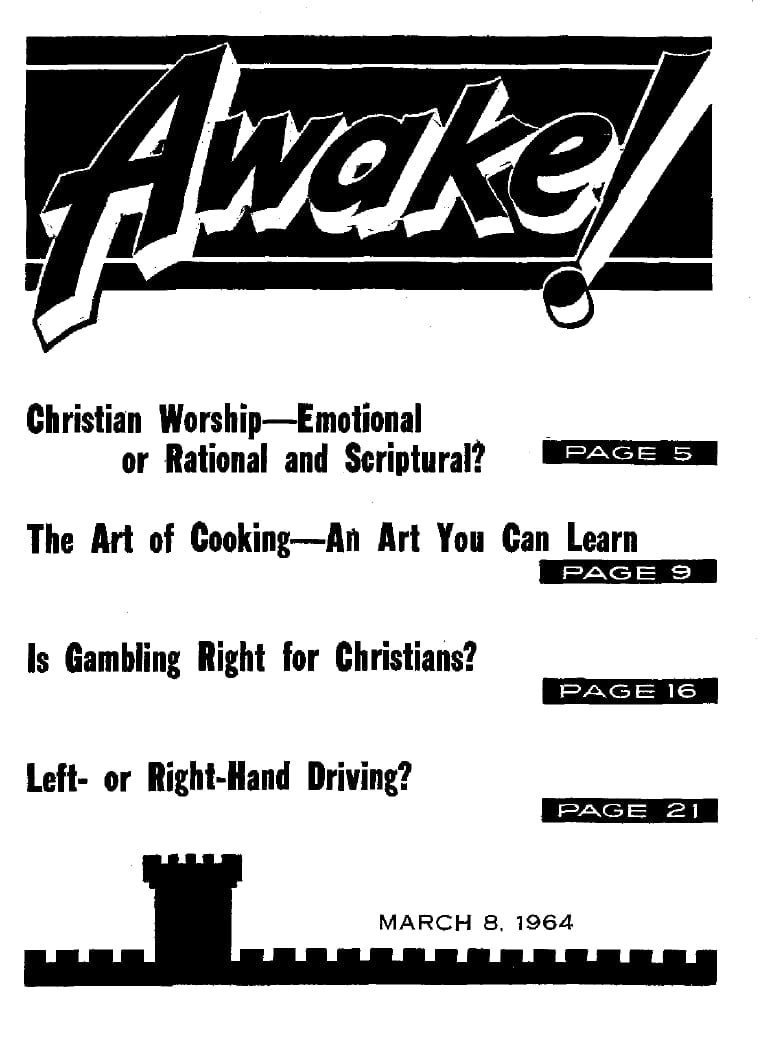
Christian Worship—Emotional or Rational and Scriptural?
PAGE 5
The Art of Cooking-An Art You Can Learn
PAGE 9
Is Gambling Right for Christians?
PAGE 16
Left- or Right-Hand Driving?
PAGE 21
MARCH 8, 1964
THE REASON FOR THIS MAGAZINE
News sources that are able to keep you awake to the vital issues of our times must be unfettered by censorship and selfish interests. "Awake!" has no fetters. It recognizes facts, faces facts, is free to publish facts. It is not bound by political ties; it is unhampered by traditional creeds. This magazine keeps itself free, that it may speak freely to you. But it does not abuse its freedom. It maintains integrity to truth.
The viewpoint of "Awake!" is not narrow, but is international. "Awake!" has its own correspondents in scores of nations. Its articles are read in many lands, in many languages, by millions of persons.
In every issue "Awake!" presents vital topics on which you should be informed. It features penetrating articles on social conditions and offers sound counsel for meeting the problems of everyday life. Current news from every continent passes in quick review. Attention is focused on activities in the fields of government and commerce about which you should know. Straightforward discussions of religious issues alert you to matters of vital concern. Customs and people in many lands, the marvels of creation, practical sciences and points of human interest are all embraced in its coverage. "Awake!" provides wholesome, instructive reading for every member of the family.
"Awakel!" pledges itself to righteous principles, to exposing hidden faes and subtle dangers, to championing freedom for all, to comforting mourners and strengthening those disheartened by the failures of a delinquent world, reflecting sure hope for the establishment of God's righteous new order in this generation.
Get acquainted with "Awake!" Keep awake by reading "Awake!"
PUBLISHED SIMULATIONOUSLY IN THE UNITED STATES BY THE
WATCHTOWER BIBLE AND TRACT SOCIETY OF NEW YORK, INC.
117 Adams Street
Brooklyn, N.Y. 11201, U.S.A.
AND IN ENGLAND BY
London N.W. 7, England
GRANT SUITER, Secretary
Printing this issue: 3,800,000
The Midway, LOS ANGELES N.W. 1/2
New Zealand, S21 New North Rd., Auckland, S.W. 1/2
South Africa, Private Bag 2, P.O. Elsewhere, Td. 70c
(Monthly additions cost half the above rates.)
*Maintenance for subscriptions should be sent to the office in your country. Observe that your invitations to Broadway. Holidays of expiration is sent at least two weeks before subscription expires.
Now published in 25 languages
Summermonthly - Africans, Chinese, Danish, Dutch, English, French, French, German, Greek, Italian, Japanese, Korean, Spanish, Turkish, Vietnamese
Monthly - Cicabay, Chinese, Iceland, Malaysia, Polish, Tamil, Ukrainian
CHANGES BF ADDRESSES should result in thirty days before your moving home. Cite on your old and new address. Call the Attn: Office of the Director of the Watch Tower, Watch Tower House, Tan Riggerty, London M.W. 7, England.
Entered as second-class matter at Brooklyn, N.Y. Printed in England
The Bible translation regularly used in "Ankhe" is the New World Translation of the Holy Scriptures, 1961 edition. When other translations are used, this is clearly marked.
CONTENTS
Speaking About Realities 3
Christian Worship—Emotional or Rational and Scriptural? 5
The Art of Cooking—An Art You Can Learn 9
Friendly Bermuda 12
Snail Travel Deluxe 15
Is Gambling Right for Christians? 16
The Birth of an Island 20
Left- or Right-Hand Driving? 21
A Reason for Not Smoking 23
The Challenge of the Mountains 24
"Your Word Is Truth"
Distinguishing the Literal
from the Symbolic 27
Watching the World 29
Volume XLV
Number 5
PEOPLE have different opinions as to what constitute realities. What may be considered a reality by one person may be viewed as imaginary or fictitious by another. There are even some who still parrot the old adage, 'Seeing is believing.' Such persons supposedly accept as realities only those things that they can see; while anything that cannot be seen is considered unreal.
However, in recent years knowledgeable persons have come to appreciate the fallacy of such a view. They now realize how limited the human vision is in its ability to detect many things. So today, electricity, gravity, radio and television waves and countless other "invisible" things are all generally accepted as realities. Their existence is unquestioned by knowledgeable persons even though they cannot be observed by the most powerful microscopes.
Is it not strange, then, that, simply because they are unseen, the existence of God and the prospects of future life are dismissed by some people as absurd unrealities? Yet this is what a great many people do, even in some lands of Christendom. A well-known Swedish writer, Alf Alhberg, noted this in the Svenska Dagbladet of May 9, 1962.
"The attitude toward Christianity on the part of the great majority in our country
SPEAKING ABOUT REALITIES
must be designated as indifferent," he said. "The questions about God's existence, a possible life beyond the present one, a higher world, and so forth,—simply do pot seem to exist. If anyone should bring up such things in conversation in better company he would risk being met with painful and shy silence . . . 'Let us speak of something else, let us speak of realities,' they would say. And 'realities' mean such things as collective agreements between employers and labor, the countryside's depopulating, or Khrushchev's latest moves."
But are God, angels and the prospects for future life unrealities, that is, mere ideas, things that are unreal, imaginary or fictitious? Stop for a moment and consider. Is that which is responsible for what is seen unreal because it is unseen? For example, is invisible electricity less of a reality than the visible light for which it is responsible? While one may be absorbed in the picture that television waves bring to his television set, would any knowledgeable person contend that the invisible waves are an unreality although the picture they produce is real?
Of course not!
Well, then, how can an intelligent, reasonable person examine the intricate movements of the heavenly bodies, and, while acknowledging their reality, deny the reality of the One who set them in their orbits? And what about man's marvelous re
joy discussing the niceties of atomic matter, and, with convincing evidence, could prove to an interested person the existence of atoms.
So it is that God, his invisible creations and his yet-to-be-fulfilled promises are considered by some as unrealities. It is not that they are actually unreal, imaginary; but the fault lies in people's incomplete or
ARTICLES IN THE NEXT ISSUE
inaccurate information about God and his purpose. This is
productive process,
whereby one infinitesimally small male
sperm unites with a
female egg, and
then, in turn, the fertilized egg develops according to a master plan until finally a baby is born? How can one accept the reality of this miracle and, at the same time, deny that an All-Powerful Wise One is responsible for the marvelous laws that govern the development of the human fetus? Truly there can
Faith Without Hypocrisy.
Adult Delinquency Rubs Off.
Ecumenical Council—Its Record to Date.
Should You Buy on the Installment Plan?
his purposes. This is the point the Swedish writer Alf Ahlberg made in his article. He wrote:
"One of the reasons [God and his invisible creations are considered unrealities] is without question that there is something radically wrong in our teaching of Christianity. . . . A professor of History of Religion told me that he sometimes asks his students, when they are up for examination, which is the last book of the Bible. Not a word of work
be no question that a Supreme Reality is responsible for these visible, very real results.
But why, then, is there likely to be a "painful and shy silence" when this marvelous God and his wonderful purposes are brought up in conversation in so-called "better company"? Is it not for a similar reason that a question regarding electronics or nuclear physics would likely be greeted with uncomfortable silence at a
book of the Bible. Not a word of reply. Comments are unnecessary!"
With such little knowledge concerning God and his Word, it is no wonder people question his existence. Yet how vital it is to our everlasting welfare to come to an accurate knowledge of Him and his purposes! God is real! He is the Creator of man and all the marvels in heaven and earth. Why, in comparison with Him, "all the nations are as something nonexistent," his Word says; "as nothing and an unreality they have been accounted to him."
Because of limited knowledge such a group might well greet explanations about the movements and paths of different atomic particles with disbelieving looks. They probably would want to change the subject and talk about something that was to them more of a reality. Yet, at the same time, a group of electrical engineers would en-
—Isa. 40:17.
How important it is, then, for us to get the right perspective—to consider things from God's viewpoint! Truly, he is the Supreme Reality, and only if we recognize that and continue to serve him will we enjoy his blessing of eternal life in his righteous new order of things.
CHRISTIAN WORSHIP
RATIONAL AND SCRIPTURAL?
WHAT comes first in Christian worship? On what should the emphasis be laid? Is Christianity a religion in which the emotions and the esthetic sense or the appreciation of things beautiful are chiefly
On what should the emphasis be placed? What is emphasized in your religion?
appealed to, or is it a religion in which the appeal is made to the intellect, to reason, to the conscience and to faith in the inspired Scriptures?
Many of the churches of Christendom put great stress on that which appeals to the senses, to the eyes and to the ears. They feature beautiful architecture, beautiful furnishings, beautiful vestments, beautiful pictures, stained-glass windows and beautiful ritual, together with beautiful music. This appears to be especially true of the Eastern Orthodox Churches, and of the Russian Orthodox Church in particular.
Thus Zernov in The Russians and Their Church states: "The service on Easter night is an experience which has no parallel in the worship of other nations. . . . Moscow stands for the unsurpassed beauty and glory in worship. Her Church represents the most devotional and most artistic of all the Christian traditions." And says Fedotov in The Russian Religious Mind: "The esthetic side of worship . . . remains one of the most constant features of the Russian religion."
Even some Protestants appear to be of
this mind. Typical of such is the report by a London Baptist clergyman that appeared in The Eastern Churches Quarterly, Vol. XV, 1963, 1, 2. According to him, "the Divine Liturgy in a Russian Church, with the
congregation taking a considerable part, more readily touches the deeper springs of human personality. I would testify that never before have I felt so completely part of the total worshiping community. . . The Orthodox Church, at its traditional worship, is already a church engaged in mission."
And says Protestant Lowrie in his book The Light of Russia: "Take, for instance, the devotional side of religion. When you visit an Orthodox Church the service may be sung in a language you do not understand, yet your heart is lifted up in the true worship of the congregation, you sense the nearness of God and the beauty of his praise. It is this side of religion which the Russian Church has preserved for us in a way unequalled in history. . . She has much to teach us of the need and beauty of devotion. . . In one other phase of religious experience the Russian Church without doubt excels all others. It is impossible for a Western Christian to listen unmoved and uninspired to the music which forms so important a part of the service. . . No words can give an adequate description of the unique and powerful worship the Russian Church has developed with its song.
All the shades of meaning of which the human voice is capable have been used with marvelous effect."
Its Background
The Russians, even before they became a part of Christendom, were a people of intense feelings. In their pagan religions the Russians did not feature or make prominent personalities, as did the Greeks and the Romans, but, rather, the beauties and things of nature, the earth, the lower animals, the products of the field. The religious feelings of the ancient pagan Russians were intense, but their religious ideas were quite vague. These characteristics at once account for the ease with which the Russians changed from pagan worship to that of Christendom, as well as for the fact that the religion they chose was that of the Eastern Orthodox Church. Yes, that the Russians embraced the Eastern Orthodox religion was due to a deliberate choice, not on the part of all the Russians, but on the part of one of their rulers, Prince Vladimir.
The missionaries of Christendom had made but little progress among the Russians when, toward the end of the tenth century A.D., their prince Vladimir, a very warlike ruler, who, although he had a number of wives and eight hundred concubines, concerned himself with the choice of a religion for his people. He inquired of the Mohammedans about their religion. When informed that they practiced circumcision, forbade the use of pork and alcoholic beverages, he rejected their religion. He felt that the Russians could not get along without liquor. He next asked the Jews about their worship. After hearing their story and of their present lot, Vladimir is said to have replied: "If God
loved you and your law he would never have scattered you abroad; do you wish, perhaps, that we should suffer the same?"
Neither was Vladimir impressed with the description the Roman Catholic representatives gave of their religion. Wondering what choice to make, he summoned his counselors, at whose instance he sent ambassadors to inquire about the various religions and report to him. After viewing the Mohammedan, the Jewish, the Roman and the Greek Catholic forms of worship, they returned. What had most impressed them was the worship of the Greek Orthodox Church:
"We went to Greece, and the Greeks led us to the edifice where they worship their God, and we knew not whether we were in heaven or on earth. For on earth there is no such splendor or such beauty and we are at loss to describe it. We only know that God dwells there among men, and their service is fairer than the ceremonies of other nations. For we cannot forget that beauty. Every man, after tasting something sweet is afterwards unwilling to accept that which is bitter."
Not, however, that its gorgeous ritual and material splendor were the only factors that influenced Vladimir. There appear to have been political reasons, as well as the influence of his grandmother who was a convert and of the Greek Orthodox princess whom he married about that time. Once having accepted the Greek Orthodox religion himself, he let it be known that all who failed to adopt his new religion would be no friends of his. All his subjects at Kiev, the leading Russian city at the time, and in the surrounding country were immersed simultaneously by the thousands. One of his sons, Yaroslav, who succeeded him, pursued the same course, and so in just a few decades practically all Russians became a part of Christendom; not because of the preaching of missionaries but because of the commands of their princes, and not out of conviction but out of policy.
The prominent role that the liturgical beauty and all that went with it played in the minds of the Russians is borne out by history. Repeatedly we read that princes would invite guests to view the splendor of their church and its services as the best argument for converting them. Well has it been said that "at all times the liturgical beauty of the Orthodox Church was considered by the Russians as the best missionary argument in the conversion of the heterodox."
No Scriptural Support
Time and again the statement has been made that the gorgeous ritual of the Eastern Orthodox Church, and especially that of the Russian Orthodox Church, resembles the worship of ancient Israel with its tabernacle and temple service together with its priesthood; some even stating that Orthodox worship is more Judaistic than Christian. Actually it is neither.
In the worship of ancient Israel all the beautiful furnishings and furniture that were to be found in the holy and most holy of the tabernacle and later in the temple were not there for the purpose of filling the people with awe, for these beautiful things could be seen only by the few that had to serve in these compartments, such as the high priest and his underpriests. The Israelites in general never got to view all this material beauty and glory.
Further, the duties of the priests consisted not only of offering sacrifices but also of teaching the Israelites the law of God, which teaching role has been so sadly neglected in the Russian Orthodox Church. As we read in God's inspired Word: "The lips of a priest are the ones that should keep knowledge, and the law is what people should seek from his mouth; for he is the messenger of Jehovah of armies."—Mal. 2:7.
In the Christian Greek Scriptures there is likewise no basis for stressing or placing the emphasis on the emotional rather than on the rational and the Scriptural. Jesus, in his Sermon on the Mount, in his explanations of his illustrations, in his discussions with his opponents, always appealed to the intellect, to reason, to conscience and to the Scriptures. The same was true of his followers. On the day of Pentecost Peter and his associates did not make their appeal an emotional one, but a rational one, and a Scriptural one. They reasoned with their listeners and appealed to their faith in the Scriptures as authority. In this way the Christians who had received the holy spirit on that day were able to convince three thousand Jews and to have them baptized in proof thereof.—Matt. 6: 25-34; 7:7-11; Acts 2:14-41.
Thus also regarding the apostle Paul we read that "he reasoned with them from the Scriptures." In particular did Paul reason with the philosophers, the Stoics and the Epicureans assembled on Mars Hill to hear him. Likewise we read of Apollos 'demonstrating from the Scriptures,' that is, proving by an appeal to the Word of God, "that Jesus was the Christ."—Acts 17:2, 22-34; 18:28.
Its Weaknesses, Its Fruits
Many are the weaknesses and bad fruits of the unscriptural emphasis on emotion in religion. It has resulted in ignorance and superstition and the carrying on of the worship of relics and icons, "holy pictures," to absurd and fantastic extremes. Thus Pierre van Paassen, a well-known writer, tells what he saw in Leningrad while visiting there within the past ten years.
The display of a certain jewel-encrusted icon of Alexander Nevski, one of Russia's leading "saints," caused crowds to come to pay it homage, repeatedly crossing themselves before it, kissing it and praying for several minutes before it. "One man with dark black beard, his cap twirling between his hands, first stood gazing at the icon as if hypnotized. Then he prostrated himself. He lay flat on his face and remained in that position till the monk on guard over the icon kindly urged him to rise in order to give others a chance to approach." Surely such idolatry cannot be pleasing to God!—Ex. 20:4:6; 1 Cor. 10:7.
Further, gorgeous ritual, or a deeply emotional experience, cannot of itself help one to meet the problems of life. It does not enlighten one and so help a believer to advance to maturity, thereby enabling him to distinguish between right and wrong and to be able to give a reason for the hope that is within him. The fact that in the time of the czars so many of the Russian Orthodox clergy were notorious for their love of wealth and of ease, their ignorance and drunkenness and their willingness to be the tools of the ruthless autocratic Czarist regime, and even of the sinister Rasputin, shows how little such gorgeous ritual aids toward producing the fruity of God's holy spirit, love, joy, peace, kindness, mildness, self-control. —Gal. 5:22, 23; Heb. 5:11-14; 1 Pet. 3:15
From the first, Christianity was basically a teaching religion. Repeatedly we read of Jesus and his apostles teaching. Just before he ascended into heaven Jesus commissioned his followers: "Go therefore and make disciples of people of all the nations, . . . teaching them to observe all the things I have commanded you." He said nothing about a gorgeous ritual. Likewise the apostle Paul was silent regarding the one but stressed the other: "Continue applying yourself to public reading, to exhortation,
to teaching." "Prench the word, be at it urgently in favorable season, in troublesome season, reprove, reprimand, exhort, with all long-suffering and art of teaching." To teach, the appeal must be made to the intellect, to reason, not to the emotions, the feelings.—Matt. 28:19, 20; 1 Tim. 4:13; 2 Tim. 4:2.
Today there is much agitation among Roman Catholic and Protestant circles about a lay apostolate, about the "laity" preaching, but not in the Russian Orthodox Church. Why? Is it not because she would substitute her gorgeous ritual for carrying out Jesus' command to make disciples of people of all nations?
It may well be asked if such a strong reaction to religion as represented by Godless communism in Russia would have taken place had there been less stress on gorgeous ritual and more on reason and the Scriptures. Not that beauty may not occupy a place in Christian worship. Beautiful buildings, furnishings and music are not harmful in themselves so long as they are kept in their place. But they were not essential to Christians worshiping in the catacombs and they are not essential to Christians worshiping underground in totalitarian lands today. The course of the Russian Orthodox Church may be likened to the housewife who gives no thought to being faithful to her husband and discharging her household duties but is only concerned with appearing beautiful and charming in a physical sense. She thereby identifies herself as one of the daughters of "Babylon the Great."—Rev. 14:8; 17:5.
On what does your religion place the emphasis—emotion or reason and the Scriptures? Jesus said that by following him we would know the truth and the truth would set us free. To get at the truth requires the stress to be, not on emotion, but on reason and the Scriptures.—John 8:32.
Cooking
GOOD cooking is a true art. It is not an art confined to a select few, as is often the case with other arts; but it is one that anybody, by work and will, can master. It requires knowledge, develops with experience and is enhanced by a little ingenuity.
It has been said that cooking is somewhat like traveling in a foreign country. Once you know the main roads you can get practically anywhere; until you know them you are at a loss. So, too, in the realm of cooking, there are reliable main roads that will help you through difficult territory. Thus there is a main highway that leads to roasting, another to gravies, another to sauces, another to cakes, and so on. Once you know these highways you will find that the thousands of recipes found in cookbooks and magazines are merely variations from the highways.
Before the cooking process starts, the housewife should give some thought to having a balanced daily ration, including,
Planning Meals
But why go to the trouble to learn the art of cooking? Because it will give you deep satisfaction to prepare something your family really likes and looks forward to eagerly. Also, often the most nutritive foods are not what the members of the family relish the most; so the housewife must prove herself a true artist, using real ingenuity and preparing food in various tasty ways so it can be enjoyed by anybody.
If possible, the various kinds of food necessary to meet the needs of the body. Protein foods are often the most costly, so when planning the menu, it is well to remember that internal organs, such as tongue, liver, kidneys, all come in the A-plus nourishment bracket and in the lowest price group. Fish, being a great source of iodine, and also a high-protein food, makes another fine dinner and perhaps can often be put on your menu.
When planning, the housewife will want to have in mind contrast. Distinctive flavors should be used with discretion; too many strong flavors do not make a very tasty meal. The contrary is also true—too many bland flavors make an undesirable meal. "Contrast," says Gwen French in The Easy Way to Good Cooking, "is the secret of making any combination of foods interesting. No meal should be all made up of soft, mushy things; nor all of hard things. If you have something salty, plan something bland with it. If you have something sweet, plan something sharp, or even a little bitter, as contrast."
Flexibility demonstrates the skill and ingenuity of the artist. If a cold meal is planned and the weather turns cold, add a cup of hot soup and a hot drink to take the chill off the eaters. The same is true when a day turns exceptionally hot and a hot meal has been planned; perhaps you can add a delicious cold salad or a cold drink.
Cooking the Meal
A visit to any good-sized public library will convince you that it would be presumptuous to set forth in one article or in one book the so-called "best recipes." This is because peoples' tastes differ greatly from country to country. You will find cookbooks with recipes from all over the world; there are books devoted to the cooking styles of Mexico, England, France, Scandinavia, Italy, Japan, China, India, to mention a few. Each country has it specialties and its ways of cooking; for variety you may wish to try some of these different recipes in fixing the same foods.
But regardless of the country, certain requirements must be met by the artist in cooking. What are they?
First, she will try to cultivate orderly work habits. Many cooks agree that one of the more unattractive aspects of housekeeping is the cleaning up of pots and pans after meals. To save time, clean up as you go along. After cooking utensils have served their purpose, they can be washed and put away. Wipe off the work space, and when working at the stove, put wet utensils on a plate, so the stove stays clean. If you splash water on the floor, wipe it up right away; that will be not only the safest thing to do but also the most practical, since it will spare you from mopping the whole floor after feet have tracked it. This will aid in maintaining a neat and efficient kitchen while cooking, and it will
cut in half the time spent after meals in cleaning up.
The good cook realizes the importance of appearance. She herself strives to look neat and clean, and she prepares food that appeals to the eye, the nose and the palate. Colorful vegetables look attractive when served with delicious brown meat, and a neatly set table can enhance enjoyment of the whole meal.
Meals served on time are thoroughly appreciated by a busy family, so time. your cooking well. Some women spend an unnecessary amount of time cooking; try to learn the shortcuts that make for efficiency. In many instances, parts of two meals can be prepared at one time, allowing more free time for other chores. While a roast is in the oven, the next day's dessert can also be cooking. While meat is on the stove, vegetables and salads can be prepared and dishes washed.
It is not necessary to have a big kitchen with the best equipment, but no doubt it is a help. On a one- or two-burner plate one can fry fish, ham, hash, bacon, chicken, cook eggs many ways, boil or fry vegetables, and so on. Hundreds of dishes can be prepared on a two-burner plate or a charcoal stove.
Seasoning
Seasoning is an integral part of good cooking. If foods are not properly seasoned, they taste flat and unappetizing. Although recipes give precise amounts of salt, pepper and other spices to be used, it is the continual experimenting of the cook that will enable her to become adept at seasoning.
When seasoning, one must keep in mind that the purpose is not to produce a predominant taste, but, rather, to accentuate the natural flavor already found in the food. The cook that carries out the seasoning process with skill can be almost sure that the dish will be a success.
The most important of all seasonings is salt. Rarely is a meal served that has not been seasoned with salt. However, a good cook treats salt, as well as other seasonings, with respect, for she knows that over-salted food is ruined and food not salted enough is insipid.
Then there are garlic, nutmeg, cinnamon, pepper and paprika. Pepper is probably the best known of all spices, and in the Middle Ages it was one of the costliest. One of the articles demanded in 408 (A.D.) by Alaric, the Gothic conqueror, as part of the ransom of Rome, was 3,000 pounds of pepper. In our day pepper is not as precious as gold, yet it is a very valuable seasoning. Paprika, the red-colored spice prepared from the fruit of the bonnet pepper, enriches flavor and color, working wonders with meats, fish, fowl, eggs, cottage cheese and vegetables. Whatever the seasoning, use it with skill and caution, and you will make dull foods interesting.
Having the Right Attitude
Cooking is an art that always can be developed, an art, too, in which there is always room for improvement. If you are an average housewife, you prepare well over a thousand meals yearly. If this function is to rise above a dull and routine task, you will want to approach it with a positive and willing attitude. If you are eager to seek out and try different recipes to please the family, it will reflect itself, not only in the food, but in its reception as well.
are tense, nervous and irritable, so she zealously tries to maintain a relaxed atmosphere at mealtimes. God's own written Word emphasizes the importance of this when it says: "Better is a dish of vegetables where there is love than a manger-fed bull and hatred along with it."—Prov. 15:17.
The wise cook knows that very little good can be derived foodwise if the eaters
Many women really enjoy planning and cooking meals but occasionally get discouraged because they feel their families do not appreciate all the work involved. It does seem to be the tendency in some homes for husbands and children to rush to the table, consume the food and then take off for various pursuits, without so much as a single word of appreciation. Is that your complaint? Do you get discouraged because you seldom get a word of praise? If so, maybe you overlook the many encouraging signs of appreciation that your family no doubt give. Are they eager to get to the table? Do they eat their food with relish? (Remember, enjoyment of food can rarely, if ever, be hidden.) Do they regularly ask for second helpings and continue to grow strong and healthy? If you can answer, Yes, to these questions, be assured that your good work is appreciated, if only silently so. Members of a family might remember, however, that good food served with care deserves a kind remark. For is it not true that the sun of appreciation and the rain of encouragement will make many an endeavor grow and thrive?
We eat often, so why not prepare the food in such a way that it will taste as good as possible? If you cook, whether for a family or just for yourself, do your best to master the art of cooking; rewards for having done so will be yours every day.
Friendly Bermu
to go through Purgatory to get there." To experience firsthand Bermuda's natural delights and her people's warm friendliness no longer requires a hazardous voyage with a possible disastrous end on the coral reefs surrounding the islands. The
GLITTERING like a handker of brightly colored jewels tossed into the Atlantic Ocean, beautiful Bermuda—not just one but a seahorse-shaped group of about 123 islands—welcomes hundreds of thousands of visitors annually.
In language more colorful than precisely accurate, Mark Twain once said that Bermuda was "like Paradise—but you have
Aptly termed "The Showcase of the Western World," the only natural resources of the British Commonwealth's oldest self-governing colony are said to be its radiant beauty and climate, but to these attractions must surely be added another natural resource—the spontaneous hospitality and kindness of its people.
The innate friendliness of the Bermudian has roots that reach down into the island's history. The early settlers suffered many hardships on their voyages to the islands and their doors were always opened to strangers and shipwrecked travelers, even though they themselves often had little to share.
approximately 700 nautical miles southeast from New York City can be comfortably navigated in just two and a half hours by jet plane, or about forty cruising hours aboard a luxurious ocean liner.
Recently, a huge jetliner slowly banked into a graceful curve and pointed its nose toward the long gleaming runway. A young passenger called out excitedly, "Look at all those white roofs. The houses are different colors but the roofs are all white and they have ledges around them—they're all the same. I wonder why that is?"
As the plane came smoothly to a standstill and passengers began unfastening their seat belts, a stewardess who had overheard the question leaned over the eager young traveler and said, "There are no rivers or wells of freshwater on these islands. This is the peak of an extinct volcano now covered with coral rock. Bermudians construct most of their roofs of coral stone and they are specially built to trap as much rain as possible and divert it to tanks under the houses. Johnny, why don't you ask a Bermudian to explain to you exactly how they do it? Don't be shy. The people who live here are some of the most friendly people in the world!"
Yes, the approximately 50,000 descendants of the hardy settlers here have earned for themselves a reputation for friendliness.
Origins of Friendliness
Analyzing and understanding the reasons for the ready and warm hospitality of the Bermudian call for an examination of the island's history.
The relaxed and observedly untroubled relationship between the predominantly colored population and their white neighbors probably dates back to the International Emancipation Act of 1833. Many slaveholding nations were slow and reluctant to comply, but among the first to respond to the Act's requirements were the Bermudians. Of the thirty-six members of Bermuda's governing body, the House of Assembly, ten are colored—a statistic that speaks for itself in these days of racial strife.
Today's "onions," or native islanders, are all descended from those forwardlooking white landowners, hardy mariners and their freed slaves who all settled down to work at making Bermuda one of the most prosperous and delightful pieces of real estate on earth. The history of their seafaring ancestors is liberally sprinkled with tales of shipwreck, danger and hardship, when a pounding on one's door more often than not meant that someone was in distress.
It has been said that early Bermudians were made of "Cedar, Salt and Saylors." Those three original features may no longer exist, but inherited friendliness has emerged as a durable and ethnic characteristic. The cedars were all but destroyed by blight; refrigeration has eliminated the need for the great troughs of seawater left to evaporate, leaving precious salt deposits for preserving food; and Bermuda is no longer an island of mariners. Over the past 300 years the shrewd businessmen of Bermuda have switched from one commercial commodity to another, always to the eventual enrichment of themselves and their little island. Today they deal handsomely and profitably in the most lucrative commodity in all of Bermuda's prosperous history—the tourist.
Traffic Problems
The twentieth century has introduced a contrivance—the automobile—calculated to irritate the calmest soul, even the easygoing Bermudian. However, only residents are permitted to own and drive automobiles, which are restricted in size. Hazardous driving conditions on narrow, twisting and turning roads require constant vigilance, iron nerves and tempers well under control.
Add to these hazards the ever-present tourist, relaxed and carefree, his eyes constantly distracted by the breathtaking scenery all around him. He energetically pedals his rented bicycle; or breezes along the unfamiliar left side of the road on his "putt-putt" (motor-assisted bicycle)—and the scene is continually set for car drivers to "blow their top" under stress.
However, the bustling streets of Hamilton, the island's capital and only "city," and the spiraling and scenic roads rarely witness displays of bad temper of exasperated drivers.
Visitors have recounted some of their experiences that illustrate the kindness and forbearance of Bermudian drivers. One such incident involved a group of rubbernecking cyclists. As they approached one of the island's few "roundabouts" (traffic circles), some discussion took place as to which of the equally inviting looking roads they should follow. The decision made, all but one thrust out their right hand, carefully following the "rules of the road" spelled out to them at the "cycle livery," and confidently pedaled in the indicated direction. One bewildered-looking girl wobbled uncertainly to the pavement edge, fearful of following her friends. All surrounding traffic came to a slow, gentle halt and the look of confusion on the girl's face was suddenly replaced with a smile of relief with the realization that she was not going to be relentlessly mowed down by an angry motorist if she made a wrong move.
As she headed around the circle and pedaled hard to catch up with her friends, the patiently waiting motorists quietly switched gears and continued on their way.
Observing the foregoing incident, a visiting New Yorker expressed amazement at such an unusual demonstration of patience. "What purpose would be served," answered the driver with whom the onlooker was riding, "if we had become impatient and one of us had perhaps yelled at her? She might have panicked and lost her balance, and this Bermudian rock is hard to fall on. She might have swung one way or another, forgetting to signal, and we could then easily run her down. It would ruin her vacation and she and her friends might have unpleasant memories and not want to visit us again." With a knowing grin, the driver added, "Besides, who's in a hurry? This island is only twenty-three miles long. We'll all get where we're heading anyway. We could be only a few minutes late by exercising patience, but when an accident occurs we have to stay at the scene sometimes for hours. So what's the sense in being unkind and impatient?"
Added to an inborn charity for the stranger is the Bermudian's astute awareness of the island's economic structure. He recognizes that the wobbly cyclist, the more daring "putt-putter" zooming around the corner (many times alarmingly on the right side of the road—the wrong side in Bermuda!), the meandering jaywalker preoccupied with a nearby flaming oleander tree—is that important import, the tourist. However, these kindly people love their island home. They genuinely want their visitors to enjoy safe and happy holidays so they will come back.
Visitors take back with them to their homes memories of spontaneous acts of
kindness they have experienced themselves. One visitor from Brooklyn on a rented motor-assisted bicycle was sailing along a scenic shoreline road when suddenly the "putt-putt" spluttered and came to a halt—out of gas!
Feeling somewhat foolish and resignedly pushing the depowered bicycle, the perspiring visitor came upon a building crew erecting a sea retaining wall. Immediately recognizing the lady's plight, the foreman of the work crew instructed one of his men to "siphon some gas from the truck, mix in some oil, and fill the lady's tank." Embarrassment fled in the face of genuine friendliness and kindness.
Power restored, the visitor sped away, and, on the return trip, as she whizzed past the same spot all tools were downed and all hands waved a cheery "so long, have a good trip."
Friendly Shopping
The port of Hamilton boasts one of the most unusual waterfronts in the world. On one side of Front Street is the dockside and on the other a row of neat and colorful stores, stocked with the finest merchandise that Bermuda's astute merchants bring back from all corners of the earth. A sight that Hamiltonians and visitors alike never tire of watching takes place every Monday morning when the luxury liner "Queen of Bermuda" sails majestically into the harbor and finally docks at Front Street, her bow resting practically cheek-by-jowl with the stores across the street.
As the eager visitors swarm down the gangplank, cross the street and spill into the stores in frantic search of English cashmere sweaters and precious French perfume, they are met by calm, courteous salesclerks. Instantly and noticeably, tension evaporates, the shoppers slow their pace and everybody enjoys the shopping spree.
The terrific tension of competitive selling so much in evidence elsewhere is noticeably missing in Bermuda. Courtesy is the key word, and if the particular item sought is not in the store, the shopper is considerately advised to "Try So-and-so down the street; I think you'll find it there."
Asked what he thought was the underlying reason for this courteous attitude on the part of the island's salespeople, a Bermuda Trade Development Board spokesman said, "Bermudians are interested in people, but not to the extent that they want to use them." This thoughtful observation accurately identifies the motive of a whole island of friendly people.
Living Conditions
The Island's sound economy undoubtedly contributes considerably to the Bermudian's lack of tension and irritability. Bermuda proudly boasts of having no unemployment, no taxes, no national debt—the books of government always being balanced "in the black." Poverty breeds discouragement and unhappiness, which are hardly inducements to spontaneous friendliness, warmth and hospitality.
People are always ready to help one another, and not with financial gain in mind. Overheard on a street in quaint old St. George—the oldest town on the island—was this conversation: "Hello, there, so you're going to build your own house! Please let me do the wiring for you; you were such a wonderful help to me when I was building. Say, we'll all have a great
time helping you build the roof." A typical housebuilding is almost a community project in Bermuda.
These kind people are not suspicious when a visitor knocks at their door. The caller may be a complete stranger but is never met with a surly, "Who are you?" or, "What do you want?" or, "Whatever it is you're selling, I don't want it."
The householder is not concerned about the skin color of his visitor either. These people maintain good relations among the races. The white, the colored and the many of Portuguese extraction who have settled here, all live quite amicably side by side along any little country lane.
A knock on the average Bermudian's door will usually elicit the following remarks from the householder: "Hello, how are you? Won't you please step in and make yourself comfortable. Now, what can I do for you?" This kind person, like many of his neighbors over the entire island, will respond enthusiastically if the visitor is calling to discuss the wonderful promises of the Bible. These kindly people are rare among earth's inhabitants—they are not only Bible owners; they are interested in what it has to say. They read their Bibles.
Those honesthearted ones who seek accurate knowledge from the Word of God are quick to acknowledge that, while their beautiful little semitropical island, nestling snugly in the protective warmth of the Gulf Stream, may have seemed like Paradise to Mark Twain; the promised Paradise of the Bible will cover the whole earth like a beautiful garden. In that global Paradise, all the inhabitants will be friendly.
Snail Travel Deluxe
The tiny aquatic snails of the American everglades in Florida prefer air travel for getting places. They have extended their range to South America by cruising aloft with cozy comfort in the feathers of a bird, the ibis.
said to be spent there annually on just the illegal gambling.
Gambling is popular among poor and rich alike. In Mexico the poor purchase tiny fractions of lottery tickets. In England the poor gamble with as little as a farthing, a fourth
DOES popularity make a thing right? If so, then gambling most certainly would be right, for it has devotees among all races and nations. Many are the political governments, the religious institutions and the social organizations that sponsor gambling for raising funds.
Each week four out of five Britons will be found gambling. Due to a law passed in 1960, gambling there has become a "growth industry," reaching heights never before attained. But even before this boom Britain had the most legal betting per capita.
Gambling is also on the increase in Japan. Its people spend some 200 million annually wagering on bicycle races alone. In Mexico the 200-year-old National Lottery annually reaps more than100 million, and comparable lotteries are operated by many other Latin-American as well as many European countries, including some behind the Iron Curtain. The Irish Sweepstakes are known to all. As for the United States, some $50 thousand million are
of a penny, and the rich with tens of thousands of pounds, losing as much as 150.000 pounds in one
evening. Gambling appeals as much to society's most honored individuals as it does to the dregs of society; and it appears to be as popular among heads of state today as it was among the ancient Roman emperors; Caligula, Claudius and Nero being especially heavy gamblers.
If antiquity makes a thing right, then gambling would be right on that basis also, for it goes back to at least the seventeenth century B.C. The ancient Egyptians, Babylonians, Indians, Chinese and Cretans gambled. Homer mentions gambling in his "Iliad"; Herodotus and Tacitus refer to it in their histories.
The earliest Scriptural reference to gambling is found at Isaiah 65:11—written in the eighth century B.C.E.—where we read: "You men are those leaving Jehovah, . . . those setting in order a table for the god of Good Luck and those filling up mixed wine for the god of Destiny." The Hebrew word here rendered "Good Luck" is rendered "Gad" at Genesis 30:11, where appears Leah's exclamation, "With good fortune!"
Among ancient Canaanite places was Baal-gad, meaning "Lord of Fortune." —Josh. 11:17.
What Are Its Fruits?
However, just as the popular and longheld belief that the earth was flat did not make it flat nor the belief right, so also the popularity and antiquity of gambling does not of itself make it right for Christians. One factor that does have a bearing on it is the fruits it produces, for Jesus said that things and persons are to be judged by their fruits. What are the fruits of gambling?—Matt. 7:16-19.
Gambling, which is "play at any game of chance for stakes," might be said to be a tree that brings forth chiefly bad fruits, among which are disappointment, dishonesty and poverty. Some justify gambling on the basis of recreation, but gamblers, be they at a casino or at a bingo church party, are anything but a happy, relaxed crowd. The one who wins may be elated, but the vast majority lose—and they are never happy about it! So after sharing in the gambling the poor are even poorer.
Gambling has its roots in idolatry, it being a sport survival of divination. Gamblers usually are very superstitious, as can be seen by the various ways in which they try to woo "Lady Luck" and by their consulting astrologers and crystal-ball gazers. They like to go by "hunches" instead of facts and reason.—Isa. 65:11.
Further bad fruits of gambling are greed and dishonesty. Gambling is sired by the "love of money," which "is a root of all sorts of injurious things." Book after book has been written exposing the dishonest practices of gamblers. Some professional gamblers have even gone to the extreme of having pink contact lenses fitted for them so they can use marked cards to cheat.—1 Tim. 6:10.
Especially bad is the fruit of compulsive gambling. Men who would never have stolen a cent will embezzle large funds to pay for their gambling mania or its debts. Women use their grocery money to play bingo. Often the result is loss of friends, loss of job, broken homes and even suicide. Gamblers Anonymous claims that psychiatrists can do little to help compulsive gamblers. Religion, however, has been found to be of the greatest help, even as it has been for alcoholics. A woman who suffered from five compulsions—overeating, alcoholism, drug addiction, promiscuous sex and gambling—said that gambling was by far the hardest to overcome.
Gambling also plays moral havoc with governments. The Louisiana Lottery (terminated in 1890) corrupted the officials of an entire state, influenced a United States presidential election and has been termed "one of the most insidious institutions in the history of the nation," corrupting everything it touched.
Concerning Britain's present gambling boom, one of her leading anthropologists recently stated: "British gambling [has become] not only a source of big business but also of big crime." There are "accounts of gangs arranging for the doping of horses or the bribing of players," and of "thugs employed by bookmakers to frighten their rivals off the race courses," or to destroy rival betting shops with hand grenades. No wonder Scotland Yard officials expressed apprehension when Britain's Betting Act of 1960 was passed!
Bearing similar testimony, the United States attorney general in 1962 said that by gambling people were supporting "narcotics, bootlegging, prostitution, gang murders, corruption of public officials and police, and the bribery of college athletes." In view of such fruits, how shortsighted are politicians who legalize gambling and how utterly inexcusable are professedly Christian groups that sponsor various forms of gambling for the sake of its profits!
Antisocial in Principle
Bad as are the fruits of gambling, such are not the only reason, in fact, not even the chief reason why gambling is not right for Christians. It is not right even when, because of strict controls, it might not be exploited by organized crime. Gambling is antisocial in principle, and especially does it run counter to Scriptural principles, clearly making it not right for Christians.
As has well been noted, there are only three honest forms of transferring property: in the form of a gift, in exchange for labor, and in exchange for other valuable goods. In each of these ways both parties to the transfer are benefited. In the giving of a gift both the giver and the receiver are blessed, even as Jesus showed. (Acts 20:35) In the exchange on the basis of labor, both the employer and the worker supply to each other a basic need. In a business transaction, likewise, both buyer and seller supply basic needs. But not so in gambling; only one party gains, the winner, and that at the pain or grief of the other, the loser.
Gambling is unproductive. It does not benefit society. Those catering to the desire to gamble cater to the weaknesses of their fellowmen and do not scruple to take unfair advantage of them. They therefore bear a resemblance to those who traffic in narcotics, in pornographic literature and in illicit sex.
Gambling is antisocial, for those who gamble are bound to lose—if not always individually, nevertheless, they do lose as a group. In national lotteries not only the government but also those who sell the tickets profit, some of the latter making immense fortunes thereby. Who pays for all this? Is it not the individual gambler?
No wonder he is referred to as a "sucker."
Gambling is a form of extortion, even though the loser consents to parting with his money. Dueling may be said to be murder by mutual consent, but that does not make it right. (Even a suicide is considered a murderer!) So gambling has been termed robbery or extortion by mutual consent, but that does not make it right. Governments are obligated to protect the morals of their people as well as their possessions. Gambling is a form of extortion in which one wins only because one or many others lose. It is morally wrong to seek pleasure or profit at the pain or loss of others.
Opposed to the Scriptures
Gambling goes contrary to the entire tenor of the Scriptures. It has its roots in divination and therefore is a form of false worship. God's Word counsels diligence, thrift, hard work, whole-souled work. The gambler would substitute luck for hard work. The Bible states that "if anyone does not want to work, neither let him eat." The one who would live by his gambling gains would eat without working. —2 Thess. 3:10; Prov. 10:4; Eph. 4:28.
In particular does gambling fly in the face of all the scriptures that counsel us to love our neighbors as ourselves, and 'to keep an eye, not only in personal interest on our own matters, but also upon those of the others.' The gambler is concerned with only his own interests. He sets himself against his neighbor, he hopes to win at the expense of his neighbors. His very buying of a lottery ticket implies a hope that he will be able to get something from his neighbors, the money they spent on lottery tickets, even though they really do not want him to have it.—Phil. 2:4.
Yes, gambling is a form of extortion, and how could anyone who loves his neighbor extort any money from him?
How far apart the two are! No wonder that the Bible says that extortioners will not inherit the kingdom of God!—1 Cor. 6:9, 10.
That gambling is incompatible with the worship of Jehovah God can further be seen from the only direct reference to it in the Scriptures, at Isaiah 65:11, for there it tells that those who set tables in order for the god of Good Luck had forsaken Jehovah and forgotten his holy mountain. This fact was recognized by the Jews, for in their Mishnah gamblers are forbidden to testify in court.
In view of all the foregoing, gambling obviously is not right for Christians, and that follows even though the gambling might be sponsored by philanthropic or religious organizations. Never do ostensibly good ends justify questionable means. In fact, many compulsive gamblers claim to have the finest altruistic motives for gambling. Gambling is wrong whether indulged in for selfish gain, "charity," or merely the thrill of it, which really is a form of sensual pleasure.
Where to Draw the Line
Gambling being basically wrong, no dedicated Christian should have anything to do with it, either in gambling himself or in helping in any way to operate a gambling enterprise. Although according to some theologians it is not wrong for a man to gamble if he has the money to spare, that is merely evading the issue. He certainly is not betting to lose. And if he wins he is getting from others money with which they do not want to part. He is an extortioner. He has not worked for it; he has given neither goods nor services in return for it, and what he receives certainly is not a gift.
Is it wrong, then, for a man to attend a horse race or other sporting events? No, not so long as he does not gamble. As
a Christian he is free to choose his recreation so long as it does not conflict with Bible principles. However, it is also well to consider the associations involved and the effect this could have on his life. 1 Cor. 15:33.
But can it be said to be wrong just to put a few pieces of change into a "football pool" at the office or for youths to pitch pennies at a line on the sidewalk to see who comes closest and who will win all? The amount makes no difference. The principle is the same.
Does this mean that all games involving an element of chance are wrong? Not at all. If no "stakes" are involved, it is not gambling, for there is then no extortion. And as for the matter of chance, usually in such games the players endeavor to eliminate that element to the extent possible by their skill. However, if there is an invoking of "Lady Luck," to win, even if no money is involved, it is wrong, for this amounts to leaving Jehovah and turning to false gods.
Then what about receiving a prize from a business establishment that gives out tickets to its customers and then at a "drawing" announces the winning number? If this is simply their way of making an impartial selection of customers to whom they will give gifts as a form of advertising, and the customers do not pay for the tickets, they are not gambling. So it is an individual matter as to whether a Christian wants to try for the gift or not and then accept it if he wins.
The crux of the matter is this: Did you pay for your "chance" and do you stand to win what others have paid for like "chances"? Does it pit you against your neighbor and put you in line to be, in effect, an extortioner? Or do you invoke "Lady Luck" to win? If so, then it is gambling and it is not right for Christians!
THE BIRTH OF AN ISLAND
By "Awakel" correspondent in Iceland
T WAS a little after seven o'clock on the morning of November 14, 1963. The weak
light of dawn had just started pushing away the heavy blankets of nocturnal darkness over the waters of the North Atlantic. About twenty miles off the southern coast of Iceland the small fishing vessel Isleifur II was waiting for the codfish to bite. Everything was quiet. As the lone watchman peered out over the surface of the calm ocean not even another fishing boat could be seen.
Then, all of a sudden, the calm was shattered. It was unbelievable! The fishing vessel's watchman was the first eyewitness to a spectacle of violence the like of which few men have ever lived to tell about. A thick black smoke column started ascending right out of the waters a short distance from the boat. At first he and the other startled crew members thought it was a huge ship on fire, but the tremendous columns of smoke and steam quickly convinced them that this was something of an entirely different nature. It was a violent volcanic eruption right out of the watery deep!
Soon the news flew all over Iceland and around the world. The matter was not merely of momentary interest, for by the next day a new island had been formed by the ashes, pumice, lava and other volcanic material thrown up from the ocean floor 425 feet below. The island continued growing day by day as the hot crater kept vomiting out colossal masses of material, estimated by some to be about fifty-six tons per second.
It was a majestic sight indeed! The smoke and steam column reached five miles into the sky. In a relatively short time the island had grown to respectable dimensions--1,650 feet by 330 feet, and a height of 330 feet.
One geologist calculated that the tremendous heat converted about a thousand tons of seawater to steam every minute. At night the glowing red-hot stones and ashes could be seen spewing into the air in explosive outbursts that often reached a height of a thousand feet. This caused real thunder and lightning, and sent down a rain of hail. The hall resulted when the hot steam reached the cold air in the upper atmosphere and condensed rapidly. The lightning could be seen seventy-five miles away in Reykjavik, the capital, despite the 2,260-foot mountain range in between!
The creation of this new island raised several questions. To whom does it belong? What should its name be? And would it stay permanently, or would it disappear beneath the sea in time?
The first question was soon settled as careful observations showed that it was well inside Icelandic territorial waters, and, therefore, questionably belonged to Iceland. However, Icelanders were not the first to set foot on it. This honor was won by three Frenchmen who were sent out by the newspaper Paris Match. They sailed out to the newly formed island in a tiny boat during a pause in the volcano's explosive outbursts. But just as they were planting France's national flag on the beach, the eruption started blasting away again. The French daredevils barely escaped with their Bives, but lost $10,000 worth of photographic equipment for their trouble.
…