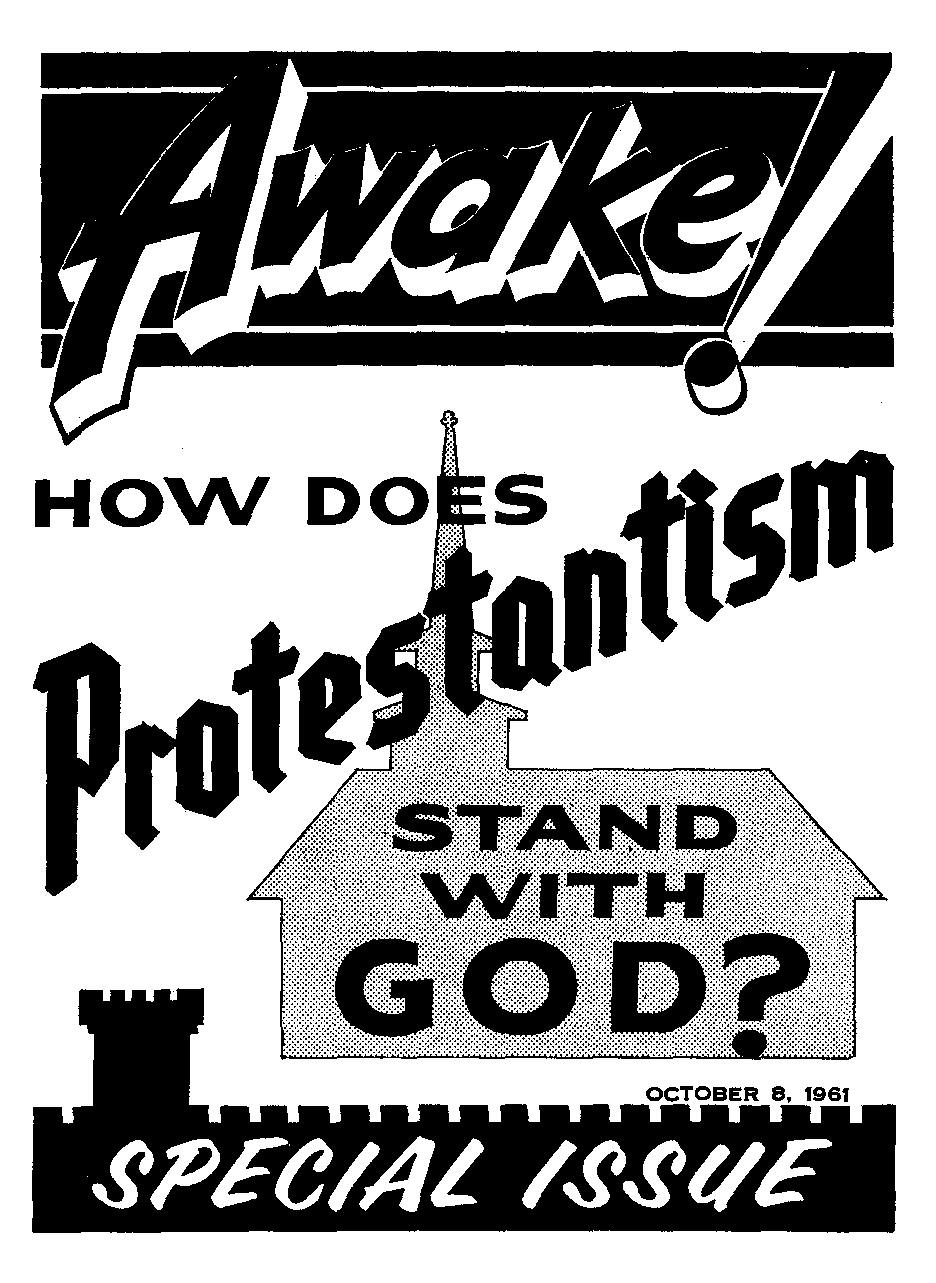
Awake!, October 8, 1961
Download: PDF — Awake!, October 8, 1961
THE MISSION OF THIS JOURNAL
News sources that are able to keep you awake ta the vital issues ot our times must be unfettered by censorship and selfish interests. “Awake!" has no fetters. It recognizes facts, faces facts, is free to publish facts. It is not bound by political ambitions or obligations; it is unhampered by advertisers whose toes must not be trodden on; it is unprejudiced by traditional creeds. This journal keeps itself free that it may speak freely to you. But it does not abuse its freedom. It maintains integrity to truth.
“Awake!" uses the regular news channels, but is not dependent on them. Its own correspondents are on all continents, in scores of nations. From the four corners of the earth their uncensored, on-the-scenes reports come to you through these columns. This journal’s viewpoint is not narrow, but is international. It is read in many nations, in many languages, by persons of all ages. Through its pages many fields of knowledge pass in review—government, commerce, religion, history, geography, science, social conditions, natural wonders—why, its coverage is as broad as the earth and as high as the heavens.
"Awake!” pledges itself to righteous principles, to exposing hidden foes and subtle dangers, to championing freedom for all, to comforting mourners and strengthening those disheartened by the failures of a delinquent world, reflecting sure hope for the establishment of a righteous New World.
Get acquainted with “Awoke!" Keep awake by reading "Awake!"
<11 nt
Published Simultaneously in the United States by the WATCHTOWER BIBLE and tract SOCIETY OF NEW YORK, INC.
117 Adams Street Brooklyn 1, New York, U.S.A,
and in England by WATCH TOWER BIBLE AND TRACT SOCIETY
Watch Tower House, The Ridgeway London N*W, 7, England
N. II. Knorr, Presided Grant Suiter, flecretan/
Printing this issue: 3,250,000 4d 4 copy (Australia, Bd; South Africa, Si'gC)
“Awake!” h published in the following 23 fenpiafM: Semimonthly—Afrikaans, Clnjanja. Duntsh, Dutch, Eng-liati, Finnish, French, German, (keek. Italian, Japanese, Norwegian, Portuguese, Spanish. Swedish. Tagalog, Zulu-Monthly—Cebu-Vtfiayan, Iloeano, Korean, Malayalam, Polish, Ukrainian.
Yearly subscription rates
Oflt&j for wmlmcmthly editions
Am erica, U.S., II? Adame St, Brooklyn 1, N.Y. $1 Australia, 11 Beresford Rd., Btrathfleld, N.B.W. 87-Canada, 150 Bridgeland Ave., Toronto 19, Ont. |1 England, Watch Tower House,
The Ridgeway, London X.ff. 7 7/-
New Zealand, (121 New North Rd., Auckland, S.W. 1 7/-South Africa, Private Bag, Elandpfontein, Tri. 70c Monthly editions coat half the above rata.
Rimlltlaits for subscriptions should be sent te the office Ln your country, Otherwise send your remittance to London. Notice of expiration Is sent at least two Issum before subscription expires.
CHANGES OF ADDRESS ahfiild reach nt thirty day* before yoir moving date. Give is yoir old and new Bddreta (Jf pOMiblo, year ofd address label). Watch TvWrt, Watch Tower House, The Ridgeway, Lwiden N.W. 7, England,
Sntmd as second-class matter at Brooklyn, N.Y. Printed in England
The Bible translation «ed In “Awake!" ie the
When other translations are
Afi - American Hlandard Version AT - An American Translation AV — Authorised Version (1611} DO, — J. N. Darby's version
md tho
JJy - •
i New World Translation । following symbols win Catholic Douay version Tha Emphatic Dlajjlott
JP - Jewish Publication tfoa. _L^ - Isaac Leeser’s version
of the appear ftfo-HO -Bfi -
’
Holy Scriptures, 1961 edition, behind the citations:
Janies xMoftatt’s version J. B. Bother ham's version Revised Standard Version Robert Young's version
CONTENTS
Divine Standard for Right Worship
Meaning of Church Membership
Rejection of the Holy Bible
Christendom's Concept of God
The Devil and His Works
What Hope for Mankind?
Effect upon the Lives of Men
A Divided House
What the Future Holds
Christianity as Taught by Jesus Christ 26
Watching the World
sw
al satisfaction, such religion may DI fl II 111
be what he wants. But God tells fi,| UII 1
man: “ ‘The thoughts of you peo- TIT An Oil ID pie are not my thoughts, nor are UKijIIll my ways your ways,’ is the utterance of Jehovah. ‘For as the heavens are higher than the earth, so my ways are
AN needs a divine standard for worship. Religion that is adhered to merely be- j cause it satisfies the inclina- j tions of the worshiper is not I in reality service to God. It is 1 true that for one who seeks in religion only personal emotionhigher than your ways, and my thoughts than your thoughts.’ ” (Isa. 55:8, 9) Thus the form of worship that is right in the eyes of God is determined, not merely by consulting one’s own feelings, but by going to the Bible, the Word of God. Worship that conforms to that divine standard results in lasting blessings from God.
It is not left up to men to judge the various religions according to their own standards. Jehovah God, in his Word the Bible, sets forth the divine standard; but those who accept it are under obligation as his witnesses to make it known to others. While they are not themselves the ones who do the judging, failure on their part to proclaim God’s judgments would show lack of faith in God, who says to them: “You are my witnesses.”—Isa. 43:10.
But do not all religions teach the truth, leading men to God in different ways? Jesus testified that he came into the world to bear witness to the truth and that everyone on the side of the truth listens to his voice. He did not say that whatever a person may happen to believe is the truth, that all religions have the truth. In prayer to his Father he identified the Source of all religious truth when he said: “Your word is truth.” (John 18:37; 17:17) When others, professing to serve God, advocated beliefs that were at variance with the Word of God, Jesus did not reason that they were all trying to serve God in their own way. To the contrary, he said: “You have made the word of God invalid because of your tradition,” and he applied to them what God said through the prophet Isaiah: “It is in vain that they keep worshiping me, because they teach commands of men as doctrines.” (Matt. 15:6-9) Theirs was not another way to the kingdom of God.
Therefore, if you are going to practice the religion God approves, you must be willing to compare your beliefs with the Word of God and then conform to that divine standard for right worship. Do not conclude that there is no need to make such a test of your faith. Follow the wise Scriptural counsel: “Keep testing whether you are in the faith, keep proving what you yourselves are.”—2 Cor. 13:5.
Meaning of Church. Membership
SUNDAY KOOK flCVlEW 'Sucevu With Ged''
■'*•1 ■
RIDAY ftaxaor
WEDNESDAY Young People Y $««
WHAT does church membership mean in your life? Is your church a place where you are instructed in the Word of God, where you are equipped to be a follower of Jesus, obeying his command: ‘Go and make disciples of people of all the nations, teaching them to observe all the things I have commanded you’? (Matt. 28: 19, 20) Are the members of your church vigorous Christians, spiritually awake to their responsibilities and active in fulfilling them? Or is your religion the not-too-controvcrsial type, the variety that is “socially acceptable”? Is your church a place where you hear book reviews and discourses on political issues, a place where you enjoy social activities such as church suppers and bazaars, perhaps even bowling and dancing?
Comments from the Pulpit
Before you give your own answer, it should be of interest to you to know what those in the pulpits of the Protestant churches have to say about it. J. Arthur Lewis, speaking in an Australian Baptist Church, said: “We have watered down the Gospel of Christ until we have made it seem that the chief end of religion is to make men amiable, easygoing, pussyfooted and tolerant of everything. We have turned a revolutionary faith into a gentle ramble around the garden, weather permitting.” In a similar vein, the primate of the Anglican Church in Australia, Hugh Gough, declared: “I do not think it would be exaggerating to say the majority of people in this Christian country have no idea of what true Christianity really is. Where does the blame for such ignorance lie?
I think it must lie with the clergy. Instead of teaching the faith, they offer teasy titbits of current affairs.”
In Germany, Der Weg, an Evangelical
paper, set out a similar plight: “We Christians are people who want to live in quietness and comfort, enshrouded in the fog and mist of beautiful religious words . , . But there is nothing behind it all. No obedience, no service and no following after.”
In view of this spiritually impoverished condition, some clergymen say that, from a religious standpoint, they cannot see why people want to be church members. As reported in the Winnipeg, Canada,
Tribune, D. R. Keating, minister of the United Church, said this: “In the present condition of the churches I can’t figure out why a person, especially a man, wants to become a member of the church. He must either have relegated religion to one of the dispensable trivialities of his life— socially useful and personally harmless; or he has illusions about what he’s getting into—maybe he’s been reading the New Testament and assumes that’s what he’ll find in the churches. ... I, for one, admit that I can’t think of a church that I would bother crossing the street to enter if I were a layman . . . The only reason I go to church is because I am a minister and I wager that, if the truth were known, the same goes for all the clergy.”
That is what a good number of those in the Protestant pulpits think about the meaning of church membership. What about those who occupy the pews ?
Survey of Church Members
Recently an extensive survey was made of Protestant families in America. The majority of those covered by this survey were consistent in their church attendance and active in the churches’ programs. Said the Religious Herald in commenting on the survey: “Ordinarily in such a group, we would expect to find basic Christian convictions and personal commitment to the essential doctrines of the Christian faith. But those who conducted this survey found very few with a mature and articulate faith. The majority were ‘vague and confused about the church and its beliefs.’ . , . Some identified Christian faith with moralism, while others thought it was about the same as communion with nature. Some equated Christianity with ‘the American way of life.’ Others thought tljat it is important to ‘have faith’ but that it does not matter much in what or in whom. . . . Some said they joined the church because they ‘wanted a sense of belonging’ or wanted to get their children into wholesome activities. Others believed the church to be a good thing for every community to have, like ‘substantial banks, swim clubs, or a city dump.’" Yes, for the majority the church was an institution of character building and a center for social activities, not primarily a center for worshiping God; yet membership was sufficient to give them a sincere feeling of religiousness.
Among some there was still found to be devotion to the underlying ideals of Protestantism, but this was rare. As reported in the book Families in the Church: A Protestant Survey (1961), not only were most church members vague and confused, about their faith, but they had abandoned the fundamental Protestant concept that the Reformation had eliminated the distinction between the priesthood and the laity because all were to participate in the Christian ministry. Yes, it was found that both pastors and church members had generally drifted back to the Roman Catholic unscriptural practice of clericalism, with a sharp division between clergy and laity. So it becomes evident that, not only are those members who fail to attend church members in name only, but even those who do attend are largely Protestant in name only.
Your Responsibility
If that type of church membership does not appeal to you, then it is up to you to prove it. If you are not being taught the Word of God thoroughly enough so that you can obey Jesus’ command to teach others, then it is up to you to start associating with those who do make a thorough study of the Bible for that purpose. On the other hand, if you belong to a denomination where you are being instructed in the teachings of your church, you ought to be like the noble-minded Bereans, of whom the Bible says: “They received the word with the greatest eagerness of mind, carefully examining the Scriptures daily as to whether these things were so.” (Acts 17:11) Do not be indifferent about it; be eager of mind. Prove it by checking the teachings of your church against the Bible. If you find that you are being taught the traditions of men instead of the truths of God, have the courage to stand up for what you know is right and to associate with those who advocate it.—Col. 2:8.
HOW important is the Bible to you? Is it the standard by which you measure ideas as to their truthfulness? Is it the authority that you would accept above all others? Few today so highly esteem the Bible. By comparison with Jesus and the early apostles the majority of Protestant theologians and clergymen would be considered rejectors of the Bible. “It is the Christian church that has forgotten God and . , . spawned a host of Bible rejectors,” claimed the Baptist Watchman-Examiner.
Theology Today, a highly regarded Protestant journal, in its January, 1957, issue, observed that ministers today fail to use the Bible and build up faith in it: “For a great many ministers, the Bible is not used as the main means of grace. In short, few congregations take the Bible seriously enough to help laymen to read it daily and meaningfully. Much of this failure to use the Bible in Church life and work may be due to the minister’s fear of being a Bible-toting proof-text-quoting evangelist.” Is this the situation in your church?
Why is there such a neglect of Bible teaching today? Do not ministers believe the Bible any longer? According to clergyman Gordon Andersen; “When we believe in the whole Bible as God’s Word we have to do it without the support from the ‘leading’ theologians in Norway and from intelligent theological professors in Denmark.” Giving further insight into how theologians and clergymen view the Bible, the foremost Protestant magazine in the United States, The Christian Century, of May 31, 1961, said: “Biblical concepts and statements cannot be taken literally as if they were pure history and science. They are symbols, and their meaning lies deeper. In these
repudiations of biblical literalism and claims to metaphysical [abstract, abstruse] knowledge nearly all schools of contemporary thought, religious and secular, concur,”
Not all of the Bible is historically true; much is abstract, needing to be interpreted by clergymen, who happen to have scores of various opinions—so the prevailing teaching of modern theology says. But where does this leave the average Protestant church member? He is confused. His faith in the Bible and in God are undermined, and in bewilderment he may give up his search for truth, feeling that the Bible is an old fiddle upon which you can play any old tune, The Christian Century, in continuing, admitted this, saying: “The plain man is bewildered and does not know what to believe.” Are there such bewildered persons, not knowing what to believe, in your church?
The Evangelical Monthly, a German church publication, in March of this year spoke of the “great gulf between most of today’s theology and the faith we find based upon the Bible,” But it lamented: “The terrible thing is that many theologians do not seem to realize that this gulf exists.” It is no wonder, then, that the average church member thinks that the beliefs and teachings of his minister are based upon the Bible and that they are the same as the teachings and beliefs of Jesus and his apostles. However, consider the evidence to the contrary.
Clergy Reject Bible
In 1929 Dr. George H. Betts published the results of a survey ascertaining the personal beliefs of ministers and theological students. The ministers questioned included 50 Baptists, 50 Congregationalists, 30 Episcopalians, 49 Evangelicals, 104 Lutherans, 111 Methodists, 63 Presbyterians and 43 from 13 other denominations. To the question, “Do you believe that the Bible is wholly free from legend or myth?” 55 percent of 500 ministers and 95 percent of 200 theological students answered “No.” The vast majority freely admitted that they did not believe all the Bible was true! When one considers that those theological students of some thirty years ago are today’s ministers, one can appreciate that among the clergy faith in the Bible is indeed at low ebb. No wonder they rarely quote it as an authority!
It is therefore understandable that Protestant Episcopal bishop James A. Pike would speak of “the myth of the Garden of Eden,” and contend: “I do not know a single member of the Anglican Communion—bishop, presbyter, deacon or layman • -who believes this story literally.” How different from Jesus and the apostles, who quoted the record of happenings in the garden of Eden as fact—authoritative! —Matt. 19:4-6; 1 Tim. 2:13, 14.
Many churchgoers may feel that these opinions are held only by a few more radical ministers, and certainly not by their own. But if some of the world’s most outstanding theologians hold these views and they are regularly expressed in theological publications that your minister reads, is it not likely that they influence his thinking?
In the booklet Why Has Our Church Become Unreliable? (published in Germany) the writings of one of these eminent theologians, Rudolph Bultmann, were cited, with the comment: “Well known theology professors and their followers proclaim it to all willing to listen: 'Christ was not the Son of God, ... he was not conceived by the Holy Spirit, but Joseph was his father. The baptism story is a legend, the words spoken at the Last Supper were not spoken by Jesus, but are taken from a Hellenistic celebration. The disciples made up the story of the resurrection,’ ” and so forth. Perhaps to ears unfamiliar to hearing what is taught in today’s theological seminaries this may sound unbelievable. Yet this is the doctrine that prospective ministers of today study!
Giving evidence of this fact, the same booklet reports that Protestant church president Pastor Niembller of Germany said “that he would not pass anyone taking the examination who said he had not dealt with the Bultmann doctrine.” What effect has this had on today’s future ministers? “A show of hands for Professor Bultmann and his theology was recently made at the Hessen and Nassau State Synod. The results were appalling: Of 180 present, 172 were for Bultmann and thereby against the truth of God’s Word, and only 8 votes (one theologian and 7 lay members) were against Bultmann and thereby for the authenticity of the Bible.” Many Protestant church members would be utterly amazed to know how little their clergy rely on the Bible as the basis for their teaching and as the standard for measuring what is right and what is wrong.
You can check this for yourself. Call upon your minister; tell him that you have heard much comment about certain sections of the Bible being myth and legend. Tell him that this shocks you and that you want to make sure that he does not believe such things. On another occasion have someone else in the congregation call upon him, someone who views matters differently and who might tell the minister that he is glad it is finally being made public knowledge that much of the Bible is actually legend and myth. Try the same approach with the hell-fire doctrine, one person strongly contending for the teaching of fiery toi’ment and on another occasion someone wanting to make sure that he does not believe “that out-of-date doctrine.” See if the minister will not try to please both of you, expressing the idea that we cannot be sure about such things but that basically he agrees with your viewpoint.—2 Tim. 4:3, 4.
According to modem clergymen, what you believe is not so important; the important thing is simply to believe. But what about the Bible? What if the Bible says certain creeds and doctrines are false, what then? 'O that makes no difference,’ they say; ‘biblical concepts and statements cannot be taken literally. They are symbols, and their meaning lies deeper, so what may be true to one person is false to another. It’s all in the way you look at it.’ Such clergy double-talk that is so prevalent today amounts to outright rejection of God’s Word the Bible! How different their smooth-tongued ambiguity from the apostle’s unequivocal statement: “All Scripture is inspired of God,” and Jesus’ plain testimony: "Your word is truth.” —2 Tim. 3:16; John 17:17.
The Bible Vindicated
When learned Protestant theologians from every quarter challenge Jesus and the apostles as to the reliability of the Scriptures, it is only natural for one to wonder who is right. Is there evidence for believing the Bible to be inspired by God and absolutely true? Yes, the evidence is overwhelming to anyone who will examine it with an unprejudiced mind.
Consider Bible prophecy. It will readily be admitted that it is beyond man to consistently foretell the future with accuracy. Yet hundreds of years before the appearance of Jesus Christ the Scriptures recorded many details concerning him. He was to be born of the tribe of Judah in Bethlehem. (Gen. 49:10; Mic. 5:2) His mother was to be a virgin. (Isa. 7:14; Matt. 1:22, 23) He was to enter Jerusalem seated on an ass, in the manner of kings. (Zech. 9: 9; Matt. 21:4, 5) Yet he was to be despised and counted among transgressors. (Isa. 53: 3, 12; Luke 22:63; 23:32, 35) Every one of these prophecies and, some have calculated, at least three hundred more were fulfilled in Jesus. How remarkably accurate is the Bible! "
Why, then, do the clergy reject the Bible, even when confronted with the miraculous fulfillment of its prophecies? When new archaeological discoveries support the Bible’s authenticity so that leading archaeologists marvel in awe at its accuracy even in the smallest details, why do the clergy still reject the Bible, failing to use it as their main instrument of teaching? It is not because they can prove the Bible wrong, but it is because the Bible proves them to be wrong. The Bible does not support their beliefs, teachings or way of life and, being too proud to conform to the Bible, they reject it as the Word of God.
GOD is the one who “gives to all persons life and breath and all things.” Man’s very existence is dependent upon him, as the inspired psalmist declared: “For with you is the source of life." Therefore, how vitally important it is to gain an accurate knowledge of God so as to have a proper concept of him!—Acts 17:25; Ps. 36:9.
However, many persons may feel; 'Well, I know God, for, after all, there is only one God and that is the one we worship in church.’ But examine this assumption. The ing? A great deal of confusion has resulted within Christendom because of failure to accept as true what the Bible says regarding God. This has left the average churchgoer bewildered, for, as the Protestant journal The Christian Century admitted: “The theologian has said nothing about God that he can claim, in plain, ordinary language, is true, and that presents him as a Being worthy of worship.”
Trinity Concept of God
Perhaps Christendom’s most confusing concept of God is found in the trinity doctrine. “Of all of the beliefs of Christian faith, the most mysterious and the most mystifying to the ordinary Christian is
Scriptures tell us that “there are many ‘gods’ and many ‘lords,’ ” and that people often worship these false gods unknowingly. As an example, consider the circumstances in Jesus’ day. At that time the Jews also claimed to worship only one God, the true God Jehovah. And yet Jesus showed that because of their religious traditions and false teachings, they were, in fact, not worshiping Jehovah. They had developed a wrong concept of God, and so in actuality, Jesus said, they were worshiping or serving the false god Satan the Devil.—1 Cor. 8:5; John 8:44.
Since religious traditions and false teachings can cheat one in his desire to know and worship the true God, is it not of vital importance to our eternal welfare to examine our own concept of Him? Is our concept of God based on what the Bible says, or is it based merely on what men say, on some religious creed or teach-the trinity,” admitted Henry P. Van Dusen, president of Union Theological Seminary. And yet, according to the Illustrated Religious Encyclopedia: “The trinity is a fundamental rule of the Christian conception of God, yes, it constitutes the central doctrine of Christianity.” Indicating the trinity’s acceptance by Protestantism, in 1952 222 religious organizations in the United States replied to a questionnaire regarding their belief in the trinity, and 208 said that the trinity teaching represented their concept of God.
Just what is this trinity teaching? It is a concept of God as being three persons in one divine essence. This belief is expressed in essentially the same terms by many Protestant creeds and religious encyclopedias. As stated in the popular Westminster Confession of Faith: “In the unity of the Godhead there be three persons, of one substance, power and eternity: God the Father, God the Son, and God the Holy Ghost.” The Augsburg Confession of 1530, which, according to Philip Schaff, formu-larized the teaching of Protestantism, described the trinity in these words: ‘‘There is one divine essence which is called and is God, eternal . . - yet there are three persons of the same essence and power, who also are co-eternal, the Father, the Son, and the Holy Ghost.”
Does this trinity doctrine represent your personal concept of God or the teaching of your church concerning God? If so, can you explain just how it is that three persons can at the same time be one? Have you really thought this matter out? How do you conceive God when you pray to and think about him? Remember that as a Christian you are under obligation to be “always ready to make a defense before everyone that demands of you a reason for the hope in you."—1 Pet. 3:15.
By using the Bible have you ever tried to prove to another person the trinity concept of God? Did anyone show you from the Bible that God is three persons in one essence? Or do you accept the trinity just because it is taught by creeds of the church and your minister says it is so? “Look out,” the apostle warned, that someone does not “carry you off as his prey through the philosophy and empty deception according to the tradition of men,” instead of using the Scriptures to guide you in the worship of the true God.—Col. 2:8.
Clergymen and theologians themselves readily admit that the trinity is ‘unexplainable,’ that it is a ‘mystery.’ Many will use a triangle or a trefoil, instead of the Bible, to try to show how something can be three, and still, at the same time, be one. Indicating the difficulty in harmonizing the trinity teaching with the Bible, a recent issue of the Lutheran Herald asked: “Have you ever tried to prove to such people that the Trinity is taught in the Bible? If you have tried, you found it rather difficult, didn’t jfou? In fact you felt you couldn’t prove it to his satisfaction. Don’t despair! The simple truth is that neither you, nor I nor the most learned Bible scholars can prove it.’’
Just why cannot a person prove the so-called “central doctrine of Christianity" by the Bible? Is not the trinity based on the Bible? You may be shocked to know that there is not one Scripture text that mentions the word trinity, much less describes or explains it. Protestant theologian Dr. N. Leroy Norquist told how the trinity doctrine was formulated: “The men who framed it designed it as a tool to be used against heretics. In fighting heresy, they experimented with words, sharpened phrases, until they had defined the relation of the three ‘persons’ of the Trinity in such a way that they could finally say, ‘Unless you believe this you’re not a true believer.’ ” Yes, the trinity is a teaching framed and designed by men, but not supported by God’s Word. It is a false religious creed that confuses and deceives people, for while believing they are worshiping the true God, they are in fact serving the false god Satan the Devil.
God as a Tormentor
A fundamental teaching of the majority of Protestant religions is that the true God is a God of love, and yet at the same time they say he is a God that keeps alive and eternally torments the souls of the wicked in a subterranean place called hell. Of 206 religious organizations in the United States questioned on this teaching, 171 said that they believed in eternal torment for the incorrigibly wicked.
Does this teaching represent your concept of God? Can you explain how love is shown by exposing persons to the excruciating pains of fiery torment? On January 24 of this year a young woman was sentenced to a prison term for tormenting her stepchildren with fire. If you were the judge, would you have commended the woman for choosing such a loving type of punishment? Of course not! Well, then, how can one argue that it is an expression of love for God to torment humans eternally?
It is impossible for persons to have a proper concept of God if they believe he eternally torments the wicked. “God Is love." (1 John 4:16) He will express his love for righteousness by annihilating the incorrigibly wicked, not by tormenting them forever. (Ps. 145:20) To be tormented eternally one would have to live forever, but God’s Word assures that “the wages sin pays is death.” (Rom. 6:23) Incorrigible sinners will be punished with death and will not receive God's gift of life. Since they will not live forever, it is impossible for them to be tormented forever. Those who conceive God as a tormentor may believe in sincerity that they are worshiping the true God, but they are actually being deceived into engaging in false worship.
Christendom’s Disbelief
The teachings of Christendom regarding God are indeed confusing and contradictory. Earlier this year Episcopal chaplain Michael P. Hamilton was moved to lament: “Protestantism in this country [United States] manifests the greatest confusion since Babel.” This condition has caused many persons to give up in their search for truth, for they reason: 'What is the use? Everyone has a different opinion anyway.’
Indicating that many of the clergy no longer believe the confusing and contradictory teachings of their own churches, Dr. George H. Betts’ survey of the personal beliefs of ministers and theological students revealed that 13 percent of 500 ministers and 35 percent of 200 theological students did not believe “that God is three distinct persons in one.” And only 53 percent of the ministers and 11 percent of the theological students said they believed “that hell exists as an actual place or location.” Episcopal bishop James A. Pike admitted concerning the trinity doctrine: “I see nothing in the Bible, as critically viewed, which supports this particularly weak and unintelligible philosophical organization of the nature of God.”
The religious creeds and teachings of men have not given a proper concept of God. They have turned millions, including many ministers, away from God in confusion and disgust. To what have they turned? Back to the Bible? No, for they have rejected the Bible as a divine guide. They have turned to agnosticism, the very brink of atheism. “For example,” said Time magazine, “Paul Tillich, America’s most eminent theologian, talks of God as ‘Being Itself’ or ‘Ultimate Reality.’ ” Episcopal bishop Pike acknowledged: “I have preached more and more in the past decade on the values of atheism and agnosticism. . . . There has to be a large measure of agnosticism in true religion.” These are not just isolated opinions but represent an ever-growing movement away from God.
Christendom by her ridiculous, Goddishonoring false creeds and teachings has misrepresented God, driving millions of persons away from him. So turn from Christendom. Turn to the Bible to gain a proper concept of God.
There is one God, and one mediator between God and men, a man Christ Jesus, who gave himself a corresponding ransom for all, —1 Tim. 2:5.
compromise between those who wanted to leave the Devil out of the proposed new Catechism and those who wanted to keep him in. The Archbishop’s commission originally recommended that the old phrase, “I should renounce the Devil and all his works, the pomps and vanity of this wicked world and all the sinful lusts of the flesh,” should be changed to "I would renounce all that is wrong and fight against evil.” The Bishop of Birmingham, Dr. J. L. Wilson, hoped that they would dispose once and for all of the idea of a personal Devil interfering in people’s lives. The Archdeacon of Aston, Dr. M. T. Dunlop, flatly denied the Devil’s existence. However, when many letters protested the change, the commission felt obliged to leave the Devil in, whether they believed in him or not.
Elsewhere in Protestantism the no-Devil trend proceeds. German theologian Reinhold Niebuhr does not accept the idea of a personal Devil. And The Encyclopedia Americana declares: "The modem tendency is to regard the personal Devil as a part of the mythology of early times when men . conceived the world forces as endowed with personal form. This is due to the advance of medical and natural science, better methods of historical criticism and modem philosophy.” (Vol. 9, page 38,1956
shrouds the Devil and his works. Does he exist or not? In the early 1950’s 250 American sects (including Catholics and Jews) were asked if their church teaches the existence of a personal Devil. Of 181 replies received, 159 said Yes; 22 said No. However, on an earlier questionnaire sent to 1,500 clergymen and theological students to ascertain what they really believe, “all formal creeds aside,” the results were different. Of the ministers who replied, 33 percent did not believe in a personal Devil and 7 percent were not sure. Denying Satan’s existence were 19 percent of the Evangelical clergymen, 32 percent of the Baptists, 33 percent of the Episcopalians, 34 percent of the Presbyterians, 54 percent of the Methodists and 73 percent of the Congregationalists. An additional
10 to 11 percent of the Congregationalists,
Ed.) The Encyclopaedia Britannica alleges
Evangelicals, Presbyterians and Methodists were not sure of the Devil’s existence, while 21 percent of the Episcopalians were not sure.
Early this year the Convocation of Canterbury (a gathering of bishops under the archbishop of Canterbury) suggested a that “it may be confidently affirmed that belief in Satan is not now generally regarded as an essential article of the Christian faith, nor is it found to be an indispensable element of Christian experience.” However, it adds: “The possibility of the existence of evil spirits, organized under one leader Satan to tempt man and oppose God, cannot be denied.”—Vol. 7, page 284, 1946 Ed.
The advent of diabolical nuclear weapons that could annihilate the human race has caused some to reconsider their dismissal of the Devil. Said Danish clergyman L. Brondum last November: “For many modern people the Devil is nothing but a figment of mind which cannot be acknowledged in our enlightened age. . . . Now it is also a little hard for Christian humanists to ascribe to man himself all the demonism that has been carried on by men. . . . The fable monster with tail and horse’s feet belongs to the imaginary world of the fairy tales; but the belief that wickedness is a wicked personal power behind human life is inextricably bound up with the speech of the Bible.”
Confused and perplexed, Protestantism is unable to come to any agreement on whether the Devil is a person or not. Vast numbers of Protestants cannot make the declaration of the early Christians: “We know we originate with God, but the whole world is lying in the power of the wicked one.” (1 John 5:19) Few see the need to follow the inspired advice of the apostle Paul: “Put on the complete suit of armor from God that you may be able to stand firm against the machinations of the Devil; because we have a fight.. . against the wicked spirit forces in the heavenly places.” —-Eph. 6:11,12.
Loved or Hated?
What has resulted from this doubt and denial of the Devil’s existence? A complete rejection of the Christian principle that God’s kingdom is “no part of this world.” Jesus clearly stated the principle to his followers: “If you were part of the world, the world would be fond of what is its own. Now because you are no part of the world, but I have chosen you out of the world, on this account the world hates you.” Is Protestantism hated by this world? Are Protestants “no part of the world,” just as Jesus was “no part of the world”?—John 18:36; 15:19; 17:16.
In place of the gospel of early Christianity that announced the certain doom of this system of things, Protestantism takes up the “social gospel” and the “psychiatric gospel.” When worldly political figures start their career, Protestantism is there to “christen” them. When they conduct a successful campaign for political office, Protestantism is there to help inaugurate them. When they die, Protestantism is there to bury them as “Christian soldiers.” Said the former dean of St. Paul’s, W. R. Inge: “A church which has gone into politics, on either side, is thenceforth good for nothing but to be cast out and trodden under foot of men . . . examples show how ready the Devil is to capture the organizations formed to defeat him. When he has succeeded, he never changes the labels.”
The early Christian church never did business with Caesar’s state, refusing to take part in Roman politics in any form. Contrast that with Protestantism’s fatal course decried by Ronald Goetz in The Christian Century, November 2, 1960: “Protestantism’s position on the relation of church and state is at odds with the New Testament understanding of that relation. . . . The entire New Testament, without exception, sees this world as a broken, fallen order which cannot be lifted up entire but must be destroyed and then recreated—and this by the power of God in the Last Days. It is not the task of a New Testament-conceived church to foster relative improvements in the structures of earthly authority, but to coexist in any given order, its members testifying that God intends to and is able to alleviate human misery and the merciless injustice of this world ... A theology based on the promise of the Kingdom of God denies the possibility of the righteous significance of the orders of this world, not because they constitute order—New Testament theology is in no sense anarchical—but because order has been corrupted by the destructive, satanic forces abroad in the world.’’
Protestantism admits that it has failed to give a Christian witness. Instead of telling the world that the Son of God comes “to break up the works of the Devil,” Protestantism infers that God has sent her to reform those works. (1 John 3:8) Accordingly, she has many fingers in them. Modern Protestantism tries to steer the ship of state, generating steam for the United Nations and sovereign nations around the world. As she once hailed the League of Nations as the political expression of God’s kingdom on earth, so Protestantism today hails the United Nations. By influencing politicians she thinks to bring about the kingdom of God. Her excuse for entering the political arena is that she intends to clean it up. Instead, her own garments are soiled.
Spiritual Adultery
Rather than being loved of God and hated by the world, Protestantism has come to love the world and live under one roof with those hated by God. Warned the disciple James: “Adulteresses, do you not know that the friendship with the world is enmity with God? Whoever, therefore, wants to be a friend of the world is constituting himself an enemy of God.” (Jas. 4:4)' Protestantism has forgotten that the worship “that is clean and undefiled from the standpoint of our God and Father is . . . to keep oneself without spot from the world.” (Jas. 1:27) Devoted to finance and prestige, Protestantism has be- -come wealthy, respectable—and sterile.
The churches are neither the salt of the , earth nor the light of the world. They have become, instead, reflectors of worldly lights, offering mundane sermons that popularize science, ethics, philosophy and politics, Protestantism has entered into a worldly marriage of convenience designed to preserve and perpetuate her own existence at the price of Christian neutrality. In short, Protestantism is in the world and of it. Her illicit union and failure to reflect pure Bible truth were admitted by one Protestant clergyman in this protest published in the Oberldnder Sonntagsblatt, January 9, 1955:
“God has entrusted the church with the gospel for the whole world. But what has the church not done with God’s gospel? Suppression after suppression, fraud after fraud has been committed. Oftentimes stones instead of bread have been held out . . . What miserable and pitiable bunglers and forgers we pastors often are when compared with the apostle Paul, who really was imbued by Christ and was a child of God! We can well understand those who have assumed a critical attitude toward the church, because its servants proved to be servants of men, of mammon and of the Devil, of political parties and groups rather than servants of the gospel.”
What does the evidence show? Is Protestantism a chaste bride of Christ or a spiritual adulteress with the world? Has she made herself God’s friend or his enemy? By denying and doubting the Devil’s role as ruler of this world and its works has Protestantism led you to God or has it led you into the Devil’s camp, where you remain at the peril of your life?
The facts speak for themselves.
m pg® s»w
FACED as he is with the prospects of nuclear destruction in a third world war, man is desperately in need of a sound hope. Which way can he turn for security? Do the Protestant churches have the answer? What do they tell those who come to them in search of a sound basis for hope?
Strongly Nationalistic
When the problem with which they are confronted is one that must be faced in this life, men are more inclined to look to men for an answer than to God. They do not feel that trust in God is a really practical solution for such threats as aggression by a foreign power. Thus, as is well known to church members everywhere, during time of war or when war is threatening, sermons from the pulpits are strongly nationalistic. They urge the people to stand back of their government, to fight for it and even to die for it. It is not merely a matter of ‘paying back Caesar’s things to Caesar, and God’s things to God,’ because in times of emergency everything is pledged to the State on the assumption that this is the will of God. —Mark 12:17.
As pointedly stated in the book Preachers Present Arms: “A consideration of the part taken by the clergymen and the churches in our leading wars shows that the government has been able to depend consistently upon organized religion for support. . . . The churches were consistent in the record of supporting all popular wars and proved, what had long been suspected, that Christianity has been becoming increasingly nationalistic.”
So it was that in 1933 the Protestant religions of Germany unitedly pledged unqualified support to the National Socialistic Germany of Adolf Hitler. That year vice-president Hahn of the Hannover State Church Conference declared: “Hitler, we of the Church with the strength imbued by faith support you and your office.” And as late as 1941, long after World War H was under way, the Protestant Evangelical Church in Mainz, Germany, thanked God for having given the people an Adolf Hitler. The Evangelical Church paper pledged faithfulness to the Fuhrer, saying that what they were doing was “a service to God.”
In the churches of the Allied nations the picture was not much different. Prayers were offered to God, thanking him for the political and military leaders who were guiding the affairs of the Allied nations. Men were encouraged to fight the enemy —even if they were fellow Baptists, Lutherans, Presbyterians, or of some other faith. On both sides God was petitioned for victory, and on both sides service to the State was viewed as synonymous with service to God. The hope to which the churches pointed their people was controlled by their nationality and political allegiance.
Now as the danger of war again becomes great the churches are once more called on to speak out- And what do they recommend? Presbyterian minister Gordon Maclean urged the building of more atomic and hydrogen bombs. "We can only be secure i£ we have superior weapons,” he said. “The hydrogen and the atomic bomb are unfortunately the superior weapons today.” Of course, not everyone agrees with him; the prospects are too terrible. But are even those who oppose the use of nuclear weapons any less nationalistic in the hope they advocate? Usually not
Since the clergy of Christendom claim to speak to the people in the name of God, we ask, Does the Word of God urge us to put confidence in the political nations and their military might? The answer is No! In fact, it was only when the people of ancient Israel turned apostate that they began to put their confidence in the military power of the nations around them. They turned to Egypt, with its horses and war chariots, for security, but in so doing they showed their lack of faith in God. Isaiah, a faithful prophet of God, reproved them, saying: “Woe to those going down to Egypt for assistance, those who rely on mere horses, and who put their trust in war chariots, because they are numerous . . . The Egyptians, though, are earthling men, and not God; and their horses are flesh, and not spirit.” (Isa. 31:1, 3) It is clear that religious leaders who teach their people to trust in the nations and their arsenals have not been sent by God.
The United Nations
Of course, when international peace organizations came into the limelight, the churches felt that it was their duty to take an active part in international affairs. Dr. Doniver Lund, an active Lutheran and a professor of history, writes of their successes. The churches, he says, “went from one cure-ali to another: the League of Nations; disarmament; the Pact of Paris; control of the munitions makers; and legislated neutrality. The churches for the most part followed along with this effort to reduce the complexities of world politics to something simple and manageable, only to meet with the frustration that all encountered.” Protestant efforts at peacemaking proved futile. The League, which they supported, failed. Nations went to war.
Apparently the Protestant churches learned nothing from their sad experience with the League, because they were soon back at it, supporting the League’s successor, the United Nations. In 1948 the Amsterdam Assembly of the World Council of Churches declared that the United Nations “deserves the support of Christians.” In 1953 the Fourth National Study Conference of the Churches at Cleveland, Ohio, made a similar plea. Various clergymen rallied to the side of the United Nations, stating that it alone had the ‘key to peace.’ One Australian minister went so far as to say that world peace rested, not with world government or with the Christian churches, but with the United Nations. Last year the Baptist World Alliance, meeting in Brazil, issued a statement that called on all Baptists to “recognize the importance of the United Nations Organization, and endeavor to support its efforts in examining and solving the complex problems of the world.” Other Protestant authorities have referred to the United Nations as “mankind’s best hope for peace."
Thus it becomes evident that the Protestant clergy have nothing to offer that the political leaders have not already advocated. Let the rulers call for war, and the clergy preach war. Let them advocate an international organization for the attainment of peace, and the clergy -jump on the band wagon. They have become parrots of political propaganda. The hope they have set before mankind is not from God. God does not tell mankind to rest its hope in the political organizations of men.
He says: “Do not put your trust in nobles, nor in the son of earthling man, to whom no salvation belongs. His spirit goes out, he goes back to his ground; in that day his thoughts do perish. Happy is the one who has the God of Jacob for his help, whose hope is in Jehovah his God, the Maker of heaven and earth.”—Ps. 146: 3-6.
Instead of advocating any government of men or any international political organization for the betterment of mankind, Jesus Christ urged people to hope in the kingdom of God. That kingdom is a government with a king and laws and subjects —not a government set up by men on earth and then blessed by God, but one set up by God in heaven and extending its rule to mankind. It is for this that Jesus taught his followers to pray: “Let your kingdom come. Let your will take place, as in heaven, also upon earth.” God’s kingdom under Christ is the hope for mankind.—Matt. 6:9, 10; Dan. 2:44; 7:13, 14.
Hope in an Immortal Soul
In connection with the hope for future life, however, Protestant theology does delve Into a field that is not related to the political interests of the world. Most Protestants have long been taught, and many sincerely believe, that regardless of what happens here on earth, there is the hope of a better life after death, attainable because man has an immortal soul. For example, Howard Conn, minister of the Plymouth Congregational Church, Minneapolis, Minnesota, stated: “What the world calls death is but the transition of this vital core from one area to another. Existence in the physical realm comes to an end; the soul goes on to new experiences.”
Amazing as it may seem, the doctrine of inherent immortality of the human soul is not taught in the Bible. Jamieson, Faus-set and Brown’s Commentary on the Old and New Testaments states, in commenting on 1 Corinthians 15:53: “Nowhere is the immortality of the soul, distinct from the body, taught; a notion which may erroneously have been derived from heathen philosophers.” Pinpointing the pagan origin of the doctrine, Bunsen’s Egypt in Universal History, Vol. 4, p. 639, says: “The Egyptians were the first who taught the doctrine of the immortality of the soul— a fact mentioned by all Greek writers from Herodotus to Aristotle, and confirmed by the monuments.” Such a hope that has no foundation in the truth of God’s Word can lead only to disappointment.
What the Bible does teach is that, due to the sin of the first man Adam, all are born in sin, and all therefore die. It is not merely the physical body that dies while the “soul” lives on. Not at all. As stated at Ezekiel 18:4; “The soul that is sinning —it itself will die.” The only hope for future life lies in a resurrection from the dead by the power of God. (Acts 24:15) How foolish it would be for us to put our confidence in the pagan philosophies of men and so incur the disfavor of God, upon whom our hope for future life depends!
Yes, the facts show that by urging mankind to look tn men for security in this life and by teaching for doctrines the traditions of men concerning the hereafter, the Protestant churches have not given mankind a sound basis for hope now or for the future. Aside from God there is no real, lasting hope. Only those who accept that fact, and reject the theories and teachings that are not in harmony with it, will enjoy the everlasting blessings of God. As the psalmist declared: “Hope in Jehovah; be courageous and let your heart be strong. Yes, hope in Jehovah.”—Ps. 27:14.
PROTESTANTISM began on the European continent with a handful of energetic men in the sixteenth century. It grew by leaps and bounds until today its estimated membership is 212,950,571 world-wide.
In the United States, during the last century, Protestantism has enjoyed a boom. About 35 percent of the country’s population, or some 63,000,000, attend Protestant churches. Gifts to its churches are expected to exceed $3,000,000,000 in 1961. Mass building and expansion programs are under way. The circulation figures of Protestant books and periodicals are also very impressive. In fact, Protestantism appears solidly established—triumphant I
Yet Protestantism today is facing a serious world crisis. Speaking of Protestantism in the United States, Bishop James A. Pike of the Episcopal diocese of California declared: “An evaluation of all the evidence would demonstrate, not only that a decline has set in, but that the upsurge [of Protestantism] itself was without substance. Even statistically, we are now losing, not gaining, ground.”
Outside the United States the picture is even worse. In the Baltic Communist countries Protestant churches have not survived, because they have not deeply affected the lives of their members. In Europe the spread of communism has rocked the
Jibe
of MEN
Protestant churches so severely that they are described as ‘helpless and in despair.’ “The most striking fact about Protestant churches in England today,” Paul Hutchinson, author of the book The New Ordeal of Christianity, says, “is the emptiness of most of them. . .. The situation is even more dismal, if that is possible, in Scotland than in England,” he declares. “And in
Scandinavia it is appalling.” Protestantism in Communist China is said to be at an end, in India it is struggling for survival and in Japan “the door of opportunity has swung shut.” Protestantism obviously is in a bad way, but the crisis is more than one of numbers.
“Pussyfooting” Preachers
The crisis in Protestantism is one of doctrines, real duties and dynamic leadership. Protestant leaders themselves tell us that modern Protestantism is plagued with “pussyfooting” preachers who are passing up the truths of the Bible that can change the lives of men in favor of "sugar-coated tidbits culled from the pages of a bestseller.” Protestant church services are described as “dreary, mushy and loquacious.” Parish magazines are called “without exception the dreariest literary productions of the day.” Protestantism itself is spoken of as having “degenerated into sentimentality.” It is said that “church membership is becoming more a badge of social respectability than a sign of religious belief,” that “Protestant churches are becoming simply respectfully tolerated Institutions in which the traditional rituals of social good form are conducted . . . but from which neither great light nor great leading is expected.’*
When members were asked why they no longer attended church, they replied: “My minister has no time for me.’’ “I do not hear the true word there, but politics.” Others said they “cannot see God because a church has been built in the way, obscuring the view, and inside the church there are cobwebs of many centuries, which well-nigh hide the central figure of our faith, Jesus Christ.”
From almost everywhere come the same complaints about Protestantism: lack of leadership, lack of knowledge, failure to have a deep effect on the lives of its members. A report from England states: “The laity complain of a lack of creative leadership among all ranks of the clergy. The spiritual resources of the worshipping community are at a low ebb”; they “are only half-converted”; “the ignorance of the Bible today, not only in the ranks of the laity but also amongst many of the clergy (and particularly the younger clergy) is really horrifying.” Protestants of Canada heard J. D. Skeene of the Presbyterian Church say: “All we have at the moment is lack of vision, lack of leadership and stubborn Congregationalism.”
In America and Germany conditions are much the same. A newspaper report says: “Religious illiteracy abounds in the pews.” Explained one clergyman: The goal now is “to convert all ‘church members’ into Christians.” Dr. Walter Van Kirk, of the National Council of the Churches of Christ in the United States, stated that “many pastors . . . are themselves lost in a wilderness of confusion and self-pity.” How, then, can they set a reliable Christian example for their congregations to follow? Lutheran bishop Hanns Lilje of Hannover, Germany, said: “The language of the theologians seems to have become so artificial, so self-centered and so remote from real life that one can only dream of the times when theology took the lead.”
So instead of there being a vigorous witness for Christianity, Protestantism’s trumpets sound muffled and uncertain. In fact, there is talk that Protestantism is “slipping” and that America is in “a postProtestant era.” This is true of Protestantism not only in America but throughout the world, because Protestantism has failed to make its members any different from the rest of the world.
Effects of “Sugar-coated Religion*’
What, then, can the effect on society be of a religion that is admittedly “sugar-coated,” devoid of content, largely complacent and irrelevant? Unavoidably, there is a great loss of faith and morals. Author Russell Kirk says some Protestants told him that the average American “now tends to tolerate God, rather than to fear him. As a coed remarked, ‘Yes, I believe in God, but I’m not nuts about him.’ Americans think that religion is a Good Thing —good, at least, for the children, and for uplift on Sunday morning. But their old confidence in Protestant—or Catholic’ or Jewish—doctrine as the source of wisdom and a guide to conduct has diminished.” A report from Canada stated: “34| percent of teen-age church members eventually abandon worship habits.” And J. A. Ross, dean of St. Andrew’s Hall at the University of British Columbia, said: Most Canadian university students regard religion as an “unwarranted, parasitic, cultural hangover.” He declared: The students “look upon the church as an aged relative having some vague claim upon them but mostly as a nuisance.”
On the European continent the reaction is similar. Hutchinson tells about the astonishment of an editor of a leading newspaper in Stockholm when he learned that a study was being made of church conditions in Sweden. “But why?” he asked. “The church is simply a venerable old monument in Sweden. We support it for historical and sentimental reasons. But it no longer plays an important part in Swedish life." Germany’s Bishop Lilje commented: “The scenery for Christianity has changed in our time . . . We do live, for all practical purposes, in a non-Christian world. . . . There is just no more room for the concept of God and, therefore, none for the Christian faith.” Such are the fruits of a “sugar-coated” Protestantism.
What Moral and Spiritual Effects?
A vital Christianity exhibits a moral force and demonstrates a high standard of ethical integrity, but does Protestantism? A report received by the General Assembly of the United Presbyterian Church in the United States said: “The so-called ‘return to religion’ in American life has produced ‘no corresponding moral fruitage.’ ’’ During 1959 church membership increased 2.4 percent; that same year crime in the United States also reached an all-time high. Nashville, Tennessee, the so-called center of Protestantism in America with some 250 churches and nearly all of them Protestant, ranks seventh among United States cities in its crime rate. —Fortune, February, 1961.
Despite all the churchgoing, it is evident that delinquency, narcotic addiction, alcoholism, homosexuality, marital infidelities, “white-collar” theft and graft, cheating and opportunism, are all on the increase, and these practices are rampant among churchgoers as well as others. “It is almost as if shallow religiosity and spiritual decadence were warp and woof of a cultural pattern," writes Kirk. Protestantism has not proved to be the means by which men’s minds are made over in harmony with the will of God.
…