Awake!, March 22, 1960
Download: PDF — Awake!, March 22, 1960
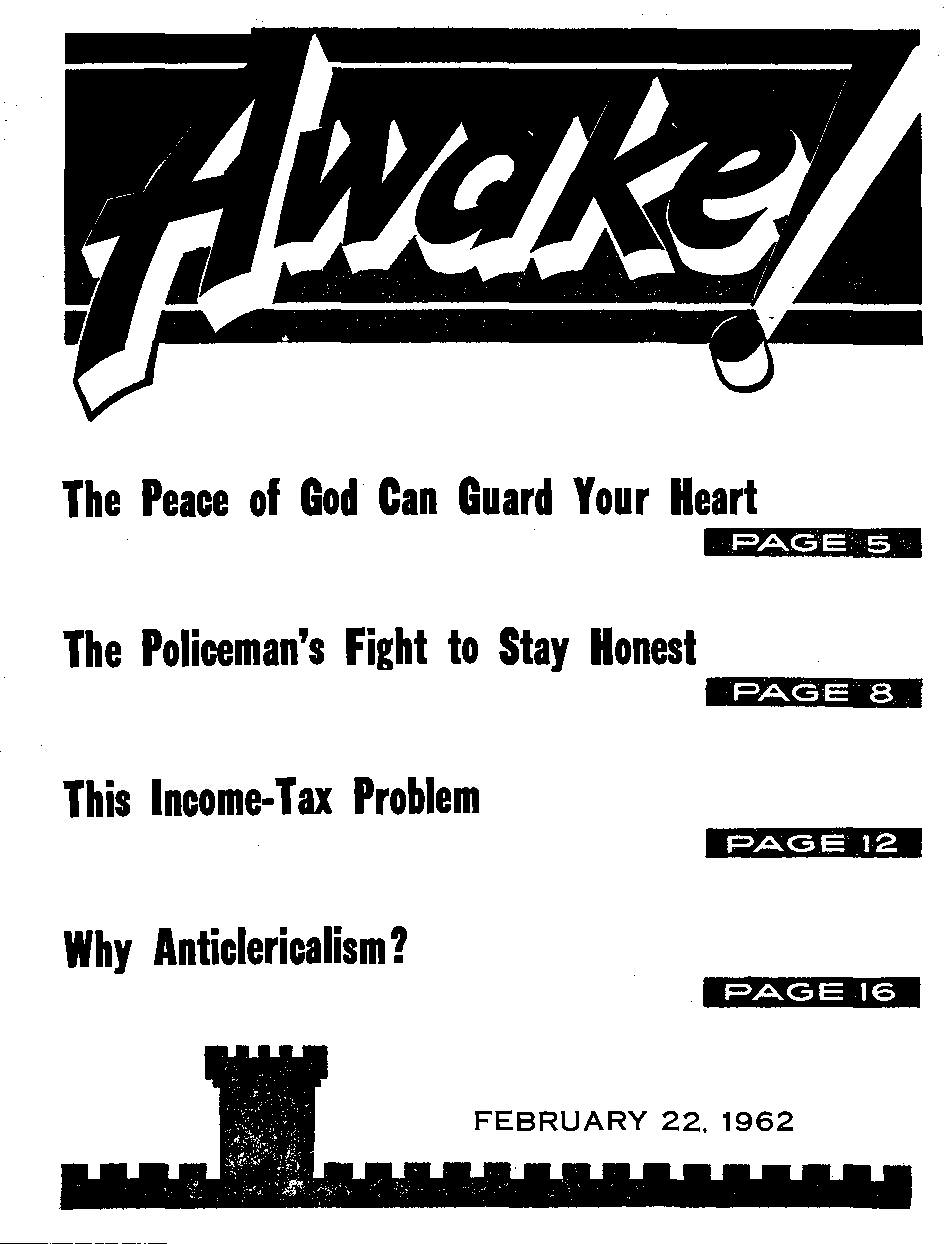
The Peace of God Can Guard Your Heart
PAGE 5
The Policeman’s Fight to Stay Honest
This Income-Tax Problem
PAGE 12
Why Anticlericalism?
PAGE 1©
FEBRUARY 22. 1962
THE MISSION OP THIS JOURNAL
News source* that are able to keep you awake to the vital Inuek Of our tirnes must be unfettered by censorship and selfish Interests. "AwakeI" has no fetters. It recognizes facts, faces facts, it free to publish facts. It Is not bound by political ambitions ar obligations; it is unhampered by advertiser* whose toes must not be trodden on; it is unprejudiced by traditional creeds. This journal keeps itself free that it may speak freely to you. But it does nat abuse its freedom, it maintains integrity to truth.
“Awake!" uses the regular news channels, but is not dependent on them. Its own correspondents are on all continents, in scores of nations, prom the four corners of the earth their uncensored, on-the-scene* reports come to you through these columns. This journal’s viewpoint is not narrow, but is international. It is read in many nations, in many languages, by persons of all ages. Through its pages many fields of knowledge pass in review—government, commerce, religion, history, geography, science, social conditions, natural wanders—why, its coverage is as broad as the earth and as high as the heavens.
"Awake!" pledges itself to righteous principles, to exposing hidden foes and subtle dangers, to champion! ng .freedom for oil, to comforting mourners and strengthening those disheartened by the failures of a delinquent world, reflecting sure hope for the establishment of a righteous New World.
Get acquainted with "Awake!" Keep awake by reading "Awake!"
—— UI—H — w Published Simultaneously in ths United Statbb bt the WATCHTOWER BIBLE AND TRACT SOCIETY OF NEW YORK, INC.
117 Adams Street Brooklyn 1, New York, Yj.S.A.
and in England by WATCH TOWER BIBLE AND TRACT SOCIETY Watch Tower House. The Ridgeway London N.W. 7, England
N. H. Knobs. President Gbant Surraa, Secretary
Printing this iaaua: 3,430,000 4d • espy (Australia, 5d; South Africa, 3|4c)
"Awiktl” li pabllthas In fUlwlat 2* h***>|a: StmlBoathly—Alrlkiw, ClnyanJj, Danish, Diitcii, Eng-lish, FltmlXb, French, tJenuan. Greek, Italian, Japanese, NonredtD, Portuguese, Spanish, Swedish, Tagalog, Zulu. Monthly—Cebu-Vlsayan, Chinee, Zlncano, Korean, Mala-yalam, Polish, Tamil, fjkr&lnlaiL
Yearly yubscrlptloii raUs
Offleei for ssmtawnthly edition*
America, U.S., 117 Adanus BL, Brooklyn 1, N.Y. SI Aurtratta, 31 Barend M, BtrrtWM, N.8.W. &A Canada, 150 Bridgeland Au., Toronto ]9, Qnt. |1 £n| land* Watch Tower Bouse,
The Ridgeway, London N.W. 7 7/-
New Zealand, 821 Nee North Rd., Auckland, 8.W. 1 Snith Atria, private Bag, EUmdsfonteln, Tvl, 70?
Monthly editions oust half the above rata,
flmlttanctB for mbBeriptiona should be sent to the office In ytur country. Otherwise send your remittance to London. Notice expiration sent at tart two lanes befwty sutacrlpticiti
CHANGES OF ADO8ESS thsild nuh li thirty days before your mtnlnn date. Give u your and new addnu (If p»flle, y«r old addreu label). Wat<b Tower, Watai Taww flora, The Rldpway, Lon* den N.W, 7, Em land.
Entered as sscood-class matter at Brooklyn. N.Y. Printed In England
The Bible translation ised fit “Awake?1 b the Rew World Transit! la of the Holy Sotiptsrei, 1961 edition. Wnen other franslatlw arc used the faftowlna aymbois will WRav behind the aMttutn:
AS - American Standard Version AT - An American Translation AV - Auchotiaed Version (1611) .Da - J N. Darby fl version
Zty _ Catholic Douay verslcm KD - The Enujhattt DlagUU - Jewish Publication Soe. Le - Isaac Lexer's wrion
Mo - James Moffatt's verMoti Ro - J. R. RotiMrtuA't waton R8 - Ravlaed Standard Version Yp - Robert Young's region
CONTENTS
Open-minded or Opinionated?
Tragedy at the Circus
The Peace of God Can Guard Your Heart
Magic’s Origin in Babylon
Hie Policeman's Fight to Stay Honest
Where the Doctor Comes on Wings
The Superiority of Moral Beauty
A Miracle or Hard Work?
This Income-Tax Problem
“Your Word Is Truth”
Why Anticlericalism?
Who Are the “Many Antichrists"?
Advancement in Uruguay
Watching the World
WE ALL have opinions on certain subjects. Their possession is one of the things that sets us far above the brute creation. Our opinions are ideas, judgments or conclusions that we reach after more or less carefully thinking about a matter. Thus we read of a columnist giving his opinion of a certain concert or play, a specialist expressing his opinion about what ails a certain patient and what should be done about it, a group of judges rendering a minority opinion. Unfortunately the opinions of many persons are based only on feelings, hearsay, snap judgments, on a woeful lack of evidence.
Regardless of what the subject may be regarding which we have opinions, we do well to be open-minded. All ideas, save those truths in the inspired Word of God, may be said to be subject to change, clarification or expansion. That is why one scientist wrote, “Science is the graveyard of ideas.” Yes, “wise men change their minds but fools never.”
To be opinionated is to be just the opposite of being open-minded. Instead of holding opinions the opinionated person is enslaved by them. Opinionated has been defined as “stiff in opinion; firm or unduly adhering to one’s own opinion,” “obstinate or conceited with regard to one’s opinions.” If we recognize that we are imperfect and prone to err and that there is oh so much that we do not know, then we will be open-minded, receptive to new ideas, willing to investigate.
OR
OPINIONATED?
As we view the pages of history we see ever so many glaring examples of persons who were opinionated. How opinionated were the opposers of the prophet Jeremiah, so certain that no calamity would befall their temple! How opinionated were the religious leaders of Jesus’ day who said that no prophet was to be raised out of Galilee! How opinionated were the Greek philosophers listening to the apostle Paul on Mars’ Hill that mocked the fact of Jesus’ resurrection!—Jer. 7:4, 14; John 7:52; Acts 17: 31, 32.
Coming to more recent times, we find like examples. Thus for more than a century after Galileo, in 1610, proved correct the Copernican theory, that the earth revolves around the sun, opinionated university professors in both Europe and in America kept on teaching the false Ptolemaic theory as a “convenient hypothesis." Harvey’s finding relative to the circulation of the blood fared similarly. According to noted physician Sir William Osler, “The Medical School of the University of Paris, at the time one of the best organized and most important in Europe, declined to accept the circulation of blood during [Harvey’s] lifetime and for some years after his death,” or for more than thirty years. Apparently that generation of professors never did see the light, so opinionated were they!
In our present century Alexander Fleming for some ten years vainly tried to enlist the aid of leading doctors in Great Britain in his discovery of penicillin. So opinionated did those men show themselves to be that Fleming’s simple explanation that he derived .penicillin from the common mold was too preposterous for them to investigate. Says a historian: “As each year went by his hopes diminished. The discovery was on the verge of falling into the abyss of oblivion together with hundreds of other potentially useful discoveries, when war broke out. The situation was reversed almost overnight. Antibacterial remedies became the center of interest on the medical stage ... Thus penicillin was rediscovered,”
Today there are ever so many persons who are so certain that the theory of evolution is true that they refuse to consider any evidence that might indicate that it is wanting in any respect. But is not such a mental attitude also opinionated? That even some of the leading evolutionists have their doubts about many aspects of the theory is apparent from a book review that appeared in the New York Times, June 25, 1961. In it one of America’s leading evolutionists, Loren Eiseley, reviews The Orion Book of Evolution, written by one of the noted evolutionists of France, Jean Rostand.
Among other things, Eiseley states and quote”: “What makes this author a happy contrast to many of his American and English colleagues is his capacity for doubt ... He is unable to convince himself that our observed mutations ‘have been able, even with the cooperation of natural selection, even with the advantage of immense periods of time in which evolution works on life, to build an entire world, with its structural prodigality and refinements.’
“ ‘I cannot,’ he continues, ‘persuade myself to think that the eye, the ear, the human brain, have been formed in this way ... I discern nothing that gives me the right to conceive the profound structural alterations, the fantastic metamorphoses that we have to imagine ... when we think of the transition from invertebrates to vertebrates , . . from reptiles to mammals.’ Are we, he questions, so saturated with the evolutionary story that we are apathetic and no longer realize the wonder of the facts we mouth? Somehow, somewhere, ‘nothing’ brought forth a world of substance and light. Similarly, life has emerged strangely, even if one avoids the word miraculously, out of inorganic substance. . . .
“Rostand doubts that we know a tithe of the hidden story. It would be well if all of us could coax our students [Eiseley is a professor of anthropology at the University of Pennsylvania] to forgo the many certainties of their science and to contemplate, for one humbling moment, the unknown darkness out of which we came and into which each one of us—like an infinitesimal universe—will dissolve in his due season.”
In view of this candid admission of doubt would it not seem that open-mindedness would require one to reconsider the case for creation as presented in the Bible? As elucidated by the publications disseminated by the witnesses of Jehovah, it is shown to be at once beautiful, convincing and comforting.
ciety.” Other countries have even higher suicide rates than the United States. Further indicating the vast number of persons with troubled hearts, in New York city there are some 567 practicing psychiatrists within just thirty-seven blocks. Many disturbed people have recently been calling public officials expressing the fear
UrpHERE was a hoping for peace, but A no good came; for a time of healing, but, look! terror!” How true today these prophetic words of Jeremiah! Expectantly peace is looked for, but in its place one crisis after another. .Terror grips at the hearts of even the strong and mighty as they consider the prospects of nuclear warfare. Just as Jesus prophesied for the last days, “men become faint out of fear and expectation of the things coming upon the inhabited earth.”—Jer. 8:15; Luke 21:26.
This climate of fearful expectation hangs like a dark, ominous cloud over earth’s population. Millions of persons feel that soon a cloudburst may rain down annihila-tory nuclear destruction, so they ignore righteous principles and live for the pleasure of the moment. As such thinking and misconduct increase so do broken homes, juvenile delinquency and the number of confused, disillusioned people with troubled hearts.
Two noted psychologists recently observed: “As a phenomenon that officially kills nearly 20,000 Americans each year, and in truth probably twice that, suicide is one of the gravest problems facing sothat they are radioactive. One doctor said that this new phobia, labeled nucleomito-phobia, was just another “product of the age.”
As never before men’s hearts have been troubling them. Personal problems multiply. The Scriptural counsel is: “More than all else that is to be guarded, safeguard your heart, for out of it are the sources of life.” (Prov. 4:23) Our very life depends on the condition of our heart. This is true not only of our physical heart but equally of our spiritual heart, the seat of motive or center of direction, from which source emotions are expressed. A strong, calm heart is needed by all who would successfully face the ever-worsening world situation. But where can those with troubled hearts turn in order to realize peace and comfort?
Medicine for Troubled Hearts
Some have found a measure of peace and comfort by heeding the advice to get away from civilization and spend some time in the forest. There one may follow a trail carpeted with springy pine needles. Overhead tower majestic trees, somehow emanating a sense of security and stability. The warm sun filtering from above reflects beautifully on the green leaves and foliage. How pleasant to the ear the song of the forest birds! As one strides through the woods or over a grassy meadow one feels exhilarated as one inhales deeply the clean, tangy air. What a calming, peaceful, uplifting effect such an experience has upon a person! One can just feel the peace. Certainly the Creator of these marvelous surroundings must be a God of peace. He is.
Long ago the young fugitive David spent much time out of doors as he fled for his life from King Saul. A man often beset by troubles, David spent time considering the marvelous works of creation. Jesus Christ also on occasion made the effort to get outside by himself, in quiet “lonely places,” These periods in the out-of-doors must have been calming, peace-stimulating times for these men, who were familiar with troubles.—Ps. 8:3; 19:1, 2; Matt, 14:23; Mark 1:35, 45; Luke 4:42.
The Source of Peace
It may be true that both David and Jesus drew a measure of comfort from solitude in peaceful outdoor surroundings. However, this peace in itself was insufficient to guard their hearts for the tremendous trials and troubles they had to face. While in the out of doors they prayed to the Creator of their peaceful surroundings. They unloaded their burdens upon him, as David himself was inspired to write: “Throw your burden upon Jehovah himself, and he himself will sustain you." It was the peace they received from God that guarded their hearts and sustained them. Jehovah is “the God who gives peace.” —Ps. 55:22; Rom. 15:33.
The nations have failed to gain peaceful relations with one another because they have not looked to the Source of peace, Jehovah God. Individuals looking to this world and its systems of education for guidance have likewise not come to know real peace. Peace is defined as “calmness of mind and heart; serenity of spirit; harmony in human or personal relations.” Such peace is a need of mankind. This world cannot satisfy this need, for it has not come to know the Source of peace.
Jesus had peace. With a calm, courageous heart and serene spirit he faced the trials of the final day of his earthly ministry. He knew his disciples would need this same peace in order to endure the trials that lay ahead for them. Therefore on his last evening with his disciples, after instituting the memorial of his coming death, he spoke so as to impart his peace to them. He said: “I leave you peace, I give you my peace. I do not give it to you the way that the world gives it. Do not let your hearts be troubled nor let them shrink for fear.” What calming, peacestimulating encouragement from one who knew he was to die on a torture stake the following day! Jesus concluded, saying: “I have said these things to you that by means of me you may have peace. In the world you will have tribulation, but take courage! I have conquered the world.” Finally Jesus led his disciples in prayer to “the God who gives peace,” petitioning that he keep them in peaceful unity.—John 14:27;16:33;17:20-26.
Jesus and his first-century followers displayed peace that the world from that time to this has not come to know or understand. With the ‘peace of the Christ controlling in their hearts’ early Christians dwelt together in unity, showing kindness, compassion and love for one another. (Col. 3:12-15) This peace allowed them to face hungry lions in the Roman arena with courageous hearts. Caesar did not give them this peace. No worldly school taught it to them. It came from Jehovah God, to whom they prayed and in whom they trusted. They received it in fulfillment of the promise: “The inclination that is well supported you will safeguard in continuous peace, because it is in you that one is made to trust.”—Isa. 26:3.
ARTICLES IN THE NEXT ISSUE
• Why Teach Children Religion?
* Kenya's Calamitous Famine.
• Hereditary Tendencies.
* What Every shioker Should Know. • How to Teach in a Public Discourse.
The peace of God can guard the hearts of all those who pray to and trust in him. “Do not be anxious over anything, but in everything by prayer and supplication along with thanksgiving let your petitions be made known to God; and the peace of God that excels all thought will guard your hearts and your mental powers by means of Christ Jesus.” This peace of God can guard your heart and mental powers. However, to receive it you must be taught by Jehovah.—Phil. 4:6, 7.
Education That Brings Peace
The prophecy of Isaiah says: “All your sons will be persons taught by Jehovah, and the peace of your sons will be abundant.” The apostle Peter showed that peace comes through accurate knowledge, when he said: “May undeserved kindness and peace be increased to you [how?] by an accurate knowledge of God and of Jesus our Lord.”—Isa. 54:13; 2 Pet. 1:2.
For you to receive this knowledge that brings peace you must “keep seeking for it as for silver, and as for hid treasures you [must] keep searching for it, in that case you will understand the fear of Jehovah, and you will find the very knowledge of God." Through such a diligent study of the Bible you will come to love Jehovah’s law, just as did Jesus and his followers. Its righteous principles will sink into your heart and you will want to live by them. Serving Jehovah and being obedient to his law will become the chief objective in your life. This will bring you peace, for, declares the psalmist, “abundant peace belongs to those loving your law.”—Prov. 2 : 4,5;Ps. 119:165.
This soothing, assuring, precious gift of peace, one that “excels all thought,” will guard your heart, making it courageous and strong and able to sustain you through any crisis or trial that may lie ahead. This peace enabled Jesus to face a torture stake; Daniel, a den of lions; the three Hebrews, a fiery furnace; and in this day, thousands of Christian witnesses of Jehovah, fiendish torture and death in Nazi concentration camps and Communist prisons. The sustaining hope of all these faithful men and women has been Jehovah’s promised reward of life in a new world of righteousness, a promise recorded in his Word: “There are new heavens and a new earth that we are awaiting according to his promise, and in these righteousness is to dwell. Hence, beloved ones, since you are awaiting these things, do your utmost to be found finally by him spotless and unblemished and in peace.”—2 Pet. 3:13, 14.
Do you desire the peace of God, peace so strong that your heart will “not fear, though the earth undergo change and though the mountains totter into the heart of the vast sea”? (Ps. 46:2) Soon this earth will experience such an earthshaking change, no, not by a downpour of nuclear weapons, but by the unleashing of natural forces at Jehovah’s war of Armageddon that will shake the very foundations of the earth. Only the peace that God gives will be able to guard your heart during that time of great trouble. So prepare now to survive then. Strengthen your heart by taking in an accurate knowledge of God and his purposes. This will bring you peace of mind and comfort now, and will equip you to face the great time of trouble ahead.
THE POLICEMAN'S
A VETERAN policeman once said, “The biggest thing we have to fear is corruption.-It’s the cancer that can destroy a police department.” Most recent of the major police scandals that have rocked nearly
every major American city is the much-publicized Denver, Colorado, debacle. Early last November a count showed that forty-one patrolmen, one sergeant and one detective—nearly 6 percent of the Denver police force—were arrested for operating the biggest burglary ring in the city’s history. There were at least five police safecracking teams using squad cars and the police radio network to execute burglaries. In fifteen years more than a quarter of a million dollars and untabulated amounts of merchandise had been stolen. Police officers were also involved with gambling and prostitution.
In a plea for understanding, one of the convicted policemen wrote from his prison cell'. “The next time an officer goes by your home or place of business look at him. He is a man who will risk his life today for one of your children, yet his head is hung in shame.” Policemen in other cities could understand. In January, 1960, a talkative thief exposed thirteen Chicago policemen who were arrested as accomplices in a string of robberies. When Cleveland did some housecleaning a few years ago, nine high-ranking officers went to jail and thirty-three other policemen had to resign, Los Angeles’ fine police force was not always so commendable. It took a retired marine general to come in and restore discipline and the public’s confidence. For years the Philadelphia police department had a reputation for dishonesty and inefficiency. In 1952 a new police head undertook reforms. Within six years 3,000 of the 5,000-man force were replaced!
The New York police department has a long history of scandals erupting periodically. In the 1890’s a police captain revealed that he had collected money from gambling houses, saloons and brothels. Corruption came to light before the first world war and in the 1930’s. A 1943 outbreak involved 111 officers of various ranks who were charged with taking bribes. Scores of New York policemen were indicted in 1950 when bookmaker Harry Gross testified that he paid $1 million for protection. As recently as 1959 twelve New York officers were arrested for various crimes, including extortion and a rape murder.
The Hard Fight
There are about 316,000 law officers of all kinds in the United States, A very small percentage of them will ever become outright criminals. Many of them are very dedicated men. But all of them, by the nature of their profession, face a constant fight to stay honest. Many a rookie has been disillusioned after graduation from the police academy. Though instilled with the desire to earn an honest living while pursuing the career of law enforcement, he may soon learn that police work involves a number of “extenuating factors.”
Suppose, for example, his immediate superiors—who will pass on his deportment during probation—have come to the conclusion that one can accept gratuities and still be a good policeman. They m&y rationalize that there is nothing really wrong with taking a gift; that it is something smart people everywhere are doing. Is the rookie going to stick by his resolve to be honest, or will he fall in line with the practice of taking free cigarettes, meals, coffee, turkeys and liquor? Dare he antagonize the men who will fill out his probationary report? This is the problem that has faced rookie policemen where dishonesty has gone unchecked in a police department.
The hard life of a policeman does not help matters. To live in peril from armed criminals and trigger-happy juveniles is bad enough, but the patrolman faces much more. While he fears to be too hasty about shooting an armed opponent, he also does not want to give his associates the impression he is a coward. There is also the matter of his home life. Can a policeman witness no end of sordid crimes and all kinds of tragedies without becoming hard-boiled, if only in self-defense? And if he becomes tough in order to preserve his mental balance, how is he to succeed in playing the role of affectionate husband and fond par
ent, which wife and children demand of him? Even his friends will introduce him to people as “Mr. ----; he’s a police
man.” All this makes him a man apart from his fellow citizens. He belongs to a fraternity of career men who suffer a high rate of ulcers, suicides and divorces. Since his fellow officers understand him and sympathize with his fears and tensions, he must be accepted as one of them. This compulsion to belong may force him to condone dishonesty if it happens to exist in his police department.
Nor is that the only source of pressure that closes in on an honest policeman. Suppose his house is mortgaged, or there are heavy doctor bills. Perhaps he wants to send his son to college. What if his police salary just does not cover it? Regulations may forbid “moonlighting,” taking on outside work. Handouts and payoffs may seem to be the answer. Where policemen have developed a greed for money, as in the recent Chicago scandal, they may stoop to burglary. Others, as in the Denver case, may take to looting stores where there have been break-ins. Last March a New York detective with nine police commendations and a patrolman were arrested for attempted extortion of a chauffeur who had been involved in a street brawl. They offered him freedom from arrest for $250. He paid them with marked bills and they were caught.
The large number of dedicated policemen face a hard fight to maintain their honesty and morale. In some cases, “too zealous” performance of duty has aroused political interference, resulting in a reprimand or even an unwanted transfer to another branch of police work. Arresting the “wrong people” has also caused police officers to suffer loss of promotion and the pay increase that would have come with it. Patrolmen are not encouraged to enforce the law when they come into court and encounter judges who are overly sympathetic with offenders. The demoralizing effect of such things was pointed out by the convicted Denver policeman who said: “Either you enforce the law or you forget it, I couldn’t enforce it so I forgot it.” Another stated: “I was really discouraged and disillusioned about the ‘glory badge’ stuff. So I took the big dive.”
Remedies?
One veteran police commander believes that police dishonesty is not out of hand as long as other policemen are reporting it. Nevertheless, the problem concerns all police departments and much thought goes Into possible remedies. In some cities defective recruiting procedures have been allowing men ill-suited and insufficiently educated to enter police work. Better screening has been urged as well as higher moral and educational standards. Also, if there is to be an efficient police department, it must be entirely free from political interference. However, such interference is often traditional and is not easily conquered. Criticism has also been leveled at Civil Service procedure, judicial reversal of dismissals and police unions that can force a department to retain a man it considers unfit for the job.
Several years ago the New York police department organized a Chief Inspector’s Squad, which soon came to be called the "Gestapo,” It was not pleasant work. The squad would investigate a policeman’s private life, check out a civilian complaint of police extortion or question a patrolman on his beat But it got results. Recently the Chicago force established a similar unit that serves as a division of internal investigation.
To induce officers to speak up, a department may give promotions to policemen who expose corruption among their fellow officers. Sometimes suspected policemen are transferred to different precincts to break up ties with lawless elements. In Denver, however, this merely spread the corruption. Another suggestion heard recently is stiffer sentences for convicted policemen. Frequently mentioned is the matter of better police wages. Certainly men exposed to constant danger while upholding the peace and safety of the community deserve to be amply rewarded. In addition, in some departments there is a real need for more men to serve as supervisors and inspectors. It is very difficult to maintain discipline and efficiency in a semimilitary organization when too many patrolmen come under the direct supervision of only one man.
The repeated police scandals Involving payoffs from gamblers have put the spotlight on present antigambling legislation in the United States. The present laws allow Americans to place bets at a racetrack but not on a street corner. A prominent judge recently criticized this double standard and recommended that gambling laws be separated from the body of criminal law on the theory that a gambler is not as bad as a burglar or a killer. It is suggested that gambling be legalized, thereby doing away with the need for bookmakers to pay patrolmen to look the other way. But if that would solve the bookie problem (without luring many more into gambling), would similar changes in legislation correct other sources of corruption? Is drag addiction to be legalized? Some have urged that clinics be established where addicts could get needed doses, thereby eliminating the gigantic narcotic racket. But would it invite many more people to take up the habit? And what about prostitution? Are traffic laws to be done away with too, so there is no possibility of payoffs for traffic violations? Obviously society cannot abolish all law in order to prevent police corruption. Inasmuch as there must be laws, there are opportunities for payoffs. This brings up the matter of the public’s role in the policeman’s fight to stay honest.
The Public’s Responsibility
Mayor Richard Batterton of Denver made an interesting comment on the scandal in his city: “It is not only a tragedy in itself but In what it indicates about the morals of our country as a whole.” In this connection a remark by Philadelphia’s Mayor Richardson Dilworth is noteworthy: “For every politician who can bd bribed there are at least ten businessmen waiting in line for the privilege of bribing him.” If these businessmen want to stay open after legal hours, sell on Sunday where prohibited by law, or park in no parking zones, they will also be waiting to bribe the patrolman on the beat. “The wonder is,” said one police commissioner, “not that cops go crooked, but that so many of them stay honest.”
The policeman is a representative of a cross section of the public from which he came. Fundamentally he is just as honest, or crooked, as a typical cross section of that public. He has gone to the same churches, the same public or parochial schools. He reads the same newspapers and has many similar interests, including the desire for a comfortable income and some pleasures in life. But when there is a general moral breakdown, as exists today, and citizens everywhere are working overtime at being dishonest, what can society expect from its police? Donning the blue uniform does not make a man honest any more than honesty comes to the shopkeeper by tying on his white apron or wearing a gray business suit. Like the businessman, somewhere along the line each police officer has to make a decision, and that will show what he is made of. It is a decision that faces, not only policemen, but the doctor, the lawyer, the garage mechanic, the corner druggist, the college student, the boy and girl in high school—it faces everyone. In the policeman’s case, since he is a symbol of law and justice, he should surely want to make the right decision for his conscience’ sake and to avoid a life of hypocrisy.
But how can he make this choice of honesty when society al] around him has fallen to the condition of ancient Jerusalem, of which the prophet said: “Your princes are stubborn and partners with thieves. Every one of them is a lover of a bribe and a chaser after gifts”? (Isa. 1:23) The answer lies in cultivating something higher than the love of money. It lies in obedience to higher laws than the community’s. He must cultivate love of God and neighbor and respect for godly principles, including the one that reads: “You are not to accept a bribe, for the bribe blinds clear-sighted men.” That is the only way anyone can win the fight to stay honest,—Ex. 23:8.
THE SUPERIORITY OF MORAL BEAUTY
Dr. Alexis Carrel, distinguished scientist, comments on the superiority of moral beauty in his book Man, the Unknown: “Moral beauty Is an exceptional and very striking phenomenon. He who has contemplated it but once never forgets its aspect. This form of beauty is far more impressive than the beauty of nature and of science. It gives to those who possess its divine gifts, a strange, an inexplicable power. It increases the strength of intellect. It establishes peace among men. Much more than science, art, and religious rites, moral beauty is the basis of eivUization/'—Pages 130, 131.
iTOte’
April 15,1962, is the unpleasant deadline for many of the more than eighty-four million taxpayers in the United States. Their Federal Income-tax returns must be filed by that date. Filling out this tax return is an ordeal that involves many painful hours of mathematical computations and strenuous efforts to understand complex and wordy tax forms and instructions. But what is most painful is the generous bite the government takes from the taxpayer’s income —20 percent for those in the lowest bracket and 91 percent for those in the highest bracket. But as unpleasant as taxes are, they are generally recognized as being necessary.
Governments need money in order to function and to provide the many benefits people have learned to expect from them. The bulk of that money comes from taxation—involuntary contributions from the people for the upkeep of their respective governments. Taxes are their payment in return for the maintaining of law and order and other services.
Because of these services and the right a government has to tax its people, Jesus Christ said: “Pay back, therefore, Caesar’s things to Caesar, but God’s things to God,” (Matt. 22:21) This command obligates
Christians to pay taxes. Caesar mints the money and provides services for which he is entitled to receive a portion of that money back in taxes. Recognition of this by a Christian means he will pay taxes on all his taxable income. He will not become a lawbreaker by purposely failing to report a portion of it or by falsifying his report.
What to Report
In the United States all earned and unearned income is usually subject to taxation. Earned income is the money or property that you may receive in return for personal services such as wages and salaries. Unearned income is what you receive from the sale of property or from income that comes from property such as real estate, rentals, investments, and so forth.
If, in addition to your regular wages, you receive a small income from practicing a hobby during your spare time, this income must be indicated on your tax return. So also must tips, commissions, fees for service, bonuses, rewards, interest on bank accounts and bonds, canceled debts, dividends and capital gains from securities and other holdings, amounts recovered from bad debts, vacation allowances, and so forth.
When you win a prize or are awarded an all-expense tour, the fair market value of the prize or tour must be estimated and reported as income. The value of turkeys, hams, and so forth, that often are given to employees on holidays are not required to be reported with your income, although the employer is permitted to deduct their value from his income as a business expense. In the event that he should distribute cash, gift certificates and similar things that can/be easily converted into money, you are required to report these things as income.
The financial gain you receive from selling your house is taxable income unless you purchase another house for an equal or greater amount within one year. Since your house, furnishings, securities and automobile are classed as capital assets, any financial gain from the sale of them is usually taxable. When they have been held for six months or more only one half of the profit you make is subject to taxation. This is an attractive feature about capital gains.
You must carefully ascertain all your sources of income, whether you receive money, goods or services. If someone does work for you in payment for services you rendered him, do not overlook his services as taxable income. The market value of them must be included in the amount you report.
Willingness to obey Caesar’s tax laws does not mean you should pay more than is required. You do nothing wrong by searching for every possible legal means to reduce your tax bill. On this point consider what the Lord President of the Court of Session in Edinburgh, Scotland, said regarding the British taxpayer: “No man in this country is under the smallest obligation, moral or other, so to arrange his legal relations to his business or to his property as to enable the Inland Revenue to put the largest possible shovel into his stores. The Inland Revenue is not slow—and quite rightly—to take every advantage which is open to it under the taxing statutes for the purpose of depleting the taxpayer’s pocket. And the taxpayer is, in like manner, entitled to be astute to prevent, so far as he honestly can, the depletion of his means by the Inland Revenue.” The same can be said of taxpayers in other countries.
Exemptions
A basic exemption of $600 is granted the American taxpayer. Anything earned above this amount is taxed according to a sliding scale, with the tax rate increasing with greater income, requiring those who have the most to pay the most.
If you are married, you may avail yourself of an additional exemption of $600 by filing a joint tax return with your wife. It matters not whether she earned anything or not. In some instances it is advisable for husband and wife to file separate tax returns, such as when both have capital losses to deduct. Each can then deduct up to $1,000, whereas the joint return is limited to $1,000. For each child you get an additional $600 exemption.
Suppose you have a son under nineteen years of age or one who was in school for five months of the year and earns more than $600 in his spare time. If you provide more than half of his support you are entitled to claim a $600 exemption for him. Because of his earnings he must file an income-tax report of his own, but he may also deduct the exemption of $600. Thus, in this case, the basic exemption is used twice on the same person.
In addition to the basic exemption you are granted for yourself, you are entitled to an additional $600 if you are sixty-five years of age or over, and the same is true for your wife. On a joint return, that would give you an exemption of $2400. Blindness entitles you to still another exemption of $600.
The death of your mate does not deprive you of her exemption for that year. The same is true of a child that dies shortly after birth. The exemption may be claimed for the child even when it lives only momentarily. Suppose the child is born in December and dies in January of the next year, you are entitled to the $600 exemption on your tax return for the dosing year as well as $600 on your tax return for the next year.
Let us say you have an aged dependent in your house who receives $650 from a Social Security pension and an annuity of $500. Although this totals more than the basic exemption of $600, you may claim the dependent exemption if you provide more than half of the person’s support, because the Social Security pension of $650 is tax exempt. Suppose the dependent is your father or mother, who is being supported by you and two brothers, with no one providing more than half of the support. One can claim the exemption, nevertheless, if he provides at least 10 percent of the support and the others sign a waiver on the claim.
What you receive as gifts is not to be considered as taxable income. This includes a bequest of a specific sum or of specific property. But if the property you receive as an heir produces income, that income is taxable. The money you receive from a life insurance policy upon the death of the insured is also exempt from income tax.
Persons with much investment capital often put a generous portion of it into State and municipal bonds, since the interest paid by such bonds is tax-exempt income. In the case of stocks this holds true for the first $50 a person receives in dividends each year plus 4 percent of the balance.
Deduction#
You most likely want to avail yourself of every deduction granted you by the government Yet many taxpayers, due to ignorance of the many deductions for which they may qualify, unwittingly pay more than is required. It has been estimated that American taxpayers pay every year approximately four billion dollars more than they owe. Because of the savings that can be had by knowing all possible deductions, some persons feel that it pays to hire a tax expert to help them make out their tax return. They feel that the money he saves them more than pays for his fee. Suppose we consider some of the deductions that may be able to help you.
Are you buying a home? Do not overlook the interest you pay on the mortgage. It is a permissible deduction. So also Is the interest or carrying charge you pay when buying something on the Installment plan. The limit is 6 percent of the average unpaid balance due.
Contributions to qualified organizations, listed in the Internal Revenue, publication entitled "Your Federal Income Tax,” are permissible deductions. If you list them instead of taking the standard deduction of 10 percent, you may deduct as much as 20 percent of your adjusted gross income, that is, your total income minus exemptions and deductions claimed. An additional deduction of 10 percent is permitted for contributions made to religious organizations, tax-exempt educational institutions and tax-exempt hospitals. In the event that all one’s contributions were, made to such institutions, he would be entitled to deduct as much as 30 percent.
For whatever claims you make be able to substantiate them with proof. Canceled checks, check stubs or a daily record of your expenses is helpful when you are questioned by a tax examiner.
The law allows for the deduction of certain transportation expenses resulting from your business. It also permits travel deductions for expenses incurred in charitable religious work such as missionary activity. When you travel outside your community to engage in religious activity, such as to a religious convention, the transportation costs, food and lodging become deductible items on your incometax return. Even used clothing and other items contributed to a charitable organization are deductible at their fair market value. In such instances the expenses are classed as religious contributions and are permissible within the 30-percent limit already discussed.
During the course of a year you pay out a substantial amount in State and local taxes. These can be deducted on your Federal tax return. Such taxes include State income tax, admission taxes, real and personal property taxes, automobile license fees, poll taxes, stamp taxes, State gasoline taxes, use taxes and local and state retail or sales taxes.
Do not pass over possible deductions from casualty losses and theft. Damage done by fire or storm to your car, home or a valuable tree is a legitimate deduction. What it would cost to repair the damage is a fair estimate of what to deduct, provided that insurance does not cover the damage. If it does, you can make no deduction. Stolen articles are also deductible, provided that you have satisfactory proof that they were stolen and not mislaid.
Have you had any medical expenses? Give them careful consideration for possible deductions. When they exceed 3 percent of your adjusted gross income almost all of them are deductible. That includes the cost of diagnosis, treatment, limited medical supplies, eyeglasses, dentures, hospitalization, nursing, whether paid to physicians, surgeons, dentists, optometrists, chiropractors or osteopaths, also premiums for accident and health insurance. For persons over sixty-five years of age the limit of 3 percent is removed. Transportation costs involved in getting medical treatment are another deductible cost. When compensation is received under a sick-benefit plan, you can deduct as much as $10 when you take an afternoon off from work for medical treatment of an injury.
Special work clothes that cannot be used in ordinary wear, such as helmets, work glaves, rubber boots, special uniforms, and so forth, are necessary business expenses that are legal deductions on your incometax return. So also are the expenses for educational courses for improving your skill in your employment or to meet requirements established by your employer.
Income splitting is often found advantageous by persons who own their businesses. By making the various members of your family, including infants, equal partners, you can divide up the income from your business and thus reduce, by a sizable amount, your personal income tax. Another method is to create a trust for the benefit of a minor child in your family. Since the trust pays its own income tax, the father reduces the amount of his taxable income. Several of such trusts can mean a big saving for the man who receives a large income.
Whether you are in the upper- or lower-income brackets, the yearly income-tax return is an unpleasant problem. Claim every possible exemption and deduction to which you are entitled. Make your report neat and easily read, double-checking your mathematics for accuracy. Have convincing arguments and adequate records to support your claims in case a tax agent questions you. Honestly fulfill your tax obligation to Caesar, and then heave a sigh of relief that the income-tax problem is behind you for another year.
m
ANTICLERICALISM
HEN Roman Catholic c Puerto Rico ordered Ca to vote for the Popular Democ ty in the 1960 elections, the
Protestant lands were shocke unaccustomed to clericalism, theV w stunned to see clerics openly usi religious authority to influence an el&Qtio The dire warning that it would be sNgin to disobey the order of the pastoral lett violated the principles of free elections. The reaction of the Catholic people of
Puerto Rico was also surprising to Protestant eyes.
Instead of obeying the order, a majority of the people voted for the party that was denounced by the clergy. They refused to support the clerically endorsed Catholic Action Party. The political meddling of the clergy stirred up anticlerical feelings in their flocks. In a few instances priests were booed and in others some, devoted Catholics walked out of the churches. The editor of the San Juan Star wrote: “Because this pastoral letter is ... an affront to the people who have built a model democracy, we hope Pope John XXIII will transfer the Bishops to posts outside Puerto Rico, and that they will be replaced by representatives of Catholicism who recognize the indispensability of the principle of the separation of church and state in a democracy.’’
After the defeat of the Catholic Action Party a legislative committee made an investigation of the elections and, among
s bf
Pat-
Oli
tl
been sue
an
ir
in
istco.
eople has
the interest of the temporal ends of our collective life. Every action of the highest dignitaries of the church, as also of the priests and prelates during this period, constitutes the most serious challenge that has ever been thrown down to our people, a challenge which tends to destroy our democratic and civic prerogatives. . . . The right of the people and of the electorate of Puerto Rico to establish and guarantee a government of the people and for the people, the basis of all democracy, would be destroyed and in its place we would have a government of clerical decree.”
The anticlericalism that manifested itself in Puerto Rico was not from Communists but from indignant Catholics. Their opposition to the political meddling of the priests did not mean they were turning against their religion. This is seldom the case in the many Catholic countries where there have been instances of anticlerical-ism.
Elsewhere in the Americas
Even dictators who agree to union of church and state and grant many privileges to Catholic clerics can eventually become incensed at clerical political activities. The former dictator of Argentina, Juan Perdn, found this to be the case. Although a Catholic, he took anticlerical action in 1954 by charging three bishops with attempting to undermine his government. From then until his overthrow the Catholic clergy were confronted with repeated acts of anticlericalism. Clerical teachers were purged from the state-controlled schools, the government subsidy to Catholic schools of $6 million a year was withdrawn, religious education was abolished in public schools, all religious institutions were made subject to taxation, a bill was passed to separate church and state, many priests were arrested, two of the highest church dignitaries were deported and mobs burned several churches. Again this was the action of Catholics, not Communists.
Former dictator Trujillo of the Dominican Republic was also closely allied with Catholic clerics for many years. In 1954 he signed a concordat with the Vatican granting special treatment for the Catholic clergy and religious of his country. But after the arrest of a Catholic seminarian in December, 1959, on charges of possessing homemade bombs and then an attempt on his life in January of 1960, his friendly attitude toward the clergy changed. It appears that he had reasons for concluding that the clerics were interfering in the political affairs of his government. Although a Catholic, he launched an anticlerical campaign. Daily the priests were attacked verbally by the government radio Caribe. In a period of five months, more than fifty priests were expelled from the country for political reasons by this indignant member of their flock.
In view of these manifestations of anti-elericalism by Catholics who resented political interference by clerics, it is not surprising that Cuba is also experiencing a wave of anticlericalism. In this country where 90 percent of the people are Catholic, the clergy have been showing displeasure over the government. They cannot influence it as they would like to. The present rulers have accused them of interfering in the political affairs of the state and have warned them to “stick to religious and philosophical issues.” As in other predominantly Catholic countries they apparently have not. Consequently, many priests have been arrested and more than two hundred Spanish priests and nuns have been deported to Spain.
To the south of Cuba in the country of Colombia, a violent display of anticlericalism manifested itself in 1948 after the assassination of the Liberal leader Jorge Gait&n. Almost all the churches in the city of Bogota were either destroyed or damaged. The anger of the crowds that rioted for eight days was also vented on the residence of the papal nuncio, laying it in ruins. This popular display of anticlericalism was not by people who hated the Catholic religion, but by Catholics themselves.
Mexico
A long history of oppressive clericalism in Mexico prepared the way for repeated eruptions of fierce anticlericalism in that country. A particularly sore spot with the poor people there was the enormous wealth accumulated by the church. The eighteenth-century bishops of Puebla, Valladolid and Guadalajara were among the richest men in Mexico, In his book A History of Mexico, Professor Henry Bamford Parkes states: “Early in the nineteenth century it was estimated that more than half the land in use in Mexico had become the property of the clergy. The Church, moreover, was a money-lending institution, owning at least two-thirds of the capital in circulation.” In view of this it is understandable why Jose Morelos, one of the leaders of an abortive revolution against Spanish rule in the early part of the nineteenth century, advocated the seizing of church lands. Although a Catholic, he saw that this was necessary in the interest of the economic welfare of the Mexican people.
Later, under the presidency of Benito Ju&rez, who also was a Catholic, drastic decrees were made against the clergy. The Laws of Reform provided for the seizure of all ecclesiastical property except actual church buildings. Ail monasteries and nunneries were to be suppressed, cemeteries were to become national property-and marriage was to be by civil contract. Churches were stripped and gutted wherever the liberal armies went. Relics and images were piled on fires, and monks who fought in the ranks of the conservatives were shot. All this was done by angry Catholics.
The crushing of liberal government by the ruthless dictator Porfirio Diaz did not upset the clergy. Instead, they gave him full support, using their influence to keep the people submissive. Under the protection of this despot they regained much of their power and began to accumulate property again. When the revolutionary government that was formed after the fall of Diaz was usurped by another dictator, Victoriano Huerta, clerics were quick to support him as they had Diaz. It is not surprising, therefore, that when Huerta was overthrown anticlericalism flared up violently, with some priests being shot and some churches being desecrated.
When it is seen how much the Mexican people have suffered from clericalism, it is understandable why the Catholic church today does not enjoy liberties in Mexico that she has in other liberty-loving countries. It was with good reason that a former president of Mexico, Lazaro Cdrdenas, once said: “You claim that liberty of conscience is recognized by all nations living under a regime of social and democratic morality, but the Catholic church has always undermined any liberty of conscience, ... In Mexico, the Roman clergy has been the instigator and sustainer of most of our bloody internal warfare and is still guilty of treachery to the fatherland.”
Spain
Unlike Mexico, which broke free from the strangling power of clericalism, Spain is still captive to it. There clericalism is in full bloom and liberty is in the deepest dungeon. As the Catholic clergy have supported despots in the Americas so they support the brutal dictatorship of Francisco Franco. Being a loyal member of the Catholic church, Franco fulfills the wishes of the religious hierarchy, granting union of church and state, church control of education and the curtailment of freedom of worship. For his loyal service the Roman Catholic Church gave him the highest pontifical decoration, the Supreme Order of Christ,
Beneath the surface in Spain anticlericalism smolders dangerously, threatening to burst out into a devastating conflagration. Fear that it will was indicated by more than three hundred Basque priests who signed a protest that indicted the Franco regime for destroying liberty and for police brutalities. The protest was sent to their bishops, but no action is expected from the Spanish Catholic hierarchy. In the indictment the priests said: "We trust that this testimonial of priests in daily contact with the people will be heeded. It would be a grave mistake to discount the seriousness of a situation which can harm the Church in our diocese for generations to come.”
In its report of this indictment, the Manchester Guardian said: “The most vital part of the clerics’ letter emphasises the idea that the Roman Catholic Church in Spain is so closely identified with the Franco regime that the Spanish people are shunning the clergy.” In its report of the same incident the New York Times remarked: “The fear among the Franco opponents in the Church is that if the regime falls, the public may attack the Church for allegedly having condoned dictatorial abuses.” This same view was expressed by journalist Herbert L. Matthews, an expert on Spain. “As of today,” he says in his book The Yoke and the .Arrows, “it is Generalissimo Franco who sits on that lid, and I met few Spaniards who denied that when he dies there is going to be another explosion of anticlericalism.”
Murderous eruptions of Spanish anticlericalism have lashed Spain repeatedly during the past 130 years. Churches have been burned and nuns and priests slain by members of their own flocks. This popular resentment of the clergy stems from clerical support of harsh rulers who have oppressed the Spanish people unmercifully and from the accumulation of vast riches by the church while the people led lives of poverty and hunger. During the nineteenth century the Catholic church held from one third to one half of all the money and property of the country.
“The popular belief,” says Herbert Matthews, “that the Church has wealth in excess of these needs [for operating its institutions and churches] and that it fattens on the country’s revenues while the people lead harsh and hungry lives has contributed to the extraordinary force of Spanish anticlericalism. ... A Spanish worker or peasant will say: 'The Church is rich; we are in misery. The Church supports the oppression of the Government; therefore we are against the clergy. But we are Catholics and remain Catholics.’ Generation after generation this mentality has been formed and whenever in modern times the bayonets that guarded the Monarchy and Church were removed, there was a terrible popular outburst. Church burnings and the killing of priests and nuns, in their modern phase, go back to 1835.”
Clergy to Blame
The Catholic clergy have themselves to blame for the many expressions of anticlericalism on the part of their religious flock, and the same can be said for the Russian clergy of the Eastern Orthodox Church. Unlike Jesus Christ, who kept separate from politics, they have persistently meddled in political affairs and have given their wholehearted support to despotic rulers despite the suffering those rulers brought upon the members of their church. Unlike the apostles, who did not seek to accumulate great material wealth, the Catholic hierarchy has gathered great riches and vast land holdings. What else could this do but build up bitter resentment among poor Catholics? During an anticlerical demonstration in Spain, a Spanish priest expressed succinctly the reason for anticlericalism when he said: “The church forgot the poor and now the poor have forgotten the church."
The religious leaders of Jesus’ day also forgot the poor in their avid quest for power and wealth, but Jesus Christ and his apostles were different. They expended themselves in behalf of the common people. Where the Christianity they exemplified exists there is no possibility of anticlericalism erupting among professing Christians.
d-vsncement of the
noon
By “Awake.i" eorYupontitnt In Umgiiay
Kingdom work was recently reached in the South American country of Uruguay. This was on October 28, 1961, when the Watch Tower Society’s new branch office and missionary home was dedicated. The dedication program, held in the new Kingdom HaU, pointed up the fine advancement that has been made in this country.
During the Saturday-aftemoon portion of the dedication program, a German missionary who has been in Uruguay since 1939 recounted the early experiences of the five original German pioneers who had witnessed throughout Uruguay, traveling on bicycles loaded with tents, small stoves, cots and literature. These pioneers did the greater part of the Kingdom preaching here up until about 1945, when there were a few more than thirty publishers in Uruguay.
Another speaker highlighted the growth of the New World society here. Uruguay had been handled by the Society through the Argentine office until 1945, when a branch office was established. That same year the Watchtower Bible School of Gilead sent the first of a number of missionaries to Uruguay. Climaxing the year was the first visit of the Society's president, N. H. Knorr. He reorganized the Branch and Inaugurated the special pioneer work here. In 1947 the first circuit assembly was held, and in 1948 the number of publishers had increased to over 300. In 1954 a district assembly drew an unexpected crowd of 1,032 persons; and for the first time radio and newspaper were used to give extensive publicity to an assembly here. In 1958 there were, on an average, 867 pub
…