Awake!, March 8, 1957
Download: PDF — Awake!, March 8, 1957
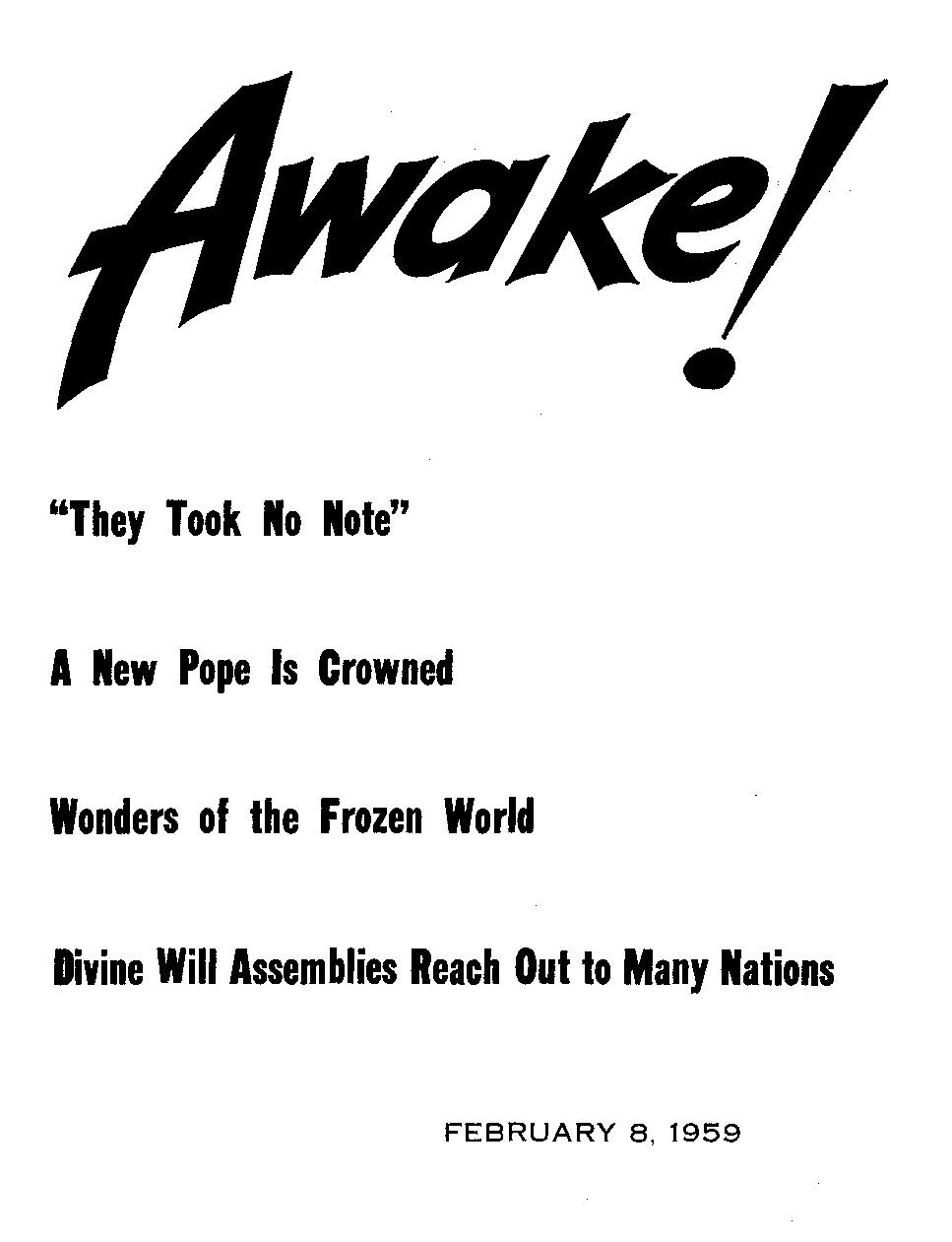
“They Took No Note”
A New Pope Is Crowned
Wonders of the Frozen World
Divine Will Assemblies Reach Out to Many Nations
FEBRUARY 8, 1959
THE MISSION OF THIS JOURNAL
News source* that are able to keep you awake to the vital issues of our times must be unfettered by censorship and selfish interest*. "Awake!" has no fetters, it recognizes facts, faces facts, is free to publish facts. It is not bound by political ambition* or obligations,- it is unhampered by advertisers whose toes must not be trodden on; it is unprejudiced by traditional creeds. This journal keeps itself free that it may speak freely to you. But it does not abuse its freedom. It maintains integrity to truth.
“Awake!" uses the regular news channels, but is not dependent on them. Its own correspondents are on all continents, in scores of nations. From the four corners of the earth their uncensored, on-the-scenes reports come to you through these columns. This journal's viewpoint is not narrow, but is international. It is read in many nations, in many languages, by persons of all ages. Through its pages many fields of knowledge pass in review—government, commerce, religion, history, geography, science, social conditions, natural wonders—why, its coverage is as broad as the earth and as high as the heavens.
“Awake!" pledges itself to righteous principles, to exposing hidden foes and subtle dangers, to championing freedom for all, to comforting mourners and strengthening those disheartened by the failures of a delinquent world, reflecting sure hope for the establishment of a righteous New World.
Get acquainted with ‘‘Awake!” Keep awake by reading “Awake!”
W ■ I Ml -I ■ ■—W
Published Semimonthly by
WATCHTOWER BIBLE AND TRACT SOCIETY OF NEW YORK, INC 117 Adams Street Brooklyn 1, N,Y,, U.K A.
N. H. Knorr, Grant Suites, Becretary
Printing this issue: 2,850,000
Five cente a copy
“Await* I” It pabHilwd In th* fallowlna 19 laniiagw: SMiatethly—Afrikaans, Danish, Dutch, Enalidh, Flmv lah, French, Germui, Greet, Italian, Japanese, Norwegian, PortutueM, Spanish, Swedish, Tagalog, ttORtkly—-Cinyaoja, Indoneeun, Ukrainian, Z-ulu, Yearly subscription rate$ tfflCM for semimonthly editions
Amtflu, U.S., 117 Adama St.. Brooklyn 1, N.Y. |1 Australia, 11 Beresford Rd., Strathfleld, N.tj.W. «/-Canid*, 1B0 Bridgeland Aya,, Toronto 19, Ont $1 Eifltnd, 84 Craven Terrace, London W. 2 7/-
Mm Zealand, 621 Nev North Rd., Auckland, 8.W. 1 7/-
Soith Afrl«, Private Bag, Elandsfontein, Tri. 7/-Monthly editions cert half the above rates.
RMilttancas foe subscription* should be sent to the office in your country. Otherwise send your remittance to Brooklyn. Notice of expiration is sent at least two Irsuu before subscription explyes.
CHANGES OF ADDRESS shoitld reach si thirty days before yoer moving date, Give n your old and new ittress <if possible, your old address label). Write Watchtower, 117 Adans Street, Brooklyn I, New YorkT U.S.A,
Entered as second-class matter at Brooklyn, N. Y. Printed in U.S.A
Tbo
Afi AT AV Da
Bible translation i»d la “Awake!” Is the New World Translation of th* Holy Script ires. Whew Mhir tranilatiMs are used Um following symbols will appear behind the citations:
American Standard Version An American Translation Authorised Version (1611) 1 N. Darby's tendon
£)w ~ Catholic Douay version £D — The Emphatic Diaglnlt JP - Jewish Publication 8oc, Le - Isaac Leescr'a verslori
jtfo - James Moffatt’s version I? 0 -> J. B, Rotherham’s version BS - Revised Standard Version yp - Robert Young's version
C CONTENTS
Quantity or Motive—Which Counts More? 3
“They Took No Note”
A New Pope Is Crowned
Open-Air Entertainment in Taiwan
Oceana Filled Exactly
Wonders of the Frozen World
How to Take Notes
Divine Will Assemblies Reach Out to Many Nations
“Your Word Is Truth”
Who Is the Antichrist?
Jehovah’s Witnesses Preach in All the Earth—Chile
Watching the World
or
WHICHXOUNTS MORE?
1(3/[HICH counts more, quantity or mo-\y>> tive—how much or why? This old world concerns itself mainly with how much. It ever worships at the altar of bigness. The man who gives vast sums to educational institutions, or to charitable, religious or even political organizations is highly praised in the public press. No one thinks of asking why. To encourage giving, religious and charitable groups will publish lists telling how much each donor gave. All such stress on quantity, of course, is to benefit the receivers.
Fortunately, quantity is not the sole criterion. Because there is such a quality as love, those not rich have a chance, as it were. So it does not at all follow that the young man who gives his espoused an engagement ring costing 51,000 loves her one hundred times as much as the one who gives his a ring worth $10.
The same is true regarding the parentchild relation. It has been established that one of the chief causes of juvenile delinquency is lack of mature mother love. Social workers have found that a child can sense whether he is deprived of his mother’s companionship because she is compelled to work to help support him or because she finds ' her duties in the home boring, and he responds accordingly; in his little heart he resents rejection but reconciles himself to her absence when such is truly necessary.
The same principle applies to the Christian and his ministry. The poor widow that Jesus commended was able to give the least of all, but gave out of love, and so all she had, and it counted for most. So also, while “there is more happiness in giving than there is in receiving,” unless we give out of love, we are not profited at all. Our motive counts more than the amount we give.—Luke 21:1-4; Acts 20:35; 1 Cor. 13:3.
All of which calls to mind the Scriptural admonition, “More than all else that is to be guarded, safeguard your heart,” and for good reason, for it is “more treacherous than anything else.” It will, unless we are careful, vitiate our serving or giving by letting a selfish motive creep in. So let us make certain that we put the emphasis where it belongs, upon right motive. Having that, quantity will take care of itself. —Prov. 4:23; Jer. 17:9.
ty’s coastal area had
th 110-mi
n deva
the fury of a hurricane hour winds. Transmitting hiSjmpressio the havoc below, the reported said: “Nov^T I know what Noah must have felt after ', the flood.”
Utter destruction on the ground was what the flying reporter saw. Demolished homes, overturned automobiles, wrecked furniture and other household effects were scattered about a thirty-mile coastal area. Tankers and barges had been shoved by the mighty winds and left stranded on the beach as if they were mere toys. After
Origans newspaperWas in art^^^e that was flying low over> ouisiana^^^eron parish. It was the mo ng after w^unlanding, the reporter heard the tragic news: the dead and missing totaled more than five hundred persons. Why this disaster? Had not warnings been sounded?
Some of the survivors contended that the weather bureau forecasters in New Orleans had not given early enough warnings. Yet an investigation of the records showed that almost twenty-four hours before the hurricane struck, an ad-
-yisory along the entire Louisiana coast Earned: "All persons fn low exposed places should move to higher ground.”
T'But not "all persons in low exposed ^jplaces” did move to higher ground. Many
Stayed. When Louisiana Civil Defense Dl~ . - rector Major General Raymond F. Hufft ''^•.Investigated the disaster, he reported:
“The people just didn’t believe the storm would hit. They had weathered out others less intense. They thought this would be ■ 1 the same. They had more than ample warning. They’re hard-headed. They gambled, and some of them lost.”
re
Many Unwilling to Heed Warnings
Does it strike us as strange that so many persons would gamble with their lives? Does it seem incredible that so many perons would jeopardize the lives of their ed ones, the members of their own fam-by ignoring warnings that came from file sources? Inconceivable it .may seem, ut as one newspaper said: "What is to be deduced from this [disaster] ? That Weather Bureau warnings are not yet perfect? Or that people don’t listen to warnings anyway? A little of both—especially the latter.”
x>r
'ip.-'V'.-lli-
So it is not so strange after all that great numbers of people pay little attention to well-founded warnings. Why was it that only eight humans survived the global flood of Noah’s day? Not because the world of that time did not have a warning. Indeed, God caused Noah to sound the warning; but the warning that that “preacher of righteousness” sounded was ignored by the masses of people. They could have investigated Noah’s warning message. They could have learned that Noah’s warning was based on the sure word of God. They could have learned that Noah was not building a huge ark for the mere enjoyment of construction. But they would not even give serious thought to the warning; they dismissed it as fantastic. So it is that the Son of God tells us concerning the people of Noah’s day: “They took no note until the flood came and swept them all a\Vay.” —2 Pet. 2:5; Matt. 24:39.
Here we see a tendency, then, a tendency to take no note of warnings if they disturb one’s pattern of living. It is so much easier to ignore the warning and to delude oneself with the thought that it may not be so. Take, for example, the warning Christ Jesus gave Jerusalem: “When you see Jerusalem surrounded by encamped armies, then understand that the desolating of her has drawn near. Then let those in Judea begin fleeing to the mountains, and let those in the midst of her [Jerusalem] withdraw, and let those in the nearby regions not enter into her, because these are days for meting out justice.” Christ even warned what the enemy armies would do: “Your enemies will build around you a fortification with pointed stakes and will encircle you and distress you from every side, and they will dash you and your children [Jerusalem’s citizens] within you to the ground, and they will not leave a stone upon a stone in you.” -Luke 21:20-22; 19:43, 44.
Jesus gave that warning A.D. 33, Not many years later it happened just as he had foretold, A.D. 66 the Roman president over Syria, Cestius Gallus, led an army against Jerusalem to quell a revolt of the Jews. Gallus was on the verge of taking the city when, suddenly, as the historian Josephus relates, “he retired from the city, without any reason in the world.” This unaccountable withdrawal gave an opportunity for flight, an opportunity to heed Jesus’ warning. This the Christians did. They fled to the mountains. The Jews who had rejected Christ also rejected his warning. They stayed. Just a few years later, A.D. 70, Roman armies again surrounded Jerusalem. Now it was too late to flee. The opportunity to heed Jesus’ warning had passed. The victorious Roman armies put to the sword a reported 1,100,000 persons and took captive 97,000.
This disregard for warnings was nothing new for the Jews. The whole history of the nation of Israel, in fact, is a long record of failure to listen to and act on warnings. God sent his prophets continually to warn the rulers and the people to turn from their stubborn, idolatrous ways, but they usually refused to heed the warnings. Because the Israelites refused to act on so many warnings, God rejected the nation. (Jer. 29:18, 19) The nation of Israel with its dynasty of kings of the royal line of David came to an end in 607 B.C. God himself caused Nebuchadnezzar, king of Babylon, to destroy Jerusalem.
Warnings from God Not a Joke
And if we go back to Abraham’s day, we find another classic example of disaster because of not listening to warnings. God had determined to destroy the cities of Sodom and Gomorrah because of their unspeakable wickedness. Abraham’s nephew Lot lived in Sodom, and for Abraham’s sake God sent his angels to Sodom to warn Lot and send him and his family out of the city before it was destroyed.
The angels said to Lot: “ ‘Do you have anyone else here? Son-in-law and your sons and your daughters and all who are yours in the city, bring out of the place! For we are destroying this place, because the outcry against them has grown loud before Jehovah, so that Jehovah sent us to destroy the city.* Hence Lot went on out and began to speak to his sons-in-law who had taken his daughters, and he kept on saying: 'Get up! Get out of this place, because Jehovah is destroying the city!’ But in the eyes of his sons-in-law he seemed like a man who was joking.” (Gen. 19:1214) What folly! Even though the warning may have sounded fantastic, the sons-in-law of Lot should have taken note that Lot was intensely serious. Instead of dismissing it as a big joke, they should have inquired into the basis for such a warning. But with the attitude they had, it is doubtful that Lot could have even explained to them the grounds for his warning. They had ears, but they were not listening. They gambled with their lives and lost.
Some Modern-Day Examples
We should not think that this long historical record of disasters arising from failure to heed warnings has been of much benefit to people of the twentieth century. It has not. How many examples there are of unwillingness to act on warnings! Familiar to almost everyone is the fate of the steamship Titanic. On April 14, 1912, this supposedly unsinkable ship was on its maiden voyage from Southampton to New York. It struck an iceberg and 1,502 men, women and children perished. Yet the Titanic had been warned. The ship’s wireless operator had received six warnings about icebergs. One warning even gave the exact location of the very iceberg the Titanic struck.
When warnings seem too improbable, the danger is that they may be dismissed without even an examination of the grounds upon which they are based. Many are such examples during World War II. America's Pearl Harbor disaster did not happen without a warning. On December 7, 1941, an army private, operating a listening device at Pearl Harbor, reported approaching planes. His warning was ignored.
The Battle of the Bulge cost the Allies heavy casualties. The German attack on December 16, 1944, completely surprised the Allies. Yet warning had been given. A number ■ of captured German soldiers gave definite assurance a German attack was imminent. Since the Allies generally believed Germany was incapable of a serious counteroffensive, the reports of German prisoners were considered too improbable.
Oddly enough, the more detailed a warning is, the greater is the tendency to cast it aside as fantastic. One of Hitler's secret service chiefs tells in his memoirs, The Labyrinth, how the Russians were informed of the exact date of the German invasion; yet they did not heed the warning. This same writer tells how a report of the true figures on American steel production was presented to Goring and Hitler as an urgent warning. Both Nazi leaders rejected the high figures of the report as utterly fantastic, sheer nonsense. “Later, at the Nuremberg Trials,” said the writer, "I occupied a cell across the hall from Goering’s. . . . Speaking from his cell in a loud voice he said to me, ‘Well, it has certainly turned out that you were not talking nonsense after all.’ ’’
It is almost comical the way precise warnings are ignored. Writing about the German officials and army officers who were anti-Nazi, Constantine FitzGibbon said in 20 July that they sent a representa-five to London “with the mission-—which he accomplished—of informing Winston Churchill and Lord Lloyd of Hitler’s plans to invade Poland. [One anti-Nazi] was so certain that Nazi Germany must not be allowed to win the war that he deliberately revealed the plan for the occupation of Norway to the Norwegian government. He told the Dutch military attache, Major Sas, of the proposed operations in the West, giving the exact date on which Holland and Belgium would be invaded. So complete was the information that the Dutch intelligence service—and apparently the British one too—decided that it must be a plant: at least no action was taken.”
Benefiting by Others’ Experiences
No action taken—what a calamitous course when a warning is well founded! Now that we know what the human tendency is regarding warnings, how can we benefit? By not considering every warning a joke, by not dismissing a warning just because it seems too improbable and by not being unwilling to investigate the grounds for a warning.
Disaster, then, can easily be avoided. When faced with a warning, a person ought to ask himself certain questions: What are the grounds for the warning? How reliable are these grounds? Has this foundation upon which the warning rests proved reliable in the past? What are the consequences to me if I reject the warning without even looking into it, and it proves true?
We can benefit by others’ experiences right now by acting on the warning that Christ Jesus gave. Remember how accurate was his warning to the people of Jerusalem. Christ warns us that when God’s kingdom puts an end to this evil world, most of earth's population will be destroyed because of not heeding the warning, just as it happened in Noah’s day. Warned Jesus: “Just as the days of Noah were, so the presence of the Son of man will be. For as people were in those days before the flood, eating and drinking, marrying and giving in marriage, until the day that Noah entered into the ark; and they took no note until the flood came and swept them all away, so the presence of the Son of man will be.”—Matt. 24:37-39.
In this same chapter of Matthew we read how Jesus answered his disciples’ question as to what would be the warning sign of his “presence and of the consummation of the system of things.” Jesus explained that there would be many woes, a flood of woes that would come upon a single generation. Among these many woes that would make up the warning sign of the “last days," Jesus mentioned world wars, “food shortages and earthquakes in one place after another.” He said there would be “on the earth anguish of nations, not knowing the way out because of the roaring of the sea and its agitation, while men become faint out of fear and expectation of the things coming upon the inhabited earth.”—Matt. 24: 3, 7; Luke 21: 25,26.
One feature of the warning sign, Jesus showed, would be, not a woe, but good news: “This good news of the kingdom will be preached in all the inhabited earth for the purpose of a witness to all the nations, and then the accomplished end will come.” Thus Jesus showed that the good news of his kingdom, established in heaven, would be proclaimed by witnesses throughout the earth. When the warning witness has been completed, Jesus explained, this evil world will come to its end with “great tribulation such as has not occurred since the world’s beginning until now, no, nor will occur again.”—Matt. 24:14, 21.
The great tribulation that brings this evil world to its end, making way for a righteous new world, is called elsewhere In the Bible “the war of the great day of God the Almighty” and the battle of “Har-Magedon” or Armageddon, One of Christ’s apostles called it “the day of wrath and of the revealing of God’s righteous judgment,” Another called it “the day of judgment and of destruction of the ungodly men,”—-Rev. 16:14, 16; Rom. 2:5; 2 Pet. 3:7.
How would people respond to the warning of Armageddon ? How would they react when it was pointed out that the great sign of the “last days” is visibly evident? Jesus said that most people at the time for the world’s end would act just like the people in Noah’s day; they would take no note.
Soon now, during this generation, God’s kingdom will come against this world. Leading heavenly armies, Christ the King will smite the nations “with a rod of iron” and bring ‘ ‘due punishment upon those who do not know God and those who do not obey the good news about our Lord Jesus. These very ones will pay the penalty of everlasting destruction from before the Lord and from the glory of his strength.” Because God “does not desire any to be destroyed but desires all to attain to repentance,” he has declared in his Word that a warning would be sounded. This is a warning that is really good news. It means that a righteous new world is at hand.—Rev. 19:15; 2 Thess. 1:8, 9; 2 Pet. 3:9.
Reliable Basis for Armageddon Warning
Despite the warning given this world, Armageddon comes “exactly as a thief in the night.” This is because most people refuse to consider the warning seriously. Many will even ridicule it. Why? “According to their wish, this fact escapes their notice, that there were heavens in ancient times and an earth standing compactly out of water and in the midst of water by the word of God, and by those means the world of that time suffered destruction when it was deluged with water." The ridi-culers, then, refuse to consider what happened to the world that Noah warned. They refuse to recognize that this present world is under a similar judgment of destruction and that it will come certainly, inexorably, with no possibility of failure. For “by the same word” (the same word of God by which the preflood world was destroyed), says Christ’s apostle, “the heavens and the earth that are now are stored up for fire and are being reserved to the day of judgment and of destruction of the ungodly men.”—1 Thess. 5:2; 2 Pet. 3:5-7.
Benefit by the warning now being sounded world-wide by Jehovah’s witnesses. They invite people everywhere to turn to the Bible, to prove for themselves that the warning of Armageddon is no joke.
Benefit by the many examples of persons who met disaster because of not even investigating a warning. Do not be like the people who would not heed the hurricane warning and move to higher ground. Remember what the head of the New Orleans weather bureau said of the Louisiana disaster: “We can only warn people of the storms. We can’t take them by the hand and force them to safety.”
Jehovah’s witnesses cannot take people by the hand and force them to safety, so they can survive Armageddon into God’s new world. No, but Jehovah’s witnesses are extending their hands helpfully. They want to aid people to learn of God’s kingdom, to take the course that leads to everlasting life on earth under that kingdom, to avoid the destruction that the kingdom will soon bring upon this evil world. Remember the warning example Jesus set before us: “They took no note until the flood came and swept them all away.”
X New Pope & Crowned
By "Awake!" correspondent in Italy
RICH medieval pageantry the 262nd pope of the Roman Catholic Church was crowned on November 4, 1958. Church officials, representatives of the ancient orders, dignitaries, special guests and invited diplomats witnessed the four-and-a-half-hour ceremony from positions within St. Peter’s basilica. For the benefit of the many people who could not get in, the proceedings were televised. The ceremonies were the climax of several weeks of excitement in the Catholic world.
The excitement began with the death of Pope Pius XII on October 9, 1958. His death was not unexpected. He had suffered a stroke three days before. A second stroke came on the eighth of October from which he never regained consciousness.
The stir created by the pope’s death and the elaborate funeral that followed gave way to speculation about who his successor would be. Rumors and counterrumors from
so-called “inside sources” flew about wildly. The choice of a new pope rested upon the shoulders of the College of Cardinals. It seemed certain that the Italian cardinals would not support a non-Italian. But there was no clear-cut favorite, as was the case in 1939 when Eugenio Pacelli was elected on the first ballot.
After each ballot the cardinals used smoke signals to indicate the results. This was done by a stove that was especially installed for the purpose. Black smoke indicated a failure to agree. White smoke signaled an agreement. Every time a puff of smoke came out of the slender chimney, excited voices from the crowd outside could be heard exclaiming that this was it. But when the smoke darkened a disappointed murmur would run through the crowd.
After several days and eleven ballots the cardinals finally signaled that a pope had been elected. He proved to be Cardinal
Roncalli of Venice. He was elected by the necessary two thirds plus one vote. The traditional announcement, “Habemus pa-pam” (“We have a pope’’), was made to the crowds from the balcony of St. Peter’s basilica. Shortly after his election the portly figure of the former cardinal appeared on the papal balcony to give the traditional Urbi et Orbi (To the city and to the world) blessing.
The Coronation
A pope’s coronation is customarily set for a Sunday, but the new pope selected Tuesday, November 4, as the day. This may have been done because November 4 is a national holiday in Italy and permitted more people to attend the ceremonies.
The day dawned cloudy and cool. The sprawling city of Rome was hardly astir before the elaborate functions within the basilica were under way. The immense square in front of the basilica gradually filled with a crowd of mixed people from various countries and walks of life. They seemed to lack the enthusiasm that a person would expect to find on such an occasion. A description of the ceremony was brought to them by means of a publicaddress system.
Finally at about 12:30 p.m. the doors were opened by brilliantly clad Swiss guardsmen. Richly robed church dignitaries, chaplains, patriarchs and others filed out to await the pope’s appearance on the papal balcony. Expectation was kindled in the crowd when red-robed cardinals began appearing on the balconies that flanked the papal balcony. Finally the door to this balcony was opened wide and Pope John XXIII stepped out for the final part of his coronation ceremony.
A cardinal proceeded to pronounce the ancient Latin formula: “Receive the tiara adorned with three crowns and know that thou art the father of princes and of kings, Pontiff of the whole world, and vicar on this earth of our Saviour, Jesus Christ, to whom is honor and glory, world without end.” At this point the triple diadem was placed on the head of Angelo Roncalli. Cries of “Vwa if papa?” rose from the crowd. After he pronounced the papal blessing to the multitudes the ceremony was over.
Inside St. Peter's Basilica
It was now possible for anyone who wished to enter the church. As I stepped through the door I was struck by the dazzling splendor of the interior. Here, indeed, were the riches of an empire. When I came to the famous black statue that the Catholic Church claims to be the image of Peter, I stopped in amazement The statue was dressed in crimson and gold robes as if it were a living pope. On its head rested a resplendently jeweled triple crown. On its breast was an ornate shield from which hung a jewel-studded cross. On a finger of the right hand was the papal ring of blessing. Lined up in front of it were devout Catholics patiently waiting their turn either to kiss reverently the statue’s right foot or to touch their hand to their lips and then caress the foot. The foot was noticeably worn by the multitudes who have given it this adoration in years past. I marveled that such image worship should take place in a church that claims to be Christian.
I thought of what the apostle Peter said to the Christians of his day who were formerly pagans: “For the time that has passed by is sufficient for you to have worked out the will of the nations when you proceeded in deeds of loose conduct . , . and idolatries that are without legal restraint.”—1 Pet. 4:3.
Papal Changes
The newly elected pope did not hesitate to use his papal authority to institute changes. He renewed a tradition that the previous pope had broken by bestowing the red hat of the office of cardinal on the secretary of the conclave. In a matter of a few weeks twenty-three new cardinals were nominated. This broke the four-hundred-year-old tradition of not having more than seventy members in the Sacred College of Cardinals. Thirteen of the new cardinals are Italians. That brought the total of Italian cardinals to twenty-nine. This seems to reverse the trend begun by the late Pius XII toward internationalizing the college by making many appointments of non-Italians.
Another change was the appointment of a new Secretary of State for the Vatican. This office had been left vacant because the previous pope had exercised the duties of the office himself. Still another change was the resuming of audiences with the Roman Curia. These had not been held for five years.
Some periodicals, such as II Punto, see an improvement of relations between the Vatican and the East. This may be due to Roncalli’s adeptness at diplomacy as well as the tolerance he has shown toward the socialists. "All these different elements,” the periodical stated, “permit us to foresee that the election of John XXIII means a liquidation of Pacellianism, not only in the removal of the men of the late Pope’s Court, but principally in the creation of a new atmosphere in the ranks of the supreme authorities of the Church. This does not at all mean that the Catholic Church wifi approach the Communist regimes, but it simply means that in the Sacred College, or among the supreme authorities of the Vatican, there exist the prospects of policies that are more dynamic and, above all, more realistic even toward the eastern countries and particularly toward the socialist forces in the world.”
Angelo Roncalli has been noted for his ability not to offend the leftist tendencies of the socialists. If recent events can be used as a criterion, Roncalli’s rule may bring forth some liberal tendencies. An indication of this has already appeared in that no new cardinals were nominated to Eastern bloc countries that had been irritated by appointments made by Pius XII.
A Great Difference
There is a great difference between the previous pope and the new one. Eugenio Pacelli came from an aristocratic Roman family, whereas Angelo Roncalli is from a poor peasant family, Pacelli was always quick to underline, both by actions and statements, that he belonged to the nobility.
The Pacellian regime could be said to have begun at the time Pacelli was Secretary of State for tty? Vatican. His private “court” of relatives, friends and friends of his relatives, as well as German Jesuits, gradually gained in power over the cardinals and other ecclesiastical authorities.
A decided German influence on Pacelli was evident from his views while pope as well as the fact that the language of his papal court was German. This may have been due to his long association with Germany as the Apostolic Nuncio to that country. It was during that time that he negotiated a concordat between the Vatican and Adolf Hitler.
Pius XII lived and worked in an isolation particularly restricted and was surrounded by an intimate group of persons who exercised a strict control on what matters reached his hands. Even cardinals had to submit their petitions to the pope in writing. Only after the written petitions had been approved by Pacelli’s court did they reach him.
While Pius XII surrounded himself with a powerful court, John XXIII appears to be returning to the cardinals their traditional role in papal affairs. This is indicated by his re-establishing the authority of the Roman Curia.
The New York Times of November 23, 1958, stated that John XXIII had “served notice upon all that he intended to grasp firmly the reins of the Vatican administration, which Pius XII had allowed to slip out of his hands.” This paper also said: “Some Vatican officials think they are paying Pius XII a compliment when they say in unguarded moments that, in his almost twenty years as Pope, he never made anyone laugh and never reit me sngniest urge or desire to do so.” This is a contrast to the present pope, who caused the Clementine Hall in the Vatican to resound with laughter during a speech he gave to five hundred newspaper representatives.
Secrecy
To millions of persons, Catholics included, the papacy is a mysterious entity beclouded with secrecy. The inner goings on, the behind-the-scenes maneuvering, are little publicized. All information from the Vatican comes through its press office. This is not always reliable. Remarking about this fact, Life magazine of October 20,1958, said: “The press office of the Vatican, the only official source of the world’s news of the Papacy, could perhaps be forgiven'its inefficiency but not its corruption. Here underlings release, invent and sell ‘news’ with callous and candid calculation and abandon. The dishonor and the scandal that they invite are scarcely more remarkable than the looseness of organization that has permitted such a condition to exist without their superiors being aware of it.”
Great secrecy surrounded the process of electing the new pope. Corridors to the room where the conclave was held were walled up. Doors and windows were locked and a special seal attached to them. The cardinals lived and met in confinement until they had selected the new pope. After his election they knelt before him one by one and kissed his feet and hands and embraced him from right and then from left.
Only One Leader
With the enthronement of a new pope in regal splendor the Catholic world rejoiced. But when a person considers the pomp and pageantry that was associated with the pope’s coronation as well as the aaurauon snown mm, n, is uimcuii to see how it is a Christian proceeding. Nothing similar to it existed among Christ's apostles. Rather than resembling something that would take place among the Christians, it resembled more closely what would have been found in the pagan palaces and temples of ancient Rome.
First-century Christians did not choose one of their members and exalt him, crown him and do obeisance to him. They worshiped Jehovah God and did obeisance to the one He designated as their Leader, and that was Christ. After he left, the apostles did not elect a new leader. Neither did they consider any one of them to be the vicar of Christ. Christ continued to be their Leader. He led them by means of holy spirit. He was the One they exalted.
There is no Scriptural authorization for any professing Christian to assume a position like that of a worldly king and to be hailed as “the father of princes and of kings, Pontiff of the whole world, and vicar on this earth of our Saviour, Jesus Christ.” When Christ was on earth he rejected the position of a worldly king of kings. How can any professed Christian accept what he rejected?—Matt. 4:8-10.
Since Christ said his “kingdom is no part of this world,” how can the pope consider himself to be the vicar or substitute for Christ with authority over worldly princes and kings? (John 18:36) There is no Scriptural authorization for such an exalted claim. The Bible tersely states: “Whoever, therefore, wants to be a friend of the world is constituting himself an enemy of God.” (Jas. 4:4) It is to Christ that Christians must do obeisance and not to any man. It is He whom they must exalt and honor, thus glorifying his God and Father, for Christ, and no man, has received the divine appointment as King. —Phil. 2:9-11.
OpCH-oilt !' 1 g gl| I 11| I
UV TCUMfOM/ F(^M***
By "Awakel correspondent in Tolwon j _ ;: <• wjjM
Tina story of the aspira- i ' .JElte
tions, ideals and dreams of a na- w
tion is often told by its trends in ?***;■ entertainment. People usually in- f dulge in what they consider to be | ! MW
amusing for the sake of escaping 1
the worries and boredom of daily living. In Taiwan, the Chinese opera enjoys a unique position in this regard. Rich in pageantry and . artistic representation, it leaves an impression not to be easily forgotten.
To the average Westerner this type of opera may appear as anything but an opera. Usually it is performed on a curtainless stage, almost void of furnishings, and is more often seen on an improvised bamboo stage in an open market or a vacant lot than in an auditorium. Unlike Western operas, stage settings are totally unnecessary for the Chinese opera. Instead, an intricate set of stage conventions is used to convey the ideas to the minds of the audience. Thus, the same drab stage may portray a street scene, a battlefield and a king's palace without any changes.
The singing is for the most part actually speaking that is done in high-pitched falsetto voices, molded by many years of rigid training in order to measure up to the strict standards of the opera critics. The orchestra, made up of a half-dozen musi-■Ml cians, is seated to one side of the stage. They play almost continuously and may become nerve-racking at times, because, according to ancient theatrical custom, the opera music must be noisy to attract public attention.
Stage Conventions
. The part may open with a principal character simply walking to the front of the stage and announcing: “I, so-and-so, am a famous general . . .in this way giving his background and telling what is to take place in the play. Whether or not the audience grasps what is going on depends largely on the individual performer. He must not only remember the hundreds of rules governing the stage conventions but also be able to carry them out skillfully.
For example, since there are no doors or windows on the stage, a harassed young maidservant simply brings her hands together at arm’s length to denote the closing of a door to keep out her overly affectionate young master, while, on the other hand, the door may be opened by bringing the hands apart. Two men may walk about the same lighted stage searching for each other. However, because they have their hands outstretched, the audience knows they are in darkness, groping about Tears are not necessary to show sorrow; rather, merely raising the sleeve in a gesture of wiping the eyes is sufficient.
If an actor is supposed to be riding on horseback he just walks on stage carrying a stick decorated with a tassel, which represents his having a whip. If he throws the stick down on the stage, that is the sign of dismounting. If, on the other hand, he should be riding in a carriage, he walks between two yellow flags. The few strokes of a paddle, as if in water, indicates he is seaborne. Actual eating or drinking is never done on the Chinese operatic stage. Drinking is indicated by holding an empty cup to the lips and at the same time shielding it with the right sleeve. An empty bowl and chopsticks are used to show eating.
When it comes to the displaying of emotions, It is very important that one have some understanding of the symbolisms. In love scenes, for example, there is never any embracing or kissing no matter how madly in love the couple may be. Instead, love is indicated only by vaguely touching each other’s hands, which are extended in the long sleeves. According to ancient Chinese tradition, the man and woman are always separated by a distance, even man and wife acting with cool politeness as though barely acquainted. The man may fluff his beard or violently shake his head to display anger, while he just wrinkles his brow if he is worried.
All action, too, is symbolic rather than actual. A fight between two persons looks more like an acrobatic contest, tor, instead of actually fighting, the opponents roll on the stage, leap into the air and go through all sorts of stunts. The faster and more strenuous the action, the greater the fight is supposed to be. Instead of chasing his foe, the winner stays behind to execute a few more difficult feats to win applause, while the loser usually turns a somersault in mid-air to concede defeat. Or if he is supposed to be killed, he falls to the stage, then gets up and hurries away. A busy housewife may thread an unseen needle with invisible thread and proceed to do mending, while a country lass scatters imaginary com to feed her imaginary chickens and ducks.
Colorful Costumes
It does not matter whether the character portrayed is rich or poor; he is invariably clothed in silk. Even the lowly beggar is no exception. Colors are important in distinguishing the various roles portrayed. Bright colors, for instance, identify a handsome young man, while a monarch will always wear yellow. Scarlet is the color for important officials, with a greater degree of fancy needlework identifying those of a higher rank. Servants and peddlers must content themselves with jackets, since the robes are reserved for the upper classes. Generally speaking, the costumes bespeak the eighteenth-century dress of the Chinese people and are seldom matched elsewhere for their elaborate design and rich colors.
Usually the actors and actresses do all of their own facial makeup. They must know by heart how to create accurately with a few paints and brushes all the many patterns of characters needed to thrill the opera lovers. Just one mistake would be a humiliating giveaway, and could do irreparable damage to the actor’s career. This face-painting is an outstanding feature of the Chinese opera, which, along with the gorgeous costumes, more than overcomes the drab deficiency of the stage itself.
IN THE NEXT ISSUE
* What do the right-to-work taws mean to industry? What do they mean to your own Job? You win want to read the article “Does a Worker Have the Right to Work?'"
A Why are enzymes described as “life’s miracle chemicals"? How do they perform a work that is essential to all bodily movements? The story will appear in the article “Introducing the Fascinating Enzymes*"
“AwakeJ” takes you to Ceylon to watch the mighty task of “nation building.” Read how jungle lands are being transformed into productive communities.
• How has the merchandising of food been revolutionized in some countries? How has this affected what a housewife must pay and the variety of foodstuffs she can get? Do not miss “Let’s Go to Market/’
9 You wilt be interested in learning how a paradise earth will become a reality and what has been the biggest obstacle to it thus far. Read it in the next issue,
In many instances the role of the leading lady is played by a man, which is also according to ancient custom. After the ordeal of eyebrow trimming, rouge, paints and lipstick, he wriggles on stage, every inch a lovely woman in the eyes of the audience. Of course, a few adjustments must first be made to add feminine charm to the plain masculine face. A slice of false hair may be stitched close in front of the ear on either side to narrow the face, while a bit of length may be added by pasting over the forehead a strip of white cloth extending to the desired length above the hairline. This is then lavished with thick paints to conceal the cloth and in this way create the long face needed to picture noble charm.
Plots for the Chinese opera may be based on actual happenings in Chinese-history or upon fiction. Regardless of which, they are usually filled with Chinese wit and humor, ending on a high moral note with the villain receiving due punishment, even though it may put quite a strain on the imagination.
Despite its many peculiarities aqd whether it is entertaining to Westerners or not, its pageantry and imaginary acting is loved by the majority of the Chinese people scattered around the globe. To the millions of displaced Chinese in the Orient, the Chinese opera is something they look upon as being their very own, symbolizing their national ways and culture. Still others view it as having educational value, for, regardless of whether one enjoys this type of entertainment or not, it must be admitted that it is not conducive to lazy minds, since every scene must be so carefully scrutinized in order to be understood.
Some wonder if the influx of new ideas from the West due to
increased military and technical co-operation may not well cause the opera to fade from the picture of Chinese entertainment. That seems unlikely, at least for the present. As Chinese as Peiping roast duck, the Chinese opera is, most observers feel, just too Chinese to be easily dispensed with.
©ceang QxactQy
< Writing in Modern Science and Christian Faith, Roger J. Voskuyl says: “In spite of the enormous amount of water on the globe, there is the right proportion of land surface to water surface. If there were any greater or less amount, the rainfall would be greatly affected. What determines this exact ratio between land and water? The ocean floors are constructed with huge basins which contain a volume no less than thirteen times the bulk of the land which rises above them.
Furthermore, they are so exactly filled that if the amount of water were to be increased by a small fraction, the land would be overflowed. Truly, He layeth up the depth in the storehouses.”
FROZEN WORLD
SNOW falls in nearly every part of the world, but since it seldom reaches the ground, vast numbers of people have never seen it. The high-flying clouds may be cold enough to produce snow, but warm air beneath can easily change it to rain before it lands on the earth. As a matter of fact, snow is found only on limited parts of the globe. The polar regions are noted for it, although it may surprise you to know that comparatively little snow fails there because there is so little moisture in the cold air. But when it falls, it may stay a long while. Snow is rare in South America, and in Africa you will probably have to go to the mountains to see it. Apart from mountaintops and the polar areas, snow is particularly found in the temperate zone of the Northern Hemisphere.
Winter has a beauty all its own, but while it lays out its mantle of white it may bring to an aggravating standstill the transportation of a large city. It supplies much-needed moisture for the farmer, but it may also isolate him for weeks at a time. And while winter sports are lots of fun, bruises and breaks from falls on ice can be very painful. So in addition to those who enjoy it, there are bound to be a good many that would prefer to go somewhere else when it comes. When cold winds and snow whip across the land, amazing protection is provided for living things. Just as the milk left on your doorstep on a cold day may freeze and push off the cap as it expands, so the water in ponds expands and floats as it freezes, instead of sinking and possibly destroying the living things beneath it. Thus a protective layer is formed. The snow, too, lays down a
warm blanket of insulation for the earth and the living things it contains. Animals can burrow into this natural blanket and keep warm. Eskimos find, that the snow around their igloos provides such fine insulation that their own body heat may suffice to keep the room warm.
Frozen Beauty
When there is a quiet snowfall the landscape is changed into a glistening sea. Damp snow clings to wires and trees, transforming them into snow-canopied marvels of architecture, and the roofs of houses take on new and delightful contours. As the moon rises and trees throw their shadows across the fields, a picture of frozen beauty appears.
The snow takes shape in the clouds when the air is cold enough. Free molecules of moisture join to form tiny ice crystals, and as these are buffeted about in the cloud they change size and shape, combining with other crystals to form snowflakes, perhaps adding branches or rays, until they become heavy enough to begin their descent to the earth. The form they take depends in great measure on the amount of vapor present in the atmosphere and on the temperature of the air.
From one storm to another there may be considerable variation in the snow. On a cool, crisp day the snow crystals will probably be dry and fluffy. On another day the clouds may be low and the air mild and humid. With these circumstances the snow is more likely to be damp and the flakes will cling together. Very light dry snow may weigh no more than 150 pounds to a cubic yard. But when snow of the very damp variety has had time to settle down, it may weigh as much as 1,500 pounds to a cubic yard. If you had not noticed the difference before, your aching back will tell you after you have shoveled it from your sidewalk.
A newly fallen blanket of snow is a peaceful sight, but, quite unseen to a casual observer, it is alive with activity. Every snow crystal is changing form. Melting and evaporation take place. From above, the weight of the surface snow will crush the delicate formations that characterized the free flakes and pack them down, and water molecules proceed to transfer from one snow crystal to another.
Another of the frozen wonders may be seen even before the snow begins to fall, and on cold winter days it may move right into your home. It is the frost. It is closely related to dew, which forms on roofs and vegetation near the ground when the temperature of the air falls to the point that the air can no longer hold its load of moisture. If the atmosphere is loaded with moisture when the temperature falls below the freezing point, then frost will form. It is not dew that has frozen. Rather, the water vapor in the air changes directly into crystals of frost. Perhaps some of the most striking illustrations of this frozen beauty are seen on the inside of windowpanes. When the air indoors is moist and the weather is cold enough to chill the windowpane below the freezing point, the frost will appear in beautiful artistic displays on the inside of the glass.
Destructive Avalanches
When the snowbanks of winter pile high on mountain slopes, it means danger for those living in the valleys below. People in the Swiss Alps know that they can expect avalanches, and year after year they see them come down the same paths. To avert danger, stone dikes are erected and buildings are located out of the danger zone.
After a heavy snowfall little encouragement is needed to send an avalanche plunging to the valley below. Rocks that could have provided barriers may have become crusted over with the snow that fell early in the season, so now the snow has an open runway when the slide begins. As it gains momentum, it rips out trees and picks up huge boulders to add to its load. While snow at the bottom and on the sides of the slide is slowed by friction, the main load may pick up speed until it hurtles down at seventy-five miles an hour. Often more deadly than the snow itself is the blast of air that it pushes ahead of it. And along both sides of the path of the avalanche everything within reach is sucked to destruction by the vacuum that follows.
In a series of avalanches in the Alps in 1951 it was reported that the wind pushed ahead of the descending snow actually snapped off grown trees and picked up homes that were not even reached by the snow and hurled them hundreds of yards before dashing them to the ground. In one case the air pressure ripped the roof from a house, lifted out a bed on which a child was sleeping, and deposited the bed with its occupant safely in a snowbank while it smashed the house to splinters.
Often avalanches come with such lightning speed that victims are trapped in a grave of snow. If the snow is light, they may have air to breathe for hours while rescue attempts are being made, provided they do not struggle. However, violent breathing may cause them to inhale so much of the powdery snow that they drown. A victim trapped beneath wet snow is smothered almost immediately.
Majestic Glaciers
Not everywhere does the snow escape in an avalanche, nor is there always enough warm weather to melt it all, so snowfields and glaciers form. As pressure of the snow and ice causes melting below, the mass slowly moves. Some of these vast fields of ice follow regular channels in their descent to the sea, and on the way they are joined by tributaries in a slow-motion imitation of rivers. While the surface ice is brittle and may break, forming yawning and dangerous crevasses, the lower part is plastic, so that the entire glacier does not move at the same rate. The center part, with less friction, moves more rapidly than the rest.
Kate Field, in her description of the majestic beauty of Muir Glacier in Alaska, said: “No pen can do justice to the grandeur of a glacier like the Muir, as all become spellbound at its majestic and irresistible force and indescribable beauty: ‘Imagine Niagara Falls frozen a solid wall of ice 3,000 feet high moving toward the ocean at the rate of SO feet a day, and a similar wall 600 or 700 feet under water, and the whole mass cracking and giving forth peals of thunder . . . thousands of tons of lovely blue ice . . . and you will have some slight conception of this imposing spectacle.’ ”
Knick Glacier, near Anchorage, Alaska, annually plays its role in the operation of an amazing self-dumping lake. Each year when it gets warm, Lake George spills over Knick Glacier and eats through the dam of ice to release a flood of about a hundred million gallons of water a day. It does not last long. Soon the glacial dam begins to close and the lake again forms behind it, awaiting the next year.
Glaciers that reach down to the sea break off to form icebergs. Some of these appear as towering mountains of ice jutting out of the sea, but five or six times as much ice may be below the water. Others appear to be vast plains of ice that move about in the water, it is an aweinspiring spectacle to see them break off a glacier and plunge into the sea, but they can be a real peril to navigation, and in 1912, after the tragic sinking of the Titanic, the International Ice Patrol was founded to watch for icebergs along shipping lanes.
The Polar Regions
Far to'the north lies the Arctic, a place that has long excited the imagination of explorers. Although it is generally thought to be a vast perpetually frozen land, that is not an accurate picture of it. In the first place, much of the Arctic is not land. And, secondly, it is not all perpetually frozen.
The New York Times Magazine of October 19, 1958, in speaking of the Arctic, said: “Although the idea that a solid ice sheet covers the central Arctic has lingered stubbornly in the popular fancy, the northern cap of ice worn by our planet is actually a thin crust—on the whole, only about seven feet thick—over an ocean two miles deep in places.” This ice is constantly being broken up and shifted. As the ice is carried along by the ocean currents, it flows south between Norway and Greenland. “The only major land-bome ice sheet in the north covers Greenland,” the article said. “There are scattered smaller ice caps in the Arctic, but most of Siberia, Alaska and northern Canada is ice-free.” The North Pole is definitely not the coldest spot on earth; In fact, it is not really much colder than it has been in North Dakota in the United States. Ocean currents do much to moderate the temperature, and summer temperatures in the Arctic often rise to the eighties. “Except in the mountainous interior of Greenland," reports Ritchie Calder, “nine-tenths of all Arctic land is snow-free in August."
Greenland itself, however, is largely covered by a mammoth ice sheet that buries mountains and valleys alike under thousands of feet of snow and ice. It seems to take the form of two large domes that are centers from which the ice works its way down to the coasts. Paul-Emile Victor did an interesting job of describing it when he said that if the Greenland ice sheet were cut up into oversized ice cubes, it could furnish a two-ton portion for every man, woman and child on earth every minute for a year before going out of business. Or, he estimated, it could be used to encase the entire globe in a seventeen-foot-thick ice case.
There are a variety of viewpoints as to what constitutes the Arctic, but the Arctic Circle that appears on a globe is the point where one enters the land of the midnight sun. This line, 23° and 30' below the North Pole, corresponds to the extent of the inclination of the earth on its axis from a vertical position. Due to the inclination of die earth on its axis and the fact that its axis is always pointed in the same direction while the earth revolves around the sun, we have variation in the seasons. When the Arctic end of the earth is inclined toward the sun, daylight continues at the North Pole for six months, while the Antarctic has a six-month period of night. Then for six months the situation is reversed. As distance from the poles increases, the length of duration of this phenomenon decreases.
Six monuis oi mgnt may not appeal to you, but to many in the Arctic it has a beauty all its own. The book Men Against the Frozen North says: “We think of night in terms of perpetual darkness. Consider however the sky-glow of the Arctic night, the starlight, the moonlight and the Northern Lights, all enhanced by the white mirror of the snow. ‘Night’ in such conditions is no longer synonymous with darkness. Travel becomes possible, and for the Eskimo the crisp winter snow is ideal for building his quick, overnight shelter, the igloo. Of course, there are the winter hazards of snow-storms and blizzards but, on the whole, Arctic weather is more predictable and less haphazard than a typical British summer."
On the other hand, the Antarctic presents a more frigid picture. During the International Geophysical Year sixteen parties from eight different nations invaded the Antarctic. Although there are vast areas of frozen water, such as the Ross Sea, the Antarctic concentration of snow and ice is piled up on a mountainous continent that is nearly as large as South America. The French expedition reported ice up to 10,000 feet thick. Generously it shares its ice with the seas around it, where icebergs up to four times the size of Manhattan island break off and go to sea. The book The Wonder of Snow describes the Antarctic as "a land of cold summers, fantastically cold winters, violent winds and snowstorms.” The more moderate ways of the Arctic do not seem to have influenced its South Pole counterpart.
While you may not choose the polar regions for your home, the frozen world is a fascinating one. The delicate snowflakes, the artistic displays of frost, the tremendous force of an avalanche and the majestic beauty of a glacier, fill God-fearing persons with awe at the wisdom displayed in the creative works of God.—Ps. 104:24.
LMOST everyone, from time to time, takes notes. It may be notes on a lecture; it may I be notes on what one reads. Whatever the source for the notes, the one who takes them wants to gain as much benefit as possible from making them. Just as with other things in life, there is an art to taking notes.
<1 We can learn much of the art of note taking by profiting from the experiences of others, thereby avoiding their mistakes. In taking notes on a lecture, there are some mistakes that are often made.
<1 First, the one who wants to benefit from the lecture may not come prepared. He may not bring with him pencil or notebook. During the lecture he may suddenly decide to make notes on important. points, only to find a scrap or two of paper. The notes that are made may be only key words and not complete thoughts. Later he may not be able to understand his cryptic notes. He has required too much of his memory.
C In this regard Professor John Genung writes in The Practical Elements of Rhetoric; “Notes too often fail of permanent value through being too carelessly and indefinitely taken; when they are mere catch-words and fleeting hints they soon fail to call up the associations and connexions that gave them their first usefulness. Even hastily taken notes should . . . express complete thoughts, sufficient to be understood at any time afterward, without need of help from remembered associations."
<L Secondly, the person who wants to benefit from a lecture by taking notes may defeat his purpose by taking too many. He may try to copy down virtually every thought of the speaker, perhaps using shorthand to make this possible. During the speech the copyist is so engrossed in the process of dictation that he may learn exceedingly little from the lecture. Later, when asked about the talk, the copyist may have difficulty explaining even the main points. This kind of note taker usually has little in his mind and almost everything on paper. Too much time now must be spent to read and study the notes. This process is much like starting from scratch.
…