Awake!, November 8, 1956
Download: PDF — Awake!, November 8, 1956
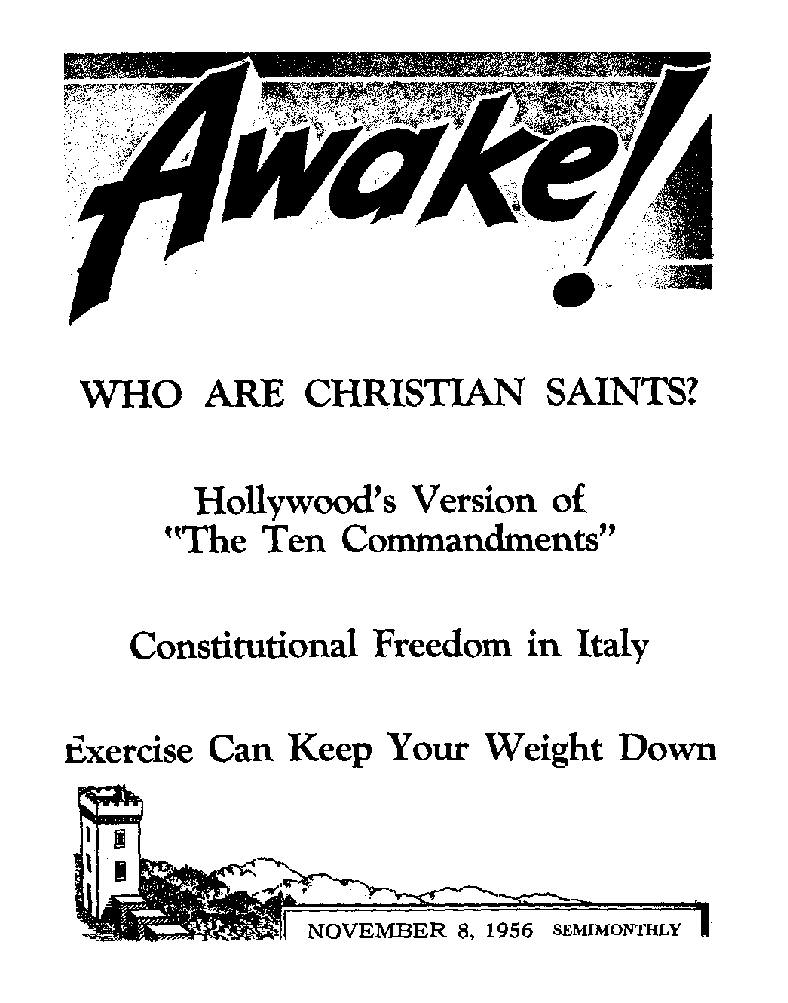
WHO ARE CHRISTIAN SAINTS?
Hollywood’s Version o£ "The Ten Commandments”
Constitutional Freedom in Italy
Exercise Can Keep Your Weight Down
THE MISSION OF THIS JOURNAL
Newt sources that are able to keep you awake to the vital issues of our times must be unfettered by censorship and selfish interests. “Awake!” has no fetters. It recognizes facts, faces facts, is free to publish facts. It is not bound By political ambitions or obligations; it is unhampered by advertisers whose toes must not be trodden on; it is unprejudiced by traditional creeds. This journal keeps itself free that it may speak freely to you. But it does not abuse its freedom. It maintains integrity to truth.
"Awake 1” uses the regular news channels, but is not dependent on them. Its own correspondents are on all continents, in scores of nations. Froih the four corners of the earth their uncensored, on-the-scenes reports come to you through these columns. This journal's viewpoint is not narrow, but is international. It is read in many nations, in many languages, by persons of all ages. Through its pages many fields of knowledge pass in review—government, commerce, religion, history, geography, science, social conditions, natural wonders—why, its coverage is as broad as the earth and as high as the heavens.
"Awake I” pledges itself to righteous principles, to exposing hidden foes and subtle dangers, to championing freedom for all, to comforting mourners and strengthening those disheartened by the failures of a delinquent world, redacting sure hope for the establishment of a righteous New World, .
Get acquainted with “Awake!” Keep awake by reading "Awake!"
PtiBLtsiiKD Semimonthly By
WATCHTOWER BIBLE AND TRACT SOCIETY OF NEW YORK, INC.
117 Adams Street, Brooklyn 1, New York, U. S. A.
N. H. Knorr. President Grant Suiter, Secretary
Printing this Issue; 2,000,000 Five cents a copy
OiMr faniHpM in whlrt "AwiM!" Ii *it>IUhed: Simimonthly—Afriiainn, Finntah, Fnntah, German, Hollandlah, Italian. Norwegian, Spanish, Swedish. Mtithty—Danish, Greek, Japanese, Portuguese,. Ufa-alulae.
Yearly subscription rstcn Oflm for Femi monthly edition^
Amerfa, U.S.. 117 Atiataa St., Brooklyn 1. N.Y. (I Australia, JI Rd,( strathfield, N.S.W, 8/’
Ganait, 150 Brldgelsud Are,, Part ftasd P.0u
Toronto 10. Ontario
England, 34 Crites Terrace, London W. 2
Knr Zealand, <LP.O. Bw 30. Wrillnfftt®. C, 1
Sfffr AfrlM, Private Efartrfufottlefn, FrL
Manthiy edltlane co&t half the above rater
Remittances should he sent to cfTlce in your country la compliance Flth regulations to guiracU* safe delivery of money. Remittance* ire accepted a: Brooklyn from countries, where no office 1» located, by inl^rnaiJonal money order only. Subscription rates jn different countries are here slated In local currency. Notice of explratlift (with renewal blank! 19 sent at least two tatH* before subscription expires. Cha DM of ad drew when sent to our office may be expected effective within one month. Send your old u well as new address .
Entered w jwrofid-rjajs matter at Brooklyn, N. T.
Printed in U.S.A,
CONTENTS
Scientists Balk at Facing Facts
Sauerkraut a Chinese Invention
Who Are Christian Saints?
Civilized Men Along with Cave Men 8 Hollywood’s Version of “The Ten
Commandments”
Establishing Constitutional
Freedom in Italy
Rgd Evasion
Jewish Persecutions in Medieval Times 16
Exercise Can Keep Your Weight Down
A Dangerous Fad
“Your Word Is Truth” The Darkness That Covers the Earth 25
Undercover Agent, Texas Style
Jehovah’s Witnesses Preach in All
the Earth—Egypt
Snow Plows in Summer
Do You Know?
Watching the World
SCIENTISTS BALK T
AT FACING | FACTS |
II It IS claimed that "absolute honesty of LBj mind and love of truth” are the basis
of true science. However, not all who claim \methods. In either case there is here a challenge whether it be to physiology, sta-
to be scientists are as objective as that claim would have us believe. Sometimes bias or preconceived ideas prevent scientists from exercising a love for the truth. It makes them balk at facing the facts. A case in point is the attitude many scientists take regarding the evidence presented by ESP.
What is ESP, you ask? ESP stands fbr “extrasensory perception” and refers to mental telepathy and all other forms of transferring thoughts from one person to another without the use of a physical medium, apart from the senses. Included in ESP is also the seeming influence of mind over matter, as when one D.D. Home of the last century played musical instruments without touching them. A new branch of psychology has come into being that concerns itself with ESP and that is termed parapsychology.
Many scientists balk at the evidence presented by ESP because it does not fit into their understanding of the laws of nature. As Dr. Alan 'Parkes of the ’ilation'A Pn-stitute for Medical Research said: “We are faced either with a major biological discovery or else with the unpalatable conclusion that highly impressive results can arise as artifacts of the use of established tistlcs or psychology.”
Some, such as Dr. Robert A. McConnell of the University of Pittsburgh, are willing even to go to the extreme of discarding the “calculus of probabilities,” or the law of averages, in their determination to discredit the evidence of ESP. Others, such as Prof. George R, Price of the University of Minnesota, are willing to impugn the motives of all those having to do with ESP, charging fraud and trickery, or, at best, tJJ, ss> ws, v/st * v
accept ESP’s testimony.
As reported by science writer Waldemar Kaempfert in the New York Times, July 22, 1956: "Because ESP cannot be explained by a mechanism and because experiments so far favor action at a distance,” thought transference seeming to work just as well many miles apart as in the same room, “which is abhorrent to scientists, they, especially the physicists, ■rejetfi \Yieni. The aWrtufie cfi Tne siiieifiist toward ESP is the same as his attitude
toward the stage magician. The scientist knows that the magician is playing a trick when he pretends to puli rabbits out of a hat or to extract yards and yards of paper from his mouth. The scientist cannot see how the tricks are done, but he is convinced of their fraudulent character.”
In this analogy, however, the scientist is inconsistent on-two counts. First of all, the magician does not insist that he is doing something out of the ordinary, but merely does it for the sake of entertainment. And, secondly, a little investigation will reveal the tricks of the stage magician to be merely optical illusions. But scientists working with ESP are in dead earnest and no one has been able to make the charge oPtrickery or deceit stick.
Yes, “scientists enough have witnessed ESP experiments and seen to it that there was no trickery and no self-deception.” Yet “in most cases they have refused to accept the findings.” Even though “the proceedings of both the British and American Societies of Psychical Research are replete with authentic instances of telepathy and clairvoyance” they balk at accepting ESP as a fact
Arguing for the evidence submitted in behalf of ESP, Kaempfert continues: “The trouble lies in our inadequate knowledge of the mind’s powers. The evidence that Professor Rhine and others before him have accumulated is so formidable that it cannot be rejected because it does not fit into physical science. The truth is that psychology and parapsychology have an immense task to perform.” And further, “There is no question that there are genuine phenomena which are embraced In the designation ESP. What we need is a thorough exploration of the mind’s capabilities.”
Why should scientists balk at the facts presented by ESP? Do they know everything? If not, would it not be wiser for them to seek the explanation rather than balk at the formidable evidence and accuse those who present it of trickery? But pride closes their eyes and makes them blind guides and the common people foolishly accept the testimony of such men in preference to that of the Bible.
Not that ESP does not have an inherent weakness. Scientists insist on a formula or explanation and ability to repeat results before accepting claims made, and this, of course, ESP cannot do. But let it be noted, though, that ESP does not have the explanation the Bible has, which, however, is not accepted by parapsychologists in general, although it is by many associated with psychical research. And what is the explanation? The presence of unseen creatures, spirits. The Bible shows that there are good spirits and bad spirits. It is the bad spirits that communicate with mankind and deceive men by the phenomena associated with ESP. These wicked spirits could certainly account for the evidence seeming to indicate the influence of mind over matter. The lack of uniformity in the results of ESP experiments would further argue that, rather than a power of the mind, capricious, wicked spirits are involved. Those accepting the Bible’s explanation have no occasion for balking at the facts.
Sauatklaui a. Chinese Dnvaniion
This, no doubt, will surprise many Germans. Sauerkraut is a Chinese invention. According to the National Kraut Packers Association kraut originated in China about 300 years before Christ, while the Great Wall was being built. Bands of Tartars took loads of it to Europe, where it became a popular German dish.
/KRE CHRISTM
rCjpeotadiy the prate tells of the pope’s canonizing a deceased person os a ‘'saint." What doos the Bible say about taints? What is God's purpose regarding saints, and what is
WHO are Christian saints? required of them? That question was recently
thrust to the fore by the publication of a review in Time magazine, August 8, 1956, of “four lively and curious volumes of Sutler's Lives of the Saints” in “a brand-new bicentennial edition.” These volumes name 2,565 “saints.” This listing, however, is neither wholly wsr '*!i-
inclusive, no such list having been published.
No doubt what make these volumes curious are the facts regarding some of these “saints.” For example, there was Benedict Labre, “a dirty saint who spent most of his life tramping from shrine to shrine throughout 18th century Europe, sleeping in sheds or fields, eating meagerly of handouts or garbage, talking to virtually no one and smelling to high heaven.” It must also seem curious to many that included in this list of 2,565 saints’ biographies are what Time magazine terms “some of the best stories in Christian tradition though modem scholarship and/or common sense deny them corroboration.” Among such stories is that of "the Seven Sleepers of Ephesus,” who, “sealed up to suffocate in a cave by a persecuting emperor, were placed in miraculous hibernation by the Lord, to emerge 2^% years toter to tireiT own astonishment and the edification of all good
Christians.” Though purely legendary, these seven “saints" are commemorated annually on July 27.
According to the Catholic Encyclopedia (Vol, 2, pp. 364-369) only the pope can decide who -deserves being termed a saint. It further tells that only after a long-drawn-out process involving investigations, special meetings, weighing of evidence, etc., regarding purported miracles and a life of sanctity and heroic virtue is a person eligible for beatification. Those eligible fall into two groups, the “martyrs” and the “confessors," the latter being those who died peaceful deaths. Beatification, or being pronounced, “blessed,” permits veneration or commands it only locally. Farther steps, involving more evidence, must be taken before a person is canonized, by which the pope commands veneration by all Catholics world-wide.
How elaborate the process is by which a person is canonized can be seen in some measure by the expense involved. According to an itemized list published in the Catholic Encyclopedia (1913, latest edition) the cost of canonizing a person is at least $42,816.87. This is to be paid by the patron or patrons interested in having the particular person proclaimed a saint. History records that Henry VI, English king of the fifteenth century, was not made a saint, as was the custom in those days, be-
cause his successor, Henry VII, was unable or unwilling to pay the high cost.
Who Are Christian Stunts?
What are the Scriptural qualifications of a saint? Does the Bible authorize the beatification and canonization of persons as saints? Does it command that these be venerated, and encourage us to pray to them for help?
God’s Word nowhere teaches that asceticism or self-torture makes one a saint. On the contrary, it plainly states that “a severe treatment of the body” is of ‘‘no value in combating the satisfying of the flesh.” We are also told to treat our bodies as slaves. One does not abuse or torture a slave but rather takes good care of him so that he can do the best and the most work possible. But at the same time a slave is kept in submission. A master does not do the will of his slave but the slave does the will of his master.—Colossians 2:23, New World Trans. '
Neither is there any Scriptural precedent for canonizing persons as saints. Stephen and the apostle James were among the first Christian martyrs, and had it been God’s will to canonize and venerate them certainly the Scriptures would have told of this being done in their case. Far from venerating creatures, Jesus plainly said: “None is good, except God only.” If not even Jesus was to be called good, how could any other person that ever lived be termed good because of his manner of life or death, so as to merit veneration?—Luke 18:19, Msgr. Knox’s translation.
Likewise there is no Scriptural warrant for praying to saints to intercede for one. True, Christians are told to pray for each other, but nowhere do we read that certain holy ones are to be singled out as having greater influence with God because of their supposed sanctity, upon which fallacy is based this matter of praying to saints for them to intercede on behalf of others.
And how futile all this has been is still more apparent when we recollect that the Scriptures show that all faithful Christians remained asleep in death until Christ’s return, at which time “the dead will rise up, those who died in Christ.” The apostle Paul expressed the hope of receiving his crown of life not at death but only in that day of the resurrection. Incidentally, this also proves that none of these dead “saints” could be credited with miracles, as is claimed.—1 Thessalonians 4:15, Knox.
In view of all these facts it is apparent that there can be no Scriptural basis for appointing “saints” as patrons of church buildings or of certain nations, nor for designating certain saints as patrons for protection against specific diseases or as patrons of trades and professions, of pawnbrokers, of barbers, of firemen, etc. There is no valid reason, then, for the present pope’s appointing, in just the past year, the apostle Matthew as the patron saint of bookkeepers.
Turning to the Bible we find that the Greek term so often translated saint means “sacred, holy, pure, blameless.” It is also the root of the Greek words that are translated “sanctify" and “sanctification.” So a saint is a sanctified or holy person, that is, wholly devoted to or set apart to God’s service*:
Jesus spoke of himself as “him whom the Father hath sanctified.” (John 10:36, Douay) And God spoke of Jesus as his holy one. All the early footstep followers of Jesus Christ were also known as holy ones or saints. Thus Paul addressed his letters to the saints at Corinth, at Ephesus, at Philippi and at Colosse. (Knox; Douay) So among the early Christians the term “saint” was not restricted and limited only to certain ones long after they had died and only after they had been canon-
ized by a pope. Nor is there the slightest basis for terming Mary, the mother of Jesus, “the greatest of all saints.”
How One Becomes a ‘Holy One or Saint
Why could these early Christians all be termed holy ones or saints? Because of what God and Christ did for them and because of what they themselves had done. Since it was not a pope but God himself who sanctified Jesus it follows that it is God. who sanctifies or makes saints of Jesus’ followers. And so we read of the apostle Paul’s praying: “May the God of peace sanctify you wholly.”—1 Thessalonians 5:23, Knox.
Not a vicar of Christ but Jesus Christ himself as God’s high priest shares in sanctifying his followers or making them holy ones or saints. How so? Because it is oh the basis of his sacrifice for sins that they are declared righteous and have a standing with God. So we read that these "have been sanctified by an offering made once for all, the body of Jesus Christ.” Yes, it was by a single offering that Jesus “has completed his work, for all time, in those whom he sanctifies.”—Hebrews 10:10, 14, Knox.
Additionally, we learn that it is God's holy spirit or his active force that sets apart or sanctifies Christ’s followers, making them holy. ones. Thus the apostle Paul wrote that by reason of God’s undeserved kindness he came “to be a minister of Christ Jesus to the Gentiles in the priestly service of the gospel of God, so that the offering of the Gentiles may be acceptable, sanctified by the Holy Spirit.”—Romans 15:16, Rev. Stan. Ver.
Of course God, Jesus Christ and God’s holy spirjt do not arbitrarily make a person a holy one. The person involved must of his own free will set himself apart for God’s service and to a life of holiness, even as God. commanded the Israelites-. “You must be men set apart, as I am set apart, I, the Lord your God.” To set oneself apart does not mean becoming a hermit or entering a monastery. There is no Scriptural precedent for that What it does mean is to keep untainted from this world’s politics, greed and immorality.—Leviticus 19:2, Knox.
Since the prospective holy one or saint would not know how to proceed without instructions from God’s Word, we find that such instructions also play a vital role in sanctifying Christ’s followers. That is why Jesus prayed, “Sanctify them through thy truth: thy word is truth.” However, for the truth to sanctify these they must daily study it, strive to understand it, meditate upon it and bring their lives in harmony with its teachings. The truth of God's Word sanctifies because it is powerful; it sets men free from the bondage of fear, sin and false dogmas and rituals. It follows, then, that one who has not had. access to God’s Word could not become a holy one or saint. —John 17:17.
For the truth to have a sanctifying power, however, one must exercise faith in it. As Jesus told Saul (later the apostle Paul) on his way to Damascus to persecute Christians: “I am now sending thee, to open their eyes that they may turn from darkness to light and from the dominion of Satan to God; that they may receive forgiveness of sins and an inheritance among those sanctified by faith in me.”—Acts 26:18, Cath. Conf rat.
Why Made Holy Ones or Saints
What are the purposes of Christians’ being sanctified, being made holy ones or saints? One purpose is that they may be proper representatives or ministers for bringing the pure truth of God’s Word to the people. They are to be like unspotted mirrors, reflecting God’s righteous qualities. Since God is holy and pure his ministers must likewise be holy and pure. They
may not be hypocrites, seeming to be what they are not. As Paul told the holy ones in his day, “the life to which God has called us is not one of incontinence, it is a life of holiness.”—1 Thessalonians 4:7, Knox.
And the second purpose is the preparation of them for their heavenly reward. Their “aim must be peace with all men,” and to have “that holiness without which no one will ever see God.” That hope of seeing God will be realized by a very few, the ones concerning whom the apostle John wrote: “I looked, and saw where the Lamb stood on mount Sion, amidst a company of a hundred and forty-four thousand, with his name, and his Father’s name, written on their foreheads.”—Hebrews 12:14; Revelation 14:1, Knox.
Thus we see that what makes a Christian a saint is not the torturing of oneself but rather the co-operating with God and Christ in setting oneself apart wholly for God’s sacred service; and that it involves God’s holy spirit, his Word, and faith, as well as a life of holiness. And it is God, not some pope, who sets one apart as a holy one or saint. He does it, not that one might be venerated and worshiped, but that one might now be a suitable minister of his, bringing his pure truth to the people, and that one might prepare oneself for greater service in the heavens.
But perhaps someone will ask at this time, What about others? Is salvation limited to just 144,000 followers of Christ? By no means. Other scriptures show that God holds out the hope of endless life on a paradise earth to countless other sheeplike ones. His original purpose to have the earth filled with righteous creatures will someday be realized. Those enjoying these blessings will be the subjects and children of Christ and his heavenly bride of 144,000 holy ones or saints.
The fulfillment of Bible prophecy also indicates that we are living at the very threshold of God’s new world, which will bring about an earthly paradise, and that those who will be the first to enjoy its blessings are now being gathered by the preaching of the good news of God’s kingdom. These also have dedicated themselves to do God’s will, and today number in the hundreds of thousands.
Are you among that happy number?
Civilized fflen Rlong with Coue men
On a group of volcanic islands some fifty miles north of Sicily, Italian scientists have dug up beautifully constructed whitewashed huts, with household equipment. Well-shaped vessels, lovely vases, handy kitchen utensils, cups and small statues have been unearthed. The statues were carved from volcanic rock. These scientists believe their findings may go back nine thousand years. Says a report, “If these scientists are figuring correctly, a civilization flourished at a time many of us thought man was sulking around in the best cave he could find.” Scientists are continually getting themselves all tangled up by clinging to the withered evolution theory of gradual development. The Bible doctrine of creation, on the other hand, is in keeping with scientific findings and fact. Man was of high order to begin with, perfect, in fact. Only after sin did degeneration, not evolution, set in. So in keeping with this truth these new scientific discoveries make sense, after discounting the scientist’s flair for high-age estimates. Otherwise they add up to confusion and dissolution peculiar to evolution.
“This is the only place where we do not intend to be Scripturally accurate.” So said Mr. DeMille when filming the golden calf sequence of “The Ten Commandments." But is this the only place that the finished film goes astray?
HOLLYWOOD'S
VERSION OF
“Che Cen Ommai^meiiW”
■fdo you lean so heavily on Bib-Heal material for your stories ?” DeMille was once asked. He replied: “Because man’s discovery of God is the most wonderful story ever told, and whether he admits it to himself or not his need for God is ever present.” Cecil B. deMille’s high regard for the Bible is widely publicized.
What now brings this famous moviemaker into the spotlight is his latest Bible film epic, “The Ten Commandments.”
It was ten years in the planning, three years in research, three years in the writing and more than three years in the making. Three months of advance location shooting was done in Egypt and on the slopes of Mount Sinai itself. Twenty-five thousand extras appear in the picture, eight thousand in one scene. For scenes made in Egypt of the exodus these extras were not hired by the individual but by whole tribes, along with their animals and goods. A single scene, the parting of the Red Sea, cost one million dollars, took two years of planning, required a year of camera work, yet will take only six minutes on the screen. The total cost of this three-hour-and-forty-minute motion picture is $13,500,000.
Cecil B. deMille
It Is Impressive Entertainment . . .
The results of this tremendous outlay of time and money are impressive. Done in color and VistaVision, the photography is excellent. The costumes and sets are colorful and authentic Egyptian customs and backgrounds add interest. The building operations on Pharaoh’s treasure city are shown in sweeping panorama, with Israelite slaves struggling like myriads of ants under their burdens. The first plague, where the waters of the Nile turn to blood, is striking in vivid color. The writing of the Ten Commandments on stone by. Jehovah God is dramatically handled. The departure from Egypt is a spectacle. But the outstanding scenes are those showing the dividing of the Red Sea, the Israelites crossing between the restless watery cliffs, the chariots of Pharaoh following into the great escape corridor and the futile underwater strugglings of the Egyptians when the trembling walls of water collapse in upon them.
In general the acting is good, but not outstanding. Charlton Heston as Moses turns in the best performance, with Yul Bryriher doing adequately as the cruel Pharaoh. It is difficult to cling to a feeling of reality at times, perhaps not so much because of the acting but because of the Hollywoodian glitter and brilliance in dazzling color, and certainly any illusion of realism is shattered when the Pharaoh of Moses’ youth mumbles against his counselor such names as “windbag.” It is difficult to feel fully the depths of religious fervor that flowed like a powerful current through these mighty happenings in Israel’s history, but probably the primary obstacle to this is the added material with which Hollywood diluted the spirituality of the sweep of Scriptural events. For the average movie-goer this may not spoil a thoroughly enjoyable film, but it inevitably waters down its spiritual strength.
NOVEMBER 8, 1956
But is it Scriptural?
Publicity tells us that one of DeMille’s primary purposes in making the film is to exalt the Bible and glorify God, but in actuality much of the spiritual impact is sacrificed to the contrived love affairs that constantly intrude. The Bible does not. detail the events of Moses’ childhood or early manhood, and this period is filled in from such sources as Philo and Josephus. Hollywood supplies the romance. One is between Moses and Pharaoh’s daughter; another between Joshua and the Israelite maid Lilia. This is fictitious, and DeMille, apparently realizing this, says that after that period is past and the Bible account starts: “The Bible gives us everything else in our story. We’ll be on firm ground from now on."
So the person interested in Bible history feels that from now on, if not up to this point, the film will be Scripturally correct. Confidence grows as advance publicity says the guiding principle was: “All Scriptural scenes must be completely Scriptural, with the Bible as the final authority.” DeMille says: “All these things are as I have found them, in the Holy Scriptures.” “To transfer the Bible to the screen,” says DeMille, "you cannot cheat. You have to believe.” And when you believe, you will not add to or take away, for in the very scroll that Moses wrote under inspiration and from which this story is supposedly taken it says: “You must not add to it nor take away from it.”1 Before final editing the film was shown to leaders of Protestantism, Catholicism and Judaism. The finished film benefited from this advice from cardinals, bishops, rabbis and doctors of divinity and it was highly praised by them. So Biblical accuracy should be assured for the general viewer.
But is the film accurate? It says the Israelite babes were killed to cut off a promised deliverer; the Bible shows Pharaoh ordered this to curb the population increase of the Israelites.2
Is it accurate when it says Moses did not know he was a Hebrew? The Bible indicates he knew it all along. Because he was a Hebrew Moses killed an Egyptian that was striking one of his Hebrew brothers, and Moses was not enslaved at the time.1 When this became known Pharaoh sought to kill Moses, and that is why Moses fled to Midland He did not suffer exile because Pharaoh’s son learned he was Hebrew and wanted to remove him because both loved the same woman, as the film states.
It is inaccurate to have God telling Moses at the burning bush that the law is soon to be written on the hearts of men. This was not told until centuries later, and then to Jeremiah?
Is the film accurate when it repeatedly speaks of God’s name as being unknown to the Israelites, even after God stressed it to Moses in Egypt and Moses used it over and over again before Pharaoh? DeMille claims to have followed the King James
Version, and at Exodus 6:3 it says: "I appeared unto Abraham, unto Isaac, and unto Jacob, by the name of God Almighty, but by my name JEHOVAH was I not known to them.” But DeMille’s Moses continued ignorantly to use the indefinite “Lord God” instead of the personal name “Jehovah.”
Is the film accurate in having on the throne of Egypt a Pharaoh who, at the time of Moses’ return from Midian, hated him? The Bible shows that his former enemies were now dead."
And how faithful is it to the Bible chronology to show no aging by Joshua and Lilia, or by the son that exiled Moses and is now Pharaoh, or by the woman now his queen, who was Moses’ love interest? Forty years was Moses in Midian, but those forty years were kind to John Derek, Debra Paget, Yul Brynner and Ann Baxter, the players involved, not touching them at all It allowed young romance to go on, though forty years had intervened. Only Moses showed the wear of years, but even his aging was miraculous, coming all at once at the burning bush.
Highly inaccurate was the tenth plague, the death of the first-born. In the film it was not God’s idea, but Pharaoh’s. Pharaoh decides to slaughter the first-born of every Hebrew family, and for this God stepped in and did it to the Egyptians first To stave off the death of her son the queen rushes to Moses to plead, and, if you can imagine it, Moses asks God to call off the tenth plague.’ But God does not listen, the plague comes, Israel marches forth free.
Why does Pharaoh later pursue Israel? Not to recover his slave labor, as the Bible says/ but because his queen tells him Moses spurned her and all the desert tribes will laugh at him.
It may be debatable whether pharaoh was with his troops at the Red Sea. He may have remained at his palace. But in the film he drove at their head, and this may very well be true. However, If he did lead his troops he did not survive the Red Sea catastrophe, as the film allows him to do. All the Egyptians there fighting Israel perished in the sea: “Not so much as one among them was let remain.”8
And is it Scripturally accurate for Dathan to be shown as the instigator of the golden-calf worship at Sinai, and as punishment to have the earth swallow him up? The responsible ones in that calf worship were destroyed by sword and plague. Much later Dathan and other rebels were swallowed up by the earth, and for a different trespass.1’
Now here is a very strange thing. DeMille confessed to one Scriptural inaccuracy, but it was no inaccuracy'. When filming the golden-calf sequence he commented: “This is the only place where we do not intend to be Scripturally accurate. The Bible says the people danced naked. I want this picture to be the kind the whole family will be able to see.” So he clothed the dancers. It is true the King James Version says, at Exodus 32:25, that the people were naked, but more accurate modern versions, and Hebrew translations, show that the people were unruly, unrestrained, had broken loose. So in the one place he thought he was inaccurate he was accurate, and in the many places where he claims accuracy he errs greatly.
Conclusion
When Hollywood films a book it shuffles the facts to fit its fancy. Not even God’s Word is exempt. DeMille boasts accuracy, and in the case of “The Ten Commandments” a publicity report says concerning any challenges that might arise; “DeMille thinks he will have the answer on every detail of his latest, greatest, effort.”
Does he have the answer to the foregoing challenges to his Scriptural accu-
racy? He peers so closely at small details, but what about the big events? While straining out gnats he swallows camels.
If you go to see this film go to be entertained, not instructed. It is entertaining. At times it is thrilling and powerful. But often it is fiction. Even where the Bible offers the firm footing DeMille claims to love, the story wanders off on ground as unstable as Egypt’s shifting sand dunes. If you kri&w nothing about the Bible, or if you care nothing about the Bible, you can thoroughly enjoy this spectacular and su-percolossal production. If you have a deep regard for the Bible you will suffer bumps and bruises and feel regret for .what might have been. As far as Bible authenticity is concerned, this is typical Hollywood hash. It is not so much a version as a perversion.
1 Deuteronomy 12:32, Nmu World Trans,
1 Exodus 1:9, 10.
’ Exodus 2:11, 12.
< Exodus 2:13.
• Jeremiah 31:31-33.
1 Exodus 4:19.
’ Exodus 14:5, 6.
■ Exodus 14:28. New World Trans.: Psalm 106:11; 136:15.
• Exodus 32:27, 28, 35.
la Numbers 16:1-3, 12, 2S-32.
CONSTITUTIONAL FREEDOM
In I T A 1 Y
Historic decision by new court
AFTER the defeat of Fascism the Italian people set about to rebuild their nation.
A plebiscite was held on June 2, 1946, and the people voted to have a republic. Its constitution guaranteed freedoms for the individual citizen as well as set out the structure of the government. It gave just as much freedom if not more than the American constitution! Truly a new era was appearing on the horizon for the Italian people.
However, the old Fascist laws were still in effect and guided police action. Almost immediately a fight began as to when and how the lofty principles of the constitution should be applied, especially that concerning the freedom of the press, speech and religion without the need of police authorization. A paradoxical situation arose. On the one hand, the new constitution gave much democratic freedom to all, while, on the other hand, the old Fascist laws were still the law of the land.
Many were the court cases by various individuals and organizations, including Jehovah’s witnesses, seeking to have the courts apply the constitution. Cases were appealed up to the Supreme Court of Cassation in Rome, seeking to have the highest court of Italy rule in favor of the constitution.
At times it would uphold the constitution and hence rule that it was of immediate application. On other important de-
cisIons concerning freedom of press, speech and religion this court would rule that the Fascist laws were still in effect and that what the constitution set out was only "programmatic” and not of immediate application. That is, it was only a program of what was being aimed at but not something to be applied now. Application of these freedoms was to come at some future date. As a result many were the imprisonments and fines against persons using tbeir constitutional freedoms. Hence the value of the constitution was being weakened.
Constitutional Court Provided
What had helped create this situation was that a constitutional court that could rule on constitutional questions had yet to be established. The constitution provided for such a court’s having fifteen judges appointed to serve therein. This court was to serve as a guarantee of the lofty principles of the constitution. The constitution provided that five of the judges would be appointed by the president of the republic, five by the joint session of Parliament and five by the judicial administration.
Since the constitution went into effect in 1948 it has not been possible to have the court function, because Parliament could not agree on electing five judges. Many attempts were made to appoint these judges, but Parliament would not agree on whom to appoint, as various political factions fought to have their choice appointed. Finally, during the fall session of 1955, Parliament was able to agree on the appointment of these five judges. Shortly thereafter the other judges were appointed by the president and judiciary administration. On January 23, 1956, the court began to function and started working on legal procedure, etc. So eight years after the constitution had gone into effect a constitutional court that would guarantee the principles of the constitution began to operate.
But even yet many apprehensions were still to be overcome in regard to this court and its function. Various discussions were being carried on as to how the court should function and to what extent its authority could be used in deciding on existing laws. Outstanding was a very insidious attempt to annul the effect of the constitution even before the court had been formed. The source of this attack can be readily discerned. This appeared in the form of an article in the Jesuit magazine printed in Rome, Cwitti Cattolica, in 1953. The writer of the article was a Jesuit priest, Lener, In brief his argument was that the constitutional court when formed would not be able to rule on laws already existing be-fore thc constitution went into effect. It would be able to rule only on future laws!
This, in substance, meant that all the Fascist laws that had killed freedom in Italy for over two decades would still be in effect and that the constitution would be deprived of all its force that guaranteed freedom of the press, speech and religion, etc., for the Italian people! Tragic and inconceivable as this may sound, nevertheless, this thesis began to make headway among the legal minds of Italy. This same position was later assumed by the state as well in its argument before the constitutional court.
First Coses
After the formation of the constitutional court cases began pouring in from all over the country, appealing to this court to uphold the basic freedoms guaranteed by the constitution. The primary target of these appeals was article 113 of the Fascist law, which stated, in part; "It is forbidden, without a license of the local authorities of public security, to distribute or put into
circulation written matter or drawings in public places or those open to the public.” Also up for appeal to this court were four cases involving Jehovah’s witnesses.
The court established April 23, 1956, as the date the first session of the court would be held, to hear debate on this law. Thirty cases concerning this law were to be considered together. All other cases were left to be considered later, if necessary. In newspapers and judicial circles a debate was going strong as to whether the constitutional court had the authority to rule on laws existing prior to the constitution or not. All freedom lovers were anxious to see whether the court would carry out its true mission and uphold the constitution or whether the perennial enemies of man’s God-given freedoms would triumph over the new Italian democracy. What would the court decide? Its first decision would indicate, without a doubt, just what function the court would have in Italian life and just what direction it would take concerning constitutional freedom.
The Decision
The momentous day arrived on June 14, 1956. The constitutional court handed down its first decision, which was truly historical. First of all, it swept away the Jesuitical argument that it had no authority to judge laws prior to the formation of the court by firmly stating, in part: “The declaration of unconstitutionality of a law cannot be made except by the constitutional court in harmony with article 136 of the same constitution. The assumption that the new institution of ‘unconstitutionality’ refers only to laws after the constitution and not those before, cannot be accepted.”
The decision proceeds to show why article 113 of the Fascist law is contrary to article 21 of the constitution, in that it would give the police authorities the power to give or deny freedom of the press, etc., and such authority they do not have.
In addition, the need for Parliament to go to work on co-ordinating the laws of the land with the spirit of the constitution was strongly pointed out. Up till now Parliament had ignored co-ordinating the laws with the constitution.
On all sides the press played up this historical decision. Hence, after ten years since the institution of the Italian Republic, we can see that Italy has made a historic decision for democratic freedoms. The complete end of the former police state is in sight and democracy has been given a firmer hand in Italy. For many years Jehovah’s witnesses have been in the forefront in fighting for constitutional freedom in Italy. This decision of the constitutional court has wiped away one of the principal laws that had been used against them in an endeavor to stop their preaching work.
The court has since continued to hand dpwn decisions nullifying other Fascist laws that had been restricting personal freedom of the Italian citizen, thus further purifying Italy of Fascist laws that no government as yet had removed. So it appears that the constitutional court will serve as a bulwark and a guarantee of the constitution and its freedoms, as intended by the Italian people.
Other Decisions
Another decision made in favor of Jehovah’s witnesses well worth mentioning was made in the spring of 1956 by the Supreme Court of Cassation in Rome. Two of Jehovah’s witnesses had been engaged in preaching the gospel by visiting the people at their homes and leaving with them printed sermons for their consideration. They were arrested by the police and were accused of being peddlers peddling without a license. They were charged with arti-
de 121 of the Fascist laws. The lower court convicted them of this charge. An appeal was made to the Supreme Court in Rome.
The Supreme Court- ruled that the work done by these two Jehovah's witnesses eould not be considered peddling and set out to define what was considered peddling. It showed that they were not engaged in preaching the gospel in order to maintain their family and hence could not be considered peddlers earning a living.
Heje another legal barrier has been knocked down, which will enable Jehovah’s witnesses to carry on their God-given commission of preaching. Also, with this decision the freedom of speech, press and religion has become more firmly entrenched for all the Italian people.
Still another ruling, this by the Council of State, should be here considered. During the spring of 1956 the Council of State handed down a ruling concerning an appeal made to it by an American Protestant minister concerning a ruling of the Ministry of Interior. The Ministry of Interior had refused to recognize him as a minister. The Council of State upheld the Ministry of Interior in its ruling because of his not being an Italian citizen. However, in its ruling the council took a very decided position regarding religious freedom as guaranteed by the constitution. It showed that, in harmony with the constitution, all religions were permitted in Italy and all ministers were permitted to practice their religion freely. Recognition of a minister by the Ministry of Interior was necessary only when the minister serves as a civil servant for the state, as in performing a marriage ceremony, etc. It pointed out that all were free to practice the ministry in Italy, whether Italian citizens or not.
This is another far-reaching declaration and administrative decision showing that non-Catholic ministers can practice their religion freely. It is the first such expression by such a high governmental authority and another full application of the constitution. This further opens the door for religious freedom in Italy. It is gratifying to see various decisions coming forth, all building up democracy and freedom in Italy.
Last spring truly saw historic decisions made for freedom in Italy. Jehovah’s witnesses are busily engaged in legally establishing and defending the right to preach God’s Word in Italy and, by their activity, are helping to establish constitutional freedoms for all.
Many are the eyebrows raised in amazement at seeing the increase of the work of Jehovah’s witnesses in Italy. It can be seen that God has used various means to throw open the door so that the good news of his kingdom might be preached fully in this land as well.
Soon Jehovah God will crush the enemies of freedom not only in Italy but all over the universe by destroying them at the coming final war of Armageddon. The chains of ignorance, intolerance and slavery will then be broken forever. Thereafter man will be able to enjoy in full the God-given freedoms in all fields of human endeavor. .
RED EVASION
C, When United States Air Force Chief of Staff General Nathan Twining visited Moscow recently the Soviets showed him around nearby airfields. One of General Twining’s party asked how far the new Soviet Jet light bomber could fly. The answer was: "Not quite as far as oar medium jet bomber.” Then when asked how far the medium jet bomber could fly, the Soviet marshal answered: "A little farther than the light bomber.'1
U JU1 story or the sufferings of_ the Jews in medieval times is a tale of ignorance and superstition, of fanaticism and intolerance, of torture and murder. It clearly proves medieval Christendom to have been anything but Christian, And it makes one wonder how anyone could call those times the “Golden Age of Faith."
True Christianity requires that we love our neighbors as ourselves and that we even ‘continue to love our enemies and to pray for those persecuting us.’ True Christianity teaches that the only weapon of attack that Christians may use is “the sword of the spirit, that is, God’s word.” And true Christianity results in bringing forth the fruitage of the holy spirit: “love, joy, peace, long-suffering, kindness, goodness, faith, mildness, self-control." Yes, nothing could be farther removed from true Christianity than persecution of others, regardless of the reason.—Matthew 5:44; Ephesians 6: 17; Galatians 5:22, 23, New World Trans.
If today the Jews seem to have a certain aversion to all that is brought to them in the name of Christianity, do not blame them. Rather blame those who so mistreated them for the past sixteen centuries. “You made me what I am,” the Jew could well say to his critics.1
During the first three centuries of our common era the Jews were not discriminated against by their pagan Roman rulers. But just as soon as pagan Rome fused with apostate Christianity, persecution of the Jews began. Thus Constantine in 315 (A.D.) issued a decree forbidding that “abominable sect” of the Jews to circumcise their Gentile slaves. In it he also ordered that any Jew who annoyed a Jewish convert to Catholicism “must speedily be given to the flames and burnt together with all his accomplices,” and referred to synagogues by a term used for Roman houses of ill fame. Other restrictions followed; Any Jew marrying a Catholic woman was to be put to death; Jews were not allowed to own Catholic slaves nor to testify against Catholics in court, neither were they allowed to hold profitable political offices.
Leaving no doubt as to the origin of this anti-Jewish sentiment is an incident relating to Emperor Theodosius the Great and Ambrose of Milan (described by the Catholic Encyclopedia as a “Saint” and as “one of the most illustrious Fathers and Doctors of the Church”). Theodosius had ordered a certain bishop to rebuild a synagogue that the populace had burned down at his instigation. Ambrose personally appealed to Theodosius in behalf of the bishop, arguing that burning down a synagogue was a good Christian deed: ‘Is not the cause of religion of greater impor-
tance than the show of discipline?’ And after all, he argued,, what is a synagogue but “a home of unbelief, a house of impiety, a receptacle of folly, which God himself has condemned”?
The Crusaders and the Jews
The First Crusade marked a turning point in the vicissitudes of the Jews. Up until then the Jews suffered primarily from the restrictions placed upon them by the rulers, after that from the popular frenzy, the result of the common people’s having it dinned into their ears that the Jews were the murderers of Jesus and were traitors. Thus, bands enlisting in the First Crusade, A.D. 1096, began wholesale slaughter of Jews in England, France and Germany, incited by three priests, Peter the Hermit, Volkmar and Gottschalk.
Jews were robbed, tortured and forcibly converted to Catholicism. Those who refused to convert were slain by the sword, burned at the stake or herded into houses, which were then set on fire. Many died at their own hands rather than apostatize or be burned alive. And over and over again as the flames licked at the Jewish victim tied to the stake he or she was heard to exclaim triumphantly: “The Lord our God is one Lord!” taken from Deuteronomy 6:4. Between May and July, 1096, in the Rhine provinces alone some 12,000 Jews perished in this way.
Many claim that these massacres were not approved of by the leaders of the Crusade. However, the fate of the Jews in Jerusalem upon its being taken by the Crusaders bears out the truthfulness of the statement that Godfrey of Bouillon4, “declared that he would avenge the blood of Jesus on that of the Jews, and leave none of them alive.” (Jewish Encyctope-dia, Vol. 4, p. 378) As Jerusalem fell on that fateful July 15, 1099, the Crusaders stormed in and in two days slaught^ed 70,000 men, women and children. And what about the Jews? The accounts merely state that all the Jews in Jerusalem, whether in the hundreds or in the thousands, were herded into a synagogue, which was then set on fire.
The Medieval Mentality
That the medieval, illiterate, superstitious and credulous population should be eager to believe anything regarding the Jews regardless of how fantastic it was is not surprising in view of what they heard regarding the Jews from their spiritual guides. Pope Innocent III likened the Jews to Cain and consigned them to “perpetual slavery.” The Fourth Council of the Lateran, held in his day, 1215, required Jews to be distinguished from Catholics by color of clothes and a Jew badge.2 It forbade Jews to employ Christians as nurses, tutors or domestic servants and to intermarry. Said Peter the Venerable of Cluny, prominent Catholic theologian of the twelfth century and adviser of kings and emperors: “Really, I doubt whether a Jew can be human,” be-
* Lepers had to wear similar badges, causing many to confuse Jews with lepers.
cause of his failing to be converted by the Catholic arguments presented to him.
indicative of the brutal mentality of the times are the words of King (“Saint") Louis IX of France: “A layman, when he hears the Christian law mis-said [by a Jew], should not defend the Christian law, unless it be with his sword, and with that he should pierce the missayer in the mid-riff, so far as the sword will enter.”
In thos^ times Catholics believed that Jews had a peculiar odor, which, however, left them when they were baptized as Christians; that Jews were sorcerers, in league with the Devil; that they had horns and tails; that at times Jewish mothers gave birth to piglets and other lower animals; that Jewish men menstruated as do women. Jewish physicians were not to be trusted—either they poisoned their patients or used magic to make them well. “It is far better to die with Christ than to be healed by a Jewish doctor with [the help of] Satan,” was the ridiculous medieval reasoning.
Fantastic Medieval Accusations
Among the fantastic medieval accusations leveled against the Jews were that they desecrated Catholic images, spat upon them, stoned them and pierced them with knives so as to make them suffer. It was often rumored that these images bled when thus wounded, which miracle was taken to be a command from heaven to avenge the image by destroying the Jews.
Shortly after the Fourth Council of the Lateran announced the dogma of transub-stantiation, that the wafer of bread, the “host,” and the wine of the mass became the actual flesh and blood of Jesus, Jews began to be accused of desecrating the host. Illogicaliy it was believed that the Jews also accepted this teaching and therefore were anxious to obtain such wafers for the purpose of tormenting Jesus by sticking pins in them or by crushing them underfoot, or that they wanted to use them for magical purposes. The fact that at times reddish-brown spots of mold were seen on such wafers was taken as proof that they had been tortured by the Jews and were bleeding. Throughout six centuries this fantastic accusation was made against the Jews, and because of it thousands were burned at the stake or in their homes and synagogues, thousands of others escaping such a fate by committing suicide or being baptized.
Typical was the incident that took place on July 19, 1510, at Bernau, near Berlin, where the elector Joachim had twenty-six Jews burned to death on the charge of desecrating the host, and two beheaded. The two had accepted baptism and so as an “act of grace” were given the more “merciful” sentence, merely being beheaded! The notorious “Rindfleisch” persecutions that began on April 12, 1298, were led by their namesake, who claimed to have received a commission from heaven to avenge a certain desecration of the host. In six months he and his band swept away some 120 Jewish communities in Germany and destroyed more than 100,-000 Jews. In the following century this bloodthirsty work in Germany was taken up by the “Armleder” bands, who were identified by a patch of leather on one of their arms. About the same time the Pas-toureaux shepherd bands wiped out some 110 Jewish communities in southern France. These were followed by the flagellants under one Vincent Ferrer, who went, about France working up the frenzy of the populace by scourging themselves publicly and by forcibly dedicating synagogues to the Catholic Church.
Ritual Murder and Poison Accusations
Among other fantastic medieval accusations brought against the Jews was that of ritual murder. When a Catholic, and especially a child, disappeared, had been murdered or was accidentally killed the Jews were charged with having crucified that one in mockery of their having impaled Jesus. Vainly the Roman pontiffs remonstrated against such fantastic accusations—their anti-Jewish propaganda was working too effectively for their own comfort!
Many also believed that the Jews drained the blood of their victims for various medical and magical purposes and to be drunk at their passover. Nothing could have been more preposterous than to accuse the Jews of using blood, in view of their strict adherence to the law of Moses, which forbade all such use of blood. Yet for more than 750 years this accusation was made, the first in England in 1144 and among the last in Bohemia in 1899. On the basis of these accusations thousands of Jews were slaughtered or burned to death by fanatical mobs.
Jews were also accused of poisoning meats, wines, spices, etc., and especially wells. In France in 1321 some lepers had poisoned certain wells because of ill treatment and under torture blamed the Jews. Popular reaction was such that 5,000 Jews were burned to death that year. Just decades later the “Plague” or the Black Death swept over Europe killing twenty-five million people between 1348 and 1351. Now generally recognized to have been the bubonic plague, which is spread by rats, it was blamed on the Jews. It was said that they had poisoned all the wells in a grand international scheme to destroy Christendom.
The Catholic population of the day did not take note of the fact that the Jews were drinking from the same wells as they were, and that the Plague was killing as many Jews proportionately as Catholics. It served as an excuse to express religious fanaticism, or to get rid of economic rivals (as in Strasbourg, where 1,000 Jews were burned at the stake and the same number escaped that fate by submitting to baptism). At Mayence 6,000 Jews perished, at Erfurt 3,000, etc., some 350 German communities being wiped out during 1348 and 1349 on the basis of this fantastic accusation.
Expulsions
Time and again the Jews were expelled from various lands, sometimes because of economic reasons but more often because of religious intolerance. After a stay of about two centuries in England the Jews were expelled from there in 1290. More than 365 years passed before, due to Cromwell’s efforts, legal residence in England was again made possible for Jews.
Jews were found in France at least as far back as the second century A.D., and though expelled time and again they were repeatedly allowed to return after a comparatively short number of years. In fact, at times the popes complained to the kings of France because of the good treatment the Jews were receiving in their land!
Jews were also repeatedly expelled from certain states and cities of Germany and Switzerland but invariably were recalled or allowed to return because of their skill in handling finances.
Regarding the expulsion of the Jews from the Papal States The Encyclopaedia Britannica states: “In March 1569 Pius [V] ordered the expulsion of the Jews from the States of the Church. For commercial reasons they were allowed to remain in Rome and Ancona, but only upon humiliating conditions.” They were expelled because, according to the bull He-braeorum gens, “they seduce many imprudent and weak persons with their Satanic illusions, their fortune-telling, their charms and magic tricks,” etc.
When in 1492 the Jews were expelled the second time from Spain, which involved 300,000 and brought indescribable suffering and death to many thousands, it brought to an end the largest and most distinguished European settlement of Jews at the time. Incidentally, the Spanish Inquisition, in which more than 30,000 were put to death and more than 300,000 tortured, was directed primarily against the Maranos or “the damned.” These were the descendants of the Jews who had been forcibly converted in a campaign against them in 1391, and who had Judaized, lapsed into Judaism again. The story of their sufferings and those of their fellows in Portugal furnishes some of the darkest pages, of history until Hitler’s time.
In December, 1496, King Emmanuel of Portugal gave the Jews ten months to leave the country, doing so, however, only because Isabella, daughter of Spain’s rulers, Ferdinand and Isabella, whom he wanted to marry, demanded it. He had good reason to be reluctant, for as The Encyclopaedia Britannica expresses it, the Jews “were the richest and most useful class of people in the kingdom and had been faithfully protected ever since the days of Affonso Henriques,” the ruler who brought about Portugal's independence in the twelfth century.
While certain religious historians would put the onus for all this abuse of the Jews on their success in finance, science, medicine and their giving allegiance at times to the Moslems, the facts show that these were at best only contributing causes and that the chief one was religious intolerance. As one historian put it, they forgot to rob the Jew once he was baptized. The more devoutly Catholic the region was the more fanatically the Jews were persecuted. And helping to mold this anti-Jewish sentiment as well as its result were anti-Jewish popular songs, pictures and plays. And though the Roman pontiff ever and anon condemned such excesses, they did not see fit to use the effective instruments of excommunication and the interdict to bring their subjects to their senses.
That the religious factor was paramount is also seen in the persecutors’ attempt to give a righteous basis to their actions by torturing the Jews until they confessed what their tormentors wanted to hear, and then to use such confessions as the basis of wholesale slaughter and burnings. Human nature being what it is, it cannot be denied that at times a Jew may have killed a Catholic child, yet such charges had gone so far that in the fourteenth century more than one charter granted to the Jews made specific provision for exempting them from blame should dead children be found on their premises! And while some Jews may on occasion have molested and mocked monks carrying the host, as on April 18, 1389, in Prague, as a result of which 3,000 Jews were slain on that day, yet the Jews as a class were not guilty of such things, a point which Roman Catholic historian Peter Browe well makes in his history on the Eucharist.
…