Awake!, December 22, 1954
Download: PDF — Awake!, December 22, 1954
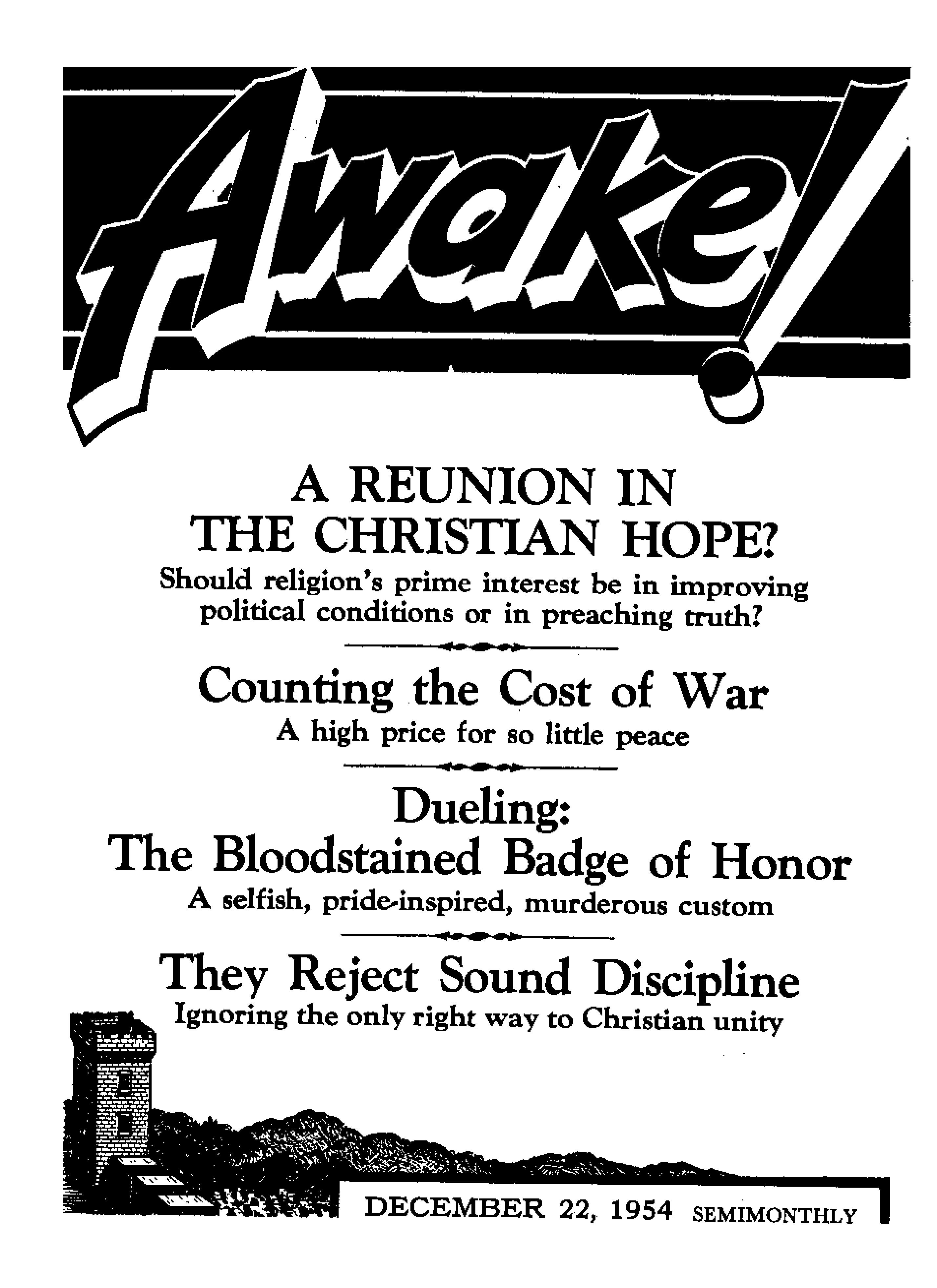
A REUNION IN THE CHRISTIAN HOPE? Should religion’s prime interest be in improving political conditions or in preaching truth?
Counting the Cost of War
A high price for so little peace
Dueling:
The Bloodstained Badge of Honor
A selfish, pride-inspired, murderous custom
They Reject Sound Discipline
Ignoring the only right way to Christian unity
DECEMBER 22, 1954 semimonthly
THE MISSION OF THIS JOURNAL
News sources that are able to keep you awake to the vital Issues of our times must be unfettered by censorship and selfish Interests. “Awake!” has no fetters. It recognizes facts, faces facts, is free to publish facts. It is not bound by political ambitions or obligations; it Is unhampered by advertisers whose toes must not be trodden on; it is unprejudiced by traditional creeds. This journal keeps Itself free that it may speak freely to you. But it does not abuse its freedom. It maintains integrity to truth.
"Awake I*’ uses the regular news channels, but is not dependent on them. Its own correspondents are on all continents, in scores of nations. From the four corners of the earth their uncensored, on*the-scenes reports come to you through these columns. This Journal's viewpoint is not narrow, but is international. It is read in many nations, in many languages, by persons of all ages. Through Its pages many fields of knowledge pass in review—government, commerce, religion, history, geography^ science, social conditions, natural wonders—why, its coverage is as broad as the earth and as high as the heavens,
"Awake 1” pledges itself to righteous principles, to exposing hidden foes and subtle dangers, to championing freedom for all, to comforting mourners and strengthening those disheartened by the failures of a delinquent world, reflecting sure hope for the establishment of a right* eous New World.
Get acquainted with “Awake !H Keep awake by reading “AwakeI1 *
Published Semimonthly By WATCHTOWER BIBLE AND TRACT SOCIETY, INC.
117 Adams Street Brooklyn 1, N. Y„ TL S. A
N, H. Knorr, President Grant Suites, Secret ary
Printed this Issue: 1,300,000
Five cent* a copy
LsngoaiM to which the Nagaikt k pibihh«l: Soaiciotithly—Af. Luans, Engluh, FhmUb,, French, German, Hcdlandlsh, Norwegian, Spanish, Swedish. Monthly—Danish, Greet, PortUjuef*!. Ukrainian.
Offices Yearly subscriptioti Rate
Amiri's, U.S., 117 Adama 3U Brooklyn 1, N.Y $1 Aoitralli, 11 Beresford Rd,, strathfield, N.8.W, 8e Canada, 40 Irwin Ave., Toronto 5, Ontario England, 34 Craven Terrace, London, W. 2 7a Stith Atriea, Private Bag, P.O. Blindsfonteln,
Transvaal 7s
Remittances should be sent to office in your country In compliance with refutations to guarantee safe delivery of money. Remittances are accepted at Brooklyn from countries where no office is located, try international none? order only. Subscription rales In different countries are here stated in local currency. Not Ise of expiration (with renewal blank) l.q sect at least two issues before subscription expires. Change of attftss when sent to our office may be expected effective within one month, fiend your old as well ae new address.
EZtmd as second-class matter at Brooklyn. N. Y.
Act of Marek 3, 1879. PrintaJ Id U.S.A,
CONTENTS
Christ—the Hope of the World
A Reunion In the Christian Hope?
Not Through the World Council!
Counting the Cost of War
Fishing in the Lair of the Marine-Cat
“Little Venice” Becomes Ultramodern
Embarrassing Methods
Vesak
Dueling: The Bloodstained Badge of Honor
Unexpectedly Strange Duels
What an Amazing Fabric—Leather!
Religion of Modern Israel
a Divisive Business
“Your Word Is Truth”
They Reject Sound Discipline
The American Legion and the Girl Scouts 27
Do You Know?
Watching the World
Index to Volume XXXV of Awake!
Christ—the Hope of the World
T IE main theme of the World Council of Churches’ recent second assembly, held in Evanston, Illinois, U. S. A., was “Christ—the Hope of the World." The shocking controversy that surrounded that theme shows just how divided today’s religions are on even such basic matters as the Christian hope. The two contradicting views were presented at the assembly’s opening sessions by Professor Edmund Schlink of Heidelberg, Germany, and Professor Robert L. Calhoun of the United States.
Edmund Schlink pointedly said: “The New Testament further announces that great tribulation shall befall the world before it finally does pass away—war and hunger, the disintegration of all community, mass destruction and natural disasters are to be expected. We are told to watch for such things to occur. Wherever, then, people speak of the coming Christ as the hope of the world, they are always speaking of the end of the world.... Even among Christians many have grown deaf to the proclamation of the world’s end. They dismiss it as mere Judaic-apocalyptic thinking. Yet it is clear that today people are afraid that humanity is doomed.... There is an essential difference, however, between the fears of modem men and the New Testament proclamation of the end of the world.... in the New Testament the calamities of the last days are not merely human misdoings nor are they the consequence of human disobedience. They are rather the activity of God himself. In the New Testament it is God who will bring the end of the world. ... If in our thinking about this subject we place the emphasis on the preservation of this threatened world, then we shall miss the point of our assembly theme completely. . . . The name of Christ is taken in vain if it is used as a slogan in this world’s struggle for its own preservation.’’
He further said: "Jesus Christ then is the hope of the world not because he guarantees the preservation of this world, but because he liberates us from al] the binding ties of this world. . . . Christ is the hope of the world insofar as the world no longer remains the world but is transformed through repentance and faith. . . . So through the gospel here in this world Christ is gathering his people to live together with him in the new life. . , , Fo this reason the days in which we live aj the last days."
He continued: “That these are, in fact, the last days may seem to be disproved by the fact that nearly 2,000 years have passed since the coming of Jesus Christ. Many people no longer believe in the promise of his future coming. But the length of time is no refutation of his promise. It is not a sign of God’s weakness, as if he could not if he wished bring to fulfillment what
he has promised through Jesus and the apostles. Rather, this time in which we live is the time of God’s patience, God wills that many shallbe saved. . . /then shall the world pass away and then shall the new creation appear as if emerging from a hiding place.”
Today, he said, “we are faced with a new kind of post-Christian man. ... he has separated his new freedom from submission to Christ. He has usurped the control of nature. He has himself set about tp establish the eternal.kingdom of peace on earth. He no longer waits for Christ to come. . . . For those who hope in Christ, however, the tumult of this world is a sure sign of Christ’s coming. The world would not tremble if he were not the victor. The wintry gales that are now howling over the world are the signs of the coming springtime. The sicknesses of our time are the birth pangs of the new creation.”
What did the World Council think of these thought-provoking words that contain a great deal of truth ? One critic of the Biblical hope said Professor Schlink’s discourse “hardly met the average churchman’s idea of the promise which that Hope holds for him.” The Christian Century referred to “the theological opacity of much” of what Schlink said, and commented on the fact that, as a result of this and the poor acoustics and extreme heat, the latter half of this “opening plenary meeting was mainly remarkable for the size of the stream flowing out the exits.” It said the Schlink speech “came as a shock to many American delegates” who thought they had long ago “escaped” such ideas.
Another comment was that Professor Robert L, Calhoun of Yale Divinity School “put the Christian Hope in somewhat more acceptable terms.” What was his view? That the Kingdom could come here and now, by man’s efforts, not God’s. Of materialistic Americans he said: “When we think of hope, it is usually hope for a better life tomorrow, for our children, for the increasing number of those who depend on us and for whom we feel responsible. In this context, much of our theology has come to lay special stress on ethics and to be far less confident about eschatology,” which is the ultimate hope, Christ’s second coming and man’s final destiny.
Thus they forsook their high mission of preaching Christ’s kingdom, and watered that word down to apply it to human goals. Their theology, he said, “has found signs of the breaking in of God’s Kingdom here at home in the advancing conquest of diseases and hunger, the abolition of chattel slavery and the extension of Christian conscience from private to public affairs, ... It does not forget the final judgment nor the life everlasting, but its chief confidence has been in God’s grace from day to day.”
In their view it must be pathetic that Jesus did not think of this, putting his chief confidence in bettering the Jews’ political conditions under Rome, abolishing the slavery, reducing the oppressive taxation, attacking political and social problems, They must think it a shame that Jesus chose to obey his heavenly Father, preaching his second coming and making this foremost work so important that he had no*time for anything else. They might think it pathetic that Jesus took that right course, but true Christians do not! True Christians are indeed joyful at the works done by Jesus, think nothing could have been more important, and continue that same work, pointing to signs of the nearness of that kingdom, and completing the preaching of that kingdom now.
Calhoun’s theory is not proving itself in practice. Thus he admits that in today's atom-charged world “there is no sign that earthly history is being progressively purged of evil and steadily nearing per-
fection,” and he further admits that “a hope that can rightly triumph over such hydra-headed perils must envisage in some sense ‘a new heaven and a new' earth.’ ” But he says: “Again it is God and not we who can know what this new order will be. Too confident speculation is out of place, and we American Protestants for the most part have sought to avoid it.” But God has explained the "new order” in his Word; so why is “speculation” necessary? It is their practice of deliberately avoiding what God’s Word says that, as Calhoun puts it, has often lost for them the faith that “the church through the centuries” has had in “the age to come.”
What does this mean to you? It means that you must be alert, for many of your clergymen have little confidence in the Christian hope given in the Bible, and are, therefore, not concerned with teaching it to you. That is one reason for so much religious illiteracy today, and another reason why so many people are examining their Bibles on their own, and, as a result, are gaining a better knowledge of Christian truth. For more information on the Evanston meeting see the next article.
A Reunion in the Christian Hope?
COUNTING delegates, ob-servers, staff members, wives, husbands and the press, well over 2,400 people from forty-eight nations gathered for the second assembly of the World Council of Churches that met last August in Evanston, Illinois, U. S. A. This assembly received massive public
Art religion! right? Should they gat together to do o better fob? How great It th* divltion that exlaW among thorn? Sho»ld their Intemt bo In improving political condition* or In preaching the truth, and why? Where do tholr effort* at unity fall thort? Doe* thi* affect the quality of their wonhip? And what thou Id It moan to you?
only Son, our Lord, who is the Hope of the World; and in the Holy Spirit.” When asked “Why have you come?” their answer was: “We have come to worship God.”
Yet the assembly proved that they were far from unity on how God is to be worshiped, and its wide
ity, was marked by impressive pageantry, and considered the views of noted religious leaders. In the evening of its first day more than a hundred thousand persons attended a spectacular “Festival of Faith” in Soldiers Field on the lake front in downtown Chicago.
Here a black-robed pastor asked: “Who are you to have come here?” The audience answered in chorus: “We are Christians. We have come from many different traditions.” “What is it to be Christian?” asked the pastor. The answer the audience gave: “It is to believe in God the Father, in His publicity merely emphasized that division. Not only were the delegates miles apart on such matters as baptism, communion and the ordination of ministers, but they could not agree even on the meaning of the assembly’s main theme, namely, how ‘Christ is the hope of the world.’ A European view is that the Christian hope Ues mainly in Christ's second coming. Their critics say they should pitch in and improve society here and now. The European view is that Christ meant what he said, and that the wickednesses of our time are the birth pangs of the new creation. The general
American view, satisfied with its materialistic accomplishments, is that man can bring In the Kingdom himself.
Two Views of the Hope
This issue so sharply divides today’s denominations that many churchmen publicly bemoaned the World Council’s choice of the subject “Christ—the Hope of the World.” In their struggle to get the various denominations together they had “blandly detoured” doctrine as being unimportant. Yet, if they cannot agree on such a basic matter as how Christ is the world’s hope, they might as well fold up their unity plans, admit their divisions, and forget the idea of trying to convince the world that all religions are the same anyway.
For at least two years a commission of Christendom’s most learned theologians, scholars and historians of doctrine had been at work on composing an acceptable statement on how Christ is the hope of the world. Then assembly delegates and consultants, meeting in fifteen separate groups, discussed the theologians’ conclusion. After this a co-ordinating committee worked several days, merging the conflicting views into a statement that, on August 25, was presented to the assembly. Only after three rewordings and re-presentations was the statement finally accepted for transmission to the churches.
Had they really agreed on the matter? No. The delegates could not agree on whether the Christian hope for the kingdom of God can be fulfilled by man in this world or only by Christ. Bishop Lilje, chairman of the co-ordinating committee, explained that the report attempts to combine both views. The “humanistic” view has been referred to as “the Kingdom that is now,” the Biblical view as “the Kingdom that is to come.”
The prophet long ago wrote: “Behold, the days come, saith the Lord Jehovah, that I will send a famine in the land, not a famine of bread, nor a thirst for water, but of hearing the words of Jehovah.” (Amos 8:11, Am. Stan. Ver.) The World Council indeed evidenced such a famine. The report of the advisory commission on the main theme said: “We find that the note of joyous affirmation and radiant expectancy which should mark a statement of the Christian hope does not sufficiently illuminate the report . . . We are not agreed on the relationship between the Christian’s hope here and now, and his ultimate hope.... we are not satisfied with the presentation in the report of the so-called ‘rival hopes.’ ” In the World Council’s Central Committee, meeting shortly after the assembly closed, President Henry Knox Sherrill said something is wrong when a Chicago Tribune headline can blare: “World Council Split on Second Coming of Christ.”
The assembly officially said, however, that considering the greatness of their theme, the “sharp differences in theological viewpoint” that were expressed “should occasion no surprise.” One commentator added: “Indeed, so grave are the doctrinal issues that any progress toward their reconciliation would be spectacular.” But is it not more spectacular to see men who consider themselves competent teachers about Christ prove unable to agree even on what hope he offers for the world? and, even further, to say that such disagreement should be expected? Is that the view you want your religious leaders to have?
Pinning Jesutf Name onto Other Hopes
The World Council, which could not agree on how Christ was the world’s hope, had much to say on other matters. It dealt with labor unions, farmers’ groups, professional associations, the hydrogen bomb, what the nations owe to one another, and how the U. N. should operate. It made a
strong declaration of principles on the racial Issue, proposed that all weapons of mass destruction be prohibited, and made other suggestions regarding international agreements.
Why does the World Council, which can agree on such worldly, material matters, remain so greatly divided on spiritual, lifegiving matters? Why can they not agree on what the hope in Christ is? Because they want Christ to fit their ideas on these subjects, rather than adjusting their ideas to fit his instructions. Many apparently do not believe he meant what he and the apostles said about remaining separate from the world and about the righteous conditions to come under the blessings of his literal kingdom.—John 15:19; 17:16-18; James 4:4; Matthew 6:9,10; 2 Peter 3:13.
How can Jesus be the hope of the world to men who will not follow his example? and who consider their political and material accomplishments of more importance than the Kingdom about which he preached? Professor Robert L. Calhoun of Yale Divinity School admitted at the World Council’s opening session: “A major part of our academic Protestant theology itself came to be concerned less with the structure of Biblical and traditional doctrines and more with the task of redressing injustice in the new industrial and political scene.” But this was not Christ’s course. His concern was not with political affairs, but with spiritual matters; not with redressing social injustices, but with giving men contentment and life; not with freeing' their bodies, but with freeing their minds. That job has not been finished to this day, and until it is finished what business would Christ’s followers have in spending their time in other fields?
The World Council can reach agreement on the questions Jesus ignored, but it cannot agree on the things he stressed.* Yet which is the more important? If you or your religious leaders disagree with his choice in this matter and think he should have dealt with political, social and economic matters instead of life-giving spiritual ones, then you are not recognizing his authority, and if you do not recognize his authority, how can you possibly claim the name “Christian”? A true Christian is more than a mere believer in Christ, he must also be a follower.
Rejecting Sound Doctrine
But the World Council thinks that all the religions that bear the name “Christian” should work together, no matter what their doctrines. Many of the World Council’s supporters say that even trying to agree on doctrine is one of the organization’s flaws, that it should ignore doctrine and just work in mutual evangelism and political and social activity. Even the little bit of doctrine that was brought into the World Council's meeting irked
* The September 22 Christian Century commented: "While a reassuring humility marked the Evanston approach to every question, perhaps this difference between the sessions which dealt with theological matters and those given to social Issues may best be summarized by saying that the latter moved with a confidence the former never attained,"
some delegates. Said the Christian Century, September 22: “Could it be that if the World Council studied its theology less dogmatically and more in action, from the saddle, so to speak—that the council would last longer and go farther? Certainly if it does not find a new manner, if four more assemblies handle theological and dogmatic th'emes as badly as this one did, the outlook is not encouraging. Give the World Council about four more such theological or dogmatic main themes—say, the nature of Biblical authority in 1960, the nature of the church in 1966, the nature of salvation in 1972 and the creedal basis of the council’s own being in 1978—and if the world itself hasn’t blown up by that time the council most certainly will.”
Before the assembly opened theologian Reinhold Niebuhr said that it is silly to advertise Christianity by insisting on what, to the secular-minded, will seem “fantastic,” that is, Christ’s second presence, ‘‘What would be more to the point,” he said, “is to bear witness to our faith in terms ... of watchfulness and soberness ... of faith and of love—which will appeal to a world in the night of despair as having some gleams of light in it, derived from the ‘Light that shineth in darkness.’ ”
But the light that shines in this world’s dark night of despair is Christ Jesus, and Niebuhr would put even that light out. (Isaiah 49:6; John 1:9) The wisdom of God may seem foolish to some men who through their “wisdom did not get to know God,” but it provides salvation because “God saw good through the foolishness of what is preached to save those believing.” —1 Corinthians 1:21, New World Trans.
The theologians who do not want Christ’s kingdom preached put themselves in the same category as the Jewish religious leaders who considered it ‘fantastic’ that the apostles should preach Christ at his first presence. Those ancient leaders wanted a political messiah, one who would restore to them a kingdom in the literal city of Jerusalem. Today’s religious leaders follow the same pattern, wanting a kingdom that will solve the world’s political and social problems, but not the real kingdom that the Scriptures show will soon abolish wickedness and bless the earth with lasting peace.
Theologian Edmund Schlink, in the World Council’s opening address, warned that the council must be concerned not only with methods of evangelism, but that “the whole assembly must concern itself with the content of evangelism.” The World Council encourages the preaching of the “gospel” throughout the world, but the Evanston meeting showed that its members have two kinds of “gospel.” The World Council tells how to evangelize, but not what is truth; what the U. N. can do, but not what religions should teach; what responsible society is, but not which view about God’s kingdom is right.
Not Through the World Council!
Should religions that cannot agree on such things unite? No, because the Christian is reminded that just “a little yeast ferments the whole lump,” and he is specifically instructed: “Do not become unevenly yoked with unbelievers. For what partnership do righteousness and lawlessness have? Or what fellowship does light have with darkness? ‘Therefore get out from among them, and separate yourselves,’ says Jehovah, ‘and quit touching the unclean thing,’ ‘and I will take you in.’”—1 Corinthians 5:6; 2 Corinthians 6:14, 17, New World Trans.
In summary, then, why can the World Council not bring a reunion in the Christian hope? First, because it is not sure what that hope is. Second, because it is going about achieving unity in the wrong way, namely, by making compromise
agreements rather than firmly pointing the way to right worship and sound doctrine. And third, because it is prone to reject doctrine whenever conflicts over what is right pose a threat to its organizational unity. Thus it becomes more concerned with denominational unity than with doctrine, more with size than with truth.
According to the Archbishop of Canterbury, the ecumenical movement (of which the World Council is a part) is “a seeking by all the churches of what cannot be had in any other way—a new manifestation of Christ to His church and so to the world which He died to save.” That new manifestation is present, but not through taking an agreeable'average of all their doctrines. Christ’s first manifestation did not come through an averaging out of the conflicting doctrines of the different Jewish sects, nor does the present one come through averaging out the various denominational viewpoints of today. A proper following of the Hebrew Scriptures (which were too often ignored by the early Jews) would have led the people of the first century to Christ; a proper following of Jesus’ instructions conveyed through the Greek Scriptures (which are too frequently ignored by modem "Christian” clergymen) leads to right worship and a reunion among those who will accept the true Christian hope today!
You can benefit from that manifestation of Christ, coming to unity with those who accept the true hope, if you win make a faithful and diligent study of God’s Word, considering its specific instructions as more important than man’s theories, his interdenominational activities, or his political accomplishments. It does work, but the only way you can prove it does is to try it yourself. Will you do so?
(For An explanation of why the religions are m divided, see the article "They Reject Sound Discipline,’* on page of this magazine.)
were only dollars and cents, the figure alone would be staggering. But the price is infinitely higher. Money can be replaced, cities can be rebuilt, the war-ravaged earth will renew itself, but not so the tens of mil
life lost in battle represents a tragic toll.
Upw much is a man’s life worth? On today’s market, very little. But in the eyes of God it is precious. With this in mind let us consider the cost of war and the price
lions of lives sacrificed to the god of war. for peace.
These are gone and no man or organizations of men can bring them back. Each
Of all the nations of the world France has suffered the greatest losses in human
life during the last three centuries. During the seventeenth century she spent sixty-four years at war; in the eighteenth century, flfty-two years; in the nineteenth century, thirty-two years. Of the 1,700 battles fought in Europe during this period France engaged in 1,079. The tabulation of casualties for only a few of the major wars gives <a partial picture of the ghastly horrors of history. The casualty list numbers more than 10,469,710. But even this price is small, to compare with the suffering imposed upon civilian populations and noncombatants. How many women, children and old men, if not butchered and killed outright, have been maltreated and tortured and left to suffer the rest of their lives will never be known. This, too, is part of the cost of war and. the price for peace.
The cost and price also includes starvation and disease. Multitudes died from these causes when Athens, Syracuse and home were besieged in ancient times. Over 30,000 people lost their lives in the sacking of Magdeburg. Another 20,000 to 30,000 starved to death in Genoa during the Napoleonic wars. In 1830 Poland lost 326,000 of its population due to disease. Typhus, cholera and typhoid reaped havoc on both the combatants and noncombatants. All of this men paid for peace, and still no peace.
The cost of war goes up and the price for peace with it. All the wanton destruction of previous wars fades into insignificance when compared with the conflagration during 1914-1918. About 1,700,000,000 people were in some way involved. For four years nations slaughtered each other. The war ended only in blood and mud. The price was colossal. The casualty list claimed 37,508,686 victims. In single battles whole armies were butchered to pieces. The British lost 60,000 on the first day of the
attack at Somme. The French lost nearly 500,000 lives and the Germans half that number at Verdun in 1916, Epidemics like the Spanish flu, directly attributed to war, claimed the lives of millions more. Four million Armenian, Jewish, Syrian and Greek civilians were massacred. One third of the population of Poland was wiped out. Two million Russian civilians perished; 800,000 German and nearly 1,000,000 Au&-trian and Serbian civilians died. Among fishermen and sailors there were nearly 100,000 killed by mine explosions. AH of this was the cost of war and the price for peace, but still no peace.
World War II came along. Prices went up and so did the cost of war and the casualty list—to 44,835,196. Vatican sources set the number even higher. The total dead, they say, was 22,960,000 and the number wounded, 34,400,000. And still no peace. Because soon to follow was the Korean war-
Accordmg to the United Nations report of August 7, 1953, the United States and its allies had a casualty list of 455,000; the losses of their foes were estimated as three times as great. United States Secretary of State John Foster Dulles declared- “The North Korean army is virtually extinct and the Chinese arid North Korean Com-
■Jli.
000 casualties, and of the 10,000,000 people of North Korea one out of every three has died from war ravages and inhuman neglect, which their rulers have imposed.”
Eight Limited “Hot Wars”
The major wars have been squelched, at least, for the time being. But continuing at the present time are eight little hot wars where lives are being sacrificed almost daily. The world is certainly not at peace. But this is not a new phenomenon. In 3,361 years of recorded history, there have been
3,134 years of war and only 227 years of peace. What a tremendous waste of life for something still not attained!
Dollar Cost of War
The high cost of war is not only in life but in dollars and cents. These figures represent the burden of war upon humanity. The nineteen years of Napoleonic wars were said to cost $15,000,000,000. If to this there is added the cost of all other wars thereafter, both small and great, up to 1914, there was at least $40,000,000,000 spent to destroy life. And how does the cost of World War I compare with this? It cost over eight times as much as the previous two hundred years of wars, or $337,980,579,657! On July 1, 1946, there were still $15,000,000,000 of World War I debts unpaid. And how does this compare with World War II ? The cost of World War n ran into astronomical figures, amounting to more than a thousand billion dollars, $1,160,991,463,984, or more than three times as great as the cost of World War I. Still this price did not buy peace.
The dollar cost to the United States of the Korean war ran upward of $20,000,000,000, seven months before the war ended. These billions were strictly the direct cost in Korea itself. Indirect costs resulting primarily from war in Korea are much greater. And, too, what the war cost the Communist world can only be imagined.
War, what woeful waste! Waste? Yes, when we stop to think that the blood spilled and the money spent have not yet bought peace! War is waste, when we know that it cannot bring or buy peace. Think of the untold billions that not only the East but also the West is devoting to war and war preparations. What a paradise this earth would be if all this effort were converted to peacetime pursuit and development! The price of one modern heavy bomber would build a modem brick school in more than thirty cities. There would be new schools in all the major cities of the world, if such monies were devoted to constructive purposes. The cost of aircraft destroyed in the second world war and in the Korean and Indochinese wars was enough to have easily built hospitals fully equipped for any emergency throughout the world. The money expended on ammunition would have supplied the nations with modem highways. The money spent on tanks would have equipped farmers everywhere with trucks and tractors to till the soil. The millions hungry for wheat and rice could have been fed at the cost of the fighter planes junked or destroyed during the last wars. The cost of a single destroyer would build new homes that could house more than 8,000 people. Homeless ones could have been housed, and slums could have been cleared away for the price of the ships sunk in battle. All of this has been sacrificed to the god of war without bringing peace.
Man-made wars can never bring peace. Man himself is no peacemaker, as the above record clearly shows. Selfish man is a waster and a destroyer. Wars will cease, peace will come, but not in man’s way. “The God who gives peace will crush Satan under your feet shortly,” and with the crushing of Satan at Armageddon will come peace. The woeful conditions upon the earth, “wars and reports of wars,” nation rising against nation and kingdom against kingdom, food shortages, diseases, sorrows and wholesale murder are a sure sign of the end of this Satanic system and that peace through the kingdom of God by Christ Jesus is near at hand. In Jesus’ words: When you see these things, “raise yourselves erect and lift your heads up, because your deliverance is getting near.” —Romans 16:20; Matthew 24:6, 7; Luke 21:28, New World Trans.
Fishing t*tVvcV“MARI!
By ’‘Awakef* correspondent in El Salvador
(rt XARINE-CAT” is what 1V1 he Is called by the sun* toasted fishermen who ply the brinish coastal waters of El Salvador, but to you and me he is a man-eating shark. He can be seen at night in the light of the loading crane off the pier at Acajutla—not all of him,
but just a quick spine-chilling glimpse as a huge, shiny-black dorsal fin clips the water in a faint instant, so quickly, so noiselessly that you may rub your eyes in disbelief until suddenly a foamy wake and a longer glimpse of something strange and dreadful drive home the point that your eyes have not betrayed you. You may look in vain for minutes into hours without seeing him again, but the excited chatter and wide-eyed stares of the dock hands let you know that they, too, have seen him, and all know only too well that beneath those lazy, foamy swells lurks the sleepless marine-cat.
Right now at my elbow is the dried jawbone of a marine-cat whose over-all length was equal to two medium-sized automobiles parked bumper to bumper. His sawlike teeth are so arranged in rows in upper and lower jaws as to number about two hundred. His hide, not slick and slimy like that of most fish, is as tough and abrasive as emery cloth. The oil from his liver brings a high price, and, feared though he is, he is relentlessly fished out of his ocean home and his flesh is sold on the market daily.
<[The marine-cat is not the only monster of the deep whose liver is prized by fishermen; he has a cousin whose meat is sweeter and far more edible and whose liver yields much more oil than that of the man-eater. His hide is so rough and tough that he is called by the fishermen, in their own language, “Sandpaper." Yet “Sandpaper's" meat is highly prized for its mild flavor. The two dorsal muscles on each side of his spine are neatly cut free and lifted out to be sold on the spot in the form of two six-foot tenderloins as thick as
fence posts. Anxious buyers line the dpck in their eagerness 40 buy this choice delicacy.
<^Yet Salvadoran gourmands pass up the “Sandpaper" in preference to a still fl ner-tasting d enizen
of the blue pacific. This is the sawfish—a marine monster that comes as big as the man-eater, but has, instead of fierce incisor teeth, a four-foot, double-edged saw extending forward out from his head. His flesh is indeed an epicurean delight!
<[ The seafood problem in El Salvador, however, is the problem of getting its price down to what a laboring man can afford. At present the average El Salvadoran must be content to let his family sip broth made from a fish head and spices, or go without fish altogether. Expressly to meet the seafood problem head on, the government has obtained larger boats, and is going into the matter of commercial fishing in earnest,
<[ A trip on one of these fishing boats can indeed be interesting. We are ready at 6 a.m. with our bottle of water, a sack of French bread and three avacados. Our hosts scramble down a salty rope. Being unable to follow them in this manner, we climb down a badly corroded iron ladder into the bobbing boat. We set out to sea, and as the heat of the dsy increases the captain carefully sets the throttle, grasps the loose end of a rope and, with all his clothes still on, flings himself into the ocean, where he rides for a time in the boat's wake, spitting foam. On deck the other men cool off by stripping naked and dousing themselves from head to foot with salt water. Soon it is time to lower the dragnet, and two forty-flve*minute hauls are made with it. Then draglines with two hundred or more hooks are hauled in and rebaited for sharks.
On our returning to port, the ocean is peaceful and quiet. Save for an occasional drifting log loaded with hitchhiking gulls, as far as the eye can see there is nothing to break the sameness of this whole, vast watery expanse. It can impress upon one's mind just how completely natural and peaceful will be the relaxed and unstrained new world, when there will be neither fear nor shortage of food nor inequality in its distribution.
By “Await*!1 con«p©rxienl in Vorieiutla
IF YOU are tired of the hustle and bustle of everyday life and desire to get away from it all, perhaps you, like so manyt dream about the tropics as a perfect hide* away from civilization. Well, stop dreaming and snap back to reality, because even the tropics have gone ultramodern. For a fine example, take the enchanting land of Venezuela, right on top of South America, This country was once a dense jungle, but look at it now—a bustling Pittsburgh or a traffic-jam med New York city. But Venezuela is still enticing.
Travel to Maracaibo, at the very tip of South America, Here one can behold the mighty Andes towering high into the wild blue yonder with all their majestic splendor, They form a giant backbone all along the western side of the continent. At the southwest comer of Venezuela the main body continues on north toward the Isthmus of Panama, but a cordillera, or spur, breaks off and arcs toward the northeast where it suddenly drops off into the sea in northeastern Venezuela, In the “Y” that is formed between the cordiltera and the main range of the great Andes is a huge water-filled basin, Lake Maracaibo, It is 110 miles long and a little over 65 miles wide, almost as large as Lake Ontario, At the north end the lake narrows down to a very narrow outlet and flows into the Gulf of Venezuela and from there into the Caribbean Sea, Where the lake narrows, wc find the second-largest city of Venezuela, Maracaibo, While everything else has changed around here, the climate has not. It is still unbearably hot. The average annual temperature is 82 degrees. The natives sleep in hammocks, because a mattress in this sweltering heat is unthinkable.
What, then, is the attraction in Venezuela? According to history, the Indians were there first. But of the white men, Christopher Columbus was the first to stumble onto this "gold mine’* in search for a shorter route to India and the spices that were to bolster a shaky Spanish economy. On his first trip Cristobol Colon discovered the rich isles of the Caribbean, and on a subsequent voyage he touched South America near the delta of the Orinoco River. He thought it was just another island until he noted that he was sailing in fresh water. Realizing that such a mighty river denoted something bigger than a mere island, and, too, recognizing the river had four mouths, Colon firmly believed that he had discovered the site of the garden of Eden, Actually the Orinoco discharges water into the sea through upward of seventy mouths.
With the tall tales that were brought back to Spain from this so-called garden of Eden, other adventurers sallied forth. In 1499 Alonso de Ojeda skirted the northern coast of Venezuela from the east toward the still unknown west, and bypassing a little peninsula he sailed into the Gulf of Venezuela. Slowly edging around some
islands to the south he suddenly found himself in Lake Maracaibo, Before him lit up a different world, a new world. There were Indians living in thatched huts built on piles out over the water. Many of them were paddling to and fro in canoes, so Ojeda named the place "Venezuela” or “Little Venice”; at least, so the story says.
The Indians that lived along Lake Maracaibo were peace-loving Indians, But the Spaniards, not so. The Spaniards were ambitious and greedy. They saw that the land held out great possibilities. They needed labor to work it and almost before the Indians knew what had taken place they had become the slaves of the white man. Settlements began to grow and slave markets thrived. Africans were shipped in and sold on these same slave markets, Maracaibo, being strategically situated and easy to defend, thrived as a slave station. Why all the commotion? Gold! That “magic” metal that has attracted thieves, pirates and ambitious men to other lands also brought them to Venezuela where the precious dust was found. That was several hundred years ago, but what is the attraction in 1954?
Gold! This time “black gold.” Across from Maracaibo, near the shore line at La Salina, can be seen what interests modem man. Thousands of oil derricks pumping oil. There are over 2,000 producing wells in Lake Maracaibo in the La Salina district alone. In this very same spot the Spaniards of old looked for El Dorado, the city of gold. The Indian legend said it was in the center of a lake. Today cold steel pipes wind their way far beneath the center of this great lake in the Maracaibo basin and the city of black gold is pumped to the surface. Venezuela ranks second only to the United States in oil production and most of it comes from under the lake.
The Indians of this vicinity believed that in years long gone by there was a great flood that covered all the land and everything living perished, that is, everything except for a family of their ancestors, who climbed on top of a high mountain. In time this family built a golden city in the middle of the lake. Since the Indians had no need for gold they never looked for the city. The Spaniards called it El Dorado, the golden city. They pillaged, tortured, enslaved and murdered the Indians in an effort to find the golden city, without success.
Today the golden city is not yellow, but black. With its value many cities in Venezuela have become “golden cities,” with wide paved highways, attractive plazas, magnificent hotels, modem bridges and all the conveniences that the twentieth century can provide. Her riches consist of more than oil. Her soil is still rich in yellow gold and her mountains are heavy with iron ore, too.
As for natural beauty, travel south from Ciudad Bolivar some 150 miles. Here a plateau rises out of an almost trackless jungle to some 6,500 feet above sea level. It is apparently flat on top, with an area of around 300 square miles and jagged, vertical walls that fall away to the jungle floor thousands of feet below. Off the top of Auyan-Tepui (Devil Mountain) plunges the most spectacular waterfall in the world, spilling over the top and barreling downward some 2,648 feet before it strikes a ledge and sizzles off to plunge downward yet another 564 feet to the jungle floor! What beauty! What a roar! The fall is named El Salto Angel, or Angel Falls, not because of its beauty, but after an American who discovered it. Long before Angel flew over it in 1935 while prospecting for gold, the Indians would speak of these falls, but the white man thought it was just another legend. How does this 3,212-foot falls compare with the Niagara Falls?
There is hardly a comparison, because the Niagara drops a mere 167 feet. Angel Falls might well be the highest falls in the world.
For a city of beauty there is the capital, Caracas. It has a climate of perpetual spring, its walls are completely surrounded by mountains, and modem architecture has converted it into a workingman’s paradise. A superdeluxe express highway originating in the heart of the city stretches to Maiquetia, where the latest thing in airports is located. The highway itself is a marvel. It travels over yawning canyons on graceful bridges, tunneling through mountains, reducing an eighteen-and-a-half-mile journey on a twenty-three-footwide highway, which had 395 dangerous curves, into a pleasant eleven-mile drive on a seventy-foot-wide highway with only thirty-six curves, any of which can be taken at fifty miles an hour without danger. This autopista, as it is called, cost close to six and a half million dollars a mile! The time and lives it saves have justified its cost.
In the business center of this capital city there is a square rivaling Rockefeller Center in New York city, if not in splendor or size, then certainly in cost. Underground bus terminals, skyscrapers, beautiful architecture, smart shops, air-conditioned offices, fancy restaurants and busy people are everywhere. As a witness of greater prosperity and progress to come, no matter in what direction the eye scans, new buildings are being constructed, office buildings, hotels and business establishments. No wonder Caracas is being labeled the fastestgrowing city in the world. Surely all of this is a far cry from the jungles that it was a few years ago!
This prosperity and progress are not limited to Caracas alone, but can be seen and felt throughout Venezuela. So, for your search to get away from the hustle and bustle of modern living you had better reconsider. The jungles in many parts of the world have gone modem. There are a few unadulterated tropical places left; Nueva Esparta is one of such, an island state of Venezuela. It is the kind of paradise men dream about and never go to —with sandy beaches, tall coconut palms and warm Caribbean waters, with green mountains, tropical fruit, fish, pearls, fertile valleys and bodily peace and rest.
But the peace and rest men seek is that of the mind and only God can give that. This will come through the paradise of the new world now at hand.—Philippians 4:7.
Embarrassing Methods
C, Representative Wayne L. Hays, democrat of Ohio, was critical of the methods a U. S. Congressional committee was using in an attempt to prove that tax-exempt foundations have promoted the "Socialistic line.” Illustrating that the method of lifting quotations out of context could be both misleading and unfair, without identifying their source Representative Hays asked the committee's researcher for his opinion on three quotations. The researcher considered them, then said: “All of these are closely comparable to Communist literature I have read. The objectives parallel very closely Communistic ideals and Socialistic ideals." Then, as the committee’s chairman turned scarlet, the quotations were identified as coming from popes Leo XIII and Pius XI. Hays said he considered the Catholic Church "one of the great bulwarks against communism throughout the world,” but wanted to show that congressional committees “can’t lift a paragraph out of context and prove anything.”
VESAK
By ,lAw*k*P cM-MpanilMt k» Ctfloa
DMAGIKE celebrating the birth of Christ, hie baptism and his resurrection all at the same time; or, say, combining Christmas, New Year and Easter into one celebration! Exactly such a threefold anniversary is "VeBak” (pronounced we-suk), only it has to do with Buddha, and not Christ. To the Buddhist this day is the anniversary of three holy events: the birth of an Indian prince named Siddhartha, his attainment of enlightenment cr Buddhahood and his passing away.
The Buddhists entertain no doubt about their date of celebration, as do Christians about the birthday cf Christ. They maintain that the full-moon day of May is the exact anniversary of the birtb of Prince Siddhartha Gotma (623 B.C.), of his enlightenment In his thirty-fifth year, and of his passing away at the age of eighty.
<L About two days in advance preparations for the celebration begin. Places are selected where large pan dais, or temporary sheds or booths, will be erected. First large pole frameworks are set up. Then during the night before Vesak very elaborate paintings In colors of yellow and brown are secured to these frames. The pictures depict meritorious events in the previous lives of the Buddha (he having lived 500 In all, say they), the circumstances of his birth and enlightenment; hells and purgatories with the devils at work with their saws, forks and racks punishing their victims; conversions to Buddhism: and human life with some of its causes of sorrow, namely, birth, marriage and death. The pandals are colorfully adorned with multlhued lights, which continually flash on and off, lighting scene after scene. During Vesak night and the night following, thousands of worshipers flock from far and near to see these depictions.
C Smail structures with cadjan roofs, roofs made of dried coconut fronds, are set up along the streets and by the markets. These are called danaalat> places where, on Vesak day, all who enter may eat and drink free of charge. However, those who are able to pay eat at the hotels and restaurants. An array of little lamps of clay, candles, colored electric lights, flags, white streamers, Bud-4 dhlst pictures and other decorations are X placed around all the Buddhist temple* and Y other places of worship, such as the bo trees.
grottoes and Images or around Buddhist X homes.
X C The big day begins at an auspicious i minute, which has been set by astrologers. X This may be in the wee hours of the morning Y or in the forenoon* But regardless of the J* hour, everything must wait till then. At the precise moment a sudden burst of fireworks breaks out as if a bombardment had suddenly commenced. Easterners have a great love o for noise. To the minute the fires In the t homes must be lit to cook the morning food, y which is also of auspicious variety* The dev-X otees then proceed to their temples or places X of worship, all dressed in white to make their £ offerings of flowers by placing these at the X feet of the statues of the Buddha. They then ? kneel, hands clasped together before their 4 breast with head bent forward, repeating X Buddhist stanzas reminding them of proper x conduct
y C The rest of the morning and afternoon is X spent at home or with relatives or visiting X friends. The evening is alive with activity. 4 Country folk and villagers stream into town* X Ceylon's largest city, Colombo, becomes X packed with people. These have come to sec1 v the panda!a and illuminations. Some of these $ people will walk (because all traffic is X stopped) all night in an effort to see every-Y thing possible so they will be able to con-X verse Intelligently about any of the panda Is j and express an opinion as to which they 4 think was the best. The most outstanding X one receives a prize.
Y C Vendors are everywhere with their sweets 4 and treats* Children, like children throughout 2 the world, are overheard pleading for this Y and that. 111670 are irritable mothers, ex-Y hausted fathers and disgusted shopjjers. X Businesses flourish. Complaints are voiced i about the non-Buddhist advertising his wares ? in the name of Buddha, even as Christmas £ articles are being sold In the name of Christ, t Others explain: "Circumatanees have led us Y to adopt the conqueror's Christmas at Vesak 2 with lanterns, decorations, 'Happy Vosak' Y cards, Veaak cakes, masks and caps, carol 4 parties and crackers."
I € In Vesak the worship with their lips is Y mifidlrecied. How like in the western Christ-J mas! 'Tn vain do they worship me/' said the .J Cod of the universe.
DUELING
h wicked.
trial the property of the defeated went to the church. “The ritual preceding the actual encounter, whereby the entrants spent the night previous kneeling before the al-
almost the be
THE
BLOODSTAINED
BADGE
OF
HONOR
ginning of the twentieth century a wicked custom dictated the lives of men. This was dueling. “Dueling” does not mean battles fought by “bad men” but rather a combat with deadly weapons between two persons whom society viewed as being gentlemen. Duels were prearranged and took place under a code of etiquette and in the presence of witnesses called “seconds.” A hasty remark, a misconceived gesture, these could provoke a challenge to a duel. When challenged very few men had the moral principles and courage to refuse to take up the people-pleasing custom. Rather than suffer any loss of “face,” almost all, whether statesmen or senators, felt obliged to wear the bloodstained badge of honor. So duels raged and men died. They called for swords, rapiers and daggers. Later the call was “pistols for two and coffee for one."
How and where did this God-dishonoring custom start? Dueling for the sake of “honor” started in Christendom. Its roots go back to the Middle Ages when judicial combats were fought to decide the guilt or innocence of persons charged with crimes. The principle of these “trials” was that
ight. Only such trials as were ved by the Roman Catholic Church ^were recognized as strictly legal. After the
tar, beseeching the protection of certain specified saints, supported by priests, to whom confession was made, and by whom the knightly swords were blessed, no less than the actual combat itself, was Church inspired, and very largely Church governed.”—Famous Duels and Assassinations.
Bonor-prompted Duels Begin
With the Reformation the custom of “trials by combat” faded into oblivion. But even before honor-prompted duels came into vogue the “trials by combat” had degenerated into an excuse for a deadly fight between grudge-holding men under protection of law. So it was not long before “gentlemen” everywhere soon thought themselves privileged to draw a sword whenever their ego was hurt. As society became more refined, duels became more frequent In' France under Henry IV it is said that no less than 4,000 gentlemen lost their lives in just one year. No portion of Europe was completely exempt from the wicked custom. History says: “At some periods [in Christendom] war itself was scarcely more
DECEMBER 22, 1954
destructive than the so-called contests of honor."
Since the dueling custom itself was absurd, It is not strange that life and death often hinged on absurd matters. An Irishman once challenged an Englishman because the latter declared that anchovies did not grow on trees. One noted duel was fought over a goose. A' member of Louis XVUTs bodyguard challenged three men in one day—one because he had stared at him, another because he had looked at him askew and a third on account of his passing by without looking at him!
Although never as popular with the Englishman as with the more excitable Continental, the custom of dueling spilled much blood on the British Isles. Scotland never got excited over dueling, but in Ireland dueling at one time became such a fad that it was deemed wise for the aspiring barrister to purchase, along with his law books, a case of pistols. At the time when the bloody badge of honor was so highly prized, the two questions asked of a man who proposed to a lady were: “What family is he of?" and “Did he ever blaze?”
The wicked custom found its way to America early. In 1621 a duel was fought at Plymouth, Massachusetts; but it was not until after the Revolution that citizens met in mortal combat to any alarming degree, From then on until 1840 many heartrending chapters in American history were written in blood. Most duels were fought in the South, where dueling was strongest At one time, in Charleston, South Carolina, there was even a dueling society. Each member took precedence according to his number of “kills.” One day an old weatherbeaten officer of the British navy arrived. He got into an angry dispute with the president of the society. The Englishman was challenged to a duel. He accepted. Though warned that the American was a “dead shot,” he did not back out. So the duel took place. The aim of the old Englishman was unerring; the proud American crumpled to the ground like a ruined tower. The fastdying president called upon the members of the dueling society to give up the wicked custom that had brought about his downfall, Thus ended what was probably the first and last dueling society in America.
Famous American Duels
In 1806 one of the most famous of American duels took place. Andrew Jackson had challenged Charles Dickinson because the latter had slandered his wife. Each intended to kill the other. Both were excellent marksmen. On the way to the field of honor Dickinson amused his friends by cutting a string with a bullet from a distance of twenty-four feet. But now the time came for Dickinson to shoot at a target that could shoot back. The word was given. Dickinson raised his pistol and fired. A puff of dust blew from the breast of Jack-son’s coat. But Jackson stood firm. Dickinson recoiled, crying out, “Great God! Have I missed him?” Moments later Jackson took aim and squeezed the trigger. Dickinson reeled, his face turned white, he sank to the ground. Dickinson died from his wound but Jackson lived to become the seventh president of the United States.
Another noted duel occurred in 1820 between James Barron and the distinguished naval officer, Stephen Decatur, They elected to fight with pistols at eight paces. Both fired, both felL On the ground the wounded men carried on a sort of conversation. What they said is not positively known, except that they exchanged forgiveness of each other. Decatur died that night; Barron died weeks later. One who knew well the difficulty between the two men, the then attorney general of the United States, wrote: “Decatur said he had never been his enemy, that he freely forgave him his death—though he could not forgive those who had stimulated him to seek his life. One report says that Barron exclaimed, ‘Would to God you had said this much yesterday!’ ”
The most sensational duel in the United States was between Vice-President Aaron Burr and that famous statesman, Alexander Hamilton. Both men aspired to the presidency. But for Hamilton, Burr would have in all probability attained his desire. Hamilton considered Burr an unscrupulous, power-mad politician whose interests were pot for the good of the country. Of Burr he said: “If we have an embryo Caesar in the United States, ’tis Burr!” Hamilton’s influence prevented Burr from being governor of New York. In Burr’s bitter disappointment (for this governorship carried more power than the vice-presidency) he picked a quarrel with Hamilton. The only settlement that Burr would accept was a duel. Before the duel began Hamilton made it dear: “1 am conscious of no ill will to Colonel Burr distinct from political opposition. ... If our interview is conducted in the usual manner, and it pleases God to give me the opportunity, to reserve and throw away my first fire, and I have thoughts even of reserving my second fire, and thus giving a double opportunity to Colonel Burr to pause and reflect.”
On July 11, 1804, the two men met at Weehawken, New Jersey, at the same site where Hamilton’s eldest son had been killed in a duel three years before. Each party took his place and the word was given. Burr raised his arm and slowly took deliberate aim. One shot rang out. Hamilton, raising himself convulsively, fell forward on his face, his pistol discharging as he sank to the ground fatally wounded. Hamilton’s death stirred up the mind of the people, as nothing before, to the positive horror and vanity of dueling.
It is interesting to know that on fine evening before Die duel Hamilton had prepared a paper containing his view of dueling. It said: “My religious and moral principles are strongly opposed to the practice of dueling; and it would ever give me pain to shed the blood of a fellow creature in a private combat forbidden by the laws,” Why, then, did he meet Burr in a duel in which, it seemed, he was not even going to shoot at Burr? Hamilton’s own words answer. He said “his relative situation, as well in public as private,” imposed upon him, as he thought, "a peculiar necessity not to decline.” So Hamilton went to the foolish field of honor rather than not conform to public prejudice. Hamilton was a victim of a selfish, pride-inspired, murderous custom.
…