Awake!, September 22, 1954
Download: PDF — Awake!, September 22, 1954
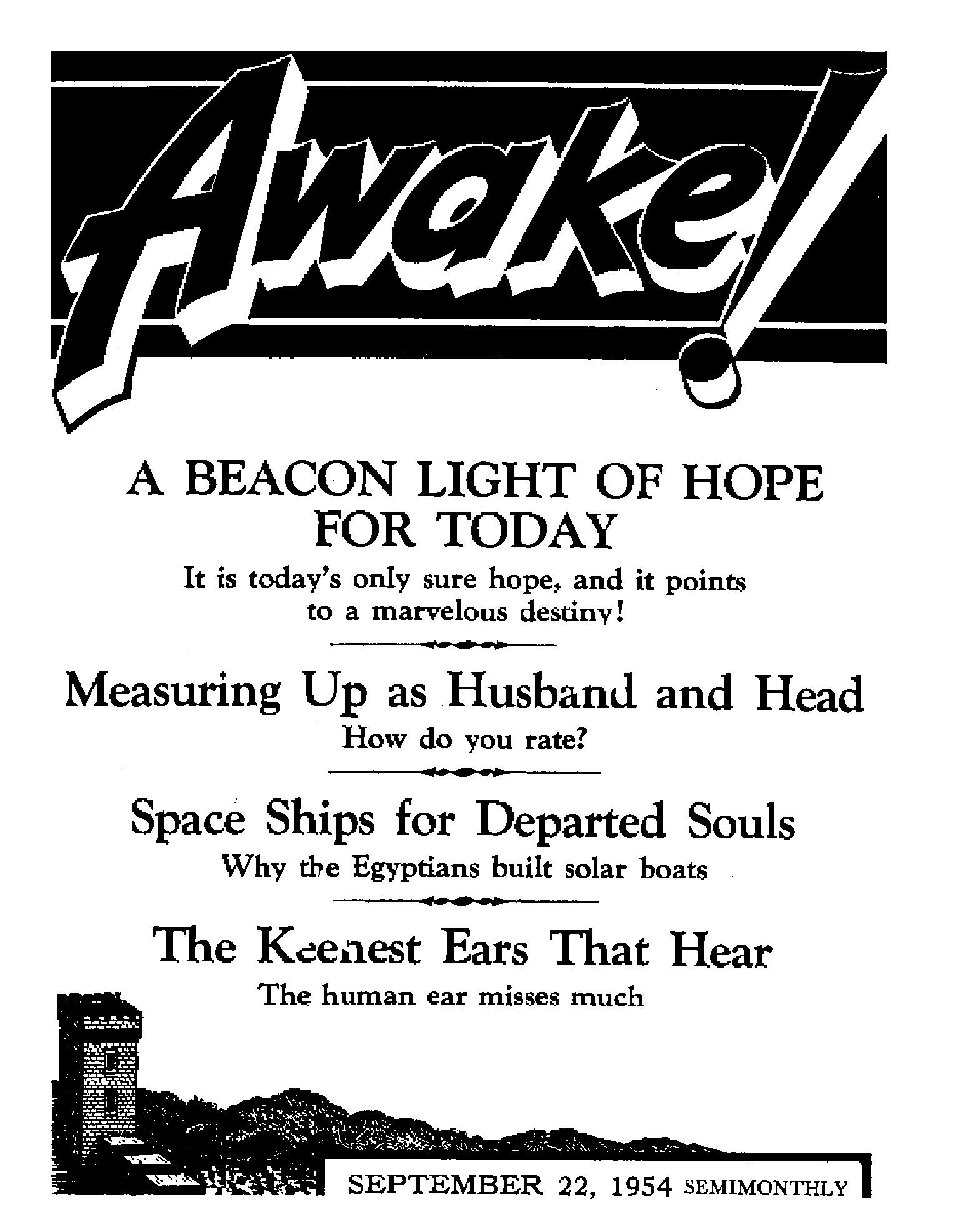
A BEACON LIGHT OF HOPE FOR TODAY
It is today's only sure hope, and it points to a marvelous destiny!
Measuring Up as Husband and Head
How do you rate?
Space Ships for Departed Souls
Why the Egyptians built solar boats
The Keenest Ears That Hear
The human ear misses much
THE MISSION OF THIS JOURNAL
News fourceB that ore able to keep you awake to th* vital issues of our times must be unfettered by censorship and selfish interests. “Awake!” has no fetters. It recognizes facts, faces facts, is free to publish facts. It is not bound by political ambitions or obligations; it is unhampered by advertisers whose toes must not be trodden on; it is unprejudiced by traditional creeds. This journal keeps itself free that it may speak freely to you. But it does not abuse its freedom. It maintains integrity to truth.
•‘Awake 1’* uses the regular news channels, but is not dependent on them. Its own correspondents are on all continents, in scores of nations. From the four corners of the earth their uncensored, on* the-scenes reports come to you through these columns. This journal's viewpoint is not narrow, but is international. It is read in many nations, in many languages, by persons of all ages. Through its pages many fields of knowledge pass in review—government, commerce, religion, history, geography) science, social conditions, natural wonders—why, its coverage is as broad as the earth and as high as the heavens.
•’Awake I” pledges itself to righteous principles, to exposing hidden foes and subtle dangers, to championing freedom for all, to comforting mourners and strengthening those disneartened by the failures of a delinquent world, reflecting sure hope for the establishment of a righteous New World.
Get acquainted with w A wake!” Keep awake by reading ’ ‘Awake 1”
PrBLTSHiD Semimonthly by WATCHTOWER BIBLE AND TRACT SOCIETY, INC.
117 Adama Street Brooklyn 1, N. Y„ IS. S. A,
N. H, Knorr, •Pf’csiSenl Grant Suiter, Secretary
Printing this issue: 1,250,000
Five cents a copy
LinvnfH h whtoli the mmuIr* Il Hkll>h»4: Sttnlwmthly—Alrikitru, Endisb, Ftonkh, French, flertnin, HoHtadiili, Norwegian, Spiniih, fhredhti. Month!?—Danish, Greek, PortuctMe, Ufciitiliii.
Ofltat Yearly lubtcriptiMi Rale
AffvrlM, ILS , 117 AdimiSU Brooklyn L NX |1 Aaitralla, 11 watfordlw., SintMdd, N,S.W« Ss Cuan, 40 Irwin An., Toronto 5, Ontario $1 Eailaal. 34 Craven Terrace, London. W. 2 Ta Heth Africa, Private Btj, P.O. EtadefaLtoin,
Trinsvcil Tc
Entered as second'd ass matter at BrookTyn, N. I. Art At March 3, 1879. Printed In D. fi. A.
CONTENTS
Starvation or Salvation—Which?
A Beacon Light of Hope for Today
The Keenest Ears That Hear
Trace Elements and Health
Space Ships for,Departed Souls
The Papaw
Who Robbed the Mint?
East Pakistan Imperiled
"Expecting a Boy, or a Girl?”
They Bury Their Dead
Measuring Up as Husband and Head 21
‘Loving Your Wife as Yourself' 23
The Lifesaving Elephants of Kenya 24 “Your Word Is Truth”
What Does It Take
to Become Truly Rich?
Jehovah's Witnesses Preach
in All the Earth—Uruguay
Do You Know?
Watching the World
Volume XXXV
Brooklyn, N, Y., September 22, 1954
Number 18
Starvation or Salvation—Which?
RIGHT now the world is concerned with starvation. Authorities predict the world’s population will rise from two and a half billion to four billion in thirty years and in a hundred years the population will skyrocket to seven billion. To feed these growing billions under present standards will call for a miracle. With the present modest population of only two and a half billion the New York World-Telegram and Sun asserts that "seventy per cent... go to bed hungry every night,” and the New York Times for May 2, 1954, reports “that over one-half of the world’s population is living on the edge of starvation and suffering from malnutrition diseases.”
All this starvation without a food shortage is difficult to believe, but it is true. The executive director of the relief organization CARE revealed that the Commodity Credit Corporation alone has some $6 billions’ worth of surplus foods and fibers that are feeding and clothing no one, piled in idle ships and storage. Not only would the release of these items ease hunger pangs but would help to save American taxpayers almost $168 million a year which they now pay in storage charges alone.
“The gloomy, basic prediction of the report,” says Kathleen McLaughlin, referring to a report compiled by United Nations’ experts who examined the possibilities of production to sustain an increased population, "is that ‘ignorance, greed, strife, superstition and blind adherence to tradition’ will prevent men from accomplishing works that are in their power, ‘even though the alternatives may be misery and starvation.’ ” Showing how superstition contributes to malnutrition and disease, Science Digest for June, 1954, says:
“The reason that the people of the world are badly nourished is due to ignorance about diet as well as to the lack of needed foods, says Dr. Cicely D. Williams in the British medical journal, The Lancet. For instance, although meat and milk are widely available in East Africa, women do not get them. ‘The women are told that if they eat eggs they will become sterile, if they eat fowls they will crow, if they eat goat they will grow beards.’... In India things are even more difficult. Eating even an egg is looked on as a kind of murder. On the African Gold Coast, there is a prejudice against condensed milk, although the inhabitants suffer from a lack of proteins and it is well known that milk, fresh or condensed milk—out of cans—is considered a luxury. It is believed inelegant to drink the nutritious local buffalo milk.’’
While the world worries itself over its food famine, it has completely lost sight of a greater and by far more devastating famine in its midst—a spiritual famine. Not just a half or seventy per cent of its people are thus starved, but in the words of John: “The whole world is lying in the power of the wicked one.” (1 John 5:19,
New World Trans.) If the political administrators have proved themselves poor managers, then the clergy have shown themselves to be twice as slothful and selfish in the handling of spiritual food. They have a never-ending supply of spiritual food at their disposal in God’s Word the Bible if they would use it.
But the clergy have "rejected the word of Jehovah; and what manner of wisdom is in them?” Instead of dining on the "wheat,” solid truths of the Bible, Christendom’s religious leaders have preferred the “husks,” the synthetic diet of philosophy, political economy, psychology, sociology, tradition and mere ethics, and have forced its members to eat this diet until the souls of its parishioners are starved for they know not what.—Jeremiah 8:9, Am. Stan. Ver.
Almighty God foretold the coming of this famine through his prophet Amos, saying; "Behold, the days come, saith the Lord Jehovah, that I will send a famine in the land, not a famine of bread, nor a thirst for water, but of hearing the words of Jehovah.” The lack of material food may cost one this life, but the lack of hearing the words of Jehovah is far more serious. It will cost one his' everlasting existence. That is why Jesus said: “Man must live, not on bread alone, but on every utterance coming forth through Jehovah’s mouth.” These utterances are food for the mind and heart that persons must have to gain Jehovah’s approval and life. Without them a person is the samp as starved. Such is this world, and it will die the death at Armageddon.—Amos 8:11, Am. Stan. Ter.; Matthew 4:4, New World Trans.
Therefore, “work, not for the food that perishes, but for the food that remains for life everlasting, which the Son of man will give you, for upon this one the Father, even God, has put his seal of approval.”—John 6:27, New World Trans.
Why are hit mcceiiei so limited? What hope do the Scriptures give in this materialistic age? How will the auro hope mean a new world? What doe* it all mean to you? and how can you benefit from this knowledge?
TODAY’S world is in the dark. It thinks it knows where it has
been, is not sure of where it is, and is afraid of where it may be going. It has no firm hope toward which to direct its course, no beacon light to mark its path, no clear destiny in view. The United Nations has not brought peace, wars have not remedied matters, delinquency increases, fear grows. Just as Jesus long ago foretold: "Men become faint out of fear and expectation of the things coming upon the inhabited earth.” (Luke 21:26)* Indeed, this earth certainly needs godly new conditions!
Without a sure hope man despairs. He
* In this article texts from the Greek Scriptures (“New Testament”} are quoted from the New World Translation, and, unless otherwise noted, those from the Hebrew Scriptures ( ’Old Testament''} are quoted from the American BtandaTd Version.
has no specific aim, no one purpose toward which he can direct his life. Under norma] conditions this is bad enough; in times of crisis it may prove disastrous. But a desirable hope must be a sure one, because a false hope that collapses under strain may be worse than none at all. So, man needs not only a definite hope, but a reliable one, worthy of trust.
Where is such a hope to be found? Surely the Creator of the universe did not make man a miserable failure to despair; yet man’s basic schemes today continue to fail. Human efforts for a desirable world, for peace and righteousness, continue to prove little more than the dreams of waking men!
Futility of Human Efforts
Some people put their trust in politics, thinking that this alone is practical; yet as Pageant magazine said in discussing future world prospects: “Genuine, wholehearted [political] agreements that can be trusted do not appear on our horizon at all.” We must agree with world analysts who take that view, because the mere prospect of development of international political agreements, so hard to make and so frequently broken, does not really provide a firm basis for confident trust. Those who really rely on such agreements to bring man’s desires are trusting in a dream that is still tar short of realization.
Other people pay little attention to politics. What they want is money. It is their trust for the future. Yet money is based on politics, and if politics fails your money collapses. Indeed, it may do so anyway! For example, if you live in the United States and are just now inheriting savings that your grandfather put away in 1900, you find that what he put aside for a shirt buys only the collar, for shoes buys only the heels and laces, for a chicken buys only the drumstick. Even more recently, every $1,000 that you confidently put away in 1939 was by last year worth only $533. And at that the United States’ dollar is one of the world’s sounder currencies. Thus, money is not a firm hope, and those who consider it a real security also prove to be dreamers.
Still other people turn to religion to see if it provides the sure hope. True religion should sibh hwpfc, Vwrt. many wYiu
have turned to today's denominations have come up with the conclusion that was expressed by Boston University Professor Harold A, Ehrensperger at a Methodist Student Movement meeting in Lawrence, Kansas, last January 2. He said religion has become “a name, an institution, not an experience in life. What we lack are prophets—there are no prophets any more.” Another problem regarding religion concerns which religion’s hope is sure, which is right? You say it does not matter which of the several hundred kinds of religion you accept? Then you are living in your own hope that this theory is correct, not in a flrm trust in that religion. And even worse, God’s Word disagrees with you.
Others have turned materialistic, turning to science as a savior. But that indeed seems foolish in this year of the H-bomb. It is science’s developments that have made modem war possible, have struck the world with, fear and have uuderstcxed the need for a sure hope. No matter who uses these weapons, the science that has made them certainly provides no sure hope for man today!
Why, then, have all of man’s efforts to find a firm foundation for trust failed? Why have his high hopes proved to be merely the dreams of waking men? Because the task is bigger than weak, imperfect men are. Today’s world is under the control of wicked spirit creatures who are far more powerful than any human forces. Many people scoff at this, but that scoffing
is to their hurt, for the existence of such spirit creatures is certainly not a myth. It is an absolute fact!
Note that the Bible tells us that "the whole world is lying in the power of the wicked one,” and that it further says that "the god of this system of things has blinded the minds of the unbelievers" Who is this "god of this system of things”? Certainly not Christ, for he said: "My kingdom is no part of this world." Then who is this world's god? He is the one who, because he was in possession of these kingdoms, had the audacity to offer Jesus “all the kingdoms of the world," namely, Satan himself! (1 John 5:19; 2 Corinthians 4:4; John 18:36; Matthew 4:1-11) He is the one who is responsible for this world’s distressed conditions. Thus Revelation 12:12 predicted: “Woe for the earth and for the sea, because the Devil has come down to you, having great anger, knowing he has a short period of time."
If these Scriptural facts seem amazing to you, then it would be well for you to get your Bible out and read them for yourself, for they are true, and are a key to understanding the world's present darkened condition.
A Dependable Guide
These Bible promises are not just a dream, they are a reality. How do we know we can trust what that Book says? Because it is God's dependable Word. That Book’s historical accuracy has repeatedly been proved true, to the consternation of its critics. Its permanency is indisputable. “The grass withereth, the flower fadeth; but the word of our God shall stand forever.” Its basis of authority is unexcelled. Its writers did not write on their own authority, but they attributed it to God, as did David, who said: “The spirit of Jehovah spake by me, and his word was upon my tongue."—Isaiah 40:8; 2 Samuel 23:2.
Most conclusive, however, is the fact that the Bible reliably predicts the future. Hundreds of years in advance it foretold regarding Jesus that he would be born of the tribe of Judah, born in Bethlehem, born of a virgin, would be hated, would be betrayed by a follower for thirty pieces of silver, would be convicted by false witnesses, would be impaled with sinners, even that lots would be cast for his garments, etc.—Genesis 49:10; Psalm 22:16, 18; 35:11; 41:9; 69:4; Isaiah 7:14; 53:12; Micah 5:2; Zechariah 11:12.
But we do not have to go back even as far as Jesus, just 1900 years ago, to appreciate the Bible’s miraculous power of prophecy. It predicted even the wars and distress this century has witnessed. In symbolic language it told of the failure of man’s attempt to establish a unified world peace organization, the League of Nations, and even told that that organization would go out of existence and then come to life again, as it did when the United Nations was born. It even foretold the United Nations’ failure to bring peace. (Matthew 24:7; Revelation 17:8-14) Thus, such a tried and proved guide can be firmly trusted regarding its statements about man’s present condition and its promises of a new world/It provides, not the dreams of men, not a wobbling hope built on a sand foundation, but the sole firm, reliable and unshakable hope for today!
The Real Hope
What does this reliable Guide say about the real hope? about a new world? about righteous conditions to come to this earth? Why, that new system of things is the whole theme of the Bible! No one ever told you that before? If not, then it is time to get some new instructors! Note how this theme prevails. The Bible’s first chapter, Genesis chapter 1, tells of the earth’s preparation for man and of man’s creation.
The second chapter tells of Jehovah’s instructions to man, and the third chapter tells how the serpent representing Satan, who is still causing earth’s difficulties today, caused man’s fall, prompted him to disobey his Creator and to lose his right to perfect life.
Right then and there, at Genesis 3:15, it was predicted that the serpent’s (Satan’s) head would be bruised, thus foretelling the destruction of this one who had caused rebellion and loss of life. Thus Satan’s old world or system of things would not go on forever, but would end, and this would allow for the establishment of a new system of things, or the re-establishment of conditions that had prevailed in Eden.
Abraham, Isaac, Jacob, Judah and other faithful men of old looked for such desirable conditions. Thus we read bf Abraham: “For he was awaiting the city having real foundations and the builder and creator of which is God.” (Hebrews 11:10) Isaiah prophesied of the King of the new world when he said: "Of the increase of his government and of peace there shall be no end.” (Isaiah 9:7) The Bible books of Matthew, Mark, tuke and John tell of that royal King Christ Jesus’ coming to earth, proving himself under the test and ransoming those who would benefit from the Kingdom’s blessings. Finally, Revelation 20 tells of Satan’s binding; then in Revelation 21, the next to the last chapter of the Bible, we read: “ 'And [God] will wipe out every tear from their eyes, and death will be no more, neither will mourning nor outcry nor pain be any more. The former things have passed away.’ And the one seated on the throne said: ‘Look! I am making all things new.’ ”—Verses 4, 5.
This new world under God’s kingdom is not just heavenly, for we are told in the preceding two verses that these conditions are coming down to prevail among men on earth. Thus the conditions that were lost in Eden will actually be restored to this earth, and as Isaiah 32:16,17 says: "Then justice shall dwell in the wilderness; and righteousness shall abide in the fruitful field. And the work of righteousness shall be peace; and the effect of righteousness, quietness and confidence for ever.”
Satan and his wicked rulership are to be destroyed—of that fact there is no doubt. We read: "For yet a little while, and the wicked shall not be.” Again: “All the wicked will [God] destroy.” And then In contrast with the wicked rule, "in the days of those kings shall the God of heaven set up a kingdom which shall never be destroyed, . . . but it shall break in pieces and consume all these kingdoms, and it shall stand for ever.’’-Psalm 37:10; 145:20; Daniel 2:44.
So the fact that Jehovah will destroy these kingdoms of earth that Satan controls will not mean that the world will be without a ruiership. It does not mean anarchy, but rather it means a replacement of the present failing and wicked rulership of the earth, both visible and invisible, with a righteous rule under the supervision of the invisibly reigning King, Christ Jesus. The difference between that rule and the one earth now knows is well stated in the Proverbs: “When the righteous are in authority, the people rejoice: but when the wicked beareth rule, the people mourn.” —Proverbs 29:2, King James Ver.
Making This Hope Yours
This is not abstract, it is not just theoretical, nor is it a blessing reserved for the long-distant future. We are living in a special time in history. Bible prophecies and current events show that ours is the time for Satan’s destruction and this new world’s establishment. Just because it has not come in the past, some say: "It couldn’t be in our day.” But they are blind to the turbulence of current events. The Jewish people
in Jesus’ day had been looking for the Messiah for centuries, but when he came they were blind to all the proofs that he was that Messiah. They had waited so long that they thought, “It couldn’t be now.” Do not make the same mistake. Do not close your mind to the seriousness of our time, nor become blinded to the fact that the very turbulence of our day is in fulfillment of the text cited above: “The Devil has come down to you, having great anger, knowing he has a short period of time.’3 (Revelation 12:12) He knows that time is short, but would like to blind all mankind to that vital fact.
Yet he has not done so. The great sign of the birth of Jehovah’s heavenly kingdom, and the promise in Matthew 24:34 that the generation on which this sign comes “will by no means pass away until all these things occur,” fire with zeal those who have not been blinded to this bright hope for today. A New World society is formed that points to these Scriptural facts, calls attention to their present fulfillment and is tireless in preaching it to the world. The scope of its work is tremendous. A half-million people are preaching this message in 150 lands. On the average 139 more persons each day, fifty thousand each year, join in this activity, conforming their lives to what God’s Word says, living even now as a New World society and abiding by its right principles.
Their faith is solid, their hope is sure. It is not a popular hope, but it is right. Accepting it is not like being converted to a new religion every time a revivalist hits town, but it means changing your entire way of life, conforming it to the honest principles of God’s Word. Such a viewpoint is ridiculed, it even brings persecution, but in this right kind of faith there is the greatest of strength. Remember; “Everything that has been born from God conquers the world. And this is the conquest that has conquered the world, our faith.”—1 John 5:4.
How can you get such strength today? You must study God’s Word to know what he has promised, you must associate with God’s people to gain mutual help and strength, and you must trust in God’s power. “The everlasting God, Jehovah, . . . giveth power to the faint; and to him that hath no might he increaseth strength. . . . they that wait for Jehovah shall renew their strength; they shall mount up with wings as eagles; they shall run, and not be weary; they shall walk, and not faint.” —Isaiah 40:28, 29, 31.
Then you must cut loose from the old world’s habits, for its impurities are not invited into the new world. “What! Do you not know that unrighteous persons will not inherit God’s kingdom? Do not be misled. Neither fornicators, nor idolaters, nor adulterers, nor men kept for unnatural purposes, nor men who lie with men, nor thieves, nor greedy persons, nor drunkards, nor revilers, nor extortioners will inherit God’s kingdom. And yet that is what some of you were. But you have been washed clean.”—1 Corinthians 6:9-11.
To a world conditioned to Satan’s rule the new world seems astounding, but it is not just a dream of men. Its hope is a foretaste of pure blessings. The new world being firmly backed by the supreme Creator of the universe and definitely promised in his inspired Word, the knowledge of it is realistic: it shows where the old world has been, the danger of where it is, and the necessity of changing your course from the way it is going. This knowledge provides a firm hope toward which to direct your course. It is like a bright beacon light to mark your way, bringing into sharp view the marvelous destiny of everlasting life on a perfect earth. A firm confidence in these godly new conditions of life in the new world is the only sure hope today!
not hear a sound with his own keen ears, he just makes a robot with
Well, we do not have to go to the elephant, who has a good sense of hear-
electronic ears to hear the sound for him* One of man’s hearing achievements is sonar. This term applies to all types of underwater sound devices that operate on the basis of reflected sound waves. With a sonar device man can detect an enemy vessel by the sound of its engines. A new development in sound detection is a device for termite exterminators. The instrument consists of a tiny microphone with a “hip-pocket” power unit and earphones. With this device-the “termite detective” can hear the clicking noises made by the termites’ jaws and their footsteps as well. Still another man-made hearing device is one that makes a visual record of sounds higher in pitch than those man can hear. Marvelous this is. But do not praise man too highly, for all these things, including the detection of sounds pitched beyond the human limit, are not new. Nature had them first!
Do not think it strange that some animals can hear sounds that we cannot. We know that the bloodhound’s nose is more sensitive than ours and that the eagle’s eyes are more farsighted than ours. So it should be no big surprise
to know that some animals have, in several respects,
Ing, or to the deer, whose sense of hearing is believed to be keener than man’s, but we can begin right at home with those favorite pets, the cat and the dog* Did you ever notice how these animals prick up their ears, turning them forward and backward? Often, when they do this, we cannot hear a thing, so we may imagine that the animal just had a “false alarm,” But, more probably, our pet has heard a sound that we could not hear. Incidentally, this ability to move the ear forward and backward has two big advanta?ges for Fido and Tabby: it enables them to make the most of the sound that comes to them, and it helps the animals decide where a sound comes from.
Range of Hearing
To gain a better understanding about some of the keenest ears that hear it is well to know the human limits of hearing. Man can hear sounds pitched from fifteen to about 18,000 cycles per second. That is a wide range! But what can the dog do? Why, the dog’s range is from thirty two all the way to 35,000 eye second. Since sound waves having a frequency too high for detection by the human ear are called "ultrasonic,” it becomes clear that the dog has a measure of ultrasonic hearing. No wonder a dog whistle has been made that is so high in pitch that it can be heard by dogs but not by us!
Now here is a surprise: rats have better ultrasonic hearing than dogs. They can hear sounds pitched up to 40,000 cycles per second. Ah now, what about that foe of the rat, Miss Pussy Cat? She even excels the rat in ultrasonic hearing, for she can detect sounds pitched up to 50,000 cycles per second! So dogs, rats and cats are all at their best listening to sounds pitched higher than those we enjoy. Really, then, when it comes to ultrasonic hearing, nature had it first*
No list of the keenest ears that hear would be complete without mentioning that clever character, the fox* Well known is his reputation for escaping enemies the clever way* Now we can take a peek into the fox’s “bag of tricks” by learning something about his hearing ability. His ears are so wonderfully keen that he depends upon them much more than upon his eyesight in avoiding his enemies. When the fox first hears hounds baying in the distance he pricks up his ears. He listens anxiously. In a few moments the fox knows what course the hounds are following, whether they are on his trail or that of another fox; in the latter case he simply goes to sleep again or watches the course of the hunt at a safe distance. But if the hounds’ baying tells the fox’s ears that they are on his track, the fox stretches himself and starts off, planning all sorts of stratagems to throw them oft his scent.
When not hunted, the fox is an excellent hunter himself! Again using his ears more than his eyes, the fox tracks down rabbits, muskrats and mice. The fox frequently sits on his haunches dog-fashion in the middle of a meadow, listening for a mouse dinner. If a mouse in the neighborhood so much as lets out a tiny squeak, mouse-burger is certain to be on the fox's menu that day! How true this is can be realized from an experience related by one naturalist who wrote: “[The fox] was at least one hundred and fifty yards away and going from me, but the air was still and I squeaked like a meadow mouse, hoping that perhaps his big ears might catch the sound even at that distance, though the sharpest human ears could scarcely have heard so faint a noise at a tenth part of the distance. Yet the fox heard it and stopped instantly, and turning came leaping lightly over the hassocks in my direction*”
Sonar—Nature Had It First
Sonar, and even the whole concept of ultrasonics, was unknown to man until, comparatively speaking, a few years ago. But that flying mammal, the bat, has been using the sonar principle long before this modem age. The bat emits cries that cannot be heard by man, some of them pitched as high as 90,000 cycles per second. These air-borne waves bounce back from obstacles ahead of the bat when it is in flight and are picked up by the supersensitive ears of the animal in the periods of silence between the bursts of sound. Thus the bat, operating on the principle of sonar, can invariably change its course in time to avoid a crash with any obstacle.
In the field of detecting enemies by the sound they make, the kangaroo rat is outstanding. Although well known for his going through life with never touching a drop of liquid the kangaroo rat deserves to be better known for another reason: his sharp, two-way ears* Now this animal dwells in a maze of tunnels and cozy chambers. He finds it is a good idea to have several back doors to his underground apartment house so that if an enemy enters via the front door he can exit via a back door. Even if a snake, on the prowl for a tasty steak dinner, slithers its way ever so silently down one of his front hallways, the kangaroo rat is seldom caught off guard. How does he keep on the alert in such an amazing manner? By using his ears. This animal has specially keen ears, for he can hear not only through air but through the ground as well! His ears’ resonance chambers, which take up half of his skull space, enable him to detect enemies through the ground vibrations they make. So when a snake invades his home the kangaroo rat hears the warning sound and has time to slip out the back door.
in
Keen Ears in Birddom
Man’s newly invented termite detector is an ingenious device. Yet long before man thought of it the robin has been locating his prey by a similar technique. Did you ever notice a robin on a lawn suddenly stop and cock his head? Wonder why? He is listening. To what? Why, to the soft stirring of an earthworm under the grass. In a moment, If you watch him closely, the robin will reach into a tiny hole and come out with a long worm. TYuly, the robin’s ears are his own built-in worm detector.
So birds have a remarkably sharp sense of hearing, as we might well infer from the vocal abilities exhibited by many of these gifted songsters. Recently, a group of professors analyzed bird songs with a device that “hears” notes much higher than the human limit and writes them down on its paper tape. Most bird songs, the professors discovered, are ultrasonic, that is, they are not intended for human ears. A few, such as the songs of whippoorwills and song sparrows, can be heard complete by man, but others contain many parts that are too high pitched. When heard by human ears the golden crowned kinglet’s song is believed to be a pale shadow of what ft sounds like to another golden crowned kinglet, which can appreciate all of its highest notes. The blue jay, the professors found, can sing what amounts to a major chord, holding a low note and a high note simultaneously; then after a hundredth of a second, he adds a middle note.—Time, July 20, 1953.
Among nocturnal birds the sense, of hearing is exquisitely developed. The owl has found that the satisfaction of its stomach depends, not only upon his eyes, but also upon his ears. Fully at ease at night is the barn owl. His ears are large and so sensitive that they detect the slightest stir. Do long-eared owls hear much better than short-eared owls? Strangely, they do not. For the short-eared owls, though their ear tufts are small, have ear openings much larger than those of the long-eared species. In fact, the ear openings are almost cavernous in their proportions. This owl needs keen ears. In the long grass the movements of much of its prey cannot be seen and must be heard. It does much of its hunting with its ears rather than its eyes..
So it has been interesting learning how birds and animals excel man when it comes to keen hearing. But this does not mean that the human ear is not among the keenest ears that hear. It definitely is. Why, at the lower end of the hearing range, man hears much better than canaries, cats or dogs. Just hit the bottom key of a piano and you will hear a sound that dogs apparently cannot hear. The truth is, then, that each creature has ears that fully satisfy his individual needs, ears that are the best for that creature’s well-being and happiness. Ail credit for ears, including the keenest ears that hear, goes not to any animal or man but to the Creator, “The hearing ear, and the seeing eye, Jehovah hath made even both of them.”—Proverbs 20: 12, Am. Stan. Ver.
Trace Elements and Health
MONG the taunts made by certain agnostics is that if they were God they would have made health instead of disease contagious* They thereby betray their abysmal ignorance, for health and disease are not primarily matters of contagion but of cause and effect. To the extent that man intelligently cooperates with the vital forces in his body, to that extent he can expect to have health. ¥ That health is a matter of cause and effect is apparent from psychosomatic medicine* This fact is also brought home to us in another hew science, that of biogeochemistry, by which men have learned that so little as one part in a million of certain elements can mean the difference between health and disease. Thus Dr. Harry V. Warren, in The Scientific Monthly, June, 1954, urges physicians, geologists, agronomists (soil specialists) and geographers to co-operate in ascertaining the biogeochemical possibilities for health*
* 8? Among other things he points out that fifteen main elements, such as oxygen, phosphorus, calcium and nitrogen, comprise ninety per cent of earth's crust* The remaining elements, because of the minute quantities in which they are found, are termed “trace" elements* Today these can be measured in quantities as small as one part in ten million. Certain of these trace elements are found in a pure state in enzymes, and they play a vital role in all life processes, we are assured, from penicillium to human tissue* Growth of bacteria can be Influenced by the amount of certain trace elements present in the culture.
* 8? Sheep require cobalt to live, although it need be present In their food only to the extent of one part in a million* Lack of iodine not only causes goiter in humans but renders the lower animals Incapable of bringing their young to birth*
Too little of certain trace elements makes land sterile. In New Zealand it took only two ounces of molybdenum per acre to make certain land fit for farming* A lack of it causes a viruslike disease in grapefruit. Molybdenum is an essential part of a catalyst present in all liver cells where it functions in nitrogen metabolism? Evergreens that were growing only to a height of three to four feet grew to a height of fifty merely by adding zinc and phosphorus. On the other hand, too much of certain trace elements will produce cancer and other diseases in both the lower animals and man.
¥ According to Dr* Warren, among the reasons why supplying the necessary trace elements presents a problem are: complications due to man's scientific progress, such as the use of chemical fertilizers: modern irrigation in which the rich mineral-laden silt settles in artificial lakes and the land is irrigated with mineral-free water; growth of cities, where the waste is flushed into the rivers and the seas instead of its being returned to the ground; and the use of refined products such as white sugar and white bread. ¥ That the problem of supplying trace elements is both complex and real is apparent from the wide variations of trace elements found in various plants. Thus dried pine needles from one part of Canada contained only .1 part per million of molybdenum, whereas those from another section of Canada contained 50 parts per million or 500 times as much.
¥ "Virtually all forms of life contain, respond to, and are affected by virtually all these trace elements, * * * including not only such elements as molybdenum and cobalt but also some such as cadmium, nickel, silver and gold, whose relation to nutrition has been little investigated." In times past men have stressed the need of phosphorus and lime, then the emphasis was placed on calories, then on vitamins and now, says Dr. Warren, the time has come to stress the vital role that trace elements play in health. Incidentally it might be stated that for some years a modern movement among agriculturists, known as “organic farming,” has been stressing this very thing, the need of the trace elements for health*
* 8? Thus we see that one of the latest recognized scientific activities, biogeochemical research, bears out that it is not so much a matter of whether health or disease is contagious, but a case of cause and effect, a matter of man’s intelligently co-operating with the vital processes in himself and in the lower animals* Truly the more man learns the more he appreciates how little he really knows and how vast, marvelous and intricate are the works of the Creator,
ELABORATE PREPARATIONS FOR DEATH
many re
Egyptian
unlike Christendom’s ligions, the ancient
HE care for the dead has remained a striking and constant feature of Egyptian religion down through the centuries. From Egypt have
believed that the human body must be preserved, because the soul might desire to
come many theories about the state of the dead, the hereafter, burial customs, mummification, ritual, gods, sun worship, etc., so that the general consensus today is that the ancient Egyptian spent half of his life worshiping peculiar gods and the other half preparing for death.
Death was the one phenomenon that did not explain itself to the Egyptian. Everywhere he saw things ever changing, but ever recurring. The sun set in the west but would rise bright in the east, after a brief spell of darkness. The Nile River would overflow its banks each year to renew the parched land. The Egyptian himself would go to sleep, but on the morrow he would rise again refreshed. Everything appeared explainable but death. Death could mean only one thing to the Egyptian: a change of life—a passing from this life into the next, which was something momentous and mysterious. Death was not the end, merely a change. The deceased would return again and again like the seasons, like the Nile’s overflow, like the rising sun, only to enjoy the next life even more. Luxuries and comforts that were denied him in the present life he would attain in the next.
But how would the transfer from this life into the next be made? For convenience’ sake his religion taught that he was equipped with an immortal soul. However, return to it and therefore have need of it. In an effort to preserve the body the Egyptians became experts at embalming and mummifying the dead. But to take no chances they also placed within the tomb of each departed ruler or queen a carved likeness, usually on the lid of the inner coffin, which looked just as much like the deceased as it was possible for the most skillful worker to accomplish. On return if the soul found the body returned to dust it would enter the image and there abide.
Egyptian kings spent a good portion of their lives preparing for death. They carefully designed their tombs and were concerned about making them comfortable dwelling places for their souls. Life’s necessities, comforts and luxuries were all carefully stored away for the enjoyment of the soul. Household objects, domestic utensils, the warrior’s arms, children’s toys, in addition to a large supply of good food, were all religiously tucked away for future use. Many of these ancient customs impressed themselves so deeply upon civilization that even to this day some have survived in all their ancient form both in religions of the East and in so-called Christian religions.
Among some of these surviving practices are the doctrine of the immortality of the soul, belief of the soul’s departure from the body after death and that it is rejoined with the body in a resurrection, the periodic visitations to the graves, the mourning, the feasting and various observances on these occasions, the prayers and invocations made for the dead or directly to the dead, the supplying of food for the departed, fear of evil spirits and appeasing them with special food offerings. These customs are rill of pagan origin and have been adopted into religions of this so-called modern world. Cardinal Gibbons in his book Faith of Our Fathers openly admits that the Catholic Church accepted many pagan practices and customs into its religion. These it masquerades in the name of Christianity.
Rendezvous with the Sun
The blazing Egyptian sun was hailed as the greatest of all gods. He was called Ra. Pharaohs dreamed of spending an eternity in the presence of Ra, following him through his day and night journey through the sky. Only Ra was worthy of Pharaoh’s worship, and only to Ra did he owe allegiance. All other gods were inferiors. At first, pharaohs alone worshiped him, but later this privilege was extended to some of their nobles and priests.
On earth Pharaoh was worshiped as god, the bodily son and earthly representative of the sun-god Ra. He was the very incarnation of every local deity. Therefore every temple in Egypt belonged to him. He was shown as the equal of every god on earth, for he was himself that god in human form. So as not to offend or slight local gods by not worshiping them Pharaoh effected a compromise. He attached the name of Ra to the name of local gods, thus elevating them to high places of honor and worship. So in the new arrangement Amon became Amon-Ra, Sebek the crocodile was Sebek-Ra, and so on. The goddesses held their identification over a longer period of time, but they too were absorbed by the royal goddess lais.
According to official legends the sun was the offspring of Nut, the sky-goddess, of whom he was born every morning and in whose arms he died every night. Other gods also went through this same death and rebirth. In a sacred place located in “the east of the sky” were the doors to the next world. Before these doors stood tall sycamore trees on which the gods sat. Here Pharaoh found the sun-god after death and the two made their journey through the exciting world of darkness called Duat.
Solar Ships for Souls
Among the ancient Egyptians it was commonly believed that the sun passed over the earth in a boat, that it sailed along on the celestial Nile. The boat was called the “Boat-of-Millions-of-Years.” The day trip across the sky was uneventful, but the night journey was filled with adventure and danger, partly from the darkness and partly from the terrible serpent, Apophis, that lay in wait to destroy the sun-god Ra. To make this nocturnal journey with Ra was the future that the Pharaohs of Egypt hoped for. There are several versions of this nightly episode, but the main story remains the same.
One version, which was inscribed on royal sarcophagi, has no Egyptian name, but is called by modern Egyptologists “The Book of Gates.” According to this version Duat is divided into twelve sections or countries, each section having its own name and being divided from the next by a gate that is guarded by a warden. Each section corresponds with the hours of the night. The boat of the sun is loaded with deities who are there to protect the sungod from all the dangers of the night, and is piloted through each section by the goddess of that hour, who alone knows the secret password for the gate at the far end of her domain. Without that password not even Ra would be allowed to pass through.
Each night on this journey the monstrous, awe-inspiring serpent, Apophis, wages war with the sun-god. And each night the gods that accompany Ra in the boat leap out of the boat to battle with the mighty monster. Each night they bind him with chains and pierce him with knives. But each time night comes again he is loose, strong and well, waiting at the same place for a rematch with Ra and his protectors. As many times as Apophis is defeated, pierced and chained, yet he has never been destroyed. In fact, he cannot be destroyed, and just as tragic he cannot win. He merely gets the worst end of it. How long has this been going on? No one seems to know.
At first pharaohs alone made the trip across the sky with Ra, and alone each night they battled the mighty serpent, Apophis, defeating it. This was a royal destiny, possible only to a Pharaoh. But in later years nobles and priests asserted the right to share it. At sunrise they were permitted to return to their old homes, where they could sit in the shade of their gardens and enjoy the cool breezes of the north winds. But at sunset they gathered together at Abydos, and entered the sunboat as it passed through the gap of Abydos into the regions of the night and thick darkness to war with Apophis.
Another version says that the sun died at sunset, and only its corpse is passed into the realm of the night. Khepri, which means life or existence in the form of a scarab, awaits the coming of the dead sun, then the soul of Khepri and the soul of Ra are united. The soul of Ra is in this way revivified, and he passes on alive to the sunrise, his dead body being cast out of the boat before he rises on the land of Egypt.
Image of Ships Rise
Ships like the ones built by Pharaoh Cheops, or Khufu, one of which was recently discovered by Kamal el-Malakh, near the Great Pyramid, were carefully constructed and completely furnished with all the necessities for the celestial voyage. Some were solely for soul transportation, while others were loaded with all the finery of life, such as precious jewels, clothing, kitchenware, statues of crew members and court favorites. There may be effigies of dancing girls to entertain the soul of Pharaoh. There may be a group of his friends for company. There may be a crew to sail the ship in procession behind the sun, represented in statuettes, of course, in addition to papyrus documents containing religious formulas, hymns to Ra and Osiris, and writings and charts regarding the king’s daily life and navigational science. Whatever was placed in, on or about the boat, it was believed by Cheops that the image of the same, the spirit image of the ship and all its crew and possessions would rise from its fixed position of its material form into the presence of Ra. In contrast with Cheops’ beautifully constructed boats the common people made theirs of clay.
Following the invasion of Egypt by Alexander the Great in 332 B.C., solar boats slowly disappeared from the scene of Egyptian religion. Today, in the shadow of the Great Pyramid, the religious past of ancient Egypt is being uncovered and that which is brought to light reveals the past to have been an age of superstition and fear, once praised as the wisdom of Egypt.
For the living know that they shall die: but the dead know not any thing, —Ecclesiastes 9:5.
the papaw
gy “AwakeJ” corrtipondent in Australia
■■RE you thinking of having some whole-fl some fruit for the breakfast table? Then dish up the Inviting papaw! As a dessert or salad papaw also hits the spot* This is one fruit that has earned a secure place in the diet of a growing number of persons In various parts of the earth. It is reported to be healthful, and a few of its seeds are sometimes used as a laxative.
The papaw (Carica papaya) Is believed to be Indigenous to Central America, but today is found growing particularly well in all parts of the tropics and in many parts of the subtropics where high temperatures and rainfall promote a continuous growth* A familiar sight in the Pacific Islands is the papaw growing amidst tropical vegetation, and the weary traveler/ feeling both thirsty and hungry, can help himself to this delicious fruit* Lately, however, the natives, sensing its commercial value, now bring the papaw into the local markets-
fjj The papaw tree itself reaches a height of fifteen to twenty feet and bears a crown of large light-green palmate leaves* A papaw plantation, a sight to behold, resembles a thick jungle area. Papaw trees have been known to have a life span of fifteen years and over, and during that period to yield upward of a hundred pounds of fruit yearly. -*jj According to one authority there are three primary flower typea in the papaw tree, namely, pistillate, stamina and hermaphrodite. The pistillate flower is found on the female tree, and the stamina on the male tree. Now how do we tell the difference between the two trees? Well, the male tree with the stamina flovVers cannot produce fruit. However, not to be outdone is the male tree with the reduced hermaphrodite flower. These flowers are produced on profusely branched stalks which attain a length of three to five feet. At certain times these flowers may produce fruit, but, alas for the male, they are extremely variable In quality and have little market value. Now In existence is the hermaphrodite papaw tree with the elongate flower predominating throughout its life, and from this flower is produced a long narrow fruit popularly called the "long torn?* (Queensland Agriculture Journal, hOctober 1951)
The papaw is no exception to God’s law as recorded at Genesis 1:11, for fruit to produce because its seed is within itself; for one papaw alone can contain from flve hundred to a thousand seeds, and in tropical areas these will quite often germinate simply by hand broadcasting. In areas where the papaw tree has grown too tall for convenient harvesting, the farmer will cut it back to about three feet from the ground. This causes the papaw to rejuvenate itself, and it will send out numerous branches. Care is taken, however^ to cover the cut surface of the stem with a suitable covering to prevent cracking and subsequent decay
's; Great care is exercised in the harvesting of the fruit, for it bruises easily. The fruit is generally cut and not pulled from the tree to avoid damage at the basal end. Should the immature fruit be accidentally cut, a milky latex will exude from the rind and this will irritate the skin of the picker; hence the necessity, if handling the fruit for lengthy periods, to wear rubber gloves.
Where the papaw is grown for commercial value we find it provides work tor the fruiterer, the jam factory, and in the making of chutney. Now, and doubtless in the new world, the papaw will always be a delight to the palate of those who partake of this fruit provided by the loving Creator for the benefit of mankind*
WHO ROBBED THE MINT?
ft The United States’ mint at Denver, Colorado, where many of the nation's coins are made, was recently robbed of about $15, not in coins, but in perfectly-sized nickel and dime blanks. These promptly found their way into phones, pinball machines and bottled-drink dispensers. The blanks were recovered, the pilferers pun* Uhed, hut the officials were sUVk chagrined, for the culprits were junior high school students who had jiggled containers and filled their pockets while on an official tour.
By “Awtik*!1* corraipond*nt In Pciklitan
HOW many of you could put a finger on a map of the world and say: “This is Pakistan’’? Quite a number of you? Good! Now, to make it a little more difficult. How many of you could say: “This is East Pakistan’’? Probably not so many this time. East Pakistan is small in area but has a large population—approximately 42 million. East and West Pakistan are separated by over 1,000 miles of land belonging to India, West Pakistan being on the Arabian Sea and East Pakistan on the Bay of Bengal,
Those persons who live in West Pakistan are mainly Urdu-speaking and wish to have Urdu as the state Language of Pakistan. Those in the East speak Bengali and, naturally, would like Bengali to be one of the state languages. There has been a great deal of controversy over this matter and some in the West vehemently oppose the adoption of two official languages for Pakistan, giving as their reason: “Urdu is inextricably linked with the history of Muslims.” “Urdu embodies Muslim culture and tradition, also Muslim history, theology beliefs, in short, the Muslim way of thinking.” The language question is one of the causes of trouble between East and West Pakistan and one of the causes of dissatisfaction within East Pakistan.
Several months ago East Pakistan got wide publicity in the world press, very little of it favorable, because of the shocking riots that have taken place in
Chandragona, Dacca and Na-rayanganj.
At the end of the third week of March there was a change
of government in East Pakistan: the United Front came into power with an Unprecedented, overwhelming majority. Unfortunately, this change of government seemed to be the signal for an outbreak of lawlessness, and on March 22 a serious riot took place in the Kamaphuli Paper Mill at Chandragona; thirteen people were brutally murdered and many people injured. The prime minister of Pakistan, Mohammad All, stated:
“There is considerable evidence to show that this riot was not the result of acts committed in the heat of the moment but had been carefully pre-planned. The modus operandi of these subversive agents was simple. It was to work up hatred between different sections of the mill workers, follow it up by exploiting the ill-will created and to strike at an opportune moment This they did with considerable success. As a result the paper mill, one of the finest in Asia and an eye sore to Pakistan’s enemies, had to close down and its operation has not even yet been restored to full efficiency and production,”
The next serious disturbance of the peace was on Thursday, May 6; and on Friday, May 7, the people of East Pakistan were appalled to read in the Jfominp News the sensational headlines: “Over 55 injured in Police-Crowd Clash in Dacca.” The East Pakistan government issued the following press note:
“At 5:30 p.m. to-day there took place an altercation between some shop-keepers and members of the public and certain warders of the Dacca Central Jail at Chak-bazar followed by brickbatting. It is reported that a big crowd collected near the South Gate. The jail staff raised an alarm and under orders of the Jail Superintendent some warders armed with muskets proceeded to the spot. According to the Jail Superintendent, who followed the warders, the brickbatting increased in intensity and the warders had to open fire in self-defense. In the firing and brickbatting about 40 persons including ten warders received injuries.”
Soon after the incident three East Pakistan Ministers, prominent United Front leaders and high officials visited the scene. The large crowd dispersed following the persuasion of the United Front leaders. After the departure of these officials another crowd collected at the jail gate. About 10:30 p.m. the crowd threw brickbats and attempted to storm a jail barrack and the jail police fired a second time.
In his radio broadcast Pakistan’s prime minister, Mohammad Ali, stated: “The significance of this incident arises from the fact that a person who led a riotous mob against the jail staff was arrested and handed by the inspector-general of police, that he was subsequently released because of his political influence with the United Front and that he was later sworn in as a minister in Mr. Fazlul Huq's expanded cabinet.”
Violence Near Narayanganj
The Adamjee Jute Mill, situated near Narayanganj, East Pakistan, is the largest jute mill in the world, covering less than half a square mile of land and employing thousands of workers. Trouble is alleged to have started at the mill on Friday evening, May 14, when a clash occurred between two parties on a fire brigade, as a result of which one person was seriously injured and died the next morning. This created tension between two sections of laborers, those from East Pakistan, the Bengalis, and the non-Bengalis. Then about 9:30 on Saturday morning the clash came. The battling mobs fired the living quarters of the laborers, killing men, women and children. In the evening the army was called in and took over the mill area.
The first press account stated: "A large number of persons are reported to have been killed and about 300 injured, some of them seriously,” but the full extent of the riot was not at first made public. On May 16 it was reported that 206 dead bodies had been recovered and because of the tension existing and as a precautionary measure the assembly of more than five persons was prohibited in Dacca and Narayanganj.
Wild rumors were continually being set afloat and tension continued building up. On May 19 the government press note reported: “The situation in the Adamjee Jute Mill as well as in the cities of Dacca and Narayanganj remained quiet. No untoward incident was reported. The recovery and burial of ail the dead bodies (380) has been completed. The total of the dead in the unfortunate riot will thus amount, including those who died in the hospitals, to about 400. There are good reasons to say that both sections which clashed suffered heavily, particularly in the number of the dead which to our utter shame included 25 women and nine young children.”
All sorts of reasons have been given as to why these riots occurred, as to why Moslems should be killing Moslems, but it seems that the opinions of the different factions differ greatly. Tyeb Gilani, general secretary of the Provincial Anjuman Ma-hajerin, blamed the rioting on “the unchecked preaching of provincialism,” linguistic nationalism and communism.
The Pakistan prime minister, Mohammad Ali, stated that the United Front lead-era made the fantastic allegation that the Center and the Moslem League had instigated these riots to discredit the United Front. “This,” he said, “was, of course, a deliberate falsehood and a wicked attempt to mislead the people and make political capital out of a great tragedy.”
According to the Morning News of May 20, the East Pakistan chief minister, A. K. Fazlul Huq, “referred to suggestions that communists were behind these disturbances and expressed the view that communists do not appear to have been behind these disturbances. He further said communists had no influence among the rank and file of the people in East Pakistan.” However, at Karachi on the 21st elderly Huq denied making that statement. Huq stated that he could not blame anybody for the Narayanganj riots as the cause was “wrapped up in deep mystery,” which nobody could find out. He added, however, that some very intelligent police dfficers might succeed.
The Results
At a meeting of Pakistan’s central cabinet the decision was made that drastic action would have to be taken to control law and order in East Pakistan. The governor of East Pakistan was recalled and a new governor was appointed in his stead. The governor-general of Pakistan proclaimed on May 29: “Whereas the governor-general is satisfied that a grave emergency exists and their etiy he secuni of East Bengal is threatened . , , the governor-general is pleased to direct the governor of East Bengal to assume cm bis behalf all powers vested in or exercisable by the provincial legislature,”
The prime minister of Pakistan told the nation over the radio that the sole aim in thus taking over the administration of the province was to save East Bengal and save the integrity of Pakistan, that the administration of East Bengal had virtually broken down and the Fazlul Huq ministry was not able to secure the lives and property of the people of the province. The Pakistan Observer said of the prime minister’s action: “It was clear that neither [Huq] nor his cabinet was fit to administer the province nor could be trusted to restore peace and confidence and work for the prosperity of 42 million people. The Center had therefore no other alternative but the dismissal of the Huq ministry.”
…