Awake!, July 22, 1954
Download: PDF — Awake!, July 22, 1954
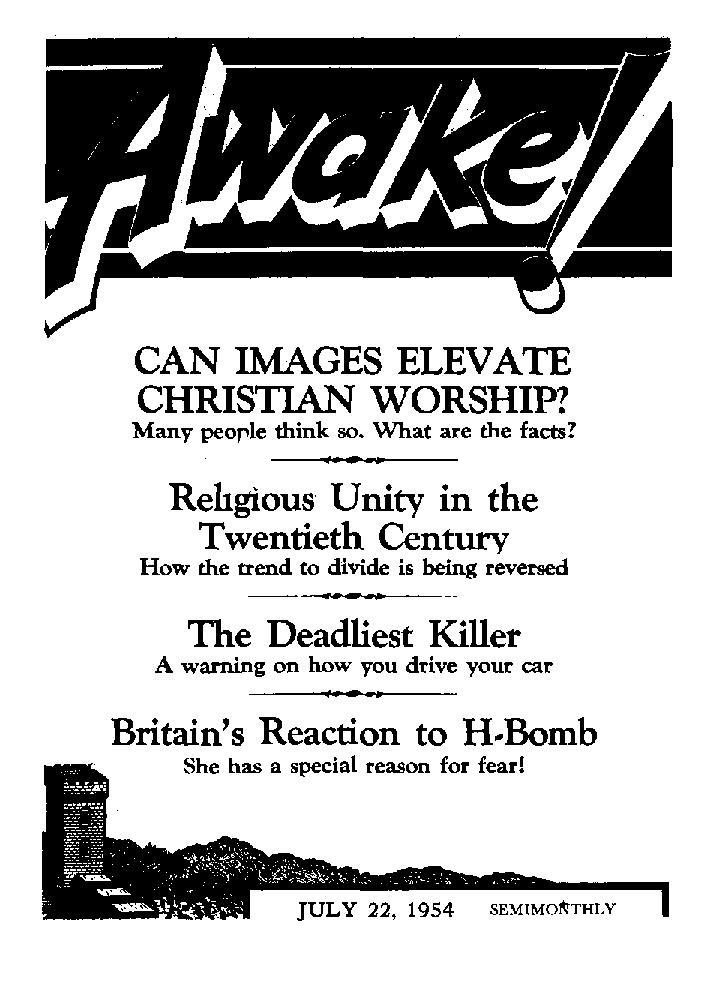
CAN IMAGES ELEVATE CHRISTIAN WORSHIP?
Many people think so. What are the facts?
Religious Unity in the Twentieth Century
How the trend to divide is being reversed
The Deadliest Killer
A warning on how you drive your car
Britain’s Reaction to H-Bomb
She has a special reason for fear!
JULY 22, 1954 semimonthly
THE MISSION OF THIS JOURNAL
New* lourccs that are able to keep you awake to the vital iuue* of our time* must be unfettered by censorship and selfish interests. “Awake I" has no fetters. It recognize* facts, faces facts, is free to publish facts. It is not bound by political ambitions or obligations; it is unhampered by advertisers who** toes must not be trocden on; it is unprejudiced by traditional creeds. This journal keeps itself free that it may speak freely to you. But it doe* not abuse its freedom. It maintains integrity to tnith.
w Awake I” use* the regular news channels, but Is not dependent on them. Its own correspondents are on all continents, in scores of nations. From the four comers of the earth their uncensored, on-the* scenes reports come to you through these columns. This journal*s viewpoint i* not narrow, but 1* international. It is read In many nations, in many languages, by persons of all ages. Through Its pages many fields of knowledge pass in review—government, commerce, religion, history, geography, science, social conditions, natural wonders—why, its cover* age is as broad as the earth and as high as the heavens.
“Awake J” pledges itself to righteous principles, io exposing hidden foes and subtle dangers, to championing freedom for all, to comforting, mourners and strengthening those disheartened by the failures of a delinquent world, reflecting sure hope for the establishment of a right* cous New World.
Get acquainted with “Awake I” Keep awake by reading “Awake!”
PUBLISHED SCMIMOSTHLT BT WATCHTOWER BIBLE AND TRACT SOCIETY, INC.
117 Adama Street Brooklyn 1, N, Y., IL S. A.
N. H. Kkorb, PrMident Grant Suiter, fictretar*
Printing this issue: 1,250,000
Five cents a copy
flanitUnm should be peat to afflea In ymir Mun try in compliance with rotulatioos La futrintr* sift delivery of money. Remittances are accepted ai Brooklyn from countries where so office is locale it by International money order only. Subscription rates In' different countries are here stated Io local currency. Notice of miration (with renewal blank) Ji sent at least two issues before subscription empires. Chang* of addrei* when seat to our office n&y bi expected effective within one month, Send your old as well si new adtan.
Ari <rf torcb 3, J $7$. Print ri io U. 8. A.
UnHHtt In wjiitfi thk inyuta h publUhad: SoiarmthlF’—Afrikami, Etifllih, Fiu&bh, Frtnch, German, Holltndish,, Ncmrtgi*nh Spanish, Swedish, Monthly—Ointsti, Greek, PoHugune, likralniin.
Office* Yearly subscription Mate
Anjarha, u s(. ]J 7 Adams St.. Brooklyn 1, N.Y. *1 Airtrllh. U Beresford Rd, StrtthHeld, N-S.W.
Canada, 40 Irwin Ata., Toronto f», Ontario *1 Englant, 34 craren Terrace, Lbndwi, W. 2 7a South Africa, Print* P.O. Etandsfoateta, TranBTta! 7s
Entered as jecoTirf-cIa'is matter at Brnofcfrn, 5', 1'
CONTENTS
Britain's Reaction to the Hydrogen Bomb 3 i
Can Images Elevate Christian Worship? 5
Religious Unity in the Twentieth Century 9
The Vampire—There Is a Villain!
The Wonder Drugs
Quetta, Baluchistan
Fanning the Flames of Intolerance 17
Anything Can Happen!
The Pupu Spring
Really Moving!
The Deadliest Killer
Do Tinted Windshields Impair or
Improve Vision?
Mauritius, an Isolated Miniature World 24 “Your Word Is Truth”
Need for Stronghearted Men
Jehovah’s Witnesses Preach
in All the Earth—Belgium
Do You Know?
Watching the World
Volume XXXV"
Brooklyn, N. Y., July 22, 1954
Number 14
Britain’s Reaction to
By “Awaktl” correspondent in Britain
FEAR has gripped the world. The recent hydrogen-bomb tests in the Pacific have added new terror to the already greatly strained and fear-stricken civilization. Tension and apprehension mount in the Far East. Trepidation and anticipation are running high in Russia and America. Even the once confident and Gibraltar-like Great Britain is quaking out of fear.
The gravity of the situation was heavily underlined by events in Parliament when Mr. C. R. Attlee, the leader of the Opposition, tabled a motion that "this House, recognising that the hydrogen bomb with its immense range and power as disclosed by recent experiments constitutes a grave threat to civilisation and that any recourse to war may lead to its use, would welcome an immediate initiative by Her Majesty’s Government to bring about a meeting between the Prime Minister and the heads of the Administrations of the United States of America and the Union of Soviet Socialist Republics for the purpose of considering anew the problem of the reduction and control of armaments and of devising positive policies and means for removing from all the peoples of the world the fear which now oppresses them and for the strengthening of collective peace through the United Nations Organisation.”
Attlee went on to say that his party believes "that civilisation today is in grave
the Hydrogen Bomb
danger”; that “we have reached a culminating point in the development of warfare”; that “those who contend that the possession of the hydrogen bomb can be an instrument for preserving peace” are laboring under a “profound delusion.” “The minds of people all over the world are disturbed at this hydrogen bomb explosion,” said Attlee. “I think that it is a world-wide fear and that it will grow, and I believe that it should be encouraged to grow. I want every man and woman in the world to be acutely aware of the danger in which they stand.”
What, then, does the future hold, according to Mr. Attlee? His reply is that “the forces of destruction will keep piling up. We cannot stop these things. It may be that the knowledge of how to make these weapons may get more and more extended. Incidents leading to war continue; the burden of armaments presses on the nations and causes impatience. The only way open to us seems to be to make a new approach to world problems with the consciousness of this great danger.”
To Attlee’s speech the prime minister, Sir Winston Churchill, remarked: “I do not feel that he [Attlee] has bridged the gulf between the awe-inspiring facts which he mentioned and the practical method of solving them by the Motion.” Attlee had)no new solution to offer to the nations, nor has any world leader for that matter. Their hearts melt within them and their knees quake for what they see coming upon the earth, because, as Jesus said: They know not the way out/—Luke 21:25, 26, New World Trans.
The grave concern of political leaders over the subject is reflected in two statements quoted from the Parliamentary Debates. One member, Mr. Strachey, said: "What has happened is that the peoples of the world have, for the first time, realised what it is to live in the world of the hydrogen bomb. . . , It is not the bomb itself which menaces our existence today. That is not what destroys us. It is men’s use of the bomb. After all, the bomb did not make itself. Human beings made it. ... now that we have done it, what matters is that the peoples of the world should realise what it means to live in a world where the power of almost ultimate destruction is for the first time in history in human hands/’ The leader of the Liberals declares: “Undoubtedly, the hydrogen bomb has accomplished one thing. It has brought home to people everywhere, not only in this country but in every country, the grave danger in which we all are. It is a threat not only to peace, but a threat to civilisation itself.”
Britons resent the idea that they are pledged to fight as allies of the United States while having no say in how and when the hydrogen bomb is to be used. They feel that the United States is treating Britain like a small brother, British com cem over American policy was the subject of a statement by Lord Hore-Belisha, quoted in the Sunday Pictorial, April 4, 1954, Before the House of Lords he called attention to the significance of United States Vice-President Nixon’s announcement that in the future the United States would rely primarily on its massive mobile retaliatory power, and urged that “Britain must be consulted in advance if the principle of unity of action with her powerful ally is to be maintained. Otherwise we would be handing over to the United States the unilateral responsibility for declaring a war into which we would irretrievably be drawn. This would be to sacrifice our sovereignty and our independence.” The British attitude to the use of the hydrogen homb was tersely phrased in the newspaper headline: “No 'Surrender* to Our Friends.”
However, an ominous fact that adds to British consternation is the fear that in the event of another war Britain would be the “cockpit** with the two major powers on each” side and Britain like a “sitting duck** in the middle. Were these weapons launched from British air bases Britain might well be the first to experience retaliation, The British Isles with their dense and compact population would be open to virtual annihilation.
But not only the British are concerned hut the whole world is, and they have cause to be. Professor Hans Thirring, head of the department of Theoretical Physics at the University of Vienna, said that it would be possible in time to construct a hydrogen bomb encased in cobalt layer, weighing 10,000 tons and capable of killing all organic life on earth.—Sunday Pictorial, April 4, 1954.
Those who study their Bibles and have come to know of the new world of righteousness at the door are confident that such destruction will not occur, for it is not left in the hands of men to do as they will. The ultimate destiny of all our earth is in the hands of the Almighty, and he assures us that he will “bring to ruin those ruining the earth/' (Revelation 11:18, Neu; World Trans.) Wise persons will now take heed to the significance of these eventful days and learn of God’s way and find the way to life.
CAN MAGES
ELEVATE
CHRISTIAN
WORSHIP?
AVAST number of professed
Christians use images to help them in their worship. Sometimes the images are large statues on pedestals. Quite often the images are small enough to be carried in the hand. Thus when the wife of Cuba’s president visited the United States, the Chicago Tribune noted that she arrived in Washington "clasping a statue in her hand ‘as a shield against evil.’ ” But the use of images goes far beyond the mere carrying of them for protection purposes. For many professed Christians bow down before images, pray to them, dress them in splendid robes, crown them, parade them with pomp through a city’s streets, kiss them, light candles to them, bum incense to them and even offer food to them. So whether one uses images in his worship or not the answers to the following four questions will be interesting and enlightening: (1) What is the origin of images in worship? (2) Did early Christians use images? (3) What do the inspired Bible writers have to say about images? (4) Does the effect of using images raise the quality of worship?
To find out the origin of images in worship we turn to page 373 of Cardinal Newman’s work An Essay on the Development
"A* long os you vonorafo thli Imago you ■hall not know want.” Claim* like thl* are being made for certain religious images. Can these images bring prosperity or protect one from harm? Here are facts regarding images that every truth-seeking person should know.
of Christian Doctrine, The cardinal explains that images, among other things, are "of pagan origin and sanctified by their adoption into the [Roman Catholic] Church.” According to another authority, more than just the pagan practice has been adopted by the church. The book, A Dictionary of Religious Knowledge, says, on page 455: “How slight is the difference between the image-worship of modem and of ancient Rome is indicated by the fact that in more than one instance what was formerly a heathen statue serves as a representation of some Roman Catholic saint, or Biblical patriarch, prophet, or apostle—and, in one famous case, of Jehovah himself!”
But in actual practice is there not a difference in the use of images between professed Christians and pagans? No, for even as ignorant pagans view images as being very real so likewise do Catholies of limited education. Du Bois, one of the early Roman Catholic missionaries in India, declared: “The common people indubitably worship the image itself.” Of the use of images in the eighth qentury after Christ, the Catholic Encyclopedia (Vol. VII, page 668) says: “The way in which some people treated their holy icons [images] argues more than the merely relative honour that Catholics are taught to observe toward them. . . . Icons were crowned with garlands, incensed, kissed.” The twentieth century is not different: In Central and South America and Mexico, Catholics of little education not only incense and kiss images but they offer food to them. This indicates
that the common people, whether pagan or professedly Christian, give images more than relative worship. Finally, even as the educated Catholic says that he is not worshiping the image itself but what is represented by the image, so likewise no intelligent pagan believes that the stone or metal that he bows down before is of itself a god.
Images Not Used by Early Christians
It may surprise some, yet not in any genuine writings of the early age of Christianity can any trace be discovered of the use of images. In fact, says the Encyclopaedia, Britannica, Vol; XII, page 750 (1907 edition): “It was a common accusation brought against Christians by their enemies that they had ‘no altars, no temples, no known images’; and that ‘they set up no image or form of any god’, and this charge was never denied.” Enlightening us further, Dr. Augustus Neander, in his book The History of the Christian Religion and Church During the Three First Centuries, says: “The use of images was originally quite foreign to the Christian worship and churches, and it remained so during this whole period. The intermixture of art and religion, and the use of images for the latter, appeared to the first Christians a heathenish practice.”
When, then, did the use of images begin? “It was not until after the establishment of Christianity under Constantine that statues and pictures of our Lord, of the Virgin Mary, and the saints, were commonly introduced.” (A Dictionary of Religious Knowledge) Constantine was not an apostle of Christ nor an inspired Bible writer but a pagan who grafted together the heathen state religion of Rome and the group of deflected, apostate “Christians." Of the result, history says: “As no one proposed utterly to abolish the ancient pagan institutions but only to alter them somewhat and purify them, it was unavoidable that the religion and the worship of Christians should in this way become corrupted.”—Mosheim's Ecclesiastical History, page 191.
Testimony of the Hebrew Scriptures
Having learned that the use of images is of pagan origin and that true Christians of early times rejected the use of images, we are next interested in what Jehovah God said through his prophets regarding image worship. In referring to the testimony of the Bible writers we shall use two Roman Catholic translations of the Bible, the Douay and the one by Monsignor Knox.
What happened when Israel first adopted the use of images by making a golden calf? “Now the Lord [Jehovah] said to Moses, Away, down with thee. They have been swift to leave the way thou didst mark out for them, by making a molten calf and falling down to worship it.” (Exodus 32:7, 8, Knox) Does this mean that the Israelites had abandoned the worship of Almighty God for the worship of a molten image? The Israelites did not think that way, for verses five and six of the same chapter show that along with their image worship they held a celebration in Jehovah’s honor. The image, then, was merely an addition to their worship, an attempt to enrich their worship by the use of a visual aid. Yet in spite of this Jehovah’s anger was so intensely kindled against them that had it not been for Moses' entreaty Jehovah would have destroyed the entire nation of Israel.
Almighty God knew that sinful man would be enticed by the idea of having visual aids in the worship of the invisible God. Therefore, to indicate that he would never approve the use of images, even though they are used in a relative manner, he declared: “Thus says the Lord God, he
who created the heavens and spread them out, craftsman of the world and all the world affords, he who gives being and breath to all that lives and moves on it* I am Jave [Jehovah]; that is the name I bear; I will not let the boast that is mine pass to another, or share my renown with graven gods/’ All who wish to please the Most High God will give heed to his clear-cut commands: "Thou shalt not carve images, or fashion the likeness of anything in heaven above, or on earth beneath, or in the waters at the roots of earth, to bow down and worship it,” "When the Lord I Jehovah] spoke to you from the heart of the flame on mount Horeb, there was no outward shape you saw. And will you be deluded into carving some outward image or likeness, of man or woman?”—Isaias 42:5, 8; Exodus 20:4, 5; Deuteronomy 4:15, 16, Knox.
Recently a priest in New York announced that to all those who subscribed for a certain Catholic magazine he would give an image of the Infant Jesus of Prague, The image was highlighted with this advertisement: "As long as you venerate this image you shall not know want” Then the priest explained: "Bold words? Maybe. But through three centuries, it has been demonstrated, time and again, that devotion to the Infant of Prague brings prosperity, spiritual and temporal, to communities and homes.” But the priest made no mention of the fact that Italy, which is completely given over to the use of images of Fatima, Madonnas and numerous "saints/’ has experienced no spiritual prosperity, On the contrary, image-filled Italy has sunk to a spiritual low, having more professed Christians turning Communist, in proportion to its population, than any other democratic country in the world!
Neither spiritual nor material prosperity can result from trusting in any image, as the Bible declares: "They have mouths, and yet are silent; eyes they have, and yet are sightless; ears they have, and want all hearing; noses, and yet no smell can reach them; hands unfeeling, feet unstirring; never a sound their throats may utter. Such be the end of all who make them, such the reward of all who trust them.” —Psalm 113:13-16, Knox.
In 1944 Italian peasants placed their images in the path of onrushing lava from Mount Vesuvius in an attempt to avert disaster. The images failed to help those who trusted in them. Protection from evil cannot come from any image, for God’s Word declares: "What avails image, that carver should be at pains to carve it? In metal his own hands have melted shall a man put his trust? Cheating likenesses, dumb idols all! And thy prayer was, stock and stone would wake up and come to thy aid, senseless things that cannot signify their will.”—Habacuc 2:18, 19, Knox.
Throughout South and Central America and in the West Indies parades are often held in the honor of an image. In May, 1952, the image of the Virgin of Charity was paraded through Havana and thousands of persons thought themselves blessed if they even caught a glimpse of the fifteen-inch image. Emphasizing the futility of such rituals over an image, Jehovah God warns: "What comparison, what match will you find for me, what likeness to resemble me? Fools that fetch gold out of a sack, weigh silver in the balance, bid some craftsman make a god they should fall down and worship! Shoulder-high it must be borne, set down on its pedestal; there it stands, powerless to move from its place, deaf to their cry, and in their need bringing no deliverance.” The true Christian will heed the admonition of the Hebrew Scriptures, remembering the words of the apostle of Christ, who said: "See
haw all the words written long ago were written for our instruction.”—Isaias 46:5-7; Romans 15:4, Knox.
Testimony of Christ and His Apostles
But in spite of the fact that the use of images is condemned by the Hebrew Scriptures, image-users often excuse their action on the grounds that the images are “Christian.” Actually, the use of images is contrary to the principle Of Christian worship. This Paul explains: “If only we will fix our eyes on what is unseen, not on what we can see.” “For we walk by faith and not by sight.”—2 Corinthians 4:18, Knox; 2 Corinthians 5:7, Douay.
So it becomes apparent that the Christian Greek Scriptures forbid all use of images, even though the image-user worships in a “relative” manner. The apostle Peter was quick to forbid such “relative” worship: “As soon as Peter had entered, he was met by Cornelius, who fell at his feet and did reverence to him; but Peter raised him; Stand up, he said, I am a man like thyself.” The Bible tells us what happened when the apostle John tried to worship God in a “relative” manner: “I fell down as if to worship at the feet of the angel who revealed it to me. But he said, Never that.” And then the angel added: “Keep thy worship for God.” So if neither Peter nor an angel from heaven could be given “relative” worship, then how can one properly give it to inanimate images?—Acts 10:25-27; Apocalypse 22:8, 9, Knox.
Is the use of images, then, elevating? Hardly! Christendom is filled with images and statues, and yet the quality of Christian worship has not been raised but has been lowered. There is nothing uplifting about the use of images. Users of images display superstition and lack of Bible knowledge. The newspaper LSEuropeo of April 5, 1947, showed pictures of devout Catholics In Naples crawling prostrate on their stomachs before the images of Madonnas and licking the ground with their tongues on their way to the statues. How such worshipers need to be told the words of Christ’s apostle!—“If we are the children of God, we must not imagine that the divine nature can be represented in gold, or silver, or stone, carved by man’s art and thought.”—Acts 17:29, Knox.
So the sincere Christian worshiper needs knowledge, not images. It is the study of God’s written Word that is the elevating factor, not images. The clergy have not taught the people these truths but have fostered image worship. Recently, the editor of The Catholic Art Quarterly admitted that the sale of images has become a “racket.” The editor’s words: “Priests and sisters, to whom the laity naturally look for guidance, are often even more deeply corrupted for the simple reason that they open their hearts even more generously to the available images.” (New York Times, April 11, 1953) So now from Catholic authorities themselves we learn that the sale of images is a “racket.” But what is most important, we have learned four things: (1) That the origin of images is pagan, (2) that the Christians of the first three centuries completely rejected the use of images, (3) that the Bible positively forbids the use of images and (4) that the Bible declares and the history of religion shows that, in Reality, the use of images does not elevate Christian worship, that its effect is directly the opposite, that it degrades not only Christianity but the mind as well.
Those who seek everlasting life in Jehovah’s new world will abandon the use of images and conform to the requirements for proper worship as established by Christ Jesus himself: “God is a spirit, and those who worship him must worship him in spirit and in truth.”—John 4:24, Knox.
t
that unity of action was necessary. Thus, missionaries in the field, representing different denominations, got together to consider their problems. Then national mission conferences were established back home. Also, people from different denominations were drawn to
LET us learn a new word, the word "ecumenical” (ec'umen'i.cal). Do not be frightened by it; it is only two letters longer than "catholic,” and has a similar meaning. “Catholic” means “universal,” but has become so closely associated with Rome that a different word, namely “ecumenical,” was chosen to describe the present world-wide attempt to find a universal, unified faith for Christendom.
“Ecumenical” will be an important word next month, since a major ecumenical meeting, the second assembly of the World Council of Churches, will be held on the campus of Northwestern University at Evanston, Illinois, U. S. A., August 15-31. What is it all about?
In Roman Catholic circles “ecumenical” describes the major Church councils that have been held throughout history, but in non-Roman circles the word is also used to describe the current attempt at unity between the various religious denominations. This new use of the word “ecumenical” goes back no farther than the turn of the century, and actually became widespread only about seventeen years ago. The interfaith activity that it describes, however, had its beginning about 150 years ago, with the extensive Protestant missionary enterprise of the early nineteenth century.
Members of the different denominations, facing huge missionary fields, felt that the job was too big for any one organization alone, and decided gether in six international missionary conferences in Britain and America between 1854 and 1900. But by far the most far-reaching of such assemblies was the World Missionary Conference held in Edinburgh, Scotland, in 1910. It was at Edinburgh that the ecumenical movement really got under way, but before considering what made this 1910 conference so outstanding we must examine another influence that also was working toward unity among people of the various religious denominations.
This influence was a growing youth movement that provided the leadership for the developing ecumenical activity. Such organizations as the Y.M.C.A. and the World’s Student Christian Federation provided what have been termed “practice games” for the forthcoming ecumenical movement. These youth organizations ministered to university students of many different denominations, and the students’ discussions bridged across
ci,
their denominational differences. Those who took the lead In these student organizations began to think, not of their denomination’s interest, but of student evangelism as a whole. Their thinking well equipped them to become the men who would lead just such an interfaith activity as the rising ecumenical movement.
Thus the foundation was laid. The churches had, to some extent, worked together in the mission fields and also at home, and the student movement contributed “vision, daring and leadership” for the World Missionary Conference held at Edinburgh in 1910. To that conference we must ascribe the beginnings of the most important organizations in the current ecumenical movement.
The Edinburgh Conference
What made this Edinburgh conference so outstanding? At least three things: (1) Whereas previous missionary gatherings had been attended by individuals who represented nobody but themselves, the Edinburgh conference consisted of officially appointed delegates speaking for their religious organizations. (2) An amazing desire for togetherness was evident, a new willingness to respect one another’s differences of doctrine, and yet to work together toward a common goal—the sort of international and interdenominational cooperation that has marked this twentiethcentury ecumenical movement. (3) The appointment of a continuation committee to carry on the work that the conference had started. This small but significant act, for the first time, established a continuously functioning, international, interdenominational body aimed at unified action on the part of the various religions. Eleven years later, in 1921, this led to the formation of the International Missionary Council—no small part of the ecumenical movement.
To prompt further missionary cooperation, this council sponsored subsequent conferences in Jerusalem in 1928, and in Madras, India, in 1938. The Madras meeting in particular faced the conflicting ideas of the different denominations, and heard representatives of the younger churches that had been established in the mission fields speak out vigorously against the denominational divisions that sever modern-day Christendom.
But the International Missionary Council was not the only thing that came out of the Edinburgh missionary conference of 1910. In addition to the interest it stirred in a united missionary activity, it also stirred interest in an actual unity of doctrine. What attempts were made to achieve this?
Faith and Order
At Edinburgh Dr. Charles H. Brent, a missionary bishop of the Protestant Episcopal church, envisioned a united Christendom—not just a Christendom co-ordinating its far-flung missionary activity, but one actually united in doctrine and theology. And, largely on his initiative, a world conference on Faith and Order was summoned to consider wherein the various denominations could attain unity on doctrine itself.
Delayed by World War I, this Faith and Order conference was finally held in Lausanne, Switzerland, in August, 1927. Four hundred delegates, officially representing 127 denominations, discussed “the church’s message to the world,” “the nature of the church,” and similar doctrinal matters. Says Princeton Theological Seminary Professor Norman Victor Hope, in high praise of this assembly: “For the first time since 1054—when the Eastern Orthodox Churches separated from the Church of the West —all significant branches of Christendom, except the Roman Catholic Church, which refused to participate, were able to meet together to consider frankly and yet sympathetically the theological and doctrinal implications of the Christian faith which they held in common.”*
Ten years later another conference on Faith and Order was held in Edinburgh, Scotland, August, 1937, to discuss doctrinal issues further. Delegates from 122 churches in 43 countries still faced clear-cut and deep-going disagreements, but marked progress in the direction of the unity that this movement desired.
Life and Work
Parallel in time with these conferences on Faith and Order, another force was working toward religious unity, but in another way. Called "Life and Word,” this movement sought to promote unity between the denominations, not through agreement on doctrine, but through a united attack by the religious organizations on the social, economic and political evils of the day. Its view was that the churches should get together by working together.
Rather than stemming directly from the World Missionary Conference at Edinburgh, as Faith and Order did, Life and Work grew out of pre-World War I conferences between clergymen in Great Britain and Germany who wanted to relieve the rising tension between their countries. A forerunner of the Life and Work conferences was the World Alliance for the Promotion of International Friendship through the Churches, which met in Constance, Switzerland, in August, 1914. Life and Work’s activity dealt with economic, industrial, social and moral problems, international relations, education and the like.
Its first major conference was in Stockholm, Sweden, in 1925. This was a most colorful occasion, regarding which one authority said: "It is doubtful whether, up to
♦ One Christ One World One Church, Norman Victor Hope, page 37-that time, a more representative gathering of Church leaders had come together in one place.”* Among many others who were present there was the “Chief Justice of the German Reich,” a German bishop “resplendent in his episcopal robes,” a "silver-tongued orator” from France, one of the four presidents of the Federal Council of the Churches of Christ in America, and a large delegation from the Orthodox Churches. But there was no doctrinal unity. Even the subject ‘God’s purpose for the world’ seemed so dangerously close to a theological one that representative clergymen just gave their individual views, which were received and printed without discussion. Doctrine was not the conference’s purpose; only work in social fields was to be considered.
After the Stockholm conference a continuation committee kept up the work of Life and Work, and in July, 1937, a second conference was held in Oxford, England. Its delegates from 119 denominations included all the larger church organizations of Christendom except the Roman Catholic, which declined to participate. Subjects considered here included the churches’ relation to the community, to the state, to the economic order and to education.
Obviously, not all the denominations were in agreement with one another as to what they should do in respect to these matters, and it became increasingly obvious that their objections stemmed from theological differences. Thus the clear-cut line of distinction that these men were trying to keep between the realm of faith (in the Faith and Order movement) and the realm of morals (in the Life and Work movement) could not be successfully maintained. The sharp distinction between the two movements was becoming blurred. Thus Life and Work and Faith and Order
4 Toward a Chwrii. William Adams Brown,
page 75.
JULY 22, 195$
agreed to a plan for merging the two groups into the World Council of Churches.
The World Council
The merger was logical, since some of the same persons attended the conferences sponsored by both movements, since the same churches were represented by both of them, and since the same religious organizations paid their expenses. The first World Council assembly was delayed by World War II, but was finally held at Amsterdam, Holland, August 22 to September 4,1948. Its 351 delegates represented 147 member churches, including such Protestant bodies as Methodists, Presbyterians, Lutherans, Congregationalists, Episcopalians, Disciples of Christ and some Baptists, plus Old Catholics who had seceded from Roman Catholicism over the papal infallibility decree of 1870, and several of the Orthodox Churches that separated from Rome in 1054. Said one authority: “It is thus by far the most comprehensive council that Christianity has ever fashioned for itself in all its strange, eventful history."
Yet the World Council of Churches re-Thus, despite its tremendous strides, the ecumenical movement does not, in fact, embrace even half of present-day Christendom. Further, it has basically been handled by board secretaries, high-ranking church dignitaries and other top-level sponsorship. It is not widely understood by the common man, and is sometimes almost unknown to individual church members.
Nevertheless, the ecumenical movement is an existing fact. Starting with isolated missionary councils and student movements like the Y.M.C.A., it has grown into a colossus. However, several distressing factors remain. First, is it really Christian? Is this broad acceptance of those who believe other doctrines in harmony with Jesus’ statement that “narrow is the way, which leadeth unto life”? Did Jesus’ prayer, “That they all may be one,” mean that we should unify with those holding to different doctrines, to become “one" in a big organization, or that we should hold to right doctrine and be “one” in truth? (Matthew 7:14; John 17:21) Then, also, there are problems about the World Council of Churches that those who would fol-
mains far short of what the ecumenical movement envisions. Roman Catholicism holds aloof; the relation of the Russian Church, the largest Orthodox group, is uncertain; the Southern Baptist Convention in the United States, with twice as many members as there are Anglicans in England, has taken no active part.
CHURCH CONFERENCES OF THE TWENTIETH CENTURY A brlof Ouilin* of lh« growth of tho fcumentail Mov*m«nt end progro* toward tho World Council of Churchw
Co-ftparnlivt miiilonwy •Pprli, plej Vnliy ypulb now-
***1* lit* rh* T.MX.A, and ftlhtr Murfitnl Itd < r pl fo r i, W to
low Christ should examine carefully before continuing as members of organizations that support it. The ecumenical movement has done much, but the question is, Is what it has done right? And, finally, what should we watch for in next month’s Evanston meeting? These questions will be discussed in our next issue.
There is a Viliam
By LIAwok«rr correspondent in Trinidad
MERE mention of the word “vampire” is enough to give most persons a creepy feeling. The more superstitious may conjure up medieval legends of horrible, ghoulish, blood-sucking ghosts that carry on their nefarious work in the dead of night on their helpless sleeping victims. Such creatures, of course, exist only in the overworked imaginations of their creators. There does exist, however, a vampire whose depredations almost rival the weird tales of superstition. He is a little bat with the big name Desmodus rufus. This vampire seeks out every kind of animal, including man, and sucks its blood.
For a long time it has been known that tropical America is the haunt of vampires. Yet lack of accurate knowledge on the subject resulted in a number of ferocious-appearing but harmless bats’ being labeled as vampires. Indeed no small number of people, even in the United States where no true vampires exist, have erroneously believed that all bats were vampires. The truth is that only two species are true vampires. But because of the original confusion some large bats are now called Vctm-pyrus or vampires, but they really are false vampires, Trinidad has Desmodus rufus, one of the true vampires.
Contrary to popular supposition, the vampire is not a large bat. He is not more than three inches in length, is covered with short, pale-reddish-brown fur, and has a wingspread of about fifteen inches. It is not until one inspects the vampire's mouth and throat that the kind of diet he en-joys-comes to light. His two front teeth are so large that they take up all the space between the canine teeth and protrude outward. They look like midget guillotines and are,so sharp-edged that they inflict a wound like the scratch of a razor blade, which is scarcely felt but which produces copious bleeding. The bat’s canines are also long, curved, very sharp and pointed. Against this formidable equipment even the tough hide of an old bull can put up little resistance.
Besides his teeth, the vampire has other peculiarities. His gullet is so narrow that it cannot accommodate anything but liquids. So Mr. Rufus vampire feeds on blood. This food, being easily assimilated, does not go to the bat’s stomach, for the vampire has no stomach. His digestive apparatus consists only of a simple tube, uniform in caliber from end to end. Truly the vampire’s manner of feeding is unlike that of any other known mammal.
The Vampire Dines at Night
Like a true villain the vampire prefers to work unseen and quietly. His base of operations is the deep forest in a hollow tree or a cave or underneath a bridge. He operates with greater activity during the rainy season. He dines alone and at night, waiting even until dusk has turned into the blackness of night. Then on silent wings he approaches his prospective dinner. His choice is cattle, but he will accept a meal from any domestic animal. Even man gives the vampire a dinner—if he carelessly sleeps with his toes uncovered. Mr. Vam-
pire is guilty of color prejudice, too, for he prefers dark skins, even biting the dirk part of a skin that Is mottled, such as that of a Holstein cow,
A slash of his incisors on the shoulders, buttocks or neck produces two small grooves from which blood flows freely and painlessly to the waiting tongue of the vampire, which laps it up greedily, A warm meal is had at the expense of a blissfully ignorant host. Never has the vampire been known to attack a human that is not asleep, arid he displays such finesse in his biting technique that the person sleeps on. When he finds a sleeping person, the foot becomes the vampire’s target. Inflicted on the naked foot, the bites are so slight that those bitten feel nothing until the bed is covered with blood that flows from the envenomed wound in profuse quantities. It can be stopped only with some difficulty. So the peril is serious unless a cure is effected by prescribed remedies.
In tfiew of his shyness and reluctance about having company to dinner, it is not surprising that people knew little as to who the real villain was that caused so much damage to livestock. After the conquest pf Centrar America, Peter Martyr, the Italian historian, observed that bats on the Isthmus of Panama sucked the blood of cattle, even to killing them. In Ecuador the cattle of early missionaries were entirely wiped out by these bloodsuckers. It fell to the lot of Charles Darwin to go on record as actually having seen the rufus vampire in the act of lapping blood from one of the horses he was using on an expedition in Chile. Since then flash photographs have been taken of the vampire at his sanguinary repast.
The Real Peril
Damage done by vampires in their bloodletting activities would be comparatively slight if it were limited to the loss of blood only. But a far more sinister result has come to light in recent years. Particularly since the beginning of the twentieth century it has been observed that herds kept in pastures near forest lands often suffered from a mysterious malady that was always fatal.
Some herds in South America suffered fifty per cent loss. In the twenties and thirties of this century, herds in Trinidad became affected with the same severe losses. Over a thousand cases occurred some years, mostly in cattle. All died. In 1929 a serious outbreak occurred in the southern part of Trinidad. This time human creatures suffered. The mortality was one hundred per cent! Finally, after years of research, scientists agreed that the disease was paralytic rabies. But how was it being carried from one animal to another ? There is the villain—Desmodus rufus, Trinidad’s true vampire! Ten per cent of all this species captured in Trinidad were found to be carriers of the disease.
Paralytic rabies affects the hind quarters of animals that contract it so that they gradually lose all control, being paralyzed. With the onset of paralysis consciousness is not at all disturbed; the half-paralyzed animals look distressingly behind, taking notice of everything that is happening around them, even recognizing their owners. The animal salivates profusely. Bodily processes of elimination slow up and cease. The animal usually dies in from three to five days after the first symptoms are noticed. Literature concerning treatment says tersely: "There is no curative treatment.”
After Trinidad’s vampire became known in his true colors he was public enemy number one. The sanitation department organized extermination squads that went into action all over the island. These men, braving snakes and other dangers, scoured the deep forests, looking for roosting places
of the bats, usually a hollow tree. When found they would sometimes gas them or catch them in nets as they were flushed from their hiding places. Today the shotgun is used extensively m destroying vampires. While not completely under control, they are much lees a threat than formerly.
The government has taken steps to prevent the disease as far as possible, since treatment seems useless. Bright lights in barns where electricity is available is effective in keeping vampires away. Natives burn kerosene lights in their homes all night for protection. The most effective preventive seems to be vaccination, and it is relied on to a very large extent in combating the disease. As a result of all these precautions few cases are reported now.
So the villain has been flushed out. A tiny vampire bat can carry a disease fatal to man. The havoc he has caused in the past is still vividly remembered by older persons here. The department of agriculture still wages relentless warfare against paralytic rabies. And those persons who live deep in the forests where vampires still live must not forget them nor leave them out of their plans. They must remember not to sleep with toes uncovered—a vampire might be hungry!
THE WONDER DRUGS
■WHENEVER a new antibiotic is Introduced § Uj] it is hailed as the answer to another of g U mankind’s problem ailments. Then some- g thing happens. We hear of unpleasant re- i actions, even deaths due to the drug. When § the world’s top authorities on antibiotics met § in Washington last November, Boston’s Dr. g Ethan Allan Brown called today’s haphazard s use of antibiotics “appalling.” H
C What should be done? Discard antibiotics? 5 Far too valuable they are for that! To pre- || serve the lifesaving benefits of the drugs and |g eliminate their toxic reactions as much as g possible, foremost authorities are now de* i manding the drugs' careful and selective use. g Sir Alexander Flemings the discoverer of penicillin, said that the drug is being used far ± too freely all over the world in cases where g it can do no good, especially in the common g cold. And two doctors who conducted a care- g ful, scientific study on 159 children, victims § of the common cold, reached the conclusion |j That, bed rest with plenty of fluids is still the 2 most effective treatment. Modem wonder = drugs, they said, do more harm than good. 3
C To combat the disadvantages of antibiotics, s doctors are now using smaller dosages, avoiding frequent or prolonged use of them. Withat 3 least a dozen antibiotics to choose from, they J are becoming more selective, When strains of f resistant bacteria appear, doctors can use one z of the other antibiotics to knock out the germ. There is little fear that the world’s bacteria population will defeat man’s antibiotic weapons.
<L But what of severe and fatal reactions? They are usually preventable. If physicians discriminate in using drugs, if patients are tested in advance to determine whether they are allergic, if physicians closely watch for toxic reactions and if patients co-operate with doctors by telling them of their previous experience with antibiotics, then fatalities can be prevented. Clearly, antibiotics, even in such forms as penicillin ointment or nose drops or lozenges, should never be used like aiplrln! G, Though some risk is Involved in using wonder drugs, there may be much more risk involved by not taking them. In the case of many death-dealing infections the lifesaving power of the antibiotics is overwhelming. They have put a quick and permanent end to diseases that were formerly fatal. When common colds lead to complications, such as ear infections or pneumonia, antibiotics are lifesavers. They save not only countless lives but an immeasurable amount of time, pain and money. When they are carefully administered and definitely needed, they should not be rejected. Yes, the wonder drugs are still wonderful, if they are used with utmost caution.
QUETTA, BALUCHISTAN
“AwoJttl" fttwpAndant In Pcikittan
HEN Pakistan came into being as a Mos-lem state, August 14, 1947, with the partition of India, one large province that
became part of Pakistan was that of Baluchistan, Baluchistan’s largest and most colorful dty is Quetta.
<L Travel with me then to mountainous Quetta and view life for yourself. Leaving the teeming metropolis of the capital city, Karachi, one passes through the Sind desert by train and within twenty-four hours climbs to the hill station of Quetta, nestling 5,500 feet above sea level. Listen to those gigantic engines puff and snort as they wend their way up the steep gradient. What a masterpiece of engineering in bringing this line through the Bolan Pass with Its many small tunnels' Some fifty-odd miles before reaching Quetta it becomes necessary to attach a banker engine behind the train in order to accomplish the climb. It is said, and correctly so, that this is one of the world's steepest climbs for broad-gauge railways.
C And now, running smoothly downhill, the train brings Quetta into view and glides in to the platform. What a majestic sight to see the complete circle of gaunt, barren and rugged mountains completely surrounding the city I How bare they appear now, but just see them snowcapped and glistening in the winter! Hullo! What are those men in bright-red coats doing? Surely they dannot possibly handle all that luggage without accident. Amazingly, one man puts your three trunks on his head, and, with hands full of smaller parcels, sets off at a steady pace to the awaiting horse-drawn conveyance called a tonga. In successive days and years you still continue to marvel at the way people of this land handle all manner of things by balancing them upon their heads so expertly,
C Now one can hear many languages spoken, sueh as Pushtu, Urdu, Baluchi, Brohl and Persian, as well as English. Regardless of what language you speak, what a kind and hospitable reception you get! Before listening to what you wish to say ybu are politely seated, while the ever-popular cup of chae (tea) is called for. Yes, life in most instances moves more slowly in the East. Here, too, natural curiosity overcomes the masses, and if j you happen to be speaking where others are s passing they will also stop and listen. Cer-j tainly no difficulty to obtain an audience!
x <L To set oneself up in business requires little i space, as the people have the happy knack J of sitting cross-legged for hours at a time < without any signs of fatigue. Here can be seen J a tailor at work in a spot a few yards square; ? there another, selling his wares with equally f limited space. Even youngsters set up their f own little shops at vantage points in the city. 1 4 The most popular Jorm. of transportation ( in a province where the general population is ! not so richly blessed as their neighbors in J other landis the cycle. The stately ship of the $ desert, the camel, provides yet another form J of transportation. Dally they can be seen striding majestically toward the market, laden
s with produce from the nqarby villages.
• 4 Comes winter season and the seasonal
s workers and vacationers decide to migrate to s the far warmer regions of the plains. Long J strings of camels,4 complete with household $ effects and families, can be seen daily moving ' out as cooler weather approaches. But what J a sight to see these people again return at ; the close of the cold season, complete once more with all belongings and their gaily
| colored costumes!
v 4 Dress varies, but the most common is the J shalvjar, with a flowing shirt worn outside ; these large baggy trousers. On more formal > occasions a form-fitting three-quarter-length coat called a sherwani is worn. Jinnah caps
v have completely replaced the fez. The frontier J Pathan ties his turban round a eolorful skull-s cap. Women also wear shalwars and long J frocklike shirts, with a dopatta of silk or mus-s lin thrown over the head and shoulders.
J 4 And so we leave this strange land of con-s trasts, a mixture of the West and its customs $ blended with the East and where modem $ Cadillacs glide silently past their equally 5 silent rival, the camel. The arrival of large s quantities of American wheat has just re-5 cently warded off famine, but despite materia? $ relief thinking persons of this intriguing land $ still seek for some more permanent solution to the problem. This can be found only in Jeho*
$ vah God's kingdom under his reigning King, Christ Jesus.
FANNING
8y “Awake!" correspondent in the Motherland*
sistent? It would inconsistent if
I should refuse to rent the hall to Je-V hovah’s witnesses and turn around and rent it to other associations."
Also in 1953, when preparations began for the fall series of circuit assemblies, the choice for one assembly fell on Kerkrade, in the mining district of Limburg, where a suitable hall
£6/'"''AN a man take fire in his bosom, and Vj his clothes not be burned? Or can a man walk on red-hot coals, and his feet not be scorched?" asked wise King Solomon, (Prov. 6:27, 28, An Amer. Trans.) In this atomic twentieth century we still observe that people who play with fire bum their clothes, yes, their fingers too. The Roman Catholic Church in the Netherlands has set fires of intolerance and has burned many holes in her clothes of identification.
One such fire of intolerance was started in Venlo in the spring of 1952, but public opinion and a fair press stirred up a storm that blew the flames right back into her face. The contract for a hall in which a Christian assembly was there to be held was broken by Mr. D. Claessens, the hall owner, who was ordered by the Civil Chamber of the Court of Roermond to pay damages to cover the financial loss inflicted upon these Christians, Jehovah’s witnesses, by his breach of contract. The newspapers gave the matter a good airing, Claessens’ expense resulted from his having accepted bad "spiritual advice,” so perhaps he should start shopping for better spiritual counselors.
Another attempt to start a similar “fire” was made by the Catholic clergy in Herto-genbosch in 1953. But the hall owner, a man of courage, effectively doused the first flicker with: "Why should I be incon-was available, and where no previous assembly had been held. The hall was engaged for December 11-13; the willing owner signed the contract and accepted a deposit. However, a shameful smear campaign was begun, aiming all the means of propaganda at its disposal toward disrupting assembly plans.
As one example, a series of derogatory articles began in the press on November 19. Said a screaming front-page inset in De Zuid-Limburger, November 27: "We warn the Catholics of Kerkrade by no means to cooperate towards the success of this assembly and to grant their members no accommodation regardless of shape or form.” Said Limburgsch Dagblad, November 28: "For already several weeks the Witnesses of Jehovah have been developing their activity to obtain accommodations for the 700 participants at this assembly. Doorbells are being rung from house to house in Kerkrade. For several weeks already, the inhabitants have been urgently requested from the pulpits of the various parish churches not to cooperate in the way of accommodations for the participants of this assembly. It appears, however, that there still are Catholics, who, for the sake of financial returns, have promised to accommodate one or more Jehovah’s Witnesses on December 11,12 and 13.”
What would happen now? Would the owner of the hall follow the course of the one in Venlo or in Hertogenbosch? Mr. Dubois followed the course of Mr. Claes-sens in Venlo and treated the contract as a scrap of paper. “Regardless of what may happen/’ he said, “they will not have my hall.”
With still two weeks in which to make other arrangements, Jehovah’s witnesses continued preparations under the slogan: “Hall or no hall, the assembly will be held!” Dismayed, the Limburghsch Dagblad asked, November 28: “Shall the Witnesses of Jehovah . . . hold their assembly in a tent as was the case in Venlo?” No, this ■ was not necessary, because another hall was obtained from a courageous owner Just a few miles from Kerkrade. The Gazet van Limburg commented caustically: “The socialists of De Burcht [the name of the hall] apparently wish to show Catholic Limburg what real and true hospitality is and what the purport of one’s respect of another man’s principles should be.” It is possible that Catholic Limburg could learn a great deal from this gesture of friendlL ness!
A “Mene Tekel” on the Wall
Kerkrade “will have made it clear,” said De Nieuwsbron, December 11, regarding Jehovah’s witnesses, “that the populace here prefers to see them leaving than com' ing. They found no assembly hail there nor accommodations for assembly participants.” But if the populace so dislikes the witnesses, then why go to such efforts to warn them? Why not leave it to them to decide for themselves as to what they will do? Is it that the Church is always on the losing side when she lets the people exercise their right of free thought?
And as for rooming accommodations in the people’s homes, De Nieuwsbron was a bit off there too. When asked if he had accommodations for those coming to the assembly, one householder remarked: “Because the clergy oppose you so, you can count on me.” Another said: "I am boss in my house; you will sleep here!” Still another: “There are less protests lodged against holding carnivals where beastly conduct prevails, than there are against your meeting. Is it more dangerous to speak about God than holding a carnival?”
As was the case of Venlo a year and a half earlier, it appears that the thing that concerns the clergy is that many people prefer to see the witnesses coming than going! One of these clergymen said; “Thus is the coming assembly for South Limburg again a Mene Tekel on the Christian wall. We of the Mining District, must not suppose that we live on an island which is immune to the often abominable heterodoxies of the time. . . . There is often too little knowledge of Catholic faith and too little understanding that Catholicism is primarily a way of life, that is, Catholic life." Now, it is an easy matter to call a religious entity an “abominable heterodoxy” without telling wherein it so is.
But in the very' same article another clergyman said: “We shall have to get down to forming Christians who have the faith to witness to Christ in the mines as well as in the factory, on the street, in the bank and in the office." It is the fact that they do not have this faith, not that Jehovah’s witnesses come into their midst with it, that is the real “Mene Tekel” they recognize on their wall, since, according to Daniel 5:26, 27, Mene means, “God hath numbered thy kingdom, and finished it,” and Tekel, “Thou art weighed in the balances, and art found wanting.” And these are things that result from one’s own course, not the course of another.
When the Pharisees were not able to refute Jesus’ arguments they resorted to
stone-throwing and other forms of violence, and even though modem religionists show the same course Jehovah’s witnesses will continue to preach the word in both favorable season and troublesome season. Opposition does not hurt the truth. Threats of violence, as published in De Nieuwsbron, December 11, will not stop gospel-preaching. Jehovah’s witnesses do not hunt trouble, but mind their own business, exercising their right to show their fellow men the promises in God’s Word. If these Bible promises sting religious leaders so much that they will publicly singe their fingers and bum holes in their carefully donned clothes of tolerance, then they should examine themselves to find out why they so object to Bible truth, and their people should examine to see why their religious leaders are so opposed to others’ talking to them about Christianity!
Jehovah’s witnesses at this successful assembly in Kerkrade were happy to have part in this “glorious treasure” of Christian service, whether the clergy of Christendom liked it or not!
Anything Can Happen!
HE people of the United States have a I popular expression to the effect that1‘anything can happen/’ Just to what extent this is true appears from the following, which, under the title, "Zany Mishaps of *53, Have You Been Shot by a Deer Lately?*' was published in the Easton, Pennsylvania, Express, December 12, 1953:
<L “So you think that you got troubles—that everything happens to you? Well, have you been shot by your lawn mower lately? Or by a rake? Or by a deer? No? Then down, boy! You haven't had it at all. For all those wacky things, and many others, happened in 1953 to people who were just as surprised as you would be if they happened to you*
C "Robert Helnbaugh was cutting the grass in his yard at Painesville, Ohio, when all of a sudden he felt shot His lawn mower had run over a bullet and plugged him in the big toe* In Santa Cruz, California, John Plumbe was shot by a rake he had always regarded as trustworthy* He was raking rubbish into a bonfire. In the rubbish was a shotgun shell* In Payson, Utah, Shirl Kelsey knelt triumphantly beside the deer he had just shot down. The animal kicked defiantly, struck the trigger of Kelsey’s gun, and the bullet hit Kelsey in the thigh*
…