Awake!, December 22, 1953
Download: PDF — Awake!, December 22, 1953
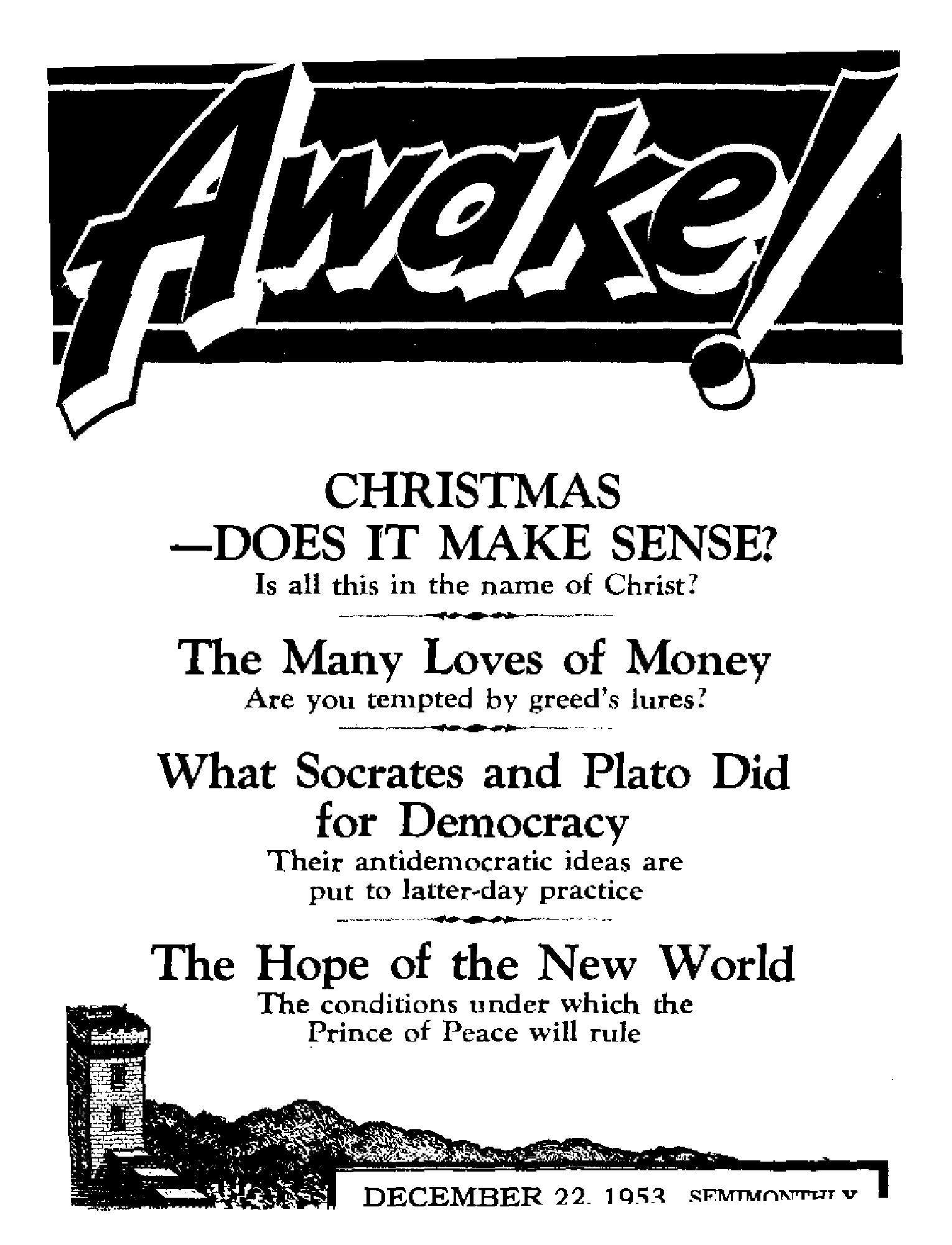
CHRISTMAS —DOES IT MAKE SENSE? Is all this in the name of Christ?
The Many Loves of Money
Are you tempted by greed’s lures?
What Socrates and Plato Did for Democracy Their antidemocratic ideas are put to latter-day practice
The Hope of the New World
The conditions under which the
DECEMBER 22 1Q.W rfmtvhkhwv
THE MISSION OF THIS JOURNAL
News sources that are able to keep you awake to the vital issue* of our times must be unfettered by censorship and selfish interests. *’Awake J” has no fetters. It recognises facts, faces facts, is free to publish facts. It is not bound by political ambitions or obligations; H is unhampered by advertisers whose toes must not be trodden on; it is unprejudiced by traditional creeds. This Journal keeps itself free that it may speak freely to you. But it does not abuse its freedom. It maintains integrity to truth.
"Awake 1*’ uses the regular news channels, but is not dependent on them. Its own correspondents are on all continents, in scores of nations. From the four corners of the earth their uncensored, on-the-scenes reports come to you through these columns. This Journal*® viewpoint is not narrow, but is International It is read in many nations, In many ■ languages, by persons of all ages. Through its pages many fields of knowledge pass in review—government, commerce, religion, history, geography* science, social conditions, natural wonders—why, its cover* age is as broad as the earth and as high as the heavens.
"Awake r pledges itself to righteous principles, to exposing hidden foes and subtle dangers, to championing freedom for all, to comforting mourners and strengthening those disheartened by the failures of a delinquent world, reflecting sure hope for the establishment of a righteous New ’World.
Get acquainted with "Awakei” Keep awake by reading "Awake 1**
Published Semimonthly by WATCHTOWER BIBLE AND TRACT SOCIETY. INC.
117 Adams Street Brooklyn 1, N. Y.( U. S. A.
K. H, Knohr, PrerfdeM Chant Suiter, fieoretary
Printing this Issue: 1,130,000
Five cents a copy
ftcmittaMHi Hhcrald be sent to office in your country in compliance with regulations to guarantee sale delivery of money. Remittances are accepted at Brooklyn from countries where no office la Jota ted, by International money order only. SutaCriptlon ratefl in different countries are here stated In local currency, N alite of expiration (with renewal blank I li sent at Jwt two iMKUfts before subscription expires, Gtanve of adrfrrn when sent to our office may be expected effective wllhln one month. Send your Old IB Well as new uddresS.
Act of March 3, 1870. Printed In U> 8 A.
Langaapti In which tkh mainline li pnhllihed: Semimonthly—Afrikaans, English, Finnish, French, Germ tn, HollSadJflb, Norffegiaii, Spanish, fikedlaii. Monthly—Danish, Greek, Portuguese, Ukrainian.
Offices Yearly subscription Kate
Amrita, U.S., 11T Adams St., Brooklyn 1, N.¥.
Aaitralla, 11 Beresford Bd., Strathfield, KS.W. 8g Canaft, 40 fnria Are . Tohwrto 5, OEtsria 11 fHOfand, 54 Craven Terrace, Lontfon, W. 2 Ta South Africa, Private Bag. P.O, EJandtfooietn,
Transvaal 7s
Entered as seeond-daas matter at Brooklyn, N. Y
CONTENTS
A Woman President lor the LT. N.
Earthquake Shakes the Ionian Islands
Christmas—Does It Make Sense?
Fiji Quakes
The Scriptures Regarding Christ’s Birth
The History of Bathing
\ytiat Socrates and Plato
Assembly Publicity Expands
Did tor Democracy
"Your Word Is Truth”
It the Churches Would Do Their Job
The Hope of the New Worid
2$
Nature Had It First
Wine an Antibiotic Source?
—the Mountain Climber
Do You Know?
The Many Loves of Money
Watching the World
Animal Names and People
Index to Volume XXXIV of Awake!
Brooklyn, N. y., D member £2, 1093
Nutr>b»ikM
A Woman President for the U.N.
WOMAN’S entrance into politics did not come about without a long and hard struggle. Nineteen th-century rulers and those of the early twentieth century, such as the kaisers of Germany, felt very strongly that woman1# place was with Kindert Kuwhe, Kirch?—children, kitchen and church or religion. But times have changed and today there is no place for kaisers in politics, whereas women—
No question about it, the suffragists waged a winning fight for equality before the law and for woman’s right to vote, gaining their coveted rights in Great Britain in 1918, in Germany in 1919 arid in the United States in 1920 with the adoption of the nineteenth amendment, JEver since, women have become more and more active in politics; among the more prominent ones might be named Viscountess Astor, Eleanor Roosevelt and Eva Perdn.
Currently, the most striking example of woman’s success in politics is furnished by Mme. Vijaya l^kahmi Pandit of India, who, on September 15, 1953, was elected president of the General Assembly of the United Nations. Mme. Pandit, a mother of three daughters, wife of a lawyer and scholar, and sister of the prime minister of India, Jawaharlal Nehru, is a veteran in politics. During the nineteen thirties and forties she took a prominent part in India’s struggle for independence and was several times imprisoned for civil disobedience. Concerning her the New York Tiw&t, September 16, 1953, stated: "She is perhaps best known at the United Nations for her fiery speeches on behalf of countries that are not yet free although stirred by strong nationalistic tides. In the Assembly she has led many a bitter controversial debate on complaints against French administration of the African protectorates of Morocco and Tunisia.”
While Mme. bandit hopes that her sex and origin will not be stressed, she, nevertheless, expressed the opinion that her appointment wag a tribute to her country and also that it was “a recognition of the part that women have played and are playing in furthering the aims and purposes of this great organization.”
No question about it, Mme, Pandit la a very able sfateswomoji; but may we expect the current session of the United Nations to be more successful than previous ones by reason of having her as president? In arguing for woman suffrage, suffragettes pointed to the corruption in politics and held out the hope that with women voting politics would become clean and honest However, the moral tone of American politics has steadily worsened in spite of woman's ever-increasing political activity.
The fact is that having women in politics or in the United Nations Is not the solution, but is just getting farther away
from God’s way of doing things. How so? Because it runs counter to God’s principles regarding universal headship, as enunciated by the apostle Paul: “But I want you to know that the head of every man Is the Christ; in turn, the head of a woman is the man; in turn, the head of the Christ is God.** And as regards procedure in the Christian congregation Paul did not equivocate but plainly commanded: “Let a woman learn in silence with full submissiveness, I do not permit a woman to teach, or to exercise authority over a man, but to be in silence.”—1 Corinthians 11:3; 1 Timothy 2:11, 12, New World Trans.
That the apostle Paul was not arbitrary in this matter is borne out by Jesus’ example. Although among his followers were women of unselfishness, zeal and appreciation, none of the twelve or of the seventy sent-forth-ones were women. In this he followed the precedent set by his Father, who had only males to serve as priests in the tabernacle or temple and to rule as kings upon the throne of Jehovah, though Queen Athaliah usurped the throne for a time and was deposed in disgrace.
Likewise, when the early Christian congregation chose envoys or apostles to represent it or to serve as assistants to supervise the distribution of food, the selections were limited to the males. Clearly this was not accidental; nor may we conclude that this was because there were not women with natural ability in the early Christian congregation.-There was Priscilla, who is repeatedly linked with her husband in Christian activity, Paul referring to both as “my fellow workers.” He also mentions Tryphaena and Tryphosa “who have worked hard in the Lord.”—Luke 8:1-3; Acts 18:26; Romans 16:3, 12, New World Trans,
This principle of man's always taking the lead and exercising the headship may not be appreciated by a modem world and least of all by modem woman. However, if we accept the Bible as God's Word, as inspired and therefore timeless, which Christians are compelled to do, then we have no alternative but to be governed by its wisdom, which comes from above. —Psalm 119:105; John 17:17; James 3:17.
The modern world, Christendom included, is not interested in adhering to God’s principles; if it were, it would not be in the wretched state that it finds itself, and that in spite of its United Nations. The religious leaders of modern times urge faith in the United Nations, pray for it and see in it “the promise of the ultimate establishment of the kingdom of God.”
The United Nations is very definitely a part of this world, but Christ Jesus taught his followers to pray for a kingdom that is no part of this world. (Matthew 6:10; John 18:36) The United Nations is man’s loftiest achievement, but Jesus said that that which is lofty among men is disgusting in God's sight, and he urged all to flee to God's kingdom when they saw such a disgusting thing. (Matthew 24:15, 16; Luke 16:15, New World Trans.} The United Nations resorts to carnal or fleshly weapons, but Jesus Christ warned that those who took up the sword would perish by it and Paul tells Christians that the weapons of their warfare are not carnal.—Matthew 26:52; 2 Cqrin-thians 10:3-5.
Christendom, by uniting with godless, ruthless, murderous, hypocritical totalitarian communism within the United Nations, will receive the same fate from that element as did the Jewish nation from Rome in the first century (A.D. 70) because of their alliance with it. (Luke 19:42-44; 21:20-24; John 19:12-16) The election of a Hindu woman to the presidency of the United Nations is but another reason for Christians not to have anything to do with it.
CHRISTMAS
Does It Make Sense?
A GROUP of American soldiers while on occupation duty in Japan arranged a Christmas party for some Japanese youngsters. The party featured the usual Santa Claus, Christmas carols, gifts and plenty of food. While the rest were eagerly open-
Ing their gift packages one thoughtful youngster had a curiosity of another kind. With a puzzled expression on his face he asked one of his companions: '‘Whose birthday is it? The man with the whiskers?”—Saturday Evening Post, December 20, 1952.
Also asking a thought-provoking question in regard to Christmas was one five-year-old Kent Bolley. Cornering his father around Christmas time he said: “Daddy, did you know there isn't any Santa Claus?" Noncommittally, his father replied, “Oh, is that so?” “And did you know,‘I continued the little lad, '*that William Boyd of the movies is really Hopalong Cassidy?*' Not wishing to add to the child’s disillusionment the father again answered without committing himself. Then the five-year-old naked: “Daddy, is there really a God?” (The Oregonian, January 13, 1953) Incidents such as these may well pose the question: Does Christmas make sense?
Does Christmas make sense? It does to big business—and little business; in fact, it is itself a big business. In the United States the Christmas-tree business annually antounts to $50 million. Christmas savings clubs each year hand out to their members more than a billion dollars around Christmas time. We are told that the Christmas season accounts for thirty per cent of all retail business done in the United States,
and with some businesses the amount is Christmas season burdens doctors and
as high as fifty per cent. Yes, Christmas makes sense in the business world, but how compatible is its profit-making motive with Christ’s principles regarding laying up treasures in heaven and giving free because we have received free?—Matthew 6:20; 10:8.
Crime at Chrittmat
Not only that, but there la also a very seamy side to this Christmas business. A United Press dispatch of November 17, 1952, said: “More murders arc committed on Christmas day than on any other one day of the year, according to a report by Gerhard J. Falf, University of Pennsylvania sociologist.” Does that make sense?
The Christmas season also furnishes the ideal time for the kind of stealing known as “shoplifting.** Noting this other side of Christmas, the New York Sunday Newe, December 21.1952, told of the apprehension of a young matron shoplifter who sobbed and writhed and begged for mercy, that she might nut be exposed, because of her having been paught with a number of things she had “lifted ” including a $23 dre® *701 a Christmas dance." The chief detective of the store observed to the news reporter: "We get 'cm every day . , . and when Christmas time is here, they increase in numbers.*’ Shoplifting a dress for a “Christmas dance.** Does that make sense?
crowds hospitals because celebrants indulge too freely in food and drink. In fact, Christmas presents a peculiar hazard to the auto driver because of the number of drunken drivers on the road. In view of Jesus' words, “Pay attention to yourselves that your hearts never become weighed down with overeating and heavy drinking/' does such overindulgence done in His name make sense?—Luke 21:34, New World Trans.
Does Christmas giving make sense? In the United States, in 1952, some 1,300 firms gave their customers, dealers or employees upward of $80 million for Christmas. Out of love? As a Christian sentiment? Or as “good business”? And what about individual giving? Does the old principle, “Let your gifts be to the necessitous and the deserving,” govern, or is it a matter of giving because someone gave something to you, or because you expect to receive something in return? And is the size or worth of one’s gift determined by his desire to make a good impression, by what one hopes to accomplish by giving; or by what the other fellow gave you last year? Touching on another aspect of Christmas giving, a New York Times columnist advised keeping a notebook specially ruled for the purpose, showing what one gave his friends from year to year so that ‘Uncle G—— will not be given a pair of mittens just like the ones you gave him last year and which, he hasn’t worn as yet/ Does Christmas make sense?
Pagan and Medieval Origins
A National Geographic Society release around Christmas time, in 1952, told that “Christmas Tree Custom Began as Pagan Rite.” A missionary “found the Teutons worshiping the sacred oak of Odin. Instead of trying to destroy that practice, [he] persuaded the Christian converts to substitute an evergreen tree for the oak and decorate it in honor of the Christ Child. The practice stuck/'
And regarding other Christmas features the Encyclopedia Americana states: "Among the German and Celtic tribes the winter solstice was considered an important point of the year, and they held their chief festival of Yule to commemorate the return of the burning-wheel [the sun]. The holly, the mistletoe and the wassail bowl are relics of pre-Christian times.” Does it make sense to fuse such pagan relics to Christianity when God strictly forbade his people to do so?—2 Corinthians 6:14-16.
The medieval legends that serve as the basis of many of the Christmas customs are so farfetched and fantastic in their details as to represent an insult even to the intelligence of a child. This is particularly true of those concerning “St. Nicholas,” supposed to have been "the greatest wonder worker of all the saints in Christendom” in his day, some sixteen centuries back. Because of his purported miracles he is the patron saint of sailors (replacing the Greek god Neptune), of pawnbrokers, of robbers, of small children, of Russia, etc. A native of Italy, his counterpart is found in various lands under differing names and guises: Santa Claus in Holland; Knecht Ruprecht, Weinachtsmann and Kris Kringle in Germany; Jul-Nissen in Norway and Denmark; Jill Tomter in Sweden; to mention some of the better-known ones.
And as for the Christmas date, it is a well-known fact that December 25 does not have any Scriptural support but was borrowed from the pagan Saturnalia, a season of celebration when the population went mad and did everything the opposite from what they did the rest of the year: men and women wore each other’s costumes; masters served their servants, who
ordered thsn around; antigaffiing laws were suspended. Also gifts were exchanged, such as holly, wax fruit and dofla. "It was all right to say anything, do anything, and everyone had fun/* we are told. Th make it easy for these pagan Romans to accept the Catholic religion, they were allowed to keep the celebration, but merely changed its name to "Christ's mass."
It should not surprise us, then, to note that in New York city, In 1952, the Hindus had a week’s celebration of Christmas, because the Christmas spirit together with the Christmas tree at their chapel demonstrated the "ancient Hindu dictum, ‘Truth is one, men call it variously.’ "
And not only in New York city, but right in Bombay, India, were the Hindus carried away with the Christmas spirit A dispatch to the Chicago, Illinois, Tribune from Bombay stated: "India, a land of blood sacrifices and many idols, today [December 25] took time out to celebrate the alien Christmas festival. Not one Indian In fifty is a Christian, but the Yuletide spirit of good will and gift-making sub merged India's awn religions. Ye terday prosperous Indians shopped eagerly.’’
And not only the Hindus, but also the Shintoisls of Japan have adopted Christmas. In 1952 an "Orgy of Spending" and holiday frivolities began with Christmas day and continued for as long as three weeks. Virtually all businesses and government offices were closed for the first week, whereas movie houses, dance halls cabarets and burlesque theaters were doing a booming business entertaining overflow crowds. Were the spirit of Christ truly in the Christmas celebration, would it be adopted by such non-Christian religions? —New York Timex, January 4, 1953.
The Scriptures Regarding Christi Birth
The Bible indicates that Jesus was born about October 1, 2 B.C., that he came as the Messiah A.D. 29, and was put to death three and a half years later, about April 1, AJX 33, Scriptural testimony < in which this is implicit is in Daniel 9:24-27 (the prophecy concerning the "seventy weeks") and Luke 3;1, 23. The October date harmonizes with the fact that the shepherds were still out at night with their flocks; iLus would not have been the case at the end of December,
Nor can the visit of the astrologers be linked with the time of his birth. Astrologers are demon worshipers, and in view of the terrible outcome of their trip, the slaying of the young boys, it does not seem reasonable to hold that God led them to Jesus; and if not God, then it must have been the Devil, for no light in the sky of natural origin could have directed the astrologers. Nor is their number, given as three, Indicated in the Bible.
Herod's decree to kill all the male children of two years and under, “according to the time that he had carefully ascertained from the astrologers," indicates that Jesus was about two years old at that time. That is why we read that the astrologers saw a young child In a house whereas the shepherds saw an infant in a manger. Compare Matthew’s account with Luke's, New World Translation. Incidentally, while historians generally give the date of King Herod's death as 4 B.C., there is a difference of opinion among authorities, and the chief witness, Josephus, is contradictory on this point, so that a date in conflict with the one indicated in the Bible cannot be correctly affirmed.
Birthdays are studiously ignored in the Bible. Although lime and again an exact dale is given for other events, such as when Noah entered the ark and when he left, when the feasts of the law covenant were to be celebrated, the date of the conspiracy against the Jews in Esther's time, yet not once is indicated the day on which
a person was born. In all the Scriptures only two birthdays are mentioned, each of pagan rulers and each marred by a murderous execution.—See Genesis 40:20, 21; Matthew 14:6-12.
A Sign of Immaturity
Look in whatever direction we will, does Christmas make sense? Its commercialism, its self-indulgence, its increased crime, its pagan origin and medieval legends, its wrong date, its confusing of the visit of the astrologers with Christ’s birth, and the very celebration of birthdays, do not make sense and are all foreign to what it claims to be—a Christian festival.
Actually Christmas is a sop to selfishness in man. Persons who are hateful, selfcentered, miserly, become sentimental at Christmas time, having been bribed to make a display of generosity because of the babe-in-the-manger stpry, the Christmas carols, the beautiful decorations, and the wining and dining. What about the other 364 days in the year? No sentimental appeal then, no generosity then? No wining and dining and so no brotherly feeling then?
Ostensibly Christmas is celebrated as Christ's birthday; but usually when someone’s birthday is celebrated, that one gets the gifts. But whoever thinks of giving gifts to Christ Jesus on Christmas day? In fact, everybody gets gifts except him. Some may hold that Jesus said that what was given to the least of his brothers was given, to him, but who gives gifts because another is Christ’s brother?
Said Dr. McCracken of New York's fashionable Riverside church, regarding Christmas’ being a secular celebration with many: “People are sick and weary of the world in which they live, with its meanness and its pettiness, its dishonesty and double-dealing, its ugly passions that make life a rotten little game instead of a great one. Dimly aware of a great lack, they are searching for something that can really satisfy that need. Their hearts, if not their voices, are crying, ‘Give us God.’ ''—New York Times, December 23,1952.
With those wor^s that clergyman uttered more truth than he realized, for by them he was giving an indictment not only of those who secularize Christmas but of all who celebrate it. Why do we find Indian Hindu, Japanese Shintoist, modem Jew, agnostic, atheist and infidel all joining with the professed Christian in celebrating Christmas? For the very reason that there is something lacking in their lives; their religion or irreligion does not fully satisfy their needs; it has not sparked them to express unselfishness, which they instinctively know they should be expressing. So with the help of the emotionalism of Christmas time they are made to feel noble at least for a day or two out of the year.
Mature Christians, who sincerely and intelligently follow in the footsteps of the one whose name they have taken upon themselves, do not need to be emotionally stimulated by appeals to the eye or the ear or the palate to be put into the mood of giving; nor do they give merely because everybody else is giving. Knowing that there is more happiness in giving than there is in receiving, they practice giving 365 days in the year, and that without any ulterior motive, any feeling of obligation or hope of reward or return.—Acts 20:35, New World Trans, * .
And while they do not despise the giving of material assistance in cases of need, true Christians appreciate that the greater need comes first, the need for a knowledge and understanding of Jehovah and his Word, which alone can make one wise to the gaining of everlasting life. (John 17:3; 2 Timothy 3:15-17) And these do not hunger at heart for God, for they have found him and rejoice in him.
WHAT SOCRATES AND PLATO DID
FOR DEMOCRACY
were still left without any sure moral guide and they
were seething in the fleshpots of confusion
ISTORY tells us that democracy reached its finest state in Athens four hundred years before Christ. Socrates lived then. No one gave democracy more of a headache than Socrates did. That is, of course, with the exception of his star pupil, Plato.
To tell the truth, Athenian democracy was no democracy at all. Of the 400,000 inhabitants of Athens 250,000 were slaves, without political rights in any sense of the word. And of the 150,000 freemen or citizens a mere handful presented themselves at the Ecclesia, or general assembly, to cope with the affairs of state. “Yet,” says philosopher-historian Will Durant in his book The Story of Philosophy, “what democracy they had was as thorough as never since; the general assembly was the supreme power, and the highest official body, the Dikosteria, or supreme court, consisted of over a thousand members (to make bribery expensive), selected by alphabetical rote from the roll of all the citizens. No institution could have been more democratic, nor, said its opponents, more absurd.”
Times were turbulent in Greece. Thanks to the Sophists, who specialized in quibbling about everything and everybody, the gods and goddesses had toppled off Mount Olympus. That meant that people who were guided by something of a moral code built around fear of these “deities” were now left in the lurch. It may be true that the moral practices required to please Zeus and Artemis were among some of the things to shy out of sight of, according to the law of Moses. Nevertheless, the Greeks and disillusionment, and were ripe for ruin. Folks who enjoyed the privilege of thinking were left wondering if each man might just as well be guided by his own notions. “As for the state,” Durant says with warmth, “what could have been more ridiculous than this mob-led passion-ridden democracy, this government By a debating-society, .. . this unchoice choice of simple farmers and tradesmen, in alphabetical rotation, as members of the supreme court of the land? How could a new and natural morality be developed in Athens, and how could the state be saved?”
How? Well, there was Socrates. No, he did not lead an army; he was thoroughly pacific. He did not even run for king. He just sat around in the shade and talked. Not that he professed any wisdom of his own. The only thing Socrates claimed to be champion of was the art of asking questions. But what questions!
His questions implied that democracy or people-rule was just a politician’s silver-plated word for mob-rule, and that by lewd fellows of the baser sort. “How can a society be saved, or be strong, except it be led by its wisest men?” That was the Socratic question that headed the list,
Plato Finds the Answer
Thanks to stimulation of this kind, a revolution broke out, and after the bloodletting, “democracy” still ruled. The party in power sentenced Socrates to drink hemlock and die.
So it was left to young Plato to carry on-We are told that 28-year-old Plato was left filled "with such scorn of democracy, such a natred of the mob, as even his aristocratic lineage and breeding had hardly engendered in him; it led him to a Catonic resolve that democracy must be destroyed, to be replaced by the rule of the wisest and the best. It became the absorbing problem of his life to find a method whereby the wisest and the best might be discovered, and then enabled and persuaded to rule,” —The Story of Philosophy.
Once discovered and enabled, the wise ones would hardly have to be "persuaded” to rule. So discover them he must. “Until philosophers are kings, or the kings and princes of the world have the spirit qf philosophy, and wisdom and political leadership meet in the same man, . . . cities will never cease from ill, nor the human race."—The Republic, by Plato.
It took Plato many long years and a lot of hard work to compound the formula. But when he did, it made him famous. Unraveled out of his voluminous dialogues and pieced together, the formula boils down to a fairly simple antidote for democracy:
First, you take the children of ten years of age away from the “habits of the parents" and educate them properly. Parochial schools, in plain words. By a thorough development in physical education the need for correction by the medic’s serpent-entwined rod would be dispensed with, and everybody would be sound in body if not in mind. However, lest you have nothing but generation of wrestlers and weight-lifters, you teach them music too. The art of music fills a young soul with harmony and rhythm and a disposition to justice; “can he who is harmoniously constituted ever be unjust?” Juvenile authorities might jot th|s down.
After ten years of practice with biceps and voicebox, the regenerated race, now twenty years old, must undergo a screening. It is time to find out which they have more of, brains or brawn. The odds are that most will wind up with more brawn than brains. So graduate the brawny ones right there. It is .plain to see after all this time that they were cut out to take care of the mundane side of Utopia, Send them out to battle the weeds, manufacture swords, cobble shoes and row ships. That is what their muscles are for. If they grumble or look unhappy, remind them that they have been trained to whistle while they work.
But what about those that pass the test and survive the stiff screening? Well, educate them for ten more years. Now they are thirty years old. Time for another screening. Now only the finest of the superfine will be left. And the new crop of graduates must sally forth to become the auxiliaries, the executive aides and military officers of the state.
But what of the high-grade brains that are still whizzing? They are given five years more of parboiling in the fat of ad-vanced> philosophy. At the age of thirty-five they are cast right out in the raw old world to find out the hard way if their high-toned ideas will hold water. If, after fifteen years of weathering the mortal storm, these intelligentsia survive intact, they automatically, at the age of fifty, reach the highest state. They become members of the ruling class. They are now higher than the gods that fell from QJympus were, because they are an absolute hierarchy of philosopher-kings, high priests of the state.
This “guardian” class, Mr. Durant declares, would have to get by under “a system of communism." They must even become celibates of a sort. At any rate, no philosopher would have his own individual wife, but like everything else assigned to the hierarchy the wives would all be enjoyed in common.
4 Jtettpfai to BM Utopia TopstBr
What if the masses that graduated at trie age of twenty get tired of having to admit that they are just plain earth people? And what If the class that graduated at thirty get fed up with mere plush-lined offices and military decorations?
Do not worry. Plato fixed that He concocted a religion, just the religion needed to make everybody happy with his lot. "Wc shall tell these young people that the divisions into which they have fallen are God-dccrccd and irrevocable.”
But who would ever try to translate this philosopher’s fancy into reality? Listen to the words of one of his critics and admlr-ers, himself a member of the church that sponsored the Utopia:
“For a thousand years Europe was ruled by an order of guardians considerably like that which was visioned by our philosopher. During the Middle Ages It was customary to classify the population of Christendom into laboratores (workers), beUa~ tores (soldiers), and oratores (clergy), The last group, though small in number, monopolized the instruments and opportunities of culture, and ruled with almost unlimited sway half of the most powerful continent on the globe. ... Celibacy was part of the psychological structure of the power of the clergy; for on the one hand they were unimpeded by the narrowing egoism of the family, and on the other their apparent superiority to the call of the flesh added to the awe in which lay sinners held them, and to the readiness of these sinners to talk about their lives In the confessional.
lfMuch of the politics of Catholicism was derived from Plato’s 'royal Iles,* or influenced by them; the ideas of heaven, purgatory, and hell, in their medieval form, are traceable to the last book of the Republic.
“With this body of doctrine the people of Europe were ruled with hardly any resort to force; and they accepted this rule so readily that for a thousand years they contributed plentiful material support to their rulers, and asked no voice in the government. Nor was this acquiescence confined to the general population; merchants and soldiers, feudal chieftains and dvfl powers all bent the knee to Rome.”
As if in a postscript to the modem East and West* this noted Catholic authority adds a fascinating bit of data:
“For a time tfie Communist Party which ruled Russia after the revolution of November, 1917, took a form strangely reminiscent of the Republic. They were a small minority► held together almost by religious conviction, wielding the weapons of ortho doxy and excommunication, as sternly devoted to their cause as any saint to his, and living a frugal existence while ruling half the soil of Europe.”—The Story of Philosophy.
So while Socrates and Plato, if found in Washington, would be the first to be investigated by Senator McCarthy, there is no doubt that both would look right at home in the Vatican or the Kremlin!—Contributed,
If the Churches Would Do Their Job
C A column headed “Quotation Marks" in the New York Times Magazine, October 18, reported that Owen D. Young, “retired industrialist, lawyer and consultant to Presidents. taking issue on his seventy eighth birthday with predictions that civilization is headed for destruction,” said: “I don’t go along. If the churches of the world would do their part of the job as effectively as the scientists have done Uielre, we wouldn't be In any danger.” But they haven't.
Nature Had It First—the Mountain Climber
\ yfOUNTAIN-CUMBING in its $ V j/'v 1V] modem fonn is a sport dat
ing from about 1850. But long be- ❖ fore man took up this sport, nature £ had There are animals that may * be observed sporting among the rocky heights and that attest to the fact that nature had mountain climbers first. Take, for instance, * the Rocky Mountain goat, which ranges from the Columbia River to Alaska. These goats, $ really related to the antelope tribe, like to t live far above the timber line where the ❖ scenery is grandiose and wild and where X they are surrounded by glaciers and preci- J pices. These mountain climbers are be- v whiskered animals with beautiful pure-white A hair and black horns. They tread where man * would never dare. Equipped by the Creator ■> with sturdy legs and rubbery hoofs that have $ sharp rims, the mountain goats climb and * run on snow, ice or bare rock. > •>
C When danger threatens, the mountain goat •> climbs Upward, ever upward to the safety of almost vertical peaks. In ten minutes a moun- * tain goat can climb so far that it would take *:• a hunter two hours to overtake it. Trying to ? get a close view of nature's mountain climbers, £ a hunter once wrote: “We came on a number *:• of fresh goat-tracks in the snow or the soft shale. There seemed to be several, large and * small; and the perverted animals invariably ❖ chose the sharpest slant they could find to <. walk on, often with a decent level just beside * it that we were glad enough to have. If there •> was a precipice and a sound flat-top, they X took the precipice, and crossed Its face on juts * that did not look as if your hat would hang on them.” .J
®- Another goat-antelope mountain climber is 4 the chamois, inhabiting several European £ mountain chains. Acclaimed as the most -> graceful of ajl wild goats, these animals take ’£ breath-taking leaps from rock to rock. They £ pass readily up or down precipices that almost * no other quadruped would even attempt. Why, J it Is said that the chamois is able to stand £ on the summit of a pinnacle of rock with all X its four feet gathered into a space about the J size of a silver dollar! Some climber! ’!•
Man has a shortage of expert mountain X climbers, as evidenced by the more than two 5 hundred fatalities in the Alps alone during £ 1953. But nature has an abundance of moun- X tain climbers, and champion ones too. From the edges of the Alaskan glaciers to the dry crags of the Mexican Sierras are found varieties of expert climbers called mountain sheep. They love the snowy peaks, feeling safe up near the clouds. In the Sierras, sometimes at altitudes of 12,000 feet, the mountain sheep gambol about, leaping and bounding with sure-footed ease. At the scent of an enemy, a sentry lets out a shrill snort and off the animals go to seek out the dizziest trails, the kind that few enemies can follow. Audubon was so intrigued by the Rocky Mountain bighorn sheep that he once wrote: <1. “The parts of the country usually chosen by the sheep for their pastures are the most extraordinary broken and precipitous clay hills or stony eminences that exist In the wild regions belonging to the Rocky Mountain chain. Perhaps some idea of the country they inhabit—which is called by the French Canadians and hunters ‘mauvaise terres”—may be formed by imagining some hundreds of loaves of sugar of different sizes, irregularly broken and truncated at top, placed somewhat apart and magnifying them into hills of considerable size. Over these hills and ravines the Rocky Mounts in sheep bound up and down and you may estimate the difficulty of approaching them and conceive the great activity and sure-footedness of this species, ... In many places columns or piles of clay or hardened earth are to be seen eight sor ten feet above the adjacent surface, covered or coped with a slaty, flat rock, thus resembling gigantic tosdstools, and upon these singular places the bighorns are frequently seen, gazing at the hunter who is winding about far below, looking like so many statues on their elevated pedestals.. One cannot imagine how these animals reach these curious places, especially on these inaccessible points.”
In Tibet there is a mountain sheep called argali that loves high-altitude living; it roams the craggy mountains up to 15,000 feet. Another graceful climber Is the red sheep of Cyprus that frequents the pine-clad slopes of the Cyprian mountains. Found In the mountains of Central Asia is the urial, and in the Atlas Mountains of Africa are found the Barbaiy sheep, So nature came first with the mountain climbers and with speedier, more agile ones too!
THE MANY LOVES OF MONEY
''We have brought nothing into the world, and neither can we carry anything out. So, having sustenance and covering, we shall be content with these things. However, those who are determined to be rich fall into temptation and a snare and many senseless and hurtful desires which plunge men into destruction and ruin. For the love of money is a root of all sorts of injurious things, and by reaching out for this love some have been led astray from the faith and have stabbed themselves all over with many pains.”—1 Timothy 6:7'10, New World Trans.
SATAN is a highly successful fisher and hunter of men. Success with so large a percentage proves the attraction and variety of his bait. And surely one of his versatile appealing lures is the love of money.
Money has many faces. Some of them are obvious. Thus Christians readily condemn the avaricious Achan, whose lust for .gold brought all Israel to disaster, and read with contempt the record of the Roman soldiers who took bribes to deny Jesus' resurrection, and find no words to describe the unspeakable treachery of Judas. Scriptural history furnishes many more examples of greed for gold or its equivalent, from which we turn in disgust. But from this may we safely conclude that love of money would never be a bait to entice us to bite on Satan’s hook?
That we need to exercise caution may possibly be illustrated by several specific examples. These are not drawn from the ancient past, but from the modern present. The principles of the Bible, its rules of conduct, affect all ages and all men. It should not be surprising, therefore, to see the outworkings of ancient themes among the people of our day. Examination may prove illuminating.
Axiomatic with all practical fishermen is to vary the lures to attract a variety catch. For ex ample, a youngster might catch a fish
in a muddy river with a handline of string. But in many clear lakes the end of the line or leader must be of such transparent material that the fly or lure will appear like a free-swimming insect or minnow, otherwise the fish will not bite. Even to fish, the obvious cord with a worm on a hook is definitely not inviting. Following this analogy, the obvious miserly money lover, sitting by candlelight counting his stacks of gold, is not the sort of attractive bait that will ensnare many people. For success the snare must be deceptive. For his purposes the Deceiver has many deceptive uses for money.
Money’s variety of appeal is manifold. It has more costumes than*a beautiful model displays at the fashion revue. In fact, its allure may be concentrated in the person of this expensively gowned young woman. But it may as well be represented in the executive office, decorated in soft contrasting shades, heavily carpeted, in a preferred location with a “river view” and staffed with efficient servants to do the executive’s bidding. To entice another, and these allures may be adapted to draw either sex, it may be the country or city club, with its charming recreational features, set in beautiful countryside or city opulence, and providing heartwarming companionship with those so financially secure that they can dismiss grim reality and hardship • and choose the pleasant role, both in conversation and in enjoyment. But the human fish are not all of the same size, hence the lures must be graduated to fit the catch. So the enticement may be merely a new dress to outshine school friends who cannot afford to buy in the exclusive shop whose name appears in the collar. It may even be designed for minnows: the extra bowl of rice or bar of chocolate above the allotted ration, given as reward to the worker who betrays his fellows to the Communist thought-censor.
For purposes of deception Satan “keeps transforming himself into an angel of light” (2 Corinthians 11:14, New World Trura.) Therefore, beware the obvious; look for something deeper. Money has its proper uses, so the question for selfappraisal becomes: Does my desire for self-gain or my worldly success place a barrier between me and my proper love for my fellow men? “Each of us will render an account for himself to God.”—Romans 14:12, New World Trans,
Its Value Emphasized
To emphasize the value of money, or power to purchase benefits with it, only about two per cent of the population are usually permitted to possess amounts sufficient to set them apart. According to studies completed in 1929 in the United States, this two per cent, possessing $50,000 or more, owned 40 per cent of the total wealth of the country; sixty-five per cent of the people owned $3,500 or less. Though the amount of money today is greater, it is probable that these percentages have not changed greatly, even though the United States has become the richest country ever on earth, with its recent rating of Trillionaire,1 To keep a small percentage in control, difficulties are raised in the path of those who try to acquire wealth.
Consider John Jones, for example, who works at a manual trade, owning a small bicycle repair shop in a moderate-sized city of the United States. His charge for labor and small profit on replacement parts constitute his income. He makes enough to get along, supporting his wife and two children. Then disaster strikes. To save her life, his wife requires an expensive operation, one that had been put off for lack of money. A nurse must be hired to care for two infant sons. Expenses at the hospital and for the doctor will be overwhelming. The only solution is to borrow on his shop and tools. He rents the building, so this leaves his tools. What are they worth? A frosty-eyed agent for a small loan agency tells him that they will lend about ten per cent of the value of his tools. Rates for such loans run as high as twenty per cent. An additional loan is arranged at the bank, based on his average earning power, and which will probably run up to ten per cent or more for interest. Relatives add a little in a patronizing attitude. He shockingly learns that he has no friends. And, as he lies awake at night worrying about the situation, one fact is indelibly imprinted like a brand of fire: Lack of money caused this trouble.
It is said that many of the richest men on earth came from poor families, where deprivation and distress, similar to the difficulties of Jones, stamped their early lives. The sons of Jones, in the above example, observed firsthand the effect of lack of money. This memory, more than anything else, carved their careers. After their earning more than enough for security, the habit of making money continued. They learned that not only leisure could be bought, but also brains, talent, beauty, worldly esteem, and respect of associates.
And they discovered that the mawer in which money was obtained did not Jeraen its potency. They have also learned that making money is a slow process, like digging in sand with a needle; while spending it is like pouring water on the sand. Recalling all this they came to love their position, their wide gulf of separation from want, their wealth-induced eminence in this world. Thus a barrier has been effectually erected between such men and the truth of the Bible, because the truth requires a first love of righteousness; while the worldling’s first love is for the position he has built with money. Only a few can cross that barrier.—Luke 18:23-25.
Extent t)f Its Penetration
Adept players at the game of moneymaking come to regard every overture from the standpoint of self-interest. Friendship is a commodity worth just so much in dollars and cents. Those who want their association must pay high in service. In business the servants of money must accord respect for the wishes and often the moods of the wealthy employer. The higher the executive who'works for a salary, the more exacting the demands. While the family life of the janitor may not be important, that of the vice-president becomes very significant. Ability to entertain and amuse those of wealth becomes of paramount importance in the higher altitudes of society. The writer knows of one executive who was forced by his board of directors to purchase a more elegant home to “entertain in a manner befitting his position.
Not only, the executive but the lives of his wife and children are subject to close scrutiny and criticism. His conversation and speech must reflect the policies of his superiors. Rather difficult, would you not say, to be the wife or child of such a personage, dutifully carrying out social func-tfas in the evening and then to go railing on the director's wife the next day with books explaining the Bible, according to the organization of an unpopular minority, as a Christian witness? How is such a man, or his wife and children, to do as Christ did and call on the homes of the people to encourage them to accept the still unpopular true Christianity? When such a course brings pressure on the businessman or executive, where is his first love? Will it be for God, or for his position? If his love is for money it may be expressed In hla fear of offending moneyed interests.
So holy is the esteem for money by those who possess it that human blood is cheap by comparison. An article in Collier’s (January 10, 1953) entitled “The Secret Weapon We Failed to Use" discloses that the Secretary of the Treasury, with approval by Franklin D. Roosevelt, refused a plan to undermine Nazi currency with a probable crippling effect on their war machine during World War II, because he feared reprisals that might have damaged American currency. To a less degree deference toward money Is exhibited by the man paying awed respect to high-salaried business officials, who adroitly and flatteringly draw him Into their warm intimate circle. But would their circle include him long if he became a humble house-to-house witness of Jehovah? "Everything in the world—the desire of the flesh and the desire of the eyes and the showy display of one’s means of life—does not originate with the Father, but originates with the world."—1 John 2:16, Now World Trans,
Love of money is disclosed by spending impressive sums to buy the flimsy smile of tntth-spumers, or turn aside the reproach that would otherwise be heaped upon one for Christ’s sake. Love of money may also be expressed in scorn for those who do not have it. It may mean contempt
far the family that does not send their children to one of the socially prominent colleges or does not give presents at Christmas and other times to relatives and associates of the world. Acts done for show or display alone are condemned.
Governments well recognize also the powerful attraction of superior economic rank. Officials who prate of the plight of the people are always far removed from the pinch of poverty, by enjoying expensive incomes. The Communist party regime is nothing but a graded bureaucracy, serving according to a type of capitalistic regime they claim to abhor. The incentive held out is merely the pleasure-purchasing ruble. Communism, which gained its foothold by promising elimination of moneyed ranks and operating everything for the people’s interests, is itself “an autocratic state capitalism ” with slave worker and plutocrat.
In this system the highly placed Soviet official looks down the economic ladder to the lowest rung, probably the lowest income group on earth, to the Siberian filaVe-labor victims. Actually they are paid a pittance for the manufacture of trinkets, which the U.S.S.R. sells for naturally fabulous profits. So little food is mixed with their misery that frequent hair-pullings occur in the women’s division, so escapees report. The bone of contention is literal, a single meaty piece in the pot to feed the entire mess. Knowing the living death in such iniquitous holes, where want, cold and cruelty dig endless graves, both the big brass and the lesser Communist are moved to please their masters in Europe’s biggest concentration camp.
Thus economic fears are used by both corporations and countries to club their servants into line. Love of money is graduated to fit all social classes. Its use is proper, but beware of its abuse to ensnare us. To determine when our course may be deviated from that proper way, let us examine our conduct with the measure of Christ, who, above all others, loved righteousness and hated iniquity.—Contributed.
C. Animal names are often applied to people, quite often In a derogatory sense. Jesus could have chosen no better name for the cunning, wicked Herod than “fox”!
(Luke 13:32) Curiously enough, an animal highly valued by man as a pet may not fare so weir when its name is applied to man. For then the highly prized “dog" becomes a mean, worthless person and the "cat” becomes a mean, spiteful woman. Why, some animal names just never incite favorable reaction. Take, for example, the bat It seems to be used invariably in the derogatory sense, often imputing the quality of clumsiness or blindness. And the height of its unsavory use comes when the bat is associated with supposed flaws in a person’s mentality,
C Other animals whose names cany unpleasant connotations are the vulture and the wolf, both carrying the thought of cruelty and greediness. Anyone who acts like a pig earns for himself the discrediting name. Animal names abpund in similes where they impute a variety of qualities: the peacock, vanity; the loon, stupidity; the dodo, extinction; the mule, stubbornness; the whale, bigness; the owl, wisdom; the lamb, gentleness; the ox, strength; the horse, capacity for work, and the lion, bravery. There is no hard and fast rule to follow when using animal names In similes or in direct application. Common sense must be the guide when dictionaries do not enlighten. A woman is sometimes called, as a term of endearment, a “kitten," but “cat" would never do! If you must use animal names use them right, so that you can make someone happy as a lark and not as mad as a bull.
Only the stronger remained tn eaUi ly observe what had taken place. It was tragic.
The most beautiful island of Zante exists no more. Nothing was left standing. Of its forty-eight villager, the sole building saved was that of the National Bank, along with one or two more earthquake-proof structures. Edifices, lordly palaces and picture galleries, libraries and theaters, magnificent church structures and humble
By ljAwqI»I" Krrvtpandanf in Gitaw
CUNDAY, August 9t 1953T will long be kJ remembered by those of the Gi-eek islands of the Ionian Sea, That day entire towns and villages were reduced to a heap of nibble. What took men thousands of years to build, an earthquake leveled in but a few seconds. The island of Ithaca, birthplace of Ulysses, lay crumbled, Cepha-lonia's towns and villages were reduced to heaps of dust, Zante was swept with flames, leaving only ashes behind.
One observer describes the tragedy in these words: ’First there was a terrible rattling, a throwing down of furniture and men. The whole earth felt as if it were nn a rough sea being tossed about by its angry waves. Then with a surprising suddenness the shaking stopped. The faces of both old and young were filled with fear. The first phase had passed, but a more dreadful one was about to take place. Unexpectedly and unbelievably, the earth gave three sudden, horrible, vertical leaps that threw down people and buildings in a lapse of unde-scribable horror. The third shock, which quickly followed, literally lowered all edifices in a deafening roar. For some time no one could breathe. The air was dark—a solid cloud of dust. We felt that all had ended, both world and life.' Shock turned to panic. It was each man for himself. A wild scramble for safety and life began. dwellings, all, without exception, were demolished. What the earthquake did not totally destroy, the fires that followed did. Tile islands of Ithaca and CephaIonia suffered a similar disaster.
The loss in life and property was great. At least a thousand perished in the quake and about four thousand were Injured, with approximately a hundred and twenty thousand inhabitants left without shelter. Th4 freakish manner In which the quakes came was the cause for the heavy toll in lives. After the first shock, which came on Sunday, August 9, 1953, about 5:30 a.m., a calm settled over the islands. rrhe inhabitants regained courage and came back into their dwellings, thinking tliat the wont had passed. At 9:30 p,m. Monday a new shock caught most of the people completely unawares. This quake was stronger and morn devastating than the first. In a few seconds hundreds lay dead and the wounded were multiplied into the thousands. Strong buildings crumbled, burying those who sought refuge in them. Other tremors followed, sowing panic and frenzy among the inhabitants. Scenes of death and destruction were everywhere. Sounds of agony pierced the night from the wounded and dying. The sight of mangled and half-buried bodies left one weak and helpless. Some who succeeded in escaping serious injury from falling debris fell into
the sea in panic. Mothers and fathers could be Seen swimming with their little children in their bosoms toward vessels that were coming into the harbors for rescue operations* Mountainous waves caused by the seismic quakes swallowed many of these.
Others rushed madly toward safer points, leaving behind all their possessions. At nightfall the picture was tragic. Everything was plunged into pitch blackness. The electric lighting network had been destroyed. Horror and despair were written in the faces of both old and young. These, without bread or water, without light or covering, crouched together in boats, in olive groves or gardens, in meadows, any place that promised a shadow of protection.
In the village Livathu almost immediately after an 11 a.m. shock the atmosphere became dark and a dense cloud of dust covered everything. Church buildings fell down with a deafening noise. Tombs and graveyards were split open and exposed their dead. At noonday the whole earth appeared to be buried in darkness.
Particularly tragic during the first days of the earthquakes was the position of the villagers. Greater damage to homes occurred in villages. Rockslides and landslides cut off the water supply. The inhabitants fled to the mountains. There, at prominent points, they signaled for help by using long wooden poles with a white cloth tied to the tip. Around these poles the humble folk would gather and mourn for the dead, and pray for mercy and rescue.
Help and Solidarity
News of the earthquake became known to the world almost immediately. Communiques from the Athens Observatoiy rang out for help. Messages such as "City of Zante ceased to exist,” "The population being isolated is in despair/' "Earth-shake destroyed islands of Zante, Cephalonia, Ithaca,” "Send ships take rescued inhabitants,” were wired to nations and ships at sea. Full-speed ahead, whole fleets responded.
International news agencies carried similar messages and appeals to the four quarters of the world. Action was immediate and gratifying. The Greek govern-inent’s care was quick and generous. It ordered all merchant ships to be commandeered for carrying victuals, drinking water, tents, clothing, bedcovers, etc., to the suffering islands* inhabitants. The country's entire machinery was set in motion to cope with the emergency. The Greek people responded by making collections of money, clothing, medicaments, and dispatching medicine, doctors and nurses with all equipment and supplies. Various Red Cross agencies were alerted. The king and queen of Greece ordered that all children, ages 6 to 14 years, be sent to children’s encampments, and thus 2,439 youths were promptly rescued from the scenes of sorrow and despair.
Many nations expressed sympathy through their embassies and asked how they could best help. Four ships of Israel were the first to reach the disaster area. These transmitted appeals. In reply came six British warships, five American warships, two Italian and the steel colossus “Franklin Roosevelt.” The United States government ordered the Sixth U. S. Fleet to discontinue its maneuvers and hold itself at the disposal of the stricken people, rendering immediate assistance by all means available. The British Mediterranean Fleet rushed there with supplies. The sight of these ships alone was a source of comfort through the difficult dark days. These “battlewagons” used their kitchens, baking-ovens, stretchers, medicines and the services of their physicians, nurses and
Bailors. Many sailors risked their lives in courageous and untiring service. Helicopters and airplanes arriving from Africa and Western Europe dropped supplies to those' who were isolated in the mountainsides and gardens.
The first-aid hours had passed. The foreign-flag warships moved nut nf port. The wounds were dressed. The dead were buried. Now was the tremendous problem of rebuilding. The government under the chairmanship of the Minister of Coordination laid the foundations of the islands’ recovery program, aiming at restoring the stricken territories to their normal condition and economic life.
WAflt Caused it?
Beyond these problems were those that concerned scientists. They desired to fathom the causes of the quakes, particularly those that brought about sudden disaster. There were scientists that attributed the quakes in general to the constant development of the earth, because of Its not having assumed as yet its definite form. Others ascribed the Ionian shocks to the earthquake zone commencing at African Morocco and passing through Lower Italy, Sicily, the Ionian Islands, Peloponnesus, and the Aegean Sea and ending at (he seashores of Asia Minor, where minor tremors are the '‘order of the day" every year.
Priests and clergy> on the other hand, charged the quakes to the wrath of God. According to them, God was punishing and correcting the wicked for their many sins. Many have challenged this religious view by asking, If Almighty God is allwise, and the all-powerful God, and his purpose is to chasten sinners, why destroy the churches? Are they wicked? Why destroy the patron saints? The images? The property of priests and nuns? What about babes and innocent children, why were these made to suffer? Why were the animals not spared? Why were not the prayers of the righteous heard? Or will the clergy say that there were none pleasing to God, not even one among their lot, whose prayer God would hear? The religious “saints” who were supposed to save were no saviors. They were reduced to dust. Destruction rained upon all without distinction or partiality. No one whe exempt Church idols, images, crucifixes, statues, prayer beads and prayers proved worthless. Those who trusted in them were left disappointed.
…