Awake!, October 8, 1953
Download: PDF — Awake!, October 8, 1953
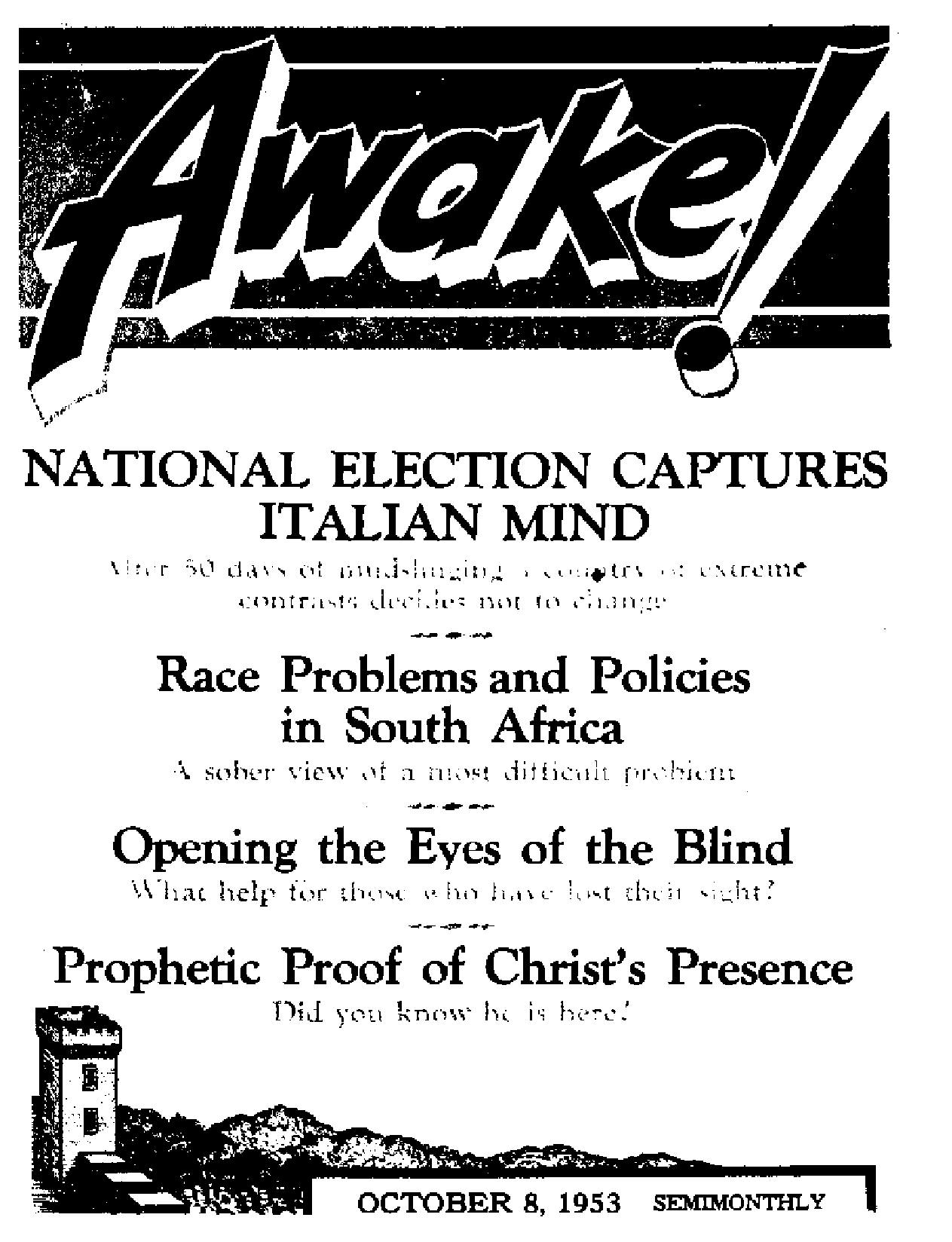
NATIONAL ELECTION CAPTURES ITALIAN MIND
\iHT C’l i; H : J" h U _■ LI! ' > vU!il)lr\ ■ • 1 UMrClTlC
<onfr;tsf'; JrrrJr- not ft' r’iun^1
Race Problems and Policies in South Africa
•\ sober- view of a ruoM diHiciih. piv-ht.-rii
Opening the Eyes of the Blind
'A hat help ter ih'ju e. hei hFo<_- thcji "ivht*
Prophetic Proof of Christ’s Presence
OCTOBER 8, 1953 semimonthly
THE MISSION OF THIS JOURNAL
New* sources that ere able to keep you awoke to the vital issues of our times must be unfettered by censorship and selfish interests. “Awake I” has no fetters. It recognizes facts, faces facts, is free to publish fiuj£& It is not bound by political amHtions or obligations; it is unhampered by advertisers whose toes must not be trodden on; it is unprejudiced by traditional creeds. This Journal keeps itself free that it may speak freely to you. But it does not abuse its freedom. It maintains integrity to truth.
“Awake [" uses the regular news channels, but is not dependent on them. Its own correspondents are on all continents, in scores of nations. From the four corners of the earth their uncensored, on-the-scenes reports come to you through these columns. This Journal’s viewpoint is not narrow, but Is international. If is read in many nations, in many languages, by persons of all ages. Through its pages many fields cf knowledge pass in review—government, commerce, religion, history, geography, science, social conditions, natural wonders—why, its coverage is as broad as the earth and as high as the heavens,
**Awake I” pledges itself to righteous principles, to exposing hidden foes and subtle dangers, to championing freedom for all, to comforting mourners and strengthening those disheartened by the failures of a delinquent world, reflecting sure hope for the establishment of a right-ecus New World.
Get acquainted with “Awake!” Keep awake by reading “Awake!”
Published Semimonthly By WATCHTOWER BIBLE AND TRACT SOCIETY, INC.
117 Adams Street Brooklyn lt N. Y.t U. B. A.
N. H. Knobs, Frcfideni Grant Suiteh, Secretary
Printing this issue: 1,150,000
LuiiM>s Is which tth iftasnilM h piiblhhed: Stminionthly—Afrtkaanj, Ecjltah. Finnish. French, Ctrmm, Holltmdlsli, NorwEglm, Spanish, Swedish. Monthly—Oinluh, Greek, rortufueeo, Ukrainian.
flfilcej Yearly Hutucriptlm Rate
America, U.S., 117 Adana St , Brooklyn 1, NA. fl Australia, 11 Beresford Rd,, Strethfield, N.S.W, 8s Canada, 4fl Irwin Are., Toronto 5, Ontario JI England, 34 Craven Terrace. London, W. 2 7s South Africa, Private Bag, P.O. Elandafctitein,
TraDsraa) 7»
UntiHd as Bewnd-dass matter at Brooklyn, N. T.
Five cents a copy frtmlttanMt should be lent to office In ynw country In contpUancs with rtgulat) qui to EU^rintee safe delivery of utoney. Remittances are accepted at Brooklyn from conn tries where no office Is Ines ted, by International money order only. Subscription ratee in different countrie* are hen staled in local currency. Notice of expiration (with renewal blank) Is sent at least two issues before rabscriptim expires. Changs of addrert when sent to our office may be expected effective within one month, senti your old as well ai new address.
Act fff Maith 3, 18TP. printed In IL S. A
CONTENTS
Awake! Is Thirty-four
Race Problems and Policies in South Africa 5
Riot, Arson and Murder
National Election Captures Italian Mind 9
The Campaign
The Results
Famous Kruger Park
Behind the Mardi Gras
Its Religious Background
The Villainous Vikings
Hawaii's Showiest Flower
Opening the Eyes of the Blind
Causes and Cures for Blindness
"Good" Vice versus Bad
"Your Word Is Truth"
Prophetic Proof of Christ’s Presence 25
Jehovah’s Witnesses Preach
in All the Earth—Switzerland
Do You Know?
Watching the World
Srooktjn, H. Y,, October 8, 1*03
Niimbtr 1B
"AWAKE!” Is Thirty-four
7TSDOM of the right order is es-
W sentlal to the welfare and happiness of mankind.11 Thus, on October 1, 19]9, began the first article in the first-issue of The Golden Age, the forerunner of this magazine. Thirty-four years later, and with approximately H70 issues, Awake’ holds as firmly as ever to its duty of providing that wisdom. The Golden Age and its two successors, Oonftolatum and Awake! have been blessed with an excellent opportunity to provide it, for they have had no commercial interests at heart, no political ambitions or obligations, have been bound by no fetters, have remained free to publish facts, have remained unhampered by the whims of advertisers and have been unprejudiced by traditional creeds or national rivalries. Yet, though being able to speak freely, they liave not abused that freedom, but have held firmly to the truth.
An announcement that preceded the first issue of The Golden Age said: "Many wonderful events are transpiring today, all of which have a Scriptural meaning. The magazine will carry these current events, together with the Scriptural explanation of the same, . , . The purpose of the magazine la to make announcement to the world that the Golden Age is at hand and the hope is by this means to bind up the broken hearted and to comfort those that mourn and turn the minds of the people to the Lord?’ It gave consolation to its readers and awakened them to the seriousness of our times and to the necessity of doing something about them.
Il maintained a firm hold on its mission, and was enthusiastically received. By the time the second Issue was off the press about 20,000 subscribers were already on the list Ihiblished every other Wednesday, It contrasted the present age with the conditions that will prevail under God’s kingdom. Bihip lectures were published;'Bible questions were answered, The growth and thoroughness of the Christian activity of Jehovah’s witnesses were shown.
On September 29, 1920, a special issue (No. 27) was published to the extent of four million copies, to expose the fantastic persecution of true Christians, even in the United States, during 1917-19. It named the overt acts committed, gave proof of them, and even showed who among the clei-gy were involved. The account of radio censorship in the United States was given; religious myths were exposed. For eighteen years The Golden Age did its job, and did it well.
Then, October 6, 1937, a new magazine, Cowjsoitrtio?^ replaced it. With the change in title came a change in format. Its page size was reduced and made more convenient. A colored cover was introduced for the first time, and Improvements In typography increased its eye-appeal. It championed the rights of Christiana when-
ever these were trampled on by anyone— the public press, religious leaders, the political or commercial interests. It reported outstanding legal battles that kept the door open for the preaching of “this good news of the kingdom” and that firmly established your religious freedom. It exposed the backers of the totalitarian powers; stood out boldly for the truth; publicized the stand of Jehovah’s witnesses, who refused to bow down to manmade images and refused regimentation that would take them away from their God-given assignment. Special articles in 1945 and 1946 heralded the victory and triumph of thousands of Jehovah’s witnesses over the German concentration camps.
Further, it published many articles of interest on education, science, travel and geography. Much pertinent Scriptural counsel was contained within its pages, and it served a very definite place in the lives of those who really wanted to know what was back of current distress.
Then, after nine years of faithful service, Consolation became Awake! Again, with the change the magazine took a major stride forward. In eighteen years (1919-1937) The Golden Age reached a total circulation of 46,000,000 copies. In just half that time (1937-1946) 57,500,000 copies of Consolation were distributed. But Awake! now has a circulation of 1,150,000 copies an issue, which, every twenty months, equals the total 18-year circulation of The Golden Age! America's largest Protestant magazine has a circulation just over 600,-000; the largest Catholic periodical, 768,-000. Awake! exceeds both. Certainly many are reading it, recognizing its value.
Why such circulation? AwakeTs first article, “Wake Up, World!” August 22, 1946, described the present twentieth century as a synthetic, atom-smashing, Jet-propelled, rad ar-controlled, electronic world headed for the ditch of destruction because of its failure to be awake to the real issues confronting mankind. This was not to be the type of magazine that would tell you everything is getting better and better. It is a magazine for people who think; for those who, while wanting interesting reading, also want facts instead of just entertainment. As its predecessors were, it is published by Jehovah's witnesses, but it certainly is not read by just them, for its circulation is more than double the number of Jehovah’s witnesses there are in the world!
If you want a magazine, that tells the truth about a situation, no matter whose toes are stepped on, Awake! offers its services. Not everyone is pleased by its facts, for it lets the chips fall where they may, in religion as well as in politics. It might at times strike one of your pet ideas. But, if so, its purpose is not to antagonize you, but to stir you to very pointed and careful thought on the matter. If you prefer the truth to sugar-coating, if you are willing to accept firmly corroborated and thoroughly documented facts, then continue reading Awake!
Awake! is not concerned with pleasing everyone. It puts reliability ahead of popularity. It prints the truth to aid, not to offend or anger, and for this reason its circulation is expanding by leaps and bounds, for it provides to those who wish to be awakened the service of being alerted to the seriousness of our times. Are you one of such? Then Awake! will be pleased to continue serving you as it and its predecessors have served, throughout the past 34 years, hundreds of thousands, yes, millions who are of like mind.
Pay constant attention to yourself and to your teaching. Stay by these things, for by doing this you will save both yourself and those who listen to you.
—1 Timothy 4:16, New World Trans.
problems and po/; .
SOUTH AFRICA
A moltttacial society gropea after a formula for racial peace
By *'AwnV*r’ copras pendant In Spvlh Africa AT THE conclusion of the second world war, the Union of South Africa, accustomed to the semiobscurity accorded to countries small in the counsels of the nations, was bewildered and embarrassed to find herself a center of world interest and debate. The nations cast critical eyes upon her racial policies and at every session of the United Nations organization uttered sententious phrases of condemnation and advice. In the 60-nation Special Political committee in November, 1952, South Africa was specifically accused of "threatening the peace of the world by persisting with its policies of political, social and economic discrimination between black and white."
Much of the criticism leveled at South Africa was well founded. Much of it, the bitterest, betrayed a lack of an elementary understanding of the South African scene. The popular picture of white South Africans as ruthless oppressors and exploiters of their nonwhite fellows is mostly mythical. The plain truth is that white South Africans have on their hands the most complex racial problem in the world, for which there is no easy or obvious solution.
South Africa is a land of sunshine and genial climat^, erratic rainfall and poor soil, a land of wide open spaces, and a few bustling cities whose prosperity is intimately linked with the fantastic gold mines of the Witwatersrand. Excluding the disputed territory of South-West Africa, its area is 472,550 square miles—-more than five times the total area of Great Britain.
In this expanse live 12,600,000 people, of every shade of color from white to black, speaking a dozen different languages and in stages of development varying from the most advanced culture of the West to near barbarism. The essential problem of South Africa is to reconcile these differences In a single nation.
White South Africans number 2,640,000. Of these a slight preponderance apeak Afrikaans, a language essentially South African, developed from Dutch. Most of the rest have English as their home language. Closest to these “Europeans’* on the color wheel ore the “Coloureds," South Africans of mixed ancestry, with an infusion of white hiQtx!, who number nearly 1,000,000. Next come the 323,000 Indians, and the last and largest group are the native Africans, the Bantu, who number 8,500,000. The white man rules. The nonwhites have almost no legal power to sway the acts of government.
The indignation, not always righteous or disinterested, of the outride world, and the conscience of white South Africa itself, made more uneasy by the rising tide of complaint from its non white subjects, have made dubious the ethical rightness of such an order, which for 300 years has had the force of a religious dogma in South Africa. White South Africans are almost unanimous that such an order cannot much longer be maintained. What order can replace it without destroying white civilization in southern Africa is the present bone of bitter contention in South African politics.
OCTOBER a, 1SSS
FAe Bantu
South Africa Indian problem, by virtue of its superior articulateness and the support of mother India, has tended to receive disproportionate attention whenever South Africa’s racial policies are denounced in holy anger. The Indian problem is indeed an ugly sore crying to be healed. But South Africa’s basic color problem is not what to do with her 323,000 Indians, nor how to satisfy the just aspirations of her one million semiwhites, but what to do with the Si million Bantu within her borders. South Africa’s whole color policy is conditioned by this fact and this fear: 80 per cent of her population is black; if the color bar is breached, what new dike can stop a black flood from overflowing and destroying the civilization with which white men have displaced the wilderness?
The Bantu are not Negroes, although an infusion of Negro blood in the remote past has given them many typically Negro characteristics—flat noses, thick lips and short, curly, peppercorn hair. As far as historians have been able to* determine, their original home was somewhere near the equatorial highlands of East Africa. Some hundreds of years ago they began a leisurely migration southward, moved by pressure of population, tribal wars and the depredations of Arab slave raiders. Their arrival and settlement in the northern and eastern parts of what is now South Africa coincided closely with the white man’s arrival in the southwestern comer of that land. Dutchmen and Bantu were in South Africa together for nearly a hundred years before their vanguards, moving in opposite directions, made contact. Rivals for the same prize, representatives of societies at opposite ends of the cultural scale, their meeting led inevitably to war. For one hundred years white men and black men fought each other sporadically, until the subjugation of the black man was complete.
The beginning of the period of subjugation saw the Bantu scattered thinly over a great area comprising the best grasslands of South Africa. The end of the period saw him compressed into reserves a fraction of the size of his previous spacious habitat. And here a seal was set upon South African Native policy. From henceforth the Bantu was to be regarded as an inhabitant of the reserves. There he could live in a foreshortened tribal society, with the white man exercising paternal oversight. Outside the reserves and particularly in the white man’s cities he would be a stranger without rights. He might enter those cities temporarily to minister to the white man’s needs, but his residence would be a tolerated one, to which could be attached no privileges of citizenship. To this day this principle remains the essence of South African Native policy and legislation. The breakdown of that principle has left South Africa floundering in a sea of uncertainty, anxiety and conflicting counsel.
Two factors contributed to the breakdown: the steady, inexorable increase in Bantu numbers, and the white man’s insatiable need for black labor for his mines and industries. Unlike the Australian aborigines and the North American Indian, the Bantu has not followed what an Australian governor called the *’natural progress of the aboriginal race toward extinction.” Pressure of population in the reserves soon became evident. At the same time a vacuum was formed in the European areas. The discovery of diamonds and then of gold brought to South Africa capital, industrialization and the need for labor. The nature of the diamond and gold mines necessitated that much of that labor should be cheap. The abundant cheap labor pressing at the bounds of the reserves flowed in to fill the vacuum. Today 3,000,000 Africans live in tribal reserves. Nearly twice that number live in European areas. South Africa re-
ceived an immigration from within, and her immigrants were black. The preaait crisis is provoked by a demand on the one hand and a refusal on the other to recognize that that immigration has taken place and that it is permanent.
Policies and Problems
White South Africans are fundamentally divided on the Issue. The Nationalist party, presently in power, recognizes that the immigration has taken place, but refuses to accept Its permanence. Its apartheid program demands that the immigrants be sent back the way they come. It contends that the mingling of white and black in one social, economic and political system is good for neither white nor black. Its declared aim Is the construction of two separate societies in South Africa, one white and one black, each developing along Its own lines and according to its own ability. Its plan is basically the restoration and extension of the principle that the home of the Bantu is in the reserves, and that in the European areas he has neither rights nor claims nor permanent dwelling.
As a plan for racial peace and security apartheid has much emotional appeal among white South Africans. Opponents of the plan declare it to be based upon wishful thinking and impossible of execution. The United party, chief of the opposition, proposes as an alternative to apartheid a policy of qualified integration, the recognition that economic integration of black and white has taken place, that in the economic system of the Union black and white a» permanent urban dwellers are essential to each other. The qualification is that social integration shall not take place. White racial integrity is to be aafe-guarded by the continuance and extension of the principles of local residential and social segregation, which have always been a feature of South African urban life, Na*
tianahsts declare emphatically tnsrc oidh safeguards are not enough, that In such a society political rights and privileges must eventually be granted to black men, to the ultimate extinction of white leadership and rulcrshlp In Africa.
Upon the question of granting political rights to black men both plans arc discreetly vague. In effect both plans embody the conception of the white man, acting under different circumstances, as an enlightened trustee for his black wards. But both plans continually beg the question as to what is to happen when the wards come of age. Many of those wards are of age right now and are demanding recognition of their Intellectual adulthood.
Much wrong thinking is occasioned by envisaging the Bantu as a homogeneous whole. In South Africa the Bantu are divided linguistically into four major groups, the Ngoni, the Sutho, the Vcnda and the Tonga. Each group constitutes a separate nation whose language is completely foreign to the other three. Each group is again divided Into many tribes, speaking different dialects and traditionally antagonistic to one another.
In the reserves the Bantu is little removed from his ancient tribalism. In the urban areas he is found in intellectual conditions of great variety. Many are scarcely superior to their tribal cousins. Most of them still have their thought processes rooted in the sanctions, superstitions and traditions of the tribe. But an increasing upper layer is working steadily toward intellectual equality with the white man. And the intellectual attainments of some few proclaim their attainment of such equality. In this confusion and complexity the white man clings to the color bar as a weapon of self-preservation. It is less than fair to say he does so ruthlessly. The plain truth is he does not know what else to do.
The color bar operates in three ways;
socially, politically and economically. The Coloureds and Indians find all three operations galling and intolerable. But aside from the upper strata of African intellectuals, the Bantu masses know little and care less concerning social and political color bars. It is the economic color bar that presses most upon them and galls them to resentment. The strictures of the economic color bar, with just one exception, are unwritten. Their force stems from traditional European color attitudes. European trade unions are the main vehicle for their application. Their effect is to prevent the African from obtaining skills and to confine him to low-pay unskilled labor. Their basis is the European's fear of economic competition from cheap, “uncivilized” labor.
The most violent Bantu resentment, however, is reserved for the group of regulations known as the “Pass Laws.” The most sober and moderate European opinion declares these regulations to be based in necessity. It is contended that abolition of the Pass Laws would react unfavorably to the Africans themselves. But the black man loathes the multiplicity of documents that he must carry on his person and that a police officer may demand to see at any time. The African passive resistance movement of 1952 was directed primarily against the Pass Laws.
Riot, Arson and Murder
Those who know the Bantu predicted1 that the passive resistance movement would result eventually in violence. In October-November, in the cities of Port Elizabeth, East London and Kimberley, Africans erupted suddenly in violence and sickening, primitive savagery. The riots were plainly antiwhite, and followed the same pattern at each place. Public buildings built by white enterprise m Native areas, even though those buildings were for Bantu pleasure or education, were burned.
The riots came at a time when South African Native policy was at the crossroads. South Africa faced a general election early in 1953 and the main election issue was the color policy. (See October 22 Awake! for a report on the election.) Liberals declare that the riots had their roots in repressive legislation, bad housing and the government’s declared determination to implement its apartheid policy. The government replies pointedly that all three centers in which the riots exploded are strongholds of liberal opinion and action. Port Elizabeth particularly is noted for its liberal local Native policy. Within its boundaries the Bantu are subjected to a minimum of restriction and control, and its New Brighton Township, scene of the riots, is declared to be the most modern, progressive and attractive Native housing scheme in southern Africa. These facts have strengthened the government in its denunciation of liberalism as a policy unfit for application in South Africa. Its declared intention is to arm itself at the next session of Parliament with increased powers to act against agitators and “resisters.” Passive resisters declare their determination to carry on their campaign, and they are now being joined actively by European sympathizers.
Amid the babble of conflicting counsel, charge and countercharge, many South African religious leaders are contending insistently that the basic need is to Christianize the Native. This, of course, is true. It is equally true that the white man himself stands in need of being Christianized. The handful of Christians in South Africa, of all colors, rejoice to know that Christ the King will himself shortly remove the affairs of South Africa, and of the entire earth, from the hands of foolish, fearful, selfish men and will fill the earth with the fruit of righteousness, which is peace.
NATIONAL ELECTION CAPTURES ITALIAN MIND
By carmponifant tn Italy
FOR the second time since the death of fascism, Italy took itself to the polls to express its views on self-government It had experienced the liberty uf a free election in 1948 and was eager to make its wishes known once more last June 7 and 8,
In 1948 the elections themselves showed much insight into the Italian political trend of thought. Among the multitude of political parties born and reborn following the waronly two seemed strong: the DemoChristians and the Communist party. The Christian Democrats put the Italian voters on the horns of a dilemma; “Italy will be Domo-Christlan or it will be Communist J* It began to Intimidate the other parties with the prospect of their dissolution, In case of absolute victory of the Communists. The tactics worked well, and the Christian democrats with De Gospcrl won.
What have been the results? Has the existing government been able to solve its problems? Ugo Ln Malta, affiliated with the Italian Republican party, in his article entitled “ Touch-and-Go in Italy/’ which appeared in the January issue of Forewn Affaira, an American quarterly review, summed up the situation quite well:
“Italy's fundamental problem is still what it was at the time of national unification—a problem of glaring contrasts. The manifestations of a long-standing culture stand beside the evidences of long-standing poverty. Qn the one hand are such progressive provinces as Piedmont and Lombardy: on the other, the island of Sardinia. ... The north is now heavily industrialized.
There are efficient mechanized farms, railways, and shipping lines with international ramifications, enterprising businessmen, workers with high technical training—and also with a heritage of acute class consciousness. The south has a backward agricultural economy, communications are larking, towns and villages are Isolated; there are masses of unskilled laborers and listless upper and middle classes whose members rely on government subsidies and government jobs. Vast inequalities of income make for the existence of two very different Itaiys, both In one political body.
“In southern Italy in 1950 the average individual income was no more than $115 a year. There were 7 automobiles and 35 radios to every 1,000 inhabitants and a correspondingly low consumption of food and expenditures for clothing and for fertilizer to grow food. In the north there were 131.4 industrial workers to every 1,000 inhabitants in 1938 and 133.4 in 1951, while in the south the number went down from 46 per 1,000 to 40, thereby worsening a situation that was already bad enough. As a result, 17,000,000 south Italians do not constitute a domestic market that anywhere nearly corresponds to their number. Their extreme poverty and lack of skill at any particular trade means widespread unemployment and the multiplication of petty middlemen whose profits prevent any increase of consumption/’
It cafinot be denied that great steps have been made by the Demo-Christians in rehabilitating the country. On every hand, especially in the north, are to be seen new
factories and hundreds of new apartment houses. The ravages and scars of war are almost removed and forgotten as these new structures rise out of the destruction. The big complaint, however, especially in the south, is that the vast majority of the people, even though they may be employed, cannot afford to rent or buy these new dwelling places. This seems evident when one recalls that the average individual income is only $115 per year. One has but to look at the hundreds of families in the big cities of the south living in one room, and not too large at that, for a family of from five to ten or more children. With such conditions still widespread there was fertile soil for the seeds of communism to take root, and this they had not neglected to do.
The Campaign
Naturally, these conditions set the stage for the some fifty days of political mudslinging that seems to be common to all political elections. The Italian takes his politics very seriously. He may not have all the facilities of the American to promote his political views, such as the latest innovation—television—but what he lacks in this he makes up for in zeal and fervor in his own methods of campaigning. Italy is ideally suited for the barnstorming political campaign with its hundreds of huge piazze, or squares, that can accommodate upward of 100,000 people, it is claimed. During the nearly two months of the election battle these squares could be seen sometimes filled to capacity, sometimes with only a handful of stragglers, depending on the considered importance of the speaker, listening to the renewed promises of the Demo-Christians to continue the progress they claimed to have made; or listening to the Communists denouncing the DemoChristians for the legge truffa, or trick law.
This was the law that granted a premium of extra seats to the party or coali-
tian that won 50.01 per cent of the total votes in the popular elections. It was the
passage of this law through the Senate In March that had given occasion to certain unruly members to incite a riot an the Senate floor. Bitter words were hurled, names were called, but more substantial things like chair cushions and bundles of papers were thrown at President of the Senate Ruini for his responsibility in permitting the passage of this law. One journalist expressed his opinion that perhaps the record of the parliament of possibly no other country had ever reported a more violent or passionate sitting than this one. According to the Christian Democrats this law was solely to make possible a strong majority in order to form a stable government, otherwise there might be three equally strong powers with no one able to form a government. According to the other parties of the opposition it was a trick on the part of the Demo-Christians to maintain themselves in power.
Not to be overlooked in all the advertising and campaigning was the liberal use of billboards and posters. No building of any size or description was safe from being thoroughly plastered with every conceivable type of poster illustrating or condemning one or the other of the many sides of this electoral battle.
As the final week approached and the heat of battle was getting stifling, greater evidence of religious pressure brought to bear on the voters was seen as every day new supplies of handbills and leaflets appeared on the streets advising Catholics like this: “Who votes for the parties of the left contributes to the preparation of days of grief for the Church and for the Fatherland.” “Who votes for the parties of the right or for other opposition lists favors indirectly the victory of the parties of the left.” The speeches and debates finally reached their climax on Friday, June 5,
when De Gasped and Togliatti, the Communist choice, gave their concluding exhortations at Rome,
At last the greatest political campaign in Italy’s modem history had drawn to a close. The voters must have time to catch th^r breath and consider at leisure once ana for all the final Issues involved. Did they want to go along with the Christian Democrats and give them a further chance to put their policies and program into practice? Had communism grown to the extent that it could carry a great enough strength of voters to control the government and put its promised “equality of the workers" into effect? Where did the monarchists and the Neo-fascists stand in the minds of the Italian electors? Saturday was a day void of campaigning; the voter had to have a day of quiet in which to make up his mind, becati.se tomorrow he must vote. It was the law!
The Results
Sunday, June 7, the rtg hay, dawned with torrential rainstorms throughout most of Italy; but this did not serve to dampen the political spirits of the Italians. They went to the polls almost thirty million strung with an outcome Ui at is now a matter of history. The De mo-Christians failed in their efforts to win 50.01 per cent of the total popular votes, with the result that they did not gain their desired premium of extra seats with their coalition of the other center parties. The final tabulation showed a majority for the center parties’ coalition of 303 seals out of 590 total in the Chamber of Deputies, giving the opposition parties 287 scats; while in the Senate the Deino-Christjans won 125 seats out of a possible 237, of course together with their allies. This gave the opposition 112 seats in the Senate.
From these results it is evident that a form of democracy will continue for a while in Italy, as the peopte have expressed their desire to have it so. But it must he realized that various opposing factions have gained In power. No, Italy did not go Communist nor fascist again, nor even monarchist not even with the groundgaining accomplishments of these movements. More than ever can be expected the bickering and quarreling that has taken place before in parliament as each party continues to seek Its own interests.
1 Inwever, granted that a democratic form of government, generally speaking, has managed to hold a slippery grip on the reins, will this type of government ever be able to stamp out once and for all the misery that yet exists in many of the big cities of southern Italy? Will It be able to bring to an end the countless crimes and the delinquency that, still exist in every part of the country? Will It be able to empty the hospitals and sanitariums of' their suffering sick and crippled? Will It restore the hopelessly poverty-stricken to the point of being able to hold their heads up and not have to beg their neighbors for a crust of bread? Will it or any other human government be able to bring the Italian people to the state where each one wants to treat his neighbor as he would be treated?
Thousands of sincere, honest Italians are coming to the conclusion that neither the Christian Democrats, nor the monarchists, nor the Communists, nor any of the other political movements of any nation of the world can bring about the desired adjustment of these conditions. Only the power of the Almighty God can and will rectify the counties injustices that still exist in Italy. Only his power can bring to an end the heated words and blow's of the political battle. Only under the perfect theocratic government of God will man be able to find the answers to his perplexing problems.
cellent meals if one is not up to barbe-cuing his own.
One soon catches onto the traditional schedule of rising at 4 a.m. to get out on the road as soon as possible. From then
WE ENTERED the gates of Kruger National Game Reserve late in the afternoon. Upon driving the five miles to the rest camp called Pretoriuskop, where we were to stay the three nights, we came in contact with our first truly wild life.
nailing stripes glared at us through the tallish grass as zebra by the dozens merged and emerged in and out of the herd. Just as plentiful were the darker, more stalky looking wildebeest, also of the horse family. We became acquainted with the beautiful little impala, a reddish-toned cousin of the deer,
It was hilly country and the vegetation was plentiful, though not tropical. It is in the subtropical zone and there is a variety of types of trees with little underbrush in most places, though tall grass is in abundance—a natural protection for most of its inhabitants. In the distance we could see the cluster of rondawels, the round, brick homes with genuine thatched roofs, patterned after the native hut, that are the homes of rich and poor alike while guests at Kruger National Park. They are extremely accommodating in the hot weather, as the high, thatched roofs have a cooling effect. They are placed mostly in a circular arrangement, with a huge outdoor brick fireplace in the center, and which fireplace is constantly at your disposal. It is kept in condition by a group of very gentlemanly native boys, mostly of the Mashangana tribe. There are public washrooms, showers, a well-equipped store and a separate “Tea Room,” which serves extill about 6 or 7 all the animals are on the hunt for breakfast, or should I say the daily meal. When breakfast is over you see them relaxing in the grass near the roadside till about 8, when the heat of the subtropics drives them into seclusion. One might as well siesta until 4 p.m., when it begins to cool and they show themselves again. But back to stalking the prey.
You might be driving behind three or four leopards that find the dirt road an easy place to walk, until they catch a scent. They lope along with a slow, easy gait, their long tails swinging nonchalantly, looking back at you occasionally as if to say: "If you don’t like it, you can take another road.” Suddenly they become restless and alert and one by one head slowly off the road and disappear. At this point I received a not very friendly row of white teeth as I snapped a picture of one spotty when we drew up side by side with him.
Having lost the leopards you begin scanning the trees and grass to see what else you can locate in famous Kruger Park’s zoo-land. A couple of hyenas slink across the road, then herds of impala gracefully span the road with one leap, and with the little baby “Walt Disney” impalas following so nervously, Steenbok, wildebeest, waterbok, and more impala. Suddenly one comes across a group of tawny bodies in relaxation, with Leo himself watching over his wives and little ones, his huge, shaggy mane a threat to any intruder in this lions’ den. At one point one of the she-lions rolled
gracefully over on her hack, stretching out her paws and exposing her tummy as if to say, "Come on over and tickle my ribs?*
These animals arc at home here, the boundaries of the park mark their property f and they view with absolute apathy these "iron Intruders." Perhaps the odor of oil and gasoline blots out any trace of human blood, but they seem to have no fear of tfce iron Intruder, which seems also to mind its own business.
One of the “musts" one must see while in Kruger Park is the elephant. He, in the true sense of the word, Is the king of the beaste, and the must dangerous and feared of jungleland, rivaled only perhaps by the rhinoceros. At the best of times he plays around by uprooting trees of a fair size, but when he is angered, anything in his way has to give way to his vengeance. If there k a iierd of angry elephants, even a motor car would soon be pulverized under the tread of about a 16-inch “paw." Hence the solemn warning "Beware of the elephant,1' as you enter his domain. One does not have to travel very far before realizing that this is Mr. Elephant’s playground. The ground is covered with whole dead trees, while major paijjs of other trees hang down lifeless. For miles one sees this silent testimony that this is private property.
We looked long and in vain for the culprit, though, and stalked him as diligently as Leo stalks his prey, all to no avail. Big as he is, he has a way of blending into the trunks of large trees as a camouflage. Not that the animals here choose to remain hidden from our view, because they simply do not seem to care whether you are looking at them or not and would generally not bother with you unless extremely hungry or angered. And the chances of their being extremely hungry are slim, there being plenty nf their type of food in this 900-square-mile park.
While searching for the elephant, my eyes came across a terribly tall, rather spotted-looking type of tree, which, upon closer scrutiny, proved to be a giraffe. Mr. Giraffe is only 18 feet tall, if you please. Why, there are some types of trees here that he cannot quite look over! His mate reaches a more humble 15 feet, while baby has to diet on the more lowly shrub. The giraffe has not much natural defense other than his height (which is not to be over-looked, however), except a terrifle kick in his hind legs, which even Mr. Lion steers clear of. We watched him nibble at the top leaves of all the trees. He was quite oblivious to our presence, though his mate quietly kept her eye on us the whole time,
Tlien our attention was drawn away by a troop of monkeys, the largest of which come right up to the car with both hands begging for food. Baby hung onto mommy’s tummy as she scampered along, or sometimes scurried around to her back. In either position she seemed at home.
After a visit to the home of our thick-skinned friend, the hippopotamus, you arc ready to barbecue your supper, then dive into your little rondawel till 4 a.m. rolls around again. A couple of days in this glorious land where nature can display with pride her dustless, shabby-less, sleek-bodied creatures makes one realize that we are the ones behind bars, we are the ones in the zoo.
Behind the
A pagan celebration popularised by Christendom
By “Awok»!'’ corrttpord-ent in Germany and Haiti
HE Mardi Gras is a religious carnival shrouded in pagan antiquity. Its king is the king of all carnival kings—Rex, Lord of Misrule. And its god, Comus, is depicted in late Greek and Roman mythology as the god of festive joy and mirth. The time for this celebration in cities or countries primarily under Roman Catholic dominance is just before “Ash Wednesday,” which is the beginning of the Roman Catholic forty-day Lenten season. Originally the season celebration began with New Year’s Day and terminated with parades, pageantry and a ball on “Shrove Tuesday,” which is “called in French Mardi gras, ‘Fat Tuesday/ in allusion to the fat ox which is ceremoniously paraded through the streets," and which is still observed in Haiti and some South American countries. However, today the festivities generally last only three days. In Spain the carnival lasts four days, including “Ash Wednesday.” In Russia the gaieties last a whole week, from Sunday to Sunday. In Germany it is only a three-day occasion, known as Fastendien-stag or “Der Karneval”
Along the Rhine River section of Germany last year more than three million persons crowded the streets to take part in the feasting and merrymaking. Protestants and Catholics alike joined in the frivolity and revelry. German austerity gave way to boisterous laughter, music and dancing. The atmosphere seemed almost magnetic in the way it attracted and affected the crowds. On occasions the mass of humanity would form a human pathway through which the magnificent floats were drawn. These floats depicted everything from scenes of legend and mythology to presentday political struggles and social needs.
People sang, “Heute blau, Morgen blau, Ubermorgen wieder” (“Drunk today, drunk tomorrow and day after tomorrow drunk again”). Arm in arm they swayed back and forth in time to the music of "Wir kommen aUe> alle in den Himmel” (“We’re all going to go to heaven”). Another popular song was, "Wer soil das bezahlen, wer hat das bestelltf" (“Who’s going to pay for it; who ordered it?”) The Wiesbadener Jfu-rier, February 17, 1953, stated: “Wine flowed in streams down the thirsty throats, an immense tidal wave of alcohol, taking captive and leaving individuals in distressful states.”
Despite their predicament the crowds managed to stand on their feet and dance to everything, from the music of the Blue Danube down to the latest on the American hit parade. Songsters and songstresses would give out with “Botch-a-me,” or tell the reveling world about the “Chattanooga Shoeshine Boy.”
Mardi Gras in Haiti
Across the Atlantic Ocean on the tropical island of Haiti, we find natives and tourists performing almost identically the same festive occasion. Last year the Mardi Gras began when the monstrous siren at Port-au-Prince sounded off. Everyone, from the unassuming peanut vender to the dignified political statesman, laid down his work and pressed his way through the crowded streets toward Champ de Mars, official rally ground for Haiti's national festival. The conventional form of life became completely paralyzed, business operations froze, public offices closed down, educational machinery recessed, Protestant and Catholic Churches postponed their services or had them on a preceding day, countryfolk forsook their banana and rice plantations—almost everyone was out to celebrate the Mardi Gras!
Groups of varied sizes formed. Some were composed of forty members, others ranged up to several hundred in number. These groups swept through the streets to the rhythm of jazz that filled the air. Groups of masqueraders carried flags or ensigns upon which were inscribed the name of a patron saint, such as “St. Jacques,” or a god or goddess designating their respective bands. Everywhere one turned he was confronted with the same eerie jazz, the laughter of crowds, the singing and swaying of a frenzied mob. Its effect was so overpowering that even spectators appeared hypnotized by it and slid into its magnetic rhythm.
Certain groups danced in scanty attire, their bodies wriggling and twisting to a suggestive jazz tune. This tantaiization spread like wildfire and affected other groups, who, whipped up by the Mardi Gras spirit, could no longer conceal their impulses. This suggestive gyrating in scanty costumes was doubtless what some of Haiti's newspapers referred to and denounced as an “indecent and vulgar carnival, ” and called for “good, clean frolic.” Whipped into a frenzy the carnival mixed blood and murder with sex. Groups clashed. Fists and knives drew blood. On February 18, the NouveUiste stated that “two groups went into it with such ferocity that police had a difficult time in restoring
order.” The same paper reported that twenty were victims of knife slashes and were sent to the general hospital for treatment, where one died shortly thereafter.
After seventy-two hours of “misrule,” King Rex, Lord of Misrule, called upon Comus, the pagan, god of drunkenness and debauchery, and the Mardi Gras, like a monstrous cyclone that has run its course, came to an end. The king ordered the court to partly disrobe and hurl their carnival apparel into the flames before him. With that command the final act of the Mardi Gras took place. Groups danced round the fire, and as they danced, gesticulating toward the fire as though the carnival were a repulsive thing, they tossed their masks and Mardi Gras apparel into the flames. The flames, like the celebration, roared loudly with destructive fury and# like the celebration, vanished into oblivion, at least for another season. The death of the last live coal symbolized the death of the carnival or Mardi Gras.
Hs Religious Background
But as a casual observer one might be prone to ask: Wherein lies the religious significance of this holiday or festival? Since it is celebrated throughout Christendom, does it have its origin with Christ, or his apostles, or his disciples? Does the Bible sanction the celebration of the Mardi Gras? Discussing the origin of the carnival or Mardi Gras, the Deutscher Kurier for February 14, 1953, stated: “In the most ancient times it was the custom of some folk at the end of winter to celebrate a festival of unrestrained gaiety.... A magnificently equipped festival-ship on wheels was pulled through the holy street [today floats are used] to the temple of the god Marduk. The ship-on-wheels can be called the symbol of this festival, which meant to greet spring which was drawing near. At all times and with all folk we find them celebrating the gay festival at the end of winter. In ancient Egypt it was held in the honor of the goddess Isis, in Greece it appears at the festival of drunken Dionysos, it emerges in the wantonness of the Roman Saturnalia and returns in the festivals of the Middle Ages throughout Europe. ... In the course of time, the Christian Church picked the heathen spring festival up and changed it to the beginning of the Easter season. So out of the Latin name ‘carrus naval is* came the word ‘carnival’ as a derivation of ‘came vale’ (fleshy live well) as a pun by the medieval monks referring to the ‘meatless’ Lenten season.”
Alexander Hislop’s The Two Bdbylons indicates that the pagan festival was held in honor of Osiris, through whom Semiramis derived all her glory and her claims to deification. The son, though represented as a child in his mother’s arms, was a person of great stature and immense bodily powers. Classical writers called him Bacchus, “the Lamented one.” In course of time he became represented under the symbol of a fat bull or ox. The custom of parading a fat bull through the streets or wearing masks depicting a bull with horns still prevails in the carnivals of Haiti and Bolivia.
The Encyclopaedia Britannica, Eleventh Edition, Volume V, also associates the carnival or the Mardi Gras with Bacchanalian revelry and the Roman Saturnalia. To quote: “The last three days preceding Lent, which in Roman Catholic countries are given up to feasting and merrymaking, . . . represents a compromise which the church always inclined to make with pagan festivals and that the carnival really represents the Roman Saturnalia. Rome has ever been the headquarters of carnival, and though some popes ... made efforts to stem the tide of Bacchanalian revelry, many of the popes were great patrons and promoters of carnival keeping.”
What could be more blasphemous than to take a pagan holiday with its wantonness, drunkenness and debauchery and charge it to Almighty God Jehovah? Yet Christendom does that very thing by her keeping of this pagan festival, calling it “Christian,” and the people who join in the frivolity of the occasion are “partners in crime.” Can you imagine Jesus, or his apostles, or disciples, or any of the early Christians (who did not even celebrate Easter or Lent) whirling through the streets of Jerusalem, wriggling their bodies in suggestive ways to the seductive rhythm of jazz? Can you picture the early Christians, with drooping lips and blurry eyes, singing, “Drunk today, drunk tomorrow and day after tomorrow drunk again”? And then having the audacity to sing, “We're all going to go to heaven”? Only a perverted and deluded imagination would allow for such thinking.
It is a big lie for Christendom’s religions to say that they can transmute pagan festivals to Christian use. The apostle Paul said: “Do not become unevenly yoked with unbelievers. For what partnership do righteousness and lawlessness have? Or what fellowship does light have with darkness? Further, what harmony is there between Christ and Belial? Or what portion does a faithful person have with an unbeliever? And what agreement does God’s temple have with idols? ... ‘Therefore get out from among them, and separate yourselves/ says Jehovah, ‘and quit touching the unclean thing/ ‘and I will take you in.’ ‘And I shall be a father to you, and you will be sons and daughters to me/ says Jehovah the Almighty.” (2 Corinthians 6:14-18, New World Trans.) The whole Mardi Gras or carnival celebration is steeped in paganism, and soon at Armageddon Jehovah God will treat it as the disgusting thing that it is. Christians now shun it.
By carmpvfldaHt tn dctiMfir
rpiTERE was a day when the people’s _L faces flushed with horror when someone cried, Vikings' immediately the word called to memory tall, ferocious-looking warriors with huge swords, spears and fearsome-shaped battle-axes and helmets with hoitis. These warriors were notorious along the European shores, especially in France, England and Ireland, during the period between the eighth and the tenth century.
The viking was a symbol of an intrepid seafaring num and a skillful sailor, a hardened and undaunted soldier. Vikings would come in great numbers in dragonheaded ships, sometimes several hundred ships at a time, and spread dread and terror among the inhabitants as they looted the land. People in fear prayed, “Save us from the savage Norm ansi”
What made these men from the North the battling savages that they were? Historians point to the fact that Scandinavia at that time was overcrowded to such an extent that these countries could not feed their populations. But even though Scandinavia was densely populated, this could hardly be the reason for their young sons’ risking their lives on the sea in pursuit of land and riches. The real cause came from the South where Charlemagne expanded his empire. The war-loving Saxons, who lived jufit south of the Danes' border, resisted Charlemagne’s fiubjugntlon, which resulted in revolution and war and finally the annihilation of Saxon nilerahip.
With these happenings south of her border, the Danes had reasons for becoming apprehensive. Not only did Charlemagne now present a threat to the North as a military force, but he also isolated them from the South from where all their goods, food and raw material came. The South was filled with mystery and intrigue. There were tales of riches, beauty and culture, The Danes were also in fear of losing their independence and manner of worship. So, cut off by land, the Danes sought the sea. Young men who sought adventure rallied around their chieftains. These directed the building of the monstrous floating battle wagons soon to ravage land and sea.
It was with one of these ships that the men from the North made their first appearance as vikings, when they slipped under the cover of darkness onto the tiny Island of Lindisfarne off the English north coast and massacred the monks and the nuns and looted the monastery. This is recorded to have taken place on June 8, 793.
Future raids were not short visits end hasty retreats OS the first one was, nor did they operate with a single ship, but whole fleets sometimes numbering a hundred or more ships moved into action- As they increased in strength, so also did they increase In their boldness, to the point of spending a whole winter in one place. At the conclusion of the viking era, their fleet of drips went out to conquer and subdue other countries and their Inhabitants. The Danish vikings conquered in
this way great parts of southern England and made them part of the Danish kingdom.
What They Worshiped
With the change in events came also a change in worship. Up until this time the vikings worshiped principally the elements of nature and the forces that governed the universe. In the imaginations of the people these forces took on various appearances as time went by and finally they were distinguished as separate gods with certain attributes and merits. Since these gods were the by-product of men’s imagination, they were restricted to the same limitations as man. By the time the vikings began to assert themselves the conceptions of the gods took on solid form, allowing for a constant development in ideas, which can be seen confirmed by the myths built up around the gods and their exploits.
For example: The Scandinavians believed the earth to be a flat circle of land carried by a huge sea. The creation of the world was due to the Asas or gods, Odin (Woden), Villi and Ve, who also created the first man and woman, Ask and Embla, and put them on earth. Beyond the sea lived the giants; they were the enemies of the gods and, therefore, also of man. The Asas or gods represented the good elements and the giants the evil elements. They were always fighting each other in deathly battles. Man had to be on good terms with the gods if he was to have success in life, so that is why he worshiped them. All circumstances in his life were ruled by the good and evil elements.
Odin was the most prominent of the gods. He was the god of the Teutons, Saxons and Thuringians. They called him Woden. The root of the name Woden is thought to be the Indo-European word vaf meaning “wind” or “to blow.” He may have been originally the wind god. Because of this, people worshiped him in groves, where the wind blowing in tops of trees was a visible expression of his presence. In gusts of wind it was imagined that Odin came to fetch the souls of the dead. He being god of the wind, it was not difficult for them to regard him as the god of spirit, mind, wit and cunning, and finally to be identified as the “master of life and death.”
No wonder the chieftains were ardent worshipers of Odin. They needed all the favorable wind, insight, cunning and courage they could muster to use in their battles and on their seagoing expeditions. The one who had the “Allfather,” Odin, as his = fulltr&i; that is, as his trust, would possess all these qualities. In order to obtain certain advantages and supernatural qualities the chieftain would devote the first prisoner taken in battle to Odin. It was the custom to hang the victim and pierce the body with a spear, as a spear was the symbol of Odin. To devote the entire battlefield to him was even better. All warriors who fell in battle became in that way the spoil of Odin and they were carried to Valhalla, which was a place reserved for men who fell in battle. Warriors who wanted to go straight down to the dark and doleful dungeon where the god-dess Hei reigned supreme and to have a light and airy hall in Valhalla would have to die honest and valiant in battle. There fighters were brought to life every day and engaged in great tournaments in front of Valhalla’s large square.
Odin would protect his favorites and deal out punishment to those who were slow to fulfill promises to him. The holy grove of Upsala, the largest in the North, contained the wooden image of Odin. Every ninth year the inhabitants would assemble in order to bring sacrifices. People came from far away bringing food and animals as offerings during the nine days the feast lasted. During that period they offered at least one sacrifice every day. It was not
infrequent to see a human creature offered to the gods. They hung them In the high trees of the grove or threw them In the pond while the chieftain^ who also acted as high priests, watched to see whether the victim would come up again to the surface or stay down as a sign of its accept' ance by the god and that the god would send them a good harvest the following year. As many as seventy-two bodies have been seen hanging in the grove of sacrifice at Upsala at one time!
The *V7orf” Thor
After Odin the god Thor was worshiped very widely. He was the patron deity of the common people. He was not a wise and cunning god, but what he lacked in wisdom he made up in strength. He was allpowerful. In addition he was Jovial and good-natured, and it gave him great pleasure to hunt down the giants, whom he caught and killed with his strange hammer that possessed the peculiar quality of always returning Lo him when he throw it after somebody. This hammer became the symbol of his strength and power. The Northerners thought ^that by carrying with them a small charm in the shape of the hammer of Thor he would keep their possessions free from attack.
Thor was also regarded as the god of the weather. It was believed that he always rode in a carriage drawn by two goats, and when it thundered and lightnings flashed, the Northerners used to sey that Thor was out driving and, he drove bo hard that the heavens roared and sparks flew. Thor was known to be a bundle of strength with a short temper. People ascribed to him fill the qualities they would like to possess themselves and made him their ideal god. The name of Thor Is still with us m one of the weekdays, that is, Thursday, the same as the god Odin or Woden is represented in our weekday Wednesday.
The chieftains we satisfied with wot-duping Odin. It w not neceffiary for them to implore other gods, afl Odin could give them everything they wanted. But for the oonnnm man it was a matter of course to worship several gods, for instance, Njord, the god of fruitfulness, or Freyr and Freya, the two children of Njord, who, like the father, were gods of fertility. Other gods worshiped in Scandinavia were Heimdal, Vidar, Hoeder and Uli. Mention must also be made of Balder. He is the last, being the youngest among the gods, and no doubt made hfs appearance under the influence of "Christianity" as it slowly worked Its way toward the northern countries.
…