Awake!, December 22, 1949
Download: PDF — Awake!, December 22, 1949
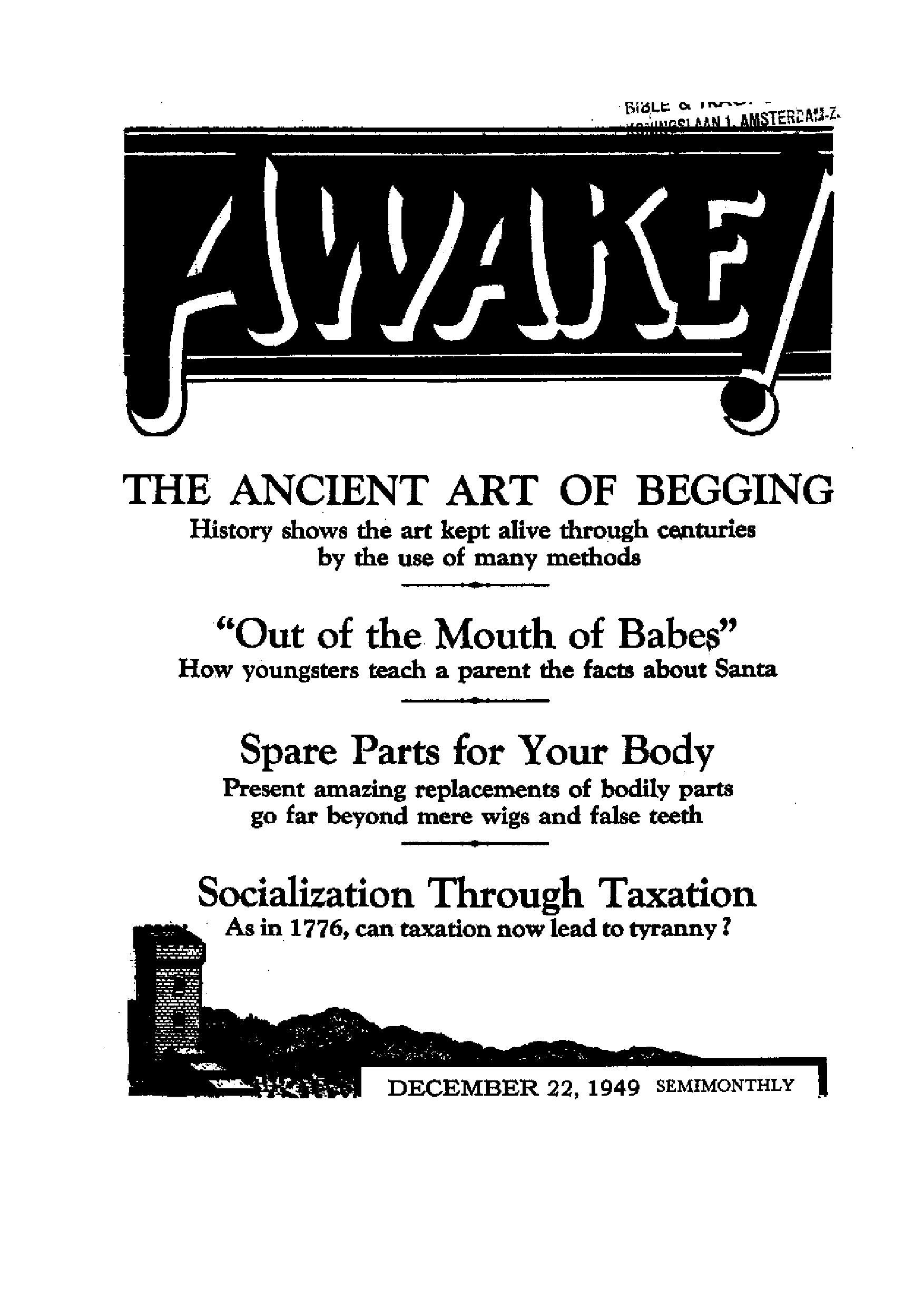
THE ANCIENT ART OF BEGGING
History shows the art kept alive through centuries by the use of many methods
“Out of the Mouth of Babes”
How youngsters teach a parent the facts about Santa
Spare Parts for Your Body
Present amazing replacements of bodily parts go far beyond mere wigs and false teeth
Socialization Through Taxation
As in 1776, can taxation now lead to tyranny ?
DECEMBER 22, 1949 semimonthly
THE MISSION OP THIS JOURNAL
Newt laurces that are able to keep you awake to the vital Issut* of our times mint be unfettered by censorship and seltuh interests. ‘'Awake!'’ has no fetters* It recognize* facts, faces facts, is free to publish facts. It is net bound by political ambitions or obligations; it Is . unhampered by advertisers whose toes must net be trodden on; it is unprejudiced by traditional creeds. This Journal keep* itself free that it may speak freely to you. But it dees not abuse it* freedom. It maintain* integrity to truth.
“Awake!” uses the regular news channels, but is not dependent on them. It* own correspondents are on oil continents, in scores of nation*. From the four corners of the earth their uncensored, on^the-scenes reports come tc you through these columns. This Journal’s viewpoint is not narrow, but is international. It is read In many nations, in many languages, by person* of all ages. Through its page* many fields of knowledge pass in review—government, commerce, religion, history, geograpny, science, social conditions, natural wonders—why, its coverage is a* broad as the earth and as high as the heavens,
"Awake 1” pledges itself to righteous principles, to exposing hidden foes and subtle dangers, io championing freedom for all, to comforting mourners and strengthening those disheartened by the failures of a delinquent world, reflecting sure hope for the establishment of a righteous New World.
Get acquainted with “Awakef’ Keep awake by reading “AwakeI”
tur Hr WATCHTOWER BIBLE AND TRACT SOCiyrTT. (NC,
117 AC*nw Btrrei
N. H. KhtiRR. PreHdenl
Ftvw cent* a copy
taiftUiM** should be *nt t* aOce la ycur »ii-Lrr :& with rttule.KK* t»
Mfe tf K'KJ. Rf airCmOt itxtTtttd it
::cni ccuncliM whrtrt r» tfllc* I* >cartd(
t) biiMiutlMM] i»w*7 enlr
him 14 difTrnK chdUM Mi Mr* «UUd In Me) euneary.
*f !X*lr«tt»e iwi.b Tvwwal b’lnl) to *»<
■I bul tw 1xea*» twfera »ut»cri>t1*e *1*0*
kMrt «t stwad-clM* mitvr *1 IrjckJn. N,
HrojnijD 1, N. ¥.„ V. 8. A, Grant 8cit£R, XrcrcMry
Ona doMar ■ y«*r
CbaM* »t affrMt *i*a Mtt u ow oC5o* ■ *? kt mpfited •£«:!** wit ni* ci* i: mth Senn yixir Md it »tf: n tew
C4Hch Yrvly rr!pll*r Sat*
Ancrltt, U.l„ :1T Adas* St , BnwMpt 1, fl.Y. *1 Autrilli, 11 SerWerC id,, UtritrMd, N S.W B< C«Md*t ioT. t-a Air., Twtsto 5. Qaltrte II E*1 land, J4 CrxTtii T* r*c*. UniCcr.. v> 'i b» U*th Africa, £23 BntflP B*cb*. Up* T&<u »■
Ml tf Muth 3, 1»T9 Fitted Sc U. & A.
CONTENTS
The Ancient Art of
The Church Enters the Business
Tse Profession in Modern Tunes
Their Methods
The Blame, and the Solution
Know Your Stuf^ng 1
Jehovah’* witnesses Not Anti-Catholic
President Tnnrmif* New Beads
“Ont of the Mouth of Babes 1
Why December 251
Background of Santa and Christmas
Uneasy Conscience at Christmastime
Spare Parts for Your Body Artificial Replacement Paris Substitute Joints, Limbs, Teeth,
Eyes. Hair
Artificial Organs
Socialization 1hrough Taxation
Destruction of Freecom “Thy AV ord Is Truth”
Bad Conscience Begin* Gold Coast Jip-Saw Pujxe Watehing the World ludrx to Volume XXX of AwaW
flwAKEI
it is high time to awake.— Romans 13:119)
Volume XXX Brooklyn, N.Y,, December 22, 1949 Number34
THE ANCIENT ART OF BEGGING
OF ALL the arts practiced by men probably one of the most universal and most lucrative (for amount of effort put forth)* is the ancient art of begging. Ancient in its basic forms and methods, but very much a modern problem in almost every country and in practically every large city in the world. Along the main streets of the world are to be found the beggars: the blind, the maimed, the crippled, and the diseased, as well as many, mainy able-bodied whose only plea for pity is based on apparent poverty.
Just when the practice first began is not definitely known. It seems likely that while the human family was young and its members lived in small groups in family relationship begging was unknown. Its nearest kin was the hospitality extended to travelers who then were without any suitable medium of exchange. In a book entitled The Beggar the author suggests that this very type of hospitality extended to the traveling stranger may have developed into or at least produced the practice of begging and, as a natural counterpart, the custom of almsgiving. As is pointed out, the treatment accorded strangers today among uncivilized tribes' undoubtedly illustrates the superstitious attitude with which strangers were viewed by many in ancient times. They believing that all persons possessed magic powers of some sort, a stranger was received with considerable caution, and usually treated well lest he be a god in human form or cast upon them a magic curse. Others, free from such superstition, however, may have merely shown hospitality as a spontaneous expression. At any rate, some availed themselves of such hospitality, either superstitious or otherwise, and decided to make capital of it
Fatee Religion Breeds Beggars
Lest anyone should think that almsgiving is a distinguishing mark or product of Christianity, it might be mentioned that the books of Confucianism speak approvingly of almsgiving. It was also held in high esteem by the Egyptians, and during the famous negative confession which the Egyptian was to make before the altar of Osiris is found the following: "I have given food to him who was hungry, I have presented water to the thirsty; I have given clothing to those who went naked, and a boat to the shipwrecked.” Similar religious value has been placed upon the beggar and his donor for many centuries in India, where “holy” beggars have infested every temple and shrine from time immemorial. And the Encyclopedia of Social Sciences states that the “giving of alms was a part of the ritual of many early religious feasts”.
As far as Europe is concerned most authorities agree that begging really got under way as a thriving business along about the twelfth century. The helping hand came from religion. The Roman Empire had fallen and its provision of “free corn” to poverty-stricken citizens had disappeared. Religion thus stepped onto the scene as the patron of the pbor. The Catholic Church provided food and lodging for beggars in its monasteries, but it did much more. It sanctified begging. The “holy” cloak of religion was extended to cover the beggars. The Church indoctrinated the people with the idea that it was saintly to dispossess oneself of earthly goods and to rely wholly upon the charity of the people. And to this they added the correlative dogma that to give-to such ones was to gain merit toward future salvation. One authority says:
The early Christian churches cared for their own poor, but took great pains to prevent pauperization. However, there grew up in the course of time the theory of religious merit of almsgiving. Charity became a means of securing forgiveness of sin to the giver, a means of grace. Almsgiving, no longer the means primarily of helping a fellow-man in need, became fundamentally a method of washing away one’s sins. With the rise of monasticism in Christendom, the religious basis of begging in the cleansing grace of charity was completed in the theory that those were of superior sanctity who forsook all their worldly possessions and depended entirely upon the charity of God’s people. Thus, the religious basis of beggary had its roots deep in man’s desire to free himself from sin by giving to a oeggar and on the other hand got its justification from the desire to attain salvation by becoming a beggar. From both points of view religion sanctified begging.
With this kind of backing the beggar business really began to blossom.
The Church Enters the Business
The Church, however, grew to like the business so well that she decided to open up a few branches of her own. The golden opportunity seemed to present itself in the form of St. Francis of Assisi, who formed an order of monks without monasteries. For this Franciscan order begging was to be adopted as the mode of living* It is claimed that “Saint” Francis intended that begging should only be a sort of last resort and that “good works”, accompanied by physical labor as a means of gaining a living, should be the program for his disciples. Begging was to be a sideline to be indulged in only when other work was unduly slack. As time progressed, however, it seemed evident that the followers were more interested in the financial returns than in the “good works” and manual labor. They soon were giving the most of their time and their very best attention to the gathering of alms and the pursuit of legacies; as one put it, they became “little more than whining alms-seekers”.
Still the field looked big enough for additional workers, and hence other orders, the Dominican, Carmelite, and Augustinian, were formed and soon were doing very nicely, gathering in alms hither and yon throughout all Europe. It was not long before it began to get noised around among the common people that begging wasznot only a virtue but also a very nice means of getting one’s living with a minimum of effort. Believing they knew a good thing when they saw it, they too began to practice the art, and, according to one authority, during this period beggars became so numerous that they threatened to overrun the continent. Thejf were well organized and often belonged to fraternities, 'Beggars' Guilds/ with members in every country of Europe. T. M. Lindsay, in A History of the Reformation, says:
The veiy fact of begging seemed to raise those who shared in it to the level of members of a religious organization. It is true that the begging friars were always the butt of the satirists of the close of the 15th century. They delighted to pottray the mendicant monk, with his sack, into which he seemed able to stuff everything. ... On their heels tramped a host of semi-ecclesiastical beggars, all of them with professional names—men who begged for a church that was building, or an altar cloth, or to hansel a young priest at his first Mass; men who carried relies shout for the charitable to kiss—some straw from the manger of Bethlehem, or a feather from the wing of*the angel Gabriel; the Brethren of St. James. who performed continual and vicarious pilgrimages to Compostella; and sometimes robbed and murdered on the road; the Brethren of St. Anthony, who had the special privilege of wearing a cross and carrying a bell on their begging visits. These were all ecclesiastical beggars. The ordinary beggars did their best to obtain some share of the sanctity which surrounded the professions; they carried . . i the picture of some saint, or placed the cockleshell, the badge of a pilgrim, in their hats, and secured a quasi’ ecclesiastical .standing.
Reverses for the Beggars
There were hard times for the beggars nonetheless. After the passing of the scourge of the Black Death at the middle of the fourteenth century there was a great shortage of workers. Forgetting their religious instruction, some of the people actually became resentful of the beggars, particularly the strong and healthy ones who were by no means lacking. In 1349 England issued the Royal Ordinance of Labourers, which was sort of a fourteenth-century 'wage and price control law’ and which put wages pack to the pre-Black Death rates, forced men to accept work offered them at the fixed wages, provided that food should be available at reasonable prices, and penalized those who accepted higher wages than those stipulated, and prohibited the giving of alms to able-bodied beggars. Things reached the point where almost gruesome punishments were legally provided for able-bodied men caught begging. In England in 1536 a decree provided that Such Should be whipped for their first offense, have their ears cropped for the second, and be executed as felons and common enemies for the third. Frankly, for the beggars, things looked bad.
The Reformation also served to take much of the joy out of life for the beggars. Heretofore the benediction which the Catholic Church had placed upon begging had served as a bulwark of protection and the legislation against them had an uphill fight in trying to overthrow this old theory. But then the storm broke in the form of the Protestant Reformation. The views of the Protestant leaders threatened to ruin the begging business in northern Europe. Luther voiced the belief that the “crying need of Christian countries was the prohibition of begging”, and went so far as to write; a book called “The Book of Vagabonds and Beggars”, which was an expose of the fakery of professional beggars. The Calvinist teachings laid great stress upon work as a religious duty and taught that prosperity was a sign of God^ favor and the mark of a Christian. If one was poor, either he did not live right or he did not work hard enough, or both. This doctrine was extremely unpopular among the beggars. Even some Catholics, such as the Spanish Vives, wrote in favor of suppressing their activity; the writings of Vives did much to break down the old system so long supported by the Church.
The beggars held on and weathered the storm the best they could and finally the rapid growth of cities came along in time to put begging back on its feet. With the formation of huge metropolises the beggars dug in and entrenched themselves once more as permanent fixtures on the social landscape. They had just the right environment in these big cities. They were generally unknown (an essential in the begging game) and prospects were to be found in abundance. As one writer put it, “With more and bigger cities came more and better beggars?*
The Profession in Modern Times
A few centuries in the stream of time have now passed under the bridge, but conditions in the world of beggardom have not changed greatly. They are still applying their talents to getting something for nothing. In India and in the various Mohammedan lands, where religious beliefs have ever favored them, conditions have scarcely changed from the time of Christ. In Europe the effect of the mendicant monks in medieval times has never fully disappeared. From 1870 to 1880 a statistical investigation was carried out in Bavaria to determine the scope of the problem in that sector. Results showed that some 20,000 persons were convicted each year for open begging or begging by letter. In 1865 Italy prohibited mendicancy; but the local authorities have the power to issue permits (permissi di mendi-care), and begging, with a license or without one, abounds, especially in the southern provinces.
In the year 1900 a census taken in Spain showed 91,227 professional beggars, of whom 51,948 were women. Spam never benefited by the writings of Vives because all attempts at suppression of begging were successfully resisted by a Dominican monk named Soto. Thus up into this twentieth century in many Spanish cities beggars have continued to take out a license to carry on their trade. Seeking alms in Spain has continued to enjoy recognition as a legitimate business, and in some places the municipality demands a percentage on the collections. At least up until about 1937 Seville was the only city that prohibited begging on the streets. In some of the other towns mendicants are permitted to ply their trade only one day a yreek.
Of the Latin-American countries the island of Puerto Rico possibly most resembles Spain in its culture and it very clearly has retained the Spanish attitude toward begging. In 1945, when the insular officials did a little beggar-counting they got a final figure of something like 1,900 professional beggars; this in an island 100 miles long and 35 miles wide. In the metropolitan area of the capital, San Juan, there were well over 400. On Fridays (Beggar Day) some store owners report as many as 100 beggars filing in and out of their respective stores, picking up the one or two cents handed out to them.
In the United States, where begging has no legal standing, there is no census to show the extent of the beggar population. There is every reason to believe, though, that it has its share, particularly in the larger cities. It is estimated that there are between 6,000 and 8,000 professional beggars in New York city alone. New York has for long been the beggars' paradise and they travel from all over the country to the Big City there to join their other fellow artists. New York’s mendicancy squad of 18 detectives arrests about 150 beggars every month.
Their Methods
But whether in Madrid, Paris, New York, or Bagdad, the mendicants* methods are basically the same. Their methods and stories are handed down from one generation to the next, each generation revising or bringing them up to date and then passing them on to the next. Their devices for playing on the emotions of the public are legion, their stories without number. Their methods generally reflect the spirit of the age or country in which they live.
In India, where spending part of one’s life in conditions of renunciation and self-restraint are a religious requirement for one to reach the state of Nirvana, the beggars are able to hold a rather high intellectual and spiritual status and they put it to good use. The superstitious beliefs of the Chinese people provide the angle from which Chinese beggars work, and it is amazing the things that the people permit. For example: If a woman is unduly hesitant about responding to the beggar’s requests it is considered a perfectly legitimate device by Chinese beggars for him to throw a snake around her neck to make her drop her “grudging gift’*. The trick has the added advantage that those who behold the act are usually so filled with terror that they are generally quick to avoid similar circumstances.
In the Middle Ages, when religion virtually converted beggars into saints, the smart thing was to carry some religious object along, that "feather from the wing of the angel Gabriel” or perhaps a "stone from the tomb of Christ”. In southern European and Latin-American countries, where religious training still keeps the begging profession on a pretty high standard, many beggars follow the medieval methods and carry a picture of some female saint to aid them. In the United States a more materialistic view prevails, and hence the methods differ. Especially in the larger cities they very frequently utilize certain conditions or events as the basis of their appeal—an epidemic of disease, a recent fire* a flood, any one of these or similar disasters may produce amazing numbers of “victims^, beggars who were no closer to the disaster than the headlines of some newspaper. Some new catastrophe may change a thousand stories on New York's Times Square or Chicago's Ldop.
On the busy city streets the beggar must, be brief and in a moment arouse pity in the prospect. Some use a tableau method, setting forth their apparent misery without the use of words, aside from perhaps a well-placed groan. Thus the man sitting on the sidewalk with a sign "Help the Blind”, or perhaps an amputated arm or leg clearly visible and with a box of pencils alongside, or maybe just an anguished look and tattered clothes are relied upon to tell the tale.
In Latin-American countries the pictures not only are pitiful, but are frequently revoking—legs bloated with elephantiasis or filaria, or twisted and deformed arms and other members giving evidence of the effects of venereal diseases on childbirth. In the Middle Ages skin diseases, inflammation and ulcers were often counterfeited by the skillful
application of certain plant juices, or a mixture of lard and blood, and other vile-looking concoctions. Artful disguises were prepared using patches, bandages, plasters, and crutches, or perhaps a woman might pad herself to simulate pregnancy. Investigations demonstrate that the same or very similar methods are still in use today. And while it is somewhat doubtful whether the medieval practice of deliberately deforming children to make them good beggars is carried on today, nevertheless in Asiatic lands and in southern European and Latin-American countries many parents are very quick to capitalize on a deformed condition in their offspring and . quickly put them to work—begging.
Beggars by Choice
What are we to assume then? Are all beggars absolute humbugs or are most of them just human derelicts who have no other recourse than to appeal to human charity in this lowly manner? The evidence, compiled over a period of many centuries and confirmed by modern-day investigations and social studies, is sadly against the beggars. While it is true that there are always some persons who are so incapacitated either physically or mentally as to make them practically useless in the society or economic system in which they live, yet there is abundance of proof to demonstrate that the majority of them beg because they want to beg. These vagrants live as leeches upon humanity.
Two such ones were picked up by the police in San Juan, Puerto Rico, somewhat over a year ago and they found that between the two of them they had in their possession some $5,213. It is estimated that Broadway Rose, a panhandler who works only the more famous, New York night clubs, extracts from her prospects, mostly screen and radio celebrities, the amazing sum of $10,000 a year* These, of course, are exceptions, but they show that begging can be a paying proposition, and it usually is, not only in the United States, or the Western Hemisphere, but throughout the world.
The Blame, and the Solution
Who, then, is io blame P and what is the solution ? Though the greed of selfish men has always kept millions in poverty by means of oppressive commercialism, and although power-hungry politics has ever been responsible for unrest, economic confusion, and wars which tear people and nations from their normal way of life and fill them with despair and rob them of their incentive to work, yet the greatest responsibility falls upon false religion. Religion fostered and provided the unhealthy atmosphere and false beliefs which enabled begging to fasten itself upon humanity and grow and spread until it had become an integral part of human society world-wide. In Europe and in the Western Hemisphere the history of begging is inseparably connected with the history of religion, i.e., so-called “Christendom” with her Crusades, her panhandling monks, and her saintly beggars and salvation through almsgiving.
And why did religion support it? and why does she still do it today f Because she is a beggar herself. Religion, whether heathen or so-called “Christian”, is the greatest of them all in the ancient art of begging, “Something for nothing” has ever been her motto as she dishes out vain philosophy, empty babblings and worthless traditions in return for the riches deposited in her outstretched palm. Though she builds huge cathedrals and temples, ornately decorated, and provides somber music, paintings and statuary for her prospects to hear and see, yet she differs but little from the beggar who fits himself out with an old squeaking fiddle and tattered clothes and sits upon the sidewalk.
In all the long centuries of her exist-enee during which she has ever played the role of patron of the poor, her sys-tern of “charitrias never brought true relief or comfort to the betrodden peoples of the world. She has given, but only so that she could ask more. She consorts with greedy commercialists and politicians and then piously says, “God must love the poor—He made so many of them? Of such ones spoke Jesus when He said, “For they bind heavy burdens and grievous to be borne, and lay them on men's shoulders; but they themselves will not move them with one of their fingers. But all their works they do for to be seen of men.” Certainly the trumpet-blowing, almsgiving religionists of today with their widely publicized acts of charity are no different from their Pharisaical counterparts in Jesus' day. (See Matthew 23:3-5 and 6:1-4.)
The remedy? From human sources, there is none. As long as greed continues poverty will straggle along behind, and there will always be some who tire of earning their bread by the sweat of their brow and resign themselves to a parasitic existence, joining the rank$ of the mendicants. The millions of beggars today by no means form a vanishing race, in spite of the hundreds of charity organizations, in spite of the social security plans, in spite of the U. N, And yet they shall vanish, and that shortly. For there is a remedy, and it is God's kingdom. That righteous government will break to pieces the present system dominated by Satan and his demons and give the whole earth to the meek for their residence. Under Kingdom rule none of earth's inhabitants shall beg, but all will work amid joyful conditions and surrounded by fruitful abundance. Let none think, however, that entrance into that righteous new world can be gained by the religious practice of almsgiving or the equally religious practice of begging. Bather one should now 'work out his own salvation’ and by such works demonstrate his faith in the Royal Government of Christ Jesus.—Awake! correspondent in Puerto Rico,
Know Your Stuffing!
VVTINTERTIME is the W season for feasts and banquets, when housewives and cooks dust off old rec* ipes and try out new ones.
It is the time of year when roast turkey, duck, goose and chicken, together with their stuffings and trimmings, frequently come to the dinner table. Preparing these big meals often means a mad rush, and in the rush, sadly enough, anything is thrown together and called stuffing.
What a mistake! Made right, the stuffing becomes the memorable dish of the meal, the part the guests remember and talk about long after they forget what salad or desert was served. Made right, the flavor of the stuffing unites with the meat in perfect wedlock. Made right, it is not sharp or violent in seasoning; rather it is delicate, mellow and suggestive, like perfume. Its tantalizing aroma teases the appetites of the guests and coaxes them to additional helpings, until they and not the bird are stuffed.
Want to learn the trick of making this exciting dish T Then begin with a simple recipe of bread and butter, chives or onions, thyme and parsley, salt and pepper, and a little water, and after you learn htfw to combine these with artistic taste and expert judgment, then add such fancy things as nuts, fruits, hits of "bacon, and seasonings. Fundamentally, stuffings are composed of these basic ingredients: cereals, vegetables, meats, nuts, fruits, seasonings and liquids.
The cereal makes up the bulk, and it varies according to the grain used: wheat, rice, rye, barley, corn, oats, buckwheat or soybean flour. The form these take is very important. Cracker crumbs should be used sparingly to avoid slippery texture. Bread, whether white, rye, wholewheat or raisin, if old and dry, can be ground to crumbs, or if fresh, can be cubed and toasted. Other forms of cereals used include noodles, macaroni, oatmeal, cornmeal and boiled rice.
The vegetables precooked, include fresh peas, beans, corn, carrots, white or sweet potatoes, celery, mushrooms, green peppers, cabbage, sauerkraut and onions. These are prepared in various ways, Onions, for example, are either par-DECEMBER 22, 2249
boiled or fried in a fat afterward used in the stnfl&ng. Potatoes are steamed or boiled and then riced when hot to make them fluffy.
Meats for the mix may include the heart, kidneys, liver or sweetbreads of the bird itself, or various cuts of pork, beef or veal that are first cooked. Also bacon, sausage or deviled ham, or raw oysters are used for various stuffings. Some recipes call for eggs, first hard-boiled, then chopped or sliced and added to the mixture. Others suggest mixing in beaten raw eggs, which upon baking stiffen the stuffing.
To give that crunchy, ’‘old-fashioned” taste, add nuts to the stuffing. Hickory nuts and'walnuts, or roasted, buttered and salted almonds, pecans or peanuts are favorites, as well as chestnuts. Stuffings with fruits are foe strong-flavored birds, and greasy goose demands the tartness that apples and prunes or apples and raisins give. Other fruits that make excellent stuffings include canned peaches, apricots, grapes, currants, oranges, pineapple and cranberries. The part of the mixture may be only water, but better to use soup broths, bouillon cubes, milk, tomato juice, sauerkraut juice, orange juice, wine, or cognae, depending on the recipe’s design.
Last, but of prime importance, are the season#-ings, Of the host of herbs and spices that may be used, some of the more important include: thyme, sage, summer savory, caraway seeds, mustard, black pepper, chili powder, horse-radish, chives, garlic, pimientoes, sweet marjoram, ginger, cloves, mace, cinnamon and allspice. Lemon and orange rind with sugar, or olives, or sweet or spiced pickles, are also very useful at times.
Do not be afraid to experiment with some of the 2,000 stuffing recipes, but do so on a small scale and at times when company is not expected. Learn to judge the finished product by how it feels and tastes before cooking, then adjust the moisture and seasoning accordingly. If at first you fail, do not become discouraged. Profit by what you learn and try again. Remember that only cooks that know their stuffings earn their reward of praise.
Jehovah’s witnesses Not AntkCatholic
THE New York Daily Compass is a liberal newspaper. Its correspondents are free to speak their own mind. Recently one of them did so, and was in error. A letter to the editor caught up the statement and proved its falsity. It is typical of the Compass that it demonstrated its spirit of freedom and fair play by publishing the letter in full in “The Readers' Forum”, in spite of the fact that the letter was of some length. It appeared in the Sunday Compass, August 7, and was as follows:
Minister, Compass Printer, Takes Issue With Stone
Dear Editor:
Your commentator I. F. Stone is pretty good. Generally speaking he is logical and sincere and ready at ah times to stand for the truth even when it might be unpalatable to the vast majority.
Hence it was somewhat of a shock to read in his column of last Friday these words on the late Justice Frank Murphy:
“ . . None was readier to speak for the hated and the hunted, whether it was the antiCatholic Jehovah's witnesses or the fugitive Eisler.”
Okay. He can say what he pleases and I for one would defend to the death his right to say it. But in these days of sudden witchhunts it is also good to pause a while and consider the impact of such an utterance upon the ones concerned.
I have been one of Jehovah's witnesses for more than 25 years and I do not consider that they, or myself, are anti-Catholic. To brand a whole Christian body of persons thus in a daily metropolitan newspaper is unjust, to say the least, unless the writer is sure of his facts. It is submitted that here he is in error.
It is a known fact that the Catholic population are only “children of the Church ” and have no part in its administration. That part belongs to the Vatican and the College of Cardinals, plus the bishops and priests in the various dioceses of the world.
Many honest Catholics today are greatly incensed at the conduct of their rulers in the central organization. To be more specific, many Catholics in New York City today are not in agreement with Cardinal Spellman's recent strikebreaking activities against Catholic grave-diggers and his attack on Mrs. Roosevelt and have emphatically so expressed themselves.
Mr. Stone would do well to review the whole record of Jehovah's witnesses and the fight they have made for civil liberties in recent years. They have carried nearly 40 cases to this nation's highest court and in general the civil liberties all of us now enjoy have been made more secure thereby. It is only necessary to glance through the IL S. Supreme Court’s series of decisions handed down from 1939 onward to appreciate the truth of this. In al! these it will be observed that Jehovah's witnesses, far from having an “axe to grind” against the Catholics, have only justly fought back in the medium of the courts when a bunch of clerical fascistic officials have denied the Jehovah's witnesses freedom of worship and have instead set themselves up as the law like Mayor Hague of unsavory memory. Is that bad?
Right now honest Catholics in the city of Quebec are in process of getting their eyes open to the nefarious doings of their central organization. In the recent trials there of Jehovah's witnesses—on the grounds of seditious conspiracy, mark you—there have been plenty of persons of the Catholic faith who have voluntarily come forward and expressed themselves as completely in harmony with the stand the Jehovah's witnesses nave taken and have symbolically embraced them with open arms.
No, Mr. Thaekrey, Jehovah's witnesses are not anti-Catholie. I personally have many Catholic friends with whom I can still drink a glass of beer at the day's end without the party ending up in a free-for-all. And if sometimes I may forget to bring them copies of our paper Awake! they will not hesitate to remind me of the matter. And many are the Bible studies we have in Catholic homes, with their own Catholic Douay Bible as a guide.
In recent weeks The Daily Compass has through its commentators and news sources published much information on the Vatican as a whole and its fight against young democracy and progression. Some of your editorials on this have warmed and thrilled my heart and I say, Thank God we have come to the time when there is’ a daily newspaper that is not afraid to speak out, sincerely and honestly, against a totalitarian political organization that behind a religious front seeks to hide its record of deceit and hypocrisy and the wicked trafficking in the souls of men! I am proud to be associated with such a paper. While I am not anti-Catholic, I am anti-Vatican as a whole; and if this be treason, make the most of it.
For the record it may be stated that Jehovah's witnesses are against any setup wherein the State is supreme. That will hold good for Nazi-Fascism, Communism or Vaticanism. (Vatican City is now a temporal state and as such can—and has—entered into concordats with other totalitarian states .such as Italy, Germany and Spain. Since also its cardinals and bishops are loyal first to the Vatican and secondarily to the country in which they may be domiciled, it may be asked how in the event of any compulsory loyalty oaths they would fare, without making a mental reservation, a ■well-known characteristic of the Jesuit Order, once banned from all Christendom in 1773 by Pope Clement XIV,)
Recently I have been engaged in practically a one-man fight against the whole Department of Justice and the State Department of this country when I came before them for a visa for permanent residence here (I am a British subject). Finding out my religious affiliations, they tried unsuccessfully to deport me because, of all things, I had not bought U. 8. savings bonds, donated my blood for war, or donated to the Red Cross—all of which they have admitted was purely. voluntary, especially in view of my draft board classification of 4-D (ordained minister), which one prejudiced inspector sent to Washington as 1-A! This red herring was „ seen through by the Board of Immigration Appeals, and I now hold a non-quota visa for permanent residence, awarded to me after a terrific fight. I do not much resent being linked to "the fugitive Eisler" in Stone's article—I can appreciate, though not a Communist, what he went through at their hands.
The Roman Catholic hierarchy is not a sacred cow. It is not above honest criticism by any individual, whether on account of its doctrines or political dabblings. If its pope claims to stand in the place and stead of Jesus Christ, and as such claims infallibility, it is not treason to scrutinize such claims. This the men who started the Reformation did not hesitate to do. Most, if not all, of these reformers were once priests in the Catholic Church, Of course, by their action thus taken, they became anti-Vatican. But never antbCatholie, since at all times they were anxious to fight and even die that their Catholic brethren should learn the truth.
The freedom that we now have we owe to those noble men, and it is no wonder that now, in a free democracy, the feudal-minded hierarchy sees in every progressive piece of legislation a threat to its superstitious hold on the Catholic population.
Eric Symondson, Linotype Operator, The Daily Compass
^President Truman's New Beads
C Washington, Oct. 10 (AP)—President Truman received today the pope's medal and rosary, especially blessed for him by the head of the Roman Catholic Church, Representative Neil J. Linehan, Democrat, of Illinois, presented the gift, which was entrusted to him during an audience with the pope on Sept. 22.—New York Times, October 11, 1949.
"Out of the Mouth of Babes"
The story at how some of the younger generation teach a parent the facts about Santa Claus
(6 A ND so that, my boy, is the story of
XXSanta Claus. Now you go out in the yard and play. J see your little friend Joseph coining over here. Go play with him, and remember to be good if you want Santa to bring what you asked for.” With this dismissal of his young offspring Humphrey, Mr. Meyers shifted and settled himself more comfortably in the big porch chair.
“Bid you mail my letter to Santa?” the still-lingering Humphrey anxiously queried.
**1*11 take care of that. You go on and play. I’ve got some reading to do,” responded the elder Meyers as he waved his son off with one hand and with the other plopped the Sunday paper of this chill December mom into his lap. Papa was deep in Li’l Abner by the time Humphrey greeted Joseph in the yard,
‘‘Hi, Joe. What's Santa bringing you?”
Joe was two years older than Humphrey, and eyed the mere child coolly for a moment before grunting, “Nothing.”
To young Humphrey, freshly filled up on Santa exploits, such a catastrophe was not to be taken lying down. In shrill voice he demanded to know whether Joe had sent a letter to Santa, was shocked to hear he had not, and was appalled at the boy’s ignorance when he asked where letters to Santa should be addressed.
“To Santa’s workshop at the North Pole, of course Where else?”
“I see him in the department stores. How many Santas are there?” questioned Joe. When Humphrey unhesitatingly shouted “One!” the older boy dipped into his fund of superior wisdom and sharply countered: “I see lots of them downtown. Which is the real one and which are the fakers?”
Little Humphrey Junior was flabbergasted, Big Humphrey Senior for the last few minutes had been dividing attention between Dogpatch and the front yard, and with the loosing of this heresy from Joe’s lips the front yard won the tug-o’-war for his attention hands down. The comics slid to the porch floor. The relentless Joe sensed his advantage and pressed it; “Some kids get lots and others little or nothing. Why doesn't Santa treat them all alike?”
“If you’re good you get presents; if you’re bad you don’t,” came back the somewhat recovered young Humphrey.
“I try to be good, yet Santa leaves me nothing.”
“I am good, and he leaves me lots,” Humphrey submitted as proof.
“Your father is rich and mine isn’t. It isn’t a case of being good or bad, but rich or poor. Jesus liked the poor and helped them, but said it would be hard for the rich to be good and get the gift of life. Santa is just the opposite. He favors the rich and forgets the poor. That’s not right.” This simple logic from one so young as Joseph caused a thoughtful expression to replace the look of annoyance that had settled on Mr. Meyers’ face.
But Humphrey was still trying to be a faithful disciple of Santa and started quoting what he considered the highest authority in existence: “Well, my father told me that if I was good Santa would give me lots.”
“Sounds like bribery to me,” rejoined the Unimpressed Joseph. “And whavs more, tell me how Santa gets into the house.”
‘Down the chimney."
“You don’t have one."
“Then he comes in the door."
“But isn’t your door locked?"
"Finally young Humphrey has spotted the flaw. With narrowed ga^e he charges, “Say, you don’t believe in Santa, and that’s why you get nothing!"
But Joseph is not floored by this attack on his faith. Instead, he calmly asserts: “Santa Claus is St. Nick, and Old Nick is the Devil."
When this low blow was landed Mr. Meyers had just about regained his composure after the charge of bribery. Now he was really shaken, and half rose, from his seat, but before his rising protest could get out of his mouth his young son, intrigued by this new light on old Santa, inquired: “Where did you get that?"
“Joan Whitfield. She’s one of Jehovah’s witnesses and read all about it in a magazine called (A wake!’ She says Christmas is not Jesus’ birthday at all. It’s a commercial racket nowadays. Parents bribe,the kids to be good, and the kids brwe Santa. One boy put 25c in his ■stocking along with a note telling Santa to buy himself some beer. I read that in the paper.”
Little Humphrey’s mouth broke into a wide grin as he asked, “Is that why he has such a beer belly?"
When their giggles had subsided Joe pointed out that that tummy was one good reason why Santa could never wriggle down a chimney, then asked in confidential tone, “Do you really believe in Santa Claus ?”
Humphrey, oblivious to the parent eavesdropping from the porch above, broke down and confessed. “Well, no, not really, but I let on like I do because it seems to make my father and mother hajapy. Why do parents try to make kids believe such stuff, anyway?”
“Oh, they think we’re just kids and
don't nave mnen sense, say, let's go to the back yard and play in your workshop, huh?”
By this time the elder Meyers was almost prone on the porch. It had started out as a pleasant enough day, but the nasty turn events had taken had made it a rugged morning for the head of the house. He was gazing vacantly off across the street when motion caught his stare and focused it on the figure of a young girl about twelve years old. She had about passed the house before Mr. Meyers realized that this was Joan Whitfield, the young lady that had briefed Joseph on Christmas- She was the young’ rebel responsible for the toppling of the Santa fable, and with a shout and a wave he drew this young Miss Whitfield onto the porch for a reckoning.
Joan Takes the Witness Stand
“What is it, Mr. Meyers?" she innocently inquired.
“What’s this you are going around telling the children about Santa Claus ? Why do you want to disillusion the younger children and spoil their fun? It doesn’t hurt you if they believe in him, does it?
* You’re a bad influence on others!"
The bad influence quickly recovered herself from this verbal butz, and replied, “No, it doesn’t hurt L>e. I don’t eare who believes in Santa ox who celebrates Christmas. The July thing, when other children ask me what Santa Claus is going to bring me for Christmas I have to tell them that. I don't believe in him. I have to tell the truth. I don’t believe it is right to tell Hee***
This kid is going to hike some smooth handling, AjrSJ thought Mr, Mgyera. He swapped his ap- f
proach of indig- \
nant scolding for an attitude of in-dulgent toler-anee. “Oh, come now, it is not that
serious. It is only innocent make-believe. The lies as you call them are only little white ones. No harm in that, now, is there ?”
“The parents lie to their children, then the children lie to the parents. The children may think their lies are also white ones, but the parents usually think they are black. The trouble is, nearly everyone that lies tries to justify it by saying their lies are white. If parents don't want their children to lie to them, then the parents better set a good example and not lie to their children/' Joan answered with such simple reasoning and obvious sincerity. When she continued with a question of her own Mr. Meyers sat thoughtfully tugging his ear lobe. "You think Christinas lies are white, blit do you know that the Bible shows them black t
“What do you mean by that! It's all in honor of Christ's birth, isn’t it?”
“No, December 25 is not the birthday of Christ Jesus?'
“What! Can you prove that?" Mr. Meyers demanded.
“The Bible proves Jesus was born about the 1st of October. First, you remember that when Jesus was born the angels sang to the shepherds that were out in the fields with their flocks. Well, in Palestine the sheep do not stay in the open fields during winter. By December 25 they would have been brought into the sheepfolds. So Jesus could not have been born at that time/' Joan answered; and as Mr. Meyers slowly nodded in agreement she continued, “Then the Bible shows that John the Baptist was born in the spring, and that he was born six months before Jesus. That means Jesus must have been born in the fall of the year, not in wintertime. Also, we know that Jesus was thirty-three and a half years old when He was killed, and that was in the spring, about April 1. So He must have been born thirty-three and a half years earlier, which would mean in the fall of the year, around October 1."
“Joan, you simply amaze me with all this. Where did you learn it?" Mr. Meyers was no longer indignant or indulgent, He was interested.
‘Tm one of Jehovah's witnesses, and the Watchtower publications tell me all about it, especially the Awake! magazine?'
“I’ll have to look into that later. But supposing we do have the wrong day, why do you say that stories about Christina & and Santa Claus are black lies. It's still in honor of Christ, even if it is on the wrong day?'
There was no hesitancy in Joan’s answer as she said, “Christ did not command Christians to celebrate His birthday. He told them to keep a memorial of His death. In the Greek Scriptures there is only one birthday that they tell about as being celebrated, and that was Herod's where Salome danced and caused John the Baptist to lose his head. But mainly the fact that it is the date December 25 that is celebrated is what makes it bad?’
“Why so? Why did they use that day?”
Why December 25?
“The Roman Catholic Church set that date as Christ's birthday. They picked that day over three hundred years after Christ died, and selected it because it was the holy day of the sun-worshipers, the day when they said the sun had a rebirth. The Catholic Church deliberately picked that day of pagan-worship so that it would appeal to the heathen and make it easier to convert them to Catholicism?’
Mr, Meyers was impressed, but not through. “Well, what is wrong with that? If by doing that we could make more Christians, why not?”
“Do you have a Bible?" Joan asks. When Mr, Meyers answers in the affirmative and fetches it from inside the house at the girl's request, Joan continues, “Read 2 Corinthians 6:14-16?'
After some thumbing of the pages to find the text, Mr, Meyers reads aloud: “Be ye not unequally yoked together with unbelievers: for what fellowship hath righteousness with unrighteousness! and what communion hath light with darkness! And what concord hath Christ with Belial! or what part hath he that believe th with an infidel! And what agreement hath the temple of God with idols! for ye are the temple of the living God.”
Mr. Meyers slowly shakes his head from side to side as he says that that does not look so good for Christmas, a pagan festival with a Christian label. He questions Joan as to how sure she is that Awake! is right in saying what it does about the pagan origins of the Christmas celebration, and when she informs him that the ideas are not those of Awake! but can be found in many encyclopedias and other books he goes into the house and returns with a volume from his set of encyclopedias and another book on the subject. After reading intently for a few moments, he looks up at Joan and says, “Call Humphrey around here. He is in his workshop in the back yard/’
To Joan’s call Humphrey answers, “Can’t come now. Busy.”
“Doing what!” Joan asks.
“Beading a Dick Tracy comic book,” comes the muffled reply from the workshop.
Ai^this point Mr. Meyers jumps up and strides to the edge of the porch and shouts for his son in a tone that brings both Humphrey and Joseph almost as quickly as the echo. When all four are on the porch Mr. Meyers unburdens himself as he resumes his seat, “That's the trouble with this younger generation. Always got their heads buried in comic books or some other trash. No wonder there's so much delinquency. When I was a boy your age I was working after school and helping make the family living. But all young folks can do nowadays is read comic books.”
Background of Santa and Christmas
Fortunately for the model boy now grown to manhood, LiT Abner lies out of sight behind the chair. He addresses his
DECEMBER 2S} 1949
son, “Humphrey, this morning I told you a lot of stuff about Santa Claus ano Christmas. I heard you and Joe talking in the yard afterward, so I know you don’t believe it. But I've learned some more things, and I want you to listen to them.” Then Mr. Meyers reads bits from the two volumes he has brought out, interweaving his own comments as he paraphrases the substance of what the books contain. His words are as follows:
“It shows here that Christ was not born on December 25, but that that was the birthday of an ungodly man named ‘Nimrod’ who lived thousands of years before Christ. After he died the people thought he became a god, and that he was represented by the sun. So they worshiped the sun, which is contrary to God’s Word the Bible. The days start getting longer about December 25, so that was considered the time when the sun was reborn. Those pagans put evergreen trees on Nimrod’s grave on December 25, because they thought that Nimrod did not die but wTas immortal. On this day there was much feasting, overeating and overdrinking, just as many do now on Christmas.
“When the ancient pagans celebrated this day they exchanged gifts, as Christendom does today, and as the three wise men did in Jesus’ day. Those three wise men were heathen religionists out of the East. They were stargazers, and were led by a demonic light to Herod, that they might betray Jesus’ whereabouts to the cruel ruler that wanted to kill Him. This shows that the early Christians did not celebrate Jesus’ birthday, that ‘in the Scriptures sinners alone, not saints, celebrate their birthday’.
“Here it quotes the Catholic Encyclopedia as saying ‘Christmas was not among the earliest festivals of the church’ and admits that ‘the well-known solar feast, celebrated December 25, has a strong claim on the responsibility for our Christmas date’. The Catholic World editor says: ‘It is a well-known fact that
popes and councils in the early Church deliberately placed a Christian festival on or near the day of a previously heathenish and generally licentious celebration/
"My goodness! Here it says that the Century Dictionary says that Old Nick means the Devil and refers to St Nicholas ! And the encyclopedia goes on to tell us that St Nicholas was a Catholic bishop of the fourth century and was called later by the Dutch 'Santa Claus’. I never dreamed that all this was in back of Christmas! And here is still more. In worshiping the sun as the source of life holly was thought to be sacred because it was always green. Mistletoe was specially sacred to the pagan worshipers, and when a boy found a girl under it he kissed her. The Christmas trees, the holly, the mistletoe, the special eats, the heavy drinking, the gifts and the date of December 25—all of it is saturated with heathen idolatry and not true Christianity. And the Bible text Joan had me read shows the two should never be mixed together, Pve been blind, but the truth has now made me free of such paganism.”
After a thoughtful pause, he turned to his son Humphrey and ordered, "Forget about this Santa Claus blasphemy.”
"I never believed it anyway. Joe told me it was all a fake/’ replied Humphrey.
"Joan told me/' volunteered Joe.
“The Watchtower publications told me,” chimed in Joan.
Mr. Meyers looked silently from one to the other of the children around him. In a quiet voice he said, “And now I’ve learned it, fOut of the mouth of babes.’ ” —Psalm 8:2; Matthew 21:16.
Uneasy Conscience at Christmastime
jg£L J, The following1 editorial was published in the New York Star of December 24,1948.
It is as appropriate now as it was a year ago. It reads: “This is an uneasy Merry "Twy Christmas, and perhaps it is well that it is. While we deck the halls with wreaths
JSc of holly, pile high the red, green, blue and white tissue paper and gaily colored
ribbons of unwrapped gifts; sing carols (those of us who still do sing); admire-the brightly lighted tree; and frolic with youngsters, new-laden with toys, some-thing of the same conscience He stirred in the minds of men nearly 2,000 years ago slips in to plague us. What is it, we ask ourselves? The splurge of buying is over and we have indulged ourselves with an emulation of the Magi, each according to, or slightly beyond our means. We rejoice at larders stocked with the sweetmeats of the earth, even though the prices still are high. Then we catch ourselves looking at statistics on Christmas sales, find they are off, and find ourselves irked a bit that we have so commercialized the season that we think of it in terms of material well-being. ‘And on earth, peace, good will toward men/ captures men’s imagination as it perhaps never did in His bellicose day. We hhng a set of warmakers in Tokyo—but, with a twinge, we think of Hiroshima and Nagasaki, of a potential $15,000,-000,000 outlay for armaments, of a western alliance, of a cold war still going on. And some of our churchmen say a hot one fought in His name against the ‘anti-Christ’ of the East would be justified, forgetting that the masses involved on the other side also worship Him as the Son of Man, the Prince of Peace. We in the West proclaim a civilization built on His philosophy, generously cast our surplus loaves across the waters, and sit back to await the world’s gratitude in good behavior. But ‘man shall not live by bread alone/ nor by preachment alone, but by a faith backed with works. The yellow, the red, the black men of Asia and Africa doubt not our ability to perform the miracles of the machine age; but looking at our own southland, at our uneasy piling up of armaments, at our toleration of race discrimination, at our inability to persuade ourselves and others to the great values He gave us, they see us through a Thomas* eyes—and with considerable logic?*
an arm an auto accident? Were some of your arteries or nerves shot away or shattered in the last war? Do cataracts blind your eyes? Have your teeth or hair fallen out? Has arthritis frozen your joints? Have a hole in your skull that needs plugging up? Need a new roof in your mouth? Or do you need a replacement for your lungs, kidneys or heart? If so, you will be interested to know that there are many shops around the country that are now in the business of supplying “spare parts” for the human body, both natural and artificial.
The best-known natural-replacement part is the cornea for the eye, the clear membrane that covers the iris of the eyeball. If you knock the window out of your house, or if the windshield of your automobile is scratched or cloudy, you get new glass to replace the old. Likewise, if “the windows of the eyes” are damaged or defective they can/ in many instances, be replaced by transplanting good corneas from other peopled eyes. But few people would sacrifice their sight in order that another might see, and even if they were willing to do so it might lead to double misery; for if the transfer should be unsuccessful, then two persons would be blind instead of one.
This led to the setting up in 1945 of an “eye bank” to which people could will their eyes. At death the hospital is then free to remove such “willed” corneas before decay sets in, and preserve them until needed. It makes no difference whether the corneas are from those of a still-DECEMBER 22, 1949
for Your Body
born baby or from an old man of 70, as long as they are healthy. And not only the corneas are placed on ice in the ffbank” but also the humor, the clear gelatinous substance that fills the eyeball. It is bottled and put in a deep-freeze unit for use in eyes where blood clots form.
During the first two years after the eye bank was set up more than 600 corneas were donated. Specialists in grafting sprouted up fast, so that in three years, instead of 10 or 15, there were over 90 capable of performing this delicate surgery. Not all the 250,000 blind people in the country will be able to have their sight restored through transplanted corneas. If their optic nerves or retinas are damaged, or if they have poor muscle control, then replacement of the tiny front window will do no good. Statistics show that many transplantings are unsuccessful, and some cloud up from unknown reasons. So unless a person is practically blind, better to get along with poor sight than gamble with the possible loss of sight altogether.
Need a new jaw or a shinbone, or a vertebra for your broken back? You can now get these replacement parts and many others for the framework upon which you are hung. Heretofore, a person requiring a bone graft had to have a piece of bone taken from another part of his owft body, or a friendly donor had to undergo an operation to supply the needed bone. Now. all the surgeon has to do is to go down to the deep-freeze compartment in the hospital and select ,a piece of frozen bone for the job at hand. In 1946 a couple of “bone lockers” were set up in New York hospitals where pieces of bones sealed in jars were kept at temperatures of 10 to 20 degrees below zero. Supplies for these surgical stockpiles were obtained from amputations and from healthy persons who met with sudden death.
The great success in bone-grarting is due to the fact that the replacement part is actually living cells that soon become an integral part of the body. One survey showed that out of 104 eases only 4 developed any complications. A 22-year-old girl, a victim of poliomyelitis, has her spine propped up with bones from nine different individuals. With more and more hospitals throughout the country setting up “bone hanks”, it will not be long before every community will have its own deep-freeze unit well stocked with a good supply of bones of every size and shape for the repair of local frames.
Other "Second-Hand” Parts
Cartilage is another name tor the “gristle” found in different parts of the body. It is a tough, flexible substance resembling to some extent certain synthetic plastics. Most useful in plastic surgery on noses and ears, and for facial repair work, cartilage in times past was taken from the patients own ribs or hipbone. But now regular cartilage banks are set up. The idea of storing this gristle is not new, but for a long time its storage was unsuccessful because it was hard stuff to preserve. Finally, it was learned that if kept in a refrigerator in a special salt solution which is changed weekly it could be kept for two years without spoiling. A few doctors report great success over a five-year period in which they performed 375 cartilage graftings.
Smaller, yet very important, “bank accounts” have been opened for. human arteries and nerves. A good artery from an accident victim is placed as the lining in a metal tube made of vitallium so that the ends of the artery extend beyond the tube. These are folded back to form cuffs over the ends of the tube. The whole is then quick-frozen and kept until needed. In replacing a section the ends of the broken artery are simply slipped over the frozen cuffs, tied with silk, and the whole, tube and all, is sewed up in the body of the patient.
nierve replacements are even more marvelous when one considers their delicate nature. If only severed, nerves can be “glued” together with special cement, but if a section of nerve is torn away completely, it must be replaced if paralysis is to be prevented. Freshly removed nerves are quick-frozen and later dehydrated in high vacuum and stored in sealed containers until needed.The Russians were among the first to remove such nerve fragments £rom battle casualties and use them to patch up the war-torn legs and arms of soldiers. Another report tells of 28 peripheral nerve graftings, most of which were very successful. Of these one was outstanding indeed. It involved the connecting together of six nerves from a shoulder with 17 nerve endings in an arm, a feat unparalleled in surgery.
…