Awake!, August 22, 1948
Download: PDF — Awake!, August 22, 1948
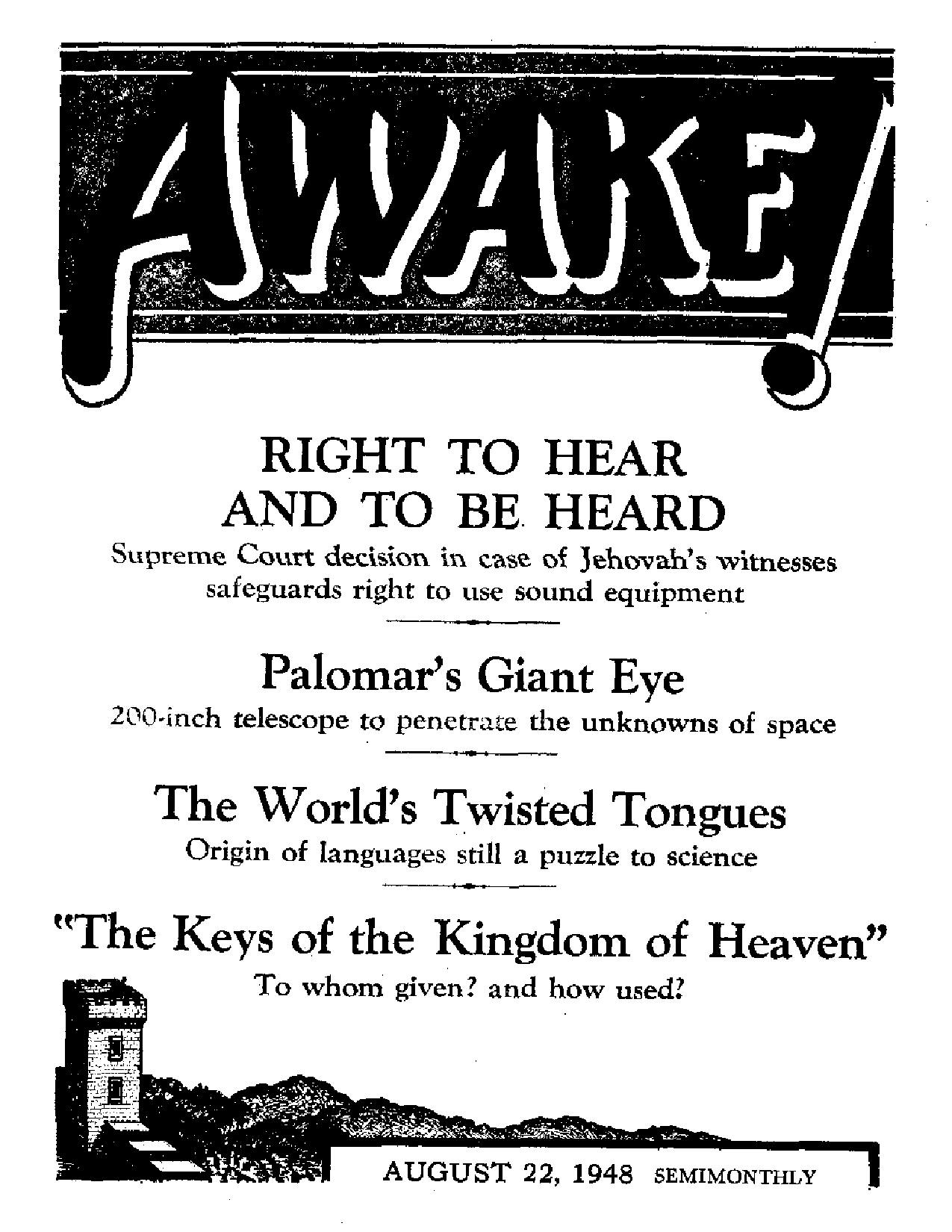
RIGHT TO HEAR AND TO BE HEARD Supreme Court decision in case of Jehovah’s witnesses safeguards right to use sound equipment
Palomar’s Giant Eye
200-inch telescope to penetrate the unknowns of space
The World’s Twisted Tongues
Origin of languages still a puzzle to science
"The Keys of the Kingdom of Heaven”
THE MISSION OF THIS JOURNAL
News sources that are able to keep you awake to the vital issues of our times must be unfettered by censorship and selfish interests, ‘‘Awake f’ has no fetters* It recognizes facts, faces facts, is free to publish facts. It is not Bound by political ambitions or obligations; it is unhampered by advertisers whose toes must not be trodden on; it is unprejudiced by traditional creeds. This journal keeps itself free that it may speak freely to you. But it does not abuse its freedom* It maintains integrity to truth*
"Awake I” uses the regular news channels, but is not dependent on them* Its own correspondents arc on all continents, in scores of nations. From the four corners of the earth their uncensored, on~the~ scenes reports come to you through these columns. This journal’s viewpoint is not narrow, but is international. It is read in many nations, in many languages, by persons of all ages. Through its pages many fields of knowledge pass in review—government, commerce, religion, history, geography, science, social conditions, natural wonders—why, its cover-age is as broad as the earth and as high as the heavens.
“Awake 1” pledges itself to righteous principles, to exposing hidden foes and subtle dangers^ to championing freedom for all, to comforting mourners and strengthening those disheartened by the failures of a delinquent world, reflecting sure hope for the establishment of a righteous New World.
Get acquainted with "Awake 1” Keep awake by reading “Awake!1*
PUBLltiHEt) SEMIMONTHLY BY
WATCHTOWER BIBLE AND TRACT SOCIETY, INC.
117 Adams Street Brooklyn 1, N. Y., U. S. A.
N. H. KN orb, President Grant suiter, Secret ar?
Five cents a copy One dollar a year
R*mlttaan« should b« sent to office la your totm* try In compliant with reeuhtions to suarsrrtee sale delivery of money. Remittances Eire accepted a,t Brooklyn from countries where no office Is looted, by international money order only. Subscription rates in different countries are here stated in local currency.
Notice of expiration (with renewal blank) is sent at least two 1»um before snbrtriptioii expires.
teuw of aHr*M when eent to oar office may be expected effective within one month. Send your old as well as nsw address.
Offices Yearly Subscription Rate
America, U.S., 117 Adame St, Brooklyn 1, N.Y. $1 Antralh, 7 Beresford Rd., Btrathfleld, N.S.W. fis tenaia, 40 Irwin Ave., Toronto 6, Ontario $1 Enfland, 34 Craven Terrace, London, W. 2 ba teith Africa, 623 Boston House, Cape Town G®
Entered M second-class matter at Brooklyn, N. Y>, Act of March 3, ISffl. Printed In V. S. A
CONTENTS
Eight to Hear and to Be Heard
Argument by Counsel
The Majority Decision for Freedom
The Minority^ Dissent
Nation-wide Comment
Planes Make Possible
Cross-Country Television
Palomar's Giant Eye
Operating the Giant Eye
What Is the 200-In cher Designed to Dol 11
Colors Sway Your Emotions
Individual Color Personalities
The World's Twisted Tongues
Factors in Language Change
Some Language Peculiarities
An International Language
Pagan Pontiffs and Their Keys
Testing the Pope's Keys
The Pagan Hat, Chair and Crosier
“Thy Word Is Truth”
“The Keys of the Kingdom of Heaven” 24
Dedication at Palomar Provokes Thought 26
Draft Registration
Watching the World
AWAKE/
®"'Now it is high time to awake.'-Romans 13:11 &
Volume XXIX
Brooklyn, N. Y„ August 22, 1948
Number 16
RIGHT TO HEAR AND TO BE HEARD
SUPPOSE a weak voice wished _2 to be heard by an assembled AMr x audience of a few hundred. As-sunie that voice wished to address a vast audience such as President Roosevelt had of democrats at Soldier Field, Chicago, in 1944 during the presidential campaign, or such as J. F. Rutherford had of Jehovah’s witnesses in and around the arena at St. Louis in 1941. In both those eases the audience exceeded 100,000 persons. Could a weak or a strong voice effectively reach such audiences without amplification by sound equipment? Could listeners hear, could speakers be heard, if sound devices were outlawed ?
Speakers have ever been confronted with the problem of being heard by their audiences. Demosthenes, Greek orator of the fourth century before Christ, sought to overcome the problem by practicing aloud at the seashore till he could be heard above the roar of the waves. But electrical sound equipment has spared modern speakers this arduous course of voice strengthening. Their problem had become one of legality. Many judges, lawyers and officers, as well as the public, have held that the use of amplifying devices can be prohibited or proscribed as a “nuisance”. In fact, scores of cities in the United States have laws either prohibiting their use completely or requiring the user to obtain permission from the chief of police. Until recently these restrictions were considered valid by the majority. Now the judicial climate has changed.
On dune 7, 1948, the Supreme Court of the United States legalized the use of sound amplifiers to allow audiences in public places to hear and to allow public speakers to be heard. The case involved one of Jehovah’s witnesses and is known as Saia v. New York. The 5-to-4 decision of the Supreme Court is one of the great landmarks in constitutional law. It extends the First Amendment to reach and shield the use of sound equipment under the freedom-of-speech guarantee. Just as the Constitution protects the printing press in making possible the wide distribution of literature, so it protects amplifiers that make speech to large audiences effective.
The facts of the case are as follows. During the summer of 1946 Jehovah’s witnesses arranged for a series of four meetings in the public park of Lockport, New York. A permit to use sound equipment was granted by the chief of police, and for four consecutive Sunday afternoons a minister delivered Bible lectures. Later in that same summer a second series of four meetings was planned, but officials refused to grant the permit to use sound equipment, stating that objections had been made concerning meetings in the park by Jehovah’s witnesses. Notwithstanding, in September of 1946 the first talk of the series began. Police appeared and ordered the sound equipment silenced. One of the officers fumed
that he “didn’t have a d----bit of use for
what has been written about the Constitution protecting the rights of Jehovah’s witnesses, nor the decisions of the Supreme Court”, He forcibly shut off the amplifier and placed the operator under arrest. This was repeated on each of the Sundays the meetings were held, and on each of the four arrests Samuel Saia was charged with violating the city ordinance requiring permission from the chief of police before using sound equipment.
All of the complaining witnesses testified that the meetings were orderly, that they were on religious matters, and that they had not considered the material offensive. They admitted the sound amplification was not nearly as loud as church hells ringing on Sunday, and none of them complained that the use-of the sound equipment annoyed them or interfered with their enjoyment of the park facilities. Yet the police court found the operator of the sound device guilty and imposed fines and jail sentences. The convictions were upheld by the county court and the highest court of the state of New York. Appeal was made to the Supreme Court late in 1947.
Argument by Counsel
Counsel for Jehovah’s witnesses argued before the Supreme Court that sound devices were necessary to speaking in public places in these modern times. It was shown that it had become common practice, in the exercise of free speech, to use mechanical means to amplify the voice. During the war the army and navy and civil service and other organizations employed loudspeakers to reach the people and make known their needs for recruits and for other purposes. Campaigners in state and national political contests would be silenced if denied the use of sound equipment. By such equipment labor unions air their side of controversies, religious organizations preach their messages, national conventions reach the ears of thousands of delegates. Athletic events are rarely without this speaking aid. Wherever a group of persons assemble for meetings there is likely to be in operation an amplifying system. Speech is crippled without it.
Parks and streets are natural and proper place^ for c ommuni cat 1 on of ideas. From time immemorial public parks have been used as places of assembly, for making public speeches on commercial, political and religious subjects. Since the days of the Lord Jesus Christ and His apostles, Christian ministers have made use of concourses, market-places, hustings and public parks; in fact, any place where a crowd could be gathered and addressed.
Hand in hand with the right to speak goes the right to be heard. And the right to be heard carries with' it the right of speakers to use devices that will further the range of their voice so as to reach hearers in public places. Since jwrrks are rightfully used for communication of opinion and information, the speaker has the right to speak so as to be heard in such parks. Any ordinance that prevents his being heard, by forbidding the use of sound equipment, effectually shuts his mouth and abridges his right of free speech and assembly.
Counsel for Jehovah’s witnesses further informed the court that the only permissible limitation upon the use of the sound device by a public speaker was the reasonable regulation as to time, place and manner of exercising free speech. Ordinances prohibiting or censoring sound amplification cut off entirely the right of listeners to hear and speakers to be heard in public places. Though they maybe called “regulations”, such ordinances are not permissible regulation but are a blanket ban on outdoor speaking with a sound device, and hence abridge the f reedoms of speech and assembly. ,And to make the freedom to speak noth sound equipment so as to be heard subject to police permission is contrary to rulings of the Supreme Court pursuant to the Constitution,
The Majority Decision for Freedom
After due consideration the Supreme Court rendered its decision, Mr, Justice Douglas, joined by Justices Murphy, Rutledge and Black and Chief Justice Vinson, in a concise and pointed opinion preserved the constitutional freedom to hear and to be heard. Said the court:
We hold that § 3 of this ordinance is unconstitutional on its face, for it establishes a previous restraint on the right of free speech in violation of the First Amendment which is protected by the Fourteenth Amendment against State action. To use a loudspeaker or amplifier one has to get a permit from the chief of police. There are no standards prescribed for the exercise of his discretion. The statute is not narrowly drawn to regulate the hours or places of use of loudspeakers, or the volume of sound (the decibels) to which they must be adjusted. The ordinance therefore has all the vices of the ones which we struck down in Cantwell v, Connecticut, 310 U, S. 296; Lovell v, Griffin, 303 U, S, 444; and Hague v. C, Z, 0., 307 U. S. 496, , , ,
The present ordinance has the same defects. The right to be heard is placed in the uncontrolled discretion of the chief of police. He stands athwart the channels of communication as an obstruction which can be removed only after criminal trial and conviction and. lengthy appeal, A more effective previous restraint is difficult to imagine. Unless we are to retreat from the firm positions we have taken in the past, we must give freedom of speech in this case the same preferred treatment that we gave freedom of religion in the Cantwell case, freedom of press in the Griffin case, and freedom of speech and assembly in the Hague case.
Dispelling the specter of anarchy conjured up by the opponents of free speech and freedom to hear through regulated use of sound amplifiers, the opinion further declared:
The present ordinance would be a dangerous weapon if it were allowed to get a hold on our public life. Noise can be regulated by regulating decibels. The hours and place of public discussion can be controlled. But to allow the police to bar the use of loudspeakers because their use can be abused is like barring radio receivers because they too make a noise. The police need not be given the power to deny a man the use of his radio in order to protect a neighbor against sleepless nights. The same is true here.
And abuses which loudspeakers create can be controlled by narrowly drawn statutes. When a city allows an official to ban them in his uncontrolled discretion, it sanctions a device for suppression of free communication of ideas. In this case a permit is denied because some persons were said to have found the sound annoying. In the next one a permit may be denied because some people find the ideas annoying. Annoyance at ideas can be cloaked in annoyance at sound. The power of censorship inherent in this type of ordinance reveals its vice.
Courts must balance the various community interests in passing on the constitutionality of local regulations of the character involved here. But in that process they should be mindful to keep the freedoms of the First Amendment in a preferred position. See Marsh v, Alabama, 326 U, S, 501, 509,
The Minority Dissent
Four justices dissented, taking the extreme viewpoint that the peace and quiet of the park outweighed the right of free speech. They failed to recognize the middle ground established by the majority, between “uncontrolled discretion” of police and “irresponsibility to set up sound equipment in all sorts of public places”. This fair middle ground can be established through the use of narrowly drawn and specific statutes regulating sound equipment. The dissenters asserted judicial remedies were available when police authority was abused, but disregarded the fact that such remedy at best is only after trial, conviction and lengthy appeal, as in the present case. Forgotten, also, by them were former pronouncements by the court that “where-ever the title of streets and parks may rest, they have immemorially been held in trust for the use of the public and, time out of mind, have been used for purposes of assembling, communicating thoughts between citizens, and discussing public questions”. (Hague v. C. I. 0.)
The “freedom to be let alone” contended for by the minority is an innovation in the field of constitutional law. They stretch this specious, alien doctrine too far. If the streets, concourses, public squares and parks were reserved exclusively for the rest and solitude of the public—including the lazy, loafers, bums, vagrants, panhandlers—then their cher-, ished use as places of public assembly will have been destroyed. The new, vaunted phrase of the minority is a mere euphemism. “Freedom of privacy” in a public place is too far-fetched to be taken seriously.
In a separate dissent Justice Jackson derides'the majority with the bold assertion that “this decision, which seems to me neither judicious nor sound and to endanger the great right of free speech by making it ridiculous and obnoxious, more than the ordinance in question menaces free speech by regulating use of loudspeakers”. The true target of his vituperative darts is Jehovah’s witnesses, toward whose Christian message and. work he has shown no love and little tolerance. By artful insinuation he subtly paints Jehovah’s witnesses as invaders of others’ rights and property, as an-noyers, fanatic propagators of obnoxious doctrines, and indiscriminate, irresponsible abusers of the use of sound systems. He presumes to exaggerate the facts, stating they “set up a sound truck so as to flood this area with amplified lectures”. He wwites loosely of “erection” of elaborate apparatus on public property, despite the record that the loudspeakers were mounted on a car parked at the curb of a public street.
Justice Jackson, through free use of such terms as “regulate” and “control” in describing the ordinance, seeks to soften the impact of the prohibition in the ordinance. He shuts his eyes to the censorship delegated to the police chief. And again he departs from the facts when he says: “There is not the slightest evidence of discrimination or prejudice against the appellant because of his religion or his ideas.” But the record shows that the Lutherans were using sound equipment in 3 near-by stadium, about 1,000 feet from the place where Samuel Saia was using sound equipment. When the police shut off Saia’s equipment, the Lutheran amplifiers were clearly audible. On this point Jackson ventured into the field of acoustical engineering, intimating that because of a six-foot-high fence the Lutheran sound equipment would not be heard. A remarkable contention!
Pursuing his hair-splitting argument, he grasped at the recent decision forbidding religious courses in public schools. From it he argued that free speech in public parks should be denied because the parks are public property. On this theory preaching could be forbidden on the streets or sidewalks or by house-to-house calls, since the streets and sidewalks are public property. His final suggestion that use of sound equipment may be prohibited because it “may lead to riots and disorder” is so flimsy, so untenable, so reactionary and so contrary to a long line of Supreme Court- decisions that it need not even be refuted.
Nation-wide Comment
Some of Justice Jackson’s absurdities were reflected in the widespread editorial comment on the decision. The careless handling of fact by Jackson became flagrant falsehood in the columns of some newspapers. A Florida paper, the Miami Herald, maliciously wrote, on
June 19, in an editorial entitled "Asinine Decision”: “At Lockport, N. the Jehovah witnesses made night hideous with their sound-truck shoutings which prevented people from sleeping.” Remember, the lectures were on Sunday afternoon. No Pulitzer prize editorial, this. It will take its place alongside two other infamous editorials appearing in the Herald, on November 2 and 7, 1944. In reversing the convictions of the asso-dato editor and tto; Miami Harald Publishing Company for contempt of court, the Supreme Court found the ‘editorials and a cartoon based on inaccurate, distorted, incomplete, and biased reports’. (Pennekamp v. Florida)
A sane editorial on the decision appeared in the Lockport Union-Sun and Journal, June 8. Jehovah’s witnesses concur with it. It said:
On the face of it, and in fairness under our democratic system, it appears that the religious sect which forced the case to the Supreme Court after adverse rulings all along the line is as much entitled to use sound equipment as any other agency—whether it be an athletic enterprise or some medium of advertising. On the other hand, the public peace should not be flouted by indiscriminate cacophonies of noise. Alteration of the Lock-port ordinance relating to this problem in order to bring it into harmony with the Supreme Court decision is a matter for legal minds. In the meantime, however, it is not amiss to remind advertisers, religious sects, sports broadcasters and home radio fans that "moderation in all things”, especially when adjusting the volume control, is still a very good philosophy.
In this day of jet-propulsion, atomic energy, radar and electronic developments, a loud-speaking apparatus long a necessity lor elective public speaking. Sound equipment has a necessary relationship' to freedom of speech and assembly. Every speaker has the right to be heard. Every listener has the right to hear, whether he be on the front row or the back row. The modern practice of reaching all the ears of large audiences by sound devices should be preserved. By a narrow margin, a 5-to-4 decision, it was preserved by the Supreme Court. Chief-Justice Vinson cast the deciding vote, and thereby iciinnd. tb.% four liberals, Justices Douglas, Black, Rutledge and Murphy. He is to be commended for swinging over to the side bulwarking personal liberties, and sharing in another landmark precedent by this liberal court. The decision stands as a beacon to the right to hear and the right to be heard.
//
Planes Make Possible Cross-Country Television
41 Television radio waves travel in straight lines, unlike standard radio broadcast waves. Hence television does not carry beyond the horizon, near to the ground, due to the curvature of the earth. This limits telecasting to 35-50 miles, without costly relay stations or coaxial cable lines, not now available in most areas.
But, during an evening of the recent Republican convention in Philadelphia, the television broadcast of the convention was brought to Zanesville, Ohio, a video-less community. It was effected by aviation. A plane wheeled in lazy circles high above Pittsburgh, and at its 25,000-foot altitude could pick up the television program from Philadelphia, and rebroadcast it on to Zanesville. The plane simply became, in effect, an ultra-tall television antenna. Eight planes could effect a coast-to-coast television network between Hollywood and New York. Such air-borne television networks axe called “strato vision broadcasts\
BVLOMA Il'S GIANT EYE
■Ji ft w
EVER since a Polish monk named Copernicus, in the early sixteenth century, incurred the pope’s hatred by declaring that the earth is a part of a system of which the sun is center; and since Galileo looked at the heavens with a homemade telescope of concave and convex lenses spaced . apart, advanced the theory of planetary rotation, and for fear of the Papal Inquisition was forced to recant from this great truth; ever since those times the Roman Catholic Church has waged a losing fight in its effort to stop the investigation of the visible universe. As one writer expressed it: “Like Canute, the Church rumbled in vain. For men will find out and believe new things even if it kills them.”
Such is the momentous scope of the new 200-inch telescope mounted at the Astrophysical Observatory of the California Institute of Technology on Palp-, mar mountain in southern California that all other penetration of the heavenly universe pales in comparison. It is to penetrate four times as much space as ever before. Yerkes Observatory, at Williams Bay, Wisconsin, has its 40-inch refractor type telescope, the largest of that kind in the world. Mount Wilson, California, has its 100-inch mirror or reflecting type telescope, which until the June 3 erection of Palomar’s 200-incher, was the largest in the world. (See article on page 26 regarding dedication.) All three of these space-piercing telescopes were
To penetrate four times as much space as ever before
largely the work of the late Dr. George Ellery Hale, whose work has been honored by the naming of Palomar’s “giant eye” the “Hale telescope”.
Information about the heavenly creations of Jehovah may well be vastly increased by this latest triumph of science and engineering. Its use will show further the insignificance of the entire solar system, that it is but a grain of sand in a Sahara of space and astral matter.
People who have accustomed themselves to enormous figures by contemplation of the national debt are apt to shrug at the mention of the glass’ 16$ feet diameter, and ask why they did not make it fifty or a thousand feet in diameter. The facts are that the twenty-ton glass disc, as it was originally poured by Corning Glass Works of the famous Pyrex type, almost proved too much for the ingenuity of the world’s greatest scientists. To ship, polish, transport and erect the giant reflector on the granite up-thrust known as Palomar mountain (elevation 5,565 feet) bred prodigious difficulties that would be tripled by adding even another 100 inches to any future mirror.
In the manufacture fused quartz was first used in an effort to produce a disk with almost no contraction and expansion. The bubbles in this could not be removed. Then other glass was employed and smaller models experimentally poured. The glass must be rigid, because its only purpose was to furnish a suitable surface for the millionth-of-an-inch layer of aluminum paint that would be applied to form the world’s largest mirror. To reduce the weight of what would otherwise have been a solid disk two feet thick, the glass mold was designed to form ribs or cells similar to those of a waffle. A forty-inch hole was left in the center of the “eye” for secondary reflection, The final resnlt, after grinding and polishing away more than five tons of material, was a curved solid surface only 4j inches thick, stiffened by the supporting ribs. Still the glass retained some flexibility, and had to be supported by a steel pan with fulcrums and counter weights to prevent stretching and distortion in the various positions required for observing the heavens. The first disc cast on March 25, 1934, in Corning, New York, proved defective and had to be discarded.
In 1936, after a successful pouring with Pyrex glass and a controlled cooling process, which permitted a temperature reduction of only one degree each day, the great plate was carefully packed for shipping on a special car. Although nearly engulfed by a flood in the East, it finally arrived in Pasadena, in April of 1936. The final polishing into exactly the desired .curve, accurate to within two-millionths of an inch, has consumed almost all the time since.
The importance of precision in the finish is underscored by the necessity of attaining perfect reflectance. In the polishing process, only flour-like iron oxide was used. Even the clothes of the employees were specially designed, no air circulation was permitted during the day, temperatures were carefully regulated, dust and metal filings were removed by vacuum and magnet. The great polisher, supported by an overhead crane, operated so carefully that only one-quarter ounce of glass was removed each week! The. final precision test was made through a device employing a light wave,
accurate to two-millionths of an inch!
At 3:30 a.m. on November 18, 1947, a twenty-two-wheel truck left the Cal-Tech campus in Pasadena with its carefully packed cargo of 14| tons of glass. One hundred and fifty miles away, on Palo-mar mountain—selected because of its clear air, earthquake-resisting base of twenty-mile-deep granite, and flattened top permitting emplacement some five miles back of its rim to avoid glare from San Diego, fifty miles distant— stood the 137-foot dome, complete with yoke, tube, and intricate operating equipment. The dome is hemispherical, and appears silvery from the outside. It rises 110 feet from the observation floor and has a diameter the same as its height, 137 feet. The whole dome revolves by rubber-tired friction motor on a track swinging the thirty-by-eighty-five-foot aperture in any direction. Thus given access to the heavens, the telescope can survey any portion of the sky from the North Pole to the southern horizon. The aperture is in turn opened and closed by electrically-driven shutters, each weighing 100,000 pounds.
Before the caravan left for south-central California the dome was all ready for the “giant eye”. In transit the greatest precautions were taken. The caravan moved at low speed, often no more than four miles per hour. Fifteen motorcycle patrolmen accompanied the truck. Bridges were specially supported with shoring. Inside the ease was a microphone to warn of any vibrations that might shake the big glass too much. After a tedious trip up the c e d a r-a n d-o a k-fringed road of Palo-mar, the disk arrived and installation began.
The great giant is designed to automatically find a star, given the position from a previous photograph. Thereafter everything is the work of an infallible robot. “A motor rated at onetwelfth horsepower tracks the star. There are no jumps. Errors accumulate slowly and uniformly, and, when they amount to a tiny yet an intolerable fraction of a second, the machinery corrects them automatically. A perfect timing device slows up and accelerates the tracking motor just enough.” A four-foot air space between the inner and outer shells of the dome gives heat insulation, making possible the control of the glass’ expansion and contraction due to variations in temperature. Other intricate mechanisms turn so as to offset the rotation of the earth. Resting on a thin film of oil under pressure of more than 500 pounds per square inch, the supporting base moves in a manner more frictionless than anything else known to man except the earth, which Jehovah “hangeth upon nothing*.
Operating the Giant Eye
Now follow the operations of a typical observation. The observer (who is really a director of the telescopic sky exploration, and cannot see the dim outline of the stars which slowly take shape on the negative receiving the mirror’s reflected light) first takes an elevator to his station within the tube itself. This tube, which contains the mirror, and is called the declination movement, is really an open frame-work of giant struts and girders, large enough in diameter to con-, tain the great eye near its lower end, and long enough to accommodate the prime focus 55 feet upward from the mirror. (See diagram.) The muzzle itself, which constitutes the end of the tube pointing toward the heavens approximately 70 feet above the observation floor, can be swiveled in a complete circle and raised and lowered. By these two adjustments any portion of the skies can be brought under observation.
The observer sits in the tube of the telescope itself. In fact, he is cutting off some of the light from the heavens that is entering the muzzle above and striking the mirror 55 feet below him. But some light must be sacrificed in this type of reflection, and the portion cut off about equals in position and amount the loss caused by the 40-ineh hole in the center of the mirror. The observer has a log showing the location of each previously explored star, galaxy, etc. He decides on the sector to be scrutinized, sets the instrument according to the sky map, utilizing a not-too-distant star as a guide. Remember that the observer cannot see anything in the big mirror below, but his guide star appears at the conjunction of cross hairs on the receiving negative he has inserted in the holder on his desk. Thereafter he must keep the guide star centered on the negative.
This operation makes clear that the giant mirror is not designed for enormous magnification, but for- the extensive collection of light. The use of the Hale telescope is purely photographic. Thus while the monster tracks the heavens around the “guide star”, the director marks any deviation in the guide star’s position, and speaks instructions to his assistant at the control board below’. No telephone receiver is required. His words are transmitted by microphone, and the answer comes by loudspeaker. While an eyepiece assists the observer to check the telescope’s movements as indicated by the guide star, the picture being made by time exposure cannot be seen, because in observing distant stars their light is often so feeble that only after hours of exposure does it appear at all. Then it shows up after the negative is developed. Photography has thus become the master art of modern astronomy.
In addition to accommodations for the scientists (and only astronomers will be granted use of the magnificent equipment) Palomar also has a 48-inch Schmidt-type telescope, and a smaller,
18-incher. These are useful tor scouting the skies, locating “game” worthy of the big mirror. These instruments cover a larger area of sky, while the Cyclopean giant concentrates its vision on onefourth second of arc at a time, or approximately 1/25000 of the entire sky area. This means that the big ’scope would have to take 27,000 photographs to map the whole sky; and, since many of these would require long hours, perhaps eighty or more, and the astral bodies would change position greatly in the years, it seemed more advisable to make selections for observation, which is done through the smaller telescopes.
What Is the 200-1richer Designed to Do?
The experience, skill and wisdom of the scientists of the world have gone into the production and erection of the Palo-mar telescope. Nearly all branches of physics and engineering contributed to the final result. After Hale found that forty inches was about the greatest size for efficient use of the refractor type telescope, he designed the 100-inch mirror type, and had its erection at Mount Wilson financed. Meanwhile the astronomer had largely diverted his interest from such comparatively close objects such as the sun, moon, and planets. Studies and observations turned to previously uncharted reaches of space. His vision was projected into distances so staggering that their computation called for a vaster unit of distance. To meet this need the light year was the unit adopted. When it is remembered that a light year is the distance that light, flashing at the rate of 186,000 miles per second, can travel in a year, which has been computed at nearly six trillion miles, then the term 500,000,000 light years, the outer fringe of penetration by the 100-incher, becomes fabulous indeed.
Light from the moon reaches us in about a second and a half. From the sun it requires eight minutes, and from Pluto, the farthest known planet in our AUGUST 22, 1943
soiar system, it requires about six nours to traverse the three billion miles. But inspection of our solar system was not what the new telescope was designed fur. Although because of its greater light gathering it will be used to take snap shots of Mars (previously only time exposures could be taken, as there was not light enough for flashes) the great purpose of the new telescope will be to study distant galaxies, spiral nebulae, island universes similar to our Milky Way, of which the solar system is but a dot on the outer fringe.
Efforts to determine the composition or mean density of the universe, whether the “jeweled galaxies” that float in outer space are in reality traveling away at speeds approaching one-seventh that of light, whether sidereal (starry) space will reveal itself as finite or infinite— these are questions which scientists hope to answer through the latest invention of human ingenuity. No doubt the instrument will prove as ineffectual or powerless to answer the enigmas of the universe as dissection of the human anatomy has proved futile in solving the mysteries of life. As one w’riter wisely predicted, the telescope will answer many questions but as it pierces into ever vaster reaches of the universe it will raise more questions than it solves.
As the quest for wisdom inspires the ionospheric rocket, and the glass with a million-eye power, the result has not been to raise intelligent men’s estimation of themselves, but rather the contrary. The Papacy has had to swallow some bitter pills since they burned Giro-dano Bruno at the stake in Rome for expounding Copernicus’ theory that the sun, not the earth, was the center of our system. Our solar system is not even the center of our Galaxy, the Milky Way. It is really near the sparsely-filled outer rim of this great system extending about 78,000 light years across. Some think that our Galaxy would have a spiral shape if viewed from the outside, and that the nucleus, or central point, is hidden by interstellar dust somewhere in the region of Sagittarius.
Our Milky Way, that faintly luminous tract or belt seen at night stretching across the heavens, contains as many as 200 billion other suns, besides our own. Whether these in turn have each their planetary systems is not known. The nearest galactic island is Andromeda, a great flat rotating disk of 100 to 200 billion stars, 65,000 light years across. Each of the galaxies, often including novae or exploding stars, revolves around a dense nucleus of stars, sometimes taking 200 million years for a single rotation. “Despite the sparseness of about one galaxy per three billion billion cubic light years, yet 150 million galaxies have come within the range of the 100-inch telescope already.” Astronomical experts, who do not know that Jehovah is the God. of order, are greatly amazed that, despite the incalculable number of stars, nebulae, and island universes within the infinite universe, there has never been a single recorded instance of collision between stars.
It is estimated that a man with best visibility can see a candle burning at a distance of sixteen miles. Only about 5,000 stars are visible to the unaided eye. Dr. Walter S. Adams, former director of Mount Wilson, estimates that with the 200-incher a picture could be made of a candle distant 41,000 miles. The great mirror has the power of a million eyes. It is expected to penetrate a part of the cosmos hitherto unplumbed and bring in the light of stars a billion light years distant! Not only will it seek out new heavenly wonders, but it is hoped it yfill discover why the more distant spiral nebulae appear to rush away from us. Is the universe curved, they wonder, and having a terminus, as believed by Einstein? And do not forget, the giant will be raising some questions erf its own also.
In the museum at Palomar a picture of the nearest spiral nebula, about 700,000 light years distant, arrests the eye. The brilliance of the spiral nebulae is reduced by the limitation of man’s vision to color wave-lengths from red to violet. Infrared is reflected as black. Yet the sight of the first spiral nebula as it came to an investigator’s eye must have dazzled even the experienced. Even if not sentimental he doubtless gazed enraptured. In the photograph it looks like a fiery pinw’heel caught with its flashing streamers curling out from the. blazing vortex.
While picking up stars of the 21st magnitude, of which 63,000,000 would be required to make the light of one star of first magnitude such as Sirius, the glass will investigate a peculiar phenomenon noticed in connection with the spiral nebula. A great many of these clusters are bunched on the outer edge of visibility’s limit for the 100-incher. Their spectrum or breakdown into component colors indicates a shift to the lower red wave-length. In closer constellations this has indicated rapid movement away from our Galaxy. The question which will be probed now is whether this does indicate a motion that is similar to an “explosive increase” outwardly of our universe.
Great things are expected of the giant mirror. But before enthusiasm for this latest effort to search out the wisdom of the heavens, domain of the Infinite God, runs too high let it be remembered that the photographs of distant star clusters are very small affairs, and hypothesis is apt to out-distance fact in the conclusions arrived at. Nevertheless, Palomar is certain to bring forth some amazing facts about God’s universe. To the Godfearing, the revelations will multiply proof of King David’s meditations: “When I consider thy heavens, the wrnrk of thy fingers, the moon and the stars, which thou hast ordained; what is man, that thou art mindful of him? and the son of man, that thou visitest him?” —Psalm 8: 3,4.
colors of the flowers and birds, all evoke
SbW
There is more to color.than meets the eye. There is more to color than the physical stimulation of the retina's color cones. Color penetrates the mind, reaches the innermost feelings, and either tickles one’s fancy, thrills one’s emotions ur calms and quiets upset nerves.
Think of the feeling of warmth that passes over us when staring at the red flame® of a bonfire or a molten kettle of foundry metal. Call to mind the heartening "lift” that the bright green of early springtime gives after a long, cold winter. Think of summertime’s golden ears of coin and the yellow glow of ripening wheat fields. Think of the joy and gaiety that creep over us when walking through autuP11* woods that are splashed with natures colors. Or call to mind how heavy and depressing a gray-skied cloudy day weighs upon you. A dashing girl on skis becomes more dashing in a ski s«it of flaming red. A moonlight scene is more relaxing and romantic if painted with deep blues and violets. Yes, color is more than an outward sensation. It does something to us inwardly. It either quiets down or stifs up our emotions. Why, we are kdd evew the ill-colored walls of a home niay be the soured domestic quarts*
The red of the bloody the blue of the sky, the green of the woods, the multi-august ms
in our winds certain distinct emotional reactions, each different from the others. Some of these reactions touched off are so strong that colors like red or orange actually make the body warmer than a color like blue. This was forcefully demonstrated when the girls in an office complained that they were cold even though the temperature of the room was 72crE', When engineers were called in they recommended the repainting of the bluegreen walls with a warm coral-colored paint. This done, all complaints ceased.
Color Molds Different Moods
There are many other instances where colors have been found to play heavily on the mental attitude of creatures. In a Pittsburgh steel plant during the war absenteeism of oito department was cut from 20 percent to 6 percent when the walls were painted a warm beige to neutralize the sickly bluish light of the fluorescent lights.
Though one may not be aware of it, color greatly affects the appetite. Green salad plates instead of white ones increase the custom61'’a appetite in a restaurant. No chef of any reputation overlooks the matter of color when planning and arranging his menu. Eye appeal, or, better stated, mental and emotional appeal, is much greater when serving red meat like beef if yellow carrots and green peas are served with
green sprigs of parsley on the white potatoes. Even children will go for their milk if it is brightened up and made flashy with harmless food dyes.
The aircraft industry learned that airsickness is reduced if the interior of the planes is decorated with pastel shades of green and blue instead of yellow and brown. Not only has eyestrain, “afterimage” and nervous fatigue been reduced, but also the mental attitude and disposition of the workers has been improved, with higher production as a result, in factories and industrial plants that have chosen proper colors for work benches and walls. Certain colors of clothing will make one look older or younger than other colors. And when it comes to a masquerade party or similar social gathering an exciting and mystifying effect may be created by replacing the ordinary lights with several strong bulbs with magenta-colored filters over them placed on the floor behind the furniture.
An improper or misused color also emphasizes what a powerful influence color plays upon human emotions. The wicked Nazis used color as a weapon to torture their helpless captives. By placing their victims in large brightly lit rooms that were painted with the most fantastic and horrid colors they were able to drive some of them mad by the clashing colors.
If some colors and color combinations can stimulate and excite people to the point of mental breakdown, it is reasonable to suppose that other colors and color arrangements would have the opposite effect, a soothing and calming effect. And such is the case. In fact, medical science has not overlooked this, especially when treating nervous and mental disorders. Hospital patients suffering from mental depression are stimulated and given a “lift” in rooms with walls decorated in pinks, yellows and oranges. On the other hand, those that need quieting and calming down are put
•in rooms painted witn subduing ohies and soothing greens. When the doctor advises the over-excited and nervous individual-to “take to the woods” for a vacation he is using good color psychology, for out there one is surrounded with a quiet curtain of forest green and a cool blue sky overhead.
Individual Color Personalities
Red is by far the most powerful color there is, the one that increases the respiration and blood pressure of man more than any other. It suggests action and excitement. Hence red is chosen as the color for labels reading “Explosives”, “Fragile,” “Poison,” “Danger” and “Exit”. A football coach painted one room red, where he gave his fight talks, but another room used for rest and relaxation he had painted blue.
Blue is passive, cold and deep in its mood. It is characteristic of tranquillity, calmness and expansiveness. It symbolizes truth, justice, consistency and sincerity. Certain yellows suggest to the mind glory, prosperity and cheerfulness, whereas other yellows suggest sickness, cowardice and cheapness. One shade of purple might suggest majesty and royalty, but another purple impresses one with the feeling of passion, suffering and mystery.
Psychologically black also has a great influence on the mind. As a sedative and sleep-inducer black bedclothes, bed sheets and pillowcases in a Toom with black walls has been suggested by one doctor as a treatment for insomnia. “Those that have made a specialty of occult studies,” says the San Francisco Chronicle, “point to the fact that black is the color of Saturn, the planet of gloom, misfortune, fatality and other evil things.” Such symbolism is continued to this day by the black-garbed clergy and hooded nuns of Christendom. The success of the black gowns worn by fashionable ladies is not due to their clergy-like darkness, but to the texture of the material and the mystifying lines and contour that are set off in contrast and in relief. Lady spies are popularly conceived as garbed in mysterious and aristocratic black.
All of this research and study has led colorists to some very definite conclusions regarding the effect of various hues on the human emotions and disposition. Psychologically some colors are warm, while others are cool. Some are light in weight; others are heavy. Some are advancing and others are retiring. White is the lightest in weight and black the heaviest, with all other colors falling somewhere between the two extremes. A workman who has pushed a black handtruck all day feels more tired than when the same truck is painted green. Red, a warm color, is also an advancing hue, while blue, a cool color, is passive and receding. Even the lens of the eye becomes nearsighted to cool rays and farsighted when looking at warm colors. Taking advantage of these facts, subtle effects and optical illusions are created solely by colors to give perspective and the third dimension.
Color Harmony and Emotions
Understanding how color affects the human mind and its emotions, the artist and designer uses colors to give beauty, joy and contentment. Color harmony in a butchershop was achieved when the bright yellow walls were repainted green, the complementary color of the red meat. A marked increase in customers resulted. Using color’s psychological or purely suggestive power on the mind, white, blue and blue-green are used for advertising refrigerators, and red, orange and red-brown for advertising heating units.
Probably no other field of endeavor makes a more extensive study of color psychology than the commercial packagingindustry. Sales promotion agencies
demand that soft feminine colors never be used for men’s personal articles, and vice versa. Toothbrushes, combs, boudoir chairs, bedspreads and dresser sets for the ladies must be colored in dainty pastels. Articles for children—toys, games, scooters, balloons, and such—must be painted with strong, gaudy colors. The South American’s colorfiil garments do not appeal to the conservative European. Chinese color taste differs from that of ' the African. All of this is because emotions differ with age, sex and race. Again, there is a wide variety in personal likes and dislikes between those of the same race, sex and age. One thirsts after one color, others after another, because of difference in mental temperament and color sensitivity. Time, weather and circumstances also affect the mood and emotion of the same individual, so that different color schemes must be provided for an individual’s bedroom, living room and kitchen. Offices, libraries, restaurants, hospitals, theaters and homes all vary in color design to fit the human emotions at various times—sometimes volatile, sometimes static.
Color and its power over man’s emotions is founded on fixed laws, divine laws. If used successfully colors must be combined intelligently in accordance with these laws. Like musical notes, they must be arranged in patterns to give melodious compositions that are pleasing to man’s sensitive emotional perception. Study the color designs in nature if you want to learn the true power and harmony of color. The enduring and permanent part of creation is made up of greens, browns, tans and grays. The brilliant flashes of color are reserved for the everchanging sunsets, seasonal birds and fruits, and the temporary flowers.
1 Jehovah God in His in-
finite wisdom made no errors in clothing the countless objects of this planet in color.
Whence All the Languages ?
ONE of the biggest of the big barriers that make world unity an unattainable goal by this confused old world is that of languages. Ranking along with religion and politics as a source of general confusion the present-day Babel of tongues reaches an incredible figure: that of 2,796 tongues; some spoken by millions, others bv onlv a few hundred. When, even among those of the same language, misunderstood statements have been known to cause strife leading to bloodshed, it is not difficult to visualize the power of languages as a divisive factor among earth’s inhabitants.
But where in the world did, they all come from? And why is it, when life is life the world over, that men should have so many different ways to say essentially the same thing? The study of languages in an effort to unravel this' mystery is indeed a fascinating one and rather new. Philology, as such comparative study is called, is no older than the nineteenth century.
Lingual experts define language as “a system of vocal Sounds by means of which ideas are passed from one to another”, pointing out, however, that no one sound applies to one certain object. To be a language such sound system must be understood by others, so-called "unknown tongue” gibberish by some religionists thus being automatically ruled out.
With respect to the definition of language and its diversification during the past several centuries the philologists do quite well. But when they endeavor to explain the origin of languages they come up with theories that are just as foolish as those produced by men in other fields of science when they begin wondering about the beginning of things. To start -with, they are handicapped by the fact that Only a few* tongues have literature dating before the Christian era and the greater number have none at all. Thus, having very little circumstantial evidence upon wffiich to proceed, they resort to that favorite pastime of so many scientists: theorizing. Likewise, they all proceed upon the same false premise that man is a creature of evolution and hence originally had no language. The results of such imaginative thinking on their part generally resolve down to three main theories, humorously named (1) the pooh-pooh theory, (2) the bow-wow theory, and (3) the ding-dong theory.
The first of these was advanced long ago by the Greek Stoics who claimed that language grew* from involuntary exclamations, i.e., shouts of glee, cries of fear, etc. Hence, the name. Others advance the second theory, that language was born as a result of man’s attempt to imitate animal sounds. The other theory is that language had its start through attempts at description by vocal imitation of nature, exemplified by words such as "bang”, “rippling,” "gurgling,” etc. To its originators this “ding-dong” theory is as clear as a bell.
The Bible, itself, hag no mean record in the linguistic field. Recorded originally in three languages, Hebrew, Aramaic and Greek, it has now been translated in whole or in part into more than a thousand tongues. The information contained therein as to the origin of languages is entirely in accord with the known facts. It is admitted that there is not so much as a remote tradition of men with no speech. It is also admitted that no language now in use started from scratch, but rather that all are dialects of older languages and gradually became distinct from the parent tongue.
The inspired Record shows that the first man Adam’s design included a fine set of vocal organs, chief of which was a tongue of far greater agility and flexibility than that of the other creatures. Thus, though it be true that animals have means of communication, such ability could not compare with man’s far-surpassing ability to articulate speech, to divide sounds up into syllables and words and by arrangement or combination of these to have a vocabulary and speak distinctly and connectedly. Rather than learning to speak by imitating the animals, the true facts as set down in the book of Genesis are that man made almost immediate use of his powers of speech by bestowing names upon the various animal creation.
Moreover, some 1700 years after man’s creation it could still be said, “And the whole earth was of one language and of one speech.” (Genesis 11:1, Am. Stan. Ver.) United in language but not in worship of their Creator, men tried to defy God's rule by establishment of a union of mankind, a United Families organization, under one global government with headquarters at Babel. Jehovah God expressed His condemnation of this project shortly after it got under way, and He did it by sending forth His spirit or active force and confusing their language and then, by that same spirit, invisible as the wind, scattered them to all parts of the earth. (Genesis 11:6-9) Thus languages came into being.
It seems that they having kept their hands clean from that Devil-inspired world government project, the language of God’s servants.Noah and Shem was not changed but that they continued speaking the sanie pre-Flood language first used by man in Eden. The nation of Israel was made up of descendants of Shem, and their language known as Hebrew is the main stem of the Semitic languages. It seems a reasonable deduction, therefore, that the original Hebrew should resemble to a great extent man’s original language.
Factors in Language Change
After the break-up at Babylon men began drifting away from this “cradle of civilization”, ranging farther and farther abroad. Certain parent languages were, no doubt, spoken for a time over large areas as roaming mankind gradually spread out over earth’s surface. But, due to not being bound together by close communication ties, differences of speech, even among those of the same language group, wrnuld quickly crop out, dialects would spring up, and eventually new languages would be born, similar to and yet distinct from the parent language. Such changes could come about more rapidly than in this modern day and age when literature, newspapers and radio serve to check speech irregularities from forming into dialects or becoming too widely separated from the mother tongue.
But what are these restless factors that have kept the world’s tongues in a fairly constant state of change ? Distance or physical barriers, wars and conquests, perhaps climate, an effort to eliminate more difficult sounds or sound combinations, and a desire to imitate prominent or popular persons—all these have played their part.
War and conquest have played a large part in bringing about language changes. During the time of the Roman Empire its roads stretched out over the continent of Europe, reaching all the way to England. Military stations were maintained throughout the subjugated countries and, no doubt, the presence of Latin-speaking soldiers had its effect on the languages. In these countries the language was either replaced or affected by Latin, and thus nearly all European languages show at least some trace of Latin influence. The effect of the Norman conquest on English and that of the Moors on Spanish are well known by many.
An outstanding example of religion’s influence on languages is that of Arabic, the language of Mohammedanism. As Mohammedanism gained more and more converts and spread into many countries Arabic spread along with it. It became the prevailing speech of southwestern Asia and of eastern and northern Africa.
There seems to be a definite tendency noted over a period of many years to gradually eliminate the more difficult sounds or sound combinations so that speech requires less and less energy. The human race is swiftly wearing out and even talking becomes a labor to earth’s weakened creatures. It is almost invariably true that among poorer or undernourished classes the speech is slovenly and slipshod, many sounds being either eliminated or barely sounded.
Changes are far from regular. The Arabic language, for example, shows very little evidence of change throughout the years. The Old Norse spoken today in Iceland is nearly identical with that spoken in the ninth century when Iceland was colonized by the Norwegians. Rare indeed are such cases.
Other languages seem to change quite rapidly, figuratively speaking. It is stated that the languages of New Guinea change from year to year; the reason being that upon the death of their owner certain words, evidently originated by him, are thenceforth considered as taboo, thus necessitating the adoption of new ones. What a job trying to keep an up-to-date dictionary on hand—if it be that the New Guineans have such!
Language Classes and Families
Taking a general view of the language situation we find that as a whole they usually fall into one of three, classes: (1) monosyllabic or isolated; (2) agglutinated; and (3) inflective. These terms are not as difficult as they sound. Monosyllabic means “one-syllabled” and finds its best example in the Chinese language, a language of one-syllabled words. In effect, Chinese has no grammar. This is due to the fact that a word becomes a part of speech by virtue of its position in the sentence. An example given is that of the word “ta”, which can mean greatness, great, to be great, or greatly, depending upon its position.
One would think that with only one-syllabled words their vocabulary would be much restricted. But they overcome this by means of voice inflection while pronouncing the words. Thus the same word when pitched in a high or a low tone, or spoken with a rising or falling inflection of the voice, will in each ease have a different meaning. The same system is used by Siamese, another* monosyllabic language. With an immense alphabet of forty-four consonants and thirty-two vowels it does not have even two thousand words. But it does have five different voice inflections, which solves the problem. And woe be to the fellow who might be tone-deaf!
The second and largest of the three classes is. the agglutinative. Just keep the word “glue” in your mind and you won’t have any trouble with the meaning of this term. In the languages of this class root words are united by juxtaposition only, that is, by placing them side by side, making them contiguous, not by changing their basic form. Some of our own words that illustrate this principle are: foreground, moonstruck, warehouse, etc. They may include a whole expression, as never-to-be-forgot-ten, jack-of-all-trades, and others. In languages that belong to this class, however, such words are not the exception, but rather the rule, and form the most noticeable characteristic of the language. Our own American Indian dialects belong to this group. Thus the Indian •names Water-in-the-Face, Man-Afraid-of-His-Shadow, etc.
And then there are the inflective languages. Knowing that the word ‘Inflect” means to bend or vary, it is not difficult to understand that these are languages in which the words undergo internal changes. Thus variation of nouns is accomplished by declension, verbs by conjugation. These variations are gained, not by the adding of syllables merely, but by changes within the words themselves. Thus we have “man”, “men”; “foot,” “feet”; “hang,” “hung.” Inflected languages also contain monosyllabic and agglutinated words, but the latter are usually so united or grown together that it is difficult to distinguish their various parts.
…