Awake!, June 8, 1948
Download: PDF — Awake!, June 8, 1948
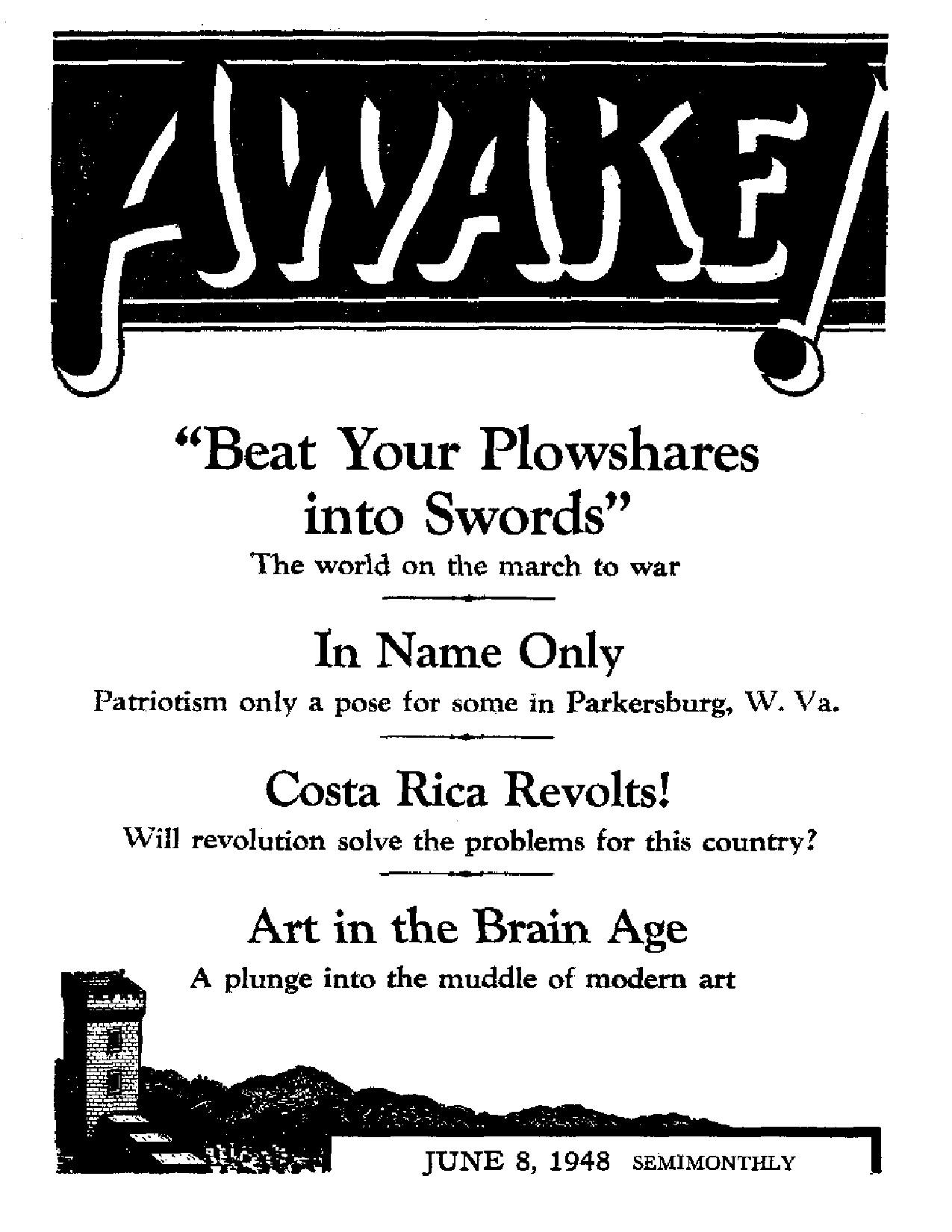
Beat Your Plowshares into Swords”
The world on the march to war
In Name Only
Patriotism only a pose for some in Parkersburg, W. Va.
Costa Rica Revolts!
Will revolution solve the problems for this country?
Art in the Brain Age
A plunge into the muddle of modem art
r iwa
THE MISSION OF THIS JOURNAL
News sources that are able to keep you awake to the vital issues of our times must be unfettered by censorship and selfish interests-“Awake!” has no fetters. It recognizes facts, faces facts, is free to publish facts. It is not Bound by political ambitions or obligations; it is unhampered by advertisers whose toes must not be trodden on; it is unprejudiced by traditional creeds. This Journal keeps itself free that it may speak freely to you. But it does not abuse its freedom. It maintains integrity to truth.
“Awake 1” uses the regular news channels, but is not dependent on them. Its own correspondents are on all continents, in scores of nations. From the four corners of the earth their uncensored, on’the- scenes reports come to you through these columns. This journal’s viewpoint is not narrow, but is international. It is read in many nations, in many languages, by persons of all ages. Through its pages many fields of knowledge pass in review—government, commerce, religion, history, geography, science, social conditions, natural wonders—why, its cover* age is as broad as the earth and as high as the heavens,
"Awake I” pledges itself to righteous principles, to exposing hidden foes and subtle dangers, to championing freedom for all, to comforting mourners and strengthening those disheartened by the failures of a delinquent world, rrftecting sure hope for the establishment of a right* eous New World.
Get acquainted with “Awake!” Keep awake by reading “AwakeJ”
Published Semimonthly By WATCHTOWER BIBLE AND TRACT SOCIETY, INC.
117 Adama Street
N. EL Knokb, President
Five cents a copy
RenlttuiCM should be sent to office In year own* try in complimce with regulations to guarantee Bife delivery of metier, Bemlttanoes are accepted at Brooklyn from countries where do office. Is located, by InterDttfanl money order only. Subscription rates in different countries are here stated in local currency. Notice of expiration (with renewal blank) Is Boot at least two law beton subscription expire*.
Brooklyn 1, N, Y., U. 8. A.
Grant Suiter, flecrefary One dollar a year
Change of tuftfren when sent to our office mar bo expected effectlTB within one mouth. Send ?ow old u well as dow address.
Offices Yearly gfabBtriptlon Bate
AiierlM, U.S.. 117 Adame St, Brooklyn 1, NJ, $1 Australia, 7 Beresford Rd., Strathfleld, N.8.W. Ba Canada, 40 Irwin Av®., Toronto 5, Ontario Enolaal $4 Craven Terrace, London, W. 2 5s South Africa, 623 Borton House, Cape Town 5s
Entered as second-class matter at Brooklyn, N. Y., Act of March 3, 1379. Printed in V. S. A
CONTENTS
“Beat Your Plowshares into Swords”
“Prepare War”
"Wake Up the Mighty Men”
"Plowshares into Swords”
Warless World to Come
Television in the Theaters
In Name Only
Fighters for Freedom
Costa Rica Revolts I
Election Results Questioned
Caines the Revolution
The Communism Issue
Sih eri a} Land of Vanishing Peoples
Conquerors and Exiles
Eighty Vanishing Races
Art in the Brain Age
Is It Art?
Demon Influence
Conclusion of the Matter
“Thy Word Is Truth”
The Christian’s Commission
at the World’s End.
Brazil Outlaws the Communists
Watching the World
AWAKE
it is high time to awake.— Romans 13:11 ft/
Volume XXIX Brooklyn, N, YM June 3, 1948 Number 11
"Beat Your Plowshares into Swords”
NEVER, not in all history, was there a time when the cry for peace was louder than it is today. The groaning masses of mankind who hate suffered and survived two global wars desire peace more than anything else. Widows, after losing their husbands in World War I, worked and struggled to raise their infant sons only to see them cut down in World War II. They hate war. Old men who returned as disabled veterans from the first world war cursed the nations when they rearmed for the second all-out death struggle. They abhor war. Innocent children, young men and fair maidens who never tasted the bitter waters of the first global war were baptized in the raging seas of the second. They detest war. Not only from the lips of these crippled casualties of former wars, but also from those who yet have their youth and vitality, comes the united, plea for peace. It is not an exaggeration to say that more than ninety-nine percent of the people hate war for what it is, desire peace, and long to see the final beating of “swords into plowshares”.
In the face of these facts is it not indeed strange to see the whole world preparing for war on a greater scale than ever before? The banner of philosophy that is held high today, not so much by the warmongers as it is by the peace planners, is this: “If we want peace we must prepare for war.” What a paradoxical and contradictory situation I The most fearful and frightened ones that cry the loudest for peace are also the ones that are the most hysterical about all-out preparation for war. Devout lovers of peace become bewildered. A feverish frenzy overtakes them. The rising tide sweeps them along. And, as if some unseen Satanic force were behind them, they find themselves pushing the “preventive war” program to the limit. Everywhere and from all quarters come the screaming proclamations: “Prepare for war! Wake up the mighty military men! Give the youth universal military training 1 Mobilize the manpower! Draft industry 1 Stock-pile resources! Push scientific research, and develop new and more terrible weapons! This is the road to peace!”
Instead of this being the road that will ultimately lead them to the good end of fulfilling the Bible prophecy of Seating swords into plowshares’, as they claim, it sweeps them along another road, to the fulfillment of an exactly opposite Bible prophecy:
Prepare war, wake up the mighty men, let all the men of war draw near; let them come up: BEAT YOUR PLOWSHARES INTO SWORDS, and your pruninghooks into spears: lei the weak say, I am strong. Assemble yourselves, and come, all ye heathen, and gather yourselves together round about.—Joel 3:9-11.
In December 1946 the General Assembly of the United Nations adopted a disarmament resolution. But that is as far as the matter went. People ask why. It is a time to prepare for war, and mighty unseen forces have been at work to prevent disarmament. Take, for example, the United States. Pressure from public opinion caused the discarding of many engines of war and battle wagons, and the discharging of many troops, during the first few months after hostilities ceased. Now we are told that this was a mistake. Rearm! is the cry.
In March of this year the stage was set for an all-out drive. The air was heavily charged with electrical tension. The “war of nerves” had seen to this. Too, a highly secretive meeting on March 11-14 was held at Key West, Fla., where the august personages of the joint chiefs of staff discussed plans for the future conduct of wars. An emergency was at hand. A ''great crisis” had arisen. A “fateful” hour. What next? The suspense was terrific 1
An announcement. The president of the United States would address a joint session of Congress on March 17. The night before tension was further increased. The president was holding intensive meetings with members of his cabinet and his top advisers on foreign affairs. And, as if to temper the House of Representatives for the blast that would fall upon them the next day, the speaker of the house, Martin, on March 16, declared:
We must build up our military and naval establishments. We must build and main tain a mighty air defense. We must have the strongest navy on the seas. We must make ourselves absolutely supreme in the air and under the seas. In this issue, where the fate of civilization is at stake, we must spare no effort to be sure of the outcome.
“Prepare War”
‘7 am here,” Truman began, “to recommend action.” He was speaking not only to the joint session of Congress but to the greatest invisible radio audience assembled since V-E day. Continuing, Truman said that although nearly three -years had passed since the end of the last war “peace and stability have not returned to the world”, in spite of the fact that “conference after conference has been held in different parts of the-world”. Therefore, he was now recommending “action”. “Time,” he said, “is now of critical importance.” Once launching this “guided missile”, it was now time to explode it where it would do the most damage to the road block that had obstructed military preparation. Pulling the fuse, Truman demanded both “prompt enactment of universal training legislation” and the adoption of an emergency draft. Then, as if to add powerful logic to the initial puff of oratory, frightened Truman said: “We have learned the importance of maintaining military strength as a means of preventing war. We have found that a sound military system is necessary in time of peace if we are to remain at peace.” And, furthermore, “We cannot meet our international responsibilities unless we maintain our armed forces,” he said. In conclusion, Truman again rang the alarm bell in an effort to arouse the lawmakers to the necessity of preparing for war: “The recommendations I have made represent the most urgent steps toward securing the peace and preventing war. . . . With God’s help we shall succeed.”
While Truman, in his speech, did not declare war on Soviet Russia, or proclaim a state of emergency, the effect was almost the same. Rushing from the chambers of Congress, Truman flew to New York, where he reviewed a “St. Patrick’s” parade, and made another speech, which was a repeat performance of the one given before Congress. Meantime General Marshall, the secretary of state, was pushing the campaign on another front. In less than two hours from the time Truman shot off his volley in
Congress, Marshall was firing another into the Senate Armed Services Committee, in which speech he said bluntly: “Diplomatic action, without the backing of military strength in the present world, can lead only to appeasement.”
The switch had been thrown, and across the, nation and in the capitals of the world the editorial rooms of the publicity agents were again buzzing with the same activity that won them medals in World War II. The press and radio machines ground out their inflammatory propaganda at high speed. “The nation,” said the Minneapolis Tribune, “needs to strengthen its armed forces with men trained and available for services where-ever needed." Wrote The Constitution of Atlanta, Ga.: “We believe the Congress should unite for the emergency as it did in war, and that we should prepare the, nation with all necessary weapons and research.” “Perpetual and invincible readiness for war appears to be our current destiny,” said the Seattle Times. “The tide is running fast in world affairs,” is the way the New York Times put it; hence, “we can ride it or be overwhelmed by it. The choice is ours to make.”
The louder one shouts in a dank, dark cavern the louder and more numerous the echoes. This is the principle that explains why the repercussions from the March 17 explosion are still heard around the world. Big voices, like those of the former associate justice of the supreme court, Owen J. Roberts, and Dr, Karl T. Compton, president of the Massachusetts Institute of Technology, boomed forth urging universal training. Presidential aspirant, Governor Thomas E. Dewey, echoed that there should “be an immediate and large increase in our air forces". Senator Taft, another presidential hopeful, urged rearming the nation for defense. The former secretary of state, James F. Byrnes, crying out for rearmament, asked: “Are we going to prepare?” In answer he moaned: “I hope so. I pray so.” Joseph C. Grew, former undersecretary of state, striking a pious posture with folded hands, sighed: “Let us pray to Providence . . . that the rebuilding of that military power will not come too late.” One of the huskiest voices heard croaking for military preparedness is that of Bernard M. Baruch, who outlines the following system for immediate adoption:
A system of industrial mobilization with priorities, allocations, and rationing powers; a ceiling over all prices, wages and rents, to prevent inflation; taxation to take the profit out of war; the accumulation of strategic raw materials which may he lacking or in short supply; a work-or-fight wartime draft; the organization of pools of labor of all kinds and in all professions and sciences; intensified scientific research; .expanded intelligence and information services; retention of war plants in stand-by readiness; the decentralization of industry to guard against an over-concentration which could be a strategic liability; up-to-date surveys of underground industrial facilities,
“Wake Up the Mighty Men”
“Prepare war.” The peril is great. Action, and that quickly. There is no time to lose. Arouse the leaders, not only in the political, but also in the commercial, religious, educational and social fields. Wake up the mighty military men. “Let all the men of war draw near.” War, war, war, and still more war! That must become the fear and the talk of the people. Call in the propaganda boys and let them advertise it. Sell this idea to all lovers of peace! Whoop it up loud and long, and they will expect war in a matter of months or, at the most, within a few years.
And so it is, from every source great torrents of war talk have poured forth to drown and wash out opposition, and to carry before it the masses of people and their public opinion. Books are written to arouse the people. Full-page advertisements are carried in leading newspapers, advocating military preparedness and supremacy, not only on land and sea, but also in the air. The ether waves of radio are likewise used to bombard the eardrums with the same ballyhoo. Those that refuse to be awakened by this noisy flood of talk and publicity are dubbed, to quote the Washington Evening Star, “sleepwalkers.”
But the patriotic organizations will show the world they are no sleepwalkers. They hear Truman’s bugle call for action, and so they are among the first to climb on board the bandwagon by adopting resolutions, circulating petitions and, in other ways, advocating rearmament and universal military preparedness. The American Legion, the Jewish War Veterans and others, to hear their official leaders tell it (for the rank and file have no say), are taking the lead in crying “Wolfl Wolf!” Right behind them come other chorus boys singing the same refrain. The New York State Association for Health, Physical Education and Recreation calls out for “preparedness for the preservation of national security”. Columbia University Professor George S. Counts avers that democracy must “marshal all of its moral and intellectual resources” if it hopes to survive, since “education is a weapon”.
The “mighty men” that wear the consecrated garb of religion are also awakening, as the trumpet call for war continues to sound. Beating their breasts with a great outward display of loyalty, they endeavor to mobilize their following. Five clergymen make a big splash on the front page of the San Francisco Examiner, declaring, in the words of one of them: “The purpose of universal military training is to prepare to prevent war.” All of them were in favor of the military program. The day after Truman’s “preparedness address”, under the headline “Vatican Acclaims Speech of
Truman”, the New York Times reported : “Rome, March 18—L'Osservatore Romano gave today wholehearted approval to President Truman’s speech.” Hailing the' speech D'Osservatore Romano said it was a “political ultimatum” that may “usher in a new prewar phase consisting of war-like mobilizations and preparations”.
When it comes to slinging the showy oratory none seem more qualified than Cardinal Spellman. In the presence of Truman and other dignitaries who attended the St. Patrick’s day assembly, distressed Spellman relieved himself of the following:
I hate war. And it is because I do hate war that I must put my trust in- men who know better than I the dangers that beset America; and, if these men chosen by the vote and confidence of the American people believe preparedness will prevent war, then I, who love America better than I love my life, cast my vote, as a private American citizen, for universal military training.
Brass and Braid Do the Bossing
Being a time for preparing war, the Big Brass has moved in and taken over the reins of government policy. Not in numbers, but in key positions graduates of the military colleges 'are able to muster the military strength of the nation. A new secretary of state is needed; General Marshall, army chief of staff, takes over the job. He is given a medal, declaring him “at the helm in peace as in war”. And, as a publicity stunt, he is photographed on bended knee at a Catholic mass. A super military boss is needed. No trouble, just create a new cabinet post and put James V. Forrestal in it, with the title “secretary of defense”. Under him many militarists find jobs in key positions in the government—planning, policy, organization, operation. Ambassadors are needed. Send Lieut. Gen. Walter Bedell Smith to Russia, Brig. Gen. Frank T. Hines to Panama, Gen. Thomas Holcomb to South Africa, Adm. Alan G. Kirk to Belgium. Governors of occupation are needed. Send Lieut. Gen. Lucius
D. Clay to Germany, Lieut. Gen. Geoffrey Keyes to Austria, and Gen. Douglas MacArthur to Japan. Special missions are needed to investigate and advise in different theaters. To do this job some thirteen military missions are scattered throughout South America, besides those in Greece, Turkey and other countries in Europe and the Far East. Other Brass and Braid march under other civil titles, as, for example, Robert Pell of the war department goes along as an “adviser” with Myron C. Taylor when he pays a social call on Franco and Pope Pius. These, of course, are very few of the expanding list of military “Who’s Who” who are in the saddle now running the government
“Plowshares into Swords’*
And why are all the mighty military men taking the lead ■ in the open field of govern-
K^HagBrnent? Are they out there KBBSjl leading a clean-up campaign, gathering up all the broken swords of past battles in order that such may be beaten into peaceful plowshares? They are in a scrap-iron campaign all right, but it is one that is gathering the plowshares in order that they may be forged into new and more terrible weapons than heretofore seen on any battlefield. But don’t worry, we are told they are weapons of peace. Why, who would dare think otherwise after what the propaganda agencies have told us?
The war plants may have shut down after World War II, but that, it seems, was only to allow them to retool. Research and experiments with new weapon models have been going on apace, and now, with the stepped-up program for rearmament, Congress is asked to appropriate billions, not millions but billions of dollars, for the production of these weapons. As matters now stand $46,000,000,000 is asked for military purposes for the next three years 1 Two hundred government war plants are to be 'reconditiohed**just in case”. A survey of 22,000 other plants is now being made to alert them for a moment’s change-over.
Super aircraft carriers displacing 80,000 tons are in the offing. Super-subs are an accomplished fact. They can carry airplanes and launch guided missiles on the high seas. And they will have a speed heretofore unknown. And then there are the heinous weapons which employ deadly bacteria and special strains of virus for the use in “BW” (bacteria warfare). “A" is for atom, this military age teaches, and the ‘■piece-makers” love to play with them. And so they are making “bigger and better” A-bombs. And A-clouds, also. If you have not heard, atom clouds are radioactive and are said to be more deadly than the atom bomb. A pleasant peace thought! But those of the “old school” who love their TNT are now dropping 42,000-pound bombs experimentally in California, just to see what happens. Other busy military boys are testing out sound waves that produce such intense heat that it is “hoped” they will be able to kill humans. The research and pro-, fession al services of the universities are being subsidized and bought out by .the War Department in its effort to mobil-
< ■ 2x ize all the scientific, education-al and experimental facilities in the country. Aircraft pro-JEL duction is to be trebled under the new program, and work on W guided missiles and atomic en-ergy is to be pushed.
The United States is not rearming in order to conquer the world. Not at all. The whole world is rearming. It is a race, not to see which nation wins by getting ahead, but rather, we are told, it is a race to see which nation loses by failing behind. Consequently, the nations of this wicked world are united in becoming a “one world” army camp.
Five nations sign Europe’s postWorld War II military alliance: Belgium, France, Luxembourg, Netherlands and Great Britain. Poland, China, Greece and France pass draft laws. In fact, while the United States debates the issue, universal military training is practically “universal" in Europe. Tension grows. Sweden, Canada and France step up their military preparedness programs. Britain too is concerned. More arms are asked for Greece, Turkey and China. Argentina gets the jitters and orders 1,000 more planes. Italy, spoiled by the war, is now rebuilding her navy. And every one knows the mighty men of Moscow are awake and in the race. 'One report says Russia’s war production is now turning at the 1940 speed. Another report says she is spending oneeighth of her gross income for defense, to compare with a U. S. A. expenditure of one-sixteenth for the same purpose. There is even talk of giving the United Nations a military horse, called a “foreign legion”, so it can compete with the others in the race.
War I ess World to Come
It is all as foretold: "Assemble yourselves, and come, all ye heathen, and gather yourselves together round about.” (Joel 3:11) It is exactly as foreseen by the apostle John (Revelation 16:13-16): "Ana i saw ruree ’unclean spirits like frogs ... for ; they are the spirits, of devils, working1 miracles, which go forth unto the kings of the earth and of the whole world, to gather them to the battle of that great day of God Almighty. . . . And he gathered them together into a place called in the Hebrew tongue Armageddon.”
In this prophecy of Revelation is revealed the inspired talk mustering the world for war. The peoples of earth do not want it, yet propaganda or “unclean spirits” issued by the organization of Satan the Devil, the “god of this world” (2 Corinthians 4:4), move the leaders of this world’s visible organizations toward total war. Actually, they herd the nations toward a clash with God on the battlefield of Armageddon. There all militarism will end, along with visible and invisible wicked ones, including man’s chief enemy, Satan.
Thereafter, under the righteous rule of God’s promised. Theocratic kingdom the survivors will finally beat “swords into plowshares” and “spears into prun-inghooks”, for “nation shall not lift up a sword against nation, neither shall they learn war any more”.—Micah 4: 3.
television in the Theaters
On the evening of April 14 a surprised audience at the Paramount theater, Broadway and Forty-third, saw a “sneak preview” of television on the motion picture screen. Three rounds of boxing were televised from Brooklyn to the top of the Daily News building on east Forty-second street, then relayed to the top of the Paramount building. Paramount has a special film recorder that almost instantly transposes television reception onto the standard 35 mm, film used in the usual motion picture projection machine. From the time a punch was swung in the Brooklyn fight ring till it was seen on the Paramount screen, only 66 seconds elapsed. The pictures on the screen were for the most part of good definition and brightness, with only slight fuzziness noticeable onee or twice in one corner of the screen. The expressions of the fighters were clearly conveyed on the large-size images, 18 by 24 feet. Paul Raibourn, in charge of Paramount’s television activities, hopes to regularly pick up news events, and possibly even make a bid for theater televising of the coming Louis-Wolcott heavyweight championship bout.
a
Q
> IM NAME ONLY
Hypocrisy is hated by all honest men. But hypocrites often gain the approval of honest men deceived by a camouflage of words. Some hypocrites are such by deliberate design. Others are blind to their own hypocrisy through ignorance of the inconsistency of their words and acts. A loud tongue is often proved a lying tongue by the acts of the one who wags it. This was illustrated in the United States during the month of April, when self-proclaimed Christians and patriots performed acts that called them hypocrites instead.
Attention settles on Parkersburg, West Virginia. There twelve war veterans’ organizations are represented by a Veterans Council, chairman of which is R. Tracy Evans. Evans declared that the Veterans Council represents 6,000 veterans in that vicinity. Through their mouthpiece Evans the organization makes loud claims of Americanism and boasts of its religious tolerance.
Now there looms up on the local scene an event that calls for protest and action by patriotic persons, according to the Veterans Council. Jehovah’s witnesses, Christian ministers, are to meet there on April 23-25, and arrangements provide for their meetings to be held on Friday and Saturday and Sunday morning in the Y.M.C.A., and on Sunday afternoon in the Jefferson school auditorium. But to allow to this minority group-freedom of speech and worship and assembly would be unpatriotic, according to R. Tracy Evans, Veterans Council chairman. Hence he took what he considered patriotic steps to choke off these freedoms for this particular minority.
The Veterans Council through Evans protested to the Y.M.C.A. for allowing Jehovah’s witnesses to meet there, but the pressure methods did not intimidate the general secretary of the Y.M.C.A. Nor did they work when applied against superintendent of schools Lloyd H. Wharton, when Evans protested to him about Jehovah’s witnesses’ use of the Jefferson school auditorium for the Sunday afternoon public Bible lecture. According to the Parkersburg Sentinel, April 24, Evans stated:
The Veterans Council is definitely opposed to the use of this public school by any organization that would not put the welfare of its country above that of its own group in time of peril to, the nation. Members of this group preferred to spend their time in the safety of claiming to be conscientious objectors while other able-bodied men spent their time on the battle, fronts of the world. Any idea of religious intolerance in this matter is out of the question, because every religion is represented, except Jehovah’s witnesses, in the 12 war veterans’ organizations in the city.
Perhaps Evan’s patriotic hypocrisy comes through ignorance rather than design, since his statement is contrary to fact. Jehovah’s witnesses did not put the welfare of their group ahead of the country’s good, but they put God’s cause first. The most that an honest person might say was that the Witnesses put God ahead of the country. Any Christian would, when confronted with the choice. But even this would not be the true fact in this instance. The draft law of the land exempted ministers. Jehovah’s witnesses are ministers. They .were law-abiding in claiming exemption as ministers. The lawless ones were those that tried to force them into the army when the draft law of the land exempted them. When Evans speaks of Jehovah’s witnesses as claiming exemption as conscientious objectors he errs again, since their claimed exemption was based on the ministerial status, Andhe displays pathetic ignorance in logic when he seeks to'eliminate any charges of religions intolerance by claiming that every religion (a slight exaggeration?) is united in opposing Jehovah’s witnesses on this matter. If true, all this would logically prove is that religious intolerance was unanimous.
But the facts argue that feeling against Jehovah’s witnesses was not so unanimous as Evans claimed, not even among the 6,000 veterans he represents. Even by radio his call went out to the community: “We want a mass meeting, a general muster of all veterans in uniform at Jefferson school at 1:30 p.m,” But on Sunday afternoon only a handful of rabble appeared in answer to their master’s voice. Local papers estimated 60 servicemen present, some uniformed, some in caps, some carrying flags. Sixty out of 6,000. Not very unanimous.
Hundreds of townspeople gathered near by as curious onlookers. Tenseness increased as the Witnesses began arriving at 2 o’clock. Observers saw them walk the gantlet of veterans that lined both sides of the path leading into the auditorium. They heard Evans rouse the rabble to a higher pitch, by means of sound-car equipment. They heard the strains of “The Star Spangled Banner” played from the sound truck, and the taunts hurled at the Witnesses as they passed into the building. Cries of “Send them back to Russia" reflected the typical stupidity of the mob mind. The onlookers saw the first violence when a trouble-maker struck a young lad on the chin. They saw others slapped and cuffed about, and Bible literature snatched from the Witnesses’ hands and burned. The climax came when those carrying flags marched from the' entrance shortly be-
rore a o'clock. This was apparently the signa! for the attack, as the11 mobsters surged forward with cursings and shouts that they were coming in. But the hundreds of observers saw a small squad of Witnesses block the door and beat off the attackers. Into this melee of flying fists some 25 policemen flew to completely scatter the attackers. Some of the servicemen were treated for minor injuries at the hospital. Their putsch failed.
After seeing and hearing the excitement outside the auditorium, the curious ones that had gathered, now over 1,000, heard the hour-long Bible lecture by means of a loud-speaker placed on the building for their convenience. Inside more than 500 other persons listened. The outcome was that more heard because of the opposition than would have without it. The gospel message was furthered. With the apostle Paul, each Witness there can joyfully say: “The things which happened unto me have fallen out rather unto the furtherance of the gospel.”—Philippians 1:12,
Fighters for Freedom
Though the “things which happened” furthered the gospel, they did not advance American ideals. They constituted an assault upon freedom. But this initial assault was commendably turned back by superintendent of schools Wharton, who refused to break the contract with the Witnesses to eater to those that lipserve civil liberties while fighting against them. Also standing fast for freedoms was the general secretary of the Y.M.C.A., Walter Helfer. In the Parkersburg News, April 25, he stated:
Armed veterans withdraw the colors, preliminary, to the rush by veterans to storm the meeting inside
“We’ve had other church groups here, and the Watchtower Society is holding its meetings just like any other group. We must be tolerant,” the general secretary continued. “This is a free country, and if we can’t stand people who don’t think like we do, we might as well close up. The Quakers and a good many ministers don’t believe in war and are not persecuted.”
The Y.M.C.A. general secretary described the family groups of men, women and children as one of the best-behaved assemblies ever to meet at the Y.M.C.A., and stated flatly : “I have no apologies for allowing them the use of the W’ facilities. I assume full responsibility, and would do the same again under the same circumstances." .'. . "I believe this action of the veterans is very un-American. First we should be Christian in our own actions.”
That, statement was made before the violence of Sunday. Afterward he expressed doubts that Evans “speaks for the majority of the veterans’ organizations”, adding: “What was done Sunday was mobocracy and not democracy.”
Walter Helfer’s doubts about Evans’ speaking for the veterans’ organizations seem well founded. The Amvets Post No, 19, on April 26, passed by a large majority a resolution “unequivocally condemning the attitude and actions of certain so-called veterans and their selfappointed leaders at the Jefferson school yesterday”. It declared that such methods are “in the best tradition of the police state, and make the ‘American way1 a mockery”.
Apparently some American Legionnaires were present to help break up the meeting on Sunday, but if they were it was not as representing Parkersburg Post No. 15 of the American Legion. At the earnest opportunity tms r'ost aiso adopted a resolution. Its preamble declared righteous and lawful principles of liberty and then condemned “certain individuals purporting to represent the Wood County Veterans Council” that voiced threats and later, on Sunday, April 25, “did perform and act in a manner most disgraceful.” This Legion Post “did not approve, sanction, ratify, or confirm any of the acts taken” and “none of its members took part therein, on behalf or under the authority of the American Legion”. In concluding it said: “Now, therefore, be it resolved, that the members of Parkersburg Post No. 15 of the American Legion deplore the entire incident.”
No hypocrisy in these words. They were backed up by vigorous action. During May, by ballot, R. Tracy Evans was ousted as head of the Veterans Council.
Recall that Evans claimed to be backed by “every religion” except Jehovah’s witnesses m his fight against freedom'? He again took too much for granted. On May 4 an alliance of ministers of Parkersburg and Wood county adopted a resolution' accusing the veterans of disturbing the peace and, by their methods of intimidation and violence, flagrantly violating the Constitution and using police-state tactics. The resolution did “emphatically condemn as unwise and un-American any and all efforts by any person or group of persons to take the law into their own hands”.
Certainly deserving of commendation as fighters for freedom are Chief of Police Joseph Beckett and the some 25 officers present. They knew of the activity of the agitators, and they came prepared to frustrate any un-American action. They did just that. In addition to the uniformed officers, it is reported that there were some 30 officers in plain clothes mixed in the crowd at the close of the meeting, to quell any violence that might be attempted then. The chief of police is reported to have said: “The way it is written in my book everyone should have the privilege of worshiping God according to his belief, and I wanted to see that these people did just that.”
Jehovah’s witnesses do not hold any feelings of bitterness against the people of Parkersburg. As a whole they seem to be for freedom. Their officials represent well their interests in that freedom. The school board and superintendent honor contracts, the Y.M.C.A. does not capitulate to threats and pressure, the police force not only speaks but acts for civil liberties, the ministers of the community have a true concept of freedom of worship and stand fw it, and it is evident that as a whole the veterans’ organizations thereabouts do not believe in running roughshod over peaceful assemblies. R. Tracy Evans and a scattering of rabble seem to stand alone in their devotion to methods of threat and pressure and mobocracy.
Cowardice and Injustice
But Evans boasts that the cowardly fight against freedom will continue. We say “cowardly’ because after fomenting the minor riot he sought to disclaim responsibility for it, in the following statement: “The demonstration this afternoon by the Veterans Council terminated with the withdrawal of our colors from the school property. The Veterans Council does not feel responsible for any altercation that may have taken place after the withdrawal of our colors.” (Parkersburg News, April 26) He would not stand behind the few he could push into the front-line fight. That the fight was to continue is shown by Evan’s statement that the Veterans Council would push for the resignation of superintendent of schools Wharton and Y.M.C.A. general secretary Helfer. Will the people of Parkersburg allow this frustrated fanatic’s venom to be thus turned on the two who stood for freedom?
If so, injustice greater than that committed on April 25 will be wreaked. Greater, for instance, than that perpetrated against the school janitor, who was beaten by hoodlums when he came to lock up for the night, after the meeting. Greater, even, than the riling attack by bullies on the person of Charles William Taylor, 23-year-oid navy hospital-man first class. lie merely went to the auditorium to pick up a passenger, but this holder of two purple heart decorations'for landings at Saipan and Iwo Jima was whisked off to the outskirts of town in one car with two other carloads of “veterans” following. His protestations that he was no Witness hut a navy man failed to penetrate the foggy-s brained “patriots”. Seven men crowded around him after he was taken from the car. The first blow came from behind. After all, there were only seven to face this one “Witness”, as • they thought. Blood spurted over his face, memory dimmed. He was hurled over a fence after the beating, with this parting threat ringing in his ears: “Next time you’ll end up with a 38 in your head!” Evans, of course, also disclaims responsibility for this. He took no part in the explosive violence. He just lit the fuse. Why, he is super patriotic! He says so. And he overflows with religious tolerance. That direct from his lips, also.
Lips and tongues can turn out smooth speeches that tickle ears and deceive many minds, but actions out of harmony with such mouthings only show up hypocrisy. Those whose words and actions do not match harmoniously should take stock. Is it through ignorance, a blindness to the inconsistency of word and act? Or do the words slide out in deliberate design to deceive, to sugar-coat a reprehensible act? Are thosb that laud American ideals with their lips but trample them underfoot by their acts Americans? In name only. And those that say “Lord, Lord” with their mouth but fail to do His will, and oppose Bible meetings and act as Christ Jesus never did, are they Christians? In name only. —Matthew 7:20, 21; 15: 7, 8.
tfORAUp! Fraud I” was the
J? recent cry of the National Republican party in Costa Rica. The cry came when its candidate, former President Rafael Angel Calderon Guardia, lost the February 8 election to the candidate of the National Union party, newspaperpublisher Otilio Ulate Blanco. According to the of- «
ficial count Ulate ./iSj
had won by a mar-gin of 10,000 votes. However, the official party claimed that there had been frauds committed at the polls and that many of the voters supporting the government’s candidate had not been able to cast their vote. Added to the cry of “fraud”, parades were organized by Dr. Calderon’s party members, these augmented by Vanguardia Popular, Costa Rica’s Communist party, headed by Congressman Manuel Mora.
Election Campaign
Much name-calling and mudslinging was done by both sides, and both candidates, accompanied by their adherents, covered most of the republic in speechmaking tours. The strong cry of the Ulatistas was to take the grafters out of power and to put an end to communism in Costa Rica, branding the gov-ernment’s candidate as a red. On the other hand, Calderon’s party was accusing the opposition of being a capitalist’s party and that it was their aim to oppress the working class and to destroy all legislation that was in favor of labor. The high point of the campaign came on January 25, when the Calderonistas came into San Jose from all corners of the country, by train, bus and any other means by which they could be brought in, for this final manifestation. The Calderon party leaders called it a huge success and plastered the city with posters
stating that Calderon was ‘God’s choice because he was the people’s choice’. The opposition accused them of having used trick photography in making up the foto of the group at the end of their parade in “Plaza Viquez”, where the speeches were made.
Election day, Sunday, February 8, came and the Costa Rican voters went to the polls. The election was quiet and both parties stated that it had been the most peaceful one in twenty-five years, and that it had been free of government influence at the polling places. Early reports gave Dr. Calderon the advantage, and between announcements cheering of the official party members at the president’s house came in clear over the radio as the announcer read the telegrams coming in from the electoral tables in various parts of the country, Monday, when more results came in, the margin was in favor of Ulate, and with the final count Ulate had a margin of a little over 10,000 votes, having carried San Jose Alajuela, Cartago and Heredia provinces; while Dr, Calderon carried the other three, Puntarenas, Guanacaste and Limon.
Election Results Questioned
The Calderonistas, however, would not admit defeat and kept up their campaign cry of “Calderon Guardia sera presidente" (Calderon Guardia will be president). The government radio as well as the communist station urged their supporters ‘into the streets’ to ask for a new election, "Queremos votar” (we want to vote) was all that Could be heard from the demonstrators, both men and women. All the while the electoral board was reviewing the results, so they could give their final decision before Congress met on March 1. When the decision finally came the three-man board could not come to a unanimous agreement, two of them declaring Otilio Ulate Blanco president-elect, while the third said he could not agree with his colleagues, because the time had been too short to give the ballots the proper scrutiny. This gave the government the loophole it needed.
This one dissenting vote was sufficient to fan even higher the fast-growing flame of antagonism, causing it to encircle the entire country. There were more demonstrations on the part of the Calderon supporters, these being urged on by frenzied radio announcers. It must be said of the Ulate radio propagandists that, quite to the contrary, they insisted that their supporters stay at home, celebrate the victory indoors and not antagonize or dispute with their provocators. However, over the air both sides kept the air waves hot with their insults of each other.
On March 1, then, Congress convened to settle the issue of whether the election of February 8 had been legal. The Calderon party had the majority in Congress, counting the Communist or Van-guardia Popular deputies that would continue supporting the government candidate. The debate was heated and the gallery was full of government backers. When a C alder onista spoke they cheered, and when one of the opposition deputies rose to speak he was booed, so that he could hardly be heard when he shouted into the microphone. Finally, the Communist leader, Manuel Mora, and one of his colleagues, the Communist deputy from Puntarenas, took the floor to quiet the spectators so that they themselves could hear their opponents arguments. Slowly the noise abated and order was restored. When the final vote was taken the election wag declared illegal by a vote of 19 to 27. Of the nineteen, four were Calderonistas who had voted not to annul the election, including the president of Congress.
This action of the leftist majority in Cpngress gave the green light to the government forces and the Communists, already armed and patrolling the streets of San Jose. Homes and business places of the Ulate party members were searched for arms, and where none were found other articles of value were taken. One such attempt was made on the home of a famous San Jose physician where Ulate had taken up his headquarters. The house was surrounded by government troops and the occupants of the house were ordered to open up to them. When they refused two soldiers were ordered to go over the wall fence; these were shot down, and then the shooting began in earnest. The result was that the doctor wms critically wounded and American and British diplomats, along with the archbishop of Costa Rica, came to the rescue of Mr. Ulate and the wounded doctor. The doctor was carried to the hospital, where he died several days later, and Mr, Ulate, with some of his closest party members, was taken to jail, but released the next day.
Comes the Revolution
The doctor’s death set off the fuse in the opposition ranks, and. uprisings were reported in various parts of the country. The main one, and the one that has turned out to be the revolt, tcfok place in San Isidro de General at the end of the Pan-American Highway to the south of San Jose. The opposition forces took over the airport at San Isidro and from there began to move in toward the capital. When government forces went in to halt them, the opposition forces under Jose Figueres threw up a road block of highway machinery, and the two forces shot it out.
Mo one knows how many men Figueres lost. Early in the revolt the govefn-ment lost three of its generals, said to have been riding along in Figueres’ section in a jeep. The estimates for all men dead run into fantastic figures; however, fairly reliable sources give the number of dead around 1,000. There is no way to know the exact , number, as military censorship does not permit any data to be published.
The clergy have had a strong hand in the politics here, and precisely when the archbishop with representatives of the candidates as well as with Communist representatives were negotiating to put a third man into the presidency is when the(revolt broke out in San Isidro. There were several day and night sessions, but it seems that they could not make any agreement that would satisfy both parties. The clergy’s meddling in politics has not had the approval of many Costa Ricans, and especially since Archbishop Sanabria came out in favor of Ulate after the election, after having been a Calderon supporter. One head of a San Jose family said he was prohibiting his family from ever returning to the church. Some high church officials upheld the archbishop’s stand and others of the clergy have flatly denounced it; thus it is seen thgit they are ‘a house divided’, and instead of uniting the people they tend to cause even greater divisions among them.
When the revolt broke out all constitutional guarantees were suspended and a military censorship was put on all correspondence. Truck loads of “recruits" went up and down the streets with rifles, looting at will. Private homes continued to be searched, and arrests made. Looting became so bad that recently Van-guardia Popular came out in La Tribuna with an announcement denouncing such vandalism and at the same time stating that such treatment w’as an abuse of authority or even lack of authority. They asked punishment for those thus disgracing their uniform.
Soldiers and Supplies
Many of the recruits sent to the front had never had a rifle in their hands before, much less any training in warfare. They were picked up off the streets and piled into trucks or buses to be taken to the front. Those that refused to go were taken to jail. The first ones the government put into service were the wharf hands from the Pacific ports. For night guard duty in the city, postal and other government employees were put into the service. One postal employee remarked that he was doing guard duty from eight to five and taking care of his work at the post office during the day. He also confided that the oppositionists outnumbered the Calderonistas but didn’t have the arms, stating at the same time that the Communists were well armed and that they knew how to use them.
How furious the fighting was at the time no ope knew, as the official reports published did not go into detail. The region where the fighting took place is mountainous and wooded. The reports that filtered in and that were heard on the street showed that the Figueres forces fought guerrilla style. Another disadvantage to the government forces was the fact that its mariachis (men in arms, not regular soldiers) were mostly from the low tropical coastlands; and in the mountainous region, some 10,000 feet above sea level, the extreme cold'was hard on these men from the very hottest regions of Costa Rica. Most of them are without shoes and have only light clothing.
To supply some of the needed food and clothing for its men, the government requisitioned these provisions from the local businessmen. This was being abused greatly and a government order was published to the effect that no merchandise was to be given over unless the one asking for it had the proper papers ordering such supplies. However, most people don’t argue with them when ft truck load, armed with rifles, pulls up and sends in a spokesman to ask for what they want. When asked where the authority is, the rifles are pointed to as being sufficient. Many of the trucks and buses which are used for transportation of government troops were gotten in the same way, either requisitioned or taken. The owner of a bus line operating in the city went to see about two of his buses that had been taken over, and as a result he spent several days in jail.
With the military censorship all opposition radio stations and newspapers were closed down, including Ulate’s Diario de Costa Rica with its afternoon sheet La Hora. This left only La Tribuna and La Prerrsa Libre. Before the election La Prensa Libre leaned toward the Ulatistas and wag quite critical of the other side. Since censorship, however, it has, taken a strictly down-the-middle-of-the-road policy and seldom mentions present conditions, sticking mostly to outside dispatches and local news of minor consequence.
The Communism Issue
Costa Rica maintains a small army with a mobile unit; This equipment was purchased from the United States, and at the time it was brought into the country the Costa Ricans were not in favor of it, stating that it would have been better to have brought in agricultural equipment. This also leaves a bad feeling, especially since the United States is combating Communism. Those with anti-communistic feelings state that while Communism is being combatted on the home front, the Americans were arming them in Costa Rica.
This raises the dispute whether Calderon is Communist. The government newspaper in its issue of April 6, 1948, says that he is not and cites a pontifical statement approving of him, quoting from the same La Tribuna in their issue of May 8, 1943. This may be well with some, yet others remember that the Vanguardistas, parade with the Russian flag and that not too long ago this same Communist party staged a demonstration against “Yankee imperialism”, and that it lent its entire support to the government candidate, Dr. Calderon Guardia, in the past election. At present its members are armed in defense of the government.
On the other hand the government backers accuse Jose Figueres of being a Falangist and terrorist. It is on his property to the south of San Jose where the fighting broke out. According to reports he has been training men and preparing for this for about two years. He was put out of the country during the Calderon administration and then permitted to return under President Picado.
But by the latter .part of April the Costa Rican rebellion had subsided. On April 13 both sides issued cease-fire orders. On April 20 Santos Leon Herrera was installed as provisional president, till May 8, when a junta (board) would take over the government of Costa Rica. On April 24 Jose Figueres and his army arrived in the capital. A dispatch to the New York Times, dated May 7/said that the junta would be led by Jose Figueres, also in command of the army. It listed nine other departments, with 'their appointed secretaries, including “Father” Nunez, chaplain of the army of liberation, as head of the department of labor. All appointees took active part in the revolution. The junta is to rule for 18 months, with a possible 6-month extension. Thus stood matters in troubled little Costa Rica early in May.
What the Costa Ricans need is God’s kingdom; not revolutions. Many have sought it and its blessings, others are learning about it, and many are inquiring about it as they see that all this old world can offer is misery, suffering, injustice and death, no matter under which kind of established man-rule. —Awake! correspondent in Costa Rica.
TY7TTHIN the gigantic Russian Soviet W Socialist Republic (one of the sixteen Soviet states) lies one of. the strangest and most mysterious regions in the world. It is called Siberia. A strange country is Siberia, because it is so vast and cold and primitive, and yet so rich, A mysterious place it is, because the fate of some eighty peoples, most of whom have all but vanished within its borders, remains a tale untold.
Siberia begins at the boundary line between Europe and Asia, that is, the Ural mountains in Russia, and stretches eastward to swallow up the whole northern half of-the continent of Asia, ending in the Bering sea, just 56 miles short of Alaska. It is fwice as big as continental United States. Except for a southern fringe of rolling steppe, Siberia is characterized by two immense geographical zones. One is called the tundra, the other taiga. To visualize the tundra, picture a country up north of the Arctic Circle, a country of desolate wind-beaten wastes, where the temperature drops to 90° below zero (F.), where the subsoil is frozen permanently, where unending marshes remain, solid ice —except during the very short intense summers, when they burst forth miraculously resplendent with many-colored flowers : that is the Siberian tundra. As your imagination travels south below
IB E RIA
Jjand of Vanishing Peoples
the Arctic Circle, you see the tundra gradually merging into an immeasurable expanse of jungle-like forest, a forest over a thousand miles broad from east to west and interspersed with swamps as great as the seas. This forest, embracing the most colossal tract of virgin timber on earth, is the Siberian taiga. The trees are predominantly a coniferous variety, such as spruce, pine, fir, cedar and larch.
Siberia’s rivers flow north. And though they are comparatively short, as great rivers go, they include three of earth’s mightiest: the Ob, the Yenisei and the Lena. They rowel their frigid journeys through both taiga and tundra to empty into the Arctic ocean.
Siberia is rich; how rich no one knows. Such natural resources ,as its timber, iron, oil and coal are just at the stage of being sampled by the Communist regime. Its vanishing native people never troubled themselves with wealth of that kind, but pursued their primitive industries of reindeer breeding, seal hunting and fishing. There is gold along the Kolyma river, and there is coal and iron in the region of the Amur, and much oil on Sakhalin island. But such points as these mark only a few of the southern and eastern outposts of Siberia, where a lacework of industrial cities are being built to sap its wealth. As for the wealth of the interior, it remains for the most part in “cold storage”.
Conquerors and Exiles
Siberia, though twice the size of the United States, has but one-fifth the population, a total of some twenty-eight million inhabitants. At least ninety-five percent of this population occupies only a thin ribbon of land along the southern edge of Siberia, whence runs the Trans-Siberian, the world’s longest railroad. This leaves the vast Siberian interior the most desolate wilderness on earth. The majority of inhabitants are Great Russians, Ukrainians and Cossacks, who for ages emigrated across Siberia in the role of conquerors and race exterminators. These “foreigners” or siberiaks dominate the existing order of things. West from Vladivostok and not far within its borders live close to 200,000 Korean refugees who fled from the Japanese war lords who annexed their homeland in 1910. In this same general vicinity are about 30,000 Chinese who have seeped over the frontier. Then just north of the Ariiur river are about 150,000 Jews who have been collectivized into their own Jewish Autonomous ’Region. With the taking over of southern Sakhalin island and the Kurile islands from Japan, as her share of the war loot in 1945, the Soviet added to her Siberian population about 400,000 Japanese, some of whom may be repatriated or absorbed for keeps in the notorious Siberian labor colonies, along with untold numbers of German and Italian war prisoners.
But, of a certainty, these Japanese, German, Italian and other nationals do not find themselves the only foreigners in the land. A large segment of Siberia’s population are descendants of political exiles, convicts, religious nonconformists, former serfs, and other unfortunates who fell under the displeasure of the Russian czars as well as the Bolsheviks.
Eighty Vanishing Races
The conquerors plus the exiles (that is, the Great Russians, Ukrainians and Cossacks) added to the foreign prisoner populations and other exiles, are estimated to make up twenty-seven out of the twenty-eight million population of Siberia. This means that although there are some eighty native peoples of Siberia alive today, yet the remnants of all these races tolled together will not exceed one million souls.
That tells a story of race extermination that puts to shame the demise of the American Indians. In fact, some of these ancient Siberians were in all probability the ancestors of the American natives. Students of the human race generally agree that in the remote past Siberian tribesmen migrated across Bering strait, which is only fifty-six miles wide and interspersed -with islands, and gradually spread over Alaska, North, Central and South America.
Like the American Indians, the native Siberians were nomads or seminomads. They roamed over the immense, unsettled spaces of Asia, hunting and fishing and grazing their herds of reindeer on the ever-shifting pastures. Into modern times they remain the most backward of all racial groups within the Soviets. The Orochons (“deer breeders”) who dwell among the low mountain regions inland from Japan, were found by a Soviet schoolteacher to be totally ignorant of the use of such everyday items as soap, towels, beds, knives, forks, pens and pencils. Orochon children were unafraid of all sorts of wild animals, but of cows they were desperately frightened. The Oirats, the very first people met in crossing Siberia from the east, still dwell in chooms, which are cone-shaped, bark-covered tents similar to tepees. In southeast Siberia, along the coastal region of the Amur river, live the Nivki, who, if they have not changed their customs of late, still hunt with bow and arrow, and dwell
in mud huts filled with the stench of sun- J They also Runt wolves, bears and -foxes.
dried fish.
By reason of being the most backward, the native Siberians fell victims to the invading Russians and other conquering hordes from the west They were exterminated without mercy. They never had the chance to learn the ways of civilization. The proof is mutely attested to in the tiny remnants of the many tribes yet barely existent. Take, for example, the Oduls. These people, inhabiting the vicinity of the Kolyma river, were at one time so numerous that there was a saying that “the smoke of the Oduls’ bonfires hid the twinkling of the stars”. Today not more than 500 Oduls remain in the land of the living. Poverty and famine at times drove the Oduls. to eating larch wood,, and such things account for many of them perishing but there are gold deposits along the Kolyma river, and that accounts for the Oduls’ troubles too. And then there are, or were, the Ainu. These natives of southern Sakhalin island were once so numerous they occupied most of Japan proper. Today only a few thousand Ainu remain, about 1,000 of them living within the Siberian borders. The Aleuts, inhabiting the bleak, frigid Komandorskie islands, had been decimated by 1917 to 300 survivors.
…