Awake!, September 8, 1947
Download: PDF — Awake!, September 8, 1947
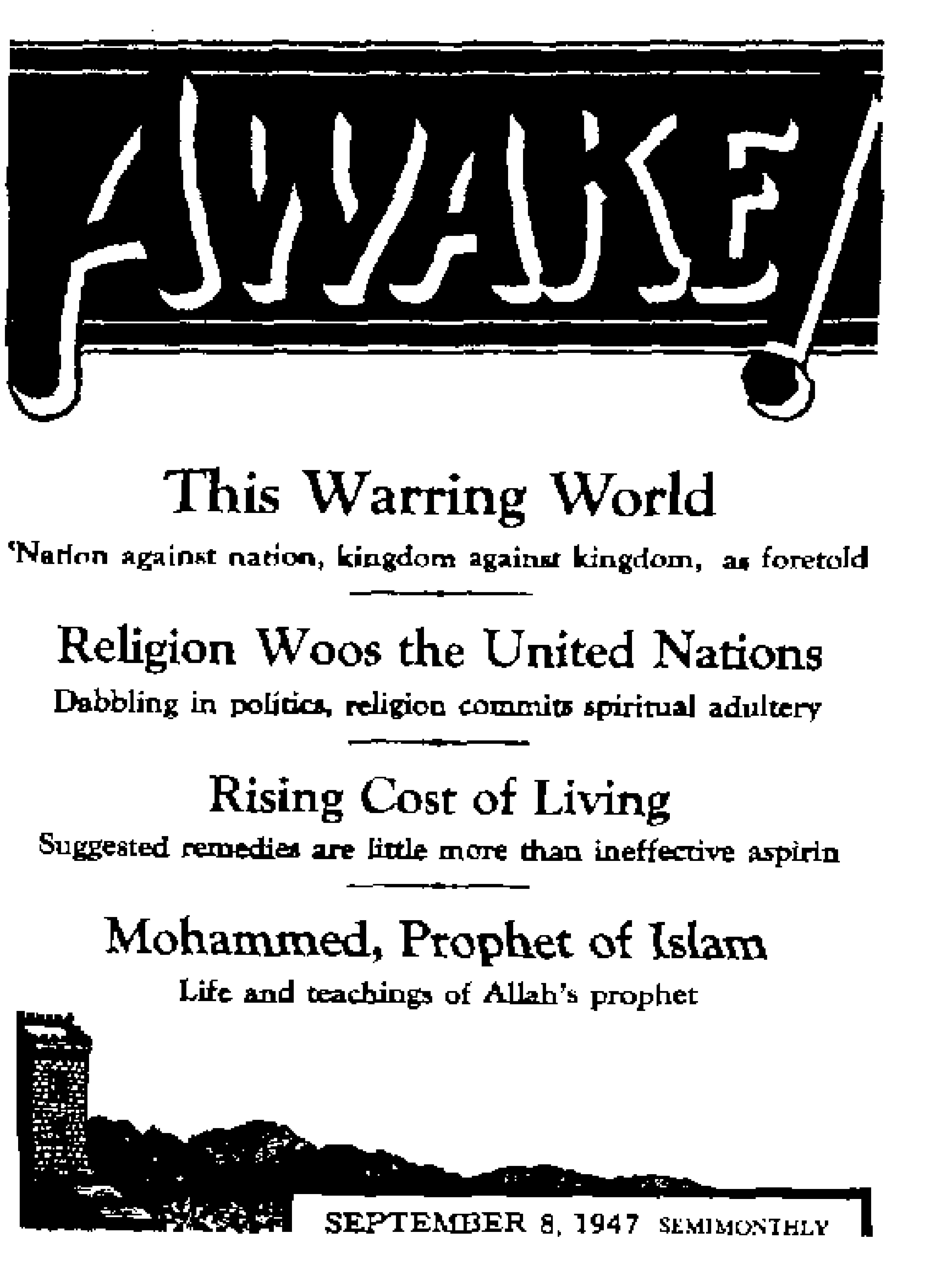
This Warring World
'Nation against nation, kingdom against kingdom, as foretold
Religion Woos the United Nations
Dabbling in politic*, religion commit* spiritual adultery
Rising Cost of Living
Suggested remedies are little more than ineffective aspirin
Mohammed, Prophet of Islam
Life and teachings of Allah’s prophet
THE MISSION OF THIS JOURNAL
News sources that are able to keep you awake to the vital Issues of oun times must be unfettered by censorship and selfish interests. “Awake!** has no fetters. It recognizes facts, faces facta, is free io publish facts. It is not bound by political ambitions or obligations; it is unhampered by advertisers whose toes must not, be trodden on; it is unprejudiced by traditional creeds. This journal keeps Itself free that It may speak freely to you. But it does not abuse its freedom. It maintains integrity to truth.
"Awake I** uses the regular news channels, but is not dependent on them. Its own correspondents are on all continents, in scores of nations. From the four corners of the earth their uncensored, on*ihe'HCenes reports come to you. through these columns. This journal’s viewpoint Is not narrow, but is international It is read in many nations, in many languages, by persons of all ages. Through its pages many fields of knowledge pass in review—government, commerce, religion, history, geography's science, social conditions, natural wonders—why, its cover-age is as, broad as the earth and as high as the heavens.
“Awake I” pledges itself to righteous principles, to expajfing hidden foes and subtle dangers, to championing freedom for all, to comforting mourners and strengthening those disheartened by the failures of a delinquent world, reBecting sure hope for the establishment of a righteous New World.
Get acquainted with “Awake!” Keep awake by reading "Awake!”
Published Shmimoktuly by WATCHTOWER BIBLE AMD TRACT SOCIETY, INC.
117 Adams Street Brooklyn 1, N. Y*p TL 3, A.
N. H. IDfCfiB, Praefdeni Qrast Suiter, Secretary
Five cents a copy One dollar a year
UtMlttancM should be sent to offto In yonr country in compliance with rejuUtions to guarantee eVe delivery of nwiey. flemittanCM ere accepted at Broafalyn from countries wtere no office la located, by intaraatlcaal money order only. BubftCrfntion rates In different countries ato htfe atatod in local currency.
Notice *f eocpintlQH (with renewal hlanlt) Is sent st least tro lanes belort sutacripLlxm explres-
Chanp Of adJrtM sent to our office may Tae expected effective within one month. Semi your old ag well as mw address.
Offices Yearly Subscription Itet&
An erica, U.S., 1 IT Adams St., Brooklyn 1. N.Y. $1 Airtralja, T Beresford Rd.* BtrnMeht NAW. 6s Canatfa. 40 Irvin Ave., Toronto 5, Ontario $1 £nf land, 34 Craven Terrace, Lcmdoic, W. 2 ba South Africa. 62s Boetou House, Cape Town Ba
Entered as secabd-class matter u Brooklyn, N. 7., Ad of March 3* 1879. Printed in U. 8. A
CONTENTS
This Warring World
World War I
World War II
Behold the “Last Days”!
Torrid Zones of the Atmosphere
.Religion Woos the United Nations
Religion Helps Shape the Charter
U. N. 'Stands in the Holy Place’
A Plastered Abomination
Rising Cost of Living
Who Is to Blame?
The Vicious Circle
Mohammed, Prophet of Islam
Conversion by Conquest
His Idea of Paradise
“Greased Lightning”
Cuba, America’s *6ugar Bowl
Cane Planting and Harvesting
Workers’ Wages
Notes on Nature
“Thy Word Is Truth”
Spirit upon Men pf Good-Will
Wonders of the Heavens
Watching the World
AWAKE!/
®/?Now it is high time to awake.— Romans 13:11 &
Volume XXVIII
g?^g----->■< I« — Ml , ■— I —
Brooklyn, N.Y., 6epttmb«r B, 1M7
Number 17
This Warring World
AR is a hateful thing. The history of this world is the history of its wars written in human blood. Nor is the record of slaughter that began when Cain warred against his brother completed ; the closing chapters of this gruesome history of wickedness have yet to be written, which means that the blood of multitudes more will be spilled before this warring world comes to its violent end.
War has been defined as “the last resort for the settlement of disputes" (Encyclopedia Americana), “the use of organized force between two human groups pursuing contradictory policy" (Encyclopedia Britannica), "a continuation of politics by other means" (Clausewitz, the famous Prussian war philosopher), War is a most amazing phenomenon in which the instinct of self-preservation is ignored. An army displays ruthlea s destruction of a harmless and peaceable people on the one hand, and, on the other, a nation endures the greatest amount of suffering for the sake of its liberties. Glorified by the warmongers as a demonstration of bravery and self-sacrifice, war in its reality is most often a manifestation of the
base qualities of brutes and leaves in its wake wounded, exhausted and mutilated soldiers and martyred civilian populations,
A lover of peace and righteousness, after reading such a preface, would prefer to close the book and turn away from this bloody history. But to do so leaves one dangerously ignorant of vital information so necessary in this twentieth century, when preparations are being made for full-scale atomic warfare. It is therefore with a sense of duty and necessity that one briefly considers the history of this war-torn world.
Ancient historians were so careless in their details, and the ink is so faded, it is next to impossible to get more than an estimate on the number of casualties in ancient wars. Commanders often intentionally falsify their reports for the purpose of deceiving the enemy. Sometimes no distinction was made in the number killed by the enemy and those that died of wounds, diseases and accidents. Sometimes no distinction was made between prisoners of war and those missing in action. All of which makes it necessary to limit the study of statistics to more modern times.
Of all the nations of the world France has suffered the greatest losses in human life during the last three centuries. During the seventeenth century she spent 64 years at war; in the eighteenth century, 52 years; in the nineteenth century, 32 years. Practically half the time she was fighting. Of the 1,700 battles fought in Europe during this period France engaged in 1,079. The Austro-Hungarian empire was second only to France i.i the number of lives she sacrificed on the altar of patriotism. The following tabulation of casualties for a few of the major wars gives a partial picture of the ghastly hor—rs of history.
Wars
Date
Casualties
Seven Years* W ar
1756-1763
483,000
Napoleonic Wars
1796-1815
6,000,000
II S.-British
1812-1815
50,000
Bnseo-Turkish
1828-1829
100,000
IL S.-Mexican
1846-1848
50,000
Crimean
1854-1856
787,000
Italian
1859-1861
113,000
U. S. Civil War
1861-1865
936,122
Freneh-M exican
1862-1867
6,654
Dano-Prussian
8,321
Austro-Prussian
106,494
Franco-German
1870-1871
710,000
Basso - Turkish
1877-1878
250,000
Chile*P eru-B olivia
25,119
British-So. African
180,000
Sp anish- Ameri c an
6,000
Busso - J apanese
1904-1905
550,000
Balkan Wars
1912-1913
108,000
Total
10,469,710
The Greater Losses
It is not an exaggeration to say that the casualties among soldiers dne to enemy fire or other causes is small in comparison with the suffering imposed upon civilian populations and non-combatants. Conquering armies have pillaged towns, raped the women, robbed them of their necessities of life, and left them to die. How many women, children and old men, if not butchered and killed outright, have heen maltreated and tortured and left to suffer the rest of their lives will never be known.
Other fruits of war include starvation and disease. The historians Thucydides, Diodorus and Tacitus tell how multitudes of civilians died from these causes wiien Athens, Syracuse and Borne were besieged in ancient times. During the Thirty Years’ War (1618-1648) 30,000 people are said to have lost their lives in the sacking of Magdeburg. Starvation killed 20,000 to 30,000 in Genoa during the Napoleonic wars. In 1830 Poland lost 326,000 inhabitants due to disease among its civilians. Dumas, in his book Losses of Life Caused by War, in describing conditions of the American Civil War, says: “It is said that many of the northern prisoners suffered from stomach troubles, which caused them to evacuate food without having assimilated it, and that their comrades frequently became so ravenously hungry that they went so far as to search among their excrements for non-digested particles of food to wash off and eat.” Wars not only leave behind disfigured and helpless creatures, but they also breed death-dealing diseases like typhus, cholera and typhoid fever. Statistics reveal that venereal diseases caused a larger number of hospitalizations among soldiers than any other disease. Here again these distresses wreak their greatest havoc upon non-combatants and the generations that follow.
World War I
All the wanton destruction of previous wars fades into insignificance when compared with the conflagration during 1914-1918. Ninety-three percent of the world’s population were involved in the first world war, or about 1,700,000,000 people. When the two greatest armies ever assembled in the field up to that time, approximately 2,000,000 men on each side, threw themselves at each other in 1914 they hoped to gain a quick victory. But after six weeks of fighting they found themselves stalemated in trenches stretching from Switzerland to
the North More ineat wera fltnvi Enlo the tranches util a total of 65J300,-000 ven locked in mortal txnnlmL Fhr four year* every attempt to gate a derisive victory cm either ride salted only in mud and Homi.
The losses of World War T wen colossal, surpassing anything up to that tima, a* noted by the following tahnto-ticm.
OAKTAUm or Woslo Was 1
?ep“
MQBCflDCgtO
tO^OD
Uneca
ft ,000
Pcrtufri
Bdriani Bolguia Mb
9SBM 2M.9I9 831J«
United Atous
Buoanls
wa,rw
Turkey
Italy
8JOTXOO
British Enpin
S,1W»
Auhc AwlFte-HcxafBry
6.160J00 LOO.DOO
Genoany
L142J68
Emil
6,160,000
aukme than wen nearly lOOyOOO Hllod by mine eorpLcwcma.
Not only did World War I change the hotrndaries and nearly every character ef human life, it alee npeet hitherto accepted fundamental prmcxploa underlying government, mtarnatioDtd relattoii coamsree, democracy and freedom, More than a score of thrones crmabtod. But instead of making the world safe fbr democracy. it made the world cafe for dictatorship. With the rise of totalitarianism the world ta a few years was again gored by a world war so eotoual that it completely overshadowed World War J in rise and destmo-tioo.
Verid W<r W
Tn spite of the great advancement in anaansente, defensive warfare, and
tt^ombb
Total
By SMsaringimh fatten u Iks nahr sf wulta, ■adcomtaieBLa and owL W«W War I is found to to wv« Uma is great as ths an pn*te&a major wan a aompaxt
■)* obvwth^ World War IT iuous up crvwriwdcnvs Iha fori Wwld War by Dearly tear
«W "*JW wen
an a*, w JL0. WM
WORLD WAR
I
umxun a iur
life-preserving efficiency of the medicbl corps, the casualty list of World War II climbed to a new high, as noted in the following revised table.
Casualties of World War II
Luxemburg Netherlands Denmark Norway South Africa British Colonies New Zealand Bulgaria Finland Czechoslovakia Australia Canada Rumania India Belgium Philippines Greece Italy
United Kingdom Austria France
United States Yugoslavia China Poland
Japan Germany U. S. S. R.
500 6,825 7,100 10,000 23,044 28,057 31,476 36,000 52,609 60,000 69,198 92,493 100,000 100,446 109,095 118,442 147,600 301,494 574,852 700,000 747,710 1,135,054 1,685,000 3,178,063 5,265,800 5,758,338 9,500,000 15,000,000
Total
44,835,196
Vatican sources set the number of casualties even higher. The total dead, they say, were 22,060,000, and the number wounded, 34,400,000.
Measuring the cost of these two twentieth-century global wars in money, they also surpass all other wars. The nineteen years of Napoleonic Wars were said to cost $15,000,000,000. Added to this the cost of all other wars thereafter, both small and great, up to 1914, there w*as at least $40,000,000,000 spent to destroy life. And how does the cost of World War I compare with this? It was over eight times as great as of the previous7 two hundred years’ wars, or $337,930,-579,657! On July 1, 1946, there was stiH $15,000,000,000 of World War I debts unpaid. As for the cost of World War II, it ran into astronomical figures amounting to more than a thousand billion dollars, $1,160,991,463,084, or more than three times as great as the cost of World War!!
. It is easy to see from this that war is the direct cause for national debts and inflations that follow. The Committee on Public Debt Policy says: “Five times in the nation's history we have incurred great national debts—all of them to finance wars?’ Whereas in 1860 the national deht was $406 per family, and in 1920, $1?147, by .1946 it had rocketed to $7,009 per family.
Behold the “Last Days”!
When, 2,000 years ago, the disciples of that wise Nazarene named Jesus asked Him when the end of this present wicked world would come, and when His righteous kingdom would be established, He said to them, among other things: “Ye shall hear of wars and rumours of wars: see that ye be not troubled: for all these things must come to pass, but the end is not yet. For nation shall rise against nation, and kingdom against kingdom: and there shall be famines, and pestilences, and earthquakes, in divers places. All these are the beginning of sorrows/’ (Matthew 24:6-8) Can there be any doubt that this great prophecy began to be fulfilled in 1914? Where in all the past history of this warring world prior to 1914 had there been a mass rising of "nation against nation, and kingdom against kingdom'? The overwhelming evidence proves beyond all doubt that 1914 marked the beginning of a period of time when ware, famines, pestilences and earthquakes would begin to come in concentrated doses as foretold. According to a Harvard University analysis as reported by Collier's magazine of September 29, 1945, World War I was seven times as great as the previous 901 major wars that have occurred since 500 B,C. And on the same basis of analysis World War 11 could, no doubt, be shown to be four times as great as World War L (For statistical proof that earthquakes, famines, and pestilences have accompanied these global wars since 1914 see previous issues of Awake! November 22, 1946, May 22, 1947, June 22, 1947.)
One would think that the world would be tired of bloodshed and human carnage; but it is not In spite of past history, and in spite of the desire for peace among the common people, the leaders of this war-crazy world at present are in a feverish armament race on a scale heretofore unknown. Instead of disarming after World War II, a survey shows that at the present time the standing armies of the world number 19,000,000 and are maintained at a yearly cost of $27,400,-000,000. Many more billions of dollars are concealed in research expenditures for the development and improvement of A-bombs, guided missiles, jet planes, death-dealing radioactive clouds and bacteriological warfare. After nearly two years of wrangling in the IL N. Se- . curity Council the piling up of A-bombs continues. The stock-piling of strategic war materials continues among the nations, with the United States building a pile worth over $2,000,000,000. New secret submarines faster and more deadly than anything heretofore known are now being built at a cost of $16,500,000 each. Bombs weighing 25,000 pounds, bigger than any used in the recent war, are being tested. Airfields for atomic warfare are now being rushed to completion in Alaska, which is said to be the most “strategic spot on earth”. Blocs are being formed, the world is being split into military camps, and hemisphere defense is being pushed for all it is worth. Compulsory military training is considered by many to be essential to survival. And headlines in the New York Times of July 21 announced: “Ordnance makers ready for orders. Larger demands antici-
pated when Congress completes Army-Navy unification.”
Such preparation for war is exactly as foretold by the prophet Joel; 'Proclaim ye this among the nations; prepare war; stir up the mighty men; let all the men of war draw near, let them come up. Beat your plowshares into swords, and your pruning-hooks into spears: let the weak say, I am strong. Haste ye, and come, all ye nations round about, and gather yourselves together.” (3:9-11, Am. Stan, Fen). In view of such prophecy, and in view of the facts in fulfillment of such prophecy, it is sheer folly and gross hypocrisy to believe and preach that any so-called "United Nations” organization can and will establish peace in this warring world. As a sample of how the leaders of this world talk peace while at the same time they prepare for war we note President Truman^ Christmas message, 1946, in which he said: “With faith and courage we shall work to hasten the day when the sword is replaced bv the plowshare and the nations do not learn war anymore’.” Their actions belie their mouthings.
Responsibility for Wars
Only by understanding the causes of the terrible wars in these latter days is it possible to explain why intelligent men in this twentieth century engage in such inhuman butchery. The sinister power that is driving this warring world on to its final destruction is the god of this world, Satan the Devil, and his invisible demons. This wicked one who is responsible for all the past wars of history is now bringing great woes npon the people in a final effort to turn all creatures away from Jehovah God and His kingdom of righteousness, as it is written in Revelation 12: 9,12: “And the great dragon was cast out, that old serpent, called the Devil, and Satan, which deceiveth the whole world: he was cast out into the earth, and his angels were cast out with hint . . . Woe to the in-*
habiters of the earth and of the seal for the devil is come down unto you, having great wrath, because he knoweth that he hath hut a short time.*
Politics, commerce and religion are very much a part of the Devil's present wicked world It is not necessary to make a commentary on the responsibility of political dictators and giant commercial cartels for the wars. As for the religions clergy, everyone knows they instigated the Crusade slaughters and the religious wars that ended in the Thirty Years* War, which latter war, the En-cyclopedia Britannica says, was "the most horrible single military episode in western history”. As for demon rdigion’s responsibility for World War I, ''Bev/' George Willis Cooke, in 1919a writing in the Chieago Unity, said:
Christianity has betrayed itself tatfy and bduL The attitude of the churches in this country, and in even greater degree in the other countries, has not been such as to inspire faith in their sincerity To a very large extent they have abandoned Christianity for patriotism. They have been committed to a brutal, revengeful, and savage hat for war and all the worst that war demands. . , . The most cruel, heartlew, and revengeful demands made In behalf of war have come from Christian pulpiti on both syies-
The Detroit Free Press, August 6, 1919, in flpeaking of the responsibility of the clergy for World War I, said:
They joined the most rampageous of our jingnfrc and war-af-any-prfce patriots in arouting the belligerent paniona of the people . . . Nearly all of them could be brevetted far distinguished service in boosting the human slaughtering game . , , Indeed the ministers in all the belligerent countries engendered so much passion and violence that it might be called their war.
Ample testimony could be cited to prove that the clergy during World War II followed exactly the same course as in former years. Catholics and Protestants of the Aris powers fought against Catholics and Protestants of the Allied armies, and on both sides the clergy blessed the soldiers and prayed for victory.
This explaina why Christians who are *not of this world* (John 17:16) have nothing to do with its religion, politics and commerce, nor its wars. With confidence these lovers of righteousness announce that wben this devilish wafting world comes to ite final end at Armageddon it will be replaced by Jehovah God's Theocratic rule under Christ the Prince of Peace. Only then will there he no more war.
Torrid Zones of dw o4tmosphere
Droamen who think they win taval to tta ewod ia a wobt dup wfl? ■ be biierMted bo tesro what they win paw through. Heretofore it wu
thought tint above Sevan mW height there ww * eoutaat tempera* *tLPB A7 degrees below aero Fahrenhrit The thermometers, however, that wm attached to the rockets shot up at While Sands, New Mexico, brought teek pome revealing information. Between 30 and 40 miles tip there ii a torrid sone m which the heat nachos 170 degrees. Thmi, between 40 and 50 miles the temperature drops u Low as 150 degrees below ttrtx Still highs’, between 50 and 75 milBs (hero is a territa hast tone estimated to reach 088 degrees, Wbai lies beyond that is anybody's guea. Only the tfhmatieW>J those persans that an struck with the idea that some day they will travel io the moon, are probably the <mee that are worried very much whether the tbennometer hiha ahwhite xero or the boiling point of tungxlm, rinoe most people an atmient to dwell upon the earth, where the Creator placed thtUL
V.f.:::1
.^'7:::':”''"'!;?:.■ id'
WSSE
SmW« **!.. s\ *i J.*.*. '■ '"'.V• «sV1'
dns.' :';i» ratrted
Christe
ftietotoi® -deai' tol Awe ''litofi
! ■
earth,' ■ ■■ totoliisll
Siiffirf ■ with tw
heator ■ and ' a / war ;
s
Odes the hastohto
sw®
—„ ........ __ «t® shall
Slitiod par««6. If ’ • • •
Mligtoei itefllll
ggfiiey ever pyssesWeW 'iiysdiiritttal.-toelleth Tighteottsnos1 , .............................
has long 'siiteb Wen spent and 'xtorehdMei»W-orgawze(i toigioftlte
IgtlBr- degeneration-- into dmiitoral nite ' give <torit- oftooi 'will-MtfcmtewliisiiS;
.....noItoagiretofWioMW. most HaspliBiniMisly
.glpm.era.tion. • to teligioas ■ orgart«.i®if
.'ttitned-. its hack on wrisfe ItogdomllipStlSB haling ?lw Beagne; of toatioits ;
pofitifialwpieston of (tod’s MSI
SartW. Ahto ChristeiMiom’s;. »lgwitlg3| lost rtheir lover as^ .att'eariy'-eaBtoMlO© 'the-.'World War1 'if it/ww
e tond'thongfc 'the gB.toMww:w
vihuiB,. the; - eotog. ■' low ■ Bpwtote' 'S|i|tSfiS which -Christendom’s. reHgiotis-tow ? 'MSO'S ;S|| ■to; tos'arfeeted -Befcg«e» -nantod;
Sritostoeakitomo^
gitressta to .political «inp8';'is ;'C(Hiiptete.
;iimh» 'so y/iittwl' -fte. weighty proofs; Wit 'fcaefc. it ap.' pWiMtr reinember ttat 'CitotetooiifB to phgicm olaim to he wtgjn;iritohf Christ gii,, to' .elean, of■ any ;BoiiiftolMiow-'
B; to®. 'Satan the Devil Then < toiMthat to.
'■''Bilie-slows'that Satan if tidgoi?W-fliis. World, -that the whole'world liea. i-ii-hini, and that 'Christ’s bride; to Wtttotoe# Mt low the world' or 'eoifftoB;® to-or. toms® entangled in '.its" affair#. .-(2 (to r&ttt|ns -4t 4;' 1- Joto'^'W'}' ttiOyW: 21' 2: Titodtl^;;.gr'4)tBeligio3jg' or^wittationB that dabWin^polties pcmw y<jtlj'''»afce religion < of ''this ?fe|to®t3^ g'it spiritual aditter yg W ■ the lliMe ' yoeonto offender -.it.." gpiritiiil -States: “¥© adnlfews‘ini'adulteresses,-andtoerehyctoulletlwp '..v,
Inow-ye; not -tliat fttofeendMip<<rf tlie ' 'IfigtoIaspheiny; to;Wwtedly;MmMSsili .Writ! is eiimity with to thftief orfe'? wBl.he' a: ■ friend, of the world M -i 'tie'enemy.of (Joel” j' (d aittes 4.M|' Birt ’ Ch:ei|-' • (■ tendoiii's. refcimis hiW- ;";:.'
(?
■?
II
!!!!\-.,
■K iff '.■ 'i'i'/.1"..
■W'T': '.'.‘g: |jlU ' fc-'
to
: ■.•
rt.
i;.!i
.to
M®®%
Ito ;e®sf; aside' Wito
gfa n ce s.; ■and topbto .; speedw 1h a-e> e d>;tte'"'.I sw of Biigtof ?\<hea "'I 'to. :' ■
WBWtfc jtlie Itogwrif ;'..; S1t i d 4 s. A bi d ,r >i s";'?.
C’tarda,■ to'- Sfflf> ,'is- ■ s'aed-tfdMttdmt dtoaat- ■ .■ iff jito^to^itogw’-of' ‘t
eotopldtely ■ -aij< ’-ehaSe after; Wltieal 1 Wet#; -;
■' '■„" Fb fiteWi -'iWorM W wT-tlie WStWriatwh
J
.roofoftoWtilB
■ ••to'.'
pasgtges ■ ;eone6rning;;iCtoiMo>*d ''1H langtett ;to iiphe tlf ;s e e mi h-g 1 'tifi
niaris impottotoWiedfe; maliBhif t? iartriitMdftf® called Itotorgy. ■ and'' eiitts.. vie 'with. ..eael; tote wwsy toto eMel'ihhfieK 'hlto’'5’'5’1**’ Why;' la j gg
tokto»|rto:towi'tf "' sto'to ■ ':®l'e <'Mhe'if: >S toriri... ftehto'toy gteiitoliil
3f
•B.Wto
■.'.'...'!. "
■.'ll,',:/?'
!d ■■■'■;.'
• 7.
II..
' ?: % JukK^l iM>LlL4jhX*>/d>L,s k*jL iJAkUto*
.OwMfflSB 8,<19W '■
this ■'; torld' to ’ wad. -<ito tots® tototef 'totofeat'BiSISiBS Igtoff to gl.oriteit.gefe'g;;g;iE jM': If'' 0 hr i
iBiine into- fliatod® ttoktillfi totliahs 1 pljiSi.toll Skisi ighteiatotewteld SflSi
' -' . ' ■’■ ■"kotrtosfel
■■
pel the covering darkness evil-doers love, and their bubble would burst, (John 3:19-21) Becoming specific, let us review some utterances of men that darken understanding and push into the shadows Christs kingdom, but which polish to dazzling brilliance men’s international political creation.
Religion Helps Shape the Charter
Overblesaed by worldly religions, unblessed by God—that is the plight of the United Nations. In 1945 many nations assembled at San Francisco to adopt a charter for the resurrected league of ba-tious. Many religions assembled there; but so disunited were they that they could not agree on how to pray or to what god to pray; so the conference opened prayerless. A minute of “silence and solemn meditation” was the compromise adopted. Nevertheless, the religious spirit so saturated the atmosphere that the Protestant Federal Council Bulletin reported: “The opening of the Conference reflected far more than did the Versailles conference a sense of dependence upon God.” Later this bulletin claimed that the scope of religious activity in relation to the establishment of the United Nations was “without precedent in the experience of American Protestantism”.
Protestant, Catholic and Jewish religions bombarded the international politicians with religious peace proposals, and according to a Catholic Hierarchy report this combined counsel “undeniably had a great effect on the Charter which emerged from San FranciscoJ’. But these groups did more than pamphleteer: in certain sessions they were allowed to sit in and advise. By this arrangement Hierarchy proposals were written into the charter on at least nine points, the Catholic press claimed, and councilmen for Protestantism chimed out their claims that they influenced the formulation of “five amendments dealing with human rights and fundamental freedoms”. Yes, rights and freedoms that spiritually sick Protestantism will compromise and forget at a frown from Caesar; while, in the words of Supreme Court Justice Frank Murphy, some despised minority such as Jehovah’s witnesses will test the world’s devotion to its own ideals.
In her press column of June 26, 1945, Eleanor Roosevelt said that she “could not help but think' that the representatives who have been working on the charter out in San Francisco have labored to bring forth something which will prepare the way for that kingdom of God on earth which we poor, faulty human beings have been so long awaiting”. Sinking even lower in misapplying Scripture, clergyman Henderson Shina, of Ohio, emoted on July 29, 1945: “ ‘Say among the nations that the Lord reign-eth . .. . He shall judge the people righteously,’ The clear word of the psalmist, translated into terms of modern application, was definitely heard in the formulation of the Charter of the United Nations. The Charter, as finally written, embodies many changes recommended by thoughtful Christians of different communions . , . Let no one say that the voice of the Christian peoples of the world is of no effect in the international political' councils. That voice has been heard and heeded.” Even the cautious and wily Pope Pius XII at that time “expressed deep satisfaction with the progress and accomplishments of the San Francisco Conference”.
Obviously pleased with themselves, the world-loving religions meddled more in politics by urging in Senate eonunit-tee hearings the adoption of the charter by the United States. Typical is the report published in the New York Times of July 13,1945:
The support of the Federal Council of the Churches of Christ in America was put before the committee by a communication from Bishop Gf. Bromley Oxnazn, council president, to Chairman Connally. The statement said
that the council believed the Charter offered mankind an important means of achieving a just and durable peace; that it was the “clear duty” of the government to ratify it quickly, and that Christians had a responsibility to help create the determination to use fully the procedures provided by the Charter.
Eabbi James A. Wax presented a paper on behalf of the Central Conference of American Rsbbis, the conclusion of which was as follows: “Because of the promise of peace and international co-operation that the United Nations Charter will bring immediately, because of the horrible sacrifices and devastation of war which all good men seek to avoid, because of the promise of the ultimate establishment of the kingdom of God that we see in it, we American Rabbis, speaking for ourselves and for the men and women whom we serve and lead, plead for the speedy ratification by the Senate of the United States of the United Nations Charter. We are confident that the blessings of God will rest upon all men who participate in speedily making this charter the accepted law of the nations. [Italics added]
Not to cause the bosom of the world religions to swell with unpardonable pride, but to clinch the point that they shared in shaping the United Nations Charter, we quote the sop President Truman cast to the religionists. In his speech to the Federal Council of Churches of Christ in America, in Columbus, Ohio, on March 6, 1946, the president poured out these oily phrases:
There is no problem on this earth tough enough to withstand the flame of a genuine renewal of religious faith. And some of the problems of today will yield to nothing less than that kind of revival. ... As among men, so among nations, nothing will do more to maintain the peace of the world than their rigorous application of the principles of our ancient religion. We have tried to write into the charter of the United Nations the essence of religion. By these principles the United Nations have laid the framework of the charter on the sound roek of religious principles.
SEPTEMBER 8, 1947
But are the religious principles supplied by worldly religions a sound rock! Hardly, when the Scriptural rock foundation of Christ has been rejected by these religions for an illicit love affair with world politics. The foundation is not rock, but sand, and the structure erected thereon will prove a washout at Armageddon’s storm, as Jesus foretold. (Matthew 7:24-27) But religion is not content with supplying a sandy foundation of principles; it woos to become a full partner. A bold advance in this direction was made by the World Council of Christians and Jews, a religious combine of 105 denominations from 35 countries and boasting leadership over more than 175,000,000 persons. The New York Times of April 6, 1947, reported that this World Council had applied for affiliation with UNESCO (United Nations Educational, Scientific and Cultural Organization), which application was warmly endorsed and supported by the United States state department.
U. N. ‘Stands in the Holy Place’
The Bible declares that Christ and His kingdom are the only way of salvation, Christendom's clergy and politicians disagree. The sponsoring committee of the World Congress of Religion, to be held in Boston next October and bringing together religious leaders of allfaiths from more than fifty countries, urged united religious support of the United Nations because “unfaltering and loyal support of the United Nations and its leadership can yet save us”. (Chicago Sun, July 5, 1947) On April 13 of this year Unitarians in Washington, D.C., heard a plea that “Christianity should recognize the United Nations as a force which also has a role of salvation.” The American Unitarian Association president, Dr. Eliot, fumed: “Christianity must abandon its claim to a monopoly of the way to salvation.” Only a few days earlier Benjamin Cohen, assistant secretary general of the United Nations, told a te
ll
Hgiona assembly in New York city that “the message of the Charter of U. N. was becoming the gospel of mankind”. Thus they seek to replace Christ's kingdom with the U. N.
The kingdom of Christ is the hope of the world, says the Bible; but religious hypocrites say the United Nationals. Dr. Nolde, representative of the Federal Council of Churches at the San Francisco Conference, said: “The hope of mankind is now fixed on the United Nations organization.” In January of this year Cardinal Spellman vowed: “I avow before the world that the precious peace which all men crave will never^come to pass until a strong, loyal United Nations, undaunted, believes and lives the motto of our United States ‘In God is our Trust*.” Not long ago Henry Wallace, at Madison Square Garden in New York city and over a nation-wide hookup, said: “There is but one hope for world peace —the United Nations.” Last Christmas America's Bible-quoting president did lip service to Christ but showed how distant his heart was from Christ’s kingdom when he acclaimed the United Nations as “the world’s hope for peace”.
In his religiously phrased Christmas sermon President Truman also said: "With faith and courage we shall work to hasten the day when the sword is replaced by the plowshare and the nations do not ‘learn war any more’.” Seventeen days later Senator Vandenburg succumbed to the temptation to toy with these same rhythmic Bible truths while discussing the international forums, saying, “This process of reciprocal candor is one of the major forces which can beat swords into plowshares on the anvils of mutual understanding and good-will.” But conscientious Bible readers know that Jehovah God through Christ is the only force that will fulfill the prophecies of a warless new world, and not politicians intent on universal military training and war preparedness.
Standing in the holy place? Yes, as firmly as a flood of grandiose speeches can. put the United Nations there. But that will prove to be not so firm in the end. Just as infirm, in fact, as the religionizing at the time of what the public press called the “consecration”, not dedication, of the United Nations site in New York. The ubiquitous Spellman opened the ceremony with the solemn declaration that “this portion of America” was now set apart to be “a temple of peace”, Mayor O’Dwyer declared the site for the world capital was “hallowed ground”. All this palaver was reported in the New York Times, April 14, 1947.
A Plastered Abomination
In their mutual love-making clerics and politicos bandy about Scripture texts and misapply them to the United Nations. The Bible does foretell the League of Nations, its demise, and its resurrection as the United Nations; but political clergymen and religious politicians shy from these texts. The seventeenth chapter of Revelation rightly prophesies that this political creation would be plastered with names full of blasphemy. Christ Jesus foretold it as an “abomination of desolation” that would “stand in the holy place” reserved by God for His heavenly kingdom,—Matthew 24:15.
The worldly religions, in their haste to woo and win the United Nations, have been taken in the same noose that snared the Jewish religionists of Jesus* day. The scribes and Pharisees . rejected Christ and said, “We have no king but Cffisar.” They chose an alliance with Rome, an abomination to God, and in the unhappy end were desolated. Since 1914 Christ’s kingdom has been established (see “Let God Be True", pages 185-196, 243-255), but rebellious Christendom rejected it and tried to set in the “holy place” first the League of Nations and now the United Nations, They woo the international combine, and win it. But with it they shall fall.—Daniel 2: 44.
Rising Cost
: prosper-affects to
Housewives find it difficult to follow the ever-changing opinions of learned economists who analyze the rising cost of living. The reason for this is that the condition of ity, or lack of it, of one nation i some extent the status of other nations. The economist must measure these variable facts and correctly interpret each shadow of change in them if he is to make a correct forecast. Because his observations are often confined to the realm of theory, which is never entirely accurate, his learned opinions are generally shattered by any sudden turn of events. But, however inexact the science of economics when it comes to foretelling the cost of tea in China, a general knowledge of economies will explain to a great extent the causes for the present high cost of living.
The financial experts often take leave of the common down-to-earth level and fly away in a cloud of figures. Very few of them say outright what they all know: that the chief cause of the high cost of living is the great expense of war. On April 1 the national debt stood at $257,-786,305,359, which amounted to more than $1,800 indebtedness for every man, woman and child in the United States, From 1943 to 1946, the years of heaviest spending for war and war agencies, the government borrowed at an unprecedented rate. By spending more than its receipts the government plunged it-
self $181,000,000,000 farther into the red during those four years alone! Victory was costly and it has not been paid for. While many regard these
expenditures as necessary to the prosecution of the war, it is not clear to them how this affects the high cost of living. It has frequently been stated that inflation is n fnrm of taxation. It is resorted to because the effect is not so immediately felt as in more direct taxation. Stripped of its complexities this is how inflation works: In order to make the tremendous purchases required for war, the government borrows extensively, then buys and uses up the goods and services purchased. Thus the national resources are depleted, but there is left an excess of currency, because the government borrows, and issues bonds and currency from the treasury to cover its indebtedness. This increase in currency in circulation is used to buy the decreased total of commodities, and this in turn accounts for a general higher price scale due to greater scarcity of materials. The purpose of the OPA was to put an artificial brake on demand, that is, limit demand, and distribute the smaller supply equitably.
But the difference between a controlled economy and inflation is largely psychological. Whether the people prefer to do without because of rationing, or because the price is too high for the average pocketbook, the results are the same.
The depletion of supplies is the basic headache in either a controlled or free economy, and war is the primary cause for the depletion.
But, now that the war is over, why does the price of goods continue high? In considering the causes for this condition one's view must be expanded beyond the domestic problems to take in the needs of Europe and Asia. The hunger of the German frau and the French femme affects the American housewife whether she realizes it or not. When the European shivers in his bomb-vented house the tremor goes around the world. It is now a small world whose troubles in one locality are transmitted along the nerve stream of commerce producing reflexes in other parts of the body global.
The whole world needs food, steel, building materials, chemicals, and many other basic industrial commodities which America, as the great undamaged industrial center, produces. Although the total of all exports to Europe in 1946 was only 6.6 billion dollars, or only 3.4 percent of the food and services produced in America, yet this depletion, however commendable from the humanitarian viewpoint, adds to the pressure that pushes prices up. Meat-hungry Europe reveals its desperation when its offers for meat are four cents a pound higher than even America’s own inflated domestic price. Thus competition was a contributing cause for the June price of beef on the hoof at 28 j cents to compare with 21 cents on the black market when OPA ceilings were 18 and 19 cents. This shows, then, how domestic inflation adds to dollarpoor Europe’s plentiful troubles and in the end boomerangs on America’s turbulent sea of domestic problems.
Who Is to Blame?
In situations like this, which bring present pain and future disaster, it is customary to look for a scapegoat. Various ones have been nominated as the unlucky culprit; capital, labor, Republic cans, Democrats, Congress (for removing OPA restrictions), and the people themselves (for wanting a postwar spree of buying). But each of these in turn endeavors to escape the odium resembling that of a scapegoat. President Truman, in his Jefferson Day speech, tried to disclaim any responsibility for the present conditions by lamenting the present high cost of living and the possibility of a future deflation. However, the devout hope that a disastrous price break will not come before the 1948 election is undoubtedly the private talk of the Democrats. But, since the witch-hunt is on, it is not surprising that the executive fingerpointing is in almost any direction that will divert attention away from the White House.
Across the nation a few merchants took up the president’s cry for reduced prices in the hope that wholesalers and manufacturers would in turn cut prices. A notable example of this was in Newburyport, Massachusetts, where the majority of merchants reduced prices 10 percent. However, their noble experiment failed and had to he abandoned through lack of co-operation on the part of manufacturers and wholesalers. In general, the price level was little affected by Truman’s drive for lower prices.
Soaring Price of Food
The price of farm products has climbed the most steeply, with the result that the farmers as a class have enjoyed the greatest prosperity in the history of the United States, On August 4, corn hit a new high of $2.23 per bushel, while wheat reached $3,23% and hogs $30 per hundredweight this spring. This is in contrast with the early 1930’s, when corn fell to a disastrous low of 10c a bushel and hogs brought $3 per hundredweight. Since the beginning of 1946 food prices have accounted for about 70 percent of the increase in living cost.
According to the Bureau of Labor
Statistics, April 19, 1947, food prices were 130 percent above the 1939 level, while all other commodities were only 63 percent above the 1939 average. Farm products stood at 169 percent above 1939. From this'it would appear that all farmers were riding on a tidal wave of pure gold. But this is hardly the case. Without question, Big Farming, like Big Business, has grown prepondcrously fat, but the average farmer feels the pressure of the rising cost of living as do other average people. The small fanner who has to buy corn for his hogs and chickens at $2 a bushel instead of 10c indignantly objects to being called a profiteer, and rightly so. Granted that food prices are away out of line, has no one ever heard of “the middle man” that gets all the. gravy? The small southern farmer who is paid an all-time high of 38c a pound for his cotton wonders who piles up the difference between that and the $5 he pays for a white shirt
Since food prices take great jumps from time to time, as much as 18 percent in a six-week period, economic reports soon become out of date. Ono way the housewife can estimate the rise of the cost of food from week to week is to compute the cost of one quart of milk, one dozen eggs, one half-pound of butter, one loaf of bread, and one half-pound of bacon, and then compare this with the 1939 cost of 93 cents. In 1946, throughout the nation the cost was about $1.66. This year it is much higher.
The Vicious Circle
Organized labor, business, industry, capital and stockholders constitute a favored, if not happy, group. Around this group rages one of the most heated controversies concerning the responsibility for the increase in coat of living. Labor unions paint industry as the monster devouring widows' houses, while industry denounces labor's inordinate demands for wage increases as the red dragon of inflation. Thus, while these forces light it out, and chase each other up the spiral staircase to the dizzy heights of inflation, each progressiva wage increase being matched by a corresponding price increase for the commodity made, the party o£ the third part, the general public, whose wages have generally lagged at about 70c per hour while labor's went to $1.16 base rate, carries the crushing burden of the high cost of living. When the soft-coal miners recently won a raise of 44c an hour, bringing the daily wage to $13.05 for inside work, and the hard-coal miners won an increase of $1.20 a day, it simply meant that the price of coal would be raised to more than pay the wage increases.
Supporting her claims for increased wages, labor presents these arguments: corporation earnings in 1946 were at a record high, $12,000,000,000; that corporation earnings are predicted to go to fifteen to seventeen billion dollars for 1947; that some corporations have increased profits by 300 percent since 1945. Bulwarked by these arguments labor contends that another round of wage increases is the order of the day.
On the other side of the ledger, business executives complain that, despite high profits, the over-all profit average was but seven to eight percent in 1946; that wages amounted to about seven times profit, or about fifty percent of cost, and that a general wage increase of fifteen percent would consequently wipe out profits; that no certainty exists that profits will continue higher, and that therefore reserves must be maintained; that stockholders are entitled to increases to meet their rising cost of living.
But no matter to which school of thought one leans it must be admitted that any appreciable increases in wages will he followed by price increases. In the vicious circle any blanket increase in wages means another rise in prices. Thus the people are eaught in the vortex of inflation.
Spotting the Real Ballaona
Emerging from this analysis it seems fairly evident that relief will not come by presidential decree. Nor does one locate the cause for the rising cost of living by following along the line of vision in which executive finger-pointing extends. There is another direction in which to look, the matter of taxation, which is generally overlooked when considering the rising cost of living. Since 1939, the increase in taxes has amounted to 169 percent. Taxes now take out onefourth to one-third of the national income, which is presently estimated to be between 168 and 176 billion dollars. The high cost of government, along with the wars it supports, which must be paid for by taxation, is undoubtedly the greatest single cause for the rising cost of living. Up, up, they go, higher and higher, these government gas-bag balloons I The Federal government alone is now costing about $35,000,000,000 a year in peacetime, to contrast with the total cost of government before 1910, which never reached over $800,000,000 in any one year. The total expenditures of government from 1789 for the eleven years through 1800 were less than $6,000,0001
And why the high cost of government? Well, besides the great appropriations that are made for the army and navy in this time of peace (?) the government spends millions of dollars of the people’s tax money to buy potatoes, and kerosene in which to soak the potatoes so they are not fit for human consumption, in order to boost higher the high cost of living. Numb-brained politicians in this time of famine not only have curbed the potato crop for this year, but demand that the wheat acreage be reduced next year. Said the secretary of agriculture, Clinton P. Anderson, according to the United Press: “I am going to see that our wheat program tapers off next year.” Behold, what fools these mortals be!
After considering the complex factors which contribute to the high cost of living, housewives will probably conclude that they cannot eat statistics, am), like one who was urged to support a buyers’ strike, will ask if anyone has come up with a substitute for food. Such individuals may agree that the high costs of government and war are the cause of the high , cost of living, but, since they cannot puncture such balloons, they concentrate their efforts on the things within their grasp, such as food budgets.
If food is the crux of the family's immediate trouble, the industrious may apply snch home remedies as the “victory gardens”. Those who cultivated such small home gardens this last season know that they paid dividends double what they did during the war. A flock of chickens along with a garden in the back yard brings to the table meat and eggs together with vegetables. Women may also profitably turn their attention to sewing for the children and dressmaking for themselves. Dollars can be saved during a year by turning the worn collars on hubby’s shirts. Husbands, if they do not already know, may also save money by learning to use a pipe-wrench, hammer and hoe.
Bnt all these remedies are scarcely more than ineffective aspirin for a national headache in a war-weary world. They are not a cure for man’s woes. Europe, which the Allies strained every effort to destroy, must now be rebuilt to a large extent by the same hand. It is indeed a sad commentary on man’s bondage to Satan the Devil, the god of this wicked world and the great fomenter of war, who lays his burden heavily upon both the conquerors and the conquered. The proud boastings of those who said that they would establish freedom from fear and want in this so-called postwar world have come to nought. Man’s present dilemma is sufficient evidence that only a righteous, Theocratic government under control of Jehovah God and Christ Jesus can and will establish peace and prosperity for men of good-will.
.OOwjramed.
prophet ofdslar^^^
0 tf
j WERE is no god but Allah, and X Mohammed is his prophet? That is the essence of religion for some two or three hundred million of this earth’s inhabitants. They speak of it as Islam, meaning "complete surrender (or submission) to God”, and of themselves as Moslems, “those having surrendered themselves.” In these days of political unrest Moslems represent a peculiarly aggressive and unyielding factor in such lands as Palestine, India, Indonesia, etc., and therefore some information of their background is timely.
Arabia, that parched peninsula in southwestern Asia, is a little less than half the size of the United States. Its inhabitants are a Semitic people that claim relationship to Abraham through his son Ishmael. Down to the seventh century of our common era, Arabia had no centralized government, but was split up into many tribes which were ever at war with each other save for the four "sacred" months of the year. A man measured his wealth in camels, but his most prized possessions were his children male children; for baby girls were Considered a liability and were often buried alive at birth. On the other band, they loved to display hospitality and generosity, even to an enemy, and among their many forms of gambling was that of gambling away camels for the benefit of the poor. Polygamy and coneuhinage also were very common.
In those days the Arabs worshiped the things of nature: sun, moon, stars, stones (meteorites), and idols. They had a vague notion regarding the existence of a supreme being, whom they called Allah; but considering him distant and impartial, they made lesser gods which they thought would take a personal interest in their own-era. All roads led to
Mecca, religiously and commercially the chief city of Arabia. That city not only boasted itself of 360 idols and the sacred well Zem-Zem, from which, it was believed, Hagar obtained water for her son Ishmael when he was dying of thirst, but also the most revered object of all Arabia, the kaaba stone. According to tradition, this stone, a meteor six by eight inches in size and of a reddish-brown color, came down from heaven to Adam in Eden, was originally white, but, because of the sins of those that kissed it, gradually became dark. It was built into the side of a building also called a kaaba, and a number of rites, such as kissing it seven times, were associated with it.
wealthy widow Kadijah. She proposed
In this very idolatrous city of Mecca, A.D, 570, there was born Mohammed, "the praised’* of the tribe of Koreish. In hie early twenties he was hired as caravan leader by the comely and to him, and, though some years younger than she, Mohammed readily accepted.
While Moslem traditions surround every part of Mohammed's life with the miraculous, these are so contradictory and fantastic as not to merit serious consideration.
Although known as an 'TJrnmy" because of being illiterate, Mohammed was a shrewd and able businessman, had a very keen understanding of human nature, and because of his dependability earned for himself the title “the Trustfur. However, he was of a sorrowful disposition and always meditating even to the extent of neglecting Kadijah'e business. He used to hear voices which he feared were those of the evil genii or jinws, or what we would call demons. But his wife went to great length to assure him that so honest a man as he would not be annoyed by evil spirits and that therefore these must be good genii. Still they made him so depressed that he frequently contemplated suicide. These messages were particularly strong when he had fits or epileptic spells, to which he had been subject since early childhood. In the year 610, when forty years of age, he received what he believed to be a message from the angel Gabriel, which ended all doubts and assured him that he was the prophet of Allah.
SEPTEMBER 1917
Mohammed, the Orator
Feeling his way cautiously, Mohammed began preaching secretly, his first converts being his wife and a devoted friend, Abu Bekr, The first few years saw but forty converts. As they increased he began to preach openly. The Meccans were skeptical and demanded miracles as proof of his prophetic mission, Mohammed replied that miracles were withheld as a test of faith, that evil jinns could perform miracles, and then pointed to the Koran, the book containing his messages, ostensibly from heaven and recorded by his secretaries, as "proof”. Allah’s prophet was a fiery orator. And what was his message? That he was sent as a warner from God, the Creator; that all other gods were idols; that belief and good works would be rewarded by life in paradise; and that failure to heed the warning would be punished by eternal torment after death. He called it the “religion of Abraham”, and his messages abounded with references to Jewish traditions.
Such a radical message, conflicting with all the hoary traditions of Mecca, soon brought on persecution. To escape such some of his followers fled to Abyssinia. As more influential friends and relatives joined the movement the leaders of Mecca saw in this new religion a threat to the city’s prosperity, whicji was largely due to its idol business, and so presented an ultimatum to Mohammed’s uncle: either cause him to quit preaching or turn him over to us for punishment. His uncle was unable to persuade Mohammed to desist, and refused to surrender him, so the entire Hashim clan to whieh Mohammed belonged was banished from Mecca. After three wearisome years the ban was lifted. Mohammed found a hearing ear in pilgrims from Yathrib. To escape assassination Mohammed fled to this city, where he was given a royal welcome, the city even changing its name to Medina, “the city of the prophet.” This flight from Mecca to Medina (about 270 miles) is known as the Hegira (flight) and marks the beginning of the Moslem era, A.H.; corresponding to A.D. 622.
Conversion by Conquest
Medina contained two powerful warring Arabic and three wealthy Jewish tribes. Mohammed first built a mosque, then organized raids upon his old enemies, the Koreish of Mecca, and soon became the leading figure of the city. Espionage was organized, disaffection was punished, and his following increased, either from love of booty (his raids becoming ever more successful) or from the fear of bloody feuds. Thus gradually the warning tolerant prophet of Mecca was transformed to the warriug intolerant despot of Medina.
Above all else, Mohammed wished to be recognized as a prophet by the Jews, and he made every possible concession to win them. He decreed that Jerusalem should he his kibla or direction of prayer, and even told of a midnight journey to heaven via Jerusalem and Jacob’s ladder; but alt to no avail. While eloquent of speech, he was weak in argument and repeatedly came off worst in his discussion with the Jews. How he smarted under their condescension and ridicule! Time and again he publicly prayed to Allah to be eased of a satirist that was offending his dignity, and each time his followers accommodated him by assassinating the offender.
Mohammed soon found occasion for proceeding against all the Jews, one tribe at a time: the first two tribes were banished,'all their possessions being appropriated by the Moslems; and the last one was executed, all of the more than 700 men being beheaded in the chief market place, while the women and children were sold into slavery. From early dawn until night by torchlight, Mohammed viewed the executions with keen satisfaction. His offer of full pardon to any who would recognize him as prophet revealed his real motive for this mass murder; but not a single one accepted his offer!
His Idea of Paradise
Mohammed’s teaching of fatalism and that only the infidel’s sword separated his soldiers from a most sensuous paradise, filled with lovely black-eyed maidens, made of pure musk (perfume), with swelling bosoms, and without any of the frailties now common to the feminine sex, all aided in building up Mohammed’s army and making it well-nigh invincible. One by one the Arabian tribes submitted, * and soon the idolatrous city of Mecca embraced Islam at the point of the sword, submitting to the destruction of its 360 idols. A year later the kaaba ceremony was incorporated into Islam and limited to Moslems. After the fall of Mecca the remaining independent tribes quickly tendered their allegiance. All Arabia now recognized Mohammed as the prophet of Allah. Shortly thereafter, A.D. 633, Mohammed died in the arms of his favorite wife, Ayesha. While some historians laud Mohammed’s many virtues, the fact remains that he showed such only to those who recognized him as the prophet of Allah.
For twenty-five years Mohammed was loyal to Kadijah, she bearing two sons, who died in infancy, and four daughters, Fatima being his favorite and most famous. Shortly after Kadijah’s deaths at Medina, Mohammed, now in his middle fifties, began to acquire a barem, adding wives and concubines as he grew older and more foolish, until he had more than a dozen. According to his favorite wife, Ayesha, the girl he married when she was but ten years old, Mohammed loved, above all else, women, perfume and food (except onions and garlic). Musicians and poets he consigned to hell.
Mohammed claimed that his book, the Koran- (recitation or reading), was brought from the highest to the lowest heaven and there revealed to him in installments called suras (series). These were received while he was in a fit, either real or simulated, and written down on anything convenient by his secretaries, of which he had many. Every problem, political, religious, and even the squabbles of his harem, were conveniently solved by one of these suras. The Koran contains 225 contradictions, clearly indicating it to be the work of man.
Eihpire of Islam
Mohammed, having visions of an Islamic empire, had sent envoys to the rulers of Persia, Constantinople, Abyssinia, and others, calling upon them to acknowledge him as the prophet of Allah. After his death, the first three caliphs, “successors” (and related to him by marriage), Abu Bekr, Omar and Othman, began in earnest to make his visions a reality, and in less than a century the Moslem empire was larger than Rome’s had ever been. After conquering Asia Minor, Syria, Egypt and Spain, the warriors of Islam invaded France, where they were stopped by Charles Martel at the notable battle of Tours, in 732. The next century saw the sword of Islam pierce the bosom of the East: Persia, Afghanistan, India, and the islands beyond, and witnessed the “golden age” of Islam under the reign
…