Golden Age, December 14, 1927
Download: PDF — Golden Age, December 14, 1927
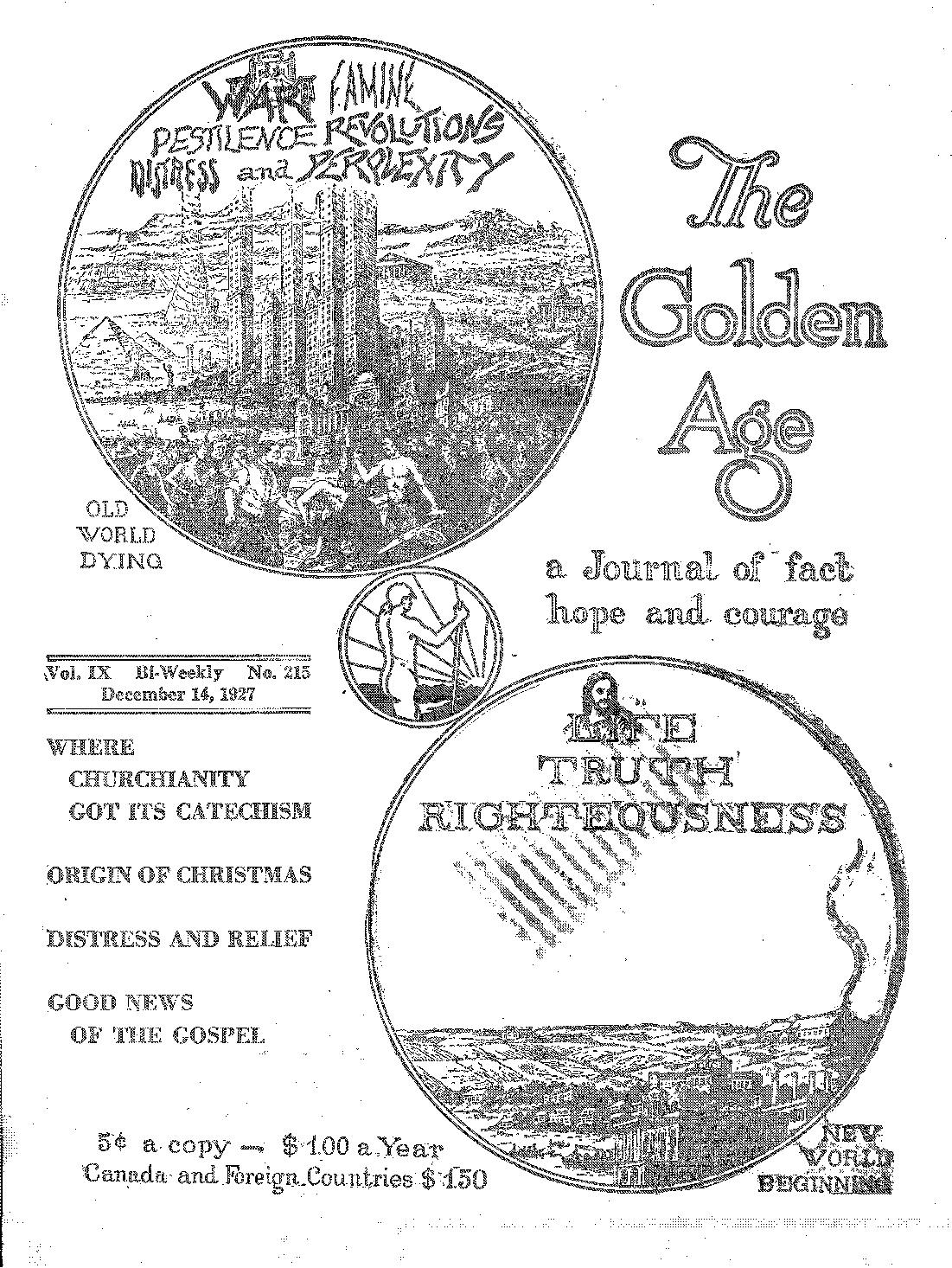
16a
UTTLE
i Mir xhc - <■
Labor anb Economics ffHB GeNTEEMBN OF TH8 IMMGRMIOS SERVICE
A Stingtns
cal—Domes'! OF CAPtTAMSil
Religion a:
JVhekb Chubchianity Got Its Ca
Purposeful Fabrications . . . . A Weak Imitation . . . . .
1 Incarnation,
Course
‘ Miscellaneous Musings ......
j Immortal “Souls” Handled Delicately
j Atonement. Obscured .......
Sunday and the Eucharist . . , . .
1 Reverence for the Clergy Emphasized
• Jealous Shepherds ........
; Individual Bible Study Adroitly Discouraf Misleading Interpretations of Prophecies Adoration and Worship of Women . .
Frekdom fob rar Peopi.es ......
Bibi® Questions and Answers ....
What the Government Does
Blessings Coming' . . .
Golden Age
Volaazra® IX fhiwldy^ M, Yos W©^wsglays Dseemfeer Ms 1027 N^mbes’
Where Churchianity Got Its Catechism. — Part 1
,.:• By 0. L. Rosenkranst Jr„
THE writer has before him a neat, compact little volume, soberly bound in black with gilt lettering and intriguingly illustrated with cuts of ancient sacred pictures. Somewhat whimsically it recalls to his fancy the black clerical habit and gold chain of oldtime parish clergymen who in Walpole’s days were obsequiously ready to dignify by saying grace the carousals of their patrons, fox-hunting English squires, but were required by inexorable custom to retire with the ladies before the “second bottle”.
The writer confesses to having acquired this treasure in a species of bibliophile enthusiasm without any very sanguine anticipation, of tangible profit from its perusal; and indeed a preliminary survey of the contents served rather to strengthen than to dispel this suspicion ; for such a muddle of antique superstition, pious sophistries and sacerdotal Mother Goose, tedious enough and provocative of yawning merely to glance over, seemed devoid of rational interest in a world confronted with such problems as radio-zoning the air and the application of “vita-glass” to egg production.
Distracted by the stream of honking traffic on the highway, the writer’s attention refused to focus itself on such superannuated lore. How strange that .anyone should ever have bothered his brains about it I In our day, the public yields a docile ear to the seductive appeals of “high-powered” salesmanship, until even the pidpit is its pupil,
Compared with the mechanical magic of these latter days, the tawdry miracles of the Apocryphal New Testament pale into insignificance. Science has harnessed the genii and made them 'drudge. We dismiss with a shrug the puerile folk-lore of our forefathers. We question whether the survival of these illegitimate scriptures can have served any end other than to gratify antiquarian curiosity concerning the dry-as-dust, calf-bound erudition of our ancestors, whose fund of patience must, have been considerable, or else their stock of reading matter strictly limited, to have found solace in such rubbish.
Good and useful wmrks, the old divines pronounced them, and such they may have seemed in cloistered quietude read under light which came filtered through stained-glass; but grotesquely irrelevant to the spirit of our noisy bustling times with their hedonistic outlook and their fetishistie attitude toward. science.
Nevertheless if merely to be an anachronism ■were the most damning article in our indictment of the books, this paper would not be written; for why should one busy himself to resuscitate forgotten, fallacies, just to point derisively at them ? But the reader, by degrees, is made sensible of a more sinister reaction on his spirits than mere boredom as he laboriously threads his way through, the tortuous maze of homilies, pious platitudes, false guesses, meaningless marvels and-misapplied quotations from the'inspired text. ■ .
The reflection obtrudes itself persistently that though these books are how Discredited, our ancestors rated'them authoritative, along with the canon, which they claim to amplify and serve as commentaries on and whose obscure passages they often purport to elucidate. Furthermore, since those works profess to have appeared at such an early date in church annals, even, during the apostolic generation, .how can we be positive that the doctrines herein enunciated demot properly constitute what the apostles taught?
Subversive Fallacies,. ■
HpHESE counterfeit scriptures openly testify to the orthodoxy of dogmas which scholars now deem imscriptural, via., inherent immoj**
16S , ■
tality, the trinity, inearnation, trahsubstantia-tion, hell, the immaculate conception, eta If these represent errors engrafted from paganism, why were they not refuted by the apostles! And how quickly the latter’s words and influence must have been effaced after their demise to suffer these fallacies to obtain such wide ere-‘deuce. .
Nay, insinuates the tempter, let us concede that in a sense these writings were impostures inasmuch as they owed their origin to over-zealous ecclesiastics, less scrupulous to record the exact sayings of their teachers than, we could wish, but perhaps not really departing from the spirit of the apostolic teachings, with which no doubt they were intimately familiar; which teachings their own writings were designed to be supplementary to, as detailed statements, where only outlines are afforded in the canon. Consequently, it does not follow that the Apocrypha are actually unconformable in cardinal articles of faith to what was generally believed in flie primitive church. ‘
I riving slyly inserted this douht, the demon has brought his victim to the brink ch slipping faith in the very elements of triaon, well-nigh, preovkod into grouping the ciPirc ‘feripturcs, two and false, in the same catewwy as archaic and vwiojwry eontoetore, wpwrtr and ursprov-gble with nc logical bearing or the problems of our modern electrically-driver. rye.
But we in ant beware of tmsly a.‘v-nnrpfion.s. Trulv, If (ri ri sti ani ty were d-yend W w yorim-.ics fur its validity, the line of eb'rnwo-vlon rw-tween fact and fiction might in A™ to trace, T ' ’ ' ' - * in
giiffh between the "vafino and i’w wulrlirn,. "......--- ....... .....■'
'fncAeTu seholnrly research has riw>ng.nt to light iinbopeachable evidence in the shape of old manuscripts which snridete even the Apoery-to be what thoir name indicates, irrespective .of their disagreement or presumed conformity with the canon; but proving likewise that they are not really in conformity with it, as the editor of th.® aforesaid black and gold compilation has pointed out in illuminating annotations.
Moreover, there is no evidence that any of flies® New Testament Apocryphal gospels, acts, epistles and apocalypses are older than the Fourth Century A. D., and of many the original MSS. are lost, and we possess only transcripts of the Middle Ages. We recall, in addition to this, that the Protestant clergy were fain eventually' in the interests of candor to exclude these books from the Bible, although the same were useful in reinforcing ecclesiastical pretentions.
So putting all these considerations together our enthusiasm, for these books revives; but it is negative in character, not evoked by their intrinsic merits, either as truth or clever forger-" ies, but by their value in exposing the vulpine policy of an apostate church, ambitious to consummate an adulterous union, of church and state and to persuade the laity of the divine ordinance thereof.
Purposeful Fabrications
TfiJY THE foregoing, we do not mean to imply XJ:? that Nicene orthodoxy was an outgrowth of the Apocryphal, teachings. The reverse is ths truth ; the apostolic doctrine.was corrupted first, and the spurious gospels and epistles fabricated afterwai’d to give -the vitiated doctrine the weight of authority.,
Briappoirted in their expectations of a eono'. i > r T fin ainbitious
elewry proeknnti the Hennanic irirgdom as ti-rpndy established under hierarchical auspices. Their program was to eoncfiiata tl.vear and
a r • * ,., , i ’ • t - 1 - by
to the ruling clasww Their- policy was to consolidate their g-Priuwl empire by wholesale conversions ef the Tinman, populace..
. The la tin
attached to their Idclatrou.s practices that it was no easy niatroe to lure them aws.y, Accordingiy the old gods were incorporated in driguri-d form as sannts and marlyrs. their idtialrms ■warship adapted to the chm-cli .ritual. In tins way the masses were reconciled to the new
And so subtly was this metamorphosis effected that agnostically-mindcd scholars, confuting the original with the adulterated, doctrine, have been led to infer that Christianity represents simply a variation of the solar myth, an astrological adaptation, of Judaism. But the monstrous alliance facilitated the ecclesiastical program ofi winning imperial patronage..
The surviving Apocryphal books (as well, we surmise, as those the titles of which alone have been transmitted to us, i. e., the “lost gospels” of Andrew, Bartholomew, Basilides, Scythianus, Titan, Thaddeus, Thomas and Valentinus, various “Acts of the Apostles” by Leucius, Lenti-tus, Leuthon, and others, the “Bevelati ons” of Cerinthus, Paul, Peter and Stephen; the Acts of Andrew’, the “Epistles” of Christ to Peter and Paul, etc.) all reflect the zeal of loyal partisans of ecclesiasticism to promote its plans for setting up a theocrasy1, a defilement of the sancfu-ar> with heathen abominations.
Nor docs it invalidate this supposition that many of these false scriptures antedate the controversy of Arius and Alexander! The church J1 ad been adulterously minded for some time prior to this; and priestly sycophants were alert to forge a Scriptural blessing to the projected illicit union.
In the Apocrypha an ingenious counterfeit is presented of the inspired writings; the apostolic style and diction is cleverly imitated in a way calculated to deceive the pious. There is a similar recourse to parables and enigmatical utterances, but the meaning is carefully made clear and not left for future truth seekers to unravel, line by line and precept by precept, here a little and there a little. The reader is never left to form his own conclusions, but instructed in the meaning as prescribed by orthodoxy.
Passages from both Old and New Testaments aie liberally intercalated between the text to leaven the whole with an odor of sanctity and plausibility; but these quotations are grossly misapplied with often explanatory words tacked on to the end to give a wrrong twist to the senses
Thus I Clement states that “God divided the eaith from the ■water, with which it is encompassed”, as if in divine corroboration of the contemporary hypothesis of a flat earth, encircled by the “river of ocean”. Similarly, it is gravely asserted that “even the smallest creatures live together in peace and concord with each other”, a manifest absurdity, contradicted by our daily experience and observation.
A Weak Imitation
“B/TUCH resort is had to unctuous prating of XVJL goodness, with pious exhortations toward humbleness, meekness, charity, and all the cardinal virtues, special emphasis being laid on reverence for one’s spiritual superiors and the need of cultivating submissiveness. Shallow platitudes and trite recommendations to holiness abound. Through all a sanctimonious twang is detectable.
The reader is sensible of something lacking; his spirit is not abashed by that intangible hid, den power and inscrutable wisdom that intern lines the inspired text. Mysteries are aplenty; but they are unconvincing, palpable subterfuges designed to impose on devout credulity and to exalt the sacerdotal office of interpreter. The reader is conscious of no obligation to scan the enigmatical utterances reverently and ponder over their meaning, but skips along in a spirit of levity as if he were reading a sub-division promoter’s advertisement.
No wonder if, as alleged, Catholic pastors used to interlard the services with ribald jokes interchanged with their parishioners, and that communicants repaired to the corner saloon after morning mass! It is reported that priests used to rebuke risibility by free use of the horsewhip. (Carleton, Traits and Stories of the Irish Peasantry.)
The Apocrypha, indeed, seem excellently adapted to bolster up a system of formalism and superstition whereby the goats are enabled to crowd into the sheepfold by acquiring the ovine “bleat”. In the “Shepherd of Hermas” sheer formalism is rebuked, the godly being reminded that the true fast is of the spirit; but the Shepherd is careful to add that formal observances are praiseworthy in their place as works of merit and supererogation.
*‘Trimtyn Repeatedly Endorsed
HOUGH Protestantism discarded the Apocrypha, its leaders were not vouchsafed enlightenment to abjure along with it the doctrinal errors sanctified therein. These errors, transparent enough in our day of critical research to bo candidly admitted and sifted out, one. Mould think, remain imbedded in the creeds and are stubbornly reiterated as sacred truths by the very same seminary graduates who as disciples of higher criticism virtually disavow the Bible itself, regarding the same as a strictly Inman compilation, no more under divine supervision than the Sig Veda or the Shakespearean dramas.
These same divinity students may be cognizant of the practical unanimity of heathen religions in endorsing a trinity of some sort, and that the triune concept was not implanted in the creed without a long and bitter controversy in the primitive church; but, for all that, they ding to it with pertinacious insistence as the very corner stone of their faith. And for tins they have not a shadow of Scriptural authority besides the three heavenly witnesses of 1 John 5:7, a proven interpolation absent from, all the Greek hlSS. executing one in Beilin, k>.ovn to have been transcribed from the printed B..blia Coiv jhtf eii -B
Neither is this a recent d’Neovery; for as far back as the times of our grandfaloeis' grandfathers Hr Trane Ntwion prove 1 the text to be absent from any Greek MSS. earlier than the Fifteenth Centuiy, or Latin MSS. hefoie the Ninth Century, ft is fiivt cited by Virgilius Tapseiisis, a Lat-n writer of no credri in the Fifteenth Century, and by him supposed, to have been forged.
It was held doubtful by Erasmus, Luther and other eminent leaders of the ’Reformation; and is not referred to by the early trinitariaus in their acrimonious controversies with the heretics. If it were authentic, it is reasonable to suppose they vould have seized on this text with avidity as one of their most clinching arguments.
Outside of the pagan pantheons of the Babylonians, Egyptians, Hittites, Phoenicians, etc., the only authority for the trinity antedating the three heavenly witnesses are certain texts in the Apocryphal books. These ie\t> are quite numerous and their endorsement specific: as, '‘There is one Jesus Christ . . . uho proceeded from one Father, and exists in one, and w returned to one.’*—Epistle of Toatms to the Maanesians 11:2.
Tg. Nag. V:4: “Study therefore to be conformed in the doctrine of oiw Lord and of his apostles: that vhatsoever ye do, ye may prosper both in body and in spirit, in faith and chanty, in the Son awl in the Father, and in the holy spirit: in fh» beginning and in the end.”
Gospel of the Birth of Mary VJI1I: 15: “And she brought foi th her first born son, as the holy evangelists have taught, even our Lord Jesus Christ, who with the Father, Son and Holy Ghost, lives and reigns to everlasting ages.”
Acts of Paul and Theda 1:18: “Blessed are they who keep their baptism pure: for they shall find peace with the Father, Son and Holy Ghost.”
Incarnation, of Course
HpHE preposterous doctrine of incarnation, an adjunct of trinitarianism, is often cited by agnostics as supposed irrefragable testimony to the conflict of Christianity with common sense. With pertinent sarcasm, they inquire whether the uiiivfise vras left to run itself while its supreme J lead absented himself from His throne to mmgle ireoqnrio among !Iis creatures in an obscure oi b in Hio realm. The reply to this criticism is that incarnation is not properly a Christian rancipt, but a heatlun one, common to Hindu, Greek and. Roman paganism, and mystically' typifying a phase of solar activity.
It is unwarranted by the Bible, and Sir Isaac Newton, sewJl le of its paradoxical nature, generations ago observed: “What the Latins have done to this text (1 John 5:7). the Greeks have done to that of St. Paul (1 Timothy 3 :16). For by changing; omikioii into theta, the abbreviation of theos, they’ now read, ‘Great is the mystery’ of godliness; God manifested in the fleCu’, whereas all the ancient versions, Jerome as well as the rest, read, 'Great is the mystery’ of godliness which was manifested in the flesh.’ ”
But this dogma passes unchallenged in tire Apocrypha. Witness: “There is one physician, both fleshly and spiritual, made and not made; God incarnate: true life and death: both of Mary and of God; first impossible, then possible, even Jesus Christ our Lord.”—Epistle of Ignatius to the Ephesians II: 7.
Oh, nhat a mystery of priestly gabble is this to befuddle devoutly’ credulous brains! First impo-rible. then possible! Unbidden memories float baric m us of oldfimo bar room lecturers and the profound inanities they uttered between hiccups, with such drunken gravity! From Vs inception, the pulpit has ever prescribed noi.se as the unfailing panacea fox spiritual anremia.
Tree life and death! In a choice bit of 1’)-mamst fiction, Urn pallor s comment on. the suppliant's avowal that i-Le preferred death to life is, “That is a beautiful sentiment, my child.” Beautiful ? Are the shroud and mouldering boiv s more beautiful than the green-gold of the grass, spangled with a yellow glory’ of dandelions and streaked with the long shadows of the tree trunks, or than the dimpled bosom, of the Jake sparkling like diamonds in the morning sun ?
What message streams down to us from the star-strewn grandeur of the dizzy7 cosmic vault, ■where Polaris, our anchor, drags in a circle? Always the tonsured-cult disparage the sublime handiwork of the Almighty as vanity, bidding us fix our hopes on jeweled harps and golden pavements. Howbeit, themselves are strangely reluctant to bid this good green earth adieu!
The Notorious “Star”
IN IGNATIUS to the Magnesians IV: 11-13, we are confronted with the novel theory that mankind’s redemption was primarily brought about by the Star of Bethlehem, or at least the text conveys that thought. This star, it is related, so eclipsed in brightness the other heavenly bodies as to attract world-wide attention, stimulating speculation as to its import, the outcome of these cogitations being mental manumission from the bonds of “magic, ignoi'ance, and sin”, vdiereby “the old kingdom vTas abolished, God himself appearing in the form of a man for the renewal of eternal life”.
How that anything which is inherently eternal should require renewing surpasses ordinary every-day intelligence to comprehend. Apparently, the author’s ideas are prepossessed by certain aspects of the Solar myth where the deity periodically dies and renews itself at the end of a cycle, and he is transferring to the Star of Bethlehem some of the attributes of Spica in the constellation Virgo. This cyclical concept colors Ig. Mag. J 1:5, which refers to “Jesus Christ, who was the Father before all ages, and appeared in the end to us”.
A Jesuit writer, after extolling the Magi as g -eater personages than Csesar, Columous, or Om Captain Lawrence of the Chswapeake, -.rrtlws the Virgin Mary J-i n ystwal jihistra-t -a as th? “bean'if d star that rose in Jacob”. So hs-AC +he B maiusri cv°r sbiwn to subnid’-wi c. s-.e Son i •) the mother, as if Mary were the Gm; of ;< cob, and mat though avnri' beside 11.00 ewfLe, her syMt simultaneously mode in the star. Palpably he -dent-ties Spica w Virgo a. the “Wse Men’s’ bea -on.
The Gospel op Nicodemus readapts the hoary me th of Tsfhar and Thanwuz (and its va nations in other lands as the myths of Cybele and Vttis, Isis and Horus, Venus and Adonis, e,c.) into a form more suitable for reconciling heathen converts to diocesan episcopacy.
“St. Jerome” vouched for the story of Christ’s 'descent into hell and this incredible tradition seems to have been foisted onto the creed at an early date, the general belief being that Adam, Noah and the ancient worthies, together with all the righteous dead had been confined in hell until Christ descended thence to transport them to the celestial paradise.
Miscellaneous Musings
IN NICOD. XV: 9 an altercation ensues between Satan and Beelzebub, prince of the infernal regions, the former recommending the permanent incarceration of the expected visitor and the latter protesting its impossibility. Beelzebub explains that the wresting of Lazarus from his custody had enlightened him as to Christ’s omnipotence: “And I know now that he is the Almighty God who could perform such things, who is mighty in his dominion and mighty in his human nature, who is the Savior of mankind.”
Previously (Nicod. XIV: 8) those functions are ascribed to the Son which Jesus declared unequivocally to be kept in the Father's own power, when all the saints are made to prostrate themselves before the Savior’s feet, exclaiming, “Thou art come, O ^Redeemer of the world, and hast actually accomplished all things, v hich thou didst foretell by the law and the holy prophets.”
The crucified thief, translated to heaven, relates to Adam and the saints how he addressed Jesus at Calvary: “And I believed him to be the Creator of all things, and the Almighty King; and I prayed to him, sawing, Lord, remember me, when thou co nest in to thy kingdom.” (Nmod. XX : 9) The author evidently puts Ins trurf in the misplaced fommo, or its unciem equivalent,
Even the skeptical Pontius Pilate concludes that Ie had m cis rffieial capgery condemned and executed the ebu ud Tint Cause, being mode to testify: so E rhat
Jems e.born ne cii?1’twd is M=u Crrivi u o Sou ot Led and true and AJnl-hi’' Cod. J men.”™ Nicrnl. XXI I: 20. ' ”
la Acts of Paul and Theda V'lv: C r’'lv'niu prays, “O Lo-d God of heaven m I taiLi, J( sus Christ, thou Son of the Most limb, grant that her daughter, FMcoriiJa, may live ior ever.” Barnabas III: I asserts that the lord (Jesus) had shortened the times and the days so that His beloved, the saints, might hasten His coming into His inheritance.
The thought involves a paradox of preordained adventitiousness, as if the immutable plans were reconsidered to anticipate a prearranged date to enhance saintly prestige by allowing them to contribute more effectually toward the second advent. But this is to misconstrue the original, therein the words "unless those days should be shortened” imply not an alteration of predetermined plans, but indicate the overwhelming nature of a catastrophe, such ®s v ould extinguish all life if long continued.
Immortal “Souls” Handled Delicately
SOME well meaning Utopians (exponents perhaps of the “good old world” theory, so good they are quite satisfied with its indefinite perpetuation under the present kindly auspices) have prophesmd an eventual undying of all leligious systems through the elimination of non essential dogmas and the intention of chose common to piactmalb meiy crcul. The hope of inunortaE dj, they qw, wdl rmmsh a umveisal point of n ru<uiint m a base- o Im Lag av the )3i u *" k1 ueiu me-.
B-ea -ve' urrhia’ *ty l<?oils us \ » Ml neat' -
■’•n i-uwl i Wh 1 lion a-s o’- maf1 ot the
\ i v c - i (t oL Ch e tidbitv
T u (. on not L' d i i h ifiiM diu-im tl r gmiCKcim, ft o 2ipm,nphrJ W'to ar« somewhat ei’ium^p M m them f thtade to yard it; howmer, the reality oi the soul ie vouched for in the second epistle of Clement to the Corinthians V: 1 3: "The Lord himself being asked by a certain person, When the kingdom should come? answered, When . . . that which is without [shall be] as that which is within; He means this: he calls the soul that which is within, and the body that which is without. As therefore the body appears, so let the soul appear by its good works.”
From which we deduce the kingdom is presumed to conesnond to a plane of spuitual development attained separately by each individual Christian. The kingdom is conceived as the remp of Christ in the heart, a far onte ww ofi modern churehiainty also
Clement, a disciple of Peter, subsequently beer'me bishop of .Rome He is bsted as the fom rh pope’m some oj the catalogues and as filth m others 'He was highly esteemed by Cie inn Altxoi tour ic, Ft sehms and other jath-eis of the dunt , bcmg i*mJ uu(;\siy «•" m topost ibc nici’, an “anwue”, am ‘■'Lnoet cQ apis M. Bv . i, iik. <■(> - i em pu’ ey
o. i-.i '-i In s m i - c ii i h
r 1 1 m m t to’’ j. r’ n - & u d L, br u 1L ( 1 J l £ l z Z I. I <(
c a ” h >. tin v c i 3‘ £' ’t H l e J C _i >
3 ’ I ! .
■ft 4 I i
' < 1
f c < d "gun
i z. 3. "erjs ?.e
'V ml. lti it Lt in Io ’ 'to tS th t he p’ae s mwp ahfie< aipim"] oi d lmc Em-Ike. or C viwjiit, J i..vex?tmg fjria “esteemed st a gieat blessing’ th t they v e “happiiv d scoyoied for the mnrave and '■on' i« mation ot our laith a» vwllasourehani-yT > Jr B
a partiality the pulpit has alv s shown lor hndi sounding, empty, meaning!A5s phrases! !t must have required truly a superabundance of either faith or gullibility to swallow these pom-gjosities without nausea.
As for charity, Clement makes large inroads ©n our stock; for the most charitable assumption that his unswerving loyalty to Catholicism 'tempted him into "using the word of God deceitfully", rather than private vanity or ambition.
Like all the Niemans, Clement wholly misap-gjreheiids the destiny of the new creation in relation to the general redemptive plan, and its Histinction therefrom. He shows this where he says, "We must therefore keep our flesh as the temple of God. For in like manner as ye were ©ailed in the flesh, ye shall also come to judgment in the flesh. Our one Lord Jesus Christ, who has saved us, being first a spirit, was made flesh and so saved us; even so we also in the flesh shall receive the reward."
If the translation be accurate this would argue that Christ’s reward for His fidelity was stripes mid martyrdom; hence correspondingly the saints are to look on their persecution while in the flesh, not as a badge of service, but as the reword itself I
The lack of insight of the church fathers in regard to tb° resurreclion and the judgment day is stril’togly exemplified in Ignatius to the Saiyra&ans 1:7-9, vrhere we are remindod that our Id aster’s sufferings were a reality and not illusion "as some heretics claim”. The latter are ’dortour cod, brii ,g warned that "as they believe so shall it happen unto them; when being divested of the flesh, they shall become mere spirits ["incorporeal dvmcues” in the original]. But I know that even after his *< eshirreetion, he [Jesus] was 5n the flesh; and I believe that he is still so.”
Are we to mfer that he .believed that ihv Master retained TIis terrestrial body even after His ascension? What a blundering transportation of Bible teaching is here effected where the saints are promised a fleshly hereafter, and the jmregenerate sinners threatened after their demise with a mere spirit existence 1 Followers of Dr. Conan Doyle might profitably insert this passage in their apologies of the nightmare Science.
Staeiwi Obscwed
INDEED the vital significance of the atonement, which is made so plain, in the words of T&ul “As all in Adam die; so in Christ shall all be made alive,” seems to have escaped the Apo®-ryphal writers. In Barnabas IV: 10 some groping attempt at explanation is given, that it was essential for the Redeemer to “appear in the flesh that he might make good the promises given to our fathers, and preparing himself a new people, might demonstrate to them whilst he was ■upon earth, that after the resurrection he might judge the earth.” In short, the subordinate features are emphasized; and the main purpose, the ransoming of Adam’s seed from original sin, is lost sight of.
Churehianity has always taught that mankind at large is already under judgment as individuals during the incumbency of the god of thi® world: consequently for* the overwhelming majority of people the judgment day must decree condemnation. They are predestined to "hell fire” through no fault of their own, and to them the blood of Christ must be mockery!
‘This narrow viewq so signally misrepresentative of the divine attribute of mercy, is reflected in Barnabas IV: 15, “IVherefore the Son of God came in the flesh for this cause, that he might fill up the measure of their iniquities who have persecuted the prophets unto death.” Yet Jesus gave His posi five assurance that He came not to condemn the world, but. that it might be savedi Wherever possible, sectarian bigotry lias sedulously striven to substitute bogeys in lieu of divine mercy.
Vain Imagirfngt JVighlis Endersed
rpHOSE modern philosophers, including the A noted author of the Outlive of Histoiy, who indulge in gloomy forebodings of an ultimately freezing planet, under & cooling sun, must have had their ancient prototypes; for we read: “'Then he dearly manifested himself to be the Son of God. For had he not come in the flesh, how should mon have been able to look upon him that they might be saved? Seeing if they beheld only the sun, which was the work of his hands, and stall hereafter cease to be [Italics mine—B.], they are not able steadfastly to look against it.” "—Barnabas IV: 13,14.
Again he is trying to account for sunlight by 'disregarding the sun. Of course his argument is valid up to a certain point. In a sens® the Savior would in His spirit body remain invisibl® t@ fleshly humanity; but the witness of His works during His fleshly career was only in®^ ■ ’dentabto the key purpose, the ransom, which Barnabas seems studiously to ignore.
And, alas for Mr. Wells and his efforts to frighten us about what will happen to our greatgrandchildren’s remote descendants, the more advanced thinkers among scientific men have recently scrapped the whole La Place hypothesis and invented a planetesimal theory to take its place, which makes no provision for the solar system gradually running down and being forgotten by the Winder-up.
The Apocryphal writers, destitute of any comprehensive appreciation of the divine plan, correspondingly failed to discern the ultimate destiny of Israel in relation thereto. Hence they revert to speculative and fictitious exegeses of the promises to Abraham, intended with a literal fulfilment, but construed by them as pertaining to individual growth in Christian character; as Barnabas V: 8-14, where the divine invitation extended through Moses to enter into a land flowing with milk and honey is interpreted as a call to the Christian to be transformed from the fleshly to the spiritual nature.
The simile is used (Barnabas V: 9) that “man is the earth which suffers; forasmuch as out of the earth Adam was formed.” Pursuing this forced and arbitrary symbology he explains: “Wherefore ye see how we are again formed anew; as also he speaks by another prophet: Behold, saith the Lord, I will take from them . . . their hearts of stone, and I will put into them hearts of flesh. Because he was about to be made manifest in the flesh and to dwell in us.” —Barnabas V: 16,17.
Undeniably it is a beautiful thought that our hearts should be transformed by the indwelling of Christ in them; but that is not the sense of the original, which foretells the Jewish change of heart after, as a nation, they learn to recognise their Messiah in Jesus. In a wider application it relates to human enfranchisement from the rule of selfishness.
In view of the dulnoss of perception evinced in so much of the foregoing, it is curious to not® the endorsement thereof by such eminent divines as Archbishop Wake, Vossius, Dupius, Whiston, Dodwell, and Doctors S. Clark, Bernard, Mill and Cane, who are unanimous in pronouncing Barnabas a genuine epistle. Probably their estimate of its genuineness is the measure of their own misconception of the divine plan
I which Bambas is so out of harmony with.
Sunday ami the Eucharist
SUNDAY is sanctified by long-established custom as the Christian sabbath. Without questioning the propriety of this custom, the fact remains that the Scriptures are silent in the matter, whereas the Apocryphal books present the customary arguments in favor of Sunday observance; as Barnabas VIII: 9,10, where Judaizing tendencies within the congregation meet with the caution that the seventh day is not acceptable to the Lord, who “resting from all things . . . shall begin the eighth day, that is* the beginning of the other world. For which cause w’e observe the eighth day with gladness, in which Jesus rose from the dead; and having manifested himself to his disciples, ascended to heaven.”
In Ignatius to the Magnesians III: 1-3 it is alleged that the holy prophets of the pre-Christian era did not conform to the imperfect Jewish law, but lived under the dispensation of Christ, “and for this cause were they persecuted. . . . Wherefore . . . they who were brought up under these ancient laws came nevertheless to the newness of hope, no longer observing sabbaths, but keeping the Lord’s day.” What is her® postulated exhibits a curious similarity to the Koran’s assumption that Adam, Seth, Noah and Jesus were good Mohammedans!
Where fjie true meaning of the atonement had become almost obliterated it is not surprising to find the false doctrine of transubstantiation in bold relief. A modern casuist attempts to justify this cardinal tenet of Catholicism in th@ miracle of the loaves and fishes, the only num. ele, hejaretends, that is recorded in all. the four gospels. The multiplication of the loaves, he ex>« plains, “prepares us to believe that under the form of bread he [Christ] would multiply his real presence, so as to feed millions of Catholics with his own body and blood.”
We are not advised of the tariff for masses in those first centuries of Episcopal ascendancy, though we find this hideous error already strongly rooted then. In Ignatius to the Philadelphians 1:10, communicants are cautioned, “Wherefore let it be your endeavor to partake all of the sam@ holy eueharist.”
In Ignatius to the Smyrnseans II: 16 the congregation are admonished to beware of heretics^ who “abstain from the eueharist and from the public offices [formal prayers and ritual]; because they confess not the eucharist t® be the flesh, of our Savior Jesus Christ” Again: “Let the eucharist be looked upon as well established,, which is either offered by-the bishop, or by him to whom the bishop has given his consent.”-™ Smyrn. Ill; 3.
llevenncs fer the Clergy Emphasized
CCLESIASTICISM always set great store on formal observance and solemn mummeries calculated to overawe and mystify the laity and to impress them profoundly with a conviction that the priest was indispensible. In the Catholic legend, Jesus himself in the gui.se of an acolyte assists a priest to serve mass I
The necessity for a regularly graduated hierarchy to serve as the divine interpreters is repugnant to the apostolic teachings. In the new creation all members become Levites and ordained ministers of God. It remained for an ambitious clergy to erect the most stupendous and complex ecclesiastical system ever dominant ©ver the human spirit, and to devise impostures ©f the inspired text in ostensible corroboration of its requisiteness.
The program of churehianity is divulged in 1 'Clement XXX: 1-3, where it is narrated how the apostles, “having received their command « . . went abroad, publishing that the kingdom ©f God is at hand.” From the context, it is apparent -that they intended to convey that the kingdom, was to be established during the current generation under the auspices of & church yet in the flesh, through wholesale conversion of the heathen, which remains after many centuries the ideal of churehianity. “And thus preaching through countries and cities, they appointed the first fruits of their conversion to he bishops and ministers over such as should afterward believe, having first proved them by the spirit.”—1 Clement XXX: 4.
According to the views of these churchmen., Messianic kingdom could be consistently set ®p in this present evil world, inasmuch as Christ feeing himself the First Cause is omnipresent, ’“Where Jesus Christ is, there is the Catholic .Church”.—Ig. Smyrn. Ill: 4.
If the validity of this claim is granted it follows as a natural sequence that “it is not lawful without the bishop, neither to baptize, nor to ©elebrate the holy communion,”. (Ig. Smyrn. HI? 5) “It is a good thing to have a du© regard both to God and to the bishop: he that honors the bishop, shall be honored by God. But he that does anything without his knowledge [Italics mine-R.], ministers unto the devil/’—Ig. Smym» HI: 7.
Here we detect, unless our discernment is at fault, the germ of auricular confession, the thrice-holy Inquisition, sermons in a dead tongue, and all the other auxiliaries of medieval mental enslavement to the Vatican; for even as Christ was held to be omnipresent, so likewise must His body, the church, participate in this quality. Consequently, it became flagrant sin to conceal anything from the clergy.
The belief that the Messianic kingdom was already set up under omnipotent Christ eon-noted church regnancy over all nations and tongues. This spiritual empire was closely modelled on the imperial structure to which its officials and territorial divisions corresponded. At first subservient to Caesar, as hierarchical power became .centralized in archbishops, patriarchs and metropolitans its arrogancy increased until in 606 A. D. the Emperor Phocas officially recognized the Pope as supreme head of the church.
Thereafter the Man of Sin augmented his powers and pretensions, claiming an authority even superior to Caesar’s to hold the keys of heaven and hell, to bring suppliant monarchs barefoot to kneel at his feet. There were no limits to his pride and ambition until even the titles appropriate only to divinity were arrogated to him.
Some hint of this future exaltation is afforded in Ignatius to the Ephesians 1:12, where the diocesan magnates are likened to Christ in authority and their title to universal spiritual dominion explained. “For even. Jesus Christ, our inseparable life, is sent by the will of the Father; as the bishops, appointed to the utmost bounds of the earth, are by the will of Jesus Christ.” This outwardly innocuous text might be construed as a warrant to punish as rebels any heretical or heathen, nations who disputed the rule of diocesan episcopacy.
Hierarchical solidarity is urged in Ignat. Magnes. II: 4, 5,8, whiqh outlines the scheme of government: “I exhort you that you study to d® all things in divine concord, your bishops pre® siding in the place of God, your .presbyters in the place of the council of the apostles, and your
'deacons, most 'dear to me, being entrusted with the ministry of Jesus Christ. ... As therefore the Lord did nothing without the Father, being united to him; neither by himself or yet by the apostles; so neither do ye anything without your bishop and presbyters.” By all means, let your superiors do your thinking, otherwise you will not make docile church members, and not accept Papal infallibility in years to come!
The solicitude of its founders was to maintain and stabilize ecclesiastical integrity, so naturally they deprecated individual self-assertion. "Tn • like manner let us reverence the deacons as Jesus Christ, and the bishop as the Father; and the presbyters as the Sanhedrin of God and college of the apostles. ’Without these, there is no church.” (Ignat Trallians 1:8,9) Here the clergy are already blasphemously demanding ' the same homage due to the Creator and His Christ, and declaring salvation to be available only through their own instrumentality.
""Wherefore it will become you to run together, according to the will of your bishop, as also ye do. For your famous presbytery worthy of God, is fitted as exactly to the bishop as the strings are to the harp.” (Ignat Ephesians 1:13,14) Nor was strictly sacred music always played bn these harps: more often the minstrel attuned them to the "lay of the golden goose”, until merchandising in indulgences, dispensations, absolutions, masses, etc., yielded incalculable profits, finally precipitating the Reformation.
“Obey Yeiir Sistop”
SINCE ecclesiasticism is rooted in ignorance and superstition, its perfect fruition is cowed and quiescent masses, making a virtue of their own poverty to lavish treasures on convent and cathedral. Hence, implicit obedience is stressed as a cardinal virtue with the laity; as Ignat. Magnesians IV: 5, “Be subject to your bishop and to one another [keep one another loyal by dutiful reminders], as Jesus Christ to the Father, according to the flesh, and the apostles both to Christ and to the Father, and to the Holy Ghost; that so ye may be united both in body and in spirit”
Apparently the thought embodies church sovereignty, both spiritual and temporal, over mind and body. "For whereas ye are subject to your bishop as to Jesus Christ . . . it is therefore necessary that as ye do, so without your bishop, ye should 'do nothing; also be ye object to your presbyters as to the apostles «fl Jesus Christ our hop®” (Ignat Traffians 6) Do nothing without consulting his revere®®^, because he is properly a better judge ©f private affairs than you are yourself I
"Whoever does not act in harmony with the church is proud and already condemned himseH, For it is written, God resisteth the proud. L®t us take heed therefor® that we do not. set ourselves against the bishop, that we may be subject to God” (Ignat Ephesians 11:3) “Fos whomsoever the master of the house sends to be over his own household, we ought in like mm. ner to receive him, as we would do him that serf him. It is therefore evident that we ought to look upon the bisJiop even as we would do upon the Lord himself J’ [Italics mine—R.] (Ignat, Ephes. II; 4) “It will therefore behoove you in all sincerity to obey your bishop.”—-Ignat. Mag-nesians 1:7.
Already Antichrist was giving utterance to great things and blasphemies, showing himseH in the temple that he was God. No wonder that Protestant prelates were slow to discard such, “good and useful” allies as these books, which, educated the laity into a fitting deference toward their clergy! Ignat. Ephes. 11:4 paves the way for Papal pretensions to infallibility.
Jealous Shepherds
ATURALLY, heresy comes in for strong reprobation by these champions of Nieen®
orthodoxy. As in Ignat. Trallians II: 1, “I exhort you . . . that ye use none but Christian nourishment; abstaining from pasture which is of another kind. I mean heresy.” "For they that are heretics confound together the doctrine oS Jesus Christ, with their own poison; whilst they seem worthy of belief. As men give a deadly potion mixed with sweet wine; which he who drinks of does with treacherous pleasure sweetly drink in his own death.” (Ignat. Trail. II: 2,3)^ “He that is within the altar is pure; but he tha^ is without, that is, that does anything without the bishop, the presbyters, and the deacons, is not pure in his conscience.”—Ignat. Trallians 11:5. '
The church claimed to be conscience-keeper for the public, discountenancing to the extent ofi inquisitorial repressions private liberty ofl thought. There were seven minor sins, seven deadly sins, and seven sins that cried to heaven Mor vengeance; also there was a graduated seal® ©f fines for their remission.
Eventually, there were indulgence hawkers with -blanks made out for every conceivable ©rime, ready to he filled in with the purchaser’s aaame. If one yearned to relax oneself with a little playful homicide, the prudent course was to get absolved in advance. Business was brisk until Luther began asking awkward questions, Fuch. as, “If the pope releases souls from purgatory for money, why not for charity’s sake?”
Much follows in the same strain, as Ignatius to the Philadelphians 1:8, “For as many as are ©f God and of Jesus Christ, are also with their bishop.” The insubordinate are of the Devil’s communion. “Be not deceived, brethren; if anyone follows him that makes a schism in the church, he shall not inherit the kingdom of God. "<f anyone walks after any other opinion, he agrees not with the kingdom of Christ.”-—Ibid 1:9. '
Cyprian, the great promoter of Catholicism, had written that whoever separated himself £rom the universal church was in the position of those outside the ark during the flood of Noah. “But the Lord forgives all that repent, if they return to the unity of God, and to the council of the bishop” (Ibid 11:17) Eepentance is vain, however, unless the specified penances are performed, or commuted by a cash equivalent!
“It is & shame, my beloved, yea, a very great ’shame and unworthy of your Christian profession, to hear that the most firm and ancient church of the Corinthians should, by one or two persons, be Jed into sedition against their priests.” (1 Clement XX.: 24) The Theodosian Code eommicsioned the successors of the persecuted apostles to themselves turn persecutors. The beast was ready to tear and trample whoever insulted his haughty rider. Once accused ©f sedition against Divas (?®sar, the Christian professors employ the same term to incriminate their detractors.
“Let no mail deceive himself; if a man. be not Mthin the altar he is deprived of the bread of God. For if the prayers of one or two be.of such force, as we are told, how much more poweiTul Bhall be that of t he bi shop and the whole church ?” —Ignat. Ephes. II: 2.
| The implication is that the church is omnis-®ient and omnipotent, having supernatural supervision qver the thoughts and private welfare of the laity. The mark of the beast was to be on everyone’s forehead and in his hand. To offend the clergy seriously was to tempt Providence । but whoever stood in their good graces was assured of prosperity, both temporal and spiritual®
Theories of “Fathers?’ Recommended
WE INFER that Ignatius was received with a ceitain amount of skepticism by his contemporaries, from the obligation he seems to feel himself placed under to defend his statements ; some of which were evidently challenged as being wtieanonical. Thus, in Ignatius to the Philadelphians II: 19-2.1.., he says: “Nevertheless, I exhort you that you do nothing out of strife, but according to the instruction of Christ. Because I have heard of some who say: 'Unless I find it in the originals [the canon], I will not believe it to be written in the Gospel. And when I said, It is 'written [in the originals] : they an-swer.ed [referred me to] what lay before them in their own corrupted copies.”
He cunningly pretends that Iris own misquotations are the pure doctrine, and that the unadulterated versions of his critics are misleading. He endeavors to ward off criticism by pious generalities, slyly insinuating that his own. special inspiration is superior even to that of the four gospels I “But to me Jesus Christ is instead of all the incorrupied monuments of the world,” concluding, with smug sophistry: “All there Core together are good if ye- believe with charity.” That is, if you listen in. a friendly, tolerant spirit, the prophets, the gospels and his own words are oi equal merit and sanctity.
The Papists have always stressed the equal authority of the fathers of the cbm ch with the Scriptures on which their works served as commentaries. Protest nits are told that they err in relying on private interpretation which their lack of scholarsoip unfits them for. In the above we have an example of how liable these same church fathers were to impudently foist their own ideas onto the public, as of equal authority with the apostolic writings.
Sndmdmil iBiMe Study Adroitly Dismayed
IT SEEMS astonishing that in our day of analytic research, when so much light has been thrown, on the Scriptures by new-found manuscripts and contributory evident® @f varims® kinds which serve to confute the divine origin of ithe Augustinian Creed, exposing it to be a med-’ley of truth and pagan errors, that otherwise : intelligent and educated church people should cling so tenaciously to these doctrines as the bed-rock foundation of their faith.
Are tfot the same critical expositions of this fallacy as available to themselves as to others? Indeed, yes; but unread by the majority, who are supremely indifferent as to the critical merits of a doctrine. This predilection is notoriously to follow a leader with a resounding bray and to give vent to their emotions in concert with their fellows.
Emotion has contagious qualities, whether yielded to in the theatre or in the pew. Moreover, with church 'people, their religion is so inextricably involved with social life that the average member prefers a tacit concession of what he hears from the pulpit rather than social ostracism. *
There is a certain comfort' and reassurance in public worship (whatever it is directed to I), and the average church member is reluctant to alienate his friends and prejudice his business interests by open antagonism to doctrines which very frequently his reason finds inadmissable.
Conscious of his own incapacity to interpret trio Scriptures, the average church member relies on his pastors, who have been trained as specialists in this field, and whose scholarship entitles them, as he supposes, to a hearing. Unfortunately, the ulterior motives of the shepherds are too often, not to feed their flocks, but to conspire against them with the wolves.
Neither are the uncritical congregations cognizant of the fact that in all ages the priest cult has been partial to discovering strange and mysterious applications in the sacred text, symbology being stretched beyond its proper sphere by Jewish rabbi and Christian teacher alike.
MiBlesu&tg Snlerpretatiom &f Pwphecws
E FIND this tendency exemplified in the Apocrypha, where, as though to prevent
the clear understanding of the -prophecies before 'due to be understood, the Devil is permitted to suggest false interpretations. Thus, Barnabas IV: 10 attempts to elucidate the meaning of Daniel concerning the ten kings, the beast, and the little horn.
Having not the remotest suspicion that this pxcpb.ecy contains an indictment of the churches’ apostasy, the author conceals his own perplexity under an air of profundity, referring ambiguously to the “ten kings that reign in the heart” and exhorting the pious not to be like those that “add sin to sin”, but to remember that the “consummation of sin is come”, as illustrated by the little horn which plucks up the first three horns.
He assumes that the prophecy contains instruction on living the Christian life, and is a hint to believers to be cautious how they allow to pass unrefuted the supposition of the unconverted world that “their covenant is ours also; for they have forever lost that which Moses received”.
Moses, he reminds them, broke the tablets of the law because the people lapsed into idolatry. The blood of Christ was shed for the elect, to the exclusion of unbelievers. Indubitably he meant to imply that mankind in the aggregate were doomed to a hell of unending torment. He continues, admonishing his hearers to give heed to the last times, which expression he presumes to indicate the closing days of life for the individual during his earthly probation. “For all the times past of our life and our faith will profit us nothing, unless we continue to hate what is evil, and to withstand future temptations.”
The fourth beast is depicted as symbolizing the ultimate triumph of sin in. the heart of the straying Christian, and his eternal perdition. The ten horns denote the ten cardinal sins, which, are absorbed by the little horn, the unpardonable sin. In Barnabas IV: 10. the expounder of this text expatiates still further on this theme, piously inveighing against the danger of private interpretation. “Wherefore, consider the works of the evil way'’, drawing an argument from the text of Isaiah, “Woe unto them that are ’wise in their own eyes”, which he amplifies into, And who sitting, “fall asleep in. our sins; and the wicked one, getting the dominion over us, stirs us up, and shuts us out of the kingdom of God.”
In relation to Abraham and his seed, the Apocryphal writer searches after the most abstruse and mystical meanings. He cannot believe but that the Jews are perpetually shut out from divine favor. Barnabas VIII: 11-13 proceeds; “Abraham first brought in circumcision, circum.-eising 318 men. of his house. Mark first the 18 and next the 300. For the numerical letters of 10 and 8 are I H'. And these denote Jesus. And because the cross was that by which we are to find grace, therefore he adds, 300; the note of which is T (the figure of the cross). Wherefore by two letters he signifieth Jesus and by the third his cross/’
Among the Bomans of Barnabas’ day, each letter of the alphabet had a numerical significance. However, the Hebrew prophets were unfamiliar, we suspect, with either the G reek letters or their numerical character. The “Tau symbol” is now recognized by archaeologists as pertaining to Moloch, figuring his destructive attributes. The Apocryphal writer, by identifying the Cro$§ with the Tan symbol, would tacitly identify Moloch with Christ.
More About “Chamctsr’1
AJRNABAS IX is chiefly a discussion, of the commands to the Israelites pertaining to clean and unclean beasts. The author severely taxes his ingenuity to descry a spiritual meaning in. these dietary regulations. .He assumes them to relate to the formation of "Christian character”, interpreting the prohibition of sowmeat to "not join thyself to persons who are like swine”, lest you be defiled.
To abstain from the flesh of the eagle and the crow is to avoid keeping company "with such kind of men” who do not earn their own. livelihood "but injuriously ravish away the things of others”. Barnabas has committed an. inadvertence here, exposing to censure many notable pillars of the churches, let alone the clergy themselves I
The lamprey and the cuttle-fish must be eschewed because they typify "accursed ones” who wallow in the mire of contumacy, instead of rising to the sacerdotal bait like the more freely swimming suckers. The hyena is tabooed because it “every year changes its kind and is sometimes male and sometimes female”.
The weasel represents those “’impure women who do wickedness with their mouths”. Maybe we should include in this category those lady evangelists who attract a large following, gain welcome publicity and amass quantities of filthy lucre by preaching hell fire and the Devil’s first lie.
What a nightmare of superstition the world labored under so long as the monasteries were the sole repositories of learning, and education was confined to the priests 1 They used to wall-up skeletons or “grims” in the masonry of church vaults to deter good Catholies from breaking in to steal tii® golden pyx and silver candlesticks.
The ehwsh plaesd it® official denial, on ghosts, but was not averse to making use of the popular dread of them to protect its own treasures! The Mosaic restriction of diet to those animals which “elave the hoof” is accounted for as figuratively specifying the Christian, since the “righteous liveth in the present world; but his expectation is fixed upon the other”.
Quite charmed with his own sagacity, the author exclaims, “See, brethren, how admirably Moses commanded these things!” (Barnabas IX: 19) But who, we wonder, were the antitypical Israelites who were to eat nothing but the flesh of Christians? Perhaps it was the clergy who were to devour their substance, depriving them of the “bread, of life”.
Adoration and Worship ®f Women
N AMBITIOUS clergy, apostatizing to win imperial recognition, were fain to grant concessions to the pagan prejudices of their prospective converts. Because the celebration of Sunday and Christmas as holy days ante-ceded the Christian era, agnostics have deducted Christianity to represent a re-alignment of the solar myth into partial conformity with Judaism.
In connection therewith they point to Mariol-atry as a disguisement of the world-old worship of Gaea, the earth mother, elsewhere variously denominated Ishtar, Ashtaroth, Isis, or Aphrodite. Among the Hittites and Cappadocians she was known as Derketo (Cybele) and Ma. Some archaeologists identify her with the pseudo-mythical queen, Semiramis. Tn the corrupt communities of pre-Hellenic Crete, she was the powerful Snake Goddess in whose honor the bull rings flourished. In the West Asiatic cities of Hattushash and Karkhemish, her temples were served by throngs of Galli or nniltilated priests and by man-hating armed priestesses, the Amazons, whose ruthless faces still glare at us from the sculptures.
The favorite symbol of Cybele was the dove, subsequently transferred to Venus, and eventually to the Madonna. Originally the patroness of fecundity, another of her symbols was the palm. Small images, fashioned as vulva, were worn by women to avert barrenness, giving rise to the wearing of amulets to ward off the “evil eye”. The modem counterpart of those appear to he the scapulars of Our Lady of Carmel, those “old-fashioned brown scapulars”, which the chaplains pretend soldiers begged for so piteously on Flanders fields, protesting against substitution of the less efficacious scapular medals.
In the course of centuries, "Our Heavenly Mamma” (as St. Gabriel affectionately termed her) has graduated from procuress to queen of sterility. However, the dogma of the perpetual virginity, now vehemently affirmed as canonical, was advocated with less confidence by the early controversialists, requiring fuller substantiation, than the Scriptures supplied; to remedy which oversight were fabricated “The Protevange-lion”, or “Birth of Christ”, and the “Gospel of the Birth of Mary”. The former was accredited to Matthew; the latter to James the Less.
These books are chiefly interesting as disclosing how rapidly heathen notions had multiplied within the church by the times of St. Jerome, who included the “Birth of Mary” in his translation. The Collyridians referred to this
Freedom for the Peoples
HOW Judge Rutherford’s great lecture Freedom for the Peoples affected two promi
nent Brooklyn business men is interestingly brought out in the two letters which follow. The truth is gradually spreading and finding lodgment in honest hearts in every walk of life.
. October 31, 1927
Judge Eutherford,
International Bible Students Association, Brooklyn, New York.
Dear Sir:
I loaned my copy of Freedom for fte Peoples to a friend of mine. He returned it in this morning’s mail with the attached letter, which I thought might be of interest to you.
His sentiments are the same as mine regarding your little booklet; and I used to be a regular attendant of gospel in corroboration of their teaching that Anna likewise conceived of the holy ghost, Mary; in consequence being exempted from original sin.
In our day. the idolatrous “adoration of the Virgin” continues to be an integral factor in Roman Catholic worship. Mary is rapturously acclaimed as “Queen of heaven and dispenser of its graces and blessings; Queen of the earth and custodian of hearts; Queen of the abyss and the terror of its wicked powers.”
Isis worship has got entangled with a good many of our customs and observances, one reminder being the zodiacal harvest sign of our almanacs. “God and the mother of God,” was the rallying cry of the riotous Alexandrines; and for centuries afterward her tinsel image sw~ pered a benediction on rapine and murder perpetrated within the very shadow of the cross. But psychiatrists identify her worship as the deified maternal principle.
(To be continued.),
—— 1/
Plymouth Church while Dr. Hillis was pastor there and heard the exact remarks which you have quoted.
Wishing you many more years in the good work you are carrying on and God’s richest blessings, I remain
Very truly vours, ‘ P. 0. Hebwig.
~~~~ October 29,1927
My dear Friend:
Enclosed please find booklet, which has been read twice with great interest.
Believe it to be absolutely true and correct and the finest piece of literature to be had, comparable with the holy Bible. ■>
…