Golden Age, December 15, 1926
Download: PDF — Golden Age, December 15, 1926
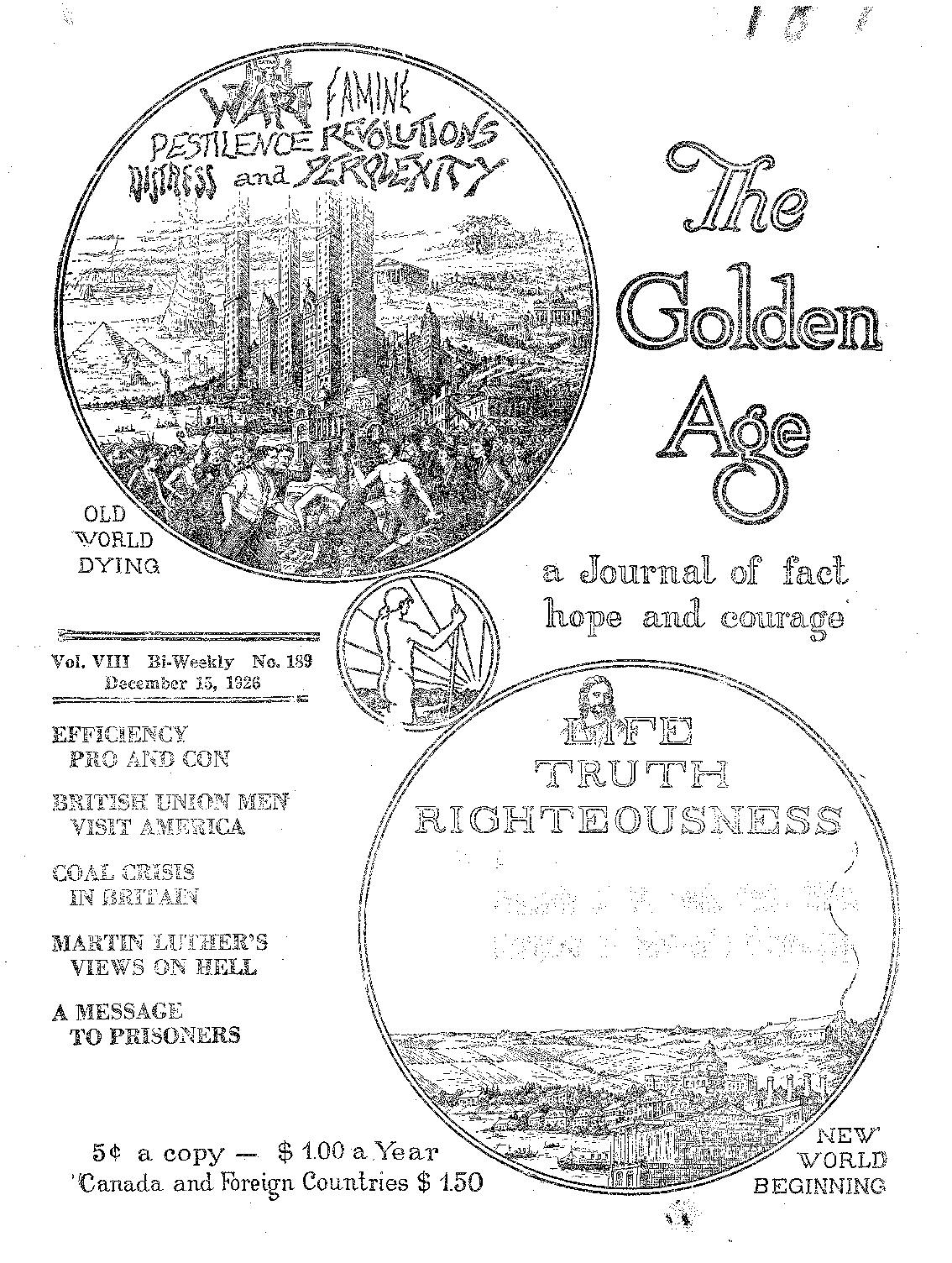
Contents of the Golden Age
-r-.............. ' r ~
Labor and Economics
British Trades Union Mission to the United States ..... 169
'ins Coat.-Minixc Crisis in Britain ........... 170
Social and Educational
s
V [j IJ 1^ ii!
Punished every o Ipi u v i 1 < i v. i •. v qV
\ i I H £ ■> J { - - -
Copartiie? s and f J l f s v'vjr y U.S.A.
CLAYTON J. VVOvx> vv J’uxi . . . uaiauji lull i . Business 2»la.uagar
iwi. u. huDGL’iWtt . . e d i i .s.
Five Cents a Copy—$i.ou a Year M‘V hi \ is u OOI.iJEd ao& Notice to Subscribers: We do not, as a i i t c 11 x i aovvledgiucn:- for a renewal or for a new subscription. A rei tiee of expiration)
will be sent with the journal one month H t v ■> iv i expires. Change of
address, when requested, may be expected t ippo ion us< tb I within one month. Foreign Offices : British.....34 Craven a°e Laat u Gate. London VV. 2
’ Oanadian ....... 0 i yvi , Toronto, Ontario
Australasian .... 49 o i s m vt Veibourne, Australia
South African ...... t? Lene street, Cape Town, South Africa
Entered as second-class matter at Brooklyn, N. Y., under the Act of March 3e 1878
The Whys and Wherefores of Efficiency
SOMEBODY with a penchant for figures has calculated what the average man of seventy years of age has done with his life; and the mere iteration of the list is enough to make us all feel that we should do with our might what our hands find to do, because in a little while we shall have done all that we can do and other hands than ours will be busy about our tasks. The list follows :
1-Early Childhood ...__________________10 years
3-Undressing ...............................................11 months
3-Sleeping...................................21 years, 8 months
4-Bathing ________________________________________________......4 months
S-Brushing teeth .........................8 months
6-Shaving ....................................................6 months
^-Dressing ............ 11 months
8-Cleaning up................................2 years, 8 months
9-Changing clothes ..............................7 months
10-Eating___________________„_____________________5 years, 5 months
11-Attending church ..............................7 months
12-Working_______________________________16 years, 10 months
13-Other duties and pleasures 8 years, 11 months
No man with a decent regard for the interests of himself and his fellow men can cut do A very much on any of the first ten items in this list— or perhaps the eleventh also, if he really goes to church and not to a social club or a heathen ceremony sometimes called church. But most of the efficiency controversies rage around the question of what shall be done in the time available for the last two items on the list.
As the productive capacity of the -world’s machinery increases, there is a natural and an inevitable pressure on the part of millions to exchange some of the time once spent in item No. 12 for equivalent time in No. 13; and there is a constant fear on the part of those who have a larger share of item No. 13 in their lives than they should have, that they may lose some of it and be pressed back into more hours of item No. 12.
Those who already have a surplus share of item No. 13 in their lives are very eager to 163 keep a high score of efficiency while at work for those who already have more of item No. 12 in their lives than they care for. The result is an increasing number of employes vsho are restless and dissatisfied. The very eagerness for efficiency on the part of some, so that the fruits of that efficiency may be enjoyed selfishly, defeats its own ends.
Some of the Big Leaks
TT WAS only about the time of the World War that we began to hear very much of “personal efficiency'’, or even of efficiency in any aspect; but the studies that have been made show some enormous wastes that exist. Every waste in an industrial process is a waste to the people as a whole; for the whole people must pay the bill, waste and all.
Take for example the waste in fuel. The Department of the Interior made a study of the power plants between Washington and Boston, and found that in 1919 these plants used 19,125,900 tons of coal, whereas one central power plant could have developed all the energy generated by these several plants, by merely burning 5,268,800 tons—hence that more than 13,000,000 tons were being thrown away. Anybody can see that, speaking for the country as a whole, it would have been better to maintain at full wages the miners and railroad men who mined and hauled that fuel than to have lost the fuel itself without any recompense.
The Bureau of Standards has been doing great work in promoting simplicity, and it still has plenty to do. For instance, there are 2,700 separate brands of book and job paper, each brand sold in different colors, weights and measures ; and there are 200 types, sizes and styles of printing presses to do the work which five types, sizes and styles could do. All can see the; field open, here to the student of economy and efficiency.
It is claimed that over fifty percent of the wastes in industrial processes are due to mismanagement. Thus it is alleged by Herbert Hoover’s engineering committee that only mismanagement makes it necessary for the retailer to ask $40 for a suit that even with his profit added is not worth a penny more than $24.
There is mismanagement wholesale in putting employes into wrong jobs. A New York factory which has studied this matter critically has discovered that it averages to lose $50 every time a change in employes takes place. The principal items here are the idleness of the machinery, interruption of routine, and cost of advertising for a substitute. It is estimated that about eighty percent of workers are misplaced, i. e., they would do better in other lines of work than in those in which they are employed.
The Biggest Leak of All
THE biggest leak of all is the governmental leak. The best government under the sun is accredited with spending for wars past, present and future, ninety-three cents out of every dollar that it takes in. What would be thought of the head of a family who used ninety-three percent of his income (all of which should be devoted to the welfare of his family) in getting into fights with his neighbors, with the certain knowledge that many members of his family would suffer personal injuries as a result? He would be accounted insane.
There is nothing in the world that is so beastly and so inefficient as militarism. One who had the opportunity to make a close survey of all the government departments at Washington found conditions in the War Department overwhelmingly inefficient. A recent sample: Uncle Sam took just fifty-three years to pay to Fenwick McCloud of Clearfield, Pa. $15 due to his father for services rendered as a. chaplain during the Civil War. But a governmental department can speed, up sometimes. It took only three days to jam through a $7,000,000 claim of a foreign capitalist in whom Mr. Daugherty, Attorney General, was interested. The latter was indicted as a result, but the jury disagreed.
Inefficiency in government is not confined to ths federal departments and bureaus. We do not know how it is now, but some time ago the New York County Clerk’s office was seven years behind in the filing of certificates of incorporation: and the reports of corporations.
In Germany the people have so suffered from governmental mismanagement that the men. have lost heart; and the 'workmen, once the most docile and industrious, are reported to have lain down on the job and either cannot or will not work nearly so hard as they did before the World War. They have concluded that in the absence of a really efficient government they might as well take it as easy as they can, as all they can make is bound to be taken from them in taxes anyway.
A visitor to the late Czar of Russia inquired why a sentry was stationed at an isolated spot on the palace grounds. Inquiry revealed the fact that the Empress Catharine two hundred years previous had seen some snowdrops growing there and had stationed a sentry there to watch them.
Workers Must Be Considered
A NY system of efficiency which fails to take into consideration that most intricate of all machines, the human body, can never succeed. The famous Taylor system, which planned scientifically to get out of the worker the last ounce of energy he developed, has been abandoned even by its originator. It was inhuman and hence had to go, yet for a time the whole engineering world was agog over it.
In Henry Ford’s factories efficiency has gone to seed. Men sit at their benches half dead, mechanically doing over and over the same bits of work; and they find such employment galling to the last degree. Men like to work, to do something, but they like to do work in which they have some chance to put their originality into effect.
A noted Englishman visiting in this country says that America has gone "efficiency mad” and that after a time they will tire of it, that after a person has spent all his time for a long period in doing nothing but being efficient he gets tired of it and wants a little time in which to be natural and really enjoy something of life. We cannot imagine that in the Millennium and ever thereafter men will work until their tongues hang out of their mouths, and go at that speed, as many hours every day as possible, merely for the sake of being efficient. The old idea of hell would not be much worse. -
Experience has shown that the boys and girls.
who were most efficient in school, i. e., the ones who got the best standings in their classes, did ■ not turn out the best in later life. They went too fast and too hard a pace. Capacity to apply knowledge is more important than ability to acquire it.
What Reason to Speed Up?
WHAT reason would the workers in shoe factories have to speed up their work?
At present there are in the United States 1,570 boot and shoe factories. Of these, 227, or fourteen and one-half percent, now produce two-thirds of all the shoes worn, and if they worked full time could produce them all. Perhaps it would be efficient to let them do it, but what would be done with the employes in the remaining 1,353 factories? This thing must be considered.
Conditions are the same in the coal mining industry. Taking the country over there are 1.85 men in the industry for every job it has to offer. If only the most economical mines are worked, and they are all worked full time, what will be done with all the other workers? The present financial and currency system demands not efficiency but inefficiency to keep it going.
A gentleman who had often heard of the famous “Message to Garcia” was depressed by it, because it was Garcia who received all the advertising, although he had nothing to do but receive the message sent him, while Rowan, the man who carried it, is almost unknown, despite the fact that his efficiency was A-l.
Thomas Jefferson, late in life, declared that the first fifty years of his life had been harassed by the habit of thinking it indispensable that, things should be speeded up, engagements kept at the moment, etc., but later experience had proven that in a thousand instances the net results were better when wider personal latitude was allowed.
It is efficient in one way to harass employes with questionnaires about how many minutes a day are spent in combing the hair, powdering the nose, or nibbling at chocolates; but the net result is an amount of antagonism on the part of the employ which more than offsets all possible advantage obtained. An indignant, dissatisfied employe is an inefficient employe. Efficiency management which lacks common sense and tact is inefficient management of the worst sort.
The Marvelous Human Machine
JN THE modern factory the science of machinery is developed to its highest point. In the selection, construction and use of machinery nothing is left to chance. Its type is selected in accordance with its exact fitness for the work demanded of it. It is constructed of appropriate materials, and is so designed as to avoid lost motion and waste of energy that is transformed to perform the work required. It is kept clean, unnecessary friction is avoided, and every care is taken that its bearings shall not become corroded or worn beyond repair. When in action, it is run at the speed for which it is planned; it is not overloaded, and not overheated: the conditions under which it can work with greatest efficiency have been carefully studied; and every effort is made to maintain these conditions and secure the largest possible output without injury or unnecessary deterioration to the machine itself.
The human machine is no less needful of care. The fact must be recognized that in the body of the worker, with its combination of living organs and tissues, undergoing chemical reactions, and transforming energy under the direction of the nervous system, we h.we a very intricate mechanism, upon the pre r working of which depends in large degree, i •:mistrial efficiency, and through it industrial ;'.access.
Fatigue is the natural result w' work and. shows itself in a diminished cay wav for doing work. It clogs the wheels of the ’ww machine. Fatigue ought to be avoided like poison; because, in reality, it is poison. To anticipate fatigue, to check it (by change or by .rest) before its poisons slbw down lie body, is one of the problems before the scientific mamiger; or, as he is often called, the engineer of industrial economy. The study of fatigue is not a theoretical or academic matter, it is a. matter of dollars and cents; because fatigue affects output as directly as it affects the physical organism of the worker. Work done after fatigue has set in is wasteful; because it not only costs more effort and requires increasingly longer periods of rest for recuperation, but it accomplishes less.
In a pamphlet published by the U. S. Public Health Service fatigue is regarded as the greatest single obstacle to maximum output. Four out of eleven ways outlined by this pamphlet to reduce fatigue, deal directly with posture. This
Is but an indication of the importance which is being attached, as a result of scientific study, to something’ which a few years ago was regarded as a trifle or mere detail. To stoop continually to get supplies from a box on the floor is tiring, and it is a comparatively simple matter to put the supplies nearer the bench top. To sit all day on a stool with one’s feet dangling in the air is also tiring; and yet these and other obviously bad conditions exist, causing fatigue, which is entirely unnecessary and therefore is sheer waste.
It is only a little time since the United States Steel Corporation made the discovery that a man cannot do one and one-half times as much work in a twelve hour day as he can in an eight hour day. It is only a little while since it was proven that real efficiency demands a play place of at least an acre within a half-mile distance of e very inhabitant of a community.
In Germany it has been learned that beauty of environment is an essential to efficiency. At the the great Elberfeld dye factory the worker constantly comes in contact with marble halls, riots of beautifully colored fabrics, statuary and suburban gardens, and his own. home is in a little park surrounded with trees.
There are window boxes in many of the shops, and flowers on the desks of the workers; and it has been found that these things increase the efficiency of the human machine as well as greatly increase the joy of living. Efficiency should have some other end than the mere making of money.
Gauses of Ineffectwes
JN THE gathering togetherfof the American -S- Expedition to France it was found that forty-five percent of the foreign-born recruits had the mental capacity of normal children of only eleven years of age and could never be expected to have any more. Their ancestors had worked for centuries as agricultural laborers in Europe, with Httle to engage the use of their minds.
At Gary, Indiana, it was found that 95.2 percent of the children were physical defectives. Gary is the principal headquarters of the United States Steel Corporation, a concern which believes in foreign-born, non-union, cheaply-paid workers, and therefore is not in any proper Sense of the word a patriotic concern, but in every practical sense one of the most unpatriotic in the land. The infant mortality at Gary is very high.
Some two hundred years ago a mental defective settled in Sweden, and it is claimed that in the interval his 2,232 descendants have cost the Swedish government and people more than 4,000,000 crowns. Patriots, real patriots, encourage neither the making nor the multiplication of defectives. Yet the World War strewed the world deeply with defectives and cripples. Not only the bodies of these men have been crushed, but their minds, their courage, their manhood.
A fruitful cause of production of ineffectives is the greed of big business. Thus a barrelmaking concern had a squad of ton men who were able to produce eighty steel barrels per day at a cost to the concern of ninety cents per barrel. By accident the concern found it could train girls to do the work, and was pleased to throw the men oat and reduce the cost of making these barrels to fifty-two cents each.
A while ago it was widely circulated by big business that before the war bricklayers would lay per day 2,000 bricks, but that since the war they lay only 500 to 750; but th%y neglected to explain that it makes all possible difference whether the bricklayer is working on an 8-inch, a 12-inch, a 16-mch or a 24-inch wall, whether he is laying to a line and some one else filling in behind him, of’ whether he is laying face brick or building a dead wall. A first class bricklayer might lay 1500 bricks 'one day and 400 the next; and work harder laying the 400 face bricks, ; pointed mortar, than on the 1500. '
A large Indiana concern, in order to strike > terror into the hearts of their men and to really I make them ineffective, advertised for 100 men | that it did not need, so that it could keep these j men standing in line, and hoping thereby to r speed up the old men and keep them on the job. This is inefficiency, not efficiency.
Human Material Below Par
WRITER in the Saturday Evening Post averages up the people of the United States , in accordance with the doctrine of mental levels, | Children are included in this estimate. On the ? basis of 100,000,000 population his figures are as follows:
A grade, Very superior Intelligence_______4,500,000
B grade, Superior Intelligence__-___...9,000,000 ;
C plus grade, High Average Intelligence..16,500,000
C grade .............. ..........................25,000,000
G minus grade ............................................20,000,000
D grade, those whose mental age is to
11| years.............—.........— -—15,000.000
I) minus and E grades ............—-----—10,000,000
D minus persons have the mental age of a child of ten years or Less. They are not capable of advancing beyond the third or fourth grade of the elementary school, no matter how long they may attend. Those of the E group are mentally deficient. Many of them belong to that class of the feeble-minded called morons.
The first three classes in the above list do the thinking for the whole people; and judged by what they themselves were led to swallow during the World War, and by the condition of the world, their thinking does not amount to much.
In the state of Iowa recently a variety of tests and measurements were made on a group of fifty-two children entering school. Not a single child was free from some mental or physical defect. These were the children of parents in average circumstances in life. About 66.7 percent of the children of school age in New York are physically defective, in the country as a whole a million children who should remain in school have to leave to work in factories and sweatshops. The average criminal received at Sing Sing has the mentality of a child. Defectives are more common among the children of the poor than of the well-to-do.
But there is something on the other side of the question. The Northwestern University imposed an intelligence test on freshmen and the youths made a good showing; but, in the words of the witty editor of Commerce and Finance, “When the tests were imposed on twenty-four college presidents, the returns were like the count of the Republican vote on election night in Mississippi.” . .
There is no denying the great overplus of defectives in America (and the conditions in Britain and other countries are even worse); yet the great poets, Shelley, Burns and Poe, were said to be mentally sick, and the good Queen Elizabeth was the child of a degenerate father and a nymphomaniac mother.
Scant Comfort for Evolutionists
THE New York World quotes Prof. Terman of Stanford University, one of the foremost experimenters with intelligence tests, expressing the belief that under present conditions it is decided for humanity before birth whether they will be unusual, mediocre 02 morons. The World goes on to say:
The average intelligence of the race is decreasing and genius will be scarcer in the future than in the past, This being the case, would it not be better for humanity to quit now while its reputation is still good than to descend from century to century into darker depths of stupidity, culminating, no doubt, in the oblivion of the oyster? If Mr. Terman is correct, we have passed high-water mark and the rest is going. But human intelligence is a difficult field to chart and Mr. Terman may be wrong. .
In somewhat similar vein Dr. J. H. Kellogg, head of the Battle Creek Sanitarium, has said:
Carlyle once said that the population of England was “mostly fools”, and Galton declared that the intelligence of the average citizen was barely above ths level of imbecility; while Davenport startled us some years ago by the assertion that mental defectives constitute one percent of the population of the U. S. '
For many years the writer has been calling attention to these and other facts as evidences that the human race is degenerating; and that while modern intelligence, aided by our vast accumulation of knowledge, is able to accomplish now and then a brilliant achievement, the actual average intelligence of the race is sinking, just as vital stamina is lowering, notwithstanding the increase in average longevity.
The application of intelligence tests to tens of thousands of young men in the war exemptions (1,600,000) shows not only that the statements of Carlyle, Galton and Davenport were true, but that the facts are even worse than they made them out to be. The psychologists describe three classes of congenital defectives—idiots, imbeciles and morons.
A careful analysis of a hundred thousand of these tests shows that the average intelligence of the young. men of the country between the ages of 21 and 31 years, t including college students, teachers, bankers, lawyers— ■ men of all classes but excluding the obviously defective,. the insane, imbeciles and idiots—is equal only to that of a normal child of 13 years . . . those whose minds are definitely below the level of ordinary intelligence are greater than 3 percent.
It would also appear from the army examinations that no more than ten percent of the population may be regarded as capable of profiting fully by a college education. Of these, not more than one-fifth actually attend college. ;
Besides those who are intellectually normal there are large numbers who are emotionally unbalanced. They are in no sense of the word insane, and yet until their emotional equilibrium is regained they are not fit subjects for associa*
tion with their fellows. These men go to prison but should go to hospitals for intelligent, sympathetic treatment. .
Proposed Correctives of the Moron Situation
FFORTS are being made in some quarters to segregate the child morons, but this has its disadvantages. They do not chance to live close together but are scattered, and this makes their instruction separately from normal children quite impractical. No child would wish to be thus separated from its companions and have the name of being a student at a crazy school, nevertheless it would be better for the normal if the abnormal could be separated from them.
Occasionally the news of the day brings to light some criminal who is restored to normal life by trepanning his skull. A Spokane man re* ceived an accident. After the accident he became a radio fan, an enthusiast on the subject; he also committed a crime. Imprisoned, and his skull trepanned, he proved to be a mild-tempered, kindly man, had no knowledge of his crime, and did not even know there is such a thing as radio transmission. The memory of his earlier life returned in full, but he has no knowledge of anything that transpired from the time of his accident to that of the operation.
Some physicians occasionally raise the question if it is not the duty of society to put to death the victims of general paralysis and those gibbering idiots who do not even know enough to know they are alive; but no one likes to take the risk of settling the account afterward with God. ' _ . .
Another remedy which appeals to many is quaintly put in The New Republic. It says:
Justice Olson of Chicago has prepared, for submission to the Ill. General Assembly, a most model bill to check ths multiplication of the unfit. The law proposes a survey of the population of the state, to ferret out the “socially inadequate”. These are to be haled into court
Theologians Cannot Teach Arithmetic
THE New York American makes the wise obA- servation that “the public school, which teaches that three times one are three, should 'be kept separate from religion, 'which includes a trinity in which three times one are one”. The joke of it is that most people believe the trinity doctrine to be a Bible doctrine, not knowing that it is a heathen one, foisted upon the so-called Christianchurch by the unbaptiaed and if found guilty of inadequacy on report of the state eugenicist, are to be gently but firmly sterilized. By the “socially inadequate” are meant (1) feeble-minded; (2) insane; (3) criminalistic (including the delinquent and wayward) ; (4) epileptic; (5) inebriates (including the tuberculous, the syphilitic, the leprous and others with chronic infectious and segregable diseases); (7) blind (including those with seriously impaired vision) ; (8) deaf (including those with seriously impaired hearing) ; (9) deformed (including the cripples), and (10)i dependent (including orphans, ne’er do well’s, the homeless, tramps and beggars). From this catalogue we surmise that Chicago is developing in Judge Olson a ne^ and subtle humorist. It is a risky thing to subtract front a humorous performance or add to it. But we can’t re* train from asking Judge Olson why he did not add an 11th category, to take in those individuals who strut about parading the quaint illusion that science hag picked them out as the prize breeding stock of creation
It does seem foolish on the face of it that the graduates of Harvard University should averag® only one child apiece, while a man and a woman, both since found insane and committed to asylums, had twelve children, every one of them mentally defective and a potential criminal.
But we have the best remedy of all for th© present situation, namely, the Lord’s kingdom, the desire of all nations. There will be no case beyond the reach of the Great Physician. Humanity will be restored to the perfect balance of Adam before he sinned. There will be perfect physical, mental and moral conditions to which all may attain, and a perfectly ordered arrangement of society in which sweatshop efficiency will not be needed or tolerated.
There will be efficiency, but it will be a real efficiency which will regard the health and happiness of man as of the very first consideration. Money considerations will be quite secondary. The man will be the important thing. The way the prophet puts it is that ‘a man shall be more precious than gold, yea, even than the golden wedge of Ophir’.
heathen emperor Constantine in the very year in which he murdered his own son. It cannot be defended either Scripturally or reasonably, Anyone who is willing to use his brains can see for himself that a teaching that the son is the father of himself and the father is the son of himself, and that each of these is a third person who is the same as and yet different from the other twos is impossible all around.
British Trades Union Mission to the United States
IN THE early part of 1926 the London Daily Mail sent a party of British trade unionists to the United States, paying all their hotel and traveling expenses, and full weekly wages to their wives in their absence. The men were also provided with allowances for their outfits and personal expenditures. They were commissioned to find out the secret of the high wages paid to labor in the United States, and were given carte blanche to go where they would and see whom they chose in the effort to answer the question. They came, they saw and they conquered. That is to say, they found the answer; and at a luncheon given in their honor on their return to Britain they set forth their impressions.
The ten men visited twelve of America’s most important industrial cities, traveling 5,000 miles and visiting forty-two plants. The men were agreed that in America production and still more production is always the objective; high wages are paid as a matter of course; every workman has from three and one-half to four horsepower of machinery at his elbow; standardization has become a fine art; workmen have their own homes, telephones and motor cars; workshops are kept scrupulously clean; shower baths and lockers are plentiful; good meals are served inexpensively; medical attention is generous; saving is encouraged; sick and pension clubs and bonus arrangements are common; there are almost no apprentices; and there can be no question that, at the present time, the 'American workman is paid better, works better, lives better and produces more than his British contemporary. These were the general conclusions arrived at.
Mr. Browning, blacksmith, said that at plants Which, he visited he saw drop-forging done on a scale he had never before dreamed of, some of the hammers weighing 5,000 lbs. He observed that drop-forging is superseding easting.
Mr. Kay, iron moulder, observed that in every shop he went into, the best job, the most intricate and the one requiring the most skill, was in seventy-five percent of the cases in the hands of a European, usually a Briton. He believes the American moulder woifis no harder than his British cousin, but produces much more because of more and better machinery and the use of improved methods of cleaning floors after the day’s moulding is done.
Mr. Murray, patternmaker, stated that nowhere in the United States did he see men waiting in queues for the use of indispensable machines, as is frequently the case in Britain, but there were from three to six times as much machinery, with consequent increase of production. Wherever he met any of his old countrymen it was always painful to hear them say that conditions are much better in the United States than in Britain.
Mr. Wareing, fitter, was struck with the free dental service in one plant which he visited, and with the remark of the employer that it was not a matter of philanthropy but good business. He was also struck with finding a wood floor being laid over a cement one, because it had been found that cement is hard on the nerves and the ■employer could not afford to waste energy for which he is paying at the rate of two cents a minute. American shops are all laid out, as far as possible, so that the product will come in at one end of the building and go out at the other, finished, if possible. Mr. Wareing was repeatedly informed that Britain has the finest craftsmen in the world. , ■
Mr. Ratcliffe, machineman, observed that the cordial, even friendly, relations which have been established between the management and workpeople in the great industrial plants of the United States are a revelation to the visitor from overseas.
Mr. Wilkinson, turner, noted with interest a boring machine, provided with a platform, which a man by touching a lever could raise or lower to bring himself to a position in which he could work comfortably. Compressed air is used for cleaning metal borings from jigs and molds, saving time and avoiding injuries to the worker. Spare cutters or tools are always ready in case of breakage.
Mr. Wildman, tool turner and fitter, was attracted by the fact that directors (superintendents) and supervisors (foremen) are invariably chosen from the ranks, thus holding out to all the assurance that ability and industry are quickly appreciated and rewarded.
Mr.’Gill, constructional ironworker, noted that boys will not take jobs as apprentices, but go from place to place earning good money at whatever jobs suit their fancy, with the result that in America boys are doing work wiiich. is
isa
Britain is done by men, and men are often employed in doing work which, in Britain would be done by boys. -
The Daily Mail has published a 112 page book containing an interesting account of the tour and the members’ reports in fall.
The Cc:_ Prix ng Crisis in Britain By Irin. Harrison (England)
TpOR over seven months Britain has had her J- normal course of industry disturbed and dislocated by a strike or lockout of all its miners. As to whether it is called a strike or a lockout depends largely upon the point of view; most conservatives, capitalists and interestmongers would call it a “strike”, the miners and laborites in general call it a “lockout”. The facts are that the colliery companies simply posted up notices of termination of the workers’ contracts by such a date.
The coal stoppage during the first three months alone cost the country, according to Mr. Runciman, a leading Liberal, about £148,500,000; calculated under six heads as follows:
Loss under all heads during Gen. Strike £30,000,000 Loss in the heavy industries 46,000,000
Loss on textiles and exports 17,500,000
Loss on home trade 20,000,000
Loss in wages of miners alone 25,000,000
Loss in wages in other industries 10,000,000
Grand Total £148,500,000
In addition, the shipping trade has been badly hit; the tonnage laid up in British ports had risen from 736,000 on April 1, to 1,376,000 by July, and is correspondingly worse at the present time. Other industries are also being increasingly injured as the strike continues. The outlook is still dark; no tangible signs of an amicable settlement appear as yet, although many starving miners are being forced to go back to their jobs. .
It is clear to all unprejudiced minds that whatever action the government has taken towards a settlement so far has always been in the interests of the colliery owners. Without any popular demand from either the miners or the country the government has used its majority to pass an act of parliament increasing the miners working day one hour, i. e. from seven hours to eight, which the miners refuse to accept, and which has only stiffened and embittered their determination to continue the fight
Actual Conditions Existing '
GREAT deal of distress prevails amongst the poorer miners and others, although the capitalist press is deliberately trying to make it appear otherwise. False ideas are being promulgated, that the miners get fabulously high wages, etc. I have worked in and about a coal mine for twenty-four years, in the Notts, Derby and South Yorkshire coal fields, but have never known (except in isolated cases) miners to get £7 or £8 per week, under normal conditions of labor and trade. The facts are, that only about 30 percent of the miners can ever- get more than an ordinary fixed day’s wage.
There are contractors, generally called stallmen or butties, however, who are paid according to work done or amount of coal sent out. These generally employ several other men to work for them, known as getters or hewers and fillers, trammers, etc., who are paid a.s a rule a fixed day’s wage. Most pits work on the shift system —one- crew of men work mornings, others afternoons, six shifts and five shifts per week respectively, when making full time.
Just before the war the average wage in the best paid districts was 7/- per shift for a coal getter, 6/- for a filler, and 5/- for an ordinary qualified dayman or road repairer. During and since the war wages have been raised considerably ; but the high cost of living has always more than kept pace, so that the average miner has never been any better off in the long run. Now, owing to high rents, the conditions are almost intolerable in some districts. At one time miners generally got free coal allowance and cheap houses, which privileges were somewhat of a boon; but in later years these have been turned by various subterfuges into means of oppression and tyranny—shackles to keep the colliers down and submissive.
Trade Unions
FjOHE General Strike of the Railway and -*■ Transport workers in sympathy with ths miners, which in May paralyzed trade and industry for nearly a fortnight, caused the government supporters to vent their spleen upon the Trades Unions; and Lord Banbury (a prominent conservative) has introduced a bill to repeal the “1911 Trades Disputes Act”. This bill is doubtless too drastic for even the present government to dare to support, but in all probability they will attempt some measures to fetter the power of Trade Unions to “strike” in combination for self-protection.
I hold no “brief” for Trades Unions, as from experience I know that there are many abuses and evils in their practice; the men’s leaders and the men themselves are ofttimes animated by selfishness and do things that are inimical to their own interests. Yet no one can deny that trade unionism has done much during the last
advantageous conditions, ofttimes until I trembled in every limb; and for this I received a mere 5/- per day. Coal miners in Britain are slaves.
He hurried to breakfc t, he gulped hvf his food ; He hurried to work like a person pursued;
Ho hurried to lunch, and he hurried right back, He jostled and bumped other folks from his track; He hurried his smoking, his talking and writing, He hurried his joking. Iris walking and fighting; He couldn’t be quiet, he kept in the race And hurried to beat in the time-beating pace Of the hurry and worry and flurry.
He hurried his men and he hurried his work, He hurried to fire every one who might shirk;
He hurried his courtship and marriage as well, He hurried his preacher, if truth we may tell;
He hurried his reading, his riding and rowing, He hurried his feeding, his coming and going;
He couldn’t be placid, he went with a rush, And never found time for a moment of hush In the hurry and worry and flurry.
He hurried to bed with an illness last week, He hurried the doctor, his healing to seek;
He hurried the nurse and attendants beside, He hurried and sank, and he hiriried and died. His sorrowing mourners rushed the und.orta.ker, Who hurried him out to the little God’s acre. ' ;
The friends hurried back with tears hurriedly dried, And they quickly forgot that he lived and he died In the hurry and worry and flurry. —-Chicago Post,
Conditions and Events in Canada From Our Canadian Correspondent
/"CANADA, in common with most other countries engaged in the war, has suffered greatly commercially and otherwise. She has, however, courageously shouldered her burdens and is gradually rising to a more normal and prosperous condition. Her tremendous resources, her youth and vigor, have come to her aid and optimism is gradually but steadily becoming the pirit of her people. Her gold production dur-ng 1925 reached a new high level, the value thereof being $35,880,826, while the Ontario Department of Mines estimates the gold production for Ontario alone during 1926 as $31,518,300.
The automobile industry is rapidly coming to the front as a Canadian industry and the export trade is large. Canada has one automobile for every thirteen inhabitants.
Unparalleled Use of Electric Power
SOME idea of the phenomenal development of electrical energy in Canada may be gleaned from an item appearing in the Ottawa Journal and printed in the Moose Jaw Evening Times.
The “white coal” of our great rivers, the use of which is promoting so greatly the domestic comfort of the Canadian people as well as greatly stimulating our industries, continues to be developed to an extent which is not paralleled in any other country in the world. In Canada 38.3 out of every hundred persons live in electrically lighted abodes; the nearest compeitor being the United States, with 36.8 percent. In the consumption of electrical power by commercial users Canada has one to every 19 people, compared with one to every 50.8 in the United States, which ranks next to us.
Not only docs this country use more electric power than any other, in proportion to population, but electricity is cheaper in Canada than anywhere else. A comparison of prices in Canada and the United States is made in one of the recent bulletins of the Canadian Daily Newspaper Association. The details are. interesting. The conditions in the two countries are compared in corresponding zones. Taking as a unit the cost of electricity per kilowatt hour, the figures are as follows:
Canada
Price
United States
Price
Maritime Provinces
.057
New England States
.0245
Quebec
.0068
South Central
.0237
Ontario
.0072
Atlantic
.0198
Prairie Provinces
.02
North Central
.0196
British Columbia
.0108
Pacific
.0144
Only in our Maritime Provinces is there still a low development of electricity. Perhaps the harnessing of power with the aid of such ocean tides as those of the Bay af ffundy may do something to improve this. In any case, the Maritime case is but a small part of that of all Canada. Over sixty percent of the total population of the Dominion resides in areas in which the cost of electric current is less than one cent per kilowatt hour.
The number of customers of central power stations in Canada was as follows last year: .
Maritime Provinces
Quebec '
Ontario
Prairie Provinces
British Columbia
71,891
821,494
507,038
189.806
110,341
Here are some “per capita” figures of the consumption of electricity in kilowatt hours, for the countries in which most electricity is used:
Canada L
Switzerland !
Norway 1
United States
Sweden
As already said, Canada’s lead in electricity is increasing. The projects now on foot in this country for power development are tremendous, particularly in Quebec and British Columbia ; and Ontario is to benefit by receipt of a large part of the planned development in Quebec, namely that on the Gatineau River. And let none of us forget that of the development of electricity in Canada, a great part, and the part most beneficial to Ontario municipalities and their people, was due to the imagination, foresight, ability and courage of Adam Beck.
Telephone Statistics
ONE of the interesting items in the latest bulletin of telephone and telegraph statistics compiled by the Bell System, is that next to the United States Canada leads all other countries in the number of telephones per 100 of population, and for all the countries of the world for which, statistics are available Canada stands first in the number of miles of telephone and telegraph wire per 100 of population. The figures as of January 1,1925, are 3.4 miles per 100 population.
Among cities of over 200,000 population. Toronto stands ninth and New York tenth. The ten telephone leaders in order of precedence are: San Francisco, Omaha, Washington, Chicago, Minneapolis, Stockholm, Portland, Ore., Los Angeles, Toronto and New York.
Apples
APPLE prospects for the whole Ox Canada point to a yield slightly in excess of last year, or 3,045,900 barrels, according to the Dominion Fruit Branch.
British Columbia promises to have the largest crop on record for that Province, which is estimated at 3,525,500 boxes. Ontario is considerably lighter than last year. Quebec and the Maritime Provinces have prospects of increased yields. In Ontario the commercial apple crop will be about 80 percent of 1925, or 774,000 barrels; Quebec 77,900 barrels; New Brunswick 40,000 barrels; and Nova Scotia 978,726 barrels.
Coal
HR HE Saturday Night reports the following
■*- concerning Canadian coal deposits:
An attempt is at present being made to explore the lignite deposits of Northern Ontario, for many years known to occur exposed along the Mattagami and Moose Rivers and their tributaries. These are considered to be partly inter-glacial and partly Mesozoic in age. Interest in these deposits has recently been revived through the extension now under way by the Temiskaming and Northren Ontario Railway, north from Cochrane, which will pass comparatively close to the outcropping beds.
According to a recent report a bore-hole put down at Long Rapids on the Mattagami River has discovered a higher grade of coal than any heretofore noted by geological explorers who have studied these deposits. As a result 51 boring licenses have recently been issued by the Ontario Department of Mines.
Canada’s K. of C. Censorship
DESPITE the fact that the war has ended and we are supposed to live in a free country, censorship has by no means ended in Canada. The Catholic Register says:
On May 8 the Canadian Department of Customs and Excise notified its collectors at all ports that the following publications are barred from Canada: “The Tyranny of God,” a book by Joseph Lewis, published by the Truth Publishing Company, New York; The Truth Seeker, published weekly by the Truth Seeker Company, New York; and “Convent Cruelties/''' a book by Helen Jackson [ex-nun], and published in Toledo, Ohio.
Mr. Boivin is gradually but drastically excluding the vile, blasphemous and obscene from the bookstores and news-stands of Canada. Previously banned was the Bail Splitter, a monthly publication published in Milan, Illinois. A series of pamphlets published by the Bail Splitter Press have also been banned. These include: “Decay of a Nation,” “Traffic in Nuns,” “Priestly Celibacy Exposed,” “Rome’s Substitute for Marriage,” “One Hundred Reasons Why I Left the Roman Catholic Church,” “The Anti-Catholic Joke Book,” and other pamphlets. ■
Mr. Boivin, who has recently died, was Supreme Director of the .Knights of Columbus.
Canada’s Divorce Situation '
AN EDITORIAL appearing in the Prince Albert Herald, gives a concise survey of th© divorce situation in this country. It says:
There were 551 divorces granted in Canada last year. This seems like a large increase, but the reason for this is apparently the change in the law which renders it easier* and less expensive to dissolve the marriage tie. Until a few years ago the senate committee had the exclusive right to grant divorce, except in certain provinces. Naturally it was .an expensive procedure to bring witnesses and conduct the case before the senate. Recently the courts of Manitoba and Saskatchewan were confirmed in their right to grant divorce, and the court process places the privilege at the disposal of the public at less expense.
The trend in Canada is following that in other countries. In 1924 there were 170,867 divorces granted in the United States, while the marriages numbered 1,178,206. There is also a marked increase in divorces in all European countries. The assumption that Canadians are more moral in this respect than the people of other countries is probably erroneous. Unsatisfactory marriages were generally tolerated because of the difficulties and the cost to get a dissolution. ■
Women are taking a different .view, and their advancement in social and political freedom has probably altered their views as to the indissoluble nature of the marriage tie. They are inclined to the belief that release from unholy and unhappy marriage should be easily obtained. Quebec does not send many candidates to the divorce court, because the people there are largely of Roman Catholic faith and their church does not recognize the institution of divorce.
The fact that the courts in all the provinces, except Ontario and Quebec, can grant divorces is likely to add to the number, so that an increase need not necessarily indicate that the country is becoming less moral. If access to divorce had been as simple in the past as it is today the percentage of applications in proportion to population probably would have been as large,
The Forces of Action and Reaction
rp HE Bible Students are at it again, and Dr, A A. J, Hunter sounds an alarm! We quote from the Winnipeg Free Press:
Dr. A, J. Hunter, for over twenty years a medical missionary to new Canadians, who addressed the Women’s Missionary Society of the Presbyterian Church in Canada here, Thursday, asserted that the Ukrainians were obsessed by the idea that the Anglo-Saxons wish to “swallow them up”. He declared that Seventh Day Adventists and Russellites were taking advantage of the existing confusion among the Ukrainians and are milking tremendous headway. They are strongly armed with a profusion of literature in that language, something which the orthodox churches are sadly in need of.
There are at least 300,000 Ukrainians in Canada and they are coming in rapidly still, said the speaker.
Wokwj Not Qualified to Drive a Taxi!
HD following interesting news item is reported in the Sentinel:
A Magistrate, a Judge, and the Mayor of Hamilton, presented a ridiculous figure last week when they fused a woman a permit to drive a taxi. The three wiseacres refused the application, not upon the woman’s inability to manage a car but upon the fact that she was a woman. The humor of the situation is all the more striking as the latest driving statistics show women to be belter and safer drivers than their brothers and fathers. - A woman may now enter Parliament, but she may not drive a taxi in Hamilton | How reluctantly do the gentlemen relinquish those privileges so long held sacred to the sons of Adam!
Gehenna, Second Death, Sheol,
FpO GET a. clear understanding of sheol, hades, hell, grave and gehenna we must learn their original meaning. For instance, we know that the Old Testament was written in Hebrew and the New Testament was written in Greek. When Adam died he went to sheol, the Hebrew word for the grave. If Adam had died in Greece he would have gone to hades. If Adam had died in England he would have gone to hell, the English word for grave. If Adam had died in the United States he would have gone to the grave, as these four words are all synonymous, and refer to the unconscious state into which all people go when they die.
In old English the word hell means to cover up, in the same way you cover your potatoes when you plant them. When the King James translators produced the Authorized Version of the Bible they used the old English word hell properly enough; but under the influence of
Hades, Hell, Grave By J. W. Heatherly
Dante, Dore and other purgatorial visionaries we lost sight of the true meaning of the English word hell, and that is where the mistake was made. ■
If Adam had gone where the incorrigible and impenitent are to be punished he would have gone to Gehenna,-—which is symbolized in the book of Revelation as “the lake which burnetii with fire and brimstone, which is the second death”. (Revelation 21:8) If when Adam is raised from the dead he does not make good he will go to Gehenna—the second death, from which there is no resurrection. There could be no second death without a second life. Christ gave His life to redeem all mankind from the first death; and He thus guarantees that all shall live again who have not committed wilful sin or who have had a knowledge of the truth and rejected it.
Did You?
(Anonymous)
Did you give him a lift? He’s t brother of man, And bearing about all the burden he can, Did you give him a smile? He was downcast and blue. And a smile would have helped him battle it through. Did you give him your hand? He was.slipping down hill, And the world, so I fancied, was using him ill.
Did you give him a word? Did you show him the road, Or did you just let him go on with his load?
Did you help him. along ? He’s a sinner like you, But a grasp of the hand may have carried him through. Did you bid him good cheer? Just a word and a smile Were what he most needed that last weary mile.
Did you know what he bore in the burden of cares, That i« every man’s load and that sympathy shares? Did jkki try to find out what he needed from you.
Or did you just leave him to battle it through? Do you know what it means to be losing the fight, When a lift just in time might set everything right? Do you know what it means—just the clasp of a hand, When a man’s borne about all a man ought to stand? Did you ask what it was—why the quivering lip, And the glistening tears down the pale cheek that slip? Were you brother of his when the time came to be ? Did you offer to help him or didn’t you see? Dorit you know it’s the part of a brother of man To find what the grief is and help when you can ? Did you stop when he asked you to give him a lift, Or were you so busy you left him to shift?
Oh, I know what you meant—what you say may be true— But the test of your manhood is—What Did You Do?
Martin Luther on the Soul Question
(Reprinted from The Fool Killer')
MOST of us m this country call ourselves
Protestants. But are we really Protestants if we hold on to the old theology of the Papacy against which Martin Luther protested ? Martin Luther started the Reformation and became the head of the Protestant movement. He protested. What did he protest against? One of the things that he protested against was the old papal doctrine of the immortality of the soul.
Let us look at a few sentences from Luther's writings on this subject:
The dead arc insensible. They lie, not reckoning days or years, but when awakened r ill seem to have slept scarcely a moment. . . .
They (the dead) lie in a profound rest and sleep, to the day of judgment, not knowing where they arc. . . .
All that is said concerning the immortality of the soul is nothing else bat an invention of antichrist to make
I permit the pope to make articles of faith for him-aeb. anci ins larcmui, sum as . . . me soui is the substantial form of the human body, the pope is the emperor of the world and king of he~ud God upon earth, tiio soul is immortal, with a. monstrous opinions to be found, in ths Itoman d'
•eat witnesses testify as
of the sleep of the soul
.1 foimdation; and then he made use of it as a confutation of purgatory and saint-worship, and continued in that belief to the last moment of his life. Luther was clearly and indisputably on the side of those who maintain the sleep of the soul.
Again Archdeacon Blackburn says:
Luther, by consigning all the dead to a state of rest and sleep, left no pretense for the appearance of human souls after death. . . . Luther retained to his dying moment the idea of a total suspension of thought and consciousness during the interval between death and the resurrection.
Cardinal Du Perren says:
Luther denied the immortality of the soul, whence he drew an argument against praying to saints, showing that the saints hear not our prayers. . . . Luther reckons this among the impieties of the Roman Church, that she believes in the immortality of the soul.
Thomas More (papist) objected to Luther because he held that “all souls lie and sleep till u.vvxil o uay .
Roman Catholic hell there are nine enumerated by papal writers as fol-
In the first circle or limbo the unbaptized, among whom is Virgil himself, desire without hope. In the second are carnal sinners tossed by warring winds where liyht is silent. In the third, gluttons bitten by Cerberus are exposed in a stinking land to storms of hail, in the fourth are the prodigal and. the miser, each pushing a heavy weight up a hill with his breast. In the fifth are the irascible under the foul and fetid slime of the Stygian lake. In the sixth, arch-heretics smart and agonize in tombs of flame. In the seventh the violent swim in rivers of blood, suicides are changed into gnarled trees, and blasphemers writhe under a rain of fire. In the eighth are pimps scourged by demons, flatterers sunk in human ordure, simonists with their heads downwards in equal
precipitous descent, the hell of hypocrites, the last, the worst, the frozen, traitors are fitly placed: and among these, blue-pinched, shrouded in ice, are to be found the
most famous of that crafty crew, Lucifer and Judas.
The Presbyterian hell is not quite so definite, but still it is pretty bad. It has been described by Calvinistic authorities in the following terms.
It is everlasting wrath. It would be dreadful to suffer this fierceness and wrath of Almighty God one moment; but you must suffer it to all eternity; there will be no end to this horrible misery; when you look forward, you shall see a long forever, a boundless duration before you, which will swallow up your thoughts, and amaze your soul; and you will absolutely despair of ever having any deliverance, any end, any mitigation, any rest at all; you will know certainly that you must wear out long ages, millions of millions of ages, in wrestling and conflicting with this Almighty merciless vengeance; and then when you have so done, when so many ages have actually been spent by you in this manner, you will know that all is but a point to what remains. So that your punishment will indeed be infinite. Oh, who can express what the state of a soul in such circumstances is!
All that we can possibly "bout 1 fgges hut a very feeble, faint representation o.
expressible and
inconceivable: for “who knows the power of God’s anger ?”
Neither one of these hells, which are the results of the diseased imaginations of Dante and of Jonathan Edwards respectively, bears the slightest resemblance to the Bible hell, which every intelligent and educated minister today knows is nothing more nor less than the tomb, the death state. Persons desiring further information on this subject may write us.
The Prince of the Power of the Air'
AT A banquet in the Waldorf-Astoria hotel, given in honor of the Swedish crown prince, the Bev. Dr. William P. Merrill, president of the Church Peace Union, introduced the Bev. Dr. S. Parkes Cadman, president of the Federal Council of Churches of Christ in America, as the “prince of the powers of the air”. Bible Students who may laugh at tris break of one dominie in calling another dominie by a title which is usually and Scripturally applied only to his majesty, the prince of darkness, that is to. say, the Devil, will be reminded of that curious prayer offered by another dominie therein he branched out by saying at first, “O god, the- god of this world,” not knowing that Ssripturally the term “the god of this world” is also a reference to the Devil. When preachers get so mixed on the Bible that they get to calling one another by names which belong to the Devil, and when they get to praying to the Devil too, it is high time for the common people to take a hand themselves and find out what they believe and why they believe it. The Bible itself is reasonable, logical, consistent; but the men who have been hired to teach religion are unreasonable, illogical and inconsistent, because they have neglected the one Book that would give them any real message of either hope or comfort for humanity. Back to the Book I
News Items
Calles Draws Up a New Bill
resident Calles of Mexico continues to draw up bills ever more and more drastic for the enforcement of the constitution. A new bill requires priests to register with the municipal authorities before they can perform any religious ceremonies at all, thus prevent, g them from conducting masses in private homes. The bill also makes civil marriage obligatory, and it must precede the so-called religious marriage. No sects are mentioned in these new rules.
An Extraordinary Funeral in Vienna
IN VIENNA a servant girl, about to be run down by a brewery team, pushed one child back to safety and sent a perambulator with another child flying ahead to safety. The city gave her a funeral. So touched were the plain people of Vienna with the heroism of this unknown woman that it is estimated fully 100,000 persons came out to the funeral. The interesting thing about it is that the newspapers of the city made little mention of the affair.
…