Procedure of Jehovah's Witnesses Under Selective Service (1953)
Download: PDF — Procedure of Jehovah's Witnesses Under Selective Service (1953)
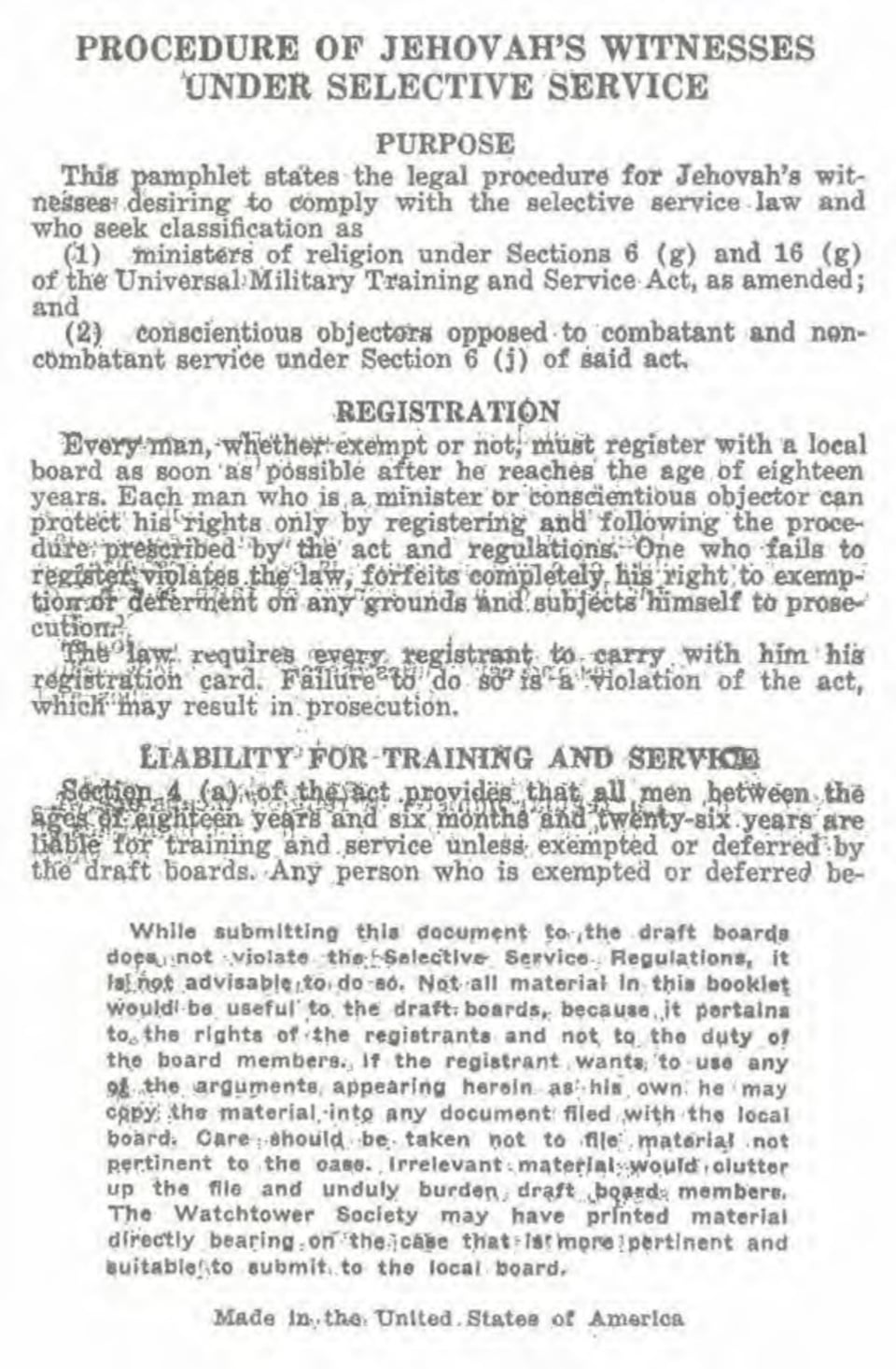
PROCEDURE OF JEHOVAH'S WITNESSES UNDER SELECTIVE SERVICE
PURPOSE
This pamphlet states the legal procedure for Jehovah's witnesses desiring to comply with the selective service law and who seek classification as
(1) ministers of religion under Sections 6 (g) and 16 (g) of the Universal Military Training and Service Act, as amended; and
(2) conscientious objectors opposed to combatant and non-
combatant service under Section 6 (j) of said act.
REGISTRATION
Every man, whether exempt or not, must register with a local board as soon as possible after he reaches the age of eighteen years. Each man who is a minister or conscientious objector can protect his rights only by registering and following the procedure prescribed by the act and regulations. One who fails to register violates the law, forfeits completely his right to exemption or deferment on any grounds and subjects himself to prosecution.
The law requires every registrant to carry with him his registration card. Failure to do so is a violation of the act
which may result in prosecution.
LIABILITY FOR TRAINING AND SERVICE
Section 4. (a) of the act provides that all men between the ages of eighteen years and six months and twenty-six years are liable for training and service unless exempted or deferred by the draft boards. Any person who is exempted or deferred be-
While submitting this document to the draft boards does not violate the Selective Service Regulations, it is not advisable to do so. Not all material in this booklet would be useful to the draft boards, because it pertains
to the rights of the registrants and not to the duty of the board members. If the registrant wants to use any of the arguments appearing herein as his own he may copy the material into any document filed with the local board. Care should be taken not to file material not pertinent to the case. Irrelevant material would clutter up the file and unduly burden draft board members. The Watchtower Society may have printed material directly bearing on the case that is more pertinent and suitable to submit to the local board.
Made in the United States of America comes liable for training and service upon discontinuing such exempt or deferred status at any time prior to reaching his thirty-fifth birthday.
PROVISIONS OF LAW CONCERNING MINISTERS
Section 6 (g) of the Universal Military Training and Service Act, as amended, provides:
"Regular or duly ordained ministers of religion, as defined in this title, and students preparing for the ministry under the direction of recognized churches or religious organizations, who are satisfactorily pursuing full-time courses of instruction in recognized theological or divinity schools, or who are satisfactorily pursuing full-time courses of instruction leading to their entrance into recognized theological or divinity schools in which they have been preenrolled, shall be exempt from training and service (but not from registration) under this title."
Section 16 (g) of the act provides:
"(1) The term 'duly ordained minister of religion' means a person who has been ordained, in accordance with the ceremonial, ritual, or discipline of a church, religious sect, or organization established on the basis of a community of faith and belief, doctrines and practices of a religious character, to preach and to teach the doctrines of such church, sect, or organization and to administer the rites and ceremonies thereof in public worship, and who as his regular and customary vocation preaches and teaches the principles of religion and administers the ordinances of public worship as embodied in the creed or principles of such church, sect, or organization.
(2) The term 'regular minister of religion' means one who as his customary vocation preaches and teaches the principles of religion of a church, a religious sect, or organization of which he is a member, without having been formally ordained as a minister of religion, and who is recognized by such church, sect, or organization as a regular minister.
"(3) The term 'regular or duly ordained minister of religion' does not include a person who irregularly or incidentally preaches and teaches the principles of religion of a church, religious sect, or organization and does not include any person who may have been duly ordained a minister in accordance with the ceremonial, rite, or discipline of a church, religious sect or organization, but who does not regularly, as a vocation, teach and preach the principles of religion and administer the ordinances of public worship as embodied in the creed or principles of his church, sect, or organization."
DEFINITION OF MINISTER
A liberal interpretation placed upon the terms "duly ordained minister of religion" and "regular minister of religion" would include a minister who works at secular work during the week, such as some company servants and company publishers.
But Senate Report No.1268, dated May 12,1948, states that the exemption of ministers of religion "is a narrow one" as defined in Section 16 (g). A narrow interpretation may be placed upon the exemption by the draft boards and the courts so as to deny the exemption to one who is a company publisher or who has a secular job during the week while preaching part time. The exemption certainly would seem to be available even under a narrow interpretation to all registrants who are pioneers.
The regular preaching, to entitle one to claim exemption, must be done as the "regular and customary vocation" of the registrant claiming exemption as a minister. The word "vocation" means a stated or regular occupation, a calling. It has also been defined as "a call to, or fitness for, a certain career, especially a religious position". (New College Standard Dictionary, Funk and Wagnalls, 1947) The words of the act that exclude ministers "who irregularly or incidentally" preach and who do not "as a vocation" preach may be construed so as to exclude from the exemption company publishers.
In view of the fact, however, that the courts may interpret the act otherwise, and since some company publishers preach regularly as a vocation and do not "irregularly or incidentally" preach, some company publishers may be justified in making a claim, supported by proof submitted to the draft board, for exemption under the act as regular or duly ordained ministers of religion.
PRECAUTIONS IN DEALING WITH DRAFT BOARDS
It is always best to communicate with the local board in writing. Where the regulations require something to be submitted to the board, it must be done in writing. Do not rely on a statement from a member or clerk of the local board that an oral request for something required by the law to be done in writing is sufficient. No draft board official has the authority to authorize a registrant to make an oral request when the regulations require such to be written.—See Sections 1624.1, 1625.2, 1626.2, 1626.11, 1627.4, printed in the booklet entitled Excerpts.
If a registrant is away from his home or permanent address for more than a few days he ought to leave instructions to have his mail from the draft board opened and the message relayed to him by telephone or telegram. This must be done so that the ten-day period for complying with notices will not expire. By the time he receives the notice through regular mail it would be too late to take action within the ten-day limit.
He must carry his last classification card at all times. Failure to carry either the registration card or classification card is an offense punishable by imprisonment.
KEEP COPIES OF EVERYTHING
Copies of all papers and letters submitted to the local board should be kept by the registrant. Answers to questions and information put in his classification questionnaire and conscientious objector form, or any other form, ought to be copied and kept in his personal file. One who fails to keep a complete file of everything makes a mistake. Great difficulty will be experienced later because of not knowing what information has been filed. A registrant ought to inspect his file and make copies of any material that he does not have. However, if his case is on appeal, he will have to wait until the file is returned and he is notified thereof by receipt of notice of the appeal board classification.
All forms, statements, affidavits, letters and other material submitted by the registrant to the boards should be neatly written (with typewriter if possible) and in orderly and logical arrangement. All communications written to the local board should contain the registrant's full name and address and selective service number.
All communications received from the Selective Service System, including all classification cards, should be carefully preserved.
ADVANCE STUDY AND PREPARATION NECESSARY
The minister desiring to claim exemption needs much advance preparation and study along with his ministry in the field. This should be started when he is approaching the age of registration and should be continued until the time arrives when it is required. He should be thoroughly familiar with the material contained in chapters XIX and XX of "Let God Be True" (Second Edition), pages 21-29 of Defending and Legally Establishing the Good News, pages 3-5 of Counsel on Theocratic Organization, pages 3-15 of Memorandum in Reference to the Classification of Jehovah's Witnesses, and other available material.
OBTAIN MEMORANDUM FROM COMPANY SERVANT
A Memorandum in Reference to the Classification of Jehovah's Witnesses was submitted to the National Selective Service Appeal Board and to the Director of Selective Service in November 1950. This memorandum should also be studied in advance by every person who files a questionnaire claiming Class IV-D and also by Jehovah's witnesses who claim classification as conscientious objectors. Ask your company servant or a male pioneer for his copy. Each company servant should make it available on loan to any one of Jehovah's witnesses in the congregation required to file the classification questionnaire and the special form for conscientious objector. A close and careful study of such memorandum, together with this pamphlet, will assist the minister in properly submitting his proof as a minister or as one conscientiously opposed to participation in combatant and noncombatant service.
The registrant should refer to and study the parts of the booklet Defending and Legally Establishing the Good News dealing with information concerning children as ministers, door-to-door distribution of literature as preaching, accepting contributions not selling, preaching not peddling, and part-time secular work proper. These points also are more extensively discussed in the above-mentioned memorandum.
QUESTIONNAIRE
Following registration the local board will mail to the registrant a classification questionnaire (SSS Form No. 100). This is an eight-page printed document with blanks that must be filled out by the registrant. Regardless of whether a registrant is entitled to exemption he is required to fill out and file the questionnaire with the local board.
The questions ask information on identification, education, prior military service, family status, dependents, present occupation, agricultural occupation, status as a student, citizenship, court record, physical condition, conscientious objection to war, and ministerial training and status.
One who claims to be a minister of religion as defined in the act should carefully and neatly fill out the form concerning proof of ministry. Also he should submit an abundance of supporting evidence to prove his ministry. This would include affidavits from other brothers and people of good will, a certificate from the Society (if he is a pioneer or servant in a congregation) and other data showing in detail his ministerial activity and standing.
One of Jehovah's witnesses who regularly preaches and who has been baptized may properly answer in Series VI on page 3 of the questionnaire that he is a minister of religion and has been "formally ordained". He can show as the date of ordination the date he was baptized and that the one in charge of the baptismal services was the ordaining official. Separate papers and letters should be submitted to support these statements.
Series XIV, page 7, contains the statement in reference to conscientious objection. A man having conscientious objections to his participation in war or service in the armed forces in any capacity should sign his name on the signature line, requesting the mailing of the special form for conscientious objector.
Also on page 7 of the questionnaire is registrant's statement regarding classification, which has a space for the classification the registrant believes he should be given. If he is a minister within the meaning of the act he may properly state "Class IV-D", which is the classification for a minister of religion. In the space following that the registrant may refer to his attached statement for further information concerning his claim for classification.
ADDITIONAL STATEMENT, AFFIDAVITS AND LETTERS
The registrant should attach to or submit with the questionnaire his own and several additional statements, affidavits by others and printed documents relied on by him in proof of his ministerial claim, all of which should be carefully and neatly prepared. There is a provision on page 7 of the questionnaire authorizing the submitting of additional material. No one should make a claim for exemption as a minister of religion without submitting proof in writing in addition to the answers appearing in the questionnaire. If it is not supported by statements and letters by others it may not be allowed. At this point in the form the registrant ought to mention (and if possible list) the documentary evidence and other statements that he has attached to the questionnaire for consideration by the draft boards.
A complete and comprehensive statement or affidavit should be made by the registrant and by each of his witnesses and attached to the questionnaire, giving information as to:
(1) the circumstances, reasons or desires causing him to become a minister;
(2) the total number of hours devoted monthly to the performance of his ministerial duties (which would include time devoted to study, preparation for discourses and meetings, preparation for back-calls and Bible studies, attending all meetings and all witnessing);
(3) information about special positions of service, if any, occupied with the congregation, such as company servant (or any other servant's position, or conductor);
(4) preaching from the pulpit at service meetings or public meetings;
(5) past and present training for the ministry, including the subjects studied in the theocratic ministry school, the Watchtower studies and other studies;
(6) how others of Jehovah's witnesses view the registrant in respect to his being a minister; and
(7) all other facts, and finally state whether he regularly and customarily (and not incidentally) preaches and teaches as a vocation the doctrines and principles of the Bible as advocated by Jehovah's witnesses.
Before preparing the statement or affldavits above referred to, the registrant should refresh his mind by carefully studying again the literature listed above at page 4, giving particular attention to the Memorandum in Reference to the Classification of Jehovah's Witnesses. The statement should be based on this material along with the facts of his case.
The registrant should show in the statement submitted that the Director of Selective Service determined in 1940 that Jehovah's witnesses and the Watchtower Bible and Tract Society constitute a recognized religious organization and that all of Jehovah's witnesses who regularly and customarily teach and preach the doctrines and principles of the Bible as advocated by Jehovah's witnesses as a vocation—and not incidentally—are entitled to exemption as ministers of religion.
WARNING: GET STATEMENTS BY OTHERS
Unless a registrant supports his ministry claim in the classification questionnaire with as many statements and affidavits from other persons as possible, he may not be properly classified. He may not get his ministry claim allowed. To avoid difficulties later or a delayed attempt to supply proof to the local board, each registrant would do well to file with the local board as many letters, statements or affidavits from others as he possibly can get. These statements should cover the seven points above mentioned, as well as all facts about the ministry known by the person making the statement. They need not be notarized nor in affidavit form, if it is not convenient. A signed, informal statement or letter from each person, addressed to the local board, is sufficient. It need not be in any particular form.
ENTITLED TO MORE THAN ONE CLAIM
A registrant has the right to present to the board or the appeal boards several claims at the same time, enumerating his preference among the different classifications contended for. A man can legally claim classification as an ordained minister, a conscientious objector, one in necessary employment or one with dependents. He may present all these claims at once. The law does not require him to select from them or give up any of them in order to be entitled to the best or any other.
RETURN QUESTIONNAIRE TO BOARD WITHIN TEN DAYS
Before returning the questionnaire to the local board the registrant should carefully check to see that all questions have been answered. When completed it must be returned to the local board within ten days from the date it was mailed by the local board, or upon the date specified on the face of the questionnaire. Failure to return it on time is a violation of the law, and the registrant may be classified in I-A without the benefit of the questionnaire even though he may be entitled to exemption. See Section 1623.1 (b).
A registrant who sees that he cannot file the questionnaire within the time specified should request from the local board by letter an extension of time to complete it, stating valid reasons. See Section 1621.10.
If, at the time the classification questionnaire is filed, the registrant is residing in a locality different from that of the local board and is so far removed from the local board as to make compliance with notices a hardship, he may request the local board, by separate letter accompanying the questionnaire, to transfer his file "for classification only" to the local board in whose jurisdiction he is at that time residing.
He should cite in the request for transfer Section 1623.9 of the regulations as authority.
CONSCIENTIOUS OBJECTOR FORM
The law as to conscientious objectors (Section 6(j) of the Universal Military Training and Service Act, as amended) provides that a person "who, by reason of religious training and belief, is conscientiously opposed to participation in war in any form" and who is opposed to participation in noncombatant service shall be exempt from all military training and service, provided he, in good faith, has conscientious objections. The section defines "religious training and belief" as "an individual's belief in a relation to a Supreme Being involving duties superior to those arising from any human relation, but does not include essentially political, sociological, or philosophical views or a merely personal moral code".
Following the filing of the questionnaire, accompanying statement and other documentary evidence bearing upon the status of the registrant as a minister of religion, the local board will mail to the registrant who signs the statement in Series XIV on page seven of the classification questionnaire (thus indicating he has conscientious objections) a special form for conscientious objector (SSS Form 150). If this form is not received within a reasonable time after the questionnaire has been mailed, the registrant should write to the local board calling attention to the board's failure to mail the special form and request that the special form be mailed immediately.
If the local board should mail a notice of classification (SSS Form 110) in other than a ministerial classification of IV-D before the special form for conscientious objector is received, it would not be sufficient merely to write to the local board requesting the special form for conscientious objector after receiving the notice. In order to protect his rights under the regulations the registrant must request in writing a personal appearance or file a written notice of appeal within ten days after the mailing of the notice of classification. In these letters complaint should be made of the failure to send the conscientious objector form.
SIGNING STATEMENT ON PAGE ONE
The special form for conscientious objector has space for a signature below each statement contained in Series I. A person signing statement (A) certifies that he has objections only to carrying a gun but not to wearing the uniform and performing noncombatant duty in the armed forces. A person signing statement (B) certifies that he has objections to all types of service in the armed forces. Signing statement (B) (if the claim is sustained) will result in a classification of I-O (replacing IV-E), a classification for one opposed to participation in combatant and noncombatant service (if the person signing such statement is held not to be entitled to exemption as a minister).
A person who, as a minister of religion, claims exemption from all training and service and who cannot conscientiously sign either statement (A) or statement (B) of Series I, as worded in the form, may add to the last sentence, of whichever statement he signs, the following: "Unless my claim for exemption as a minister is sustained," or, "subject to my claim as a minister." Then he may add: "See my attached explanation," and then he can explain the matter on a separate sheet attached to the form. Unless one of the statements is signed the registrant may be held to have waived his claim as a conscientious objector.
In answering the remaining questions in this special form reference may be made to publications of the Watchtower Society, in addition to filing a written statement setting out fully the facts on the subject of participation in war.
The law requires each registrant who, by reason of his covenant obligations with Jehovah God, maintains a position of strict neutrality against participation and service in the armed forces, either as a combatant or a noncombatant, to fill out the special form for conscientious objector. The answers to the questions should set forth fully his views and reasons why he opposes combatant and noncombatant service. In filling out the form the registrant will see that there is not enough space provided in the form for making full answers. Reference should be made in the form at each place to attached statements containing the full answers to the questions. Extra sheets of paper can be attached to and made a part of the form.
Documents, including literature of the Watchtower Society, stating the official position of Jehovah's witnesses toward participation in war and performance of combatant and noncombatant service may be attached to or submitted with the special form. They should be listed in answers appearing in the form.
The Watchtower for February 1, 1951, containing the articles, "Why Jehovah's Witnesses Are Not Pacifists" and "Pacifism and Conscientious Objection—Is There a Difference?" may be filed with the special form or information contained in such articles may be incorporated into the statement attached to the form, if relied upon by the registrant.
Affidavits or statements of the registrant and letters from his parents, friends, other ministers or people of good will who personally know the registrant, may also be attached to or submitted with the special form. All such additional statements, letters and affidavits should give details and specific facts. They should not contain mere brief, summary statements or opinions on sincerity.
The registrant should give the details in his answers, showing all facts that prove he is a sincere objector to participation in combatant and noncombatant service. The background, religious training and belief of the registrant based on the Bible and other facts should be explained fully and clearly. To prove objections to participation in combatant and noncombatant service the registrant must show that, because of belief in the Supreme Being, he is opposed to all wars waged by nations of this old system of things.
In answering questions 6 and 7 of Series II of the form, the registrant can answer according to the facts. His life course as one of Jehovah's witnesses, who are strictly neutral in the wars of this system of things, is itself a conspicuous demonstration of consistency.
Series IV calls for evidence of participation in an organization whose members have conscientious objections to participation in war. One who is a publisher of the good news and associated with Jehovah's organization can answer "yes" to question 2, showing in part (a) "Jehovah's witnesses", as well as the name and address of the Society, and in part (c) the name of the congregation and location of the Kingdom Hall.
Series V calls for references. Each registrant should be able to refer to brothers, friends, members of his family or others who personally know of the attitude and position of conscientious objection to participation in war by the registrant. In this connection, it would be advisable to obtain written statements from such persons as to their knowledge of the sincerity of the registrant, his character, background and other facts bearing on his objections to participation in war in any form, which statements can be submitted with the form.
FILE FORM AND OTHER MATERIAL WITH BOARD PROMPTLY
When the form has been completed and all papers to be attached are prepared, they should be filed with the local board on or before the date specified by the local board for the return of the form. If the form and additional material cannot be filed with the local board on or before the date shown the registrant should immediately request an extension of time for the filing of the form. Failure to return the form on time (without an extension from the local board) may constitute a waiver of the claim.
It might be well to draw the local board's attention to Section 1621.11 of the regulations (see printed Excerpts), which provides that the form becomes a part of the classification questionnaire to be considered when classifying the registrant.
In some cases agents of the Federal Bureau of Investigation investigating claims of Jehovah's witnesses have represented to them that they should not claim to be conscientious objectors if they are claiming classification as ministers of religion.
They erroneously and illegally discourage ministers from claiming to be conscientious objectors.
A minister does not lose or forfeit any of his rights because he claims to be a conscientious objector. A board is not justified in holding that he is not a minister of religion. The classification questionnaire asks each person whether he is a conscientious objector. If one has conscientious objections based on Bible texts and a sincere belief in Jehovah God, he may, if he chooses, answer that he is a conscientious objector. The selective service officials are entitled to know the truth. It would not be right for a conscientious objector to deny his conscientious objections or hide his conscience merely because he believes it might hurt his ministerial status. Providing the truth and filling out the special form for conscientious objector that follows the signing of Series XIV in the classification questionnaire does not forfeit or take away any of the rights of the minister to claim his exempt ministerial status under the law.
FIRST CLASSIFICATION
When the classification questionnaire and the special form for conscientious objector have been filed the members of the local board should consider them. Following consideration by the local board of the two forms it will mail a notice of classification (SSS Form 110) to the registrant.
A person required by the local board to perform military service will be placed in Class I-A. (See Section 1622.10.) A person required by the local board to go into the armed forces as a conscientious objector with limited objections and perform military duties (except carry a gun or fight), such as hospital work, will be placed in Class I-A-O.-See Section 1622.11.
A conscientious objector to all military service may be required by the local board to perform, for a period of twenty-four months, civilian work "contributing to the maintenance of the national health, safety, or interest" in lieu of induction into the armed forces. He will be placed in Class I-O if the board has found him "to be conscientiously opposed to both combatant and noncombatant training and service in the armed forces". (See Section 1622.14.) A conscientious objector performing such work will be placed in Class I-W by the local board when he enters upon the performance of such civilian work.-Section 1622.16.
A person found by the local board to be engaged in secular employment that is "necessary to the maintenance of the national health, safety, or interest", who cannot be replaced or whose removal would cause a material loss to such interest, is entitled to Class II-A, in accordance with Section 1622.22 of the regulations. A farmer entitled to agricultural deferment and whose farm is necessary to the national interest is entitled to be placed in Class II-C, in accordance with Section 1622.24 of the regulations.
A married man is not entitled to deferment unless he has a child or children, or "whose induction into the armed forces would result in extreme hardship and privation" to his dependents. If he is found to be entitled to deferment he will be placed in Class III-A, in accordance with Section 1622.30 of the regulations.
A registrant who has completed service in the armed forces, or who is the sole surviving son of a family of which one or more sons or daughters were killed while serving in the armed forces, will be placed in Class IV-A, in accordance with Section 1622.40 of the regulations.
A person entitled to classification as a minister of religion, either regular or ordained, is entitled to exemption under the provisions of Sections 6 (g), and 16 (g) of the act and will be placed by the local board in Class IV-D.—See Section 1622.43.
A person who, on armed forces physical examination, is found to be mentally, physically or morally unfit for any service in the armed forces or for performance of work which contributes to the national health, safety or interest, or who has served a prison term, state or federal, exceeding one year or has a dishonorable discharge from the armed forces and for whom the local board has not received a statement from the armed forces that he is morally acceptable, will be placed in Class IV-F and deferred.—See Section 1622.44.
Any person who reaches the age of twenty-six years before he is ordered to report for induction, or who, prior to reaching the age of twenty-six years, has been placed in some nonexempt classification, will be placed in Class V-A, subject to being reclassified in event the age limit is raised. See Section 1622.50.
It is the duty of the local board to place a registrant in the lowest class for which he is eligible, I-A being the highest, followed by I-A-O, I-O, IV-D and I-C.—See Section 1623.2 for complete order of classification.
ORDER TO REPORT FOR ARMED FORCES PHYSICAL EXAMINATION
Every registrant classified in Class I-A, I-A-O or I-O will be required to submit to an armed forces physical examination. He will be mailed an order to report for physical examination (SSS Form 223) commanding him to appear for such examination "without regard to whether [he has] requested or will request a personal appearance before the local board and without regard to whether an appeal has been or will be taken". See Section 1628.11.
Taking the armed forces physical examination does not constitute a waiver of the right of personal appearance or appeal. These may come later if the registrant is found physically fit.
Nor does it result in induction into the armed forces. It may result in rejection, thus ending the matter. Failure to report for the examination is a violation of the law and may result in prosecution, regardless of how meritorious the claim for exemption or deferment may be.
A person living at such great distance from the local board that it would be a hardship to travel to the local board to take the physical examination may request a local board nearer the place where he is presently residing to arrange for a transfer of his physical examination.—See Section 1628.14.
REQUESTING PERSONAL APPEARANCE AND APPEAL
Promptly after receiving notice of classification and within the ten-day limit, a registrant who is dissatisfied with the classification received should address two letters (registered mail, return receipt requested) to the local board:
(1) One should notify the local board that he appeals his classification; (2) the other should contain a request for personal appearance.
The letter of appeal can be a brief one-sentence letter. It should state that the registrant, subject to the right of personal appearance, appeals the classification to the appeal board.
The letter requesting personal appearance ought to point out that the registrant is dissatisfied with his classification. It should state that he desires to discuss his claim for a different classification, point out things in his file that he believes the board has not considered or has overlooked and also offer new and additional evidence.
Each of these letters must be filed with or delivered to the local board within ten days from the date of mailing the classification card. It is not enough to mail them within the ten-day period; they should be in the hands of the local board within ten days. If the ten-day limit is drawing near, the registrant ought to, if possible, personally deliver the two letters to the clerk of the local board so as to avoid their reaching the local board after the expiration of the ten-day period.
The registrant should note that he has no right to a personal appearance following "a classification which is itself determined upon an appearance before the local board under the provisions" of Part 1624 of the regulations. (See 1624.1(a).) His only remedy is to appeal when he receives the classification card following the personal appearance. He cannot request another personal appearance before he appeals. If, however, a case is reopened by the local board, the registrant may request a second personal appearance. In other words, he has the right to a personal appearance following every classification by the local board except that made upon personal appearance before the local board.
STUDY FILE BEFORE HEARING
Following the filing of the written request for a personal appearance the registrant should go to the local board and study his file carefully (Section 1606.32 (a)) to see if anything has been removed and is missing from the file or whether it contains all the material that he has submitted. The registrant also ought to check to see if there is some material that he has neglected to file or submit. Then he ought to prepare himself for the personal appearance. In addition to reviewing the material for study mentioned previously (page 4) he should give careful attention to pages 22 and 75-77 of Defending and Legally Establishing the Good News and pages 31-42 of Memorandum in Reference to the Classification of Jehovah's Witnesses, on the subject of performance of secular work by ministers, and also to the suggestions given below.
WITNESSES AT HEARING
The registrant does not have the absolute right to have other persons appear and give testimony in his behalf before the local board. The local board has the discretion, however, to allow such. (See Section 1624.1.) The local board should be requested to hear other witnesses. If the local board refuses to allow others to appear, the registrant should complain in a later letter of appeal, if the wrong classification is subsequently received. Draft boards are usually fair about allowing a person the right to be heard and, if the request is made, some boards will allow witnesses to be present and give testimony. These may be the company servant or other persons familiar with the registrant's ministerial activity and conscientious objections.
PROCEDURE UPON PERSONAL APPEARANCE
The regulations provide that a person may discuss his classification upon personal appearance. Therefore he may question the board or members of the board and inquire why he was not granted his claimed classification. Also he may point out the class or classes in which he thinks he should have been placed. If he is entitled to deferment on account of age or secular occupation, he may point this out. If he is entitled to be classified as a minister of religion in Class IV-D, he can point this out. He has the right to read to the board or ask the board members to read the regulations and discuss the applicability of the ministerial classification in Section 1622.43 of the regulations and the sections of the regulations concerning conscientious objections.
He may discuss with the board members why he should be classified as a minister. He may ask them questions about the proof submitted to the board. He should ask for the file and take his file and review each and every piece of evidence in the file before the local board. He should direct attention to any important answer in the questionnaire or special form or any other letter or statement attached.
At such appearance he can review and read orally the important information in his file that he believes the board has overlooked or to which it has not given sufficient weight.—Section 1624.2.
The registrant has the right, in the course of his discussion with the local board, to ask the board if it has any evidence that contradicts or denies any information that he has in his file. If the board answers that it does have such contradictory evidence the registrant has the right to ask the board to point it out. If the contradictory evidence is oral or is information reported to members of the board, then the registrant has the right to insist that the board reduce it to writing.—See Section 1623.1 (b).
Upon the personal appearance the registrant also has the right to present such further information as he believes will assist the local board in determining his proper classification. While the information may be in writing (if the registrant desires to submit written information) it is far more effective if the information on one's ministerial status or conscientious objection be also submitted to the board orally. It is the duty of the registrant to file a written summary of oral information submitted at the personal appearance.—See Section 1624.2 (b).
The registrant can make a brief outline of the above-stated points and also of any new evidence that he desires to submit orally to the local board. He should take this outline with him to the hearing and use it while submitting his argument for the classification he desires. The outline should not be given to the board to be placed in the file. The outline for oral presentation should cover:
(1) the facts of his personal life that bear upon his sincerity, his conscientious opposition to participation in war between the nations of this world, his training for the ministry in the home and at the Kingdom Hall and his activity as a minister;
(2) whether he was brought up in the "discipline and authoritative advice of Jehovah" in the home by his parents or just how he started his ministerial career;
(3) his home training for the ministry and his ministerial training at the Kingdom Hall;
(4) the nature of the talks and studies at the Kingdom Hall, the Watchtower study, the ministry course, service meeting and area studies;
(5) the Bible is the basic textbook at the various studies and the various publications of the Society are used as aids to the study of the Bible;
(6) the studies are a part of preparation for the ministry;
(7) the subjects covered in the various meetings are summarized in the books "Equipped for Every Good Work" and Theocratic Aid to Kingdom Publishers, and reference can be made to the index and table of contents; (8) as a result of such course of study, the registrant became apt to teach and preach as a minister;
(9) along with such training, the registrant, at the same time, received practical training for the ministry in the field with his parents or other ministers before he became a minister so that he might learn how to preach;
(10) the presiding minister of the congregation arranged for his ordination;
(11) although there was no written examination, the presiding minister knew of the qualifications of the registrant because of his personal knowledge and observation of the attendance at and participation in the meetings and activity in the field as a minister;
(12) certain duties were engaged in and discharged following the ordination (mentioning appointed positions, if any);
(13) whether he engages in door-to-door ministry;
(14) whether he was assigned a specific territory in the missionary field;
(15) whether he was first a part-time minister;
(16) whether he served as a "vacation pioneer" during school vacations;
(17) whether he thereafter entered the full-time ministry;
(18) his congregations are to be found in the homes of the people and he actually has such congregations in the missionary field:
(19) he actually serves more people than the average clergyman speaks to in the course of a week;
(20) the Bible literature distributed in the course of the registrant's ministering to the people constitutes printed sermons used as a substitute for oral sermons and is a means of introducing the message of God's kingdom to the people; it is distributed with the intention of return visits upon the people to stimulate their interest in the Bible and, if desired, the study of the Bible in their homes;
(21) an explanation of the terms "back-call" and "Bible study";
(22) how many studies are conducted in the homes of the people in the ministry assignment;
(23) the public ministry upon the streets and its relation to the public meeting program as a means to contact many people not otherwise reached or supplied with Bible literature;
(24) the registrant's method of preaching is "missionary work" and Jehovah's witnesses are a society of "missionary evangelists";
(25) the Watchtower Society is composed exclusively of ministers;
(26) the door-to-door method of preaching is the same method followed by Jesus and the apostles (citing scriptures).
and is the main method used (the congregational method being secondary);
(27) the registrant's "pulpit" preaching is regular as he has regular parts in the meetings (service meeting, ministry school and public meetings);
(28) he is capable of administering the rites and ceremonies of Jehovah's witnesses in public worship, such as the baptismal, burial, Memorial and (where true) marriage ceremony;
(29) he has continued to serve in all features of the missionary evangelistic ministry of Jehovah's witnesses;
(30) if a pioneer, by reason of being appointed by the Watchtower Society as a pioneer minister, he is recognized by all congregations of Jehovah's witnesses as a duly ordained minister in view of being subject to assignment to any congregation;
(31) if an appointed servant or study conductor, by reason of such appointment is recognized by all members of the congregation as an ordained minister.
The registrant who claims IV-D as a minister under Section 1622.43 of the regulations and exemption under Sections 6 (g) and 16 (g) of the act should place emphasis, at his personal appearance, on the fact that his ministry is not a sideline or pursued incidentally to secular work but is his "vocation" and main occupation. If he finds that his personal circumstances make it necessary to engage in part-time secular work, the registrant can show that this is necessary in order to maintain himself in the ministry and so as not to be a burden upon his congregation. He can show that his secular work is incidental to his ministerial work and does not prevent him from pursuing the ministry full time as a pioneer or as his vocation. Reference should be made to the history of the performance of secular work by ministers to support themselves.
PREPARE A WRITTEN RECORD OF HEARING
It is the duty of the registrant to reduce to writing all oral evidence given by him at the personal appearance. This means that following his personal appearance the registrant should immediately write out in the greatest detail a narrative and dialogue as to what occurred and was said. This should be filed immediately following the personal appearance or with the statement of appeal. The memorandum he makes should include not only what additional information and new evidence he gave but also that which the local board did not allow him to give.
NEW NOTICE OF CLASSIFICATION FOLLOWING HEARING
If, upon the personal appearance, the local board is of the opinion that the evidence submitted is sufficient to warrant a change in classification, it will classify the registrant anew and mail him a notice of classification showing his new classification.
Even though the local board determines not to reopen the classification, it must mail the registrant a new notice of continuance of the old clasification following the personal appearance.—Section 1624.2.
If the local board fails to mail a new notice of classification following personal appearance it will not be necessary for the registrant to complain about the failure to the local board or to write another letter of appeal. If the board, however, does mail a new notice of classification which is not satisfactory to the registrant—and only if he is mailed such notice—he must mail a new letter of appeal to the local board. Each such new notice of classification or determination not to reopen is followed by a right of appeal. (See Section 1624.2.) The new appeal must be made in writing and filed with the local board within ten days of the mailing of the notice of classification. The letter should state that the registrant appeals to the appeal board from the determination of the local board (mentioning the date of the classification).
STATEMENT ON APPEAL
If the registrant cares to do so—he is not required to do so—he may prepare a letter (called his statement on appeal) to mail to the local board in addition to and along with his written notice of appeal. In such statement he can argue for the benefit of the appeal board the reasons why the local board committed error in classifying him. He can specify the proof in his file establishing that he is entitled to either or both the conscientious objector and ministerial classifications. Furthermore he can refer to any prejudicial statements that may have been made by members of the local board on the occasion of his personal appearance. If he was denied a full and fair hearing as provided in Section 1624.2 or the right to have other witnesses testify for him, this failure can be mentioned in the statement.
Following the filing of the statement on appeal the local board will forward the file to the appeal board. The appeal board considers the file entirely anew; in the same manner as did the local board. It then classifies the registrant according to its understanding of the law and facts.
FILE REFERRED TO DEPARTMENT OF JUSTICE
If the registrant has claimed, by reason of religious training and belief, to be conscientiously opposed to participation in war in any form and by virtue thereof to be conscientiously opposed to participation in both combatant and noncombatant training and service in the armed forces, and the local board has classified the registrant in Class I-O, the appeal board shall proceed with the classification of the registrant.
If, however, the local board has classified the registrant in any class other than Class I-O, the appeal board shall transmit the entire file to the United States Attorney for the federal judicial district in which the appeal board has jurisdiction, for the purpose of securing an advisory recommendation from the Department of Justice. (See Section 1626.25.) The purpose of such investigation and recommendation is to determine the good-faith objections of the registrant after full consideration of his life and history. If the registrant (with other than I-O classification) has his file forwarded to the appeal board and does not promptly receive a favorable classification exempting or deferring him, he can assume that the Department of Justice is conducting a secret investigation and inquiry as to the conscientious objector claim. The entire file will be in the hands of the Department of Justice possibly for several months, because of the long time required to complete the investigation, before it is returned to the appeal board for making of the final classification on appeal.
When the Department of Justice receives the file from the appeal board, agents of the F.B.I. question extensively the registrant's friends, neighbors, employers and schoolteachers. The accuracy of the statements in the file made by the registrant is checked by the F.B.I. Information bearing on the sincerity of the registrant is gathered. When the F.B.I. has finished its investigation and made its written report, the file, together with the report of the investigation, is forwarded by the Department of Justice to a hearing officer. He is usually a lawyer located in the state where the registrant's draft board is located. The hearing officer thereupon notifies the registrant of the time and place of hearing.
REQUEST UNFAVORABLE EVIDENCE
The notice of hearing mailed to the registrant informs him that upon his request the hearing officer will advise him of any adverse or unfavorable evidence in his file which would tend to defeat his claim, so that he might be fully prepared to answer and refute such unfavorable evidence, make a memorandum thereof and prepare himself to answer it upon the hearing. When the registrant obtains such unfavorable evidence he ought to request the hearing officer to furnish to him the substance of all the evidence that is adverse or unfavorable which is furnished by the F.B.I. to the officer. Should the hearing officer refuse to provide this unfavorable or adverse evidence that is secretly put in his hands by the F.B.I. agent by letter or in writing before the registrant goes to the hearing, then, in that event, the registrant has the privilege of asking the hearing officer to give him a written statement or a summary of the evidence that is unfavorable when he appears in person before the officer.
If the officer does not give him a written statement of the unfavorable evidence before the hearing, then the registrant may insist upon the officer's furnishing orally to the registrant the substance of the adverse or unfavorable evidence in his hands from the secret F.B.I. investigative report.
The registrant should then prepare for the hearing. He can make an outline covering his life course in so far as it pertains to his conscientious opposition to participation in war. He has the legal right to take with him witnesses to corroborate his testimony given before the hearing officer. This is different from the personal appearance before the local board where the privilege depends on the mercy of the local board. He also has the right to submit to the hearing officer additional statements as to his status as a conscientious objector and as a minister; however, this additional material will not necessarily become a part of his draft board file but may be retained by the Department of Justice.
The registrant will be required to answer questions propounded by the hearing officer. These may include whether the registrant would let an aggressive nation destroy this nation, whether he believes in defending his loved ones and family, whether he would bear arms to defend such loved ones and family, whether he knows that Christ used violence by chasing the money changers out of the temple and Peter by cutting the ear off the servant of the high priest with a sword, whether the registrant believes in rendering to Caesar the things that are Caesar's, whether it is love to stand by and watch his neighbors murdered by the enemy, whether the registrant accepts military protection but will not render help to the military, whether the payment of taxes is not supporting the war and, if so, why not go farther and render time in service taken to earn money to pay taxes, whether the country would not be destroyed if everybody took the same attitude as the registrant, whether the Bible supports war because of the wars conducted by the Jewish nation when they were God's people, whether the registrant believes in submitting himself to orders of the state because of the scripture on the higher powers, whether the registrant supports communism by not fighting it with arms, whether the registrant does not believe in complying with all the laws of the land, and so forth.
MAKE A MEMORANDUM FOLLOWING HEARING BEFORE THE HEARING OFFICER
It is important to remember what took place before the hearing officer. Especially is it important to make a written record of the statements made by the hearing officer upon the hearing about the unfavorable or adverse evidence in his possession which is supplied by the F.B.I. in its secret investigative report made to the hearing officer. In making the summary it should be done in writing as soon as possible after the hearing; and if there were any witnesses present at the hearing to support or corroborate the registrant in his claim, it is advisable to make a record of what was said, because the report of the hearing officer is not now made a part of the draft board record.
WAIVER OF CONSCIENTIOUS OBJECTOR CLAIM
Some of Jehovah's witnesses have been induced not to fill out a special form for conscientious objector, because they were led to believe that Jehovah's witnesses are not conscientious objectors, since they are not pacifists. This erroneous belief is due to lack of knowledge of the publications of the Society. The conscientious objections of Jehovah's witnesses were stated long ago in The Watchtower for November 1, 1939, which contained the article on "Neutrality", and which was later printed and distributed in pamphlet form.
At the beginning of World War II counsel for Jehovah's witnesses submitted to the Department of Justice a letter outlining the position of Jehovah's witnesses as to participation in war. This letter was printed in Consolation, October 30, 1940, under the heading, "An Important Letter to the Department of Justice." These views have been more recently stated in two articles in The Watchtower, February 1, 1951, issue, entitled "Why Jehovah's Witnesses Are Not Pacifists" and "Pacifism and Conscientious Objection—Is There a Difference?"
The Department of Justice has caused to be distributed certain circulars to United States attorneys, hearing officers and agents of the F.B.I. that encourage them to attempt to procure from each one of Jehovah's witnesses a waiver of his claim, which is an agreement to withdraw his special form for conscientious objector. The purpose of this policy, which the courts have declared illegal, is to relieve the Department of Justice of the necessity of making the investigation required by law.
Ministers of religion who also are sincerely opposed to service in the armed forces are not required by the law to waive their conscientious objector claim. If such person does so he will be deprived of his rights and privileges as a conscientious objector under the act and regulations. In order to induce Jehovah's witnesses to withdraw their claims some agents of the F.B.I. have unlawfully misrepresented the effect of the act and regulations, stating that if they insist on their conscientious objector claims and permit their special form for conscientious objector to stand in their draft files they cannot get consideration of their ministerial status by the draft boards.
This representation is false. The regulations do not provide that a minister will forfeit his right to his claim as a minister because he claims that he is conscientiously opposed to serving in the armed forces. The law permits a minister to make his claim for classification as a minister and at the same time to press his claim as a conscientious objector. The law does not prohibit one with such conscientious scruples from being classified as a minister.
When evidence shows both claims it is the duty of the board to classify according to law, giving preference to the ministerial classification. (See Sections 1623.2 and 1624.2 (b).) If the ministerial classification is not established, it is still the duty of the Department of Justice to make a full investigation and report on the claim of each one of Jehovah's witnesses as a conscientious objector. A registrant who is a conscientious objector and who is induced to sign a statement waiving his right and privilege as such will be deprived of rights and privileges that are guaranteed to him by the law of the land.
Neither the Watchtower Bible and Tract Society nor any person authorized to speak for the Society has ever informed any person that it was necessary for him to withdraw his special form for conscientious objector in order to be classed as a minister.
REPORT OF THE HEARING OFFICER
Following the hearing the hearing officer prepares his recommendation. It is forwarded to the Attorney General at Washington along with the registrant's file. Ultimately the Attorney General makes a recommendation to the appeal board as to whether the registrant should be classified as a conscientious objector or his claim denied. This recommendation is not made a part of the file and it is not now returned to the appeal board as it used to be. In the summer of 1952, the President of the United States promulgated an executive order that directed the Department of Justice not to return to the selective service boards the report of the hearing officer.
After the hearing has been concluded, the registrant may write a letter to the Attorney General, United States Department of Justice, Washington 25, D.C., reciting that a hearing has just been had before the hearing officer and that it is understood that the hearing officer will make a recommendation to the Attorney General based upon the hearing and the F.B.I. secret investigative report. Then in the same letter a request may be made that the Attorney General mail to the board of appeal, along with his recommendation to the board of appeal, a copy of the hearing officer's report and a copy of all of the adverse evidence appearing in the F.B.I.
secret investigative report. A carbon copy of this letter to the Attorney General should be sent to the local board along with a covering letter requesting the local board to place the letter to the Attorney General in the cover sheet.
CLASSIFICATION BY THE APPEAL BOARD
If the appeal board decides that the registrant is liable for training and service in the armed forces, it will classify him in either I-A or I-A-O. If it is of the opinion that the registrant's claimed opposition to both combatant and noncombatant service should be sustained, it will classify him in I-O. The file, with the record of the new classification, is then returned to the local board. The local board then mails the registrant a notice of classification showing the classification given by the appeal board. If the vote by the appeal board is not unanimous, the local board is required to show upon the notice of classification the divided vote of the appeal board.-See Section 1626.31.
WRITE ANOTHER LETTER
Immediately upon receipt of the notice of classification by the appeal board (in the event the classification is I-A or I-A-O) the registrant should write a letter to the local board requesting a copy of the secret investigative report of the F.B.I. and the recommendation of the hearing officer of the Department of Justice, before whom the hearing on the conscientious objections was conducted.
…