Letter to All Bodies of Elders, 1984-09-20: Judicial cases and disassociations
Download: PDF — Letter to All Bodies of Elders, 1984-09-20: Judicial cases and disassociations
WATCHTOWER BIBLE AND TRACT SOCIETY OF NEW YORK, INC.
25 COLUMBIA HEIGHTS, BROOKLYN, NEW YORK 11201, U.S.A.
PHONE (718) 625-3600
September 20,1984
TO ALL BODIES OF ELDERS
Dear Brothers:
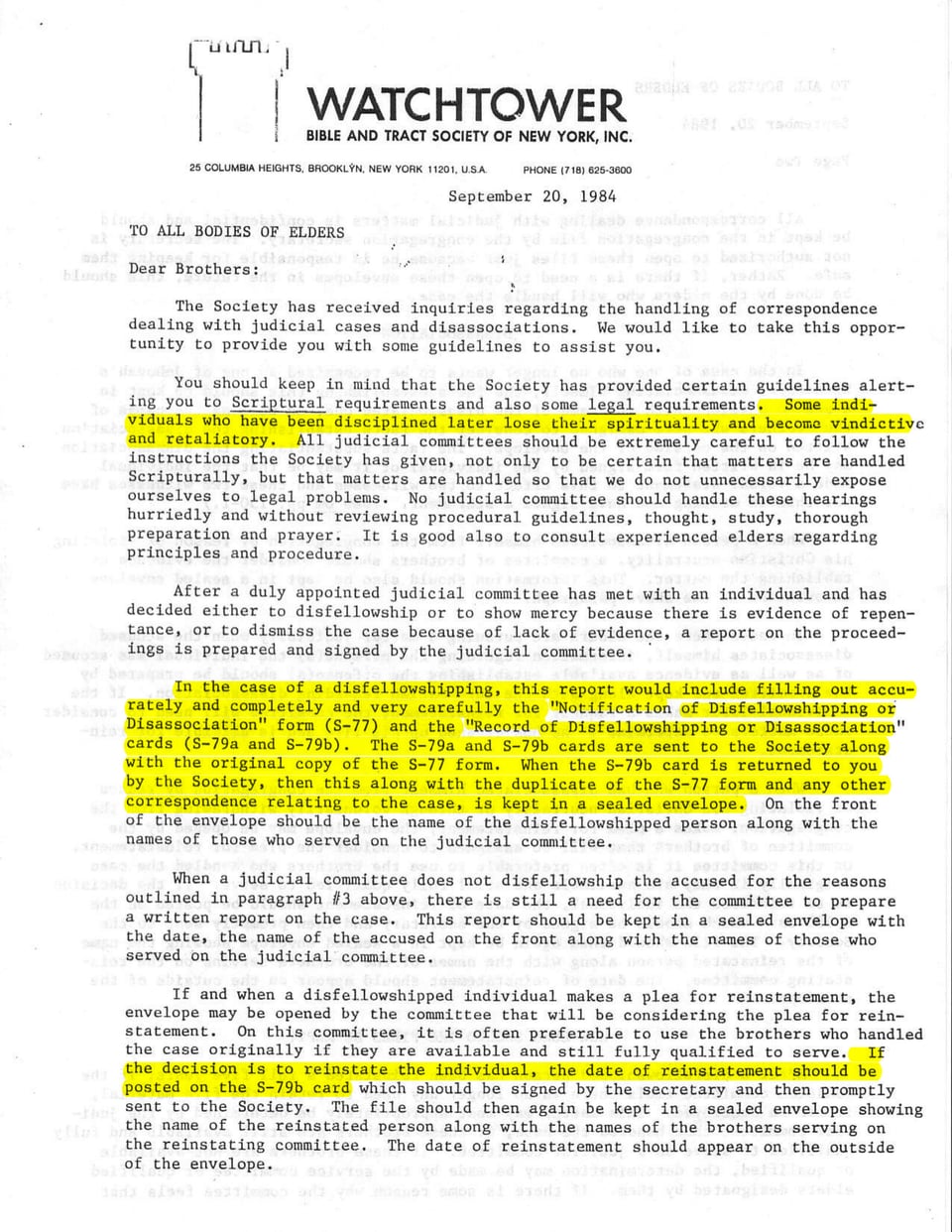
The Society has received inquiries regarding the handling of correspondence dealing with judicial cases and disassociations. We would like to take this opportunity to provide you with some guidelines to assist you.
You should keep in mind that the Society has provided certain guidelines alerting you to Scriptural requirements and also some legal requirements. Some individuals who have been disciplined later lose their spirituality and become vindictive and retaliatory. All judicial committees should be extremely careful to follow the instructions the Society has given, not only to be certain that matters are handled Scripturally, but that matters are handled so that we do not unnecessarily expose ourselves to legal problems. No judicial committee should handle these hearings hurriedly and without reviewing procedural guidelines, thought, study, thorough preparation and prayer. It is good also to consult experienced elders regarding principles and procedure.
After a duly appointed judicial committee has met with an individual and has decided either to disfellowship or to show mercy because there is evidence of repentance, or to dismiss the case because of lack of evidence, a report on the proceedings is prepared and signed by the judicial committee.
In the case of a disfellowshipping, this report would include filling out accurately and completely and very carefully the "Notification of Disfellowshipping or Disassociation" form (S-77) and the "Record of Disfellowshipping or Disassociation" cards (S-79a and S-79b). The S-79a and S-79b cards are sent to the Society along with the original copy of the S-77 form. When the S-79b card is returned to you by the Society, then this along with the duplicate of the S-77 form and any other correspondence relating to the case, is kept in a sealed envelope. On the front of the envelope should be the name of the disfellowshipped person along with the names of those who served on the judicial committee.
When a judicial committee does not disfellowship the accused for the reasons outlined in paragraph #3 above, there is still a need for the committee to prepare a written report on the case. This report should be kept in a sealed envelope with the date, the name of the accused on the front along with the names of those who served on the judicial committee.
If and when a disfellowshipped individual makes a plea for reinstatement, the envelope may be opened by the committee that will be considering the plea for rein- statement. On this committee, it is often preferable to use the brothers who handled the case originally if they are available and still fully qualified to serve. If the decision is to reinstate the individual, the date of reinstatement should be posted on the S-79b card which should be signed by the secretary and then promptly sent to the Society. The file should then again be kept in a sealed envelope showing the name of the reinstated person along with the names of the brothers serving on the reinstating committee. The date of reinstatement should appear on the outside of the envelope.
All correspondence dealing with judicial matters is confidential and should be kept in the congregation file by the congregation secretary. The secretary is not authorized to open these files just because he is responsible for keeping them safe. Rather, if there is a need to open these envelopes in the future, this should be done by the elders who will handle the case.
DISASSOCIATION
In the case of one who no longer wants to be recognized as one of Jehovah's Witnesses, disassociating himself, the facts establishing this should be kept in a sealed envelope with the name of the disassociated one, as well as the names of the brothers who were assigned to consider the facts establishing the disassociation, written on the outside of the envelope. The facts substantiating the disassociation may be in written form signed by the individual or it may be that the individual made a verbal statement to this effect to two witnesses and these two witnesses have put this in writing and have signed a statement. (See om pp. 150-1.)
When a person disassociates himself from the congregation by reason of violating his Christian neutrality, a committee of brothers should consider the evidence establishing the matter. This information should also be kept in a sealed envelope as outlined in the above paragraph.
In cases where the elders are pursuing a matter judicially when the accused disassociates himself, information regarding the offense(s) the individual was accused of as well as evidence available establishing the offense(s) should be prepared by the committee and kept along with the information regarding disassociation. If the individual later makes a request for reinstatement the committee will need to consider these matters to determine if he has cleaned up his life and is eligible for rein- statement.
When a person who has disassociated himself from the congregation by reason of violating his Christian neutrality or through voluntarily withdrawing from the congregation, makes a plea for reinstatement, the envelope may be opened by the committee of brothers that will be assigned to consider the plea for reinstatement. On this committee it is often preferable to use the brothers who handled the case originally if they are available and still fully qualified to serve. If the decision is to reinstate the individual, the date of reinstatement should be posted on the S-79b card which should be signed by the secretary and then promptly sent to the Society. The file should then again be kept in a sealed envelope showing the name of the reinstated person along with the names of the brothers serving on the rein- stating committee. The date of reinstatement should appear on the outside of the envelope.
HOW LONG SHOULD THE FILES BE KEPT?
After a disfellowshipped person has been reinstated a full five years, if the judicial committee feels there is no longer any need to retain the file material, it can be destroyed. This matter may most appropriately be determined by the judicial committee that handled the case, if these brothers are still available and fully qualified to serve on a judicial committee. If these brothers are not available or qualified, the determination may be made by the service committee or qualified elders designated by them. If there is some reason why the committee feels that September 20,1984
Page Three
it would be better to retain the correspondence longer, it can be kept as long as necessary. If a man or a woman has entered into an adulterous marriage, the file should be kept for five years after reinstatement and thereafter at least until the death or remarriage of the innocent mate.
When individuals who disassociated themselves have been reinstated, the file on the case should be kept in a sealed envelope for at least five years after the reinstatement. It may be kept longer if there is some reason why the committee feels this would be appropriate.
It is our hope that these guidelines will assist you in caring for these important matters. Be assured of our warm Christian love.
Your brothers,
Watchtower B.V.S. Society
OF NEW YORK, INC.