The Watchtower, February 15, 1994
Download: PDF — The Watchtower, February 15, 1994
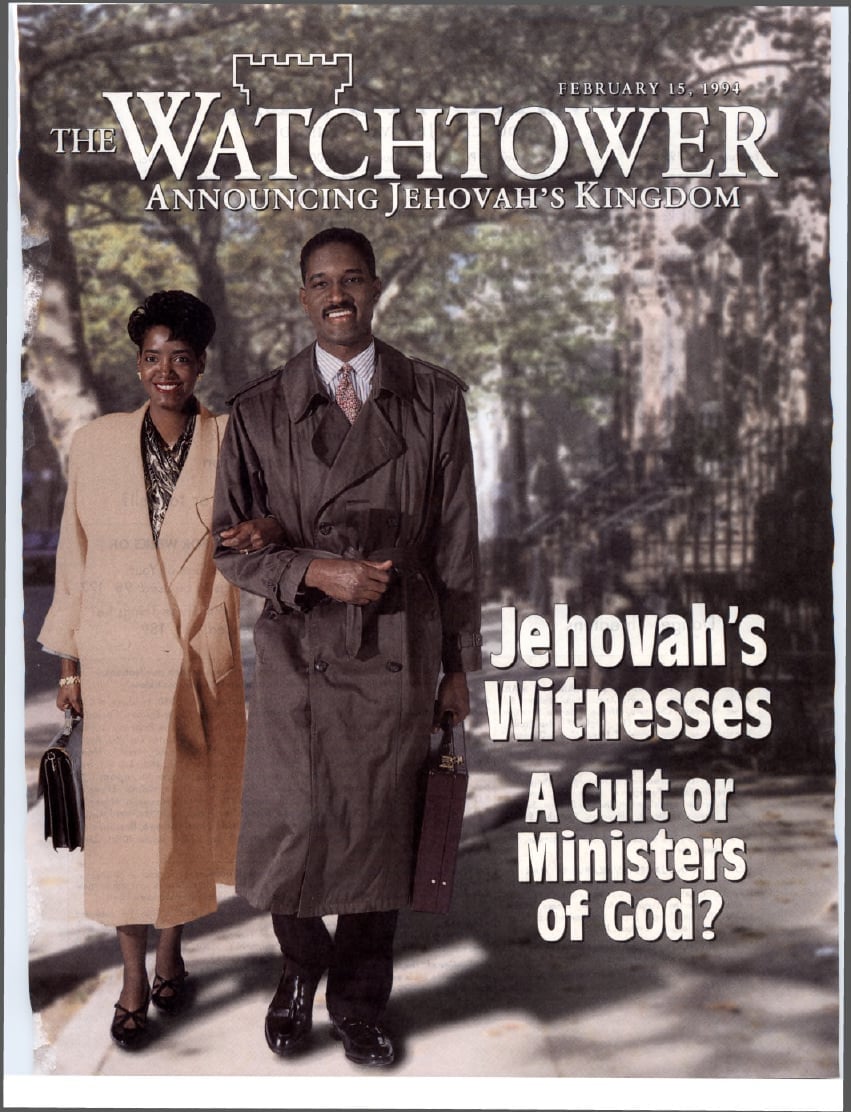
FEBRUARY 15, 1994
THE WATCHTOWER
ANNOUNCING JEHOVAH'S KINGDOM
Jehovah's Witnesses A Cult or Ministers of God?
February 15, 1994
Average Printing Each Issue: 16,100,000
Vol. 115, No. 4
THE PURPOSE OF THE WATCHTOWER is to exalt Jehovah God as Sovereign Lord of the universe. It keeps watch on world events as these fulfill Bible prophecy. It comforts all peoples with the good news that God's Kingdom will soon destroy those who oppress their fellowmen and that it will turn the earth into a paradise. It encourages faith in God's now-reigning King, Jesus Christ, whose shed blood opens the way for mankind to gain eternal life. The Watchtower, published by Jehovah's Witnesses continuously since 1879, is nonpolitical. It adheres to the Bible as its authority.
IN THIS ISSUE
3 Cults—What Are They?
5 Are Jehovah's Witnesses a Cult?
8 "What Will Be the Sign of Your Presence?"
16 "Tell Us, When Will These Things Be?"
22 Keep Your Distance When Danger Threatens
26 The Assumption
—A Dogma Revealed by God?
30 Come to the "Godly Fear" District Convention
32 Going to Heaven or to Hell?
WATCHTOWER STUDIES FOR WEEKS OF
MARCH 21: "What Will Be the Sign of Your Presence?" Page 8. Songs to be used: 98, 177.
MARCH 28: "Tell Us, When Will These Things Be?" Page 16. Songs to be used: 111, 189.
Now published in 116 languages.
SEMIMENTO LANGUAGES AVAILABLE BY MAIL:
Africanum, Allianan, Ahmariic, Aratic, Bicol, Bilimara, Biblama, Gebuanu, Chichicheu, Chinese, Cibemba, Gracanion, Gisbonu, Chichicheu, Chinese, Cibemba, Gracanion, Gisbonu, Efian, Fujian, French "French" G, Goerman, Greek, Hiyagannan, Hirt Motu, Hungarian, Iglo, Ikabe, Indonesian, Japanese "Iaali (also Braille)", Kannada, Koman, Macadougna, Malagasy, Malayalam, Maltese, Malayalam, Malayalam, Malayalam, Papalamento, Polish, Portuguese, Romanian, Russian, Sanar-Lemer, Saimon, Seppedi, Serbian, Sesotho, Shinada, Shinada, Slovak, Swahili, Spanish, Swahili, Tsholong
MONTHLY LANGUAGES AVAILABLE BY MAIL:
Bengali, Bengal, Greenlandic, Gujarati, Gujarati, Hausa, Hindi, Hindi, Icelandic, Kinyawand, Kwanyawan/Ndonga, Lakvi, Lilianu, Luguan, Marathi, Moreau, Nepali, Niuen, Persian, Sangan, Slizi, Solomon Islands Pidgin, Sanrangan, Tongan, Tuvanul, Urdu
Study articles also available in large-print edition.
Audiocassettes also available
© 1994 Watch Tower Bible and Tract Society of Pennsylvania. All rights reserved. Milton G. Henschel, President
If you would like to learn about Jehovah's Witnesses or their publications, please write to Watch Tower at the appropriate address below.
America, United States of, Wellsill, N. Y. N. 12899, Australia: Box 280, Ingleboro, N. S.W. 2565, Bahamas: Box N=1247, Nassau, N. P. Barbados: Fort堡菲le, Bridgant, Canada: Box 4100, Halton Hills (Georgetown), Ontario L7G 4Y4. England: The Ridgeway, London NW17. NRP: Germany (Nettersam, Nettersam, Dishills, F51618, Sellers), Ghana: Box 760, Gauyana: Box 5016, Georgetown I6. Hawaii 96819; 2055 Kum Kwil, Honolulu, Hong Kang: 4 Kent Road, Kowalow, Tonga. India Post B10, Lonavala, Pune DIs, Mah 410 401. Indonesia 29A Jamestown Road, Ringla, Dublin 11. Jamaica: Box 180, Kington 10. Japan 1271 P.O. Box 10-3800, Mokau, New Zealand; P.O. Box 14, Monawea, Nigeria; P.M.B. 1090, Benin City, Edo State, Philippines; Republic of P.O. Box 2044, 1099 Monale, South Africa: Private Bag X2067, Krugerstad, 19. Trinidad and Tobago; Republic of Lower Raspay Street & Lazmine Lake, Zambia: P.O. Box 3345, Luwak 1010. Zimbabwe: 55 Filene Avenue, Harare
The Bible translation used is the New World Translation of the Holy Scriptures—With References, unless otherwise indicated.
Would you welcome more information or a free home Bible study? Please send your request to Watch Tower, using the appropriate address above.
Publication of "The Watchtower" is part of a worldwide Bible educational work supported by voluntary donations.
Changes of address should reach us 30 days before your moving date. Give us your old and new address (if possible, your old address label).
The Watchtower (ISSN 0034-1083) is published semimonthly by Watchtower Bible and Tract Society, Brooklyn, N.Y. 11201. Second-class postage paid at Brooklyn, N.Y., and additional mailing offices. Postmaster: Send address changes to Watchtower, Walkill, N.Y.
Cults—What Are They?
FEBRUARY 28, 1993—more than a hundred law-enforcement agents raided a compound of buildings housing dozens of men, women, and children. The object was to search for illegal weapons and to arrest a suspected criminal. The agents, however, were caught by surprise when a hail of bullets came flying toward them from inside the buildings. They returned the fire.
This confrontation left ten dead and several wounded. During the following 50 days, hundreds of government agents laid siege
to the compound with enough guns to wage a small war. The standoff
ended in a showdown that left 86 dead, including at least 17 children.
But who was the enemy? An army of drug-dealing mobsters? A guerrilla faction? No. As you may know, the "enemy" was a group of religious devotees, members of a cult. Their tragedy made an inconspicuous community on the plains of central Texas, U.S.A., the focus of international attention. The news media flooded the airwaves and the printed page with a barrage of reports, analyses, and comments on the dangers of fanatical cults.
The public was reminded of previous instances in which cult members were led to death by their leaders: the 1969 Manson murders in California; the 1978 mass suicide of cult members in Jonestown, Guyana; the 1987 murder-suicide pact engineered by cult leader Park Soon-ja of Korea, which resulted in the death of 32 members. Significantly, most of these people claimed to be Christians and professed belief in the Bible.
Jerry Hoefer/Fort Worth Star Tologram/Sipa Press Understandably, many who respect the Bible as the Word of God are appalled at the brazen misuse of the Scriptures by these cults.
As a result, over the years hundreds of organizations have been established for the purpose of monitoring cults and exposing their dangerous practices. Experts on cult behavior predict that the coming of a new millennium in a few years may trigger the proliferation of cults. One news magazine noted that according to anticult groups, there are thousands of cults "out there poised to snatch your body, control your mind, corrupt your soul. . . . Few are armed but most are considered dangerous. They'll seduce you and fleece you, marry and bury you."
What Is a Cult?
The term "cult" is used loosely by many who may not be fully aware of its connotations. To prevent confusion, some theologians actually avoid using the term.
The World Book Encyclopedia explains that "traditionally, the term cult referred to any form of worship or ritual observance." By that criterion, all religious organizations could be classified as cults. However, in general usage today, the word "cult" has a different meaning. The same encyclopedia notes that "since the mid-1900's, publicity about cults has altered the meaning of the term. Today, the term is applied to groups that follow a living leader who promotes new and unorthodox doctrines and practices."
Endorsing the popular usage of the term, Newsweek magazine explains that cults "are normally small, fringe groups whose members derive their identity and purpose from a single, charismatic individual." Similarly, Asiaweek magazine notes that "the term [cult] itself is vague, but it usually denotes a new religious creed built around
a charismatic leader, who often proclaims himself to be the personification of God."
The language used in a joint resolution of the 100th Congress of the State of Maryland, U.S.A., also conveys the derogatory connotation of the term cult. The resolution states that "a cult is a group or movement exhibiting excessive devotion to a person or idea and employing unethically manipulative techniques of persuasion and control to advance the goals of its leaders."
Clearly, cults are generally understood to be religious groups with radical views and practices that clash with what is accepted today as normal social behavior. Usually they conduct their religious activities in secrecy. Many of these cultic groups actually isolate themselves in communes. Their devotion to a self-proclaimed human leader is likely to be unconditional and exclusive. Often these leaders boast of having been divinely chosen or even of being themselves divine in nature.
Occasionally, anticult organizations and the media have referred to Jehovah's Witnesses as a cult. A number of recent newspaper articles lump the Witnesses with religious groups known for their questionable practices. But would it be accurate to refer to Jehovah's Witnesses as a small fringe religious group? Cult members often isolate themselves from friends, family, and even society in general. Is that the case with Jehovah's Witnesses? Are the Witnesses using deceptive and unethical techniques to recruit members?
Cult leaders are known to use manipulative methods to control the minds of their followers. Is there any evidence that Jehovah's Witnesses do this? Is their worship cloaked in secrecy? Are they following and venerating a human leader? Pointedly, are Jehovah's Witnesses a cult?
Are Jehovah's Witnesses a Cult?
JESUS CHRIST was accused of being a drunkard, a glutton, a Sabbath breaker, a false witness, a blasphemer of God, and a messenger of Satan. He was also accused of being subversive.—Matthew 9:34; 11:19; 12:24; 26:65; John 8:13; 9:16; 19:12.
After Jesus' death and resurrection, his disciples were likewise the target of serious accusations. One group of first-century Christians were dragged to the city rulers by people crying out: 'These men have overturned the inhabited earth.' (Acts 17:6) On another occasion the apostle Paul and his companion Silas were taken to the authorities and charged with greatly disturbing the city of Philippi.—Acts 16:20.
Paul was later accused of being a "pestilent fellow and stirring up seditions among all the Jews throughout the inhabited earth" and of trying "to profane the temple." (Acts 24:5, 6) The principal men of the Jews in Rome accurately described the situation of Jesus' followers when they acknowledged: "For truly as regards this sect it is known to us that everywhere it is spoken against."—Acts 28:22.
Evidently, this new group established by Jesus Christ was considered by some to be a religious group with radical views and practices that clashed with what was accepted in those days as normal social behavior. Undoubtedly, many today would have considered the Christians a destructive cult. The accusers were often prominent and respected members of the community, and this seems to have added weight to the allegations. Many believed the accusations against Jesus and his disciples. Yet,
as you probably know, every one of these charges was false! The fact that people said these things did not make them true.
What about today? Would it be accurate to refer to Jehovah's Witnesses as a religious group with radical views and practices that clash with what is accepted as normal social behavior? Are Jehovah's Witnesses a cult?
What the Evidence Shows
A government official of the city of St. Petersburg, Russia, explained: "Jehovah's Witnesses were presented to us as some kind of underground sect sitting in the darkness and slaughtering children and killing themselves." However, the people of Russia have recently become better acquainted with the true nature of the Witnesses. After working with Jehovah's Witnesses in connection with an international convention, the same official observed: "Now I see normal, smiling people, even better than many people I know. They are peaceful and calm, and they love one another very much." He added: "I really do not understand why people tell such lies about them."
Jehovah's Witnesses do not hold ritualistic meetings, nor is their worship cloaked in secrecy. Non-Witness author Julia Mitchell Corbett notes: "When they meet, usually more than once a week, in Kingdom Halls (their meeting sites are not called churches), most of their time is spent in Bible study and discussion." Their meeting places are clearly marked with a sign. The meetings are open, and the general public is invited to attend. Unannounced guests are more than welcome.
The "Witnesses have earned the reputation of being honest, courteous, and industrious," adds Corbett in her book Religion in America. Many who are not Witnesses readily acknowledge that there is nothing freakish or bizarre about Jehovah's Witnesses. Their conduct does not clash with what is accepted as normal social behavior. The New Encyclopedia Britannica accurately states that the Witnesses "insist upon a high moral code in personal conduct."
The director of news and special projects for a television station in the United States wrote to Jehovah's Witnesses in response to a biased report about the Witnesses on the TV news show 60 Minutes. He said: "If more people lived the way your faith does, this nation wouldn't be in the shape it is in. I am one newsman who knows that your organization is founded on love and a strong faith in the Creator. I want you to know that not all News people are as biased."
A Well-Known Religion
Is it fair to say that Jehovah's Witnesses are a small fringe religious group? In a sense, Jehovah's Witnesses are few in number compared to some religions. However, recall what Jesus said: "Narrow is the gate and cramped the road leading off into life, and few are the ones finding it."—Matthew 7:13, 14.
At any rate, the Witnesses are far from being a small fringe cult. In the spring of 1993, more than 11 million people attended the Witnesses' Memorial of Christ's death. But more important than their number are their moral character and exemplary behavior, which have brought them worldwide commendation. Undoubtedly this has been a factor in countries that have given them official recognition as a known, bona fide religion.
Outstanding is a recent ruling by the European Court of Human Rights. It declared
that the Witnesses should enjoy freedom of thought, conscience, and religion and that they have the right to speak about their faith and teach it to others. This would hardly be the case if Jehovah's Witnesses were known to use deceptive and unethical techniques to recruit members or if they used manipulative methods to control the minds of their followers.
Multitudes around the world are well acquainted with Jehovah's Witnesses. Of the millions of non-Witnesses who are studying the Bible with the Witnesses or who have studied with them at one time or another, we ask, Were there any attempts to brainwash you? Did the Witnesses employ mind-control techniques on you? "No" would doubtless be your frank response. Obviously, if these methods had been used, there would be an overwhelming number of victims in contradiction to any argument in favor of Jehovah's Witnesses.
"Absorbed in Humanity"
Cult members often isolate themselves from family, friends, and even society in general. Is that the case with Jehovah's Witnesses? "I do not belong to Jehovah's Witnesses," wrote a newsman in the Czech Republic. Yet he added: "It is obvious that they [Jehovah's Witnesses] have tremendous moral strength. . . . They recognize governmental authorities but believe that only God's Kingdom is capable of solving all human problems. But watch it—they are not fanatics. They are people who are absorbed in humanity."
And they do not live in communes, isolating themselves from relatives and others. Jehovah's Witnesses recognize that it is their Scriptural responsibility to love and care for their families. They live and work with people of all races and religions. When disasters strike, they are quick to respond with relief supplies and other humanitarian assistance.
More important, they are engaged in an educational program that has no comparison. How many religions have an organized system to pay personal visits to every individual in their community? Jehovah's Witnesses do this in more than 200 lands and in more than 200 languages! Clearly, Jehovah's Witnesses are "absorbed in humanity."
Strict Adherence to the Bible
Admittedly, the teachings of Jehovah's Witnesses are different from those provided by the churches. Jehovah's Witnesses believe that Jehovah is the almighty God and that Jesus is his Son, not part of a triune deity. Their faith is anchored in the belief that God's Kingdom alone can bring relief to suffering humanity. They warn people of the imminent destruction of this corrupt system of things. They preach about God's promise of an earthly paradise for obedient mankind. They do not venerate the cross. They do not celebrate Christmas. They believe that the soul is mortal and that there is no hellfire. They will not eat blood, nor will they accept blood transfusions. They abstain from involvement in politics and participation in warfare. Have you ever asked yourself why the teachings of Jehovah's Witnesses are so different?
A Massachusetts newspaper, the Daily Hampshire Gazette, explains that Jehovah's Witnesses" "strict interpretation of the Bible forbids many activities others take for granted . . . , all in an effort to follow the example of first-century Christians and the word of the Bible." The Encyclopedia of Religion agrees that "all that they believe is based on the Bible. They 'proof text' (that is, supply a biblical citation to support) almost every statement of faith, taking for granted the authority of the Bible, which
entirely supplants tradition." The book Religion in America states: "The group has never wavered from its focus on Bible study, and its teachings are supported by an elaborate system of references to scripture."
Who Is Their Leader?
It is precisely because of this close adherence to Bible teachings that the veneration and idolization of human leaders so characteristic of cults today is not to be found among Jehovah's Witnesses. They reject the concept of a clergy-laity distinction. The Encyclopedia of Religion aptly states about Jehovah's Witnesses: "A clergy class and distinctive titles are prohibited."
They follow Jesus Christ as their Leader and as Head of the Christian congregation. It was Jesus who said: "Do not you be called Rabbi, for one is your teacher, whereas all you are brothers. Moreover, do not call anyone your father on earth, for one is your Father, the heavenly One. Neither be called 'leaders,' for your Leader is one, the Christ." —Matthew 23:8-12.
It is clear that Jehovah's Witnesses are as far from being a cult as Jesus was from being a glutton and a drunkard. Admittedly, not everyone who was influenced by the false reports about Jesus and his disciples fell into the trap of slandering him. Some may simply have been misinformed. If you have questions about Jehovah's Witnesses and their beliefs, why not get to know them better? The doors to their Kingdom Halls are wide open to all who seek truth.
You can also benefit from their careful search for accurate Bible knowledge and learn how to worship God in harmony with Jesus' words: "The hour is coming, and it is now, when the true worshipers will worship the Father with spirit and truth, for, indeed, the Father is looking for suchlike ones to worship him."—John 4:23.
WHAT WILL BE THE SIGN OF YOUR PRESENCE?"
"When will these things be, and what will be the sign of your presence and of the conclusion of the system of things?"—MATTHEW 24:3.
MOST people are interested in the future. Are you? In his book Future Shock, Professor Alvin Toffler noted "the sudden proliferation of organizations devoted to the study of the future." He added: 'We have seen the creation of future-oriented think tanks; the appearance of futurist journals in England, France, Italy, Germany and the United States; the spread of university courses in forecasting.' Toffler concluded: "Of course, no one can 'know' the future in any absolute sense."
1, 2. What shows that people are interested in the future?
2 The book Signs of Things to Come says: "Palmistry, crystal gazing, astrology, card reading, I Ching are all techniques of more or less complexity to give us some idea of what our particular future might hold." But instead of turning to human methods, we do better to look to a proven source—Jehovah.
3The true God stated: "Just as I have figured, so it must occur; and just as I have counseled, that is what will come true." (Isaiah 14:24, 27; 42:9) Yes, Jehovah has been able to counsel mankind about what
Why is it fitting to look to God for knowledge of the future?
will happen, often doing so through human spokesmen.
One of these prophets wrote: "Jehovah will not do a thing unless he has revealed his confidential matter to his servants the prophets." —Amos 3:7, 8; 2 Peter 1:20, 21.
4 Jesus Christ was God's foremost prophet. (Hebrews 1:1, 2) Let us focus on one of Jesus' key prophecies that foretells things occurring around us now. This prophecy also offers us insight into what will soon occur as the present wicked system ends and God replaces it with an earthly paradise.
Jesus proved that he was a prophet. (Mark 6:4; Luke 13:33; 24:19; John 4:19; 6:14; 9:17) Thus, it is understandable why his apostles, sitting with him on the Mount of Olives overlooking Jerusalem, would ask him about the future: "When will these things be, and what will be the sign of your presence and of the conclusion of the system of things?" —Matthew 24:3; Mark 13:4.
6 You will find their question and Jesus' reply in Matthew chapter 24, Mark chapter 13, and Luke chapter 21.* In many respects the accounts are complementary, but they are not identical. For example, only Luke mentions 'pestilences in one place after another.' (Luke 21:10, 11; Matthew 24:7; Mark 13:8) Logically, we should ask, Was Jesus foretelling events just within his hearers' lifetime, or did he include our time and what the future holds for us?
The Apostles Wanted to Know
7 Just days before he was killed, Jesus declared that God had rejected Jerusalem, the Jews' capital. The city and its grand temple would be destroyed. Some of the apostles then asked for a 'sign of Jesus' presence and
the conclusion of the system of things.'
(Matthew 23:37-24:3) Undoubtedly they had in mind primarily the Jewish system and Jerusalem, for they did not grasp the scope of what lay ahead. But in answering them Jesus looked far beyond what occurred up to and including 70 C.E. when the Romans destroyed Jerusalem.—Luke 19:11; Acts 1:6, 7.
dom had been heard widely in Africa, Asia, and Europe.*—Colossians 1:23.
"THEN" the End
10 In some respects Jesus presented events as occurring in sequence. He said: "This good news of the kingdom will be preached . . . , and then the end will come." Bibles in English frequently use "then" with the simple meaning of "therefore" or "but." (Mark 4:15, 17:12
As you can read in the three Gospel accounts, Jesus spoke of nation rising against nation and kingdom against kingdom, food shortages, earthquakes, fearful sights, and heavenly signs. In the years between Jesus' giving of that sign (33 C.E.) and the desolation of Jerusalem (66-70 C.E.), false prophets and false Christs
or out. (Mark 4:15, 17; 18:23) However, at Matthew 24:14, "then" is based on the Greek adverb to'te.'e Greek experts explain that to'te is a "demonstrative adverb of time" used "to introduce that which follows in time" or "to introduce a subsequent event." Jesus thus predicted that there would be Kingdom preaching and then ('after that' or 'subsequently') "the end"
would arise. The Jews would persecute the Christians, who were preaching Jesus' message.
8 These features of the
The tribulation in 70 C.E. was the greatest that Jerusalem and the Jewish system ever experienced
sign actually occurred, even as historian Flavius Josephus confirms. He writes that before the Romans ever attacked, false Messiahs instigated rebellion. There were terrible earthquakes in Judea and elsewhere. Wars broke out in many parts of the Roman Empire. Were there major famines? Yes, indeed. (Compare Acts 11:27-30.) What of the
would come. Which end?
11 One fulfillment of Jesus' prophecy can be found in the events leading up to the end of the Jewish system. The wars, earthquakes, food shortages, and so on, that Jesus foretold occurred over a period of three decades. Yet, commencing with Matthew 24:15, Mark 13:14, and Luke 21:20, we read of events that were directly linked to imminent destruc-
Kingdom preaching work? By 60 or 61 C.E., when the book of Colossians was written, "the hope of that good news" of God's King-
*To'te appears over 80 times in Matthew (9 times in chapter 24) and 15 times in the book of Luke. Mark used to'te only six times, but four of those involved "the sign."
Why should we take note of the Greek word to'te, and what is its significance?
How did Jesus focus on events directly linked to the destruction of Jerusalem?
tion, when the end was at the doorstep.
—Note the single dotted line on the chart.
12 Responding to a Jewish revolt in 66 C.E., Romans under Cestius Gallus marched against Jerusalem, surrounding this city that the Jews considered holy. (Matthew 5:35) Despite Jewish counterattacks, the Romans forced entry into the city. They thus began "standing in a holy place," true to Jesus' prediction at Matthew 24:15 and Mark 13:14. Then there was a surprising development. Though they had surrounded the city, the Romans suddenly withdrew. Christians immediately recognized the fulfillment of Jesus' prophecy, and the withdrawal allowed them to flee from Judea into the mountains across the Jordan. History says they did so.
13 But if the Romans withdrew from around Jerusalem, why did anyone need to flee? Jesus' words showed that what had occurred proved 'that the desolating of Jerusalem was near.' (Luke 21:20) Yes, desolating. He foretold 'a tribulation such as had not occurred from the beginning and would not occur again.' About three and a half years later, in 70 C.E., Jerusalem actually did experience "great tribulation" from the Roman armies under General Titus. (Matthew 24:21; Mark 13:19) Why, though, would Jesus describe this as a tribulation greater than any before or since?
14 Jerusalem was ravaged by the Babylonians in 607 B.C.E., and the city has seen horrible fighting in our present century. Still, what occurred in 70 C.E. was uniquely
a great tribulation. In a campaign of about five months, Titus' warriors defeated the Jews. They killed some 1,100,000 and took nearly 100,000 into captivity. Moreover, the Romans demolished Jerusalem. This proved that the Jewish system of formerly approved worship that centered on the temple had permanently ended. (Hebrews 1:2) Yes, the events of 70 C.E. could rightly be considered 'tribulation such as has not occurred [on that city, nation, and system] since the world's beginning, no, nor will occur again.'—Matthew 24:21.*
As Prophesied, More Was to Follow
15 Jesus, however, did not limit his prediction to the tribulation in the first century. The Bible shows that much was to follow that tribulation, as is suggested by the use of to'te, or "then," at Matthew 24:23 and Mark 13:21. What would develop in the period following 70 C.E.? After the tribulation on the Jewish system, more false Christs and false prophets would appear. (Compare Mark 13:6 with 13:21-23.) History confirms that such individuals have arisen over the centuries since Jerusalem's destruction in 70 C.E., though they have not misled people who have sharp spiritual vision and who have been looking to "the presence" of Christ. (Matthew 24:27, 28) Nevertheless, these developments after the great tribulation of 70 C.E. form one indication that Jesus was looking beyond that tribulation, which was only an initial fulfillment.
16 If we compare Matthew 24:15-28 and Mark 13:14-23 with Luke 21:20-24, we find a second indication that Jesus' prediction extended beyond the destruction of Jerusalem. Recall that Luke alone had mentioned pestilences. Similarly, he alone closed this section with Jesus' words: "Jerusalem will be trampled on by the nations, until the appointed times of the nations ["times of the Gentiles", "King James Version] are fulfilled."* (Luke 21:24) The Babylonians removed the Jews' last king in 607 B.C.E., and after that, Jerusalem, standing for God's Kingdom, was trampled on. (2 Kings 25:1-26; 1 Chronicles 29:23; Ezekiel 21:25-27) At Luke 21:24, Jesus indicated that the situation would persist into the future until the time came for God to reestablish a Kingdom.
17 Here is a third indication that Jesus was pointing also to a distant fulfillment: According to the Scriptures, the Messiah was to die and be resurrected, whereupon he would sit at God's right hand until the Father sent him forth subduing. (Psalm 110:1, 2) Jesus alluded to his having to sit at his Father's right hand. (Mark 14:62) The apostle Paul confirmed that the resurrected Jesus was at Jehovah's right hand awaiting the time to be King and God's Executioner. —Romans 8:34; Colossians 3:1; Hebrews 10:12, 13.
18 For a fourth and conclusive indication that Jesus' prophecy about the conclusion of the system of things applies beyond the first century, we can turn to Revelation chapter 6. Writing decades after 70 C.E., the apostle John described a compelling scene of active horsemen. (Revelation 6:2-8) This prophetic view into "the Lord's day"—the day of his presence—identifies our 20th century as a time of notable warfare (verse 4), widespread food shortages (verses 5 and 6), and "deadly plague" (verse 8). Clearly, this parallels what Jesus said in the Gospels and proves that his prophecy has a greater fulfillment in this 'day of the Lord.'—Revelation 1:10.
1темпер Informed people acknowledge that the composite sign foretold at Matthew 24:7-14 and Revelation 6:2-8 has been manifest since the first outbreak of world war in 1914. Jehovah's Witnesses have announced worldwide that Jesus' prophecy is now having its second and greater fulfillment, as evidenced by brutal wars, devastating earthquakes, tragic famines, and rampant diseases. On this last point, U.S.News & World Report (July 27, 1992) said: "The AIDS epidemic . . . is sending millions of victims to their death and may soon become the most costly and catastrophic plague in history. The Black Death killed about 25 million suffering souls in the 14th century. But by the year 2000, 30 million to 110 million people will be carrying HIV, the virus that causes AIDS, up from some 12 million today. In the absence of a cure, all face certain death."
20 What, then, are we to conclude about how Jesus answered the apostles' inquiry? His prophecy accurately foretold things leading up to and encompassing the destruction of Jerusalem, and it mentioned some things to follow 70 C.E.
But most of this was to have a second and greater fulfillment in the future, leading up to a great tribulation that would end the present wicked system of things. This means that Jesus' prediction at Matthew 24:4-22, and the parallels in Mark and Luke, were fulfilled from 33 C.E. through the tribulation of 70 C.E. Yet, the same verses would have a second fulfillment, which would include a greater tribulation in the future. This larger fulfillment is with us; we can see it daily.*
Leading Up to What?
21 Jesus did not end his prophecy with mention of false prophets performing deceptive signs during the long period before 'the appointed times of the nations would be fulfilled.' (Luke 21:24; Matthew 24:23-26; Mark 13:21-23) He went on to tell of other startling things to occur, things observed earth wide. These would be associated with the coming of the Son of man in power and glory. Mark 13:24-27 is representative of his continued prophecy:
22 "But in those days, after that tribulation, the sun will be darkened, and the moon will not give its light, and the stars will be falling out of heaven, and the powers that are in the heavens will be shaken. And then
they will see the Son of man coming in clouds with great power and glory. And then he will send forth the angels and will gather his chosen ones together from the four winds, from earth's extremity to heaven's extremity."
23 The Son of man, the resurrected Jesus Christ, did not come in that spectacular manner following the destructive end of the Jewish system in 70 C.E. Certainly all the tribes of the earth did not recognize him, as Matthew 24:30 notes, nor did heavenly angels then gather all the anointed Christians from the entire earth. So when would this additional part of Jesus' stupendous prophecy be fulfilled? Is it finding fulfillment in what is going on around us now, or does it, rather, provide divine insight into things that we can expect in the near future? We should certainly want to know, for Luke records Jesus' admonition: "As these things start to occur, raise yourselves erect and lift your heads up, because your deliverance is getting near."—Luke 21:28.
Why can we look for the fulfillment of Matthew 24:29-31 long after the first century C.E.?
Do You Recall?
□ Jesus' answer to the question at Matthew 24:3 had what fulfillment leading up to 70 C.E.?
□ How does the use of the word to'te help us to understand Jesus' prophecy?
In what sense was there a first- century "great tribulation" such as had not occurred previously?
Luke refers to what two unique aspects of Jesus' prophecy that involve us today?
What indications point to a second and greater fulfillment of the prophecy at Matthew 24:4-22?
MATTHEW 24
MARK 13
LUKE 21
4“Jesus said to them:‘Look out that nobody misleads you;’for many will come on the basis of my name,saying,‘I am the Christ,’and will mislead many.You are going to hear of wars and reports of wars;see that you are not terrified.For these things must take place,but the end is not yet.7“For nation will rise against nation and kingdom against kingdom,and there will be food shortages and earthquakes in one place after another.8All these things are a beginning of pangs of distress.9“Then people will deliver you up to tribulation and will kill you,and you will be objects of hatred by all the nations on account of my name.10Then,also,many will be stumbled and will betray one another and will hate one another.11And many false prophets will arise and mislead many;12and because of the increasing of lawlessness the love of the greater number will cool off.13But he that has endured to the end is the one that will be saved.14And this good news of the kingdom will be preached in all the inhabited earth for a witness to all the nations;and then the end will come.
5“So Jesus started to say to them:‘Look out that nobody misleads you.6Many will come on the basis of my name,saying,‘I am he,’and will mislead many.7Moreover,when you hear of wars and reports of wars,do not be terrified;these things must take place,but the end is not yet.8“For nation will rise against nation and kingdom against kingdom,there will be earthquakes in one place after another,there will be food shortages.These are a beginning of pangs of distress.9“As for you,look out for yourselves;people will deliver you up to local courts,and you will be beaten in synagogues and be put on the stand before governors and kings for my sake,for a witness to them.10Also,in all the nations the good news has to be preached first.11But when they are leading you along to deliver you up,do not be anxious beforehand about what to speak;but whatever is given you in that hour,speak this,for you are not the ones speaking,but the holy spirit is.12Furthermore,brother will deliver brother over to death,and a father a child,and children will rise up against parents and have them put to death;13and you will be objects of hatred by all people on account of my name.But he that has endured to the end is the one that will be saved.
8“He said:‘Look out that you are not misled;for many will come on the basis of my name,saying,‘I am he,’and,‘The due time has approached.’Do not go after them.9Furthermore,when you hear of wars and disorders,do not be terrified.For these things must occur first,but the end does not occur immediately.’10“Then he went on to say to them:‘Nation will rise against nation,and kingdom against kingdom;11and there will be great earthquakes,and in one place after another pestilences and food shortages;and there will be fearful sights and from heaven great signs.12“But before all these things people will lay their hands upon you and persecute you,delivering you up to the synagogues and prisons,you being haled before kings and governors for the sake of my name.13It will turn out to you for a witness.14Therefore settle it in your hearts not to rehearse beforehand how to make your defense.15for I will give you a mouth and wisdom,which all your oppersons together will not be able to resist or dispute.16Moreover,you will be delivered up even by parents and brothers and relatives and friends,and they will put some of you to death;17and you will be objects of hatred by all people because of my name.18And yet not a hair of your heads will by any means perish.19By endurance on your part you will acquire your souls.
15“Therefore,when you catch sight of the disgusting thing that causes desolation,as spoken of through Daniel the prophet,standing in a holy place,(let the reader use discernment,)then let those in Judea begin fleeing to the mountains.17Let the man on the housetop not
14“However,when you catch sight of the disgusting thing that causes desolation standing where it ought not(let the reader use discernment),then let those in Judea begin fleeing to the mountains.18Let the man on the housetop not come down,nor go inside to take anything
20“Furthermore,when you see Jerusalem surrounded by encamped armies,then know that the desolating of her has drawn near.21Then let those in Judea begin fleeing to the mountains,and let those in the midst of her withdraw, and let those in the country places
come down to take the goods out of his house;18and let the man in the field not return to the house to pick up his outer garment.19Woe to the pregnant women and those suckling a baby in those days!20Keep praying that your flight may not occur in wintertime, nor on the sabbath day;21for then there will be great tribulation such as has not occurred since the world's beginning until now, no, nor will occur again.22In fact, unless those days were cut short, no flesh would be saved; but on account of the chosen ones those days will be cut short.
out of his house;16and let the man in the field not return to the things behind to pick up his outer garment.19Woe to the pregnant women and those suckling a baby in those days!20Keep praying that it may not occur in wintertime;19for those days will be days of a tribulation such as has not occurred from the beginning of the creation which God created until that time, and will not occur again.20In fact, unless Jehovah had cut short the days, no flesh would be saved. But on account of the chosen ones whom he has chosen he has cut short the days.
not enter into her;22because these are days for meting out justice, that all the things written may be fulfilled.22Woe to the pregnant women and the ones suckling a baby in those days!For there will be great necessity upon the land and wrath on this people;24and they will fall by the edge of the sword and be led captive into all the nations;
21Then if anyone says to you,“Look! Here is the Christ,”or,“There!”do not believe it.24For false Christians and false prophets will arise and will give signs and wonders so as to mislead, if possible, even the chosen ones.25Look! I have forewarned you.26Therefore, if people say to you,“Look! He is in the wilderness,”do not go out;“Look! He is in the inner chambers,”do not believe it.27For just as the lightning comes out of eastern parts and shines over to western parts, so the presence of the Son of man will be.28Wherever the carcass is, there the eagles will be gathered together.
21Then, too, if anyone says to you,“See! Here is the Christ,”“See! There he is,”do not believe it.24For false Christians and false prophets will arise and will give signs and wonders to lead astray, if possible, the chosen ones.22You, then, watch out;I have told you all things beforehand.
and Jerusalem will be trampled on by the nations, until the appointed times of the nations are fulfilled.
22Immediately after the tribulation of those days the sun will be darkened, and the moon will not give its light, and the stars will fall from heaven, and the powers of the heavens will be shaken.23And then the sign of the Son of man will appear in heaven, and then all the tribes of the earth will beat themselves in lamentation, and they will see the Son of man coming on the clouds of heaven with power and great glory.24And he will send forth his angels with great trumpet sound, and they will gather his chosen ones together from the four winds, from earth's extremity to heaven's extremity.”
24But in those days, after that tribulation, the sun will be darkened, and the moon will not give its light, and the stars will be falling out of heaven, and the powers that are in the heavens will be shaken.26And then they will see the Son of man coming in clouds with great power and glory.27And he will send forth the angels and will gather his chosen ones together from the four winds, from earth's extremity to heaven's extremity.”
25Also, there will be signs in sun and moon and stars, and on the earth anguish of nations, not knowing the way out because of the roaring of the sea and its agitation,26while men become faint out of fear and expectation of the things coming upon the inhabited earth; for the powers of the heavens will be shaken.27And then they will see the Son of man coming in a cloud with power and great glory.28But as these things start to occur, raise yourselves erect and lift your heads up, because your deliverance is getting near.”
"TELL US, WHEN WILL THESE THINGS BE?"
"New things I am telling out. Before they begin to spring up, I cause you people to hear them."—ISAIAH 42:9.
DIVINE teaching springs from Jehovah God, "the One telling from the beginning the finale." (Isaiah 46:10) As the preceding article showed, the apostles sought such teaching from Jesus, asking him: "Tell us, When will these things be, and what will be the sign when all these things are destined to come to a conclusion?" —Mark 13:4.
2 In answer, Jesus described a composite "sign" consisting of evidence that would prove that the Jewish system was soon to end. This was fulfilled with Jerusalem's destruction in 70 C.E. But Jesus' prophecy would have a greater fulfillment far down the stream of time. Once "the appointed times of the nations" ended in 1914, a sign on a vast scale would be available, manifesting that soon the present wicked system would end in a "great tribulation."** (Luke 21:24) Millions alive today can testify that this sign has been fulfilled in the world wars and other momentous events of this 20th century. These also mark the major fulfillment of Jesus' prophecy, this modern fulfillment being typified by what happened from 33 to 70 C.E.
3 After Luke's mention of the appointed times of the nations, the parallel accounts in Matthew, Mark, and Luke describe a further series of developments that include a sign in addition to the composite 'sign of the conclusion of the system of things.' (Matthew 24:3) (On page 15, this point in the
account is marked off by a double line.) Matthew says: "Immediately after the tribulation of those days the sun will be darkened, and the moon will not give its light, and the stars will fall from heaven, and the powers of the heavens will be shaken.
And then the sign of the Son of man will appear in heaven, and then all the tribes of the earth will beat themselves in lamentation, and they will see the Son of man coming on the clouds of heaven with power and great glory. And he will send forth his angels with a great trumpet sound, and they will gather his chosen ones together from the four winds, from one extremity of the heavens to their other extremity." —Matthew 24:29-31.
Tribulation and Celestial Phenomena
4 When would that be fulfilled? All three Gospel accounts mention what we might call celestial phenomena—sun and moon darkened and stars falling. Jesus said that these would follow "the tribulation." Did Jesus have in mind the tribulation that climaxed in 70 C.E., or was he speaking of the great tribulation that is still future in our modern times?—Matthew 24:29; Mark 13:24.
5 Ever since the appointed times of the
nations ended in 1914, God's people have been keenly interested in "the great tribulation." (Revelation 7:14) For years they thought that the modern-day great tribulation had an opening part corresponding to the time of World War I, then an interrupting interval, and finally a concluding part, "the war of the great day of God the Almighty." If that were so, what would occur during the intervening decades of the "conclusion of the system"?—Revelation 16:14; Matthew 13:39; 24:3; 28:20.
6 Well, it was felt that during this interval the composite sign would be seen, including the preaching work done by God's gathered people. It seemed also that the foretold celestial phenomena could be expected during the interval after the opening phase in 1914-18. (Matthew 24:29; Mark 13:24, 25; Luke 21:25) Attention focused on literal things in the heavens—space probes, rockets, cosmic or gamma rays, and landings or bases on the moon.
However, The Watchtower of January 15, 1970, reexamined Jesus' prophecy, especially the coming great tribulation. It showed that in view of what happened in the first century, the modern tribulation
could not have an opening part in 1914-18, a decades-long interval, and later a resumption.
That magazine concluded: "The 'great tribulation' such as will not occur again is yet ahead, for it means the destruction of the world empire of false religion (including Christendom) followed by the 'war of the great day of God the Almighty' at Armageddon."
But Matthew 24:29 says that the celestial phenomena come "immediately after the tribulation." How could that be? The Watchtower of May 1, 1975, suggested that here "the tribulation" meant the one that climaxed back in 70 C.E. But in what sense could it be said that celestial phenomena of our time were taking place "immediately" after an event in 70 C.E.? It was reasoned that in God's sight the centuries in between would be brief. (Romans 16:20; 2 Peter 3:8) However, a deeper examination of this prophecy, particularly of Matthew 24:29-31, points to quite a different explanation. This illustrates how the light shines "more and more unto the perfect day." (Proverbs 4:18, American Standard Version)* Let us consider why a new, or changed, explanation is appropriate.
To four of his apostles, Jesus gave the prophecy of 'the sun being darkened, the moon not giving light, and the stars falling.' As Jews, they would recognize such language from the Hebrew Scriptures, where at Zephaniah 1:15, for example,
God's time of judgment was called "a day of storm and of desolation, a day of darkness and of gloominess, a day of clouds and of thick gloom." Various Hebrew prophets also described the sun as being darkened, the moon not shining, and the stars not giving light. You will find such language in divine messages against Babylon, Edom, Egypt, and the northern kingdom of Israel.—Isaiah 13:9, 10; 34:4, 5; Jeremiah 4:28; Ezekiel 32:2, 6-8; Amos 5:20; 8:2, 9.
10 When they heard what Jesus said, Peter and the three others likely recalled Joel's prophecy found at Joel 2:28-31 and 3:15: "I shall pour out my spirit on every sort of flesh, and your sons and your daughters will certainly prophesy. . . . I will give portents in the heavens and on the earth, blood and fire and columns of smoke. The sun itself will be turned into darkness, and the moon into blood, before the coming of the great and fear-inspiring day of Jehovah." "Sun and moon themselves will certainly become dark, and the very stars will actually withdraw their brightness."
11 As related at Acts 2:1-4 and 14-21, at Pentecost 33 C.E., God poured out holy spirit on 120 disciples, both men and women. The apostle Peter made known that this was what Joel had foretold. What, though, of Joel's words about 'the sun being turned into darkness and the moon into blood and the stars withdrawing their brightness'? Nothing indicates that this was fulfilled in 33 C.E. or during the more than 30-yearlong span of the conclusion of the Jewish system of things.
12 Evidently that latter part of Joel's prediction was more closely linked with "the coming of the great and fear-inspiring day of Jehovah"—the destruction of Jerusalem.
The Watchtower of November 15, 1966, said about the tribulation that befell Jerusalem in 70 C.E.: "That was certainly a 'day of Jehovah' with reference to Jerusalem and her children. And in connection with that day there was plenty of 'blood and fire and smoke mist,' the sun not brightening the gloom of the city by day, and the moon suggesting shed blood, not peaceful, silvery moonlight by night."*
13 Yes, as with other prophecies that we have noted, the celestial phenomena Joel foretold were to be fulfilled when Jehovah exacted judgment. Rather than extending over the conclusion of the Jewish system, the darkening of the sun, moon, and stars occurred when the executionary forces came against Jerusalem. Logically, we can expect a larger fulfillment of that part of Joel's prophecy when God's execution of the present system gets under way.
Which Tribulation Before Celestial Phenomena?
14 The fulfillment of Joel's prophecy (in harmony with other prophecies using similar language) helps us to understand the words at Matthew 24:29. Clearly, what Jesus said about 'the sun being darkened, the moon not giving light, and the stars falling'
does not refer to things occurring over the many decades of the conclusion of the present system, such as space rocketry, moon landings, and the like. No, he pointed to things tied in with "the great and fear-inspiring day of Jehovah," the destruction yet to come.
15 This relates to our understanding of how the celestial phenomena would be "immediately after the tribulation." Jesus was not referring to the tribulation that culminated in 70 C.E. Rather, he was pointing to the start of the great tribulation to befall the world system in the future, climaxing his promised "presence." (Matthew 24:3) That tribulation is still ahead of us.
16 What about the words at Mark 13:24: "In those days, after that tribulation, the sun will be darkened, and the moon will not give its light"? Here, both "those" and "that" are forms of the Greek word e-kei'nos, a demonstrative pronoun indicating something distant in time. E-kei'nos can be used to indicate something long past (or previously mentioned) or something in the remote future. (Matthew 3:1; 7:22; 10:19; 24:38; Mark 13:11, 17, 32; 14:25; Luke 10:12; 2 Thessalonians 1:10) Thus, Mark 13:24 points to "that tribulation," not the tribulation stirred up by the Romans, but Jehovah's mighty act at the end of the present system.
17 Chapters 17 to 19 of Revelation fit and verify this adjusted understanding of Matthew 24:29-31, Mark 13:24-27, and Luke 21:25-28. In what way? The Gospels show that this tribulation will not start and end at one fell swoop. After it begins, some of disobedient mankind will still be alive to see "the sign of the Son of man" and to react—to lament and, as stated at Luke 21:26, to "become faint out of fear and expectation of the things coming upon the inhabited earth."
That overwhelming fear will be due to their seeing "the sign" that betokens their imminent destruction.
18 The account in Revelation shows that the future great tribulation will begin when the militarized "horns" of the international "wild beast" turn on "the great harlot," Babylon the Great.* (Revelation 17:1, 10-16) But many people will remain, for kings, merchants, ship captains, and others mourn the end of false religion. Doubtless many will realize that their judgment will be next.—Revelation 18:9-19.
What Is to Come?
19 The Gospel passages in Matthew, Mark, and Luke combine with Revelation chapters 17-19 to shed considerable light on what will soon occur. At God's fixed time, the great tribulation will begin with an attack against the world empire of false religion (Babylon the Great). This will be particularly intense against Christendom, which corresponds to unfaithful Jerusalem. "Immediately after" this phase of the tribulation, "there will be signs in sun and moon and stars, and on the earth [unprecedented] anguish of nations." —Matthew 24:29; Luke 21:25.
20 In what sense will 'the sun be darkened,
the moon not give its light, the stars fall from heaven, and the powers of the heavens be shaken? Doubtless, in the early part of the great tribulation, many luminaries —prominent clergymen of the religious world—will have been exposed and eliminated by "the ten horns" mentioned at Revelation 17:16. No doubt political powers too will have been shaken up. Could there also be frightening events in the physical heavens? Quite likely, and far more awe-inspiring than those described by Josephus as occurring near the end of the Jewish system. We know that in the ancient past, God displayed his power to cause such cataclysmic effects, and he can do so again.—Exodus 10:21-23; Joshua 10:12-14; Judges 5:20; Luke 23:44, 45.
21 At this point all three Gospel writers use tote (then) to introduce the next development. "Then the sign of the Son of man will appear in heaven." (Matthew 24:30; Mark 13:26; Luke 21:27) Since World War I, Jesus' true disciples have discerned the composite sign of his invisible presence, while most people have not recognized it. But Matthew 24:30 points forward to a further "sign" appearing in the future, that of "the Son of man," and all nations will be compelled to take note. When Jesus comes with clouds of invisibility, opposing humans worldwide will have to recognize that "coming" (Greek, er-kho'me-non) because of a supernatural demonstration of his kingly power.—Revelation 1:7.
22 Matthew 24:30 uses tote again to introduce what comes next. Then the nations, sensing the consequence of their situation, will beat themselves and lament, perhaps recognizing that their destruction is imminent.
How different with God's servants, for we will be able to lift our heads up, knowing deliverance is near! (Luke 21:28) Revelation 19:1-6 also shows true worshipers in heaven and on earth rejoicing over the end of the great harlot.
23 Jesus' prophecy goes on to say, at Mark 13:27: "Then [to'te] he will send forth the angels and will gather his chosen ones together from the four winds, from earth's extremity to heaven's extremity." Jesus here focuses on the remnant of the 144,000 "chosen ones" still alive on earth. Early in the conclusion of the system of things, these anointed disciples of Jesus were brought into theocratic unity. However, according to the sequence employed, Mark 13:27 and Matthew 24:31 describe something else. "With a great trumpet sound," the remaining "chosen ones" will be gathered from the ends of the earth. How will they be gathered? Unquestionably, they will be "sealed" and clearly identified by Jehovah as part of "those called and chosen and faithful." And at God's designated time, they will be gathered up to heaven to be king-priests.* This will bring joy to them and to their faithful companions, the "great crowd," who will themselves be marked for 'coming out of the great tribulation' to enjoy blessings on a paradise earth.—Matthew 24:22; Revelation 7:3, 4, 9-17; 17:14; 20:6; Ezekiel 9:4, 6.
24 When the apostles said, "Tell us . . .," Jesus' reply covered more than they could grasp. Yet, within their lifetime they rejoiced to see the typical fulfillment of his
prophecy. Our study of Jesus' reply has focused on the part of his prophecy that will come to pass in the near future. (Matthew 24:29-31; Mark 13:24-27; Luke 21:25-28) Already we can see that our deliverance is getting nearer. We can look forward to the start of the great tribulation, then the sign of the Son of man, and then God's gathering of the chosen ones. Finally, as Jehovah's Executioner at Armageddon, our Warrior-King, the enthroned Jesus, will "complete his conquest." (Revelation 6:2) That day of Jehovah, when he executes vengeance, will come as a grand finale to the conclusion of the system of things that has marked the day of the Lord Jesus from 1914 onward.
25 May you continue to benefit yourself by divine teaching, in order to respond to the yet future fulfillment of Jesus' words: "As these things start to occur, raise yourselves erect and lift your heads up, because your deliverance is getting near." (Luke 21:28) What a future lies before the chosen ones and the great crowd as Jehovah proceeds to sanctify his holy name!
How can we share in the yet future fulfillment of Luke 21:28?
Do You Recall?
How were aspects of Joel 2:28-31 and 3:15 fulfilled in the first century?
Which tribulation is Matthew 24:29 referring to, and why do we conclude that?
To what celestial phenomena does Matthew 24:29 point, and how can this be immediately after the tribulation?
How will Luke 21:26, 28 be fulfilled in the future?
Keep Your Distance When Danger Threatens
FEW people are more sensitive to danger than are sailors. They must keep a wary eye on the weather, the tides, and their ship's proximity to the coast. When both tides and winds combine to drive the ship toward the shore, sailors face hard work and danger.
Under these conditions—known as a lee shore—a sailor keeps considerable sea room between his boat and the coast, especially if the craft is propelled only by sail. A sailing manual explains that 'to be caught in a gale on a lee shore is perhaps the worst plight' in which a sailor can find himself. The recommended solution? 'Never allow your vessel to be found in such a predicament.' The safe way to avoid foundering on a sandbank or a rocky shore is to keep a good distance from danger.
Christians must be sensitive to dangers that could shipwreck their faith. (1 Timothy 1:19) Nowadays, conditions are by no means ideal for keeping a steady course. Just as a boat can be driven off course by winds and tides, so our dedicated lives can lose direction because of the constant tug of our imperfect flesh and relentless buffeting by the spirit of the world—now almost gale force in intensity.
A Man Who Lived Dangerously
How easy it is to venture unwittingly into dangerous spiritual waters!
Consider an example that occurred near a landlocked body of water, the Dead Sea. We refer to the example of Lot. His decision to live in Sodom brought him many problems and no little sorrow. After a quarrel
between their respective herdsmen, Abraham and Lot agreed to live in different areas. Lot, we are told, chose the District of the Jordan and pitched his tent among the cities of the District. Later, he decided to live in Sodom, even though the life-style of the Sodomites distressed him.—Genesis 13: 5-13; 2 Peter 2:8.
Why did Lot continue to live in a notoriously immoral city that offended Jehovah deeply and even caused a public outcry from people living nearby? Sodom was prosperous, and Lot's wife doubtless enjoyed the material benefits of city life. (Ezekiel 16:49, 50) Perhaps even Lot was attracted by Sodom's vibrant economy. Whatever his reason for living there, he should have left sooner than he did. Only at the urgent insistence of Jehovah's angels did Lot's family finally abandon the danger area.
The Genesis account says: "When the dawn ascended, then the angels became urgent with Lot, saying: 'Get up! Take your wife and your two daughters who are found here, for fear you may be swept away in the error of the city!' But even after that pressing warning, Lot "kept lingering." The angels finally "seized hold of his hand and of the hand of his wife and of the hands of his two daughters and they proceeded to bring him out and to station him outside the city."—Genesis 19:15, 16.
…