The Watchtower, May 15, 1983
Download: PDF — The Watchtower, May 15, 1983
May 15, 1983
The Watchtower
Announcing Jehovah's Kingdom
Announcing Jehovah's Kingdom
In This Issue
Earthquakes
—Does God Cause Them? 3
Earthquakes—A Sign of the End? 4
What Will God's Kingdom Do? 8
Loyal Youths Martyred
for God's Kingdom 10
Stimulatingly Hot,
Refreshingly Cold 12
Insight on the News 15
The Ride of the
Four Horsemen—A Sign 16
The Glorious Work That Follows
the Ride of the Horsemen 21
Were You There? 27
Celebrating 40 Years
of Missionary Training 30
Questions From Readers 31
THE PURPOSE OF "THE WATCHTOWER" is to exalt Jehovah God as the Sovereign of the universe. It keeps watch on world events as they tuffil Bible prophecy. it comforts all peoples with the good news that God's kingdom will soon destroy those who oppress their fellowmen and that it will turn the earth into a Paradise. it encourages faith in the now-reigning king, Jesus Christ, whose shed blood opens the way for mankind to gain eternal life. "The Watchtower," published by Jehovah's Witnesses continuously since 1879, is nonpolitical. it adheres to the Bible as its authority.
"WATCHTOWER" STUDIES FOR THE WEEKS
Average Printing Each Issue: 10,050,000
June 19: The Ride of the Four Horsemen—A Sign. Page 16: Songs to Be Used: 86, 105.
Now Published in 102 Languages
June 26. The Glorious Work That Follows the Ride of the Horsemen. Page 21. Songs to Be Used. 13, 11.
SEMIMONTHLY EDITIONS AVAILABLE BY MAIL
Afrikaans, Arabic, Cebuano, Chichewa, Chinese, Cibemba,
Danish, Dutch, English, Finnish, French, German, Greek,
Hilgayonan, igbo, iloko, Italian, Japanese, Korean, Lingala,
Malagasy, Maltese, Norwegian, Portuguese, Seepedi, Sesotho,
Shona, Swain, Swahili, Swedish, Tagalog, Thai, Tswaria,
Xhosa, Yoruba, Zulu
MONTHLY EDITIONS AVAILABLE BY MAIL
Armenian, Bengali, Bicol, Bulgarian, Croatian, Czech, Etik,
Ewe, Fijian, Ga, Greenlandic, Gujarati, Gn, Hebrew, Hindi,
Hri Motu, Hungarian, Icelandic, Kannada, Kikuyu, Kikugo,
Kipugo, Pangasian, Marathi, New Zealand, Pangasian, Pangasian,
Papuanism, Polish, Rorotangon, Romanian,
Russian, Samar-Leyte, Samoan, Sango, Serbian, Silozi,
Sinhalese, Solomon, Solomon Islands-Pidgin, Tahiti, Tamil,
Telugu, Tahilua, Tsonga, Turkish, Twi, Ukrainian, Urdu, Vietnam
The Bible translation used is the "New World Translation of the Holy Scriptures," unless otherwise indicated.
Copyright © 1983 by Watch Tower Bible and Tract Society of Pennsylvania. All rights reserved. Printed in U.S.A.
Fifteen cents (U.S.) a copy
Yearly subscription rates Semimonthly
Watch Tower Society offices
Semimonthly
America, U.S. Watchtower, WalkinN, N.Y. 12588
$3.50
Australia, Box 280, Ingleboro, N.S.W. 2565
$3.50
Canada, Box 4100, Hattons Hill (Georgetown), Ontario L7G 4Y4
$4.00
England, Box 4100, Hattons Hill (Georgetown), Ontario L7G 4Y4
$4.00
New Zealand, B4 Eastern Springs Rd., Auckland 3
$N.50
Nigeria, P.O. Box 194, Yaba, Lagos State
$2.50
Philippines, P.O. Box 2044, Manila 2800
P3.00
South Africa, Private Bag 2, Elandstond, 1406
R4.00
Remittances should be sent to the office in your country or to Watchtower, Wallkill, N.Y. 12589, U.S.A.
Changes of address should reach us thirty days before your moving date. Give us your old and new address (if possible, your old address label).
The Witchtower (ISSN 0043-1087) is published semimonthly for $3.50 per year by Watch Tower Bible and Tract Society, 25 Coumhurie Heights, Brooklyn, N.Y. 11201. Second-class报纸 paid at Brooklyn, N.Y., and at additional mailing offices.
Postmaster: Send address changes to Watchtower, Wallikill, N.Y. 12589.
Published by
Watch Tower Bible and Tract Society of Pennsylvania
25 Columbia Heights, Brooklyn, N.Y. 11201, U.S.A.
Frederick W. Franz, President Grant Suiter, Secretary
EARTHQUAKES Does God Cause Them?
"Firm ground becomes like jelly under your feet. You take three or four steps forward and you are yanked back like being on a carpet ride. You fall down and find it difficult to get up because you are being pulled in every direction. Trees whip, their tops touching the ground—first one side, then the other—some splitting into two. You try the road for escape; it moves as a snake twisting before you. On the ground—everywhere—you see crevices opening and snapping shut again. Terror grips you. There is no safe place. You think: 'it's the end of the world!'"—Sarah Burn Plunkett, 1964 Alaskan earthquake survivor.
HAVE you experienced the shuddering of an earthquake? Even if you have not, earthquakes affect your life. How? In at least two ways. First, they
indicate that, regardless of where you live, the very ground beneath you is in constant motion. Second, and, more importantly, modern earthquakes are symptomatic of "the end" of this global "system of things." In this connection a famous prophecy states: "And there will be great earthquakes." (Luke 21:9-11; Matthew 24:3-8) The Bible predicted that literal earthquakes would be part of a "sign" pointing to the time when God's heavenly Kingdom would end evil and establish a peaceful Paradise on earth. (Psalm 37:10, 11; Matthew 6:10) This may prompt some to ask: "Is God responsible for those earthquakes?"
Are all earthquakes caused by God? In brief—No! Earthquakes are a natural process of the earth, just as wind or raindrops are. Tremors have been rippling through the earth for aeons. On the average, the earth experiences one tremor every 30 seconds.
In a few specific cases earthquake have been initiated by Jehovah God. For what reason? These earthquake served a definite purpose and were selective in destruction—never freakish. Consider these examples:
Thirty-four centuries ago, during the inauguration of one of God's covenants, the people of Israel assembled at the base of Mount Sinai and "the whole mountain was trembling very much." As one demonstration of his unmatchable power, Jehovah thus used an earthquake to stress the seriousness of the covenant.
The trembling of the mountain also served as a memory aid for the Israelites. They would not easily forget their pledge, for Jehovah linked this important agreement with awe-inspiring events that included an earthquake.—Exodus 19:7-19.
Another earthquake occurred a short time later. Rebellion against Jehovah's appointed leader developed among the households of Dathan, Abiram and Korah. After ample counsel was given and ignored, Jehovah used an earthquake
to rid his people of these rebels. "The ground that was under them began to split apart. And the earth proceeded to open its mouth and to swallow up them and their households and all humankind that belonged to Korah and all the goods."—Numbers 16:31, 32.
However, God has not been the cause of modern-day earthquakes. Why, then, does the Bible include them as part of the sign of "the end"? And are we really living at "the conclusion of the system of things"?
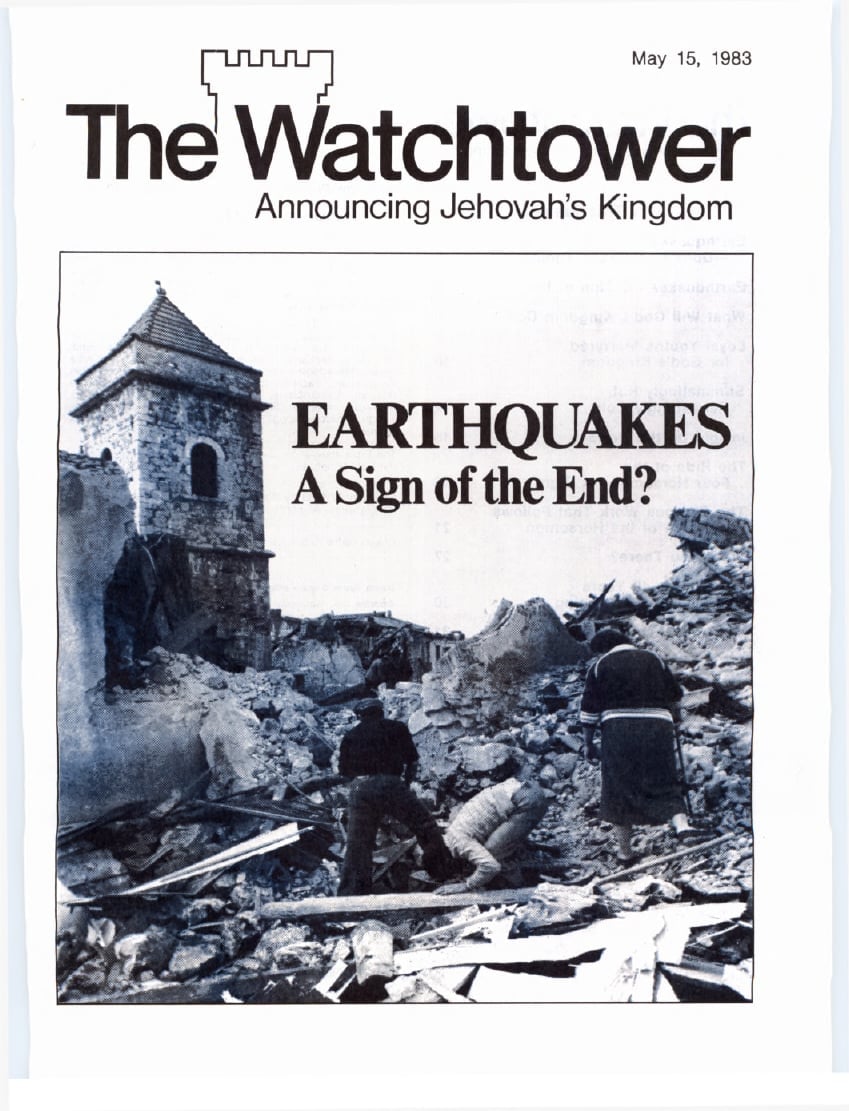
EARTHQUAKES A Sign of the End?
ALONE with Jesus on a high hill, surrounded by gnarled olive trees and with the city of Jerusalem below, four men were puzzled. Earlier that day they had heard their Leader, Jesus Christ, predict that Jerusalem and its temple would be destroyed with 'no stone left upon a stone.' Surprised, they asked: "When will these things be?" Jesus' answer keenly interested them. But his answer should be of greater interest today. —Matthew 24:1-3.
Of immediate concern to the apostles was the impending destruction of Jerusalem. Yet their curiosity did not stop with that one question, for they also wanted to know the time of Jesus' future presence in Kingdom glory and when to expect the end of an evil order. They asked: "What will be the sign of your presence and of the conclusion of the system of things?" The answer Jesus gave satisfied his first-century followers. His
answer about "the sign" can also satisfy his modern-day followers who long to see wickedness end, for the sign's fulfillment is in our day.
The sign Jesus gave has obvious features, easily noticed everywhere. These are not obscure or abstract. Note part of Jesus' answer at Matthew 24:7: "For nation will rise against nation and kingdom against kingdom, and there will be food shortages and earthquakes in one place after another." When wars strike, nations know it. When people are hungry—starving—they know it. And when an earthquake shakes the ground under your feet, you know it, because an earthquake is one of the most awesome natural events that can be experienced. These and other highly visible features, all afflicting mankind within one generation, compose "the sign." (Matthew 24: 3, 34) Let us examine just one part of this "sign"—earthquakes.
Earthquake belts of the world
Earthquakes—What Did Jesus Mean?
Jesus was not a seismologist. He was a preacher and teacher, also a prophet. While "full of holy spirit" and under the direction of this invisible active force from Jehovah, Jesus prophesied concerning earthquakes and other features of "the sign."—Luke 4:1; John 8:28.
Was there a first-century fulfillment of Jesus' words? Yes. Biblical and secular history record a great number of earthquakes between the year of his prophecy, 33 C.E., and the devastation of Jerusalem in 70 C.E. Two earth tremors shook Jerusalem within days of Jesus' prophecy. (Matthew 27:51; 28:2) Seventeen years later an earthquake occurred in the city of Philippi, as Bible writer Luke noted. (Acts 16:26) In addition, non-Biblical historians point to at least six major earthquakes in that part of the earth during that period. (See Chart I.)
Christians? Answering those questions can help us understand the significance of earthquakes in our day.
What made earthquakes special in the first century? And was the report of an earthquake unusual news to first-century
Since the earth's crust around the Mediterranean, including Jerusalem, lies in a moderately active earthquake zone, and therefore would suffer from crustal instability, earth tremors would not be uncommon to first-century inhabitants of the area. For example, the Great Rift Valley of the Jordan River and the Dead Sea and the transverse faults that form the Plain of Esdraelon (Jezreel) between Galilee and Samaria were associated with earthquakes even before the first century.—Amos 1:1; Zechariah 14:5.
Earthquakes in themselves would not give any special significance to Jesus' prophetic "sign" of Jerusalem's approaching end, any more than a high fever would give indication of a specific illness without other symptoms being present. Therefore, what added special meaning to Jesus' prediction of earthquakes was that they occurred in combination with
YEAR
LOCATION
Jerusalem
Jerusalem
c.46
Crete
c.50
Philippi
Rome
Apam aea
Laodicea
Pompeii
c.67
Jerusalem
all the other features of "the sign." And it was this composite "sign" of predicted events that first-century Christians witnessed and to which they responded.
Modern-Day Earthquakes
Does Jesus' prediction of earthquakes find a fulfillment in the 20th century? In other words, have there been great earthquakes that indicate we are living at "the conclusion of the system of things"? Facts prove that this century is being rocked by earthquakes. The earth experiences more than 1,000,000 per year, with 1,000 of them being damaging shocks.
Some seismologists believe that the earth is now in an active earthquake period. For example, Professor Keiiti Aki of the Department of Earth and Planetary Sciences at the Massachusetts Institute of Technology speaks of "the apparent surge in intensity and frequency of major earthquakes during the last one hundred years," though stating that the period from 1500 through 1700 was as active.
In the Italian journal Il Piccolo, of October 8, 1978, Geo Malagoli observed:
of high seismic activity, as statistics show. In fact, during a period of 1,059 years (from 856 to 1914) reliable sources list only 24 major earthquakes causing 1,973,000 deaths. However, [in] recent disasters, we find that 1,600,000 persons have died in only 63 years, as a result of 43 earthquakes which occurred from 1915 to 1978. This dramatic increase further goes to emphasize another accepted fact—our generation is an unfortunate one in many ways."
Jesus prophesied that "the conclusion of the system of things" would be marked by "earthquakes in one place after another," and, according to Luke's account, "great earthquakes." (Matthew 24:3, 7; Luke 21:11) Has the generation that was living in 1914, and of which there are still many survivors, witnessed these things? The facts answer, Yes! (See Chart II.) And earthquakes are still being witnessed not only by remaining ones of that generation but by the largest number of people in history. (Matthew 24:34) Mankind today is also more aware of the global activity of earthquakes and their effects than were people in any past century.
What is it that would make an earthquake "great"? Its intensity, or magnitude, as measured by the Mercalli or Richter scale? Or, rather, would it not be its notoriety and the amount of destruction it caused? As the accompanying Chart III indicates, loss of human life due to earthquakes has mushroomed since 1914. True, some earthquakes of the greatest magnitude have been deep within oceans, known only to a few, with little if any effect on human property or life. However, in determining the modern fulfillment of Jesus' prophecy, we should focus not merely on the magnitude of quakes according to the Richter or other such scale but on the extent of resultant property damage and loss of human life.
Clearly Part of "the Sign"
Europe magazine of July-August 1980 states: "In this century, earthquakes have cost the lives of some 1,600,000 people, with 120,000 dead in Europe alone." So when we view the world scene and compare it with Jesus' words we can agree that "earthquakes in one place after another" and even "great earthquakes" have been taking place. Has any single generation of the past experienced such grim destruction by earthquakes as that
<tr><th>YEAR
LOCATION
DEATHS
Avezzano, Italy
29,970
Kansu, China
200,000
Kanto, Japan
142,800
Kansu, China
70,000
Bihar-Nepal, India
10,700
Quetta, Pakistan
60,000
Chillan, Chile
30,000
Erzincan, Turkey
30,000
Assam, India
20,000
Agadir, Morocco
12,000
Northwestern Iran
12,230
Northeastern Iran
11,500
Northern Peru
66,700
Managua, Nicaragua
10,000
Guatemala City, Guatemala
23,000
Tangshan, China
800,000
Northeastern Iran
25,000
(Estimation based on 1,122 years) Up to 1914-1,800 a year
Since 1914-25,300 a year
afflicting mankind since 1914? Statistics indicate none.
However, some will say: "That is because we have more people on earth." True, mankind has multiplied, but this does not nullify Jesus' prophecy. Rather, it adds more force to it, giving us all the more reason to heed his words. Why? Because 2,000,000,000 people, about half the world's population, live in areas threatened by earthquakes. In addition, rapid communication and sophisticated seismographs have been keeping people posted on earthquakes as never before, even those who have never experienced the force of a tremor firsthand. Hence, earthquakes affect more persons and are conspicuous to more people today than ever before. And as they see other features of "the sign" being fulfilled on the one generation, this should move them to action. In this way, who can be excused from failing to heed "the sign of [Jesus'] presence and the conclusion of the system of things"?
Have you noticed that the impact of earthquakes on human lives has increased since 1914? And in combination therewith, have you observed the other features of "the sign," such as war, famine and increased lawlessness? If so, you are no doubt desirous of finding out more about what Jesus predicted for the immediate future. Jehovah's Witnesses are pleased to help you examine these important matters.
What Will God's Kingdom Do?
IN HIS famous Sermon on the Mount, Jesus Christ taught his followers the prayer commonly called the Our Father or the Lord's Prayer. Perhaps you have repeated it many times. Millions of people have. They have prayed to God: "Thy kingdom come."
(Matthew 6:10, Authorized Version; Douay Version) When making that request, do you know what you are asking for?
Perhaps like most people you have said these words without giving much thought to their meaning. But since God's Kingdom is a real government, what will happen to the present governments of the world when God's Kingdom comes? Have you thought about that?
The Bible leaves us in no doubt as to the answer. In a prophecy that points forward to our day, the Bible says: "In the days of those kings the God of heaven will set up a kingdom [this is God's Kingdom, for which Christians pray] that will never be brought to ruin. . . It will crush
and put an end to all these kingdoms [present governments of the world], and it itself will stand to times indefinite." Daniel 2:44
—Daniel 2:44.
Think about that!
God's Kingdom is going to destroy all present governments of the world. And when you pray, "Thy kingdom come," you are praying for this to happen. Yet surely such a change is needed. Never in history has a human government been completely satisfactory. So what could be better than to have a perfect government by God replace all human governments!
Because Jehovah God is almighty, his Kingdom will satisfy the desires of all righteously inclined persons. "Your kingship is a kingship for all times," the Bible explains. "You are opening your hand and satisfying the desire of every living thing." (Psalm 145:13, 16) What desires do
you wish to see fulfilled? The end of war, hunger, injustice, poor housing, crime, sickness and even death? All these problems and others will be eliminated by God's Kingdom.
The Bible promises "the abundance of peace until the moon
is no more." "As regards the wicked," it says, "they will be cut off from the very earth." Yes, people then "will certainly build houses and have occupancy." "God himself will be with them. And
he will wipe out every tear from their eyes, and death will be no more."—Psalm 72:7, 8; Proverbs 2:22; Isaiah 65:21-23; Revelation 21:3, 4.
What blessings for the human family! Would you like to be a subject of God's Kingdom? Then learn how to be one. Study God's Word and apply what you learn.—John 17:3.
... usher in a new one Loyal Youths Martyred for God's Kingdom
IT WAS about 8:30 on an October morning. Young Elmer and Alex, 16 and 14 years of age, were playing in the front yard of their home in San Salvador, capital city of trouble-torn El Salvador. Suddenly a white pickup truck with five armed men appeared on the scene. Two men got off and ordered the boys onto the truck. They were whisked away without the knowledge of their family.
When their parents realized what had happened, they notified the elders of the local congregation of Jehovah's Witnesses, and a frantic search began. Politically motivated violence has been the daily fare in El Salvador for a long time. The parents, Napoleon and Orbe, feared the worst. The authorities were advised and also joined in the search.
The following day some men, driving a hearse for a local undertaker, advised one of the elders that they had seen the bodies of two boys along with other corpses in a common dumping ground for victims of violence. Yes, Elmer and Alex had been found, their bodies riddled with bullets. There were signs that they had been tortured before they were finally killed. It is believed that one of the subversive groups tried to convince them to join their group in warring against the government in power. However, the boys, being Jehovah's Witnesses, would not break their Christian neutrality by joining such a group. Apparently for this reason they were executed. They were two more martyrs in the long line of faithful Christians who have died for
refusing to become involved in worldly politics. They obeyed God rather than men.—John 17:16; 18:36; Acts 5:29.
Thus, in just one day, the Lopez family was reduced from five members to three. It was a terrible blow to the parents. In their time of dire need they received comfort and help from their Christian brothers at the El Salvador branch office of the Watch Tower Society and from the congregation. They recently wrote a letter of appreciation that we would like to share with our readers.
The Healing Effects of God's Promises
"Please accept from my wife, Orbe, my daughter, Reyna Noemi, and me our gratefulness and appreciation for the encouragement and consolation given to us at a time when these were greatly needed. We are so grateful to our Father, Jehovah God, who through the Scriptures provided the fortitude that we needed —yes, because of the tragedy that came upon us the past October 27. Just as we cannot forget our dear sons Elmer and Alex, neither can we forget your love at that time.
"It is true that we still feel a profound sorrow over the loss of our sons. But now we feel how much more we need the New Order, and seeing what this wicked system of things does can only increase our appreciation of the need for God's Kingdom.
"Brothers, we have come to value these things even more, and we give thanks to Jehovah because we have a sure hope—not just castles in the air but a real tangible government.
"A brother lovingly said to me: 'You cannot forget Elmer and Alex, and there is only one remedy for your sadness—talking to others about your hope. Yes, talk and talk about the Kingdom whenever you have the opportunity to do so.' How true this has been! In the evenings we have talked to our neighbors, and this has brought us comfort. Orbe, my wife, has been able to give a witness to 'important' people who have made an effort to find out about our faith. One day a doctor said to her: 'Do you have faith?' 'Yes,' she answered. 'Show me what it is,' he replied. Well, for an hour
he listened, showing much interest even though he had patients waiting for him. She offered him the book The Truth That Leads to Eternal Life, and he readily accepted it.
"One day the general manager of
'What, you do not believe that Jesus is God and therefore that Mary is the mother of God!' 'No,' I said, 'the Bible does not support such a dogma.' Very surprised, he got up and said: 'Where do you have your meetings? Give me the address, as I want to attend.' 'Why?' I asked. He answered that when he was in the seminary he never believed in that doctrine and had concluded that all religions believed in it. What a surprise! A priest who did not believe in the Trinity!
'Really, brothers, today more than ever we pray to Jehovah for his 'Kingdom to come' and end all wickedness. It is true, brothers, that we have not fully recovered. As each new day
All youthful Witnesses—fortify yourselves as did Elmer and Alex by your study of God's Word, that you "may be able to stand firm" no matter what trials may come.—Ephesians 6:11; 1 Peter 5:8-10
the factory where I work called me and said: 'Napoleón, I want to talk to you and ask you a question. Do you believe that the world is coming to an end soon?' This man had been a Catholic priest but had renounced the priesthood. When I explained that the Bible presents solid proof that we are in the last days of this wicked system of things, he said that he had his doubts about the Bible. As I talked about the organization of Jehovah's Witnesses, he was surprised when I explained that we were not part of the evangelical groups. Then I told him that we did not believe in dogmas. He wanted an example. 'For instance,' I said, 'that Mary is the mother of God.'
comes, the memory of our sons is there before us, and it all seems like a horrible nightmare. But how happy we are that Jehovah helps us! Yes, we feel his loving-kindness in the congregation. How thankful we
are for Jehovah's promise that through Christ those who sleep in death WILL LIVE! (Acts 24:15) And what a blessing it will be, when our sons come back, to tell them how their 'parting' gave us the opportunity to talk about the Kingdom to people whom we may never have approached otherwise!
"Although at times we still feel overwhelmed by grief, and the absence of our boys makes us sad, yet every day we thank Jehovah for our knowing the truth, for his kind hand and for the brothers and friends like you who helped us in those moments of anguish.
"Thank you very much,
Napoleón and Orbelina López" Stimulatingly Hot, Refreshingly Cold
UNFEELING, apathetic, indifferent. Seemingly, some people just cannot be moved. The early Christian congregation at Laodicea was plagued by such a problem, giving rise to these words of censure from the glorified Jesus Christ: "I know your deeds, that you are neither cold nor hot. I wish you were cold or else hot. So, because you are lukewarm and neither hot nor cold, I am going to vomit you out of my mouth." (Revelation 3:15, 16) Why was the congregation in this deplorable spiritual state?
The Phrygian city of Laodicea was situated inland from Ephesus in Asia Minor. An important trade route passed through Laodicea and then forked. One branch of the road led to Ephesus; the other crossed the mountains to Philadelphia, Sardis, Thyatira and, finally, Pergamum. Wealthy Laodicea became famous for its financial transactions. Its exports included fine, soft, black wool obtained from the local sheep. A medical school was established nearby, and Phrygian eye powder, held to be specially curative, was produced in the area. Laodicea became well known for its Phrygian carpets. The art of embroidery is thought to have originated there, and the Latin word for "embroiderer" (phrygio) seems to lend support to this view. Laodicea also became a center for music and the noted Phrygian art form that is characterized by geometric designs—swastikas, meanders and lozenges.
In view of Laodicea's prosperity, could it be that some of the Christians there
had allowed themselves to become involved in commercial activities to such an extent that they had little time left to share the good news with others? Had some of them begun putting a worldly career first in life because they wanted 'something more interesting' than the sound principles of Christianity?
There is no doubt that such attitudes could have caused a cooling off in the Laodiceane's love for Jehovah, the Master Jesus Christ and their neighbors. (Matthew 24:12; 22:37-39) Likewise, if we today permit materialism to make inroads into our time and put the pursuit of a worldly career first in our lives, we are in danger of becoming "lukewarm" in our devotion, merely going through the motions as a form of "insurance," just in case the "great tribulation" does come in our lifetime."—Revelation 7:14.
How much better to be stimulatingly hot toward those who feel that the world is a "cold" place because others fail to show real interest in their problems! How much better to appear refreshingly cold toward those for whom things are made "hot" by injustices!
Fellow Christians, too, can be stimulated by a zealous example in putting Kingdom interests first. (Matthew 6:33) They can be cooled or refreshed by comforting words and loving deeds when they are sick or face other trialsome circumstances. Especially will young Christians do well to meditate upon making the best use of their time and energies.
How to Avoid Lukewarmness
Why did the resurrected Jesus use the wording he did when addressing the Laodicean congregation? He could well have been alluding to the city's water supply. Unlike nearby Hierapolis and Colossae, Laodicea did not have its own water source. Hierapolis was known for its hot springs, so stimulating to the tired winter traveler. Colossae had cold water, which was very refreshing in the heat of summer. But the water of Laodicea had to be conveyed some distance into the city, first on an open aqueduct and then through bored cubical stone blocks that had been cemented together. Very likely the water was lukewarm when it reached the city's inhabitants.
Jesus Christ also referred to other matters that would have been familiar to Christians at Laodicea. (Revelation 3:17, 18) Rather than the soft, glossy, black woolen garments that were so highly prized in the area, the Laodiceans needed to obtain white outer garments of identification as Christian servants of Jehovah. (Revelation 16:15) Instead of the "gold" of Laodicea's monetary transactions, they were admonished to demonstrate such qualities as faith and endurance that could be strengthened by testing and were far more valuable and lasting than any material riches. (1 Corinthians 3:10-15; 1 Peter 1:6, 7) Spiritual
"eyesalve" would prove far more effective than the Phrygian eye powder. The Laodiceans needed to discern the hope of eternal life and to be planning their lives with that in mind.—Romans 12:12; 1 Timothy 4:7; Philippians 3:13, 14.
There is a lesson here for the Christian today. Rather than trying to satisfy his desires for the latest styles in clothes and the best in food, home and transportation, he wisely seeks to "buy" from Jesus spiritual "outer garments," "gold" and "eyesalve." Yes, "buy" them, said Jesus. It will cost something—time to associate with God's people; time to study God's Word and Bible study aids; time to meditate on what we learn and relate new points to what we already know, making adjustments in our thinking; time and effort to share what we learn with others. This may mean managing with less materially to devote more time in study of the Scriptures and helping others spiritually. Such a course is bound to keep alive the Christian's hope.
Snares From Entertainment and Immorality
Other snares menaced Christians at Laodicea and could have contributed to their becoming "lukewarm." Archaeological diggings have revealed ruins of a stadium, theaters and gymnasiums. Could some Christians have allowed
A Roman aqueduct carried water to Laodicea
a love for pleasure to creep into their lives? God's servants today have to be on guard against the desire for the wrong type or an inordinate amount of entertainment. Young Christians especially may feel that there is something wrong with them if they are not going out to see a movie or a show, or having a party every week, particularly on Saturday nights when others seem to be enjoying themselves.
These younger Christians may feel embarrassed if they cannot discuss worldly entertainment with their schoolmates or workmates on the following Monday morning. But why not arrange entertainment with other spiritually strong young people and also older ones? How much better it is to experience refreshment by being with "those who call upon the Lord out of a clean heart!"—2 Timothy 2:22.
Immorality and reveling posed additional threats to the spiritual welfare of Laodicean Christians. The populace worshiped Dionysus, the Greek god of wine. His worshipers sought to become assimilated into him by wild dancing. The phallus was prominent in his rituals.
Today we are surrounded by a world of ever-declining moral standards. Immorality is the norm in many places. Much of modern-day disco dancing is similar to the orgiastic "raging" in honor of Dionysus or Bacchus. Jehovah's people must resist pressure to participate in such things if they are to avoid being 'vomited out of Jesus' mouth. It is indeed vital that we conduct our lives in harmony with Jehovah's holiness or purity. 1 Peter 1:16.
In Our Next Issue
Increasing Lawlessness-A Sign of the World's End?
Keep Your Marriage Honorable
Maintaining God's View of Sex
Remaining "Hot" or "Cold" Today
Jesus Christ reminded the Laodiceans that his reproof and discipline were evidence of his love for them. (Revelation 3:19) He urged them to continue to gain spiritual strength. As they contemplated the manner in which Jesus introduced himself as the "Amen," "the faithful and true witness, the beginning of the creation by God," early Christians could have been assured of the dependability of God's Son and the sureness of what he had promised them. (Revelation 3:14) Just as Jesus is the "beginning" of intelligent creation, so he is the "beginning" of the creation of "new heavens and a new earth," which Christians awaited. (2 Peter 3:13) The gaining of the reward was just a matter of time for them.
Likewise today, it is just a matter of time, and all the evidence indicates that a short time is involved. (Revelation 12:12) Therefore, avoid allowing the influence of the world to cause you to become "Tukewarm." Be careful about involvement in materialistic pursuits. Think searchingly about the wisdom of centering your life around a worldly career. Watch the amount and type of entertainment in which you engage, as well as your associations. Keep yourself spiritually strong and alert by wise use of your time in Bible study, in meetings with Jehovah's people and in zealous service to your God.—1 Corinthians 15:58.
Jesus Christ had a manner and a personality that were both stimulatingly hot in the eyes of those who loved Jehovah and refreshingly cold, soothing, to those weared by sin and the burdens of life. (Matthew 11:28, 29; John 2:17) Christians today can follow Christ's example by acting in harmony with the import of his message to the Laodicean congregation.
Insight on the News
Strange Union
An unusual transformation is occurring in the relationship between Christendom and Judaism. After centuries of alienation an amicable bond is being forged. More and more church bodies are abandoning their view that God has cast off Israel and also that Jews must go through Jesus to reach the Father. "This amazing reversal has been made by Protestants and Catholics, and on both sides of the Atlantic," states Paul M. Van Buren, noted theologian of Pennsylvania's Temple University.
Even fundamentalist and evangelical groups are embracing and supporting Jewish leaders. The prime minister of Israel has welcomed and met with evangelical and Baptist preachers. "There is a fascination on the part of the evangelical right with Israel and a belief that everything Israel does must be supported, because God is on Israel's side," says Timothy Smith, professor of theology at Johns Hopkins University, as quoted in The New York Times.
Many may view such accommodation as a fine thing. But if founded on error, is it truly beneficial? Jesus told his Jewish listeners: "I am the way and the truth and the life. No one comes to the Father except through me." (John 14:6) Furthermore, the apostle Paul made it clear that only through Christ, not man-made compromises, can
the two parties be united. "For Christ himself has brought us peace by making Jews and Gentiles one people. With his own body he broke down the wall that separated them and kept them enemies." —Ephesians 2: 14. Today's English Version.
'Milk and Honey to Tears'
By the thousands, aliens into Nigeria lured by its riches. Suddenly, their dream of wealth switched to a nightmare. World oil prices fell, Nigeria's economy soured. Africa's wealthiest country ordered all illegal aliens out within two weeks. Two million fled. Dozens died trekking back to their homelands of Togo, Benin, Upper Volta, Cameroon, Mali, Chad, Niger and Ghana. One Ghanaian, observing this steady stream of returning foreign workers, said: "They were going for milk and honey and they are coming back weeping tears."
World history is peppered with rapid, unexpected economic reversals such as this one Countless millions have seen their future crumble because of trusting in the protective wall of material things to ward off calamity. They are like those described at Proverbs 18:11. "The valuable things of the rich are his strong town, and they are like a protective wall in his imagination." In contrast, the preceding verse points to where trust can be put so as not to suffer disappointment: "The name of Jehovah is a strong tower. Into it the righteous runs and is given protection."—Proverbs 18:10.
Drug Use Climbs
Jesus predicted that "the increasing of lawlessness" would be one evidence of the last days. (Matthew 24:12) illegal drug use has become a major driving force behind crime. In fact, the International Narcotics Control Board in Vienna sees the growth of illegal drugs as a catalyst for violent crime and political instability. This United Nations agency has issued a sobering 32-page report on the global production and use of illegal drugs. The report states that in the last two years bumper crops of poppy from the so-called Golden Triangle—Burma, Thailand and Laos—have heaped opium, morphine and heroin on the illegal world market. Western Europe is reeling from the effects, as the document says: "Heroin is readily available. prices have fallen and the number of abusers is considerable."
If there are no buyers for illegal drugs, its source and abuse would soon wither and die. However, because many have become "lovers of pleasures rather than lovers of God," drug abuse flourishes and has become a big business—another evidence that we are living in "critical times" that mark the "last days" of unrighteousness. 2 Timothy 3:1, 4.
IT WAS Friday, the second day of the month of October of the year 1914. Into the dining room of the headquarters staff of the Watch Tower Bible and Tract Society at 124 Columbia Heights, Brooklyn, New York, U.S.A., stepped the president of the Society. It was just about seven o'clock in the morning. Before going to his place at the head of the dining-room table, he paused. To get the undivided attention of the Bethel family members seated at the dining tables, he clapped his hands. Then, with a positive voice, he made reference to the opening words of verse 3 of the song entitled "Our King Is Marching On!" as found on pages 162, 163 of the songbook Hymns of Millennial Dawn, saying, "The Gentile Times have ended, for their kings have had their day." First then he took his regular seat, to preside over the daily religious program of the Bethel family breakfast.
2 As early as in the year 1876, in an article that he submitted for publishing in The Bible Examiner, the president had pointed forward to 1914 as the date for "the times of the Gentiles" to end, with serious consequences for the whole world of mankind. (Luke 21:24, Authorized Version) Amazingly, at the time that the president announced to the Brooklyn Bethel family that the Gentile Times had ended, the first world war of all human history was in its 66th day. Already by then 14 declarations of war had been made by participants in that terrible conflict against one another.
Before the end of that vicious struggle for world domination and for the commercial markets of the world, 29 nations and empires had become entangled in that unimaginable conflict. The Society's president, who spoke those appropriate words, died before his own country, the United States of North America, got involved in World War I on April 6, 1917, to become an ally of the British Empire against the Central Powers of Europe.
3The Society's president had reemphasized the vital significance of 1914 in the columns of the Watchtower magazine from 1879 onward, and especially in the book The Time Is at Hand, published in 1889. But by October 2, 1914, he had observed enough of the current of world affairs in that memorable year to gain reassurance for his publicly stated position. He could feel vindicated, at least in this respect, as a close and careful student of the chronology, or time schedule, of the Bible, which prophesies about God's times and seasons.
4 Thus, before his unexpected death on Tuesday night, October 31, 1916, the Society's president had seen the beginning of the ride of the four horsemen of the Apocalypse from the year in which the Gentile Times were due to end according to Bible chronology. The Apocalypse, or the Revelation, is the last book of the Christian Greek Scriptures, usually called the New Testament. The ride of the four horsemen is of worldwide significance, for it is part of a "sign" marking where the human family is on the stream of time. It indicates that we are in what
the disciples of Jesus called "the conclusion of the system of things." (Matthew 24:3) That it is a "sign" is stated for us in the opening verse of the Revelation, where we read: "A revelation by Jesus Christ, which God gave him, to show his slaves the things that must shortly take place. And he sent forth his angel and presented it in signs through him to his slave John."—Revelation 1:1.
5 The ride of the four horsemen is set forth in Revelation 6:1-8. Interestingly, whereas the New World Translation uses the expression "presented it in signs" and thus corresponds with Rotherham's The Emphasised New Testament, the expression "signed it" is used by the King James Version, or Authorized Version of 1611, B. Wilson's The Emphatic Diaglott and Young's Literal Translation of the Holy Bible. True to those introductory words, the last book of the Bible, the Revelation, is just full of signs, symbolisms significant of things of far greater importance in human history. These were to take place in the future, "shortly."
The Four Horses and Their Riders
There are no historic developments to prove that those things came to reality during the 18 centuries after the death of the apostle John, about 98 C.E., and so, now, our attention focuses upon the current 20th century C.E. Doing so, we find that it has remained for us of this exciting century to enter into the happiness to which the inspired apostle pointed forward, when he wrote: "Happy is he who reads aloud and those who hear the words of this prophecy, and who observe the things written in it; for the appointed time is near." (Revelation 1:3) For our happiness let us examine "the sign" of the four horses and their riders.
Let us read Revelation 6:1-8:
7 "And I saw when the Lamb [Jesus Christ] opened one of the seven seals [of the scroll that was in his hand], and I heard one of the four living creatures say with a voice as of thunder: 'Come!' And I saw, and, look! a white horse; and the one seated upon it had a bow; and a crown was given him, and he went forth conquering and to complete his conquest.
8 "And when he opened the second seal, I heard the second living creature say: 'Come!' And another came forth, a fiery-colored horse; and to the one seated upon it there was granted to take peace away from the earth so that they should slaughter one another; and a great sword was given him.
9 "And when he opened the third seal, I heard the third living creature say: 'Come!' And I saw, and, look! a black horse; and the one seated upon it had a pair of scales in his hand. And I heard a voice as if in the midst of the four living creatures say: 'A quart of wheat for a denarius, and three quarts of barley for a denarius; and do not harm the olive oil and the wine.'
10 "And when he opened the fourth seal, I heard the voice of the fourth living creature say: 'Come!' And I saw, and, look! a pale horse; and the one seated upon it had the name Death. And Hades was closely following him. And authority was given them over the fourth part of the earth, to kill with a long sword and with food shortage and with deadly plague and by the wild beasts of the earth."
THE WHITE HORSE AND ITS RIDER
11 The white horse signified a royal mount, a bearer of royalty, a righteous and pure carrier, swift in movement like a literal horse. The rider of this speedy means of travel signified a newly installed king, for a royal crown was given him. He was a warrior king, for he was armed with a bow. Furthermore, he rode forth conquering, even down to the last opponent of his Kingdom to be put under him as conquered. It was to be a complete victory! In line with that, a long sword was given to him, a royal implement of warfare. Who, then, has been fulfilling this role in our own 20th century? Evidently the same one as the King who fulfills Psalm 45, where we read:
12 "My heart has become astir with a goodly matter. I am saying; 'My works are concerning a king,' . . . Gird your sword upon your thigh, O mighty one, with your dignity and your splendor. And in your splendor go on to success; ride in the cause of truth and humility and righteousness, and your right hand will instruct you in fear-inspiring things. Your arrows are sharp—under you peoples keep falling—in the heart of the enemies of the king. God is your throne to time indefinite, even forever; the scepter of your kingship is a scepter of uprightness. You have loved righteousness and you hate wickedness. That is why God, your God, has anointed you with the oil of exultation more than your partners."
—Verses 1-7.
13 In Hebrews 1:8, 9 the apostle Paul quotes Psalm 45:6, 7 and applies the words to the Son of God, Jesus Christ, Inescapably, then, the rider of the white horse who rides on victoriously must be Jesus Christ at his coronation in heaven at the close of the Gentile Times in 1914.
14 We recall the occasion when Jesus Christ rode as the king-elect as if to his coronation at the temple in Jerusalem. At that time he did not ride on a spirited white horse. He rode astride an ass. This was in fulfillment of the prophecy of Zechariah 9:9, which reads: "Be very joyful, O daughter of Zion. Shout in triumph, O daughter of Jerusalem. Look! Your king himself comes to you. He is righteous, yes, saved; humble, and riding upon an ass, even upon a full-grown animal the son of a she-ass." Conforming to this prophecy, Jesus rode a peaceful animal when he made his climactic ride into Jerusalem on the 9th day of the Jewish month of Nisan, 33 C.E., to correspond with the Passover lamb that was taken into Jewish households on Nisan 10, to be kept there until the Passover celebration on Nisan 14. In riding that way Jesus imitated his illustrious forefather, Solomon, the son of David. When David resigned from his kingship after 40 years of sitting upon the throne of the kingdom of Israel, he made Solomon ride on a she-mule to his coronation. Then, after High Priest Zadok had anointed him to succeed his father, the attending crowd of Israelites broke out into shouting, "Let King Solomon live!" —1 Kings 1:33-40.
15 What, now, was to be the reception accorded to Jesus when, four days before the Passover, he rode on an ass down the Mount of Olives to the city of coronations? The crowds that started to accompany him caught up the spirit of the occasion from the setting of things and felt that he was the promised Messianic king of Israel. They waved palm branches. They spread out their outer garments to let him ride over them. "As for the crowds, those going ahead of him and those following kept crying out: 'Save, we pray, the Son of David! Blessed is he that comes in Jehovah's name! Save him, we pray, in the heights above!'" (Matthew 21:1-9) Such was the popular reaction. But as for Jerusalem itself, it was under the influence of the Jewish religious leaders who were not guided by the fulfillment of prophecy before their eyes. So Jerusalem gave him no royal welcome.
16 When Jesus went to the temple, High Priest Caiaphas did not anoint him to be the Messianic king independent of the Roman Empire. The priests were allowing the merchants to use temple areas to carry on their gainful business, but Jesus displayed the proper qualities of a high priest by driving them away, and he rebuked those who objected by saying to them: "It is written, 'My house will be called a house of prayer,' but you are making it a cave of robbers." Blind and lame Jews came to him in the temple, and he healed them. But the chief priests and the scribes found fault with what was going on, and they refused to accept him as the "Son of David" and to inaugurate him as the rightful ruler of the kingdom of Israel. When Jesus left
□ When did the horsemen start their ride?
□ What expectation was then fulfilled?
□ What preliminary ride did the first rider make, and how was he received?
□ How do Revelation 6:1, 2; 19:11-16 and Psalm 45:3-8 indicate the purpose of this rider's later ride?
them behind at the temple and went out to Bethany, he did not do so as a newly installed king.—Matthew 21:1-17.
17 Four days later, when Jesus stood before the Roman governor Pontius Pilate, this Gentile asked him whether he was a king. Jesus replied that his Kingdom was no part of this world to which Pilate belonged. At the instance of the chief priests that had said, "We have no king but Caesar," Pilate handed Jesus over to be impaled at Calvary. Yet Pilate stood firm for putting above the head of Jesus on the impalement stake the sign: "Jesus on the impalement the King of the Jews."—John 19:15, 19-22.
18 It remained for the Almighty God, Jehovah, to raise his martyred Son as "the firstborn from the dead" on Nisan 16, the very day on which the Jews presented the firstfruits of the barley harvest to Jehovah at the temple. (Revelation 1:5) Thus the future King was
able to manifest himself to his faithful disciples that very day. Some days later, before ascending back to heaven, he said to them: "All authority has been given me in heaven and on the earth. Go therefore and make disciples of people of all the nations, baptizing them in the name of the Father and of the Son and of the holy spirit."—Matthew 28:18, 19; Leviticus 23:10-12; 1 Corinthians 15:20.
Completing His Conquest
19 Thus Jesus Christ was enabled to fulfill the prophetic picture of making his ride on the white horse, riding as a crowned king to complete conquest over all his enemies in heaven and on earth. (Revelation 6:1, 2) Since the end of "the appointed times of the nations" in the year 1914 C.E. he is a warrior King, armed as it were with a bow to pierce his foes from afar off. In reality, to this warrior King were addressed the prophetic words of Psalm 45:3-8:
20 "Gird your sword upon your thigh, O mighty one, with your dignity and your splendor. And in your splendor go on to success; ride in the cause of truth and humility and righteousness, and your right hand will instruct you in fear-inspiring things. Your arrows are sharp—under you peoples keep falling—in the heart of the enemies of the king. God is your throne to time indefinite, even forever; the scepter of your kingship is a scepter of uprightness. You have loved righteousness and you hate wickedness. That is why God, your God, has anointed you with the oil of exultation more than your partners. All your garments are myrrh and aloeswood and cassia; out from the grand ivory palace stringed instruments themselves have made you rejoice."
21 At Hebrews 1:8, 9 the apostle Paul quotes from the words of Psalm 45:3-8 and applies the quotation to Jesus Christ, to call attention to his now highly exalted position. This makes it certain that the "king" to whom "the sons of Korah" were inspired to address themselves was the duly installed King Jesus Christ. (See the superscription to Psalm 45.) The arrows from his "bow" will be aimed at the heart of the opposers of his Kingdom with greater accuracy than that of the ancient Parthians, who were expert bowmen though mounted on horses.
22The rider of the white horse described at Revelation 6:2 proves to be the same as the rider of the white horse portrayed at Revelation 19:11-16. In this
latter reference his name is called "The Word of God," and on his thigh he wears the title "King of kings and Lord of lords." Here he is pictured as at the grand climax of his charge against his opponents, when he brings his ride to final victory at "the war of the great day of God the Almighty" on the battlefield of Har-Magedon, or Mountain of Megiddo. (Revelation 16:14-16; 19:17-21) Unseen to human eyes, there then comes the binding of Satan the Devil and his demons for a thousand years of confinement in an abyss. (Revelation 20:1-3) Blessed are our eyes to see by faith the ride of the crowned King on the "white horse" since the end of the Gentile Times in 1914. Thrilled to our very souls at his conquests so far, we cry out, 'Ride on, you royal rider on the white horse, to your matchless victory at Har-Magedon, for the vindication of the universal sovereignty of Jehovah God, the Giver of this prophetic "sign."
The Glorious Work That Follows the Ride of the Horsemen
THE "King of kings and Lord of lords." Jesus Christ, is present. (Revelation 19:11, 16) We have "the sign" for this. He has been present in his God-given Kingdom since the end of "the times of the Gentiles" in the year 1914, 69 years
ago. (Luke 21:24, Authorized Version) Then the trampling down of the Kingdom of Jehovah God as once represented by the kingdom of Israel in Jerusalem in the royal line of King David ended. Over in the Middle East the city of Jerusalem has no king of the family line of David but is the capital city of the Republic of Israel, with a Jewish prime minister. But what about the "heavenly Jerusalem"?
(Hebrews 12:22) It is up there in the superhuman, super-Gentile realm that "the Son of David," Jesus Christ, reigns as "King of kings and Lord of lords" since the running out of the Gentile Times in 1914. The Gentile nations here on earth may oppose the Kingdom and its proclaimers, but they cannot touch it. They cannot dominate it, as once did the last five world powers of world history, namely Babylonia, Medo-Persia, Greece, Rome and the Anglo-American world power of Britain and the United States. —Revelation 21:1, 2.
2 The vision given to the apostle John, as set out at Revelation 6:1-8, prophetically shows what was to accompany the start of the ride of the "King of kings and Lord of lords" on the symbolic white horse toward the all-determining conflict at the battlefield of Har-Magedon. What that vision showed corresponds with what Jesus Christ himself told his disciples in answer to their question: "When will these things be, and what will be the sign of your presence [parousia, Greek] and of the conclusion of the system of things?" (Matthew 24:3) With regard to the "pangs of distress" that would mark "the sign" of his presence, or parousia, and of "the conclusion of the system of things." Jesus said: "For nation will rise against nation and kingdom against kingdom [in war], there will be earthquake in one place after another, there will be food shortages. These are a beginning of pangs of distress [marking the birth of a new system of things]." (Mark 13:8) "Then he went on to say to them: 'Nation will rise against nation, and kingdom against kingdom; and there will be
great earthquakes, and in one place after another pestilences and food shortages; and there will be fearful sights and from heaven great signs."—Luke 21:10, 11; Matthew 24:7, 8.
THE
FIERY-COLORED
HORSE
3So the start of Christ's "presence," or parousia, from the end of the Gentile Times in 1914 was not to be marked by peace either in heaven or on earth. The vision given to John at Revelation chapter 6 confirms this fact. What, then, would the opening of the second seal unveil to us? Along with the apostle John, we watch: "And when he opened the second seal, I heard the second living creature say: 'Come' And another came forth, a fiery-colored horse; and to the one seated upon it there was granted to take peace away from the earth so that they should slaughter one another; and a great sword was given him."—Revelation 6:3, 4.
4 What did that tableau signify? What else but the outbreak of war, and that on an earth-wide scale, forasmuch as the rider on the fiery-colored horse was "to take peace away from the earth."
5 Since the fiery-colored horse and its war-minded rider followed the rider on the white horse, does this mean that the first horseman started World War I after his coronation in 1914 and thus started using his "bow"? Not at all! Revelation chapter 12 pictures what would follow the birth of the Kingdom of the first horseman in 1914: an invisible, superhuman war.
"And war broke out in heaven: Michael and his angels battled with the dragon, and the dragon and its angels battled but it did not prevail, neither was a place found for them any longer in heaven. So down the great dragon was hurled, the original serpent, the one called Devil and Satan, who is misleading the entire inhabited earth; he was hurled down to the earth, and his angels were hurled down with him. And I heard a loud voice in heaven say: 'Now have come to pass the salvation and the power and the kingdom of our God and the authority of his Christ, because the accuser of our brothers has been hurled down, who accuses them day and night before our God! . . . On this account be glad, you heavens and you who reside in them! Woe for the earth and for the sea, because the Devil has come down to you, having great anger, knowing he has a short period of time.'" —Verses 7-12.
6 That account places the blame for the first world war that claimed more than 8 million human lives from July 28, 1914, squarely upon the Devil and his demons. The rider on the second symbolic horse pictured the military hosts of the world, of which Satan the Devil is "the god"; and the fiery-colored horse matched the fiery fury and nature of that war and of its aftermath, World War II. The "great sword" of a cavalryman was given to this militaristic rider, to slash away with it at his victims. The greatness of this weapon of war would also indicate the greatness of the type of war that was now instituted earth wide, total warfare, warfare on a world scale. Nothing like it before! The history books are there in
the libraries to give us the details about World Wars I and II! Indeed, war of world proportions erupted at the end of the Gentile Times in 1914.—Luke 21:24.
7 The one that gave to his apostle John the signs of Revelation chapter 6 was the same one that gave the information in answer to his apostles, including John, away back in 33 C.E. in answer to their question: "What will be the sign of your presence and of the conclusion of the system of things?" Since the order of events that he set out back there shortly before his death lines up with the order of events that he depicts at Revelation chapter 6, it indicates that what that 6th chapter envisions shows that the end of the Gentile Times in 1914 and the outbreak of war on a world scale marked the start of his "presence" in his heavenly Kingdom and the beginning of "the conclusion of the system of things." As foretold by Jesus at Matthew 24:7, 8 and Luke 21:11, nation did rise against nation and kingdom against kingdom to mark the start of his invisible "presence" or his giving attention to the affairs of earth now that it had become the territory of his newly established Kingdom. But what about "food shortages" and "in one place after another pestilences"? These were also forevisioned by the ride of the four horsemen depicted at Revelation 6:1-8.
8 After the ride of the horseman on the fiery-colored horse, what does the vision present to us?
"And when he opened the third seal, I heard the third living creature say: 'Come!' And I saw, and, look! a black horse; and the one seated upon it had a pair of scales in his hand. And I heard a voice as if in the midst of the four living creatures say: 'A quart of wheat for a denarius, and three quarts of barley for a denarius; and do not harm the olive oil and the wine.'"
-Revelation 6:5, 6.
9 Plainly, that denotes food shortages, scarcity of eatables. And did not these come along with World War I "in one place after another"? With the taking away of farmers from their farms and gardens in order to draft them into the fighting forces of millions of men, would not hunger prevail over wide areas, with little or nothing to satisfy it? Logically so! No wonder that millions of humans died of hunger. Prices of foodstuffs soared to beyond the financial reach of many countless famished ones, with such inflation! Think of it, a day's wage, "a denarius," for but a quart of wheat! A day's wage for but three quarts of the inferior food barley, the staple diet of the financially poor! Those who were made rich through war occupations and munitions making could afford to get what oil and wine were on the market. And so for them "the olive oil and the wine" were not harmed. High wages could meet high prices! All of this draws a dark picture in connection with global war that drew so many men away from productive occupations, such as farming, into destructive activities. There is therefore no room for surprise that the horse that bore the rider with the symbol of measuring out food at exorbitant prices and of rationing out food was a black horse!
…