The Watchtower, December 1, 1972
Download: PDF — The Watchtower, December 1, 1972
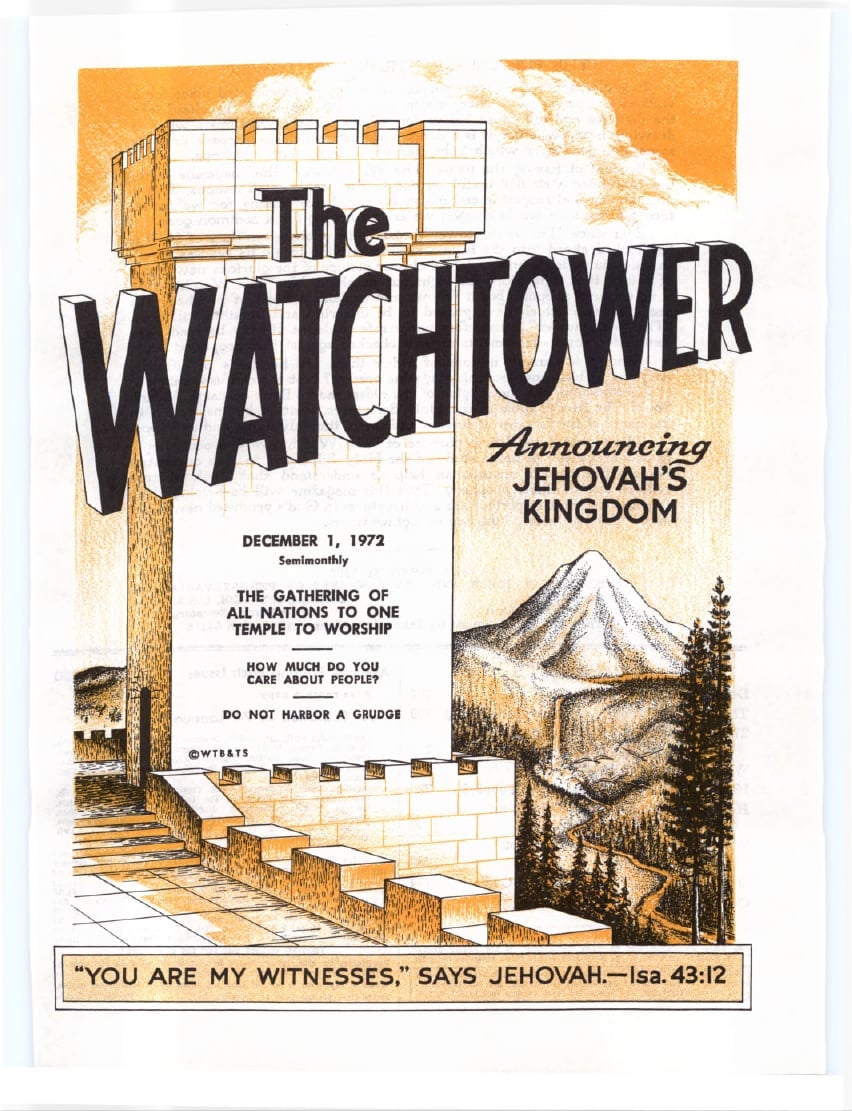
"YOU ARE MY WITNESSES," SAYS JEHOVAH.—Isa. 43:12
THE PURPOSE OF "THE WATCHTOWER"
Every watchtower has its purpose. It serves as an elevated place for a wide-awake person with sharp vision. It enables him to see far ahead into the distance and tell those below for whom he is a watchman what is drawing near, whether it is a danger against which to prepare or it is something good over which to be glad with strong faith and hope.
Because of having the name "The Watchtower" this magazine justly has to render a similar useful service to the people of all nations. This is an international magazine and makes no racial distinctions, for we are all facing a common world danger; we are all hoping for a common good.
Ever since "The Watchtower" began to be published in July of 1879 it has looked ahead into the future, always striving to aid its readers to advance in knowledge and to gain a clearer picture of the glorious new order of things that is to store for future use. Marked No. "The Watchtower"
is no inspired prophet, but it follows and explains a Book of prophecy the predictions in which have proved to be unerring and unfailing till now "The Watchtower" is therefore under safe guidance. It may be read with confidence, for its statements may be checked against that prophetic Book.
Among the many nations of today there are hundreds of differing religions. Which one does this magazine present? Not the confused religions of Christendom, but the religion of the oldest sacred Book on earth. Which Book? The Sacred Bible of the Holy Scriptures, written by inspiration in the name of the Creator of heaven and earth, the only living and true God.
The sacred, nonpolitical purpose of "The Watchtower" is accordingly to encourage and promote study of the Holy Bible and to give our many readers the needed unsectarian help to understand that Book of true religion and infallible prophecy. Thus this magazine will be helping them to prove worthy of perfect life and happiness in God's promised new order under His everlasting kingdom of righteousness.
PUBLISHED BY THE
WATCH TOWER BIBLE AND TRACT SOCIETY OF PENNSYLVANIA
117 Adams Street Brooklyn, N.Y. 11201, U.S.A.
N. H. KNORR, President
GRANT SUITER, Secretary
"They will all be taught by Jehovah."—John 6:45; Isaiah 54:13
CONTENTS
Do Not Harbor a Grudge 707
The One True Temple at Which to Worship 709
Will Greedy Ones Perish? 723
How Much Do You Care About People? 726
How Heavenly Headship Directs an Earthly Congregation 729
Average Printing Each Issue: 7,850,000
Five cents a copy
Now Published in 74 Languages
Seminégia: Afrikaans, Arabic, Cebuano, Chinese, Chihona, Chimba, Chimbaia, Chimba, Dutch, Dutch, English, Finnish, French, German, Greek, Hillaryson, Ihebo, Italian, Japanese, Korean, Malagasy, Norwegian, Nyakorongo, Ihebo, Italian, Japanese, Spanish, Swahili, Swedish, Tagalog, Thai, Xorube, Yoruba, Zulu.
Menthiy: Armandian, Bhiol, Criolan, Ekk, Ewe, Fifian, Gan, Hebrew, Hindi, Hungarian, Icelandic, Indonesian, Kanarese, Malay, Malayalam, Malayalam-Pidgin, Pamanga, Pamangaan, Pamangaan, Palau, Sihlone, Sihlonean, Tamil, Saman, Saman, Spoop, Sordian, Sordian, Sihlonean, Tamil,
What Your Attitude Toward Your Parents Reveals 732
'Embarrassment if Jesus Called God' 734
Questions from Readers 734
Tuscan, Tuscany, Turkish, TWL, Uttarakhand, Uttal, Vichinasshe, Yearly subscription rates for most countries in local currency
America, U.S., 117 Adams St., Brooklyn, N.Y. N.1301 $1.50
Canada, 117 Bridge Street, Montreal, N.C. N.1301 $1.50
Canada, 150 Bridghead Avenue, Toronto, N.C. 380, Octans $1.50
England, Watch Tower House, The Ridgeway, London NWT 1RN $6p
New Zealand, 021 New North Bd., Ankara 3 $1.50
Nigeria, West Africa, P.O. Box 194, Yaba, Lanssate State $10/9
(Monthly subscription cost half the salary rate.)
Resultats for subscriptions should be sent to the office in your country, Gaborica send your remittance to Brooklyn.
Notice of expiration is sent at least two issues before subscription expires.
Second-class postage paid at Brooklyn, N.Y. PUBLISHED in U.S.A.
EVERYONE seemed to be having a good time at a party when the man of the house arrived. He was greeted enthusiastically by all—by all except one. Why? Reserve months before a fane.
slayer." (1 John 3:15) In fact, it can turn to actual murder, as in the case of two survivors of a bus crash in Belém, Brazil. They fought it out with knives, with the result that one was killed and the other was arrested on the charge of murder. New York Times, July 21, 1972.
The Bible gives ever so many examples of what a grudge can cause. To mention but one, there was Esau. He nursed a murderous grudge against his brother Jacob because Jacob got the firstborn's blessing, which Esau had sold to him. Because of the Jacob's grudge I learn.
Why? Because months before at a farewell party the man of the house had ignored this man's outstretched hand. He certainly was nursing a grudge, and how unhappy it made him every time he saw the object of his grudge!
Do you at times cherish resentment by harboring a grudge, and so find yourself unhappy when all around you others seem to be enjoying themselves?
How unwise! In fact, there are ever so many reasons why we should heed the Bible's counsel not to harbor grudges: "You must not take vengeance nor have
this, Jacob fed to his uncle Laban until, as his mother Rebekah put it, "the rage of your brother calms down." And, no doubt, had not Jacob done so, Esau, in his chagrin at not having received the firstborn's blessing from his father Isaac, would have killed him. As it was, when they first met again after twenty years, Esau had a change of heart, for we read that 'Esau went running to meet him and fell upon his neck and kissed him, and they burst into tears.'—Gen. 27:41-45; 33:4.
We may feel that we have been wronged. Maybe we were, or we might be mistaken.
a grudge against the sons of your people; and you must love your fellow as yourself. I am Jehovah."—Lev. 19:18.
For one thing, you cannot nurse a grudge against a person without disliking that one, and dislike can well turn to hate. What does the Bible say about that? "Everyone who hates his brother is a man-
Yet if we do not "take vengeance" against the one who seemingly wronged us, in time the wound may well heal and we will be able to "let bygones be bygones."
But how much better to be like Joseph, the favorite son of Jacob! Some of his brothers harbored a grudge against him because he was his father's favorite (and
because of the dreams he had that indicated that they would bow down to him), and they were ready to kill him.
But due to Judah's intervention he was sold into slavery instead, and eventually landed in prison because of a false charge against him. But did he nurse a grudge against his brothers because of all this evil that came upon him? Not at all. When the tables were turned and they were at his mercy, instead of taking vengeance, Joseph freely forgave them.—Gen. 45:1-8; 50:15-21.
Who do you want to be like? Like those who nursed a grudge to the point of wanting to kill, or like Joseph, who was forgiving and merciful?
There are various reasons why one may nurse a grudge. One may feel offended because another made an uncalled-for and an uncomplimentary remark. Or one may have been slighted or ignored when one wanted to show friendliness. Or one may feel hurt because of seemingly having been reproved unjustly or too severely.
Suppose you have heard another make an uncomplimentary remark about you. Could it be that there is a measure of truth in the remark and that is why it hurt you so much? If it was wholly uncalled for, why not exercise charity and be forgiving, giving the other the benefit of the doubt? After he said it he may have realized that it would have been better left unsaid, but still he shrinks from admitting that fact to you. Call to mind Jesus' counsel that, unless we forgive others their trespasses against us, God will not forgive us our trespasses against him. —Matt. 6:12-15; 18:23-35.
Or has someone slighted, ignored or rebuffed you? Once a Christian woman up in years approached an elder in a Christian congregation and asked him why he had slighted her, if he held anything against her, and if so, what was it. He was
flabbergasted, as this Christian woman was one of his best friends and he thought highly of her. He had not been aware of his ever having slighted her, in fact, he had always been glad to see her. But this incident, in turn, caused him to reflect. For long he had borne a grudge against another when he himself was slighted—seemingly. He now realized that he could have been just as mistaken as she was.
There is also the case of reproof that we might feel was uncalled for or was too severe. This brings to mind what a humorist once related. At times his father spanked him for something he had not done. When he complained, his father responded: 'Well, that was for the time you did something for which you should have gotten a spanking and didn't get one.' We all must admit that we have transgressed time and again without being reproved for it. Then, too, there may have been extenuating circumstances that caused the one in charge to be overly severe; or it may well be that his sense of righteousness is stronger than ours. Put yourself in his place, and you will be able to forgive and forget.
So, guard against harboring grudges. Do not be quick to take offense, "for the taking of offense is what rests in the bosom of the stupid ones." (Eccl. 7:9) You cannot harbor a grudge without hurting both yourself and others. And you are likely not only to hurt yourself physically but also to harm your spiritual well-being. You cannot enjoy good relations with God unless you also have good relations with your Christian brother. In fact, our love for God is tested by our love for our brothers. As the loving apostle John so forcefully put it: "He who does not love his brother, whom he has seen, cannot be loving God, whom he has not seen." (1 John 4:20, 21) So be wise, be just, be loving, and you will not harbor a grudge.
THE ONE TRUE TEMPLE
"And the temple sanctuary of God that is in heaven was opened, and the ark of his covenant was seen in his temple sanctuary."—Rev. 11:19.
THE news of today pours in from all quarters of the globe in such quantity that we ordinary people cannot keep up with it. It is in such variety that we are bewildered by it. The earthly affairs of the world get quite a coverage by all the news media, such as magazines, newspapers, telegraph, telephone, radio and television.
2 However, there is a most important item of news that is regularly being overlooked by all these channels of communication. This news item deserves our most serious attention. It has taken its place in the procession of events that has passed before mankind in this era of international wars and changes in political governments since the newsworthy year of 1914 in this Common Era of ours. This rare news item was timed beforehand for our twentieth-century period of human history. In an inspired history that was written in advance, that is to say, in divine prophecy, it was foretold and described for us nearly nineteen centuries ago. As we now read this prophetic write-up, we can see the connection that this news item has with what has been taking place in world affairs.
a We dig out this news item from the last book of the Sacred Bible, called Revelation or Apocalypse, chapter eleven, and
at Which to Worship
verses fifteen through nineteen. It reads: "And the seventh angel blew his trumpet. And loud voices occurred in heaven, saying: 'The kingdom of the world did become the kingdom of our Lord and of his Christ, and he will rule as king forever and ever.' And the twenty-four elders who were seated before God upon their thrones fell upon their faces and worshiped God, saying: 'We thank you, Jehovah God, the Almighty, the One who is and who was, because you have taken your great power and begun ruling as king. But the nations became wrathful, and your own wrath came, and the appointed time for the dead to be judged, and to give their reward to your slaves the prophets and to the holy ones and to those fearing your name, the small and the great, and to bring to ruin those ruining the earth.' And the temple sanctuary of God that is in heaven was opened, and the ark of his covenant was seen in his temple sanctuary. And there occurred lightnings and voices and thunders and an earthquake and a great hail."
'Well, what comment deserves to be made on that prophetic news item today? This: Regardless of the fight since the year 1914 between the democratic bloc of nations and the dictatorial bloc of nations for the domination of the world of mankind, it is the ever-living Jehovah God, the Almighty, that has taken his great power and begun ruling as king since that year 1914.
In that year "the kingdom of the world did become the kingdom of our Lord [God] and of his Christ," that is to say, of Jesus Christ the Son of God. Jehovah God, the Almighty, as the present Possessor of the "kingdom of the world," has come to his temple sanctuary. His presence in that holy place was symbolized by the sacred receptacle, called "the ark of his covenant." Just the size and shape of this "ark" are not described for us by the viewer, the Christian apostle John; but it represented the presence of the Lord God, whom it is impossible for us to see and to describe fully in human language. This symbolic "ark" is the ark of the "new covenant" of God with men, which has been in force since the year 33 C.E.
The records of history show that a temple is a building or place that is dedicated to the service and worship of a deity or deities. In the case of the symbolic "ark of his covenant," the temple sanctuary is that of Jehovah God, the Almighty. It is to this divine temple that all the nations must yet come to worship unitedly, even if it is necessary to bring the peoples of the nations back from the dead by the promised resurrection of the righteous ones and the unrighteous. (Rev. 11:18; Acts 24:15) This is the one and only way by which the peoples of all the nations can gain endless life on our earth, which will be duly transformed into a global paradise. They must all recognize and worship and serve the divine Holder of the "kingdom of the world," who will rule as King at his temple sanctuary forever and ever.—Rev. 11:15.
Does this worship, in being carried on in a paradise earth, mean that the peoples of the nations will not go to heaven? If they do not do so, how can they go to God's temple, inasmuch as Revelation 11:19 speaks of it as "the temple sanctuary of God that is in heaven"? That is a fitting question here, but is it because we think of God's temple sanctuary as being a building or edifice up in the invisible heavens that has walls and a doorway? Well, then, let us recall what an outstanding temple builder of the eleventh century before our Common Era said when inaugurating the temple. This was wise King Solomon, who built the first temple of its kind on Mount Moriah of Jerusalem. Addressing God, Solomon said:
"But will God truly dwell upon the earth? Look! The heavens, yes, the heaven of the heavens, themselves cannot contain you; how much less, then, this house that I have built!"—1 K1. 8:27.
aIn the temple sanctuary built by King Solomon, the innermost room was called the Most Holy and it was a perfect cube twenty cubits long, wide and high. It was certainly big enough to accommodate the earthly, material "ark of the covenant of Jehovah," this ark containing the two stone tablets on which the finger of God had written the Ten Commandments. (1 Ki. 6:19, 20; 8:6-9; Ex. 34:1, 27, 28; 40:20) But that innermost room or Most Holy of the temple was hardly big enough to contain the personal presence of Jehovah God, the Creator of heaven and earth. The ark of the covenant was the sacred thing toward which the high priest of God sprinkled the blood of the sin-atoning sacrifices on the annual Day of Atonement.
In this way the ark represented the throne of Jehovah God in the heavens. In keeping with this fact, the Most Holy of the temple, where the ark was located, pictured that part of the limitless heavens where God has his holy residence. That place is large enough to contain Him.
THE "TENT" OR "TABERNACLE"
The temple sanctuary of which King Solomon was the builder was patterned after the sacred tent or tabernacle that the prophet Moses built in the wilderness of Mount Sinai in Arabia. That tent had two compartments, these being separated from each other by an inner curtain. The first compartment, which the priests entered by passing the outer curtain that faced the courtyard, was called the Holy. The innermost compartment, which the high priest entered by getting past the inner curtain, was called the Most Holy. When the high priest entered the Most Holy he brought along an incense burner or censer in order to fill the Most Holy with incense smoke. This was done in order to prepare the situation for the high priest to sprinkle
the blood of the Atonement Day sacrifices toward the golden ark of the covenant. The Christian apostle Paul describes this, in Hebrews 9: 2-10, saying:
10 "There was constructed a first tent compartment in which were the lampstand and also the table and the display of the loaves; and it is called 'the Holy Place.' But behind the second curtain was the tent compartment called 'the Most Holy.' This had a golden censer and the ark of the covenant overlaid all around with gold, in which were the golden jar having the manna and the rod of [High Priest] Aaron that budded and the tablets of the covenant; but up above it were the glorious cherubs overshadowing the propitiatory cover. But now is not the time to speak in detail concerning these things. After these things had been constructed this way, the priests enter the first tent compartment at all times to perform the sacred services; but into the second compartment the high priest alone enters once a year, not without blood, which he offers for himself and for the sins of ignorance of the people. Thus the holy spirit makes it plain that the way into the holy place had not yet been made manifest while the first tent was standing. This very tent
GROUND PLAN OF THE TABERNACLE
is an illustration for the appointed time that is now here, .
. . the appointed time to set things straight."
11 Let us take note that the writer says that the sacred tent constructed by the prophet Moses was an "illustration for the appointed time that is now here." The "time that is now here," in the writer's case, was about the year 61 C.E., or nine
years before the temple in Jerusalem was destroyed by the Roman armies in the year 70 C.E. It was also twenty-eight years after the death and resurrection of Jesus Christ and his ascension to heaven. So that tent built by Moses was an "illustration" of something future and not of something before the days of the prophet Moses. In the days of High Priest Eli that illustrative
Gen. 14:18-20) Although faithful witnesses of Jehovah God like Abel, Noah, Abraham, Isaac, Jacob and Job offered sacrifices to God, they built no temple to Him. Well, then, did Jehovah God have a temple in heaven, although having no material temple on earth? No! That is to say, not a temple such as was illustrated by the tent built by Moses and the temple built by
Solomon's temple, as well as the tabernacle, typified God's spiritual temple—the arrangement for approaching Jehovah in worship on the basis of Jesus' propitiatory sacrifice
"tent" came to be called a "temple." (1 Sam. 1:9; 3:3; note also 2 Samuel 22:7; Psalms 18:6; 27:4.) So the tent or temple constructed by Moses was not an illustration of a temple that had existed prior to Moses' time.
12 When we look back to the time previous to Moses, we find no record of a temple's being built on earth by any faithful worshiper of Jehovah God, not even by the man Melchizedek, who was "king of Salem, priest of the Most High God." (Heb. 7:1;
King Solomon. 13 Certainly, when Jehovah God created Adam and Eve in human perfection in the garden of Eden, there was no need of such a temple in heaven. Why not? Because at that time after the creation of the perfect man and woman at the close of the sixth creative day, when "God saw everything he had made and, look! it was very good," there was no sin in all
creation, either in heaven or on earth. There was no need for God to have a high priest to offer up sin-atoning sacrifices, nor was there need for an altar in a temple courtyard on which to offer up a sin offering. (Gen. 1:26-31; 2:7-24) Such references to a temple as found, for instance, in Psalm 11:4, Micah 1:2 and Habakkuk 2:20 were prophetic and were written after Moses had constructed the tent temple or Solomon had built the temple at Jerusalem. These illustrated or typified a spiritual temple that was yet to come into existence.
14 So, now, when did the real temple that was illustrated by the tent constructed by Moses and the temple built by Solomon come into existence? Was it on the festival day of Pentecost in the year 33 C.E., when the Christian congregation or church was founded? Why we ask is because the apostle Paul wrote to the Christian congregation of his day and said: "Do you not know that you people are God's temple, and that the spirit of God dwells in you? If anyone destroys the temple of God, God will destroy him; for the temple of God is holy, which temple you people are." (1 Cor. 3:16, 17) From those words it might be reasoned that the tent built by Moses and the temples built at Jerusalem by King Solomon and Governor Zerubbabel and King Herod the Great pictured or typified the Christian congregation as a figurative temple. But is this true? What answer does Paul himself give us on the question?
15 So we turn back to Hebrews, chapter nine, to where we left off, and go on to read these explanatory words of Paul: "However, when Christ came as a high priest of the good things that have come to pass, through the greater and more perfect tent not made with hands, that is, not of this creation, he entered, no, not with the blood of goats and of young bulls, but with his own blood, once for all time into the holy place and obtained an everlasting deliverance for us."—Heb. 9:11, 12.
16 Jesus Christ did not die sacrificially on the Jewish Day of Atonement (Tishri 10) and enter with his own blood into
the Most Holy of the temple of Herod at Jerusalem. He could never do that. He was not a Levite high priest. The Jewish high priest was then Calaphas, and he went with the blood of a young bull and of a goat into the Most Holy of the Jerusalem temple on the Day of Atonement. But not so Jesus Christ. Well, then, into what "holy place" did he enter with his own blood? Not into the Christian congregation on earth, for that was not yet founded on the day of Jesus' resurrection nor on the day of his ascension to heaven ten days before the festival day of Pentecost of 33 C.E. So what was the "holy place" into which Jesus Christ entered before that Pentecostal day? Again we turn to Hebrews, chapter nine, and let Paul give the answer:
17 He says: "Therefore it was necessary that the typical representations of the things in the heavens should be cleansed by these means, but the heavenly things themselves with sacrifices that are better than such sacrifices. For Christ entered, not into a holy place made with hands, which is a copy of the reality, but into heaven itself, now to appear before the person of God for us."—Heb. 9:23, 24.
THE REAL TEMPLE TAKES ON EXISTENCE
18 Thank you, Paul, for we are glad to learn that the holy place into which the resurrected Jesus Christ entered with the value of his own sacrificial blood was not a holy place on earth where his few disciples then were, but was "heaven itself," where the "person of God" is, where God himself dwells personally rather than dwelling there by spirit. However, that real "holy place," namely, "heaven itself," was not all that there was to the real temple.
Why not? Because the Most Holy of the earthly tent and temples made with hands and where God dwelt by his spirit was not all that there was to those sacred structures. The Most Holy was only the innermost room of those earthly structures, and was separated from a first compartment by a curtain. (Matt. 27:50, 51) This inner curtain illustrated the fleshy barrier that Jesus had to pass in order to get into the heavenly Most Holy, namely, his fleshy body, his humanity. Talking of his hope, Paul says:
15 "We who have fled to the refuge may have strong encouragement to lay hold on the hope set before us. This hope we have as an anchor for the soul, both sure and firm, and it enters in within the curtain, where a forerunner has entered in our behalf, Jesus who has become a high priest according to the manner of Melchizedek forever."—Heb. 6:18-20.
20 We remember that the first compartment of the tent or tabernacle was called the Holy and that it was separated by a curtain or screen from the courtyard outside the temple sanctuary. In that courtyard and in front (or east) of the temple sanctuary there was a large copper altar.
22 Like the temple sanctuary itself, this altar was typical. The apostle Paul shows this, when he speaks of the difference between the Jewish priests and the baptized disciples of Christ and says: "We have an altar from which those who do sacred service at the tent have no authority to eat. For the bodies of those animals whose blood is taken into the holy place by the high priest for sin are burned up outside the camp. Hence Jesus also, that he might sanctify the people with his own
blood, suffered outside the gate [that is to say, outside the gate of Jerusalem]." (Heb. 13:10-12) The Christian altar therefore has to do with Jesus' human sacrifice. But what is this antitypical altar? Also, what is the antitype of the first compartment or Holy of the earthly tent or temple? Let us figure this out with Bible help.
22 That inner curtain between the Most Holy and the Holy of the temple represents a dividing line. It illustrates the fleshy barrier that Jesus Christ had to pass by laying down his perfect human flesh in sacrifice, giving this up forever. Now, since the Most Holy compartment inside the inner curtain pictures "heaven itself," where God dwells, not by spirit but in person, everything outside that curtain (or to the east of it) would stand for something not in the invisible heavens but down here on earth. It would have to do with the flesh of those worshiping and serving Jehovah God here on earth. This rule applied therefore to the copper altar. In the cases of the temples of Solomon and of Herod, the altar was located in the inner courtyard or priests' courtyard, where the high priest and his underpriests carried out their sacrificial duties. What did this altar typify?
THE ANTITYPICAL ALTAR
23 This is made clear for us by the apostle Paul in Hebrews, chapter ten. After having described how Jesus Christ as God's High Priest entered into heaven itself in order to appear with the value of his own blood before the person of God for us, Paul goes on to say:
24 "For since the Law has a shadow of the good things to come, but not the very substance of the things, men can never with the same sacrifices from year to year which they offer continually make those who approach perfect.
. . . for it is not possible for the blood of bulls and of goats to take sins away. Hence when he comes into the world he says: "Sacrifice and offering you did not want, but you prepared a body for me. You did not approve of whole burnt offerings and sin offering." Then I said, "Look! I am come (in the roll of the book it is written about me) to do your will, O God." After first saying: 'You did not want nor did you approve of sacrifices and offerings and whole burnt offerings and sin offering'—sacrifices that are offered according to the Law—then he actually says: 'Look! I am come to do your will.' He does away with what is first that he may establish what is second. By the said 'will' we have been sanctified through the offering of the body of Jesus Christ once for all time."—Heb. 10:1-10.
25 From this it is evident that the antitypical equivalent of the copper altar in the temple courtyard is God's "will," his willingness to accept a perfect human sacrifice for which he had made preparation, this "will" of God being foretold in what was written in the roll of the book. (Ps. 40:6-8) God had not been willing to accept the imperfect human sacrifice of Abraham's son Isaac, but he was willing to accept the perfect human sacrifice of his only-begotten Son, Jesus Christ. He did not want and did not approve of the animal sacrifices of the annual Day of Atonement endlessly, but, according to His will and purpose, he did want a perfect human sacrifice that would atone for human sins, really "take sins away." Jesus Christ came to do God's will, and it was on the basis of God's will as upon an altar that the
presentation of the perfect Jesus for human sacrifice was accepted and his prepared, perfect human body was offered up. This perfect human sacrifice on the altar of God's "will" really brought sanctification to Christ's disciples. That is why Paul added: "By the said 'will' we have been sanctified through the offering of the body of Jesus Christ."—Heb. 10:10.
28 That is why, also, Paul said later on: "We have an altar from which those who do sacred service at the tent have no authority to eat. . . . Hence Jesus also, that he might sanctify the people with his own blood, suffered outside the gate." (Heb. 13:10-12) That is, we Christians who are spiritual underpriests have a sin-atoning sacrifice on the altar of God's "will" from which the priests who serve at Herod's temple in Jerusalem have no authority to eat the sacrifice because of their lack of faith in Jehovah's true High Priest, Jesus Christ, the Mediator of Jehovah's new covenant.
27 When did Jesus as a perfect human being come to present himself for sacrifice on the altar of God's "will" as prescribed in the roll of the book? This was at the time that he presented himself to John the Baptist in the year 29 C.E. in order to be immersed in the Jordan River. That Jehovah God accepted Jesus' self-sacrifice is manifest, for after Jesus' water baptism Jehovah poured out his holy spirit upon Jesus and made him the Christ or Anointed One and audibly said from heaven: "This is my Son, the beloved, whom I have approved." (Matt. 3:13-17; John 1:29-34) Consequently it was at that time that God's antitypical "altar" came into existence and there was an acceptable sin offering upon it.
From then on Jesus Christ was walking in the antitypical priestly courtyard superintending his human sacrifice to the death. The great antitypical Day of Atonement had begun, and Jesus
Christ as God's High Priest was serving at God's true spiritual "altar" in a way similar to that of the Aaronic high priest in Jerusalem's temple on the annual Day of Atonement, Tishri 10.—Heb. 8:1-6.
THE GATHERING OF ALL NATIONS to one temple to worship
NOW the great spiritual tabernacle sanctuary of Jehovah God took form. How so? Because now the antitypical "Holy" of God's spiritual temple came into
existence. This was because God poured out his holy spirit upon Jesus and made Jesus a spiritual priest. God begot Jesus with his spirit in order to make him a spiritual Son of God, clothed with the honor of a priesthood higher than that of the earthly Jewish high priest of the family of Aaron.
2 Hence Paul writes: "A man takes this honor, not of his own accord, but only when he is called by God, just as Aaron also was. So too the Christ did not glorify himself by becoming a
high priest, but was glorified by him who spoke with reference to him: 'You are my son; I, today, I have become your father.' Just as he says also in another place: 'You
are a priest forever according to the manner of Melchizedek.'" (Heb. 5:4-6) Jesus thus came to be in a spirit-begotten condition, even though he was still in the flesh. In this condition he could enter into the antitypical "Holy" of Jehovah's spiritual temple. In that "Holy" he could offer up incense of prayer, praise and service to God like incense.
When Jesus was anointed with holy spirit in 29 C.E., God's great spiritual temple came into existence
*Now, also, the Most Holy of God's spiritual temple took form, that is to say, that definite area of heaven where Jehovah God thrones in person above the heavenly cherubs, as above a mercy seat or "propitiatory cover."
(Ps. 80:1; Num. 7:89; Heb. 9:4, 5) In this heavenly area that has now taken on the characteristics of a Most Holy compartment or innermost room, Jehovah thrones as above the propitiatory cover of the ark of the new covenant, ready and willing to be propitiated, appeased, softened by a satisfying sin offering, the perfect human sacrifice of his High Priest Jesus Christ at the climax of the great antitypical Day of Atonement. (Lev. 16:1-34) Thus now the great antitypical spiritual temple of Jehovah God had come into existence, with its antitypical Most Holy and Holy and courtyard with its altar of sacrifice. From Jesus' baptism in the Jordan River in 29 C.E. Jehovah's real temple was functioning, with blessings in store for all mankind.
4 Now, the only thing that separated Jesus Christ as High Priest from Jehovah's true Most Holy was that symbolic "curtain," that barrier of the fleshy organism. "Flesh and blood cannot inherit God's kingdom." (1 Cor. 15:50) For this reason Jesus Christ completed his perfect human sacrifice on God's "altar" by dying as an innocent victim on Passover Day, Nisan 14, of the year 33 C.E. But on the third day of Jesus' death, namely, on Nisan 16, Almighty God brought his High Priest Jesus Christ beyond that intervening "curtain," by raising him from the dead, not as a High Priest of flesh and blood, but as a High Priest in the spirit, partaking of the "divine nature" and clothed upon with immortality. (1 Pet. 3:18; 1 Cor. 15:42-54; 2 Pet. 1:4) The temple "curtain," illustrating the fleshy barrier, was now indeed passed for the resurrected Jesus Christ, and on the fortieth day
from his resurrection he could ascend to heaven itself and appear before the person of God with the precious value of his sin-atoning blood, to present it at God's propitiatory throne in behalf of all mankind. With that presentation the great antitypical Day of Atonement came to an end.
THE CONGREGATION OF SPIRITUAL UNDERPRIESTS
5 In the light of all the foregoing, nothing could be clearer than that the tent constructed by Moses and the temples built by Solomon, Zerubbabel and Herod at Jerusalem did not picture the congregation of Christ's disciples. That Christian congregation did not come into existence until the fiftieth day after Jesus' resurrection and hence after he had ascended to heaven and appeared in "heaven itself" before the person of God in their behalf. Speaking of himself as the symbolic Rock, Jesus said to his twelve apostles: "On this rock-mass I will build my congregation, and the gates of Ha'des will not overpower it." (Matt. 16:18) He began to build this spiritual congregation on the festival day of Pentecost ten days after his ascension to heaven in 33 C.E. He received holy spirit from God and channeled it down upon his waiting disciples on earth at Jerusalem. In this manner they became spirit-begotten and this resulted in their becoming spiritual sons of God. By that same spirit they were anointed to become spiritual underpriests under their High Priest Jesus Christ. (Acts 2:1-36) The apostle Peter speaks of this, saying:
"You yourselves also as living stones are being built up a spiritual house for the purpose of a holy priesthood, to offer up spiritual sacrifices acceptable to God through Jesus Christ.
But you are a 'chosen race, a royal priesthood, a holy nation, a people for special possession, that you should declare abroad the excellencies' of the one that called you out of darkness into his wonderful light."—1 Pet. 2:5, 9.
This "spiritual house" is made up of "living stones" that are underpriests of Jesus Christ. They are told: "Consequently, holy brothers, partakers of the heavenly calling, consider the apostle and high priest whom we confess—Jesus." (Heb. 3:1) As a house of such underpriests they are "to offer up spiritual sacrifices acceptable to God through Jesus Christ." (1 Pet. 2:5) This means that they have been brought into the antitypical courtyard where God's antitypical "altar" is located, there to offer up their "spiritual sacrifices," on the basis of God's "will." This means also that, in their spirit-begotten condition as spiritual sons of God, they have been brought into the antitypical first compartment or "Holy" of God's spiritual temple. There they enjoy spiritual enlightenment as from a golden seven-branched lampstand, and eat spiritual food as from the golden table of shewbread and offer up prayer, praise and service to Jehovah God as if standing at the stationary golden incense altar that stood before the inner curtain.
8 From this standpoint, the Holy of the temple pictured or typified the spirit-begotten condition of God's spiritual priesthood even while the members of this are still in the earthly body, in the flesh. It is a special spiritual relationship to God that is screened off from outsiders as if by a
curtain so that these cannot discern it or appreciate it. The priestly court where the copper altar was located pictures their special human standing with God. He looks upon them, not as imperfect, condemned sinners unfit to serve at his spiritual "altar," but as repentant, converted, baptized disciples of Jesus Christ whom he counts righteous, sinless, because of their faith in God and through the atoning blood of the High Priest Jesus Christ. (Rom. 5:1, 9; 8:1; 3:24-26) So the temple courtyard with its copper altar pictured or typified the righteous standing of God's spiritual underpriests as to their fleshly bodies.
Since "flesh and blood cannot inherit God's kingdom, neither does corruption inherit incorruption," these spirit-begotten underpriests under Christ must also pass the fleshy barrier as pictured by that inner "curtain" of the temple. This they do by performing their spiritual priesthood on earth until human death, after which, in God's due time, he resurrects them from the dead with Christ's resurrection, namely, as spirit creatures of the divine nature and enriched with immortality and incorruption. As it is written: "It is sown [in death] a physical body, it is raised up a spiritual body." (1 Cor. 15:42-44; Rom. 6:4, 5) In this way they will be ushered into the personal presence of the Most High God, but, of course, not as offering to him any sin-atoning sacrifices. That has all been accomplished by Jehovah's High Priest, Jesus Christ, on the antitypical Day of Atonement. (Heb. 10:19-22) But, being then united with their High Priest in heaven, they will be able to serve as "priests of God and of the Christ, and will rule as kings with him for the thousand years."—Rev. 20:4, 6.
10 While on earth, they are compared to a number of things. For instance, in 1 Corinthians 3:9, they are told by the apostle Paul: "You people are God's field under cultivation, God's building." We ask, What "building"? The answer is given in verses sixteen and seventeen: "Do you not know that you people are God's temple, and that the spirit of God dwells in you? If anyone destroys the temple of God, God will destroy him; for the temple of God is holy, which temple you people are." This does not say or mean that they are the temple pictured or typified by the tent built by Moses and by the temples at Jerusalem. In that temple about which Paul speaks in the book of Hebrews God dwells in person, he being personally present there. But the temple such as Paul says that the congregation is does not have the personal presence of God. Merely God's spirit dwells in this symbolic temple. God dwells there merely by his spirit, because the members thereof are in the flesh on the earth.
11 God's temple in the heavens is not built upon the foundation of the Christian apostles and prophets. But the Christian congregation as a temple is built upon the Christian apostles and prophets. In Ephesians 2:20-22 the apostle Paul writes: "You have been built up upon the foundation of the apostles and prophets, while Christ Jesus himself is the foundation cornerstone. In union with him the whole building, being harmoniously joined together, is growing into a holy temple for Jehovah. In union with him you, too, are being built up together into a place for God to inhabit by spirit."
12 It is because God's spirit dwells within this harmoniously organized body of spiritual underpriests of Christ that this congregation is called a "temple" of Jehovah God. His personal presence is up in the heavenly Most Holy of his great spiritual temple. In the "Holy" compartment of the great spiritual temple this temple class yet on earth find themselves. Because of being likened to a temple on earth in which Jehovah dwells by his spirit, this spirit-begotten congregation must not admit any kind of idolatry or worship of false gods within it. "What agreement does God's temple have with idols?" asks the apostle Paul, and then adds the explanation: "For we are a temple of a living God; just as God said: I shall reside among them and walk among them, and I shall be their God, and they will be my people.'" —2 Cor. 6:16.
TEMPLE COURTYARDS THRONGED WITH WORSHIPERS
25 This spirit-begotten congregation that is likened to a temple must be treated as holy. In due time this congregation will pass off the earthly scene. With their passing, the spirit-begotten condition of the spiritual underpriests (as pictured by the Holy compartment of the temple of Jerusalem) will pass out of existence. These spiritual underpriests will have passed beyond the fleshy barrier (pictured by the temple's inner curtain) into the heavenly Most Holy by their death in the flesh and their resurrection in the spirit.
14 What a holy privilege it will be for the 144,000 underpriests of Jehovah's spiritual temple to find themselves in its Most Holy, before the very person of Jehovah God!
This feature was not pictured in the case of the underpriests who served in the temple at Jerusalem, but it is beautifully pictured in the last book of the Holy Bible. There the congregation of 144,000 underpriests who serve under Jehovah's High Priest Jesus Christ is likened to his bride on her wedding day. With lovely phraseology the Christian apostle John describes this composite bride, saying: "And I saw a new heaven and a new earth; for the former heaven and the former earth had passed away, and the sea is no more. I saw also the holy city, New Jerusalem, coming down out of heaven from God and prepared as a bride adorned for her husband."—Rev. 21:1, 2.
15 We remember that ancient earthly Jerusalem, down to the year of its destruction by the Roman armies in the year 70 C.E., had a gorgeous temple in it. But what about the heavenly New Jerusalem, which the apostle John saw in vision about twenty-six years after the destruction of old Jerusalem's temple in 70 C.E.? As John continues his delightful description of the heavenly New Jerusalem he tells us, saying: "And I did not see a temple in it, for Jehovah God the Almighty is its temple, also the Lamb is. And the city has no need of the sun nor of the moon to shine upon it, for the glory of God lighted it up, and its lamp was the Lamb. And the nations will walk by means of its light."—Rev. 21:22-24.
18 Why should the heavenly New Jerusalem have a temple in it, a separate building for the 144,000 underpriests to serve in and thus render sacred service to God indirectly through an intermediate building? Why, when they are before the
very person of God and "see his face"? (Rev. 22:4) Jehovah God himself is the temple of the New Jerusalem. The heavenly New Jerusalem is not the temple. No, Jehovah God the Almighty is the temple. He fills the place, takes the place, of a temple for the heavenly city. Since he is there, not by spirit, but in very person, he does away with the need of a separate building through which the inhabitants of the New Jerusalem, the 144,000 underpriests, would be worshiping and serving him indirectly. So they render sacred service to him directly under the high priesthood of the Lamb, Jesus Christ.
17 That is why the Lamb shares with Jehovah in being the temple of the New Jerusalem. Just as Revelation 21:22 says: "Also the Lamb is." He is there in person in the Most Holy of Jehovah's spiritual temple. He has already offered to God directly the sin-atoning sacrifice of the antitypical Day of Atonement. As Jehovah's High Priest like Melchizedek, he is seated at God's right hand.
18 In spite of there then being no more a spirit-begotten condition of the 144,000 underpriests as typified by the Holy compartment of the temple, the earthly courtyards of Jehovah's great spiritual temple will continue. People on earth who will benefit from Jehovah's Day of Atonement will do so in those courtyards. This fits in happily with the fact that the sin offering of the Day of Atonement was offered not merely for the priestly family but for all the rest of the people who worshiped Jehovah at his temple.
19 When God's prophet Zechariah was prophesying in connection with the rebuilding of the temple at Jerusalem in the sixth century before our Common Era, he was inspired to say: "And many nations shall join themselves to Jehovah in that day, and shall be my people; and I will dwell in the midst of thee."
"Yea, many peoples and strong nations shall come to seek Jehovah of hosts in Jerusalem, and to entreat the favor of Jehovah." (Zech. 2:11; 8:22, American Standard Version) In harmony with that prophecy of the coming of non-Israelites to worship Jehovah at his temple, the temple that was built by King Herod, which replaced the temple that was built in the prophet Zechariah's day, contained, not only a priests' courtyard with its altar, and also the courtyard of Israel and the courtyard of the women, but additionally the courtyard of the Gentiles or non-Israelites. Even centuries before this, King Solomon, when inaugurating the first temple at Jerusalem, prayed for the foreigners who would come from distant lands to worship at Jehovah's temple.—1 Ki. 8:41-43; 2 Chron. 6:32, 33.
20 The prophecy uttered long ago by Zechariah is already undergoing fulfillment in our day, particularly since the year 1935 C.E. That means a fulfillment while there is still a remnant of the spiritual underpriests on earth, who are serving in the Holy compartment of Jehovah's spiritual temple. For that reason the "great crowd" of foreigners that are streaming from all parts of the earth to the courtyards of Jehovah's one spiritual temple are having contact and association with these spiritual underpriests yet on earth. The date 1935 C.E. marks the year when that "great crowd"
PROPHETIC SIGNIFICANCE
MOST HOLY: Definite area of heaven where Jehovah thrones in person
HOLY: Spirit-begotten condition of Jesus Christ and 144,000 anointed Christians while they are still in the flesh
CURTAIN: The curtain as a divider between the Holy and the Most Holy represented the fleshy barrier that separates the priesthood on earth from access to God's presence in heaven
ALTAR: God's will as shown by his willingness to accept Jesus' perfect human sacrifice
COURTYARD OF PRIESTS: Righteous standing of Jesus Christ and God's spiritual underpriests as to their fleshly bodies
COURTYARD OF THE GENTILES: Righteous standing to which all mankind must come in order to worship God acceptably
of nonpriestly worshipers of Jehovah began to be noticed coming to the temple, because in that memorable year the prophecy of Revelation 7:9-17 concerning the "great multitude" or "great crowd" was explained according to the facts of the day. (See The Watchtower as of August 1 and 15, 1935.) As we look at the Revelation vision seen by the apostle John, it is as if we are seeing the international "great crowd" of worshipers celebrating the antitypical Festival of Booths at Jehovah's temple.
21 Telling us what he sees, John says: "Look! a great crowd, which no man was able to number, out of all nations and tribes and peoples and tongues, standing before the throne and before the Lamb, dressed in white robes; and there were palm branches in their hands. And they keep on crying with a loud voice, saying: 'Salvation we owe to our God, who is seated on the throne, and to the Lamb.' . . . 'These are the ones that come out of the great tribulation, and they have washed their robes and made them white in the blood of the Lamb. That is why they are before the throne of God; and they are rendering him sacred service day and night in his temple; and the One seated on the throne will spread his tent over them.'"—Rev. 7:9-15.
22 This beautiful vision presents the international "great crowd" as serving Jehovah in his temple, that is, in the earthly courtyards reserved for those who are not spiritual Israelites, as it were in the "courtyard of the Gentiles." Ah, yes, in the apostle John's vision, the great spiritual temple of Jehovah God has survived the "great tribulation" of these last days, for this "great crowd" has survived the "great tribulation" and they find themselves in Jehovah's temple, waving palm branches like the traditional festive palm branch (the lulab) that was waved by the people during the Festival of Booths. To Jehovah
God and to his sacrificial Lamb, Jesus Christ, they attribute their salvation, and now they are on the way to an endless life of happiness and divine service in God's new order of things in a paradise earth. (Rev. 7:16, 17) They gratefully accept the benefits of the sin offering that was provided on Jehovah's great Day of Atonement.—Lev. 16:1-34.
23 However, these survivors of the "great tribulation" with which this present system of things will end are not the only ones that will throng those courtyards of salvation. During the thousand-year High Priesthood of the Lamb Jesus Christ along with his 144,000 spiritual underpriests in the heavenly realm of Jehovah's spiritual temple, there will be a "resurrection of both the righteous and the unrighteous." (Acts 24:15; Rev. 20:4, 6, 11-14) All these must come to the courtyards of Jehovah's spiritual temple and join in serving him and also joyfully celebrating the great antitypical Festival of Booths. There is no salvation to life eternal in the earthly paradise by any other way. The last six verses of Zechariah's prophecy appear to indicate that. All the resurrected ones who desire eternal life on earth must come to the spiritual temple "to bow down to the King, Jehovah of armies," and to "celebrate the festival of the booths." What an unspeakably joyful time it will be for those who do sol—Zech. 14:17, 18.
24 Blessed, too, is the outlook of all of us today who are in the courtyards of Jehovah's spiritual temple now, whether some of us are in the inner courtyard of the priests or the greater number of us are in the courtyards of the nonpriestly worshipers of the Most High God, Jehovah of armies.
This is the only temple that the God of salvation recognizes. It is the one and only temple to which people of all the nations must come in order to engage in pure worship and thereby gain eternal salvation in God's righteous new order. That temple is now open for the
ingathering of all seekers of the one living and true God. This is indeed great news that is associated with the events of our marvelous times. It is the grand privilege of all of us who are serving in the courtyards of Jehovah's spiritual temple to communicate that lifesaving good news to all others, before the coming "great tribulation."
WILL
ALL of us have in some way suffered from the harmful effects of man's greed. Greed has been responsible for the ruthless deforestation of many hills and mountains, the devastation of vast land areas through strip-mining operations, the pollution of streams with sewage and wastes, and the transformation of cities and towns into places filled with smoke, grit and noise. Humans have also exploited fellow humans and enriched themselves at their expense. Will such greed ever end? Will greedy ones perish?
Yes, for greedy acts have not escaped the attention of One who hates greed and who is powerful enough to put an end to it. That One is the supreme Sovereign of the universe, Jehovah God. The historical example of his dealings with ancient Israel shows that greedy persons will not be tolerated indefinitely and that righteously disposed persons will be blessed.
AN EXAMPLE FROM ANCIENT HISTORY
PERISH?
</div>
In the seventh century B.C.E. many inhabitants of Jerusalem and the land of Judah were greedy. They had no concern for the Israelites that had been deprived
of their hereditary possession due to the Assyrian deportation in 740 B.C.E. and the Babylonian deportation in 617 B.C.E. The attitude of the greedy ones toward those exiles was: "Get far away from Jehovah. . . . the land has been given us as a thing to possess." (Ezek. 11:15) As brothers to the Israelites who were living as exiles in the Babylonian Empire, the inhabitants of Jerusalem and the land of Judah should have displayed the spirit of a repurchaser who would buy back a hereditary possession so that his landless brother could be reinstated on the Godgiven property. (Lev. 25:13-38) But these greedy ones were pleased to have their brothers forced to be as "far away from Jehovah" as possible, that is, from the land of Israel where Jehovah was understood to be. They wanted the land for themselves.
Jehovah God, however, felt quite differently about the matter. He was disposed to favor the repentant ones among the exiles, becoming a "sanctuary" to them "for a little while," or, "in a little way."
(Ezek. 11:16) For the "little while" of their exile Jehovah would be a sanctuary. He would be a holy place in which they could find safety and be preserved for his future good purposes. Then, too, Jehovah would be a sanctuary "in a little way," that is, in a limited way or extent. This is because he could not shield the exiles from all the deserved consequences of their bad conduct nor could he shorten the length of the foretold exile, set to run for seventy years after Jerusalem's fall.
Eventually, however, Jehovah purposed to restore them from exile. He promised: "I will also collect you from the peoples and gather you from the lands among which you have been scattered, and I will give you the soil of Israel." (Ezek. 11:17) This promise began to be fulfilled when, in 537 B.C.E., a repentant Jewish remnant returned to their homeland.
On the other hand, Jehovah did not put up indefinitely with the greedy inhabitants of Jerusalem and the land of Judah. He had warned: "As for those whose heart is walking in their disgusting things and their detestable things, upon their head I shall certainly bring their own way." (Ezek. 11:21) Accordingly, by means of the Babylonians, Jehovah brought upon those greedy Jews the fruitage of their disgusting, detestable way. The year 607 B.C.E. saw the destruction of Jerusalem, with the greedy ones either perishing or being forcibly ripped from the land and taken into exile.
A WARNING FOR TODAY
What happened back there in Jerusalem and the land of Judah nearly twenty-six centuries ago is no mere dead history. It proves that Jehovah God will see to it that those practicing greediness get their just deserts. This includes the greedy persons associated with the religious systems of Christendom. It should be remembered
that the inhabitants of Jerusalem and the land of Judah claimed to be servants of God. That claim, however, did not shield them from God's adverse judgment.
In the estimation of Jehovah God, false, hypocritical religious systems are all part of a great harlot organization referred to in the Holy Scriptures as "Babylon the Great." That harlot organization includes the hypocritical church systems of Christendom, which, like the rest of "Babylon the Great," have "lived in shameless luxury." (Rev. 18:7) Is it not true that the churches of Christendom have often sought to gain the favor of the rich and influential classes? Has this not led to oppression of the poor while providing religious leaders with a comfortable, yes, even luxurious life? Are not many religious edifices and the regalia of ecclesiastical dignitaries adorned with precious jewels, gold and silver? Has not much of this wealth poured into the coffers of church systems at the expense of the poor?
On account of such selfish greed, "Babylon the Great" will be destroyed. Bible prophecy indicates that Revelation 18:21 will be fulfilled within this generation: "A strong angel lifted up a stone like a great millstone and hurled it into the sea, saying: 'Thus with a swift pitch will Babylon the great city be hurled down, and she will never be found again.'"
This judgment does not mean the end for true religion and those practicing it. Why not? Because Jehovah God is favorably inclined toward those who have repentantly turned from the disgusting practices of "Babylon the Great." Such persons see that God's dealings with them parallel the experience of the repentant Jewish exiles who returned to Jerusalem and the land of Judah in 537 B.C.E.
Modern historical evidence shows that during the world war of 1914-1918 the dedicated, baptized anointed remnant of Jehovah's Christian witnesses were brought into Babylonish captivity.
In the spring of 1919 C.E., however, they experienced a liberation. Since that time they have seen in their own case the fulfillment of Ezekiel 11:18-20:
"They will certainly come there [to the soil of Israel] and remove all its disgusting things and all its detestable things out of it. And I will give them one heart, and a new spirit I shall put inside them; and I shall certainly remove the heart of stone from their flesh and give them a heart of flesh, in order that they may walk in my own statutes and keep my own judicial decisions and actually carry them out; and they may really become my people and I myself may become their God."
Yes, the anointed spiritual Israelites came back to the symbolic "soil" of spiritual Israel. They left behind the detestable and disgusting things of Christendom and the rest of "Babylon the Great." Jehovah has given them a "heart of flesh," not hard like stone but one that moves them to observe his commandments because of love for him. He also put a "new spirit," that is, his holy spirit, inside them. Hence its fruitage—love, joy, peace, long-suffering, goodness, kindness, faith, mildness and self-control—is manifest in their lives. They have indeed become Jehovah's people and He has become their God.
The spiritual Israelites, however, are not the only ones today who are experiencing God's blessing. Back in the sixth century B.C.E. natural Israelites were not the only ones who returned from Babylonian exile. Among those returning were such non-Israelites as the Nethinim temple slaves. (Ezra 2:58) Similarly, since the year 1935 C.E. a constantly increasing "great crowd" of sheeplike persons have forsaken "Babylon the Great" and are now enjoying Jehovah's favor along with the restored remnant on the symbolic "soil" of spiritual Israel. Because of having taken up the pure, undefiled worship of Jehovah, they, along with the anointed
remnant, will be spared when greedy Christendom and the rest of "Babylon the Great" are destroyed.
NEED FOR WARNING
The destruction of Christendom and the rest of "Babylon the Great" is just as certain as the destruction that befell ancient Jerusalem in 607 B.C.E. How urgent it therefore is for someone to sound a warning about the coming calamity! The sounding of such a warning would be in imitation of what the prophet Ezekiel did. After Jehovah revealed to him in vision that the greedy ones of Jerusalem and the land of Judah would experience divine retribution, Ezekiel reports:
…