The Watchtower, January 15, 1972
Download: PDF — The Watchtower, January 15, 1972
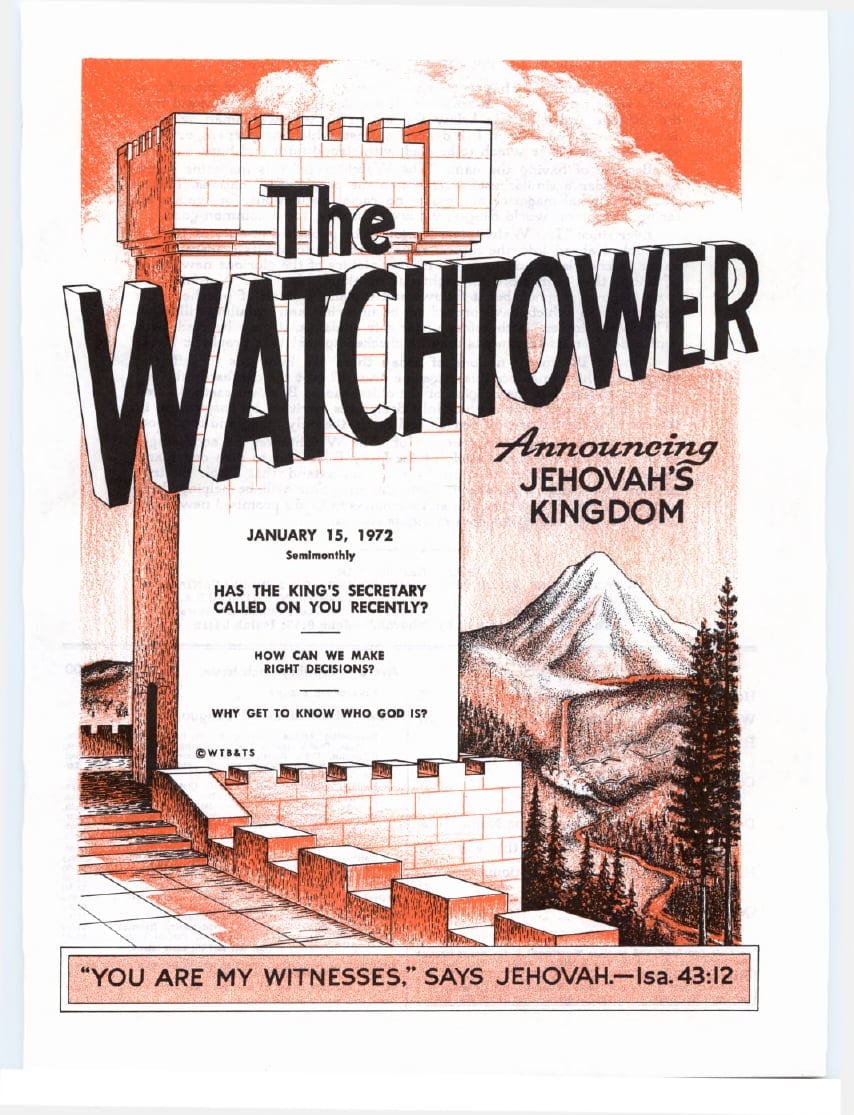
WATCHTOWER
JANUARY 15,1972 Semimonthly
HAS THE KING'S SECRETARY CALLED ON YOU RECENTLY?
Announcing JEHOVAH'S KINGDOM
HOW CAN WE MAKE RIGHT DECISIONS?
WHY GET TO KNOW WHO GOD IS?
WTB&TS
"YOU ARE MY WITNESSES," SAYS JEHOVAH.—Isa.43:12
THE PURPOSE OF "THE WATCHTOWER"
Every watchtower has its purpose. It serves as an elevated place for a wide-awake person with sharp vision. It enables him to see far ahead into the distance and tell those below for whom he is a watchman what is drawing near, whether it is a danger against which to prepare or it is something good over which to be glad with strong faith and hope.
Because of having the name "The Watchtower" this magazine justly has to render a similar useful service to the people of all nations. This is an international magazine and makes no racial distinctions, for we are all facing a common world danger; we are all hoping for a common good.
Ever since "The Watchtower" began to be published in July of 1879 it has looked ahead into the future, always striving to aid its readers to advance in knowledge and to gain a clearer picture of the glorious new order of things that they store in the Watchtower involved. No, "The Watchtower"
of things that is in store for righteous mankind. No. The Watchtower is no inspired prophet, but it follows and explains a Book of prophecy the predictions in which have proved to be unerring and unfailing till now.
"The Watchtower" is therefore under safe guidance. It may be read with confidence, for its statements may be checked against that prophetic Book.
Among the many nations of today there are hundreds of differing religions. Which one does this magazine present? Not the confused religions of Christendom, but the religion of the oldest sacred Book on earth. Which Book? The Sacred Bible of the Holy Scriptures, written by inspiration in the name of the Creator of heaven and earth, the only living and true God.
The sacred, nonpolitical purpose of "The Watchtower" is accordingly to encourage and promote study of the Holy Bible and to give our many readers the needed unsectarian help to understand that Book of true religion and infallible prophecy. Thus this magazine will be helping them to prove worthy of perfect life and happiness in God's promised new order under His everlasting kingdom of righteousness.
PUBLISHED BY THE
WATCH TOWER BIBLE AND TRACT SOCIETY OF PENNSYLVANIA
117 Adams Street
Brooklyn, N.Y. 11201, U.S.A.
N. H. KNORE, President
"They will all be taught by Jehovah." — John 6:45; Isaiah 54:13
CONTENTS
How Can We Make Right Decisions?
Why Get to Know Who God Is? 37
Has the King's Secretary Called on You Recently?
Completing the Work of the King's Secretary 49
Declaration Concerning the Divine Name 54
Average Printing Each Issue: 7,650,000
Five cents a copy
Now Published in 73 Languages
Seminario: Afrikaan, Arabic, Cebuano, Chihuahua, Chichibu, Chichena,
Ciyanan, Dutch, Danish, English, Finnish, French, German, Greek,
Hillgarten, Hokoe, Italian, Japanese, Korean, Malagasy, Norwegian,
Nordic, Stamne, Stamne, Spanish, Sesleri, Tagalog, Xhosa, Yola.
Monthly: Armenian, Beagil, Becil, Crostian, Edk, Kew, Flian, Flian,
Kanunian, Kunian, Ligura, Malahian, Malahian, Malahian,
Mampango, Pangangan, Papanetton, Polish, Suman, Suman-
Legtz, Suman, Suman, Seppeli, Sedirian, Sihlac, Sihlacan, Sihlacan,
Sihanian, Sihanian, Sihanian, Sihanian, Sihanian, Sihanian,
Upbuilding Associations Smooth the Way 57
How Valuable Are the Superscriptions in the Book of Psalms? 61
Questions from Readers 63
The Bible translation used in "The Watknotter" is the modern-language "New World Translation of the Holy Scriptures," unless otherwise indicated.
CHANGES OF ADDRESS should reach as thirty days before your mailing date. (BibleWorks.com, 117 Avenue of St. Brooks, New York 11201, U.S.A.)
BibleWorks.com, 117 Avenue of St. Brooks, New York 11201, U.S.A.
**Weekly subscription rates for semi-
monthly editions in local currency**
Amsterdam, Belfast, St. Bruno, St. Bloem, Belfast,
Australia, 11 Blenheim, Belfast, St. Bridgethe, N.S.W. 2155
$1.10
Canada, 15 Bridgway Island, Aventure, Toronto 3090
$1.50
$1.50
Jamaica, W. 41 Tyrfalcon Rd., Kingston 10
$1.50
New Zealand, 623 New North Bath, 13and 3
$1.50
South Africa, 13and 3
Trinidad, W.1., 12 Taylor St., Woodstock, Port of Spain
($Monthly editions cost half the above rates.)
Remitances for subscriptions should be sent to the office in your country. Otherwise send your remittance to Brooklyn.
Notice of expiration is sent at least two issues before subscription expires.
Second-class postal paid at Brooklyn, N.Y. Printed in U.S.A.
How can we make
RIGHT DECISIONS?
ALL of us, at some time or another, have to make critical decisions. On what do you base yours?
Many men—leaders in politics, business, science, religion and other fields—offer themselves as guides. But when you look at world conditions, or even conditions in your own neighborhood, what do you see to show that these men themselves are making the right decisions? The Bible points us to a far better basis.—Prov. 19:20, 21.
The temptation to look to men to point the way, rather than to an invisible God, is always great. Yet right in the physical world around us we can see abundant reason for seeking God's help in our decisions. (Rom. 1:20) The whole universe
testifies that there is a Supreme Lawgiver. Did you ever stop to think that all human sciences —physics, chemistry, mathematics, aerodynamics, to name but a few—depend on knowledge of laws that were here long before man existed?
Knowledge of those laws helps tremendously man's ability to accomplish things, to work with success. Is it not reasonable that the Source of all the wisdom bound up in these physical laws is also
the One who can give us wise moral laws, standards to guide us in our relations with one another and with Him? In his Word, the Bible, we find the principles and standards we need to make right decisions in life.—Ps. 119:105.
True, many persons shy away from submitting to Bible standards. They prefer to set their own standards, to make up their own rules of conduct. But how would you like to drive in a city where each person made up his own traffic rules and went by them? Certainly even a big city's traffic cannot compare with human relations in complexity.
Rather than rob us of our freedom to enjoy life to the full, accepting Bible standards as our guide brings us far greater freedom. When we base our decisions on these, we are protected from the very things that enslave man in hurtful bondage. As God's Son said: "You will know the truth, and the truth will set you free." (John 8:32)
When each one sets his own rules for life, the results are like the chaos that would result if each one made his own traffic rules With God's Word guiding us, we can make our decisions free from superstition, extreme fear of men, false religious ideas and false hopes.—Prov.
3:21-26.
WHY SUPERIOR
There is a strength to Bible standards that no personal moral code can ever give. Parents who make decisions based on the Bible and who show their children the Scriptural reasons for these have a tremendous advantage. The children can see that this is not just their father's or mother's idea, whim or prejudice. It is what their Creator says. This gives real weight to parental counsel.
Persons who seek Scriptural guidance when problems arise in married life are in a far better position to make right decisions than those with only personal moral codes or human philosophies to guide them. As Ecclesiastes 4:12 says: "A threefold cord cannot quickly be torn in two." Problems that split up some couples fail to break the unity of the husband and wife who are careful to include their Creator in their decisions by consulting his Word.
The Bible says that a man should love his wife as himself and that she should have deep respect for him. (Eph. 5:33) Someone may say, "But I can read words of similar counsel in modern marriage books." Perhaps so, but it is not just what those words in the Bible say that gives them their strength. It is from whom they proceed, the Source of their inspiration.
For example, 1 Peter 3:4 counsels wives to adorn themselves with "the incorruptible apparel of the quiet and mild spirit." But why? Because this is "of great value in the eyes of God." So, too, husbands are to 'assign honor to their wives as to a more delicate vessel, the feminine one.' But why? "In order for your prayers not to be
hindered." (1 Pet. 3:7) Yes, the husband and wife are made to realize that what they do matters to God and is bound to affect their relationship with him.
Only God's Word can authoritatively tell us these things that bear so heavily on what course we decide to follow.
Questions of right and wrong often arise in one's employment. Under the push and pull of pressure and temptation, personal moral codes can crumble. Many decide that a little dishonesty now and then is necessary to get along in a tough world. Even if not caught, they pay a heavy price—the loss of a clean conscience and constant tension caused by fear of exposure.
The Bible gives the strength to decide in favor of honesty and integrity. That is why even those Christians who were slaves in the Roman Empire could give faithful, honest service to their masters, "not with acts of eyeservice, as men pleasers, but with sincerity of heart." Again, why? Because of knowing that "it is from Jehovah you will receive the due reward . . . Certainly the one that is doing wrong will receive back what he wrongly did, and there is no partiality." (Col. 3:22-25) No personal moral code, not even the thought of hidden television cameras, can have the power for honesty that the desire to please the Creator does.
"The law of Jehovah is perfect." (Ps. 19:7) Decisions based on it will unfailingly bring the best results, for it applies consistently everywhere, at all times, under any circumstances. To have confidence that this is so, you need to be well acquainted with the Bible; you need to put its counsel to work in your life and see the results. Why not write the publishers of this magazine for a free Bible discussion in your own home to help you to do this? It is a decision you need never regret.
WHY GET TO KNOW
WHO GOD IS?
</div>
IS THERE a true and living God? If so, should we be concerned with what he is like, with what he thinks? Should we know whether he cares about mankind or involves himself in men's affairs?
Some clergymen say "God is dead"—that he has no part in current history. But what if these persons are wrong? What if God is concerned about human affairs and is working out a purpose toward humankind? Would it not be dangerous for those who think "God is dead"?
If we, having the opportunity to know him, prove to be the ones who do not care about God, might it not be to our calamity?
WHO GOD DECLARES HE IS
If a person has been delaying or avoiding a decision on whether there is a God who cares about men, it is time for him to search his own heart and thinking abilities. Is he delaying the decision in order to sidestep accountability? The fact that, of all earth's living things, only man has intelligence and reasoning powers does not mean that man is independent of a yet higher intelligence and that he can run the earth in his own way. The facts of history prove that he cannot. Man's intelligence is given to him so that he can follow the laws of his Creator, and this results in his own welfare.
God speaks to those who should know him, those who have his Word of truth, as people in Christian lands have. He says:
"Have you not come to know or have you not heard? Jehovah, the Creator of the extremities of the earth, is a God to time indefinite."—Isa. 40:28.
By virtue of his creatorship, Jehovah is God. He said to Abraham: "I am God Almighty." (Gen. 17:1) The psalmist writes: "To Jehovah the Sovereign Lord belong the ways out from death." (Ps. 68:20) The Christian apostles acknowledged him as such One, saying, "Sovereign Lord, you are the One who made the heaven and the earth and the sea and all the things in them."—Acts 4:24.
Bible history, therefore, testifies that God exists. It reveals that he is not "dead" but that he has much to do with the affairs of men.
THE WORLD POWER HAD TO KNOW
Someone may say, 'If he is almighty and a God of good, why, then, does he not let us today see him doing something?' Well, we have to consider that, as Sovereign, God has the right to act when and how he pleases. And we must realize that, being a God of order, he has a time schedule for the development of his purposes. —1 Cor. 14:33; Gal. 4:4.
We may consider the seventy or so years of our life as a long time, or several centuries an almost intermineable time. To God, who sits high above the earth, the inhabitants of the earth who oppose him are as grasshoppers. How long does a grasshopper live?
But of Jehovah it is written: "A thousand years are in your eyes but as yesterday when it is past, and as a watch during the night." (Ps. 90:4; Isa. 40:22) So an event that occurred as far back as the year 1513 before our Common Era, nearly three and a half millenniums ago, took place a mere half week ago in God's time reckoning.
It was indeed an event that took place this "half week" ago that illustrates to us the reason why we need to get to know who God is. And we do not want to disregard that event as a small-scale thing. It seriously crippled the world power of that day. That mighty nation came to know who God is, but very reluctantly, and in a calamitous way that they could have averted had they used the reasoning and good sense to know God in a peaceful, friendly way.
What happened then is a part of history that is repeating itself in this day, only on a far grander scale. The power that dominated the earth in that sixteenth century B.C.E. was of one of the three great branches of the human family from Noah, namely, the one through Noah's son Ham. Also dwelling in that land, Egypt, was a nation springing from Shem, another son of Noah. These people, though numerous, were not political agitators. They were peaceful residents of that land. Nevertheless, just as we have seen in some nations in our time, that Hamitic government began a campaign against those Shemites, a program of genocide.
Was it, as is often the case, a racial issue that brought about this genocidal attempt? No. It was a RELIGIOUS issue. The Shemites, though they had become slaves in Egypt, refused to share in worship of the many gods of the land. This was because they knew and worshiped the one God of all the earth, the Sovereign Lord Jehovah.
Jehovah had made wonderful promises to Abraham, Isaac and Jacob, the forefathers of the Shemites. But he had not yet brought the fulfillment of the most significant promises. These forefathers knew God and his name Jehovah, but likely some of the sons of Jacob or Israel did not know God fully for who he really is. However, Jehovah had given their forefather Abraham a prophecy setting forth the time when he would bring an end to their affliction in this land. Then they would come to know God as never before. In that sixteenth century B.C.E. the time had finally arrived.—Gen. 15:12-14.
By God's deliverance of those oppressed
Shenites the great military power of
Egypt also came to know who Jehovah is.
HOW DID GOD DO IT?
In order to convince that mighty enslaving nation that he is God, the Sovereign, who does as he purposes among mankind, Jehovah had to use superhuman power, miraculous power. In this way, not only would he be recognized as existing; he would also make his name to be respected, indeed, to be feared by the great world power as well as by the other nations with whom his people would later have dealings. By these demonstrations of power and intelligence far beyond anything men possess, he proved that he is indeed GOD.
Egypt had its many gods and its magic-practicing priests. How, then, would miraculous acts of God be distinguished so that the Egyptians would not attribute them to their own gods or their priests? In a simple and very effective manner. God would use a man as his spokesman or prophet to announce the miracles beforehand. Then, when they occurred, particularly when the miracles adversely affected the Egyptian gods, the people would be forced to know that their gods had been powerless before the superior might of Jehovah.
In working out his purpose God had a qualified man available. This man was Moses, born in Egypt and trained by his mother in the knowledge of the true God. Moses had attempted the Israelites' deliverance forty years previously, but found it was not yet God's time and was forced to flee from Egypt. For the next forty years he experienced training in patience, endurance and humility as a shepherd in Midian. Then, at Mount Horeb in the wilderness of Sinai, God sent his angel to Moses, saying:
"You must tell the Israelites this, that it is JEHOVAH the God of their fathers, the God of Abraham, the God of Isaac, the God of Jacob, who has sent you to them. This is my name for ever; this is my title in every generation. Go and assemble the elders of Israel and tell them that JEHOVAH the God of their forefathers, the God of Abraham, Isaac and Jacob, has appeared to you and has said, 'I have indeed turned my eyes towards you; I have marked all that has been done to you in Egypt, and I am resolved to bring you up out of your misery in Egypt, into the country of the Canaanites, Hittites, Amorites, Perizites, Hivites, and Jebusites, a land flowing with milk and honey.' They will listen to you, and then you and the elders of Israel must go to the king of Egypt."—Ex. 3:15-18, New English Bible.
THE CHALLENGE MADE AND MET
That it was a religious issue was made clearly evident when Moses appeared before Pharaoh and requested that the Israelites be allowed to go a distance into the wilderness to celebrate a festival to Jehovah. Pharaoh replied: "Who is Jehovah, so that I should obey his voice to send Israel away?" Then, to back up his defiance of Jehovah as if He were a mere Nobody, the idol-worshiping Pharaoh added: "I do not know Jehovah at all and, what is more, I am not going to send Israel away."—Ex. 5:1, 2.
God's sovereignty was hereby brazenly challenged. He met the challenge in a way that left no doubt in the minds of God's bitter opponents as well as of his worshipers. He proved that he was a God concerned, even taking action, in the affairs of men. By bringing a series of ten devastating plagues upon Egypt he brought Pharaoh to his knees.
The first three plagues, (1) turning the Nile waters into blood, (2) frogs in all the land, and (3) swarms of gnats, were experienced by both Egyptians and Israelites. Israel knew, however, that Jehovah was not meaning to punish them, but by suffering also they were enabled to feel how real a blow it was to the oppressive Egyptians. Doubtless any among them who doubted came to know Jehovah in this way.
Because of these circumstances, Pharaoh and his priests may have doubted Jehovah's ability to protect his own people. Additionally, the magic-practicing priests seemed to imitate the first two plagues. But at the third, the plague of gnats, they were powerless to duplicate it and had to admit: "It is the finger of God!" It is notable that they avoided using God's name Jehovah. But the facts spoke for themselves as to who brought the plagues against them and their gods.—Ex. 8:19.
Was there any protection possible through worshiping the true God, even this God with the unliked name? This question was undeniably answered by the fourth plague. For this plague as well as those that followed did not touch Israel. So on two counts Pharaoh was made to know that the true God is Jehovah: first, the priests were unable to duplicate the plagues, starting with the third one; and second, Jehovah separated and protected his own people. In fact, when the seventh plague hit, a very heavy hail, even the servants of Pharaoh who heeded Moses' warning and brought their livestock under cover saw them spared.
This proved that Jehovah was not a mere tribal or national God, but the God of the whole earth and the Preserver of all those who put their trust in him.—Ex. 9:18-21.
There is a warning to the nations today in what followed. Three more plagues came, ending with the death of the first-born of all the Egyptian households. Then Pharaoh made haste to let Israel go. Surely God had given Pharaoh and his subjects more than enough opportunity to come to their senses and save their lives. He was long-suffering with them. But with Pharaoh the principle proved true: "A man repeatedly reproved but making his neck hard will suddenly be broken, and that without healing." How?—Prov. 29:1.
A few days after Israel's release, when they were camped by the Red Sea, Pharaoh showed that he was unworthy of any favor or further patience. He had hardened himself against Jehovah beyond recovery. As Jehovah had said to Moses: "Pharaoh will certainly say respecting the sons of Israel, 'They are wandering in confusion in the land. The wilderness has closed in upon them.' So I shall indeed let Pharaoh's heart become obstinate, and he will certainly chase after them and I shall get glory for myself by means of Pharaoh and all his military forces; and the Egyptians will certainly know that I am Jehovah."—Ex. 14:1-4.
However, it was not the Israelites who were trapped, but the Egyptians who fell into a trap for their destruction. For that night, under the light of the Passover moon, the hundreds of thousands of Israelites passed across the bed of the Red Sea with the miraculously parted waters of it on each side of them. The military forces
entered the dried seabed in pursuit, but when Jehovah began to hamper their progress, the Egyptian military forces sensed danger and began to feel that they were fighting against Jehovah. At last making an acknowledgment of Him by name, they said to one another: "Let us flee from any contact with Israel, because Jehovah certainly fights for them against the Egyptians." But it was too late, for Jehovah caused the waters to close in upon them to their destruction, while his people Israel were safely on the opposite shore looking on.—Ex. 14:25.
IN WHAT WAY WE OUGHT TO KNOW GOD
Thus the Egyptians knew that God is Jehovah before they went into destruction. Political rulers and nations today who have a Pharaoh-like attitude against that name should take care. And individuals in such nations can, if they will, take note of this actual historical example and avoid a like fate. Those hardened against the Divine Name will know that God is Jehovah just before their destruction, but this is not a desirable way to find out about him. We should want to know him now as the true God and Sovereign, the Purposer, and the Protector of those who trust him. We should know him as Moses did and as Jesus Christ encouraged others to know God. It is a matter of life or death, as Jesus truly said: "This means everlasting life, their taking in knowledge of you, the only true God, and of the one whom you sent forth, Jesus Christ."—John 17:3.
Jehovah's witnesses, who themselves have heeded the preaching of the good news, have come to know Jehovah by studying his Word. They are glad to help others, free of charge, to come to this knowledge. You will profit by studying the Bible in your own home with them.
FOR a number of years now the King's secretary has been making his
calls at the homes of the people. Has he called on you recently? It may be that you are surprised at the question. You may say: 'No one identifying himself as the King's secretary called on me at any time.' But it may be that, because of the fear of opening the door to an unexpected caller in these dangerous times, you kept your door
shut and locked. Or, if you did open the door at his call, you did not recognize him as the King's secretary. Your not identifying him does not rule out the likelihood that he called on you. His work is very urgent, and he was calling on you in your interest. 'How was I to know?' you may exclaim. 'Tell me, just who is this King, and who is his secretary? And what is his business in calling?' The answers to these questions of yours are very important in these days of uncertainty when some emergency or contingency is bound to happen.
2 Our unusual question can be understood in the light of the circumstances under which it is framed. The world situation of today is not altogether new. Long ago there was a situation like it, but on a miniature scale. It is therefore a warning example for us today, and that is why it was recorded in ancient history in order that its lesson might not be lost. We today need the lesson, and for our lasting good we need to take it to heart and heed it. Just like back there in the typical situation,
"There was one man in among them clothed with linen, with a secretary's inkhorn at his hips."—Ezek. 9:2.
the greatest King of all is implicated at the present time, yes, the very same King. The secretary whom he has now sent out corresponds with the one whom He commissioned to go forth long ago for the sake of the people in their need. How many kings on earth will do such a thing? At least this great King has done so. He foreshadowed that he would do so in our times by what he did long ago under like circumstances. For our enlightenment and guidance today, He took care that a genuine accurate record was made of it.
transport ourselves back 2,582 years to the year 612 before our Common Era. A new mighty world power (Babylon) had lately taken the dominant position in the realm of world politics. A kingdom that had ruled for 465 years in the one royal family since 1077 B.C.E. was about to be destroyed. It had but five years yet to go according to the way that history worked out. So, in actuality, its capital city—Jerusalem—was destroyed in 607 B.C.E., and along with it the temple of the kingdom's God. This event was to affect the whole world of mankind, for then a period of 2,520 years was to begin during which the Babylonian World Power, the MedoPersian World Power, the Grecian World Power, the Roman World Power, and the Anglo-American World Power were to dominate all mankind in succession.
4 The domination of the earth by those world powers was not to be interrupted by the Supreme Power of the Universe by means of any kingdom of His establishment. Historically, that long period of uninterrupted political world domination ended in the year 1914 C.E., when international war broke out that finally engulfed twenty-eight nations, including the dual world power of Britain and America, namely, the first world war of human history. Hence we can now appreciate that that year of long ago to which our attention is here directed—612 B.C.E.—was a crucial year for that time and foreshadowed a crucial time for now.
aAlready, in 612 B.C.E., there were ten thousand individuals from Jerusalem and the Kingdom of Judah who had been deported from there into exile in Babylon. (2 Ki. 24:14) These included men who became prophets of Jehovah God, namely,
Daniel and Ezekiel a son of Buzi the priest. (Dan. 1:1-6; Ezek. 1:1-3) The year 612 B.C.E. was the sixth year of the exile of these two deportees. In that year the prophet Ezekiel had a vision. Bodily, he remained in a place called Tel-abib near the river Chebar in Babylonia, but in spirit or by inspiration he was transported back to Jerusalem. (Ezek. 3:15; 8:1-4) In this vision he was taken on a tour through the temple that had been built by King Solomon the son of David, for the worship of Jehovah as the God of the Kingdom of Israel. Jehovah forbids the use of any images or pictures in the worship of him as the invisible God; and yet here at the temple dedicated to the worship of this God of heaven and earth the prophet Ezekiel saw images and wall pictures being used in the worship of false gods. For instance, one of the sights Ezekiel saw was this:
"Look! there was every representation of creeping things and loathsome beasts, and all the dungy idols of the house of Israel, the carving being upon the wall all round about. And seventy men of the elderly ones of the house of Israel, with Jaazaniah the son of Shaphan standing in among them, were standing before them, each one with his censer in his hand, and the perfume of the cloud of the incense was ascending. And he proceeded to say to me: 'Have you seen, O son of man, what the elderly ones of the house of Israel are doing in the darkness, each one in the inner rooms of his showpiece? For they are saying, "Jehovah is not seeing us. Jehovah has left the land."'"—Ezek. 8: 10-12.
7 Time would tell, and that very soon, whether those seventy elders inside Jehovah's temple were correct in saying such things and in expecting to go unpunished for degrading and polluting Jehovah's house of worship in this way.
In a detestable way they were breaking the first and second of the Ten Commandments. Jehovah is a "jealous God" in the sense of demanding exclusive devotion and not sharing His glory with false gods and His praise with idolatrous images. Upon all the practicers of false worship right in His own temple at Jerusalem, Jehovah was
critical and false worshipers to the consequences of their own wrong practices. And because Jehovah has plainly told all of us that he does this very thing, we should appreciate that He is not a God to be tampered with. The people of the prophet Ezekiel found that out, this historical fact proving that he is a real, live God, that he is in truth the only living and true God in all existence. The present-day gen-
justified in bringing the punishment for their error and iniquity. (Ex. 20:1-6; Isa. 42:8) That he was unchangeably set to do
so, he indicated to his prophet Ezekiel. After letting Ezekiel become an eyewitness to even the practice of sun worship in His temple, Jehovah said to him:
8 "I myself also shall act in rage.
eration of mankind is going to find that out also! But what hope is there for divine pity toward any individuals of this generation? From what took place in the case of Jerusalem of Ezekiel's day we can find out.
So let us listen to what Ezekiel now has to tell us:
ATTENTION TO BE GIVEN TO THE CITY—HOW?
10 "And he proceeded to call out in my ears with a loud voice, saying: Have
My eye [which those seventy elders thought was blind] will not feel sorry, neither shall I feel compassion. And they will certainly call out in my ears with a loud voice, but I shall not hear them."—Ezek. 8: 13-18.
Ezekiel saw in vision seventy elders who were polluting Jehovah's house of worship and saying, "Jehovah is not seeing us"
0 What shall we, who live in a similar rious throne that rides on that chariot
those giving their attention to the city come near, each one with his weapon in his hand for bringing ruin!"
11 It is Jehovah who is issuing this command in Ezekiel's hearing. (Ezek. 9:1) Where is He? There He is, seated on that glo-
crucial time, say to this? Shall we ask, Is Jehovah a pitiless God? Will he show no mercy to anyone in the coming climax of our own critical situation? We cannot blame him in the least for leaving the hypo-
with fearfully high wheels, with a heavenly cherub alongside each of the four wheels. (Ezek. 8:2-4; 10:1, 2) He has the right to issue orders respecting the city of Jerusalem, for he is a King. He is "the King of eternity." (1 Tim. 1:17, New World Trans-
lation; Moffatt; Rev. 15:3) He was really the invisible King of Ezekiel's nation; and the anointed king that sat upon the throne of Jerusalem was said to sit upon "Jehovah's throne," as the visible representative of Jehovah the invisible King.
(1 Chron. 29:23; Ezek. 20:33) Jesus Christ called the Jerusalem of his day "the city of the great King." (Matt. 5:35) So he had the supreme royal right to give orders as to how the city of Jerusalem was to be disposed of. According to the next vision in this series of visions to Ezekiel, Jerusalem was to be burned down. (Ezek. 10:1-7; 2 Ki. 25:8, 9; 2 Chron. 36:17-19) But before the city was razed to the ground, what was to be done to its inhabitants?
12 As respects these inhabitants of Jerusalem, it sounded ominous when Jehovah the invisible King was heard to call out with a loud commanding voice: "Have those giving their attention to the city come near, each one with his weapon in his hand for bringing ruin!" (Ezek. 9:1) Upon whom were those weapons for a ruination to be used? Upon Jerusalem's own inhabitants? Upon all of them? Those armed with such weapons for a ruination were spoken of as "those giving their attention to the city." That description did not mean the then reigning king, Zedekiah, nor his governmental princes nor the military commanders nor the high priest and the second priest of the temple. These would not turn ruinous weapons upon their own people in Jerusalem. Who, then, were the armed men?
that way "giving their attention to the city." Although in the vision they appeared as men, they were really holy angels of Jehovah to be used in executing His adverse judgments upon the city's inhabitants. According to history, the armed forces of Babylon were used visibly in executing Jehovah's judgments upon the rebellious city, but these were not the ones pictured in Ezekiel's vision. These Babylonians were merely employed by the heavenly angels against Jerusalem.
13 Being subject to Jehovah, who was about to "act in rage," they were His executioners, who were to execute his judicial decisions upon Jerusalem's inhabitants, in
14 At Jehovah's royal command, how many armed men put in appearance, and from what direction did they come? Ezekiel tells us, saying: "And, look! there were six men coming from the direction of the upper gate that faces to the north, each one with his weapon for smashing in his hand; and there was one man in among them clothed with linen, with a secretary's inkhorn at his hips, and they proceeded to come in and stand beside the copper altar." —Ezek. 9:2.
15 There were six men with weapons for smashing in their hands. Not many, but, as they represented angels, they had superhuman powers that were more than a match for the thousands of inhabitants inside Jerusalem. So, their being six in number did not mean that there was anything imperfect about them or that they were inadequate for work as executioners. We notice that these six executioners come "from the direction of the upper gate that faces to the north." This was a foreboding of the fact that the Babylonian armies would march against Jerusalem from the north, to serve as instruments on earth for Jehovah's executional angels. From the south there came up the armies of Pharaoh of Egypt in response to the appeal of King Zedekiah of Jerusalem, but these allied forces were beaten back by the Babylonians.
Jehovah's determination to "act in rage" for the destruction of Jerusalem was not to be thwarted. The symbolic "six men" with weapons for smashing whom He had called to give "attention to the
S six armed men accompanied the King's secretary. They represent God's angelic forces who will soon wipe out this corrupt system, including Christendom
city" had divine support and were bound to triumph over all resistance.
14 Let not the force of that prophetic circumstance be lost on us today. What this present worldwide system of things is facing up to in the near future is not mere human forces of destruction and demolition. What these radical, anarchistic,
nihilistic, disorderly human elements may fail to break down and obliterate, Jehovah's superhuman angelic armies for the executing of his "rage" against this wicked system of things will wipe out. Every vestige of this corrupt, polluted system of things must perish!
17 Christendom also? Yes, for she is today the dominant section of this system of things. Moreover, she is the particular organization that is pictured by ancient unfaithful Jerusalem and its domain, the land of Judah. She is the religious organization that claims to worship the God of the Holy Bible, who is named Jehovah. She claims to recognize Jesus, the Son of Jehovah God, as being the Christ, and for that reason she has chosen to be called Christendom. But, like ancient Jerusalem, she has broken her religious covenant with Jehovah and has corrupted herself with the pagan religions of this world and hence does not practice true Christianity. Her religious name will not protect her. The solemn hour draws near when the prophetic "six men" will 'give attention to Christendom' with their weapons for smashing. You people of Christendom, this is indeed something for you to be alarmed about!
18 The shattering, the smashing to pieces, of this entire system of things, including Christendom, is a dead certainty that is due within this generation. There will be no avoiding this world catastrophe that comes from the hand of Jehovah, the universal King who rides on his celestial chariot to the full execution of his judgments. Is there anything that we can individually do about it—now, before those symbolic "six men" start smashing worldly things with their weapons for a ruination? In order to know, let us examine further the prophetic drama that the prophet Ezekiel saw in vision.
IDENTIFYING THE KING'S SECRETARY
19 Let us take note that there were not just "six men" that came from the north and entered the temple courtyard and stood beside the copper altar of sacrifice. There were seven. Also, the seventh man was not armed like the other six. Ezekiel says: "And there was one man in among them clothed with linen, with a secretary's inkhorn at his hips." (Ezek. 9:2) Who is he howay?
20 Why, that is the King's secretary. His nonmilitary attire together with his inkhorn containing pen and ink identifies him as being a secretary. He too must give his attention to the city, and since he was summoned by the One seated enthroned upon the celestial chariot, he must be the secretary of Jehovah, whose earthly visible throne at Jerusalem was then occupied by King Zedekiah of the royal family of David. He is the secretary, not of rebellious King Zedekiah, but of the King of Eternity, Jehovah. Who was he back there in Ezekiel's day, or who is he today?
21 Since he was in among the "six men" who represented angels of heaven for the execution of Jehovah's judgments, does he also represent a heavenly angel or angelic band? If he were an unseen heavenly angel, how would you know whether he had called on you recently? But, according to the work that Jehovah assigns him to do, he apparently pictures something here visibly on earth used in a peaceful way. Well, then, he stands for a man, does he not? Well,
looking back to Ezekiel's time, we have no record in the Bible of any one man literally doing the work that this man "clothed with linen" was told to do. The prophet Jeremiah, who was back there in Jerusalem, did not do so. Ezekiel did not do so, for he got back to Jerusalem only in vision, by the spirit of inspiration from Jehovah. But though no literal man with a secretary's inkhorn was then seen going through Jerusalem doing the work that Ezekiel saw in vision, the beneficial effect of such a secretary's work showed up just as if a literal man had gone through the city and done the work assigned. So the man with the inkhorn was just a pictorial device to point to an accomplishment by God back there.
22 How, though, about our day? It becomes clear that the vision of the man with the secretary's inkhorn was meant to have application primarily for our day, for the benefit of us "upon whom the ends of the systems of things have arrived." (1 Cor. 10:11) Back in Ezekiel's day no single man was depicted, although an individual man could have done the job within ancient walled Jerusalem during the time that yet remained before the city was destroyed. But when we consider that the antitypical "city" of today is Christendom, with her worldwide dimensions, we can appreciate that it is no one man's job. It must be the work of a group of men over years of time. Hence, for our day, the visionary man "clothed with linen, with a secretary's inkhorn at his hips," must picture a modern composite man, that is, a united group of men, all working together under one headship in the one same work, with the same one end in view, in the service of Jehovah, "the King of eternity." Such is the King's secretary of our day.
28 Just because this composite "secretary" is in Jehovah's service, it does not today mean a Jewish group of people. Jehovah was the God of their forefathers Abraham, Isaac, and Jacob and of Moses, but the circumcised natural Jews or Israelites of today are certainly not in Jehovah's service today. Unfortunately they exclude themselves from this, because they do not accept the impaled and resurrected Jesus as being the Messiah or Christ, the Son of Jehovah God. Furthermore, they as Jews would not be doing throughout Christendom the Christian work that fulfills the work done by the man "clothed with linen" who was seen in Ezekiel's vision. Neither are the clergymen of Christendom acting as a united body in doing the secretarial work of Jehovah God. Those clergymen see no need for such a work, for they do not believe that Christendom is shortly to be destroyed by Jehovah by the hands of his angels under his Son Jesus Christ. For example, what did the Roman Catholic pope of Vatican City say this past Easter Sunday, April 11, 1971?
24 Under date of the next day the New York Times published the special dispatch datelined "Rome, April 11," and said: "Pope Paul VI in a hopeful Easter message said today, 'The great ideas which are the guiding lights of the modern world shall not be put out.' 'The unity of the world shall be achieved,' the Pope asserted. . . In what he termed his 'Message of Hope,' the Pontiff said: 'The dignity of the human person shall be recognized not only formally but effectively. The inviolability of life from that in the mother's womb to that of old age shall have general and effective support. Unworthy social inequalities shall be overcome. Relationships
between peoples shall be peaceful, reasonable and fraternal.'
25 In disbelief of the Bible prophecies for our time, the religious clergy and groups of Christendom work, hope and pray for her perpetuation with all of her detestable things. The modern realization of the prophetic man with the secretary's inkhorn is not to be found in such religious groups of Christendom. Who, then, has been doing the work of the modern-day composite man "clothed with linen"? The historic facts as published throughout the earth are at hand to identify who that composite "man" is.
26 It is that small body of dedicated, baptized Christians who, in the year 1931, recognized the impending destruction of Christendom and therefore the need for the work of the "man clothed with the linen" to be done in its modern application. On July 30, 1931, at the general convention of these anointed Christians in Columbus, Ohio, U.S.A., at 3:00 p.m., the lecture "The Man with the Writer's Inkhorn" began to be delivered and immediately after the close of this lecture the book Vindication explaining Ezekiel, chapters 1 through 24, was released to the thousands there gathered in convention. Just four days prior to this, or on Sunday, July 26, 1931, this convention of spirit-anointed Christians embraced as a distinguishing name for themselves as Christians the designation "Jehovah's witnesses." Not just the name, but the work carried out by them since then proves that this anointed remnant of Christian witnesses of the Most High God are unmistakably the twentieth-century fulfillment of the man "clothed with linen, with a secretary's inkhorn."
So this is the modern "King's secretary." Has he called on you recently?
27 That the work of this anointed remnant is not some man's scheme but originates with Jehovah God is well pictured in the vision seen by Ezekiel. Showing from where the "man clothed with the linen" received his instructions, Ezekiel tells what he saw and heard, saying: "And as regards the glory of the God of Israel, it was taken up from over the cherubs over which it happened to be to the threshold of the house [the temple sanctuary], and he began calling out to the man that was clothed with the linen, at whose hips there was the secretary's inkhorn."—Ezek. 9:3; 10:2.
28 Thus Jehovah's glory moved from the platform that was above the wheels alongside of which the four cherubs were located and it took its position over the threshold of the Most Holy compartment of the temple of Jerusalem. Jehovah was now indeed in his holy temple, and it was from Him there that the "man clothed with the linen" was told what to do. It was not from the unaffraid priests of the polluted temple. This man was to move into action first, before the "six men" armed with weapons for smashing did. What was he to do ahead of those six executioners? Jehovah says: "Pass through the midst of the city, through the midst of Jerusalem, and you must put a mark on the foreheads of the men that are sighing and groaning over all the detestable things that are being done in the midst of it."—Ezek. 9:4.
29 Jehovah did not tell this man to pass through the temple and do the marking.
There were no foreheads to mark there, for the prophet Ezekiel during his inspection tour had been shown that the worshipers there in the temple were practicing false worship, with some women weeping over the false god Tammuz and not over the detestable things that were being done in the temple and in the midst of Jerusalem. (Ezek. 8:13, 14) Hence the "man clothed with the linen" was ordered to go outside the temple and "through the midst of Jerusalem." Jehovah saw that throughout unfaithful Jerusalem there were persons "sighing and groaning over all the detestable things" being done in the midst of it.
How would the "man clothed with the linen" locate such individuals who were thus "sighing and groaning"? Not just by going to the public square or to the marketplace, but to the homes of the people, going from house to house. In that way he would be able to hear their heartfelt expressions and decide whether they should be marked on the forehead or not. This was no speedy operation, by any means, but called for patiently and conscientiously going from house to house or from door to door and making an honest inspection, showing no partiality but marking only those who sincerely grieved at all the detestable things that others were doing inside the royal city. The "man clothed with the linen" did not ask these to bare their bosom and then pen a mark over their hearts. No, but he put the distinguishing mark upon their foreheads where it could be publicly seen by friend or foe. This mark, and not the kind of clothing that they wore along with hypocritical religious speech, would indicate them to be Jehovah's worshipers.
AVITAL question for today is, Have you been marked in your forehead by the modern-time "man clothed with the linen"? Do not look into the mirror to see whether you have a literal mark on your forehead. In Ezekiel's vision it was a literal mark, but it is not such a thing today. What, then, is the mark, and how is it inscribed as it were on the foreheads of people? A preliminary question is, Do you deserve to be marked in your forehead? Back in Ezekiel's day the ones marked were those who were worshipers of Jehovah. We know that, because those marked were loyal to Jehovah and believed in his pure worship and hence were "sighing and groaning" over all the detestable things being done in what ought to be the holy city of Jerusalem. Such detestable things included idolatry at the very temple of Jehovah. Besides that, Jehovah told Ezekiel of other detestable things, saying: 2 "The error of the house of Israel and Judah is very, very great, and the land is filled with bloodshed and the city is full of crookedness; for they have said, 'Jehovah has left the land, and Jehovah is not seeing.' "—Ezek. 9:9.
OF THE
3 Since the marked ones back there were the loyal pure worshipers of Jehovah, you must ask yourself, 'Am I a true, loyal worshiper of Jehovah?' Then you can look for the identifying mark. Yes, the symbolic mark today is that which marks or identifies you as a worshiper of the Sovereign Lord Jehovah. Figuratively it is put upon your forehead, not to picture that you have had Bible knowledge concerning Jehovah God put into your head and inscribed upon your brain. Many persons inside and outside of Christendom had read the Bible through from cover to cover a number of times, and despite the knowledge in their heads they have not been marked as Jehovah's worshipers who are grieved to the heart over the Jehovah-defaming things being done throughout Christendom, such as her crookedness, her bloodshed, her religious error, her various forms of idolizing things apart from Jehovah.
KING'S SECRETARY
4 So more is required than mere knowledge in your head. It is not what you have in your head that counts, but what you really are as a personality. As if stamped in your very forehead, it becomes plainly visible and readable to all who look at you and study you. This personality, which does have Bible knowledge as a basis, has to be developed in you. And here is where the modern "man clothed with the linen" comes into the matter. Following the events of the aforementioned year 1931 this composite "man," namely, the anointed remnant of the Christian witnesses of Jehovah, have been busy at the marking of the foreheads of the worthy ones.
True, this anointed remnant of dedicated, baptized Christians have gone from house to house, from door to door, from city and village to city and village, distributing Bible literature, as well as giving Bible lectures from public platforms with "seats free and no collection." But more is required than just letting people read these pieces of literature as aids to Bible understanding.
The readers need further personal help to understand what they read and how to apply the things they read. In course of time this need became more fully appreciated, and by the year 1936 return visits began to be made on receivers of literature. Then a course of home Bible study was established with the interested ones and was conducted by members of the anointed remnant, weekly or more frequent return visits being made on the interested for this purpose.
These newly interested persons may already have been disgusted at what they observed in Christendom. But when they got their eyes open to the Bible truths regarding pure worship of the one living and true God, they saw more discerningly the "detestable things" that were being carried on by religious hypocrites in Christendom. In view of this, they saw the need to withdraw and divorce themselves from all partnership with Christendom and from all moral support of her in committing her "detestable things." The anointed remnant helped these persons loyal to Jehovah to grow in knowledge and understanding to the point where they made their personal decision and dedicated themselves to Jehovah God through Jesus Christ his Son and symbolized this dedication by being immersed in water. By thus becoming "disciples" of Jehovah's Son, Jesus Christ, they got marked in their foreheads.—Matt. 28:19, 20.
In the year 1935 the anointed remnant saw, from Revelation, chapter seven, verses nine through seventeen, that a "great multitude," a "great crowd" out of all nations, tribes, peoples and languages were to be marked in their foreheads as those
who publicly stand before the throne of God and of his sacrificed Lamb, Jesus Christ, and say: "Salvation we owe to our God, who is seated on the throne, and to the Lamb." Symbolically speaking those of this "great crowd" are identified by "white robes," for, as Revelation 7:14 says, "they have washed their robes and made them white in the blood of the Lamb." Not only do they have approved recognition "before the throne of God," but they "are rendering him sacred service day and night in his temple." This requires them to obey the Scriptural command: "Put on the Lord Jesus Christ, and do not be planning ahead for the desires of the flesh." (Rom. 13:14) Is not the Christlike personality that they thus put on an approved mark that openly distinguishes them as if they were plainly marked in their foreheads? Yes, indeed! These dedicated, baptized members of the "great crowd" are further helped to share in the house-to-house work, hunting out still others who are "sighing and groaning over all the detestable things" that are being practiced inside Christendom. In this way they have a share in the marking work under the supervision of the anointed remnant. By doing this they are openly displaying the symbolic "mark" on their foreheads to all the world, inside and outside of Christendom. As a result thousands on thousands of other seekers of the pure worship of Jehovah God are proving fit to receive the identifying "mark" on the easily visible forehead. For example, in the service year of 1970 alone 121,226,605 return visits were made on interested persons world wide and 164,193 were baptized in water to symbolize their dedication to Jehovah God. This explains why from year to year the number of the "great crowd" keeps increasing.
But of what value is that identifying mark?
EXECUTIONAL WORK BY THE "SIX MEN" NEARS
If we value our earthly lives we will be interested in the value that the "mark"
carries with it. We learn to appreciate it as we hear what the King Jehovah says from his throne after he tells the "man clothed with the linen" what to do. The prophet Ezekiel tells us what Jehovah says
Make Jehovah's Purpose Your Way of Life.
What Sort of God Is Jehovah?
next in the vision: "And to these others he said in my ears: 'Pass through the city after him and strike. Let not your eye feel sorry, and do not feel any compassion. Old man, young man and virgin and little child and women you should kill off—to a ruination. But to any man upon whom there is the mark do not go near, and from my sanctuary you should start.'"—Ezek. 9:5, 6.
Why Avoid Self-Abuse?
THE NEXT ISSUE
10 Does it sound cruel for Jehovah to say, "Old man, young man and virgin and little child and women you should kill off—to a ruination"? Yes, but think of the divine mercy revealed in Jehovah's express command to the symbolic "six men" armed with weapons for smashing. "But to any man upon whom there is the mark do not go near!" Ah, now, we appreciate that there is protective value in that mark. If, in the coming "great tribulation" upon Christendom and all the rest of this detestable system of things, we desire to be spared by Jehovah's angelic armies, we will make sincere efforts now to acquire the
"mark" for our preservation. We will try to aid others in acquiring the "mark" also, that they may be part of that "great crowd" concerning whom it is prophetically written: "These are the ones that come out of the great tribulation, and they have washed their robes and made them
white in the blood of the Lamb." (Rev. 7: 14) If we appreciate that the marking work is nearing its end and that soon the symbolic "six men" are about to smash the unmarked heads, we will lovingly endeavor to
back up the lifesaving work of the King's secretary.
11 Let us not egotistically presume that we, if with unmarked foreheads, shall be able somehow to go unnoticed by the armed "six men." When ancient Jerusalem was destroyed by the Babylonians in 607 B.C.E., then, according to the hard facts, little children as well as virgins, women, young men and old men were destroyed. If the little babies did not die from hunger or pestilence or at the hands of the cruel Babylonian soldiers, then they died at the pitiless hands of their own starving mothers, who ate them like cannibals. The prophet Jeremiah, who was a prisoner inside Jerusalem until it fell to the besiegers, tells us so. (Lam. 2:20, 21) What about your children who are too young today to make an intelligent dedication and get baptized in symbol of becoming a disciple of Jesus Christ? They may be too young to get the mark in the forehead personally.
12 But are you yourself marked with that mark of dedication and of Christian personality?
Are you striving to do as the Christian apostle Paul admonishes a parent to do, namely, bring them up in the discipline and the mental-regulating of Jehovah, and are they obediently responding to your loving efforts?
(Eph. 6:1-4) Only if this is the case can you
ary, where those who tried to mix Jehovah's pure worship with unclean pagan worship were. The "six men" did not feel compassion or pity for the hypocritical religionists, for we next read: "So they started with the old men that were before
the house. And he said further to them: 'Defile the house and fill the
trust that the merit of the "mark" in your own forehead will extend to your minor children and that they will be mercifully spared with you from execution or destruction in the oncoming "great tribulation such as has not occurred since the world's beginning until now, no, nor will occur again."
Christian parents need to bring up their children in the discipline of Jehovah. Only if they are obediently responding can the merit of the parental "mark" extend to minor children
(Matt. 24:21) Now in the short time that expect to be marked by the King's secre-
courtyards with the slain ones. Go forth!" And they went forth and struck in the city." (Ezek. 9:6, 7; 8:10-12) Later the temple as well as the city was destroyed by the Babylonians. So, if we keep associating with that hypocritically religious crowd inside Christendom, can we reasonably
remains is the time to do this, before the modern-day "man clothed with the linen" finishes his marking of all worthy foreheads and the symbolic "six men" start using their smashing weapons on all unmarked foreheads that they discover. You parents, do you want your little children to be considered, not "unclean," but "holy," because of your marked forehead in Jehovah's day for executing vengeance? Naturally you should. But do not presume that your children who are intelligent enough to make a decision and personally dedicate themselves to Jehovah through
tary in the forehead and be spared the disastrous end of those unrepentant false worshipers? Not at all!
14 So extensive will the snuffing out of lives in Christendom and in the whole worldwide system of things be that it will appear as if no one would be spared and escape. But we should not think that Jehovah is going too far with his execution of judgment, nor should we feel sorry for those executed by God's means and agencies. Jehovah God is not unjust, and we should respect him by taking his viewpoint.
Christ will come under the merit of your marked forehead.
13 Another thing to watch now is our religious connections. Remember that the "six men" were ordered to start their shattering of heads from Jehovah's sanctu-
To teach us this lesson, note what Ezekiel goes on to tell us, as he watched the slaughter work go on:
15 "And it came about that, while they were striking and I was left remaining, I
proceeded to fall upon my face and cry out and say: 'Alas, O Sovereign Lord Jehovah!
Are you bringing to ruin all the remaining ones of Israel while you are pouring out your rage upon Jerusalem?' So he said to me: "The error of the house of Israel and Judah is very, very great, and the land is filled with bloodshed and the city is full of crookedness; for they have said, 'Jehovah has left the land, and Jehovah is not seeing.' And as for me also, my eye will not feel sorry, neither shall I show compassion. Their way I shall certainly bring upon their own head.'"—Ezek. 9:8-10.
16 Is that undue cruelty on God's part? Is it unjust when he lets violators of the divine laws eat the fruitage of their own doings, suffer the terrible outcome of their chosen course of action? In vindication of Jehovah God we say No! All those of mankind who do not now get their foreheads marked are in effect saying: 'Jehovah has left the earth, and it is now our obligation to control the
earth and rule it in the way that we choose. He is not seeing what we are doing; he is blind, yes, dead, as far as we are concerned, and therefore we
…