The Watchtower, January 15, 1970
Download: PDF — The Watchtower, January 15, 1970
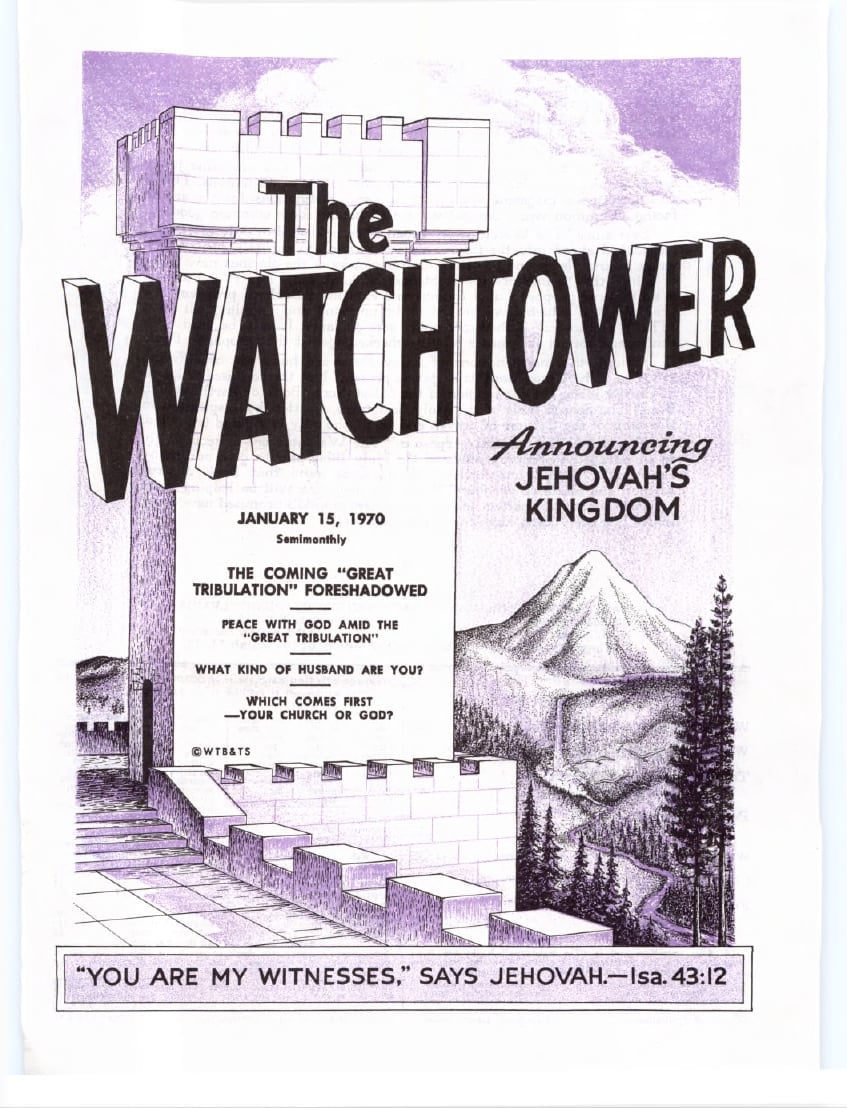
WATCHTOWER
JANUARY 15,1970 Semimonthly
THE COMING "GREAT TRIBULATION" FORESHADOWED
PEACE WITH GOD AMID THE "GREAT TRIBULATION"
WHAT KIND OF HUSBAND ARE YOU?
WHICH COMES FIRST
—YOUR CHURCH OR GOD?
Announcing JEHOVAH'S KINGDOM
WTB&TS
"YOU ARE MY WITNESSES," SAYS JEHOVAH.—Isa. 43:12
THE PURPOSE OF "THE WATCHTOWER"
Every watchtower has its purpose. It serves as an elevated place for a wide-awake person with sharp vision. It enables him to see far ahead into the distance and tell those below for whom he is a watchman what is drawing near, whether it is a danger against which to prepare or it is something good over which to be glad with strong faith and hope.
Because of having the name "The Watchtower" this magazine justly has to render a similar useful service to the people of all nations. This is an international magazine and makes no racial distinctions, for we are all facing a common world danger; we are all hoping for a common good.
Ever since "The Watchtower" began to be published in July of 1879 it has looked ahead into the future, always striving to aid its readers to advance in knowledge and to gain a clearer picture of the glorious new order of things that is in store for righteous mankind. No, "The Watchtower" is no inspired prophet, but it follows and explains a Book of prophecy the predictions in which have proved to be unerring and unfailing till now. "The Watchtower" is therefore under safe guidance. It may be read with confidence, for its statements may be checked against that prophetic Book.
Among the many nations of today there are hundreds of differing religions. Which one does this magazine present? Not the confused religions of Christendom, but the religion of the oldest sacred Book on earth. Which Book? The Sacred Bible of the Holy Scriptures, written by inspiration in the name of the Creator of heaven and earth, the only living and true God.
The sacred, nonpolitical purpose of "The Watchtower" is accordingly to encourage and promote study of the Holy Bible and to give our many readers the needed unsectarian help to understand that Book of true religion and infallible prophecy. Thus this magazine will be helping them to prove worthy of perfect life and happiness in God's promised new order under His everlasting kingdom of righteousness.
PUBLISHED BY THE
WATCH TOWER BIBLE AND TRACT SOCIETY OF PENNYSVILANIA
117 Adams Street
Brooklyn, N.Y. 11201, U.S.A.
N. H. KNOR, President
GRANT SUTER, Secretary
"They will all be taught by Jehovah."—John 6: 45; Isaiah 54: 13
CONTENTS
What Kind of Husband Are You? 35
Which Comes First—Your Church or God? 37
The Coming "Great Tribulation"
Foreshadowed 41
Peace with God amid the "Great Tribulation" 49
Waiting on Jehovah with Endurance 56
Christian Slavery Provides True Friends 61
Further Expansion at Watchtower Headquarters 63
The Bible translation used in "The Watcherwatch" is the New World Translation of the Holy Scriptures, 1961 edition. When other translations of the Bible will appear, the American Standard Version (AS - American Standard Version) L - Isaac Lesser's version
AT - An American Translation M - James McMott's version
JP - Joseph P. Patterson's version
DY - Catholic Deny Version RS - Revised Standard Version
JP - Jewish Publication Sec. YG - John Young's version
Average printing each issue: 6,000,000 Five cents a copy
"The Watchtower" Is Published in the Following 72 Languages
Samilmonthly Monthly
Afrikaans
Finnish
Norwegian
Anglo-Saxon
French
Spanish
Colombo
German
Switzerland
Chinese
Greek
Switzerland
Croatian
Hindi
Papalog
Citizenship
Indian
Papalog
Danish
Japanese
Yoruba
Danish
Japanese
Zulu
English
Malagasy
Armenian Bicol Croatian
Bengali Burmese Efik
Eve
Melaurentia
Slamese
Pitian
Pligin
Silent
Gin
Pligin
Silent
Gin
Pampango
Slovenian
Hindi
Pampango
Slovenian
Hindi
Pampango
Tamil
Icelandic
Ruslan
Tumblua
Kanarese
Ruslan-Later
Turkish
Kanarese
Ruslan-Later
Turkish
Lingala
Sango
Ukrainian
Malaysalam
Sapon
Uruda
Malaysalam
Sapon
Uruda
Yearly subscription rates for semimonthly editions
for semilimited editions
America, U.S., 117 Adams St., Brooklyn, N.Y. 11201
$1
Canada, 117 Adams St., Toronto, N.Y. 11201
$1
Canada, 150 Bridge Street, Toronto, N.Y. 890, Ontario
$1
Engined, Watch Tower House, the Ridgeway, N.W. N
9/-
Jamaica, W.I., 41 Trafair St., Kingston 10
$1
$1
South Africa, Private Bank, P.O. Box 41000, Transvaal
70c
Trinidad, W.I., 21 Taylor St., Woodbrook, Port of Spain
$2
Monthly editions cost half the above rates.
Benchmark for subscription should be to the office in your country. Otherwise, cost per Brooklyn Miles of expiration is sent at least two issues in subscription expires.
CHANGES OF ADDRESS should reach us thirty days before your moving date. Give us your old and new address (If possible, your old address label). Write Watchflower, 117 Adams St., Brooklyn, New York 11201, U.S.A.
Second-class postage paid at Brooklyn, N.Y.
Printed in U.S.A.
What Kind of Husband Are You?
IF YOU are a married man, you know that being a good husband is not easy. One reason is that it does not come by "instinct." Skill in marriage is similar to skill in any other field of endeavor—it must be acquired. And that takes time, thought and effort.
But what is the right kind of husband? True you can read many books about this
husband have the main role in providing for your family materially, spiritually and emotionally. You are the one who should make the major decisions and take the initiative in doing things for the good of the family.
When you take the right kind of lead, your wife does not find it burdensome to "be in subjection" to you as her husband
True, you can read many books about this written by doctors, psychiatrists and marriage counselors, and these books no doubt contain valuable information. But often such persons give conflicting advice. Whose advice will you follow?
Does it not make more sense to turn to the One who originated marriage to get information about the subject? That One is Jehovah God. He created man and woman—and originated marriage.—Gen. 2: 22-24.
When we study the matter from God's viewpoint, we quickly see that the role of
in subjection to you as her husband. (1 Pet. 3:1) She is happier because she is able to concentrate on the role that Jehovah equipped her for so admirably, that of being a helper and companion for you, making your home a good place to live, and caring for the children.
Yet, any husband will come into difficulty if he thinks that his divinely appointed role as head means that he is authorized to be a dictator. When headship is exercised in that way, then the wife will show the strain, since nobody respects a tyrant.
the husband is in certain respects more difficult than that of the wife. Why? Because God's Word states: "A husband is head of his wife." (Eph. 5:23) God has assigned the man the leading role in marriage, that of headship. So his role is more complex.
A man could not be tyrannical and be the right kind of husband, for Jehovah's Word says: "Husbands ought to be loving their wives as their own bodies." (Eph. 5:28) Just how far should you go in dealing lovingly with your wife? While you are the head of your wife, still the Bible, at 1 Peter 3:7, says: "You husbands, con-
tinue dwelling in like manner with [your wives] according to knowledge, assigning them honor as to a weaker vessel, the feminine one."
How do you honor persons you know?
You usually speak
well of them, do things for them, and consider their feelings, views and wishes. The same is true in assigning honor to your wife.
THE NEXT ISSUE
that Jehovah created her for this role. But you should not expect your wife to do everything for the children. Actually, you should play the key role in their mental and spiritual development, for the Bible
Loyal Advocates of the Word of God.
Do You Worship as Jesus Did?
What Do You Want Out of Life?
Essential here is communicating with your wife, that is, having mutual exchanges of views. Often, information that a wife has enables her husband to make better decisions. And although as the head he has the final say in matters, a husband who 'assigns his wife honor' will often allow her preference to prevail above his when there is no issue at stake.
The right kind of husband appreciates what his wife does in the home. Why, it would cost a small fortune to hire people to cook, clean, sew, iron, take care of children and do the many other things that a wife does! Hence, why not at times express appreciation for her hard work? True, at times words of correction may be necessary, but if this is what the wife always hears without any upbuilding commendation, then her attitude can sour.
Just as husbands need a break from their daily routine, so do wives. Recognizing this need, why not take the initiative and suggest that you and your wife do something different together at times? Perhaps eating out, enjoying upbuilding entertainment, visiting others, or even taking a walk together would be appreciated by her.
Every husband who is also a father knows the large role his wife plays in raising children. Her tenderness and love, her motherly qualities, all show clearly
counsels: "Fathers, do not be irritating your children, but go on bringing them up in the discipline and authoritative advice of Jehovah." (Eph. 6:4) This is why Christian fathers do well to conduct regular Bible studies with the family and guide them in the worship of Jehovah.
There are many other times when you can help with the children too. For instance, when the entire family is away from home in the company of other people, you can show consideration for your wife by assisting in handling the children, instead of directing all your attention to other people. This is a loving thing to do, and it shows that you appreciate your responsibilities as a family head.
The right kind of husband also considers his wife's emotional makeup. As the "weaker vessel" she has her physical cycles, which make her more emotionally inclined than her husband. On certain days when she is not feeling well, the considerate husband avoids inviting company over or expecting too much from his wife.
All this consideration has a very desirable influence. The wife that is dealt with in this way will usually respond in a positive way. She will have deeper respect and love for her husband, a greater willingness to do things for him. And even if she does not, the right kind of husband will continue to deal with his wife in this loving manner. Why? Because it is the right way, the way Jehovah approves. —Eph. 5:25.
—YOUR
CHURCH
OR GOD?
MOST believers are concerned about the crisis presently experienced by the Catholic Church and also by the Protestant religions. Their reactions differ, however, according to the type of believer they happen to be. With some, God comes first and their church is merely a means used to worship him. With others, their church has become an end in itself, taking priority over God and his Word, the Bible. Where do you stand? In your own heart and mind, which comes first—your church or God?
Last July, one of France's weekly news magazines, Le Nouvel Observateur, came out with a vivid purple cover showing a priest peering out of a church door, under a headline in bold white letters: "La mort de l'Eglise" (The Death of the Church). After excusing itself for using a title likely to shock many Catholics, but adding that "this expression is not ours: it was used by ecclesiastics," the magazine went on to speak of three men that typify three categories of believers:
"The first man is the one who feels at ease within the traditional structures of the Church; the second would like to see some changes made in these structures; as for
the 'third man,'* he has left the Church, but quietly, without making a fuss. He still believes in the Gospel values, but he expects no more help from the Church. He has quit, and the Church's problem has ceased to interest him, once and for all."
QUESTIONS FOR THE "FIRST MAN"
The "first man" represents the believers who remain faithful to their church out of loyalty to the religion they were brought up to believe in. Their attitude is: Right or wrong, it is my religion! Is that the way you feel? If so, you are certainly a loyal person. But to whom do you owe the greater loyalty—to your church, or to God? With so much disbelief rife throughout the
earth, you are to be commended for maintaining your faith, but where should your faith be placed—in a religious organization, or in God? Why do you go to church? Basically, is it not because you believe in God? Do atheists go to church? Is not the very purpose of churchgoing to worship God and gain his approval? So if it became clear that your church was not fulfilling its basic purpose, where would your first duty lie?
"But," you may reply, "how can one tell if one's church is fulfilling its purpose?" Well, is your church drawing more and more people to God and helping them to serve him? Or are its best and most sincere members disappointed, disillusioned and disheartened? What kind of people do you see around you in church on Sunday morning? Are they fine people who produce the fruits of the spirit, such as "love, joy, peace, patience, kindness, goodness, trustfulness, gentleness and self-control"? Or are they people who, behind the scenes, indulge in "fornication, gross indecency and sexual irresponsibility; idolatry and sorcery; feuds and wrangling, jealousy, bad temper and quarrels; disagreements, factions, envy; drunkenness, orgies and similar things"?
Since "those who behave like this will not inherit the kingdom of God," is it not obvious that a church whose clergy condone such behavior and whose members indulge in such practices cannot be pleasing to God and have his blessing? —Gal. 5:19-23, Catholic Jerusalem Bible.
Furthermore, to be pleasing to God, should not a church teach the truth? Did not Jesus Christ emphasize this to the Samaritan woman at the well in Sychar? He told her: "Believe me, woman, . . . the hour will come—in fact it is here already—when true worshippers will worship the Father in spirit and truth: that is the kind of worshipper the Father wants. God is spirit, and those who worship must worship in spirit and truth."—John 4:21-24, JB.
Notice that worship in "truth" is a must! It is therefore impossible to worship God acceptably without a deep love of the truth. The true Christian religion must be founded on the truth, not on traditions, creeds, dogmas and articles of faith that are often hard to understand because they defy all the faculties of reasoning with which God created us. Now what is the Christian standard for measuring truth? Is it not the Bible? So if there should prove to be contradiction between the tenets of a church that claims to be Christian and the plain statement of truth found in the Holy Scriptures, which should come first in your worship—your church or God's Word, the Bible? What will be your answer if you sincerely desire to be "the kind of worshipper the Father wants"?
That such a choice is necessary can well be illustrated by examining the mysterious doctrine of the "Trinity." This is a basic dogma of the Roman Catholic Church, and
all the two hundred and more churches belonging to the World Council of Churches are required to believe in the Trinitarian concept of "one God, Father, Son and Holy Spirit." Yet nowhere in the Bible can the word "trinity" be found, and the only verse that contains a clear statement of this dogma (1 John 5:7 in the Catholic Doux Version and in the Protestant King James Version) is admittedly a spurious addition to the inspired text. The inserted wording does not appear in recent translations, such as the Protestant New English Bible or the Catholic Jerusalem Bible, which states in a footnote: "The words in italics [the Father, the Word and the Spirit, and these three are one] (not in any of the early Greek MSS, or any of the early translations, or in the best MSS of the Vulg[ate] itself) are probably a gloss that has crept into the text." Evidently these words were made to 'creep into the text' to fill a pressing need: lack of any clear proof for the "Trinity" doctrine elsewhere in the Bible.*
Interestingly, this dogma is coming in for criticism even within the churches of Christendom. In the Netherlands, the Dutch Catholic bishops have approved a catechism that raises doubts on fourteen important doctrinal points, one of which is the "Trinity." Confirming that some Catholic bishops apparently have some doubts about the "Trinity" dogma, the French news magazine L'Express reported that a conservative member of the Congregation of Seminaries and Universities at the Vatican, "Monsignor" Romeo, considered the second Vatican Council to be a "sinister comedy of three thousand good-for-nothings, some of whom do not even believe in the Trinity or the Virgin." —Issue of Nov. 30—Dec. 6, 1964, page 49.
As for Protestant doubts about the "Trinity," Time magazine, in a long article on "Theology," reported that an Episcopal bishop suggested that "the church should abandon the Trinity, on the ground that it really seems to be preaching three Gods instead of one. Christianity, in his view, should stop attributing specific actions to persons of the Trinity—creation to the Father, redemption to the Son, inspiration to the Holy Spirit—and just say that they were all the work of God."—April 8, 1966, page 54.
The plain statement of Bible truth is that "there is one God, and one mediator between God and men, the man Christ Jesus." (1 Tim. 2:5, AV) As for the holy spirit, this is not a person but is God's invisible active force with which he anointed his Son, and which was poured out upon Jesus' apostles and disciples at Pentecost.—Acts 10:38; 2:4, 33.
Both the Protestant King James Version and the Catholic Douay Version speak of "the church of the living God, the pillar and ground of the truth." (1 Tim. 3:15) Hence any church that teaches error on such a fundamental point as the very person of God cannot be "the church of the living God." If you belong to such a religion, which should you put first—your church or God? Surely your love for God and of the truth will move you to seek the religion that will allow you to "worship the Father in spirit and truth." The purpose of this article is to help you find the true religion.*
REASONING THINGS OUT WITH THE "SECOND MAN"
The "second man" mentioned in the Nouvel Observateur represents those Catholics and Protestants who stay with their church because they do not know where
else to go. They have been taught that their church represents God, and they do not want to turn away from him. They disapprove of many church practices or doctrines, but they hope to reform their church from within.
Typical of these are the 744 French Catholics who, in November 1968, sent a long open letter to the pope. In it they stated: "Today the Christian needs to live in a 'true' Church . . . Therefore all that is false, contrary to the Gospel and scandalous within the Church today wounds the Christian." Then followed a long list of grievances against the Catholic Church and its current teachings and practices. Yet, toward the end, these Catholics expressed their unconditional adherence to their church by alluding to John 6:68 and stating: "Who could we go to? In her [the Roman Catholic Church] we find the One who has words of eternal life."†
But can Christ dwell in a church where so much is admittedly "false, contrary to the Gospel and scandalous"? Did not the apostle Paul write: "What participation hath justice with injustice? Or what fellowship hath light with darkness? And what concord hath Christ with Belial?" (2 Cor. 6:14, 15, Dy) In his recent book Etre vrai: l'avenir de l'Eglise (Being True: The Future of the Church), Swiss Catholic theologian Hans Kling admits that 'a large part of the world has been turned away from Christ' because of the Church.'
Such statements as these are being made not only with regard to the Roman Catholic Church but also in connection with the Protestant churches. French Protestant minister Louis Simon, vice-president of the General Commission for Evangelization in the Reformed Church of France, spoke recently of the "Silent Church" made up of people "who maintain their belief in Jesus of Nazareth, but who can no longer find him within the traditional Church."
In Geneva, Switzerland, twenty-two Protestant theology students refused ordination to the ministry because, as they put it, "we are looking for a style of Christian living that will serve the Gospel. But serving the Gospel these days results in challenging the work of the Church on several points."—L'Express, Dec. 1968.
Thus, honest Catholics and Protestants are beginning to recognize the necessity of choosing between the church and Christ, the church and the Gospel. What about all you 'second men,' who hope to reform your church from within? Which comes first with you—your church or God? Indeed, what is the church of God? After the words quoted above, Paul wrote to sincere anointed Christians: "For you are the temple of the living God; as God saith: I will dwell in them, and walk among them; and I will be their God, and they shall be my people. Wherefore, Go out from among them, and be ye separate." (2 Cor. 6:16, 17, Dy) It is not without interest that A Catholic Commentary on Holy Scripture states that in this passage Paul shows "that the union of the faithful to God involves a separation from false religion [italics ours]." Precisely!
What example did Paul himself set? As a Pharisee and prominent member of the Jews' religion, he had persecuted the true church of God. He wrote: "I persecuted the church of God . . ., being more abundantly zealous for the traditions of my fathers." (Gal. 1:13, 14, Dy) Did Paul remain within the traditional church, the Jews' religion, and attempt to reform it from the inside? No! He considered that the only way to worship and serve God acceptably henceforth was to 'go out from among' the Pharisees and become a part of God's true church which, at the time, was a small despised sect. Before Governor
Felix, Paul later declared: "But this I confess to thee, that according to the way, which they call a heresy [JB: a sect], so do I serve the Father and my God."—Acts 24:14, Dy.
Consequently, if your church teaches and does things that are contrary to the Bible and displeasing to God, your duty as a Christian is clear: Imitate Paul and 'serve the Father and your God' within the true religion which, not surprisingly, the churches often "call a heresy."
REASSURING NEWS FOR THE "THIRD MAN"
This brings us to the "third man," representing the disillusioned who have ceased practicing their religion altogether, yet still maintaining their belief in God. Although this article is not written primarily for them, since they have already chosen to abandon the church systems of Christendom, nevertheless we have some good news for them. To all these, and to the two other categories of believers we have been discussing, we say: Separate from false religion, yes! Forsake the churches, by all means! But don't stop there. Seek the true religion outlined in the Bible. True Christianity is being practiced throughout the earth today by a group of sincere men and women, well over a million strong, known as Jehovah's witnesses.
To help you learn what true religion is, as set out in God's Word, Jehovah's witnesses will be happy to study the Bible with you, free of charge, in your own home. Ask any of them to arrange this for you, or send your request to the publishers of this magazine. Of course, you are also welcome to attend the meetings of Jehovah's witnesses at the nearest Kingdom Hall. So doing, you will have the opportunity of learning how to "worship the Father in spirit and truth." For, remember, "that is the kind of worshipper the Father wants."—John 4:23, JB.
"GREAT TRIBULATION FORESHADOWED
"Then there will be great tribulation such as has not occurred since the world's beginning until now, no, nor will occur again. In fact, unless those days were cut short, no flesh would be saved; but on account of the chosen ones those days will be cut short." —Matt. 24:21, 22.
MORE than two thousand five hundred years ago, after the overthrow of the mighty Babylonian Empire, the aged prophet Daniel was told about the worst time of trouble to come in all human history. (Dan. 10:1 to 12:1) He was told, however, not to lose his peace of heart and mind about it. (Dan. 12:13) For more than eighty years Daniel had been an exile in idolatrous Babylon on the Euphrates River of the Middle East. There he survived the destruction of the holy city of Jerusalem, which the emperor of Babylon had brought about in the year 607 before our Common Era. (Dan. 1:1 to 2:1, 14) But shortly after mighty Babylon itself was overthrown, Daniel received the assurance from God's Word that Jerusalem would be rebuilt. The city and its territory of Judah were to lie desolate only seventy years, even as Daniel's friend, the prophet Jeremiah, had predicted. (Dan. 9:1-3) But, more than that, God's angel assured Daniel that the long-looked-for "Messiah the Leader" would come to this rebuilt Jerusalem. But not in aged Daniel's day!
2 How long after Daniel's day? God's angel told Daniel that Jehovah God had marked off seventy weeks of years, or 490 (7 X 70) years, in his timetable concerning this "Messiah the Leader." The Messiah would present himself to Daniel's people at the end of sixty-nine of those weeks of years, or after 483 years. From when? From when the commandment would go forth to rebuild and restore the walls of Jerusalem. So the Messiah's appearing would start off the seventieth week of years, but in the middle of that week, or after three and a half years of it, he would be "cut off" in such a way that he would "cause sacrifice and gift offering to cease" at Jerusalem. After the end of the seventy weeks of years there would be tremendous trouble for Jerusalem because of a "disgusting thing" that would be "causing desolation." (Dan. 9:24-27) Would this trouble upon her be associated with mankind's greatest time of trouble? Daniel died before finding out.
3 The title Messiah means "Anointed One."
In autumn of the year 29 of our Common Era an anointing of someone did take place, not by some man, but by God; not with anointing oil, but with God's holy spirit. Timing himself accurately, God did this anointing right on time, at the beginning of the seventieth week of years. He anointed his own Son in human form, Jesus, immediately after he was baptized in water by John the Baptist in the Jordan River. This anointing with holy spirit made Jesus "Messiah the Leader." Thus the Messiah appeared, and the crucial seventieth week of years began. He started carrying out what his anointing commissioned him to do by preaching God's Messianic kingdom. For doing this he made many enemies in Jerusalem and Judea and the neighboring provinces. In the middle of the seventieth week of years, which came in early spring of the year 33 C.E., Jesus the Messiah made sure to be at Jerusalem, with the twelve apostles whom he had chosen.
*On Tuesday, Nisan 11, three days before the Passover feast, he visited the rebuilt temple of Jerusalem. He had already foretold the destruction of this rebuilt Jerusalem; but now he plainly told the people worshiping at Jerusalem that their "house," their religious temple, was abandoned to them. Then he added: "For I say to you, You will by no means see me from henceforth until you say, 'Blessed is he that comes in Jehovah's name!'" (Matt. 23:37-39) He left the temple never to be seen in it again.
As Jesus was going out, his apostles called his attention to the temple buildings and stones. Then he made known the terrible result of the temple's being abandoned to the people of Jerusalem by saying: "Do you not behold all these things? Truly I say to you, By no means will a stone be left here upon a stone and not be thrown down." (Matt. 24:1, 2) Later that day he and his apostles looked at that temple from atop the Mount of Olives. As they looked down on Jerusalem and its temple, the apostles remembered what Jesus had said. This prompted them to ask the following question: "Tell us, When will these things be, and what will be the sign of your presence and of the conclusion of the system of things?"—Matt. 24:3.
When would all these things be, resulting in destruction for Jerusalem and her temple? Since Jesus had said that the people of Jerusalem would see him no more until they said to him, "Blessed is he that comes in Jehovah's name!" when would he come again from where he was going and be present again? Since all these things could not take place without the end of a system of things, when would the conclusion of the system of things be?
7 Evidently those apostles did not know what was embraced in those three things about which they were asking. But Jesus knew, and so he gave them a bigger answer than they might have expected, an answer that went farther than the time that they calculated. It is plain, however, that, first of all, they wanted to know when Jerusalem and her temple were to be destroyed. Would it come in their day, in their generation? So Jesus spoke first on that feature of the threefold question and with a direct application to literal Jerusalem and her temple. He said:
8 "Look out that nobody misleads you; for many will come on the basis of my name, saying, 'I am the Christ,' and will mislead many.
You are going to hear of wars and reports of wars; see that you are not terrified. For these things must take place, but the end is not yet."—Matt. 24:4-6.
9 Those misleading men would not come saying, 'I am Jesus,' but would come using the title Messiah and would come saying: "I am the Christ." For Jews, those professed Messiahs would have to be Jews, not Gentiles. In view of the threatening destruction of Jerusalem, they would come as Liberators, Preservers, of the Holy City, for which reason they would have much appeal to the Jews and would mislead many. They would have just the opposite message from what Jesus, the true "Messiah the Leader," proclaimed, namely, the destruction of Jerusalem and her temple. By this warning Jesus' disciples could know that those self-styled Christs, who did not have the anointing of God's spirit, were false.
Jesus' apostles asked him, first of all, when Jerusalem and her temple were to be destroyed. He gave them a bigger answer than they might have expected
10 Jesus did not make a false prediction here, for Flavius Josephus in his history called "Wars of the Jews," Book 6, paragraph 54, tells of three false Messiahs as being one of the reasons for the explosion against Imperial Rome that led to the destruction of Jerusalem.
"WARS AND REPORTS OF WARS"
11 Besides the appearance of false Christs (which would indicate that Jesus Christ
would not be personally present in flesh), the apostles were to "hear of wars and reports of wars." In the case of some wars, the apostles would be so close to the neighborhood of them as to hear directly the sound of them, and not hear mere reports of distant battles. When would this be? Since Jesus' prophetic words here are leading up to his description of the destruction of earthly Jerusalem, these wars would be between the time of his prophecy and the destruction of the holy city. Especially so if the apostles were to "hear of" such wars.
12 Well, then, what about the wars foretold in the very next verse, verse seven, in which Jesus goes on to say: "For nation will rise against nation and kingdom against kingdom, and there will be food shortages and earthquakes in one place after another"?
Are these wars different from the ones just previously foretold? Here the parallel account by the Evangelist Luke makes a break. After quoting Jesus' words, "When you hear of wars and disorders, do not be terrified. For these things must occur first, but the end does not occur immediately," Luke's account reads: "Then he went on to say to them: 'Nation will rise against nation, and kingdom against kingdom; and there will be great earthquakes, and in one place after another pestilences and food shortages; and there will be fearful sights and from heaven great signs.'" (Luke 21:9-11) This break in Luke's account has been understood by some commentators to mean that Jesus is here starting off on a new line. Yet, how could this reasonably be so, since Jesus is still leading on to Jerusalem's destruction?
13 Plainly, then, here in the first application of the prophecy, Jesus is referring to international wars due to occur before the impending destruction of Jerusalem. By going on to say that nation would rise against nation and kingdom against kingdom, Jesus is explaining why it is that they would hear of wars and reports of wars. But they should not get disturbed at such wars, because these are not the visible proof that the end is right upon them. And according to secular history, there were wars that occurred between the time that Jesus ascended to heaven and the destruction of the holy city. There were the Parthian wars in southwest Asia and the uprisings that took
place in the Roman provinces of Gaul and Spain. There was the war waged by Asinaeus and Alinaeus against the Parthians to the east of the Roman Empire. There was the Parthian declaration of war against King Izates of the land of Adiabene.*
14 True, these were wars that had no direct connection with Jerusalem, but, be it remembered that Jesus foretold the rising in war of nation against nation and kingdom against kingdom, which would allow for purely Gentile wars. During that time the Jews under the Roman Empire had no kingdom. Nevertheless, there were risings of Jews against other nationalities, and risings of other neighboring nationalities against the Jews, involving the Syrians and Samaritans, so that tens of thousands of Jews were slain. It was a very painful period for the Jews. By a number of rabbis the Jews had been told that, when kingdom would be rising against kingdom and city against city, it would indicate the time of the Messiah, that his appearance was near.
15 There were also earthquakes back there, which are on record. There was that earthquake on the island of Crete during the reign of Claudius Caesar, another in Smyrna, others in Hierapolis, Colossae, Chios, Miletus and Samos; another overthrew the city of Laodicea during the reign of Emperor Nero. There was even one in Rome, as reported by the Latin historian, Tacitus. In his Wars of the Jews, Book 4, chapter 4, paragraph 5, Josephus tells of a dreadful earthquake as occurring in Judea itself.
18 Families also took place, one of which is reported on in the Acts of the Apostles, chapter eleven, verses 27 to 30, the one foretold by the Christian prophet Agabus and occurring during the reign of Emperor Claudius. Reportedly, many Jews in Jerusalem died because of this famine. Of course, because of food shortage and thus the lack of proper nourishment, the people succumb to sicknesses, and pestilences break out. It was as Jesus foretold.
17 However, these things were not to be the instantaneous forerunners of the destruction of the "city of the great King," Jerusalem. After foretelling those things, Jesus added: "All these things are a beginning of pangs of distress." (Matt. 24: 8) As far as they had a connection with Jerusalem, they were a beginning of distress pangs for her and the province of Judea. But they did not mean the immediate end of the holy city and the desolation of Judea. But the fact that those things were at least the beginning of distress pangs for Jerusalem should have been enough to stir the Christians to greater activity, instead of relaxing and taking it easy because "the end is not yet." (Matt. 24:6; 5:35) There was an extensive work to do, and this required great effort and persistence in spite of religious persecution. So, in verses 9-13 Jesus went on to warn his apostles of the coming persecution by Jews and Gentiles and of the increase of lawlessness and of the need of Christian endurance, and then he added: "And this good news of the kingdom will be preached in all the inhabited earth for a witness to all the nations; and then the end will come."—Matt. 24:14.
18 Several weeks later, after his resurrection from the dead and before his ascension to heaven, Jesus commanded his disciples: "Go therefore and make disciples of people of all the nations, baptizing them in the name of the Father and of the Son and of the holy spirit, teaching them to observe all the things I have commanded you." (Matt. 28:19, 20) Some days later, after the next festival of Pentecost, the faithful disciples proceeded to do this. What was the result? By about the year 60 or 61 C.E., when the apostle Paul was a prisoner in Rome, he could write to the Christian congregation in Colossae, Asia Minor, and say of their hope: "The hope of that good news which you heard, and which was preached in all creation that is under heaven." (Col. 1:23) At that time Paul was wanting to carry the good news of God's kingdom into Spain, as a pioneer evangelizer. (Rom. 15:23, 24) Such a preaching of God's kingdom in the inhabited earth had already been given by ten years before the destruction of Jerusalem in 70 C.E. The "end" could not come before this was accomplished. —Matt. 24:14.
THE END OF FIRST-CENTURY JERUSALEM
19 Having mentioned the coming of "the end," Jesus promptly proceeded to speak about the holy city upon which the end would come during that first century C.E. According to Matthew 24:15-22, he said: "Therefore, when you catch sight of the disgusting thing that causes desolation, as spoken of through Daniel the prophet, standing in a holy place, (let the reader use discernment,) then let those in Judea begin fleeing to the mountains. Let the man on the housetop not come down to take the goods out of his house; and let the man in the field not return to the house to pick up his outer garment.
Woe to the pregnant women and those suckling a baby in those days! Keep praying that your flight may not occur in wintertime, nor on the sabbath day; for then there will be great tribulation such as has not occurred since the world's beginning until now, no, nor will occur again. In fact, unless those days were cut short, no flesh would be saved; but on account of the chosen ones those days will be cut short."
20 Jesus here definitely mentions the province of Judea. He instructs his disciples to flee out of it, a thing that would necessarily include fleeing out of Jerusalem, the city holy to the Jews. In Judea was where the sabbath law applied, making it hard for persons to journey over great distances or carry loads and also closing the gates of walled cities even to fugitives fleeing there. How much more difficult this would make it for Jewish women in pregnancy or nursing babies to go in haste on foot! Also, the wintertime with its bad weather would make it difficult, not only for such women, but for all other persons in flight. Upon noting the indication foretold by Jesus, all were to flee, from housetop to housetop, if necessary, and from fields outside the city. Get out of all Judea without delay!
21 Why, though, all this extreme hurry? Because now at last "the end" was near. There was immediately at hand a "great tribulation" that would be so destructive that, were not the days of it cut short, "no flesh would be saved." On account of God's chosen ones, those days would be cut short. Under those circumstances, only
a minority of persons in Judea would have their flesh saved. Hence, to take no chances of being among the vast majority whose flesh would not be saved in that "great tribulation," the wise and safe course for them would be to heed Jesus' instructions and get out of Judea, fleeing to mountains outside.
22 What, then, was the "holy place" in which the "disgusting thing that causes desolation" was to stand? Well, what place in all Judea was the "holy place"? It was the holy city of Jerusalem and its immediate surroundings. That is the "holy place" where the "disgusting thing that causes desolation" "ought not" to be standing at any time. (Mark 13:14-20) In fact, the parallel account of Evangelizer Luke concerning Jesus' prophecy plainly names Jerusalem. Luke, chapter twenty-one, verses 20-24, reads:
22 "Furthermore, when you see Jerusalem surrounded by encamped armies, then know that the desolating of her has drawn near. Then let those in Judea begin fleeing to the mountains, and let those in the midst of her withdraw, and let those in the country places not enter into her; because these are days for meting out justice, that all the things written may be fulfilled. Woe to the pregnant women and the ones suckling a baby in those days! For there will be great necessity upon the land and wrath on this people; and they will fall by the edge of the sword and be led captive into all the nations; and Jerusalem will be trampled on by the nations, until the appointed times of the nations are fulfilled."
24 When was it that the Christian Jews in Judea saw "Jerusalem surrounded by encamped armies"?
It was in the year 66 C.E., after the revolt by the Jews brought the Roman armies of General Cestius Gallus against the city, at the time of the celebration of the festival of booths (tabernacles), October 19-25. This was exactly thirty (30) years after the seventieth week of years, foretold by the prophet Daniel, had ended in the year 36 C.E. On the thirtieth day of the Jewish month Tishri, or about November 3/4, General Gallus brought his army into the city. For five days they made an attack on the temple wall and succeeded in undermining it on the sixth day. Then, suddenly, for apparently no good reason, he withdrew his armies, which suffered considerable casualties at the hands of the pursuing Jews. Thus the unparalleled "great tribulation" for the Jews in Jerusalem and Judea did not begin then. But now the Christian Jews knew it was near.
26 In this manner the Christian Jews caught sight of the "disgusting thing that causes desolation" standing in a "holy place," where it "ought not" to stand, when the Roman armies stood on ground considered holy by the Jews around the city, especially when undermining the temple wall. This was the "disgusting thing" foretold in Daniel 9:27. In that verse, after describing events of the seventieth week of years, Daniel goes on to say: "And upon the wing of disgusting things there will be the one causing desolation; and until an extermination, the very thing decided upon will go pouring out also upon the one lying desolate." This desolation of the rebuilt Jerusalem is detailed in the preceding verse (26b), in these words: "And the city and the holy place the people of a leader that is coming will bring to their ruin. And the end of it will be by
the flood. And until the end there will be war; what is decided upon is desolations." Jesus said that Daniel had foretold this "disgusting thing."
26 Who, then, was the "leader that is coming," whose "people" actually brought the "city and the holy place" to ruin? This was General Titus, the son of General Vespasian who became the Roman emperor in the year 69 C.E. In the Hebrew Scriptures an army is repeatedly spoken of as "the people." Also, an army is spoken of as flooding into the invaded land. This flooding of the military "people" of the "leader," General Titus, against Jerusalem did not occur till the spring of the year 70 C.E. So from the retreat of the armies of General Gallus in November of 66 to early spring of 70 C.E. there was an interval of more than three years and five months. During that favorable interval the Jewish Christians in Jerusalem and Judea seized the opportunity to flee out, to the "mountains" outside that doomed province, for now they knew, from what Jesus said, that Jerusalem's desolation had drawn near. Thus these Christian "chosen ones" escaped.
27 In the spring and summer of 70 C.E. the predicted "great tribulation" befell Jerusalem, causing much loss of Jewish lives. According to Jesus' prophecy, God had a fixed time for the "great tribulation" upon Jerusalem. He did not postpone the time for it to begin. Hence he let the called-off attack of Cestius Gallus in 66 C.E. serve as notice for his endangered "chosen ones" to flee. Cestius Gallus could easily have taken Jerusalem in short order, but missed his chance. It was not God's time. Not all of his "chosen ones" were then in the danger zone.
Already there were hundreds of Christian Jews outside the province of Judea, and outside the Roman Empire as well as inside. These were in no danger because of the impending destruction of Jerusalem. Only the Christian Jews inside Judea were in peril. It was these imperiled "chosen ones" whom God purposed to have safely out of Judea and Jerusalem before his fixed time for Jerusalem's "great tribulation" to start. Why should any of these be destroyed when he executed his vengeance upon unfaithful Jerusalem and Judea? They did not deserve to be destroyed.
28 Having by then fled from Jerusalem and Judea, the Jewish Christians were thenceforth in no danger of being hurt by Jerusalem's "great tribulation." It was the unbelieving Jews who got bottled up inside the city that then ran the danger of being destroyed. All the Jewish "flesh" inside Jerusalem faced the danger of losing life, if the tribulation went on too long. Such non-Christian Jews had flocked into the city in order to celebrate the Passover festival on Nisan 14, this to be followed by the week-long festival of unleavened bread. It was then that General Titus swooped down with his military "people" against the doomed city. He surrounded it, thus cooping up the rebellious Jews inside. He also had his "people" build around the city a stockade about five miles long, thus to prevent any besieged Jews from escaping. Since Jehovah God had by then had all his "chosen ones" outside the doomed area, he could be speedy in executing his vengeance upon Judea and Jerusalem, thus confining the execution to a short time of intensive destructiveness.
29 The siege of Jerusalem did not last long, only from Nisan 14 to Elul 6 (September 6, Gregorian calendar), or less than six months, and not eighteen months as in the siege of Jerusalem by the Babylonian armies in 609-607 B.C.E. There were a number of things* as permitted by Jehovah God that worked together for the shortening of the siege in 70 C.E.
Short though the siege was, it was horrible enough, although not being the greatest tribulation that had happened to mankind until that time and could never occur again. The "disgusting thing that causes desolation" did bring about an extermination, according to God's own decision. The Jewish historian, Flavius Josephus, reports that 1,100,000 Jews were killed or died. But because of 'cutting short' the days of that "great tribulation" upon Jerusalem, some Jewish "flesh" was saved. Josephus reports that 97,000 survived and were taken captive and dragged off into Egypt and other Roman provinces.† The city and its temple were completely destroyed, just as Jesus had foretold.
Thus, in a very literal sense, Jerusalem continued to be "trampled on" by the Gentiles (non-Jewish nations) from the time of the first destruction and desolation of Jerusalem and Judah by the Bab-
ylonians in the year 607 B.C.E.* But some day those Gentile Times were due to be fulfilled, namely, 2,520 years after their beginning back there in autumn of 607 B.C.E. That means in 1914 C.E.—Luke 21:24.
PEACE WITH GOD
amid the
"GREATTRIBULATION"
</div>
REMARKABLY the prophecy of Jesus, as recorded in Matthew 24:4-
sus' prophecy is at times difficult to understand or apply. He gave it in answer to a question of three parts, namely, about when the destruction of Jerusalem and her temple would be and about the sign
22, had a literal fulfillment. That was between the time of his giving it in 33 C.E. and the end of Jerusalem's "great tribulation" in 70 C.E. Such a "great tribulation" has not occurred again or been repeated upon Jerusalem, even upon the rebuilt Jerusalem in the days of the Crusades as carried on by the Roman Catholics against Mohammedans in the Middle East. Well, then, does this mean that that much of Jesus' prophecy is now mere dead history, with no further application? No! For even the way in which Jesus words his prediction of the "great tribulation" points to
of his "presence" and of the "conclusion of the system of things." (Matt. 24:3) These commentators admit that, in Jesus' prophetic answer to all three parts of the question, it is sometimes hard to grasp whether he is referring to one or the other feature. \dagger For example, with refer-
a tribulation far greater than Jerusalem's siege and destruction in the year 70 C.E. Yes, indeed!
2 It is admitted by well-known Bible
filament. This is the reason for the having of kuiroi [the times] with the article (compare xix. 44)."—Pages 503, 505, Mark and Elegential Hand-Book to the Mark and Elegential Hand-Book by H. A. W. Meyer, Th.D., and copyrighted in 1884.
† On Matthew 24:3 Dr. A. T. Robertson comments: "They ask three questions about the destruction of the earth: what is the temple his own second coming crucusia, presence, temple in the past, visit of the emperor, and the end of the world. Did they think that they were all to take place simultaneously? There is no way to answer. At any rate Jesus was the first to take place, and the most difficult problem in the Synoptic Gospels. . . It is sufficient for our pur [continued on next page] ence to Jesus' words in Luke 21:22, "These are days for meting out justice, that all the things written may be fulfilled," the author and Bible commentator A.
Plummer makes this suggestion: "The reference, therefore, is to the destruction of Jerusalem regarded as a type of the end of the world."*
3 Very evidently, in all good reason, when Jesus tells of the time that "these things" would be and also what would be the sign of the "conclusion of the system of things," Jesus had in mind something immensely bigger than what the inquiring apostles had in mind. He used doomed unfaithful Jerusalem of his day as a type, and so he had in mind the antitypical unfaithful Jerusalem, namely, Christendom, and he also had in mind a system of things larger than that of the Jewish system built around Jerusalem and her temple. Hence Jesus could say, without exaggeration: "Then there will be great tribulation such as has not occurred since the world's beginning until now, no, nor will occur again. In fact, unless those days were cut short, no flesh would be saved; but on account of the chosen ones those days will be cut short." (Matt. 24:21, 22) The terrible destruction of antitypical unfaithful Jerusalem, Christendom, is part of the calamitous end of this present worldwide "system of things," commonly spoken of as "the end of the world." —Matt. 24:3, AV; AS.
4 Certainly the second "presence" of Jesus Christ did not take place at Jerusalem's destruction in 70 C.E. Furthermore, the Gentile Times were to continue after her destruction, and thus this worldwide "system of things" was to continue on till at least those Gentile Times were "fulfilled." Moreover, there are features of Jesus' prophecy that run from after his description of Jerusalem's "great tribulation" down to his parable of the sheep and goats, and these features were not fulfilled at Jerusalem's destruction in 70 C.E. (Matt. 24:23 to 25:46) So it was only reasonable that Jesus should use doomed Jerusalem in a twofold sense, literally and symbolically, typically and antitypically.
Well, then, we are not wrong when we also apply Jesus' prophecy from the year 1914 C.E. onward to the coming war at Armageddon, are we? No! For we do have with us till now the symbolic, antitypical unfaithful Jerusalem, namely, Christendom. Both the Bible's time schedule and the physical facts of history prove that the Gentile Times, "the appointed times of the nations," ended in 1914 C.E. about October 4/5 that year. (Luke 21:24) The Gentile nations had not been 'trampling on' antitypical unfaithful Jerusalem (Christendom) down till that year 1914. However, they had been trampling on the Kingdom right of God's Messiah, as the Permanent Heir of King David, to rule at Jerusalem and over David's nation of the twelve tribes of Israel. Hence Jehovah God terminated that trampling by Gentile nations on the Kingdom right of his Messiah in 1914 C.E. How? By installing his Son Jesus Christ on the heavenly Mount Zion and thereby restoring the Messianic kingdom.
From then on God has been proceeding to make the Gentile nations the footstool of his Messianic King Jesus, to destroy them finally at the coming war of Armageddon.
"Nineteen hundred years ago Jesus became absent from the earth by ascending back to heaven. Since old Jerusalem was typical, the time period from his ascension and down to Jerusalem's destruction thus becomes typical. It pictures the time period from the end of the Gentile Times in 1914 C.E. down to the "war of the great day of God the Almighty" at Armageddon, where the political lovers and associates of antitypical unfaithful Jerusalem, Christendom, will be destroyed. (Rev. 16:14-16) Were there wars, famines, pestilences and earthquakes back there nineteen centuries ago before Jerusalem's destruction in 70 C.E.? Yes, and likewise with this present time period since 1914 C.E., when Jesus' absence ended, spiritually speaking. In fact, the end of the Gentile Times in that year was marked by nation rising up against nation and kingdom against kingdom in the first world war of human history. Famines, pestilences and earthquakes accompanied or followed that first world war on a scale never recorded before. This was plain proof to the nations that Jesus Christ was "present" in his heavenly kingdom as Messiah, just as after his ascension to heaven and sitting down at God's right hand he was reigning among his dedicated, baptized disciples on earth till Jerusalem's destruction and thereafter.
As in the case of nineteen centuries ago, the international war, the food shortages, the pestilences and earthquakes were a "beginning of pangs of distress." (Matt. 24:8) This was particularly so for the antitypical unfaithful Jerusalem, Christendom, for World War I was preponderantly her war, all twenty-eight parties thereto except four being so-called Christian nations and kingdoms. But after more than four years of World War I, the "end" was "not yet." It did not lead into the war of God's great day at Armageddon. There was yet much work to do. Before that "end" would be allowed to come, a worldwide work had to be done by his faithful disciples on earth. What? "This good news of the kingdom will be preached in all the inhabited earth for a witness to all the nations; and then the end will come." Just as there was a preaching of the "good news" in "all creation that is under heaven" before Jerusalem's destruction in 70 C.E., so there has been a witness to God's established Messianic kingdom in all the inhabited earth to all the nations since 1914 C.E. This too has been done by Jehovah's witnesses despite persecution.—Matt. 24:9-14.
The antitypical unfaithful Jerusalem, Christendom, has had her "beginning of pangs of distress," and her situation and that of the rest of the world has not become less painful since, Jesus' prophecy indicated that the "anguish of nations" and their perplexity would continue, with no improvement. (Luke 21:25, 26) There is yet ahead the "great tribulation" upon the antitypical unfaithful Jerusalem, a tribulation that is bound to affect her worldwide political associates and patrons. Jesus' description of it makes it plain that, like the global flood of Noah's day, the tribulation threatens all human life in the flesh. (Matt. 24:21, 22, 36-39) If allowed to continue too long, it would exterminate all "flesh."
Hence the purpose of God is to shorten the number of "those days" of this unparalleled "great tribulation." Mark 13:19, 20.
9 On account of his "chosen ones" he cuts short the days. How? Back in the year 1925 the suggestion was set out in the leading article of the Watch Tower issue of May 1, entitled "For the Electt's Sake," that "those days" of the "great tribulation" were cut short in the middle. The explanation was given that the "great tribulation" had begun in 1914 C.E. and that it was not allowed to run its full course then but God stopped World War I in November of 1918. From then on God was allowing an interval for the activity of his anointed remnant of elect Christians before he let the final part of the "great tribulation" resume at the battle of Armageddon and come to its termination. This would allow for sheeplike persons to be saved.—Matt. 25:31-46.
19 This explanation sounded good and reasonable back there in 1925, just seven years after World War I and fourteen years before the unexpected World War II, a conflict four times as bad as World War I. But even World War II did not merge into the "war of the great day of God the Almighty" at Armageddon, as some had expected it to do. (Rev. 16:14-16) Here we are, twenty-four years after World War II closed in 1945 and a portion of the anointed remnant of elect ones are still here and the war at Armageddon is still ahead, although getting very close now. Back in 1925 the Bible timetable as set out in the book "The Time Is at Hand," published in the year 1889, was still thought to be correct. Hence it was not
calculated that six thousand years of man's life on earth were yet to end during the 1970's. Of course, the old timetable for scheduling the events of the Bible and fulfillment of prophecies affected the understanding of matters by the International Bible Students. But now chronology has been reexamined.
11 If, as explained in 1925, the first part of the "great tribulation" began in 1914 and ended in 1918, then the time interval by which "those days" of the tribulation are being cut short has extended itself for fifty-one years and is not yet over. Many of the anointed remnant that witnessed the end of World War I in November of 1918 and others that have been added to the remnant since then have grown old, and some have been killed in persecution or died of old age or other causes. For example, in the year 1948, out of 376,393 that celebrated the Lord's Supper, only 25,395 partook of the bread and wine to testify that they were of that anointed remnant. But on April 1 of the year 1969, out of 2,719,860 that celebrated, only 10,368 partook of the bread and wine. This included quite a number of the remnant who experienced the "beginning of pangs of distress" during World War I. A number of these should survive still longer to see and go through the war of Armageddon, in harmony with Jesus' words, at Matthew 24:33-35:
12 "When you see all these things, know that he is near at the doors. Truly I say to you that this generation will by no means pass away until all these things occur. Heaven and earth will pass away, but my words will by no means pass away [unfulfilled]."
18 Were the suggestion made in 1925 true as to cutting short the days of the "great tribulation" in the middle, "for the elect's sake" (Matt. 24:22, AV), what then? Then the time interval between the opening part of the "great tribulation" and the closing Armageddon part thereof will prove to be around five times as long as the length of the "great tribulation" itself. However, in order to correspond with the events of the first century, from the time of Jesus' departure by ascending to heaven in 33 C.E., to Jerusalem's destruction in 70 C.E., the antitypical "great tribulation" did not begin in 1914 C.E. Rather, what took place upon Jerusalem's modern antitype in 1914-1918 was merely "a beginning of pangs of distress" for her and her political allies. The "great tribulation" such as will not occur again is yet ahead, for it means the destruction of the world empire of false religion (including Christendom) followed by the "war of the great day of God the Almighty" at Armageddon against the political allies of Babylonish false religion. In that "great tribulation" the present system of things must end in its religious and political phases.
…