The Watchtower, November 1, 1966
Download: PDF — The Watchtower, November 1, 1966
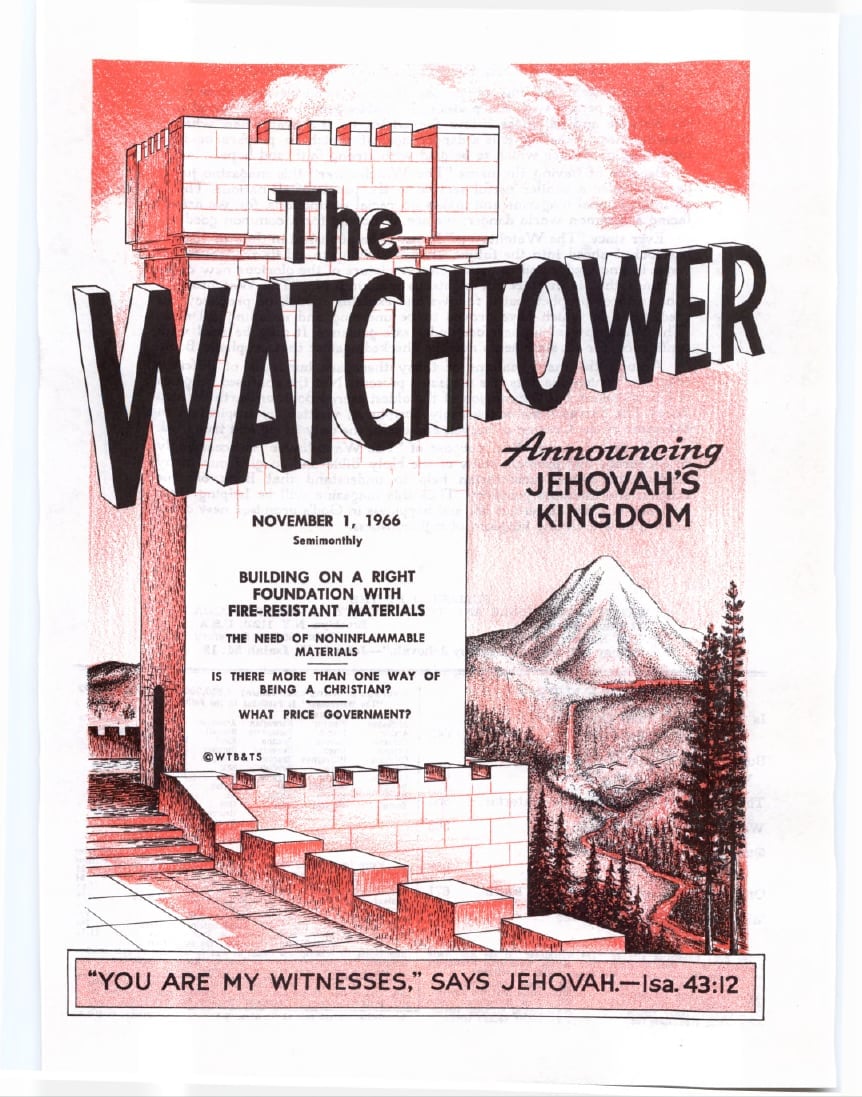
THE PURPOSE OF "THE WATCHTOWER"
Every watchtower has its purpose. It serves as an elevated place for a wide-awake person with sharp vision. It enables him to see far ahead into the distance and tell those below for whom he is a watchman what is drawing near, whether it is a danger against which to prepare or it is something good over which to be glad with strong faith and hope.
Because of having the name "The Watchtower" this magazine justly has to render a similar useful service to the people of all nations. This is an international magazine and makes no racial distinctions, for we are all facing a common world danger, we are all hoping for a common good.
Ever since "The Watchtower" began to be published in July of 1879 it has looked ahead into the future, always striving to aid its readers to advance in knowledge and to gain a clearer picture of the glorious new order of things that is in store for righteous mankind. No, "The Watchtower" is no inspired prophet, but it follows and explains a Book of prophecy the predictions in which have proved to be unerring and unfailing till now. "The Watchtower" is therefore under safe guidance. It may be read with confidence, for its statements may be checked against that prophetic Book.
Among the many nations of today there are hundreds of differing religions. Which one does this magazine present? Not the confused religions of Christendom, but the religion of the oldest sacred Book on earth. Which Book? The Sacred Bible of the Holy Scriptures, written by inspiration in the name of the Creator of heaven and earth, the only living and true God.
The sacred, nonpolitical purpose of "The Watchtower" is accordingly to encourage and promote study of the Holy Bible and to give our many readers the needed unsectarian help to understand that Book of true religion and infallible prophecy. Thus this magazine will be helping them to prove worthy of perfect life and happiness in God's promised new order under His everlasting kingdom of righteousness.
PUBLISHED BY THE
PUBLISHED BY
WATCH TOWER BIBLE AND TRACT SOCIETY OF PENNSYLVANIA
117 Adams Street
H. N. Krohn, President
"They will all be taught by Jehovah."—John 6: 45; Isaiah 54: 13
CONTENTS
Is There More than One Way of Being a Christian? 643
Building on a Right Foundation with Fire-Resistant Materials 649
The Need of Noninflammable Materials 655
What Price Government? 663
Qualifying to Be a Preacher of the "Good News" 668
Organized to Fight Hard for the Faith 671
Missionaries Who Give Free 671
The Bible translation used in "The Wattewater" is the New World Translation of the Holy Scriptures, 1951 edition. When other translations of the Bible are used, the American Standard Version AL - American Standard Version AL - An American Translation MO - James Mott's version MY - James Mott's version DY - Catholic Bible version DY - Catholic Bible version PJ - Jewish Publication Society YG - Robert Young's version
Average printing each issue: 4,850,000 Five cents a copy
“The Watchtower” Is Published in the Following 70 languages
Arabic Alfaxians Pimish Norwegian Armenian Icelandic Sans-Larot Arabic Arabic French Portuguese Beagle Kanarese Sasanan Chinese Chinese Greek Stevian Burmese Lingala Nianese Chihona Hillagoon Spanish Creatian Malayalam Slost Chinese Chinese
ONE of America's leading liberal Protestant theologians was nearing the age of eighty. As he would look back on his long active life, one milestone in particular stood out. As a young German army chaplain trudg-
ing among the dead and dying at the Battle of Champagne during World War I. is the fact that this leading theologian—
the words of Nietzsche came to his mind
—"God is dead." "I changed from an idealist to a tragic realist" as a result, he later said.1
It was not at all surprising, then, that T. J. J. Altizer of the "God is dead" group, in a discussion with the old theologian one evening, told him: "You have opened the confrontation with the real world. You fathered us, we are your children." But apparently those words were no small jolt to the old theologian, for he had felt that the "God is dead" group had gone too far. In footnote kin discussion with Altizer
who was the first non-Jewish professor to be dismissed by the Nazis—should have indulged in such philosophical speculations under the guise of the Christian religion as to cause some of his seminary students to come to the conclusion that "God is dead." Yes, and even more to be lamented is the fact that Paul Tillich, T. J. J. Altizer and a host of other Protestant theologians have played so loosely with the term "Christian" that for many it has come to mean any number of different things!
How can we know what it means to be
fact, in his discussion with Artizer that evening he became so excited that his wife took it upon herself to insist that they go home, they agreeing to continue the discussion the next day. But the discussion was never resumed, for that night Paul Tillich suffered the heart attack from which he died.—Life magazine, November 5, 1965.
a Christian? Are there many ways of being one? How can we tell? There is a way to tell, and that is by going to the only source that gives us the complete record of Jesus Christ. All those professing to be Christians do more or less recognize Jesus Christ as their pattern or they would not take the name "Christian." If he is one
meriting to be followed, then we must, logically, adjust our thinking to his.
CHRIST REVEALED A PERSONAL GOD
No one can read the Christian Greek Scriptures, free from preconceptions, without recognizing that, to Jesus Christ, God was a Person, a very real Person. Jesus tells of his coming forth from God his Father; that he was going to return to his Father; that his Father resides in the heavens; that his Father sees and hears and that he answers prayers; that he forgives; that he loves his Son; that he has affection for Jesus' followers; that certain angels always behold the face of his Father who is in heaven. Moreover, he said: "My Father has kept working until now, and I keep working." (John 5:17) In fact, some 180 times in the Christian Greek Scriptures we find Jesus attributing personality to God by terming him "Father."
That Jesus considered God to have personality just as much as himself is to be seen from his references to his Father's being one witness and he himself another and to his Father's sending him. It takes personality to send and bear witness. That is what Jesus meant when he said: "I am one that bears witness about myself, and the Father who sent me bears witness about me." (John 8:18; 5:32) Further, we repeatedly read of God's voice being heard from heaven.—Matt. 3:17; 17:5; John 12:28.
More than that, God's being a Person is clearly indicated by the commandments Jesus quoted for us to 'love God with all our heart, mind, soul and strength and to love our neighbor as ourselves.' It is also made clear from Jesus' words that we are to fear God because he can destroy both body and soul in Gehenna. And God's personality is also indicated by Jesus' stress
upon God's name.—Mark 12:29-31; Matt.
10:28; 6:9; John 17:6, 11, 12, 26.
In view of all this testimony, how at variance with it all are the speculations of Paul Tillich that God is Depth or the Ground of being, the inexhaustible ground of history. According to him,
"That is what the word means, and it is that to which the words Kingdom of God and Divine Providence point. And if these words do not have much meaning for you, translate them, and speak of the depth of history, of the ground and aim of our social life, and of what you take seriously without reservation in your moral and political activities. Perhaps you should call this depth hope, simply hope . . . If you know that God means depth, you know much about him. You cannot then call yourself an atheist . . . He who knows about depth knows about God."2
What folly these modern theologians are capable of in their efforts to deny the personality of God can be seen from what the "Honest to God" Bishop Robinson has to say about God. According to him, Christians can no longer say that God is "out there," out in space or beyond the realms of space, for all this has been explored by means of radio telescopes and these have not discovered God! This kind of shallow reasoning is to be expected from a Communistic atheistic Russian astronaut, but certainly not from one who professes to be a Christian bishop! Surely the Divine Spirit, the great Creator of the universe, can no more be apprehended by the powerful radio telescopes than He could be by the eyes of a Russian astronaut!
Clearly, then, when it comes to the personality of God, there is not more than one way for a Christian to view it. The God of the Bible is a Person, the Great Spirit, the Creator, the Supreme Being.
MIRACLES OR MYTHS?
Many modern professedly Christian theologians also dispute the miracles recorded in the Bible, yet the Bible might be said to be full of them.
From creation and the Garden of Eden on to the last recorded events in the lives of the apostles Paul and John, the Bible tells of miracles. Moses asked for and received miraculous credentials. As he said, 'Otherwise, O Jehovah, they won't believe what I tell them about your having appeared to me and commissioned me to lead my people out of Egypt!' (Ex. 4:1-9, 28-31) So also the greater Moses, Jesus Christ, was able to prove his divine commission by the performance of many miracles. In fact, there are upward of a hundred references to miracles in the Gospels and some fifty miracles are specifically described.
We have not only the accounts of the miracles themselves but also a record of the witness that these gave, thereby serving their divine purpose. Thus we read of the people who witnessed them concluding that here was a great prophet, here was THE prophet, here was the very Son of God.—John 6:14; 2 Pet. 1:16-18.
More than that, Jesus himself repeatedly referred to his miraculous works, as when he reminded his apostles of having fed thousands miraculously on two occasions (Matt. 16:9, 10) and as when he sent word to John the Baptist: "The blind are seeing again, and the lame are walking about, the lepers are being cleansed and the deaf are hearing, and the dead are being raised up."—Matt. 11:5.
Not only that, but time and again Jesus pointed to his miracles as a reason for others to put faith in him: "I have the witness greater than that of John, for the very works that my Father assigned me to accomplish, the works themselves that I am doing, bear witness about me that the Father dispatched me." (John had performed no miracles, but Jesus was performing many of them.) "Believe me that I am in union with the Father and the Father is in union with me; otherwise, believe on account of the works themselves." "If I had not done among the works that no one else did, they would have no sin; but now they have both seen and hated me as well as my Father." What could be clearer, more unambiguous, more plain and unequivocal than Jesus' own testimony to his having performed miracles and their effect upon others, all to prove his divine commission?—John 5:36; 14:11; 15:24.
Yet in spite of all this testimony, what do we find? Rank disbelief in the miracles recorded in the Scriptures by those who profess to teach the Scriptures. Typical is the contemporary Protestant German theologian Rudolph Bultmann whose theories are becoming ever more popular. According to him, the record of Jesus Christ as given to us in the Gospels needs to be "demythologized," freed of its myths. What are these myths? All that is written about God and Satan exercising direct influence or power in the affairs of the earth. All that is written about Jesus' having come to earth, having had a prehuman existence, having been born of a virgin, having performed miracles, having died sacrificially and having been raised from the dead and having ascended into heaven is to be gotten rid of as just so many myths. Not that the record is all a patch of falsehood, he says; it is just that the words telling about these things do not mean what they seem to say or mean! Bultmann would have us believe that "all this is the language of mythology, and the origin of the various themes can easily be traced in the contemporary mythology of Jewish Apocalyptic and in the redemption myths of Gnosticism. To this extent the kerygma* is incredible to modern man, for he is convinced that the mythical view of the world is obsolete."
But, then, how can we account for the phenomenal rise of Christianity? Why did not Gnosticism or Judaism create such an impact and produce such eloquent missionaries as the apostles Peter and Paul? Why did not their leaders inspire the devotion that Jesus Christ did? Surely such theories are not only lacking in faith but unreasonable, and it is patently dishonest to label them as Christian. Why, all these modern theologians would attribute a higher degree of morality to Mohammed than to Christ and his apostles, for Mohammed explicitly disclaimed the power to perform any miracles! There are not many Christian ways to view the miracles of Christ but only one, and that is to give them full credence!
CHRISTIAN MORALITY RELATIVE?
Not content with robbing Biblical Christianity of its vital, indispensable elements, such as the personality of its God and its miracles, many of these modern theologians would also rob the Christian religion of its high standards and principles. Thus "Honest to God" Bishop Robinson, when on a witness stand, testified that he saw nothing objectionable or scandalous in a book that portrayed adultery in a favorable light; and more than that, he is a member of England's Homosexual Law Reform Society, which would make homosexuality legal between consenting adults. According to him, whether certain sexual acts are wrong or not all depends upon whether "love" is involved.
But here again, the Christian Greek Scriptures do not allow for more than one way of being a Christian. With Jesus morality was not relative. Certain acts were right or wrong per se, in themselves. Thus he categorically condemned divorcing a wife for any reason other than adultery. Far from granting a wide latitude for
sexual pleasure, Jesus set an extremely high standard, as can be seen from his words spoken in the Sermon on the Mount: "Everyone that keeps on looking at a woman so as to have a passion for her has already committed adultery with her in his heart."—Matt. 5:28, 31, 32; 19:3-9.
If Jesus so condemned promiscuousness between the sexes, how much more must he have been opposed to promiscuousness within the sexes! That homosexuals are promiscuous is apparent from their ever seeking new partners. Whoever heard of two homosexuals celebrating their fiftieth anniversary of being 'married'? In fact, their promiscuousness is posing no small social problem, as can be seen from a report that appeared in a leading medical weekly: "Homosexuality is proving a new and major source of VD, especially in cities."
No question about it, judging from the Scriptures as well as the fruits of homosexuality, among which must also be listed lack of mental and emotional strength and stability, such practices are not compatible with Christianity. The apostle Paul, not the modern theologians, had the right way, the Christian way, of looking at homosexuality: "Likewise even the males left the natural use of the female and became violently inflamed in their lust toward one another, males with males, working what is obscene and receiving in themselves the full recompense, which was due for their error."—Rom. 1:27.
THE CHRISTIAN COMMISSION
'Is there more than one way of being a Christian?' is a question that might also appropriately be asked regarding the Christian's commission. Perhaps nowhere is this commission more succinctly stated than at Matthew 28:19, 20, where are found Jesus' words: "Go therefore and make disciples of people of all the nations, baptizing them in the name of the Father and of the Son and of the holy spirit, teaching them to observe all the things I have commanded you."
But the German theologian Schleierbach of some 150 years ago, who appears to have blazed the trail for the modern liberal theologians, got into difficulty with the Prussian government because of his "liberal political activity." And today we find clergymen involved in politics world wide and espousing ever so many secular causes.* The late Albert Schweitzer was a Protestant clergyman, who, having lost his faith in the supernatural elements of the life of Christ, left his pastorate, studied medicine and then went to Africa to minister to the physical, the medical needs of Africans.
Many missionaries are following his example by devoting themselves to the physical rather than to the spiritual needs of the people. These are being praised for being concerned about the "real needs of the people." Regarding this trend a missionary quarterly states: "The evangelistic missionary is often forced into a teaching or advisory role or some similar task where it is difficult for him to undertake direct evangelistic work."
But is that what Jesus had in mind when he commissioned his early disciples to teach others, to do what he had taught them to do? True, Jesus at times ministered to the physical needs of the people but these were wholly incidental to the spiritual benefits he offered and were done by supernatural means and primarily to prove his divine commission. His primary role was that of Teacher; that is why we find him so named some forty times in the Bible, whereas only once is he addressed as "Physician." He also referred to himself as such on one other occasion, but it was as a physician that healed spiritual,
not physical, ills.—Luke 4:23; Matt. 9:9- 13; 23:8.
His early disciples understood it all that way. The record of their activities shows that the emphasis was ever on the "foolishness of what is preached" by which people might be saved. And all preached; there was no clergy-laity distinction.
—1 Cor. 1:21; Acts 8:4; Rom. 10:9-15.
WHY SO MANY VIEWPOINTS?
From the foregoing it is clear that there are not many ways of being a Christian but there is only one way. A Christian believes in a personal God, he has faith in the miracles recorded in His Word, he lets himself be governed by the principles set forth in that Word and he recognizes the commission to go and make disciples of others. Then, what accounts for these differing viewpoints and many more that fly in the face of the plain statements of God's Word by men who claim to be "Christian" ministers, theologians?
The Scriptures, reason and the facts give us logical answers. For example, we have the words of the apostle Paul that "faith is not a possession of all people." What could be more plain than that? And since, as he says at another place, "we [Christians] are walking by faith, not by sight," it is to be expected that those without faith would be unable to understand, appreciate and accept the Bible as the inspired Word of God.—2 Thess. 3:2; 2 Cor. 5:7.
Moreover, God's Word tells us that, "if, now, the good news we declare is in fact veiled, it is veiled among those who are perishing, among whom the god of this system of things has blinded the minds of the unbelievers, that the illumination of the glorious good news about the Christ, who is the image of God, might not shine through." Yes, what else can we expect, since Satan is "misleading the entire inhabited earth," "transforming himself into an angel of light" so as to deceive many?
—2 Cor. 4:3, 4; Rev. 12:9; 2 Cor. 11:14.
Another reason for the position taken by these "liberal" theologians appears to be a concern to please, to be well thought of by those who are saturated with worldly wisdom, and so they make all manner of concessions. They take the position that "contemporary man," or the "intelligent man," cannot and does not believe in a personal God nor in miracles. But in this they sadly err. Thus a current book reports that "a large number of books have appeared in recent years in which scientists of very varied types have given reasoned expression to their conviction of the truth of Christianity and have argued not merely that Christianity and science are compatible but also that it is only in the light of Christian doctrine that the scientific exploit and achievement can be seen to make sense."11
Another reason that might be added as to why these modern theologians would have it that there are other ways of being a Christian aside from the way the Christian Greek Scriptures plainly indicate is that they prefer the wisdom of this world, such as philosophy and psychology. Why, it is even said that Paul Tillich chose philosophy as his field and the Evangelical Lutheran ministry as the gateway to it.
For this they find no precedent in the Scriptures. The apostle Paul did not come with man's wisdom but with God's wisdom, so that his hearer's faith would rest on God's Word and not on man. Well did he show that "not many wise in a fleshy way were called, . . . but God chose the foolish things of the world, that he might put the wise men to shame."—1 Cor. 1:26, 27; 2:1-16.
Another reason why there are such varying views as to what is a Christian is
that many do not understand why God has permitted evil or wickedness and so they are taken in by the arguments of atheists and others that God does not exist, or that he could not be a person or that at least he is not deserving of our worship for either he is not almighty or he is not just and loving or else he would put an end to wickedness. However, the Bible shows that God has good reasons for permitting evil and wickedness and that in his due time he will put an end to them.*
And most serious of all, there is the question of honesty. Why do men who are atheists in fact keep speaking in religious terms? Some of them even admit their dishonesty, as one professor of theology did: "I would ask to be defrocked if that could be done in a quiet, inoffensive way, but it can't . . . If somebody wants to fight about a name, then I guess I would have to admit that I'm just not a Christian."12 Certainly to call oneself a "Christian atheist" is palpably dishonest.
The Scriptures and reason make the matter plain. They show that true Christians will have faith in a personal God and in his performing or causing to be performed miracles by his servants upon earth; they will recognize the high principles set forth by Jesus Christ and fulfill the commission to preach and to teach. There is no other way that accords with God's Word for one to be a Christian.
See Awake1 October 8, 1966.
REFERENCES
combustible construction having a fire resistance of four hours for exterior walls, columns and wall-supporting girders and trusses; and a three hour fire resistance rating for floors and walls. All exterior and interior weight-bearing walls are of masonry and rein-
MATERIALS
"Each one's work will become manifest, for the day will show it up, because it will be revealed by means of fire; and the fire itself will prove what sort of work each one's work."—I. C. 3:13.
THERE is a great safeguarding and salvaging of costly buildings by making them fireproof. This is largely done by making them of fire-resistant mate
forced concrete." (The Encyclopedia Americana, 1956 edition, Volume II, page 246, under "Fire Protection") Very plainly the construction materials of a superstructure on any foundation play a vital part.
3 One of the grandest, costliest buildings in human history was destroyed by fire. This was the temple built by King Herod the Great on the same site where King
by making them of fire-resistant materials. If a local fire were started in a fireproof building, it would be hard for it to spread and finally envelop the whole building in flames and reduce it to ashes. If a general conflagration were started in the surrounding community, the fireproof building would remain, somewhat tarnished in outward appearance and smelling of the singing fire, but standing structurally, just the same. The fire-resistant materials put into the building would thus prove their worth, and the extra cost of labor and money would have
the great on the same site where King Solomon of Jerusalem had built his magnificent temple, which likewise had been the victim of fire. Regarding the destruction of Herod's temple nineteen hundred years ago, a Cyclopedia* tells us:
4 "During the final struggle of the Jews against the Romans, A.D. 70, the Temple was the last scene of the tug of war. The Romans rushed from the Tower of Antonia into the sacred precincts, the halls of which were set on fire by the Jews themselves. It was against the will of [the Roman general] Titus that a Roman soldier
justified itself.
2 Thus it would pay for a builder to conform to the National Building Code, which classifies a fireproof building as "one in which the structural members are of non-
threw a firebrand into the northern outbuildings of the Temple, which caused the conflagration of the whole structure, although Titus himself endeavored to ex-
tinguish the fire.
. . . [The Jewish historian Flavius] Josephus remarks, 'One cannot but wonder at the accuracy of this period thereto relating; for the same month and day [the tenth day of the fifth lunar month called Ab] were now observed, as I said before, wherein the holy house was burned formerly by the Babylonians. Now the number of years that passed from its first foundation, which was laid by King Solomon, till this its destruction, which happened in the second year of the reign of [Emperor] Vespasian, are collected to be one thousand one hundred and thirty, besides seven months and fifteen days; and from the second building of it, which was done by Haggai in the second year of Cyrus the [Persian] king, till its destruction under Vespasian there were six hundred and thirty-nine years and forty-five days.'
As regards the destruction of Solomon's temple at Jerusalem by the conquering king of Babylon in 607 B.C.E., the Bible historian tells us: "And he proceeded to burn the house of the true God and pull down the wall of Jerusalem; and all its dwelling towers they burned with fire and also all its desirable articles, so as to cause ruin."—2 Chron. 36:19; Jer. 52:12-14.
*No statue or image of the God worshiped at those temples of Jerusalem perished in the flames, because the God who was there worshiped forbade any idol image to be made by His worshipers. (Ex. 20:1-6) Furthermore, the worship of the God who was adored at those temples survived the destruction of those material temples and has survived till today and is, in fact, flourishing. This God needs no material temple in which to be worshiped
here on earth. Still, in behalf of his worship, he is constructing the grandest temple of all time. (Isa. 66:1; 1 Ki. 8:27-30; Acts 17:24-28) This temple will stand eternally, for it is being made of fire-resistant materials. It will pass unscathed through the fire of the world's coming day of trouble, and it will shine with even greater glory and beauty for the experience. In its design and in the materials of its construction, this temple is being conformed to no Building Code and fire-protection regulations of any earthly nation. It is being conformed to the Building Code of the Supreme Designer, the Creator of heaven and earth. It is being built with the materials that he specifies and can supply.
7 God the Creator has been at the building of this temple longer than the time spent on putting up any other building ever constructed. Regarding Herod's temple, the Jews said to Jesus Christ nineteen centuries ago: "This temple was built in forty-six years." (John 2:20) The main building of Roman Catholicism, Saint Peter's Basilica in Vatican City, was founded by Emperor Constantine the Great in the fourth century and it was still under construction in the days of the Protestant reformer Martin Luther, in the sixteenth century. But God has been constructing his eternal temple of worship from the days of the apostles of Jesus Christ in the first century till now, and only now, more than nineteen centuries later, is it near completion.
FELLOW BUILDERS
a in the construction of his fire-resistant temple, God has been pleased to use fellow builders here on earth. Are you a fellow builder with God in this temple construction?
The Christian apostle Paul was one; so was an eloquent Christian disciple with whom he was acquainted, Apollos, a converted Jew of Alexandria, Egypt. Concerning their working together with God, the apostle Paul wrote to the Christian congregation in ancient Corinth, Greece, and warned them against becoming sectarian followers of any religious man, saying: "When one says: 'I belong to Paul,' but another says: 'I to Apollos,' are you not simply men? What, then, is Apollos? Yes, what is Paul? Ministers through whom you became believers, even as the Lord granted each one. I planted, Apollos watered, but God kept making it grow; so that neither is he that plants anything nor is he that waters, but God who makes it grow. Now he that plants and he that waters are one, but each person will receive his own reward according to his own labor. For we are God's fellow workers. You people are God's field under cultivation, God's building."—1 Cor. 3:4-9.
9 Planting comes before watering; and the apostle Paul, being likened to the planter, was doing the initial or opening work. He was doing the pioneering in behalf of Christianity. This was true with reference to the Christian congregation there in Corinth. Paul arrived there as a missionary and began preaching Jesus as the Jewish Messiah in the synagogue. Later it became necessary for Paul to transfer the believing Jews to a meeting place in a house next to the synagogue. Paul baptized Crispus, the presiding minister of the synagogue, and his family, also a believer named Gaius, and also the household of Stephanas.
that made it advisable for Paul to go to Jerusalem. On his way there he stopped at Ephesus in Asia Minor, leaving his traveling companions Aquila and Priscilla there. (Acts 18:1-22; 1 Cor. 1:13-16) Later Apollos, partially instructed in Christianity, came to Ephesus and preached in the synagogue. Aquila and Priscilla got acquainted with him and explained Christianity more fully. As Apollos now wanted to go to Achaia (Greece), the Christian brothers in Ephesus sent along with him letters of recommendation. Thus Apollos got in contact with the congregation in Corinth and did a helpful work among them. Figuratively speaking, he watered the seed that the apostle Paul had planted. (Acts 18:24 to 19:1) Who, though, produced the growth? It was God.
10 After his teaching Christianity there for a year and a half, conditions arose
11 What was the seed that Paul planted in Corinth? It was Christians, disciples of Jesus Christ. The case was like that of Jesus' parable of the wheat and the weeds (tares). Jesus said: "The field is the world [of mankind]; as for the fine seed, these are the sons of the kingdom." (Matt. 13: 38) Paul was preaching and was planting, not just the seeds of Christian truth, but Christians, disciples of the Lord Jesus Christ. He was 'making disciples,' as Jesus told his followers to do. (Matt. 28:19, 20) As Paul was a fellow worker of God, it was correct for Paul to say to the congregation of believing, baptized Corinthians: "You people are God's field under cultivation." (1 Cor. 3:9) It was really God who made the members of that congregation grow as Christians. It was really God who brought them to life as disciples of Jesus Christ his Son. Paul was merely a fellow worker, whom God had used to bring the life-giving good news about Christ to them, which good news Paul had got from God. So that field of growing Christians did not really belong to Paul.
It belonged to God as the true and rightful Owner. So unless God imparted his blessing and spirit, all the work that Paul or Apollos did would be without results.
12 Hence the credit for Christian growth or existence was not to be given either to Paul or to Apollos. Also, the members of the Christian congregation in Corinth were not obligated to become followers of either Paul or Apollos, who were mere "ministers," servants, by means of whom the Corinthians believed. Rather, they were to be followers, disciples of God, the Owner and the One with the power to make Christians come into existence and grow to maturity. How narrow-minded it was, therefore, to set up religious sects and follow prominent men! God is so much bigger than a mere man and than all men put together. Even those men whom he uses as ministers belong to God, and so in the final analysis everything belongs to God.
10 We do not belong to any minister, and we are entitled not to have just one minister from God. We should be enjoying the ministry of all his ministers. "Hence," as Paul says, "let no one be boasting in men; for all things belong to you, whether Paul or Apollos or Cephas [Peter] or the world [of mankind] or life or death or things now here or things to come, all things belong to you; in turn you belong to Christ; Christ, in turn, belongs to God." (1 Cor. 3:21-23) So let us follow God, recognizing his ownership of us and of all who are his special ministers in our behalf.
"GOD'S BUILDING"
14 God's work with regard to Christians
may be compared not only to farming but also to building. God is a Builder, an Erector of a building; and if we are "God's fellow workers," then we must be builders also. This is the inescapable fact that the apostle Paul reminds us of by saying: "We are God's fellow workers. You people are . . . God's building." (1 Cor. 3:9) Do we grasp that thought? "People" are God's building. It is a staggering thought for a person to realize that, aside from being a descendant of God's first human creation Adam, he is built by God, he is part of God's building of a particular kind. All men are offspring of God's first human creation, but how many today are "God's building"?
15 In this building work, God is pleased to use human "fellow workers." What part of the work does a human fellow worker do? Not all fellow workers have the same part or same type of work to perform in the building activity. Some may have a more prominent or important part, according to the undeserved kindness of God granted to them. The apostle Paul saw and appreciated his own special assignment of work. He tried to shoulder the responsibility of it, not sidestepping the extra calls, the continual calls, that it made upon him. So, describing his own special work, particularly in connection with the Corinth congregation, Paul wrote:
10 "According to the undeserved kindness of God that was given to me, as a wise director of works I laid a foundation, but someone else is building on it. But let each one keep watching how he is building on it. For no man can lay any other foundation than what is laid, which is Jesus Christ."—1 Cor. 3:10, 11.
27 Having been made an "apostle of Jesus Christ through God's will," Paul had a part in God's building program like that of a "director of works" or master builder or chief artificer. As such, Paul would be interested in the building from the bottom up, for, as a wise director of works, he knew how important the foundation of a building is. Christian apostles had to do with the foundation work of the congregation, for, in Revelation 21:9-14, the congregation under Christ is likened to a city, New Jerusalem, and the foundations of this symbolic heavenly city are said to be apostles, "the twelve apostles of the Lamb." (1 Cor. 1:1, 2) It was very fitting that Paul always tried to be in on the groundwork of the Christian building program. He made it his special effort to do pioneering in new, unworked territory. Thus he could say:
18 "I will not venture to tell one thing if it is not of those things which Christ worked through me for the nations to be obedient, by my word and deed, with the power of signs and portents, with the power of holy spirit; so that from Jerusalem and in a circuit as far as Illyricum [part of what is today Yugoslavia] I have thoroughly preached the good news about the Christ. In this way, indeed, I made it my aim not to declare the good news where Christ had already been named, in order that I might not be building on another man's foundation; but, just as it is written: 'Those to whom no announcement has been made about him will see, and those who have not heard will understand.' Therefore also I was many times hindered from getting to you [Romans]. But now that I no longer have untouched territory in these regions, and for some
years having had a longing to get to you whenever I am on my way to Spain, I hope, above all, when I am on the journey there, to get a look at you and to be escorted part way there by you after I have first in some measure been satisfied with your company."—Rom. 15:18-24.
19 In this way Paul had, not only the hard work, but also the pleasure of getting things started and then seeing them grow. He knew that a builder could get things started off in a wrong direction, or on an improper footing. He appreciated so much the importance of a right and good foundation for things. In this regard he had the spirit of God and of Christ. God, the great Builder of all things, emphasized the importance of a foundation when he said to the God-fearing Job: "Where did you happen to be when I founded the earth? Tell me, if you do know understanding. Who set its measurements, in case you know, or who stretched out upon it the measuring line? Into what have its socket pedestals been sunk down, or who laid its cornerstone?" (Job 38:4-6) Jesus Christ illustrated the importance of a firm foundation when he said: "He is like a man building a house, who dug and went down deep and laid a foundation upon the rockmass. Consequently, when a flood arose, the river dashed against that house, but was not strong enough to shake it, because of its being well built."—Luke 6:47, 48.
THE FOUNDATION
20 A person could not be a fellow worker of God and at the same time disregard the specifications of God, who is the Main Builder and to whom the building is to belong. With regard to the base on which the building rests, God approves of only one foundation for it.
The apostle Paul knew what that foundation was. When he founded the Corinth congregation, this was the foundation that he laid in order to work in harmony with God and have God's approval upon his work. Every other fellow worker of God had to recognize that foundation that Paul had laid and then build upon it rather than try to lay some other foundation and transfer the superstructure to that other foundation. That was why Paul warned: "No man can lay any other foundation than what is laid, which is Jesus Christ." (1 Cor. 3:11) This was the rock-mass to which the Lord Jesus referred when he said to the apostle Peter: "On this rock-mass I will build my congregation, and the gates of Ha'des will not overpower it."—Matt. 16:18.
21 Pioneering Paul said with regard to the Corinth congregation: "I laid a foundation." (1 Cor. 3:10) Now, in what way did Paul lay Jesus Christ as the foundation? Well, when Paul first came to Corinth to preach, he did not preach Simon Peter or Cephas, nor the eloquent Apollos, nor even himself; nor did he baptize anybody there in his own name. In a challenge he could say to them: "No one may say that you were baptized in my name." (1 Cor. 1:15) Shortly after having left Corinth, Paul was reported as being in Ephesus and there baptizing in Jesus' name. (Acts 19:1-7) So he baptized in the same name in Corinth.
22 The apostle Paul laid Jesus Christ as a foundation in that he taught that Jesus Christ is the basis for our salvation from sin and death. The record of Paul's pioneer work in Corinth says plainly: "He would give a talk in the synagogue every sabbath and would persuade Jews and
Greeks. When, now, both Silas and Timothy came down from Macedonia, Paul began to be intensely occupied with the word, witnessing to the Jews to prove that Jesus is the Christ." (Acts 18:1-5) Even in that land of pagan Grecian philosophy Paul did not try to blend Jesus Christ with intellectual pagans or worldly-wise philosophy, but he preached Jesus Christ impaled on a torture stake as a human sacrifice to God. Paul says:
20 "Christ dispatched me, not to go baptizing, but to go declaring the good news, not with wisdom of speech, that the torture stake of the Christ should not be made useless. For both the Jews ask for signs and the Greeks look for wisdom; but we preach Christ impaled, to the Jews a cause for stumbling but to the [non-Jewish] nations foolishness; however, to those who are the called, both Jews and Greeks, Christ the power of God and the wisdom of God. Because a foolish thing of God is wiser than men, and a weak thing of God is stronger than men. But it is due to him that you are in union with Christ Jesus, who has become to us wisdom from God, also righteousness and sanctification and release by ransom; that it may be just as it is written: 'He that boasts, let him boast in Jehovah.'"—1 Cor. 1:17, 22-25, 30, 31; Jer. 9:24.
24 When Paul came to Corinth to preach the good news, he was not overawed by the worldly wisdom of the pagan Greeks. He did not try to display great intellectualness in a worldly way in order to compete with Greek philosophy and to show that he was smarter than pagan philosophers and thus to win followers. He did not try to tickle the ears of men who were seeking worldly wisdom, human theories and philosophies. He came there to lay Jesus Christ as a foundation for a Christian congregation.
"And so," says he, in 1 Corinthians 2:1-5, "I, when I came to you, brothers, did not come with an extravagance of speech or of wisdom declaring the sacred secret of God to you. For I decided not to know anything among you except Jesus Christ, and him impaled. And I came to you in weakness and in fear and with much trembling; and my speech and what I preached were not with persuasive words of wisdom but with a demonstration of spirit and power, that your faith might be, not in men's wisdom, but in God's power."
25 Thus, like Paul the apostle, a pioneering Christian today may be trembling and feeling quite weak on coming into a stronghold of worldly philosophic wisdom. Yet he can make a demonstration of God's spirit and power and establish the faith of others in God.
In a situation like that of Paul in Corinth, how may a pioneering Christian feel, but what can he do?
28 Little wonder that it was necessary for the Lord to encourage Paul in Corinth, just as we read: "By night the Lord said to Paul through a vision: 'Have no fear, but keep on speaking and do not keep silent, because I am with you and no man will assault you so as to do you injury; for I have many people in this city.' So he stayed set there a year and six months, teaching among them the word of God." (Acts 18:9-11) God's Word was not put to rout by worldly-wise pagan philosophy. The congregation that Paul founded in Corinth was still there and flourishing years later when Paul wrote his first and second letters to the Corinthian Christians. It had been founded on a right foundation. It could stand firm.
(a) How did the Lord encourage Paul in Corinth, and so what did he do? (b) Why was the Corinth congregation found still standing years after that?
NONINFLAMMABLE MATERIALS
THE only foundation allowed for "God's building" is his Son Jesus Christ. The true Christian congregation, not Christendom, was founded on that foundation nineteen centuries ago, on the day of Pentecost, Sivan 6, of the year 33 C.E. at Jerusalem. Serving as 'God's fellow worker,' the apostle Peter courageously announced God's foundation for God's building and concluded his keynote speech to the Jews there assembled, saying:
"Therefore let all the house of Israel know for a certainty that God made him both Lord and Christ, this Jesus whom you impaled."
2 Then, when conscience-stricken Jews asked what they should do according to God's provision, Peter still held true to God's one foundation by counseling them: "Repent, and let each one of you be baptized in the name of Jesus Christ for forgiveness of your sins, and you will receive the free gift of the holy spirit."
(Acts 2: 1-38) That foundation there laid has withstood the raging storms of the centuries. Today, in this materialistic, modernistic, science-worshiping, nuclear, space age, the members of God's building stand unmoved on that same imperishable foundation.
3 Building on Jesus Christ as the Foundation means more than building on him as the ransom sacrifice for our sins. It is true that his human sacrifice lies at the basis of our salvation to eternal life. We must accept in their strict meaning Jesus' words: "The Son of man came, not to be ministered to, but to minister and to give his soul a ransom in exchange for many." (Matt. 20:28) We must accept in their exact sense the apostle Paul's words: "Our Savior, God, whose will is that all sorts of men should be saved and come to an accurate knowledge of truth. For there is one God, and one mediator between God and men, a man Christ Jesus, who gave himself a corresponding ransom for all." (1 Tim. 2:3-6) But we must accept him as more than our Ransomer.
4 We must put faith and hope in him as the resurrected Jesus Christ, exalted to glory in the heavens. This was how Peter preached him to the Jews on the day of Pentecost. He presented him as the resurrected Jesus, whom God had exalted to his own right hand and made to be the King-Priest foreshadowed by the ancient Melchizedek king of Salem and priest of the Most High God.
9 Thus Jesus ascended to heaven, in fulfillment of Psalm 110:1 as written by King David. Hence Peter, after telling of Jesus' being exalted to God's right hand, refers to Psalm 110:1 and says: "Actually David did not ascend to the heavens, but
he himself says, 'Jehovah said to my Lord: "Sit at my right hand, until I place your enemies as a stool for your feet."' It is therefore to the exalted Lord Jesus Christ at God's right hand in heaven that verse four of Psalm 110 is addressed, in these words: "Jehovah has sworn (and he will feel no regret): 'You are a priest to time indefinite according to the manner of Melchizedek!'" This fact is repeatedly confirmed later on in the inspired scriptures addressed to the Christianized Hebrews. (Acts 2:32-35. Heb. 1:1-4, 13; 5:5-10; 6:19 to 7:22; 10:12, 13) As Christians we must accept Jesus in that official position.
However, since the apostle Peter made his Pentecostal speech, circumstances have changed radically with regard to God and his Christ. Just ten days before Peter's speech Jesus had ascended to heaven to sit down at God's right hand, and only 638 years of the Gentile Times of 2,520 years' length had passed. But now those Gentile Times have ended. Autumn of 1914 marked their end. Jesus' time of waiting at God's right hand has ended. At that time God brought him forth as his enthroned, crowned King, fully authorized to start ruling in the midst of his enemies. God then sent the rod of his installed King Jesus Christ out of the heavenly Zion, with the command to go subduing in the midst of his enemies. Since then he has reigned. He was rejected by men, by the Gentile nations who have preferred their League of Nations and its successor, the United Nations; but we must now accept him as God's reigning King! If we put faith in him as the "precious corner of a sure foundation" laid in heavenly Zion, we shall never go panicky over world conditions or come to disappointment. —Isa. 28:16; 1 Pet. 2:6-8.
7 Christendom, with her hundreds of millions of Catholic, Orthodox and Protestant members, has seemingly made much of the sacrificed Christ. She displays crucifixes everywhere, showing Christ nailed to a cross. She has her church steeples topped with crosses to symbolize the instrument on which Christ was put to death. She celebrates her religious masses daily, her annual Good Friday, her weekly or monthly Lord's supper. She pays formal respect to him as a ransom sacrifice, but she stumbles over him as reigning King at God's right hand. Christendom, up to more than half her population, worships before the ruler of Vatican City as the reigning "Vicar of Christ." At the same time, up to the whole of her population (961,112,000), Christendom rejects the reigning heavenly Christ and chooses to have no king but Caesar, the political factors of this earth with their United Nations, even Vatican City advocating this organization.
8 Today, in this time of modernistic thinking, men are attempting to strip Jesus Christ even of his status as the Son of God and of his value as the ransom sacrifice for saving mankind. This new attack on Jesus Christ comes from an unexpected quarter, from ordained Protestant clergymen who are on the faculties of theological seminaries and departments of religion and yet are endeavoring to introduce a "theology without God" and a religious philosophy that "God is dead." Says an article published in the 1966 Edition Britannica Book of the Year, page 671:
"What do the proponents of this radical theology suggest as a substitute for the idea of God, and why do they (or should they) still claim the name 'theologian'? It may seem paradoxical, but the repudiation of traditional theism has been accompanied by a deepened loyalty to the figure of Jesus. He is, in another of [the German pastor] Bonhoeffer's phrases, 'the man for others,' who, by his utter dedication to the welfare of his fellowmen even unto death, made possible for them—and made possible for us today—a life of courage and hope. To be a Christian does not mean to recite the creed or to participate in the ritual of the Church but to be a man for others, too, and to consecrate one's life to their service, thus both finding and manifesting the freedom of the authentic humanity disclosed in the life and death of Jesus Christ."
10 Such a mere Godless, humanitarian Christ is not the one whom the apostle Paul laid as a foundation in his day. The question of who and what Jesus Christ is presents no mystery to honest Bible students today. Who the Christ was to be was long a "sacred secret of God," but the apostle Paul goes on to say with regard to the revealed Christ: "Carefully concealed in him are all the treasures of wisdom and of knowledge. This I am saying that no man may delude you with persuasive arguments. . . . Therefore, as you have accepted Christ Jesus the Lord, go on walking in union with him, rooted and being built up in him and being stabilized in the faith, just as you were taught, overflowing with faith in thanksgiving. Look out: perhaps there may be someone who will carry you off as his prey through the philosophy and empty deception according to the tradition of men, according to the elementary things of the world and not according to Christ; because it is in him that all the fullness of the divine quality dwells bodily.
And so you are possessed of a fullness by means of him, who is the head of all government and authority." —Col. 2:2-10.
11 This is the Biblical Christ whom Jehovah's witnesses of today recognize as the Foundation that Jehovah God has provided. This is the only Foundation upon whom Jehovah's witnesses as "God's fellow workers" can build and do build. Any seeker after God who comes in contact with Jehovah's witnesses today and undertakes a study of the Holy Bible with them can be perfectly sure of one thing: that he will not be led away from Christ into the religious philosophies of Christendom but that he will faithfully be built up spiritually on the only Biblical foundation there is, and that is Jesus Christ the Son of Jehovah God.
HOW ARE WE BUILDING?
12 We are now absolutely sure of being on the right foundation. How, though, are we to be built up upon this Foundation? The apostle Paul sounds a note of warning in this regard, saying to "God's fellow workers": "Now if anyone builds on the foundation gold, silver, precious stones, wood materials, hay, stubble, each one's work will become manifest, for the day will show it up, because it will be revealed by means of fire; and the fire itself will prove what sort of work each one's is."—1 Cor. 3:12, 13.
13 This is why Paul said earlier: "Let each one keep watching how he is building on it." (1 Cor. 3:10) But what is it that a fellow worker of God is building on
the one foundation, Jesus Christ? Is it a doctrinal structure, a building made up of Bible teachings? And may some of these doctrines be compared to gold, silver, precious stones, wood materials, hay, stubble, according to their religious worth or importance? And is this a doctrinal structure that a person is building up within himself by his personal Bible study and by getting an understanding of Bible teaching and then exercising faith in it? And is it our doctrinal building that is to be tested by fire as to the durableness of its materials? Is it one's personal self-instruction in knowledge, understanding and faith about which the apostle Paul is talking?
14 Look again! Read Paul's words again! He is not talking about building a doctrinal structure and developing a well-worked-out religious creed or set of beliefs. No, but he is talking about building people. He says: "You people are . . . God's building." (1 Cor. 3:9) This building was foreshadowed by the temples that the Jews built for the worship of God at Jerusalem. In logically following up this thought, the apostle Paul proceeds to say: "Do you not know that you people are God's temple, and that the spirit of God dwells in you? If anyone destroys the temple of God, God will destroy him; for the temple of God is holy, which temple you people are."—1 Cor. 3:16, 17.
18 This temple of living persons, this spiritual temple, is being built up with Jesus Christ as the essential, main foundation. "You," says Paul, in Ephesians 2: 20-22, "have been built up upon the foundation of the apostles and prophets, while Christ Jesus himself is the foundation cornerstone. In union with him the whole building, being harmoniously joined together, is growing into a holy temple for Jehovah.
In union with him you, too, are being built up together into a place for God to inhabit by spirit."
17 So, as "God's fellow workers," we are not creating people who did not exist before, but we are making certain persons out of people who already exist as humans. With God's help, what sort of persons are we making out of people? We are making disciples of Christ out of them; we are making Christians in the true sense; we are building up Christian personalities in others. This is what we should be doing, if we are building on the precious Foundation that Jehovah God has laid in the heavenly Zion, namely, Jesus Christ. We desire to produce the real Christians; otherwise, our work at building will be wasted.
18 In his parable of the wheat and the weeds (or tares) Jesus pictured that there would be many imitation Christians. Outwardly, at the start of growth, the real thing and the imitation would look quite alike so that the one could easily be mistaken for the other. That is why, when the farm laborers wanted to pull out what looked to them like weeds at an early stage of growth, the farm owner said: "No; that by no chance, while collecting the weeds, you uproot the wheat with them. Let both grow together until the harvest; and in the harvest season I will tell the reapers, First collect the weeds and bind them in bundles to burn them up, then go to gathering the wheat into my storehouse." (Matt. 13:29, 30) Jesus explained that, "as for the fine seed, these are the sons of the kingdom; but the weeds are the sons of the wicked one." (Matt. 13:38) Consequently, as Paul warned, we have to watch how we are building on the Foundation Jesus Christ. If we are building
imitation Christians, symbolic weeds, then we are working with the planter of the weeds, Satan the Devil.
19 Will the sort of Christians we build withstand the day of fire? Or will all our work go up in smoke? It all depends upon what we build into the Christians that we are making. We must build with firesistant, noninflammable materials, as it were. In our building work we can use materials that compare with gold, silver, precious stones, wood, hay, stubble. Of course, if we build with materials corresponding with woodstock, hay, stubble, we could normally expect our building to be destroyed in the fire. Gold, silver, precious stones are noninflammable. They would be expected to stand up under the fire test.
20 For sixteen centuries Christendom has claimed Christ as her Foundation and has produced thousands of millions of professed Christians, and today she has over 961 million of them left. In earlier centuries she has forced them into her religious organization at the point of the sword. She has baptized them into the church system as infants a few days old. She has adopted the religious philosophies and practices of pagans in order to ease their way over into the church system. She has let her religious flock remain a part of this political, commercial, social, militaristic world while at the same time giving them good standing in the church system. What sort of Christians has she produced?
21 If the answer is not already manifest in the case of individual churchgoers of Christendom, it will shortly be manifest in the oncoming fiery day just preceding the world's Armageddon. Then Christendom as a whole will stand exposed as not Christian.
Then Christendom will be laid bare as being a part, in fact, the dominant part of Babylon the Great, the world empire of false, Babylonish religion. It will be revealed that she has built Christians in name only, using combustible ways and means like wood, hay, stubble. The climax of the spiritual harvesttime will come, and the symbolic weeds will be completely separated from the true Christians and will be burned, literally destroyed, as pictured in the parable of the wheat and the weeds. (Matt. 13:36-42) Then all Babylon the Great, including unchristian Christendom, will be brought to everlasting ruin. —Rev. 18:1 to 19:3.
GOLD, SILVER, PRECIOUS STONES
22 Well, then, have we been building disciples of Christ with symbolic gold, silver and precious stones? Yes, if we have been inculcating, engraving in these converts the laws, commandments and principles of
God's written Word. Yes, if we have been instilling in them the chaste, peaceable "wisdom from above." (Jas. 3:17) In Psalm 19:7-11 we read: "The law of Jehovah is perfect, bringing back the soul. The reminder of Jehovah is trustworthy, making the inexperienced one wise. The orders
from Jehovah are upright, causing the heart to rejoice; the commandment of Jehovah is clean, making the eyes shine. The fear of Jehovah is pure, standing forever. The judicial decisions of Jehovah are true; they have proved altogether righteous. They are more to be desired than gold, yes, than much refined gold; and sweeter than honey and the flowing honey of the comb. Also, your own servant has been warned
by them; in the keeping of them there is a large reward."
23 Furthermore, as regards the quality of faith, conviction, confidence in God and Christ, the apostle Peter writes: "For a little while at present, if it must be, you have been grieved by various trials, in order that the tested quality of your faith, of much greater value than gold that perishes despite its being proved by fire, may be found a cause for praise and glory and honor at the revelation of Jesus Christ."—1 Pet. 1:6, 7.
24 To the Laodicean congregation the glorified Jesus Christ mentioned gold and said: "You are miserable and pitiable and poor and blind and naked, I advise you to buy from me gold refined by fire that you may become rich."—Rev. 3:14-18.
25 As respects the lasting preciousness of wisdom, discernment, understanding and thinking ability, the wise man of old was inspired to write: "If you keep seeking for it as for silver, and as for hid
…